Battlefields

Spock: To expect sense from two mentalities of such extreme viewpoints is not logical.

Star Trek, “Let That Be Your Last Battlefield” (s3ep15), Stardate: 5730.2

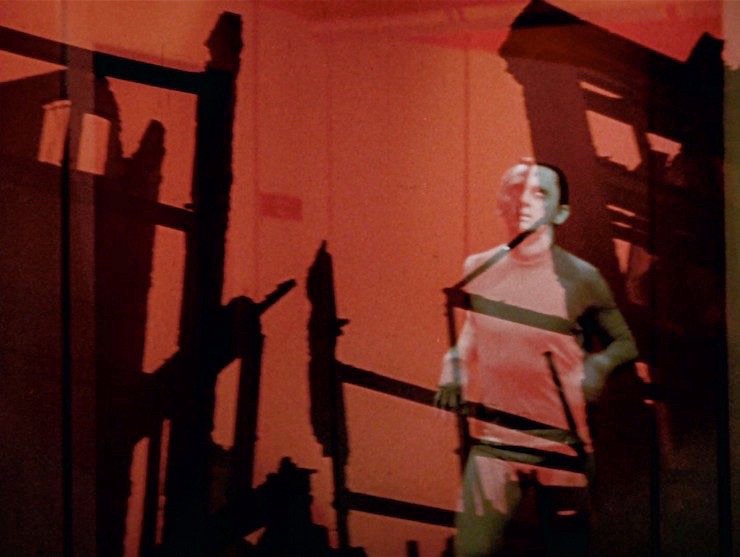
In the infamous episode of Star Trek, season three, Let That Be Your Last Battlefield, we see two aliens who have been chasing and attempting to defeat one another for “50,000 standard years” because the patterns on their faces are different.

“Bele” (L), played by Frank Gorshin, and “Lokai” (R), played by Lou Antonio

In the big climax at the end, they commandeer the Enterprise and return to their home world which is now a dead, lifeless world: their people have annihilated one another in Bele and Lokai’s absence. Rather than giving up, Bele and Lokai beam down to the surface (after an awkward running scene through the hallways) and continue their battle for all eternity.

This scene included stock footage from the Second World War, iirc. Because the war was only a generation earlier, the message was not lost on viewers.

The final dialogue of the episode between the crew is:

SULU: But their planet’s dead. Does it matter now which one’s right? 

SPOCK: Not to Lokai and Bele. All that matters to them is their hate. 

UHURA: Do you suppose that’s all they ever had, sir? 

KIRK: No, but that’s all they have left. 

While the episode exaggerates the topic, it does beg the question: how can people get into such a death spiral of conflict and hatred?

The single most important thing in Buddhism is the mind. Not a god or deity, but the mind. We see the world through our mind, we shape our view of the world through our mind, etc, etc. In a sense, even the gods are a product of the mind.1

The implications of this are really profound, but on a practical level it also helps explain why two seemingly rational adults can have such profoundly different views, to the point of being entirely hostile to one another.

When the Buddha spoke to a wandering ascetic named Vaccha, the Buddha called this need to assert a view-point “I-Making”. In the Aggi-Vacchagotta Sutta (MN 72 of the Pali Canon), Vaccha is trying to pin down the Buddha’s stance on this philosophical debate or that. But the Buddha is having none of that:

“A ‘position,’ Vaccha, is something that a Tathāgata [a Buddha] has done away with. What a Tathāgata sees is this: ‘Such is form, such its origination, such its disappearance….Because of this, I say, a Tathāgata—with the ending, fading away, cessation, renunciation, & relinquishment of all suppositions, all excogitations, all I-making & mine-making & obsessions with conceit—is, through lack of clinging/sustenance, released.”

Translation by Ven. Thanissaro Bhikkhu

In modern English, the Buddha is saying that holding onto views and beliefs just “feeds the ego”. By feeding the ego, it also imprisons us.

It’s hard to see this, because we naturally piece together the world around us through our experiences, but no matter who we are, the picture is incomplete and we fill in the rest based on conjecture, belief and hearsay. Nonetheless, if someone attacks our beliefs, it is an attack on our deepest sense of self too. This leads to the death spiral I alluded to earlier: the stronger we try to assert our beliefs (even if they are logical and sound), the more we stir conflict, forcing us to push even harder against perceived resistance.

But, like the honey badger, the Buddha don’t care. And because he has stopped clinging, he has no ego to bruise. Without an ego to bruise, he no longer suffers and is fully liberated.

This sounds far easier than it is, but that’s the gist. Sometimes it’s just better to shut up, don’t assume you know the answer, and just pay attention to the world around you. Imagine a blade of grass bending in the wind.

Afterall, what is the alternative?

P.S. as with the previous post, I started this months ago, and just now catching up.

1 put another way: we create our god by projecting our own ego.

The Hero Of Our Own Story

A rich man thinks all other people are rich, and an intelligent man thinks all other people are similarly gifted. Both are always terribly shocked when they discover the truth of the world.

“I, Strahd” by P.N.Elrod

Another book I have been reading lately for Halloween is the novel I, Strahd, which is a fictional autobiography of the villain of the “Barovia” fantasy-gothic horror setting: Strahd von Zarovich. As an autobiography, Strahd talks about his origins and justifies why he’s such a monster, literally and figuratively. It was one of the most popular novels of the Ravenloft series that was published in the 1990’s to promote this venerable Dungeons and Dragons setting, and is a kind of “bible” for fans of the setting due to broad number of characters, helpful backstories, and compelling story.1

But I digress.

People naturally assume their values and beliefs are pristine because that’s all they ever know, and that others will naturally agree to them. They are then shocked to discover that other functional adults subscribe to very different beliefs. Their own world is briefly shattered or they feel threatened, and conclude that such adults are just stupid, insane or evil. What follows usually isn’t good.

Even when people claim they are open to discussion or free-thinkers, I am reminded of Dave Barry’s famous quote:

People who want to share their religious views with you almost never want you to share yours with them.

Of course this applies to me as well. But on the other hand, I have to remind myself that I am not the center of the Universe. Whether I am actually right or not is irrelevant; I have to accept that not everyone comes to the same conclusions that I do, and I have no right to judge them for their views:

Gandalf: “Do not be too eager to deal out death in judgment. Even the very wise can not see all ends. My heart tells me that Gollum has some part to play yet, for good or ill before this is over.”

“Fellowship of the Ring”, by J.R.R. Tolkien

Hence the Dhammapada has the famous line:

Hatred is never appeased by hatred in this world. By non-hatred alone is hatred appeased. This is a law eternal.

Translation by Ven. Acharya Buddharakkhita

It doesn’t mean you have to be best friends with other people, but you have to accept the sheer variety of people, ideas and beliefs no matter how stupid they seem.

Spock: Madness has no purpose.  Or reason.  But it may have a goal.

Star Trek, “The Alternative Factor”, stardate 3088.7

You don’t have to give them oxygen either. Some ideas are better left dead. It’s about tolerance of people, not tolerance of bad ideas. Ideas are, like all phenomena, contingent and impermanent (Buddhism par excellence).

As soon as you begin to harbor ill-will toward others who are different, you will quickly spiral into a dark path of your own doing.

Namu Amida Butsu

P.S. I have a huge backlog of drafted posts lately, so you may see a few more this week. I hope you enjoy.

1 It is a terrific read, but I admit I still like Vampire in the Mists featuring his rival, the elf-vampire Jander Sunstar, even more. Strahd is definitely *not* the hero in that tale. Heart of Midnight was also an excellent read and a close third for me. To be honest, all the novels I’ve read int he series so far, even the less compelling ones, are still good reads.

Who Dwells In This House?

I’ve been mulling over a certain quotation of Honen (法然, 1133–1212), the 12th century Buddhist monk credited with spreading the Pure Land tradition in Japan, and thus founder of movements such as Jodo-Shu and Jodo-Shinshu:

“All of our deeds in the realms of saṃsāra result from ties with the three worldly passions of greed, anger, and ignorance. Understand that when the worldly passions of greed, anger, and ignorance surface, an illusion arises that causes one to fall into the lower realms. Do your best to prevent such an occurrence.

If these worldly passions arise, merely think of them as a guest of the heart, and think of nembutsu as the host of the heart. In this way, birth in the Pure Land will be possible. Contrarily, if you think of the worldly passions as the host and nembutsu as the guest, nembutsu becomes virtue mixed with worldly passions and falsity, making birth in the Pure Land impossible.

In essence, even if worldly passions surface in the moments before and after nembutsu is recited, do not allow these passions to intermingle with the recitation of the six characters, Na mu A mi da Butsu.”

Translation from The Promise of Amida Buddha (Digital Edition, pg 105) Joji Atone & Yoko Hayashi, originally posted here.

What Honen says here is quite profound, and shows a good grasp of the challenges of the spiritual life. Saying your are spiritual, or calling yourself a spiritual person frankly isn’t enough. It’s just words and labels. The real question is is who or what lives in the house of your heart?

I’ve been thinking about this a lot, and with some shame, I think the Buddha tends to be more of a guest at times than the host. I’ve been Buddhist at least 2005, but I am also a working parent, and, live with a lot of distractions. So, of course my practice and conduct suffer at times.

And yet, I think it’s more than that.

As members of the homo sapiens species, our natural inclinations are, crudely speaking, to feed, fight, and fuck.

In one sense, this is perfectly normal as a biological species. We are hairless apes after all. Our ancestors were doing this for 300,000 years or more. But deep down it’s just instinct baked into the fiber of our being. What seems perfectly good and normal to us humans may differ from another species. What seems tasty to a jackal might be revolting to us humans.

Further, the Buddha Shakyamuni didn’t necessarily call this “evil”, but he did describe people who lived by such instincts as “run-of-the-mill”, nothing extraordinary. There was nothing praiseworthy about choosing this default lifestyle driven by one’s passions and instincts. Such people are born, grow, struggle, procreate, and die. End of story.

Instead, the Buddha praised those who lived a life of self-control and mental discipline such as this quote from the Dhammapada:

280. The idler who does not exert himself when he should, who though young and strong is full of sloth, with a mind full of vain thoughts — such an indolent man does not find the path to wisdom.

281. Let a man be watchful of speech, well controlled in mind, and not commit evil in bodily action. Let him purify these three courses of action, and win the path made known by the Great Sage.

Translation by Acharya Buddharakkhita, sourced from here: https://www.accesstoinsight.org/tipitaka/kn/dhp/dhp.20.budd.html

But this all comes back to the point that Honen made earlier. Honen spoke about it in the context of Pure Land Buddhism, and the desire to be reborn in the Pure Land, but it’s not hard to broaden this to the entire Buddhist tradition. Whoever we choose to let dwell in our house, that is what will drive our actions. Other aspects of our lives drop in as guests, come and go.

Later in the Dhammapada, the Buddha warns that this ins’t just a mental exercise: the clock is ticking:

287. As a great flood carries away a sleeping village, so death seizes and carries away the man with a clinging mind, doting on his children and cattle.

288. For him who is assailed by death there is no protection by kinsmen. None there are to save him — no sons, nor father, nor relatives.

289. Realizing this fact, let the wise man, restrained by morality, hasten to clear the path leading to Nibbana [a.k.a. Nirvana, “final unbinding”].

Translation by Acharya Buddharakkhita, sourced from here: https://www.accesstoinsight.org/tipitaka/kn/dhp/dhp.20.budd.html

In the Lotus Sutra, the Parable of the Burning House also reminds us that we are “on the clock”, and the Buddha calls us to get out before it is too late.

Namo Shakyamuni Buddha
Namu Amida Butsu

P.S. even a pinch of austerity is a good start. 😏

Concentration, or Lack Thereof

This is me, most of the time.

I am the sort of person who is bad with names. I recently met some new neighbors, and they told me their names, and I made a point of remembering those names, but 5 minutes later, I had already forgotten one of them.

In the early Buddhist sutras, the Buddha described the mind as a monkey flitting from branch to branch:

Just as a monkey, swinging through a forest wilderness, grabs a branch. Letting go of it, it grabs another branch. Letting go of that, it grabs another one. Letting go of that, it grabs another one. In the same way, what’s called ‘mind,’ ‘intellect,’ or ‘consciousness’ by day and by night arises as one thing and ceases as another.

Assutavā Sutta (SN 12.61), translation by Ven. Thanissaro Bhikkhu

This inability to focus the mind prevents us from gaining any insight, being easily swayed by sensual lust, anger, or ignorance, unable to see the bigger picture. Centuries later, in the Parable of the Burning House of the Lotus Sutra, the kids in the burning house are so distracted by their toys, that they do not notice their father calling them to get out.

This notion of the unstable mind unable to see its own peril is found in every Buddhist tradition, and what drives much of the Buddhist practice. Recognizing one’s own mental patterns is the first step, an important one too, but another important step is to counteract this. One cannot stop the thoughts themselves, it’s just the way the mind of Homo sapiens works. Instead, one should look into Buddhist training to either withstand such thoughts, counteract them, or look past them. This isn’t a simple thing either. It’s quite difficult, and requires long-term training. But it is essential to one’s well-being.

When I catch myself brooding angry thoughts, or thinking something stupid and selfish, I often think about something Honen said in a famous catechism called the 145 Questions and Answers (ippyaku-shijūgo-kajō-mond, 百四十五箇条問答), namely question #69:

一。心に妄念のいかにも思はれ候は、いかがし候べき。

Q) When bad thoughts keep arising within my mind, what ought one to do?

答。ただよくよく念仏を申させ給へ。

A) The only thing to do is to repeat Nembutsu.

Quoted from Honen the Buddhist Saint page 56, with Japanese from http://kyokusho.g.dgdg.jp/benkyo/c145.htm

Because the Pure Land tradition of Buddhism is so large, there’s a lot of ways to interpret this. I don’t know the right answer. You should do your own research and decide for yourself. For some, this is using the nembutsu as a form of mindfulness practice (withstanding evil thoughts), while for others, this is acknowledging the grace of Amida Buddha, and that one is still destined to be reborn in the Pure Land (looking past evil thoughts).

This is not to replace the tradition of mindfulness meditation, either. It’s just not always possible to be sitting on a cushion meditating, so remembering Honen’s advice is a handy thing to do when you are going through life, and feeling your mind looping the same negative or unwholesome thoughts over and over.

Namu Amida Butsu

A Pinch of Austerity

Anyone who’s ever followed a religious path, regardless of religion, will know that there’s usually some kind of rules, restrictions or prohibition about how to live one’s life. Some people approach this as “Eager Beavers” and dive head-first, others hate the idea of rules imposed on their own life and rebel. Others find some kind of middle-ground.

For Buddhism though, The Buddha treated the entire Buddhist path, from mundane newbie to fully-awakened buddha as nothing more than self-training. It’s something you have to take on yourself, following the Buddha’s advice (like a doctor telling you to eat more vegetables), and you’re responsible for your own efforts, pace, self-discipline, and so on.

Further, no matter what tradition, Buddhism is at heart a path of austerity. Because monks and nuns explicitly give up all worldly attachments to focus on the Buddhist path exclusively, this is seen as the ideal form of practice. However, even for lay followers, Buddhism encourages moderation and austerity as one can reasonably practice.

Another way of looking at it: anyone who pursues the Buddhist path is “living like a monk” to some degree.

But how does a lay person find the right balance?

In an old sutra of the Pali Canon, the Buddha used the example of a vīna (a kind of lute), but we can use modern examples such as a guitar, cello, and so on. If the strings are too tight, they will soon snap. If they are too loose, the music sounds terrible. Tuned just right, the instrument plays well.

I like to think of it as adding spice to a soup. If you add no spice, the soup is kind of bland, unremarkable. If you add too much, the flavor is ruined. A pinch of spice though really enhances the flavor.

In the same way, adding a pinch of austerity to one’s life is a safe, sustainable approach. The Five Precepts are a great start, but you can also add a small amount of Buddhist practice like meditation or chanting. Remember though, if you add too much at first, it will “ruin the soup”, so start small. If it’s not enough, add a bit more. If you can’t follow all Five Precepts, start with four, three, two or even one. Do not be taken in by self-doubt; start small, experiment, try something, evaluate later.

Just a pinch of austerity in one’s life can help a person gain self-respect, dignity, and a sense of stability. It’s not obvious at first, but speaking from almost 20 years of trial-and-error experience, it does pay off.

P.S. This is another draft I started writing before I had my medical emergency.

P.P.S. Featured image is some home-cooked nabé (鍋) soup my wife made. It’s basically just fish broth (dashi), vegetables, tofu and/or some sliced meat. Easy to make, flexible, and very hearty. I make a good vegetarian lentil soup too, and will probably share the recipe someday.

Life, It’s Complicated

Open the door
And walk away
Never give in
To the call of yesterday

Memories that made
Those days sublime
These ruined halls entomb
Stolen time….

Here in cherished halls
In peaceful days
I fear the edge of dawn
Knowing time betrays

“Edge of Dawn”, theme Song for Fire Emblem: Three Houses, YouTube

Recent events are a reminder that even when life is calm and going well, something bad can hit you square in the face like a frypan. Try as we might, this is not something we can always avoid.

In the Pali Canon, the Buddha said the following:

You shouldn’t chase after the past
or place expectations on the future.
What is past is left behind.
The future is as yet unreached.

Whatever quality is present
you clearly see right there,
right there.

Not taken in,
unshaken,
that’s how you develop the heart.

Ardently doing
what should be done today,
for — who knows? — tomorrow
death.

There is no bargaining
with Mortality & his mighty horde.

“The Sutra of the Auspicious Day” (Bhaddekaratta Sutta, MN 131), trans. by Thanissaro Bhikkhu

People who are chasing after spirituality through Yoga and self-help books will mostly fixate on just the first part, without knowing the rest. No one wants to pay money to be told life sucks, afterall.

While the world might be interconnected, and life has its beautiful moments filled with laughter, light, and love, it is also marked by pain, frustration, death, fear, frustration, strife, humiliation, and so on. People try to run away from the latter, while chasing happy moments for that “spiritual high“, but it’s all in vain. It’s like covering a pile of dog-poop with some silk. It’s just more of the mind leading the mind astray.

Simply put: life is complicated.

Mount Rainier, known locally as “Tahoma”. Photo taken by me.

Life must be faced with both eyes open, and as the sutra above says, one must train the mind not to be taken in by the highs and lows, neither to be taken in by nostalgia nor illusions of the future. Like a mountain quietly sitting, regardless of which way the winds blow, or a blade of grass that bends. For sooner or later, time betrays and the frypan of life will smack you in the face once more.

Namu Shakamuni Butsu

Ego Unfettered

This article from the Guardian is a poignant reminder of what happens when you have power and money, and no restraint. The symbolism of a moldy mansion, rampant infections, and miserable people is not lost on readers either.

In an old bilingual book about Rinzai Zen I picked up at the airport in Japan once, the author described the normal, run-of-the-mill mind as the “mind that leads the mind astray” (mayowasu kokoro, 迷わす心):

この「迷わす心」はいくら自分の意識で落ち着こう、ものごとを客感的に見よう、判断しようとしても、思う通りにはいかない。

No matter how you try to calm this “mind that leads the mind astray” through your own efforts, and no matter how you try to see and judge things objectively, you are likely to fail.

page, 30-31

Until one has fully broken through to the state of awakening (e.g. Buddhahood, enlightenment, etc), one cannot fully trust one’s own mind, no matter how certain one is. The mind operates from a basis of ignorance, insufficient information, a single point of view, etc. It is a slippery slope from a mistaken assumption, or a selfish thought to a line of thought that leads one further and further astray. One thinks they are working towards their own happiness and well-being, but in the end may drag others down with them.

This sort of ego is also self-reinforcing:

Your habits always come hunting after you. The self you construct will haunt you. A ghost wandering around in search of your body, eager to possess you. We are addicted to the self we construct.

Frank Herbert, Chapterhouse: Dune (Dune, #6), also posted here.

Thus, an unrestrained mind is ultimately a disaster for oneself, and those around them. It can happen to any of us, given the right circumstances. Or, as the old Tears for Fears song goes:

Thus as is written in the Dhammapada:

375. Control of the senses, contentment, restraint according to the code of monastic discipline — these form the basis of holy life here for the wise monk.

376. Let him associate with friends who are noble, energetic, and pure in life, let him be cordial and refined in conduct. Thus, full of joy, he will make an end of suffering.

translation by Ven. Acharya Buddharakkhita

Better to know one’s limit, stay vigilant, and savor the moments you have.

Namu Shakamuni Butsu
Namu Amida Butsu

Make Your Own Buddhist Sutra Book

Lately I’ve been talking a lot about home Buddhist practice, including home Buddhist services and such. These are things that devout lay-Buddhists often do (myself included), but then I realized I never talked about making one’s own sutra book.

There are a couple reasons why one might make their own.

First, Buddhist resources outside of Buddhist countries are hard to find. For someone like me who lives on a large city with a large Asian community this is not so hard. But if you lived in, say, rural Iowa, it might be a lot harder. So, sometimes you have to just DIY.

Second, it’s a nice way to personalize your Buddhist practice in a way that suits you.

I started making my own maybe about 9-10 years ago. I picked up a nice little Paperblanks notebook at the airport at the time, and I decided to collect Buddhist sutras and quotes that I liked. I started out small, just copying things now and then from sites like accesstoinsight.org, or copied from books.

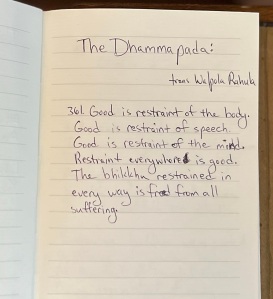
This is a small quote from the Dhammapada :

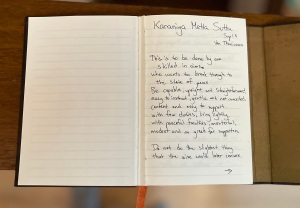
And the Metta Sutta from the Pali Canon:

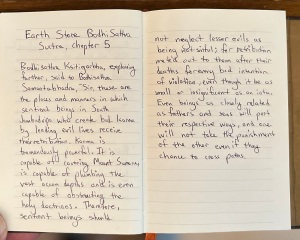
I also recorded Mahayana Buddhist sutras as well, such as this quote from chapter 5 of the Earth Store Bodhisattva Sutra:

I copied each of these by hand. I even tried to copy much longer texts, such as the 4th chapter of the Golden Light Sutra, which is a very beautiful prose about repentance and goodwill, but the text was much longer than I thought, and I eventually gave up halfway.

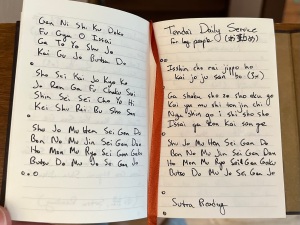
But eventually, around 2017-2018, when I left my old Jodo Shinshu-Buddhist community and started exploring other sects, I focused more on home practice and I started to add Japanese-style liturgies as well:

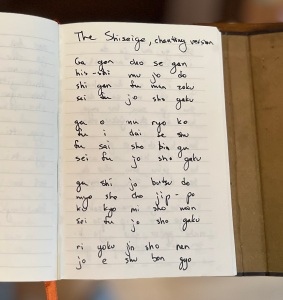
I also wrote specific sutra chants too, such as the Shiseige:

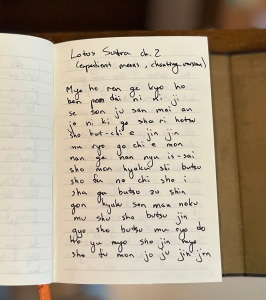
And chapter 2 of the Lotus Sutra:

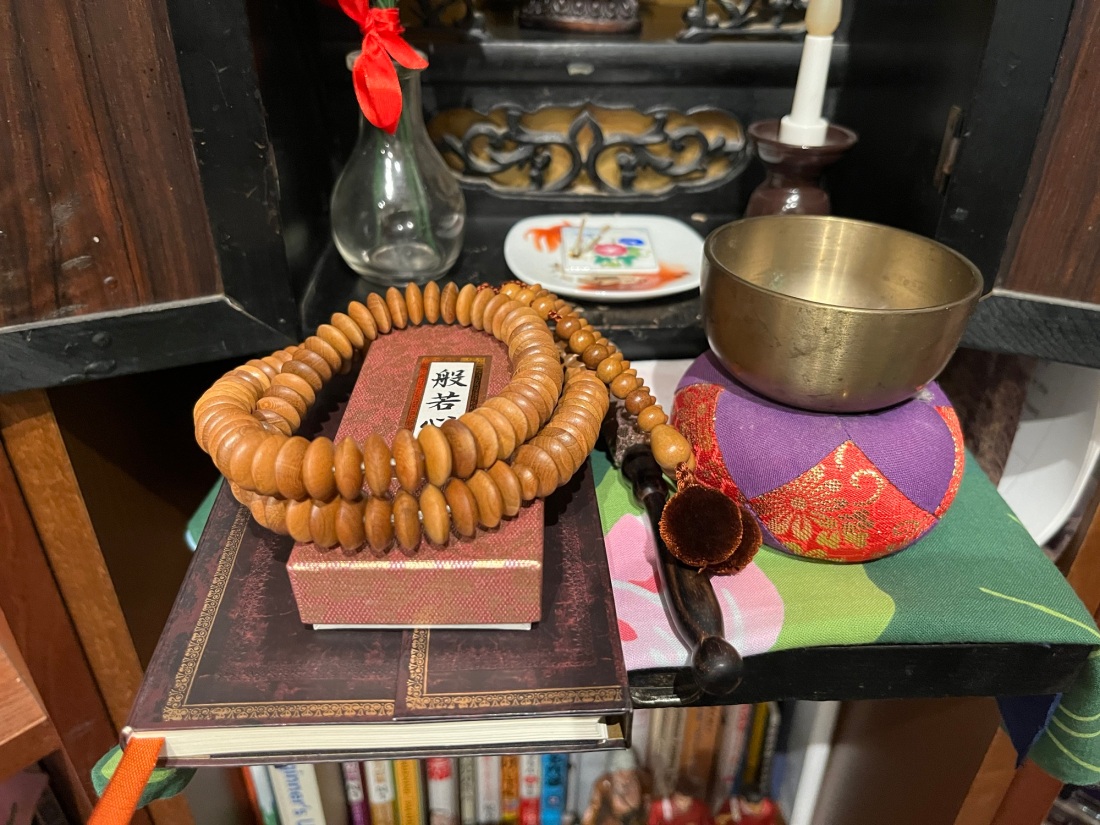
As you can see from the featured photo above,1 I keep this sutra book on my home altar (bottom left in photo), and use it almost daily. A personal sutra book works best when it’s meaningful, simple and useful for you, so the important thing is to not do what other people do, but make it useful for yourself. Find sutras or Buddhist quotes you like, collect them into a notebook, and copy them by hand (word of advice, use a gel pen, not a ballpoint pen, it’s easier to read), and make it your own. There’s no wrong way to do it.

Further, the sutra book I made has gradually progressed over time, just as my own path and practice have and I still have more room to write things in the future.

1 You can also see my Buddhist rosary, a Tendai-style rosary I ordered online, along with a boxed copy of the Heart Sutra, which I got in 2023 while visiting Nara‘s Kofukuji Temple, one of my personal favorite.

Cutting Losses

Recently, I was reminded of this old sutra from the Pali Canon, the Gotami Sutta (AN 8.53):

“As for the qualities of which you may know, ‘These qualities lead to dispassion, not to passion; to being unfettered, not to being fettered; to shedding, not to accumulating; to modesty, not to self-aggrandizement; to contentment, not to discontent; to seclusion, not to entanglement; to aroused persistence, not to laziness; to being unburdensome, not to being burdensome’: You may categorically hold, ‘This is the Dhamma, this is the Vinaya, this is the Teacher’s instruction.'”

Translation by Ven. Thanissaro Bhikkhu

I’ve always liked this simple, straightforward benchmark of the Dharma. It reminds me of a quote by a Zen master many centuries later (quoted here originally):

This old man [himself] has spent more than thirty years in the rinka [monasteries], sitting in Zen meditation, quietly withering away my desires, without expectations for the morrow. When hunger comes, I eat. When the time comes, I sleep….The present does not persist. The past and future do not exist

Sōtō Zen in Medieval Japan by William M. Bodiford

One of the advantages of old age is perspective, and (ideally) not getting hung up on the ups and downs of life as much compared to our youth when everything is fresh and raw. Being able to approach life through equanimity and goodwill, not being tossed about by the Eight Winds is a great gift for oneself and others.

Of course, many older people are in fact the opposite: childish, petty, and irrational too. The older one gets, the more social filters break down and their true nature reveals itself. Similarly, I still have plenty of petty and mean days myself, but looking back, I do feel the Buddha-Dharma has helped smooth at least the roughest edges over time.

That’s why, as the Buddha and the Zen teacher both show, training in the Buddha-Dharma is so useful. Setting good habits and healthy perspectives sooner than later will gradually pay off over time, like a good investment.

The more you invest, and the sooner you invest, the better.

Namu Amida Butsu

P.S. I do have certain reservations about Thanissaro Bhikkhu’s rather conservative approach toward women’s ordination in Buddhism, but that’s not to deny his positive contributions as a translator. I’d call it a “professional disagreement”, except of course I am just a layperson and not a bhikkhu. 😅

P.P.S. Unlike the last two posts, this is a new one, not a re-post. 😎

Even Carrion is Tasty to Some

Tetsugen Dōkō (鉄眼道光, 1630-1682), often called “Tetsugen” is a somewhat obscure but influential Buddhist monk of the similarly obscure Obaku Zen sect in Japan. Tetsugen was a prolific teacher and writer in his day, and today is best known for his efforts to provide a comprehensive, high-quality block-printed edition of the entire Buddhist canon (the “Obaku Edition” of the Tripitaka) in Japan. The life and teachings of Tetsugen are compiled in the excellent biography Iron Eyes: The Life And Teachings of Obaku Zen Master Tetsugen Doko.

One of his best known writings is a text called the Dharma Lesson in Japanese (鉄眼禅師仮名法語 , tetsugen zenji kana hōgo) which was written for a lay-devotee and is based on the Heart Sutra.

I had read the biography and the Dharma Lesson years ago, but suddenly recalled this quote:

Even though what we think of as painful or pleasant aren’t really pain and pleasure, because we are deluded, we end up thinking they are. The reason for this is that when a crow, a dog, or a fox sees a dead crow or horse rotting or a human corpse festering, they think it is a rare treat. First they enjoy looking at it, then their enjoyment increases as they smell it and grasp it. They think this is the greatest of pleasures. Seen from the human perspective, this seems immeasurably impure and repulsive. If we were forced by others to eat such putrid things, it would be incomparable suffering. What is worse than being forced to eat them is that crows devour such things greedily, and think it is pleasant…(pg. 99)

Translation by Helen J Baroni

Similarly, the Buddha, when observing moths attracted to a flame commented to his disciples:

Rushing up but then too far, they miss the point; Only causing ever newer bonds to grow. So obsessed are some by what is seen and heard, They fly just like these moths — straight into the flames.

Ud 6.9, the Adhipataka Sutta, translation by Andrew Olendzki

It’s not hard to see how this pertains to people as well.