True story, I had some spare time one day recently to sit and meditate,1 first time in a while. I set the app to 10 minutes, and sat on the ol’ cushion. About five minutes into this, my youngest child walked in and asked me to unlock the parental control on his tablet.
Concentration broken, oh well.
This is a frequent issue with being a parent and being a Buddhist, but it’s not a new one.
In the Buddha’s time, he distinguished the “householder” followers with the “renunciant” ones. This wasn’t meant to denigrate one versus the other, but it was intended to differentiate those who fully could devote themselves to the Dharma (the “renunciants”), to those who had other, competing obligations (the “householders”). Because the renunciants could, in theory, devote themselves full time to practice, and had cut loose any personal obligations and bonds, they could progress a lot further along the Buddhist path. The lay followers (householders) could still progress, but they would be hampered by their mundane obligations, social “entanglements”, and such.
However, because the Buddhist path was intended to help all, the renunciants would set aside certain days of the lunar month for outreach, helping lay followers through teaching and shared practice. This is known as Uposattha in the earliest Buddhist communities.
In later centuries, especially through the Mahayana tradition, Buddhist thinkers and communities sought to expand Buddhist practice to be more engaging toward lay Buddhist followers. The goal of such practices was not intended to replace the traditional monastic establishment, but (I believe) to help fill in the gaps. By expanding the available gates of Buddhist practice, people from all walks of life could find a place to start, and progress. In other words, an even more inclusive Buddhism.
Which comes back to my situation.
If we think of daily life as a box, there are only so many Lego bricks we can fit in there. Most of those Lego bricks, as a parent, are already spoken for, so that leaves only a bit of space left for “me time”. Within that spare time, self-help can be time-consuming, impractical. Or, one is just too mentally exhausted to do anything else but space out. In some ways, life as a “householder” hasn’t changed all that much since the Buddha’s time. We suffer less from hazards like dysentery and Viking raids, but the distractions and obligations are still there.
In any case, until the kids leave the nest, and especially after retirement, I have to be realistic in my own expectations. Simple practices such as the nembutsu, the odaimoku (a la Nichiren Buddhism), the Mantra of Light, or the Heart Sutra, combined with upholding the Five Precepts amidst daily life, are a helpful way to keep up one’s training while being realistic about time and energy. Even reciting something as simple as the nembutsu deepens the karmic bond with the Buddha and hopefully makes the world a slightly better place.
Also even a bit of forward momentum is better than to squander one’s life staring at a screen. 😉
1 my meditation routine has always been very … inconsistent.
Recently my wife shared a certain Youtube channel in Japanese by a Nichiren priest1 who lives in Kyoto. It’s a nice channel with some good Dharma talks, and good English translations via closed-captioning. In particular, she shared this video with me. The owner does not allow embedding into the blog, so you’ll have to click on the link above instead.
This is a story from the priest’s own childhood and reflects a Japanese sentiment that the dead remain with us for some time. This is not always seen as a bad thing, just more of a sensitivity to death and mortality, especially the loss of loved ones. It also plays into various practices and superstitions as well, which are too many to go into here. Also, the word “gacha-gacha” are the little capsule machines in Japan that have knick-knacks, toys and such.
Japanese ghost stories, such as those in the famous collection Kaidan (or Kwaidan in older spellings) are not the same as ghost stories in the West which tend to focus on evil or tragic stories. Japanese ghost stories, by contrast, tend to be more weird and less scary. Of course, there are exceptions such as the films The Ring and The Grudge. So, it’s not all roses.
But I digress. The video above is actually a very interesting story, and well worth watching. Enjoy!
P.S. of course if you don’t believe in ghosts or prefer not to deal with them, remember this scene from Thor: Ragnarok:
1 For various and complicated reasons, Nichiren Buddhism tends to have a lot of sub-sects, and they frankly don’t always get along. Most overseas Westerners tend to encounter fringe sects and offshoots2 such as Nichiren Shoshu or more oftentimes SGI (Soka Gakkai), or Rissho Kosei-kai. I have had positive experiences with RKK myself, though I am not a follower. But it’s important to remember that these are offshoots, and not necessarily “normative” Nichiren Buddhism. Mainstream Nichiren Buddhism, or Nichiren-shu, is the mainstream branch and has the most extensive history. It is what you see most often in Japan. They all chant the odaimoku (Namu Myoho Renge Kyo), but disagree on matters of interpretation and practice. As the Romans would say: Caveat Emptor.
2 This issue of fringe sects having many followers in the West is not limited to Nichiren Buddhism. You can find this in western Tibetan Buddhist communities, Zen communities, etc. Westerners are often converts with zero experience in Buddhist culture, and looking for answers. It’s not hard for a cult to gain followers easily this way, even when the home culture rejects them. I wish I could offer advice on this, but there’s not much I can say other than do your homework, be cautious, and if a sect’s claims seem outlandish no matter how much you might agree with them, they probably are outlandish.
Another post for the Fall Ohigan week. I was watching some classic Star Trek and wanted to share this quote:
Captain Kirk: Yes, well, those pressures are everywhere in everyone, urging him to what you call savagery. The private hells, the inner needs and mysteries, the beast of instinct. As human beings, that is the way it is. To be human is to be complex.…
Star Trek, “Requiem for Methuselah” (s3ep19), Stardate 5843.7
Being the homo sapiens that we are, we are indeed complex creatures. We are gifted with the capacity for logic and reason, and yet we are still savage in many ways. We still pattern ourselves in many ways our ancestors did, even if they are seemingly more modern and complex.
But also, from a Buddhist standpoint, we are capable of a great many things, both good and bad.
“We reach”
In Tendai Buddhism is a concept, later popularized in Nichiren Buddhism, called “3000 worlds in a single thought”, or ichinen-sanzen (一念三千). Broadly speaking, the idea is that with any moment in time, our thoughts and actions are capable of manifesting the highest levels of buddha-hood, or the very lowest, foul levels of a demon, and everything within that spectrum. There is certainly more to this, but that’s a brief summary.
Another way to look at it: we have within each of us that which is capable of being a bodhisattva or even a buddha, and yet we also have that within us that is capable of great evil. It comes down to things like environment, training, awareness and so on. We like to think other people as crazy and evil, but under the right circumstances we could just as easily slip down that path. In the same way, we see ourselves as hopeless, and yet with the right support and training, we can go on to do great things.
So, it helps to be a little vigilant of one’s own mind, especially when stressed, fatigued, or insulted. When times are good, it’s easy to behave kind and enlightened. The real test comes when under pressure, and given enough pressure anyone can crack and their brutal nature comes out.
On the other hand, when one does inevitably falter, it’s important to reflect and not flog oneself. Goodwill towards oneself is just as important as goodwill towards others. We are, afterall, human. It’s also why, especially in the Pure Land traditions, we acknowledge those faults and give thanks to the Buddha Amida for his goodwill towards us regardless.
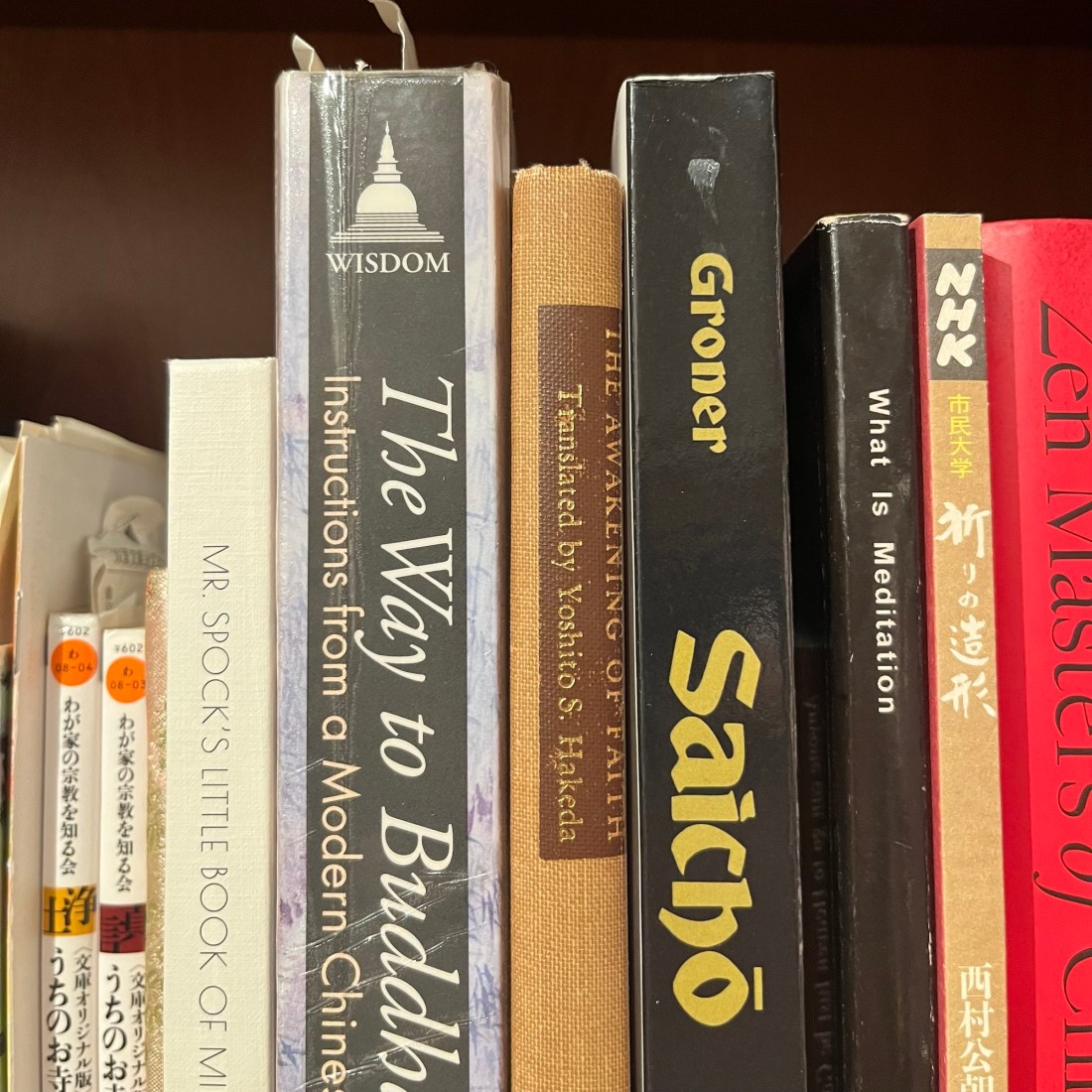
Not too long ago, I found an old book I had forgotten I had: a translation of the Awakening of Faith in the Mahayana. For simplicity, we’ll call it the “Awakening of Faith” in this blog post. The Awakening of Faith is a Buddhist treatise, a śastra,1 written probably in the 6th century, but attributed to a Buddhist master in India, Aśvaghoṣa from the 2nd century. It is thought to have been composed in China, but likely drew from Indian sources, or was composed by an Indian-Buddhist monk living in China. Since it is mainly found in China, it is called Dàshéng Qǐxìn Lùn (大乘起信論).
Wikipedia points out that researchers now think a more appropriate title would be Awakening of Mahayana Faith in the Suchness of the mind. The 信 here might also be interpreted as “trust” or “entrusting”, so maybe Awakening of Mahayana-style Entrusting [in the Suchness of the Mind]? That reads a bit awkward though, so readers will have to decide how to phrase it.
If readers are curious what Mahayana Buddhism is, please feel free to read here.
This might sound like I am splitting hairs, but it is kind of important to emphasize that English terms like “faith” aren’t a good analogue for what the book is about. This is not a book of Christian-style faith. Instead, the author of the treatise addresses why they wrote The Awakening of Faith, when the same teachings are found throughout existing Mahayana sutras:
Though this teaching is presented in the sutras, the capacity and deeds of men today are no longer the same, nor are the conditions of their acceptance and comprehension….
Translation by Yoshito S. Hakeda
The author lists eight reason such as helping all attain peace of mind, liberating from suffering, and correcting heretical views (my words, not the book). In other words, the author wanted to both assert an orthodox Mahayana viewpoint of Buddhism, but also to clarify any misunderstandings and inspire others to take up the path. It is in a sense, a textbook introduction of Mahayana Buddhism.
Mahayana Buddhism is actually a pretty broad tradition, with lots of sub-schools, diverging viewpoints and so on. So, it’s hard to explain the entire tradition in a single book. Still, the treatise does a good job of touching on some essentials that many Mahayana Buddhist traditions today are founded upon. Traditions such as Zen, Pure Land, Nichiren, Tendai, and Vajrayana (among others) all have certain common teachings that pervade them all. The Awakening of Faith helps to enumerate what these are, in a fairly short, readable format, which for a 6th century text is pretty impressive.
To give an example, here is a quote on Suchness : a fancy term for reality, totality of existence, the Whole Enchilada, the Whole Shebang, etc, etc.:
[The essence of Suchness] knows no increase or decrease in ordinary men, the Hinayanists [earlier Buddhist schools], the Bodhisattvas, or the Buddhas. It was not brought into existence in the beginning, nor will it cease to be at the end of time; it is eternal through and through.
Page 65, translation by Yoshito S. Hakeda
If this sounds strangely familiar to readers, you might find something very similar in the Heart Sutra:
“Hear, Shariputra, all dharmas [all things, stuff] are marked with emptiness; they are neither produced nor destroyed, neither defiled nor immaculate, neither increasing nor decreasing….”
Translation by Ven. Thich Nhat Hanh in “Heart of Understanding”
You can definitely see some common themes between The Awakening of Faith and early Mahayana-Buddhist sutras such as the Heart Sutra. Further, The Awakening of Faith explores the notion of Bodhisattvas quite a bit:
The Buddha-Tathāgatas [e.g. the many buddhas], while in the stages of Bodhisattva-hood [i.e. on the cusp of becoming fully enlightened buddhas], exercised great compassion, practiced pāramitās [perfecting certain virtues], and accepted and transformed sentient beings. They took great vows, desiring to liberate all sentient beings through countless aeons until the end of future time, for they regarded all sentient beings as they regarded themselves.
Page 67, translation by Yoshito S. Hakeda
… but it gradually moves from theoretical teachings into more practical ones too. I was surprised to see the treatise openly teach the importance of developing faith in the Western Pure Land of Amida Buddha:
Next, suppose there is a man who learns this teaching for the first time and wishes to seek the correct faith but lacks courage and strength….It is as the sutra says: “If a man meditates wholly on Amitābha Buddha in the world of the Western Paradise and wishes to be born in that world, directing all the goodness he has cultivated [toward that goal], then he will be reborn there.”
Page 103, translation by Yoshito S. Hakeda
The particular “sutra” that the author is talking about is unclear. Hakeda and other scholars seem really quick to dismiss this section as a later addition, or influenced by the Pure Land Buddhist community, since it’s not found in the Three Pure Land sutras, but I would argue that it is either quoted from, or related to an earlier Pure Land sutra called the Pratyutpanna Sutra. Note this quotation here:
In the same way, Bhadrapāla, bodhisattvas, whether they are ascetics or wearers of white (i.e., laypeople), having learned of the buddha field of Amitābha in the western quarter, should call to mind the buddha in that quarter. They should not break the precepts and call him to mind singlemindedly, either for one day and one night, or for seven days and seven nights. After seven days they will see Amitābha Buddha. If they do not see him while in the waking state, then they will see him in a dream.
Translation by Paul Harrison, courtesy of BDK America
But I digress.2
If you think of The Awakening of Faith as a kind of Mahayana training manual, you’d probably be right. It’s meant to distill the vast corpus of teachings into a more bite-sized treatise that covers all the important bases without getting bogged down in sectarian debates. It’s not difficult to read, but does get a little cerebral at times. Still, it was a pretty impressive effort for the day, when Buddhism was still being introduced in China, and people wanted sought to find a way to make the teachings accessible and easy to understand.
It’s influence on later East Asian Buddhism cannot be understated. It provided an important foundation for later schools such as Tian-tai (Tendai in Japan), and subsequent schools that arose from it: Zen, Pure Land, etc.
English translations are hard to find, but if you manage to find a copy of The Awakening of Faith, and are interested to understand what Mahayana Buddhism is all about, definitely pick it up.
2 It’s quite possible that Professor Hakeda is correct in that it’s a later addition. Ph.D’s aren’t for show: the dude has a lot of background and training in the subject, so he knows a lot. I just think that because the Pratyutpanna Sutra was already popular in China by the time that The Awakening of Faith was composed, it might not be a later addition. But as the kids say, that’s just my “head canon”. 😁
Also noteworthy is no mention of the verbal nembutsu in the above quote. The verbal nembutsu as a practice was popularized centuries later by Shan-dao. Therefore, if it was added to The Awakening of Faith as an afterthought, it was probably something very contemporary.
One of the most influential sacred texts in Buddhism is the Lotus Sutra.
The Lotus Sutra has had a tremendous influence on Buddhism as we know it today. Much of Buddhist culture as we know it either came from the Lotus Sutra, or was influenced by its ideas and teachings. Not everything, of course. But the influence is hard to ignore. If you know the Lotus Sutra, a lot of things about Buddhist culture make more sense.
A copy of the Lotus Sutra enshrined at a Vietnamese Buddhist temple. Taken at Ksitigarbha Temple in Lynnwood, WA in 2013.
Because the Lotus Sutra has been translated to many different cultures at different times, it has had many names:
Original language
Title
Romanization
Sanskrit
Saddharma Puṇḍarīka Sūtra
n/a
Chinese
妙法蓮華經
Miàofǎ Liánhuā Jīng
Vietnamese
妙法蓮華經 (Han Nom) Diệu Pháp Liên Hoa Kinh (modern)
n/a
Korean
妙法蓮華經 (Hanja) 묘법연화경 (Hangeul)
Myobeop Yeonhwa gyeong
Japanese
妙法蓮華経
Myōhō Renge Kyō
Tibetan
དམ་ཆོས་པད་མ་དཀར་པོའི་མདོ
Damchö Pema Karpo’i do
The full title in English is the Sutra on the White Lotus of the True Dharma, but usually we just call it the “Lotus Sutra”. Similarly, in other languages, the full title of the Lotus Sutra is shortened as well. For example, in Japanese, Myōhō Renge Kyō is shortened to Hokekyō.
But I digress.
The Lotus Sutra is not short, and for new Buddhists it is not easy to read. Composed in India in the first century CE, it is divided into 28 chapters, so it reads like a full book. Many of these chapters have a prose section, then repeats itself in one or more verse sections.1
Like all Buddhist texts, or sutras, it presents its teachings in the form of a sermon by the historical founder of Buddhism, Shakyamuni Buddha (“Shakyamuni” for short). Could the Buddha have given such a long, long sermon all in the span of one sitting? Probably not. But that’s how Buddhist sutras are usually presented.
Through the Buddha, the Lotus Sutra teaches many parables and similes to get its point across. Many of these parables took on a life of their own and frequently appear in Buddhist art or literature. Others are strange and obscure to modern readers. In fact, if you’re just reading the sutra for the first time, it really helps to have some kind of side-by-side guide to help make sense of it because if you tried to read it literally, you will get a headache. Thich Nhat Hanh’s book Opening the Heart of the Cosmos really helped me a lot.
For example, the chapter with the Sermon in the Sky, where a second Buddha named Prabhutaratna appears, and everyone flies up impossibly high to hear their sermon, and the Buddha projects himself across many worlds, is a difficult read. If you try to read at face-value, it reads like a fever dream.
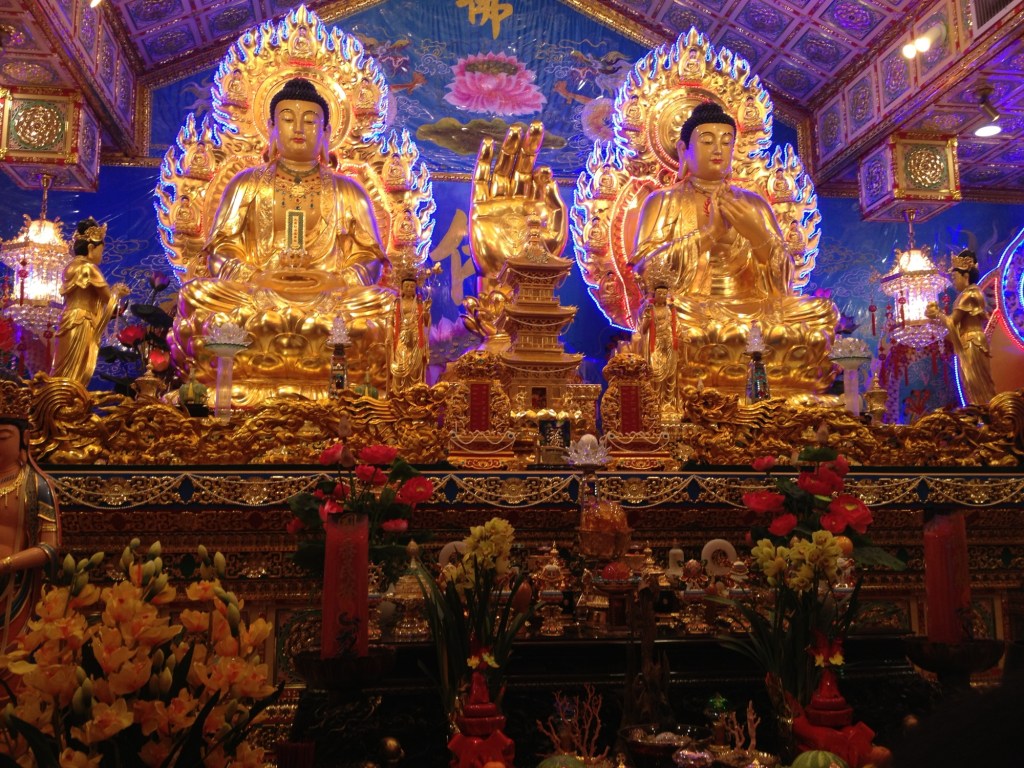
A mural from the Yulin Grotto in China. See page for author, Public domain, via Wikimedia CommonsAn altar revering the two buddhas, Shakyamuni and Prabhūtaratna, from the eleventh chapter of the Lotus Sutra, enshrined at a Vietnamese temple. Taken at Ksitigarbha Temple in Lynnwood, WA in 2013.
But the style of the Lotus Sutra isn’t to appeal to the head, it tries to appeal to the imagination. It is one thing to say that life is impermanent, it is another to describe the world as a great burning house, with people inside too distracted to notice. When the Buddha is shown projecting himself to countless worlds, it is just a colorful way of saying that the Dharma is everywhere, and there are countless buddhas across many worlds each preaching according to the environment. When the Buddha describes archetypal bodhisattvas in the later chapters, each one is meant to convey a different Buddhist virtue.
Deep stuff.
The Lotus Sutra was pretty radical for its time, and a core part of the larger Mayahana-Buddhist reform movement. The parable of the Dragon Princess, attaining enlightenment faster than any was obviously meant to blow the minds of the establishment, and challenge certain cultural prejudices about women, and so on.
A 12th century Japanese mural from the Heike Nokyo, depicting the Dragon Princess offering a jewel to the Buddha before transforming. Public domain, via Wikimedia Commons
Similarly, the chapter where countless streams of “bodhisattvas of the earth” emerge from the ground was meant to show how we didn’t need to rely on elite gurus, but that everyone had the capacity for being a bodhisattva too, if they just had the confidence.
I’ve talked about the main themes of the Lotus Sutra in an older post, but I wanted to cover two really important ones.
First, the most important teaching of the Lotus Sutra is probably the “One Vehicle” (Ekayāna) teaching. Previously, the reform Mahayana, or “great vehicle” Buddhists, bickered with the traditional Buddhist establishment (called Hinayana, or “small vehicle”), and traded barbs witih one another. You can see this is in some of the really early sutras composed by Mahayana Buddhists.
But then the Lotus Sutra took a step back and looked at the big picture, and taught that it was all just Buddhism (e.g. “one vehicle”) anyway. There were many places to start, and ways to move forward, but in time they would all converge, and the quality of one buddha was no different than another. What worked for one person didn’t necessarily work for another. There was no use bickering, any effort great or small was worth it.
Second, the other major teaching of the Lotus Sutra is that the Buddha was far, far older than history would tell us. The sutra implies that the Buddha would appear in some time and place, restart the Buddhist community, grow old and die, but that was just trick to keep people getting attached to the Buddha. This seems pretty disingenuous.
But what the sutra is trying to tell us is that the Buddha just personifies the Dharma (the teachings), and that the Dharma is the Buddha. Since the Dharma, the principle of existence, has always been around, in the same way one can see the Buddha also being around in one form or another, even in the darkest of times. Where does one begin, and the other end? I think the Mahayana Buddhists who composed it wanted people to stop getting hung up on the physical/historical Buddha, avoid a “cult of the Buddha”, and focus on the Dharma.
As a side note, the Lotus Sutra frequently promotes itself. It says that anyone who sincerely hears the Lotus Sutra, and praises it gets all kinds of benefits. But is not the Lotus Sutra as the written text from 1st century India. Like the “eternal Buddha”, this is the Lotus Sutra as the ultimate teaching (e.g. the Dharma) in its unvarnished form.
Thus, the Lotus Sutra is in some ways a very strange text because it is so dense with metaphor, simile and parables to get things across. But when you look at all the artwork and culture influenced by it, you can see that it gets something right. Rather than appealing to intellect, it conveys its messages through more impactful means. It is one of those texts that you keep referring back to over the years because it stands out so much.
Speaking from experience, it helps not to read it from cover to cover. Instead, focus on one chapter, try to suss out the meaning. Some chapters are, in my experience, a little bland, others are really moving. Sometimes a chapter won’t make any sense, then years later you will have an “ah ha” moment and you see it in a new light.
Speaking from experience. 😏
P.S. I probably own 3-4 translations of the Lotus Sutra, the Gene Reeves translation is probably the easiest for beginners in my opinion, but I like them all in their own way.
1 Researchers believe that the verses actually came first, and then the authors composed narrative around them.
The Lotus Sutra, one of the most important sutras of Mahayana Buddhism, is the size of an epic novel, and thus much too large to recite cover to cover. Even reciting a single chapter can be daunting because each chapter contains a large narrative section, and one or more verse sections that recap the narrative.
For this reason, certain verse sections have become popular for chanting because they get to the heart of the Lotus Sutra and convey its essential teachings, in a manageable size.
Popular examples (among others) include the Kannon Sutra, the verse section of chapter 16, and the opening section of chapter 2. Both are actively recited in Nichiren and Tendai sect home services. Today we will focus on the big verse section at the end of chapter 16, called the jigagé (自我偈) in Japanese.
Chapter 16 of the Lotus Sutra is the big reveal of the sutra: Shakyamuni Buddha is not just a historical figure that lived in 5th century India, and member of the warrior-caste Shakya clan, but is also, on another level, a timeless Buddha that has pretty much existed since a remote, incalculable past:
Since I attained Buddhahood the number of kalpas [aeons] that have passed is an immeasurable hundreds, thousands, ten thousands, millions, trillions, asamkhyas [in other words, a mind-boggling amount of time]. Constantly I have preached the Law [a.k.a. the Dharma], teaching, converting countless millions of living beings, causing them to enter the Buddha way, all this for immeasurable kalpas.
Translation by Burton Watson
I believe this part of an important theme not just in the Lotus Sutra but Mahayana Buddhism in general: the Dharma is a timeless, eternal law of reality and the various Buddhas simply embody it. The Dharma is what matters, not one particular Buddha or another. You can see hints of this in older Buddhist sutras such as the Vakkali Sutta (SN 22.87) in the Pali Canon, but I believe that Mahayana Buddhism took it to its logical conclusion.
Later in the same verse section is the famous lines:
My pure land is not destroyed, yet the multitude see it as consumed in fire, with anxiety, fear and other sufferings filling it everywhere….But those who practice meritorious ways, who are gentle, peaceful, honest and upright, all of them will see me here in person, preaching the Law [a.k.a. The Dharma]
Translation by Burton Watson
To me, this reinforces that even in the worst, most desolate times, the Dharma is always there, and anyone who seeks it sincerely will find it even when others cannot see it. I’ve talked about this passage often in the Nirvana Day posts I’ve made in the past, among other places.
Anyhow, let’s move on now to the liturgy itself.
Liturgical Language
Because this is a chant used in Japanese Nichiren and Tendai traditions, among others, I am posting it as-is in Japanese, more specifically Sino-Japanese: the original Classical Chinese that it was recorded in, but with historical Japanese pronunciation. You are welcome to recite in English, or any other language, there is no restriction.
For this liturgical text, I relied on a fewsources, plus I double-checked the spellings using physical sutra books I have at home. I am fairly certain it’s accurate.
Also, I formatted the text similar to how it is formatted in real service books.
Translation
I decided not to post the translation side-by-side with the text, the way I do with the Heart Sutra and such. This is due to formatting reasons on the blog, plus also length of the text makes this more difficult. I may revise this later.
For now, I highly recommend checking out a modern translation here by the excellent Dr Burton Watson. The Buddhist Text Translation Society also has an excellent translation here. The chant below is the first narrative section that goes all the way to the first verse section.
Disclaimer and Legal Info
I hereby release this into the public domain. Please use it as you see fit, but if you attribute it to this site, greatly appreciated. Also, please bear in mind this is an amateur work, and should not be taken too seriously.
Dedication
I dedicate this effort to all sentient beings everywhere. May all beings be well, and may they all attain perfect peace.
Namu Shakamuni Buddha
The Lotus Sutra sixteenth chapter, verse section
Preamble
Classical Chinese
Japanese Romanization
妙法蓮華経 如来寿量品 第十六
Myo ho ren ge kyo nyo rai ju ryo hon dai ju roku
Verse Section
Classical Chinese
Japanese Romanization
自我得仏来 所経諸劫数 無量百千万 億載阿僧祇
Ji ga toku butsu rai sho kyo sho kos-shu mu ryo hyaku sen man oku sai a so gi
常説法教化 無数億衆生 令入於仏道 爾来無量劫
jo sep-po kyo ke mu shu oku shu jo ryo nyu o butsu do ni rai mu ryo ko
為度衆生故 方便現涅槃 而実不滅度 常住此説法
i do shu jo ko ho ben gen ne han ni jitsu fu metsu do jo ju shi sep-po
我常住於此 以諸神通力 令顛倒衆生 雖近而不見
ga jo ju o shi i sho jin zu riki ryo ten do shu jo sui gon ni fu ken
衆見我滅度 広供養舎利 咸皆懐恋慕 而生渇仰心
shu ken ga metsu do ko ku yo sha ri gen kai e ren bo ni sho katsu go shin
衆生既信伏 質直意柔軟 一心欲見仏 不自惜身命
shu jo ki shin buku shichi jiki i nyu nan is-shin yoku ken butsu fu ji shaku shin myo
時我及衆僧 倶出霊鷲山 我時語衆生 常在此不滅
ji ga gyu shu so ku shutsu ryo ju sen ga ji go shu jo jo zai shi fu metsu
以方便力故 現有滅不滅 余国有衆生 恭敬信楽者
i ho ben riki ko gen u metsu fu metsu yo koku u shu jo ku gyo shin gyo sha
我復於彼中 為説無上法 汝等不聞此 但謂我滅度
ga bu o hi chu i setsu mu jo ho nyo to fu mon shi tan ni ga metsu do
我見諸衆生 没在於苦海 故不為現身 令其生渇仰
ga ken sho shu jo motsu zai o ku kai ko fu i gen shin ryo go sho katsu go
因其心恋慕 乃出為説法 神通力如是 於阿僧祇劫
in go shin ren bo nai shitsu i sep-po jin zu riki nyo ze o a so gi ko
常在霊鷲山 及余諸住処 衆生見劫尽 大火所焼時
jo zai ryo ju sen gyu yo sho ju sho shu jo ken ko jin dai ka sho sho ji
我此土安穏 天人常充満 園林諸堂閣 種種宝荘厳
ga shi do an non ten nin jo ju man on rin sho do kaku shu ju ho sho gon
宝樹多花果 衆生所遊楽 諸天撃天鼓 常作衆伎楽
ho ju ta ke ka shu jo sho yu raku sho ten kyaku ten ku jo sa shu gi gaku
雨曼陀羅華 散仏及大衆 我浄土不毀 而衆見焼尽
u man da ra ke san butsu gyu dai shu ga jo do fu ki ni shu ken sho jin
憂怖諸苦悩 如是悉充満 是諸罪衆生 以悪業因縁
u fu sho ku no nyo ze shitsu ju man ze sho zai shu jo i aku go in nen
過阿僧祇劫 不聞三宝名 諸有修功徳 柔和質直者
ka a so gi ko fu mon san bo myo sho u shu ku doku nyu wa shichi jiki sha
則皆見我身 在此而説法 或時為此衆 説仏寿無量
sok-kai ken ga shin zai shi ni sep-po waku ji i shi shu setsu butsu ju mu ryo
久乃見仏者 為説仏難値 我智力如是 慧光照無量
ku nai ken bus-sha i setsu butsu nan chi ga chi riki nyo ze e ko sho mu ryo
寿命無数劫 久修業所得 汝等有智者 勿於此生疑
ju myo mu shu ko ku shu go sho toku nyo to u chi sha mot-to shi sho gi
当断令永尽 仏語実不虚 如医善方便 為治狂子故
to dan ryo yo jin butsu go jip-pu ko nyo i zen ho ben i ji o shi ko
実在而言死 無能説虚妄 我亦為世父 救諸苦患者
jitsu zai ni gon shi mu no sek-ko mo ga yaku i se bu ku sho ku gen sha
為凡夫顛倒 実在而言滅 以常見我故 而生憍恣心
i bon bu ten do jitsu zai ni gon metsu i jo ken ga ko ni sho kyo shi shin
放逸著五欲 墮於悪道中 我常知衆生 行道不行道
ho itsu jaku go yoku da o aku do chu ga jo chi shu jo gyo do fu gyo do
随応所可度 為説種種法 毎自作是念 以何令衆生
zui o sho ka do i ses-shu ju ho mai ji sa ze nen i ga ryo shu jo
得入無上道 速成就仏身
toku nyu mu jo do soku jo ju bus-shin
P.S. I’ve been posting a lot of Japanese-Buddhist liturgy from various sources, and this is the last one I will post for a while. The ones I have posted so far on the blog cover the most common sutra chants, so anyone curious to get started in a tradition (or rediscover a tradition) should hopefully find what they need. Good luck!
The Lotus Sutra, one of the most important sutras of Mahayana Buddhism, is the size of an epic novel, and thus much too large to recite cover to cover. Even reciting a single chapter can be daunting because each chapter contains a large narrative section, and one or more verse sections that recap the narrative.
For this reason, certain verse sections have become popular for chanting because they get to the heart of the Lotus Sutra and convey its essential teachings, in a manageable size.
Popular examples (among others) include the Kannon Sutra, the verse section of chapter 16, and the opening secction of chapter 2. Both are actively recited in Nichiren and Tendai sect home services. Today we will focus on the opening section of chapter 2, called the hōbenpon (方便品) in Japanese.
Chapter 2 of the Lotus Sutra introduces the concept of Expedient Means (Sanskrit upāya), the idea (alluded to in earlier Buddhists texts) that the Buddha’s teachings and practices are flexible and meant to accommodate the capacity of the follower, guiding them along until they reach the ultimate truth (e.g. Enlightenment). Later, the chapter leans on this concept to further teach that any effort along the Buddhist path is not wasted, and every bit counts. But the chant above is for the just the opening section, which teaches that full Enlightenment is a deeply profound concept, but something only the Buddhas can truly understand between one another, so it’s a pretty lofty goal (e.g. that’s why the Buddhas and Bodhisattvas do what they can to help).
“Shariputra, ever since I attained Buddhahood, I have widely expounded my teachings through many stories of past relationships and many parables, and by countless means have led the people to renounce all their attachments.”
Because this is a chant used in Japanese Nichiren and Tendai traditions, among others, I am posting it as-is in Japanese, more specifically Sino-Japanese: the original Classical Chinese that it was recorded in, but with historical Japanese pronunciation. You are welcome to recite in English, or any other language, there is no restriction.
For this liturgical text, I relied on a fewsources, plus I double-checked the spellings using physical sutra books I have at home. I am fairly certain it’s accurate.
Also, I formatted the text similar to how it is formatted in real service books.
Translation
I decided not to post the translation side-by-side with the text, the way I do with the Heart Sutra and such. This is due to formatting reasons on the blog, plus also length of the text makes this more difficult. I may revise this later.
For now, I highly recommend checking out a modern translation here by the excellent Dr Burton Watson. The Buddhist Text Translation Society also has an excellent translation here. The chant below is the first narrative section that goes all the way to the first verse section.
Disclaimer and Legal Info
I hereby release this into the public domain. Please use it as you see fit, but if you attribute it to this site, greatly appreciated. Also, please bear in mind this is an amateur work, and should not be taken too seriously.
Dedication
I dedicate this effort to all sentient beings everywhere. May all beings be well, and may they all attain perfect peace.
Namu Shakamuni Buddha
The Lotus Sutra second chapter, opening section
Preamble
Original Chinese
Japanese Romanization
妙法蓮華経 方便品第二
Myo ho ren ge kyo ho ben pon dai ni
Verse Section
Original Chinese
Japanese Romanization
爾時世尊 従三昧 安詳而起 告舎利弗
Ni ji se son ju san mai an jo ni ki go sha ri hotsu
諸仏智慧 甚深無量 其智慧門 難解難入
sho buc-chi e jin jin mu ryo go chi e mon nan ge nan nyu
一切声聞 辟支仏 所不能知 所以者何
is-sai sho mon hyaku shi butsu sho fu no chi sho i sha ga
仏曾親近 百千万億 無数諸仏 尽行諸仏。
butsu zo shin gon hyaku sen man noku mu shu sho butsu jin gyo sho butsu
無量道法 勇猛精進 名称普聞 成就甚深
mu ryo do ho yu myo sho jin myo sho fu mon jo ju jin jin
未曾有法 随宜所説 意趣難解 舎利弗
mi zo u ho zui gi sho setsu i shu nan ge sha ri hotsu
吾従成仏已来 種種因縁 種種譬諭 広演言教
go ju jo buc-chi rai shu ju in nen shu ju hi yu ko en gon kyo
無数方便 引導衆生 令離諸著 所以者何
mu shu ho ben in do shu jo ryo ri sho jaku sho i sha ga
如来方便 知見波羅蜜 皆已具足 舎利弗
nyo rai ho ben chi ken ha ra mitsu kai i gu soku sha ri hotsu
如来知見 広大深遠 無量無礙 力無所畏
nyo rai chi ken ko dai jin non mu ryo mu ge riki mu sho i
禅定解脱三昧 深入無際 成就一切 未曾有法
zen jo ge das-san mai jin nyu mu sai jo ju is sai mi zo u ho
舎利弗 如来能種種分別 巧説諸法 言辞柔軟
sha ri hotsu nyo rai no shu ju fun betsu gyo ses-sho ho gon ji nyu nan
悦可衆心 舎利弗 取要言之 無量無辺
ek ka shu shin sha ri hotsu shu yo gon shi mu ryo mu hen
未曾有法 仏悉成就 止舎利弗 不須復説
mi zo u ho bus-shitsu jo ju shi sha ri hotsu fu shu bu setsu
所以者何 仏所成就 第一希有 難解之法
sho i sha ga bus-sho jo ju dai ichi ke u nan ge shi ho
唯仏与仏 乃能究尽 諸法実相
yui butsu yo butsu nai no ku jin sho ho jis-so
Conclusion
(note: at least in some Nichiren traditions, this part is repeated 3 times. I am unclear if this is also done in the Tendai tradition.)
Original Chinese
Japanese Romanization
所謂諸法 如是相 如是性 如是体 如是力 如是作 如是因 如是縁 如是果 如是報 如是本 末究竟等
sho i sho ho nyo ze so nyo ze sho nyo ze tai nyo ze riki nyo ze sa nyo ze in nyo ze en nyo ze ka nyo ze ho nyo ze hon ma ku kyo to
While continuing my research into Buddhist home practice in Japanese Buddhism, I found this neat excerpt online from a Rinzai Zen booklet (I don’t have a copy, so I am just transcribing here).
The contents of home practice are zazen [zen meditation], veneration [of the buddha], and the reading of sutras, and yet only when these are seen as one can we truly call it “Home practice”. First, by freshening ourselves up, then warmly venerating the Buddha, and reading sutras solemnly, how can this be anything other than Zazen!
I think what the author is trying to say here is that when people think of Zen, they naturally think of meditation (e.g. zazen, 座禅), but it’s more than the physical act of sitting on a cushion, it’s also an attitude: a reverence toward the Buddha, the sutras (e.g. the Buddha’s teachings), and personal conduct both through sitting meditation, but also through life.
In an old post, I stated that expectations for lay followers to keep up a consistent meditation practice as monks and nuns do is a bit unrealistic for most people. Try doing this if you’re a working-class single mom, for example. On the other hand, Buddhism is a religion focused more on practice than faith, yet for lay-followers the practice has to be somehow reasonable and sustainable, while still retaining the essence of the Buddha’s teachings.
This is probably how the common practice of home services (otsutomé お勤め, or gongyō 勤行) evolved over time in Japan. Western Zen communities tend to emphasize zazen as in the physical act, which isn’t necessarily wrong (it is after all the central practice of Zen), but it’s a somewhat narrow interpretation.
Further, other Buddhist sects encourage their practices with a similar attitude too. One can follow this advice above in a Pure Land context, Vajrayana (Shingon) context, Nichiren context, or Tendai context with only minor adjustments. Whatever sect or practice one is inclined towards, and regardless of background, it is definitely possible maintain a healthy, sustainable Buddhist practice if one approaches it with reverence, and with sincerity.
Here is another wonderful poem (previous posts here and here) by the 11th century Japanese poetess, Lady Izumi (izumi shikibu 和泉式部 in Japanese), that I found in The Ink Dark Moon by Jane Hirshfield and Mariko Aratani:
Original Japanese
Romanization
Translation*
ものをのみ
Mono o nomi
Should I leave this burning house
思ひの家を
Omoi no ie o
of ceaseless thoughts
出でてふる
Idete furu
and taste the pure rain’s
一味の雨に
Ichimi no ame ni
single truth
ぬれやしなまし
Nure ya shina mashi
failing upon my skin?
* Translation by by Jane Hirshfield and Mariko Aratani
The headline for this poem reads:
On the night of the sixth, the sound of the night monk’s voice reciting the Sutras mingled with the sound of incessant rain, and truly this seemed to be a world of dreams…
Lady Izumi cleverly makes not one, not two, but THREE separate allusions to the famous Lotus Sutra, in this poem. I’ve talked about the Lotus Sutra before. It’s a very influential Buddhist text in the Mahayana tradition, and contains many parables and dramatic allusions, compared to some of the drier, more textbook style Buddhist sutras. Thus, allusions to the Lotus Sutra are found throughout literature in East Asia. In my opinion, understanding the Lotus Sutra is key to understanding Buddhism in East Asia: Zen, Pure Land, Tiantai, Nichiren and Vajrayana, etc.
The “burning house” here alludes to the Parable of the Burning House of third chapter of the Lotus Sutra. I’ve talked about it here, among otherplaces. This is pretty straightforward to understand in the poem: the Burning House here is symbolic of the world we live in, burning with passions, craving, anger, delusion, old age, disease, and so on. We can step out of the burning house if we choose to, but we are often distracted by things in the house, and thus unaware that the timbers all around us are on fire, putting us in mortal danger.
The second allusion is that of rain. In the fifth chapter of the Lotus Sutra, there is a parable describing rain on plants, the so-called The Parable of the Medicinal Herbs:
What falls from the cloud is water of a single flavor, but the plants and trees, thickets and groves, each accept the moisture that is appropriate to its portion. All the various trees, whether superior, middling or inferior, take that is fitting for large or small and each is enabled to sprout and grow. Root, stem, limb, leaf, the glow and hue of flower and fruit— one rain extends to them and all are able to become fresh and glossy, whether their allotment of substance, form and nature is large or small, the moistening they receive is one, but each grows and flourishes in its own way.
The Buddha is like this when he appears in the world, comparable to a great cloud that covers all things everywhere, Having appeared in the world, for the sake of living beings he makes distinctions in expounding the truth regarding phenomena.
This is, for me, one of my most favorite parts of the Lotus Sutra. As a sutra, it’s very inclusive (cf. the Parable of the Dragon Princess), but it also acknowledges that there is a huge variety of people in the world. Some people are just different than others, but they can all benefit from the Dharma in their own way, just like the various plants in world drinking from the rain.
Finally, the third allusion in Lady Izumi’s poem is that of a single “taste”. Both the Parable of the Burning House and the Parable of the Medicinal Herbs make a single point: the Dharma of the Buddha appears in a variety of ways, or “gates” for one to enter, but in the end the Dharma tastes the same equally, and is but one truth. So, whichever gate one enters, the rain will ultimately taste the same. For the Burning House, when the children come outside, their father offers, in the end, a single magnificent cart (not many) to offer them as an incentive.
Turning back to Lady Izumi, it’s obvious that she was very thoughtful of these things, even if she struggled to practice them amidst her life. Even when she was surrounded by scandal, and lost both her lovers and her daughter to illness, she could see past it and look at the greater picture.
Recently while taking my personal retreat, I spent some time catching up on Buddhist reading, and finished a book titled Introduction to the Lotus Sutra by Yoshiro Tamura, and translated to English. I had high hopes for the book, but came away pretty disappointed as it was a pretty thinly veiled promotion of a Nichiren-Buddhist interpretation of the Lotus Sutra, and of Nichiren Buddhism in general.1
One passage makes some interesting comments worth noting though (Wikipedia links added):
Shinran (1173-1262), Dogen (1200-1253), and Nichiren (1222-1282) also came into reality of out Mt. Hiei’s hall of truth [same as Honen a generation earlier]. Yet their attitudes toward the actual world were quite different from Honen’s. While Honen was mostly devoted to giving up on life and longed for the pure land of the next life, Shinran, Dogen, and Nichiren struggled positively within the actual world. Their activities and writings came right after the Jokyu turbulence of 1221 and were related to it.
Page 123, translation by Michio Shinozaki, edited by Gene Reeves
Mr Tamura is comparing several different Buddhist monks who all left the Tendai sect around the same time, and each founded their own sects. The first, was Honen, who founded the Jodo Shu sect and greatly popularized Pure Land Buddhism in Japan. This is a fascinating historical phenomenon that started in the last 12th century with Honen, and persisted with a couple more generations of Buddhist monks all trained from the same Tendai sect, and apart from Nichiren, its great temple complex on Mt Hiei.
As Nichiren was the last of these great reformers, he had the benefit of hindsight, and tended to be rather harsh toward Honen’s Pure Land movement as degenerate, and further obscuring the true Buddhist teachings (as enshrined in the Lotus Sutra and the Tendai sect). Thus, ever since, Nichiren authors and followers have had particular animus toward Honen. The book doesn’t pull punches either.
But it’s an interesting comment to make, and not without merit. The Jodo Shu Buddhist sect has always been focused on a singular goal within the larger Buddhist religion: to enable followers to be reborn in the Pure Land of Amitabha (Amida) Buddha and thus provide as a refuge, but also to enable them to accelerate on the traditional Buddhist path faster. A lot of this hinges on a medieval-Buddhist interpretation of the “end days” or Dharma Decline, which looks a bit silly knowing what we know now.
In any case, Jodo Shu sect Buddhism, at least on paper, definitely focuses on the life to come. From what I hear on the ground, the reality is a lot more nuanced, and many communities still practice some manner “traditional Buddhism”, but the primary focus still remains rebirth in the Pure Land to come.
So, what Mr Tamura says makes sense.
Mr Tamura is also correct in that Dogen, who founded the Soto Zen sect, and Nichiren approached the same medieval concern with Dharma Decline, but in different ways: Dogen focused on the classic Buddhist approach to mindfulness, meditation, focus on the now, etc. Nichiren took the logical conclusion of the Lotus Sutra’s egalitarian teachings in the form of social reform, nominally as a reform of the Tendai sect, especially in the face of the crooked administration by the new Hojo clan’s military government.2
But I have to disagree with Mr Tamura’s hidden conclusion that by focusing on this-worldly practice that certain sects of Buddhism are superior to others. I feel that this hopelessly generalizes things.
One of the things that always attracted me to Honen’s teachings was his overt rejection of petty, secular life while keeping his focus on the future, namely the Buddha’s Pure Land. It may seem counterintuitive, but by focusing on the “world to come” and thus rejecting the world as it is, i think this fosters a renunciant’s mindset, even as one continues to live in this world. The historical Buddha, Shakyamuni, definitely advocatedthisapproach.
This may seems like not a big deal, especially given other Buddhist sects also have some form of monastic practice, or similar rejection of secular life, but consider that the other aforementioned reformers were all Buddhist monks of hte same Tendai sect, and Tendai at the time had a controversial teaching called hongaku (本覚) or original enlightenment. The idea is that one is already enlightened but unaware of this due to ignorance or skewed viewpoints. This leads to all sorts of thorny issues with Buddhism and Buddhist practice, and gave some scallywags in the Buddhist monastic community an excuse to “loosen the reins a bit” in terms of discipline.
Honen seeing the state of affairs of the community at his time, overtly rejected this concept. Other reformers embraced the concept to some degree or another, sometimes leading to some behavior that in the wider Buddhist world would raise eyebrows.
On the other hand, the historical Buddha definitely advocated practice and mindfulness here and now too. In fact, it’s pretty much central to Buddhist practice, at least for monastic followers. So, Mr Tamura, Dogen, Nichiren and others aren’t wrong.
As a modern 21st-century Buddhist speaking 800 years later (and from another culture), with plenty of personal biases of my own, I think you need a bit of both. On the one hand, whether you are a Buddhist layperson or a monastic, it’s healthy to maintain a renunciant’s mindset. The world is a series of endless transitions, both on a macro level and a personal level, so there’s no lastingrefuge or rest. Further, it doesn’t make sense to just throw up your hands and bank on the future through prayer and good merit, because there’s plenty of things you can do in the hereandnow to make life better for others, and also for yourself. Even if you engage in a little bit of Buddhist practice,3 that’s still a step in the right direction. Even if you meditate even only occasionally, that’s still better than nothing.
So, in a sense, all of the Buddhist reformers in 12th-13th century Japan had something positive to contribute, and each was approaching the same issues with novel approaches. It’s somewhat stupid to try to and hold up one sect as superior to others based on an artificial criteria.
So, anyhow, the book was disappointing, but it does help remind me of what matters.
P.S. Photo taken at the Butchart Gardens in Victoria BC last week.
1 The book started out reasonably well, but the last third of the book was unabashedly promotion of Nichiren Buddhism. Bear in mind that the Lotus Sutra has been revered and influential in many Buddhist communities outside of 13th century Japanese-Buddhist thought, so this tendency to focus on a single sect’s teachings to the exclusion of others. The book’s not-so-subtle tendencies to belittle continental Buddhist culture while promoting Japanese thought didn’t help either. People sure do love to inject culture into their religion.
2 Shinran, who was a follower of Honen, took a more nuanced approach that tends to incorporate some elements of Honen’s view, while focusing on a radically lay-oriented religious community (similar to Nichiren). There’s already plenty of books about Jodo Shinshu (Shinran’s sect), and Shinran, so no need to belabor it here.











 Gleanings in Buddha-Fields
You must be logged in to post a comment.