Japanese Enka Music

When most people think of Japanese music they think of J-Pop, and “idol” girls, etc.1 But there’s a whole other side of Japanese music that is found everywhere, but a bit more of an acquired taste: Enka (演歌).

The closest comparison I can think of, is that Enka music in Japan is similar to Country music in the US: raw, folksy, culturally specific, etc. Compare this to Pop music which is usually polished for as wide an audience as possible. Enka instead harks back to a more bygone era of Japanese culture, so it has a nostalgic feel to it, while also using modern and instruments.

I have a lot of memories of my in-laws in Japan watching Enka singers on TV, and singing along with songs they grew up with. Even my late mother-in-law, who was usually pretty quiet, would sing her favorite tunes sometimes. It was very sweet. So, despite not being Japanese, I have a surprising number of memories and nostalgia for it.

But as a foreigner, it’s also hard to get into unless you know where to start. Enka is a big industry in Japan, and there are plenty of artists who come and go, famous songs, etc. Sometimes, even foreigners sometimes become successful Enka singers. I vaguely know some very famous singers (through my in-laws), but although I like Enka, I never really knew where to start.

Luckily, the family and I were watching this year’s Kohaku Uta-Gassen show on Japanese TV for New Year’s, and they often showcase mix of venerable artists as well as newer ones. This song, Kurenai no Chō (“crimson butterfly”, 紅の蝶) is by Yamauchi Keisuke (山内惠介), is great and I have been listening to it on repeat lately. You can purchase it overseas on iTunes and such.

Anyhow, while Japanese music is not always easy to find outside of Japan, you can find some good Enka artists, especially more modern ones, and find some music you might like. It’s hard to explain what Enka sounds like, but I hope you take the time to sample songs and get a feel for it. Enka is a really fun genre.

1 I never really got into J-Pop music after all these years. I had a big K-Pop phase some years ago, and occasionally still purchase an album or two, but J-Pop just never interested me.

Happy New Year 2025

Hello Readers,

It’s 2025, and I am happy to be back. The break wasn’t as restful as hoped (too many holiday obligations), but I did accomplish most of my goals, and got to celebrate my firstborn’s 18th birthday which was an important milestone for us parents. I also played lots of Fire Emblem: Engage,1 and watched plenty of old Star Trek episodes.

Anyhow, for the first temple visit of the year, the priest stated that according to the traditional 60-year Chinese calendar 2025 was the sign ki-no-to-mi (乙巳), which can be roughly translated as “yin wood snake”, which implied change coming to fruition, like a tree growing its branches. For context, last year was “yang wood dragon” (ki-no-é-tatsu, 甲辰). Which implied much turmoil, like a baby dragon bursting from its shell.

While I might be speaking from confirmation bias, I cannot help but feel recent events in the last few years reflect this. But, I suppose it’s up to individual interpretation.2

Anyhow, I have some fun posts coming up that I finally finished while on break.

Hoping you all have a great year, or at least stay out of trouble. 😅

1 Engage doesn’t have the emotional depth of Fire Emblem: Three Houses (I doubt few games would), but it has grown on me, and I enjoy many aspects about it, and will likely play through it again.

2 I consulted the Yi Jing for the year, and my own personal fortune wasn’t great either. Warnings of not “stepping on a tiger’s tail” and such.

Hatsumodé: the First Visit of the New Year

Of the many traditions in Japanese New Year (Jan 1st through 3rd, unlike Chinese New Year) is the first temple or shrine visit: hatsumōdé (初詣).

Japan essentially has two religions that have co-existed for many centuries: Shinto and Buddhism. Although they are very different on paper, on the ground, customs and traditions have blended as a result of this (mostly) peaceful coexistence and this includes New Year’s traditions.

People will try to go to their preferred Shinto shrine (jinja 神社) or Buddhist temple (otera お寺) within the first 3 days of the New Year, but most often on January 1st. You can visit any shrine or temple, there’s no pressure to “commit” to one or the other in Japanese culture. At times, we’ve visited Meiji Shrine in Tokyo, Kawasaki Daishi in Kawasaki city (a Shingon-sect Buddhist temple), Asakusa Temple in Tokyo, and Tsurugaoka-Hachimangu Shrine in Kamakura. The featured photo above is from Hatsumode at Asakusa Temple in 2009. We’ve also visited more local temples back home.1

Temples and shrines, especially famous ones, during this time are jammed packed with people trying to start off the new year with a blessing and maybe a few omamori charms too. Old charms are often disposed of at this time too. Here’s an old photo from a past Hatsumode visit to Kawasaki Daishi in 2012:

This photo may not seem like much, but Kawasaki Daishi’s pagoda is visible way in the background, and the road leading up to the shrine is packed with people. It took maybe an hour to get through the procession to the temple itself.

For this year, 2024, we are at home, so I visited a small Shingon-sect Buddhist temple in the area. Shingon temples are pretty hard to find in the US, but somehow we have two temples in the area, and one of them offers a nice Hatsumode service. I don’t normally follow Shingon-sect Buddhism,2 but as I mentioned above, there’s no sense of commitment or obligation within Japanese religions: you can visit whatever service, and if you choose to follow more closely that’s up to you.

In our particular Hatsumode service, the priest led a series of Shingon-specific rituals to help cleanse any bad karma for the year, reciting the Heart Sutra (prominent in Shingon), and then a brief sermon based on the 60-year zodiac cycle. This year is apparently the year of kino-é-tatsu (甲辰), or wood-yang-dragon, which implies a lot of upheaval. After the last few years, that’s the sort of news I was not hoping to hear. 😒 Then again, shit happens.

I picked up a couple omamori charms for my daughter: a charm for success in studies since she is applying to college next year, and a charm for Yakudoshi since she is of the correct age (unlucky for her). I have learned the hard way not to laugh off Yakudoshi years. 

Anyhow, like many Christians in the West during Christmas, Hatsumode might be the only time of the year when most Japanese visit a temple or shrine, but it’s an important time to reconnect and a break away from the usual bustle. I always enjoy this time, even with the crowds, freezing cold, and the hope that the next year will be better than the old one.

P.S. The history between Buddhism and Shinto in Japan is a great case study of two religions co-existing peacefully since they usually just operate at different levels. Shinto’s focus on there life now (and one’s connection to the kami) has little in common with Buddhism’s emphasis on the cycle of rebirth, and the eventual progress toward Buddhahood (e.g. Enlightenment). Chinese culture has a similar balance between Buddhism, and more native religions like Taoism. It’s only in Western religions that approach things with an “all or nothing” attitude that conflict tends to arise, but even then in traditional Christian cultures, native pagan beliefs tended to find a balance with Christian religion. They were not necessarily mutually exclusive, except on paper. Food for thought.

1 We used to visit Japan in the Winter so we could spend New Year’s in Japan with my wife’s family, but as our daughter grew up, and started going to school, we shifted the visits to Summer to avoid affecting attendance. We haven’t been back to Japan in Winter for almost a decade until 2022 and that was due in part to a funeral.

2 I am not against Shingon either, but I’ve found it difficult to commit to since it is an esoteric-only Buddhist sect, and I tend to be kind of an eclectic. It’s also why I frequently struggle with Zen and even Jodo Shu/Shinshu. Hence, my default “preferred sect” is Tendai due to its umbrella-approach to Buddhist practice. Still, due to available resources in my area, Shingon’s always been something I’ve considered.

Happy 2024: Year of the Dragon

Hello dear readers, and happy new year, or as they say in Japan akemashite omedetou gozaimasu!

My family and I took time off for Winter Break and are probably more exhausted now than when the break began.

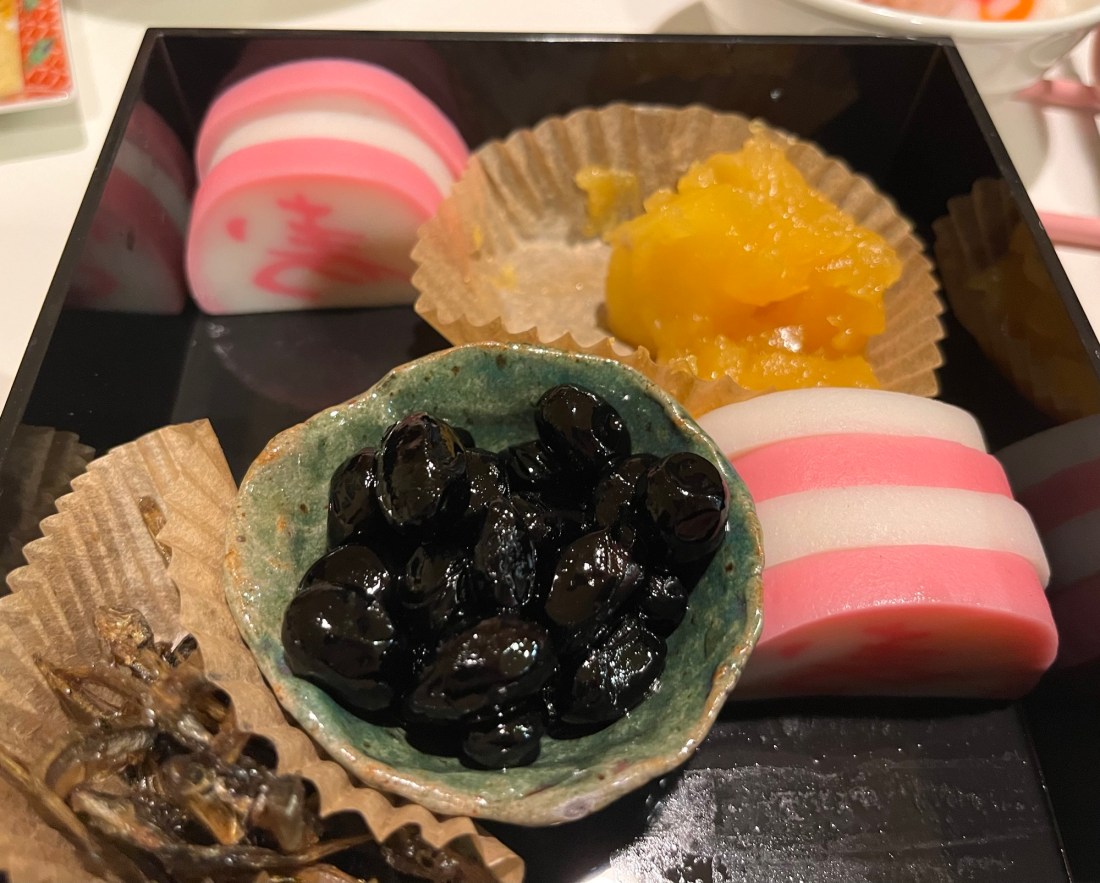
After enjoying New Year’s Eve with friends, we woke up this morning to eat Osechi (お節), which are traditional foods eaten in Japan for New Year for good luck. This is just one of many traditions found in Japanese New Year, also called oshougatsu (お正月).

I won’t list each one, but you can read here. These are foods thought to have auspicious meanings, and include things like shrimp, black beans, candied fish, chestnuts and so on. I like some more than others, but I try to have a bite of at least one of each. I like the pink and white kamaboko in particular. This year, we bought a brand that has the Chinese character 寿 (kotobuki) in it, meaning “felicitations” and such. The featured photo shows the Chinese character in reverse.

Also, in the photo above, our little ceremonial dishes feature the Seven Luck Gods too, and in the ozouni soup shown the naruto fish cakes feature Mount Fuji in front of a sunrise.

Later today, I will probably play some Karuta and then head for the local Japanese Buddhist temple for the first visit of the year, hatsumoude, and post on that soon.

Happy 2024 to everyone!

P.S. For us Star Trek fans, another thing to may be look forward to this year:

Merry Star Trek Christmas to you all

See you in 2024!

Happy Year of the Rabbit

A set of figurines for the Japanese zodiac we purchased in our recent trip.

Hello Readers and Happy New Year! In Japanese, people greet each other for the first time using the stock phrase akemashite omedetō gozaimasu (明けましておめでとうございます) which means something like “congrats on the opening of a new year”.

Note that Japanese New Year is based on Chinese New Year, but since early industrialization period, the Meiji Period, Japan moved away from the lunar calendar to the Western solar calendar.

The traditions inherited from Chinese culture still persist, even if the calendar changed, thus the original zodiac is still in place, and the new year is still frequently referred to as “spring” even if it is no longer anywhere close to meteorological spring.

In any case, it might sound a bit early but Happy Year of the Rabbit!

Japanese New Year: a shopping list

If you, or a loved one, are celebrating Japanese New Year, Oshōgatsu (お正月), you may need to do some shopping. During the December in 2021, we got snowed in really bad, and my wife couldn’t go to the local Japanese supermarket to buy goods and ingredients herself. So, I went on her behalf using public transportation to downtown, got the goods, and came back.

To save other husbands (or anyone else who likes to celebrate) some uncertainty, here’s a recommended list of things to get and why. I purposely took photos of my own at the local Asian grocery store, rather than stock photos, because I felt this would help readers on the ground more, especially if they can’t read Japanese.

New Year Altar

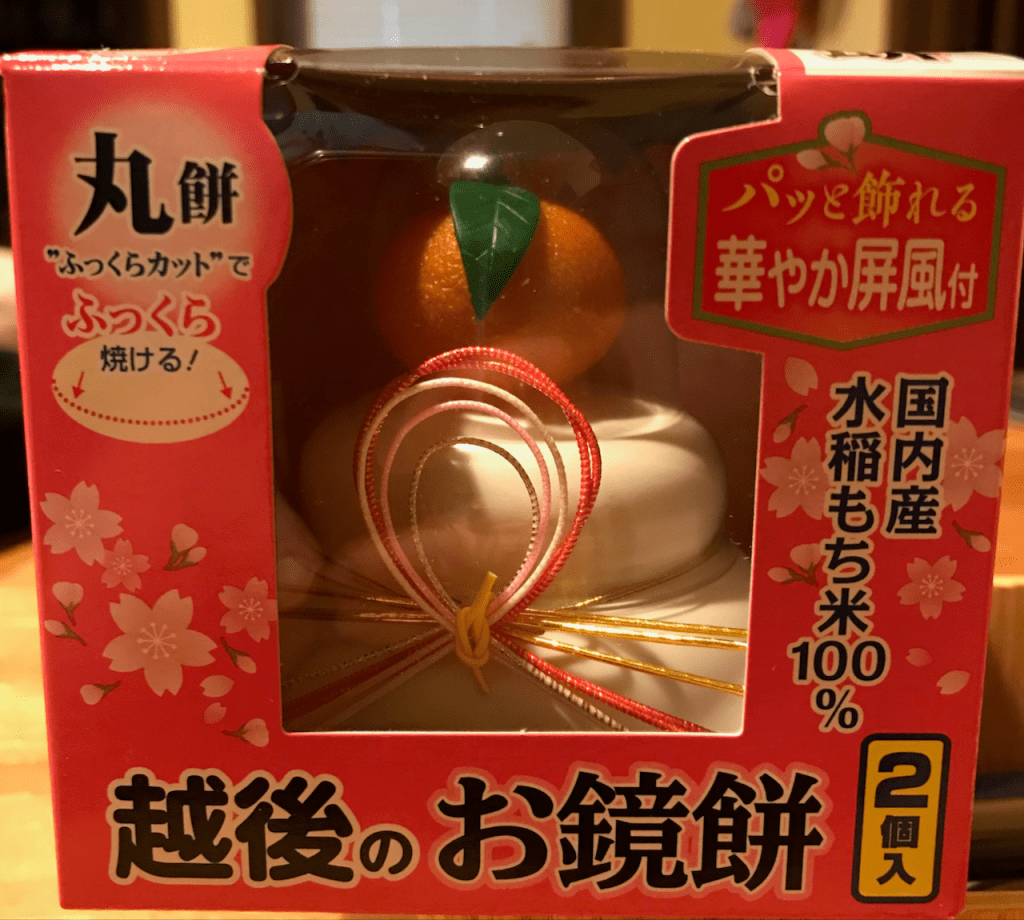
A common tradition in Japan is to get a kagami-mochi, kind of like so:

Kagami-mochi are a pair of mochi (rice cakes) stacked one on top of the other, usually with a ribbon around it, and a bitter orange or other decoration on top. I’ve talked more about it here. These are often available at any Japanese grocery store, and include instructions on how to set it up. Remember, on January 11th, there’s a separate ceremony to break open the mochi and cook it for good luck.

Soup Ingredients

There are several items, often available in your local Asian food store, that are essentials for Japanese cooking during New Years.

First, is naruto, shown on the left:

This is not to be confused with the manga series. Naruto is a food that usually comes in a long roll and is sliced thin and added as a topping to soups and ramen during New Years. A similar food, shown on the right, is kamaboko. Kamaboko often comes frozen, and has to be thawed out first, then sliced and added to soup, including toshi-koshi soba which is eaten the night before New Years.

Another food often used, especially in ozoni soup (eaten on New Year’s morning) are mochi rice cakes:

There are many kinds, and cuts, so just find something that’s suitable for your needs. Out of the package, they are hard little bricks but when added to warm soup or baked in a toaster oven, they have a taffy-like consistency. Keep in mind that it’s possible to choke on mochi if you don’t chew thoroughly. They’re delicious but consider yourself warned.

Osechi

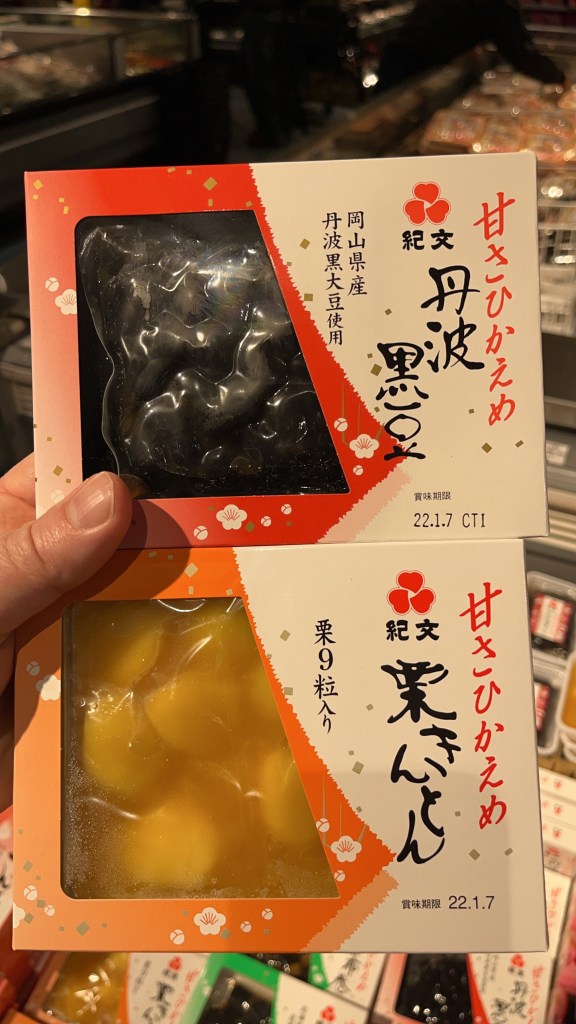
During New Year’s day, it is considered auspicious to eat certain foods on the first day. These are collectively known as osechi-ryōri, or just osechi. There are many possible foods to use in osechi, but one common one is kuro-mamé:

These are just sweetened black beans, and something I enjoy eating in particular. In the same picture, shown below are yellow kuri-kinton which is a kind of walnut paste.

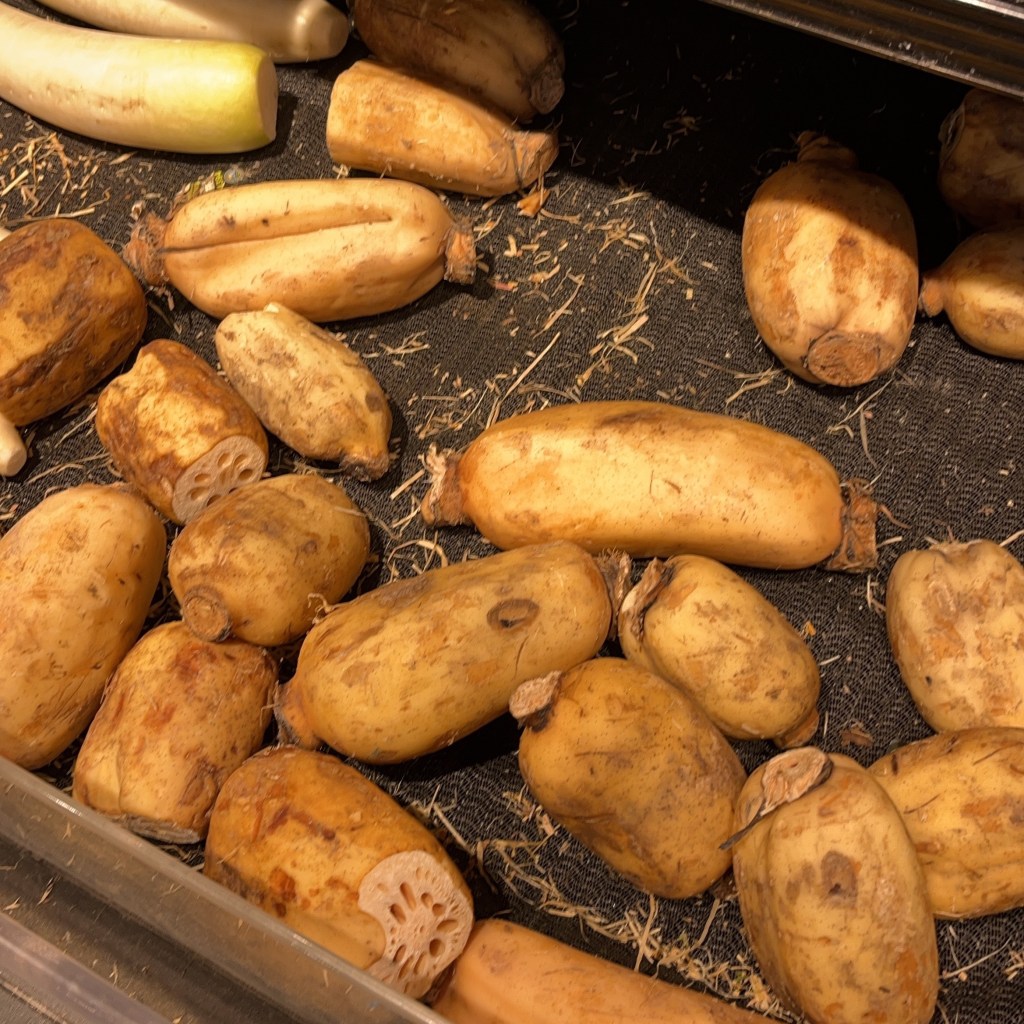
Another great choice are lotus root, or renkon. They look like huge tubers at the store…

But when peeled, sliced thin and cooked in broth they look more like this:

They have a nice consistency like potato and are delicious to eat. Highly recommend.

Finally there are special chopsticks you should pick up for osechi:

The chopsticks themselves are nothing special, but using bright, clean chopsticks with auspicious decorations on them, I believe that this helps symbolizes a fresh (and positive) start for the new year.

Conclusion

This not an exhaustive list of goods for Japanese New Year, but I hope this helps cover basic foods and goods you might need to enjoy New Year. Your mileage may vary. I will also try to update and polish this up as time goes on.

Good luck!

New Year’s Terms and Greetings in Japanese

Although it’s still a couple weeks away, New Year’s is just around the corner, and it is a big occasion in Japanese culture.  You see, Japan, like many other east Asian countries, relied on the Chinese lunar calendar for centuries, but then moved to the Western solar calendar during the 19th century Meiji Period.  New Year’s retained its cultural value, but moved to a fixed date of January 1st as a result.

When people ask me what Japanese New Year, or oshōgatsu (お正月), is like, I tell them it’s  Thankgiving and Christmas rolled into a single 3-4 day holiday.  While Christmas (and Halloween) might be trendy in Japan, they don’t have nearly the same deep cultural roots.

For example: New Year’s Greetings.

an_instance_of_new_year_card_in_japan
An example of a Japanese greeting card of nengajō (年賀状), courtesy of Wikipedia.

When you first encounter someone (or send a card) after the New Year, there’s certain customary greetings used.  Some are more formal and used only for one’s elders, while others are more friendly.

The default greeting used is:

明けましておめでとう
akemashite omedetō

This basically means “Congrats on the beginning of a new year”. The verb akeru (明ける) refers endings and beginnings.  For example, sunrises (end of night, beginning of day) and years.

However, when speaking to one’s elders it’s more appropriate to use:

明けましておめでとうございます
akemashite omedetō gozaimasu

The extra gozaimasu is a honorific frequently used in Japanese, though much too formal for use with friends, colleagues, etc.

If you want to go the extra mile, an even more honorific term might be:

謹んで新年のお慶びを申し上げます
tsutsushinde shinnen no oyorokobi wo mōshiagemasu

While it’s kind of hard to translate into English, it basically means “we wish to humbly express our pleasure at the coming of a new year”.¹  This is a great example of Japanese keigo speech, which is not easy to learn but can really spice up your communications if used correctly. This is something you might in business Japanese, but definitely not among friends or acquaintances.

In any case, New Year’s greetings are not limited to these examples.

For example, you might see the term geishun (迎春) posted on advertisements, greeting cards, etc.  This literally means “welcoming spring”, however this is a relic of the old lunar calendar, where Spring often marked the new year.  Now it just means “[Happy] New Year”.  The term above isn’t appropriate more respectful or polite correspondences though, so there are other, similar terms you can use:

  • kinga-shinnen (謹賀新年) – this means something like “Humbly wishing you a happy new year”.
  • kyōga-shinnen (恭賀新年) – this means something like “Reverently/respectfully wishing you a happy new year”.

There’s a much nicer explanation on this website (Japanese language only).

In any case, Japanese New Year is full of traditions and this includes special phrases and terms of address.  If you can remember akemashite omedetō [gozaimasu] as a way to greet people after the New Year, you’re on very solid footing.  If you learn some of the additional phrases though, you not only impress others, but you also get a window into Japanese New Year culturally. 😀

¹ Based on personal experience, one of the biggest differences between Japanese and English is levels of politeness.  Japanese can have many levels of respect (or disrespect), while English sounds relatively “flat”.  That’s not to say English doesn’t have levels respect or disrespect, but it’s interesting that even when addressing royalty (or  head of state), English sounds relatively unchanged when compared to talking with a sibling or friend.  Japanese on the other hand has more dramatic differences in terms of pronouns, verbs, stock-phrases, etc.