Keeping a Level Head

McCoy: Illogical? Did you get a look at that Juliet? That’s a pretty exciting creature. Of course your, uh, personal chemistry would prevent you from seeing that. Did it ever occur to you that he might like the girl?

Spock: It occurred. I dismissed it.

McCoy: You would.

Star Trek, “The Conscience of the King” (s1ep12), Stardate 2817.6

This quote is very Buddhist to me. Spock is aware of fine-looking ladies (including his ex, T’Pring), but isn’t ruffled by them.1 This self-mastery, regardless of whether you’re a man or woman, old or young, rich or poor, is very much what the Buddha taught:

25. By effort and heedfulness, discipline and self-mastery, let the wise one make for himself an island which no flood can overwhelm.

The Dhammapada, translation by Acharya Buddharakkhita

The Buddha (a.k.a. Shakyamuni) greatly stressed the importance of a disciplined mind. Elsewhere in the Dhammapada, the Buddha warned that the mind was the source of all happiness or unhappiness, and that much of our problems were self-inflicted. A disciplined mind, by contrast, reins in the chaotic nature of the mind, and avoids these self-inflicted issues. Enlightenment was an inevitable outcome of such practice, but it also had more immediate benefits as well to oneself and those around you.

Take myself. I love food. I have been overweight for many years, and get lectured by my doctor about it yearly. They are right of course, but I have poor willpower and often can’t resist snacking. Even after my medical emergency last year, when I lost a lot weight, I gained it back (and then some) within half a year. As I get older, the threat of medical problems stemming from these poor eating habits only grows.

So, these days, I have to keep myself from eating too many snacks. I have years of health-neglect to make up for, and so I often spend my days constantly hungry as I try to claw back my weight to a more reasonable level. It’s not easy. I have to stop during dinner and remind myself that I’ve eaten enough, I have to limit my snacks to a couple chips, and not the whole bag. I have to remind myself that I don’t have to eat junk food today, because there’s always another opportunity down the road. And so on.

I say all this to make a point: our mundane minds are easily ruffled by things good (hot girls and food) as well as bad (annoying people, existential threats to the Republic, etc). It’s not about blocking them out, or spacing out somehow. It’s about acknowledging these things, and then being level-headed about it.

This is waaaaayyyyyy easier said than done, but any effort toward this end is an investment well spent.

Namu Shakamuni Butsu

P.S. More posts on the subject.

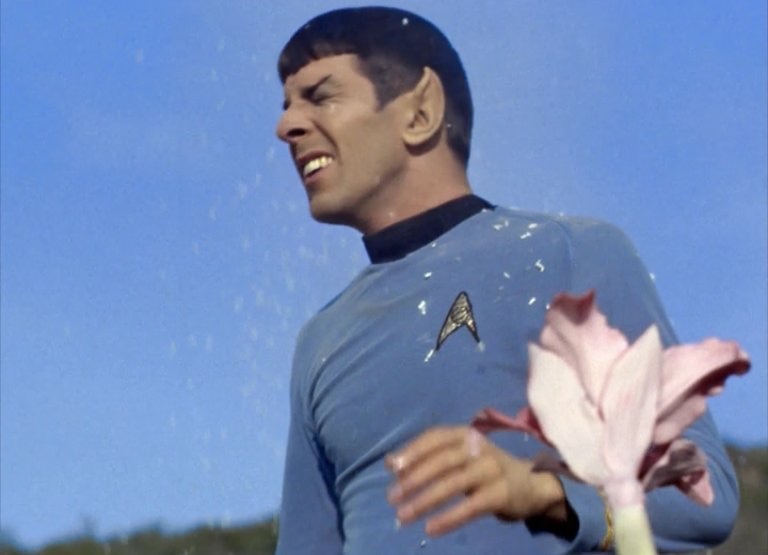
1 well … usually. Space flowers are another matter.

Spock being sprayed by the mind-controlling pollen of a space flower in This Side of Paradise (s1ep24), stardate 3417.3

The Floating World

All conditioned dharmas
Are like dreams, illusions, bubbles, or shadows;
Like drops of dew, or like flashes of lightning;
Thusly should they be contemplated.

The Diamond Sutra, Translation courtesy of Lapis Lazuli Texts

It would be illogical to assume that all conditions remain stable.

Spock, “The Enterprise” Incident”, stardate 5027.3

The “Floating World”, or Ukiyo (浮世) is an old Buddhist term meaning the world of fleeting forms and temporary joys we live in as part of Samsara. It later became, in the 16th century onward, a term for the pleasure quarters of the city of Edo (later Tokyo) when it became the capital of the new Shogunate. The idea was simple: the pleasure quarters offered everything a person could want, if they could afford it, even if it was just part of the mundane, effervescent world.

Block print titled Taking the Evening Cool by Ryōgoku Bridge, c. 1745, by Okumura Masanobu, Public domain, via Wikimedia Commons

But it’s not hard to see that this kind of Floating World, with all its glamour and joys, can be found almost anywhere at any time. Even modern Pop Culture and entertainment, even social media, is just another form of the Floating World.

It’s not that the Floating World, modern Pop Culture, or social media inherently are evil, but they glosses over the pains and realities of life. For every successful actor or actress in Hollywood, it’s not hard to find many others who scrape by. Even those who succeed pay a very heavy price. For every person who greets you at the five-star restaurant with a smile, there are countless people in the back who are slaving away to wash the dishes, cut vegetables, and so on, to say nothing of the waiter’s own personal pains and dilemmas. For every pretty girl who smiles at you, she is glossing over her own pain and trauma. And so on.

Scratch the veneer and see a lot of people working hard to make customers, listeners or viewers happy, but themselves are stressed, exhausted, miserable, or unhappy with their lives.1 Just like the rest of us.

In a sense, the whole thing is a golden sham.

And yet, why do we still gravitate toward such things, even when we know they are transient and don’t provide any lasting happiness? I am no different. When I’ve had a hard day at work, and after dinner with the family, I don’t meditate; I sit down and play a Fire Emblem game. Even Lady Izumi, a thousand years ago, lamented her inattentiveness.

Because we are human, and being human is hard sometimes.

Still, it’s worthwhile to see one’s own behavior and learn from it: the way we flit from something fun to something else fun. Even that can be illuminating. I learned a thing or two just writing this post. 🤔

But yes, life is hard, and it hurts, and it’s exhausting. The joys in life are fleeting, and yet we chase after them for even a temporary respite.

Nonetheless, the house around us is still burning. Time is short.

1 Of course, if you’re thinking to yourself “better them than me”, do not be so sure.

Live And Let Live

SPOCK: Insults are effective only where emotion is present.

Star Trek, “Who Mourns for Adonais?” (s2ep2), stardate 3468.1

SPOCK: Where there’s no emotion, there’s no motive for violence.

Star Trek, “Dagger of the Mind” (s1ep9), stardate 2715.1

I wrote about the Buddhist virtue of forbearance before, but I had an important reminder recently why this matters so much in Buddhist practice.

Our natural tendency is to hold a grudge when someone slights us, or when we have been wronged. This is normal human pattern of behavior. But, like self-doubt, this is a form of conceit, putting ourselves and our ego before others.

In the Dhammapada, a collection of sayings attributed to the Buddha and one of the very earliest Buddhist texts still preserved, the Buddha has much to say regarding the subject. For example:

133. Speak not harshly to anyone, for those thus spoken to might retort. Indeed, angry speech hurts, and retaliation may overtake you.

134. If, like a broken gong, you silence yourself, you have approached Nibbana [a.k.a. Nirvana, final Unbiding], for vindictiveness is no longer in you.

The Dhammapada, translation by Acharya Buddharakkhita

The Buddha was uncompromising on this: no vengeance, lest you bring even further misery upon yourself.

Indeed, the Buddha taught by freeing oneself of ill-will and other negative emotions, one is liberated:

197. Happy indeed we live, friendly amidst the hostile. Amidst hostile men we dwell free from hatred.

198. Happy indeed we live, friendly amidst the afflicted (by craving). Amidst afflicted men we dwell free from affliction.

199. Happy indeed we live, free from avarice amidst the avaricious. Amidst the avaricious men we dwell free from avarice.

200. Happy indeed we live, we who possess nothing. Feeders on joy we shall be, like the Radiant Gods.

The Dhammapada, translation by Acharya Buddharakkhita

Of course, this is easier said than done.

As with self-doubt or any negative emotion, stop and think like a Vulcan: assess the situation including your own feelings. Is this productive? Is it harmful? Is it based on conceit?

Spock in season 3 episode 21, the “Cloud Minders”, played by Leonard Nimoy

Many times, we are prone to act or lash out, but if we take a moment to assess our feelings, and the situation, we are more capable of handling it rationally. In so doing, we avoid further misery for ourselves and others.

When the ego is bruised, it demands attention and resolution. But that is short-sighted, and rarely fixes anything.

SEPTIMUS: Our way is peace.

Star Trek, the Son Worshiper, “Bread and Circuses” (s2ep25), stardate 4040.7.

A commitment toward peace and well-being towards others feels counter-intuitive at times, but peace toward others inevitably leads toward peace for oneself.

Namu Shakamuni Butsu

Mindfulness Meditation Isn’t What You Think

Spock : “… I have noted that the healthy release of emotion is frequently very unhealthy for those closest to you.”

Star Trek, “Plato’s Stepchildren” (s3ep10), Stardate 5784.2

Meditation, specifically mindfulness meditation, is touted as a stress-relief exercise. Busy people believe that if they can block out the time to meditate for X minutes a day, or when stressed, this will make more happy and productive. It has been all the rage in Silicon Valley too.

But it doesn’t work.

It will calm your mind while you are sitting, but as soon as you are back to work, your blood pressure will quickly rise again. Old habits will quickly resurface. Self-help, in short, does not help.

How do I know this?

I tried the same trick in my late 20’s. My first child was born, and I was working at Amazon (yes, that Amazon) for a few years in a technical support role. The environment was stressful, demanding, constantly on the move, the on-call rotation gave little time to decompress because something was always broken,1 and I had to drive into work at all hours of the night to try and fix it.

Since I had recently converted to Buddhism at the time, and listened to a lot of Ajahn Brahm dharma talks, I wanted to try meditation. We had a spare office that no one used, so I would go in there once or twice a day, turn off the lights, dutifully sit, chant certain Buddhist mantras, meditate for 20 minutes or more, and then return to work.

As soon as I was back at my desk, the stress would rise all over again. I kept at the meditation for months, almost a year, before I finally gave up.

The stress, constant sense of inadequacy measuring myself to hyper-competitive co-workers who graduated from Stanford, unrealistic work performance goals, fear of losing my job, and so on simply didn’t go away until I QUIT MY JOB AND TOOK A LESS DEMANDING ONE.2

It took me years as a Buddhist to finally realize that stress-relief is not what mindfulness meditation was intended for.

Mindfulness meditation is a tool to develop insight, not stress relief. It is necessary in the early stages of meditation to quiet the chatter in the mind, but that is just the first stage. It is to remove barriers to insight by develop a focused mind, and a quiet mind, a mind that can perceive things in a more balanced way. Consider this quote from the Buddha in a very early text, the Dhammapada:

  1. There is no meditative concentration for him who lacks insight, and no insight for him who lacks meditative concentration. He in whom are found both meditative concentration and insight, indeed, is close to Nibbana.
  2. The monk who has retired to a solitary abode and calmed his mind, who comprehends the Dhamma with insight, in him there arises a delight that transcends all human delights.
  3. Control of the senses, contentment, restraint according to the code of monastic discipline — these form the basis of holy life here for the wise monk.
Translation by Soma Thera from https://www.accesstoinsight.org/tipitaka/kn/dhp/dhp.25.budd.html

The emphasis is on focus, insight, and contemplation NOT relaxation or stress-relief. Mindfulness meditation has been repackaged and sold to naive Westerners with false promises. Meditation really does provide excellent benefits, but it has to be done as part of a much larger, holistic lifestyle change and with wholesome intentions. This is the “holy life” as described by the Buddha: a life of wholesome, guilt-free conduct, goodwill towards others, and a desire to pursue the Dharma (the teachings of the Buddha).

First, one should take up the Five Precepts of Buddhism. As we see in verse 374 above, the Buddha openly encourages that we curb our worst behaviors first as a foundation for other Buddhist practice. One will gain no lasting benefit from meditation until this is done. Full stop.

Second, one must approach meditation with the mindset of a monk. It is not necessary for lay-people to give up everything and go live in the woods. Buddhism accommodates both the “house-holder” lifestyle and that of a true renunciant (a.k.a. a monk or nun). But both the renunciant and the house-holder are expected to live a life of moderation and restraint.3 Easier said than done (speaking as a gamer and foodie), but it’s a goal to sincerely aspire to.

Speaking of restraint, one should always guard one’s speech. A long time ago, a Buddhist minister I admired once told me that speech was like toothpaste: once it was out of the tube, you couldn’t put it back. One has to learn to carefully monitor what one says both in person and online (and yes, at work). Again, easier said than done, but the alternative will only make your life miserable.

Finally, when such good foundations are established, meditation will help you learn more about yourself, and the world around you.4 It’s incredibly helpful, and life-changing when carried to fruition. I have my own little private insights that have stayed with me through the years, and I hope you will find yours too.

Namu Amida Butsu

Namu Shakamuni Butsu

P.S. if you feel the need to calm yourself right away, try something much simpler. You can recite the nembutsu, the Heart Sutra, a mantra, whatever. Try that for a minute, and see if that works. It is a band-aid fix though, and you still need to approach things from a holisitic standpoint, or you will gain no long-term benefit. Alternatively, just go for a walk.

1 Years later, the sound of a pager going off still triggers me a little bit. No joke.

2 Another ex-Amazonian who had joined the same company years earlier confided in me that after leaving Amazon, he drank himself stupid for months to decompress. I noticed that I was still on a hair-trigger for months after leaving Amazon, and it took me a while to unlearn those habits too. My wife noted that my posture improved after leaving, and that I grumbled about work less. Some jobs are simply not worth staying in.

3 The Buddha was pretty flexible about what exactly this meant, citing whatever cultural standards applied at the time as a benchmark. In short, a lot of it is rooted in common courtesy and good sense. If you cannot act toward others using common courtesy, meditation ain’t gonna fix your issue.

4 You may learn that your whole problem is that your job sucks, for example, and that the burn-out is not worth the money. Of course, if you’re a single mom caring for three kids, you have a lot fewer options available to you, and in such cases I recommend the nembutsu as a starting point.


Fall Ohigan 2024: Don’t Shoot Yourself In the Foot

Hello readers,

The Japanese-Buddhist holiday of Ohigan is fast approaching, and I haven’t written about it in years (!), so I felt like posting about it today.

Ohigan (お彼岸, “the other Shore”) started with the pious 8th-century emperor Shomu. The name implies crossing over from this shore, which is comprised of greed, anger, desired, pain, frustration, strife, etc, etc., the usual nonsense. Contrast that with the “other shore” in Buddhism which symbolizes peace, contentment, freedom from harm, fear, conflict, etc. Because Ohigan is observed both at the Spring and Autumnal equinoxes, this is a time when the weather is mild, and so people can slow down and re-commit to the Buddhist path.1 Given how climate change is affecting the weather, this point is not lost on us today either.

Ages and ages ago, quotations of the historical Buddha, Shakyamuni (a.k.a. Siddhartha Gautama) were collected in India in a text called the Dhammapada. Despite the centuries gap between what the Buddha said, and what was recorded later, the Dhammpada probably represents one of the very oldest texts, and the closest to the historical Buddha that we’ll ever get. It’s short, easy to digest, and has lots of little witticisms that even today people can learn from.

One of them is this quote:

371. Meditate, O monk! Do not be heedless. Let not your mind whirl on sensual pleasures. Heedless, do not swallow a red-hot iron ball, lest you cry when burning, “O this is painful!”

Translation by Acharya Buddharakkhita

In modern American English, I suppose we’d translate this as “don’t shoot yourself in the foot”.

But, of course we do this all the time. My doctor told me pretty bluntly that I should lose weight, and I want to lose weight, and yet when someone in the family offers to buy some bubble tea, I totally forget. What little spare time I have is usually spent playing Fire Emblem2 games instead of doing anything constructive like washing the dishes.

Centuries later, someone asked the Pure Land Buddhist teacher, Honen in the 12th century a series of questions and answers, this is question 57:

一。さけのむは、つみにて候か。
答。ま事にはのむべくもなけれども、この世のならひ。

Q: Is it a sin to drink saké [alcohol]?
A: Indeed one ought not to drink, but [you know] it is the way of the world.

Honen the Buddhist Saint, page 56

This is our normal state of being. Most of the time its benign, but clearly some actions we do are self-destructive even if just a little bit, and it’s hard to break the cycle if we aren’t even aware we’re doing the cycle to begin with.

So, there tends to be a need for both awareness, as well as self-restraint. When one becomes aware of their own habits, they are more capable of stopping self-destructive habits. By moderating or restraining bad habits, one tends to have fewer headaches later, and thereby getting one step closer on the Buddhist path.

There’s no magic formula for this. As we’ve seen in Mahayana Buddhism, there are countless ways to approach this both in the grand sense, but in the little day to day efforts too. Everyone is encouraged to find their own way, or emulate others they find admirable. The latter is why the Sangha, the Buddhist community, is considered one of the Three Treasures by the way. People can’t always see what they’re doing is harmful, and even if they can, they can’t always fix it without support from loved ones and people they trust.

The Buddhist path is long, spanning countless lifetimes, but even tiny little changes we make here and now, even if we falter, will still have big effects in the future. Don’t underestimate your own ability, and don’t be afraid to rely on others if needed. If nothing else, recite the nembutsu.3

Happy Ohigan!

Namo Shakyamuni Buddha

P.S. The featured image is the temple of Todaiji in Nara, Japan, another project by Emperor Shomu.

1 In modern Japanese culture, it is often a holiday time for overworked employees, and a chance to go to their home town, pay respects to their ancestors, etc. Like a smaller scale Obon.

2 After this initial post, I have still been actively playing Three Houses for the past year (!), but I have also branched into other games in the series. I have five games currently and am various stages of each. It’s a terrific series, but Three Houses will always be my favorite. Such a beautiful story, such an emotional rollercoaster. If you own a Nintendo Switch, I hope you get a chance to play it.

3 Question 69 of same letter addressed to Honen:

一。心に妄念のいかにも思はれ候は、いかがし候べき。
答。ただよくよく念仏を申させ給へ。

Q: When bad thoughts keep arising within my mind, what should I do?
A: The only thing to do is to repeat Nembutsu.

Honen the Buddhist Saint, page 56

Sometimes, that’s all you can do.

Concentration, or Lack Thereof

This is me, most of the time.

I am the sort of person who is bad with names. I recently met some new neighbors, and they told me their names, and I made a point of remembering those names, but 5 minutes later, I had already forgotten one of them.

In the early Buddhist sutras, the Buddha described the mind as a monkey flitting from branch to branch:

Just as a monkey, swinging through a forest wilderness, grabs a branch. Letting go of it, it grabs another branch. Letting go of that, it grabs another one. Letting go of that, it grabs another one. In the same way, what’s called ‘mind,’ ‘intellect,’ or ‘consciousness’ by day and by night arises as one thing and ceases as another.

Assutavā Sutta (SN 12.61), translation by Ven. Thanissaro Bhikkhu

This inability to focus the mind prevents us from gaining any insight, being easily swayed by sensual lust, anger, or ignorance, unable to see the bigger picture. Centuries later, in the Parable of the Burning House of the Lotus Sutra, the kids in the burning house are so distracted by their toys, that they do not notice their father calling them to get out.

This notion of the unstable mind unable to see its own peril is found in every Buddhist tradition, and what drives much of the Buddhist practice. Recognizing one’s own mental patterns is the first step, an important one too, but another important step is to counteract this. One cannot stop the thoughts themselves, it’s just the way the mind of Homo sapiens works. Instead, one should look into Buddhist training to either withstand such thoughts, counteract them, or look past them. This isn’t a simple thing either. It’s quite difficult, and requires long-term training. But it is essential to one’s well-being.

When I catch myself brooding angry thoughts, or thinking something stupid and selfish, I often think about something Honen said in a famous catechism called the 145 Questions and Answers (ippyaku-shijūgo-kajō-mond, 百四十五箇条問答), namely question #69:

一。心に妄念のいかにも思はれ候は、いかがし候べき。

Q) When bad thoughts keep arising within my mind, what ought one to do?

答。ただよくよく念仏を申させ給へ。

A) The only thing to do is to repeat Nembutsu.

Quoted from Honen the Buddhist Saint page 56, with Japanese from http://kyokusho.g.dgdg.jp/benkyo/c145.htm

Because the Pure Land tradition of Buddhism is so large, there’s a lot of ways to interpret this. I don’t know the right answer. You should do your own research and decide for yourself. For some, this is using the nembutsu as a form of mindfulness practice (withstanding evil thoughts), while for others, this is acknowledging the grace of Amida Buddha, and that one is still destined to be reborn in the Pure Land (looking past evil thoughts).

This is not to replace the tradition of mindfulness meditation, either. It’s just not always possible to be sitting on a cushion meditating, so remembering Honen’s advice is a handy thing to do when you are going through life, and feeling your mind looping the same negative or unwholesome thoughts over and over.

Namu Amida Butsu

The Best Buddhist Practice is the One You Are Already Doing

As a perfectionist, I am often plagued by self-doubt about my Buddhist practice and frequently question whether I am doing it right, whether I am doing the right practices to begin with, and so on. I’ve talked about the fundamentals of Buddhism, and how they apply to any sect or teaching on follows, but when you get into the finer details of how to put these into practice, it can feel daunting.

Recently I was reading an article in Japanese by the Soto Zen center in Kinki1 Region that I found very helpful. If you can use Google Translate to read it, I think it is well worth it. But the quote I really liked was:

おつとめの手順としては「信は荘厳(しょうごん)から」といわれるように、まず、お給仕からはじまります。

As for the process of doing a home Buddhist practice, It is said that “faith begins with solemnity” and in the same way Service [at a restaraunt] begins with waiter.

I think this is important because Buddhist home practice (otsutomé おつとめ, in Japanese) isn’t meant to be something you do to show off, because you are obligated to, to get relaxation from, or to get a spiritual thrill from either. The form of the practice isn’t so important as the spirit of solemnity.

As the article points out, we Buddhists (focus on Zen Buddhists in the article, but it applies to all of us) are trying our best to put the historical founder, Shakyamuni Buddha’s, teachings into practice according to our circumstances. We are not given much instruction in life, and each has our own partial understanding of things, not to mention the conditions we grow up under. So, we have to adapt the teachings of the Buddha accordingly. But if we do it in a spirit of solemnity, not frivolity, obligation, nor conceit, then we will make progress.

Thus, I realized that whatever Buddhist practice you are already doing is probably the right one, as long as you are doing it with the right attitude.

Similarly, I was watching a video in Japanese by a Soto Zen monk who often provides very practical advice, but also hides his identity:

Around 5:00 onward, he talks about how people who first get into Buddhism, or a particular teaching or sect are often very overeager and want to dive in and do a lot of practices. Or, they see the official liturgical format and feel that they have to do everything (I am one of those people).

Instead, he uses the analogy of a restaurant, with a menu of choices. All the choices are great, but can be overwhelming if you try to order everything, so he suggests you start small. In his example, reciting the Heart Sutra daily is a good foundation. If you do this for a while, and it feels like something is missing, you can add additional liturgy or practices based on what’s recommended. Or if it feels like too much, pare back a little.

The key is daily practice. It’s not super important how you do it, just consistency and right attitude. If you are already doing this, then keep it up, and don’t get bogged down in details.

Namu Shakamuni Butsu

1 The “Kinki” region in Japan is just another historical term for the Kansai region of Western Japan. The first time I heard this word in Japanese, I was very confused. 🤦🏼‍♂️

Self Doubt

Alternate title: What Would Tuvok Do?

Self doubt is something we may all face from time to time. For me, it hits hard when I have made a mistake, and it’s hard to shut off the negative thought process once it starts up.

The origins of this self-doubt are not that important, though. I have my theories, but it doesn’t really matter. What matters is what self-doubt does: it creates false assumptions, and cripples decision-making. One might say, it’s all in the mind.

Tuvok, as portrayed by Tim Russ.

During a recent rewatch of the Star Trek: Voyager,1 I really enjoyed Tim Russ’s character Tuvok, the Vulcan security officer. Tim Russ is a great actor, and I appreciate his portrayal of Tuvok, and especially Tuvok’s level-headed approach to situations. In the same way, Spock as played by Leonard Nimoy did the same thing in the original Star Trek series.

When Tuvok is faced with a difficult situation, and the rest of the crew (esp. Neelix) panics, he tends to remain calm, and analytical. He assesses the situation rationally.

Tuvok and Neelix (played by Ethan Phillips).

I think that’s the secret to overcoming self-doubt. Self-doubt, believe it or not, is rooted in a kind of conceit, or self-centeredness, even when it’s a negative form of conceit. Trying to counteract with self-love or self-affirmation just replaces one form of conceit with another. It’s not necessarily wrong, but kind of defeats the point.

In the same way, when I feel myself slipping into another death-spiral of self-doubt, lately I try to take a deep breath and do what Tuvok (or Spock) would do: calmly assess the situation and be rational. I am not the center of the Universe. The whole world is not judging me. If I’ve made a mistake, I need to analyze it, and correct it. If I am not at my best, I need to step back and reassess.

We can see a similar sentiment in an early sutra in Buddhism.

The Buddha “What do you think, Rāhula? What is a mirror for?”

Rāhula: “For reflection, sir.”

“In the same way, Rāhula, bodily actions, verbal actions, & mental actions are to be done with repeated reflection.

The Ambalaṭṭhikā Rāhulovāda Sutta (MN 61), translation by Thanissaro Bhikkhu

The trick is to be aware first and foremost that I am slipping into self-doubt again. This kind of mindfulness is the underpinning of Buddhism, and we can all learn to be a little self-aware. It never hurts to stop and “check in on yourself” from time to time, even during good moments. Further, the Buddhist practice of repentance is a time-honored for reflecting on your own actions in a scientific, analytical way, rather than flogging yourself.

So, in other words: CTFD.

Namu Shakamuni Butsu

P.S. More on the mind as a mirror.

P.P.S. As much as I love Leonard Nimoy as Spock, I am glad to see the Vulcan cast expanding over time: Tim Russ as Tuvok, Ethan Peck as Spock in Strange New World, Jolene Blalock as T’pol and so on.

1 Voyager was on when I was a college student so I watched from time to time, but I never loved the show the way I did Next Generation. Plus, the show has a number of inside references that are important, but if you only watched occasionally, you missed them. Rewatching again was great, though season 2 in particular was weak. Season 3 onward was amazing.

Pure Land Buddhism: Just As I Am

Something I was thinking about lately while pondering this famous tale between 12th century Japanese monk, Honen, and a woman of the night. Honen’s advice to the woman was non-judgmental but a genuine concern for her well-being, and at the same time, it also acknowledged her circumstances.

Something I’ve always liked about the Pure Land Buddhist path is its openness. The light of Amida Buddha calls to all beings, regardless of their background and circumstances, or their accomplishments as Buddhists (or non-Buddhists) and unconditionally leads them to the Pure Land. How one interprets Amida, the Pure Land and such doesn’t really matter. What’s important is that Amida accepts all beings as they are, and leads them forward.

And so, when I was thinking about this, I realized that if Amida Buddha accepts you for who you are, then it makes sense to do the same.

Thinking about the woman of the night that Honen encountered, it made me realize that Pure Land Buddhism is a great expression of Buddhist metta, or goodwill.

This is not exclusive to Pure Land Buddhism, though. In Theravada Buddhism, there is the practice of metta meditation (separate from mindfulness meditation), and Zen similarly teaches contentment with oneself and the world around you. So, each tradition in Buddhism takes metta as a core teaching and find different ways to express and foster it.

The accessibility, simplicity and portability of Pure Land Buddhism makes it ideally suited for everyday folks. As a foundation, one can then explore other aspects of Buddhism, or be content with the nembutsu.

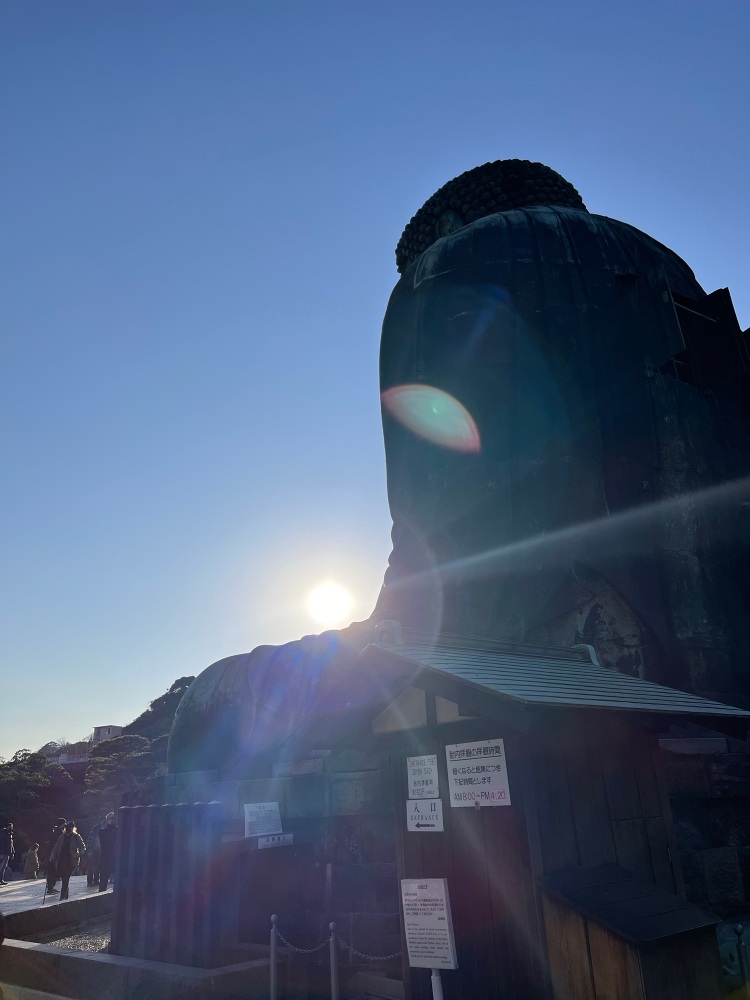
The Great Buddha of Kamakura statue (depicting Amida Buddha), taken in December 2022. I think my daughter might have snapped this photo, not me. I forget.

What’s important is that even if you are a crappy Buddhist, it’s OK. Obviously, like exercise and eating, Buddhist practice provides many positive benefits, so anything you can do, however often, is always worth the time and effort. However, if circumstances work against you, you do not need to punish yourself for your failings either. Like the woman of the night, sometimes life just gets in the way, but there’s no need to punish yourself for it. Amida Buddha’s light and goodwill extends to you just as it extends to others. Practice what you can, when you can, and Amida will guide you along the Buddhist path (via the Pure Land) somehow or some way.

Namu Amida Butsu

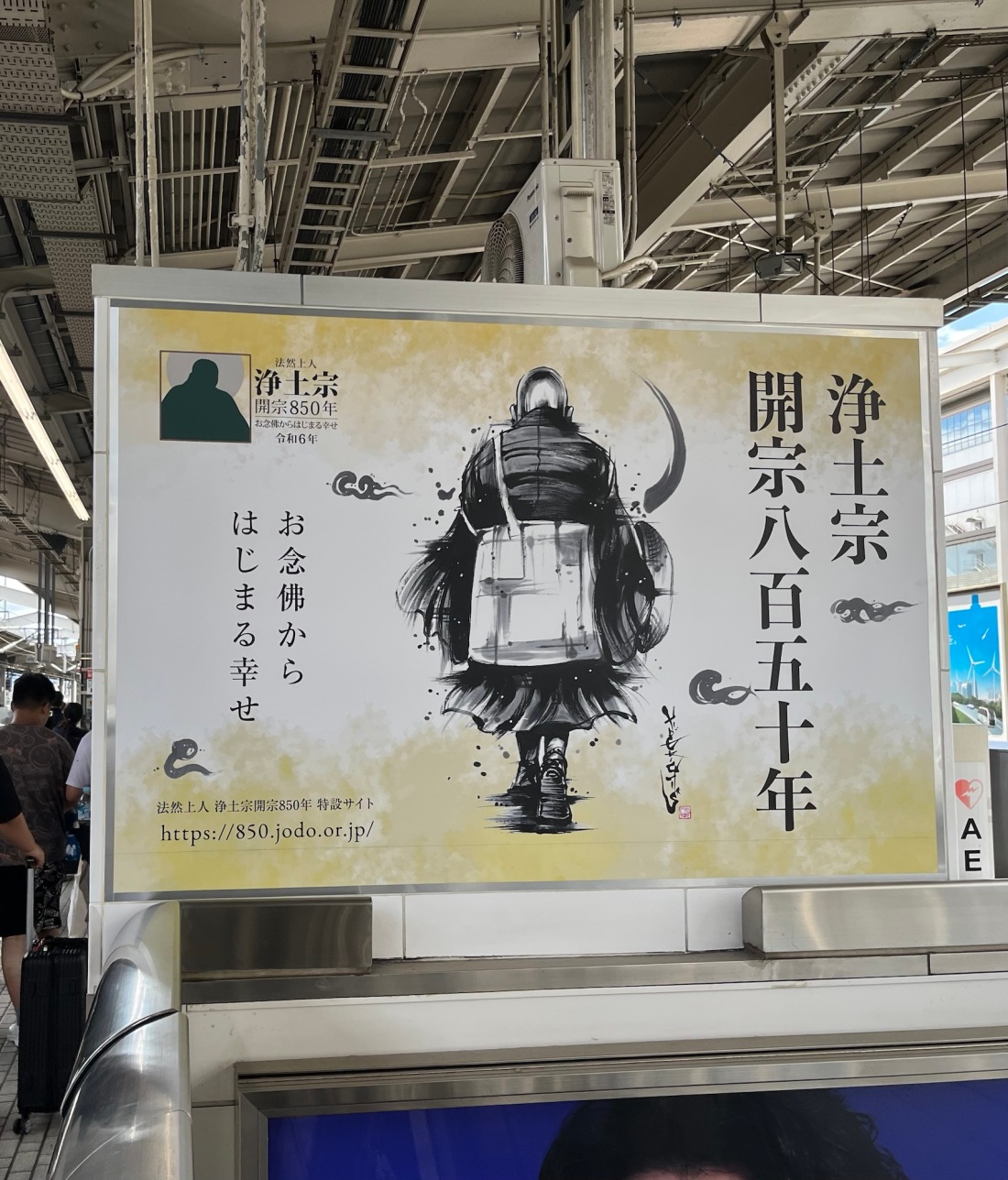
P.S. Featured photo is something I took at the Kyoto train station in summer 2023, part of a promotion to celebrate Honen’s 850th birthday. I always liked this poster, but couldn’t find a post I could work it into. 😅