Mindfulness Meditation Isn’t What You Think

Spock : “… I have noted that the healthy release of emotion is frequently very unhealthy for those closest to you.”

Star Trek, “Plato’s Stepchildren” (s3ep10), Stardate 5784.2

Meditation, specifically mindfulness meditation, is touted as a stress-relief exercise. Busy people believe that if they can block out the time to meditate for X minutes a day, or when stressed, this will make more happy and productive. It has been all the rage in Silicon Valley too.

But it doesn’t work.

It will calm your mind while you are sitting, but as soon as you are back to work, your blood pressure will quickly rise again. Old habits will quickly resurface. Self-help, in short, does not help.

How do I know this?

I tried the same trick in my late 20’s. My first child was born, and I was working at Amazon (yes, that Amazon) for a few years in a technical support role. The environment was stressful, demanding, constantly on the move, the on-call rotation gave little time to decompress because something was always broken,1 and I had to drive into work at all hours of the night to try and fix it.

Since I had recently converted to Buddhism at the time, and listened to a lot of Ajahn Brahm dharma talks, I wanted to try meditation. We had a spare office that no one used, so I would go in there once or twice a day, turn off the lights, dutifully sit, chant certain Buddhist mantras, meditate for 20 minutes or more, and then return to work.

As soon as I was back at my desk, the stress would rise all over again. I kept at the meditation for months, almost a year, before I finally gave up.

The stress, constant sense of inadequacy measuring myself to hyper-competitive co-workers who graduated from Stanford, unrealistic work performance goals, fear of losing my job, and so on simply didn’t go away until I QUIT MY JOB AND TOOK A LESS DEMANDING ONE.2

It took me years as a Buddhist to finally realize that stress-relief is not what mindfulness meditation was intended for.

Mindfulness meditation is a tool to develop insight, not stress relief. It is necessary in the early stages of meditation to quiet the chatter in the mind, but that is just the first stage. It is to remove barriers to insight by develop a focused mind, and a quiet mind, a mind that can perceive things in a more balanced way. Consider this quote from the Buddha in a very early text, the Dhammapada:

  1. There is no meditative concentration for him who lacks insight, and no insight for him who lacks meditative concentration. He in whom are found both meditative concentration and insight, indeed, is close to Nibbana.
  2. The monk who has retired to a solitary abode and calmed his mind, who comprehends the Dhamma with insight, in him there arises a delight that transcends all human delights.
  3. Control of the senses, contentment, restraint according to the code of monastic discipline — these form the basis of holy life here for the wise monk.
Translation by Soma Thera from https://www.accesstoinsight.org/tipitaka/kn/dhp/dhp.25.budd.html

The emphasis is on focus, insight, and contemplation NOT relaxation or stress-relief. Mindfulness meditation has been repackaged and sold to naive Westerners with false promises. Meditation really does provide excellent benefits, but it has to be done as part of a much larger, holistic lifestyle change and with wholesome intentions. This is the “holy life” as described by the Buddha: a life of wholesome, guilt-free conduct, goodwill towards others, and a desire to pursue the Dharma (the teachings of the Buddha).

First, one should take up the Five Precepts of Buddhism. As we see in verse 374 above, the Buddha openly encourages that we curb our worst behaviors first as a foundation for other Buddhist practice. One will gain no lasting benefit from meditation until this is done. Full stop.

Second, one must approach meditation with the mindset of a monk. It is not necessary for lay-people to give up everything and go live in the woods. Buddhism accommodates both the “house-holder” lifestyle and that of a true renunciant (a.k.a. a monk or nun). But both the renunciant and the house-holder are expected to live a life of moderation and restraint.3 Easier said than done (speaking as a gamer and foodie), but it’s a goal to sincerely aspire to.

Speaking of restraint, one should always guard one’s speech. A long time ago, a Buddhist minister I admired once told me that speech was like toothpaste: once it was out of the tube, you couldn’t put it back. One has to learn to carefully monitor what one says both in person and online (and yes, at work). Again, easier said than done, but the alternative will only make your life miserable.

Finally, when such good foundations are established, meditation will help you learn more about yourself, and the world around you.4 It’s incredibly helpful, and life-changing when carried to fruition. I have my own little private insights that have stayed with me through the years, and I hope you will find yours too.

Namu Amida Butsu

Namu Shakamuni Butsu

P.S. if you feel the need to calm yourself right away, try something much simpler. You can recite the nembutsu, the Heart Sutra, a mantra, whatever. Try that for a minute, and see if that works. It is a band-aid fix though, and you still need to approach things from a holisitic standpoint, or you will gain no long-term benefit. Alternatively, just go for a walk.

1 Years later, the sound of a pager going off still triggers me a little bit. No joke.

2 Another ex-Amazonian who had joined the same company years earlier confided in me that after leaving Amazon, he drank himself stupid for months to decompress. I noticed that I was still on a hair-trigger for months after leaving Amazon, and it took me a while to unlearn those habits too. My wife noted that my posture improved after leaving, and that I grumbled about work less. Some jobs are simply not worth staying in.

3 The Buddha was pretty flexible about what exactly this meant, citing whatever cultural standards applied at the time as a benchmark. In short, a lot of it is rooted in common courtesy and good sense. If you cannot act toward others using common courtesy, meditation ain’t gonna fix your issue.

4 You may learn that your whole problem is that your job sucks, for example, and that the burn-out is not worth the money. Of course, if you’re a single mom caring for three kids, you have a lot fewer options available to you, and in such cases I recommend the nembutsu as a starting point.

What is the Lotus Sutra?

One of the most influential sacred texts in Buddhism is the Lotus Sutra.

The Lotus Sutra has had a tremendous influence on Buddhism as we know it today. Much of Buddhist culture as we know it either came from the Lotus Sutra, or was influenced by its ideas and teachings. Not everything, of course. But the influence is hard to ignore. If you know the Lotus Sutra, a lot of things about Buddhist culture make more sense.

A copy of the Lotus Sutra enshrined at a Vietnamese Buddhist temple. Taken at Ksitigarbha Temple in Lynnwood, WA in 2013.

Because the Lotus Sutra has been translated to many different cultures at different times, it has had many names:

Original languageTitleRomanization
SanskritSaddharma Puṇḍarīka Sūtran/a
Chinese妙法蓮華經Miàofǎ Liánhuā Jīng
Vietnamese妙法蓮華經 (Han Nom)
Diệu Pháp Liên Hoa Kinh (modern)
n/a
Korean妙法蓮華經 (Hanja)
묘법연화경 (Hangeul)
Myobeop Yeonhwa gyeong
Japanese妙法蓮華経Myōhō Renge Kyō
Tibetanདམ་ཆོས་པད་མ་དཀར་པོའི་མདོDamchö Pema Karpo’i do

The full title in English is the Sutra on the White Lotus of the True Dharma, but usually we just call it the “Lotus Sutra”. Similarly, in other languages, the full title of the Lotus Sutra is shortened as well. For example, in Japanese, Myōhō Renge Kyō is shortened to Hokekyō.

But I digress.

The Lotus Sutra is not short, and for new Buddhists it is not easy to read. Composed in India in the first century CE, it is divided into 28 chapters, so it reads like a full book. Many of these chapters have a prose section, then repeats itself in one or more verse sections.1

Like all Buddhist texts, or sutras, it presents its teachings in the form of a sermon by the historical founder of Buddhism, Shakyamuni Buddha (“Shakyamuni” for short). Could the Buddha have given such a long, long sermon all in the span of one sitting? Probably not. But that’s how Buddhist sutras are usually presented.

A mural of the Buddha, attended by Bodhisattvas, at the Mogao Caves in Dunhuang, China. Photo taken by user scchoong123. Artwork is ancient and anonymous., Public domain, via Wikimedia Commons

Through the Buddha, the Lotus Sutra teaches many parables and similes to get its point across. Many of these parables took on a life of their own and frequently appear in Buddhist art or literature. Others are strange and obscure to modern readers. In fact, if you’re just reading the sutra for the first time, it really helps to have some kind of side-by-side guide to help make sense of it because if you tried to read it literally, you will get a headache. Thich Nhat Hanh’s book Opening the Heart of the Cosmos really helped me a lot.

For example, the chapter with the Sermon in the Sky, where a second Buddha named Prabhutaratna appears, and everyone flies up impossibly high to hear their sermon, and the Buddha projects himself across many worlds, is a difficult read. If you try to read at face-value, it reads like a fever dream.

A mural from the Yulin Grotto in China. See page for author, Public domain, via Wikimedia Commons
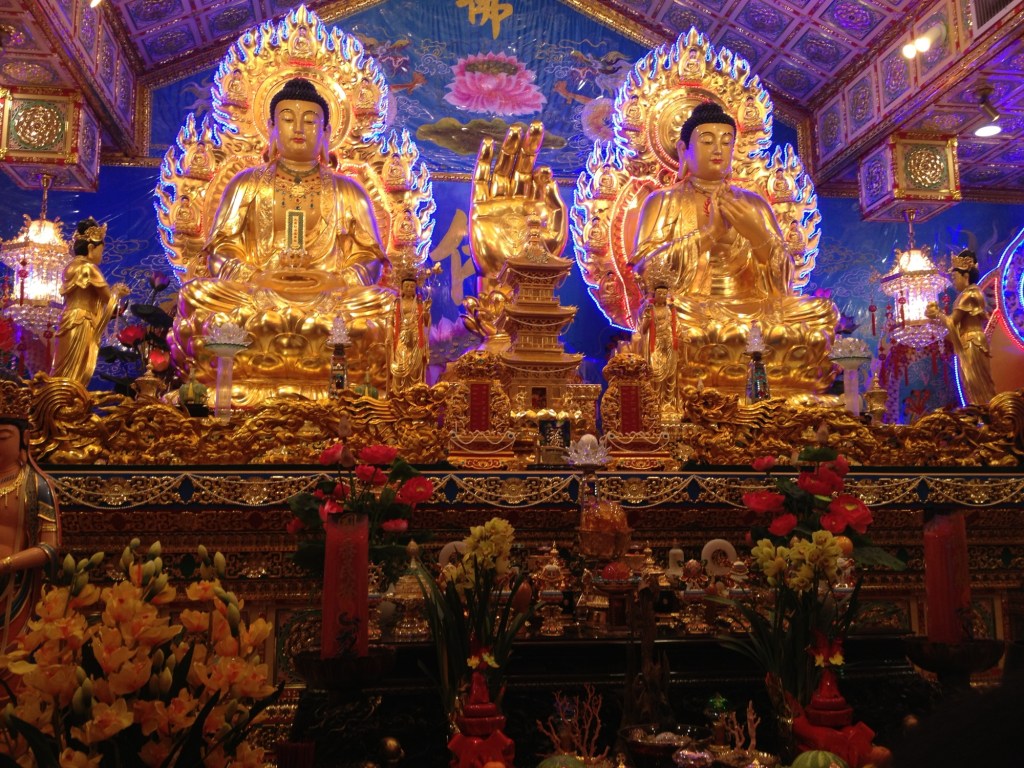
An altar revering the two buddhas, Shakyamuni and Prabhūtaratna, from the eleventh chapter of the Lotus Sutra, enshrined at a Vietnamese temple. Taken at Ksitigarbha Temple in Lynnwood, WA in 2013.

But the style of the Lotus Sutra isn’t to appeal to the head, it tries to appeal to the imagination. It is one thing to say that life is impermanent, it is another to describe the world as a great burning house, with people inside too distracted to notice. When the Buddha is shown projecting himself to countless worlds, it is just a colorful way of saying that the Dharma is everywhere, and there are countless buddhas across many worlds each preaching according to the environment. When the Buddha describes archetypal bodhisattvas in the later chapters, each one is meant to convey a different Buddhist virtue.

Deep stuff.

The Lotus Sutra was pretty radical for its time, and a core part of the larger Mayahana-Buddhist reform movement. The parable of the Dragon Princess, attaining enlightenment faster than any was obviously meant to blow the minds of the establishment, and challenge certain cultural prejudices about women, and so on.

A 12th century Japanese mural from the Heike Nokyo, depicting the Dragon Princess offering a jewel to the Buddha before transforming. Public domain, via Wikimedia Commons

Similarly, the chapter where countless streams of “bodhisattvas of the earth” emerge from the ground was meant to show how we didn’t need to rely on elite gurus, but that everyone had the capacity for being a bodhisattva too, if they just had the confidence.

I’ve talked about the main themes of the Lotus Sutra in an older post, but I wanted to cover two really important ones.

First, the most important teaching of the Lotus Sutra is probably the “One Vehicle” (Ekayāna) teaching. Previously, the reform Mahayana, or “great vehicle” Buddhists, bickered with the traditional Buddhist establishment (called Hinayana, or “small vehicle”), and traded barbs witih one another. You can see this is in some of the really early sutras composed by Mahayana Buddhists.

But then the Lotus Sutra took a step back and looked at the big picture, and taught that it was all just Buddhism (e.g. “one vehicle”) anyway. There were many places to start, and ways to move forward, but in time they would all converge, and the quality of one buddha was no different than another. What worked for one person didn’t necessarily work for another. There was no use bickering, any effort great or small was worth it.

Second, the other major teaching of the Lotus Sutra is that the Buddha was far, far older than history would tell us. The sutra implies that the Buddha would appear in some time and place, restart the Buddhist community, grow old and die, but that was just trick to keep people getting attached to the Buddha. This seems pretty disingenuous.

But what the sutra is trying to tell us is that the Buddha just personifies the Dharma (the teachings), and that the Dharma is the Buddha. Since the Dharma, the principle of existence, has always been around, in the same way one can see the Buddha also being around in one form or another, even in the darkest of times. Where does one begin, and the other end? I think the Mahayana Buddhists who composed it wanted people to stop getting hung up on the physical/historical Buddha, avoid a “cult of the Buddha”, and focus on the Dharma.

As a side note, the Lotus Sutra frequently promotes itself. It says that anyone who sincerely hears the Lotus Sutra, and praises it gets all kinds of benefits. But is not the Lotus Sutra as the written text from 1st century India. Like the “eternal Buddha”, this is the Lotus Sutra as the ultimate teaching (e.g. the Dharma) in its unvarnished form.

Thus, the Lotus Sutra is in some ways a very strange text because it is so dense with metaphor, simile and parables to get things across. But when you look at all the artwork and culture influenced by it, you can see that it gets something right. Rather than appealing to intellect, it conveys its messages through more impactful means. It is one of those texts that you keep referring back to over the years because it stands out so much.

Speaking from experience, it helps not to read it from cover to cover. Instead, focus on one chapter, try to suss out the meaning. Some chapters are, in my experience, a little bland, others are really moving. Sometimes a chapter won’t make any sense, then years later you will have an “ah ha” moment and you see it in a new light.

Speaking from experience. 😏

P.S. I probably own 3-4 translations of the Lotus Sutra, the Gene Reeves translation is probably the easiest for beginners in my opinion, but I like them all in their own way.

1 Researchers believe that the verses actually came first, and then the authors composed narrative around them.

Updates on my Buddhist Home Practice

Hello Dear Readers,

In June, I posted about the “day” and “night” concept used in Tendai Buddhist practice, using the example of the Jimon sect. I felt inspired to experiment a bit and try this out myself. My adjustments to home practice took a few twists and turns, but within a week or so I settled onto a consistent routine that I’ve been happy with.

Here’s what I’ve been doing for the past month, more or less.

For mornings, I focus on Kannon Bodhisattva:

For evenings, I focus on Amida Buddha:

I have found that splitting the practice like this has had some benefits. For me, this style of practice lets me cover both the here and now, through veneration of Kannon and reciting the Heart Sutra, while also looking to the future through venerating Amida Buddha through the evening practice. I feel pretty content covering both aspects.

I made both morning and evening routines intentionally short and lightweight so they are more sustainable, rather than doing something elaborate.

Still, to be honest, sometimes I am still too busy to even do this much. Or I just forget. 😅

I am not proud of that, but I felt I should be honest with readers and let them know that mistakes in Buddhist practice are perfectly OK. Life is unpredictable, and for us are “householders” (e.g. lay-Buddhists), life gets in the way. That’s why the monastic community was (presumably) created: to give people the option of practicing Buddhism full-time, not part-time.

That said, Buddhist practice is like exercise: the more you can do, the better. Even a little bit is a positive thing.

Anyhow, when I am simply busy, sometimes I will just recite either the Kannon mantra in the morning, or the nembutsu in the evening. Sometimes, I can only just bow at the altar for a moment.1 The Soto Zen resources I read previously often said much the same thing: adjust as needed, depending on how busy you are. Sometimes your home practice will be longer, sometimes shorter.

Just don’t give up.

Keep experimenting, keep trying, make it personal, and always be flexible.

Good luck and happy … er, “Buddhist-ing”.

P.S. I took a nice, relaxing weekend off to catch up on some things, avoid social media, and just unplug for a bit. I didn’t really have a plan, I just took a break. I may have also played some Fire Emblem games as well. The fun continues. 😀

1 To make this “split service” work, I have two altars now at home: the main one for Amida Buddha and tiny little “side altar” for Kannon on my bookshelf. It’s basic, but it’s something I can keep building on over time.

The Hymn of Zazen

Recently I stumbled upon a neat bit of Buddhist liturgy in the Rinzai Zen tradition called the Hakuin Zenji Zazen Go-Wasan (白隠禅師坐禅御和讃), or more simply the Zazen Wasan (坐禅和讃). This means “The Hymn of Zazen [of Zen Master Hakuin]”. In English it is sometimes called the “Song of Zazen”.1

Rinzai Zen is a somewhat unusual sect in Japanese Buddhism because although it was founded in the 12th century by Eisai (栄西, 1141 – 1215, alternatively called “Yosai”), and flourished for centuries alongside other Buddhist sects, the Rinzai Zen we know today is due in large part to the 18th century Zen master Hakuin (白隠, 1686 – 1769). We might think of Hakuin as a kind of reformer, or second founder.

The Hymn of Zazen is an exposition of Hakuin’s beliefs, the virtues of zazen meditation practice (especially compared to other Buddhist practices), and the nature of one’s own mind. It is regularly recited as part of Rinzai Buddhist liturgy as shown below:

Since I have a copy in Japanese, I decided to post here as a reference for others. I’ve posted the text in the original Japanese with Romanized (e.g. romaji) text. I am using the excellent translation by Robert Aitken Roshi as well, originally found here, and some proof-reading of the Japanese text using this site.

JapaneseRomanizationTranslation
衆生本来仏なり水と氷のごとくにてShujō honrai hotoké nari mizu to kōri no gotoku ni te
All beings by nature are Buddha, as ice by nature is water;
水を離れて氷なく衆生の外に仏なしMizu wo hanarete kōri naku shujō no hoka ni hotoké nashiApart from water there is no ice, apart from beings no Buddha.
衆生近きを不知らずして遠く求むるはかなさよShujō chikaki wo shirazu shite tōku motomu hakanasayo
How sad that people ignore the near and search for truth afar,
譬ば水の中に居て渇を叫ぶがごとくなりTatoeba mizu no naka ni ite katsu wo sakebu gotoku nariLike someone in the midst of water crying out in thirst,
長者の家の子となりて貧里に迷うに異ならずChōja no ié no ko to narite hinri ni mayō ni kotonarazuLike a child of a wealthy home wandering among the poor.
六趣輪廻の因縁は己が愚痴の闇路なりRokushū rinne no innen wa onore ga guchi no yamiji nariLost on dark paths of ignorance we wander through the six worlds,
闇路に闇路を踏そへていつか生死をはなるべきYamiji ni yamiji wo fumisoete itsuka shōji wo hanarubekiFrom dark path to dark path we wander, when shall we be freed from birth and death?
夫れ摩訶衍の禅定は称歎するに余りありSore maka-en no zenjō wa shōtan suru ni amari ariFor this the zazen of the Mahayana deserves the highest praise.
布施や持戒の諸波羅蜜念仏懺悔修行等Fuse ya jikai no sho haramitsu nenbutsu sange shugyō tōOfferings, precepts, paramitas, Nembutsu, atonement, practice—
其の品多き諸善行皆この中に帰するなりSono shinaōki sho zengyō mina kono naka ni kisuru narithe many other virtues—all rise within zazen.
一座の功をなす人も積し無量の罪ほろぶIchiza no kō wo nasu hito mo tsumishi muryō no tsumi horobuThose who try zazen even once wipe away immeasurable crimes—
悪趣何処にありぬべき浄土即ち遠からずAkushu izuku ni arinu beki
Jōdo sunawachi tōkarazu
where are all the dark paths then? The Pure Land itself is near.
辱なくも此の法を一たび耳にふるる時Katajikenaku mo kono nori wo hitotabi mimi ni fururu tokiThose who hear this truth even once and listen with a grateful heart,
讃歎随喜する人は福を得る事限りなしSantan zuiki suru hito wa
fuku wo uru koto kagiri nashi
treasuring it, revering it, gain blessings without end.
いはんや自ら回向して直に自性を証すればIwanya mizukara ekō shite
jiki ni jijō wo shō sureba
Much more, if you turn yourself about and confirm your own self-nature—
自性即ち無性にてすでに戯論を離れたりJijō sunawachi mushō ni te
sude ni keron wo hanaretari
that self-nature is no nature—you are far beyond mere argument.
因果一如の門ひらけ無二無三の道直しInga ichinyo no mon hiraké
muni musan no michi naoshi
The oneness of cause and effect is clear, not two, not three, the path is put right;
無相の相を相として行くも帰るも余所ならずMusō no sō wo sō toshite yuku mo kaeru mo yoso narazuwith form that is no form going and coming never astray,
無念の念を念として
謡うも舞ふも法の声
Munen no nen wo nen toshite utau mo mau mo nori no koéWith thought that is no thought singing and dancing are the voice of the Law.
三昧無碍の空ひろく
四智円明の月さえん
Zanmai muge no sora hiroku shichi enmyō no tsuki saenBoundless and free is the sky of samadhi! Bright the full moon of wisdom!
此時何をか求むべ寂滅現前するゆえにKono toki nani wo ka motomu beki jakumetsu genzen suru yue niTruly is anything missing now? Nirvana is here, before your eyes,
当所即ち蓮華国此身即ち仏なりTōsho sunawachi rengekoku
kono mi sunawachi hotoke nari
this very place is the Lotus Land, this very body the Buddha.

As Zen is not my forté, I admit I don’t fully understand the meaning of this hymn, and it’s interesting that Hakuin praises zazen in such a way that other Buddhist practices arise from it. This reminds me of Shinran’s teachings in Jodo Shinshu whereby the nembutsu encompasses all the virtues of other acts. To some degree, every Buddhist sects inevitably makes this assertion.

That said, I think it’s a very nice exposition of Rinzai Zen thought, and along with my experiences at Ryoanji Temple (a Rinzai temple) in Kyoto last year,2 it certainly inspires me to keep exploring Rinzai teachings further.

Namu Shakamuni Butsu

P.S. Featured photo is Hakuin Ekaku (self-portrait), Public domain, via Wikimedia Commons

1 I am quibbling here, but wasan (和讃) is better translated as a hymn in my opinion, not a song (uta 歌), even though a “hymn” means something different in Buddhism than it would in Christianity. You can find examples of wasan in Jodo Shinshu Buddhism, composed by its founder Shinran, as well.

2 Technically, the Golden Pavilion, which we also visited, is also a Rinzai Temple too. I will probably write about the Five Mountains system of the Ashikaga Period soon, but I am brushing up on some old books first for research. It’s not a small topic.

The Best Buddhist Practice is the One You Are Already Doing

As a perfectionist, I am often plagued by self-doubt about my Buddhist practice and frequently question whether I am doing it right, whether I am doing the right practices to begin with, and so on. I’ve talked about the fundamentals of Buddhism, and how they apply to any sect or teaching on follows, but when you get into the finer details of how to put these into practice, it can feel daunting.

Recently I was reading an article in Japanese by the Soto Zen center in Kinki1 Region that I found very helpful. If you can use Google Translate to read it, I think it is well worth it. But the quote I really liked was:

おつとめの手順としては「信は荘厳(しょうごん)から」といわれるように、まず、お給仕からはじまります。

As for the process of doing a home Buddhist practice, It is said that “faith begins with solemnity” and in the same way Service [at a restaraunt] begins with waiter.

I think this is important because Buddhist home practice (otsutomé おつとめ, in Japanese) isn’t meant to be something you do to show off, because you are obligated to, to get relaxation from, or to get a spiritual thrill from either. The form of the practice isn’t so important as the spirit of solemnity.

As the article points out, we Buddhists (focus on Zen Buddhists in the article, but it applies to all of us) are trying our best to put the historical founder, Shakyamuni Buddha’s, teachings into practice according to our circumstances. We are not given much instruction in life, and each has our own partial understanding of things, not to mention the conditions we grow up under. So, we have to adapt the teachings of the Buddha accordingly. But if we do it in a spirit of solemnity, not frivolity, obligation, nor conceit, then we will make progress.

Thus, I realized that whatever Buddhist practice you are already doing is probably the right one, as long as you are doing it with the right attitude.

Similarly, I was watching a video in Japanese by a Soto Zen monk who often provides very practical advice, but also hides his identity:

Around 5:00 onward, he talks about how people who first get into Buddhism, or a particular teaching or sect are often very overeager and want to dive in and do a lot of practices. Or, they see the official liturgical format and feel that they have to do everything (I am one of those people).

Instead, he uses the analogy of a restaurant, with a menu of choices. All the choices are great, but can be overwhelming if you try to order everything, so he suggests you start small. In his example, reciting the Heart Sutra daily is a good foundation. If you do this for a while, and it feels like something is missing, you can add additional liturgy or practices based on what’s recommended. Or if it feels like too much, pare back a little.

The key is daily practice. It’s not super important how you do it, just consistency and right attitude. If you are already doing this, then keep it up, and don’t get bogged down in details.

Namu Shakamuni Butsu

1 The “Kinki” region in Japan is just another historical term for the Kansai region of Western Japan. The first time I heard this word in Japanese, I was very confused. 🤦🏼‍♂️

Pure Land Buddhism: Just As I Am

Something I was thinking about lately while pondering this famous tale between 12th century Japanese monk, Honen, and a woman of the night. Honen’s advice to the woman was non-judgmental but a genuine concern for her well-being, and at the same time, it also acknowledged her circumstances.

Something I’ve always liked about the Pure Land Buddhist path is its openness. The light of Amida Buddha calls to all beings, regardless of their background and circumstances, or their accomplishments as Buddhists (or non-Buddhists) and unconditionally leads them to the Pure Land. How one interprets Amida, the Pure Land and such doesn’t really matter. What’s important is that Amida accepts all beings as they are, and leads them forward.

And so, when I was thinking about this, I realized that if Amida Buddha accepts you for who you are, then it makes sense to do the same.

Thinking about the woman of the night that Honen encountered, it made me realize that Pure Land Buddhism is a great expression of Buddhist metta, or goodwill.

This is not exclusive to Pure Land Buddhism, though. In Theravada Buddhism, there is the practice of metta meditation (separate from mindfulness meditation), and Zen similarly teaches contentment with oneself and the world around you. So, each tradition in Buddhism takes metta as a core teaching and find different ways to express and foster it.

The accessibility, simplicity and portability of Pure Land Buddhism makes it ideally suited for everyday folks. As a foundation, one can then explore other aspects of Buddhism, or be content with the nembutsu.

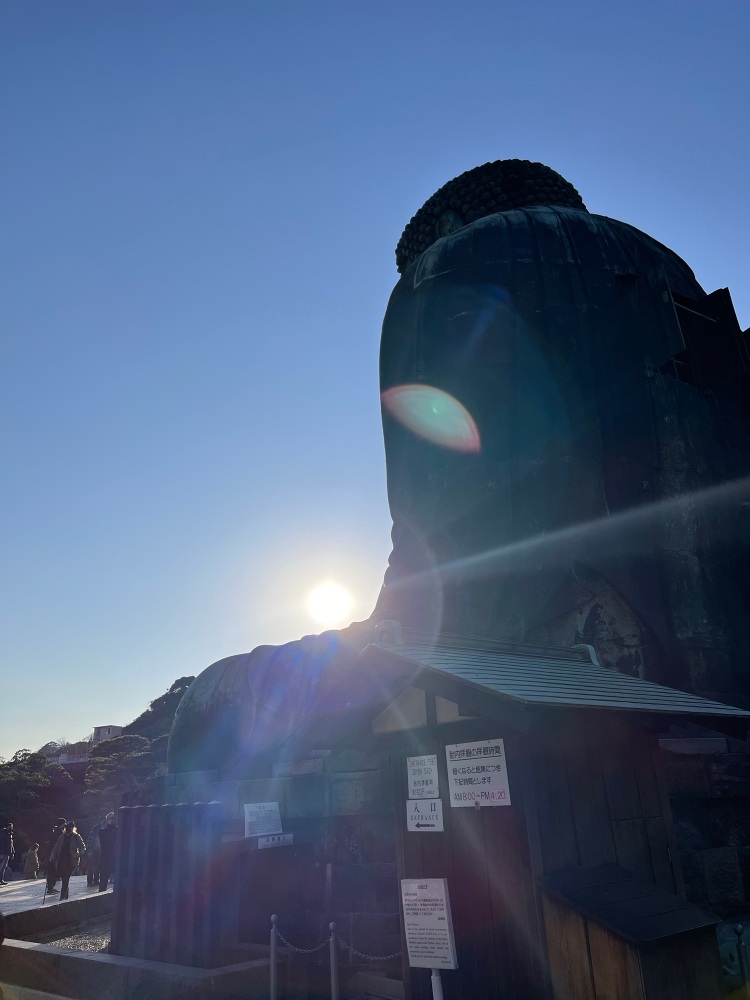
The Great Buddha of Kamakura statue (depicting Amida Buddha), taken in December 2022. I think my daughter might have snapped this photo, not me. I forget.

What’s important is that even if you are a crappy Buddhist, it’s OK. Obviously, like exercise and eating, Buddhist practice provides many positive benefits, so anything you can do, however often, is always worth the time and effort. However, if circumstances work against you, you do not need to punish yourself for your failings either. Like the woman of the night, sometimes life just gets in the way, but there’s no need to punish yourself for it. Amida Buddha’s light and goodwill extends to you just as it extends to others. Practice what you can, when you can, and Amida will guide you along the Buddhist path (via the Pure Land) somehow or some way.

Namu Amida Butsu

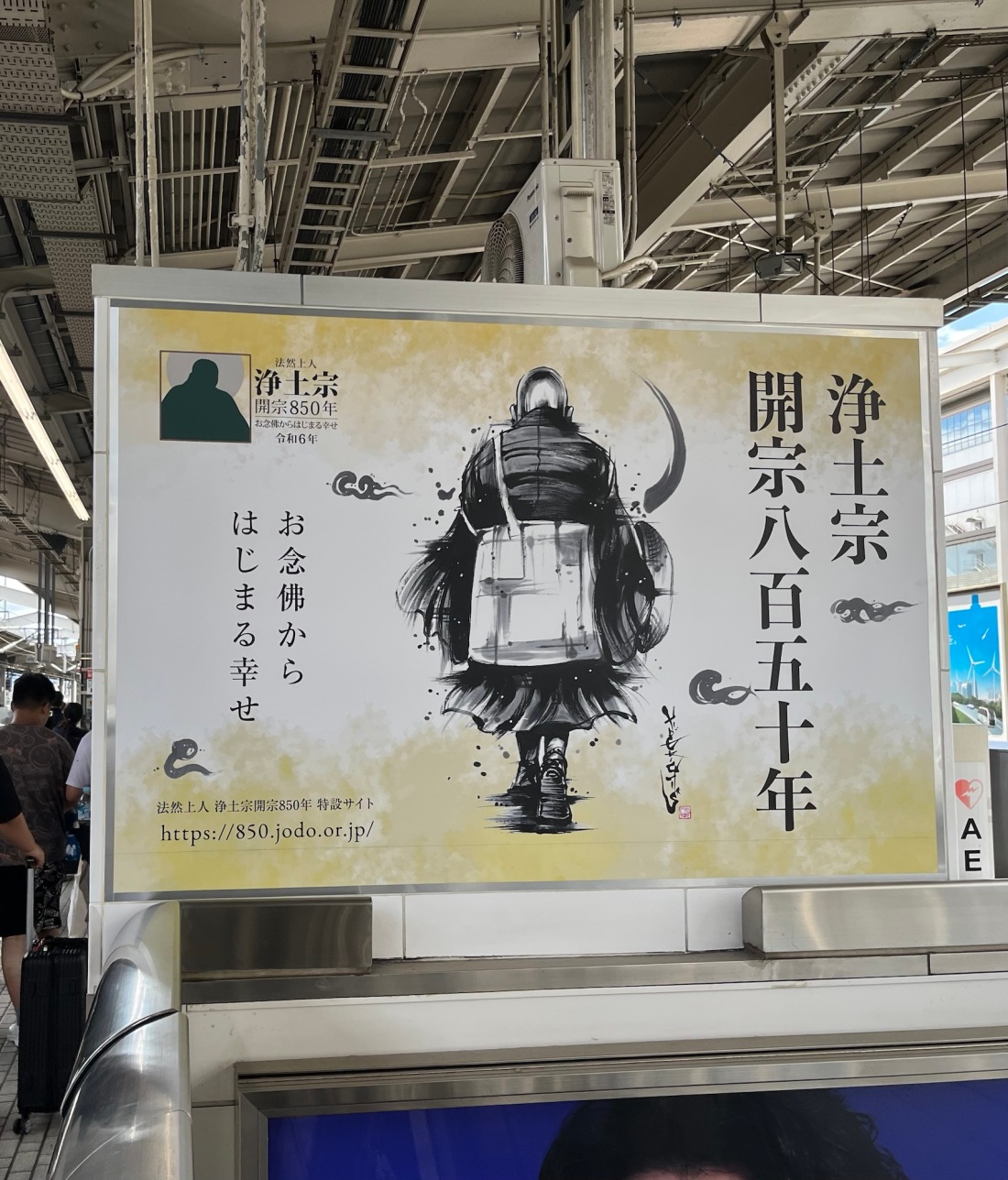
P.S. Featured photo is something I took at the Kyoto train station in summer 2023, part of a promotion to celebrate Honen’s 850th birthday. I always liked this poster, but couldn’t find a post I could work it into. 😅

Inattention

Photo by Gleb Dolskiy on Pexels.com

A while back, I talked about a famous poetess from 11th century Japan named Lady Izumi, one of several famous ladies of the court at that time, but for some reason the one I find most fascinating.1 Lady Izumi was a prolific poet, and I have been reading samples of her poetry compiled in The Ink Dark Moon by Jane Hirshfield and Mariko Aratani. I found this poem the other day and wanted to share. The headline of the poem was that Lady Izumi was on retreat while on retreat at a mountain temple in autumn…

Original JapaneseRomanizationEnglish translation*
心にはKokoro niwaAlthough I try
ひとつみのりをHitotsu minori woto hold the single thought
思へどもOmoe domoof Buddha’s teaching in my heart,
蟲のこゑこゑMushi wa koegoeI cannot help but hear
聞ゆなるかなKikoyu naru kanathe many crickets’ voices calling as well.
* Translations by Jane Hirshfield and Mariko Aratani

I think this speaks to the classic frustration many Buddhists (among others) have: the willingness to undertake a practice, and the reality of not being able to stay focused. If it were easy, we’d probably all be doing it.

Lately, in an effort to reconnect to the local Buddhist community, and due to recent experiences in Victoria, BC, I decided to join a local Soto Zen group for remote meditation sessions. It’s been great actually: I have something in the week to look forward to besides more work meetings, and it provides a nice spiritual anchor in my life again. However, I noticed that while meditating for 25 minutes at a time, my mind rarely stays focused for long. Sometimes I can discipline myself for a few minutes, counting my breaths, etc. However, most of the time my mind is just wandering around for most of the session.

When I was younger and first encountered the nembutsu, I used to dedicate myself to reciting the nembutsu 1080 times (using my rosary to help count). Usually this takes about 15-20 depending on the speed of recitation. I (surprisingly) continued this practice for months. However, I also noticed a pattern: my mind would quickly grow bored from reciting, then anxious to hurry up and finish, and then relief when I got near the end. My mind would wander, just as it does with meditation.

So, the experience that Lady Izumi has is not unique to her, and even now, a thousand years later, I can empathize with her.

Further, I don’t think there’s an easy solution here: it’s something that every one has to work out for themselves.

Namu Amida Butsu

1 Speaking of fascinating, you might like to read my review of the Diary of Lady Murasaki, her contemporary on my other blog. Lady Murasaki evidentially didn’t think too highly of Lady Izumi.

Meanwhile Life Goes On

A close-up of a honeybee landing on a flower growing from a blackberry bush.

It’s easy to forget amidst all the stresses of life, especially life now, that life goes on. If nothing else, take time today to get some fresh air and maybe meditate for five minutes. It will help provide a more healthy perspective. 🙂

P.S. Another older post on the subject.