This troubled planet is a place of the most violent contrasts. Those who receive the rewards are totally separated from those who shoulder the burdens. It is not a wise leadership….
Star Trek: The Original Series, “The Cloud Minders” (s3ep21)
The classic Star Trek episode, “The Cloud Minders”, is a fun episode late in the third season that explores a society that is separated into two social classes: the intellectual class living in the clouds and a working-class that lives below in the mines.
Years later, in the Japanese game Chrono Trigger, a similar theme was explored with a society that lived around 12,000 BC that had an elite intellectual class living in the clouds, and a worker class that lived in the icy wastes below.
It’s fascinating, if not somewhat disturbing to see real-life examples of this too. As much as I admire the Heian Period of Japanese culture, it’s not hard to see parallels: an elite literati that sits around and writes poetry all day, and a much larger illiterate peasant class that toils in the fields for their benefit. The inequality is disturbing.
Indeed, this pattern repeats over and over again in human history, regardless of time or place. There is even a political theory toward this end call the Iron Law of Oligarchy. Are we not also living under some form of oligarchy even today?
Further, the more that people “in the clouds” become cut off, the harder it is to develop empathy for those who toil, and easier to just blame them for their own predicament. This is the very antipathy of metta in Buddhism, the goodwill towards all beings, big or small, smart or foolish.
In some ways, the early Mahayana-Buddhist texts such as the Lotus Sutra or Three Pure Land Sutras1 were pretty revolutionary texts. The famous 12th chapter of the Lotus Sutra, and its story of the Dragon Princess deserves a look. In this story, the daughter of the Dragon King under the sea is introduced as a being of great wisdom despite only being 8 years old. The Buddha’s disciple Shariputra, representing the conservative faction of the Buddhist community scoffs at this:
At that time Shariputra said to the dragon girl, “You suppose that in this short time you have been able to attain the unsurpassed way. But this is difficult to believe. Why? Because a woman’s body is soiled and defiled, not a vessel for the Law [the Buddha-Dharma]. How could you attain the unsurpassed bodhi [awakening]? The road to Buddhahood is long and far-reaching. Only after one has spent immeasurable kalpas [eons] pursuing austerities, accumulating deeds, practicing all kinds of paramitas [self-perfections], can one finally achieve success. Moreover, a woman is subject to the five obstacles….”
The Dragon King’s daughter rebuffs Shariputra’s criticism and wows them all:
At that time the members of the assembly all saw the dragon girl in the space of an instant change into a man and carry out all the practices of a bodhisattva, immediately proceeding to the Spotless World of the south, taking a seat on a jeweled lotus, and attaining impartial and correct enlightenment. With the thirty-two features and the eighty characteristics [signs of a Buddha], he expounded the wonderful Law for all living beings everywhere in the ten directions.
The intended message here may seem a little strange to modern audiences. This was written for a patriarchal society in antiquity, but it’s clear the Lotus Sutra taught all beings, regardless of gender, age, or even human vs. non-human status, are equally capable of Buddhahood (full enlightenment) if given the chance. When they are not, society is stifled and suffers.
In the same way, when society maintains inequality for the sake of a few, or for the sake of tradition, it degrades society by robbing it of vitality and well-being for all.
Home services in Japanese Buddhism, known as otsutomé (お勤め) or more formally gongyō (勤行), have many different approaches. It often depends on sect, particular communities, and personal preference. Trouble is, English sources are often confusing or insufficient. So, I try to look up information in Japanese, which is sometimes harder than you might think.
Anyhow, something I’ve learned recently about Tendai Buddhism, is that at least in some Tendai traditions, home practice might be divided between a morning service and a night service. This is in keeping with the two concepts in Tendai (more on that here):
Hokké Senpō (法華懺法) – reverence for the Lotus Sutra, the foundation for Tendai Buddhism, and for much of Mahayana Buddhism.
Reiji Sahō (例時作法) – reliance on Amida Buddha to help deliver oneself (and others) from this world of frustration and fear.
Thus, in lay-Buddhist home services for Tendai Buddhism, some communities tend to divide the morning versus evening services to reflect these two concepts.
This page from the Jimon-branch of Tendai Buddhism, based in the famous Mii-dera Temple (as opposed to the Sanmon-branch based in Enryakuji atop Mount Hiei) shows example services for both morning and evening. I can’t translate everything word for word from the site, but let me try to summarize the basic format.
Morning Service
For the morning service, one pays homage to the Buddhas and Bodhisattvas “of the ten directions”1 and takes the Lotus Sutra as their basis. The morning service cited in the Jimon-sect page is based on a treatise by founder Saicho called the Hokke Sanmai Gyōhō (法華三昧行法), and for some reason is much shorter than the evening service.
The morning service is comparatively short, but includes liturgy such as:
I left out some of the liturgy from this list because I could not find details, or they were very specific to the Jimon sect (e.g. praises of Saicho’s disciple Enchin, who is the source of the Jimon branch), but hopefully you get the idea. This emphasizes the here and now, and seems rooted in the hokke senpo side of Tendai Buddhism to me.
Evening Service
The evening service by comparison uses the Amitabha Sutra as its basis and includes somewhat different liturgy.
Dedication of Merit for Rebirth in the Pure Land (this differs slightly from the morning service version).
It’s interesting to note that the evening service still includes verses from the Lotus Sutra, but also mixes the Nembutsu and Mantra of Light as well and definitely emphasizes the reiji saho side of Tendai.
Conclusion
As these are services associated with just one sub-sect of Tendai, and since people often add, subtract or adapt services to meet their needs, it’s perfectly fine to adjust this to whatever works in your situation. You could potentially reduce this all the way down to reciting the Heart Sutra in the morning, and the nembutsu at night. Or something similar. As long as it is sustainable, and captures the spirit of Hokke Senpo and Reiji Saho.
The themes of morning services expressing hokke senpo, and evening services expressing reiji saho, are a great way to apply Tendai teachings in one’s own life, or just Mahayana Buddhism in general.
P.S. features the gardens of Mii-dera temple, photo by E5894, CC BY-SA 3.0, via Wikimedia Commons
1 The eight cardinal directions, plus up and down.
June 4th is the yearly memorial service in Japan’s Tendai sect of Buddhism called Sangé-é (山家会) for its founder, Saichō (最澄, 767 – 822). I am writing this post a bit late this year, but I wanted to explore the life of Saicho a little bit and why he matters.
Saicho as depicted in a Heian-Period painting.
If you look at the history of Japanese Buddhism, Saicho doesn’t elicit much historical attention and discussion, even compared to contemporary rivals at the time like Kūkai, founder of Shingon-sect Buddhism. Yet, the sect he founded in Japan was overwhelmingly the largest and most influential for centuries (probably too much so), until it finally faded into the background in the late medieval period. This is why you rarely see mention of Saicho or Tendai these days: it’s far smaller now than it was in the past.
Also, to confuse matters further, Saicho is only the founder of the Japanese branch of Tendai. It was the Buddhist monk Zhi-yi (智顗, 538 – 597), who originally started the Tian-tai (天台) sect in China in the 7th century and it remains a very influential sect across many areas of mainland-Buddhist Asia (Korea, Vietnam, etc). Tian-tai in Japan (pronounced as Tendai) reveres Zhiyi as well.
Anyhow, Saicho was a monk at a time when Buddhism had already been established in Japan, primarily around the old capitol of Nara, yet was limited to a very tightly regulated number of schools and monks per school. Besides the Yogacara (Hossō) and Huayan (Kegon) schools, the rest are very obscure today. These schools had all been imported from Tang-Dynasty China, and represent “branch” schools to the mother temples there. The existing schools at that time were obligated to perform rituals on behalf of the Emperor to prevent calamities, cure diseases, bring prosperity to the nation and other political needs. In turn, the government allocated new acolyte monks every year, and allowed them to continue. However, beyond that, Buddhism had very little reach in the rest of Japanese society. This is very different than the bottom-up approach in China.
Saicho was ordained as an official monk, but soon left and retreated to Mount Hiei where he underwent ascetic practices, rather than stay in the urban temple complexes. In time, he attracted other like-minded disciples, and a small, informal monastic community developed there on the mountain. Further, he carved an image of the Medicine Buddha, and later lit an oil lamp in reverence to the Buddha, praying that the light would never be extinguished. This lamp, the Fumetsu no Hōtō (不滅の法灯) was the subject of a previous post. By this point, the foundations of the temple of Enryakuji were laid.
Later, by a lucky coincidence, the capitol of Japan was moved away from Nara to Kyoto (back then Heian-kyō) in 795. Since Mount Hiei happened to be to the northeast of Kyoto, and since the northeast was considered an inauspicious direction in classic Chinese geomancy, the presence of a Buddhist temple there (namely Enryakuji) helped protect the new capital from negative influences. The Emperor, for his part, saw this new Buddhist sect has a counterbalance to the old guard sects in Nara. Thus, Saicho’s star quickly rose.
The Eastern Pagoda (Buddhist stupa), of Enryakuji Temple, 663highland, CC BY-SA 3.0, via Wikimedia Commons
Now with sponsorship from the new Imperial court, Saicho was dispatched to sail back to China in 804, gather more resources and help bring Buddhism to a wider audience. On the same diplomatic mission, another promising young monk named Kūkai was also dispatched. More on him later. Of the four ships that sailed out to sea, only 2 survived a storm at sea (Saicho and Kukai were each aboard one of the surviving ships).
Saicho’s had mixed success in China. He did not speak Chinese (he could only read it), but was able to get official permission from the Chinese government to travel to Mount Tiantai. There he stayed for 135 days. Saicho later received limited training in esoteric Buddhism, which was all the rage in Tang-Dynasty China (and Japan at this time). It wasn’t until the second generation of Tendai monks who went to China (Ennin for example) that esoteric training really developed in the Tendai sect in Japan. Saicho also copied many sutras and texts in order to provide fresh copies back in Japan (printing did not come until much later, despite flourishing in China).
Guoqing Temple (guó qīng sì, 国清寺) on Mount Tiantai, head of the Tiantai Order. Photo by Joshtinho, courtesy of Wikimedia Commons.
Nonetheless, when Saicho returned to Japan 8 months later, he was feted for his accomplishments. He got to work using his newfound training, and his collection of sutras brought back from China to petition the Emperor to start a new sect derived from the Chinese Tiantai Buddhism he trained under. Saicho’s vision was slightly different than Tiantai Buddhism, particularly because he envisioned a purely “Mahayana” sect, not just a sect with Mahayana Buddhism on top of earlier Buddhist tradition. This meant different ordination platforms, different training, etc. It was a big controversy at the time, and the powerful Yogacara (Hossō in Japanese) school based in Nara really gave him grief over it.2
In Dr Paul Groner’s book on Saicho, he explains Saicho’s vision further:
In his works directed against Tokuitsu and the Hossō [Yogacara] School, Saichō argued that all people had the Buddha-nature [capacity for Enlightenment] and could attain Buddhahood. Receiving the Fan wang [Bodhisattva precepts] ordination and adhering to the precepts were religious practices open to anyone. Anyone could receive a Fan wang ordination and anyone who had been correctly ordained could in turn confer the Fan wang precepts on others….
Saichō envisaged a system in which Tendai monks would be trained for twelve years on Mount Hiei and then go to live in the princes in order to perform good works, to preach, and to confer Fan wang ordinations.
Page 179
Further, Saicho really took the idea of unifying different Buddhist practices and traditions into an “umbrella tradition” to a new level. It wasn’t enough that the Lotus Sutra was the highest teaching (per Tiantai tradition), he wanted to really absorb other practices and traditions toward that end, and diffuse them across the country in a religious community that blurred the traditional lines between monks and laity.
Saicho’s zeal, his rising status in the new Imperial court at Kyoto, and his fresh training gave him a lot of leeway, and the Emperor granted his request. Thus, Tendai Buddhism (the Japanese branch of Tiantai) was born. It has a deep connection with the mother sect in China, but Saicho also added some innovations to it as well.
Saicho’s star was soon eclipsed after the other monk from the same diplomatic mission, Kūkai, who returned some time later and brought an extensive training program in esoteric Buddhism (something Saicho had only a partial training of). Because esoteric Buddhism was all the rage (until the Purge of 845), Kukai’s training and religious material he imported outshone Saicho. Kukai and Saicho tried to maintain a cordial relationship, but Saicho wasn’t willing to train under Kukai, and Kukai kept poaching disciples of Saicho’s so the two groups became somewhat acrimonious over time.
Saicho proved throughout his life that he was dedicated to the Lotus Sutra and the Buddhist path. He was a sincere ascetic in his youth, rather than a “career monk” like many others of his time, and held himself to high standards. The fact that attracted like-minded people around him, shows that he “walked the talk” too. In China, he underwent many trainings, copied many sutras, and didn’t stop learning and improving. It should be noted that Kukai and Saicho were both pioneers for journeying to China to bring back more Buddhist teachings, rather than past schools that relied on foreign monks to make the journey to remote Japan.
If Saicho had any virtue, it was zeal.
If Saicho had any fault, it was that he was perhaps stubborn.
Personally, I like Saicho, flaws and all. Like, I would have loved to sit with him on those early days on Mount Hiei, swap practice tips, get his advice, etc. I really like his enthusiasm and positivity. Much like Honen centuries later, Saicho was bold and motivated by sincere conviction. The Tendai sect morphed into something that I don’t think he anticipated but personally I blame politics more than the founder.
But anyway, this is all just my opinion.
As for me, I did an extra long home service for Saicho this week in his honor.
1 Devout Buddhists in early Japanese history, such as Prince Shotoku, were devotees of the Lotus Sutra as well, but I don’t think there was any effort in those days to elevate it to the highest teachings, let alone make a new sect out of it. It was just there as part of the larger tradition.
2 Acrimony between Tendai and Hosso schools of Buddhism continued for centuries, starting with Saicho’s disagreements with one Tokuitsu of Hossō. Both sects frequently faced off during official Buddhist debates at the Imperial court as well.
For today, we are looking at the Chapter Twenty. This chapter features a bodhisattva named Sadāparibhūta, who in Chinese was named 常不輕菩薩 (cháng bù qīng púsà), which in turn became jōfukyōbosatsu in Japanese. In English, we translate this as the Never-Disparaging Bodhisattva.
The story of Chapter Twenty is that Never-Disparaging Bodhisattva previously lived as a simple, unlettered monk during a past aeon where the Buddhist monastic community was arrogant and domineering. Nonetheless, this humble monk always bowed to other monks, nuns and laity stating that they would one day become Buddhas themselves.
As an uneducated monk making such bold statements, the other monks and nuns found him presumptuousness (I would have appreciated the compliment, personally), and assaulted him. Rather than fighting back, he would retreat and then bow toward them from a distance, still acknowledging their inherent Buddha-nature (e.g. they had the capacity to become Buddhas someday).
This continued on for years, yet the monk never got angry and continued venerating those around him. When he was finally on his deathbed though…
…he heard up in the sky fully twenty thousand, ten thousand, a million verses of the Lotus Sutra….and he was able to accept and uphold them all. Immediately he gained the kind of purity of vision and purity of the faculties of the ear, nose, tongue, body and mind….Having gained this purity of the six faculties, his life span was increased by two hundred ten million nayutas of years, and he went about widely preaching the Lotus Sutra for people.
Translation by Dr Burton Watson
The monks, nuns, and laity were astounded by the transformation reformed their ways, becoming sincere disciples. The chapter then ends in a lengthy series of “plot twists” where such and such person in that past aeon was now a disciple in Shakyamuni’s retinue, while Shakyamuni himself was originally Bodhisattva Never-Disparaging.
I say this a bit tongue-in-cheek because the narrative style of the Lotus Sutra can feel a bit forced at times to modern audiences. However, the underlying message is really profound and something I think about regularly, especially when someone really annoys me.
Chapter Twenty is all about forbearance.
This isn’t a new teaching within Buddhism. You can find many similar teachings on forbearance in older texts such as Pali Canon (example here), the Dhammapada, and also one of the SixPerfections. From the very beginning, Buddhism elevated forbearance as a crucial teaching. It is central to the concept of goodwill in Buddhism.
3. “He abused me, he struck me, he overpowered me, he robbed me.” Those who harbor such thoughts do not still their hatred.
4. “He abused me, he struck me, he overpowered me, he robbed me.” Those who do not harbor such thoughts still their hatred.
The Dhammapada, translation by Ven. Acharya Buddharakkhita
What makes the Lotus Sutra approach interesting is the use of simile and archetypal characters. Nonetheless, even in a later text like the Lotus Sutra, the message remains the same: a disciple must always practice forebearance and avoid ill-will towards others if they intend to attain a state of peace.
This is harder than it sounds, believe me.
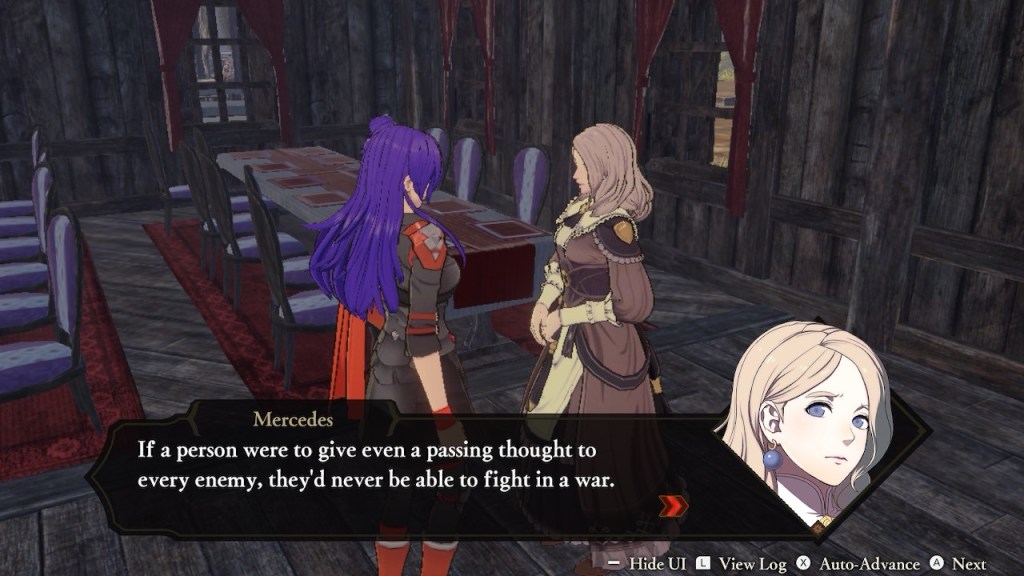
A scene from Fire Emblem: Three Hopes… Mercedes is a great character
Not too long ago, I was yelled at by a neighbor for something me (and my dog) didn’t do. It was frustrating. I tried to explain, but they didn’t listen and cursed and yelled at me. I was pretty angry, but I managed to hold my tongue and just walk away. Even now, weeks later, I am still a bit raw about it, and every time I walk past that house (which is almost daily, unfortunately), I still am a little bitter about it.
But then I have to remind myself the opening words of the Dhammapada, or the example of the Bodhisattva Never-Disparaging. Because ill-will is one of the Five Hindrances, it must be counteracted with goodwill (or at least wisdom to see why ill-will is self-destructive).
Further, because the Never-Disparaging Bodhisattva was able to practice the Buddhist path to fruition, there’s a second, related teaching that the Lotus Sutra emphasizes.
The start of the chapter talks about how those who uphold the Lotus Sutra purify their senses, and the Bodhisattva Never-Disparaging has his senses purified before his death. This “Lotus Sutra” isn’t the historical Lotus Sutra as a text, it is the deep, fundamental teaching of Buddhism that the text represents. The Bodhisattava’s unwavering conduct in the face of adversity led to his awakening to (i.e. he “heard” the teachings of) the Lotus Sutra and his senses were purified. He saw world with clarity and purity, and was this capable of teachings others.
Further, the other disciples picked up on his change. It’s not clear how or why, but there was just something “different” about him, and this metaphorical (not literal) aura was something that others around him picked up on.
You can find similar teachings in Yogacara school of Buddhism, even when it’s phrased differently. In Yogacara Buddhism, they talk about the mental feedback loop or “seeds” of the mind planting and replanting themselves through our thoughts, choices and habits. Like a pair of jeans, these seeds also give off a “scent” or “perfume” in Yogacara terms. If you wear a pair of jeans to a bar, it smells like tobacco and alcohol. If you wear a pair of jeans at a bbq, it will smell like bbq. If you wear a pair of jeans to a Buddhist temple, it will smell like incense. In the same way, one’s environment and conduct does “perfume” a person, and if one chooses the wholesome, noble path, people will eventually pick up on it. But it does require patience (shall we say _forbearance_ 😉).
Forbearance, like the other Six Perfections, is a very long-term virtue to perfect, with many setbacks, but as the Lotus Sutra shows, if carried to fruition, it is a great benefit to oneself, but also those around you.
P.S. The featured image is from Fire Emblem: Three Hopes, the successor to Three Houses. I have been enjoying this game too. The character here, Mercedes, is one of the nicest and most positive characters of the game. Also shout-out to Dorothy Elias-Fahn for her excellent voice-acting.
The Lotus Sutra, one of the most important sutras of Mahayana Buddhism, is the size of an epic novel, and thus much too large to recite cover to cover. Even reciting a single chapter can be daunting because each chapter contains a large narrative section, and one or more verse sections that recap the narrative.
For this reason, certain verse sections have become popular for chanting because they get to the heart of the Lotus Sutra and convey its essential teachings, in a manageable size.
Popular examples (among others) include the Kannon Sutra, the verse section of chapter 16, and the opening section of chapter 2. Both are actively recited in Nichiren and Tendai sect home services. Today we will focus on the big verse section at the end of chapter 16, called the jigagé (自我偈) in Japanese.
Chapter 16 of the Lotus Sutra is the big reveal of the sutra: Shakyamuni Buddha is not just a historical figure that lived in 5th century India, and member of the warrior-caste Shakya clan, but is also, on another level, a timeless Buddha that has pretty much existed since a remote, incalculable past:
Since I attained Buddhahood the number of kalpas [aeons] that have passed is an immeasurable hundreds, thousands, ten thousands, millions, trillions, asamkhyas [in other words, a mind-boggling amount of time]. Constantly I have preached the Law [a.k.a. the Dharma], teaching, converting countless millions of living beings, causing them to enter the Buddha way, all this for immeasurable kalpas.
Translation by Burton Watson
I believe this part of an important theme not just in the Lotus Sutra but Mahayana Buddhism in general: the Dharma is a timeless, eternal law of reality and the various Buddhas simply embody it. The Dharma is what matters, not one particular Buddha or another. You can see hints of this in older Buddhist sutras such as the Vakkali Sutta (SN 22.87) in the Pali Canon, but I believe that Mahayana Buddhism took it to its logical conclusion.
Later in the same verse section is the famous lines:
My pure land is not destroyed, yet the multitude see it as consumed in fire, with anxiety, fear and other sufferings filling it everywhere….But those who practice meritorious ways, who are gentle, peaceful, honest and upright, all of them will see me here in person, preaching the Law [a.k.a. The Dharma]
Translation by Burton Watson
To me, this reinforces that even in the worst, most desolate times, the Dharma is always there, and anyone who seeks it sincerely will find it even when others cannot see it. I’ve talked about this passage often in the Nirvana Day posts I’ve made in the past, among other places.
Anyhow, let’s move on now to the liturgy itself.
Liturgical Language
Because this is a chant used in Japanese Nichiren and Tendai traditions, among others, I am posting it as-is in Japanese, more specifically Sino-Japanese: the original Classical Chinese that it was recorded in, but with historical Japanese pronunciation. You are welcome to recite in English, or any other language, there is no restriction.
For this liturgical text, I relied on a fewsources, plus I double-checked the spellings using physical sutra books I have at home. I am fairly certain it’s accurate.
Also, I formatted the text similar to how it is formatted in real service books.
Translation
I decided not to post the translation side-by-side with the text, the way I do with the Heart Sutra and such. This is due to formatting reasons on the blog, plus also length of the text makes this more difficult. I may revise this later.
For now, I highly recommend checking out a modern translation here by the excellent Dr Burton Watson. The Buddhist Text Translation Society also has an excellent translation here. The chant below is the first narrative section that goes all the way to the first verse section.
Disclaimer and Legal Info
I hereby release this into the public domain. Please use it as you see fit, but if you attribute it to this site, greatly appreciated. Also, please bear in mind this is an amateur work, and should not be taken too seriously.
Dedication
I dedicate this effort to all sentient beings everywhere. May all beings be well, and may they all attain perfect peace.
Namu Shakamuni Buddha
The Lotus Sutra sixteenth chapter, verse section
Preamble
Classical Chinese
Japanese Romanization
妙法蓮華経 如来寿量品 第十六
Myo ho ren ge kyo nyo rai ju ryo hon dai ju roku
Verse Section
Classical Chinese
Japanese Romanization
自我得仏来 所経諸劫数 無量百千万 億載阿僧祇
Ji ga toku butsu rai sho kyo sho kos-shu mu ryo hyaku sen man oku sai a so gi
常説法教化 無数億衆生 令入於仏道 爾来無量劫
jo sep-po kyo ke mu shu oku shu jo ryo nyu o butsu do ni rai mu ryo ko
為度衆生故 方便現涅槃 而実不滅度 常住此説法
i do shu jo ko ho ben gen ne han ni jitsu fu metsu do jo ju shi sep-po
我常住於此 以諸神通力 令顛倒衆生 雖近而不見
ga jo ju o shi i sho jin zu riki ryo ten do shu jo sui gon ni fu ken
衆見我滅度 広供養舎利 咸皆懐恋慕 而生渇仰心
shu ken ga metsu do ko ku yo sha ri gen kai e ren bo ni sho katsu go shin
衆生既信伏 質直意柔軟 一心欲見仏 不自惜身命
shu jo ki shin buku shichi jiki i nyu nan is-shin yoku ken butsu fu ji shaku shin myo
時我及衆僧 倶出霊鷲山 我時語衆生 常在此不滅
ji ga gyu shu so ku shutsu ryo ju sen ga ji go shu jo jo zai shi fu metsu
以方便力故 現有滅不滅 余国有衆生 恭敬信楽者
i ho ben riki ko gen u metsu fu metsu yo koku u shu jo ku gyo shin gyo sha
我復於彼中 為説無上法 汝等不聞此 但謂我滅度
ga bu o hi chu i setsu mu jo ho nyo to fu mon shi tan ni ga metsu do
我見諸衆生 没在於苦海 故不為現身 令其生渇仰
ga ken sho shu jo motsu zai o ku kai ko fu i gen shin ryo go sho katsu go
因其心恋慕 乃出為説法 神通力如是 於阿僧祇劫
in go shin ren bo nai shitsu i sep-po jin zu riki nyo ze o a so gi ko
常在霊鷲山 及余諸住処 衆生見劫尽 大火所焼時
jo zai ryo ju sen gyu yo sho ju sho shu jo ken ko jin dai ka sho sho ji
我此土安穏 天人常充満 園林諸堂閣 種種宝荘厳
ga shi do an non ten nin jo ju man on rin sho do kaku shu ju ho sho gon
宝樹多花果 衆生所遊楽 諸天撃天鼓 常作衆伎楽
ho ju ta ke ka shu jo sho yu raku sho ten kyaku ten ku jo sa shu gi gaku
雨曼陀羅華 散仏及大衆 我浄土不毀 而衆見焼尽
u man da ra ke san butsu gyu dai shu ga jo do fu ki ni shu ken sho jin
憂怖諸苦悩 如是悉充満 是諸罪衆生 以悪業因縁
u fu sho ku no nyo ze shitsu ju man ze sho zai shu jo i aku go in nen
過阿僧祇劫 不聞三宝名 諸有修功徳 柔和質直者
ka a so gi ko fu mon san bo myo sho u shu ku doku nyu wa shichi jiki sha
則皆見我身 在此而説法 或時為此衆 説仏寿無量
sok-kai ken ga shin zai shi ni sep-po waku ji i shi shu setsu butsu ju mu ryo
久乃見仏者 為説仏難値 我智力如是 慧光照無量
ku nai ken bus-sha i setsu butsu nan chi ga chi riki nyo ze e ko sho mu ryo
寿命無数劫 久修業所得 汝等有智者 勿於此生疑
ju myo mu shu ko ku shu go sho toku nyo to u chi sha mot-to shi sho gi
当断令永尽 仏語実不虚 如医善方便 為治狂子故
to dan ryo yo jin butsu go jip-pu ko nyo i zen ho ben i ji o shi ko
実在而言死 無能説虚妄 我亦為世父 救諸苦患者
jitsu zai ni gon shi mu no sek-ko mo ga yaku i se bu ku sho ku gen sha
為凡夫顛倒 実在而言滅 以常見我故 而生憍恣心
i bon bu ten do jitsu zai ni gon metsu i jo ken ga ko ni sho kyo shi shin
放逸著五欲 墮於悪道中 我常知衆生 行道不行道
ho itsu jaku go yoku da o aku do chu ga jo chi shu jo gyo do fu gyo do
随応所可度 為説種種法 毎自作是念 以何令衆生
zui o sho ka do i ses-shu ju ho mai ji sa ze nen i ga ryo shu jo
得入無上道 速成就仏身
toku nyu mu jo do soku jo ju bus-shin
P.S. I’ve been posting a lot of Japanese-Buddhist liturgy from various sources, and this is the last one I will post for a while. The ones I have posted so far on the blog cover the most common sutra chants, so anyone curious to get started in a tradition (or rediscover a tradition) should hopefully find what they need. Good luck!
The Lotus Sutra, one of the most important sutras of Mahayana Buddhism, is the size of an epic novel, and thus much too large to recite cover to cover. Even reciting a single chapter can be daunting because each chapter contains a large narrative section, and one or more verse sections that recap the narrative.
For this reason, certain verse sections have become popular for chanting because they get to the heart of the Lotus Sutra and convey its essential teachings, in a manageable size.
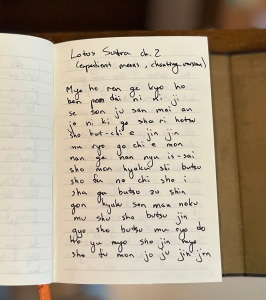
Popular examples (among others) include the Kannon Sutra, the verse section of chapter 16, and the opening secction of chapter 2. Both are actively recited in Nichiren and Tendai sect home services. Today we will focus on the opening section of chapter 2, called the hōbenpon (方便品) in Japanese.
Chapter 2 of the Lotus Sutra introduces the concept of Expedient Means (Sanskrit upāya), the idea (alluded to in earlier Buddhists texts) that the Buddha’s teachings and practices are flexible and meant to accommodate the capacity of the follower, guiding them along until they reach the ultimate truth (e.g. Enlightenment). Later, the chapter leans on this concept to further teach that any effort along the Buddhist path is not wasted, and every bit counts. But the chant above is for the just the opening section, which teaches that full Enlightenment is a deeply profound concept, but something only the Buddhas can truly understand between one another, so it’s a pretty lofty goal (e.g. that’s why the Buddhas and Bodhisattvas do what they can to help).
“Shariputra, ever since I attained Buddhahood, I have widely expounded my teachings through many stories of past relationships and many parables, and by countless means have led the people to renounce all their attachments.”
Because this is a chant used in Japanese Nichiren and Tendai traditions, among others, I am posting it as-is in Japanese, more specifically Sino-Japanese: the original Classical Chinese that it was recorded in, but with historical Japanese pronunciation. You are welcome to recite in English, or any other language, there is no restriction.
For this liturgical text, I relied on a fewsources, plus I double-checked the spellings using physical sutra books I have at home. I am fairly certain it’s accurate.
Also, I formatted the text similar to how it is formatted in real service books.
Translation
I decided not to post the translation side-by-side with the text, the way I do with the Heart Sutra and such. This is due to formatting reasons on the blog, plus also length of the text makes this more difficult. I may revise this later.
For now, I highly recommend checking out a modern translation here by the excellent Dr Burton Watson. The Buddhist Text Translation Society also has an excellent translation here. The chant below is the first narrative section that goes all the way to the first verse section.
Disclaimer and Legal Info
I hereby release this into the public domain. Please use it as you see fit, but if you attribute it to this site, greatly appreciated. Also, please bear in mind this is an amateur work, and should not be taken too seriously.
Dedication
I dedicate this effort to all sentient beings everywhere. May all beings be well, and may they all attain perfect peace.
Namu Shakamuni Buddha
The Lotus Sutra second chapter, opening section
Preamble
Original Chinese
Japanese Romanization
妙法蓮華経 方便品第二
Myo ho ren ge kyo ho ben pon dai ni
Verse Section
Original Chinese
Japanese Romanization
爾時世尊 従三昧 安詳而起 告舎利弗
Ni ji se son ju san mai an jo ni ki go sha ri hotsu
諸仏智慧 甚深無量 其智慧門 難解難入
sho buc-chi e jin jin mu ryo go chi e mon nan ge nan nyu
一切声聞 辟支仏 所不能知 所以者何
is-sai sho mon hyaku shi butsu sho fu no chi sho i sha ga
仏曾親近 百千万億 無数諸仏 尽行諸仏。
butsu zo shin gon hyaku sen man noku mu shu sho butsu jin gyo sho butsu
無量道法 勇猛精進 名称普聞 成就甚深
mu ryo do ho yu myo sho jin myo sho fu mon jo ju jin jin
未曾有法 随宜所説 意趣難解 舎利弗
mi zo u ho zui gi sho setsu i shu nan ge sha ri hotsu
吾従成仏已来 種種因縁 種種譬諭 広演言教
go ju jo buc-chi rai shu ju in nen shu ju hi yu ko en gon kyo
無数方便 引導衆生 令離諸著 所以者何
mu shu ho ben in do shu jo ryo ri sho jaku sho i sha ga
如来方便 知見波羅蜜 皆已具足 舎利弗
nyo rai ho ben chi ken ha ra mitsu kai i gu soku sha ri hotsu
如来知見 広大深遠 無量無礙 力無所畏
nyo rai chi ken ko dai jin non mu ryo mu ge riki mu sho i
禅定解脱三昧 深入無際 成就一切 未曾有法
zen jo ge das-san mai jin nyu mu sai jo ju is sai mi zo u ho
舎利弗 如来能種種分別 巧説諸法 言辞柔軟
sha ri hotsu nyo rai no shu ju fun betsu gyo ses-sho ho gon ji nyu nan
悦可衆心 舎利弗 取要言之 無量無辺
ek ka shu shin sha ri hotsu shu yo gon shi mu ryo mu hen
未曾有法 仏悉成就 止舎利弗 不須復説
mi zo u ho bus-shitsu jo ju shi sha ri hotsu fu shu bu setsu
所以者何 仏所成就 第一希有 難解之法
sho i sha ga bus-sho jo ju dai ichi ke u nan ge shi ho
唯仏与仏 乃能究尽 諸法実相
yui butsu yo butsu nai no ku jin sho ho jis-so
Conclusion
(note: at least in some Nichiren traditions, this part is repeated 3 times. I am unclear if this is also done in the Tendai tradition.)
Original Chinese
Japanese Romanization
所謂諸法 如是相 如是性 如是体 如是力 如是作 如是因 如是縁 如是果 如是報 如是本 末究竟等
sho i sho ho nyo ze so nyo ze sho nyo ze tai nyo ze riki nyo ze sa nyo ze in nyo ze en nyo ze ka nyo ze ho nyo ze hon ma ku kyo to
My wife and daughter both tested positive for COVID on Wednesday and had to isolate themselves since then. I took time off from work, bring them food, do the housework, and look after our son, ferry him to various social events and playdates, while also looking after a one year old puppy. Then, the puppy developed conjunctivitis (pink eye) as of yesterday. Further, my old acid reflux problem reared its head recently causing plenty of misery for me.
The week has been a train wreck but we’ve managed. Thankfully my wife and daughter’s both had miles symptoms and will be out of quarantine soon.
Amidst all the chaos, I tried to keep up daily Buddhist practice, with mixed success. This morning I just had only enough time to recite the Three Treasures: namu-ki-e-butsu, namu-ki-e-ho, namu-ki-e-so (praise to the Buddha, Dharma, and Sangha).
If you’re a parent, especially a single parent like my mother was, sometimes that’s all you can realistically do. That’s also true if you’re young and just getting on your feet, working a grueling 9-5 job, or you’re caring for ill or elderly family members.
Such people don’t have the time or energy to contemplate Tibetanyidam or participate in a Zen sesshin. How can someone working a demanding warehouse job at Amazon maintain mindfulness when you barely have time for a lunch break? How can a school teacher afford a retreat to Bhutan when they’re scraping money to get adequate school supplies in the classroom?
For most working-class people dealing with stress, financial woes, or parenting, such Buddhist practices are a privilege they can’t afford, but they shouldn’t be excluded either. This was a problem faced centuries ago and continues in the West today.
Instead, when your world is falling apart, or you’re cleaning poop from a baby’s diaper, or trying to mentally shut out the weirdo on public transit, sometimes it’s just enough to say the nembutsu: na-mu-a-mi-da-butsu. Maybe you can’t maintain a Buddhist altar, but it’s just enough to keep a small image in your wallet that you drew or printed out. If you can’t afford good Buddhist books, make your own.
I am not joking or making light of Buddhist practice either. Consider this verse from the second chapter of the Lotus Sutra:
If someone with a confused and distracted mind should take even one flower and offer it to a painted image, in time he would come to see countless Buddhas.
Or if a person should bow or perform obeisance, or should merely press his palms together, or even should raise a single hand, or give no more than a slight nod of the head, and if this were done in offering to an image, then in time he would come to see countless Buddhas.
And if he himself attains the unsurpassed way and spreads salvation abroad to countless multitudes, he will enter the nirvana of no remainder as a fire dies out when the firewood is exhausted.
If persons with confused and distracted minds should enter a memorial tower and once exclaim, “Hail to the Buddha!”
Then all have attained the Buddha way.
Translation by Burton Watson
Or this quote from the Sutra on the Buddha of Immeasurable Life:
“If, sentient beings encounter his [Amida Buddha’s] light, their three defilements are removed; they feel tenderness, joy and pleasure; and good thoughts arise. If sentient beings in the three realms of suffering see his light, they will all be relieved and freed from affliction. At the end of their lives, they all reach emancipation.
Translation by Rev. Hisao Inagaki
Sometimes it’s OK to just recite the nembutsu, or the Three Treasures above. It may not do much to relieve stress, or fix your situation but be assured that every tiny little bit you do to recite the Buddha’s name, or uphold the Five Precepts (or even one of them), anything you do to live an upright, honest life does count for something.
This isn’t empty platitudes either. This is straight from the Lotus Sutra and the Mahayana Buddhist tradition at large. Like contributing to a savings accounts, every little bit you do, however small, is just one step closer to your goal. Every good, wholesome seed you plant will bear fruit someday. Every time you dedicate that good merit towards the benefit of others, it will multiply even further.
No matter how shitty your life is, believe in yourself, believe in the power of the Buddha-Dharma, and trust that even a moment’s recitation or a a single good act can and does make a difference.
Lately I’ve been talking a lotabouthomeBuddhistpractice, including home Buddhist services and such. These are things that devout lay-Buddhists often do (myself included), but then I realized I never talked about making one’s own sutra book.
There are a couple reasons why one might make their own.
First, Buddhist resources outside of Buddhist countries are hard to find. For someone like me who lives on a large city with a large Asian community this is not so hard. But if you lived in, say, rural Iowa, it might be a lot harder. So, sometimes you have to just DIY.
Second, it’s a nice way to personalize your Buddhist practice in a way that suits you.
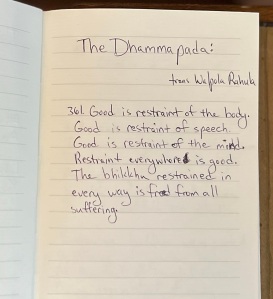
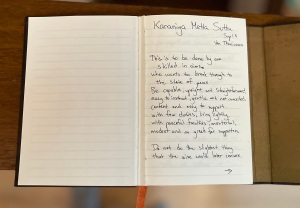
I started making my own maybe about 9-10 years ago. I picked up a nice little Paperblanks notebook at the airport at the time, and I decided to collect Buddhist sutras and quotes that I liked. I started out small, just copying things now and then from sites like accesstoinsight.org, or copied from books.
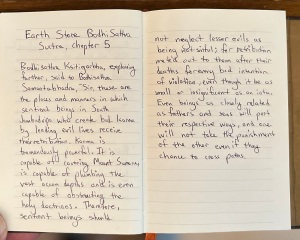
I also recorded Mahayana Buddhist sutras as well, such as this quote from chapter 5 of the Earth Store Bodhisattva Sutra:
I copied each of these by hand. I even tried to copy much longer texts, such as the 4th chapter of the Golden Light Sutra, which is a very beautiful prose about repentance and goodwill, but the text was much longer than I thought, and I eventually gave up halfway.
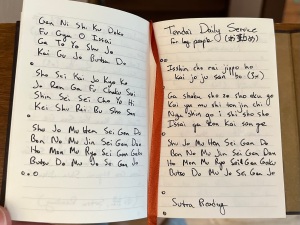
But eventually, around 2017-2018, when I left my old Jodo Shinshu-Buddhist community and started exploring other sects, I focused more on home practice and I started to add Japanese-style liturgies as well:
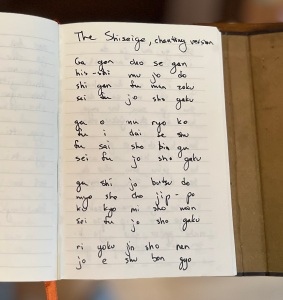
I also wrote specific sutra chants too, such as the Shiseige:
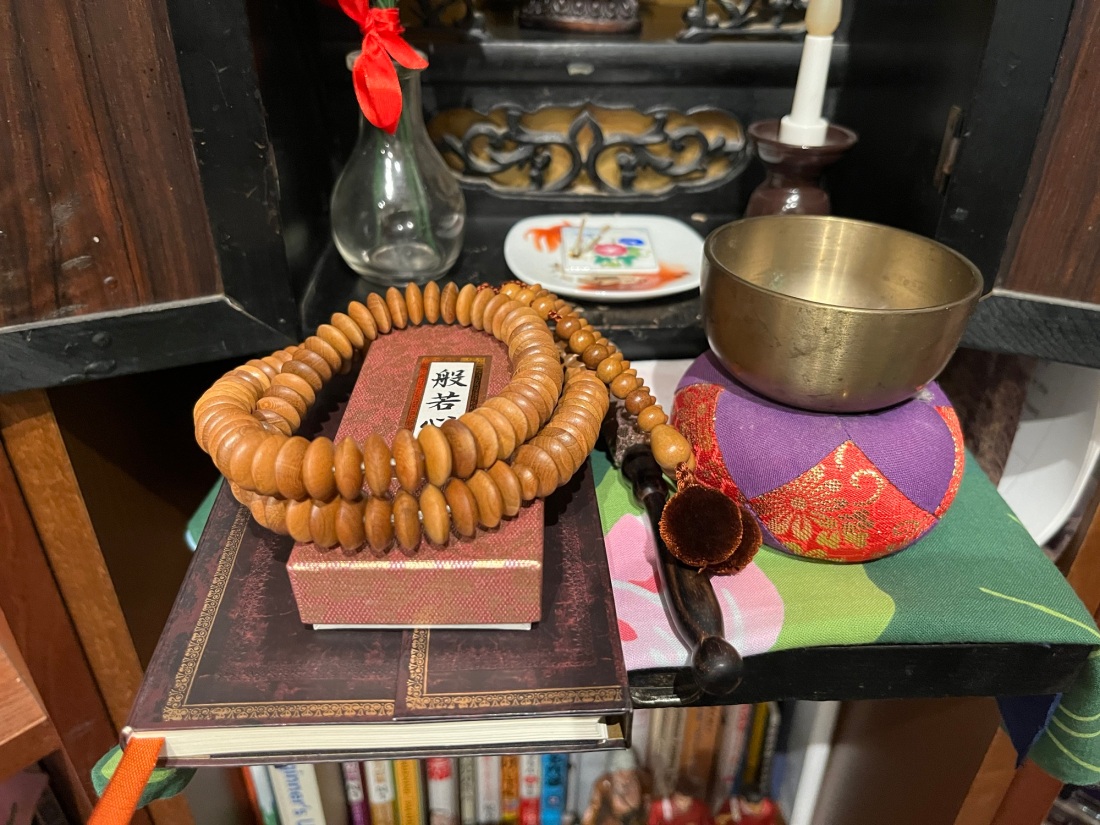
As you can see from the featured photo above,1 I keep this sutra book on my home altar (bottom left in photo), and use it almost daily. A personal sutra book works best when it’s meaningful, simple and useful for you, so the important thing is to not do what other people do, but make it useful for yourself. Find sutras or Buddhist quotes you like, collect them into a notebook, and copy them by hand (word of advice, use a gel pen, not a ballpoint pen, it’s easier to read), and make it your own. There’s no wrong way to do it.
Further, the sutra book I made has gradually progressed over time, just as my own path and practice have and I still have more room to write things in the future.
1 You can also see my Buddhist rosary, a Tendai-style rosary I ordered online, along with a boxed copy of the Heart Sutra, which I got in 2023 while visiting Nara‘s Kofukuji Temple, one of my personal favorite.
Chapter 25 of the Lotus Sutra is a popular devotional text in East Asian Buddhism. It is often referred to as the “Avalokiteśvara Sutra”, or kannongyō (観音経) in Japanese, or more formally the kanzeon bosatsu fumonbongé (観世音普門品偈, “Chapter on the Universal Gate of Kanzeon Bodhisattva”).
Despite the name, it is not a stand-alone text, but simply a famous chapter in the larger Lotus Sutra. This particular chapter is the main introduction to one of the most popular Bodhisattvas in Buddhism: Avalokitesvara (Kannon in Japanese, Guanyin in Chinese, etc.). The chapter describes the attributes of Kannon that are familiar to Buddhists, such as their vows to help all beings who call on them, their ability to take on various forms to teach people, and their unwavering compassion to lead all beings to Enlightenment.
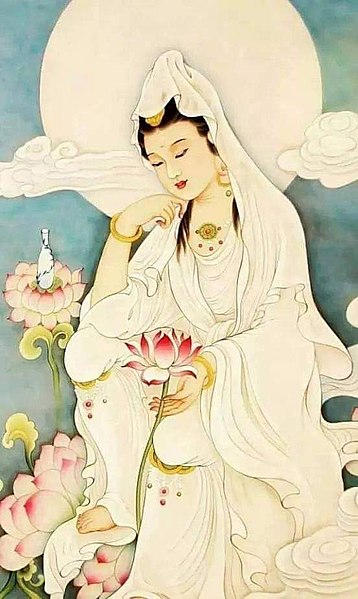
A more Chinese-style image of Kannon (a.k.a. Guan-yin) in her more motherly form, photo courtesy of Wikipedia.
The chapter as a whole is long and would be difficult to chant, so the verse section, not the narrative section, is frequently used for liturgical purposes. The Lotus Sutra often describes things in narrative form, then summarizes again in verse form. However, even the verse section alone is longer than the Heart Sutra, or the Shiseige, so just chanting the verse section is a bit challenging. In my experience it takes about 5-7 minutes.
For this reason, medieval Buddhists in Japan also devised an even shorter version called the Ten-Verse Kannon Sutra.
The sutra is frequently recited in both Zen and Tendai liturgies, among others, but it is not well known to Westerner lay-Buddhists. I had difficulty finding an online copy I could use as a reference here, even in Japanese, due to its length.
However, ages ago, I picked up a sutra book at the famous Sensōji temple in Tokyo, and once I figured out what the Kannon Sutra was, I copied it character by character to an old version of the blog, but then lost it later when I changed blogs. Recently, I was able to recover the text (not easily) from the original HTML I wrote, and posted it back on here with minor edits.
I have also provided a PDF version here if you want to print it out and use at home.
Also, special thanks to this website for providing much needed reference information on pronunciation and Chinese characters. My original, recovered text had a few errors, embarrassingly.
Examples
I found a few examples on Youtube that you can follow along if you are learning to chant the Kannon Sutra as shown below.
From Eiheiji temple (one of two home temples of Soto Zen). Note that they chant this at a pretty fast pace.
This example from Zenshoji Temple, a Shingon-sect temple, in Niigata Prefecture, has line by line annotation. The chanting pace is slower and easier to follow.
These examples are very similar, other than slight differences in pacing and pronunciation of certain Chinese characters. For people who are learning to recite the sutra, just pick what works until you get the hang of it.
Translation
I decided not to post the translation side-by-side with the text, the way I do with the Heart Sutra and such. This is due to formatting reasons on the blog, plus also length of the text makes this more difficult. I may revise this later.
For now, I highly recommend checking out a modern translation here by the excellent Dr Burton Watson. In that translation, the verse section starts after the phrase “At that time Bodhisattva Inexhaustible Intent posed this question in verse form“. The Buddhist Text Translation Society also has an excellent translation of the verse section here.
Disclaimer and Legal Info
I hereby release this into the public domain. Please use it as you see fit, but if you attribute it to this site, greatly appreciated. Also, please bear in mind this is an amateur work, and should not be taken too seriously.
Dedication
I dedicate this effort to all sentient beings everywhere. May all beings be well, and may they all attain perfect peace.
Namu Kanzeon Bosatsu
The Kannon Sutra, verse section
(2025 edition, with minor typo fixes)
Preamble
Original Chinese
Japanese Romanization
妙法蓮華經 観世音菩薩 普門品偈
Myo ho ren ge kyo kan ze on bo satsu fu mon bon ge
Verse Section
Original Chinese
Japanese Romanization
世尊妙相具 我今重問彼 佛子何因縁 名為観世音
Se son myo so gu ga kon ju mon pi bus-shi ga in nen myo i kan ze on
具足妙相尊 偈答無盡意 汝聴観音行 善応諸方所
gu soku myo so son ge to mu jin ni nyo cho kan on gyo zen no sho ho jo
弘誓深如海 歴劫不思議 侍多千億佛 発大清浄願
gu zei jin nyo kai ryak-ko fu shi gi ji ta sen noku butsu hotsu dai sho jo gan
我為汝略説 聞名及見身 心念不空過 能滅諸有苦
ga i nyo ryaku setsu mon myo gyu ken shin shin nen fu ku ka no metsu sho u ku
假使興害意 推落大火坑 念彼観音力 火坑変成池
ke shi ko gai i sui raku dai ka kyo nen pi kan on riki ka kyo hen jo ji
或漂流巨海 龍魚諸鬼難 念彼観音力 波浪不能没
waku hyo ru go kai ryu go sho ki nan nen pi kan on riki ha ro fu no motsu
或在須弥峰 為人所推堕 念彼観音力 如日虚空住
waku zai shu mi bu i nin sho sui da nen pi kan on riki nyo nichi ko ku ju
或被悪人逐 堕落金剛山 念彼観音力 不能損一毛
waku bi aku nin jiku da raku kon go sen nen pi kan on riki fu no son ichi mo
或値怨賊繞 各執刀加害 念彼観音力 咸即起慈心
waku ji on zoku nyo kaku shu to ka gai nen pi kan on riki gen soku ki ji shin
或遭王難苦 臨刑欲寿終 念彼観音力 刀尋段段壊
waku so o nan ku rin gyo yoku ju shu nen pi kan on riki to jin dan dan ne
或囚禁枷鎖 手足被杻械 念彼観音力 釈然得解脱
waku ju kin ka sa shu soku bi chu gai nen pi kan on riki shaku nen toku ge datsu
呪詛諸毒薬 所欲害身者 念彼観音力 還著於本人
shu so sho doku yaku sho yoku gai shin ja nen pi kan on riki gen jaku o hon nin
或遇悪羅刹 毒龍諸鬼等 念彼観音力 時悉不敢害
waku gu aku ra setsu doku ryu sho ki to nen pi kan on riki ji shitsu bu kan gai
若悪獣圍繞 利牙爪可怖 念彼観音力 疾走無邊方
nyaku aku shu i nyo ri ge so ka fu nen pi kan on riki jis-so mu hen bo
蚖蛇及蝮蠍 気毒煙火燃 念彼観音力 尋聲自回去
gan ja gyu fuku katsu ke doku en ka nen nen pi kan on riki jin sho ji e ko
雲雷鼓掣電 降雹澍大雨 念彼観音力 応時得消散
un rai ku sei den go baku ju dai u nen pi kan on riki o ji toku sho san
衆生被困厄 無量苦逼身 観音妙智力 能救世間苦
shu jo bi kon yaku mu ryo ku hitsu shin kan on myo chi riki no ku se ken ku
具足神通力 廣修智方便 十方諸国土 無刹不現身
gu soku jin zu riki ko shu chi ho ben jip-po sho koku do mu setsu fu gen shin
種種諸悪趣 地獄鬼畜生 生老病死苦 以漸悉令滅
shu ju sho aku shu ji goku ki chiku sho sho ro byo shi ku i zen shitsu ryo metsu
真観清浄観 廣大智慧観 悲観及慈観 常願常瞻仰
shin kan sho jo kan ko dai chi e kan hi kan gyu ji kan jo gan jo sen go
無垢清浄光 慧日破諸闇 能伏災風火 普明照世間
mu ku sho jo ko e nichi ha sho an no buku sai fu ka fu myo sho se ken
悲體戒雷震 慈意妙大雲 澍甘露法雨 滅除煩悩燄
hi tai kai rai shin ji i myo dai un ju kan ro ho u metsu jo bon no en
諍訟経官処 怖畏軍陣中 念彼観音力 衆怨悉退散
jo ju kyo kan jo fu i gun jin chu nen pi kan on riki shu on shitsu tai san
妙音観世音 梵音海潮音 勝彼世間音 是故須常念
myo on kan ze on bon on kai jo on sho hi se ken on ze ko shu jo nen
念念勿生疑 観世音浄聖 於苦悩死厄 能為作依怙
nen nen motsu sho gi kan ze on jo sho o ku no shi yaku no i sa e go
具一切功徳 慈眼視衆生 福聚海無量 是故応頂礼
gu is-sai ku doku ji gen ji shu jo fuku ju kai mu ryo ze ko o cho rai
Conclusion
Original Chinese
Romanization
爾時持地菩 薩即從座起 前白佛言世 尊若有衆生
ni ji ji ji bo sa soku ju za ki zen byaku butsu gon se son nyaku u shu jo
聞是観世音 菩薩品自在 之業普門示 現神通力者
mon ze kan ze on bo sa bon ji zai shi go fu mon ji gen jin zu riki sha
當知是人功 徳不少佛説 是普門品時 衆中八萬四
to chi ze nin ku doku fu sho bus-setsu ze fu mon bon ji shu ju hachi man shi
千衆生皆發 無等等阿耨 多羅三藐三 菩提心
sen shu jo kai hotsu mu to do a noku ta ra san myaku san bo dai shin
In the coming weeks, I hope to post a couple more such chants from the Lotus Sutra, as they are popular both in Tendai and Nichiren communities in particular, and I am learning to chant these too.
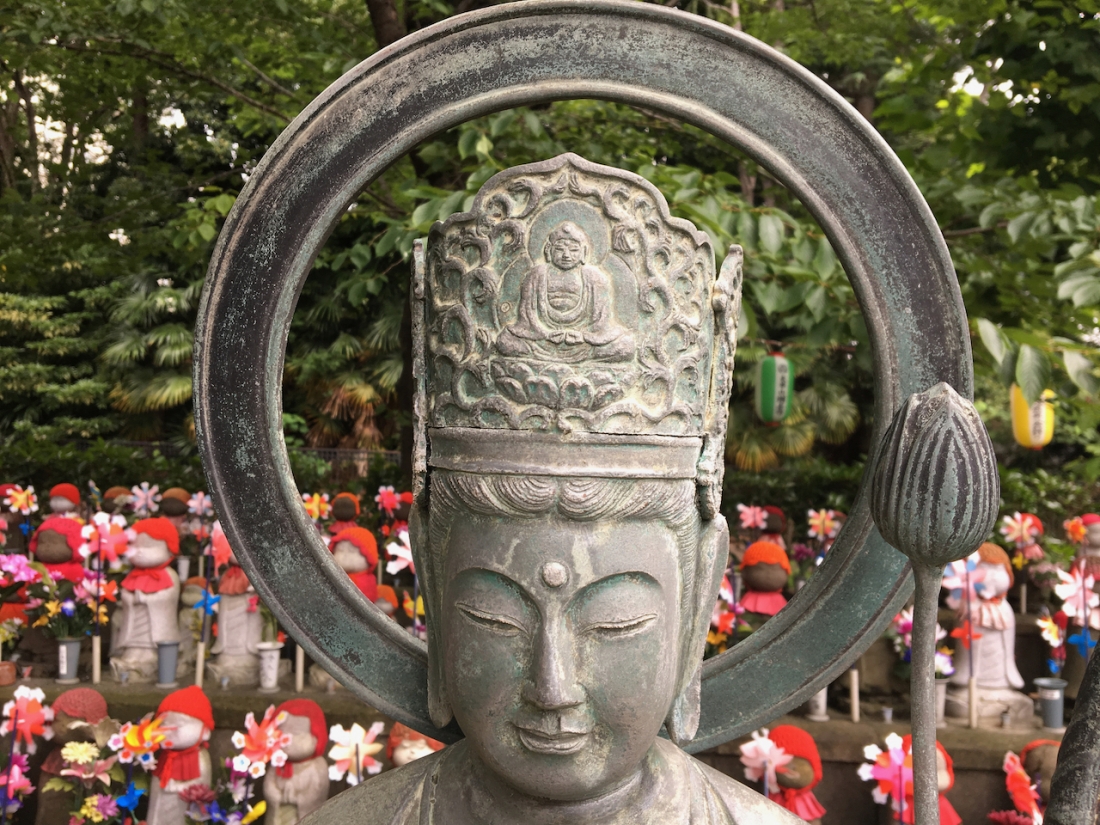
P.S. Featured photo was taken by me at Zojoji temple in Tokyo, Japan, with an image of Kannon Bodhisattva wearing a crown that features an image of Amitabha Buddha.
The Lotus Sutra is one of the most important Buddhist texts in the entire Mahayana-Buddhist canon. Because of its length, its chapters, and its variety of figures, parables and such, there’s something for everyone, hence its influence on the subsequent tradition.
Lately, I have been thinking about the story of the Bodhisattva Medicine King,1 in the 23rd-chapter of the Lotus Sutra. The story is too long to quote verbatim here, but I will try to post the relevant parts. I am using the Senchu Murano translation, but the Burton Watson translation (available online) is excellent, too.2
In this chapter, the narrator, Shakyamuni Buddha, describes a land that existed countless eons ago, populated by a great Buddha:
Innumerable kalpas [“eons”, very long periods of time] ago, that is, as many kalpas as there are sands in the River Ganges, there lived a Buddha called Sun-Moon-Pure-Right-Virtue….He was accompanied by eight thousand million great Bodhisattva-mahāsattvas…The duration of his life was forty-two thousand kalpas…There was no calamity in his world. The ground of his world was as even as the palm of his hand….
Page 305, Chapter 23 of “The Lotus Sutra” by Senchu Morano
Then as this Buddha preaches the Lotus Sutra to his disciples (with emphasis added), one of them was particularly inspired. After having practiced many austeries, and offered countless kinds of incense and flowers to his teacher (Sun-Moon-Pure-Right-Virtue Buddha), he decided it was not enough :
Having made these offerings [of incense, flowers, etc. to the Buddha] he emerged from samādhi, and thought, ‘I have now made offerings to the Buddha by my supernatural powers. But these offerings are less valuable than the offering of my own body.’
Then he ate various kinds of incense….then he applied perfumed oil to his skin, put on a heavenly garment of treasures in the presence of Sun-Moon-Pure-Bright-Virtue Buddha, sprinkled various kinds of perfumed oil on the garment, and set fire to his body, making a vow by his supernatural powers. The light of the flame illumined the worlds numbering eight thousands of millions of times the number of the sands of the River Ganges….
The body of the Bodhisattva kept burning for twelve hundred years, and then was consumed. Having made this offering according to the Dharma, Gladly-Seen-By-All-Beings Bodhisattva passed away. In his next life, he appeared again in this world of Sun-Moon-Pure-Bright-Virtue Buddha.
Page 307-308, Chapter 23 of “The Lotus Sutra” by Senchu Morano
Later in the chapter, the narrator Shakyamuni Buddha, then explains that this pattern of Gladly-Seen-By-All-Beings Bodhisattva offering himself to his teacher was repeated countless times across many eons. The big reveal in this chapter was that this Bodhisattva, according to the Lotus Sutra, was now the Medicine King Bodhisattva attending Shakyamuni’s audience.
If, by this point, you’re wondering “what on earth is going on?” don’t worry. The Lotus Sutra isn’t a straightforward text. If you try to read at face-value, you will probably get really confused. Unlike the sutras of the Pali Canon, which are formulaic and dry, the Lotus Sutra is a narrative composition that relied on literary flourish and hyperbole.
Like other bodhisattvas features in the second half of the Lotus Sutra (including Avalokiteshvara in chapter 25), each one is held up as the epitome of some aspect of Buddhism. The Medicine King Bodhisattva, I think, is meant to epitomize commitment to the Dharma. The Sutra is not asking people to burn themselves to practice Buddhism. What matters isn’t the specific action, but that he kept coming back over and over, unconcerned about the trivialities of life.
If this seems odd, consider this passage from the Heart Sutra:
Because there is no attainment, bodhisattvas rely on Prajñāpāramitā [the perfection of wisdom], and their minds have no obstructions. Since there are no obstructions, they have no fears.
Or the opening passage of the Immeasurable Life Sutra (e.g. the “Larger Sutra”) in the Pure Land tradition. I have again trimmed for brevity:
Having well learned the extensive wisdom of fearless and having realized the illusory nature of dharmas, he [a typical bodhisattva] destroys Mara’s nets and unties all the bonds of passion….
He is above all worldly affairs and his mind, always serene, dwells on the path of emancipation; this gives him complete control over all dharmas….
Having awakened great compassion for sentient beings, he kindly expounds the teaching, and endows them with the Dharma-eye. He blocks the paths to the three evil realms, opens the gate of virtue and, without waiting for their request, provides beings with the Dharma. He does this for the multitude of beings just as a dutiful son loves and respects his parents. He indeed looks upon sentient beings as his own self.
Translation by Rev. Hisao Inagaki
In each, there is a strong sense of fearlessness and long-term commitment.
But on the other hand, this is not something the bodhisattva thinks about. Consider this passage from the Diamond Sutra:
The Buddha said to Subhuti, “The Bodhisattva Mahasattvas master their mind by meditating as follows: ‘However many species of living beings there are—whether born from eggs, from the womb, from moisture, or spontaneously; whether they have form or do not have form; whether they have perceptions or do not have perceptions; or whether it cannot be said of them that they have perceptions or that they do not have perceptions, we must lead all these beings to nirvana so that they can be liberated. Yet when this innumerable, immeasurable, infinite number of beings has become liberated, we do not, in truth, think that a single being has been liberated.’
“Why is this so? If, Subhuti, a bodhisattva still has the notion of a self, a person, a living being, or a life span exists, that person is not a true bodhisattva.
Translation by Ven. Thich Nhat Hanh
So it’s not just a sense of great commitment, but also a way of living that’s not self-centered or conceited. The bodhisattvas do not keep score.
It’s like someone who is really committed to a certain hobby or sport, and they’re not even really thinking about it anymore. They just do it, and keep going, refining their craft more and more. Similarly, a good parent doesn’t count how many times they tell their kids “good job”, or how many diapers they changed. They are committed to raising their kids, and even when things are really rough, they keep at it. Mistakes are made, but they don’t quit right there. They keep going.
The Mahayana-Buddhist ideal is along these lines: someone who selflessly teaches the Dharma, helps others over and over, and polishes their minds, no matter how long it takes, and yet their total commitment means that they aren’t really consciously thinking about it. It’s just part of their being.
Anyhow, the imagery in Chapter 23 is powerful, and while this chapter isn’t usually cited by other teachers, I think it still has something to teach us.
P.S. Photo taken by me at Sanjusangendō Temple in July 2023.
1 Not to be confused with the Medicine Buddha. As far as I know, they are unrelated figures.
2 The Lotus Sutra has many, many translations in English, and honestly they’re all good. The really archaic translations from the 19th century are kind of hard to read (e.g. Soothill), but any modern translation is fine. The only time the differences matter is mostly for academic reasons, and then it just becomes hair-splitting for your average Buddhist:











 Gleanings in Buddha-Fields

.jpeg?uselang=en)
You must be logged in to post a comment.