For the sake of completeness,1 I wanted to cover home liturgy for the Jodo Shinshu sect of Buddhism as it is promoted in Japan. I spent years at a local Shinshu temple here in the US during the 2000’s and 2010’s, part of the Buddhist Churches of America (the American branch of Jodo Shinshu), whose liturgy is slightly different, but I’ll try to clarify the differences. There aren’t many, but it did surprise me when I first experienced Jodo Shinshu in Japan, and realized that it wasn’t what I was expecting.
Further, Jodo Shinshu’s liturgy is somewhat different than other ones we’ve covered so far. When we look at Rinzai, Soto, Tendai and Jodo Shu sect home liturgies, they tend to follow a certain flow:
They may have more or less content, and the particular verses may differ, but generally that’s the format.
Jodo Shinshu home liturgy differs from this pattern somewhat. I believe this is primarily because of the Jodo Shinshu sect emphasis on the Other Power of Amida Buddha, rather than one’s own good works. So, there’s nothing to cultivate in the traditional Buddhist sense, only to express gratitude for.
This lead to some changes, particularly through Rennyo the 8th monshu (head of the sect) who through his efforts to consolidate the various communities, promoted a liturgy format that centers around Shinran’s hymn, the Shoshinge. Thus, in Jodo Shinshu sect Buddhism, daily recitation of the Shoshinge is encouraged, including six wasan hymns at the end, followed by dedication of merit verse similar to other sects. This is the basic Jodo Shinshu home liturgy. If you recited the Shoshinge, and dedicated merit, that would be sufficient.
You can see an example of this here:
Alternatively, if you don’t want to recite the whole Shoshinge, as this site shows (another site) there are other things one can recite instead:
But many sources suggest the Shoshinge plus Wasan hymns when possible. Also, the same sources emphasize that Jodo Shinshu tradition does not recite the Heart Sutra (unlike other traditions).
Anyhow, going back to this site, the home liturgy is as follows:
Light a candle and incense at your buddhist altar (if you have it).
In Jodo Shinshu style, the nembutsu sounds more like na man da-, na man da-, na man da-
Ring bell twice
Recite the sutra (see above)
Recite the dedication of merit hymn
Optionally, recite a letter from Rennyo’s Gobunsho letters. My service handbook lists the following letters as recommendations to recite (English translation can be found here):
Fascicle V, letter 10 – “On Faith as Fundamental”
Fascicle V, letter 5 – “On Realizing Faith”
Fascicle V, letter 1 – “On Laymen and Laywomen Lacking Wisdom in the Last [Dharma] Age“
From my experience with the Buddhist Churches of America, this format is similar to what we recited in Sunday services, though with a couple small differences. First, the Shoshinge was only recited at more formal ceremonies since it is so long. For normal weekly Sunday services, the Juseige was most often recited. Also, at least at the temple I went to, we also explicitly recited Taking Refuge in the Three Treasures (namu kie butsu, namu kie ho, namu kie so), which is something I don’t see in Jodo Shinshu services in Japan.
But in Japanese temples the Shoshinge is emphasized, and other aspects somewhat de-emphasized, hence it’s a bit unconventional.
Good luck and happy chanting!
Namu Amida Butsu
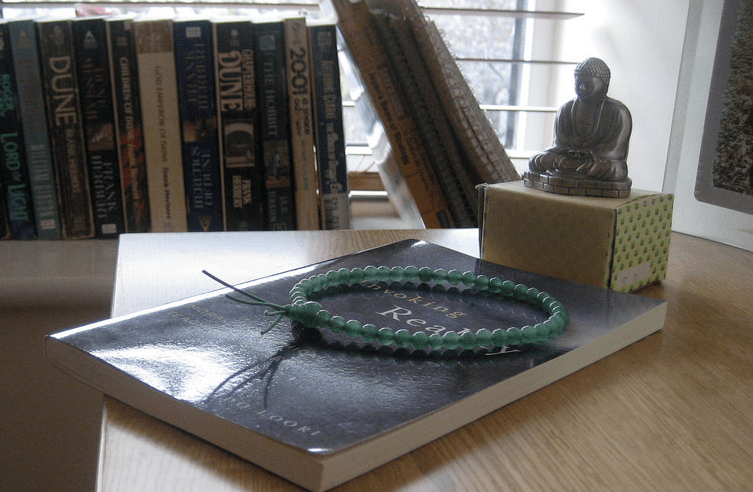
P.S. Photo was taken may years ago in 2008 when I lived in Ireland for a time. Back then, I had a lot fewer Buddhist resources (and there weren’t many in Ireland anyway), so I made this into a very impromptu altar.
1 I have not covered the Shingon and Nichiren sects, but I have too little information on them to speak with any certainty. Readers will have to do their own research for now.
Recently, I wrote about a Soto Zen sutra book I purchased some years ago, and it’s still one of the best books I own. Today, I wanted to highlight another Japanese-Buddhist sutra book that I had for years, but never really understood what it was about.
The book is available online here, among other places. The book was published by Nanzenji temple, a major Rinzai Zen temple, and I found it at a Kinokuniya bookstore here in the US in the Japanese-language section. It is titled 私の般若心経 (watashi no hannya shingyō, “My Heart Sutra [book]”)
The sutra book is really small, and easily fits in the palm of my hand. As the website description states, this is designed to that one can carry it on one’s person as a charm, but also use it for home liturgy. Pretty clever. I’ve seen such “sutra book charms” before but usually they are very small, and the print is lower-quality, since it’s meant to be carried, not read. This by contrast is very nice quality.
Inside, the contents are surprisingly dense for such a small book. Inside contains the texts necessary to do a home service according to Rinzai tradition, though it differs slightly from the one I posted previously.1
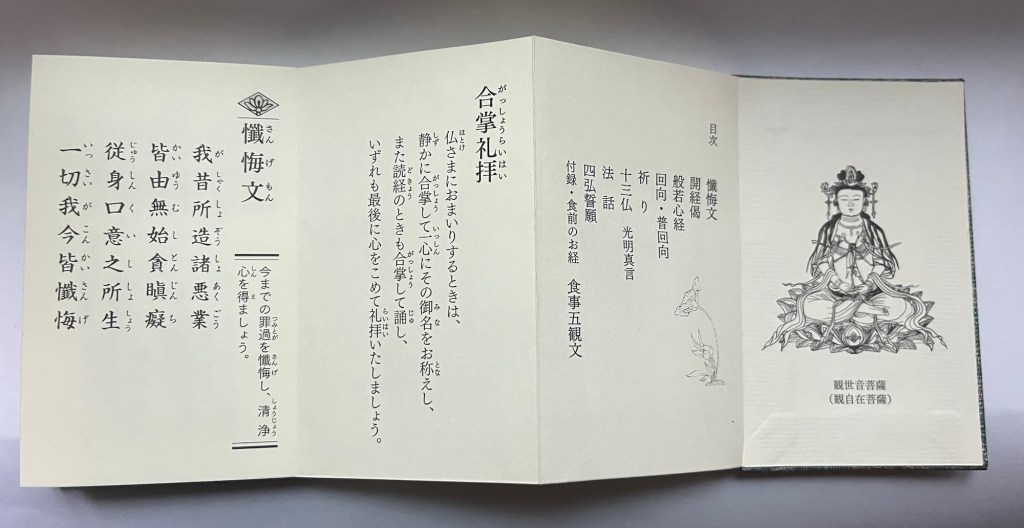
The contents, shown below include basic liturgy such as repentance verses, the opening of the sutra, a copy of the Heart Sutra, dedication of merit, four bodhisattva vows, and so on.
Above, we see the first four pages of the sutra book, from right to left: a picture of Kannon Bodhisattva, then the table of contents, an explanation about how to gassho, and finally the sangemon (verses on repentance).
Below, you can see the Heart Sutra from end to end (read right-to-left, vertically). If you can read Japanese hiragana script, you can recite this because each Chinese character is annotated with a pronunciation guide (a.k.a. furigana):
The furigana script is a bit small and hard to read, but that’s understandable given how small this book is.
Surprisingly, the sutra book contains other things I wasn’t expecting, such as mantras for the Thirteen Buddhas and Bodhisattvas, often recited during yearly memorials for the deceased. The book also the Mantra of Light, surprisingly. It also contains the five verses for contemplating food.
Finally, the book contains a sermon by the author, and has a handy blank section at the end for taking notes.
Weirdly, I’ve owned this book for almost 10 years, but back then I couldn’t read Japanese very well, so I didn’t fully appreciate what the contents of the book were, plus I had no familiarity with Rinzai Zen. Now that I have a bit more experience, I can appreciate this book a lot more, and have been using it for home liturgy lately.
For such a compact book, it’s really very nice, and only costs ¥550.
If you’re able to read basic hiragana script, and have an interest in Rinzai Zen, it’s definitely worth a purchase.
1 As noted in a previous post, Rinzai Zen in particular a number of lineages and factions, each one based around a different temple. This may help explain why the liturgy varies as much as it does.
Hello dear readers, I realized recently that after posting I home liturgy examples for Soto Zen, Rinzai Zen, and Tendai sect Buddhism, I had never posted about Jodo Shu sect home liturgy despite being a follower for many years. There are a couple reasons for this.
Sutra book for Jodo Shu followers. I think this might be the first such book I have ever owned.
First, as someone who came to Jodo Shu Buddhism many years ago, I tended to rely on English sources only, and such sources tend follow Honen’s teachings, but nothing beyond that. Thus, through such books I followed Honen’s simple advice that focusing on the nembutsu is all that mattered. So, in my early efforts to learn Buddhist practice, I focused on reciting just the nembutsu. More on why the liturgy has expanded over time later in this post.
The second reason is that the Jodo Shu home liturgy is particularly long. My book on Jodo Shu explains that this usually takes about 20 minutes.
My limited experience confirms this. I have an old Jodo Shu sutra book from many years ago, which I received during one of our earliest family trips to Japan. That particular winter, we celebrated New Year in Japan, I got to participate in a local Joya-no-kané (“ringing of the temple bell”) ceremony, thanks to my father-in-law, and generally had a great time. It might even be the first sutra book I ever owned.
A photo of Honen, founder of Jodo Shu Buddhism, with his famous poem “Moonlight” below. A copy of his handwriting is to the right depicting the Nembutsu.
The book, needless to say, has some sentimental value for me.
But I digress.
You can find example Jodo Shu liturgy here on the official Jodo Shu homepage in Japanese. There is even a translated one on the Jodo Shu North American mission website. The format of the liturgy is:
Kōgé – verse for offering incense
Sanbōrai – taking refuge in the Buddha, Dharma and Sangha
ShibujōorSanbujō – both are verses of praise to the Buddhas
Ichimai-kishōmon – Honen’s One-sheet Document, essentially his last will and testimony.
(optional) Hotsuganmon – a verse attributed to Chinese Pure Land master Shan-dao, expressing a desire to be reborn in the Pure Land, become a bodhisattva and help others.1
Shōyakumon – a verse for expressing the light of Amida Buddha.
Nembutsu-ichi-é – reciting the nembutsu as much as one likes.
Sō-e-kō-gé – Another verse for transferring the good merit to all beings.
As you can see, it has many components, with the nembutsu sprinkled throughout. Many of these verses are very short too, so once you get used to the format, it is not that hard. It can feel a bit daunting upfront if you’re new to Pure Land Buddhism, though.
Thankfully, the Japanese site also has a couple example videos showing slightly different versions of the liturgy. Version one below with uses the Shibujo and Sanshorai:
and version two, which recites the Sanbujo and Sanshinrai instead:
The North America sites uses a little of both: the Sanbujo from version two, and the Sanshorai from version one. By contrast, my sutra book has all the verses, so you presumably pick which version you want to recite. It seems like they are basically interchangeable.
Since there is already an official English translation available online, I won’t repost here. Please refer to the links above for more details.
Instead, I wanted to address the question of liturgy versus just saying the nembutsu, and I found a good explanation in this article.
The author reiterates that Jodo Shu Buddhism begins and ends with the nembutsu and doesn’t need other verses to effect rebirth in the Pure Land. So, pretty consistent so far.
And yet, the author cites Honen who encouraged people to cultivate the “five right practices” (五種正行, goshushōgyō) which includes:
Recitation of verses
Observation
Paying homage
Reciting the nembutsu [lit. Amida Buddha’s sacred name]
Praise
Thus as a liturgy, it is meant to cultivate all five, with the nembutsu as the peak or the climax of a movie. From a general Mahayana-Buddhist standpoint, it covers all the important points: taking refuge, repentance, reciting a Buddhist sutra, sharing the good merit, and vows toward becoming a Bodhisattva.
My personal opinion is that if you’re new to Pure Land Buddhism, it’s perfectly fine to just recite the nembutsu, but as you become more comfortable with Buddhism, you can expand to include the whole liturgy. I have no doubt that it’s a wonderful experience once you do it from start-to-finish, but without context it can seem a bit difficult.
In any case, good luck and happy chanting!
1 My sutra book puts the Hotsuganmon at the very end, while the Jodo Shu site in Japanese puts it just after the One Sheet Document. The North America Jodo Shu site doens’t include it at all. I am not sure why there is a difference in format. I assume it is optional.
Studying about the Ikko-Ikki rebellion (parts one, two and three as of writing) has brought back lots of memories of the local Jodo Shinshu temple that I spent many years at. I also remember the liturgy I used to train in while getting certified as a minister’s assistant. I was a terrible singer (always have been), so I never sang well. Not just OK, I was genuinely bad. But I still enjoyed many of the different liturgies we sang in Sunday services including the Shoshinge, Juseige, and so on.
One of my personal favorite was a liturgy called the Jūnirai (十二礼), which means The Twelve Adorations of Amida Buddha. We didn’t sing this one too often, but it did come up from time to time.1
As far as I can tell, this liturgy is found only in the Jodo Shinshu tradition, and is based on a document attributed to the Indian-Buddhist monk Nagarjuna. Nagarjuna (c. 150 – 250 CE) was a very influential monk in early, early Mahayana Buddhist tradition, and some documents related to Pure Land thought and Amida Buddha are attributed to him. I say “attributed”, because there is some doubt as to whether Nagarjuna authored such works, or possibly there was another monk named Nagarjuna who did. Early Indian-Buddhist textual history is tricky at best.
Nonetheless, the Hymn of The Twelve Adorations is a nice, easy melodic song. You can find translations here and here among other places. The actual hymn, sung in Sino-Japanese2 has twelve verses and a straightforward melody. There is a great example of this on Youtube below (fast forward to 1:10 for the hymn if you like):
It’s a very nice, easy tune to pick up. I’ve even heard the same tune occasionally used by elderly Japanese-Americans reciting other hymns, including the Shoshinge, but the origins are not clear to me.
Anyhow, the Junirai is simple enough that even someone tone-deaf like me can passably sing it, but also very poetic and lovely. If you’re near a Jodo Shinshu temple, check it out and see it sung in person sometime, but if not, you can find the Sino-Japanese lyrics in the links above, and can sing along as a devotional at home if you like.
Namu Amida Butsu
P.S. Old, old photo of me as a minister’s assistant in training (I still have my certificate somewhere).
I can’t remember when this photo was taken, but suffice to say, it’s old.
1 One difference I have noticed over the years between Jodo Shinshu temples in the West versus Japan is that in the West weekly services (i.e. “sunday services”) are common, but in Japan they usually only happen at major temples, not parochial ones. Thus, in Japan the emphasis is on home liturgy and chanting. People will chant the same hymns and sutras as described above, but in a home setting before an altar. Of course, Western Buddhists do home services too. It’s just that in Japan and other places in Asia, you’re not obligated to attend weekly communal services.
2 That is, Chinese characters with Japanese pronunciation, not native Japanese language.
Lately, I’ve been enjoying a fantastic history podcast called Grey History, covering the French Revolution in detail. While enjoying this show I started thinking about a famous peasant uprising in medieval Japanese history called the Ikko-Ikki rebellions of the 16th century.
The Ikko-Ikki rebellions are remarkable as being the one time in pre-modern Japanese history where a peasant uprising not only succeeded, but successfully carved out a region of Japan that was ruled by the masses, not by military samurai, nor the old aristocracy from Kyoto. The binding influence of the uprising was a strong affinity to a certain Buddhist sect, the Jodo Shinshu (浄土真宗, “True Pure Land Sect”), but there was more to the Ikko-Ikki than a “rebel cult” as some labeled them.
Information in English about the Ikko-Ikki is sparse, and often misinformed. I am happy though to have obtained a copy of Dr Carol Tsang’s excellent book War and Faith: Ikko Ikki in Late Muromachi Japan (publisher link), covers the Ikko Ikki, who they were, and their relation to the Jodo Shinshu sect. It’s been a fascinating read even for an old “history nerd” like myself.
This post is part two of three exploring the Ikko Ikki, of which part one is here. We can’t talk about the Ikko-Ikki until we cover the life of the 8th-generation Caretaker (monshu, 門主) of the Honganji mausoleum: Rennyo.
I originally intended to do only two posts, but as I wrote this one I realized there was too much interesting detail, and now it has split into three.
Enter Rennyo
As we saw in part one, Jodo Shinshu had somewhat unorthodox origins as a fully lay-oriented sect of Buddhism, through the work of Shinran in the 12th century. Shinran like many disciples of Honen, had been exiled and defrocked. Shinran took this in stride, married, and continued to spread the Pure Land Buddhist teachings he had learned from Honen to provincial people until we returned from exile and died in Kyoto.
His mausoleum (later called the Honganji temple) was managed by his descendants for generations. Like other families in medieval Japan (and other medieval societies), marriages by Shinran’s descendants were arranged to help benefit the family political, economically, etc. These descendants managed the mausoleum, while also building powerful alliances with samurai clans, or influential disciple families in the provinces. Some even married into the aristocracy in Kyoto. Shinran’s various disciples in the provinces went on to found various sects of Jodo Shinshu, while the Honganji remained significant, but not very influential.
By the time of the disastrous Onin War in the 15th century, Rennyo (蓮如, 1415–1499) had been born to the 7th generation caretaker Zonnyō (存如, 1396–1457).1 His mother was of unknown origin, but it is thought that she was a maidservant of Zonnyō, and thus politically risky. She was sent away, and Zonnyō married a woman named Nyoen from an influential family. Rennyo and his step mother did not get along well, and suffice to say, there was a succession struggle between him and Nyoen’s son, but Rennyo won out in the end thanks to the powerful Hino clan (the same clan that married into the reigning Ashikaga Shoguns). Rennyo had also, as per tradition in the family, spent time training at Kofukuji temple in Nara, and could claim some tenuous connections to the prestigious Fujiwara clan through the Kujō cadet branch.
As Jodo Shinshu grew in influence, problems between the community in his native province of Ōmi, near Kyoto, and the powerful Tendai sect arose. Ostensibly, this was due to perceived heresies by the Jodo Shinshu sect, but there’s plenty of evidence that the Tendai sect viewed the growth of Jodo Shinshu as an impact to their fiefdom revenue. Before long, armed conflict with the Tendai sects warrior-monks arose, and the Jodo Shinshu community suffered greatly. The community attempted to fight back, organizing defenses (a forerunner to later Ikko-Ikki armies), bribing the Tendai sect to back off, etc, but the Tendai persisted.
Ministry At Yoshizaki
Bronze statue of Rennyo at the remains of Yoshizaki Gobō temple. Photo by 藤谷良秀, courtesy of Wikipedia.
Rennyo decided it was safer for everyone involved for him to leave, and eventually he retreated to a remote village named Yoshizaki (吉崎) in the province of Echizen in the year 1471. Yoshizaki had a number of advantages, including a large, existent community of Jodo Shinshu followers, distance from Tendai-sect centers of power, and political remoteness, and yet it was on a coastal trade route so it was prosperous too. Soon a temple, now known as Yoshizaki Gobō (吉崎御坊) was founded the same year. The official website (Japanese only) for Yoshizaki Gobō has some neat photos and illustrations, though bear in mind that the original temple was destroyed 1506, and reconstructed centuries later.
It was here that Rennyo and his proselytizing work really took off.
For context, Shinran the founder (and Rennyo’s ancestor) had lived in exile in the eastern provinces and spent much time there teaching the Pure Land am faith as he understood it. Even after he was pardoned and returned to Kyoto in his final years, the communities out in the principles (i.e. his disciples) continued for generations, each in isolated pockets. These communities grew and diverged gradually, but were always more numerous and influential than the Honganji branch under Rennyo’s ancestors.
Thus, when Rennyo showed up, things were a little tense. A major regional sect was the Takada sect (shinshū takadaha, 真宗高田派) which still exists today. I spent a weekend trying to figure out how the Takada sect’s version of Jodo Shinshu differed from the Honganji sect, but couldn’t really find any “ah ha” moments. They both revere Shinran, both recite the nembutsu, both revere Amida Buddha, etc., so the differences feel like they are mostly administrative and liturgical. Jodo Shinshu without the Honganji, in other words. The question, it seems, was basically who had the final say on doctrinal matters.
Rennyo’s Letters
Rennyo was a very active letter writer and these letters (ofumi, 御文) were instrumental in helping to strengthen and clarify the message and build relationships with local communities. I’ve talked about the most famous letter, the Letter on White Ashes, before, but I can say with personal experience that Rennyo’s letters overall are quite good and helpful in clarifying Jodo Shinshu teachings. You can find a collection of them here. I highly recommend reading the letter On Pilgrimage in the Snow (number 6 in the link above).
Side note: these letters (formally called the gobunsho 御文書), were compiled by later generations and are now an important part of Jodo Shinshu liturgy. When my mother-in-law passed away, and we attended her first year memorial in Japan, our local priest (a family friend) recited the Letter on White Ashes, after we recited Shinran’s hymn, the Shoshinge. That’s how important they are. You can see an excellent example of this here on Youtube:2
Within years, Yoshizaki grew to a much larger community, and Rennyo clashed with other existing Jodo Shinshu sects, while also reforming liturgy and standardizing aspects of the faith. Much of these power struggles at the time had as much to do with politics as they did doctrine.
For example, the aforementioned Takada-sect was allied with one Togashi Kōchiyo warlord who was in a bitter feud with his brother Togashi Masachika. The battles for rulership of Echizen and Kaga provinces spilled over into Yoshizaki when the defeated Masachika showed up to recruit members and rebuild his forces. Thus a local ikkō-ikki was formed to assist him.
As we’ll see, this was only the beginning …
P.S. I posted this too early on accident. Please enjoy, and apologies for any typos.
1 random and useless factoid – Rennyo was alive during the final days of the Eastern Roman Empire, and roughly contemporary with its final ruler, Emperor Constantine XI Palaiologos. Of course, Japan and Constantinople didn’t really know of one another. Still, it’s weird to think how both historical events were going on roughly at the same time.
2 The language of the gobunsho letters feels archaic now to a native Japanese speaker (or a language nerd like me), but at the time, this was how people spoke, and thus it was very accessible compared to more formal texts that monks in monasteries wrote.
I have been avidly playing the game Fire Emblem: Three Houses since fall of last year. Yes, the game is that good. But also the game makes you think about things too, including religion.
One of my favorite characters in the game, is the leader of the Golden Deer House, Claude von Riegan (also mentioned here and here), voiced in English by Joe Zieja. Claude’s background is unusual for the game’s cast, and he keeps his identity close to his vest, but needless to say he’s had a very worldly upbringing, and sees things different than the other students who mostly grew up in Fódlan. He is just as ambitious as Edelgard, but prefers to meet his goals in a more hands-off, less forceful way.1
Unlike most of his fellow students, who grew up within the Church of Seiros, Claude tends to be pretty cynical about Fódlan’s only religious organization, and regularly questions it (this is also important to certain elements of the plot, but that’s beside the point).
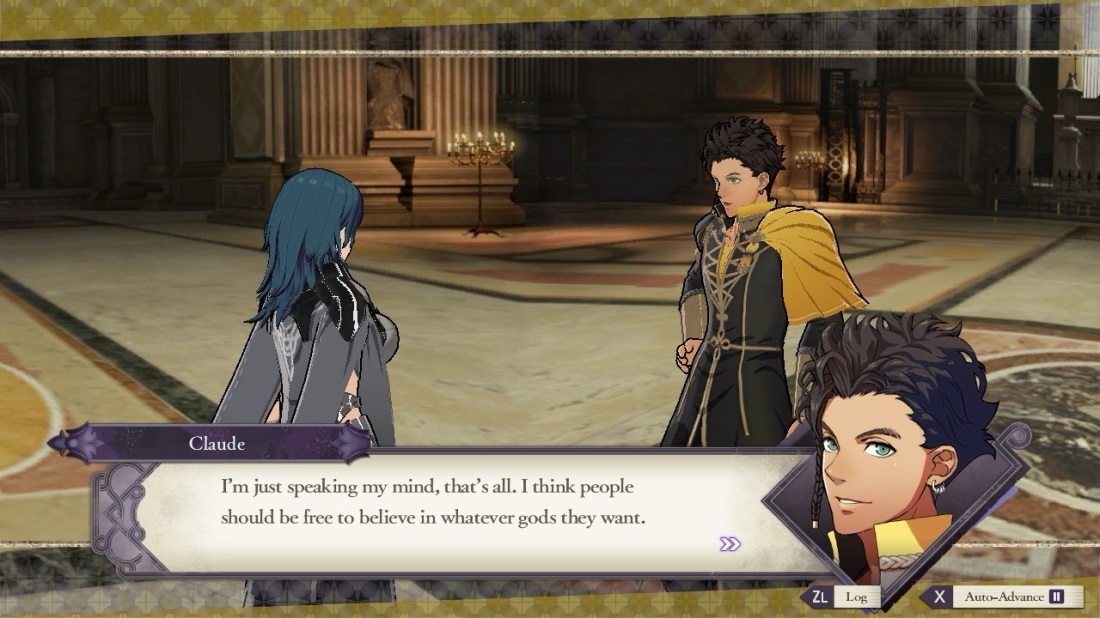
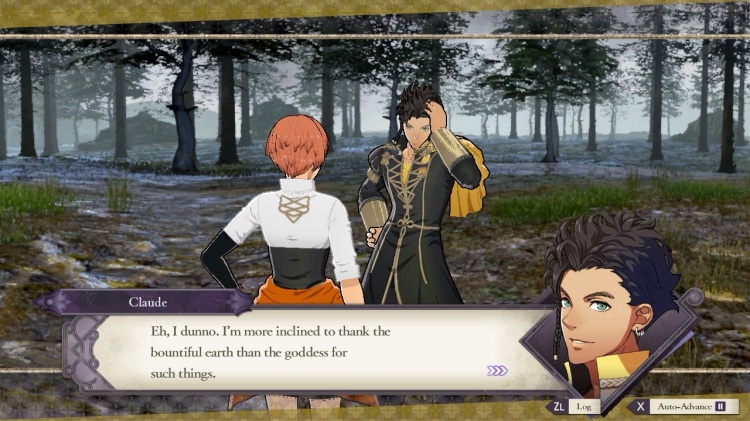
Anyhow, I wanted to share something he said that I think is worth considering (possibly out of order, I lost track of which is which):
Even though I tend to be an ardent Buddhist, I think what Claude is saying here is a healthy to look at the world and its religions. If you consider religions past and present, there have been countless gods and goddesses, rituals, liturgical languages, and so on. Even in in the same religions, practices and views diverge over time. This may offend purists, but it’s impossible to avoid, let alone manage.
Further, Buddhism has never been a particularly evangelical religion. It’s not in a race to win converts (minus a few cults), for a variety of reasons. First, this is in keeping with the Buddhist notion of metta (“goodwill”) that as long as other people have a belief system that helps them, not hinders or makes them feel bad, then that is fine. Second, the danger of imposing one’s beliefs on others is that it’s almost always fueled by ego and one’s own delusion anyway. A person’s religious beliefs, even Buddhist ones, are almost always a reflection of one’s own mind, and have to be taken with a grain of salt. Third, the Buddha clearly wanted people to take refuge in the Dharma of their own volition, and not by coercion. Even the Five Precepts are phrased as “I undertake” not as a command. Similarly with the practice of the nembutsu in Pure Land Buddhism. There’s nothing in the Buddhist canon that tells people to recite, or not recite it. It’s up to each individual to work with the tools offered in the Buddhist toolkit and apply them as best as they can. Like Claude says above, if you find a support system that works, great. This is no less true within Buddhism and its many traditions as well.
It’s generally better, and healthier for one’s own mental state, to let others be who they are, believe what they will, as long as its helpful, not harmful. The tighter one grasps, the more exhaustion and grief they inflict upon themselves, and others.
There are almost as many as variations on religious beliefs as there are people, so like the analogy of the Blind Men and the Elephant, each person is trying to feel their way through life using what resources, background and knowledge they have. Even within Buddhism, each person has their own “spin” on what the Buddha was, or what his teachings were.
It’s imperfect, but we all have to start from somewhere.
P.S. If you own a Switch, try Fire Emblem: Three Houses. 😋
1 Bit of a tangent, but of the three lords in Three Houses, I feel that Dmitri plays the role of the “conservative”, trying to restore his kingdom and the Church the way it was. Claude is the “liberal” trying to open things up and hoping it will change Fódlan, while Edelgard is the “revolutionary” who wants to change things directly (i.e. through force).
Chapter 25 of the Lotus Sutra is a popular devotional text in East Asian Buddhism. It is often referred to as the “Avalokiteśvara Sutra”, or kannongyō (観音経) in Japanese, or more formally the kanzeon bosatsu fumonbongé (観世音普門品偈, “Chapter on the Universal Gate of Kanzeon Bodhisattva”).
Despite the name, it is not a stand-alone text, but simply a famous chapter in the larger Lotus Sutra. This particular chapter is the main introduction to one of the most popular Bodhisattvas in Buddhism: Avalokitesvara (Kannon in Japanese, Guanyin in Chinese, etc.). The chapter describes the attributes of Kannon that are familiar to Buddhists, such as their vows to help all beings who call on them, their ability to take on various forms to teach people, and their unwavering compassion to lead all beings to Enlightenment.
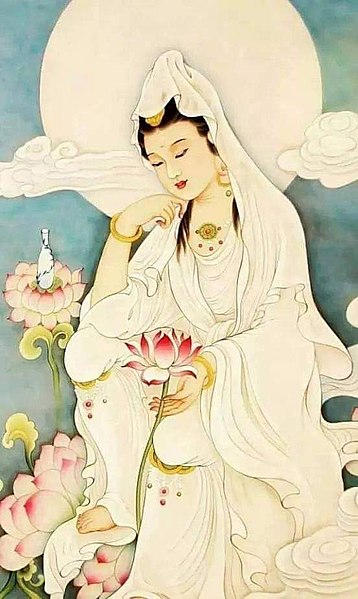
A more Chinese-style image of Kannon (a.k.a. Guan-yin) in her more motherly form, photo courtesy of Wikipedia.
The chapter as a whole is long and would be difficult to chant, so the verse section, not the narrative section, is frequently used for liturgical purposes. The Lotus Sutra often describes things in narrative form, then summarizes again in verse form. However, even the verse section alone is longer than the Heart Sutra, or the Shiseige, so just chanting the verse section is a bit challenging. In my experience it takes about 5-7 minutes.
For this reason, medieval Buddhists in Japan also devised an even shorter version called the Ten-Verse Kannon Sutra.
The sutra is frequently recited in both Zen and Tendai liturgies, among others, but it is not well known to Westerner lay-Buddhists. I had difficulty finding an online copy I could use as a reference here, even in Japanese, due to its length.
However, ages ago, I picked up a sutra book at the famous Sensōji temple in Tokyo, and once I figured out what the Kannon Sutra was, I copied it character by character to an old version of the blog, but then lost it later when I changed blogs. Recently, I was able to recover the text (not easily) from the original HTML I wrote, and posted it back on here with minor edits.
I have also provided a PDF version here if you want to print it out and use at home.
Also, special thanks to this website for providing much needed reference information on pronunciation and Chinese characters. My original, recovered text had a few errors, embarrassingly.
Examples
I found a few examples on Youtube that you can follow along if you are learning to chant the Kannon Sutra as shown below.
From Eiheiji temple (one of two home temples of Soto Zen). Note that they chant this at a pretty fast pace.
This example from Zenshoji Temple, a Shingon-sect temple, in Niigata Prefecture, has line by line annotation. The chanting pace is slower and easier to follow.
These examples are very similar, other than slight differences in pacing and pronunciation of certain Chinese characters. For people who are learning to recite the sutra, just pick what works until you get the hang of it.
Translation
I decided not to post the translation side-by-side with the text, the way I do with the Heart Sutra and such. This is due to formatting reasons on the blog, plus also length of the text makes this more difficult. I may revise this later.
For now, I highly recommend checking out a modern translation here by the excellent Dr Burton Watson. In that translation, the verse section starts after the phrase “At that time Bodhisattva Inexhaustible Intent posed this question in verse form“. The Buddhist Text Translation Society also has an excellent translation of the verse section here.
Disclaimer and Legal Info
I hereby release this into the public domain. Please use it as you see fit, but if you attribute it to this site, greatly appreciated. Also, please bear in mind this is an amateur work, and should not be taken too seriously.
Dedication
I dedicate this effort to all sentient beings everywhere. May all beings be well, and may they all attain perfect peace.
Namu Kanzeon Bosatsu
The Kannon Sutra, verse section
(2025 edition, with minor typo fixes)
Preamble
Original Chinese
Japanese Romanization
妙法蓮華經 観世音菩薩 普門品偈
Myo ho ren ge kyo kan ze on bo satsu fu mon bon ge
Verse Section
Original Chinese
Japanese Romanization
世尊妙相具 我今重問彼 佛子何因縁 名為観世音
Se son myo so gu ga kon ju mon pi bus-shi ga in nen myo i kan ze on
具足妙相尊 偈答無盡意 汝聴観音行 善応諸方所
gu soku myo so son ge to mu jin ni nyo cho kan on gyo zen no sho ho jo
弘誓深如海 歴劫不思議 侍多千億佛 発大清浄願
gu zei jin nyo kai ryak-ko fu shi gi ji ta sen noku butsu hotsu dai sho jo gan
我為汝略説 聞名及見身 心念不空過 能滅諸有苦
ga i nyo ryaku setsu mon myo gyu ken shin shin nen fu ku ka no metsu sho u ku
假使興害意 推落大火坑 念彼観音力 火坑変成池
ke shi ko gai i sui raku dai ka kyo nen pi kan on riki ka kyo hen jo ji
或漂流巨海 龍魚諸鬼難 念彼観音力 波浪不能没
waku hyo ru go kai ryu go sho ki nan nen pi kan on riki ha ro fu no motsu
或在須弥峰 為人所推堕 念彼観音力 如日虚空住
waku zai shu mi bu i nin sho sui da nen pi kan on riki nyo nichi ko ku ju
或被悪人逐 堕落金剛山 念彼観音力 不能損一毛
waku bi aku nin jiku da raku kon go sen nen pi kan on riki fu no son ichi mo
或値怨賊繞 各執刀加害 念彼観音力 咸即起慈心
waku ji on zoku nyo kaku shu to ka gai nen pi kan on riki gen soku ki ji shin
或遭王難苦 臨刑欲寿終 念彼観音力 刀尋段段壊
waku so o nan ku rin gyo yoku ju shu nen pi kan on riki to jin dan dan ne
或囚禁枷鎖 手足被杻械 念彼観音力 釈然得解脱
waku ju kin ka sa shu soku bi chu gai nen pi kan on riki shaku nen toku ge datsu
呪詛諸毒薬 所欲害身者 念彼観音力 還著於本人
shu so sho doku yaku sho yoku gai shin ja nen pi kan on riki gen jaku o hon nin
或遇悪羅刹 毒龍諸鬼等 念彼観音力 時悉不敢害
waku gu aku ra setsu doku ryu sho ki to nen pi kan on riki ji shitsu bu kan gai
若悪獣圍繞 利牙爪可怖 念彼観音力 疾走無邊方
nyaku aku shu i nyo ri ge so ka fu nen pi kan on riki jis-so mu hen bo
蚖蛇及蝮蠍 気毒煙火燃 念彼観音力 尋聲自回去
gan ja gyu fuku katsu ke doku en ka nen nen pi kan on riki jin sho ji e ko
雲雷鼓掣電 降雹澍大雨 念彼観音力 応時得消散
un rai ku sei den go baku ju dai u nen pi kan on riki o ji toku sho san
衆生被困厄 無量苦逼身 観音妙智力 能救世間苦
shu jo bi kon yaku mu ryo ku hitsu shin kan on myo chi riki no ku se ken ku
具足神通力 廣修智方便 十方諸国土 無刹不現身
gu soku jin zu riki ko shu chi ho ben jip-po sho koku do mu setsu fu gen shin
種種諸悪趣 地獄鬼畜生 生老病死苦 以漸悉令滅
shu ju sho aku shu ji goku ki chiku sho sho ro byo shi ku i zen shitsu ryo metsu
真観清浄観 廣大智慧観 悲観及慈観 常願常瞻仰
shin kan sho jo kan ko dai chi e kan hi kan gyu ji kan jo gan jo sen go
無垢清浄光 慧日破諸闇 能伏災風火 普明照世間
mu ku sho jo ko e nichi ha sho an no buku sai fu ka fu myo sho se ken
悲體戒雷震 慈意妙大雲 澍甘露法雨 滅除煩悩燄
hi tai kai rai shin ji i myo dai un ju kan ro ho u metsu jo bon no en
諍訟経官処 怖畏軍陣中 念彼観音力 衆怨悉退散
jo ju kyo kan jo fu i gun jin chu nen pi kan on riki shu on shitsu tai san
妙音観世音 梵音海潮音 勝彼世間音 是故須常念
myo on kan ze on bon on kai jo on sho hi se ken on ze ko shu jo nen
念念勿生疑 観世音浄聖 於苦悩死厄 能為作依怙
nen nen motsu sho gi kan ze on jo sho o ku no shi yaku no i sa e go
具一切功徳 慈眼視衆生 福聚海無量 是故応頂礼
gu is-sai ku doku ji gen ji shu jo fuku ju kai mu ryo ze ko o cho rai
Conclusion
Original Chinese
Romanization
爾時持地菩 薩即從座起 前白佛言世 尊若有衆生
ni ji ji ji bo sa soku ju za ki zen byaku butsu gon se son nyaku u shu jo
聞是観世音 菩薩品自在 之業普門示 現神通力者
mon ze kan ze on bo sa bon ji zai shi go fu mon ji gen jin zu riki sha
當知是人功 徳不少佛説 是普門品時 衆中八萬四
to chi ze nin ku doku fu sho bus-setsu ze fu mon bon ji shu ju hachi man shi
千衆生皆發 無等等阿耨 多羅三藐三 菩提心
sen shu jo kai hotsu mu to do a noku ta ra san myaku san bo dai shin
In the coming weeks, I hope to post a couple more such chants from the Lotus Sutra, as they are popular both in Tendai and Nichiren communities in particular, and I am learning to chant these too.
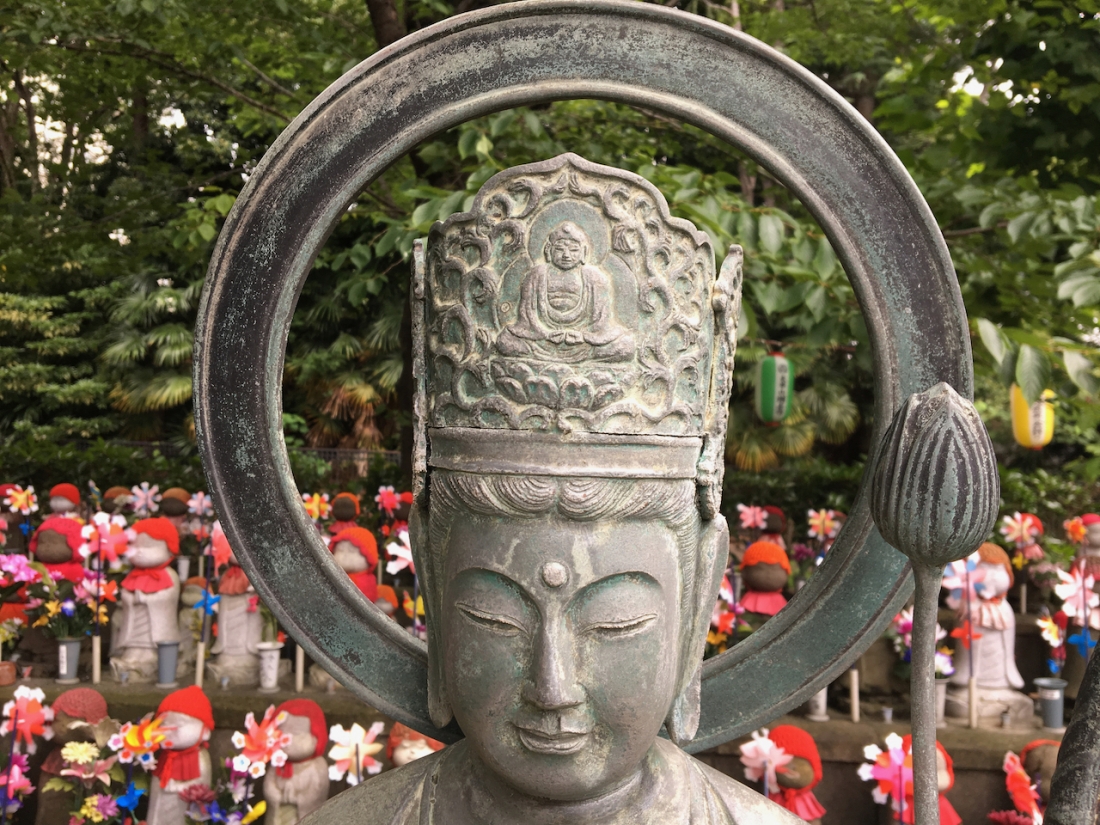
P.S. Featured photo was taken by me at Zojoji temple in Tokyo, Japan, with an image of Kannon Bodhisattva wearing a crown that features an image of Amitabha Buddha.
As a perfectionist, I am often plagued by self-doubt about my Buddhist practice and frequently question whether I am doing it right, whether I am doing the right practices to begin with, and so on. I’ve talked about the fundamentals of Buddhism, and how they apply to any sect or teaching on follows, but when you get into the finer details of how to put these into practice, it can feel daunting.
Recently I was reading an article in Japanese by the Soto Zen center in Kinki1 Region that I found very helpful. If you can use Google Translate to read it, I think it is well worth it. But the quote I really liked was:
As for the process of doing a home Buddhist practice, It is said that “faith begins with solemnity” and in the same way Service [at a restaraunt] begins with waiter.
I think this is important because Buddhist home practice (otsutomé おつとめ, in Japanese) isn’t meant to be something you do to show off, because you are obligated to, to get relaxation from, or to get a spiritual thrill from either. The form of the practice isn’t so important as the spirit of solemnity.
As the article points out, we Buddhists (focus on Zen Buddhists in the article, but it applies to all of us) are trying our best to put the historical founder, Shakyamuni Buddha’s, teachings into practice according to our circumstances. We are not given much instruction in life, and each has our own partial understanding of things, not to mention the conditions we grow up under. So, we have to adapt the teachings of the Buddha accordingly. But if we do it in a spirit of solemnity, not frivolity, obligation, nor conceit, then we will make progress.
Thus, I realized that whatever Buddhist practice you are already doing is probably the right one, as long as you are doing it with the right attitude.
Similarly, I was watching a video in Japanese by a Soto Zen monk who often provides very practical advice, but also hides his identity:
Around 5:00 onward, he talks about how people who first get into Buddhism, or a particular teaching or sect are often very overeager and want to dive in and do a lot of practices. Or, they see the official liturgical format and feel that they have to do everything (I am one of those people).
Instead, he uses the analogy of a restaurant, with a menu of choices. All the choices are great, but can be overwhelming if you try to order everything, so he suggests you start small. In his example, reciting the Heart Sutra daily is a good foundation. If you do this for a while, and it feels like something is missing, you can add additional liturgy or practices based on what’s recommended. Or if it feels like too much, pare back a little.
The key is daily practice. It’s not super important how you do it, just consistency and right attitude. If you are already doing this, then keep it up, and don’t get bogged down in details.
Namu Shakamuni Butsu
1 The “Kinki” region in Japan is just another historical term for the Kansai region of Western Japan. The first time I heard this word in Japanese, I was very confused. 🤦🏼♂️
Recently, I alluded to joining a local Soto Zen group and deepening my practice there. I am happy to report that after several weeks, I finally decided to formally join the community as a member. Thus, I guess I am now a student of Soto Zen.1 It is kind of exciting to be part of a Buddhist community again after years of isolation, but also a bit of an adjustment since I’ve been doing things a different way for a very, very long time.
As part of this I wanted to get familiar with the yearly liturgy of the Soto Zen tradition. To my surprise, the local community seemed to not follow this yearly calendar, but I guess it’s up to each follower, and each community to apply this calendar as much possible.2
This was taken near the famous Chujakumon (中雀門) Gate at Sojiji Temple, looking westward. Photo from 2012.
Anyhow, I think it’s helpful to get familiar with the calendar of events not just to have a foundation in one’s life and practice, but also to stay connected with the much larger community. So, for that reason I’m posting the yearly event calendar here for readers. Many of these holidays line up with other Buddhist traditions in Japan, and I’ve already talked about them in other blog posts, while a few are exclusive to Soto Zen only.
The Great Perfection of Wisdom Sutra requires some explanation. The Sutra is not one Buddhist text, but a collection of sutras that appeared in India starting in the 1st century CE. Each of these “great perfection of wisdom” sutras (a.k.a. prajña-paramita in Sanskrit) basically teaches the same message, but each version was composed in varying sizes: 8,000 verses, 15,000 verses, 25,000 verses, etc. The trend happens in reverse too: some versions get shorter and shorter until you get to the famous Diamond Sutra and Heart Sutra. Due to their slimmer size and easier recitation, these two sutras have retained more popularity over time.
Nevertheless, regardless of which version we’re talking about, the Great Perfection of Wisdom Sutra is a powerful foundation for Mahayana Buddhist traditions everywhere, including the Zen tradition. Thus, many traditions have some kind of “sutra reading” ceremony.
Because the Perfection of Wisdom Sutra is so large, it’s impractical to read/recite the entire sutra in a single session, so the ceremony usually involves Buddhist monks opening each fascicle and fanning through the pages to symbolize reading it. It’s a very formal ceremony. You can see an example of this below, though I am unclear which Buddhist sect this is:
If you want to the ceremony itself, skip to 11:30 or later, until about 16:00
English-language copies of the Great Perfection of Wisdom Sutra are very hard to find, by the way. I consider myself very lucky to find a copy of the 8,000-verse sutra at Powell’s City of Books some years back (that bookstore is amazing by the way):
Most Zen communities in the West can’t be expected to have such a copy. In any case, since the Heart Sutra is a summation of the Great Perfection of Wisdom Sutra anyway, it makes sense for most Zen practitioners to simply recite the Heart Sutra as appropriate. In the Youtube video above, the monks even recite the Heart Sutra at one point too.
Dual Founders Memorial
Soto Zen is somewhat unusual in Japan for having two founders, not one. The sect-founder-practice dynamic is something unique to Japanese Buddhism,3 usually each recognized Buddhist sect in Japan has one founder, not two.
Normally, when Westerners think of Soto Zen in Japan, they think of Dogen as the founder since he was the one who traveled to Song-Dynasty China, studied Caodong-sect Zen teachings, and brought those back to Japan.4 The challenge is that during this time, Soto Zen was a strictly monastic institution that had minimal appeal to the wider Japanese society.
Keizan, who came a few generations later, reformed Soto Zen as an institution that had more broad appeal. It was still centered around the monastic institution, but also included more community connections to the warrior samurai class and the peasantry as well. Soto Zen flourished in a way that other Zen sects in Japan simply never did. For this reason, Keizan is considered the second founder.
Thus, during formal ceremonies, a Soto Zen text, the ryōsokisho (両祖忌疏) is read aloud, which describes the virtuous life of both founders through the use of Chinese-style poetry.
Bodhidharma Memorial
Bodhidharma, unusually depicted standing. Taken at Sojiji Temple in 2012.
Within the world of Zen, Bodhidharma is a guy who needs no introduction. This semi-legendary monk from India supposedly came to China in the 4th century, and helped establish the lineage there, and subsequently all such lineages through East Asia.
The historicity of Bodhidharma though is pretty suspect, and some historians contend that he was made up in order to refute criticism that Zen had no prior connection to Buddhism in India. I don’t know which is true.
Regardless of whether Bodhidharma was real or not, he is the embodiment of Buddhism (particularly Zen) passing the torch from the community in India to the community in China and beyond.
End Of Year Temple Bell Ringing
The “joya” tradition is found across all Buddhist sects in Japan, and is a way of ringing in the new year. I took part in it once myself at a local Jodo Shu temple thanks to my father-in-laws connections.
The temple bell, or bonshō (梵鐘), is run 108 times, to signify the 108 forms of mental delusions (kleshas in Sanskrit, bonnō in Japanese) that all sentient beings carry with them. Things like anger, jealousy, covetousness, envy, ill-will, etc. In other words, the stupid petty shit we all do.
When I participated ages ago, this particular temple lined 108 volunteers up, and one by one we proceeded to the temple bell and rang it. As the temple bell is very large, and the striker is a large wooden log suspended by rope, this wasn’t easy, but it was cool.
Obviously, many communities in the West don’t have huge temple bells, and only tiny ones at home at their home altar. Still, one can relive the experience using a small bell, such as one found on your Buddhist altar, and ringing it 108 times (Buddhist rosaries can help keep count, by the way; that’s literally what they’re for), or some division of 108 if that’s not easy: 54, 27, etc.
Conclusion
The liturgical calendar of Soto Zen, as promulgated by the home temples in Japan, includes a lot of holidays that are practiced by the wider Mahayana Buddhist tradition anyway, plus a few novelties found only in Japan, or even just in Soto Zen itself.
Outside of Japan, how one incorporates this into one’s own community, or just in one’s personal life is entirely up to them. Personally, I like having some structure, including a set calendar like this to keep me from getting too idle, but also as a way to tie in to the larger Buddhist community as a whole. However, other people may differ.
Good luck and happy practicing!
Namu Amida Butsu
1 I should clarify that I haven’t stopped reciting the nembutsu and such, I just feel I moved onto the next phase of my Buddhist practice.
2 I have noticed over the years that communities here in the West are more or less connected to the home temple overseas. Some strive to stay in lock-step, some go the opposite route. I have mixed feelings on the subject.
3 TL;DR – The Edo Period government decided to divide-and-conquer previously militarized Buddhist establishments into distinct sects, where each one required to define their founder, their particular practice, and key sutras they base their teachings around. This led to the parochial style Buddhist institutions that still exist today, but also bucked the trend in continental East Asia where Buddhist sects tended to synthesize into a single “super-Buddhist” tradition.
4 Fun fact: the “Soto” is just the Japanese-style reading of Cao-dong: 曹洞. For a look at how Japan imported Chinese characters, and why they sound so different, you can watch this Youtube video. I have personal quibbles about some details, but it’s otherwise a great historical overview.
Mantras are a strange beast within Buddhism. The tradition of mantras predates Buddhism and goes all the way back to the early “Vedic religion”, that is the ancient devotional practices around the Vedas (precursors to Hinduism as we know it), and they continue to occupy an awkward spot.
The Mantra of Light as shown in a Rinzai-Zen service book.
“Recitation” in Buddhism usually comes in the form of recitingsutras, which makes sense, because the tradition of passing down the teachings from teacher to student has existed from the beginning. Mantras do not fit this role since they are essentially obscure (not to mention mispronounced) Sanskrit phrases, with esoteric meanings. The esoteric traditions such as Vajrayana in Tibet, Shingon and Taimitsu (Tendai school) traditions in Japan all embrace them as a central practice,1 but in other non-esoteric traditions mantras are relegated to a backup “support” role, protecting the Buddhist disciple.
For example, here’s a certain mantra as found in a Rinzai Zen liturgy book I own. This is the famous Mantra of Light (kōmyō shingon, 光明真言), which reads in various languages like so:
Ǎn ā mó jiā wěi lú zuǒ nǎng mó hē mǔ nà luō me nǐ bō nà me rù mó luó bō luō wà duō yě hōng
Japanese:2
オン アボキャ ベイロシャノウ マカボダラ マニ ハンドマ ジンバラ ハラバリタヤ ウン
Japanese romanization
On abokya beiroshano makabodara mani handoma jinbara harabaritaya un
Here’s an example of how it’s chanted in Japan (notice the Siddham letters, too):
What makes the Mantra of Light somewhat unusual within the world of mantras and esoteric traditions in Buddhism is how widely it’s been adopted. You will find it in many Buddhist traditions, even ones that are otherwise not interested in esoteric practices.
In fact, for a time in the late Heian Period of Japan, the Mantra of Light was propped up as a rival practice to the nembutsu in the Pure Land tradition particularly by a monk named Myoe (明恵, 1173 – 1232).
At that time, there was an existing funerary practice of scattering sand blessed by the Mantra of Light on the deceased, but Myoe tried to popularize it further by playing up its benefits in helping one to be reborn in the Pure Land of Amitabha Buddha. This interpretation is largely Myoe’s, however.
It never quite worked as Myoe hoped, and the popularity of the nembutsu prevailed, but even today it’s common for Buddhist practitioners to chant both. I do this in my home service for example. I happen to like the Tendai-sect approach of “umbrella Buddhism” where meditation practices, Pure Land practices and esoteric practices are given roughly equal weight, with the Lotus Sutra as a kind of capstone.
Thus, reciting the nembutsu (pure land Buddhism) and the Mantra of Light (esoteric Buddhism) are both perfectly fine.3 For me at least, I chant the nembutsu for the benefit of others, and the Mantra of Light to reinforce my commitment to being a help to others (and be less of a dickhead). That may not be the correct approach, but it’s a start.
Speaking of which what does the Mantra of Light actually mean? Like all mantras, they’re infused with meaning in esoteric traditions, so a simple translation doesn’t tell the whole story. Furthermore, in esoteric traditions, mantras are supposed to be recited while visualizing a specific image and holding your hands in a specific “mudra”. This combination is thought to jar something deep inside, not at an intellectual level, but on an experiential level. Thus, the meaning of the mantra is something shared between teacher and student. So, I don’t have a good answer for this. If you really want to know, consult a trusted teacher in good-standing!
But it’s not necessary to know the exact meaning either. The act of recitation is more important, or so I have been told. So, if you chose to recite the nembutsu, Mantra of Light, both, neither, that’s fine. Buddhism has a large toolbox, so try what works, and enjoy!
1 Interestingly enough, the Japanese word “shingon” as in the Shingon school, literally just means “mantra”.
2 Mantras are usually written in Japanese using katakana, given that they’re technically foreign words, but for ease of readibility, hiragana is also used.
3 Meditation has always been my Achilles Heel, but I still meditate from time to time.










 Gleanings in Buddha-Fields

.jpeg?uselang=en)
You must be logged in to post a comment.