I found this nice excerpt from the 25th chapter of the Lotus Sutra, better known as the “Kannon Sutra” for some, and just wanted to share:
All darkness is dispelled by the light of his wisdom As spotless and as pure as the light of the sun. The light destroys the dangers of wind and fire, And illumines the whole world brightly.
His precepts out of his loving-kindess brace us up as thunderbolts. His wishes out of his compassion are as wonderful as large clouds. He pours the rain of the Dharma as sweet as nectar, And extinguishes the fire of illusions.
Chapter Twenty-five of the Lotus Sutra, the “Kannon Sutra”, by Rev. Senchu Murano. You can find an alternate translation by Dr Burton Watson.
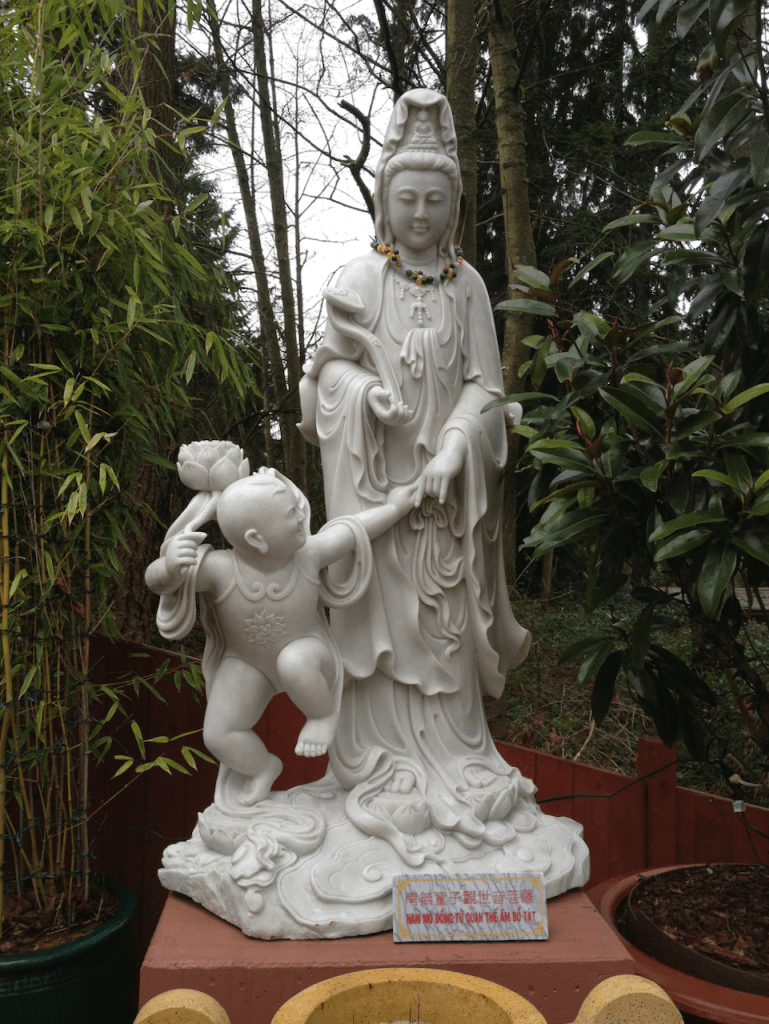
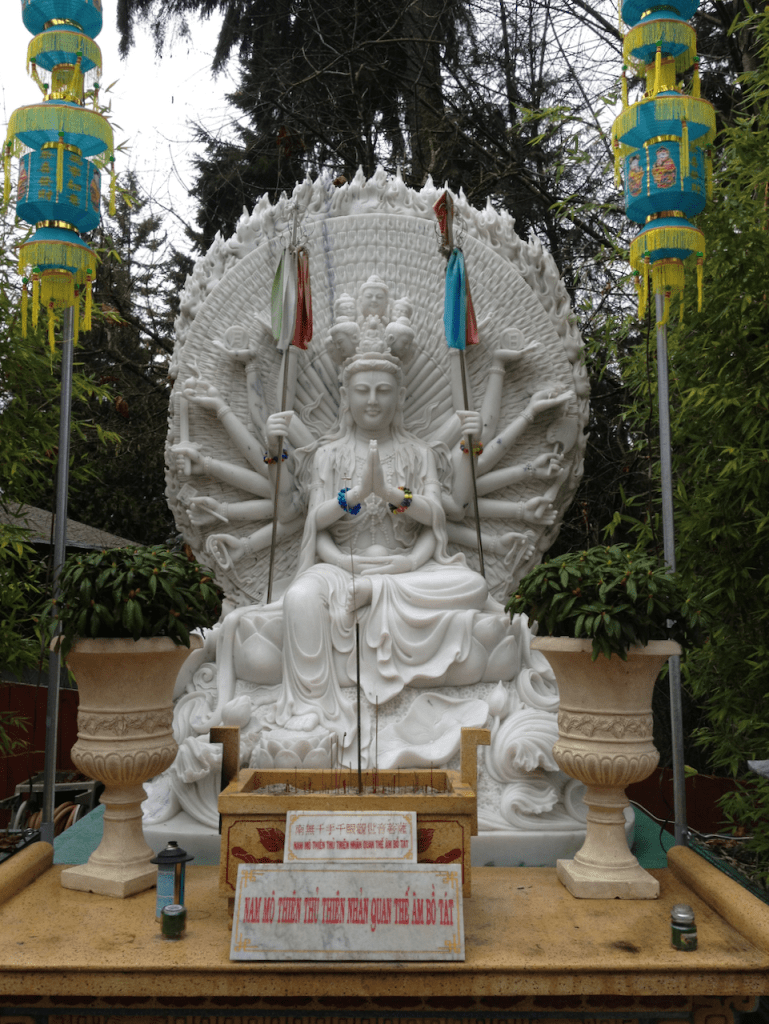
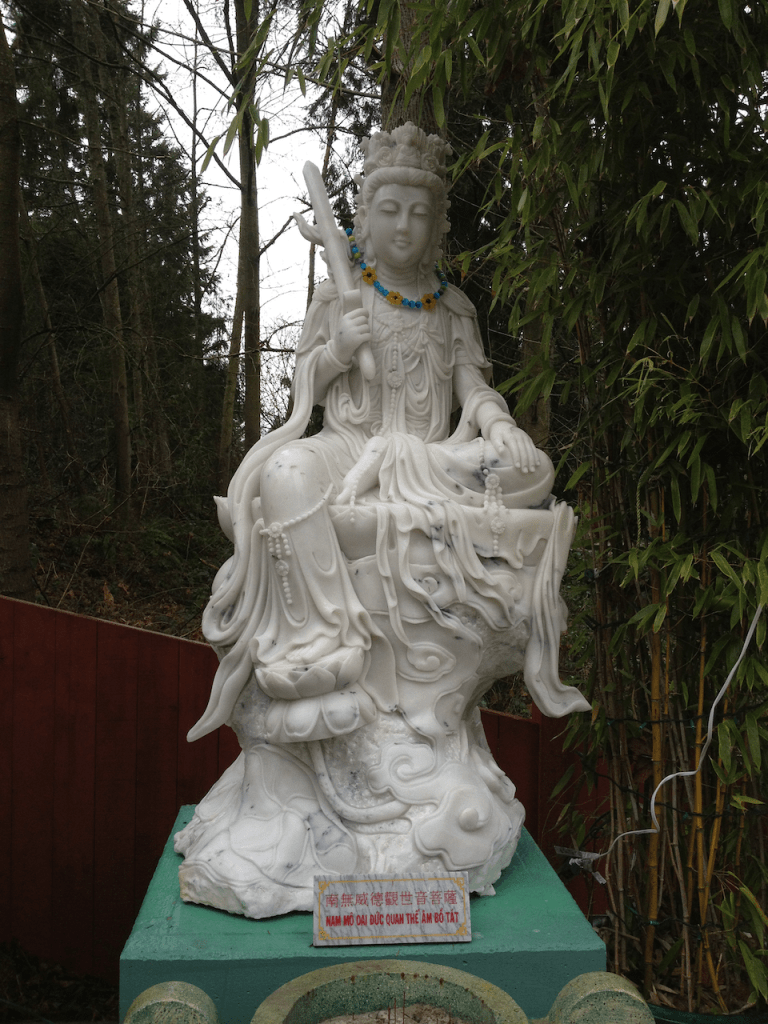
By the way, fun language-nerd fact: I noticed that my two books on the Lotus Sutra (Watson and Murano translations) both translate this passage using “he/him/his” pronoun, but both in the Lotus Sutra, and in popular culture, Avalokitesvara1 is frequently described as both male or female: a princely figure (male), a loving mother figure (female), etc. Here are just some examples from a Vietnamese-Buddhist temple in Lynnwood, WA:
In East-Asian Buddhism, the sutra is preserved in Classical Chinese, so I looked at the translated section above and it shows neither pronoun. Instead, the Chinese Character 観 is used which is the first character of Avalokitesvara’s name: 観世音.
This is hard to do in English: a pronoun is usually required, but in many languages, it’s not. In this case, the original text just abbreviated “Avalokitesvara” into a single character into the passage above.
Clever.
Namu Kanzeon Bosatsu
1 a.k.a. Guan-yin, Kannon, Gwan-seum, Chenrezig, etc. To confuse matters, how the Sanskrit name is spelled in English varies. The most phonetic spelling is Avalokiteshvara, but it’s often spelled the more Sanskrit-ey way Avalokiteśvara, expect that ś is hard to print sometimes. Thus, confusingly it becomes Avalokitesvara (no “sh” sound). Transliterating one language to another, especially languages so different like Sanskrit and Chinese is really tough…… but it’s also fun to see how different generations approached it.
Spock: Mr Scott, there was no deity involved. It was my cross-circuiting to B that recovered them.
McCoy: Then thank pitchforks and pointed ears.
Star Trek, “Obsession” (s2:ep13), stardate 3620.7
In the host of world religions, Buddhism occupies a strange place. In one sense, it is a world religion because it is followed by many different peoples, cultures, and languages throughout its 2,500 year history.
But unlike other world religions there is no central deity, no creator.
Hold on, you might be thinking, what about the Buddha?
The Buddha is the central figure of Buddhism. He is the teacher, but in the Buddhist tradition he was once a person, just like you and me, who through countless lifetimes as a bodhisattva fully accomplished the path and awakened to the Dharma: the principles of existence. He taught the Dharma to his disciples, and they became the first generation of the Sangha, the community.
Thus, these comprise the Three Treasures of Buddhism.
But why do people pray to the Buddha?
Because the Buddha and all other such figures in Buddhism are not passive. The Buddha taught the Dharma out of compassion and goodwill for all beings, and the countless Bodhisattvas such as Kannon guide any sentient beings who take up the Buddhist path. Amida Buddha provides a refuge for all beings who wish to be reborn there.
Kannon (観音) Bodhisattva in her more motherly form.
The underlying theme isn’t Enlightenment for Enlightenment’s sake. It is to help beings who suffer so that eventually they too may reach Buddhahood (a.k.a. Enlightenment).
One does not have to pray to the Buddhas and Bodhisattvas. The most important thing is to put the Buddhist teachings into practice as one can. But in times of unease, uncertainty or crisis it’s perfectly fine to pray to a Buddha or Bodhisattva that you revere. I do it from time to time myself when I am worried about my kids, on plane flights, before surgery, etc.
But also, in the end, I am responsible for my choices, my words, and my thoughts.
When you plant melon seeds you get melons, and when you plant beans you get beans. [Effect follows causes] like a shadow follows a physical shape, like an echo responds to a sound. Nothing is sown in vain. This is called “believing in the result”.
Ou-yi’s Mind Seal of the Buddhas, translation by J. C. Clearly
I alone bear the fruits of my choices, words and thoughts.
This is the last in a series of Japanese-Buddhist sutra books that I wanted to share. I talked about this Soto Zen sutra book, a Rinzai Zen book and a Jodo Shu sutra book. Today, I wanted to share the sutra book I purchased at Asakusa Temple in Tokyo, Japan.
Asakusa Temple (more properly Sensoji Temple, 浅草寺)1 is super famous, and chances are if you have visited Tokyo, you probably went to Asakusa Temple. Asakusa is technically its own Buddhist-sect now, but for much of its history it was a Tendai Buddhist temple that enshrined a legendary statue of Kannon Bodhisattva that supposedly washed up on shore and enshrined in the year 645. This is called the Yanagi no Miei (柳御影, roughly translated “the [sacred] willow image”). The featured photo above shows where it is enshrined at Asakusa Temple.
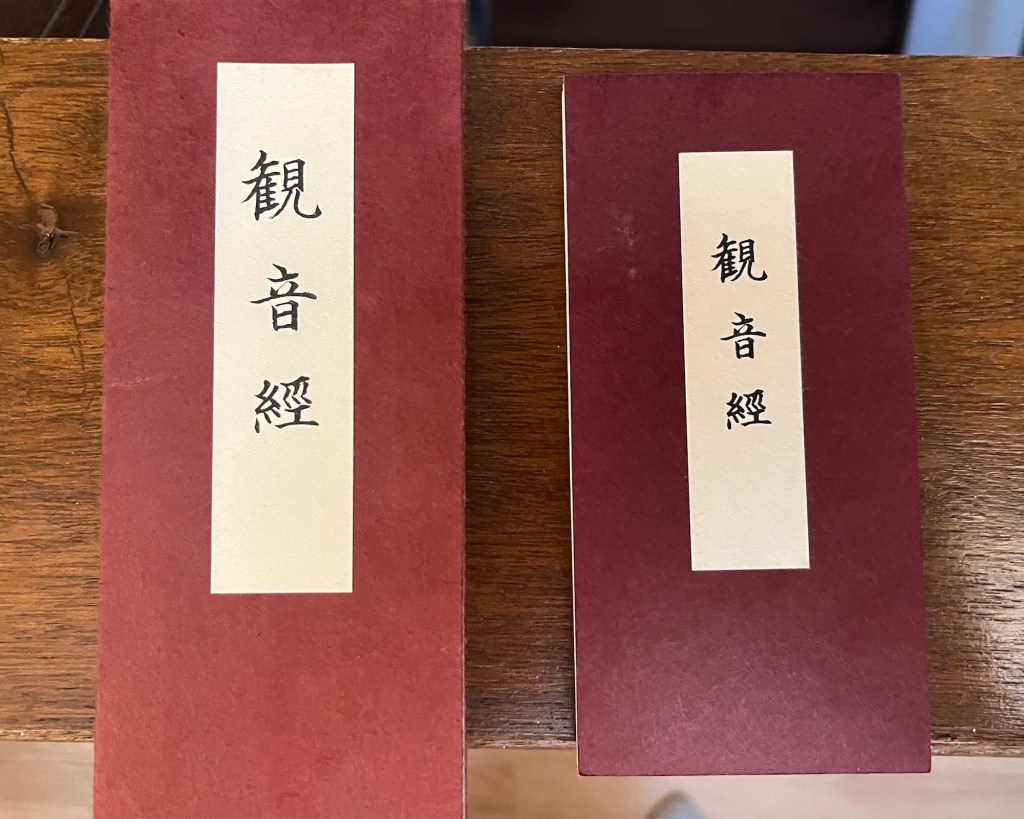
Not surprisingly, the sutra book’s liturgy focuses on Kannon-related chants. This sutra book is sold in two sizes, but the contents are the same:
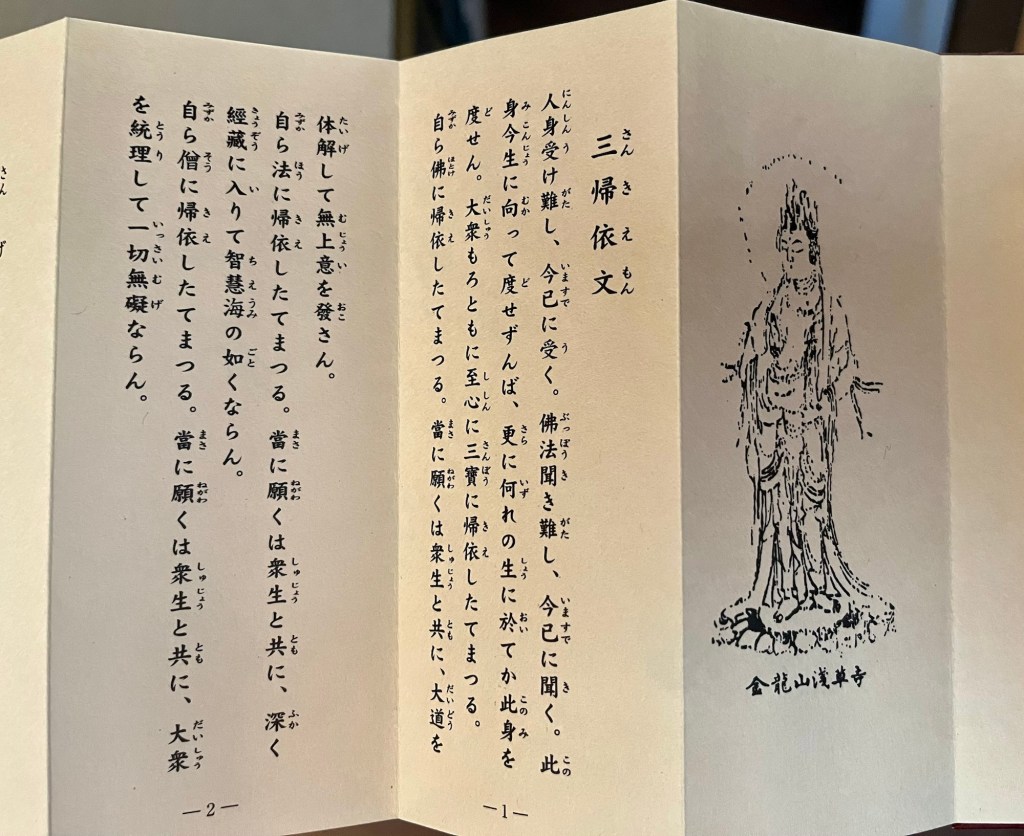
The illustration inside the cover depicts the legendary statue :
The liturgy to the left of the illustration is a form of Taking Refuge in the Three Treasures (san-ki-é-mon, 三帰依文) done in a more native-Japanese style, than the Sino-Japanese version I posted here. Both versions are perfectly valid and are chanted.
More examples below are chants that we’ve seen in older posts in right to left order:
the Sangémon (repentance) on the right,
Kaikyoge (verses for opening the sutra) second page from right, and
Unlike other examples I’ve seen, this sutra book posts the entire Kannon sutra, not just the verse section. It’s about 3 times as longer than usual.
Next, we see a classic: the Heart Sutra. This makes sense since the Heart Sutra was spoken by Kannon Bodhisattva, not Shakyamuni Buddha. So. it fits the theme.
Finally on the far left page is a simple recitation chant of devotion to Kannon Bodhisattva: namu kanzeon bosatsu (南無観世音菩薩). I’ve often used that to sign off blog posts, and unlike more esoteric mantras, this is a very common statement of devotion, much like the nembutsu for Amida Buddha. Feel free to chant it in your Buddhist practice!
Anyhow, this sutra book is something visitors to Asakusa Temple would probably overlook without the necessary background (or religious inclination), but it’s a fascinating look at Tendai Buddhist liturgy, but in a way that’s adapted to a particular temple, and to a particular deity.
Namu Kanzeon Bosatsu
P.S. That covers all the sutra books I wanted to cover here in the blog. I own a few more, but they’re not interesting or unique enough to justify another blog post. If I pick up another sutra book, I’ll post again. But if you did enjoy this mini-series, thank you for reading!
1 The words “asakusa” and “senso” are literally just two different ways to read the same Chinese characters.
Something I haven’t really covered before, but worth talking about lately is a Soto Zen service book I picked up some years ago at Sojiji Temple which is not too far from my wife’s home in Japan.
Back then, we’d visit Japan yearly to see relatives, and let the kids get much-needed language exposure. Also, I was in touch with an expat1 who lived there for 20 years and shared a passion for Buddhist temples. He and I would go “temple hopping” together around the Tokyo area whenever I was in town, and as my firstborn daughter got older, she would come with us.
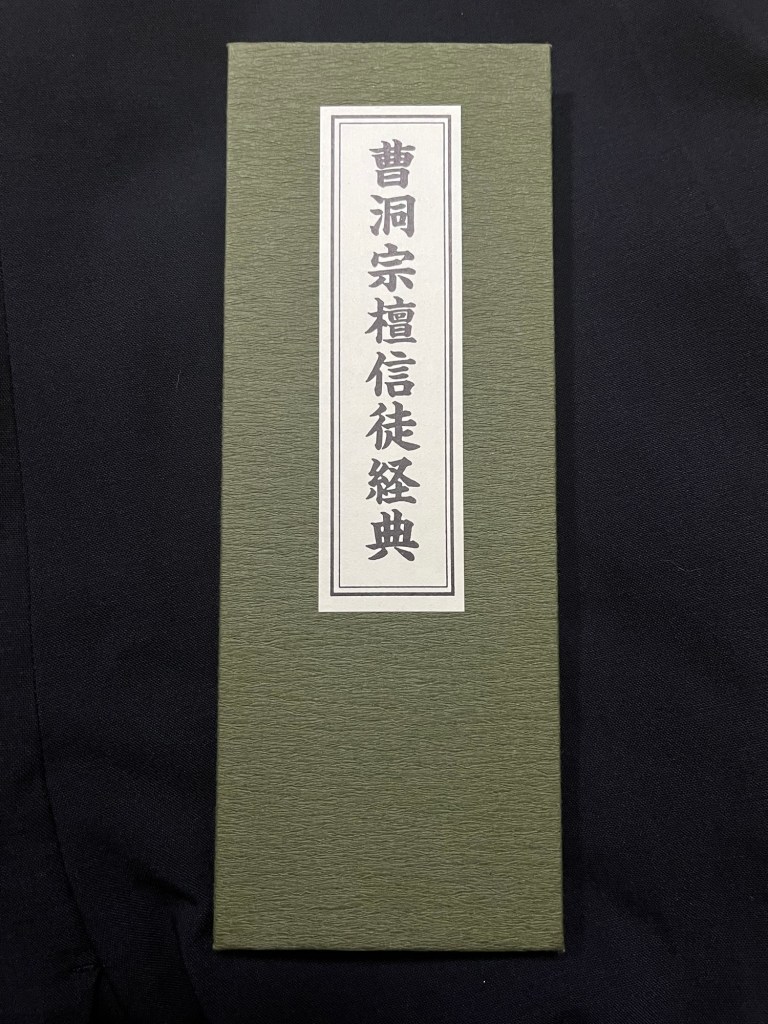
In any case here is the cover of the service book for Soto Zen home liturgy:
Cover of Soto Zen service book, purchased at Sojiji temple. Title roughly translates as “Soto Zen scriptures for parishioners”.
Inside, you can see the table of contents on the right side. Japanese text is tradtionally written right to left, and vertically (not horizontal):
Table of contents of sutra service book for Soto Zen. Purchased at Sojiji temple.
On the left-hand side is the Kaikyoge, a verse recited traditionally when starting a service. The gist of the verse is that encountering the Dharma is quite rare, and yet we are privileged to read and recite it now. Thus, may we all attain the Buddha way. During my years with the Buddhist Churches of America, we read a very similar liturgy in English. The concept is almost universal in Buddhist services.
Also, notice that the text in the Kaikyoge is Chinese characters (kanji), but with hiragana text to the side as a pronunciation aid. This is because most liturgy in Japanese Buddhism was originally adopted from China, and thus requires pronunciation guides (same is true with Korean Buddhism too, iirc). At the very bottom-left is smaller text helping to explain the meaning of this verses.
The photo below is the first part of the verse section of the Kannon Sutra (a.k.a. chapter twenty-five of the Lotus Sutra). Again, we see vertical lines of Chinese characters since the original edition was recorded in old literary (not modern) Chinese, and phonetic hiragana script beside each character. The large circle mark indicates a ring of the bell if you have one. As with above, it is read from right to left, vertically.
A copy of the Kannon Sutra, version section, from a Soto Zen service book, from Sojiji temple.
What I really like about this particular sutra book is how clear and readable the hiragana text is. Some books use a font that’s hard to read if you are a foreigner (or even Japanese possibly). This makes reciting difficult. But here, if you can read hiragana script, it’s easy to follow along.
A close up of the Kannon Sutra as printed in a Soto Zen service book, purchased at Sojiji Temple.
By the way, below is an example of verses that are not recorded in Classical Chinese: an excerpt of the Shushogi, chapters three and four. Since the Shushogi was recorded natively in Japanese, there are fewer Chinese characters, and the style of language is more readable to a native speaker. To me, as a language student, it’s still pretty difficult since the source text by Dogen was composed in the 13th century. The grammar is quite different 800 years ago. This section also includes explanations at the bottom for modern native speakers.
Because of the popularity of the Shushogi among laity in the Soto Zen tradition, all five chapters are recorded in this sutra book.
The rest of the content is pretty typical, and I explained the full contents in an older post, but what I liked about this particular sutra book was the quality, readability, and thorough content.
Side note: it turns out that there is also an eBook version of the service book (originally linked here) available in both Apple Books and Google Play formats. The eBook version is a lot nicer than I expected, and closely follows the physical book (the subject of this post), with a few slight differences:
The kaikyōge (verses on opening of the sutra) uses Sino-Japanese, the service book uses a mixture of native Japanese and Sino-Japanese
Similarly, the Sankiraimon uses native Japanese in tbe eBook version, but Sino-Japanese in the physical book.
the eBook version has a really nice altar image (gohonzon). A person who can’t access Buddhist altar goods could print it out, and install in a Buddhist altar (obutsudan).
But I digress.
For some reason I find sutra books fascinating, and if readers enjoyed this post, please let me know. I might try to make more posts on the various books I’ve collected over the years. I have service books from practically every sect in Japan.
P.S. Happy 4th of July to readers in the US. Also, happy (belated) Canada Day to readers there. To my ancient roman readers happy … (checks notes) … Battle of Adrianople?
1 via online Buddhist circles, namely the long-dead E-Sangha forum. IYKYK.
I alluded in recent posts about my visits to the temple of Sanjūsangendō (三十三間堂, San-ju-san-gen-do) in Kyoto, Japan, but I’ve never really talked about it.
My experiences with Sanjusangendo go all the way back to our first trip to Japan together in 2005. My wife (whose Japanese) and I had married the previous year,1 and we came to Japan to meet the extended family, but also take in many sites. That first trip through Kyoto was a whirlwind, and I have very fuzzy memories of most of it. I couldn’t remember much about Sanjusangendo, and since we couldn’t take photos, I had very little to remind me either.
And yet, something about Sanjusangendo drew us back in recent years. My late mother-in-law really liked Sanjusangendo, and my wife wanted visit again for her mother’s sake, and now with 20 years of experience in Buddhism, the temple made a lot more sense to me. The fact that it’s a Tendai temple (and I like Tendai Buddhism) was icing on the cake. My wife was really inspired by it too, so the following year we visited it again.
…. so, what is Sanjusangendo?
Sanjusangendo is a Buddhist temple, which venerates the bodhisattva Kannon, also known as Avalokiteshvara, Guan-yin, etc. It was founded in the 12th century by the infamous warlord Taira no Kiyomori as a way to impress Emperor Go-Shirakawa (tl;dr it didn’t work). What makes Sanjusangendo so famous is two things:
It’s very long, narrow main hall (本堂, hondō). This is different than most temples which have a more square-shaped main hall. The hondō of Sanjusangendo is a very long rectangle, but there’s a reason for this. The featured photo above is something I took in 2023, and shows the scale of the building. The website also has a nice photo.
The temple’s main attraction is the 1,000 statues of Kannon bodhisattva, centering around a much larger statue of Kannon. These statues are lined up in rows along the main hall, and in front of them are other statues featuring various gods and other divine beings protecting the temple. More on that below.
Since Sanjusangendo doesn’t allow photography inside the main hall,2 you should check out the official website instead. You can see the main hall, and the row upon row of Kannons here. The official website also has photos of each figure.
The main figure of devotion, as i said above, is the bodhisattva Kannon, but since Kannon has many forms, this form is the 1,000-armed Kannon called Senju Kannon (千手観音). This form of Kannon isn’t limited to Japanese Buddhism; I have seen this form expressed at Vietnamese Buddhist temples as well. The idea is that Kannon, according to the Lotus Sutra, uses many different means and methods to help people, and the 1,000 arms, each holding different objects, symbolizes the diverse ways that Kannon helps others.
Something you might also note is that the Kannon statue has 11 heads. Just as the 1,000 arms show Kannon’s efforts to help all beings in a variety of ways, the 11 heads show Kannon’s vigilance in watching out over people.
Not shown in the photos is a small display which teaches a particular mantra associated with the 1,000-armed Kannon:
You can recite this mantra in Japanese or Sanskrit. I am unclear what the translation is, but I’ve been told before that translating mantras is kind of pointless, like giving answers to a Zen koan. So, I left out the translation.
Anyhow, flanking the great big statue of Kannon on either side are 10 rows of smaller, standing statues of Kannon, each with 1,000 arms, which you can see here. The website says that of the one-thousand statues, they were built over time: 124 were from the late Heian period (12th century) and the rest were constructed during the Kamakura period (13th-15th century). There are a total of 1,000 statues, each one slightly different, but generally the same form.
Finally, in front of these statues is a series of mythical figures. Some are originally from India, and traveled the Silk Road, gradually transforming into what we see today. Others are more native Japanese deities who’ve also become Buddhist guardians. You can see the full catalog here.
To give an example of the eclectic nature of these figures, one figure is a Buddhist guardian deity named Vajrapani (Naraenkengō 那羅延堅固 in Japanese), whose imagery was influenced by the Greek hero Herakles at a time when places like Bactria and Gandhara were still part of the Greek world.
On the other hand, you can also see the famous figures of Raijin and Fūjin who are Thunder and Wind gods respectively. As far as I know, these are native deities and did not originate from the Silk Road.
The quality of the artwork is really excellent. When you see any of these figures, Kannon, Vajrapani, Raijin, etc, the life-like quality is really impressive. And, like many examples of Buddhist art, they are full of symbolism and visual meaning beyond words. They impress and inspire those who see them. Since I have now seen Sanjusangendo three times, I found that it continues to impress me every time I see it.
Speaking from experience, Sanjusangendo is a place that requires some context to really appreciate. If you are unfamiliar with Kannon and why they have one-thousand arms, or with the strange but beautiful figures guarding the front row, then some of it will feel like a mystery. It’s a beautiful mystery, but still a mystery. But, hopefully after reading this, you will get a chance to see it someday and really get a feel for why this place is special.
As someone who has an affinity for Kannon since I first became a Buddhist, it is a special place for me. 😊
Edit: fixed a number of typos. Three-day weekend drowsiness. 😅
P.S. Again, apologies for the lack of photos. I know sometimes foreigners will take photos anyway (I have seen people do this), despite the signs clearly saying “photography prohibited”, but I don’t want to be one of those tourists. So, if you want to see more, check out the excellent website.
1 Twenty-year anniversary as of early 2024. 🎉
2 A lot of temples in Japan do this. I don’t fully understand why, and it is frankly a little frustrating.
3 Katakana script is often used to write foreign-imported words in Japanese, as opposed to hiragana script. Since mantras are originally derived from Sanskrit, using katakana makes sense in this context. Sometimes katakana is also used for visual impact (like in manga), so that might explain things too. NHK has a nice website explaining how to read katakana.
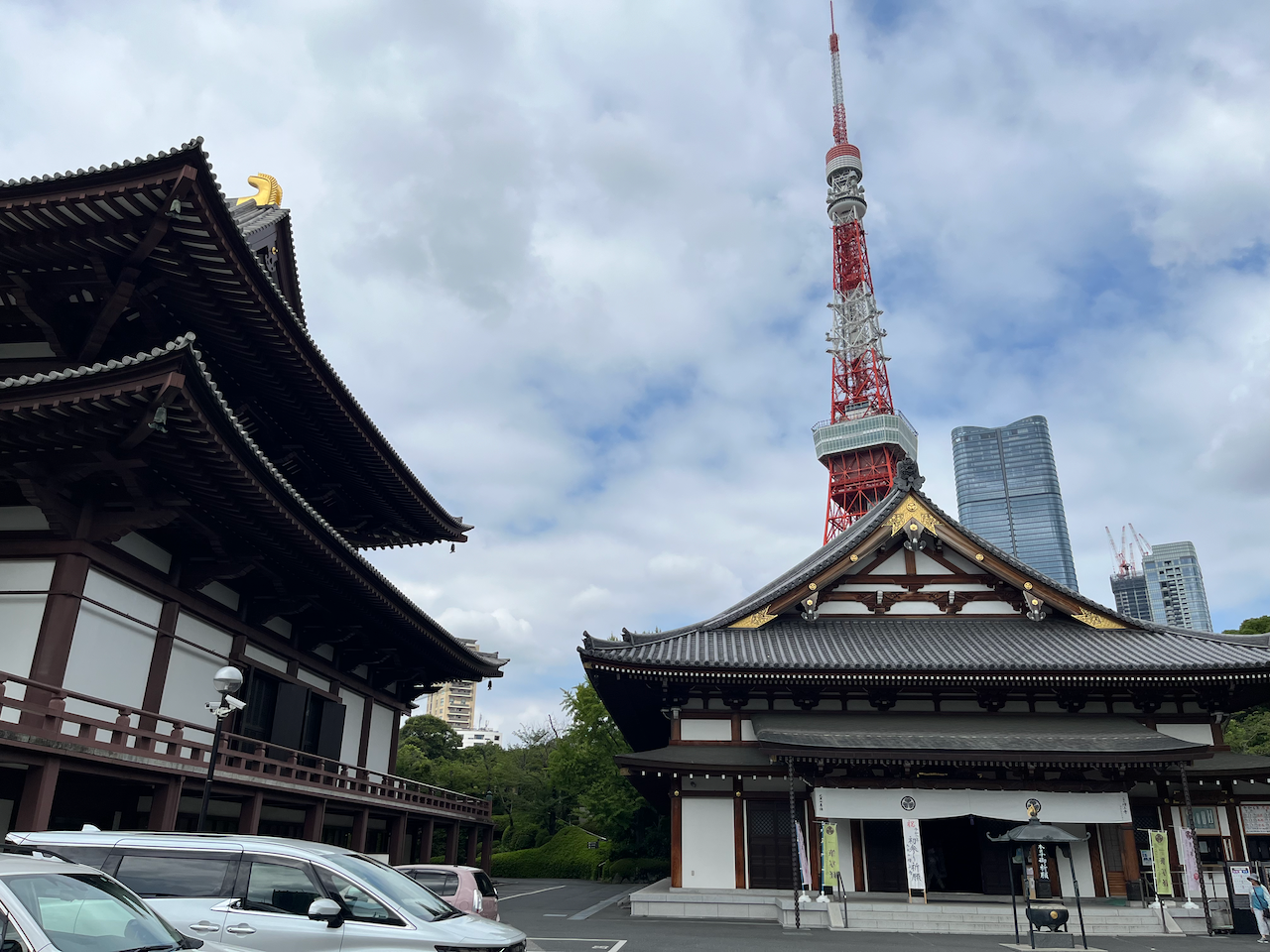
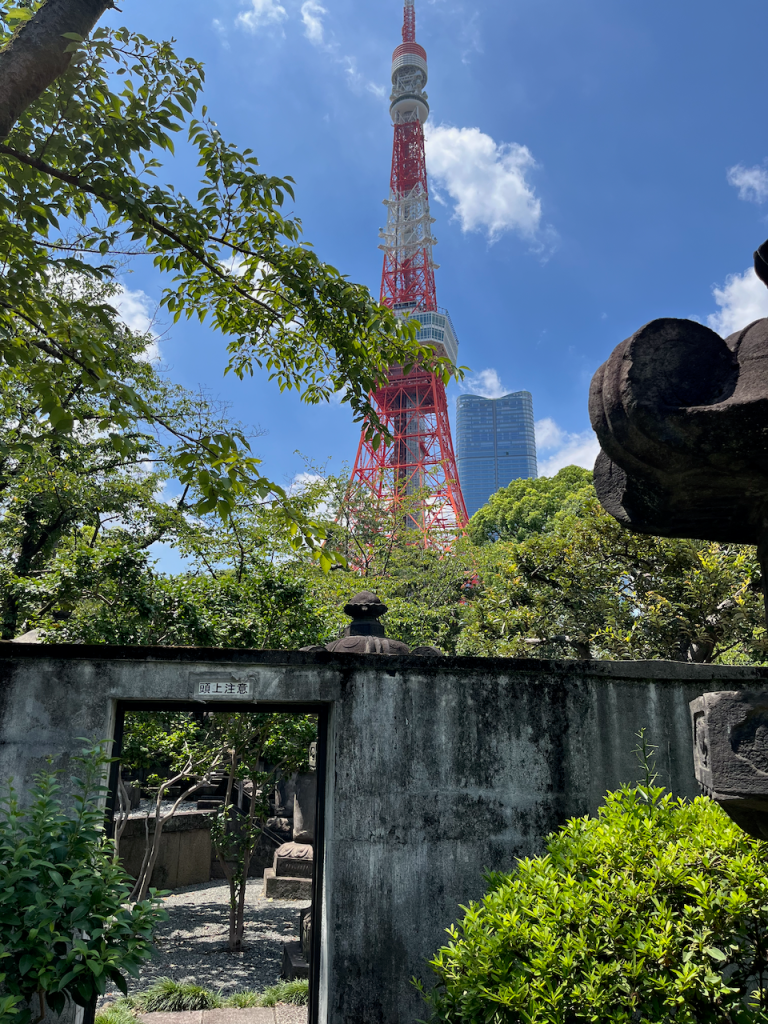
Visiting the city of Tokyo is not complete without taking a stop at the iconic Tokyo Tower. But what a lot of visitors might not know is that right next to Tokyo Tower is a Buddhist temple of great historical and cultural value: Zojoji
The temple of Zōjō-ji (増上寺) was the family temple for the Tokugawa shoguns who ruled Japan from 1600 to 1868 (e.g. the Edo Period), and many of the shoguns are interred here. The temple is also one of two main temples of the Jodo-shu sect of Buddhism. Jodo-shu Buddhism really helped me find my foundation back in the day, so I am more than a little fond of it. I have also visited the other main temple, Chion-in, in Kyoto a couple times. My first visit in 2005 is what really started me on the path to Buddhism back in the day. So, it’s no exaggeration that without the Honen the founder and Jodo Shu sect, I wouldn’t have found my path. I am always grateful.
In any case, wife (who’s Japanese) and I both like to come to Zojoji whenever we can. We joke it’s our “power spot”.1
The prestige and political power of Zojoji meant that it has been a very important temple in the Tokyo area for centuries, probably more so than Sensoji / Asakusa Temple (which I am also quite fond of).
The English website for Zojoji is actually pretty good, but it leaves out some details found in the Japanese version. Every time I go, I see foreign tourists dropping by, but I suspect some of them are unaware of the history and teachings of the temple, which is a shame because it’s actually a pretty neat place. So, this post is a lengthy tour of Zojoji. If you are reading this through email, you may want to visit the link instead. This post is VERY picture-heavy.
The Japanese site has a nice map of temple. I started at the bottom-center, at the Sangédatsu-mon (三解脱門), which might translate into something like the Three Gates of Liberation:
To the left of the gate is a sign that posts a monthly Buddhist teaching.
This month’s (August 2024) teaching is a quote from the very early Buddhist text, the Dhammapada, verse 54:
Not the sweet smell of flowers, not even the fragrance of sandal, tagara, or jasmine blows against the wind. But the fragrance of the virtuous blows against the wind. Truly the virtuous man pervades all directions with the fragrance of his virtue.
From here, I passed through the gate and took a photo of this statue of the Bodhisattva Kannon:
Next, based on the map linked above, I went clockwise around the perimeter of the temple. The next thing I saw was this pagoda (gojū-no-tō 五重塔 in Japanese) which seems to have been built in 1938:
It sits next to the other gate to Zojoji, the Kuro-mon (黒門, “black gate”) which was built in the 1700’s.
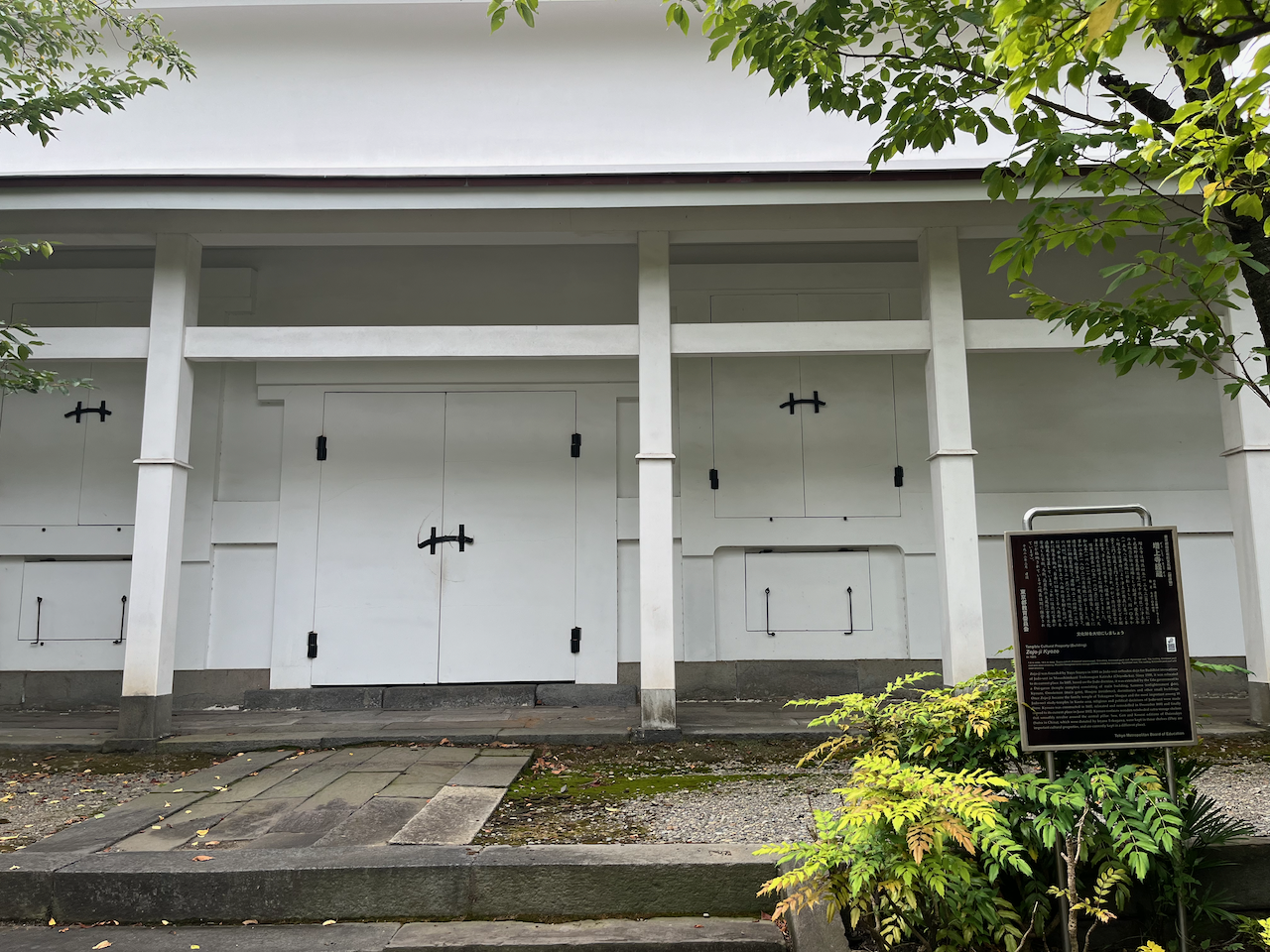
Just north of this (still going clockwise), you can see the Sutra Storehouse (kyōzō 経蔵):
This is something major temples often have: a large store house that contains the vast corpus of Buddhist literature (sutras): the Tripitaka. Sadly, I came too early in the day, and so the doors were closed. If you click on the map above, and look in the bottom left for 経蔵 you can see photo of the interior. It contains a full copy of the Taisho Tripitaka, in three different versions, in a rotating shelf.
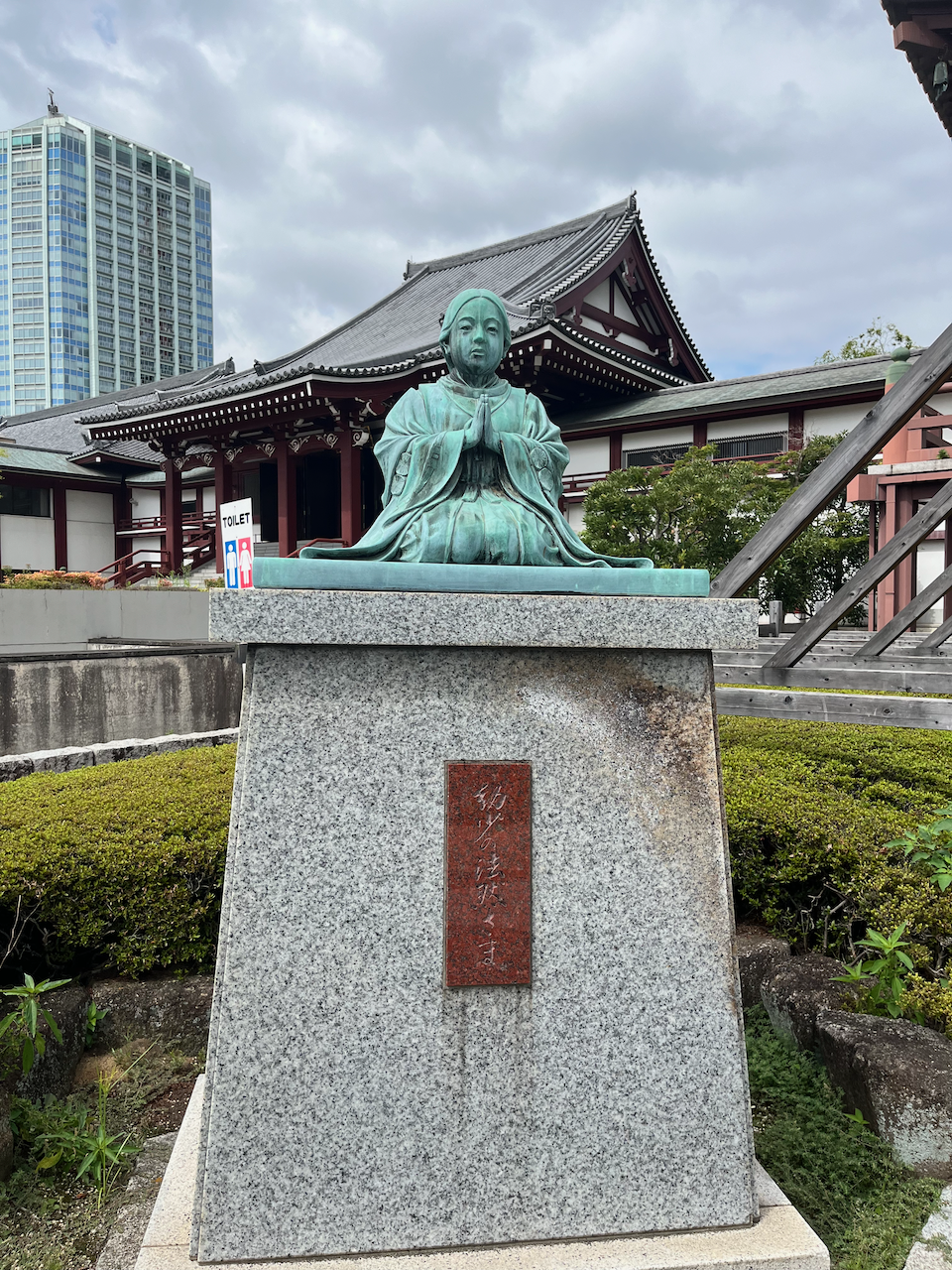
The left area of the map mostly contained meeting halls and offices, so I kind of skipped past this quickly, and headed toward the main hall (hondō 本堂). This is in the very center of the map. Just to the left of the stairs is a nice statue of the 12th century founder of the Jodo-shu sect, Honen, in his youth:
There are some famous stories about his life (somewhat embellished, I believe), including his piousness at a young age. Hence, you often see Jodo-shu temples with status of young Honen. That said, Honen is a cool guy, and he gets my respect any day.
Next is the main hall itself:
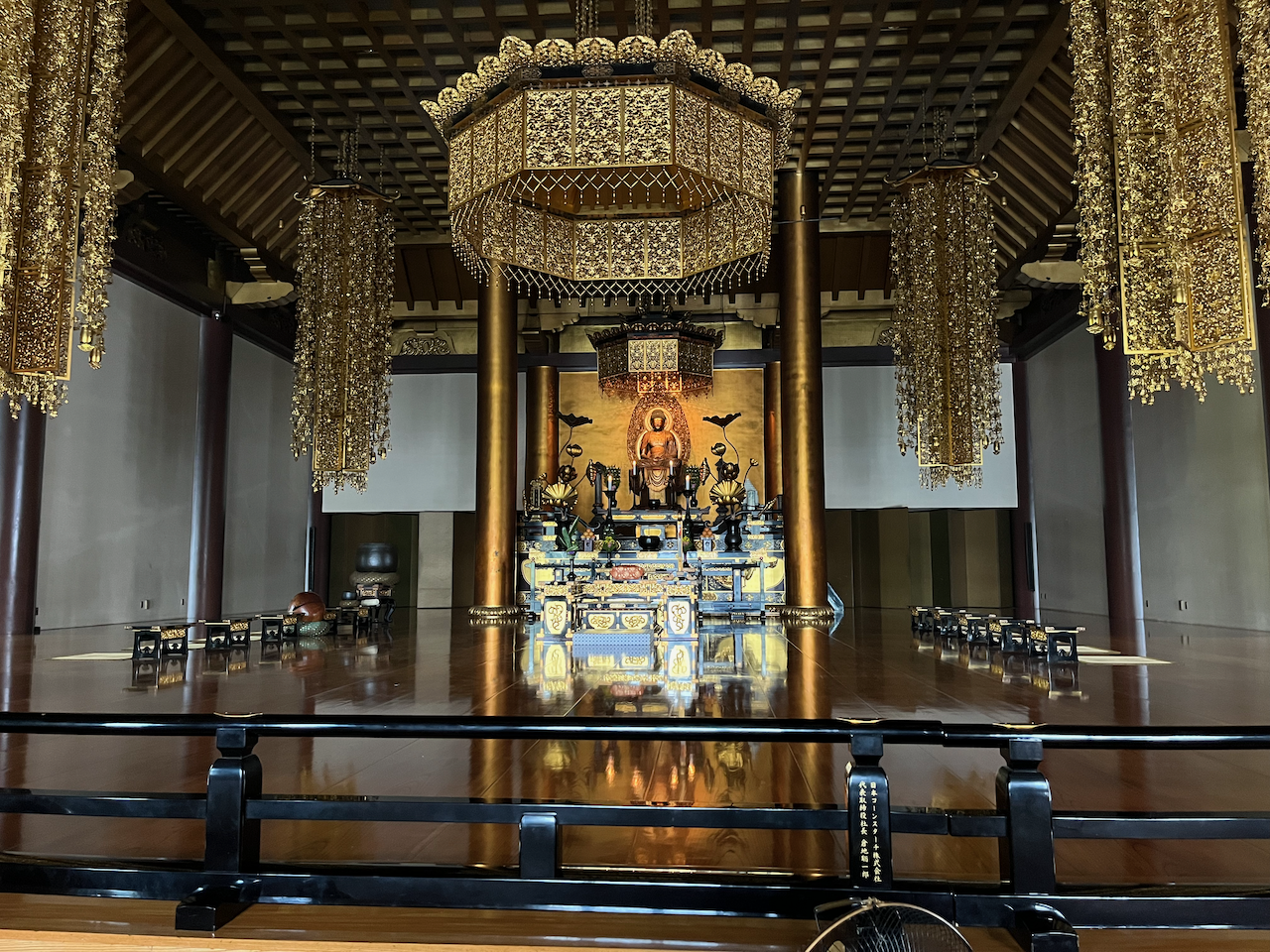
This place is pretty amazing inside. Also, unlike many temples, you do not need to remove your shoes at the door and you are welcome to take photos (except during funeral services, obviously):
The main altar is to Amida Buddha, the Buddha of Infinite Light, and the devotion of all Pure Land Buddhists across traditions. The gold color and lotus artwork are all taken from descriptions of the Pure Land, as described in the Sutras. It is said all beings reborn in the Pure Land will have the color of gold, just like Amida, and will be born from lotus buds. The Taima Mandala, not related to Zojoji, provides a nice visual representation.
To the left and right of the main altar are Honen, mentioned above, and Shan-dao the Chinese Pure Land master who inspired Honen back in the day, respectively. They lived centuries apart, but both are revered for their contributions to the tradition.
To the right of the main hall you have two choices: one you go down the stairs to the Museum. Or go to the Ankokuden Hall:
We’ll talk about the museum a bit later. For now let’s focus on the hall. Inside is both a gift shop and another altar to Amida Buddha:
This statue of Amida Buddha is historically significant though: it was the same statue venerated long ago by Tokugawa Ieyasu, the first Shogun of the Edo Period, and final unifier of Japan. This black-colored Amida statue had been a central devotional figure of the Tokugawa Shoguns for generations, so while it’s not the “main attraction” for tourists, from a historical standpoint, it is. I’ve seen it multiple times, and I never get tired of being here.
As alluded to earlier, there are shrines to the left and right of the Amida Buddha. The one on the left is of the founder of the Tokugawa shoguns,2 Tokugawa Ieyasu described above. The one on the right is less clear. It enshrines someone named Princess Kazunomiya. I had to do a bit of research and it turns out that Kazunomiya was a member of the Imperial family (not the Tokugawa family), but had been wed to Tokugawa Iemochi the 14th Shogun as a political marriage intended to heal the centuries old breach between the two families. The arranged marriage had a rocky start, but in the end proved to be a surprisingly happy and successful marriage at a time when Japan was in the waning days of the Shogunate. So, within the Tokugawa family temple, she is enshrined as an important matriarch.
We’ll see more monuments to Princess Kazunomiya shortly, so remember the name.
Anyhow, after picking up some nice incense and another seal in my pilgrimage book, I left the Ankokuden Hall. To its right is a line of statues.
The statue in the front is Bodhisattva Kannon, similar to what we saw earlier.3 There is a small altar to the right as well with another statue of Kannon that is often overlooked:
This is the “Western-facing Kannon”. The western-direction in Mahayana Buddhism is strongly associated with the Pure Land of Amida Buddha (by contrast, the eastern direction is associated with the Medicine Buddha’s own Lapis Lazuli Pure Land), and since Kannon is an attendant of Amida Buddha, this tracks.
But what about the little statues with red bibs?
These statues represent another Bodhisattva named Jizō. I haven’t talked about Jizo as much in this blog, but he’s very important in Japanese religion as a kind of protector deity, especially of children. Each statue adorned with a bib represent a child that was lost in pregnancy or in childbirth, and so the grieving parents pray to Jizo to protect their child in the life beyond. The clothing is an offering to Jizo, perhaps to pass on to the child?
While the statues are very cute, there is a tragic meaning behind them as well.
The line of statues continues back behind the Ankokuden and Hondo (main hall). It is here that you come upon the mausoleum of the Tokugawa Shoguns.
Not all shoguns are interred here. Some are interred in a shrine called Toshogu up north in Nikko. I would estimate that roughly half of the shoguns are interred here. I won’t show them all, since the map and pamphlet you receive at the ticket booth shows a full list. But to give a few examples…
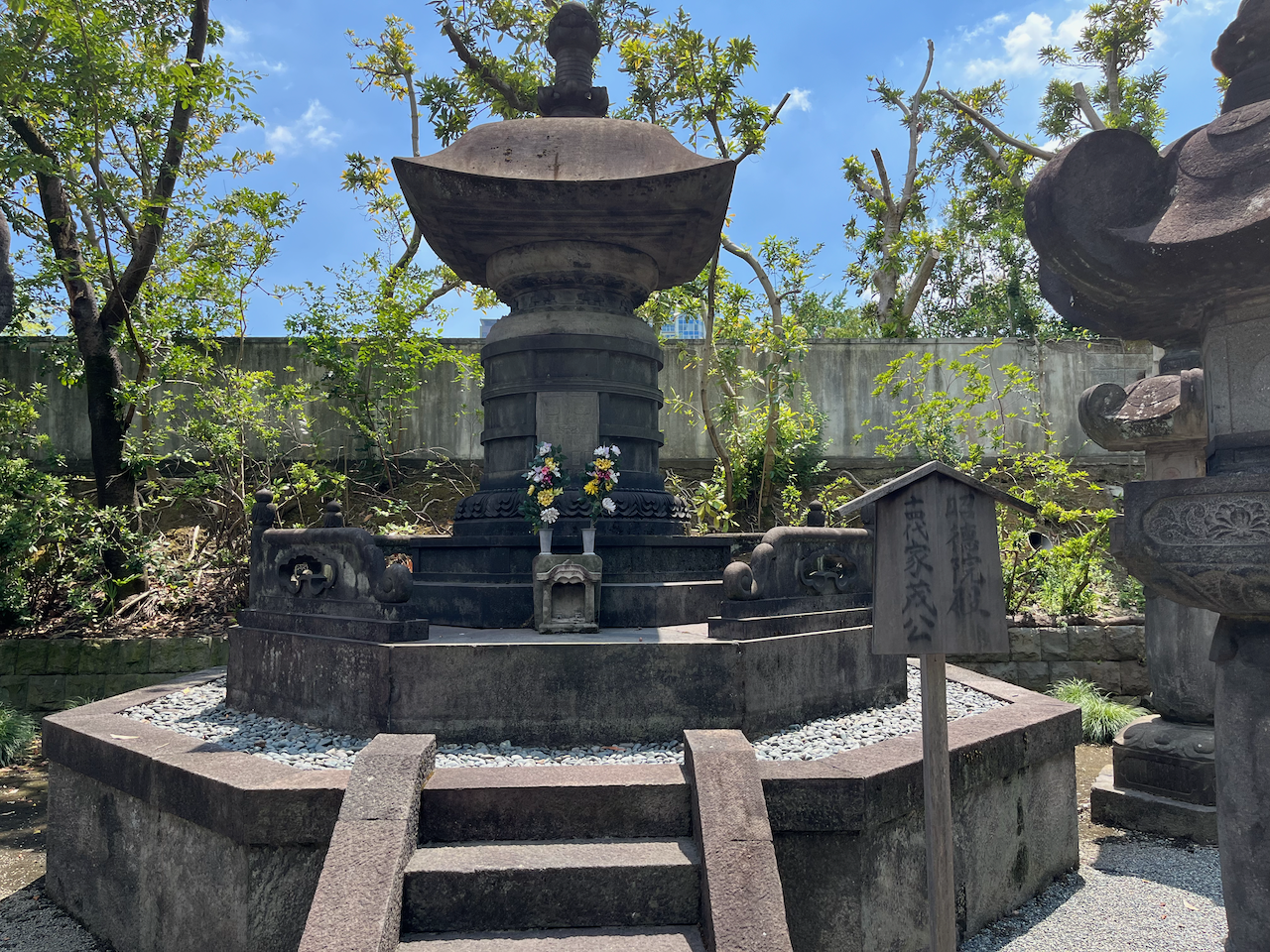
The second shogun, Tokugawa Hidetada and his wife are interred here. Edo (Tokyo) was greatly expanded during his administration from a tiny fishing village to the city we know today.
From the mausoleum entrance, if you were to go further left you will see this statue:
Without getting too bogged down in details, the four statues here represent four major Bodhisattvas in the Mahayana-Buddhist tradition. From left to right with Sanskrit (and Japanese) names:
Manjushri (Monju)
Avalokitesvara (Kannon)
Ksitigarbha (Jizo)
Samanthabhadra (Fugen)
It’s actually quite rare to see all four arrayed like this. I was kind of impressed. It is said these statues were created in the year 1258 according to the plaque.
Further left:
If you go up the stairs and turn right…
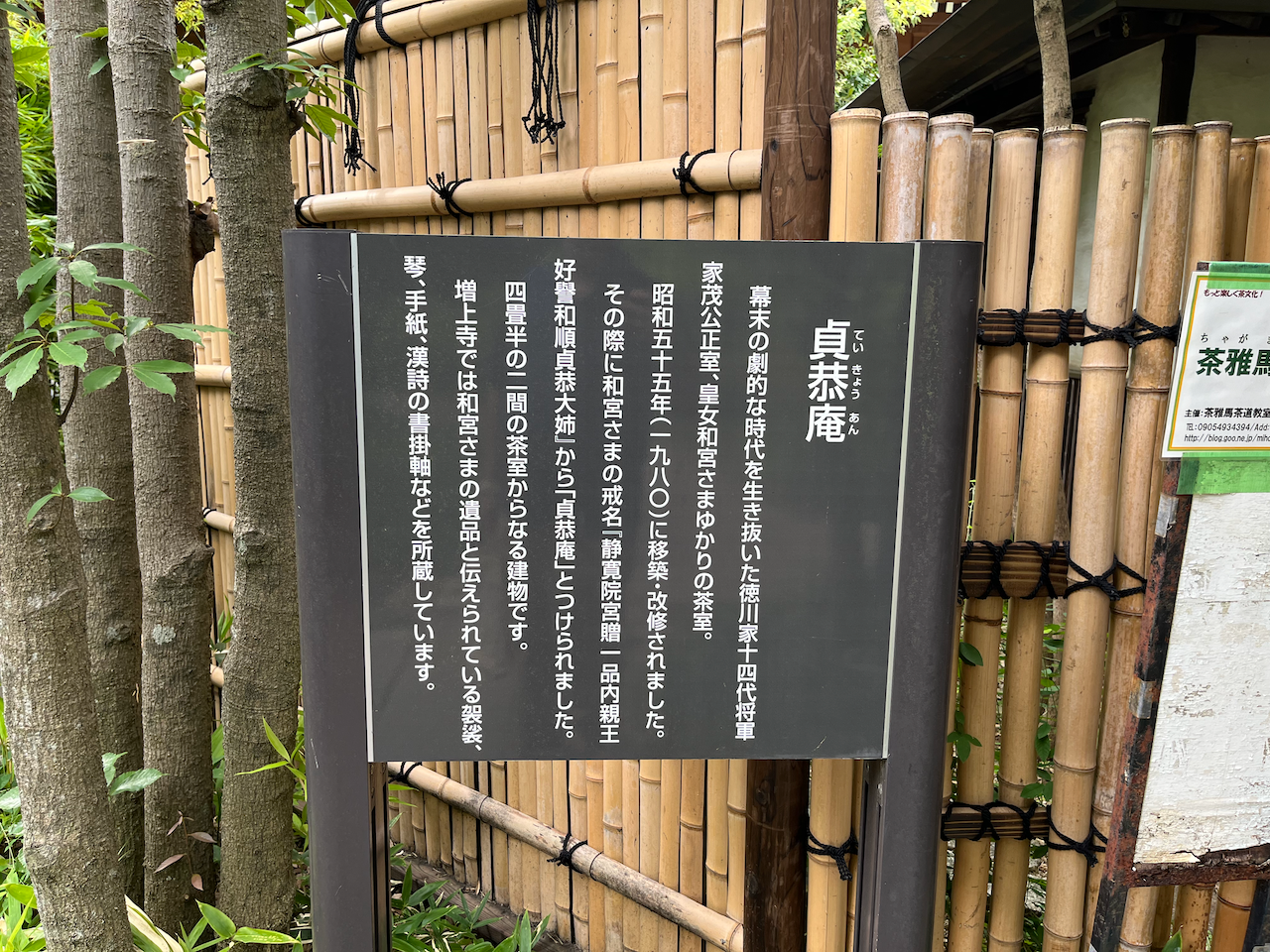
You can find the tea house of Princess Kazunomiya called the Teikyōan (貞恭庵):
Since Princess Kazunomiya took tonsure as a Buddhist nun in her final years, she took the ordination name Teikyo, so the name of the place is basically “Princess Kazunomiya’s hearth”. The sign said that it was refurbished in 1980 and is used for some public functions. It was closed when I came so I didn’t get to see much.
Facing the tea house is another statue of Kannon Bodhisattva in a more motherly form.
Past the tea house and up some stairs is this place, which is the upper part of the map:
It turns out that this is a columbarium: a storage house for the bones of the deceased after cremation. This is common in Buddhist temples. This columbarium in particular houses the bones of those who are somehow connected to the temple across the generations. Beyond that, the website didn’t provide an explanation.
By this point I wanted to see the museum but again I had arrived too early so I stopped by a local McDonald’s for brunch:
On the way out, I also took photos of the Buddhist bell (bonshō 梵鐘) as well:
And a small Shinto shrine to the right of the main entrance:
This Shinto shrine, called the Yuya (熊野) Shrine, was founded in 1624 by the 13th head priest of Zojoji, one Shoyo Kurayama, to protect the north-east corner of the temple from disasters. The north-east is seen as a particularly dangerous direction in Chinese geomancy (a.k.a. feng-shui), so the kami here provide protection. It is not unusual to see small Shinto shrines within Buddhist temples, and many Shinto deities are viewed as manifestations of Buddhist deities (gongen 権現) by Japanese in medieval times. The sign next to the shrine states that 3 kami reside here:
Ketsumiko-no-ōkami
Ōnamura-no-mikoto
Izanagi-no-mikoto (as in Izanagi from early Japanese mythology? I am not sure)
These three kami all seemed to have been imported from a trio of Shinto shrines called the Kumano shrines, which have a strongly syncretic Buddhist-Shinto worship. I didn’t even know the Kumano shrines existed until I wrote this article. Side note: the Chinese characters for Kumano (熊野) can be alternately read as “Yuya”, hence “Yuya Shrine”.
Anyhow, having satiated myself on McD’s, it was time to go back and visit the Museum…
Much of the museum doesn’t allow photography, but showed the history of Zojoji. As it is being restored from earlier destruction, there wasn’t actually that much in the museum.
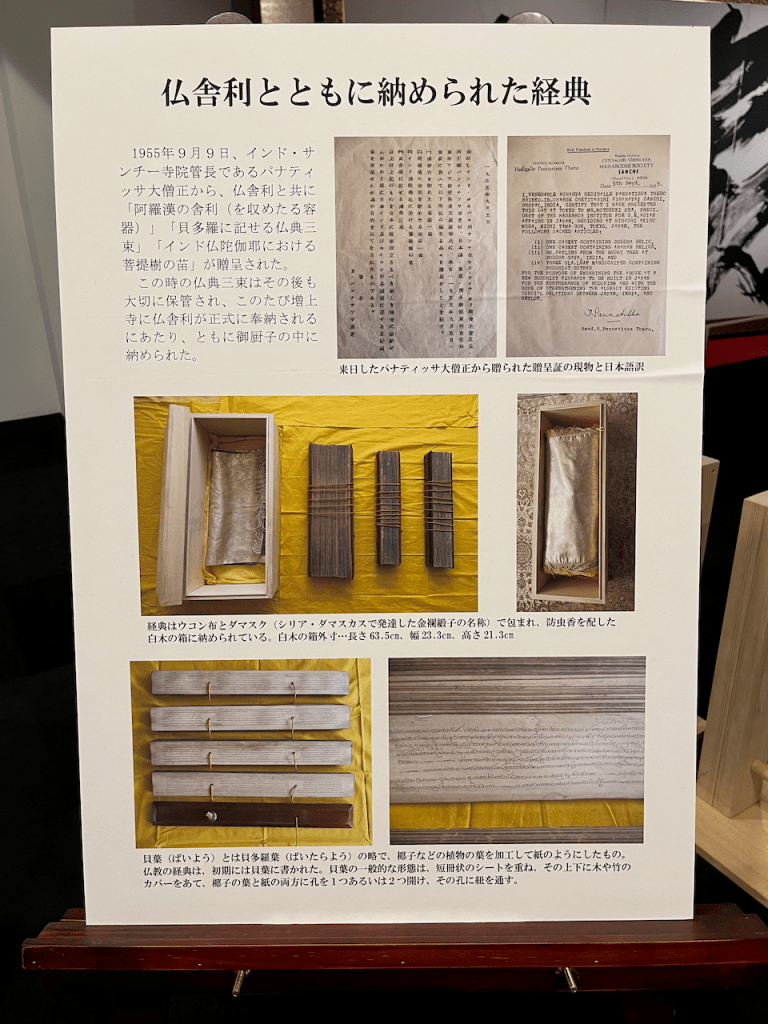
However, what the museum also had (and OK to photograph) was a genuine relic of the Buddha, as in Shakyamuni Buddha, the historical founder. It also contains relics of Rahula, the Buddha’s son before his enlightenment, and Ananda, his trusted retainer. As the sign shows above, the relics were uncovered at Sanchi, which is an important Buddhist archeological site. The relics were given to Japan as a gift in 1955 and enshrined right under Zojoji. You can see
A display to the right shows the contents, and the letter from India to Japan. In addition to fragments of the bones of Shakyamuni Buddha, Rahula and Ananda, the contents included recovered copies of Buddhist sutras that were inscribed on palm leaf at the time, and a seed descended from the original Bodhi Tree.
In my nearly 20-25 years as a Buddhist, I had never come face to face with a relic of the Buddha before, so I was kind of awestruck. The small wooden plaque just in front of the small statue of the Buddha contained a small prayer that reads:
Recite 3 times: namu shaka muni bu (praise to Shakyamuni Buddha)
I don’t have a translation of this hymn, but after a bit of late night sleuthing, I suspect it’s a verse from a Buddhist text called the Humane King Sutra. I don’t think there’s an English translation anyway.
In any case, I recited the verses of praise to Shakyamuni Buddha and finally went home.4
But that concluded the trip to Zojoji. Usually, I go with the family, and we can’t afford to spend half a day there, but this time I had some free time and was able to really take in all the sites of Zojoji. As a historical site, Zojoji is very dense and fascinating. It’s hard to imagine centuries of history, all closely tied to the Tokugawa shoguns and the Jodo-shu sect all in one place. The relic of the Buddha alone is pretty amazing too.
This post was pretty long, but I hope you enjoyed.
P.S. I didn’t really provide a lot of links to Jodo Shu Buddhism, since I talkaboutitquiteabit in the blog already, and many of the English sites have sadly atrophied or disappeared over time. I would definitely recommend various books such as A Raft from the Other Shore or Traversing the Pure Land Path, but these are mostly out of print now. I have done what I could over the years to distill many of these lost sources into an accessible format here, but there’s still plenty to find if you know where to look.
1 This is actually a slang phrase in Japanese too, taken from English: pawaa supotto (パワースポット), meaning any place that inspires you spiritually.
2 Without getting too bogged down in history, think of a shōgun (将軍) as the Imperial-appointed “General Commander of the Armed Forces”. The role has changed and evolved over generations, but suffice to say if you were the shogun, you were the real, not symbolic, authority in Japan.
3 The astute might be wondering why a temple devoted to Amida Buddha also contains so many statues to another figure like Kannon. In Mahayana Buddhism, the two share a close relationship. It is described in the sutras who Amida Buddha is attended to by two Bodhisattvas: Kannon and another named Seishi. Kannon has an outsized following of their own, but the two are frequently depicted together, as both embody the universal goodwill and compassion that are hallmarks of Mahayana Buddhism. Seishi, admittedly, isn’t described much in the Buddhist texts, and thus isn’t revered much on their own.
4 Actually, I stopped along the way at Akihabara because I had never been there. That place was … not for me. Nerdy, but in a very different way. I did have some good fries at a Turkish cafe in Akihabara for dinner, thanks to Mustafa the chef. Very nice fellow. If you are in Akihabara, stop by his cafe and get some good Turkish food.
In June, I posted about the “day” and “night” concept used in Tendai Buddhist practice, using the example of the Jimon sect. I felt inspired to experiment a bit and try this out myself. My adjustments to home practice took a few twists and turns, but within a week or so I settled onto a consistent routine that I’ve been happy with.
Here’s what I’ve been doing for the past month, more or less.
I have found that splitting the practice like this has had some benefits. For me, this style of practice lets me cover both the here and now, through veneration of Kannon and reciting the Heart Sutra, while also looking to the future through venerating Amida Buddha through the evening practice. I feel pretty content covering both aspects.
I made both morning and evening routines intentionally short and lightweight so they are more sustainable, rather than doing something elaborate.
Still, to be honest, sometimes I am still too busy to even do this much. Or I just forget. 😅
I am not proud of that, but I felt I should be honest with readers and let them know that mistakes in Buddhist practice are perfectly OK. Life is unpredictable, and for us are “householders” (e.g. lay-Buddhists), life gets in the way. That’s why the monastic community was (presumably) created: to give people the option of practicing Buddhism full-time, not part-time.
That said, Buddhist practice is like exercise: the more you can do, the better. Even a little bit is a positive thing.
Anyhow, when I am simply busy, sometimes I will just recite either the Kannon mantra in the morning, or the nembutsu in the evening. Sometimes, I can only just bow at the altar for a moment.1 The Soto Zen resources I read previously often said much the same thing: adjust as needed, depending on how busy you are. Sometimes your home practice will be longer, sometimes shorter.
Just don’t give up.
Keep experimenting, keep trying, make it personal, and always be flexible.
Good luck and happy … er, “Buddhist-ing”.
P.S. I took a nice, relaxing weekend off to catch up on some things, avoid social media, and just unplug for a bit. I didn’t really have a plan, I just took a break. I may have also played some Fire Emblem games as well. The fun continues. 😀
1 To make this “split service” work, I have two altars now at home: the main one for Amida Buddha and tiny little “side altar” for Kannon on my bookshelf. It’s basic, but it’s something I can keep building on over time.
I have never tried using these WordPress writing prompts, but I thought I’d try as a fun exercise today.
Life is stressful. That’s the First Noble Truth of Buddhism. More precisely life is marked with stress, unease, discontent, and so on, collectively called dukkha in Sanskrit. Put more succinctly, shit happens sooner or later. It is impossible to avoid, but at the same time, a well-trained even-keel mind can weather the storm and thereby help ease one’s life, but also make life better for those around you too.
Buddhism as a 2,500 year old religion comes with a really large toolkit of methods, practices, and liturgy that can help bring peace of mind.
Most people think of meditation first, but this is simply not always practical, especially if you are a working parent, busy college student, and so on. There are other practices available that can more easily be fit into a busy lifestyle, and are not difficult to learn.
The first is to take up the Five Precepts as a baseline for one’s conduct. This is a passive practice, but helps provide some guideposts to life, gradually smooths out our rough edges, and builds self-confidence as well.
The second is Buddhist chanting.
There are many, many things one can chant in Buddhism: mantras, excerpts of Buddhist texts (sutras), full Buddhist texts, or devotional phrases as well.
Mantras are very short, but esoteric phrases often used for chanting, recited originally in Sanskrit language, but filtered over time in other languages. One of the best known is the Mantra of Light, but you can find many mantras. People often recite these 3 or 7 or even 21 times, but traditions vary. Consult your preferred tradition if you are unsure. Keep in mind that many traditions within Buddhism simply don’t use mantras, or use very sparingly.
Buddhist texts (sutras), or even excerpts of Buddhist texts, are an almost universal chanting practice. They are longer than mantras, but also more commonly practiced, and have a nice habit of reinforcing important teachings within yourself. You can recite them in the old, liturgical language, or recite in your own language. It does not really matter.
By far the most popular Buddhist text to recite is the Heart Sutra. The Heart Sutra is somewhat unusual because you can recite the entire text, from start to finish, in about 1-2 minutes. It is profound, but also really pithy. Another common chanting text you can do from start to finish is the Metta Sutta in the Theravada tradition. Most other Buddhist sutras are a challenge to recite in one sitting (some are extremely long), so instead people traditionally recite key excerpts only. The Lotus Sutra is particularly quote-worthy; it has many verses and quotations that are chanted by themselves without chanting the entire chapter. There are other good quote-worthy Buddhist sutras as well.
When chanting Buddhists sutras (or excerpts), you can either do it in a chanting voice, or simply recite the same way you might read a poem aloud, or something like reciting the “Litany of Fear” in Dune. Personally, I find chanting in English sounds silly, so I recite with an even voice instead.
Finally, we have devotional phrases. Because Buddhist deities are many and varied, each embodying some essential truth or concept in Buddhism, people tend to gravitate toward one or another. This is fine, and perfectly normal in Buddhism. One might gravitate toward the historical Buddha, Shakyamuni. One might gravitate toward Guan-yin (aka Avalokiteshvara, Chenrezig, Kannon, etc). One might gravitate toward the Buddha of Infinite Light (aka Amitabha, Amida, etc). Over time, you might shift as well. Again, perfectly normal.
In any case, many of these deities will have some simple devotional phrase: “Hail to X”, or “Praise to Y”, and so on. These might overlap with mantras, but aren’t necessarily mantras. They are often exoteric (no subtle, hidden meaning), not esoteric. Sometimes mantras are used as devotional phrases too. It’s also common in some traditions to praise the Lotus Sutra itself, not as a deity, but as the embodiment of the highest and best Buddhist teachings.
All of these devotional phrases are short, simple, and easy to recite. People often recite in groups of three, but you can recite as little or as much as you like. Consult your preferred tradition if you are unsure.
When should one do Buddhist chanting?
Whenever appropriate. If you get up first thing in the morning and recite your chosen sutra, mantra or devotional phrase, that’s great. If you do it before going to bed, that’s great. If you are stressed out at work, and need a moment, go in a quiet spot, and recite something Buddhist. If you are moved by something spiritual, you can also recite something in the form of gratitude. There are many times and places to do Buddhist chanting. Find what works, experiment if needed, see what sticks in your life.
One thing to keep in mind though: always do it respectfully, solemnly, and without showing off. Intention and sincerity are important.
Why should one do Buddhist chanting?
There are many reasons why one takes up the practice. For some, it helps settle the mind, especially when stressed or worried about something. It tends to reinforce positive habits too. Sometimes it can also bring a flash of insight because one’s mind is settled and they meaning of the texts finally makes sense. It also helps generate good karma for the future, like planting seeds for later harvest. By settling the mind, it also helps disengage negative habits and avoid negative consequences later.
Coupled with the Five Precepts I mentioned above, the long-term effects are both peace of mind for yourself, but also others around you as the wholesome effects “rub off”.
The Five Precepts and Buddhist chanting are two practices that almost anyone can do almost anywhere under any circumstances. You might have to tailor things to make it sustainable in your life, but there’s plenty of wiggle-room to make it work. Also, don’t be afraid to make adjustments.
Chapter 25 of the Lotus Sutra is a popular devotional text in East Asian Buddhism. It is often referred to as the “Avalokiteśvara Sutra”, or kannongyō (観音経) in Japanese, or more formally the kanzeon bosatsu fumonbongé (観世音普門品偈, “Chapter on the Universal Gate of Kanzeon Bodhisattva”).
Despite the name, it is not a stand-alone text, but simply a famous chapter in the larger Lotus Sutra. This particular chapter is the main introduction to one of the most popular Bodhisattvas in Buddhism: Avalokitesvara (Kannon in Japanese, Guanyin in Chinese, etc.). The chapter describes the attributes of Kannon that are familiar to Buddhists, such as their vows to help all beings who call on them, their ability to take on various forms to teach people, and their unwavering compassion to lead all beings to Enlightenment.
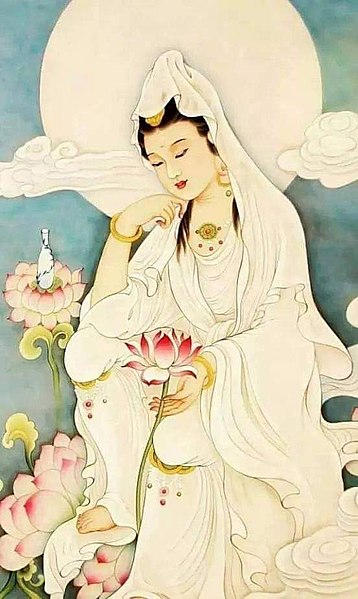
A more Chinese-style image of Kannon (a.k.a. Guan-yin) in her more motherly form, photo courtesy of Wikipedia.
The chapter as a whole is long and would be difficult to chant, so the verse section, not the narrative section, is frequently used for liturgical purposes. The Lotus Sutra often describes things in narrative form, then summarizes again in verse form. However, even the verse section alone is longer than the Heart Sutra, or the Shiseige, so just chanting the verse section is a bit challenging. In my experience it takes about 5-7 minutes.
For this reason, medieval Buddhists in Japan also devised an even shorter version called the Ten-Verse Kannon Sutra.
The sutra is frequently recited in both Zen and Tendai liturgies, among others, but it is not well known to Westerner lay-Buddhists. I had difficulty finding an online copy I could use as a reference here, even in Japanese, due to its length.
However, ages ago, I picked up a sutra book at the famous Sensōji temple in Tokyo, and once I figured out what the Kannon Sutra was, I copied it character by character to an old version of the blog, but then lost it later when I changed blogs. Recently, I was able to recover the text (not easily) from the original HTML I wrote, and posted it back on here with minor edits.
I have also provided a PDF version here if you want to print it out and use at home.
Also, special thanks to this website for providing much needed reference information on pronunciation and Chinese characters. My original, recovered text had a few errors, embarrassingly.
Examples
I found a few examples on Youtube that you can follow along if you are learning to chant the Kannon Sutra as shown below.
From Eiheiji temple (one of two home temples of Soto Zen). Note that they chant this at a pretty fast pace.
This example from Zenshoji Temple, a Shingon-sect temple, in Niigata Prefecture, has line by line annotation. The chanting pace is slower and easier to follow.
These examples are very similar, other than slight differences in pacing and pronunciation of certain Chinese characters. For people who are learning to recite the sutra, just pick what works until you get the hang of it.
Translation
I decided not to post the translation side-by-side with the text, the way I do with the Heart Sutra and such. This is due to formatting reasons on the blog, plus also length of the text makes this more difficult. I may revise this later.
For now, I highly recommend checking out a modern translation here by the excellent Dr Burton Watson. In that translation, the verse section starts after the phrase “At that time Bodhisattva Inexhaustible Intent posed this question in verse form“. The Buddhist Text Translation Society also has an excellent translation of the verse section here.
Disclaimer and Legal Info
I hereby release this into the public domain. Please use it as you see fit, but if you attribute it to this site, greatly appreciated. Also, please bear in mind this is an amateur work, and should not be taken too seriously.
Dedication
I dedicate this effort to all sentient beings everywhere. May all beings be well, and may they all attain perfect peace.
Namu Kanzeon Bosatsu
The Kannon Sutra, verse section
(2025 edition, with minor typo fixes)
Preamble
Original Chinese
Japanese Romanization
妙法蓮華經 観世音菩薩 普門品偈
Myo ho ren ge kyo kan ze on bo satsu fu mon bon ge
Verse Section
Original Chinese
Japanese Romanization
世尊妙相具 我今重問彼 佛子何因縁 名為観世音
Se son myo so gu ga kon ju mon pi bus-shi ga in nen myo i kan ze on
具足妙相尊 偈答無盡意 汝聴観音行 善応諸方所
gu soku myo so son ge to mu jin ni nyo cho kan on gyo zen no sho ho jo
弘誓深如海 歴劫不思議 侍多千億佛 発大清浄願
gu zei jin nyo kai ryak-ko fu shi gi ji ta sen noku butsu hotsu dai sho jo gan
我為汝略説 聞名及見身 心念不空過 能滅諸有苦
ga i nyo ryaku setsu mon myo gyu ken shin shin nen fu ku ka no metsu sho u ku
假使興害意 推落大火坑 念彼観音力 火坑変成池
ke shi ko gai i sui raku dai ka kyo nen pi kan on riki ka kyo hen jo ji
或漂流巨海 龍魚諸鬼難 念彼観音力 波浪不能没
waku hyo ru go kai ryu go sho ki nan nen pi kan on riki ha ro fu no motsu
或在須弥峰 為人所推堕 念彼観音力 如日虚空住
waku zai shu mi bu i nin sho sui da nen pi kan on riki nyo nichi ko ku ju
或被悪人逐 堕落金剛山 念彼観音力 不能損一毛
waku bi aku nin jiku da raku kon go sen nen pi kan on riki fu no son ichi mo
或値怨賊繞 各執刀加害 念彼観音力 咸即起慈心
waku ji on zoku nyo kaku shu to ka gai nen pi kan on riki gen soku ki ji shin
或遭王難苦 臨刑欲寿終 念彼観音力 刀尋段段壊
waku so o nan ku rin gyo yoku ju shu nen pi kan on riki to jin dan dan ne
或囚禁枷鎖 手足被杻械 念彼観音力 釈然得解脱
waku ju kin ka sa shu soku bi chu gai nen pi kan on riki shaku nen toku ge datsu
呪詛諸毒薬 所欲害身者 念彼観音力 還著於本人
shu so sho doku yaku sho yoku gai shin ja nen pi kan on riki gen jaku o hon nin
或遇悪羅刹 毒龍諸鬼等 念彼観音力 時悉不敢害
waku gu aku ra setsu doku ryu sho ki to nen pi kan on riki ji shitsu bu kan gai
若悪獣圍繞 利牙爪可怖 念彼観音力 疾走無邊方
nyaku aku shu i nyo ri ge so ka fu nen pi kan on riki jis-so mu hen bo
蚖蛇及蝮蠍 気毒煙火燃 念彼観音力 尋聲自回去
gan ja gyu fuku katsu ke doku en ka nen nen pi kan on riki jin sho ji e ko
雲雷鼓掣電 降雹澍大雨 念彼観音力 応時得消散
un rai ku sei den go baku ju dai u nen pi kan on riki o ji toku sho san
衆生被困厄 無量苦逼身 観音妙智力 能救世間苦
shu jo bi kon yaku mu ryo ku hitsu shin kan on myo chi riki no ku se ken ku
具足神通力 廣修智方便 十方諸国土 無刹不現身
gu soku jin zu riki ko shu chi ho ben jip-po sho koku do mu setsu fu gen shin
種種諸悪趣 地獄鬼畜生 生老病死苦 以漸悉令滅
shu ju sho aku shu ji goku ki chiku sho sho ro byo shi ku i zen shitsu ryo metsu
真観清浄観 廣大智慧観 悲観及慈観 常願常瞻仰
shin kan sho jo kan ko dai chi e kan hi kan gyu ji kan jo gan jo sen go
無垢清浄光 慧日破諸闇 能伏災風火 普明照世間
mu ku sho jo ko e nichi ha sho an no buku sai fu ka fu myo sho se ken
悲體戒雷震 慈意妙大雲 澍甘露法雨 滅除煩悩燄
hi tai kai rai shin ji i myo dai un ju kan ro ho u metsu jo bon no en
諍訟経官処 怖畏軍陣中 念彼観音力 衆怨悉退散
jo ju kyo kan jo fu i gun jin chu nen pi kan on riki shu on shitsu tai san
妙音観世音 梵音海潮音 勝彼世間音 是故須常念
myo on kan ze on bon on kai jo on sho hi se ken on ze ko shu jo nen
念念勿生疑 観世音浄聖 於苦悩死厄 能為作依怙
nen nen motsu sho gi kan ze on jo sho o ku no shi yaku no i sa e go
具一切功徳 慈眼視衆生 福聚海無量 是故応頂礼
gu is-sai ku doku ji gen ji shu jo fuku ju kai mu ryo ze ko o cho rai
Conclusion
Original Chinese
Romanization
爾時持地菩 薩即從座起 前白佛言世 尊若有衆生
ni ji ji ji bo sa soku ju za ki zen byaku butsu gon se son nyaku u shu jo
聞是観世音 菩薩品自在 之業普門示 現神通力者
mon ze kan ze on bo sa bon ji zai shi go fu mon ji gen jin zu riki sha
當知是人功 徳不少佛説 是普門品時 衆中八萬四
to chi ze nin ku doku fu sho bus-setsu ze fu mon bon ji shu ju hachi man shi
千衆生皆發 無等等阿耨 多羅三藐三 菩提心
sen shu jo kai hotsu mu to do a noku ta ra san myaku san bo dai shin
In the coming weeks, I hope to post a couple more such chants from the Lotus Sutra, as they are popular both in Tendai and Nichiren communities in particular, and I am learning to chant these too.
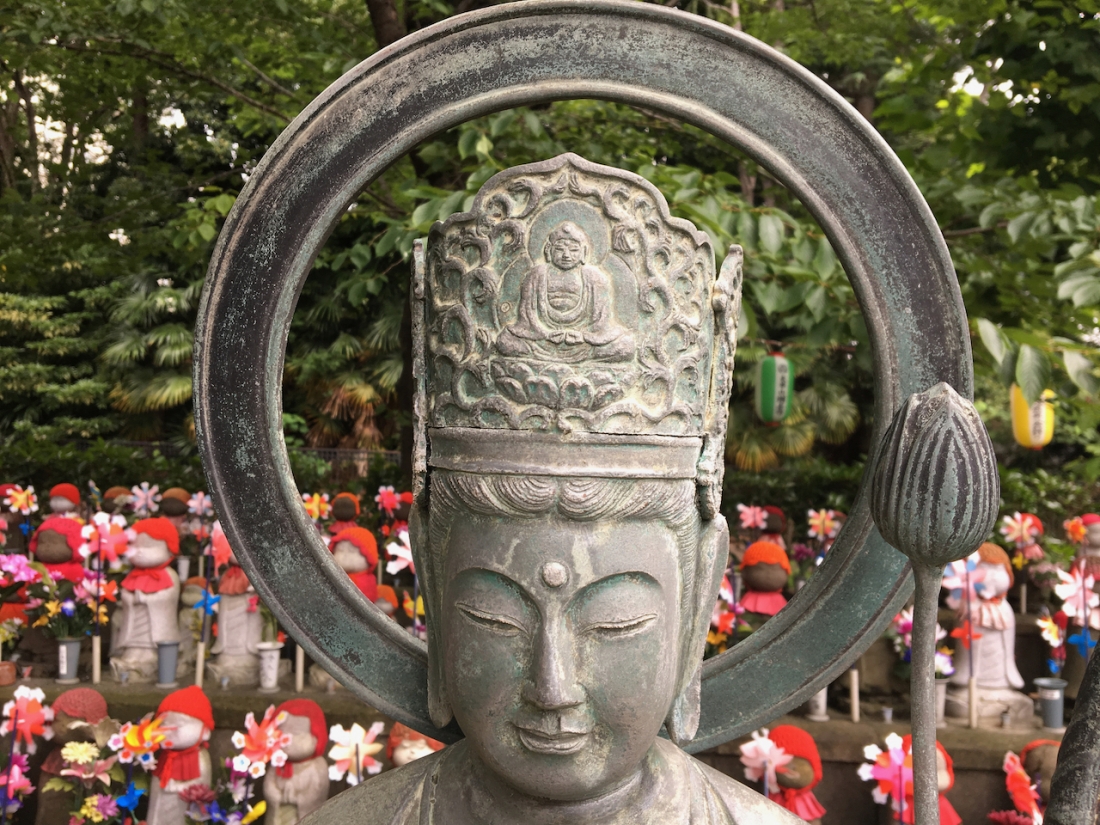
P.S. Featured photo was taken by me at Zojoji temple in Tokyo, Japan, with an image of Kannon Bodhisattva wearing a crown that features an image of Amitabha Buddha.
As a kid, I was always fascinated by Astronomy, and I remember often watching the stars at night, when I would visit my dad’s house on the weekends. Back then, I didn’t really understand astronomy well, but I learned what I could about constellations, I visited the planetarium at the Pacific Science Center, and of course I became a big fan of classic Star Trek through my uncle. In college, I even majored in Astronomy for a time until I realized that Physics wasn’t my forté.
Space and the universe have always fascinated me, and for a long time, I’ve felt that in light of space, science, etc, Buddhism has been particularly suited for this worldview.
The Buddha-Dharma functions in a lot of ways like the laws of physics or other natural laws. It’s less something to believe in, and something more to understand or at least acknowledge. It can fit into any time or place.
The various Buddhas and Bodhisattvas, primarily found in the Mahayana tradition, might seem superstitious, but embody important Buddhist truths and can be just as weird and cosmic as anything the universe has to offer. Further, belief is such beings is neither required nor expected. It is up to each person to adopt what they want. They are quite literally a form of expedient means.
Finally, when you look at the sheer vastness of space, it’s hard not feel small. But that is alright too. Buddhism thinks big, but also because everything is interconnected in some way, it assures that the choices we make, wholesome or unwholesome, do affect all other things. We can light one corner of the world (and universe) through our actions and our thoughts.
P.P.S. I’ve often wondered if the Buddhas and Bodhisattvas really do exist, would they be humanoids like us, or would they be strange aliens like in Star Trek? Would Amida Buddha’s original from be a green alien with four arms? 😋


















 Gleanings in Buddha-Fields

.jpeg?uselang=en)

You must be logged in to post a comment.