Hokkien: the Forgotten Chinese Dialect

This is not something I usually post about, but after my recent post about Ando Momofuku, I learned some fascinating things about Chinese language and wanted to share with a wider audience. In high school, I took two years of Chinese language and was an enthusiastic student. We learned the Mandarin dialect, though our teacher was from Taiwan, and we never really explored other dialetcs.

However, over the years, I’ve met various overseas Chinese who don’t speak Mandarin-dialect Chinese as a first language, and instead know Cantonese, Toisan, Taiwanese and so on. The history of Chinese languages and its various dialects is complicated. Fascinating, but far too much to cover here and I am not expert. In fact, it’s fair to say that all these dialects aren’t really dialects, but more like a language family, in the same was as Latin to French, Italian and Spanish, or Sanskrit to Hindi, Bengali, and Marathi, etc.

But I did want to cover a particular dialect that’s actually pretty widespread and influential, but not well-known: Hokkien (福建話, hoh-kee-en), sometimes also called Minnan or Bân-lâm (閩南) among other names. In Mandarin, this dialect is called Fújiànhuà (“Fujian speech”). So, we might think of Hokkien as Fujian-dialect Chinese, although as this video explains, that’s not 100% accurate:

It helps to think of Hokkien as one form of “Southern Chinese” vs. Mandarin “Northern Chinese”. This is a very rough comparison, but helps illustrate the history behind the two dialects. Hokkien is one of many, many dialects in southern China, where mountainous geography kept many communities isolated from one another over time. Meanwhile, Mandarin has its origins in northern plains of China, which also happens to be where most Imperial capitals resided in Chinese history, hence it had more influence and prestige.

Another thing to note is that the vast majority of the Chinese characters used are the same regardless of dialect, but they are read and pronounced differently depending on the dialect:

But out of all the fascinating dialects in Southern China, why am I writing about Hokkien? Two reasons.

The first reason is that the influence of Hokkien is surprisingly wide. It’s a very common dialect spoken across Southeast Asia. One of my long-time friends is Indonesian Chinese, and he told me that many people use it in Indonesia, and explained how Hokkien terms often get mixed in Indonesian conversational speech (which is natively Malay, not Chinese). This video below is a fascinating explanation of how Hokkien spread, and has continued to thrive across Southeast Asia.

Hokkien is also an important language in Taiwan. Mandarin became one of the national languages after the Nationalists fled there after 1950, but Hokkien (via Taiwanese) is very widespread too. I have a childhood friend who’s a second-generation Taiwanese-American, and he grew up learning both Mandarin (for practical reasons, every Chinese person knows at least some Mandarin), but also Taiwanese language. When his father passed away last year, I attended the funeral,1 and it was the first time I ever heard Hokkien spoken since most of the attendees were fellow Taiwanese people, and the eulogy was spoken in Taiwanese. Taiwanese is a form of Hokkien, probably the most widely spoken.

So, it’s used far more often than one might expect. But if you didn’t know how to distinguish Hokkien from Mandarain from Cantonese, you might easily miss it.

The second reason I am talking about this might surprise you.

Hokkien has a big influence on Japanese language, because that’s where all the on-yomi (“Chinese readings”) of Kanji come from, not Mandarin.

It’s easier to see when you actually compare words in Japanese, Hokkien, and Mandarin.

A common word in Japanese is 感謝 (かんしゃ, kansha) meaning “gratitude” or to be thankful. In Mandarin this is pronounced as gǎn xiè. That sounds fairly close. But in Hokkien it’s gam sia, (“gum shyah”) which sounds even closer.

Another example is the character 我 (“wa” or “ga”) in Japanese and is used for things like “self”, “mine”, “our”, etc. In Mandarin this is pronounced as , but in Hokkien it’s wa or gwá. Again, this sounds closer to Japanese than Mandarin does.

If you are curious to learn some basic Hokkien words, this is a nice video below, though it does not include Chinese characters (Romanization only):

This video is a fun, light-hearted comparison between Hokkien and other dialects by someone trying to learn Hokkien but who grew up learning Cantonese instead.

Side note, I asked my Taiwanese friend about how well he could understand other southern dialects. To him, Teochew was fairly easy to follow, but Cantonese was 50-50 for him: sometimes he could pick up what was being said, other times he could not.

Anyhow, that’s a very brief look at Hokkien by someone who’s obviously not Chinese, but fascinating by its influence across Asia. I hope to write more about Hokkien as I learn more, but I am quickly discovering how limited resources are. The only dictionary I could find was from 1922 and used for missionary work. Clearly, more research needs to be done, but I am happy to see younger generation Chinese making all these helpful Youtube videos to share information rather than Westerners doing it.

P.S. Featured photo is the city of Quanzhou (“chwan-joe”, 泉州), birthplace of Hokkien.

1 His parents had always been kind to me in school, and patient when I practiced my Chinese language skills with them.

Making Sense of Japanese Verbs

Japanese language, like any language, uses verbs a lot. But verbs in Japanese differ considerably from Indo-European languages in how verbs are constructed, conjugated and so on. This makes them pretty tricky to learn at first glance, but the good news is that the internal structure and logic is actually fairly straightforward. You just need to unlearn your native language to avoid casual mistakes.

Warning: This post assumes you can read hiragana script. Hiragana takes a bit of work upfront, but you can master it quickly, and be reading Japanese fairly well after that (kanji notwithstanding). You can see my articles here, here and here about it.

The first thing to understand is that Japanese, especially in conversation, has a lot of implicit and contextual meaning. So, you can leave out many parts of speech because it’s already implied, or you just know from the context. But usually a sentence needs at least a verb.

A: [did you eat?]

B: ん、たべた
(yeah, I ate)

This is a perfectly normal sentence in conversation. No subject, object or anything, just the verb (to eat, past-tense).

Also, as I alluded to earlier, the conjugations and usages differ from European languages. Let’s look at some examples. This chart doesn’t cover everything but covers some of the most essential forms.

ConjugationUsageExample “Godan” Verb : 読む・よむExample “Ichidan” Verb : 食べる・たべる
Dictionary formDictionary listing of verb, also used for subordinate clauses, recurring actions (e.g. I eat X daily), and also future tense!読む・よむ食べる・たべる
Polite formUsed in polite, formal speech, especially at work, talking to teachers, or one’s elders. Also used for future tense!読みます・よみます食べます・たべます
“Te” formExtremely useful. Links verbs together in sequence, or allows for other grammatical forms.読んで・よんで食べて・たべて
Simple PastCasual, past tense form. Similar to dictionary form, but expresses past tense.読んだ・よんだ食べた・たべた
Passive formWhen something is being done to you. (e.g. I am being eaten)読まれる・よまれる食べられる・たべられる

Note that I divided verbs by Go-dan (五段), and Ichi-dan (一段) verbs. This is important as each one has a slightly different conjugation process. Ichi-dan verbs, sometimes called “ru-verbs” because the dictionary form always ends in る “ru”, however not all verbs that end in る are ichi-dan verbs. Everything else are go-dan verbs because the dictionary form has five (“go”) possible endings: う “u”, つ “tsu”, る “ru”, ぬ “nu”, and む “mu”.

Speaking from personal experience, people who are first learning Japanese often learn the textbook polite form since they’re talking with other adults, and don’t want to be rude.

However, it’s far more useful to learn the dictionary form and the “te”-form. The dictionary form is useful form many grammatical forms, and for more complex sentence. Note to mention it also expresses future tense in the right context. Similarly, the “te” form is the base of many other grammatical forms.

To conjugate the “te”-form from the dictionary form, change the verb endings like so:

Dictionary Verb
ending
Becomes…Example beforeExample after
う (u)って (tte)言う・いう (iu)言って・いって (itte)
つ (tsu)って (tte)持つ・もつ (motsu)持って・もって (motte)
る (ru)って (tte)切る・きる (kiru)切って・きって (kitte)
る (ru), ichidanて (te)食べる・たべる (taberu)食べて・たべて (tabete)
く (ku)いて (ite)書く・かく (kaku)書いて・かいて (kaite)
ぐ (gu)いで (ide)急ぐ・いそぐ (isogu)急いで・いそいで (isoide)
む (mu)んで (nde)読む・よむ (yomu)読んで・よんで (yonde)

Similarly for the simple past tense, just change the “te” to “ta” like so:

Dictionary Verb
ending
Becomes…Example beforeExample after
う (u)った (tta)言う・いう (iu)言って・いった (itta)
つ (tsu)った (tta)持つ・もつ (motsu)持って・もった (motta)
る (ru)った (tta)切る・きる (kiru)切って・きった (kitta)
る (ru), ichidanた (ta)食べる・たべる (taberu)食べて・たべた (tabete)
く (ku)いた (ita)書く・かく (kaku)書いて・かいた (kaita)
ぐ (gu)いだ (ida)急ぐ・いそぐ (isogu)急いで・いそいだ (isoida)
む (mu)んだ (nda)読む・よむ (yomu)読んで・よんだ (yonda)

Using these simple tricks, you can do more complex forms, like converting a passive form verb to past-tense (i.e. the sushi is being eaten -> the sushi was eaten), and so on.

In fact, I believe when learning Japanese verbs, it’s best to record and list them like so:

dictionary-form, te-form

examples:
読む、読んで
食べる、食べて
切る、切って
着る、着て

This not only helps you memorize the basic grammatical forms, but helps you remember if it is an ichidan verb vs. godan verb. “By their te-form, ye shall know them…1

Anyhow, that’s a brief look at Japanese verbs. It’s not necessary to learn all the forms and applications at first, but a good way to build solid fundamentals and branch into more advanced lessons more seamlessly.

Good luck and happy studying!

1 This was a trick, not to mention a joke, I learned recently while studying classic, Koine Greek. Nouns are recorded as a combination of nominative + genitive forms, while Greek verbs are listed by principal parts. There’s no reason why Japanese language tools can do the same, but I don’t see books really doing this. That’s a shame. Greek and Latin have been scrutinized and studied for centuries in the West, so the teaching tools and methods are very mature. Japanese language studies in the West are much newer, and lacking many of these handy mnemonics, tools, etc.

Separated by Centuries

This is another cool moment in Japanese history (previous post here) that I wanted to share while re-watching the drama Thirteen Lords of the Shogun. Shortly after the death of Kazusa Hirotsune, the head of the Genji (Minamoto) clan named Minamoto no Yoritomo, sought to finally take the fight to Heike (Taira) clan. The trouble was was that he had a rival within the Genji clan itself.

Yoshinaka as portrayed in woodblock print from 1866, source Wikimedia Commons.

The Genji clan was quite large by this time, going all the way back a few centuries to Emperor Saga in the early 9th century. By the time of the Genpei War (late 11th century), the clan had a number of sub-clans, domains and so on. One such branch was led by Yoritomo’s cousin, Kiso no Yoshinaka.1 Yoshinaka and Yoritomo initially worked together, and Yoshinaka even sent his son, Yoshitaka (木曽義高), in good faith as a hostage at Yoritomo’s court in the city of Kamakura. However, the relationship quickly became estranged, and they competed for who could get to the capitol of Kyoto first to rescue the Emperor under house-arrest from the Heike clan.

What Yoshinaka didn’t know was that the scheming Emperor, Go-Shirakawa, was already in league with Yoritomo. Go-Shirakawa expressed gratitude to Yoshinaka, and even bestowed the lofty title of Asahi Shogun, or “Asahi” Commander of the Armed Forces, and commanded him to take the fight to the Heike. And yet, Go-Shirakawa still threw in his lot with with Yoshinaka’s cousin Yoritomo. Things quickly went downhill as Yoshinaka, realizing that he was being double-crossed, seized the Emperor briefly, and battled his cousin’s forces. In the end, Yoshinaka and his army were wiped out. His son, Yoshitaka, did not survive much longer despite being wed to Yoritomo’s daughter O-hime. This part of the historical drama is really sad because it was clear that Yoshitaka did nothing wrong, but was simply a victim of politics.

In the historical drama, and in Japanese literature, Yoshinaka is portrayed as sincere and well-meaning, but out of his league compared to the scheming of the Emperor and of Yoritomo. He was a genuine warrior, loved by his vassals, but court politics were beyond his ability, and he was ultimately betrayed by the very forces he sought to help. Seeing a pattern with Yoritomo?

So, why bring this up?

Yoshinaka’s remains were interred at a small Buddhist temple named Gichū-ji2 in the city of Otsu, in Shiga Prefecture. Centuries later, the famous haiku poet, Matsuo Basho, visited the temple on one of this pilgrimages. Basho was evidentially an admirer of Yoshinaka and composed a haiku upon visiting the gravesite:

JapaneseRomanizedRough Translation2
義仲のYoshinaka noIs this not the mountain
寝覚めの山かMezame no yama kathat Yoshinaka woke up on?
月悲しTsuki kanashiThe melancholy moon.
2 any faults in the translation are my own

According to tradition, it is thought that one night while sleeping on a mountainside, Yoshinaka woke up and gazed at the moon. Here, on that same mountainside, the moon shines melancholy, still reflecting over the demise of Yoshinaka.

Later, when Basho passed away he was, according to his wishes, also interred at Gichū-ji so that he may rest alongside the admired warlord.

There’s a travel blog entry in Japanese that shows the temple grounds and the grave sites, while this page shows the temple.

It’s interesting that such a talented poet was so infatuated by this legendary, though ill-fated warlord that he would be buried alongside him despite the passage of centuries.

P.S. If you thought Yoritomo was a scallywag now, wait until you get to the murder of Yoritomo’s own half-brother, the talented general Yoshitsune.

P.P.S. Yoritomo also punished another branch of the Genji clan, the Genji of Kai province, by executing that lord’s young heir on suspicion of treason as well.

P.P.P.S. Yoritomo was, suffice to say, a cold-blooded ruler. Not surprisingly, the Shogunal military government he founded got off to a rotten foundation and struggled after his death. Unlike the video game character Edelgard, Yoritomo seemed to have no moral conviction. He wanted power and vengeance.

1 Fun fact: the actor who played Kiso no Yoshinaka in the historical drama was also in Godzilla Minus One. He appears in the opening scene as a runway mechanic, Tachibana, talking to the ensign.

2 The kanji characters 義仲 can be read as either “Yoshinaka”, as in Kiso no Yoshinaka’s name, or as “Gichū”, the name of the temple. Clever.

Chinese versus Japanese Character Readings

Way back in high school, like most American kids, I had to study things like Spanish, French, etc. I took German for two years in high school, but I didn’t find it very interesting, and I didn’t like my teacher very much. So, I never put in much effort. Later, one of my friends told me that we offered Mandarin Chinese at my high school, and I was just beginning my “teenage weeb phase”, so I was definitely curious.1

Our teacher, Mrs. Wu, was a very nice elderly teacher, even though she was in over her head dealing with a bunch of teenagers. Still, exploring something exotic like Chinese language really interested 16-year old me, and I was a pretty motivated student. I tried to learn both Traditional Chinese characters (used in Taiwan) and Simplified characters (Chinese mainland). My best friend at the time was Taiwanese-American, and I used to practice with his immigrant parents.

Anyhow, long story short, once I got into college, I focused on other priorities, and gradually, I forgot my Chinese studies.

Lately, I have been dabbling in Duolingo and learning Chinese again. I forget why, but I guess it’s partly fueled by nostalgia, but also because I already know how to read many Chinese characters through my studies of Japanese.

It’s been fascinating to see how Japanese kanji (Japanese-imported Chinese characters), and modern Chinese characters overlap and yet differ. The important thing to bear in mind is that Japan (like other neighboring countries), imported Chinese characters at an earlier stage in history, and over centuries the usage, pronuncaition and such have all diverged.

Take this easy sentence in Chinese:

All of these Chinese characters are used in Japanese, and without any prompts, I can read this and get the gist of what its saying, but there’s some notable divergences.

These Chinese sentence above is:

日本菜和中国菜
rì běn caì hé zhōng guó caì

A Japanese equivalent might be:

日本料理と中国料理
nihon ryōri to chūgoku ryōri

A few interesting things to note.

  • The character 菜 is used in modern Chinese to mean food in general, but in Japanese it means vegetables. So the usage has diverged. I noticed that Chinese
  • The country names, 中国 and 日本 are used by both languages, but the pronunciation has also diverged considerably. 中国 is pronounced zhōng guó in Chinese, and chūgoku in Japanese. You can kind of hear the similarities, but also the pronunciation has diverged for centuries.
  • The character 和 () is used in Chinese to mean “and”, but in Japanese a system of particles is used instead. Interestingly, 和 is used in Japanese, for example the old name of Japan was Yamato (大和) or modern words like heiwa (平和, “peace”). The pronunciation is wa, so it has diverged as well.

On thing I haven’t really delved into is the native Japanese readings for Chinese characters. Chinese characters are a foreign, imported writing system to Japan, so native words sound completely different even when written with Chinese characters. The word for 中国 (chūgoku) derives from Chinese, but 中 by itself is pronounced as naka (“middle”) which is a native Japanese word (not imported).

Anyhow, this is just a quick overview of how two entirely different languages both adopted the same writing system, but have diverged over time. If you add in languages like Vietnamese and Korean that also adopted Chinese characters, the picture is even more fascinating.

P.S. Through Duolingo, I learned that the Chinese word for hamburger is hàn-bǎo-bāo.

Chinese has to import foreign words using Chinese characters that at least kind of sound like the original. Japanese uses a second syllabary system, katakana, to approximate the same thing, although in the past Chinese characters were used as well. Hence, America is usually written as amerika アメリカ, but in more formal settings it is called beikoku 米国 (compare the pronunciation with Chinese měi guó).

1 The fact that my high school even offered Chinese language at that time (1990’s America) is pretty unusual, but I am grateful for the option. Also, thank you Mrs Wu if you ever happen to read this.

Basic Japanese Particles, Part 2

In our last episode, we talked about some basic, fundamental particles used in the Japanese language. Today, we’ll cover some other, essential particles: “ni” に, “de” で, “yo” よ, and “ne” ね. The first two are often required for parts of speech, but the second two are often used to provide “flavor” or “nuance” to conversation. All of them are frequently used, and necessary to speak Japanese well.

As with the previous post, this post assumes you know how to read hiragana script. If not, now would be a good time to review. Kanji will be kept to a minimum for now.

The targeting particle: に

The particle に (ni) is used in many ways in Japanese, but it’s best to think of it as a particle that provides a target for a verb. Credit goes to Tae Kim for coming up with this explanation.

The に particle is not used for direct objects. As we saw in the last post, the を (wo) particle fulfills that role.

たなかさんCDあげた。

I gave Mr Takana the CD

Instead, the に (ni) particle is used when a verb relates to something, but not as a direct objection. A couple examples:

へやはいる。

To go into a room

also:

でんしゃおりる。

To get off a train

In both cases, a verb relates to a noun, but it’s not directly doing something to the noun. The に particle simply specifies the targets of the verb. A lot of verbs in Japanese are intransitive verbs, more so than English, so they won’t take direct objects anyway, and in such cases, に is often used.

You can also target time with a verb:

くじでる。

I will leave at 9 o’clock

One other important note: に is also used in passive speech to designate the agent of the passive action (e.g. “it was done by who”). I still consider this a target, but that’s just me.

たなかさんすしたべられた。

The sushi was eaten by Mr Tanaka

The context particle: で

This is another very useful particle. The で (de) particle is used to explain context for things. This includes:

  • Where something took place.
  • Something was done with something.
  • Something will take place within a time frame.

It’s hard to explain, but pretty easy to use once you get the hang of it.

がっこうごはんたべた。

I ate lunch (lit. meal) at school

Or:

フライパンつくった。

[I] cooked with a frypan

Another often overlooked example is:

レゴあそんだ。

[We] played with legos.

And finally for time:

ごふんつく。

[we will] arrive in five minutes.

The assertive particle: よ

The よ (yo) and ね (ne) particle below are both “nuance” particles. They are not used for parts of speech like many of the particles we’ve seen so far. Instead, these particles are put at the end of sentences to provide nuance to a sentence.

The よ (yo) particle is used to assert something. This is often done to either:

  • Present new information, or
  • Make a point

As with any culture, if you are too assertive, this can annoy other people, but there are many times this is used in Japanese without sounding rude or overly assertive.

Let’s compare these two sentences:

きょうさむい。

Today is cold.

with:

きょうさむい

Today is cold.

When translating to English, the meaning is the same. However, the nuance is different. The first sentence is matter of fact, with no nuance. The second sentence assumes that the listener either didn’t know it was cold, or that you are trying to remind the listener that it is cold (therefore you should dress warm).

The soliciting particle: ね

As with the よ (yo) particle, the ね (ne) particle expresses nuance only, but tends to convey something different. Where よ (yo) asserts something, the ね (ne) particle solicits feedback from the listener. This is often used in Japanese language to either solicit agreement from others, but also to downplay one’s opinion (e.g. soften it), thereby making it a bit more polite.

Using the example sentence above, let’s change the nuance a bit:

きょうさむい

Today is cold [don’t you think?].

Here, the speaker is making a point, but doing it in a more solicitous way, hoping to garner agreement with the listener. This is obviously less assertive, and more conciliatory to the listener.

It’s very common to also combine the two to both assert something, but not too strongly:

きょうさむい

Today is cold [don’t you think?].

You’re still asserting something information, but also pulling back a bit too, so it’s often a happy medium in conversation.

Conclusion

There are a lot more particles in Japanese language, and we haven’t covered all use-cases of these particles either, but even knowing this much gives you a solid foundation, once the usage sinks in. The best way to learn particle usage isn’t memorizing grammar, but instead learning sentence patterns, preferably from real Japanese media (books, TV, etc). Once you’ve seen a sentence pattern 50 times, you can generally get the gist of it. If you’ve seen it 500 times, you probably are pretty familiar with it. 😙

Basic Japanese Particles, Part 1

Japanese, as a language, isn’t really all that hard to learn, especially if you know the Golden Rules, but compared to English, it’s quite different. This means that you have to unlearn English ways of expressing things, and start from the ground-up. A good place to start is to learn the common particles used in Japanese.

I’ve touched on particles before, but in the following two posts, we’ll cover the most common particles in more detail. This post assumes you know how to read hiragana script. If not, now would be a good time to review. I will try to keep kanji to a minimum for now.

Particles in Japanese are small, 1 to 2 syllable markers. There is no direct, one-to-one translation to English, but they’re important for marking parts of speech. This means that you can’t make sense of a sentence in Japanese without knowing particles. Further, you cannot communicate clearly to native speakers without using the correct particles.

For today we’ll focus on “ga” が, “no” の, “wo” を and “desu” です.

When to Use What Particle

Japanese is known for being a “pithy” language, and this is true. Japanese only uses the parts of speech that need to be explicitly mentioned, while the rest is implied by context. English does this too, but not as much. Thus, English speakers of Japanese often sound wordy, and this gets tiring to a native Japanese speaker.

For example if introducing yourself, a common mistake English speakers make is something like this:

わたしなまえまつだです

“Hello, my name is Matsuda”

This isn’t grammatically wrong, just needlessly wordy. Oftentimes, Japanese speakers might simply say:

まつだです

“[I am] Matsuda.”

Therefore, we’ll try to focus on the most essential, basic particles first. This will be enough to complete basic sentences in most cases.

The noun-linking particle: の

The の “no” particle has several uses, but at its heart, it’s meant to link two nouns together. This can have different nuances depending on context. A common example to just mark possession of something:

まつだほん

Matsuda’s book

You can pretty much link any two nouns this way:

にほんじょせい

Japanese women

This also lets you do something called apposition, which means using one noun introduce another:

せんせいたけださん

Mr (or Miss) Takeda, the teacher

Or time, using なんじ (“what time”?)

なんじでんしゃ?

What time is the train?

and answer:

さんじでんしゃ

The 3 O’Clock Train

It has other uses as well, but this covers plenty. The is super useful, but takes a bit of time to get used to the different nuances.

The subject particle: が

The particle が is one of the most basic and most useful to learn first. Its job is to answer the questions “who”, “what”, “which” or “where”: who does something, which thing is which, where is something?

For example, if the word だれ means “who”, you can ask:

だれせんせい?

Who’s the teacher?

Which you can answer:

たけだせんせい。

Takeda is the teacher.

Notice that が is used both to ask “who”, but also answer “who”.

Another example using なに (“what”?)

なにたべたい?

What do you want to eat?

and the answer:

すしたべたい

I want to eat sushi

Particle を

The を “wo” particle is interesting because it represents a hiragana letter that no longer is used, and really has only one usage left: marking the direct object of a sentence.

すしたべる。

I eat sushi

Note that this only works for transitive verbs, verbs that take direct objects. Which verbs are transitive vs intransitive is not always the same as English. You just have to know, and often they come in pairs in Japanese.

The polite particle: です

The particle です is somewhat hard to explain, but in essence, it just makes sentences more polite. You can use it in one of two ways.

One way is to simply append to last noun or adjective, and make it polite:

さむいです

“It’s cold”

Another way to use it is to replace the last particle + verb, while keeping it polite.

なにたべたい?

すしたべたい。
=
すしです

Conclusion

Particles in Japanese are used in a variety of ways, and nuances, that are hard to translate 1:1 into English, but once you get used to the patterns, it’s not difficult to grasp. The key is to unlearn habits in your home language, and just get used to the basic patterns on their own merits until it becomes second nature.

In part two, we’ll explore more particles and see where we go from there.

Happy 2024: Year of the Dragon

Hello dear readers, and happy new year, or as they say in Japan akemashite omedetou gozaimasu!

My family and I took time off for Winter Break and are probably more exhausted now than when the break began.

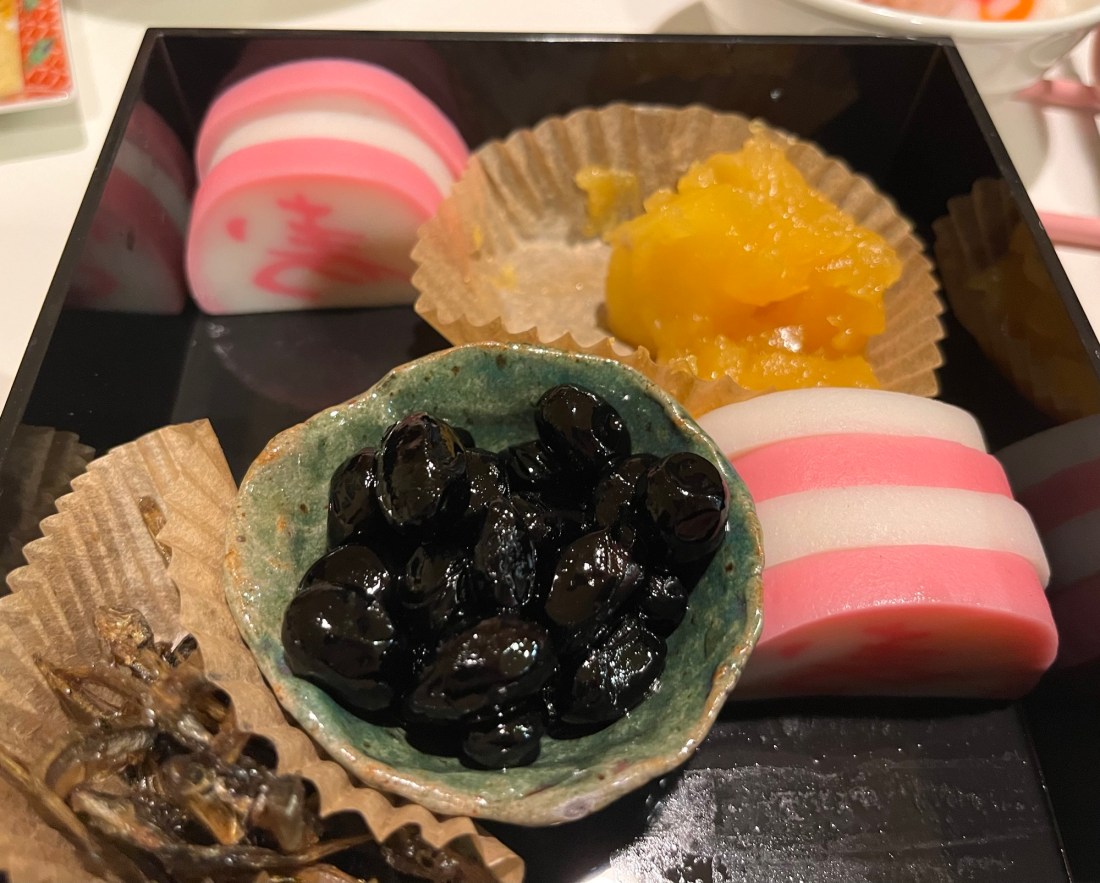
After enjoying New Year’s Eve with friends, we woke up this morning to eat Osechi (お節), which are traditional foods eaten in Japan for New Year for good luck. This is just one of many traditions found in Japanese New Year, also called oshougatsu (お正月).

I won’t list each one, but you can read here. These are foods thought to have auspicious meanings, and include things like shrimp, black beans, candied fish, chestnuts and so on. I like some more than others, but I try to have a bite of at least one of each. I like the pink and white kamaboko in particular. This year, we bought a brand that has the Chinese character 寿 (kotobuki) in it, meaning “felicitations” and such. The featured photo shows the Chinese character in reverse.

Also, in the photo above, our little ceremonial dishes feature the Seven Luck Gods too, and in the ozouni soup shown the naruto fish cakes feature Mount Fuji in front of a sunrise.

Later today, I will probably play some Karuta and then head for the local Japanese Buddhist temple for the first visit of the year, hatsumoude, and post on that soon.

Happy 2024 to everyone!

P.S. For us Star Trek fans, another thing to may be look forward to this year:

Revisiting Ryoanji

A while back, I talked about a famous Rinzai-sect Zen temple named Ryoanji that my wife and I had visited in 2005, shortly after we got married. During our latest trip to Kyoto (mentioned here and here), we got to see Ryoanji again, and this time, armed with a better camera, better weather, and more background knowledge, I was able to better appreciate the visit.

The temple was founded shortly before the disastrous Onin War, a grinding, destructive urban war that ravaged the city of Kyoto over a succession dispute, and ironically the founder of the temple was one of the major combatants, Hosokawa Katsumoto. The temple of Ryoanji was an active monastery for a long time, a second-tier temple in the Five Mountains system in the 14th century, a hierarchy of Rinzai-Zen temples patronized by the Shogunate at the time, but tourism has pushed out the original monastic training to other temples, or other parts of the complex.

Historically, like many Zen temples of the Five Mountains System, Ryoanji got tangled in politics and urban life at the time, for better or for worse,1 but even so, it was clear that over the generations, the temple community there cared about Zen and tried their best to put things into practice and that love and care showed even now.

Today, Ryoanji is best-known for its “Zen garden” or karé-sansui (枯山水) in Japanese. You might have seen pictures of it before, but seeing the real thing is pretty interesting. On the one hand, it’s surprisingly small, but on the other, there’s an ineffable feeling when you are there. There are plenty of theories about who designed the famous “garden”, but there’s no clear evidence one way or another. So, it’s design and history remain a mystery.

The temple itself is fairly small, but is part of a large, secluded area north of Kyoto. You can see a map of the complex here:

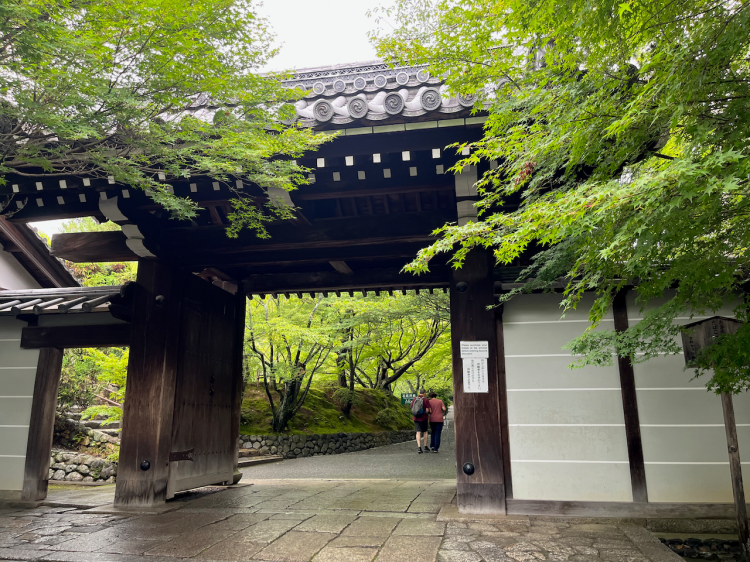
It was hot and muggy that day, and my gout, which thankfully only flares up rarely,2 was in full swing, so walking was quite painful. Nevertheless, we had already booked the tour, so we soldiered on. Ryoanji, after the chaos and traffic of other places, was a welcome respite. This is the main gate, which is shown on the map above at the bottom-right.

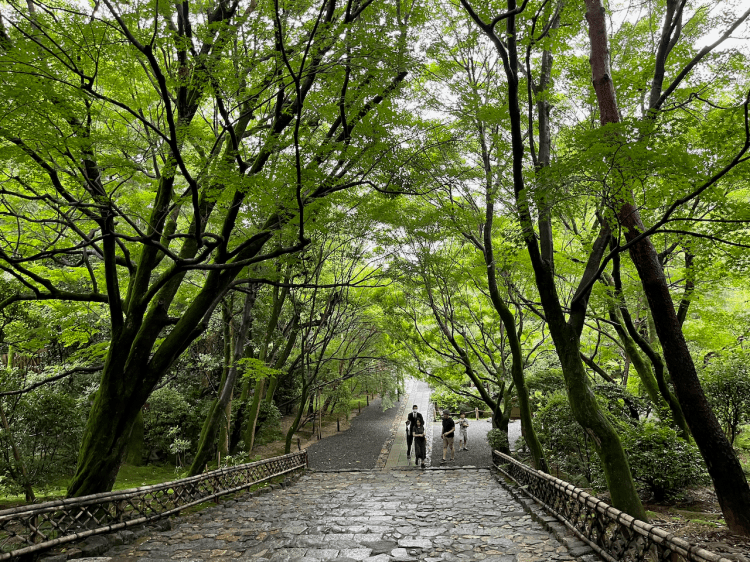
Ryoanji has a large garden area before you get to the temple itself:

From here, you come to the temple complex itself:

I vaguely recall that this was the “kitchen god”, a minor deity venerated to prevent fires in the kitchen. The first room of the temple, before you get to the garden, was formerly the kitchen, if I recall correctly.

And finally, the temple opens up to the famous sand garden:

More pictures here:

It seemed to be a fairly quiet day at Ryoanji, so we had a chance to sit down on the veranda and admire the view for a bit. The last time I came in 2005, the garden was snow-covered, so I didn’t really get to see much (but still a great experience in its own way):

Me, February 2005 at Ryoanji, with no idea what I was doing. 😅

Much has been discussed about the garden, the symbolism of the particular rocks, the use of the Golden Ratio in its proportions, etc., but for me, it was just neat to see in person. As I said earlier, there’s an ineffable feeling when you’re there. Amidst the chatter and people shuffling around, you

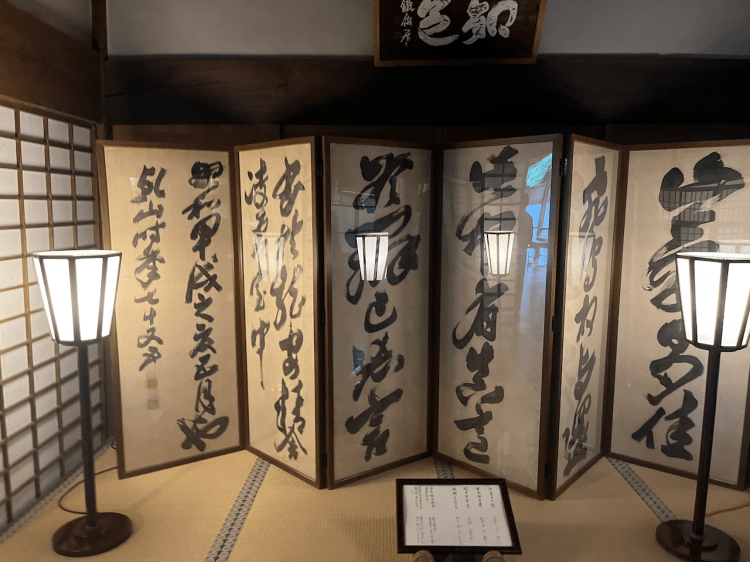
Just behind the veranda are also some black-ink murals:

From there you see the famous tsukubai, though since I didn’t have a photo this trip, here is the same thing from 2005:

The tsukubai has a square opening in the middle, and Chinese characters (kanji) on each side. The square, combined with each Chinese character form different Chinese characters, forming the sentence: 吾唯足知 or waré tada taru (wo) shiru, meaning something like “I only know contentment”, or rather more loosely, “Just as I am, I am sufficient”.

From there, visitors loop around through the garden again on the other side, which is very peaceful:

Here’s me and my teenage daughter being silly, imitating a funny Japanese comedy duo named EXIT (ポンポン!):

From here, we went to the gift shop near the exit, where I picked up a nice little incense holder,2 and of course some incense.

Ryoanji isn’t as big a tourist draw in Kyoto as some other temples, but to be honest it was a really nice experience. The quieter atmosphere, the slower pace, and the amazing art really made an impression on me more than the whirlwind experiences we had at other temples that day. Even as it hurt to walk constantly, I still felt a sense of calm and peace I hadn’t enjoyed in a while.

It reminded me of a similar experience I had back in Victoria BC, where I felt a sense of calm and clarity and a healthier perspective on things that stuck with me upon my return to the US. This might sound silly or New Age-y, but as a Buddhist for almost 20 years now, amidst the constant distractions of life and struggles with practice, the chance to stop and gain a different perspective for even a couple of hours, every so often is really valuable. Ryoanji was an unexpected highlight of the trip for me, and someday I hope to go there again.

P.S. I’ve been really heads down working on the other blog lately, plus also dealing with plenty of parental and work issues, so I am somewhat behind on blogging.

1 The famous monk, Ikkyu, grumbled about this quite a bit. Then again, Ikkyu wasn’t a saint himself. 😉 Like the Buddhist temples of the earlier Heian Period, the Zen temples of the Ashikaga Shogunate tended to be lax in monastic discipline, host parties with nobility, and get into all sorts of disreputable behavior. Besides Ikkyu, I am sure there were more serious-minded monks, but then again with any religion anywhere across history, given a sufficiently large community, you get a spectrum of saints and scallywags. Such is Humanity.

2 Rarely enough that I can avoid taking prescription medication, and focus on eating a healthier diet, plus lots of water daily. Weight loss has also helped.

3 I have some incense from Japan from previous trips, but my Western incense holders do not properly fit, so the incense tends to lean or fall over. Different holders for differently-sized incense.

The Golden Rules of Japanese Grammar

Much has been discussed over the years about how difficult Japanese language is to learn, especially the writing system.

That’s how I felt for a long time, but I eventually had a moment of clarity and realized that Japanese grammar is internally consistent and straightforward, like Latin. However, those grammar rules are considerably different than English or other European languages, which is where people often get hung up.

So, what follows are, in my opinion, the basic rules that govern Japanese grammar. My hope for you is that in understanding these rules, Japanese language doesn’t seem so hard to comprehend. I call these the Golden Rules of Japanese Grammar.

Note: knowing how to read hiragana is a big help, worth doing anyway if you’re serious about learning Japanese. This article assumes you know how. If you want to study Japanese, but still don’t know hiragana, please stop and review first.

  1. The main verb comes at the very end. No matter how long, or how short, a sentence is, the main verb is always last.
  2. The copula です (polite) or だ (informal) can be a placeholder for the final particle + verb, where appropriate.
  3. The final verb/copula determines the tense (past, present, ongoing, etc) of the whole sentence.
  4. Verbs modify nouns directly: べているいぬ (the dog that’s eating)
  5. Adjectives modify nouns directly, or with a な in the case of “na-adjectives”: 可愛かわいい犬いぬ (a cute dog), or しずいぬ (a quiet dog).
  6. Nouns can modify other nouns using the の particle: ジムのほん (Jim’s book)
  7. Adverbs always come just before the verb. Amounts count as adverbs, too. ウサギうさぎが3える。(I see three rabbits)
  8. Verbs usually come in pairs: a transitive one (that does something to something) and an intransitive one (something is). The transitive one usually uses the direct-object を marker, the intransitive verb uses either に or が particles.
  9. Intransitive verbs describe things, describe ongoing state. コップこっぷちている。(the cup fell down/ has fallen down, not “is falling down”).
  10. Many things are expressed as nouns, including grammar points.

This is definitely not a comprehensive list, and like any language, grammar is complex and varied, but if you remember the patterns above, you’ll be surprised how often you see they reappear over and over.

Using the example above from my old Anki flashcards, the grammar point わけ behaves like a noun, with the verb かえ directly modifying it. Even if you are learning this grammar point for the first time, you can see how it fits into the rules described above.

Good luck and happy studying!

P.S. this is how you write furigana in WordPress, if curious.

Understanding Japanese Kanji

The kanji poster hanging in my son’s room since he was a little boy, product by Kumon.

The Japanese writing system is … complicated.

Japanese as a language isn’t particularly difficult, no more or less than other languages, but its writing system demands considerable time and investment to really get comfortable with. Written Japanese comprises of a mix of a few different things:

  • Hiragana syllabary1 – This is the default way of writing Japanese, and what most people, including kids in Japan, learn first. Note that hiragana characters are “syllables” not letters. One sound equals one hiragana character.
  • Katakana syllabary1 – The katakana is a 1:1 analogue to hiragana. In other words, every hiragana character has a corresponding character in katakana, but katakana looks more “blockey”, less flowing, than hiragana. It is most often used with foreign words, Buddhist mantras, or just for impact (e.g. sound-effect words in manga).
  • Chinese characters – Also known as kanji.

A typical sentence might look like: 今日ズボンった。Everything in blue is kanji, everything in red is katakana, while everything else is hiragana. I’ve spoken about the hiragana syllabary (part 1, 2 and 3) already, and katakana is similar enough that it does not require a separate article. So, today we’re just covering the use of Chinese characters or kanji.

Historically, China’s neighbors, such as Korea, Japan and Vietnam spoke languages that are both very different than Chinese, yet they wanted to import Chinese technology and culture. When they imported the Chinese writing system, however, it wasn’t an simple fit. Native words sound very different than Chinese, and sounds in Chinese language don’t always exist in the native language. Thus, Chinese characters’ sounds change when they’re imported.

Returning to Japanese language, the word for Japan in Chinese characters is 日本. In modern, Mandarin Chinese this is pronounced as rì běn, but in Japanese it’s pronounced as either nippon or nihon.2 This YouTube video helps illustrate the process:

You can see how the process of importing Chinese characters into Japanese was very organic. The result is that there are often many ways to read a Japanese kanji character, depending on whether it’s read in a native Japanese way, in a Sinified (Chinese) way.

The native way, or kun-yomi, is most often used for standalone words (not compound words), people’s names, place names, and verbs. For example, the kanji is read as yama in the native way. When talking about a mountain, or in someone’s name such as Sugiyama, you would most likely see this native pronunciation.

However, the Sinified reading of this kanji is san or zan . This is the on-yomi reading, which you might see in a compound word like 登山 (tozan) for mountain climbing. It’s the same kanji character, but now it’s read as “zan” instead of native “yama”.

If you look at my son’s kanji poster above, you can see for each kanji there is a mix of kun-yomi readings and on-yomi readings. Some kanji (夕) have maybe only one reading. Some (下) have seven or more! It all depends on how it was imported into Japanese, and how it’s applied in the language over the centuries.

So, inevitably the Japanese language student asks: how am I going to learn all this kanji?!

Short answer is: you don’t.

Beyond maybe the first 100 kanji, the amount of time and effort to memorize the kanji rapidly becomes untenable, and you get diminishing returns. How many kanji have an on-yomi of shō ? A lot, too many to remember which is which. Also, the further along you go, the more obscure and specific kanji get, so the returns worsen over time. They’re important, but show up in increasingly specific contexts.

Further, using mnemonics or pictures to learn the kanji is only useful when the kanji actually looks like something, which is mostly the basic kanji only. The aforementioned 夕 does look like a moon at evening, so mnemonics work. But what about 優?3

Don’t get me started on the Heisig method. It’s a useful way for learning how to break down Kanji into discrete bits, but beyond that it doesn’t provide much value for the amount of work required.

No, the only way to learn kanji is to not learn them individually.

Instead, focus on building your vocabulary, and learn the kanji as they come up. I talked about this a while back as the “convergence method” but there’s no magic here. As you learn more vocabulary words, certain kanji come up often, and you’ll learn to anticipate their readings in future words. Sometimes you get it wrong, and that’s OK, other times you nail it perfectly.

But there is one other feature of Japanese you should leverage often: furigana.

Furigana is a reading aid often used for younger readers, and for language students by putting reading hints just above the kanji characters. For example lets look at the sentence above now using furigana: 今日きょうズボンった。

This is much easier to read. It still flows nicely in Japanese, but now we have the pronunciation hints (written in hiragana) right above each kanji.

If you find yourself embarrassed for relying on furigana, don’t be. This is how grade-school kids in Japan learn to read. This is how my kids (bi-racial Japanese-American) here in the US learned to read Japanese. In time, after seeing the same word 50 times, the reader doesn’t even need the furigana anymore, and can read without it, but it helps smooth the transition. When I was learning to ride a bike as a kid, I relied on training wheels, but as my confidence grew, I could ride without using them. The training wheels were still there, but I was riding more and more steady, so I hardly noticed when my dad took them off.

So, the key to reading Japanese well, including kanji, is to read native media that uses furigana. Many manga for younger audiences (including my favorite Splatoon manga), use furigana for all kanji characters and it makes the process of reading, plus looking up unfamiliar words, much easier. Even adult media uses furigana to help with more advanced, obscure words.

The point of all this is that learning kanji isn’t a slog of memorizing hundreds or thousands of characters, it’s more about learning to read vocabulary, preferably using native media. The latter approach is way more fun, and actually provides value in the long-run versus memorizing a bunch of kanji in isolation, then forgetting everything.

Chinese characters are great, and convey a lot of things that alphabetic systems can’t, but they are also pretty complicated and require considerably more ramp-up time.

P.S. if you use WordPress, this is how you add furigana to your Japanese text.

1 These are syllabary, not alphabets, because each character represents a full syllable, not a single consonant or vowel.

2 Side note, 日本 was used in other countries, like Korea and Vietnam, and their pronunciation differed too. Korean language pronounces it as Ilbon, while in Vietnam it’s Nhật Bản.

3 Confusingly enough, same pronunciation as 夕, by the way.