The Downfall of Two Brothers

I’ve talked about the first shogun of Japan’s new Kamakura government, Minamoto no Yoritomo and his betrayal of his vassals here and here, but I also alluded to his execution of his younger half-brother, Minamoto no Yoshitsune. Yoshitsune’s downfall is indeed a sad tale. But as we’ll see, Yoritomo’s own downfall, while slower, wasn’t much better.

Minamoto no Yoshitsune was a military genius and the youngest of nine sons of Minamoto no Yoshitomo (Yoritomo was the oldest). When Yoshitomo was executed by his rival, Taira no Kiyomori, the half brothers were all scattered in exile, but gradually reunited under Yoritomo. Out of these brothers, Yoshitsune was the most talented in warfare. Yoshitsune led the led against the Heike clan and eventually destroyed it in the battle of Dan-no-ura.

Yoshitsune has been celebrated throughout Japanese history as the ultimate warrior, who along with his companion Benkei, went on many adventures and fought many battles. Yoshitsune’s bravery and unconventional strategies, coupled with Benkei’s stalwart strength and loyalty have been the subject of many Noh and Kabuki plays, as well as many works of art.

The famous battle between Benkei and Yoshitsune on the Gojobashi bridge in Kyoto. Photo courtesy of Wikimedia Commons.

But one thing Yoshitsune was not good at was politics. Once the Heike were destroyed, tensions rose between the new military commander (shogun 将軍), namely his older half-brother Yoritomo, and the conniving emperor Go-Shirakawa. The Imperial family had lost power due to the Heike clan, and were eager to get it back. The Genji clan defeated the Heike and weren’t keen to hand over their hard-fought power.

Yoshitsune was caught between these two men, and used as a proxy for their struggle for power. The Emperor, grateful for Yoshitsune’s efforts appointed him Kebiishi (検非違使): the Sheriff of Kyoto the capitol. Accepting this position, however, meant that Yoshitune was now working under the Emperor, not his half-brother the Shogun, and Yoritomo was evidentially furious by this. From here on out, he began to suspect his baby brother of plotting to overthrow him. The historical drama, Thirteen Lords of the Shogun, implies that certain retainers, perhaps jealous of Yoshitsune, may have been whispering in Yoritomo’s ear, fanning his paranoia further. When Yoshitsune tried to return to Kamakura to talk to his brother directly, he was refused entry and had to idle in the nearby town of Koshigoé.

While staying at Koshigoe, Yoshitsune wrote the following letter to his older brother:

So here I remain, vainly shedding crimson tears….I have not been permitted to refute the accusations of my slanderers or [even] to set foot in Kamakura, but have been obliged to languish idly these many days with no possibility of declaring the sincerity of my intentions. It is now so long since I have set eyes on His Lordship’s compassionate countenance that the bond of our blood brotherhood seems to have vanished.

Source: Wikipedia

Painting of Shizuka from 1825 by Hokusai, Public domain, via Wikimedia Commons

Yoshitsune was unable to ease his older brother’s concerns, nor did he want to be under control of the Emperor either, so he bowed out, and retreated to the province of Ōshū way up north, where he had previously been exiled. It was familiar land, and the ruler of Oshu promised to watch Yoshitsune on behalf of Yoritomo, while also protecting him from Yoritomo. With his mistress, Shizuka,2 they moved there and things were quiet for a time.

However, Yoritomo wasn’t satisfied. When Yoshitsune’s keeper passed away, the keeper’s son hatched a plan with Yoritomo to allow Yoritomo’s troops to attack his Yoshitsune’s house.

Legends hype up this last stand by Yoshitsune (with Benkei defending), but in any case, Yoshitsune the famed military commander was killed by his own half-brother, and his head was preserved in a box with sake. Yoshitsune was later enshrined as a kami at Shirahata Shrine in Fujisawa.3

Yoshitsune died in 1189, and by 1192 Yoritomo was in full control of Japan since the Emperor had died as well. As the shogun, the supreme commander of military forces, no one could oppose Yoritomo any longer, the country had been pacified at last, and he had avenged his father for his wrongful death.

……..but, this came at a steep, steep price. Yoritomo had to dodge other assassination attempts, and spent the remaining years of his life constantly watching his back. He had paid for his power in blood and betrayal, and even after taking tonsure as a Buddhist monk,4 he never really found any peace. When he died at age 51, more than a few probably sighed in relief. Yoritomo was powerful, and crafty, but he was brutal and paranoid, and everyone around him spent their lives in constant fear. One can not help but see the similarities to certain dictators today.

P.S. if you go to Tsurugaoka Hachimangu shrine in Kamakura, Japan, you can see a tiny museum, just to the left of the inner sanctum, which has relics from Yoritomo’s life. It’s easy to miss, but tickets are cheap, and it’s amazing to see. We saw it in December 2022, just after watching the historical drama, and it was pretty amazing. The new, larger museum near the front entrance is also great. A visitor can easily spend half a day at Tsurugaoka Hachimangu, especially if you are a history nerd.

P.P.S. Official website for Shirahata Shrine in Fujisawa. No English, sorry, but it’s close to Fujisawa station if you’re in the neighborhood.

1 I couldn’t find a good translation of Kebiishi in English, but based on the duties, and based on varied definitions of “Sheriff” in English-speaking countries, this seemed the closest equivalent. Needless to say, being the sheriff of the capital city was a prestigious honor, but also comes with plenty of political strings attached.

2 Another revered character in the plays and art about Yoshitsune. Yoshitsune had married another one for political reasons, and Shizuka was technically his concubine, but they seemed to have genuinely loved one another and so she alone stayed with Yoshitsune at Oshu. She is often revered for her sincere, loving devotion, and for their doomed fate.

3 When we visit family friends in Japan, we often go to Fujisawa. It’s a nice seaside town, but I never knew that Yoshitsune was enshrined here. I might try to stop by one of these days and get a stamp for my book.

4 A Buddhist monk, as in an bhikkhu or renunciant. More on the terminology here. The practice of retiring to the monastic life was a common practice among the nobility in pre-modern Japan. His wife, Hojo no Masako, not only retired to the monastic life, but still took the reins of power after Yoritomo’s death becoming the famous “warlord nun“. Go-Shirakawa, the scheming emperor, had technically retired to the monastic life as well, but only as a means of dodging certain constraints on his power by the Fujiwara clan. Politics were…. complicated in those days, and few who retired truly let go of power, despite the Buddhist prohibition for Buddhist monks to be involved in politics. Then again, even now some monks fail to heed this prohibition either. Once again, politics and religion should not mix.

Also, at the risk of being sanctimonious, I wonder if Yoritomo’s Buddhist devotion did him much good in the afterlife, given how many people he had murdered. This is not unlike the ancient king in India, Ajatashatru, who while devoted to the historical Buddha Shakyamuni, had also murdered his way to the top. Because of the weight of his crimes, Ajatashatru’s devotion and progress on the Buddhist path was greatly hindered for many lifetimes to come according to Shakyamuni. I can’t help but think Yoritomo suffered the same fate. In other words, we all pay our debts some time.

Separated by Centuries

This is another cool moment in Japanese history (previous post here) that I wanted to share while re-watching the drama Thirteen Lords of the Shogun. Shortly after the death of Kazusa Hirotsune, the head of the Genji (Minamoto) clan named Minamoto no Yoritomo, sought to finally take the fight to Heike (Taira) clan. The trouble was was that he had a rival within the Genji clan itself.

Yoshinaka as portrayed in woodblock print from 1866, source Wikimedia Commons.

The Genji clan was quite large by this time, going all the way back a few centuries to Emperor Saga in the early 9th century. By the time of the Genpei War (late 11th century), the clan had a number of sub-clans, domains and so on. One such branch was led by Yoritomo’s cousin, Kiso no Yoshinaka.1 Yoshinaka and Yoritomo initially worked together, and Yoshinaka even sent his son, Yoshitaka (木曽義高), in good faith as a hostage at Yoritomo’s court in the city of Kamakura. However, the relationship quickly became estranged, and they competed for who could get to the capitol of Kyoto first to rescue the Emperor under house-arrest from the Heike clan.

What Yoshinaka didn’t know was that the scheming Emperor, Go-Shirakawa, was already in league with Yoritomo. Go-Shirakawa expressed gratitude to Yoshinaka, and even bestowed the lofty title of Asahi Shogun, or “Asahi” Commander of the Armed Forces, and commanded him to take the fight to the Heike. And yet, Go-Shirakawa still threw in his lot with with Yoshinaka’s cousin Yoritomo. Things quickly went downhill as Yoshinaka, realizing that he was being double-crossed, seized the Emperor briefly, and battled his cousin’s forces. In the end, Yoshinaka and his army were wiped out. His son, Yoshitaka, did not survive much longer despite being wed to Yoritomo’s daughter O-hime. This part of the historical drama is really sad because it was clear that Yoshitaka did nothing wrong, but was simply a victim of politics.

In the historical drama, and in Japanese literature, Yoshinaka is portrayed as sincere and well-meaning, but out of his league compared to the scheming of the Emperor and of Yoritomo. He was a genuine warrior, loved by his vassals, but court politics were beyond his ability, and he was ultimately betrayed by the very forces he sought to help. Seeing a pattern with Yoritomo?

So, why bring this up?

Yoshinaka’s remains were interred at a small Buddhist temple named Gichū-ji2 in the city of Otsu, in Shiga Prefecture. Centuries later, the famous haiku poet, Matsuo Basho, visited the temple on one of this pilgrimages. Basho was evidentially an admirer of Yoshinaka and composed a haiku upon visiting the gravesite:

JapaneseRomanizedRough Translation2
義仲のYoshinaka noIs this not the mountain
寝覚めの山かMezame no yama kathat Yoshinaka woke up on?
月悲しTsuki kanashiThe melancholy moon.
2 any faults in the translation are my own

According to tradition, it is thought that one night while sleeping on a mountainside, Yoshinaka woke up and gazed at the moon. Here, on that same mountainside, the moon shines melancholy, still reflecting over the demise of Yoshinaka.

Later, when Basho passed away he was, according to his wishes, also interred at Gichū-ji so that he may rest alongside the admired warlord.

There’s a travel blog entry in Japanese that shows the temple grounds and the grave sites, while this page shows the temple.

It’s interesting that such a talented poet was so infatuated by this legendary, though ill-fated warlord that he would be buried alongside him despite the passage of centuries.

P.S. If you thought Yoritomo was a scallywag now, wait until you get to the murder of Yoritomo’s own half-brother, the talented general Yoshitsune.

P.P.S. Yoritomo also punished another branch of the Genji clan, the Genji of Kai province, by executing that lord’s young heir on suspicion of treason as well.

P.P.P.S. Yoritomo was, suffice to say, a cold-blooded ruler. Not surprisingly, the Shogunal military government he founded got off to a rotten foundation and struggled after his death. Unlike the video game character Edelgard, Yoritomo seemed to have no moral conviction. He wanted power and vengeance.

1 Fun fact: the actor who played Kiso no Yoshinaka in the historical drama was also in Godzilla Minus One. He appears in the opening scene as a runway mechanic, Tachibana, talking to the ensign.

2 The kanji characters 義仲 can be read as either “Yoshinaka”, as in Kiso no Yoshinaka’s name, or as “Gichū”, the name of the temple. Clever.

The Great Buddha of Kamakura

Still catching up on blog posts from our latest trip to Japan, but today I wanted to share some photos from the Great Buddha of Kamakura, or in Japanese Kamakura no Daibutsu (鎌倉の大仏).1 The Great Buddha is one of two major attractions in the old city of Kamakura, the other being the grand shrine of Tsurugaoka-Hachimangu. We came to Kamakura in late December during a late afternoon.

The Great Buddha was originally part of a temple called Kōtoku-in (高徳院), but that temple was swept away by a terrible tsunami in 1498 (mentioned in this blog post too), leaving only the bronze statue of Amitabha Buddha, the Buddha of Infinite Light, behind. The current structure was built after this of course. This is near the front entrance of the premises, the Niō-mon Gate:

There is also a sign near the front entrance as shown below. Because it’s pretty far removed from walkway, it’s hard to get a good view of the sign without zooming in, so apologies for the poor quality photo:

Looking online, the message reads:

當山ハ數百年來ノ勤行絶ザル聖靈ノナリ茲ニ詣ントスル善男善女ハ何人ヲ問ス何ノ宗教ヲ奉スルニ論ナク須ク下示ノ意ヲ道守スベシ
之ハ彌陀ノ聖殿ナリ是ハ如來ノ御門ナリ冝ク敬禮ヲ盡ス可モノ也

STRANGER WHOSOEVER THOU ART and what soever [sic] be thy creed. when thou enterest this sanctuary remember thou treadest upon ground hallowed by the worship of ages.
This is the Temple of BHUDDA [sic] and the gate of the Eternal, and should therefore be entered with reverence.

Source: https://yo.drunk.jp/651.html

The antiquated English, and the heavy use of katakana (instead of hiragana) suggests that this sign was probably written in the early-modern Meiji Period, but that’s just a supposition on my part. Once you go past the sign, you will be greeted by the following:

Up close, the Buddha is definitely bigger than pictures suggest:

It’s hard to see from here, but the back of the statue contains some stairs where, prior to the pandemic, you can climb up inside the head. However, that is off-limits now.

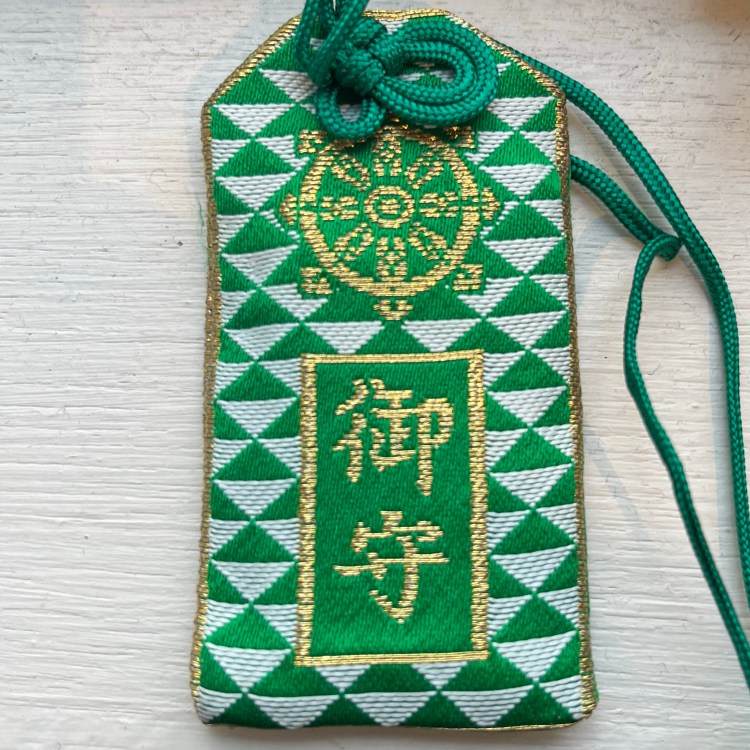
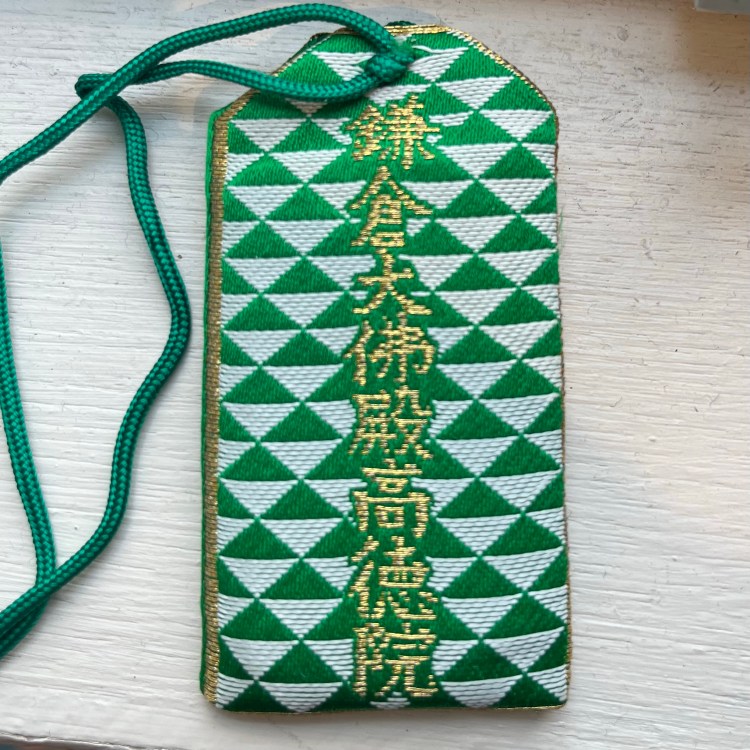
The Great Buddha is also were I got my old Buddhist rosary way back in 2007 or so, and I picked up a new omamori charm here:

Around the premises, they have a lot of nice gift shops and goods you can get there, plus lots of nice shops outside the presmises.

In short, it’s a great place to visit for half a day or so, whatsoever be thy creed.

1 This is to help distinguish it from the Great Buddha (daibutsu) in Nara, of course.

Awesome Historical Totebag

Speaking of the famous “nun warlord” Hojo no Masako, I wanted to share something really great that I picked up in Japan in Kamakura (still uploading pics from that trip, blog post coming later):

This totebag features the famous speech by Hojo no Masako shortly before the Jokyu War of 1221, when the retainers of the new Kamakura government (shown above) balked at taking up arms against Emperor Gotoba:

その恩[故右大将軍, 源頼朝に]はすでに山よりも高く、海よりも深い。

“The obligation we bear to the late Udaishogun (Minamoto no Yoritomo, Masako’s husband) is higher than a mountain, and deeper than the sea.”

from the “Azuma Kagami” (吾妻鏡, “Mirror of the East”), dated to , made in the 19th day of 5th month of the 3rd year of JOKYU era

The totebag is really cute, and represents a really great moment in Japanese history. I have been proudly using it for shopping and such since I came back to the US. The bag is made by Samurai Kibun (homepage here), which makes a lot of great products featuring famous figures in Japanese history. It appears they are focused on domestic, Japanese audiences, so there is no English site, and it states that it cannot ship overseas. So, chances are, you’re more likely to see Samurai Kibun goods in local shops in Japan.

So, if you are in Japan and you do find some of their goods, definitely show some support and pick something up!