Full Circle

SPOCK: There’s no further need to observe me, Doctor. As you can see, I’ve returned to the present in every sense. 

Star Trek, “All Our Yesteryears” (s3ep23), Stardate 5943.7

I spent this past week volunteering as a chaperone for my son’s school camping trip, which was chaotic and busy, but also bought me some much-needed quiet time to read and reflect on some things. Exhausting, but nice.

Lately, while reviewing some old Buddhist material, I realized that I had conflicting thoughts about my own Buddhist path. I have spent much of my past 20 years as a Buddhist following the Pure Land path, especially Jodo-Shu/Jodo-Shinshu sect Buddhism, and this is reflected in many posts here, including recent posts like this one. This has been really formative to my understanding of Buddhist religion and teachings.

And yet, the reason why I left my old community nearly 10 years ago was that I felt there was more to Buddhism than just passively allowing the power of Amida Buddha to lead me (i.e. tariki 他力 in Japanese-Buddhist parlance). I wanted to pursue other facets, more active practices, and so on. This is reflected in my exploration of Buddhism in general, including recent posts like this one. But even then, I never could quite pin down what I should do for Buddhist practice, or what to prioritize. I had a general sense of things, but struggled to articulate what I think I should do.

So, for some time now, I have been plagued with self-doubt, and feeling conflicted about how best to be a “good Buddhist”. I was worried that I had lost my way. I read a few sources from different Buddhist traditions in my spare time, but it only made me feel more confused.

So, I decided to get back to basics. Using my spare time at camp, I started writing down what I genuinely believed in, and not what a particular tradition dictated to me. I didn’t have a lot of time, so I would just jot down notes on my phone, a sentence here or there. Over a few days, I had a list of items, and they had certain recurring themes. I was relieved to see that I came to the same conclusions as before, but now with a greater sense of conviction. What a relief.

I felt a bit like Captain Kirk in the season one Star Trek episode “This Side of Paradise” (s1ep24), after he has been affected by the mind-control spores. He is just about to leave the ship for good, but at the last minute, he comes to his senses and realizes that what he really valued was the ship, and his role as captain. It was as if he came out of a fever dream. This is how it felt for me.

But also with this new sense of conviction, I will probably be changing tack a little bit on the blog. Nothing dramatic, but I feel that it’s time to close the book on certain topics, and focus on other things that I want to explore more. Time will tell, but that’s what I want to do for some upcoming blog posts.

Thanks for reading!

Namu Shakamuni Butsu

P.S. Photos from camp.

P.P.S. Bonus episode this week. I felt like posting sooner than later. Enjoy!

April 2025 Updates

Hello Dear Readers, and Happy Earth Day! 🌎

Just a small update: Recently I was looking for some old Buddhist resources I used to rely upon a lot, and was shocked to discover that these resources have all but disappeared. Internet attrition has taken its toll, so many old websites I used can only be found on places like the Wayback Machine and such. This makes them pretty hard to find. Also, with modern web-technology, it is far easier now to post Japanese characters side by side with English text.

So, I’ve been working on a side project to “rescue” old information from obscurity and modernize it for easier study and (when possible) for other languages. So, the first one I have completed is Honen’s famous One Sheet Document or ichimai-kishōmon. I was able to use a good translation by the now-defunct JSRI (Jodo Shu Research Institute) and draw from Japanese-language sources too since I can now read such things, unlike 15 years ago. Please check out the link above. I also added Cyrillic text for Ukrainian/Russian Buddhists who might want to recite the document.

The other text I am trying to recover is larger, and taking more time: the Tannisho. The Tannisho is centrally important to the Jodo Shinshu tradition, but Taitetsu Unno’s fabulous translation is almost gone. I got a Japanese-language introduction at Tsukiji Honganji in 2023, and I’ve been using that, plus Dr Unno’s translation. It is only partially complete, but work is proceeding. I’ve also, thankfully been able to find more information in Japanese that helps explain the history, and so on.

That’s about it. I hope to rescue more resources soon, in particular some of Rennyo’s ofumi letters, but it’s slow and time-consuming, and my own resources are somewhat limited.

Big Changes, Little Changes

A beach scene with a rocky shore, and waves lapping up to teh shore. In the distance is a cloudy sunset.

Q: The redoubtable Commander Riker, whom I noticed before. You seem to find this all very amusing.
RIKER: I might, if we weren’t on our way to help some suffering and dying humans who–
Q: Your species is always suffering and dying.

Star Trek: The Next Generation, “Hide and Q” (s1ep10), Stardate: 41590.5

Something a little embarrassing I want to confess: sometimes, when I am uneasy or stressed, I go back and read some of my own posts. I don’t do this because of vanity (hopefully) or conceit, but I like to remind myself of certain things I might forget amidst daily turmoil. I suppose I write some of these blog posts as for myself to sort out what’s bothering me, as I do for the dear readers who follow the blog.1

One of my favorite posts of all time is this one. After visiting the Royal British Columbia Museum in 2022, and watching the excellent documentary about the different geologic ages of Antarctica, I walked away deeply impressed. These experiences help give a larger perspective about the world around us, and show how change is a constant of the universe whether we see it or not.

Change happens on the micro-level in our daily lives: one day to the next, we get older, our hobbies change, things at work happen, hairstyles change, etc. When I look at old photos of me and the kids, I am amazed at how much skinner I was, and no grey hear. 🤣

The world around us changes too: political, economically, and so on. The neighborhood you live in will look different 10 years from now, or looking back it’s probably changed in the past 10 years. Thinking about my life as a college kid in the early 2000’s, the Dot-com Era, it’s amazing how much has changed in a mere 20 years. Some things got better, some things got worse.

But if we step back even further, we can see with the benefit of hindsight slow-moving, multi-generational historical changes. From following the excellent History of Byzantium podcast, it’s amazing how much changes in the Eastern Roman (a.k.a. Byzantine) empire across generations. During the time of emperor Justinian the Great, chariot races were still hugely important in Byzantium, the empire had tenuous toeholds in North Africa and Spain, and many people still actively spoke Latin. By the time of emperor Manuel Komnenos, the Eastern Roman empire was far smaller, Greek language had long since replaced Latin, and the single universal church had long since split between Roman Catholic and Orthodox faiths. Between the 6th and 12th centuries, many changes happened, but because they stretch across many generations, it’s not possible for someone living within the city of Byzantium to fully grasp the scale of the changes. It was still the same Eastern Roman empire, and would continue for another 200+ years, but it had changed and evolved as external circumstances changed.

But let’s step even further back. An Egyptian peasant working the fields, or helping to build the Great Pyramid of Khufu, would be utterly stunned at the world today. Such a world would feel totally alien to him or her. It’s not just the level of technology we enjoy today, or the quality of our medicine, but also the way we view the world. Things that seem like common sense to such a peasant would feel strange or silly to us. Things that we inherently believe as 21st century adults would feel strange or bizarre to that peasant. We can’t really pin down when or how such things changed, but it’s series of gradual changes, each one piling on top of the rest.

And yet we can step even further back. If we look at the human race, it is new to the planet Earth. People can deny this using specious reasoning, but science doesn’t care what people believe or don’t believe. The natural world just works the way it does. We humans are just here, living on the Earth, but the Earth does not belong to us. We are its stewards. If not us, perhaps the Apes or Squids will be its stewards. 😏

Which I think brings me to my point: of all the craziness and turmoil going, I think there are two things to take away from all this:

  • We may lament how things have taken for the worse, but in a dispassionate sense, this is just more change unfolding due to causes and conditions that until now we may not have ever noticed. It doesn’t necessarily mean they are good changes, or harmless, but change is change. Also, by extension, the way things are now won’t always be this way in the future. Change is still happening, even if we can’t see it.
  • Of all the things to concern ourselves with most, in my humble opinion, the Environment (with a big “E”) is the most important. If we want to benefit Mankind, the Earth, and all life on it in ways that we’ll never see in our lifetime, if we want to get the most “bang for our buck”, then anything we can do to help the Environment works towards that end. Small changes and efforts now will ripple across generations we will never see, and help shape the Earth, hopefully in a positive way.

At times like this, I truly believe my old minister Rev. Don Castro of Seattle Buddhist Church was onto something when he described Buddhism, including Pure Land Buddhism, as an eco-religion. Amida Buddha, the Buddha of Infinite Light, embodies many things:

  1. As an embodiment of the Dharma, Amida sheds light on the continuous nature of all things: impermanent, fluid, changing.
  2. Also as an embodiment of the Dharma, Amida doesn’t require praise or devotion. The Dharma is just there, whether people notice it or not, whether they believe it or not. But as a Buddha, Amida tirelessly works to help all beings, to awaken them, to provide peace of mind.
  3. Also as an embodiment of the Dharma, Amida embodies how all things relate to one another. The small things that we do day to day to help improve, or degrade, life around us affect others even if they are far removed.
  4. Finally, Amida Buddha as the Dharma teaches rational, not selfish, thinking and non-fear. In a sense, WWTD: What Would Tuvok do?

All this is to say, I suppose, even amidst crazy times, do not fear. Take inspiration from the Buddha, make rational, wholesome choices, yet never assume things will stay a certain way forever. Do not be complacent, nor take things for granted.

Namu Amida Butsu

P.S. featured photo taken at Richmond Beach in Shoreline, WA earlier this year.

1 This blog is small-time, but it’s a labor of love, and I genuinely appreciate each and every reader.

Misery

Suffering is endemic to this world, whether it be a stripper hustling just to make $20, refugees who lose their homes, or soldiers fighting to defend their homeland, or children who are simply neglected and unloved.

If you stop to think about all this suffering, pain and misery, it’s completely overwhelming, heartbreaking.

Even if you had all the money in the world, and give it away, it provides only temporary relief. If you held all the power in the world, you could only affect so much change. Worse, you might fall into hubris.

From the game Fire Emblem: Three Houses

I think this is why the Buddha-Dharma is so helpful.

Photo courtesy of the Yomiuri Shimbun newspaper. This is the fumetsu no hōtō (不滅の法灯), the “Unextinguished Lamp of the Dharma” at Mount Hiei.

A candle flame doesn’t seem like much, but in a very dark place, that candle flame really stands out.

The majestic light of the Buddha Amitāyus is the most exalted….If, sentient beings encounter his light, their three defilements are removed; they feel tenderness, joy and pleasure; and good thoughts arise. If sentient beings in the three realms of suffering see his light, they will all be relieved and freed from affliction. At the end of their lives, they all reach emancipation.

The Immeasurable Life Sutra, translation by Rev. Hisao Inagaki

I often think about the old stories of Honen, the 12th century monk who spread the Pure Land teachings in Japan. It was a time of rampant disease, warfare, and income inequality. Honen couldn’t fix any of these things but he taught a simple message to any who would listen. If nothing else, it gave hope and a sense of direction in a directionless world.

A multilingual sign posted at the front of Chion-in Temple in Kyoto, Japan. Reads in English: "This is the road of respectful affability toward Chionin temple. It is the road to encounter Master Honen. It is also the route to obtain the way of Buddhism. For the old, the weak, women, and children are lead to brightness, peaceful, and the meaning of life by collecting wisdom from the Buddha. To free tiresome beings, to let them gain dignity, and to accept the true happiness ingenuously. This is, Buddhism."
A multilingual sign posted at the front of Chion-in Temple in Kyoto, Japan.1

Sometimes, small, sincere gestures of kindness can be the best help of all.

Namu Amida Butsu

P.S. an older post on the same subject.

P.P.S. Two days and I am already violating my own blog schedule. 🤦🏼‍♂️ This was an impromptu post I wrote after yesterday’s political disaster.

1 the sign above reads in Japanese:

親しみ慕われる知恩院への道。それは法然さまに出会う道。そして、お念仏のみ教えをいただく道。仏さまの智慧をいただいて、老若男女すべての人が、明るく正しく仲よく生きることに通じる道。人生の疲れを癒し、生きる尊さ、喜びを素直にいただくことができる道。それがこの道。智慧の道。

In English I would roughly translate this as:

This is a path toward closeness with Chion-in Temple. That is to say the path for encountering Master Honen. It is also a path for receiving the teachings of the nembutsu. One receives the compassion of the Buddha, regardless of age or gender, a path that leads to a bright, upright, affable life. A path that heals weariness, reveres life, leads to sincere joy; this is that path. A path of Compassion.

In Ukrainian via Google Translate:

Дорога до улюбленого храму Чіон-ін. Це шлях до зустрічі з Хонен-самою. І шлях до отримання вчення Нембуцу. Шлях, який веде до людей різного віку, чоловіків і жінок, які живуть яскраво, праведно та гармонійно завдяки мудрості Будди. Шлях, який дозволяє зцілити втому життя та насолоджуватися гідністю та радістю життя. Ось цей шлях. Шлях мудрості.

In Arabic via Google Translate:

الطريق إلى معبد تشيون إن المحبوب. هذا هو الطريق لمقابلة هونين-ساما. والطريق لتلقي تعاليم نيمبوتسو. طريق يؤدي إلى الناس من جميع الأعمار، رجالًا ونساءً، للعيش بشكل مشرق وصالح ومتناغم من خلال حكمة بوذا. طريق يسمح لك بالشفاء من تعب الحياة والاستمتاع بكرامة الحياة ومتعتها. هذا هو هذا الطريق. طريق الحكمة.

In Spanish via Google Translate:

El camino hacia el querido templo Chion-in. Ese es el camino para encontrar a Honen-sama. Y el camino para recibir las enseñanzas del Nembutsu. Un camino que lleva a personas de todas las edades, hombres y mujeres, a vivir de manera brillante, recta y armoniosa a través de la sabiduría de Buda. Un camino que permite sanar el cansancio de la vida y disfrutar de la dignidad y la alegría de vivir. Ese es este camino. El camino de la sabiduría.

Losing A Coworker

This wasn’t the post I was intending to publish today, but on Tuesday everyone at my company was notified that a well-known and well-liked member had unexpectedly died. I didn’t know him as well as some of my coworkers did, but I worked with him enough that I definitely feel the loss. Even more so for my teammates.

I am a little past middle-age, only a few years younger than my deceased co-worker, and I have to face the fact that my health will continue to decline. The emergency surgery I had last year was a close call, and it’s a reminder that this kind of thing may come up again. I can improve my diet and exercise (work in progress) and it is worthwhile, but decline will still happen inevitably. There is no avoiding this.

This really reminds me of is the famous Buddhist parable from the Lotus Sutra, chapter three: The Parable of the Burning House. You can read a good translation here (it’s the second half of chapter 3), or my other post here.

In summary,1 the Parable describes a large, but old and rotten mansion that has caught on fire. Inside are dozens of children, and they are so engrossed in their toys and play that they don’t notice that the house is engulfed in flames. Meanwhile, the father is outside calling out to the children begging them to get out where it is safe, but initially they refuse. The Buddha likens himself to the father, calling to his children (other sentient beings of the world),2 exhorting them to leave the burning world behind before it is too late.

A screenshot from Zelda: Tears of the Kingdom, where Link is on a floating island looking out over a sunset landscape.
A screenshot from the game Zelda: Tears of the Kingdom.

As one ages, that sense of “too late” looms more and more. What if, like my coworker, I drop dead next week? It’s unlikely now, but will get increasingly likely as time goes on. Thus, it is essential to settle your affairs, both temporal and spiritual, before it is too late.

And yet, as Lady Izumi wrote, this is easier said than done.

Namu Amida Butsu

1 There is more to this parable that what I am summarizing here, especially relating to the myriad Buddhist practices and such, but am focusing on the part that is pertinent for this post.

2 From the same chapter:

The Thus Come One [the Buddha] has already left the burning house of the threefold world [i.e. the Universe as a whole] and dwells in tranquil quietude in the safety of forest and plain. But now this threefold world is all my domain, and the living beings in it are all my children.

Buddhism and Parenting

True story, I had some spare time one day recently to sit and meditate,1 first time in a while. I set the app to 10 minutes, and sat on the ol’ cushion. About five minutes into this, my youngest child walked in and asked me to unlock the parental control on his tablet.

Concentration broken, oh well.

This is a frequent issue with being a parent and being a Buddhist, but it’s not a new one.

In the Buddha’s time, he distinguished the “householder” followers with the “renunciant” ones. This wasn’t meant to denigrate one versus the other, but it was intended to differentiate those who fully could devote themselves to the Dharma (the “renunciants”), to those who had other, competing obligations (the “householders”). Because the renunciants could, in theory, devote themselves full time to practice, and had cut loose any personal obligations and bonds, they could progress a lot further along the Buddhist path. The lay followers (householders) could still progress, but they would be hampered by their mundane obligations, social “entanglements”, and such.

However, because the Buddhist path was intended to help all, the renunciants would set aside certain days of the lunar month for outreach, helping lay followers through teaching and shared practice. This is known as Uposattha in the earliest Buddhist communities.

In later centuries, especially through the Mahayana tradition, Buddhist thinkers and communities sought to expand Buddhist practice to be more engaging toward lay Buddhist followers. The goal of such practices was not intended to replace the traditional monastic establishment, but (I believe) to help fill in the gaps. By expanding the available gates of Buddhist practice, people from all walks of life could find a place to start, and progress. In other words, an even more inclusive Buddhism.

Which comes back to my situation.

If we think of daily life as a box, there are only so many Lego bricks we can fit in there. Most of those Lego bricks, as a parent, are already spoken for, so that leaves only a bit of space left for “me time”. Within that spare time, self-help can be time-consuming, impractical. Or, one is just too mentally exhausted to do anything else but space out. In some ways, life as a “householder” hasn’t changed all that much since the Buddha’s time. We suffer less from hazards like dysentery and Viking raids, but the distractions and obligations are still there.

In any case, until the kids leave the nest, and especially after retirement, I have to be realistic in my own expectations. Simple practices such as the nembutsu, the odaimoku (a la Nichiren Buddhism), the Mantra of Light, or the Heart Sutra, combined with upholding the Five Precepts amidst daily life, are a helpful way to keep up one’s training while being realistic about time and energy. Even reciting something as simple as the nembutsu deepens the karmic bond with the Buddha and hopefully makes the world a slightly better place.

Also even a bit of forward momentum is better than to squander one’s life staring at a screen. 😉

1 my meditation routine has always been very … inconsistent.

Looking Back on Twenty Years As A Buddhist

As of writing, it is late January in 2025, and it occurred to me recently that I’ve been a Buddhist now for twenty years. I can’t exactly remember exactly when this happened, but I definitely how it came about.

Let me clarify. I grew up as a Mormon in my youth, though my family wasn’t devout. I think my parents just wanted us kids to have some kind of spiritual upbringing, rather than explicitly following Mormonism. By my teens, I was exploring “Eastern thought”, and dabbling in many ideas and concepts. I was inspired by the TV show Kung Fu, and the cool flashbacks by Master Po (played by Keye Luke):

Note the first scene with the image of the Buddha in the background. I saw scenes like this, and having never seen Buddhism, I became very curious. In my teens, I continued to explore and dabble in Buddhism, Taoism, but still went to various churches (Mormon, Protestant, Catholic, etc) and such.

I didn’t really become a Buddhist, as in explicitly taking refuge in the Three Treasures, until my 20’s. When I met my future wife, she was raised Buddhist, and approached it very differently. I quickly realized that I had serious gaps in my understanding of Buddhism. Reading books about Buddhism, and being Buddhist in one’s life are two different things. I realize now that, until you take refuge in the Three Treasures, and choose to uphold the Five Precepts, the Buddhist path won’t 100% make sense.

Still, the big moment came when, after we got married, we went to Japan to meet her extended family. We also used the opportunity to visit Kyoto, Nikkō and such. Being at Chion-in temple in Kyoto, I saw a monk chanting before a statue of Amida Buddha, while striking a wooden fish to maintain rhythm. That really made an impression on me. Later, we visited my father-in-law’s hometown, which had a large temple devoted to the Medicine Buddha. The fact there was a Buddha entirely devoted to healing and well-being in Buddhism had never occurred to me.

Soon after coming home, I found the Jodo Shu Research Institute’s (JSRI) English website about Jodo Shu-Buddhism1 and that very night, I was so inspired that I recited the nembutsu for the first time. The rest, I guess, was history.

If not for my wife, the JSRI, and later Seattle Buddhist Church, I don’t know how my Buddhist path would have turned out. There was so much information that I was missing, and through all these wonderful encounters, I learned a great deal. There’s been many twists and turns, many mistakes, many experiments, bad assumptions, but overall I feel much more richer for the experience. I wonder how things will look 20 years from now.

I’ve tried sharing my experiences since that fateful January night 20 years ago, first on Blogger, and then on WordPress in one form or another. I want other Buddhists, and others curious about Buddhism, to have the full range of information.

When you look at the local bookstore for books on Buddhism, they tend to be dominated by a handful of authors, and tend to be written for either the Zen crowd, or the Tibetan-Buddhist crowd. Such books also frequently downplay cultural aspects of Buddhism, for fear or turning off their Western (read: liberal white) convert audience. Buddhism is much broader than this, and it’s a shame more books aren’t written from the perspective of Asian Buddhists, and aren’t shy about these cultural aspects. Buddhism isn’t just a philosophy for nerds, it’s a living, breathing tradition that encompasses all walks of life.

There’s something for everyone in it, and I hope people feel encouraged to explore the greater tradition, not just what’s filtered through pop culture.

Namu Amida Butsu

1 The site is long gone, sadly, but the Wayback Machine has an archive of the site.

Ablution

A floor tile mosaic showing two peacocks flanking a foundatin. Above the fountain is the Greek palindrome "ΝΙΨΟΝΑΝΟΜΗΜΑΤΑΜΗΜΟΝΑΝΟΨΙΝ".

Recently, I have been dabbling in learning ancient Greek language for the first time in years. I polished off my old DVD copy of the Greek 101 course from The Great Courses which I bought during the Pandemic after my local library no longer had it available.1 It’s been fun to review old lessons, get reacquainted with such a gorgeous language, and so on.

Anyhow, something I wanted to share was a famous axiom in Koine Greek found throughout the Eastern Roman (a.k.a. the Byzantine) world:

ΝΙΨΟΝΑΝΟΜΗΜΑΤΑΜΗΜΟΝΑΝΟΨΙΝ
(Νίψον ἀνομήματα, μὴ μόναν ὄψιν)

“Wash your sins, not only your face.”

This is pronounced as Nipson anomēmata mē monan opsin. This is a famous palindrome (same forwards or backwards) that according to Wikipedia is attributed to one Saint Gregory of Nazianzus. I am not super familiar with the Orthodox tradition, but feel free to consult Wikipedia for more details. You can find it at many monasteries across the Eastern Roman world, including the holy font at the Hagia Sophia, the central church of Constantinople.

A floor tile mosaic showing two peacocks flanking a foundatin. Above the fountain is the Greek palindrome "ΝΙΨΟΝΑΝΟΜΗΜΑΤΑΜΗΜΟΝΑΝΟΨΙΝ".
A floor mosaic at the monastery of Panagia Malevi, image by Christina Kekka from Athens, GreeceLight correction by Basile Morin, CC BY 2.0, via Wikimedia Commons

In any case, the concept of ablution is also found in Buddhism and expresses a similar sentiment.

Buddhism has a popular custom whereby one performs some kind of ablution with water or incense before approaching a Buddhist altar to pray. It is not strictly required, but is commonly performed as a gesture of respect toward the Buddhist deity you are visiting by cleansing oneself at a superficial level. Within Japanese Buddhism, some sects encourage this more than others; from what I have learned Tendai Buddhism tends to emphasize this a lot, Pure Land Buddhist sects (e.g. Jodo Shu and Jodo Shinshu) do not. The emphasis varies, in other words.

But also ablution in Buddhism is not limited to the external ritual; we also the concept of repentance (e.g. “washing the soul”). This is not the same thing as Western religions, where someone begs God for forgiveness for transgressions committed. Instead, the Buddha strongly encouraged us to constantly evaluate our past conduct, and use the Dharma as a kind of yard-stick to measure them: were they skillful actions, or unskillful actions? Inevitably, one must confront their own unskillful actions. We all do. It is part of being a human being.

So, in Buddhism, many traditions have a ritual were people reflect on their past actions and renounce them, resolving to do better. It is encouraged to do this in front of a statue of the Buddha, and to repeat the liturgy out loud, not just in one’s mind:

All of the misdeeds I’ve committed in the past, are the result of my own greed [or craving], anger and delusion [or ignorance]. I renounce [or repent] these misdeeds.

Translations vary by community, this is just one example.

The idea is that by acknowledging and confessing one’s faults, one not only learns from one’s mistakes, one also potentially diminishes some negative karma that one has sown, and also prevents further self-harm (i.e. guilt, self-recrimination) by letting go and forgiving oneself.

So, just as the old Greek palindrome says, Buddhist practice is not only washing one’s face, but also one’s “soul”.2

Namu Shakamuni Nyorai

P.S. A common misunderstanding is the primary language in the Roman Empire was Latin. In fact, most of the population spoke Greek as their primary language, though this varied widely by region. This prevalence of Greek was both a leftover from the Hellenistic Age, but also because even Romans felt that Greek was a prestige language, and wealthy Romans hired Greek tutors for their children when possible. Julius Caesar’s famous “Et Tu Brute” quote was actually recited in Greek (Kai Su Teknon).

1 I prefer having hard copies of things, whenever possible.

2 Buddhism is somewhat unique among world religions in that it teaches the concept of “no-soul” (anatman), so by “soul” I don’t mean a literal soul, but the mind and one’s provisional self.

Why This Blog

Natira: “Is truth not truth for all?”

Star Trek “For the World is Hollow and I have Touched the Sky” (s3ep8), Stardate 5476.4.

I started blogging way back in 2005 after visiting Japan for the first time, and discovering the Jodo Shu Buddhist path shortly thereafter from a now-defunct English-language site. Back then, I blogged on Blogger for a year or two, but soon moved to WordPress and have been here for almost 15 years. I have started, and then removed blogs a few times (Level 8 Buddhist, Japan: Life and Religion, etc), but I always come back and start again.

I am not sure why I have such a strong impulse to blog on such nerdy topic over and over again. In the beginning, it was my way of trying to reconcile my religious-cultural experiences in Japan, with the kind of stuff I learned about in Western textbooks. The two seemed pretty different, but over the years I learned a lot about Japanese religion and culture, and every time I learned something new, I’d put it on the blog so others could find it. I have often updated certain articles on Wikipedia as well.

Later, when I was part of a local Japanese-American temple (Jodo Shinshu sect), I learned even more from the experience. The Buddhism is often presented to Westerners is somewhat skewed by a combination of outmoded translations, native “Protestant” bias, and just lack of information. I had to relearn a lot of assumptions over the years myself, and I really miss that time with the temple community, even if I decided to follow a slightly different path.

Over the years through blogging I have been lucky to meet disparate people in places like Europe, Africa and Asia who wanted to learn more, and were themselves struggling with finding the right information. Some of these areas do not have large Buddhist communities. But what matters is that anyone from any walk of life can find information they want, and put it into practice in a way that suits their life. A single mom in rural Arkansas, or a student in Sweden, or an elderly Asian-American all have the right to learn the Dharma, and shouldn’t be limited by time, place, background or cost.

I prefer this open approach. Instead of relying on gurus, special transmissions, seminars, meditation centers, retreats and so on, I want to present Buddhist teachings as-is from sources and sites I come across. I do not make money from this, and I don’t want people’s money (my current employment is enough). Instead, what I learn for myself, I also share with others. Truth must be truth for all with no strings attached.

The way I figure it: people can make their own informed decisions about how to put the Dharma into practice in their lives. They just need sufficient information to make informed choices.

Що таке буддизм чистої землі

(Dear readers, I wanted to try and summarize the Pure Land Buddhist teachings in Ukrainian. There isn’t much information, so I wrote this post for Ukrainian audiences. It summarizes teachings from other posts. Thank you for your patience)

Привіт, я радий мати українських читачів, які цікавляться буддизмом. Тому я хотів написати цей блог саме для українців. Зверніть увагу, я трохи вивчив українську, але точно недостатньо, щоб писати блог. Тому мені доводиться часто користуватися Google Translate. Вибачте за будь-які помилки. Насолоджуйтесь цим постом і слава Україні

Буддизм Чистої Землі є вірною традицією в буддизмі. Багато людей в Азії та світі дотримуються буддизму Чистої Землі. Це просто, легко зрозуміти та легко застосувати на практиці. Для цього не потрібен ні гуру, ні храм. Ви можете почати як зараз.

За словами Будди Шак’ямуні, життя подібне до річки. На цьому березі розбрат, розчарування, невігластво, страх і так далі. На іншому березі — мир, доброзичливість і задоволення. Таким чином, буддизм вчить, як перепливти цю річку на інший берег.

Photo by Oleg Magni on Pexels.com

Крім того, Будда Шак’ямуні навчив багатьох методів і «інструментів», щоб перетнути річку. Різні люди вважають за краще використовувати різні інструменти, але всі вони будують плоти, щоб переплисти річку. Буддизм чистої землі є одним із інструментів.

Буддизм Чистої Землі вшановує Будду Аміду (あみだ, 阿弥陀), Будду нескінченного світла.

Примітка: Про буддизм Чистої Землі я дізнався через японську секту «Джодо Шу» (じょうどしゅう, 浄土宗). Отже, я використовую японсько-буддійські терміни. Інші буддистські країни використовують інші терміни, але основне вчення те саме.

Аміда Будда — легендарний, або космічний, Будда, який обіцяє допомогти всім істотам дістатися іншого берега. Аміда Будда кличе людей зі своєї Чистої Землі, яка є притулком. Цей притулок доступний для всіх людей, ким би вони не були, якщо вони просто продекламують Нембуцу (ねんぶつ, 念佛).

Що таке нембуцу?

Нембуцу означає такі речі, як «думати про Будду» або «прославляти Будду» тощо. Зазвичай люди декламують нембуцу усно.

Японською мовою це вимовляється як наму аміда буцу (なむあみだぶつ, 南無阿弥陀仏).

У буддизмі існує священний текст під назвою Сутра безмежного життя, також відомий як Велика сутра Сухаватівюха. Ця сутра представляє Аміду Будду та його походження.

Давним-давно Аміда Будда був королем, який зустрів іншого Будду. Вчення Будди справило на нього таке враження, що він зрікся престолу і став буддійським ченцем. Він поклявся допомагати всім живим істотам, створивши безпечну гавань під назвою Сукхаваті («Остання радість»), а також став Буддою.

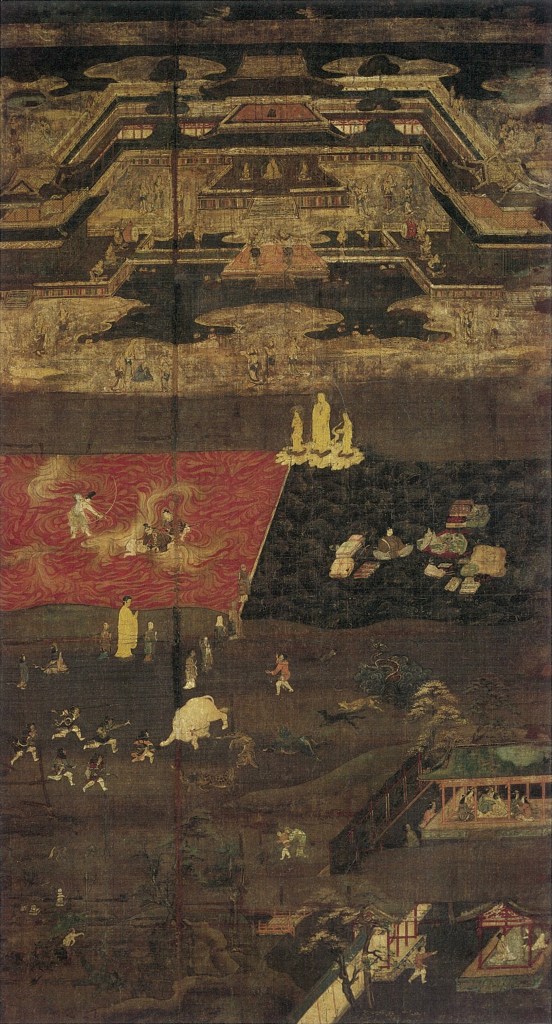
Це «Мандала Тайма», японсько-буддійський твір мистецтва VIII століття. Він показує Чисту землю Аміди Будди.

Цих обітниць насправді було 48 обітниць. 18-й обітниця є найважливішою. Це простий переклад:

Коли я стану Буддою, розумні істоти в усіх напрямках, які хочуть народитися в моїй Чистій Землі, повинні просто сказати моє ім’я принаймні 10 разів, і вони там народяться. Якщо це неправда, нехай я не стану Буддою.

Таким чином, якщо світ надто складний або людина не може слідувати традиційним буддійським шляхом, можна вибрати переродження в Чистій землі, промовляючи Нембуцу (наму аміда буцу). Це особистий вибір.

Засновник секти «Джодо Шу» Хонен (法然, 1133 – 1212) описав співчуття Аміди Будди як місячне світло. Він сяє скрізь, але лише деякі дивляться вгору:

ЯпонськоюКоваленко Переклад
月かげのцукі kaґе ноНемає такого села,
いたらぬ里はітарану сато ваде б не світило
なけれどもнакередомомісячне світло,
眺むる人のнаґамуру хіто ноале воно живе в серцях тих,
心にぞすむкокоро ні дзосумухто його бачить.

Так само в Сутрі безмежного життя є така цитата:

Якщо розумні істоти стикаються зі світлом Аміди Будди, їх три скверни усуваються; вони відчувають ніжність, радість і насолоду; і виникають добрі думки.

Але чим буддизм чистої землі відрізняється від християнства?

Фундаментальне вчення все ще є буддійським: живі істоти повинні «перепливти річку», щоб досягти короткого просвітлення. Аміда Будда просто допомагає на цьому шляху.

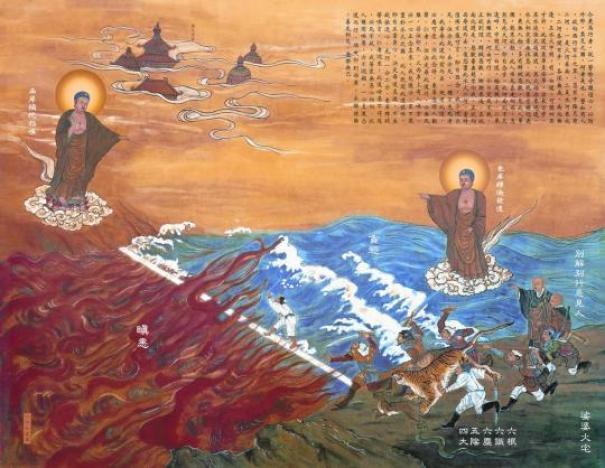
У VII столітті в Китаї жив чернець на ім’я Шандао (善導, 613–681). Він написав відому притчу під назвою «Притча про дві річки та білий міст». Ви можете побачити приклад ілюстрації нижче:

Підсумовуючи, притча вчить, що на цьому березі Будда Шак’ямуні вказує на міст. На іншому березі річки Аміда Будда кличе нас перепливти. Шлях вузький, але якщо ви прислухаєтесь до слів Будди Шак’ямуні та заклику Будди Аміди, ви пройдете безпечно.

Це базовий вступ до буддизму Чистої Землі, особливо до секти Джодо Шу. Якщо ви цікавитеся буддизмом, але відчуваєте розгубленість або самотність, просто спробуйте продекламувати Нембуцу. В якості основи використовуйте нембуцу.

У секті Джодо Шу існує традиція декламації нембуцу під назвою цзюнен (じゅうねん, 十念, «десять декламацій»). Звучить так:

наму аміда бу
наму аміда бу
наму аміда бу
наму аміда бу
наму аміда бу
наму аміда бу
наму аміда бу
наму аміда бу
наму аміда буцу
наму аміда бу

Дев’ята декламація має додаткове “цу” в кінці. Крім того, люди зводять руки разом у молитві, коли вимовляють нембуцу. Це називається «гасшо».

Ви можете побачити приклад тут, у храмі Зодзідзі в Токіо, Японія:

Вибачте, що мені довелося скористатися Google Translate, але я сподіваюся, що ви знайшли щось корисне, і я сподіваюся, що побачите світло Аміди Будди.

наму аміда буцу