Just a small update: Recently I was looking for some old Buddhist resources I used to rely upon a lot, and was shocked to discover that these resources have all but disappeared. Internet attrition has taken its toll, so many old websites I used can only be found on places like the Wayback Machine and such. This makes them pretty hard to find. Also, with modern web-technology, it is far easier now to post Japanese characters side by side with English text.
So, I’ve been working on a side project to “rescue” old information from obscurity and modernize it for easier study and (when possible) for other languages. So, the first one I have completed is Honen’s famous One Sheet Document or ichimai-kishōmon. I was able to use a good translation by the now-defunct JSRI (Jodo Shu Research Institute) and draw from Japanese-language sources too since I can now read such things, unlike 15 years ago. Please check out the link above. I also added Cyrillic text for Ukrainian/Russian Buddhists who might want to recite the document.
The other text I am trying to recover is larger, and taking more time: the Tannisho. The Tannisho is centrally important to the Jodo Shinshu tradition, but Taitetsu Unno’s fabulous translation is almost gone. I got a Japanese-language introduction at Tsukiji Honganji in 2023, and I’ve been using that, plus Dr Unno’s translation. It is only partially complete, but work is proceeding. I’ve also, thankfully been able to find more information in Japanese that helps explain the history, and so on.
That’s about it. I hope to rescue more resources soon, in particular some of Rennyo’s ofumiletters, but it’s slow and time-consuming, and my own resources are somewhat limited.
This post is part three of three four exploring the Ikko Ikki. You can find part one and part two here. We have seen in part two Rennyo’s involvement in the rapidly growing Jodo Shinshu community, and how the seeds of conflict first began as a succession dispute between local samurai warlords. In this post we’ll see how things go off the rails…
The Ikko-Ikki rebellions are remarkable as being the one time in pre-modern Japanese history where a peasant uprising not only succeeded, but successfully carved out a region of Japan that was ruled by the masses, and not by military samurai, nor the old aristocracy from Kyoto. The binding influence of the uprising was a strong affinity to a certain Buddhist sect, the Jodo Shinshu (浄土真宗, “True Pure Land Sect”), but there was more to the Ikko-Ikki than a “rebel cult” as some labeled them.
Information in English about the Ikko-Ikki is sparse, and often misinformed. I am happy though to have obtained a copy of Dr Carol Tsang’s excellent book War and Faith: Ikko Ikki in Late Muromachi Japan (publisher link), covers the Ikko Ikki, who they were, and their relation to the Jodo Shinshu sect. It’s been a fascinating read even for an old “history nerd” like myself.
Now on with the show…
Succession Crises and Retirement
The beginnings of organized conflict by the Ikko-Ikki began when the succession crisis between the Togashi brothers began in part two. As neither side could decisively destroy the other, and began to enlist more and more locals to help.
Masachika, as we saw previously, recruited from the Jodo Shinshu followers (a.k.a. the Honganji sect) of Yoshizaki, while his brother, Kōchiyo, recruited elements of the local rival Takada sect of Jodo Shinshu. Both communities formed ikki societies vowing to fight and help their preferred claimant to succeed.
Needless to say, in 1474 Masachika was ultimately victorious, but as Dr Carol Tsang notes, he did little to reward the Honganji ikko-ikki for their support. This did not go well with the Honganji followers. Dr Tsang shows that documents while somewhat scarce, and confusing, demonstrate how Honganji followers protested the ungrateful military rule, but were then brutally suppressed in 1475. It’s unclear if the uprising had any approval, let alone knowledge, by Rennyo the 8th Caretaker. There is evidence however, that his advisor Rensō had some involvement, and was expelled by the Honganji later. Being expelled or shunned by the sect was a virtual death-sentence for such a person because of the loss of community support.
Rennyo had worked hard to avoid a violent image to the Jodo Shinshu sect, yet the uprising in 1475 cemented the image of the ikko-Ikki as violent religious fanatics. Rennyo for his part left Yoshizaki that same year, reportedly under the cover of night, and travelled to nearby provinces such as the town of Deguchi in Kawachi Province, and then later returning to Ōmi Province of his youth at a place called Yamashina. By 1480 he settled at Yamashina and lodging was built there for him. Soon after a new Honganji temple, called Yamashina Honganji (official homepage here) was built and completed by 1483. It is noteworthy that this temple was designed to be militarily secure, with earthworks, moats and so on. Such where the times they lived in.
While this happened Rennyo chose his firstborn son by his second wife, Jitsunyo (実如, 1458-1525), as the next Caretaker of the mausoleum after his firstborn son (Junnyo) by his first wife had died that year. We will meet Jitsunyo again in a later post.
Overthrow
Meanwhile, after 1475 the ikko-ikki of Kaga Province not only rebelled and refused to send tax revenues, other neighboring communities started doing the same. In Etchū and Hida Provinces next door, refugees from the 1475 uprising had setup communities, and several uprisings are recorded at this time, though documents are pretty thin on what happened. The Honganji followers were able to resist crackdowns by samurai overlords because the local ikko-ikki groups formed powerful alliances that assisted one another in times of need. The sense of shared religious identity, plus religious belief they were only doing what was right, set them apart from other mundane peasant uprisings.
As the ikko-ikki groups took over and divided up territory amongst themselves, they took on increasing administrative responsibility, often county (gun 群) by county. Until the year 1530, these ikko-ikki groups did not answer to the Honganji, and acted semi-autonomously. One of these ikko-ikki might seize land from the landowners in Kyoto, another neighboring ikko-ikki might settle tax disputes between its landowner and local peasants. It was all over the map. The military establishment would sometimes lean on the Honganji leadership (i.e. Rennyo then later Caretakers) to exert pressure on these groups if needed, but otherwise the local ikko-ikki groups ruled as they pleased, independent of one another, sometimes they even threatened the Honganji for interfering. There was essentially no functional central authority in Kaga Province.
In any case, the conflict in Kaga came to a head by 1488, Togashi Masachika had burned enough bridges with supporters that they rose up and overthrew him. This included members of the Jodo Shinshu Honganji sect (ikko-ikki), but also his samurai retainers and other non-religious ikki groups. He was widely unpopular, and people had enough. Masachika had been away for a time helping the Ashikaga shoguns on a campaign (i.e. currying favor with the central authorities), when a full-blown rebellion erupted. Masachika, hurried home, but was besieged at Takao (高尾城, takōjō) Castle.1 Try as he might, Masachika was unable break the siege, and within days, Masachika’s remaining forces were overwhelmed and destroyed. Masachika was no more.
Once the dust settled, Masachika’s uncle, Togashi Yasutaka, was installed as the governor.
Dr Tsang explains that there are two noteworthy things about the downfall of Togashi Masachika:
The rebel army wasn’t comprised of peasants, but large section of the province’s population, from lowly social outcast communities (tanners and such), to Masachika’s own family and retainers. It wasn’t a “peasant rebellion”, but a broad coalition.
During the wars in 1473 and in 1488, the Ikko-Ikki played a major influence in deciding who would govern the province. This kind of popular sovereignty (or at least popular influence on sovereignty) had never really existed in Japan before. In the classical period (aka the Heian Period) it was a bureaucratic aristocracy. Under military rule of the Shoguns, it was a feudal system based on grants and titles. Now, for the first time lower class people in the province were actively weighing in on who should govern.
However, this was only the first phase of the Ikko-Ikki. As we’ll see in part four (yes, series keeps growing…), the ragtag groups would grow even stronger in later generations.
Aftermath
Something to note here is that Rennyo had very little to do with these uprisings in Kaga province. Although his proselytizing efforts greatly increased the popularity of Jodo Shinshu-sect Buddhism in the countryside, and in so doing, helped forge a common identity that allowed the ikko-ikki to form such large communities, he was never involved in these uprisings, and would find out about it later since he was in a different province. Further, when chastised by Rennyo, the ikko-ikki paid little heed. They were fed up, and going to rebel anyway. The genie was out of the bottle, in other words, and Rennyo couldn’t put it back.
Nevertheless, the central authorities in Kyoto didn’t see it that way. Rennyo took a lot of blame for his “unruly followers” and was pressured to write a letter castigating them for their actions. The letter did little to change the situation, and by 1489, Rennyo retired as the Caretaker of the Honganji mausoleum, allowing his son Jitsunyo to take over. It was an ignominious ending for someone who had otherwise made huge contributions to Jodo Shinshu Buddhism and Japanese Buddhism as a whole.
P.S. I couldn’t find any cool historical photos from this particular era. Historical documents and evidence seem to be pretty thin based on Dr Carol Tsang’s book, so there isn’t much media or art. There would be plenty of artwork depicting the Ikko-Ikki in later generations.
1 The castle is no more, but you can see photos of the park here. I am also a bit confused by the name as it should be read as Takao (高尾), but the pronunciation, as listed in Japanese sources is Takō. Call it a quirk of Japanese language, I guess.
Recently I had talked about Rennyo and his famous letters, also known as the gobunsho (御文書). These letters are sometimes overlooked by Western Jodo Shinshu Buddhists, but are a core part of the tradition.
6. On Norms of Conduct
If there are any of you who have heard the meaning of our tradition’s other-power faith and become decisively settled, you must store the truth of that faith in the bottom of your hearts; do not talk about it with those of other sects or others [not of our tradition]. Furthermore, you must not praise it openly [in the presence of such people] on byways and main roads and in the villages where you live. Next, do not slight the provincial military governors and local land stewards, claiming that you have attained faith; meet your public obligations in full without fail. Further, do not belittle the various kami and buddhas and bodhisattvas, for they are all encompassed within the six characters na-mu-a-mi-da-butsu [the nembutsu]. Besides this, in particular, take the laws of the state as your outer aspect, store other-power faith deep in your hearts, and take [the principles of] humanity and justice as essential. Bear in mind that these are the rules of conduct that have been established within our tradition.
Respectfully.
Written on the seventeenth day of the second month of Bunmei 6 (1474). [i.e. the 6th year of the Bunmei era]
There are three aspects of this letter that I find interesting:
First, is Rennyo’s advice about daily life. Because Rennyo is writing to lay poeple, not monastic renunciants, the advice is simple: be socially responsible, and don’t use your religious faith as an excuse to misbehave. “Render unto Caeser, that which is Caesar’s” in other words. This seems kind of obvious, but the Pure Land movement originally had a number offshoots and communities, and some tended to flout convention on the belief that they were saved by Amida Buddha anyway. In other words: antinomianism.
Second, Rennyo stresses the importance about not bragging about one’s faith. Jodo Shinshu was (comparatively speaking) novel and new within Japanese Buddhism, and somewhat unorthodox due to its entirely lay community. Rennyo’s warning is to avoid taking pride in this, since there was nothing worth bragging about. It was all due to Amida Buddha’s compassion, and not any accomplishment by the disciple.
Finally, Rennyo makes an interesting point about the Amida Buddha in relation to other buddhas, bodhisattvas, and the kami of Shinto. Rather than treating Amida as yet another buddha within the larger Mahayana Buddhist pantheon, Rennyo describes Amida as the source of all such divinities. His ancestor, Shinran, had also hinted at a similar view toward Amida Buddha, and indeed when we look at another buddha named Vairocana, we see that this concept is not new. They are just different names for the same concept.
But it’s interesting to hear that Rennyo, generations later, is reiterating this point: in the Jodo Shinshu interpretation of Amida Buddha, Amida isn’t just another deity, it embodies the Dharma, and all contained within it.
Lately, I’ve been enjoying a fantastic history podcast called Grey History, covering the French Revolution in detail. While enjoying this show I started thinking about a famous peasant uprising in medieval Japanese history called the Ikko-Ikki rebellions of the 16th century.
The Ikko-Ikki rebellions are remarkable as being the one time in pre-modern Japanese history where a peasant uprising not only succeeded, but successfully carved out a region of Japan that was ruled by the masses, not by military samurai, nor the old aristocracy from Kyoto. The binding influence of the uprising was a strong affinity to a certain Buddhist sect, the Jodo Shinshu (浄土真宗, “True Pure Land Sect”), but there was more to the Ikko-Ikki than a “rebel cult” as some labeled them.
Information in English about the Ikko-Ikki is sparse, and often misinformed. I am happy though to have obtained a copy of Dr Carol Tsang’s excellent book War and Faith: Ikko Ikki in Late Muromachi Japan (publisher link), covers the Ikko Ikki, who they were, and their relation to the Jodo Shinshu sect. It’s been a fascinating read even for an old “history nerd” like myself.
This post is part two of three exploring the Ikko Ikki, of which part one is here. We can’t talk about the Ikko-Ikki until we cover the life of the 8th-generation Caretaker (monshu, 門主) of the Honganji mausoleum: Rennyo.
I originally intended to do only two posts, but as I wrote this one I realized there was too much interesting detail, and now it has split into three.
Enter Rennyo
As we saw in part one, Jodo Shinshu had somewhat unorthodox origins as a fully lay-oriented sect of Buddhism, through the work of Shinran in the 12th century. Shinran like many disciples of Honen, had been exiled and defrocked. Shinran took this in stride, married, and continued to spread the Pure Land Buddhist teachings he had learned from Honen to provincial people until we returned from exile and died in Kyoto.
His mausoleum (later called the Honganji temple) was managed by his descendants for generations. Like other families in medieval Japan (and other medieval societies), marriages by Shinran’s descendants were arranged to help benefit the family political, economically, etc. These descendants managed the mausoleum, while also building powerful alliances with samurai clans, or influential disciple families in the provinces. Some even married into the aristocracy in Kyoto. Shinran’s various disciples in the provinces went on to found various sects of Jodo Shinshu, while the Honganji remained significant, but not very influential.
By the time of the disastrous Onin War in the 15th century, Rennyo (蓮如, 1415–1499) had been born to the 7th generation caretaker Zonnyō (存如, 1396–1457).1 His mother was of unknown origin, but it is thought that she was a maidservant of Zonnyō, and thus politically risky. She was sent away, and Zonnyō married a woman named Nyoen from an influential family. Rennyo and his step mother did not get along well, and suffice to say, there was a succession struggle between him and Nyoen’s son, but Rennyo won out in the end thanks to the powerful Hino clan (the same clan that married into the reigning Ashikaga Shoguns). Rennyo had also, as per tradition in the family, spent time training at Kofukuji temple in Nara, and could claim some tenuous connections to the prestigious Fujiwara clan through the Kujō cadet branch.
As Jodo Shinshu grew in influence, problems between the community in his native province of Ōmi, near Kyoto, and the powerful Tendai sect arose. Ostensibly, this was due to perceived heresies by the Jodo Shinshu sect, but there’s plenty of evidence that the Tendai sect viewed the growth of Jodo Shinshu as an impact to their fiefdom revenue. Before long, armed conflict with the Tendai sects warrior-monks arose, and the Jodo Shinshu community suffered greatly. The community attempted to fight back, organizing defenses (a forerunner to later Ikko-Ikki armies), bribing the Tendai sect to back off, etc, but the Tendai persisted.
Ministry At Yoshizaki
Bronze statue of Rennyo at the remains of Yoshizaki Gobō temple. Photo by 藤谷良秀, courtesy of Wikipedia.
Rennyo decided it was safer for everyone involved for him to leave, and eventually he retreated to a remote village named Yoshizaki (吉崎) in the province of Echizen in the year 1471. Yoshizaki had a number of advantages, including a large, existent community of Jodo Shinshu followers, distance from Tendai-sect centers of power, and political remoteness, and yet it was on a coastal trade route so it was prosperous too. Soon a temple, now known as Yoshizaki Gobō (吉崎御坊) was founded the same year. The official website (Japanese only) for Yoshizaki Gobō has some neat photos and illustrations, though bear in mind that the original temple was destroyed 1506, and reconstructed centuries later.
It was here that Rennyo and his proselytizing work really took off.
For context, Shinran the founder (and Rennyo’s ancestor) had lived in exile in the eastern provinces and spent much time there teaching the Pure Land am faith as he understood it. Even after he was pardoned and returned to Kyoto in his final years, the communities out in the principles (i.e. his disciples) continued for generations, each in isolated pockets. These communities grew and diverged gradually, but were always more numerous and influential than the Honganji branch under Rennyo’s ancestors.
Thus, when Rennyo showed up, things were a little tense. A major regional sect was the Takada sect (shinshū takadaha, 真宗高田派) which still exists today. I spent a weekend trying to figure out how the Takada sect’s version of Jodo Shinshu differed from the Honganji sect, but couldn’t really find any “ah ha” moments. They both revere Shinran, both recite the nembutsu, both revere Amida Buddha, etc., so the differences feel like they are mostly administrative and liturgical. Jodo Shinshu without the Honganji, in other words. The question, it seems, was basically who had the final say on doctrinal matters.
Rennyo’s Letters
Rennyo was a very active letter writer and these letters (ofumi, 御文) were instrumental in helping to strengthen and clarify the message and build relationships with local communities. I’ve talked about the most famous letter, the Letter on White Ashes, before, but I can say with personal experience that Rennyo’s letters overall are quite good and helpful in clarifying Jodo Shinshu teachings. You can find a collection of them here. I highly recommend reading the letter On Pilgrimage in the Snow (number 6 in the link above).
Side note: these letters (formally called the gobunsho 御文書), were compiled by later generations and are now an important part of Jodo Shinshu liturgy. When my mother-in-law passed away, and we attended her first year memorial in Japan, our local priest (a family friend) recited the Letter on White Ashes, after we recited Shinran’s hymn, the Shoshinge. That’s how important they are. You can see an excellent example of this here on Youtube:2
Within years, Yoshizaki grew to a much larger community, and Rennyo clashed with other existing Jodo Shinshu sects, while also reforming liturgy and standardizing aspects of the faith. Much of these power struggles at the time had as much to do with politics as they did doctrine.
For example, the aforementioned Takada-sect was allied with one Togashi Kōchiyo warlord who was in a bitter feud with his brother Togashi Masachika. The battles for rulership of Echizen and Kaga provinces spilled over into Yoshizaki when the defeated Masachika showed up to recruit members and rebuild his forces. Thus a local ikkō-ikki was formed to assist him.
As we’ll see, this was only the beginning …
P.S. I posted this too early on accident. Please enjoy, and apologies for any typos.
1 random and useless factoid – Rennyo was alive during the final days of the Eastern Roman Empire, and roughly contemporary with its final ruler, Emperor Constantine XI Palaiologos. Of course, Japan and Constantinople didn’t really know of one another. Still, it’s weird to think how both historical events were going on roughly at the same time.
2 The language of the gobunsho letters feels archaic now to a native Japanese speaker (or a language nerd like me), but at the time, this was how people spoke, and thus it was very accessible compared to more formal texts that monks in monasteries wrote.
Lately, I’ve been enjoying a fantastic history podcast called Grey History, covering the French Revolution in detail. While enjoying this show I started thinking about a famous peasant uprising in medieval Japanese history called the Ikko-Ikki rebellions of the 16th century.
The Ikko-Ikki rebellions are remarkable as being the one time in pre-modern Japanese history where a peasant uprising not only succeeded, but successfully carved out a region of Japan that was ruled by the masses, and not by military samurai, nor the old aristocracy from Kyoto. The binding influence of the uprising was a strong affinity to a certain Buddhist sect, the Jodo Shinshu (浄土真宗, “True Pure Land Sect”), but there was more to the Ikko-Ikki than a “rebel cult” as some labeled them.
Information in English about the Ikko-Ikki is sparse, and often misinformed. I am happy though to have obtained a copy of Dr Carol Tsang’s excellent book War and Faith: Ikko Ikki in Late Muromachi Japan (publisher link), covers the Ikko Ikki, who they were, and their relation to the Jodo Shinshu sect. It’s been a fascinating read even for an old “history nerd” like myself.
This post is part one of two three exploring the Ikko Ikki, but before we talk about the rebellions, we need to cover some Jodo Shinshu history. Speaking as someone who was part of the Jodo Shinshu community for a long time, and also a history nerd, Jodo Shinshu’s history is … different.
The Jodo Shinshu Sect
The Jodo Shinshu sect was one of several Buddhist sects that arose during the Kamakura Period of Japanese history (12th-14th centuries) as a kind of backlash to the Buddhist establishment at the time, and their close association with the ruling aristocracy. Starting with my favorite monk, Honen (法然, 1133 – 1212), a populist Pure Land Buddhist movement took shape, filling a gap that was missing in Japanese society at the time. To be clear, Pure Land Buddhism was not the only new Buddhist movement at the time: we see Nichiren Buddhism and new Zen sects imported from China as well. However, the Pure Land movement was much more widespread in comparison.1 Under Honen this movement was diverse, widespread, and loose-knit comprising of peasants, nobility, and clergy.
However, it was not to last.
The Pure Land Buddhist movement was punished by the Emperor in the Jogen Persecution of 1207 (承元の法難, jōgen no hōnan), and the community was scattered across many parts of Japan and its monks defrocked. Not unlike the many disciples of Socrates in classical Greece,2 these disciples each had their own recollection of Honen’s teachings, and since they were now living different provinces of Japan, individual sects and communities arose.
Jodo Shinshu – started by Shinran and the subject is this post.
“Single Nembutsu” teaching – started by Kosai (who was later denounced by Honen), but quickly faded.
“Many Nembutsu” teaching – started by Ryukan, but also petered out later.
Ji-shū – started by Ippen, who was not a direct discipled of Honen, but a disciple of Shoku’s disciple.
…. among other groups.
As we can see, Shinran (親鸞, 1173 – 1263) was one of these disciples.
A portrait of Shinran, founder of Jodo Shinshu, from the 13th century. Public domain via Wikimedia Commons.
According to some scholars, Shinran had been a mid-level disciple of Honen. When he was defrocked and sent to Echigo province he broke precedence, famously declaring that he was neither priest nor laymen. He then took a wife, and fathered children.
Shiran was not idle though. He was a prolific writer and teacher, spreading Honen’s message (as he understood it) to people in his province. After the exiles were pardoned, Shinran returned to Kyoto with his daughter Kakushin-ni (覚信尼, 1224-1281?) who cared for Shiran until his last days. Shinran spent his time in the capital still teaching, writing hymns and letters. When he passed, he left behind a large community of disciples in the provinces, and Kakushin-ni helped establish a mausoleum for her father in Kyoto. The ownership and maintenance of this mausoleum (later called the Honganji temple) was complicated, but it seems to have been a shared model between the disciples and supporters in the provinces, and Shinran’s descendants.
In time, Shinran’s grandson Kakué (覚恵, 1239 – 1307) assumed the role as caretaker of the mausoleum, the monshu (門首), after Kakushi-ni. Kakue passed on this hereditary role to his son Kakunyo (覚如, 1271 – 1351) and from here the role of Caretaker/Patriarch fell to successive descendants of Shinran even to this day. However at the time, the Honganji mausoleum was not very influential, compared to provincial communities. In time, that would change.
The “Karamon” gate of Nishi-Honganji (West Honganji) Temple in Kyoto, Japan. In the Edo Period, well after events here, the Honganji temple split into two separate temples and lineages due to strife between two brothers: east and west. Photo taken by me in 2010, hence the graininess (old camera phone). The Nishi Honganji temple website has excellent photos.
In any case, Jodo Shinshu from its outset was a firmly lay-Buddhist sect, the first in Japanese history. It was somewhat decentralized and had no monastic institution whatsoever. Other competing Pure Land sects listed above, were founded by monks, and still maintained some form of monastic institutions (some more than others) by contrast.
In the case of Jodo Shinshu, its local communities were organized by lay priests, peasants and craftsman who like Shinran worked and raised families. They organized religious gatherings in small dōjō (道場) rather than formal temples. A dojo in this context could be a room in someone’s home, or a communal space. A network of temples arose over the generations to oversee the various dojo, but early Shinshu communities started out small and informal.
This remained the state of the community for generations up through the Ikko Ikki rebellion.
The Warrings States Period and the Ikki Rebellions
Fast-forward about 200 years since Shinran and Honen. By this point in Japanese history, the reigning Ashikaga Shoguns have become permanently weakened by the disastrous Onin War, and social order was rapidly breaking down as rival warlords who had nominally supported the Ashikaga family, now fought one another for control of Japan. Technically, the Ashikaga still ruled a small region around Kyoto the capital, but the rest of Japan was rapidly descending into all-out war which lasted for another 100 years: the Sengoku or Warring States period (mid-15th through 17th centuries).3
A mural depicting a battle during the Onin War, by Utagawa Yoshitora, Public domain, via Wikimedia Commons
Japanese society at this time had been a feudal, militaristic society. The various domains and provinces had been managed by the Ashikaga Shogunate through a complex web of grants, appointments, and negotiations. Much like medieval society in Europe, the feudal order of Japan was complicated and full of political tension between the Church (i.e. the old Buddhist orders), local land-owning warlords, and peasants who were compelled to work the land in various arrangements. Similar to medieval England at the time, peasants were not all one social class. Many were modestly successful like the English yeoman, while others were saddled with ancestral debt and had to work the land they rented from their landlords (military or Buddhist temples) like European serfs. Other peasants were part of artisan communities that formed associations that might be vaguely compared to European guilds.
A portrait of Toyotomi Hideyoshi, formerly a peasant soldier, now the overlord of Japan and regent of the Emperor in 1598. Painting by Kanō Mitsunobu (狩野 光信, 1565–1608), Public domain, via Wikimedia Commons
Further, the distinction between samurai and peasant wasn’t so clear-cut as it would be in later generations. A low-ranking, provincial samurai or jizamurai (地侍) worked the land and sold goods just as peasants did, though they also had certain obligations to their liege lord, and enjoyed patronage and influence as a result. Even the famous Hojo no Yoshitoki worked his own land (at least some of the time).
Meanwhile, wealthy and powerful land-holding peasants could command local military resources when the needs for mutual defense arose, or lend them to the local warlord if needed, in return for some arrangement. Such peasant soldiers were often called up by local samurai as ashigaru (足軽) foot soldiers. Even the great Toyotomi Hideyoshi once started this way before eventually claiming dominion over all of Japan.
So, while there were social classes, they were fluid, and the boundaries were vague. A low-level jizamurai and a powerful peasant weren’t all that different. In the end, it was a “might makes right” environment.
Thus, in this fast, fluid and shifting environment, communities or like-minded people would form an ikki (一揆), which was a society founded for one single purpose. According to Dr Tsang, ikki were often formed in a ceremony where the participants would gather at a religious site, sign a contract vowing to accomplish their stated aim, burn the contract, mix the ashes into water, and drink it together. The pact was thus sealed in the most solemn of manners.
But why form a society like this?
Local samurai, especially if they had familial ties, might found an ikki promising one another mutual aid and defense. Peasants of a village might form an ikki to push the government for tax relief. An ikki formed in 1428 was large enough to march on Kyoto and burned down debt owners and tax-collecting tolls, for example.
The Ikko ikki (一向一揆) specifically were formed by those who subscribed to the Jodo Shinshu sect, which was also called the Ikkō (一向) sect at the time. The term ikkō referred to their singular reliance on Amida Buddha (lit. all facing one direction: toward Amida and the Pure Land). Ostensibly these followers formed an ikki for mutual defense but soon grew to challenge the most powerful warlords of the era.
With the rise of Shinran’s descendant Rennyo, the ragtag societies grew into a powerful army that even warlords like Oda Nobunaga were unable to defeat. We’ll see more of this in part two.
Stay tuned!
P.S. These longer historical posts take some time to write (let alone proofread), so I may be delayed in posted part two.
1 The rise of the opposing Nichiren sect is an interesting aspect of Japanese-Buddhist history, but it’s out of scope here, and was somewhat smaller in scale. Dr Tsang’s book does point out that there were Nichiren Ikki groups, too, in later ages.
2 Socrates left behind no writing (unlike Honen who was a prolific writer), but his disciples such as Plato and Xenophon described
3 The “sengoku” name was borrowed from a much earlier, though equally fascinating, period of Chinese history. The Warring States Period of Chinese history should not be underestimated in terms of influence too, because many strands of Chinese political philosophy arise from this period, as various thinkers tried to grapple with the collapse of social order, and the debauchery and degradation of the times. These same ideas later had a profound influence on later Asian culture, and the world at large.
Q: The redoubtable Commander Riker, whom I noticed before. You seem to find this all very amusing. RIKER: I might, if we weren’t on our way to help some suffering and dying humans who– Q: Your species is always suffering and dying.
Star Trek: The Next Generation, “Hide and Q” (s1ep10), Stardate: 41590.5
Something a little embarrassing I want to confess: sometimes, when I am uneasy or stressed, I go back and read some of my own posts. I don’t do this because of vanity (hopefully) or conceit, but I like to remind myself of certain things I might forget amidst daily turmoil. I suppose I write some of these blog posts as for myself to sort out what’s bothering me, as I do for the dear readers who follow the blog.1
One of my favorite posts of all time is this one. After visiting the Royal British Columbia Museum in 2022, and watching the excellent documentary about the different geologic ages of Antarctica, I walked away deeply impressed. These experiences help give a larger perspective about the world around us, and show how change is a constant of the universe whether we see it or not.
Change happens on the micro-level in our daily lives: one day to the next, we get older, our hobbies change, things at work happen, hairstyles change, etc. When I look at old photos of me and the kids, I am amazed at how much skinner I was, and no grey hear. 🤣
The world around us changes too: political, economically, and so on. The neighborhood you live in will look different 10 years from now, or looking back it’s probably changed in the past 10 years. Thinking about my life as a college kid in the early 2000’s, the Dot-com Era, it’s amazing how much has changed in a mere 20 years. Some things got better, some things got worse.
But if we step back even further, we can see with the benefit of hindsight slow-moving, multi-generational historical changes. From following the excellent History of Byzantium podcast, it’s amazing how much changes in the Eastern Roman (a.k.a. Byzantine) empire across generations. During the time of emperor Justinian the Great, chariot races were still hugely important in Byzantium, the empire had tenuous toeholds in North Africa and Spain, and many people still actively spoke Latin. By the time of emperor Manuel Komnenos, the Eastern Roman empire was far smaller, Greek language had long since replaced Latin, and the single universal church had long since split between Roman Catholic and Orthodox faiths. Between the 6th and 12th centuries, many changes happened, but because they stretch across many generations, it’s not possible for someone living within the city of Byzantium to fully grasp the scale of the changes. It was still the same Eastern Roman empire, and would continue for another 200+ years, but it had changed and evolved as external circumstances changed.
But let’s step even further back. An Egyptian peasant working the fields, or helping to build the Great Pyramid of Khufu, would be utterly stunned at the world today. Such a world would feel totally alien to him or her. It’s not just the level of technology we enjoy today, or the quality of our medicine, but also the way we view the world. Things that seem like common sense to such a peasant would feel strange or silly to us. Things that we inherently believe as 21st century adults would feel strange or bizarre to that peasant. We can’t really pin down when or how such things changed, but it’s series of gradual changes, each one piling on top of the rest.
And yet we can step even further back. If we look at the human race, it is new to the planet Earth. People can deny this using specious reasoning, but science doesn’t care what people believe or don’t believe. The natural world just works the way it does. We humans are just here, living on the Earth, but the Earth does not belong to us. We are its stewards. If not us, perhaps the Apes or Squids will be its stewards. 😏
Which I think brings me to my point: of all the craziness and turmoil going, I think there are two things to take away from all this:
We may lament how things have taken for the worse, but in a dispassionate sense, this is just more change unfolding due to causes and conditions that until now we may not have ever noticed. It doesn’t necessarily mean they are good changes, or harmless, but change is change. Also, by extension, the way things are now won’t always be this way in the future. Change is still happening, even if we can’t see it.
Of all the things to concern ourselves with most, in my humble opinion, the Environment (with a big “E”) is the most important. If we want to benefit Mankind, the Earth, and all life on it in ways that we’ll never see in our lifetime, if we want to get the most “bang for our buck”, then anything we can do to help the Environment works towards that end. Small changes and efforts now will ripple across generations we will never see, and help shape the Earth, hopefully in a positive way.
At times like this, I truly believe my old minister Rev. Don Castro of Seattle Buddhist Church was onto something when he described Buddhism, including Pure Land Buddhism, as an eco-religion. Amida Buddha, the Buddha of Infinite Light, embodies many things:
As an embodiment of the Dharma, Amida sheds light on the continuous nature of all things: impermanent, fluid, changing.
Also as an embodiment of the Dharma, Amida doesn’t require praise or devotion. The Dharma is just there, whether people notice it or not, whether they believe it or not. But as a Buddha, Amida tirelessly works to help all beings, to awaken them, to provide peace of mind.
Also as an embodiment of the Dharma, Amida embodies how all things relate to one another. The small things that we do day to day to help improve, or degrade, life around us affect others even if they are far removed.
Finally, Amida Buddha as the Dharma teaches rational, not selfish, thinking and non-fear. In a sense, WWTD: What Would Tuvok do?
All this is to say, I suppose, even amidst crazy times, do not fear. Take inspiration from the Buddha, make rational, wholesome choices, yet never assume things will stay a certain way forever. Do not be complacent, nor take things for granted.
Namu Amida Butsu
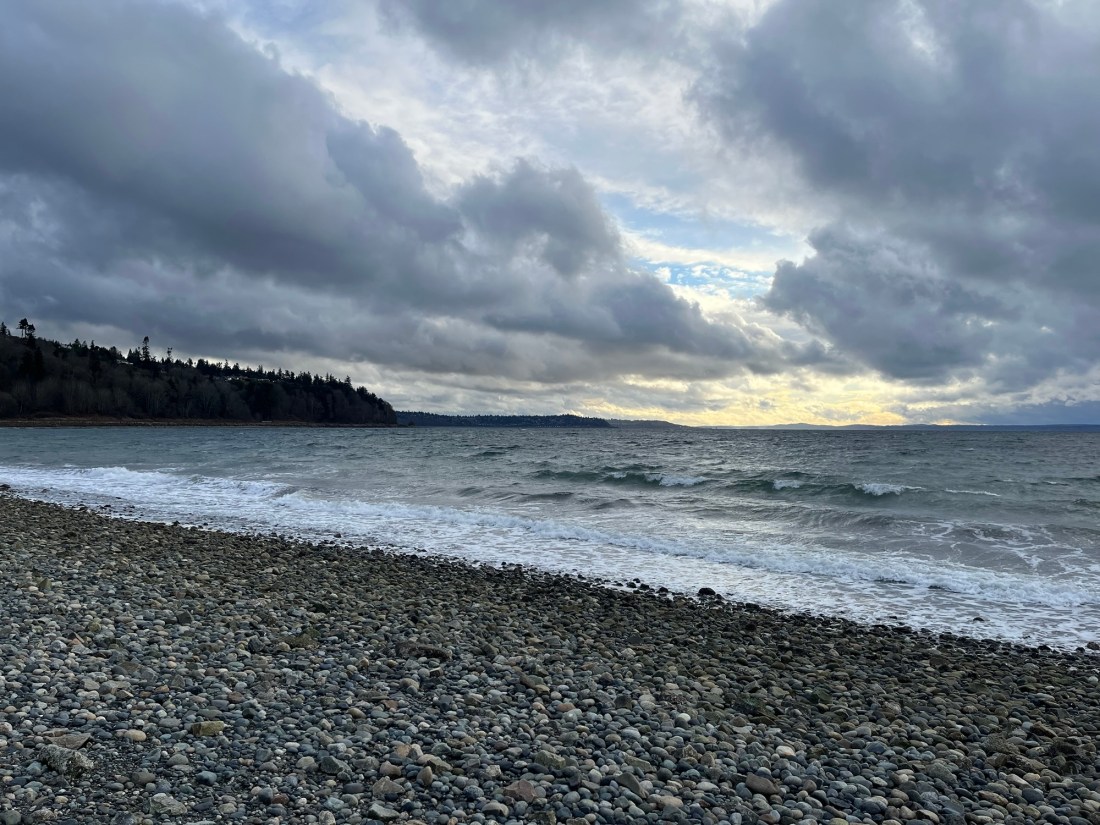
P.S. featured photo taken at Richmond Beach in Shoreline, WA earlier this year.
1 This blog is small-time, but it’s a labor of love, and I genuinely appreciate each and every reader.
As of writing, it is late January in 2025, and it occurred to me recently that I’ve been a Buddhist now for twenty years. I can’t exactly remember exactly when this happened, but I definitely how it came about.
Let me clarify. I grew up as a Mormon in my youth, though my family wasn’t devout. I think my parents just wanted us kids to have some kind of spiritual upbringing, rather than explicitly following Mormonism. By my teens, I was exploring “Eastern thought”, and dabbling in many ideas and concepts. I was inspired by the TV show Kung Fu, and the cool flashbacks by Master Po (played by Keye Luke):
Note the first scene with the image of the Buddha in the background. I saw scenes like this, and having never seen Buddhism, I became very curious. In my teens, I continued to explore and dabble in Buddhism, Taoism, but still went to various churches (Mormon, Protestant, Catholic, etc) and such.
I didn’t really become a Buddhist, as in explicitly taking refuge in the Three Treasures, until my 20’s. When I met my future wife, she was raised Buddhist, and approached it very differently. I quickly realized that I had serious gaps in my understanding of Buddhism. Reading books about Buddhism, and being Buddhist in one’s life are two different things. I realize now that, until you take refuge in the Three Treasures, and choose to uphold the Five Precepts, the Buddhist path won’t 100% make sense.
Still, the big moment came when, after we got married, we went to Japan to meet her extended family. We also used the opportunity to visit Kyoto, Nikkō and such. Being at Chion-in temple in Kyoto, I saw a monk chanting before a statue of Amida Buddha, while striking a wooden fish to maintain rhythm. That really made an impression on me. Later, we visited my father-in-law’s hometown, which had a large temple devoted to the Medicine Buddha. The fact there was a Buddha entirely devoted to healing and well-being in Buddhism had never occurred to me.
Soon after coming home, I found the Jodo Shu Research Institute’s (JSRI) English website about Jodo Shu-Buddhism1 and that very night, I was so inspired that I recited the nembutsu for the first time. The rest, I guess, was history.
If not for my wife, the JSRI, and later Seattle Buddhist Church, I don’t know how my Buddhist path would have turned out. There was so much information that I was missing, and through all these wonderful encounters, I learned a great deal. There’s been many twists and turns, many mistakes, many experiments, bad assumptions, but overall I feel much more richer for the experience. I wonder how things will look 20 years from now.
I’ve tried sharing my experiences since that fateful January night 20 years ago, first on Blogger, and then on WordPress in one form or another. I want other Buddhists, and others curious about Buddhism, to have the full range of information.
When you look at the local bookstore for books on Buddhism, they tend to be dominated by a handful of authors, and tend to be written for either the Zen crowd, or the Tibetan-Buddhist crowd. Such books also frequently downplay cultural aspects of Buddhism, for fear or turning off their Western (read: liberal white) convert audience. Buddhism is much broader than this, and it’s a shame more books aren’t written from the perspective of Asian Buddhists, and aren’t shy about these cultural aspects. Buddhism isn’t just a philosophy for nerds, it’s a living, breathing tradition that encompasses all walks of life.
There’s something for everyone in it, and I hope people feel encouraged to explore the greater tradition, not just what’s filtered through pop culture.
Namu Amida Butsu
1 The site is long gone, sadly, but the Wayback Machine has an archive of the site.
Way back in 2008, I wrote a blog post (now deleted) about my 1-year old daughter (codenamed “baby”) and teaching her about Buddhism, especially Jodo Shinshu Buddhism which we practiced at the time. I reposted excerpts of it here, with some updates in formatting and such, but also trimmed for brevity.
My 1 year-old daughter, “Baby”, likes to play with the Buddhist rosaries (o-nenju お念珠 in Japanese) we have around the house. Thankfully, most are well-made and can take a good beating from a one-year-old. She likes to chew on them as well, as it helps relieve the itching from teething. I am not sure if this is disrespectful to the rosary, but given that it makes Baby happy and helps with teething, I think it’s for the better.
We’ve been teaching Baby how to do gassho, which is a gesture of respect in Buddhism where we put the hands together close to the heart. We use the Japanese phrase namu namu (南無 南無) when teaching her how to do it. It literally means “hail, hail” or “praise, praise”, but is meant as a gesture of gratitude and respect. In Japanese Buddhism you see/hear phrases like:
Namu amida butsu – Praise to Amida Buddha
Namu myoho renge kyo – Praise to the Lotus Sutra
Namu kanzeon bosatsu – Praise to Kannon Bodhisattva
When I visited Japan in 2005, we visited my wife’s friend, whose family are practicing Shingon Buddhists. In Japan, before eating you are supposed to say itadakimasu (いただきます), which is a very humble form of the word “I am receiving”. In effect, you’re saying grace, Buddhist-style. So, my wife’s friend would tell her three-year old to “namu namu”, or to put her hands together and give thanks. The little girl promptly put her hands together and in her tiny voice said “itadakimasu”. It was really touching to see.
So, with that in mind, we teach the same wholesome habit to Baby as well. Baby is one year old, not three, so she still doesn’t really understand it yet. However, Sunday night she surprised me by draping the rosary over her arm, and waving it around, so I had to take a picture. She’s clearly learning good habits from us, and that’s what makes good parenting so important. Children need good influences or they will have a much harder time in life.
It’s hard for many Western Buddhists, especially those with kids, to know how to raise them as Buddhist. It’s hard too since a lot of people approach Buddhist from an intellectual/philosophical point of view. I am lucky because my wife comes from a Buddhist culture, so I learn a lot of this through her beyond the philosophical side. But for most people who don’t have Asian spouses, how do you develop a Buddhist-family lifestyle?
I think the key is to promote positive values to your kids:
Respect for others, your parents, teachers, etc.
Humility and gratitude knowing we depend on others for what we have. Who makes your food for example?
Kindness, kindness, kindness! In Buddhism, we toss around the word “compassion” a lot, but that’s too abstract for kids. Kindness on the other hand, is a lot easier to convey and just as good.
Plenty of research shows that kids like routine, so taking them to a Buddhist service regularly, or having a home routine is good. Meditation retreats on the other hand are a bad idea. Most are not suitable for children anyways.
Be a good example for your kids. My wife and I are pretty strict about not swearing or yelling in front of the kids. Sometimes we make mistakes, but we really try.
You get the idea. Most of this stuff is good parenting advice you can apply to any child, Buddhist or not, but the routine with “namu namu” and such is something that kids can understand, and helps convey difficult Buddhist concepts in simple terms. Raising kids is a lot of fun, especially watching them grow into adults who will carry happy memories of their childhood for the rest of their lives.
So, why did I repost this? Sixteen years have passed, and “baby” is now applying for college. It’s amazing to look back and realize how much one’s children have grown. As a teenager, my daughter has never shown any interest in Buddhism at all. We found a couple decent Buddhist books for teens, but I doubt she read them, and sometimes when I mentioned Buddhist teachings, she showed little or no interest.
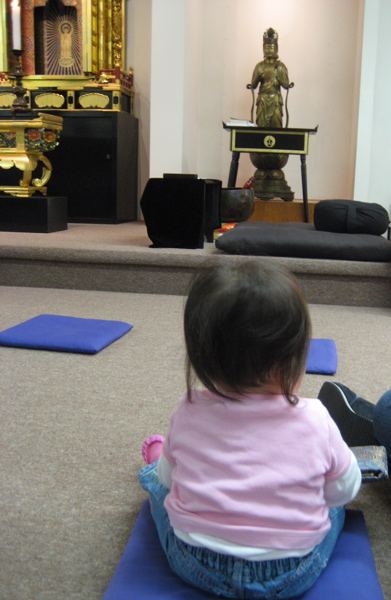
A really old photo of “Baby” at the local Buddhist temple , during a children’s service. The statue is Kannon Bodhisattva. “Baby” attended there for years, but as the kids grew up, we became less active, but this temple has been a part of the local Japanese-American community, and has excellent family-friendly services. This is something many “modern” Buddhist temples lack.
And yet, when she asked me to proofread her college application essay, I was surprised to see that she was quoting something I often say in Japanese: sho-gyō-mu-jō (諸行無常). This phrase is quoted from the famous 12th century war-epic the Tales of the Heike, and means something like the “impermanence of all phenomena”. The English translation is clunky, and since my kids were raised bi-lingual anyway, I just say sho-gyo-mu-jo.1
For example, when someone in the house broke a cup, or something breaks down, I usually just say “no big deal, sho-gyo-mu-jo“, and so on. The kids never really said anything about it, and yet when my daughter wrote her college essay, it’s clear that she really was listening and had processed this teaching as she grew up and matured. I was genuinely impressed, and a bit choked up.
The key, as my original post said, is to keep the teachings simple, set a good personal example, and let kids ease into it on their own. Hitting kids over the head with religious teachings just has the opposite effect. Kids need some kind of moral compass, but they aren’t always mature enough to understand the value of it. By setting a good example, and giving them space to figure things out, they will eventually internalize and process such teachings and figure out how to apply them to their own lives.
It’s also a reminder that good personal conduct really does have a positive impact on others, even if you can’t see the effect.
Namu Amida Butsu
1 Japanese four-character phrases (yojijukugo) are numerous, and only a small number are commonly used, but many educated Japanese have their favorite phrase or two that they will use in writing on conversation. Sometimes you see these in dramas too. It’s also a mark of education (e.g. which ones do you know?), as shown in an episode (season 1, episode 16) of the anime Chihayafuru where the characters quiz one other. Many are taken from Buddhist sources but popularized into common Japanese, others come from Chinese literature.
A few years ago, when the family and I visited Japan for my mother-in-law’s funeral, we had a long visit with the temple family who presided over the funeral. Their family and my wife’s have known each other for generations; their kids have grown up with my kids and so on. We are pretty close.
The father, who runs this small parochial Jodo Shinshu-sect temple,1 enjoys sharing Buddhist insights and discussions with me, and in spite of my language limitations, I always look forward to the conversation. He also makes excellent homemade umeboshi in his spare time.
Anyhow, he mentioned that many families in Japan have leftover Buddhist altar goods after grandparents pass away, and so he entrusted us with a statue of Amida Buddha shown below. It had been sitting in storage for a long time, and since such goods are far less common in the West, I think he wanted to help deal with surplus, but also help Buddhism overseas. Needless to say, we were grateful.
The challenge after we came home was that we didn’t know where to put it. It was too big for our altar, so we put it on top of a bookshelf, but the bookshelf was remote so we didn’t see it much. But then, my wife decided to put it near the front door mezzanine like so:
Once we did this I noticed a change in pattern. Because we pass by it constantly, I started reciting the nembutsu more. Since we go up and down the stairs all day, having the Amida Buddha statue there is a nice reminder, and it’s easy to find 30 seconds in the day to recite the nembutsu. Plus we sometimes light incense, and so on.
This is a long-winded post, but this experience made me realize that Buddhist practice doesn’t just depend on willpower and self-discipline, environment matters too. Simple changes in environment or routine can go a long way.
Namu Amida Butsu
1 it might surprise some readers to learn that many Buddhist priests in Japan marry and have kids. There’s a lot of complex, historical reasons that I can’t go into here. Plus, Jodo Shinshu has, since inception, been an exclusively lay-oriented sect anyway. I neither condone nor condemn it, it’s just how Buddhism is practiced there.
I’ve been mulling over a certain quotation of Honen (法然, 1133–1212), the 12th century Buddhist monk credited with spreading the Pure Land tradition in Japan, and thus founder of movements such as Jodo-Shu and Jodo-Shinshu:
“All of our deeds in the realms of saṃsāra result from ties with the three worldly passions of greed, anger, and ignorance. Understand that when the worldly passions of greed, anger, and ignorance surface, an illusion arises that causes one to fall into the lower realms. Do your best to prevent such an occurrence.
If these worldly passions arise, merely think of them as a guest of the heart, and think of nembutsu as the host of the heart. In this way, birth in the Pure Land will be possible. Contrarily, if you think of the worldly passions as the host and nembutsu as the guest, nembutsu becomes virtue mixed with worldly passions and falsity, making birth in the Pure Land impossible.
In essence, even if worldly passions surface in the moments before and after nembutsu is recited, do not allow these passions to intermingle with the recitation of the six characters, Na mu A mi da Butsu.”
Translation from The Promise of Amida Buddha (Digital Edition, pg 105) Joji Atone & Yoko Hayashi, originally posted here.
What Honen says here is quite profound, and shows a good grasp of the challenges of the spiritual life. Saying your are spiritual, or calling yourself a spiritual person frankly isn’t enough. It’s just words and labels. The real question is is who or what lives in the house of your heart?
I’ve been thinking about this a lot, and with some shame, I think the Buddha tends to be more of a guest at times than the host. I’ve been Buddhist at least 2005, but I am also a working parent, and, live with a lot of distractions. So, of course my practice and conduct suffer at times.
And yet, I think it’s more than that.
As members of the homo sapiens species, our natural inclinations are, crudely speaking, to feed, fight, and fuck.
In one sense, this is perfectly normal as a biological species. We are hairless apes after all. Our ancestors were doing this for 300,000 years or more. But deep down it’s just instinct baked into the fiber of our being. What seems perfectly good and normal to us humans may differ from another species. What seems tasty to a jackal might be revolting to us humans.
Further, the Buddha Shakyamuni didn’t necessarily call this “evil”, but he did describe people who lived by such instincts as “run-of-the-mill”, nothing extraordinary. There was nothing praiseworthy about choosing this default lifestyle driven by one’s passions and instincts. Such people are born, grow, struggle, procreate, and die. End of story.
Instead, the Buddha praised those who lived a life of self-control and mental discipline such as this quote from the Dhammapada:
280. The idler who does not exert himself when he should, who though young and strong is full of sloth, with a mind full of vain thoughts — such an indolent man does not find the path to wisdom.
281. Let a man be watchful of speech, well controlled in mind, and not commit evil in bodily action. Let him purify these three courses of action, and win the path made known by the Great Sage.
But this all comes back to the point that Honen made earlier. Honen spoke about it in the context of Pure Land Buddhism, and the desire to be reborn in the Pure Land, but it’s not hard to broaden this to the entire Buddhist tradition. Whoever we choose to let dwell in our house, that is what will drive our actions. Other aspects of our lives drop in as guests, come and go.
Later in the Dhammapada, the Buddha warns that this ins’t just a mental exercise: the clock is ticking:
287. As a great flood carries away a sleeping village, so death seizes and carries away the man with a clinging mind, doting on his children and cattle.
288. For him who is assailed by death there is no protection by kinsmen. None there are to save him — no sons, nor father, nor relatives.
289. Realizing this fact, let the wise man, restrained by morality, hasten to clear the path leading to Nibbana [a.k.a. Nirvana, “final unbinding”].





 Gleanings in Buddha-Fields


You must be logged in to post a comment.