For the sake of completeness,1 I wanted to cover home liturgy for the Jodo Shinshu sect of Buddhism as it is promoted in Japan. I spent years at a local Shinshu temple here in the US during the 2000’s and 2010’s, part of the Buddhist Churches of America (the American branch of Jodo Shinshu), whose liturgy is slightly different, but I’ll try to clarify the differences. There aren’t many, but it did surprise me when I first experienced Jodo Shinshu in Japan, and realized that it wasn’t what I was expecting.
Further, Jodo Shinshu’s liturgy is somewhat different than other ones we’ve covered so far. When we look at Rinzai, Soto, Tendai and Jodo Shu sect home liturgies, they tend to follow a certain flow:
They may have more or less content, and the particular verses may differ, but generally that’s the format.
Jodo Shinshu home liturgy differs from this pattern somewhat. I believe this is primarily because of the Jodo Shinshu sect emphasis on the Other Power of Amida Buddha, rather than one’s own good works. So, there’s nothing to cultivate in the traditional Buddhist sense, only to express gratitude for.
This lead to some changes, particularly through Rennyo the 8th monshu (head of the sect) who through his efforts to consolidate the various communities, promoted a liturgy format that centers around Shinran’s hymn, the Shoshinge. Thus, in Jodo Shinshu sect Buddhism, daily recitation of the Shoshinge is encouraged, including six wasan hymns at the end, followed by dedication of merit verse similar to other sects. This is the basic Jodo Shinshu home liturgy. If you recited the Shoshinge, and dedicated merit, that would be sufficient.
You can see an example of this here:
Alternatively, if you don’t want to recite the whole Shoshinge, as this site shows (another site) there are other things one can recite instead:
But many sources suggest the Shoshinge plus Wasan hymns when possible. Also, the same sources emphasize that Jodo Shinshu tradition does not recite the Heart Sutra (unlike other traditions).
Anyhow, going back to this site, the home liturgy is as follows:
Light a candle and incense at your buddhist altar (if you have it).
In Jodo Shinshu style, the nembutsu sounds more like na man da-, na man da-, na man da-
Ring bell twice
Recite the sutra (see above)
Recite the dedication of merit hymn
Optionally, recite a letter from Rennyo’s Gobunsho letters. My service handbook lists the following letters as recommendations to recite (English translation can be found here):
Fascicle V, letter 10 – “On Faith as Fundamental”
Fascicle V, letter 5 – “On Realizing Faith”
Fascicle V, letter 1 – “On Laymen and Laywomen Lacking Wisdom in the Last [Dharma] Age“
From my experience with the Buddhist Churches of America, this format is similar to what we recited in Sunday services, though with a couple small differences. First, the Shoshinge was only recited at more formal ceremonies since it is so long. For normal weekly Sunday services, the Juseige was most often recited. Also, at least at the temple I went to, we also explicitly recited Taking Refuge in the Three Treasures (namu kie butsu, namu kie ho, namu kie so), which is something I don’t see in Jodo Shinshu services in Japan.
But in Japanese temples the Shoshinge is emphasized, and other aspects somewhat de-emphasized, hence it’s a bit unconventional.
Good luck and happy chanting!
Namu Amida Butsu
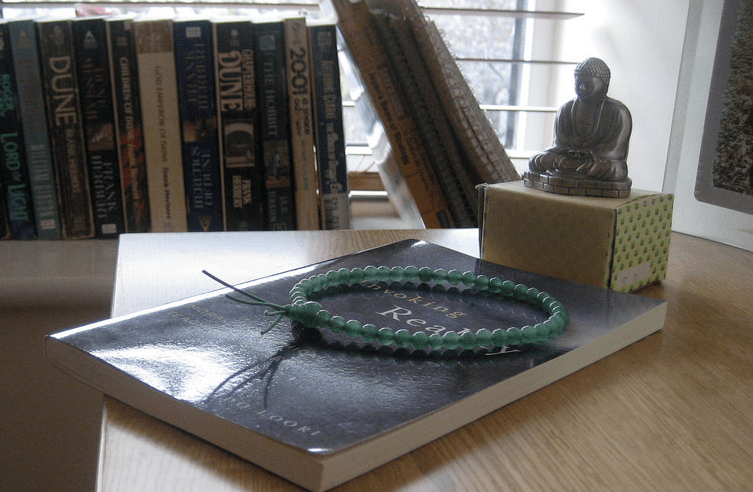
P.S. Photo was taken may years ago in 2008 when I lived in Ireland for a time. Back then, I had a lot fewer Buddhist resources (and there weren’t many in Ireland anyway), so I made this into a very impromptu altar.
1 I have not covered the Shingon and Nichiren sects, but I have too little information on them to speak with any certainty. Readers will have to do their own research for now.
As I write this post, I am in Dublin, Ireland on a short trip (business, not pleasure), helping my daughter get settled in for college. Thanks to timezone differences my daughter and I were awake at 11:30pm on a Friday and starving.
Taken near Trinity College and the main Bank of Ireland building (right).
Since a lot of pubs close their kitchens early, we went over to the local Supermac’s1 :
My daughter took this photo of her food. Mine is at the far end of the table (upper right corner).
It’s Friday night, so as we’re seated, people are stumbling in drunk looking for some cheap food, and there’s a steady stream of food delivery guys picking up orders. Still, even here, as I open my bag and eat my food, I try to still take a moment and appreciate the food, so I discreetly did gassho.
In Japanese culture, people will usually say itadakimasu before eating food, and gochisōsama deshita after finishing. The word itadakimasu is just the humble form of the verb “I receive”, and gochisōsama deshita means “It was a wonderful meal”.
But there’s also a set of verses that in the Zen tradition are recited before meals called the Shokuji Gokan (食事五観, “five observations at mealtime”). When I was watching a documentary recently, during mealtime, one of the Eiheiji monks walked the documentary host through the five verses. The five verses in Japanese for the Rinzaitradition are:
一つには、功の多少を計り、彼の来処を量る。 hitotsu ni wa, kō no tashō wo hakari, kano raisho wo hakaru
二つには、己が徳行の全闕を忖って供に応ず。 futatsu ni wa, onore ga tokugyō no zenketsu wo hakatte, ku ni ōzu
三つには、心を防ぎ、過貪等を離るるを宗とす。 mitsu ni wa, shin wo fusegi, togatontō wo hanaruru wo shū to su
四つには、正に良薬を事とするは形枯を療ぜんが為なり。 yotsu ni wa, masa ni ryōyaku wo koto to suru wa gyōko wo ryōzen ga tame nari
五つには、道業を成ぜんが為に、応にこの食を受くべし。 Itsutsu ni wa, dōgyō wo jōzen ga tame ni, ō ni kono jiki wo uku beshi.
The verses in Soto Zen appear to be slightly different. I am fairly certain, these are descended from Chinese Chan Buddhism, but I wasn’t able to find much information.
There are a lot of fine English translations available, though for now I am using the one from Sotozen.net:
We reflect on the effort that brought us this food and consider how it comes to us.
We reflect on our virtue and practice, and whether we are worthy of this offering.
We regard it as essential to free ourselves of excesses such as greed.
We regard this food as good medicine to sustain our life.
For the sake of enlightenment, we now receive this food.
In either case, the meaning is the same: before we take in the food, we should first reflect where it came from (and the countless people who made it possible),2 and whether we are living up to the practice or not. Finally, the verses remind us that food is essentially medicine (hence don’t be a pig), and that it helps us along the path toward Enlightenment. Even some chips (fries) at Supermac’s is something to be grateful for.
So, hello from Ireland, and will post more soon! 🇮🇪🖖🏼
1 The local version of McDonald’s, but ten times better.
2 The Jodo Shinshu tradition focuses on the concept of “gratitude“, so there’s a lot of overlaphere.
Speaking of the Tannisho recently, here’s another interesting quote worth exploring:
6. 自然のことわりにあひいかなはわば、仏恩をもしり、また師の恩をもしるべきなりと云々。
“When we live according to the truth of ‘made to become so by itself’, we shall know gratitude to the Buddha and to our teachers.”
Translation by Dr Taitetsu Unno
“Made to become so by itself…” what does he mean by that? Let’s look at another example.
In an separate Jodo Shinshu work, Shinran’s Notes on Essentials of Faith Alone (唯信鈔文意, yuishinshō mon’i) which we explored recently, he explains this “made to become so by itself” in greater detail:
Ji also means of itself. “Of itself” is a synonym for jinen, which means to be made to become so. “To be made to become so” means that without the practicer’s calculating in any way whatsoever, all that practicer’s past, present, and future evil karma is transformed into the highest good, just as all waters, upon entering the great ocean, immediately become ocean water. We are made to acquire the Tathagata’s [Buddha’s] virtues through entrusting ourselves to the Vow-power; hence the expression, “made to become so.” Since there is no contriving in any way to gain such virtues, it is called jinen. Those persons who have attained true and real shinjin are taken into and protected by this Vow that grasps never to abandon; therefore, they realize the diamond-like mind without any calculation on their own part, and thus dwell in the stage of the truly settled. Because of this, constant mindfulness of the Primal Vow arises in them naturally (by jinen). Even with the arising of this shinjin, it is written that supreme shinjin is made to awaken in us through the compassionate guidance of Sakyamuni, the kind father, and Amida, the mother of loving care. Know that this is the benefit of the working of jinen.
The specific phrase Shinran uses is jinen hōni (自然法爾), which is tricky to translate into English. As the Notes explains above, “jinen” means to be become so, naturally, not through contrivance. The term “hōni” (法爾), alternatively hōnen (法然),1 means something like “by virtue of the Dharma”, but in Jodo Shinshu lingo specifically it means through the power of Amida Buddha’s vows to rescue all beings.
Here, Shinran is strongly advocating a sense of total reliance on Amida Buddha, with the belief that by fully entrusting oneself to Amida Buddha’s compassionate vows (as depicted in the Three Pure Land Sutras), called shinjin (信心), rather than through calculation or conscious effort (i.e. a “weekend warrior”), then one is transformed by Amida gradually without realizing it. So, rather than trying to reborn in the Pure Land, Shinran is saying that one should trust in Amida to guide you to the Pure Land.
I’ve always found this concept very interesting.
While I might quibble with Shinran’s interpretations of things (especially since other Pure Land teachers in thepast did not have such a one-sided view), I do think there’s merit in the idea of transformation without one realizing it. This is accomplished simply by exposure to the Dharma, what Jodo Shinshu Buddhists like to call “deep listening” or monpō (聞法), which I also mentioned here.
Shinran (親鸞, 1173 – 1263), founder of the Jodo Shinshu sect in Japan, was a prolific writer. His largest work by far as the voluminous text, the Kyogyoshinsho (教行信証, “The True Teaching, Practice, and Realization of the Pure Land Way“), but Shinran also wrote a number of lesser-known text and commentaries, including the Notes on Essentials of Faith Alone (yuishinshō-mon’i, 唯信鈔文意).
Shinran’s writing style is a bit challenging, even with translations,
because Shinran tended to use subtle turns of phrase that would be lost on readers today. Sort of like a certain Buddhist blogger you might know.
or to make use quotations within quotations…
But I digress. 😋
In the Notes, which are commentaries on an older text written by Genshin, Shinran quotes a certain Chinese Pure Land teacher named Fa-zhao1 as follows:
That Buddha [Amida], in the causal stage, made the universal Vow:
When beings hear my Name and think on me, I will come to welcome each of them,not discriminating at all between the poor and the rich andwellborn, not discriminating between inferior and the highly gifted, not choosing the learned and those upholding pure precepts, nor rejecting those who break precepts and whose evil karma isprofound.
Solely making beings turn about and abundantly say the nembutsu,I can make bits of rubble change into gold.
The most important phrase here, and one that Dr Taitetsu Unno liberally referred to in his books, is “turning bits of rubble into gold”.
This notion of transformation gets to the very heart of the Buddhist path. It is not limited to Pure Land Buddhism, but speaks to the potential of all beings toward transformation if given the right conditions and training. Or, alternatively, through the compassion of Amida Buddha. If you look at the 48 vows of Amida Buddha, by the way, in the Sutra on the Buddha of Immeasurable Life, there is this vow:
(3) If, when I attain Buddhahood, humans and devas in my land should not all be the color of pure gold, may I not attain perfect Enlightenment.
Or, the Buddha’s simile of refining gold in the Pali Canon: the Paṁsudhovaka Sutta (AN 3.102):
“There are these gross impurities in gold: dirty sand, gravel, & grit. The dirt-washer or his apprentice, having placed (the gold) in a vat, washes it again & again until he has washed them away.
“When he is rid of them, there remain the moderate impurities in the gold: coarse sand & fine grit. He washes the gold again & again until he has washed them away.
In both sutras, we see that gold was used to symbolize the purity of one’s inner character. Regardless of one’s impurities, one’s inner character and potential for awakening can shine forth if purified. What makes Fa-zhao’s comment even more extraordinary is the symbolism of little bits of rubble becoming gold, not just a large nuggets.
He describes the compassion of Amida Buddha toward all beings, and his non-discrimination toward them, and how Amida’s compassion extends to all equally, transforms all equally, each according to their background and inspires them to recite the nembutsu out of sheer magnetism.
It’s easy to see why Shinran was inspired by this passage.
The saying of nembutsu is neither a religious practice nor a good act. Since it is practiced without any calculation, it is “non-practice.” Since it is also not a good created by my calculation, it is “non-good.” Since it is nothing but Other Power, completely free of self-power, it is neither a religious practice nor a good act on the part of the practicer.
The Tannisho, section eight, translation by Dr Taitetsu Unno
This quote comes from a 13th century Japanese text called The Tannisho, a record of conversations between an aging Shinran, the founder of Jōdo Shinshu-sect Buddhism, and his disciple Yui-en.
It’s a strange quote, and many aspects of the Tannisho are also strange at first glance. But the details are important and worth exploring.
Shinran is basically deflating the idea, still common today, that the nembutsu (reciting the name of Amida Buddha) is a practice in the traditional Buddhist sense. Shinran says the recitation of the nembutsu isn’t a magic spell, mantra, or anything that could accomplish a desired result. From Shinran’s perspective, the nembutsu doesn’t do anything.
So, why recite it? From the Jodo Shinshu perspective,1 the nembutsu is simply means calling out to Amida in our hour of deep need. That’s why it’s not a good act nor a practice. Further, Amida Buddha hears all beings and shines his light upon them, a combination of wisdom to illuminate our ignorance, and compassion to embrace us.
The Other-Power described here is called tariki (他力) in Japanese. The idea is that Amida Buddha’s light (i.e. wisdom and compassion) is what transform us. There’s nothing we do that adds or subtracts from this.
Sometimes when I reflect on this, it feels a little bit like sophistry to me, but then I remember an anecdote about Shinran’s teacher, Honen, that helps illustrates this.
One time, someone asked whose nembutsu was better: Honen himself, or Awanosuke, a former-fortune teller who was not well-regarded by others in the community. Honen scoffed at this question and said that there was no difference between his nembutsu and Awanosuke’s because neither skill, nor style, nor conduct, nor grasp of the Buddhist doctrines mattered. It was all through Amida Buddha and not through one’s own efforts.
The whole idea is that in spite of who we are, Amida Buddha’s compassion shines on us all. It is simply that many people may be unaware of this.
Namu Amida Butsu
P.S. Just to clarify, the concept of Other Power wasn’t invented by Shinran and his teacher Honen. It was alreaady prevalent in earlier generations of Chinese Pure Land Buddhists such as Tan-luan and Dao-chuo, but I suppose that Shinran/Honen took it to its logical conclusion centuries later.
P.P.S. I have a backlog of fun things I wanted to share with readers, but the backlog is growing, so I am posting three a week or now just to help catch up.
1 … and arguably the Jodo Shu sect, too. The emphasis of both sects is on Amida Buddha’s compassion, rather than one’s own efforts as depicted in other Pure Land traditions. Sometimes, this feels like a case of “tomayto vs. tomahtoe” to this old Buddhist, but it’s how the various sects of Pure Land Buddhism sometimes define themselves.
While reading the excellent book, River of Fire, River of Water by Dr Taitetsu Unno last week, there was a nice chapter about Buddhism being about not one, but series of small awakenings.
Many people experience this type of [radical, spiritual] awakening, but normally it touches only one aspect of life and rarely involves the total person. Furthermore, a single experience may not effect any real transformation. The awakening must be repeated and deepened for as long as we are living and breathing.
page 65
Here, Dr Unno was talking about it in the context of the experience of Shinjin (信心, the sincere entrusting of Amida Buddha that Shinran taught), but he cites a few sources, including the Rinzai Zen master Hakuin (白隠 1686 – 1769), who evidentially taught that there was the initial awakening (in a Zen context), and then subsequent awakenings.
True kenshō [見性, “seeing your nature”] is a very difficult practice. That being the case, only a select few individuals who are gifted with special religious capabilities will ever achieve kenshō.
One shouldn’t give up on attaining kenshō, but there is another state prior to it called sei [省]. Of course Zen disdains practice for the sake of personal attainments, but when one sits in zazen and properly regulates one’s posture and breathing, the mind gradually grows calm. In that state, the honshō [本性, “one’s original nature?”] and original self become active, if not completely.
pages 39-41
Here, the author is describing the process of reaching final enlightenment, using the alternative Zen-specific term kensho.1 But, in keeping with mainstream Buddhism, this state of mind is pretty difficult to attain, and yet one has any number of smaller awakenings (sei) along the way. One may not necessarily fully become awakened, but even those brief glimpses can be transformative. The point is of course that it’s a journey, not just an abstract goal.
In Star Trek terms (because I am a giant nerd), think of the movie Star Trek VI: The Undiscovered Country. Spock talks to his protegé, Valeris, about the importance of logic, even for a Vulcan:
VALERIS: But is this logical? Surely we must… SPOCK: Logic? …Logic is the beginning of wisdom, Valeris, not the end.
I think Buddhism is less about “what have I accomplished” and more about “what can I do next” or “where do I go from here?”.
Namu Shakamuni Butsu
P.S. Next week I am changing up the schedule a bit. I hope you enjoy.
1 The generic Japanese-Buddhist term is satori (悟り), and they mean more or less the same thing. As someone who accomplished neither, I can’t really speak to either one. 😅
This post is part four of four exploring the Ikko-Ikki Rebellions in 15th and 16th century Japan. You can find part one, part two and part three here.
The Ikko-Ikki Rebellions are remarkable as being the one time in pre-modern Japanese history where a peasant uprising not only succeeded, but successfully carved out a region of Japan that was ruled by the masses, and not by military samurai, nor the old aristocracy from Kyoto. The binding influence of the uprising was a strong affinity to a certain Buddhist sect, the Jodo Shinshu (浄土真宗, “True Pure Land Sect”), but there was more to the ikko-Ikki than a “rebel cult” as some labeled them.
Information in English about the Ikko-Ikki is sparse, and often misinformed. I am happy though to have obtained a copy of Dr Carol Tsang’s excellent book War and Faith: Ikko Ikki in Late Muromachi Japan (publisher link), covers the Ikko-Ikki, who they were, and their relation to the Jodo Shinshu sect. It’s been a fascinating read even for an old “history nerd” like myself.
This is the final part of this series. I wanted to go into more depth on some parts, but I wanted to keep a good, easy pace, so summarized some parts a little, while focusing on others. The history Ikko-Ikki was far more extensive and complicated than I expected originally, and I didn’t want to turn this into an eight part series. 😙
If you want to know, please Dr Carol Tsang’s good. It’s quite a good read.
Simmering Tensions after 1488
The defeat of Togashi Masachika in 1488 by a coalition of rebellious retainers and ikko-ikki armies of Jodo Shinshu-sect followers was a watershed for the rebellions, but things settled for a time in a tense balance of powers in the province of Kaga. This balance of powers meant that there was no sole ruler of Kaga, and whenever trouble arose, the central Shogunate authorities had to rely on whomever might be able to help settle a dispute locally. Sometimes ikko-ikki were enlisted to help keep the peace, other times, local samurai were tasked with defeating an ikko-ikki army.
As stated in part three the reputation of Rennyo, the 8th Caretaker of the Honganji Mausoleum, suffered even though he was not part of the rebellions, and was not even in the province. By 1489, he resigned as Caretaker (monshu, 門主) and Rennyo spent his final years proselytizing while his son Jitsunyo (実如, 1458 – 1525) carried on as the 9th Caretaker. Rennyo passed away at Yamashina Honganji temple in 1499.
Dr Tsang shows that Jitsunyo was pretty quiet and conservative for his first decade as Caretaker, carefully compiling Rennyo’s notes and letters, maintaining his reforms to liturgy and so on. Primarily ecclesiastical affairs, in other words.
Then 1506 happened.
Uprisings and Crackdowns
Without getting too embroiled in politics at the time, let me summarize. The Ashikaga shogunate by 1506 was getting weaker and weaker after the Onin War, and their deputy shoguns, the Hosokawa and Hatakeyama clans, were increasingly manipulating the succession process for the Ashikaga.1 This led to disputes by other retainers, and a power struggle increasingly spilled over to the provinces.
Jitsunyo, the ninth Caretaker (monshu, 門主) of the Honganji was forcefully approached by deputy-shogun Hosokawa Masamoto who strong-armed Jitsunyo (literally) to lend him ikko-ikki troops to help his cause. Jitsunyo refused saying he was only a peaceful monk, and tried to escape Masamoto, but Masamoto caught up to him and he finally relented.
It’s noteworthy that this was the first time in Jodo Shinshu history that the monshu directly ordered his followers to battle (even if hesitatingly), but it set the pattern for the next few generations.
This also proved to be a huge problems for the Ikko-ikki . Different Jodo Shinshu communities owed allegiance to members of the Hatakeyama, others the Hosokawa. Some refused Jitsunyo, others came flocking to his banner, but in the end, enough Ikko-ikki came to Masamoto’s assistance to turn the tide of battle. This also set a pattern that continued in later generations when Jitsunyo’s grandson Shōnyo (証如, 1516 – 1554)2 became the tenth monshu.
The Tenbun War
Unlike Jitsunyo, Shōnyo was much less hesitant to mobilize Jodo Shinshu followers into fighting forces to accomplish aims. During a civil between temples in Kaga province in 1531, Dai-shō (大小) Ikki War, Shōnyo decisively defeated the rebel temples and their armies, reasserting Honganji control.
The following year, the Tenbun War (天分の乱, 1532-1536) involved yet another generation of Hosokawa clan members fighting for control of Japan, and Shōnyo actively helped Hosokawa Harumoto (Masamoto’s grandson). The Honganji armies carried the day with Ikko-ikki members turning their wrath on Kōfukuji Temple and burning it down, while also looting Kasuga Shrine next door. This really shocked the establishment.
In the constantly switching alliances of the time, Harumoto turned on them and enlisted NichirenIkki for help. Yes, Nichiren Buddhism had it’s own ikki societes, that destroyed Yamashina Honganji in 1532, and briefly administered the capitol of Kyoto for a time. Despite the series of losses, the Honganji’s mobilization efforts meant that they were more firmly in control of Kaga Province and could muster future armies if needed.
Further, in other provinces, Jodo Shinshu temples in the Hongaji hierarchy created by Jitsunyo wielded considerable influence throughout Japan. Starting with Rennyo, many temples organized jinaichō (寺内町, “temple towns”) that were fortified and exempt from taxation to military authorities. Samurai were not even allowed in these towns, a policy called funyū (不入, “no entry”). This was a problem for local warlords who needed revenue, but also had to constantly deal with fortified temple towns in their own province. A young Tokugawa Ieyasu (future Shogun of Japan) had to contend with his local Ikko-ikki garrisons in order to assert dominance over his domain in the early 1560’s.
But finally, the Ikko-Ikki met their match. Sort of.
War with Oda Nobunaga and Downfall
(A screenshot of the classic strategy game Nobunaga’s Ambition (taken from Nintendo Switch). This shows the Kaga province in the hands of the “Honganji”, more correctly the Ikko-Ikki. Western kids like me who grew up playing this game had no idea who “Honganji” was. 😝)
For the last 100 years, the Ikko-Ikki had gradually grown from disparate, rag-tag bands of rebels to mass-armies mobilized by the Honganji (and its lineage of monshu Caretakers) that warlords would court for military favors. However, the Ikko-Ikki finally met their match with Oda Nobunaga (織田 信長, 1534 – 1582). Nobunaga, star of the Nintendo game Nobunaga’s Ambition (screenshot above), would briefly unify Japan by the 1580’s, but he did so through brutal warfare and centralizing power. This meant destroying any opposition: not just the Ikko-Ikki, but other religious powers such as the sohei warrior-monks of the Tendai Sect. There could be only one sun in the sky, and Nobunaga wanted tl be it.
Despite some initial friendly overtures by the 11th monshu Caretaker of the Honganji, Kennyo (顕如, 1543 – 1592), son of Shōnyo, Oda held a low opinion of the Honganji and it soon became clear that war was inevitable. The Honganji authorities rallied the Ikko-Ikki and fortified their position at temple complex of Ishiyama Honganji. According to one tradition, partially debunked by Dr Carol Tsang, the Ikko-Ikki by this era carried a banner that read:3
進者往生極楽 Advance and be reborn in the Pure Land 退者無間地獄 Retreat and be immediately reborn in Hell.
Nobunaga underestimated the Ikko-Ikki and sent a token force that was soon crushed. A similar, second attempt met the same fate. Finally, Nobunaga had enough and sent a much larger force, with his best generals, but the Ikko-Ikki were well-supplied and well-fortified. Thus began the 10-year long Siege of Ishiyama Honganji.
The end result of this massive and complicated siege was that eventually both sides tired, and ended in a truce, but the Honganji was definitely on the losing side of this truce. Nobunaga agreed to not execute its leadership, but the Honganji was totally burned down and later replaced with Osaka Castle. The Honganji also submitted to Nobunaga’s authority, though grudgingly. Some diehards tried to keep fighting but were destroyed.
Final Thoughts
Once Oda Nobunaga gained authority over all of Japan, the Ikko-Ikki as a phenomenon rapidly wound down and never appeared again. But, who were they?
The usual assumption in English was they they were religious fanatics, willing to die at the command of the monshu. And yet, Dr Tsang shows many examples where they disregarded the the monshu, and either didn’t fight, or sometimes they fight without the monshu’s approval. On the other hand, they had elements of millenarianism too: a deep desire not just to get better taxation, but as seen in Kaga province, to transform society.
Further complicating this was the widespread belief at the time that the monshu, in particular Shōnyo and Kennyo, did have the power to grant or deny rebirth in the Pure Land of Amida Buddha, vaguely similar to indulgences in medieval Christianity. Neither monshu promoted this idea, but they didn’t explicitly deny it either.
Thus, they were not just another peasant rebellion either. The shared religious identity that was Jodo Shinshu-sect Buddhism, in particular the Honganji lineage, gave them a sense of community that transcended the usual shifting alliances of the Warring States period. They weren’t just peasants either. Many urban merchants, artisans, rural jizamurai warriors, and others comprised the Ikko-Ikki in large numbers.
Were the rebellions a form of pre-modern democratic or Marxist revolution? No, they still submitted to authorities (secular and religious) and never reformed the local government in any way we would recognize as a democracy.
Thus, as Dr Tsang writes, the Ikko-Ikki defy easy explanation, but their impact on Japanese politics for the next few centuries, including how military authorities handled the arrival of Christian Europeans (i.e. zero-tolerance) and how the Edo Period reformed and brought all religious groups to heel, is undeniable.
P.S. posting this as a Friday bonus. Enjoy!
1 A pattern similar to previous eras of Japanese history, such as the Fujiwara manipulating the Imperial family, or the Hojo manipulating the succession of the Minamoto/Kamakura shoguns. Of course, this is not limited to Japanese history either, or even Asian history. Anytime there was a non-optimal family succession, it didn’t take long for retainers and advisors to weigh in…
2 Rennyo’s great-great-grandson, in other words.
3 The ikko-ikki at the Siege of Ishiyama did not carry this banner, but rather the allied Mōri clan in western Honshu, according to Dr Tsang.
SPOCK: There’s no further need to observe me, Doctor. As you can see, I’ve returned to the present in every sense.
Star Trek, “All Our Yesteryears” (s3ep23), Stardate 5943.7
I spent this past week volunteering as a chaperone for my son’s school camping trip, which was chaotic and busy, but also bought me some much-needed quiet time to read and reflect on some things. Exhausting, but nice.
Lately, while reviewing some old Buddhist material, I realized that I had conflicting thoughts about my own Buddhist path. I have spent much of my past 20 years as a Buddhist following the Pure Land path, especially Jodo-Shu/Jodo-Shinshu sect Buddhism, and this is reflected in many posts here, including recent posts like this one. This has been really formative to my understanding of Buddhist religion and teachings.
And yet, the reason why I left my old community nearly 10 years ago was that I felt there was more to Buddhism than just passively allowing the power of Amida Buddha to lead me (i.e. tariki 他力 in Japanese-Buddhist parlance). I wanted to pursue other facets, more active practices, and so on. This is reflected in my exploration of Buddhism in general, including recent posts like this one. But even then, I never could quite pin down what I should do for Buddhist practice, or what to prioritize. I had a general sense of things, but struggled to articulate what I think I should do.
So, for some time now, I have been plagued with self-doubt, and feeling conflicted about how best to be a “good Buddhist”. I was worried that I had lost my way. I read a few sources from different Buddhist traditions in my spare time, but it only made me feel more confused.
So, I decided to get back to basics. Using my spare time at camp, I started writing down what I genuinely believed in, and not what a particular tradition dictated to me. I didn’t have a lot of time, so I would just jot down notes on my phone, a sentence here or there. Over a few days, I had a list of items, and they had certain recurring themes. I was relieved to see that I came to the sameconclusionsasbefore, but now with a greater sense of conviction. What a relief.
I felt a bit like Captain Kirk in the season one Star Trek episode “This Side of Paradise” (s1ep24), after he has been affected by the mind-control spores. He is just about to leave the ship for good, but at the last minute, he comes to his senses and realizes that what he really valued was the ship, and his role as captain. It was as if he came out of a fever dream. This is how it felt for me.
But also with this new sense of conviction, I will probably be changing tack a little bit on the blog. Nothing dramatic, but I feel that it’s time to close the book on certain topics, and focus on other things that I want to explore more. Time will tell, but that’s what I want to do for some upcoming blog posts.
Thanks for reading!
Namu Shakamuni Butsu
P.S. Photos from camp.
P.P.S. Bonus episode this week. I felt like posting sooner than later. Enjoy!
Lately, I have been re-reading some old Jodo Shinshu Buddhist books that I read many years ago when I first encountered Buddhism. Now that 15-20 years have passed it’s interesting to look back and see things with a more experienced eye. In particular, I am enjoying an old classic titled River of Fire, River of Water, by the late Rev. Taitetsu Unno. Of his books, I think this is the best one.
Midway through the book he quotes the following:
“As long as man lives, he must work and plan for a thousand years. Even this Genza plants persimmon and chestnut trees. I have lots of work to do in this world. But we must listen to the teaching [of the Buddha], as if there’s no tomorrow.”
Inaba no Genza (因幡の源左, 1842-1930)
Inaba no Genza (often just called “Genza” in English) was an example of an archetypal Pure Land follower called a myōkōnin (妙好人), a humble, very pious lay-follower, who becomes an inspiration to others. Myokonin are rarely discussed outside of Jodo Shinshu discourse, but I bet if you look around enough, you’d find examples of such pious followers in many Buddhist countries and cultures. I can even think of a certain American myokonin I once knew.
But I digress.
I like this quote a lot because it acknowledges two things.
First, Buddhist practice in the traditional sense requires considerable time, dedication and energy. An illiterate guy working the fields, just trying to scrape by, couldn’t be expected to take up Zen practice, or to learn the finer points of esoteric doctrine. If you really wanted to take up Buddhist practice, not as a “weekend warrior”, but as a dedicated practitioner, this required renouncing the world and ordaining as a monk or nun. Not so with the Pure Land path (Nichiren Buddhism, too).
So, this helps to explain why certain Buddhist sects struggled to gain mass popularity over the centuries, while Pure Land which relies on the guidance of Amida Buddha, did not.
The reality, I think, is that little has changed even in modern times. We enjoy a material culture far surpassing what 19th century Japanese field workers might have enjoyed, but our modern capitalist culture keeps us as busy and overworked as anyone, and still struggling to survive. We may not die from dysentery these days, but may of us will still die stressed out and broke.
Second, time is short. I’ve used the example of the Parable of the Burning House to help illustrate as well as the Liturgy on White Ashes, but to reiterate, the Buddha taught that life is short, and death can come at any time. So it’s important not to squander it. One should carefully settle one’s affairs, and not lose sight of the big picture. Easier said than done, but what Inaba no Genza says is important: listen to the Dharma1 and heed it well. It may be your last chance.
Namu Amida Butsu
P.S. other than Dr Unno’s translation, I struggled to find the actual source of this quote with Japanese text. I found some limited information about a text called the kaki no ki no hanashi (柿の木の話) written by his son, Saichi, but couldn’t find anything much beyond that. It’s kind of frustrating when Western authors quote Buddhist texts, but do not cite their sources.
P.P.S. Speaking of daily grind, posting again…
1 In Jodo Shinshu, this kind of “deep hearing” of the Dharma is called monpō (聞法) which means “hearing the Dharma”. The nuance here is that you’re not just listening to the sound and words of the Dharma, but you hearing it in a deeper, more spiritual sense. This requires humility and willingness to learn, and challenge your own assumptions.
Studying about the Ikko-Ikki rebellion (parts one, two and three as of writing) has brought back lots of memories of the local Jodo Shinshu temple that I spent many years at. I also remember the liturgy I used to train in while getting certified as a minister’s assistant. I was a terrible singer (always have been), so I never sang well. Not just OK, I was genuinely bad. But I still enjoyed many of the different liturgies we sang in Sunday services including the Shoshinge, Juseige, and so on.
One of my personal favorite was a liturgy called the Jūnirai (十二礼), which means The Twelve Adorations of Amida Buddha. We didn’t sing this one too often, but it did come up from time to time.1
As far as I can tell, this liturgy is found only in the Jodo Shinshu tradition, and is based on a document attributed to the Indian-Buddhist monk Nagarjuna. Nagarjuna (c. 150 – 250 CE) was a very influential monk in early, early Mahayana Buddhist tradition, and some documents related to Pure Land thought and Amida Buddha are attributed to him. I say “attributed”, because there is some doubt as to whether Nagarjuna authored such works, or possibly there was another monk named Nagarjuna who did. Early Indian-Buddhist textual history is tricky at best.
Nonetheless, the Hymn of The Twelve Adorations is a nice, easy melodic song. You can find translations here and here among other places. The actual hymn, sung in Sino-Japanese2 has twelve verses and a straightforward melody. There is a great example of this on Youtube below (fast forward to 1:10 for the hymn if you like):
It’s a very nice, easy tune to pick up. I’ve even heard the same tune occasionally used by elderly Japanese-Americans reciting other hymns, including the Shoshinge, but the origins are not clear to me.
Anyhow, the Junirai is simple enough that even someone tone-deaf like me can passably sing it, but also very poetic and lovely. If you’re near a Jodo Shinshu temple, check it out and see it sung in person sometime, but if not, you can find the Sino-Japanese lyrics in the links above, and can sing along as a devotional at home if you like.
Namu Amida Butsu
P.S. Old, old photo of me as a minister’s assistant in training (I still have my certificate somewhere).
I can’t remember when this photo was taken, but suffice to say, it’s old.
1 One difference I have noticed over the years between Jodo Shinshu temples in the West versus Japan is that in the West weekly services (i.e. “sunday services”) are common, but in Japan they usually only happen at major temples, not parochial ones. Thus, in Japan the emphasis is on home liturgy and chanting. People will chant the same hymns and sutras as described above, but in a home setting before an altar. Of course, Western Buddhists do home services too. It’s just that in Japan and other places in Asia, you’re not obligated to attend weekly communal services.
2 That is, Chinese characters with Japanese pronunciation, not native Japanese language.







 Gleanings in Buddha-Fields
You must be logged in to post a comment.