Basic Japanese Particles, Part 2

In our last episode, we talked about some basic, fundamental particles used in the Japanese language. Today, we’ll cover some other, essential particles: “ni” に, “de” で, “yo” よ, and “ne” ね. The first two are often required for parts of speech, but the second two are often used to provide “flavor” or “nuance” to conversation. All of them are frequently used, and necessary to speak Japanese well.

As with the previous post, this post assumes you know how to read hiragana script. If not, now would be a good time to review. Kanji will be kept to a minimum for now.

The targeting particle: に

The particle に (ni) is used in many ways in Japanese, but it’s best to think of it as a particle that provides a target for a verb. Credit goes to Tae Kim for coming up with this explanation.

The に particle is not used for direct objects. As we saw in the last post, the を (wo) particle fulfills that role.

たなかさんCDあげた。

I gave Mr Takana the CD

Instead, the に (ni) particle is used when a verb relates to something, but not as a direct objection. A couple examples:

へやはいる。

To go into a room

also:

でんしゃおりる。

To get off a train

In both cases, a verb relates to a noun, but it’s not directly doing something to the noun. The に particle simply specifies the targets of the verb. A lot of verbs in Japanese are intransitive verbs, more so than English, so they won’t take direct objects anyway, and in such cases, に is often used.

You can also target time with a verb:

くじでる。

I will leave at 9 o’clock

One other important note: に is also used in passive speech to designate the agent of the passive action (e.g. “it was done by who”). I still consider this a target, but that’s just me.

たなかさんすしたべられた。

The sushi was eaten by Mr Tanaka

The context particle: で

This is another very useful particle. The で (de) particle is used to explain context for things. This includes:

  • Where something took place.
  • Something was done with something.
  • Something will take place within a time frame.

It’s hard to explain, but pretty easy to use once you get the hang of it.

がっこうごはんたべた。

I ate lunch (lit. meal) at school

Or:

フライパンつくった。

[I] cooked with a frypan

Another often overlooked example is:

レゴあそんだ。

[We] played with legos.

And finally for time:

ごふんつく。

[we will] arrive in five minutes.

The assertive particle: よ

The よ (yo) and ね (ne) particle below are both “nuance” particles. They are not used for parts of speech like many of the particles we’ve seen so far. Instead, these particles are put at the end of sentences to provide nuance to a sentence.

The よ (yo) particle is used to assert something. This is often done to either:

  • Present new information, or
  • Make a point

As with any culture, if you are too assertive, this can annoy other people, but there are many times this is used in Japanese without sounding rude or overly assertive.

Let’s compare these two sentences:

きょうさむい。

Today is cold.

with:

きょうさむい

Today is cold.

When translating to English, the meaning is the same. However, the nuance is different. The first sentence is matter of fact, with no nuance. The second sentence assumes that the listener either didn’t know it was cold, or that you are trying to remind the listener that it is cold (therefore you should dress warm).

The soliciting particle: ね

As with the よ (yo) particle, the ね (ne) particle expresses nuance only, but tends to convey something different. Where よ (yo) asserts something, the ね (ne) particle solicits feedback from the listener. This is often used in Japanese language to either solicit agreement from others, but also to downplay one’s opinion (e.g. soften it), thereby making it a bit more polite.

Using the example sentence above, let’s change the nuance a bit:

きょうさむい

Today is cold [don’t you think?].

Here, the speaker is making a point, but doing it in a more solicitous way, hoping to garner agreement with the listener. This is obviously less assertive, and more conciliatory to the listener.

It’s very common to also combine the two to both assert something, but not too strongly:

きょうさむい

Today is cold [don’t you think?].

You’re still asserting something information, but also pulling back a bit too, so it’s often a happy medium in conversation.

Conclusion

There are a lot more particles in Japanese language, and we haven’t covered all use-cases of these particles either, but even knowing this much gives you a solid foundation, once the usage sinks in. The best way to learn particle usage isn’t memorizing grammar, but instead learning sentence patterns, preferably from real Japanese media (books, TV, etc). Once you’ve seen a sentence pattern 50 times, you can generally get the gist of it. If you’ve seen it 500 times, you probably are pretty familiar with it. 😙
Basic Japanese Particles, Part 1

Japanese, as a language, isn’t really all that hard to learn, especially if you know the Golden Rules, but compared to English, it’s quite different. This means that you have to unlearn English ways of expressing things, and start from the ground-up. A good place to start is to learn the common particles used in Japanese.

I’ve touched on particles before, but in the following two posts, we’ll cover the most common particles in more detail. This post assumes you know how to read hiragana script. If not, now would be a good time to review. I will try to keep kanji to a minimum for now.

Particles in Japanese are small, 1 to 2 syllable markers. There is no direct, one-to-one translation to English, but they’re important for marking parts of speech. This means that you can’t make sense of a sentence in Japanese without knowing particles. Further, you cannot communicate clearly to native speakers without using the correct particles.

For today we’ll focus on “ga” が, “no” の, “wo” を and “desu” です.

When to Use What Particle

Japanese is known for being a “pithy” language, and this is true. Japanese only uses the parts of speech that need to be explicitly mentioned, while the rest is implied by context. English does this too, but not as much. Thus, English speakers of Japanese often sound wordy, and this gets tiring to a native Japanese speaker.

For example if introducing yourself, a common mistake English speakers make is something like this:

わたしなまえまつだです

“Hello, my name is Matsuda”

This isn’t grammatically wrong, just needlessly wordy. Oftentimes, Japanese speakers might simply say:

まつだです

“[I am] Matsuda.”

Therefore, we’ll try to focus on the most essential, basic particles first. This will be enough to complete basic sentences in most cases.

The noun-linking particle: の

The の “no” particle has several uses, but at its heart, it’s meant to link two nouns together. This can have different nuances depending on context. A common example to just mark possession of something:

まつだほん

Matsuda’s book

You can pretty much link any two nouns this way:

にほんじょせい

Japanese women

This also lets you do something called apposition, which means using one noun introduce another:

せんせいたけださん

Mr (or Miss) Takeda, the teacher

Or time, using なんじ (“what time”?)

なんじでんしゃ?

What time is the train?

and answer:

さんじでんしゃ

The 3 O’Clock Train

It has other uses as well, but this covers plenty. The is super useful, but takes a bit of time to get used to the different nuances.

The subject particle: が

The particle が is one of the most basic and most useful to learn first. Its job is to answer the questions “who”, “what”, “which” or “where”: who does something, which thing is which, where is something?

For example, if the word だれ means “who”, you can ask:

だれせんせい?

Who’s the teacher?

Which you can answer:

たけだせんせい。

Takeda is the teacher.

Notice that が is used both to ask “who”, but also answer “who”.

Another example using なに (“what”?)

なにたべたい?

What do you want to eat?

and the answer:

すしたべたい

I want to eat sushi

Particle を

The を “wo” particle is interesting because it represents a hiragana letter that no longer is used, and really has only one usage left: marking the direct object of a sentence.

すしたべる。

I eat sushi

Note that this only works for transitive verbs, verbs that take direct objects. Which verbs are transitive vs intransitive is not always the same as English. You just have to know, and often they come in pairs in Japanese.

The polite particle: です

The particle です is somewhat hard to explain, but in essence, it just makes sentences more polite. You can use it in one of two ways.

One way is to simply append to last noun or adjective, and make it polite:

さむいです

“It’s cold”

Another way to use it is to replace the last particle + verb, while keeping it polite.

なにたべたい?

すしたべたい。
=
すしです

Conclusion

Particles in Japanese are used in a variety of ways, and nuances, that are hard to translate 1:1 into English, but once you get used to the patterns, it’s not difficult to grasp. The key is to unlearn habits in your home language, and just get used to the basic patterns on their own merits until it becomes second nature.

In part two, we’ll explore more particles and see where we go from there.

My JLPT N1 Test Results for 2023

I finally got my results back from the JPLT N1 exam I took in December 2023, and the results were not surprising.

I failed, as expected.

However, the results were not what I expected:

CategoryResults
Vocab / grammar28 / 60 (pass)
Reading7 / 60 (not pass)
Listening26 / 60 (pass)
Total Score61 / 180 (100 needed to pass)

I had expected to fail listening more so than reading, the listening section was very stressful, and yet the reading section felt somewhat easy. Clearly, I underestimated things. After reading about people online who passed or failed the JLPT N1, it’s clear that the N1 assumes full adult literacy. If you can’t read a novel or two in Japanese, you will not pass the reading section. I haven’t reached that level yet, and the results aren’t that surprising then.

That said, the total score to pass has to be 100 out of 180, so even if I passed the reading section, my overall score was still pretty low, and probably not enough to pass.

Needless to say, it was a good effort, but my preparations all around were insufficient.

Will I take it again? This took considerable time, effort and willingness to go the distance, and so I have to think about whether I want to try again. Since I don’t need the JLPT N1 for work, it’s more of a personal project, and may or may not be worth the cost.

Going to think about this for a while. 🤔

Happy 2024: Year of the Dragon

Hello dear readers, and happy new year, or as they say in Japan akemashite omedetou gozaimasu!

My family and I took time off for Winter Break and are probably more exhausted now than when the break began.

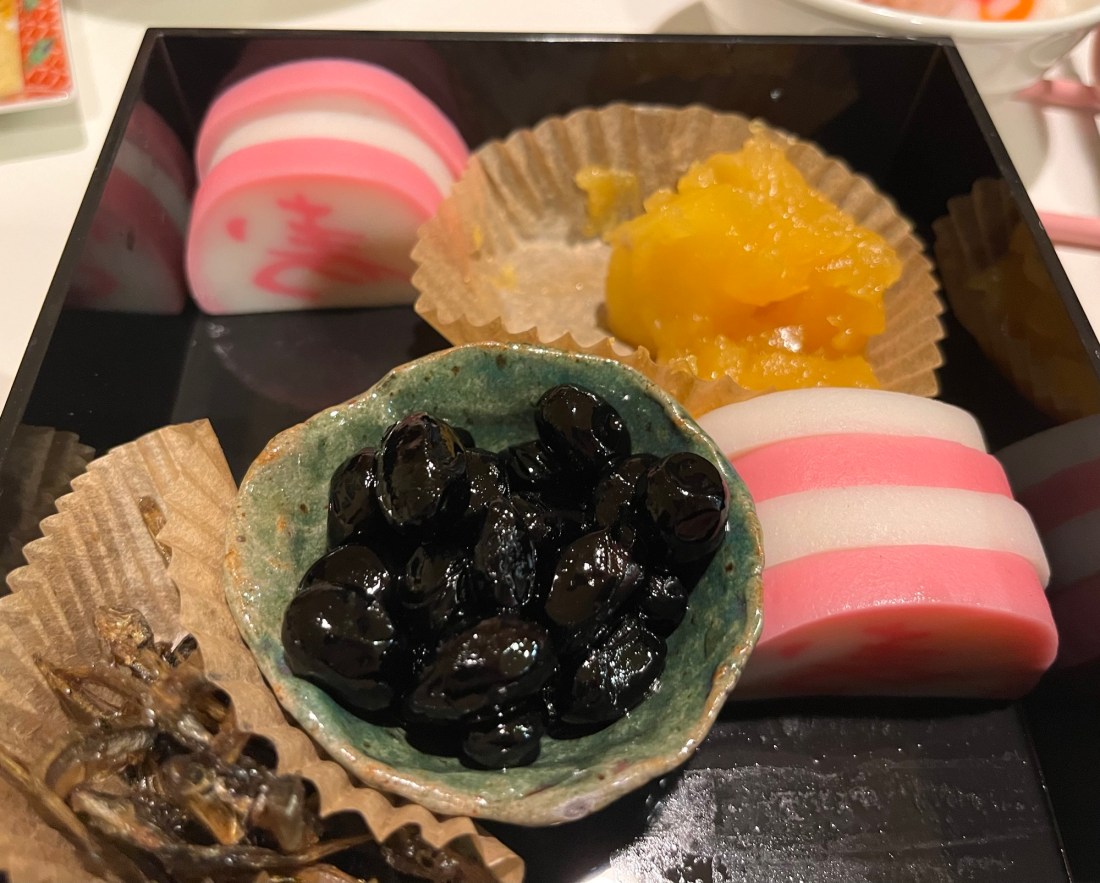
After enjoying New Year’s Eve with friends, we woke up this morning to eat Osechi (お節), which are traditional foods eaten in Japan for New Year for good luck. This is just one of many traditions found in Japanese New Year, also called oshougatsu (お正月).

I won’t list each one, but you can read here. These are foods thought to have auspicious meanings, and include things like shrimp, black beans, candied fish, chestnuts and so on. I like some more than others, but I try to have a bite of at least one of each. I like the pink and white kamaboko in particular. This year, we bought a brand that has the Chinese character 寿 (kotobuki) in it, meaning “felicitations” and such. The featured photo shows the Chinese character in reverse.

Also, in the photo above, our little ceremonial dishes feature the Seven Luck Gods too, and in the ozouni soup shown the naruto fish cakes feature Mount Fuji in front of a sunrise.

Later today, I will probably play some Karuta and then head for the local Japanese Buddhist temple for the first visit of the year, hatsumoude, and post on that soon.

Happy 2024 to everyone!

P.S. For us Star Trek fans, another thing to may be look forward to this year:

Failing the JLPT

So, I took the JLPT N1 exam last weekend, and unless I got lucky, I am fairly certain I failed the test.

Wait, you might be thinking, didn’t I give up on the test this year?

Well, yes and no.

I did become discouraged and stopped studying for a few months. But after spending the summer in Japan, I realized how much I enjoyed studying Japanese, and I felt that if I put off the test for another year, I’d just keep procrastinating my test preparation. It made sense to press the issue by registering to take the exam. This was kind of a last minute decision, and with all the personal chaos happening in fall, I neglected to mention it in the blog.

The problem is that even though I work better with a deadline than without, the reality of parenting, work, and Fire Emblem got in the way, and I made less progress in my preparation than I would have liked. I spent a lot of time reading, and did some mock tests for the reading section, and that did help.1 However, it was clear that my vocabulary and listening skills were still insufficient. I banked too much on just reading essays.

When you look at online discussions, it’s clear that by the time you get to the N1, you need to have a general adult-level literacy in Japanese, including listening. People who read and watch Japanese media in general tend to fare a lot better. I have done some of this over the last two years, but clearly not enough.

That said, it wasn’t a complete failure. I definitely could see that my study and reading skills had helped, and there were questions I could answer comfortably without much effort. So, it’s not a question of study method, so much as time put in. I need to do more of the same, and probably on a more frequent basis. Listening, as always, is the hardest skill, but now I have a fresh baseline in my mind, so I know what level of conversation or content I should focus on. As with reading, I have plenty of books at home to finish, but I will try to broaden my subjects to more than just the 2-3 things I like to read (Buddhism and the Hyakunin Isshu). I can assure you that neither subject appeared on the test. 😉

Amen, Mercedes. Amen.

Assuming I don’t pass this time, which is likely, I feel positive enough about my progress that I will likely try again next year. I will not commit to anything just yet, at least until I’ve had a chance to see my test score next month or so.

Until then, I’m just taking a much needed break, focusing on playing karuta and of course more Fire Emblem: Three Houses.

1 I was able to manage my time pretty well during the reading section, pacing myself, and even had a bit of time to go back, review, and fix a couple questions. The last time I took the exam, I was definitely rushed, and did poorly in the reading section.

Kyoto and Nara Dialects

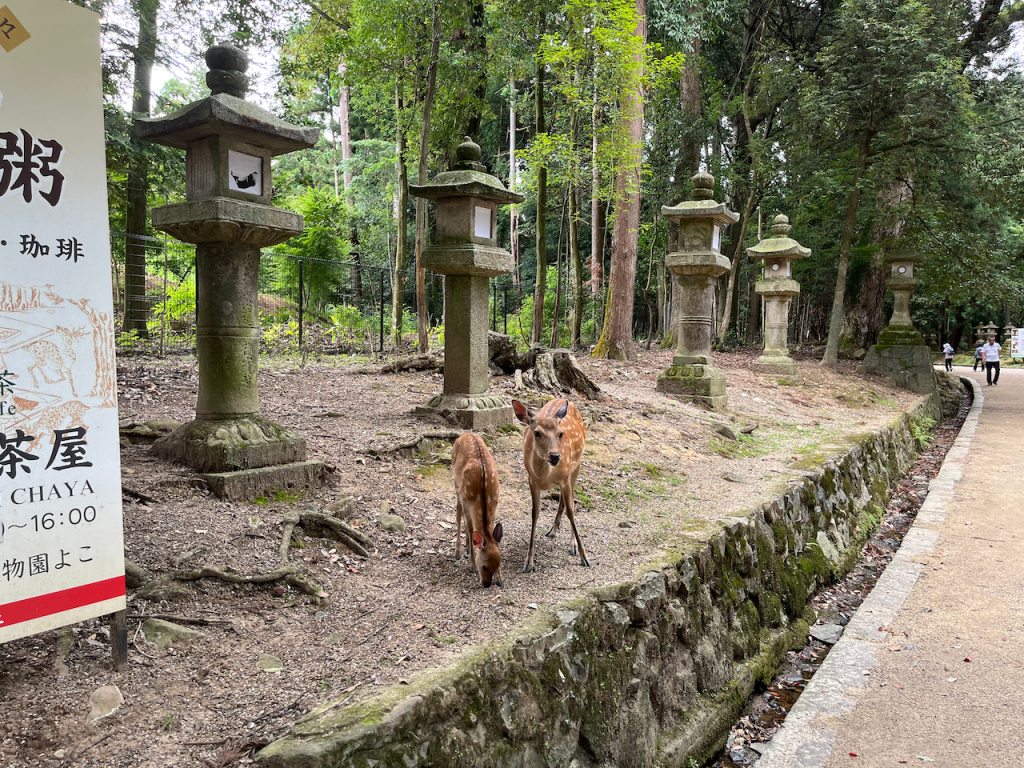
A pair of Nara Deer hanging around near Kasuga Grand Shrine in Nara. Taken in July 2023.

While visiting Kyoto and Nara recently, I started to pick up on some differences in Japanese language that took me a bit off-guard. I am not fluent in Japanese, but I consider myself functional (i.e. “good enough”), and since my wife is from the Kanto region around Tokyo, I’ve gotten used to Tokyo-style Japanese.

I know about Kansai-dialect since it’s often used on TV and comedy, but what I didn’t know is that places like Kyoto and Nara have their own sub-dialects, too within the Kansai dialect.

Kyoto Dialect

At Kyoto Station I often saw signs read おこしやす (okoshiyasu) which is the Kyoto way of saying welcome!

Other phrases often used include:

  • Okini – a Kansai-dialect way of saying arigato! (Thanks!)
  • Oideyasu – similar to the Tokyo-area phrase irasshaimasé this is how shops welcome customers when they first step in.
  • Dosu – this is another famous Kyoto-ism that replaces the standard Japanese desu.
  • Agaru / Sagaru – the verbs for “going up” (agaru) and “going down” (sagaru) can also mean going north and south respectively in Kyoto dialect.
  • Verb + よし – similar to standard Japanese command -なさい, this is an informal way of telling someone to do something.
  • Omaku – a colloquialism for a pillow (compare with standard makura).
  • Ohana ni iku – a phrase used when someone is heading for a tea party, a banquet, or other similar social functions.
  • Aisa ni – similar to standard Japanese phrase tokidoki (“sometimes”, “occasionally”).
  • Yasukenai – something unrefined or in poor taste. Similar to standard Japanese shina ga nai.
  • Yayako – a Kyoto word for “baby”.
  • Hona – a phrase for “goodbye”.
  • Kibaru – same as Japanese ganbaru, which is a key phrase to learn in Japanese.

Nara Dialect

I found, as a foreigner, Nara dialect a little hard to pick up in my experience. While Nara was once the capital of Japan a long, long time ago it is a pretty rural part of Japan now. Japanese spoken there differed somewhat from the “standard” Kansai dialect most people know. It is often described by other native Japanese speakers as a “cuter version” of Kansai-dialect.

One interesting aspect of Nara dialect is that “z” sounds are replaced with “d” sounds. For example the word for elephant, zōsan, becomes dōsan.

Another example is the colloquial ending yayo which replaces Tokyo-style dayo. Endings like yasu and mi are also used too, in place of standard ending ne.

Information in English about the Nara dialect is pretty slim, so I don’t have a good list of specific phrases, unlike Kyoto dialect.

Revisiting Ryoanji

A while back, I talked about a famous Rinzai-sect Zen temple named Ryoanji that my wife and I had visited in 2005, shortly after we got married. During our latest trip to Kyoto (mentioned here and here), we got to see Ryoanji again, and this time, armed with a better camera, better weather, and more background knowledge, I was able to better appreciate the visit.

The temple was founded shortly before the disastrous Onin War, a grinding, destructive urban war that ravaged the city of Kyoto over a succession dispute, and ironically the founder of the temple was one of the major combatants, Hosokawa Katsumoto. The temple of Ryoanji was an active monastery for a long time, a second-tier temple in the Five Mountains system in the 14th century, a hierarchy of Rinzai-Zen temples patronized by the Shogunate at the time, but tourism has pushed out the original monastic training to other temples, or other parts of the complex.

Historically, like many Zen temples of the Five Mountains System, Ryoanji got tangled in politics and urban life at the time, for better or for worse,1 but even so, it was clear that over the generations, the temple community there cared about Zen and tried their best to put things into practice and that love and care showed even now.

Today, Ryoanji is best-known for its “Zen garden” or karé-sansui (枯山水) in Japanese. You might have seen pictures of it before, but seeing the real thing is pretty interesting. On the one hand, it’s surprisingly small, but on the other, there’s an ineffable feeling when you are there. There are plenty of theories about who designed the famous “garden”, but there’s no clear evidence one way or another. So, it’s design and history remain a mystery.

The temple itself is fairly small, but is part of a large, secluded area north of Kyoto. You can see a map of the complex here:

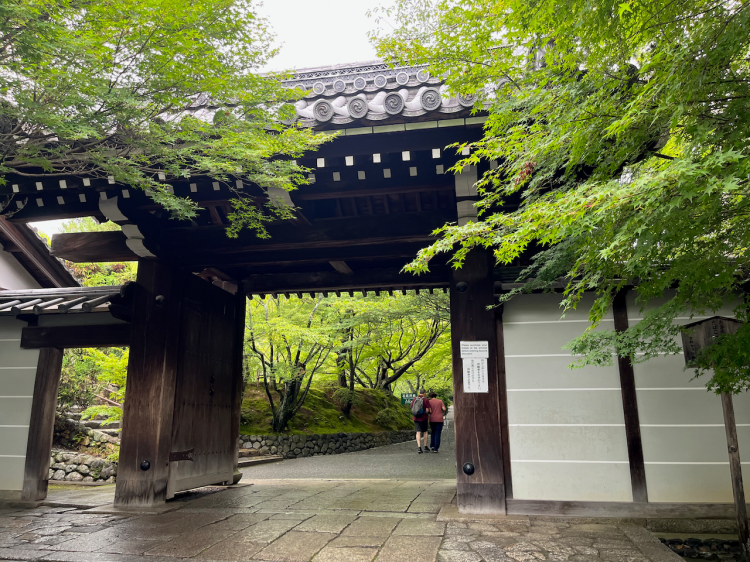
It was hot and muggy that day, and my gout, which thankfully only flares up rarely,2 was in full swing, so walking was quite painful. Nevertheless, we had already booked the tour, so we soldiered on. Ryoanji, after the chaos and traffic of other places, was a welcome respite. This is the main gate, which is shown on the map above at the bottom-right.

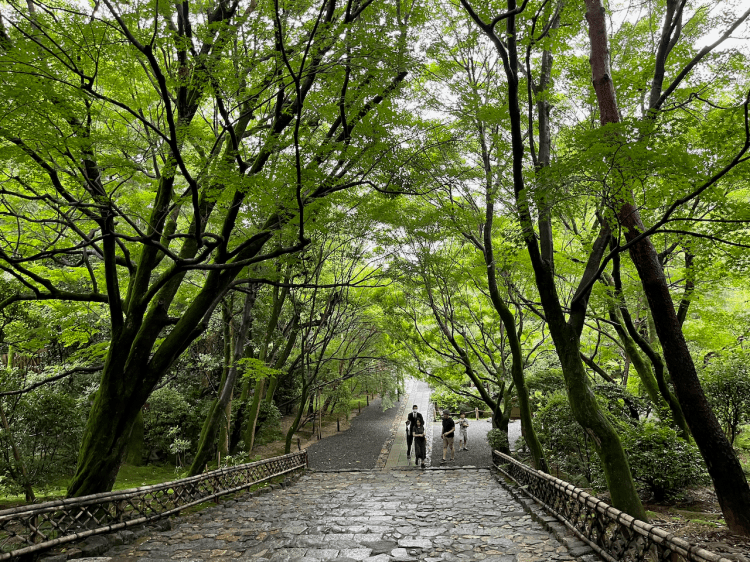
Ryoanji has a large garden area before you get to the temple itself:

From here, you come to the temple complex itself:

I vaguely recall that this was the “kitchen god”, a minor deity venerated to prevent fires in the kitchen. The first room of the temple, before you get to the garden, was formerly the kitchen, if I recall correctly.

And finally, the temple opens up to the famous sand garden:

More pictures here:

It seemed to be a fairly quiet day at Ryoanji, so we had a chance to sit down on the veranda and admire the view for a bit. The last time I came in 2005, the garden was snow-covered, so I didn’t really get to see much (but still a great experience in its own way):

Me, February 2005 at Ryoanji, with no idea what I was doing. 😅

Much has been discussed about the garden, the symbolism of the particular rocks, the use of the Golden Ratio in its proportions, etc., but for me, it was just neat to see in person. As I said earlier, there’s an ineffable feeling when you’re there. Amidst the chatter and people shuffling around, you

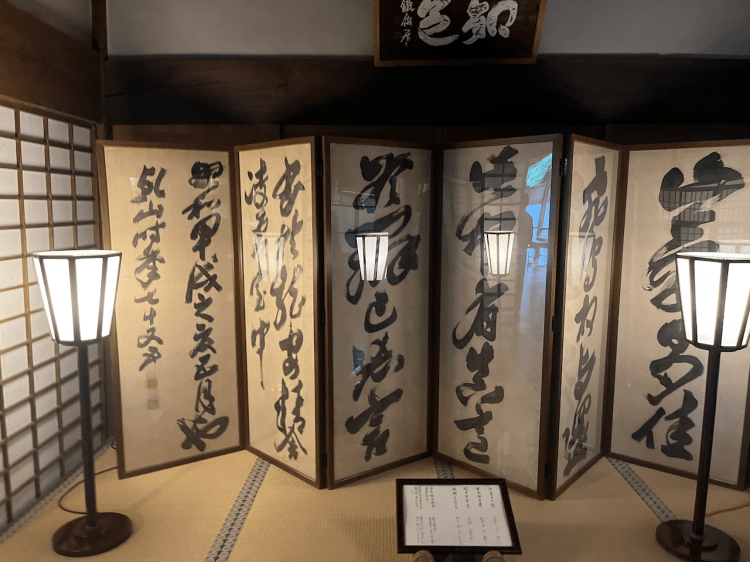
Just behind the veranda are also some black-ink murals:

From there you see the famous tsukubai, though since I didn’t have a photo this trip, here is the same thing from 2005:

The tsukubai has a square opening in the middle, and Chinese characters (kanji) on each side. The square, combined with each Chinese character form different Chinese characters, forming the sentence: 吾唯足知 or waré tada taru (wo) shiru, meaning something like “I only know contentment”, or rather more loosely, “Just as I am, I am sufficient”.

From there, visitors loop around through the garden again on the other side, which is very peaceful:

Here’s me and my teenage daughter being silly, imitating a funny Japanese comedy duo named EXIT (ポンポン!):

From here, we went to the gift shop near the exit, where I picked up a nice little incense holder,2 and of course some incense.

Ryoanji isn’t as big a tourist draw in Kyoto as some other temples, but to be honest it was a really nice experience. The quieter atmosphere, the slower pace, and the amazing art really made an impression on me more than the whirlwind experiences we had at other temples that day. Even as it hurt to walk constantly, I still felt a sense of calm and peace I hadn’t enjoyed in a while.

It reminded me of a similar experience I had back in Victoria BC, where I felt a sense of calm and clarity and a healthier perspective on things that stuck with me upon my return to the US. This might sound silly or New Age-y, but as a Buddhist for almost 20 years now, amidst the constant distractions of life and struggles with practice, the chance to stop and gain a different perspective for even a couple of hours, every so often is really valuable. Ryoanji was an unexpected highlight of the trip for me, and someday I hope to go there again.

P.S. I’ve been really heads down working on the other blog lately, plus also dealing with plenty of parental and work issues, so I am somewhat behind on blogging.

1 The famous monk, Ikkyu, grumbled about this quite a bit. Then again, Ikkyu wasn’t a saint himself. 😉 Like the Buddhist temples of the earlier Heian Period, the Zen temples of the Ashikaga Shogunate tended to be lax in monastic discipline, host parties with nobility, and get into all sorts of disreputable behavior. Besides Ikkyu, I am sure there were more serious-minded monks, but then again with any religion anywhere across history, given a sufficiently large community, you get a spectrum of saints and scallywags. Such is Humanity.

2 Rarely enough that I can avoid taking prescription medication, and focus on eating a healthier diet, plus lots of water daily. Weight loss has also helped.

3 I have some incense from Japan from previous trips, but my Western incense holders do not properly fit, so the incense tends to lean or fall over. Different holders for differently-sized incense.

The Golden Rules of Japanese Grammar

Much has been discussed over the years about how difficult Japanese language is to learn, especially the writing system.

That’s how I felt for a long time, but I eventually had a moment of clarity and realized that Japanese grammar is internally consistent and straightforward, like Latin. However, those grammar rules are considerably different than English or other European languages, which is where people often get hung up.

So, what follows are, in my opinion, the basic rules that govern Japanese grammar. My hope for you is that in understanding these rules, Japanese language doesn’t seem so hard to comprehend. I call these the Golden Rules of Japanese Grammar.

Note: knowing how to read hiragana is a big help, worth doing anyway if you’re serious about learning Japanese. This article assumes you know how. If you want to study Japanese, but still don’t know hiragana, please stop and review first.

  1. The main verb comes at the very end. No matter how long, or how short, a sentence is, the main verb is always last.
  2. The copula です (polite) or だ (informal) can be a placeholder for the final particle + verb, where appropriate.
  3. The final verb/copula determines the tense (past, present, ongoing, etc) of the whole sentence.
  4. Verbs modify nouns directly: べているいぬ (the dog that’s eating)
  5. Adjectives modify nouns directly, or with a な in the case of “na-adjectives”: 可愛かわいい犬いぬ (a cute dog), or しずいぬ (a quiet dog).
  6. Nouns can modify other nouns using the の particle: ジムのほん (Jim’s book)
  7. Adverbs always come just before the verb. Amounts count as adverbs, too. ウサギうさぎが3える。(I see three rabbits)
  8. Verbs usually come in pairs: a transitive one (that does something to something) and an intransitive one (something is). The transitive one usually uses the direct-object を marker, the intransitive verb uses either に or が particles.
  9. Intransitive verbs describe things, describe ongoing state. コップこっぷちている。(the cup fell down/ has fallen down, not “is falling down”).
  10. Many things are expressed as nouns, including grammar points.

This is definitely not a comprehensive list, and like any language, grammar is complex and varied, but if you remember the patterns above, you’ll be surprised how often you see they reappear over and over.

Using the example above from my old Anki flashcards, the grammar point わけ behaves like a noun, with the verb かえ directly modifying it. Even if you are learning this grammar point for the first time, you can see how it fits into the rules described above.

Good luck and happy studying!

P.S. this is how you write furigana in WordPress, if curious.

Understanding Japanese Kanji

The kanji poster hanging in my son’s room since he was a little boy, product by Kumon.

The Japanese writing system is … complicated.

Japanese as a language isn’t particularly difficult, no more or less than other languages, but its writing system demands considerable time and investment to really get comfortable with. Written Japanese comprises of a mix of a few different things:

  • Hiragana syllabary1 – This is the default way of writing Japanese, and what most people, including kids in Japan, learn first. Note that hiragana characters are “syllables” not letters. One sound equals one hiragana character.
  • Katakana syllabary1 – The katakana is a 1:1 analogue to hiragana. In other words, every hiragana character has a corresponding character in katakana, but katakana looks more “blockey”, less flowing, than hiragana. It is most often used with foreign words, Buddhist mantras, or just for impact (e.g. sound-effect words in manga).
  • Chinese characters – Also known as kanji.

A typical sentence might look like: 今日ズボンった。Everything in blue is kanji, everything in red is katakana, while everything else is hiragana. I’ve spoken about the hiragana syllabary (part 1, 2 and 3) already, and katakana is similar enough that it does not require a separate article. So, today we’re just covering the use of Chinese characters or kanji.

Historically, China’s neighbors, such as Korea, Japan and Vietnam spoke languages that are both very different than Chinese, yet they wanted to import Chinese technology and culture. When they imported the Chinese writing system, however, it wasn’t an simple fit. Native words sound very different than Chinese, and sounds in Chinese language don’t always exist in the native language. Thus, Chinese characters’ sounds change when they’re imported.

Returning to Japanese language, the word for Japan in Chinese characters is 日本. In modern, Mandarin Chinese this is pronounced as rì běn, but in Japanese it’s pronounced as either nippon or nihon.2 This YouTube video helps illustrate the process:

You can see how the process of importing Chinese characters into Japanese was very organic. The result is that there are often many ways to read a Japanese kanji character, depending on whether it’s read in a native Japanese way, in a Sinified (Chinese) way.

The native way, or kun-yomi, is most often used for standalone words (not compound words), people’s names, place names, and verbs. For example, the kanji is read as yama in the native way. When talking about a mountain, or in someone’s name such as Sugiyama, you would most likely see this native pronunciation.

However, the Sinified reading of this kanji is san or zan . This is the on-yomi reading, which you might see in a compound word like 登山 (tozan) for mountain climbing. It’s the same kanji character, but now it’s read as “zan” instead of native “yama”.

If you look at my son’s kanji poster above, you can see for each kanji there is a mix of kun-yomi readings and on-yomi readings. Some kanji (夕) have maybe only one reading. Some (下) have seven or more! It all depends on how it was imported into Japanese, and how it’s applied in the language over the centuries.

So, inevitably the Japanese language student asks: how am I going to learn all this kanji?!

Short answer is: you don’t.

Beyond maybe the first 100 kanji, the amount of time and effort to memorize the kanji rapidly becomes untenable, and you get diminishing returns. How many kanji have an on-yomi of shō ? A lot, too many to remember which is which. Also, the further along you go, the more obscure and specific kanji get, so the returns worsen over time. They’re important, but show up in increasingly specific contexts.

Further, using mnemonics or pictures to learn the kanji is only useful when the kanji actually looks like something, which is mostly the basic kanji only. The aforementioned 夕 does look like a moon at evening, so mnemonics work. But what about 優?3

Don’t get me started on the Heisig method. It’s a useful way for learning how to break down Kanji into discrete bits, but beyond that it doesn’t provide much value for the amount of work required.

No, the only way to learn kanji is to not learn them individually.

Instead, focus on building your vocabulary, and learn the kanji as they come up. I talked about this a while back as the “convergence method” but there’s no magic here. As you learn more vocabulary words, certain kanji come up often, and you’ll learn to anticipate their readings in future words. Sometimes you get it wrong, and that’s OK, other times you nail it perfectly.

But there is one other feature of Japanese you should leverage often: furigana.

Furigana is a reading aid often used for younger readers, and for language students by putting reading hints just above the kanji characters. For example lets look at the sentence above now using furigana: 今日きょうズボンった。

This is much easier to read. It still flows nicely in Japanese, but now we have the pronunciation hints (written in hiragana) right above each kanji.

If you find yourself embarrassed for relying on furigana, don’t be. This is how grade-school kids in Japan learn to read. This is how my kids (bi-racial Japanese-American) here in the US learned to read Japanese. In time, after seeing the same word 50 times, the reader doesn’t even need the furigana anymore, and can read without it, but it helps smooth the transition. When I was learning to ride a bike as a kid, I relied on training wheels, but as my confidence grew, I could ride without using them. The training wheels were still there, but I was riding more and more steady, so I hardly noticed when my dad took them off.

So, the key to reading Japanese well, including kanji, is to read native media that uses furigana. Many manga for younger audiences (including my favorite Splatoon manga), use furigana for all kanji characters and it makes the process of reading, plus looking up unfamiliar words, much easier. Even adult media uses furigana to help with more advanced, obscure words.

The point of all this is that learning kanji isn’t a slog of memorizing hundreds or thousands of characters, it’s more about learning to read vocabulary, preferably using native media. The latter approach is way more fun, and actually provides value in the long-run versus memorizing a bunch of kanji in isolation, then forgetting everything.

Chinese characters are great, and convey a lot of things that alphabetic systems can’t, but they are also pretty complicated and require considerably more ramp-up time.

P.S. if you use WordPress, this is how you add furigana to your Japanese text.

1 These are syllabary, not alphabets, because each character represents a full syllable, not a single consonant or vowel.

2 Side note, 日本 was used in other countries, like Korea and Vietnam, and their pronunciation differed too. Korean language pronounces it as Ilbon, while in Vietnam it’s Nhật Bản.

3 Confusingly enough, same pronunciation as 夕, by the way.

Liturgical Language and Start-up Buddhism

Warning: this is a rant post.

Although I have happily taken up with a local Soto Zen group in my area, one of the first challenges I’ve noticed is that the group is probably 99% white, and have little or no knowledge of Japanese culture or language, despite the tradition they’ve inherited. This came into stark view when one the teachers, a very nice elderly man, proudly showed some Zen calligraphy that his teacher had composed for him. I could read it, but when I explained how it’s read in Japanese, he simply gave me a confused look.

Further, another peculiarity is that we almost always recite Buddhist liturgy in English. Hearing the Four Bodhisattva Vows chanted in English frankly feels a bit odd to me, though I have gotten used to it. Teachers also frequently mispronounce basic Japanese-Buddhist terms, which is a bit grating for a language student myself.

But then I started thinking about it: am I right to criticize the lack of grounded tradition, or am I just being a Japan-snob? Am I just nit-picking a bunch of minor things while ignoring the positives?

First, I admit I am a giant Buddhist-Japan nerd. I’ve devoted a significant chunk of my life to these two subjects, written more than one blog about it over the span of 15 years, read countless books and updated more than a few articles on Wikipedia. So, my perception of things may be rather skewed. It’s like one of those snobs in a sushi restaurant who insists that “it tasted better in Tokyo”. That’s me sometimes. I have to occasionally stop and remind myself “dude, you’re a huge nerd”.

Further, the Buddha in his own time, taught his disciples in the vernacular languages of the time (Pāli being a kind of lingua franca back then) and encouraged his disciples to continue teaching in whatever local languages were suitable. There was no “holy language” or “liturgical language” in the early Buddhist community. In fact the Buddhist teachings weren’t preserved in Sanskrit, by this point a literary language in India, until centuries later.

So, reciting Buddhist liturgy such as the Heart Sutra or the Four Bodhisattvas in English, even when it sounds a bit clunky, is both practical for disciples in the US, and less intimidating for new students. Expecting students especially new students, to know what Sino-Japanese (Classical Chinese preserved with Japanese pronunciation) is is admittedly unrealistic.

I suppose this is like liturgical language in Christianity. A pious person might wish to read the words of Jesus in the Bible in the original Koine Greek. A lot of Christians wouldn’t necessarily devote the time to do this, but they still go on to be pious, god-fearing Christians. Different people express their faith in different ways.

In the same way, I consider myself a pious Buddhist, so for me, studying and reciting the sutras as they are best preserved, in Classical Chinese, makes sense. Maybe it’s not for other people though. So, when you think about it, who am I judge other Buddhists based on their grasp of other languages?

Still, in spite of all this, the one thing that continues to bother me is the lack of appreciation for, and shallow understanding of, the tradition that we white Buddhists have inherited. When I read Xuanzang’s lament about the state of Buddhism in China at the time in the 8th century, and the need to go all the way India to bring more teachings and knowledge, I empathize with this.

From one shore to another. Speaking of shores

Buddhist immigrant communities here have maintained a continuous, unbroken tradition from the beginning, passing from generation to generation, in spite of discrimination and challenges adapting to a new culture. By contrast, a lot of start-up Buddhist communities in the US feel somehow half-baked: people trying to imitate “how things are done in Asia”, but there are just some things that can’t be transmitted through books sold at Barnes and Noble. Sometimes those “cultural accretions” that white Buddhists gripe about in their quest for “pristine Buddhism” exist for perfectly good reasons, and enrich the tradition, not detract from it. The problem is when white Buddhists don’t understand something and just write it off as unnecessary. I used to do this too when I first met my wife, now I see things pretty differently.

I was prompted to write about this after an acquaintance told me recently that they used to go to the same community “for the meditation”, and had since moved on to transcendental meditation. That was disappointing thing to hear, and makes me question her motives in the first place. It’s frustrating to hear things like this.

Then again, when I am in Japan and I visit a famous historical site, knowing the history of it, and the dramatic events that happened there, and yet others shrug it off, it frustrates me too. So, sometimes I really think this is just a bunch of snobbery and all in my head.

However, setting aside my self-centered and selfish feelings on the subject, I do think that’s important to keep sharing information, translating things as best as I can, and bridging the cultural gaps. If Buddhism continues to prosper in the West, and beyond, then things will look very different from now, and hopefully more mature (not to mention diverse) too. The little seeds we plant now can have big effects for others we will never see.

P.S. The second chapter of the Lotus Sutra has a verse related to this:

[Even] If persons with confused and distracted minds
should enter a memorial tower
and [only] once exclaim, “Hail to the Buddha!”
Then all have attained the Buddha way.

Translation by Burton Watson