A Medieval Buddhist Revolution? The Ikko-Ikki part three

A Japanese mural depicting the Battle of Azukizaka in 1564. In this mural, multiple samurai warriors, carrying banners are combatting one another, so that it is difficult to tell who is who.

This post is part three of three four exploring the Ikko Ikki. You can find part one and part two here. We have seen in part two Rennyo’s involvement in the rapidly growing Jodo Shinshu community, and how the seeds of conflict first began as a succession dispute between local samurai warlords. In this post we’ll see how things go off the rails…

The Ikko-Ikki rebellions are remarkable as being the one time in pre-modern Japanese history where a peasant uprising not only succeeded, but successfully carved out a region of Japan that was ruled by the masses, and not by military samurai, nor the old aristocracy from Kyoto. The binding influence of the uprising was a strong affinity to a certain Buddhist sect, the Jodo Shinshu (浄土真宗, “True Pure Land Sect”), but there was more to the Ikko-Ikki than a “rebel cult” as some labeled them.

Information in English about the Ikko-Ikki is sparse, and often misinformed. I am happy though to have obtained a copy of Dr Carol Tsang’s excellent book War and Faith: Ikko Ikki in Late Muromachi Japan (publisher link), covers the Ikko Ikki, who they were, and their relation to the Jodo Shinshu sect. It’s been a fascinating read even for an old “history nerd” like myself.

Now on with the show…

Succession Crises and Retirement

The beginnings of organized conflict by the Ikko-Ikki began when the succession crisis between the Togashi brothers began in part two. As neither side could decisively destroy the other, and began to enlist more and more locals to help.

Masachika, as we saw previously, recruited from the Jodo Shinshu followers (a.k.a. the Honganji sect) of Yoshizaki, while his brother, Kōchiyo, recruited elements of the local rival Takada sect of Jodo Shinshu. Both communities formed ikki societies vowing to fight and help their preferred claimant to succeed.

Needless to say, in 1474 Masachika was ultimately victorious, but as Dr Carol Tsang notes, he did little to reward the Honganji ikko-ikki for their support. This did not go well with the Honganji followers. Dr Tsang shows that documents while somewhat scarce, and confusing, demonstrate how Honganji followers protested the ungrateful military rule, but were then brutally suppressed in 1475. It’s unclear if the uprising had any approval, let alone knowledge, by Rennyo the 8th Caretaker. There is evidence however, that his advisor Rensō had some involvement, and was expelled by the Honganji later. Being expelled or shunned by the sect was a virtual death-sentence for such a person because of the loss of community support.

Rennyo had worked hard to avoid a violent image to the Jodo Shinshu sect, yet the uprising in 1475 cemented the image of the ikko-Ikki as violent religious fanatics. Rennyo for his part left Yoshizaki that same year, reportedly under the cover of night, and travelled to nearby provinces such as the town of Deguchi in Kawachi Province, and then later returning to Ōmi Province of his youth at a place called Yamashina. By 1480 he settled at Yamashina and lodging was built there for him. Soon after a new Honganji temple, called Yamashina Honganji (official homepage here) was built and completed by 1483. It is noteworthy that this temple was designed to be militarily secure, with earthworks, moats and so on. Such where the times they lived in.

While this happened Rennyo chose his firstborn son by his second wife, Jitsunyo (実如, 1458-1525), as the next Caretaker of the mausoleum after his firstborn son (Junnyo) by his first wife had died that year. We will meet Jitsunyo again in a later post.

Overthrow

Meanwhile, after 1475 the ikko-ikki of Kaga Province not only rebelled and refused to send tax revenues, other neighboring communities started doing the same. In Etchū and Hida Provinces next door, refugees from the 1475 uprising had setup communities, and several uprisings are recorded at this time, though documents are pretty thin on what happened. The Honganji followers were able to resist crackdowns by samurai overlords because the local ikko-ikki groups formed powerful alliances that assisted one another in times of need. The sense of shared religious identity, plus religious belief they were only doing what was right, set them apart from other mundane peasant uprisings.

As the ikko-ikki groups took over and divided up territory amongst themselves, they took on increasing administrative responsibility, often county (gun 群) by county. Until the year 1530, these ikko-ikki groups did not answer to the Honganji, and acted semi-autonomously. One of these ikko-ikki might seize land from the landowners in Kyoto, another neighboring ikko-ikki might settle tax disputes between its landowner and local peasants. It was all over the map. The military establishment would sometimes lean on the Honganji leadership (i.e. Rennyo then later Caretakers) to exert pressure on these groups if needed, but otherwise the local ikko-ikki groups ruled as they pleased, independent of one another, sometimes they even threatened the Honganji for interfering. There was essentially no functional central authority in Kaga Province.

In any case, the conflict in Kaga came to a head by 1488, Togashi Masachika had burned enough bridges with supporters that they rose up and overthrew him. This included members of the Jodo Shinshu Honganji sect (ikko-ikki), but also his samurai retainers and other non-religious ikki groups. He was widely unpopular, and people had enough. Masachika had been away for a time helping the Ashikaga shoguns on a campaign (i.e. currying favor with the central authorities), when a full-blown rebellion erupted. Masachika, hurried home, but was besieged at Takao (高尾城, takōjō) Castle.1 Try as he might, Masachika was unable break the siege, and within days, Masachika’s remaining forces were overwhelmed and destroyed. Masachika was no more.

Once the dust settled, Masachika’s uncle, Togashi Yasutaka, was installed as the governor.

Dr Tsang explains that there are two noteworthy things about the downfall of Togashi Masachika:

  1. The rebel army wasn’t comprised of peasants, but large section of the province’s population, from lowly social outcast communities (tanners and such), to Masachika’s own family and retainers. It wasn’t a “peasant rebellion”, but a broad coalition.
  2. During the wars in 1473 and in 1488, the Ikko-Ikki played a major influence in deciding who would govern the province. This kind of popular sovereignty (or at least popular influence on sovereignty) had never really existed in Japan before. In the classical period (aka the Heian Period) it was a bureaucratic aristocracy. Under military rule of the Shoguns, it was a feudal system based on grants and titles. Now, for the first time lower class people in the province were actively weighing in on who should govern.

However, this was only the first phase of the Ikko-Ikki. As we’ll see in part four (yes, series keeps growing…), the ragtag groups would grow even stronger in later generations.

Aftermath

Something to note here is that Rennyo had very little to do with these uprisings in Kaga province. Although his proselytizing efforts greatly increased the popularity of Jodo Shinshu-sect Buddhism in the countryside, and in so doing, helped forge a common identity that allowed the ikko-ikki to form such large communities, he was never involved in these uprisings, and would find out about it later since he was in a different province. Further, when chastised by Rennyo, the ikko-ikki paid little heed. They were fed up, and going to rebel anyway. The genie was out of the bottle, in other words, and Rennyo couldn’t put it back.

Nevertheless, the central authorities in Kyoto didn’t see it that way. Rennyo took a lot of blame for his “unruly followers” and was pressured to write a letter castigating them for their actions. The letter did little to change the situation, and by 1489, Rennyo retired as the Caretaker of the Honganji mausoleum, allowing his son Jitsunyo to take over. It was an ignominious ending for someone who had otherwise made huge contributions to Jodo Shinshu Buddhism and Japanese Buddhism as a whole.

P.S. I couldn’t find any cool historical photos from this particular era. Historical documents and evidence seem to be pretty thin based on Dr Carol Tsang’s book, so there isn’t much media or art. There would be plenty of artwork depicting the Ikko-Ikki in later generations.

1 The castle is no more, but you can see photos of the park here. I am also a bit confused by the name as it should be read as Takao (高尾), but the pronunciation, as listed in Japanese sources is Takō. Call it a quirk of Japanese language, I guess.

Picture Sutras

Speaking of sutras, while reading about the Heart Sutra in Japanese, I learned about an interesting trend in the late-medieval “Edo Period” (17th through 19th century) called eshin-kyō (絵心経), or “picture Heart Sutra”).

An example of a “picture Heart Sutra” from 1795 (photo taken in 1922), composed by physician Tachibana Nankei in his travelogue Tōyūki (東遊記, “Journey to the East”), Public domain, via Wikimedia Commons

The idea was to make the Heart Sutra, a brief, but important and very popular Buddhist text, readable by illiterate peasants using a kind of rebus. The pictures above, to a native Japanese speaker of the time, would evoke certain words, which matched syllables of the sutra. For example, a few I can pick out:

  • The demon-looking character is a Hannya (mentioned here), hence hannya.
  • The pregnant woman with a baby is hara, as in a the torso.
  • The five vertical lines is go as in the number five.
  • The upright sword is ken.

This is just one example. It turns out that there’s many different versions, using slightly different pictures and styles. According to this blog, the origin of these picture sutras was a man named Zenpachi (善八). During the Genroku Period (mentioned here and on the other blog), a high-water mark of Japanese (especially Tokyo) culture, Zenpachi wanted to make Buddhist teachings easier for kids to understand and helped devise these pictures.

What’s interesting is that the tradition continues to this day, as seen in my Heart Sutra totebag my wife picked up.

This version is very cute, and of course has hiragana pronunciation guides just in case, but I think it’s a clever way to keep the Buddhist tradition alive.

P.S. moved this to Friday to make up for the accidental double-post on Tuesday and space the content out. We’ll be back to Monday-Thursday schedule starting next week.

A Medieval Buddhist Revolution? The Ikko-Ikki part two

Lately, I’ve been enjoying a fantastic history podcast called Grey History, covering the French Revolution in detail. While enjoying this show I started thinking about a famous peasant uprising in medieval Japanese history called the Ikko-Ikki rebellions of the 16th century.

The Ikko-Ikki rebellions are remarkable as being the one time in pre-modern Japanese history where a peasant uprising not only succeeded, but successfully carved out a region of Japan that was ruled by the masses, not by military samurai, nor the old aristocracy from Kyoto. The binding influence of the uprising was a strong affinity to a certain Buddhist sect, the Jodo Shinshu (浄土真宗, “True Pure Land Sect”), but there was more to the Ikko-Ikki than a “rebel cult” as some labeled them.

Information in English about the Ikko-Ikki is sparse, and often misinformed. I am happy though to have obtained a copy of Dr Carol Tsang’s excellent book War and Faith: Ikko Ikki in Late Muromachi Japan (publisher link), covers the Ikko Ikki, who they were, and their relation to the Jodo Shinshu sect. It’s been a fascinating read even for an old “history nerd” like myself.

This post is part two of three exploring the Ikko Ikki, of which part one is here. We can’t talk about the Ikko-Ikki until we cover the life of the 8th-generation Caretaker (monshu, 門主) of the Honganji mausoleum: Rennyo.

I originally intended to do only two posts, but as I wrote this one I realized there was too much interesting detail, and now it has split into three.

Enter Rennyo

As we saw in part one, Jodo Shinshu had somewhat unorthodox origins as a fully lay-oriented sect of Buddhism, through the work of Shinran in the 12th century. Shinran like many disciples of Honen, had been exiled and defrocked. Shinran took this in stride, married, and continued to spread the Pure Land Buddhist teachings he had learned from Honen to provincial people until we returned from exile and died in Kyoto.

His mausoleum (later called the Honganji temple) was managed by his descendants for generations. Like other families in medieval Japan (and other medieval societies), marriages by Shinran’s descendants were arranged to help benefit the family political, economically, etc. These descendants managed the mausoleum, while also building powerful alliances with samurai clans, or influential disciple families in the provinces. Some even married into the aristocracy in Kyoto. Shinran’s various disciples in the provinces went on to found various sects of Jodo Shinshu, while the Honganji remained significant, but not very influential.

By the time of the disastrous Onin War in the 15th century, Rennyo (蓮如, 1415–1499) had been born to the 7th generation caretaker Zonnyō (存如, 1396–1457).1 His mother was of unknown origin, but it is thought that she was a maidservant of Zonnyō, and thus politically risky. She was sent away, and Zonnyō married a woman named Nyoen from an influential family. Rennyo and his step mother did not get along well, and suffice to say, there was a succession struggle between him and Nyoen’s son, but Rennyo won out in the end thanks to the powerful Hino clan (the same clan that married into the reigning Ashikaga Shoguns). Rennyo had also, as per tradition in the family, spent time training at Kofukuji temple in Nara, and could claim some tenuous connections to the prestigious Fujiwara clan through the Kujō cadet branch.

As Jodo Shinshu grew in influence, problems between the community in his native province of Ōmi, near Kyoto, and the powerful Tendai sect arose. Ostensibly, this was due to perceived heresies by the Jodo Shinshu sect, but there’s plenty of evidence that the Tendai sect viewed the growth of Jodo Shinshu as an impact to their fiefdom revenue. Before long, armed conflict with the Tendai sects warrior-monks arose, and the Jodo Shinshu community suffered greatly. The community attempted to fight back, organizing defenses (a forerunner to later Ikko-Ikki armies), bribing the Tendai sect to back off, etc, but the Tendai persisted.

Ministry At Yoshizaki

Bronze statue of Rennyo at the remains of Yoshizaki Gobō temple. Photo by
藤谷良秀, courtesy of Wikipedia.

Rennyo decided it was safer for everyone involved for him to leave, and eventually he retreated to a remote village named Yoshizaki (吉崎) in the province of Echizen in the year 1471. Yoshizaki had a number of advantages, including a large, existent community of Jodo Shinshu followers, distance from Tendai-sect centers of power, and political remoteness, and yet it was on a coastal trade route so it was prosperous too. Soon a temple, now known as Yoshizaki Gobō (吉崎御坊) was founded the same year. The official website (Japanese only) for Yoshizaki Gobō has some neat photos and illustrations, though bear in mind that the original temple was destroyed 1506, and reconstructed centuries later.

It was here that Rennyo and his proselytizing work really took off.

For context, Shinran the founder (and Rennyo’s ancestor) had lived in exile in the eastern provinces and spent much time there teaching the Pure Land am faith as he understood it. Even after he was pardoned and returned to Kyoto in his final years, the communities out in the principles (i.e. his disciples) continued for generations, each in isolated pockets. These communities grew and diverged gradually, but were always more numerous and influential than the Honganji branch under Rennyo’s ancestors.

Thus, when Rennyo showed up, things were a little tense. A major regional sect was the Takada sect (shinshū takadaha, 真宗高田派) which still exists today. I spent a weekend trying to figure out how the Takada sect’s version of Jodo Shinshu differed from the Honganji sect, but couldn’t really find any “ah ha” moments. They both revere Shinran, both recite the nembutsu, both revere Amida Buddha, etc., so the differences feel like they are mostly administrative and liturgical. Jodo Shinshu without the Honganji, in other words. The question, it seems, was basically who had the final say on doctrinal matters.

Rennyo’s Letters

Rennyo was a very active letter writer and these letters (ofumi, 御文) were instrumental in helping to strengthen and clarify the message and build relationships with local communities. I’ve talked about the most famous letter, the Letter on White Ashes, before, but I can say with personal experience that Rennyo’s letters overall are quite good and helpful in clarifying Jodo Shinshu teachings. You can find a collection of them here. I highly recommend reading the letter On Pilgrimage in the Snow (number 6 in the link above).

Side note: these letters (formally called the gobunsho 御文書), were compiled by later generations and are now an important part of Jodo Shinshu liturgy. When my mother-in-law passed away, and we attended her first year memorial in Japan, our local priest (a family friend) recited the Letter on White Ashes, after we recited Shinran’s hymn, the Shoshinge. That’s how important they are. You can see an excellent example of this here on Youtube:2

Within years, Yoshizaki grew to a much larger community, and Rennyo clashed with other existing Jodo Shinshu sects, while also reforming liturgy and standardizing aspects of the faith. Much of these power struggles at the time had as much to do with politics as they did doctrine.

For example, the aforementioned Takada-sect was allied with one Togashi Kōchiyo warlord who was in a bitter feud with his brother Togashi Masachika. The battles for rulership of Echizen and Kaga provinces spilled over into Yoshizaki when the defeated Masachika showed up to recruit members and rebuild his forces. Thus a local ikkō-ikki was formed to assist him.

As we’ll see, this was only the beginning …

P.S. I posted this too early on accident. Please enjoy, and apologies for any typos.

1 random and useless factoid – Rennyo was alive during the final days of the Eastern Roman Empire, and roughly contemporary with its final ruler, Emperor Constantine XI Palaiologos. Of course, Japan and Constantinople didn’t really know of one another. Still, it’s weird to think how both historical events were going on roughly at the same time.

2 The language of the gobunsho letters feels archaic now to a native Japanese speaker (or a language nerd like me), but at the time, this was how people spoke, and thus it was very accessible compared to more formal texts that monks in monasteries wrote.

Visiting Kenninji Temple

I wrote about visiting a couple major Zen temples in Kyoto last summer: Tenryuji and Kenninji, but I realized that I totally forgot to post photos from Kenninji Temple. Of the two, we liked Kenninji more, and I am excited to share some of the history and art of this temple.

Both temples belonged to the Five Mountains temple network of the Muromachi Period of Japanese history, so they were very elite temples of the Rinzai Zen sect. However, Kenninji, like many famous Buddhist temples, has burned down a number of time over the centuries, including the disastrous Onin War, and reconstructed again. Many of the structures today are relatively new, or were granted from nearby temples to help consolidate.

While Tenryuji is on the western outskirts of Kyoto, near the iconic Arashiyama district, Kenninji is in eastern Higashiyama district of Kyoto. The official website of Kenninji is here, but I don’t think there is an English version. There is a nice overhead visual tour of the temple from the official tourism channel here (close captioning does work):

Another aerial tour here:

In terms of size, Kennin-ji feels smaller than Tenryuji which had a large park around it. Kennin-ji is firmly inside a busy neighborhood in Kyoto, and thus tends to feel a bit more cramped at first. There is a soba shop next to Kenninji I highly recommend by the way, to the right of the abbot’s quarters near the back exit.

If you go through the main entrance, you’ll see this gate, which is normally closed, so you are supposed to walk around it toward the main building.

The same gate, but as seen from its left as you walk around…

The pathway takes you to a scenic building called the Hojo Teien (方丈庭園, “10-foot garden”?) which is apparently the former Abbot’s quarters,1 but now includes many scenic sites. The website includes a nice gallery of the different rooms, including some I forgot to photograph here.

Within the abbot’s quarters are a series of rooms where you can find galleries of famous works stored at Kennin-ji. One of the most famous of all are the Raijin and Fujin screens shown below (gold screens on the left) painted by the famous Tawaraya Sōtatsu (c. 1570 – c. 1640):

As well as various ink paintings called shōheki-ga (障壁画):

I know I’ve seen these paintings before in college, when I was taking a course on Japanese art, but unfortunately, I don’t have any information about them now. From what I can figure out, this painting was called the Chikurin-shichiken-zu (竹林七賢図), or the “Seven Sages of the Bamboo Forest“. It was painted by Kaiho Yusho (海北友松, 1533–1615) in his 60’s. The painting depicts seven sages famous of the Western Jin Dynasty of China, who retreated to a bamboo forest and engaged in a mixture of refined conversation, heavy drinking, and lively music. These bohemian Seven Sages are apparently subjects of other works of art at the time.

Also, as I was writing this, I also realized that the calligraphy in the back (second image) is a another work of art: it’s a highly stylized calligraphy of the words 風神 (fūjin, the wind god), and 雷神 (raijin, the thunder god) by Kanazawa Shoko (金澤翔子, 1985 – present) an artist with Down’s Syndrome. Pretty amazing.

Facing out from the abbot’s quarters, you can see a nice sand garden called the Dai-on-en (大雄苑):

The abbot’s quarters also surrounds another sculpted garden called the Cho-on-tei (潮音庭):

We also saw lotus paintings like these:

Finally, the quarters connects to an altar room which contains a gorgeous ceiling mural of two dragons overlooking an altar:

The mural was painted in 2002 to commemorate the 800th anniversary of the temple, by one Koizumi Junsaku (1924–2012), and the altar itself (shown at the bottom) depicts Shakyamuni Buddha, the historical founder of Buddhism, flanked by his disciples.

We picked up a lot of goods at Kenninji: my son liked the twin dragons, and got a pilgrimage book with that image on the cover, and my wife got an incense holder with the image of Raijin and Fujin (based on the gold screen above). I picked up a miniature copy of the Kannon Sutra which I think was meant as an omamori charm.2

As temples go, Kenninji was something we knew nothing about, but it was quite a treat to visit. Foreigners who visit famous temples in Japan often remark that Buddhism feels like a museum piece, and while it is true that the Five Mountains temple system in Japan (including Kenninji and Tenryuji) is somewhat defunct now, it was clear that people really still cared about these temples, but it’s not always in ways obvious to Westerners.2 That said, Kenninji looks like a well-loved temple, and a credit to the Rinzai Zen tradition and it’s flowering culture of the era.

1 Apparently, 方丈庭園 was a common, poetic term used for major temples that had a scenic abbot’s quarters like the one showed above. Chion-in was another such example.

2 Language barrier is a big part of this, plus various unrealistic expectations that Western Buddhists have of what they expect temples to be like in Asia, compared to how people who grew up Buddhist practice. But that’s a story for another rant

A Medieval Buddhist Revolution? The Ikko-Ikki part one

A Japanese mural depicting the Battle of Azukizaka in 1564. In this mural, multiple samurai warriors, carrying banners are combatting one another, so that it is difficult to tell who is who.

Lately, I’ve been enjoying a fantastic history podcast called Grey History, covering the French Revolution in detail. While enjoying this show I started thinking about a famous peasant uprising in medieval Japanese history called the Ikko-Ikki rebellions of the 16th century.

The Ikko-Ikki rebellions are remarkable as being the one time in pre-modern Japanese history where a peasant uprising not only succeeded, but successfully carved out a region of Japan that was ruled by the masses, and not by military samurai, nor the old aristocracy from Kyoto. The binding influence of the uprising was a strong affinity to a certain Buddhist sect, the Jodo Shinshu (浄土真宗, “True Pure Land Sect”), but there was more to the Ikko-Ikki than a “rebel cult” as some labeled them.

Information in English about the Ikko-Ikki is sparse, and often misinformed. I am happy though to have obtained a copy of Dr Carol Tsang’s excellent book War and Faith: Ikko Ikki in Late Muromachi Japan (publisher link), covers the Ikko Ikki, who they were, and their relation to the Jodo Shinshu sect. It’s been a fascinating read even for an old “history nerd” like myself.

This post is part one of two three exploring the Ikko Ikki, but before we talk about the rebellions, we need to cover some Jodo Shinshu history. Speaking as someone who was part of the Jodo Shinshu community for a long time, and also a history nerd, Jodo Shinshu’s history is … different.

The Jodo Shinshu Sect

The Jodo Shinshu sect was one of several Buddhist sects that arose during the Kamakura Period of Japanese history (12th-14th centuries) as a kind of backlash to the Buddhist establishment at the time, and their close association with the ruling aristocracy. Starting with my favorite monk, Honen (法然, 1133 – 1212), a populist Pure Land Buddhist movement took shape, filling a gap that was missing in Japanese society at the time. To be clear, Pure Land Buddhism was not the only new Buddhist movement at the time: we see Nichiren Buddhism and new Zen sects imported from China as well. However, the Pure Land movement was much more widespread in comparison.1 Under Honen this movement was diverse, widespread, and loose-knit comprising of peasants, nobility, and clergy.

However, it was not to last.

The Pure Land Buddhist movement was punished by the Emperor in the Jogen Persecution of 1207 (承元の法難, jōgen no hōnan), and the community was scattered across many parts of Japan and its monks defrocked. Not unlike the many disciples of Socrates in classical Greece,2 these disciples each had their own recollection of Honen’s teachings, and since they were now living different provinces of Japan, individual sects and communities arose.

Some examples include:

  • Jodo Shu, Chinzei branch – started by Bencho.
  • Jodo Shu, Seizan branch – started by Shoku.
  • Jodo Shinshu – started by Shinran and the subject is this post.
  • Single Nembutsu” teaching – started by Kosai (who was later denounced by Honen), but quickly faded.
  • Many Nembutsu” teaching – started by Ryukan, but also petered out later.
  • Ji-shū – started by Ippen, who was not a direct discipled of Honen, but a disciple of Shoku’s disciple.
  • …. among other groups.

As we can see, Shinran (親鸞, 1173 – 1263) was one of these disciples.

A portrait of Shinran, founder of Jodo Shinshu, from the 13th century. Public domain via Wikimedia Commons.

According to some scholars, Shinran had been a mid-level disciple of Honen. When he was defrocked and sent to Echigo province he broke precedence, famously declaring that he was neither priest nor laymen. He then took a wife, and fathered children.

Shiran was not idle though. He was a prolific writer and teacher, spreading Honen’s message (as he understood it) to people in his province. After the exiles were pardoned, Shinran returned to Kyoto with his daughter Kakushin-ni (覚信尼, 1224-1281?) who cared for Shiran until his last days. Shinran spent his time in the capital still teaching, writing hymns and letters. When he passed, he left behind a large community of disciples in the provinces, and Kakushin-ni helped establish a mausoleum for her father in Kyoto. The ownership and maintenance of this mausoleum (later called the Honganji temple) was complicated, but it seems to have been a shared model between the disciples and supporters in the provinces, and Shinran’s descendants.

In time, Shinran’s grandson Kakué (覚恵, 1239 – 1307) assumed the role as caretaker of the mausoleum, the monshu (門首), after Kakushi-ni. Kakue passed on this hereditary role to his son Kakunyo (覚如, 1271 – 1351) and from here the role of Caretaker/Patriarch fell to successive descendants of Shinran even to this day. However at the time, the Honganji mausoleum was not very influential, compared to provincial communities. In time, that would change.

The “Karamon” gate of Nishi-Honganji (West Honganji) Temple in Kyoto, Japan. In the Edo Period, well after events here, the Honganji temple split into two separate temples and lineages due to strife between two brothers: east and west. Photo taken by me in 2010, hence the graininess (old camera phone). The Nishi Honganji temple website has excellent photos.

In any case, Jodo Shinshu from its outset was a firmly lay-Buddhist sect, the first in Japanese history. It was somewhat decentralized and had no monastic institution whatsoever. Other competing Pure Land sects listed above, were founded by monks, and still maintained some form of monastic institutions (some more than others) by contrast.

In the case of Jodo Shinshu, its local communities were organized by lay priests, peasants and craftsman who like Shinran worked and raised families. They organized religious gatherings in small dōjō (道場) rather than formal temples. A dojo in this context could be a room in someone’s home, or a communal space. A network of temples arose over the generations to oversee the various dojo, but early Shinshu communities started out small and informal.

This remained the state of the community for generations up through the Ikko Ikki rebellion.

The Warrings States Period and the Ikki Rebellions

Fast-forward about 200 years since Shinran and Honen. By this point in Japanese history, the reigning Ashikaga Shoguns have become permanently weakened by the disastrous Onin War, and social order was rapidly breaking down as rival warlords who had nominally supported the Ashikaga family, now fought one another for control of Japan. Technically, the Ashikaga still ruled a small region around Kyoto the capital, but the rest of Japan was rapidly descending into all-out war which lasted for another 100 years: the Sengoku or Warring States period (mid-15th through 17th centuries).3

A mural depicting a battle during the Onin War, by Utagawa Yoshitora, Public domain, via Wikimedia Commons

Japanese society at this time had been a feudal, militaristic society. The various domains and provinces had been managed by the Ashikaga Shogunate through a complex web of grants, appointments, and negotiations. Much like medieval society in Europe, the feudal order of Japan was complicated and full of political tension between the Church (i.e. the old Buddhist orders), local land-owning warlords, and peasants who were compelled to work the land in various arrangements. Similar to medieval England at the time, peasants were not all one social class. Many were modestly successful like the English yeoman, while others were saddled with ancestral debt and had to work the land they rented from their landlords (military or Buddhist temples) like European serfs. Other peasants were part of artisan communities that formed associations that might be vaguely compared to European guilds.

A portrait of Toyotomi Hideyoshi, formerly a peasant soldier, now the overlord of Japan and regent of the Emperor in 1598. Painting by Kanō Mitsunobu (狩野 光信, 1565–1608), Public domain, via Wikimedia Commons

Further, the distinction between samurai and peasant wasn’t so clear-cut as it would be in later generations. A low-ranking, provincial samurai or jizamurai (地侍) worked the land and sold goods just as peasants did, though they also had certain obligations to their liege lord, and enjoyed patronage and influence as a result. Even the famous Hojo no Yoshitoki worked his own land (at least some of the time).

Meanwhile, wealthy and powerful land-holding peasants could command local military resources when the needs for mutual defense arose, or lend them to the local warlord if needed, in return for some arrangement. Such peasant soldiers were often called up by local samurai as ashigaru (足軽) foot soldiers. Even the great Toyotomi Hideyoshi once started this way before eventually claiming dominion over all of Japan.

So, while there were social classes, they were fluid, and the boundaries were vague. A low-level jizamurai and a powerful peasant weren’t all that different. In the end, it was a “might makes right” environment.

Thus, in this fast, fluid and shifting environment, communities or like-minded people would form an ikki (一揆), which was a society founded for one single purpose. According to Dr Tsang, ikki were often formed in a ceremony where the participants would gather at a religious site, sign a contract vowing to accomplish their stated aim, burn the contract, mix the ashes into water, and drink it together. The pact was thus sealed in the most solemn of manners.

But why form a society like this?

Local samurai, especially if they had familial ties, might found an ikki promising one another mutual aid and defense. Peasants of a village might form an ikki to push the government for tax relief. An ikki formed in 1428 was large enough to march on Kyoto and burned down debt owners and tax-collecting tolls, for example.

The Ikko ikki (一向一揆) specifically were formed by those who subscribed to the Jodo Shinshu sect, which was also called the Ikkō (一向) sect at the time. The term ikkō referred to their singular reliance on Amida Buddha (lit. all facing one direction: toward Amida and the Pure Land). Ostensibly these followers formed an ikki for mutual defense but soon grew to challenge the most powerful warlords of the era.

With the rise of Shinran’s descendant Rennyo, the ragtag societies grew into a powerful army that even warlords like Oda Nobunaga were unable to defeat. We’ll see more of this in part two.

Stay tuned!

P.S. These longer historical posts take some time to write (let alone proofread), so I may be delayed in posted part two.

1 The rise of the opposing Nichiren sect is an interesting aspect of Japanese-Buddhist history, but it’s out of scope here, and was somewhat smaller in scale. Dr Tsang’s book does point out that there were Nichiren Ikki groups, too, in later ages.

2 Socrates left behind no writing (unlike Honen who was a prolific writer), but his disciples such as Plato and Xenophon described

3 The “sengoku” name was borrowed from a much earlier, though equally fascinating, period of Chinese history. The Warring States Period of Chinese history should not be underestimated in terms of influence too, because many strands of Chinese political philosophy arise from this period, as various thinkers tried to grapple with the collapse of social order, and the debauchery and degradation of the times. These same ideas later had a profound influence on later Asian culture, and the world at large.

A Look At The Meiji Restoration of 1868

As a history nerd, I’ve spent a lot of time blogging about old Japanese history, but I wanted to talk about an oft-ignored yet fascinating period in Japanese history: the Meiji Restoration of 1868. This is called the meiji-ishin in Japanese (明治維新).

Promulgation of the New Japanese Constitution by the Emperor of Japan, photo by Unknown authorUnknown author and signedThe Graphic, Public domain, via Wikimedia Commons

I was thinking about this lately while enjoying the excellent historical podcast Grey History, covering the French Revolution. The French Revolution of 1789 was a violent upheaval, with many unexpected twists and turns, of the old social order, but in the end led to the modern French republic we know today.

In some ways, the Meiji Restoration had similarities to the French Revolution, but also stark differences. Both were started by widespread dissatisfaction with a static, old order, both led to revolutionary changes that overthrew the old order and modernization of a feudal nation, but they had different conditions and led to different outcomes.

I am no expert on French history, but let me at least cover a bit of background on pre-Meiji history of Japan before the Restoration.

The Edo Period

After a century of warfare that tore Japan apart, the conflict finally ended under a single warlord: Tokugawa Ieyasu (德川家康, 1543 – 1616). Japan was unified around the year 1600, and the new Shogun established a new regime, a bakufu (幕府), based in the town of Edo (江戸). Edo eventually became Tokyo later, but at the time it was a provincial castle town.

Ieyasu wasn’t the first to unite Japan, but he made unification stick because he developed a better, more effective administration. Rival warlords were reduced to fiefdoms with only one castle each, and required to abide in Edo every other year. To avoid succession issues, Ieyasu created three cadet branch families (the gosanké 御三家) to provide heirs as a backup, in order of seniority:

  1. Owari (尾張)
  2. Kii (紀伊)
  3. Mito (水戸)

In addition to suppressing and regulating the warlords, politically powerful Buddhist temple complexes were brought to heel and regulated, while everyone in Japan was ordered to register with one temple or another. This helped the Tokugawa Bakufu to regulate temples, and keep an eye on followers by extension.

Outsiders were locked out of Japan (sakoku 鎖国) except for some very limited contact with the Dutch, and only at one port (Deshima) and only once a year. Every one else, especially Christian missionaries were banned from entry upon pain of death.

And finally, society itself. Using Confucian principles, most of society was organized into four general castes (士農工商, shinōkōshō):

  • Samurai – both as administrators and warriors
  • Peasants
  • Artisans
  • Merchants

Of note, the ancient aristocracy of the Fujiwara family, and the Emperor were above this hierarchy, but also sidelined by military government to be pure figureheads. It was a repressive military government by any definition, but it also kept Japan from tearing itself apart for 260+ years.

The problem is that it didn’t adapt to changing conditions.

Over two centuries worth of critical changes happened, both within Japan and outside, that made the regime increasingly unstable.

First, despite the caste system, real wealth and power gradually changed hands. The samurai class, despite being at the top of the hierarchy, were locked into the same pay structure for two centuries, while the merchant class in Japan profited off the stability and economic prosperity. Many samurai families spiraled into debt, and unable to increase their income because their families were doing the same hereditary roles they had generations earlier. Some low-ranking samurai worked menial jobs on the side just to survive, including peasant work.

Second, while Japan was stable, and isolated from Western colonial powers, those same colonial powers grew from being ragtag explorers to powerful maritime empires in two centuries. Science and technology rapidly developed, while Japan fell further and further behind. While some scholars in Japan imported such learnings through Dutch-imported books (rangaku, 蘭学), it wasn’t nearly enough to keep up.

The Tokugawa system prioritized stability, and it succeeded, but the price was centuries of enforced isolation and stagnation.

The Fall of the Tokugawa Bakufu

The last Shogun, Tokugawa Yoshinobu, abdicating his role at Nijo castle in 1867. You can see a really cool recreation of this moment at Nijo Castle in Kyoto. I highly recommend visiting. Photo by 邨田丹陵, Tanryō Murata, Public domain, via Wikimedia Commons

The downfall of the Tokugawa bakufu, to quote Hemingway, came slowly, then suddenly.

Due to prolonged economic depression, followed by encroachment by increasingly assertive Western powers, as well as old rivarlies from centuries before, the Tokugawa grip on power rapidly weakened. The infamous “black ships” of US Commodore Perry who strode nearly unchallenged by Shogunate forces, and demanded treaty rights in 1854 proved damaged the Tokugawa Shogunate’s reputation among rival warlords.

Before long, domains in western Japan such as Choshu, Satsuma and Tosa were sharpening their knives and working to overthrow the Shogunate. They wanted to accomplish two things:

  1. Restore the Emperor back to power after being sidelined by the Tokugawa Shoguns for centuries.
  2. Expel the foreigners who were increasingly encroaching on Japan.

This final period of Tokugawa history, the so-called Bakumatsu Period (幕末, “end of the Bakufu) is pretty fascinating, but complicated, and too much to go into here. Suffice to say, the Tokugawa forces were unable to contain unrest, and eventually civil war broke out between the Tokugawa and the enemy fiefdoms. The war was swift and Tokugawa forces fought bravely, but ultimately failed. The last Shogun, Tokugawa Yoshinobu wanted to end further bloodshed and abdicated, allowing the rebel forces to take control.

From here, the young Emperor Meiji was escorted to the new capitol of Tokyo (東京, lit. “Eastern Capital”) and a new era began which we now call the Meiji Era.

How the Meiji Era Unfolded

Compared to the isolated Edo Period, the Meiji Period was very different. The new oligarchs of the Meiji regime, those former warlords of Choshu, Satsuma and Tosa fiefdoms, recognized that against Western powers, the Japanese military had no chance. They were just too far behind technologically. So, they dropped the “expel the foreigners” slogan and adopted a new one: strengthen the nation.

This led to an intense, rapid Westernization of the country. The old feudal order was abolished, and old samurai were compelled to give up their titles and swords. Most did this eagerly, because it allowed them the freedom to invest in modern businesses and get lucrative positions in the new government. Some did not. The old fiefdoms were reorganized into “prefectures” along the French model, and the army was reorganized into a modern military. Japan adopted a constitution based on the Prussian model, which had a strong, central monarchy. Problems with this constitution arose decades later,1 but this was the first constitution that Japan ever had.

Like monarchies in the West, Japan was now a modern, constitutional monarchy, and sought to renegotiate trade arrangements on equal terms. In this respect, Japan was successful.

The Meiji Consitution, written using old-style Chinese characters and katakana script, a common practice in the Meiji period. Photo by Kantei, CC BY 4.0, via Wikimedia Commons

In addition to changes in government, the entire country went through a rapid modernization. Western technology such as railroads, telegraphs, and steam technology proliferated the country. Modern, forward-thinking Japanese chose to adopt Western dress and actively sought to learn English (Dutch was no longer a prestige language).

In the same way, Western words were actively adopted into Japanese and are now standard vocabulary now. For example:

  • Arubaito (アルバイト) – From German “arbeit” to work. Means a part-time job. Shortened to baito in modern slang (バイト).
  • Zubon (ズボン) – from French jabon (pants). Also means pants, especially slacks, in Japanese.
  • Kōhī (コーヒー) – from Dutch/Flemish koffie. Means coffee, obviously.2
  • Gasorin (ガソリン) – from English “gasoline”.

Speaking of words written in katakana script, the Meiji Period also shows an unusual trend in writing everything in katakana. The Constitution shown above is a mix of katakana script and older-style kanji. You can see similar patterns in books fo the time, or even signs, such as this sign found at the Great Buddha of Kamakura:

Notice the archaic English too, heavily borrowing Christian-style vocabulary to unfamiliar visitors.

Finally, a lot of old traditional Japanese practices were frowned upon at this time as Japan sought to project an image of modernity and Western-style culture.

How Does This Relate to the French Revolution?

I realize that comparing two different historical events a century apart, across two very different cultures is a tricky subject, but it is worth noting a few things.

First, the old order in both societies was based on a backward, feudal system with a hierarchical social structure. The French, similar to other European states, had the Three Estates of the Ancien Régime, and Japan had the four social orders of Shinōkōshō.

Both societies experienced widespread frustration at regime, not just by poor peasants, but also by middle-class intellectuals, and powerful declarations to modernize the country along enlightened principles. In France, you can see examples of this in the Declaration of the Rights of Man and of the Citizen by men such as Marquis de Lafayette and Abbé Sieyès, and in the case of Japan great writers such as Sakamoto Ryoma and Fukuzawa Yukichi. Ryoma in particular was inspired by the United States Declaration of Independence.3

Both changes ushered in a rapid era of modernization as well as a violent but doomed conservative reaction, and both introduced constitutions to countries that didn’t have them previously, as well as a more heightened awareness of national identity that didn’t exist previously.

But there are also big differences. The French Revolution was, among other reasons, driven by primarily internal challenges (starvation, taxation, etc), while the Meiji Restoration was due in part as an effort to protect Japan from foreign aggression in addition to internal issues. The French Revolution faced no such external threat until at least a year or two after it unfolded.

Finally, another interesting contrast is that France increasingly diminished the power of the sovereign (Louis XVI), while in Japan, the sovereign (Emperor Meiji) started with little power during the Edo Period but had his power restored by loyalists. France became a Republic, but Japan is a constitutional Monarchy.

This is a really quick overview, but it’s fascinating how these two events in history overlap and also differ.

1 Basically, the army answered to the Emperor, not to the civilian government. This worked well enough until the army decided to do what it wanted in mainland Asia, with no civilian oversight.

2 When I first met remember my in-laws, I remember trying to explain (in my poor Japanese at the time) that coffee was correct pronounced “Kah-fee”, not “koh-hee” as in Japanese. Thinking back, I didn’t realize that the Japanese word descended, not from English, but from Dutch. I always kind of felt bad about that.

3 A century later, after Vietnam became independent from French colonial power in 1945, Ho Chi Minh famously read aloud the Declaration of Independence of Vietnam, but observers at the time noted its similarities to the US Declaration. Similarly, French Revolutionaries often drew inspiration from the American Revolution as well. As an American, it’s sometimes easy forget what a significant moment in history the American Revolution was, and its message of revolution and Enlightenment thinking at a time of backwards, feudal thinking…. or reactionary thinking in the modern era.

Hubris

“…tin-plated, overbearing, swaggering dictator with delusions of godhood.”

Scotty, “Trouble with Troubles” (s2ep15), Stardate: 4523.3

Thinking of the story of Taira no Kiyomori, among other things today.

The Floating World

All conditioned dharmas
Are like dreams, illusions, bubbles, or shadows;
Like drops of dew, or like flashes of lightning;
Thusly should they be contemplated.

The Diamond Sutra, Translation courtesy of Lapis Lazuli Texts

It would be illogical to assume that all conditions remain stable.

Spock, “The Enterprise” Incident”, stardate 5027.3

The “Floating World”, or Ukiyo (浮世) is an old Buddhist term meaning the world of fleeting forms and temporary joys we live in as part of Samsara. It later became, in the 16th century onward, a term for the pleasure quarters of the city of Edo (later Tokyo) when it became the capital of the new Shogunate. The idea was simple: the pleasure quarters offered everything a person could want, if they could afford it, even if it was just part of the mundane, effervescent world.

Block print titled Taking the Evening Cool by Ryōgoku Bridge, c. 1745, by Okumura Masanobu, Public domain, via Wikimedia Commons

But it’s not hard to see that this kind of Floating World, with all its glamour and joys, can be found almost anywhere at any time. Even modern Pop Culture and entertainment, even social media, is just another form of the Floating World.

It’s not that the Floating World, modern Pop Culture, or social media inherently are evil, but they glosses over the pains and realities of life. For every successful actor or actress in Hollywood, it’s not hard to find many others who scrape by. Even those who succeed pay a very heavy price. For every person who greets you at the five-star restaurant with a smile, there are countless people in the back who are slaving away to wash the dishes, cut vegetables, and so on, to say nothing of the waiter’s own personal pains and dilemmas. For every pretty girl who smiles at you, she is glossing over her own pain and trauma. And so on.

Scratch the veneer and see a lot of people working hard to make customers, listeners or viewers happy, but themselves are stressed, exhausted, miserable, or unhappy with their lives.1 Just like the rest of us.

In a sense, the whole thing is a golden sham.

And yet, why do we still gravitate toward such things, even when we know they are transient and don’t provide any lasting happiness? I am no different. When I’ve had a hard day at work, and after dinner with the family, I don’t meditate; I sit down and play a Fire Emblem game. Even Lady Izumi, a thousand years ago, lamented her inattentiveness.

Because we are human, and being human is hard sometimes.

Still, it’s worthwhile to see one’s own behavior and learn from it: the way we flit from something fun to something else fun. Even that can be illuminating. I learned a thing or two just writing this post. 🤔

But yes, life is hard, and it hurts, and it’s exhausting. The joys in life are fleeting, and yet we chase after them for even a temporary respite.

Nonetheless, the house around us is still burning. Time is short.

1 Of course, if you’re thinking to yourself “better them than me”, do not be so sure.

What Is A Shogun

With the conclusion of the hit mini-series Shogun,1 it seemed like good time to delve into what a Shogun was. I talked a lot about the first few Shoguns of the Kamakura Period, and the Shoguns of the late Edo Period, but there’s a lot more to the story.

In early Japanese history (a.k.a. Japanese antiquity), the government was modeled on a Chinese-style, Confucian-influenced bureaucracy. This is epitomized in the Ritsuryo Code which started in 645, under the Taika Reforms, and continued (nominally) in some form all the way until 1868.

This imperial bureaucracy elevated the Emperor of Japan to the first rank, and other officials and nobility were allocated ranks below this. The ranks dictated all kinds of things: salaries, colors to wear at the Court, other rights and responsibilities, etc. There were bureaucratic offices for all sorts of government functions: land management, taxes, religious functions, military and so on.

The imperial court did not rule all of Japan as we know it today. The north and eastern parts of Japan in particular were dominated by “barbarian” groups called Emishi whose origins are somewhat obscure but are probably ethnically different than early Japanese people.

To subdue these people, certain military commanders in the Imperial bureaucracy were granted a temporary title of sei-i taishōgun (征夷大将軍), or “Supreme Commander of Barbarian-suppressing Forces”. Since a military force needs a clear chain of command, someone had to be made the supreme commander, and this was what the Shogun was meant to do.

But everything changed after the Genpei War, and the fall of the Heike Clan.

After the Genji clan (a.k.a. the Minamoto) crushed the Heike clan, they assumed military control of Japan. The head of the Genji clan, Minamoto no Yoritomo, was granted the title of sei-i taishōgun by the Emperor permanently, and given the task pacifying the rest of Japan. The title became hereditary, not temporary, and thus created a new system of government in Japan.

The original Imperial Court, and its institutions, remained in place in Kyoto. However, practical control of Japan was managed through the new bakufu (幕府) government headquartered in the eastern city of Kamakura. This began a period of history called the Kamakura Period of 1185–1333.

From here, Japan’s history and its bakufu governments can be divided like so:

PeriodCapitolNotes
Kamakura Period (1185–1333)KamakuraAfter Minamoto no Yoritomo‘s death, plagued with infighting and power-plays by vassals. Minamoto line died with Sanetomo’s untimely death, further heirs drawn from obscure Hojo relatives.
Southern Court Insurrection
(1336 – 1392)
YoshinoEmperor Go-Daigo attempts to reassert authority of the Imperial line. Kamakura Bakufu dispatches Ashikaga Takauji to suppress rebellion, but is betrayed by Takauji.
Muromachi Period
(1336 to 1573)
KyotoFirst 3 shoguns were strong rulers, but quality of rulership slowly declines, culminating in 8th shogun Yoshimasa, and the disastrous Onin War. High point of Kyoto culture, ironically.
Warring States
Period
(1467 – 1615)
Kyoto
(barely)
After Onin War of 1467, Ashikaga Shoguns still nominally rule until 1573, but country descends into civil war. Almost no central authority.
Oda Nobunaga
(1573 – 1582)
KyotoAfter driving out last of Ashikaga Shoguns, Oda Nobunaga reaches deal with reigning Emperor and conferred titles of authority. Almost unifies Japan. Later betrayed and murdered by a vassal.
Azuchi-Momoyama Period
(1585 – 1598)
KyotoAfter unifying Japan after Oda Nobunaga’s demise, vassal Toyotomi Hideyoshi unifies, and then rules Japan as the Sesshō (摂政, “regent to Emperor”) then Kampaku (関白, “chief advisor”). Dies in 1598, and son is too young to rule. Country falls into civil war again.
Edo Period
(1600 – 1867)
Edo
(Tokyo)
Tokugawa Ieyasu, a former vassal of Oda Nobunaga, then unifies Japan for the final time, and moves capitol to a newly fortified town of Edo (modern Tokyo). Effective policies by Ieyasu and his early descendants avoids many problems of past Shogunates, and provides stable rule for 268 years until Meiji Restoration of 1868. Similar to Muromachi period, quality of rulership gradually declines, but effective policies help maintain stability far longer.2

The last shogun, Tokugawa Yoshinobu, relinquishes authority back to Emperor at Osaka Castle in 1867.

During this entire period of history, the Imperial line, and its Court of noble families in Kyoto never ended. The Southern Court vs. Northern Court briefly split the Imperial family into two competing thrones, but once they reunified, everything continued on as normal. The Emperors reigned, but the military governments ruled.

Once the Meiji Restoration of 1868 came, this changed, and with a new constitution borrowed from the Prussian model, the Emperor’s assumed direct control again until the modern constitution in 1947 when the Emperor returned to a mostly ceremonial role that we see today.

The series of Shogun takes place at the very end of the Azuchi-Momoyama Period to the very beginning of the Edo Period, but as you can see, Japan’s military history was far longer, and its many ruling families each faced different challenges. For the peasants on the ground, who they paid taxes to may have changed, but life overall probably remained somewhat the same.

1 I read the original book by James Clavell back in the day, including his other books: King Rat, Taipan, and so on. Great story-telling, especially King Rat (based on his personal experiences), but older me kind of facepalms now at the bad stereotypes, linguistic mistakes, and so on.

Abarembo Shogun” Television series set piece, Toei Uzumasa Studios Kyoto Japan. Photo by fg2, Public domain, via Wikimedia Commons

2 It’s also why, today, many historical dramas, comics and stories take place in the Edo Period. My father-in-law likes to watch one Japanese TV show called Abarenbo Shogun (暴れん坊将軍, “Unfettered Shogun”), which is a mostly fictional drama about the unusually talented 8th Shogun of the Edo Period, Tokugawa Yoshimune (1684 – 1751). In the drama Yoshimune, often traveling in disguise, solves mysteries and fights crime. It’s campy, but also a fun show to watch. The “Megumi” lantern shown on the right is a set piece from the show.

The Zen Temple of Tenryuji

During a recent trip to Japan, we visited the city of Kyoto. Since antiquity, it was a trendy of the nobility to build villas in the hilly suburbs of Kyoto (presumably cooler there in the summer), which in turn became Buddhist temples generations later. Some of these temples grew to be very powerful during Muromachi Period of Japanese history, namely the Zen temples of the Five Mountains System.

We were lucky enough to visit two of the five temples of the Five Mountains System: Tenryuji and Kenninji. Tenryuji is located in the western area of Kyoto, in Arashiyama district. By contrast, Kenninji is in east Kyoto at Higashiyama. Both of these were apex temples in the Five Mountains System, centers of Rinzai-sect Zen, and greatly benefited from patronage by the Ashikaga shogun rulers, before they lost prestige again and essentially became museum pieces.

Both temples are quite large, and very tourist-friendly, but they each have their own character, so I am making a separate post for each temple.1

Tenryuji Temple

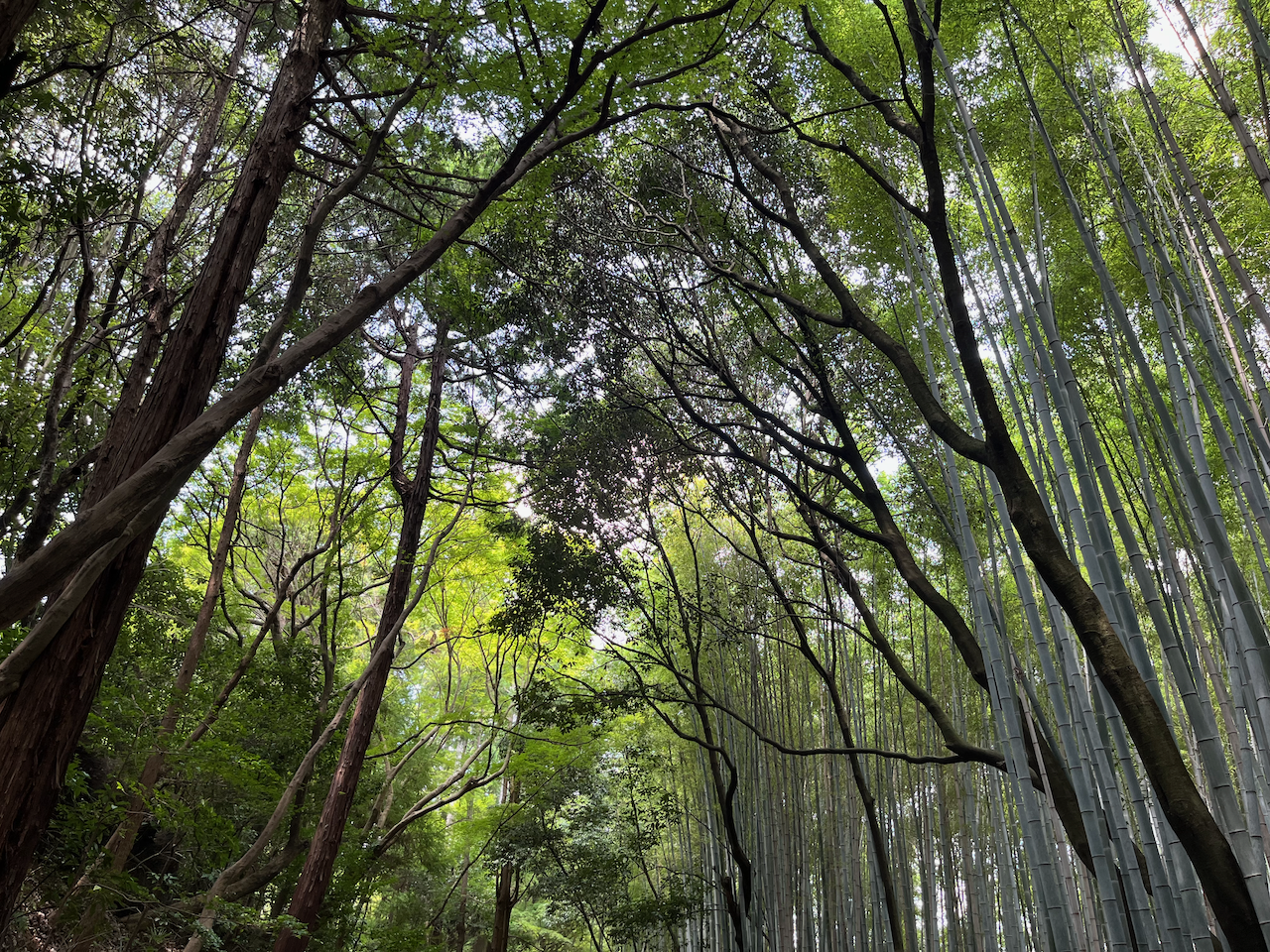
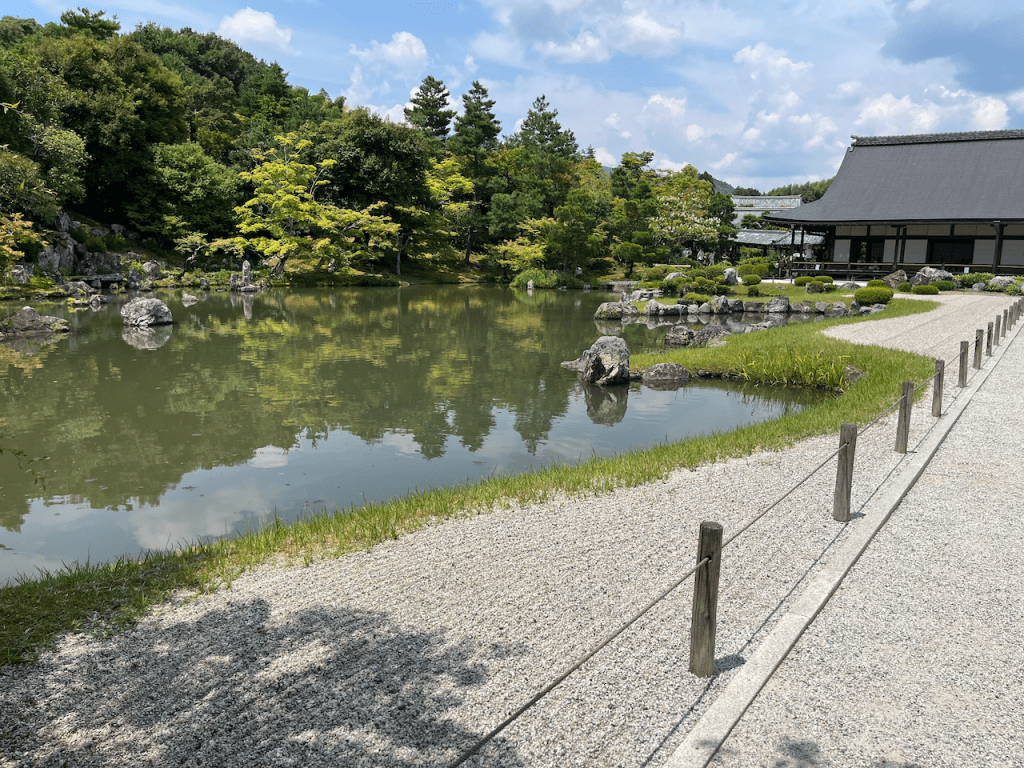
Tenryuji Temple, official website here, is a temple that has seen a lot historically. It was number two or three in the Five Mountains hierarchy, and was thus a very prestigious temple. It contains many terrific works of art, and a gorgeous pond created by Muso Soseki back in the day. Because it is right next to the famous bamboo forests of Arashiyama in western Kyoto, we were able to view both on the same hike, as well as the iconic Togetsu-kyo Bridge:

I should add that the temperature was 37C (98F) in Kyoto and extremely humid that day. The walk through bamboo forests was incredibly enchanting, but also grueling due to heat.

It’s not clear from the photos, but because of the shade and the high humidity, there was a constant mist between the trees, and an oppressive air. It was really cool, and would make a great setting for any Asian-style D&D campaign (not unlike the ones that I made previously … 😏).

Once you emerge from the bamboo forest, you enter the back-entrance of Tenryuji Temple. The front entrance that’s very close to the Saga-Arashiyama train station as well, so you can also visit from that direction too. The signs are very obvious.

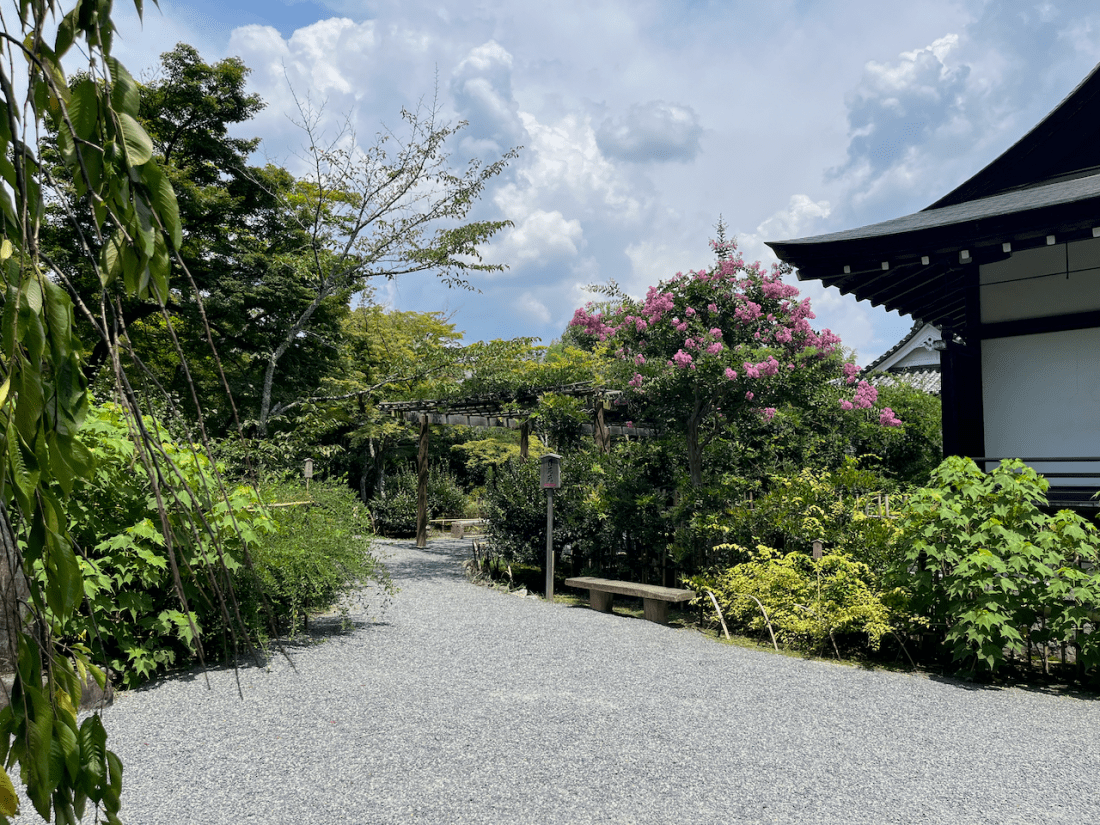
The main buildings were clustered together in the middle of the property, with a really nice garden walk surrounding it, including many lovely or rare plants. If I were a botanist, I’d probably have a field-day here. The signs are all multi-lingual too, which is really handy.

If you continue around the walk, you will come to the Sogenchi (曹源池) Pond, which according to the sign is modeled on Chinese architecture at the time (and a common feature of Japanese aesthetics during the Muromachi Period):

Similarly, you find a lovely sand garden (karesansui in Japanese, 枯山水 ) nearby too:

I wanted to take more photos of the interior of Tenryuji, but there were just too many tired, overheated tourists, and Instagram influencers. I chuckled as I saw a couple young ladies who were way over-dressed in fine, Chinese-style silk dresses and taking turns posing and photographing each other. The heat and humidity were so intense, I can’t imagine why they would do this to themselves. But I digress.
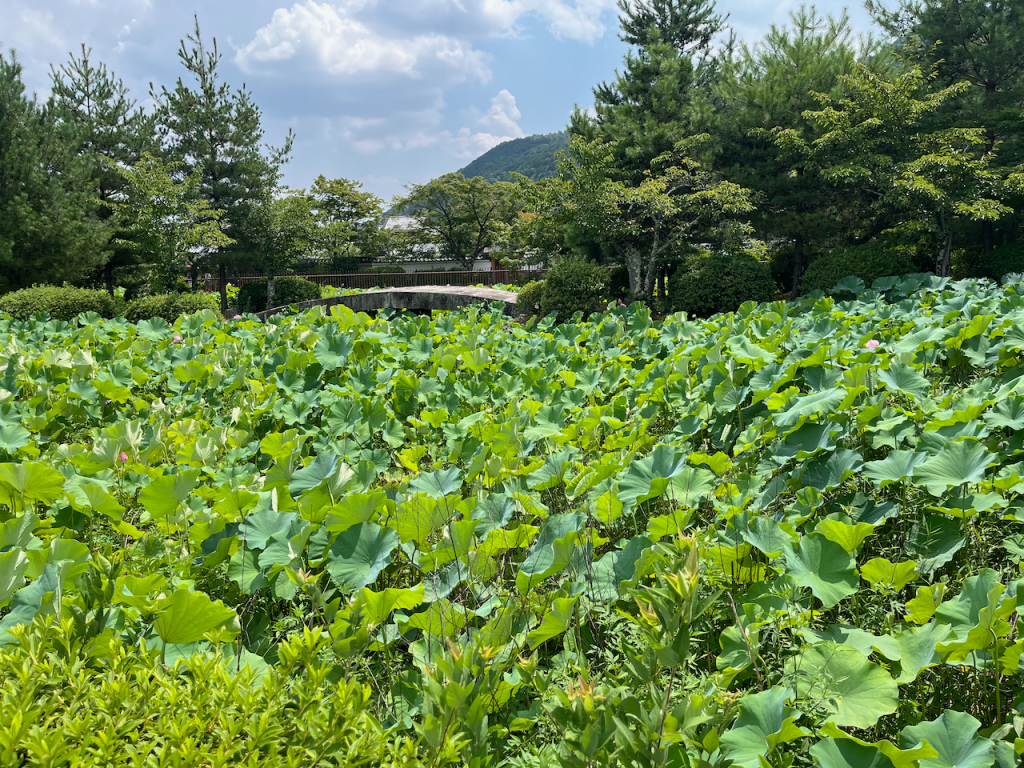
Finally, as exited Tenryuji toward the train station side we saw a very nice lotus pond:

Tenryuji Temple is, for historical reasons, a shadow of its former self, but even what remains is very scenic and embodies much of the beauty and prestige of Arashiyama. I didn’t enjoy it on the same level as another Zen temple, Ryoanji, but it is lovely. For poetry fans, the Arashiyama district is also the site where the Hyakunin Isshu anthology was compiled, which I covered on my other blog.

That said, Arashiyama is quite touristy and crowded. It’s pretty foreign friendly, and if you’re just passing through Kyoto for the first time, it’s a great place to stop. But, for me, if you have the time and want to really get to know Kyoto life and culture, there are other places I prefer.

Next time, we’ll talk about Kenninji, which was smaller than Tenryuji, but had some pretty mind-blowing artwork.

P.S. 欢迎中国游客,感谢您的阅读。

1 I tried to put both in a single post, but it quickly got too large. I am a victim of my own hubris…