The Japanese Way of Doing Things

My guide book on Japanese culture talks about a concept called sahō (作法), which in a mundane sense just means “instructions” for doing stuff. But the book explains that it also describes how things are done culturally:

… for example, in the case of the tea ceremony, every act is carefully choreographed, from where people sit, to how the water is boiled, to how the ea is prepared and so on.

Again, in the business world, one can observe sahō in action as the seller employs polite language and bows often as he shows various forms of respect to the buyer. Another case would be the social setting of a company, where a subordinate will use particular sahō with his boss.

Page 156

The book further explains:

For most Japanese, sahō is an ingrained pattern of behavior that affects their day-to-day actions without them even being aware of it. However, for people who come from overseas, some of these practices may appear puzzling. Why is someone bowing so many times in a particular setting? Or at another time, why is someone sitting ramrod straight? But for the Japanese, they are simply following the sahō that is appropriate for that place and circumstance.

I definitely experienced some of this confusion in the early years when I visited Japan with my wife. My in-laws kindly took me to a local Takashimaya department store and paid to get me a tailored suit. As a poor white kid in America, the experience was kind of awkward on a few levels: I wasn’t used to getting measured for a tailored suit, I wasn’t used to the very polite speech and mannerisms of the store employee, I wasn’t very good at speaking Japanese, and I wasn’t even used to owning my own suit.1

This concept of sahō isn’t limited to Japanese culture, of course. It is true, based on limited experience, that things can feel really choreographed in Japanese culture compared to American culture, but the idea of “how people do things” is universal. The American handshake is on example, the tendency for Russians not to smile during formal settings, the “pub culture” in Ireland and so on. There’s countless examples unique to each culture.

Even for a culture like Japan, where everything really is kind of choreographed, you do get used to it. The extra flourishes at the bookstore (wrapping the books, extra bowing, etc) were a bit confusing at first, but after a while, I don’t even really mind it anymore. Similarly, certain habits became ingrained more and more each time I visit.

So, when you encounter another culture, the important to bear in mind is that each culture has its own sahō, and it will be different than yours. Be observant, be flexible. If you do, you’ll quickly adapt and will succeed. People who stand like tall trees in the wind get blown down, but those who bend like grass prosper.

Food for thought.

P.S. Fun bonus post before Thanksgiving weekend! Happy Thanksgiving Day and Native American Heritage Day to readers in the US.

1 It is still the only suit I own, but I save it for important occasions only, such as my mother-in-law’s funeral. Speaking of sahō, funerals in Japan are very formal compared to American ones.

Family

Ying Nan: You are a product of all who came before you. The legacy of your family, the good and the bad, it is all a part of who you are.

Shang-chi (2021)

My kids and I have been watching the Marvel MCU movies for years. My firstborn is particularly a Marvel fan since she was a little girl. Some of the movies are better than others (my personal favorite is Thor: Ragnarok),1 but we both really like the movie Shang-Chi and the Legend of the Ten Rings.

When my wife (who is Japanese) and I first dated, there was an immediate clash of cultures. I was a generic American white kid who grew up in an impoverished broken home with lots of issues, my wife grew up in a working-class Japanese family that was not overly traditional, but still very Japanese compared to American standards. The fact we were dating in the first place was a bit awkward for her and her parents, whereas I hardly ever talked to my own parents.

The good news is that over time, we learned to understand one another, and that means that I too learned to appreciate her viewpoint sometimes. For example, family.

Even when she disagreed with her parents, she still respected them, and understood her family obligations. This was something frankly new to me because I openly rebelled against my parents, told my dad off, and hardly paid them any heed. I gradually did reconcile with my parents to some degree as I got older (and a bit wiser), to a level where we can get along, but more importantly I learned to accept that I am who I am due to my family. Like the quote above says, you can’t deny your own heritage, both the good and the bad, and that it does shape who you are.

But also, through my wife and through parenting myself, I learned that I do owe some level of gratitude to my parents for what they did. I chose not to be like my parents in how I raise my kids, but even that is something I learned from them.2 Thus, the lesson I learned from my wife is that I also have to be humble, and respectful to my parents enough to acknowledge what they’ve done for me, even if I disagree with them. This is a very Confucian outlook, but I can see the value in this.3

It rubs against my American sense of individualism, but I’ve found it a valuable lesson over the years, and something I think we can all learn from.

P.S. Xu Wenwu, the father in Shang-chi, is a great example of a plausible chaotic-evil person in Dungeons and Dragons: he craves absolute power and yet is also capable of being in love, being a father, etc. Yet, he inevitably bends everything toward evil or ruin, including his lawful-good wife, Ying Li. Tony Leung Chiu-wai‘s performance was excellent.

1 The Thor movies do a really nice job of weaving science fiction with magic and myth, much like Roger Zelazny did in his books generations ago (Lord of Light, the Amber Series, Creatures of Light and Darkness, etc.). Put simply, I like weird, transcendent stuff more than the “grounded” story lines like Captain America or Black Widow.

2 In Japanese there is a four-character phrase for this: hanmen kyōshi (反面教師) meaning to learn from a bad example (i.e. what not to do).

3 This importance in family isn’t even limited to Confucian-influenced cultures. You can find it in many unrelated world cultures where family is emphasized, and respect towards one’s ancestors. For whatever reason, it is not emphasized in Western culture, and maybe to our detriment I think.

Happy Golden Week 2025

Happy Golden Week to readers!

The first week of May in Japan has an interesting phenomenon in the modern calendar called Golden Week (gōruden uīku, ゴールデンウィーク): a series of national holidays that line up very closely. Thus, people often take vacations at this time (a rarity in Japanese business culture), and enjoy the fine weather before the monsoon comes. I wrote about Golden Week in more detail here.

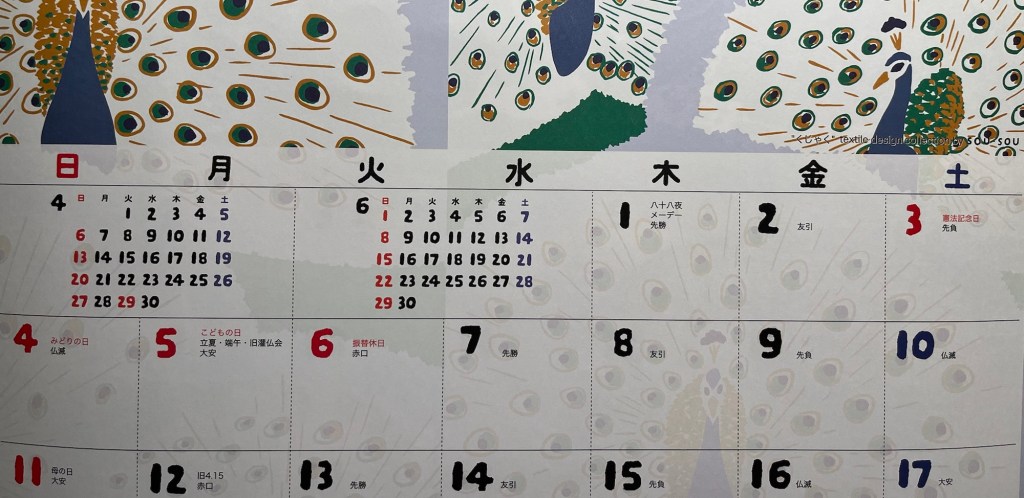
You can see on our home calendar how the holidays (in red) line up:

My sister-in-law in Japan often takes this time off, as do many other Japanese business and white-collar workers. It may be the longest vacation they take in the year, apart from Japanese New Year.

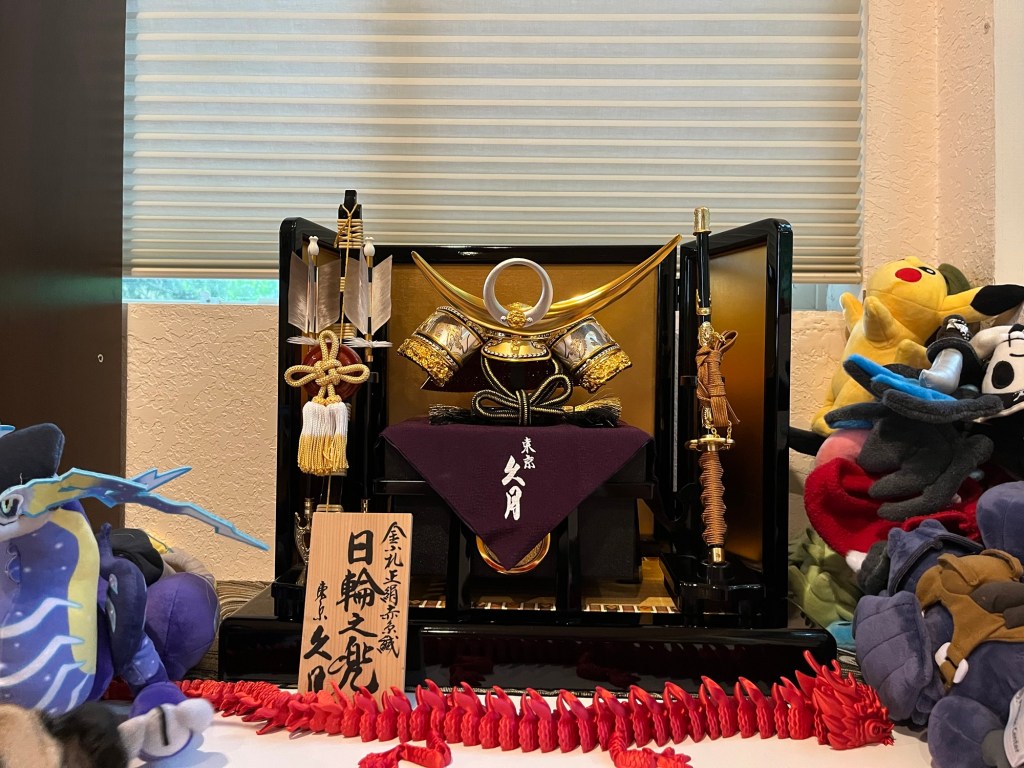
As part of Golden Week, Childrens Day, or Kodomo no Hi (子供の日) also takes place every May 5th. I’ve written about that as well. We have taken out our usual yoroi armor display:

The Pokemon toys and dragons are just my son’s toys (he should clean up more 😋).

I am not sure if we can get kashiwa-mochi this year, as Japanese goods are getting harder and harder to obtain lately, and our schedule is chaotic this week anyway, so I am not sure exactly how we will celebrate. I do know that we will go see the Minecraft movie for a third time in theaters, though. My son and I really enjoy it, and it’s nice to see all the kids yelling certain parts of the dialogue in unison.

I wish I could post more, but as alluded to earlier, I will be away for about a week, and haven’t been able to write more due to work and other competing priorities. However, I hope you all have a terrific Golden Week, and can enjoy the weather in some way. I have other great content coming up, both historical and Buddhist, so please stay tuned, and take care!

P.S. Golden Week also serves as a reminder that what many modern workers need isn’t just equitable pay, but also time off. Happy May Day! ✊🏼

Remembering the Dead

“Mercedes” is one of the nicest, sweetest characters in the game Fire Emblem: Three Houses (and Three Hopes)

It’s been about 18 months since my mother-in-law passed away, and my wife still pays her respects regularly. We have her picture setup with some flowers and incense, and per custom my wife will burn incense in the morning. The kids, who miss their “baba”, offer incense sometimes too.

We also started enshrining an old photo of my maternal grandmother, who passed away 33 years ago, and burning incense for her too. Obviously, this is not an American custom, but I felt that it was a good one to adopt. I briefly touched on honoring one’s ancestors in a past post about day to day Tendai Buddhist practice, and remembering this I decided to take up the practice.

My grandmother was pretty ahead of her time. She was a computer nerd in the 80’s, and would dabble a lot with old Tandy Color Computers, dial up on local BBS’es, and hung around Star Trek forums online. And, she would share all this with me as a kid. I have a lot of fond memories of staying overnight at her house on weekends.

Thanks to her, I developed a love of computers, and that love of computers helped me build a career from which I can raise a family now. Just as we owe my mother-in-law for her many ways of supporting us in our early marriage, my grandmother also helped us by inspiring me to learn some good technical skills.

The reason why I posted this though was to not just reflect on the past.

Through Buddhist custom, we’ve been honoring past ancestors, and expressing gratitude, but also it’s important not to get stuck in the past either. Conduct here and now matter too. The quote above from Fire Emblem: Three Hopes (the sequel to Three Houses), really expresses this point nicely:

Living in the present is the best we can do. We owe it to those who can’t come back.

Fire Emblem: Three Hopes

My wife strives to be a good mom the way her mother was, and I try to be a good dad, including working an honest career. We both look forward to being the “nice grandma and grandpa” for our grandkids someday. 😊

Of course, this isn’t just limited to raising a family. A person can also just “pay it forward” in helping others. Just as our parents (warts and all) sacrificed much to raise us, we can selflessly help others around us, or help future generations by making the world a little bit of a better place. But, even more simply, taking time to enjoy one’s life, the breath one takes, their continued good health and so on, these too can honor our loved ones who aren’t around anymore.

Namu Amida Butsu

Enma: King of the Dead

My son is at the age where is he is obsessed with Dragon Ball,1 so we watch some of the episodes together on Crunchyroll.

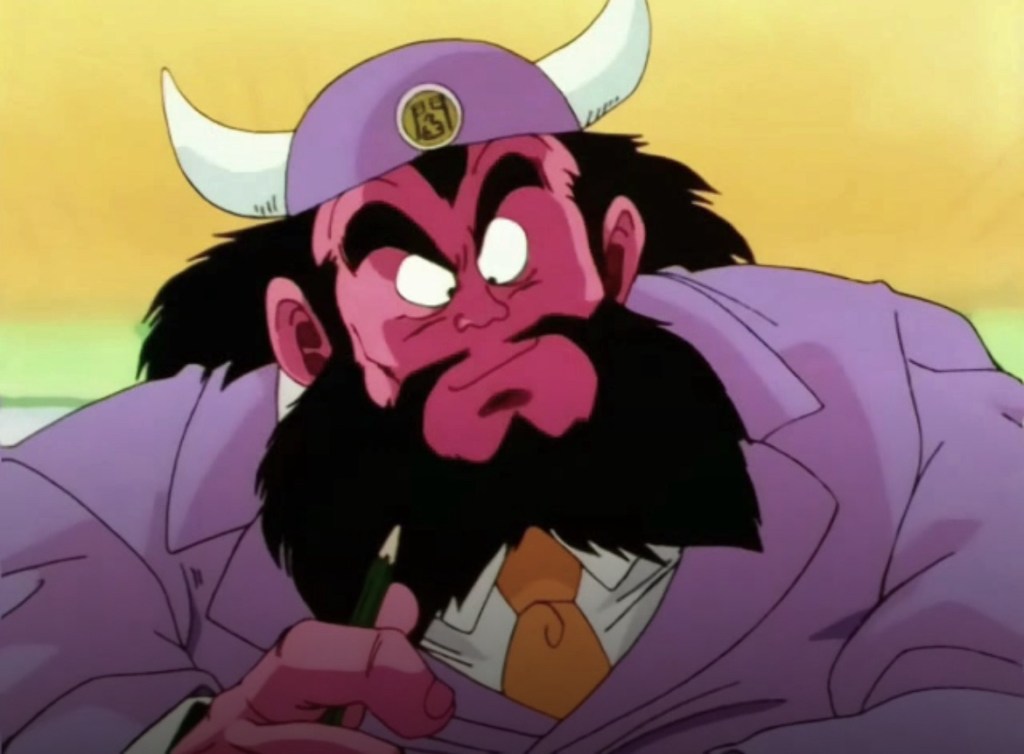
Source: https://dragonball.fandom.com/wiki/King_Yemma?file=KingYemmaNV01

Dragon Ball is a fun series because it blends a lot of Japanese-Chinese mythology, especially the early series, into a futuristic storyline. Goku is obviously based off of the famous legend of the Monkey King, Sun Wukong (Son Goku in Japanese). Another great example is the character Enma.

In Dragon Ball, Enma (sometimes spelled “Yemma” in English) presides the realm of spirits and behaves like a modern bureaucrat. In spite of the suit and tie, this Enma is definitely based on the original figure in Japanese mythology, named Enma Daiō (閻魔大王, “Great King Enma”).

The original Enma is a fascinating example of a “fusion” mythology, not a native Japanese one. Enma is originally based on the Hindu god Yama, lord of the dead.2 However, in China he was transformed into a Confucian-style bureaucrat and shoe-horned into Buddhist cosmology as a judge of the dead. Enma, along with other judges, determine the dead’s next destined rebirth within Buddhist cosmology. During certain Chinese funerary practices and festivals, you can see his visage on “ghost money” used to help the dearly departed coast through the trial process and ensure a smooth, lenient transition to their next life.

This Enma, a bureaucrat / judge of the dead, was how it was imported to Japanese culture in antiquity. He is even featured in classics such as the Tales of the Heike. When the warlord Taira no Kiyomori is dying from a terrible fever, he has a vision of Enma and his demonic attendants awaiting him. I’ve also heard of an old tradition where parents in Japan would scold their kids saying Enma would pull their tongue out if they told a lie. I have never heard this first-hand though, so I wonder if anyone ever says it anymore.

Anyhow, Dragon Ball’s spin on Enma, Goku and others is a fun look at Chinese-Japanese mythology, for a modern era.

RIP Toriyama Akira 🙏🏼

P.S. this post was also inspired after watching the Star Trek: Voyager episode “Barge of the Dead”. It’s a fun look at the Klingon afterlife.

1 growing up in the 1980’s my obsession at the time was Akira, which I still enjoy from time to time. 😄

2 if you ever pick up the book Lord of Light by Roger Zelazny, a wonderful blend of Hindu mythology and ultra-futuristic science-fiction with a lot of sass thrown in, the Yama depicted in that novel is quite an interesting character.

Capsule Machines in Japan

Game centers in Japan are everywhere in urban areas. Kids don’t have as much park space as kids in the US would, since everything is much denser and land space is much smaller, so they often hang out at game centers. And, if you go to a game center you might see rows and rows of these:

These are capsule machines, or as kids call them gacha-gacha after the sound they make. Capsule machines aren’t limited to Japan only, but the variety and prevalence is much larger than in the US. You can find capsule machines all over the place, and the variety of stuff you can get is staggering:

To the bottom-right you can even see a “Buddhist statue” gacha-gacha machine. I saw those in Kyoto a lot too. They even had one for my favorite Japanese song, Matsuken Samba:

The capsule machines can cost anywhere from 100-yen, to as much as 500-yen per capsule. Also, be aware, there is usually a small basket nearby where you can put the opened capsules (do not throw away in regular garbage if possible). So, once you’ve opened your capsule and removed the contents, just put in the basket.

As for Matsuken Samba, he sits on my bookshelf now here in the US:

Buddhism and the Legend of Zelda: Tears of the Kingdom

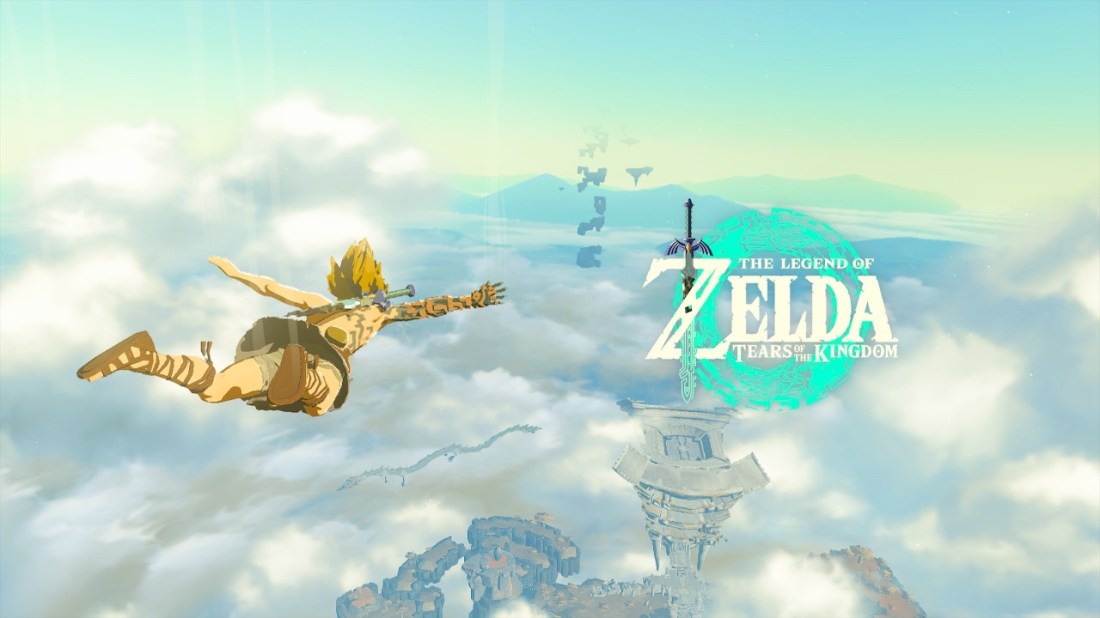
Like so many others, I am enjoying The Legend of Zelda: Tears of the Kingdom, but I am not just enjoying the game-play, I am subtly enjoying how certain Japanese cultural concepts shine through even in a medieval fantasy adventure. In a previous post, I talked about Japanese-religious influences in Breath of the Wild, and today, I wanted to revisit the subject for Tears of the Kingdom (hereafter TotK), since one aspect really stands out: the sky realm and the world below.

In early Indian Buddhism, the world was described in a complex cosmology involving devas (forerunners of the Hindu gods), and various hell realms not unlike Dante’s Inferno, plus many other states of rebirth such as hungry ghosts, asuras (titans) and so on. Many of these were inherent to Indian culture, but as Buddhism moved to other cultures, China and beyond, things gradually shifted in emphasis, or merged with native religious traditions. I don’t mean this in a sense of corruption, or loss of authenticity though. Just simply changing times, changing places.

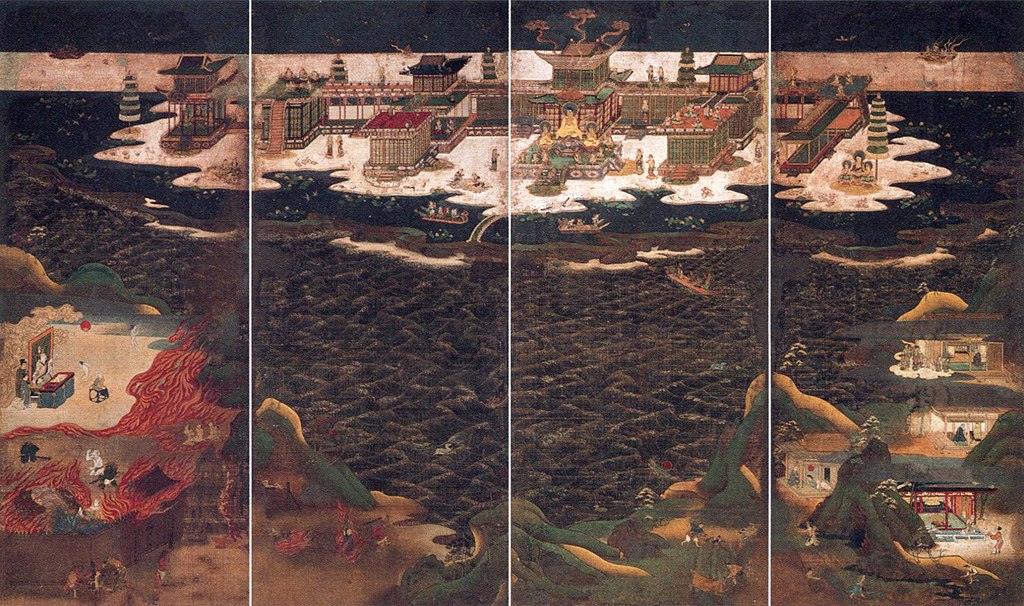
In any case, by the time of late 12th century, medieval Japan, and especially through the writings of monks like Genshin, the cosmology from India had gradually streamlined in popular culture to essentially two realms of rebirth: Hell and the Pure Land. Other realms still existed on paper (i.e. religion tradition), but in the minds of most Japanese at the time, either you were destined to Hell or through the Buddha’s compassion you might be get fortunate to be reborn in the Pure Land.

A 14th century painting depicting the Buddha’s Pure Land (top), Hell (bottom-left) and the mundane world (right). Painting courtesy of Konkaikōmyō-ji Temple, Public domain, via Wikimedia Commons

As Pure Land Buddhism gained in popularity during the Heian Period (8th-12th centuries), you see an increase of artwork depicting Amida Buddha welcoming the deceased to paradise,1 sometimes juxtaposed with images of Hell.2 Years ago I attended a local art exhibit in Kamakura, Japan, next to Tsurugaoka-Hachimangu shrine which displayed a gallery of such art from local temples and it was fascinating to see such a stark world-view, much like medieval Christianity, yet also very different under the hood, theologically.

Anyhow, getting back to the Legend of Zelda: TotK, the kingdom of Hyrule has expanded to include a sky realm, and a dark world underground. This is imagery that’s pretty universal in many cultures, but the details reflect Japanese-religious traditions.

Let’s look at the sky world first.

The sky world has placid ponds with lotus blossoms, and frequently uses a gentle golden color.

Compare with this passage from a Buddhist text, the Amitabha Sutra (阿弥陀経, amida-kyō in Japanese):

“In the pools [of the Pure Land] are lotuses as large as carriage wheels: green colored of green light, yellow colored of yellow light, red colored of red light, white colored of white light, subtly, wonderfully fragrant and pure….Moreover, Shāriputra, in that Buddhaland there is always heavenly music and the ground is yellow gold.”

Translation by City of Ten Thousand Buddhas

The beautiful and rare birds also reflect another passage in the same sutra:

“Moreover Shāriputra, in this country there are always rare and wonderful varicolored birds: white cranes, peacocks, parrots, and egrets, kalavinkas, and two-headed birds.

Translation by City of Ten Thousand Buddhas

Compare the imagery above with this recent tweet from the Twitter feed from Toshidaiji Temple in Nara:

Thus, we can see that sky world in TotK reflects imagery associated with Buddhism, especially the Pure Land of Amida Buddha. This may be entirely an arsthetic choice, but it still reflects Japanese-religious culture.

Now, let’s look at the world below:

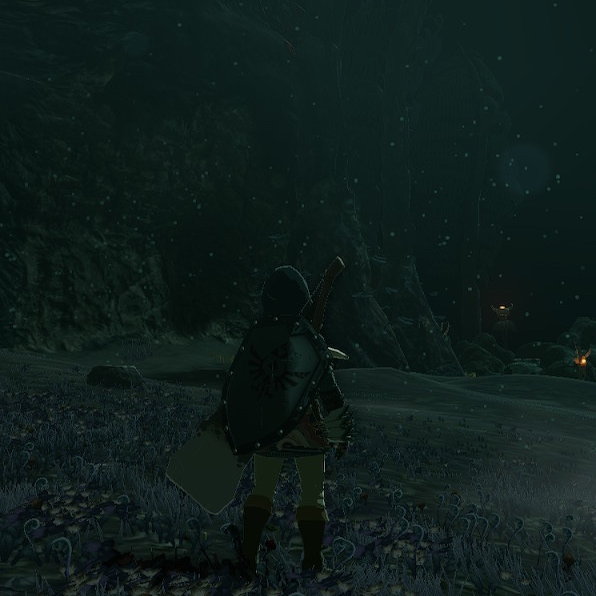
The world below is a world of darkness and misery. There is little life here, primarily predatory life, or creatures toiling away mining Zonaite minerals, and the air is stifling with spores (or ash?) in the air.

The imagery here does not fit neatly into the elaborate Buddhist hells as described in a Buddhist text such as the Earth Store Bodhisattva Sutra.

Instead, it more neatly fits a more Shinto (not Buddhist) depiction of the Land of Yomi, the Land of the Dead. Yomi, like the world below in TotK, is also accessible from the mundane world through various entrances, and similar to the Greek concept of Hades, it includes shades and shadows of former lives.

But again, in popular religious tradition, the Buddhist concept of Hell, and the native Shinto concept of Yomi blend together. This was very common in pre-modern Japanese culture where the two religions blended, and were virtually indistinguishable. In medieval Europe, Christianity blended with pagan and local folk traditions in the same way to the point where it was hard to see where one ended, and the other began.

And it’s fascinating to see the imagery applied to modern gaming as well.

A screenshot from the sky world. The image of a setting sun, by the way, is used to represent Amida Buddha in the first meditation in the Contemplation Sutra among other places.

Namu Amida Butsu

P.S. All Zelda screenshots here are by me.

1 Called amida shōju raigōzu (阿弥陀聖衆来迎図) in Japanese.

2 Called jigoku gokuraku-zu (地獄極楽図) in Japanese.

May Illness

In Japanese culture there is a phrase, gogatsu-byō (5月病), which means “May Illness”. It’s a tongue-in-cheek saying that describes the feeling of haziness or lethargy that many people experience in late April/early May.

In Japan’s case, this is keenly felt by students whose school year ends in April (not June),1 and new office workers who often start their careers in May. People are burned out in April and by the time May rolls around, they get tired plus the weather is warm and pleasant.

Another phrase you hear around this time is:

春眠暁を覚えず

shunmin akatsuki wo oboezu

I’ve talked about this phrase before, and its origin in a Tang-Dynasty Chinese poem, titled “Spring Dawn” (春曉 Chūn Xiǎo) composed by poet Mèng Hàorán (689/691–740, 孟浩然). In Japanese he was called mōkōnen. The original poem was translated into Japanese at some point, and the first verse became a phrase all its own. Here’s a side by side comparison of the original Chinese with the Japanese translation plus English:

ChineseRomanizationJapaneseRomanizationTranslation1
春眠不覺曉Chūn mián bù jué xiǎo春眠暁を覚えずShunmin akatsuki wo oboezuI slumbered this spring morning, and missed the dawn,
處處聞啼鳥Chùchù wén tíniǎo処々に啼鳥を聞くSho sho ni teichō to kikuFrom everywhere I heard the cry of birds.
夜來風雨聲Yè lái fēngyǔ shēng夜来風雨の声Yarai fūu no koeThat night the sound of wind and rain had come,
花落知多少Huā luò zhī duōshǎo花落つること知る多少Hana otsuru koto shinnu tashōzoWho knows how many petals then had fallen?
1 Translation courtesy of http://www.chinese-poems.com/m9.html

Even if you don’t live in Japan, that sense of late spring haziness is something we can all appreciate.

1 If I recall correctly, Japanese students don’t have a long summer break, like kids i, the US. Instead they have more breaks scattered throughout the year, and so summer break in Japan only lasts a few weeks.

Golden Week in Japan

We all need a break sometimes. My coworkers in the EU often take time off in August, while I usually take part of the summer of with the family to see relatives in Japan. My company is a Japanese company so per tradition we also get the last week of the year off, ostensibly for New Year’s.

Japan is a place not known for vacations though. Office workers take long hours, and often shy away from taking personal time. Sure, they have personal time by law, but pressure from office culture tends to limit this.1

Thus, many people take time off during Golden Week (gōruden uīku, ゴールデンウィーク). Golden Week is a series of small nations holidays, each minor on its own, but appear on the same week, so people often use this as a reason to take time off.

The holidays in question are (source Wikipedia):

  • Showa Day (昭和の日, shōwa no hi) – a memorial to the late Showa Emperor (Hirohito). This holiday is observed on April 29th.
  • Constitution Day (憲法記念日, kenpō kinenbi) – a day to commemorate the modern constitution (kenpō) of Japan, which was original designed by US Occupation forces in 1946, but includes some novelties and innovations that the US Constitution lacks (explicit rights for women) as well as its renunciation of war.2 Observed on May 3rd.
  • Greenery Day (みどりの日, midori no hi) – this holiday ostensibly is a day to reflect on nature and such, but originally was celebrated as the birthday of the aforementioned Showa Emperor, who also happened to love plants as a hobby. It was also renamed following the ascension of his son, the Heisei Emperor. The significance of the late Showa emperor’s birthday has lessened over time anyway and the general appreciation of nature has taken over. Observed on May 4th.3
  • Children’s Day (子供の日, kodomo no hi) – I’ve touched on this holiday before. It is observed on May 5th, and is probably the most important.

You can see three of them listed on the calendar above, which we have at home.

Vacation travel soars this week, and congestion is everywhere. Sometimes other holidays which float around can further extend Golden Week up to 10 days long. It is for many Japanese workers, the longest week off they will enjoy in the year.

Whether you are in Japan, or overseas, hopefully you can catch some rest this time of year and enjoy the weather!

P.S. Tofugu has a great article on Golden Week too.

1 My sister in law, who is unmarried and works in the banking sector, had to take a lot of time off to care for her mother before she passed away. So people do take time off, but not always for leisure.

2 It replaces the 19th century, militaristic Constitution based on the Prussian model, which gave considerable power to the Emperor and made him sole authority of the military (they didn’t answer to the Cabinet). Check out this fun video series to learn more about Prussia, especially under Frederick the Great. While in college, I attended a lecture by the US Army secretary who helped draft the part of the constitution granting equal rights to women. She was a pretty amazing lady who dealt with a monumental task.

3 Of course, May the Fourth is important around here too. 😉

A Brief Introduction to Japanese Shinto Religion

While I usually talk about Buddhism a lot, especially Japanese Buddhism, on this blog, I wanted to take some time to talk a little bit about the other religion in Japan: Shintoism. With New Year’s just past, it’s a good time to explore this oft-misunderstood tradition.

Japan has two religions that have co-existed side by side for a very long time: Buddhism and Shinto. They have different origins, different ways of describing the world, and so on. However, due to (mostly) peaceful coexistence, they influence one another, and Japanese culture leading to what we see today.

hie_shrine_red_gates
Taken by me at the excellent Hie Shrine in downtown Tokyo in 2017.

Shinto is a tricky subject in some ways because it’s deeply tied to Japan, and “Japan-ness” in a way that Buddhism, a foreign religion, is not. My personal interest in Shinto began years ago when I visited a few shrines here and there as a tourist and would pay respects to whatever kami or divinity dwelt within. It’s not something I really believe in, but I felt that it was worth taking the time to delve into the culture and do things the Japanese way.

Back then, I picked up a book on Shinto called The Essence of Shinto by a Shinto priest, or kannushi (神主), named Motohisa Yamakage to learn more. Later, I found a Professor Ian Reader’s excellent and easy to read guide to Shinto titled: Shinto – Simple Guides. These are the two primary sources for this post.

Basic Shinto Beliefs

Shintō (神道) is translated as the “Way of the Kami”. It has no founder, no doctrines, and no real central authority. Variations exist throughout different parts of Japan, and according to Yamakage, each kannushi (priest) will have slightly different view of it. It has been around since antiquity, before the arrival of Buddhism, and just gradually sprang up out of local, common practices. Each shrine, and each priest is trying to commune with the Kami, to revere nature, and much emphasis is placed upon experiential wisdom.

Shinto “deities” or Kami (神), usually gets translated into English as “gods”, but they run the gamut. Kami come in all shapes and sizes, some are revered country-wide, some very obscure and local. Many embody many aspects of nature, or aspects of life, but also include more celestial Kami as well. It’s hard to compare with modern, Western religion. But it’s somewhat analogous to ancient Greco-Roman religion with its Olympian gods, chthonic earth deities, spirits like nymphs, naiads, etc., plus foreign-imported deities from elsewhere (Dionysus, Isis, Mithras, etc). The variety of Kami is nearly endless. In Japanese, there is a term for this: 八百万の神 (yaoyorozu no kami) which means “eight million kami” literally, but really just means “countless kami”.

Ian Reader’s book lists some of the most well-known:

  • Amaterasu – Goddess of the sun and associated with the Imperial family, who traditionally claims descent from this Kami.
  • Hachiman – God of war, originally thought to have derived from the legendary Emperor Ōjin. Absorbed by Buddhism in medieval times as a bodhisattva (frequent references in the Tales of the Heike, for example).
  • Ebisu – A Kami associated with small business and commerce. Particularly popular in the Osaka area.
  • Inari – Kami of rice and harvest originally, but grew in popularity as a guardian of Buddhism and separately of business. The famous Shiseido cosmetic company has a shrine devoted to Inari on top of its headquarters called Seidō Shrine.
  • Benten or Benzaiten – Kami associated with music and the arts. Originally thought to be imported indirectly from India, as the goddess Saraswati. Imported gods in Shinto is not unusual.
  • Tenjin – Kami of education. Originally a famous Heian Period nobleman named Sugawara no Michizane, who was wrongfully slandered and whose death was thought to have triggered natural disasters at the time. Worshiped as a Kami to placate his restless spirit, as well as for his excellent poetry and writings.
  • Konpira – Kami associated with seafaring, and with sea commerce. A popular patron for sailors, fishermen and other such groups.
  • Susanoo – Amaterasu’s brother, and Kami of wind. While legendary as a trouble-maker, he is also revered for protection against natural forces such as typhoons.
  • Izanami and Izanagi – The original female and male pair of Kami believed to have created Japan according to traditional myth.

Professor Reader also quotes an excellent definition of kami from a famous scholar from the Edo Period named Motoori Norinaga:

…it is not only the divinities of Japanese sacred texts and myths that are considered as kami, for anything — humans, animals, trees, plants, rocks, mountains, seas — which appears impressive, inspires a sense of awe, or exhibits a life-force, may be a kami.

This helps to emphasize the fact that Kami are not so much a set pantheon of gods in a set hierarchy, but rather that they exist in a near-infinite variety that embody many aspects of life. Many Kami are very local to a region, and myths of their origin grow over time as worship around the Kami develops over generations after some miraculous event or discovery.

Communing with Kami

In spite of their variety, Kami are believed to have very human-like qualities and must be appeased and placated, or they may cause trouble. This is reinforced by carefully followed rituals where a Kami is honored, and whose assistance is called for. Or, one expresses gratitude to the Kami for their protection, thereby showing humility and appreciation. In order to avoid offending a Kami, the ritual must be carried out correctly, and by someone who is considered ritually pure, otherwise the Kami may ignore them, or cause problems instead.

For Shinto priests and even lay followers, it’s also important to setup a good dwelling spot so that a Kami can descend and make their presence felt. Originally, there were no Shinto shrines, or jinja (神社), instead the ancient priests would sanctify a suitable spot and call out to the Kami to descend to that spot. Later, formalized structures were built around holy places and these became the major shrines (jinja) seen today, which branched out into sub-shrines and so on. In people’s homes, devout Shinto followers will also create a small sacred space in hopes that a Kami will descend there as well. Kami don’t live in these sacred spaces, according to Yamakage, instead it’s more like an antenna allowing the Kami to descend for a time. The actual term for this “antenna” is yorishiro (依り代), and can be something like a rock, a mirror, a special charm someone got from a Shinto shrine, and so on.

Since Kami will only descend in places that are clean, pure and bright, if this “antenna” or the sacred space around it gets run-down, dusty, and such, then the Kami will not descend, and if they do not descend, they won’t be able to help you, or worse, some evil spirit will take up residence.

So as part of communing with Kami, Shinto a lot revolves around purification.

Ritual Purification

shinto_onusa
An ōnusa wand used for purification rituals.  Source: Wikipedia.

In Shinto, there is a strong relation between purity and well-being. Through contact with unclean things, or through negative and angry thoughts, one builds up negative energy or impurities that can cause concrete problems. Thus, Shinto has many ceremonies (祓 harai or harae) designed to restore balance, and to remove the impurities. According to Yamakage, the four Shinto ideals are clean, bright, right and straight and these ceremonies, rituals and such help to restore one to a state that reflects all four. Yamakage is quick to emphasize that there is no Original Sin in Shinto (obviously intended toward a Western audience), but things get off-kilter from time to time, and so one should restore the balance through these rituals.

One of the most important rituals, and probably the most familiar, is the misogi (禊ぎ) or purification by bathing in water. This ceremony can be practiced at a waterfall, river or other body of water, but ceremonies can also be as simple as temizu (手水), which is something people often do at Shinto shrines, and even Buddhist temples. Temizu is a “purification-lite” ceremony, where you wash your hands and maybe your mouth. If you’ve visited a major temple or shrine in Japan, you will see a little water area with ladles and people washing their hands. The basic ceremony is the following steps:

  • Wash your left hand with the water from the ladle.
  • Now wash your right hand with the water from the ladle.
  • (optional) Now, holding some water in your left hand, pour it into your mouth.

That purifies the person, so they can enter the sacred space of a shrine. Of course, if you forget to do this, it’s not a disaster, it just won’t help you in any way commune with the Kami there.

Relation to Buddhism

The relation to Buddhism here is a tricky one. Medieval Buddhism, that of the Nara and Heian Periods, tended to have a strong blending of native Shinto and Buddhist beliefs. A common theory from that time until the modern era, was that the Shinto Kami were manifestations of Buddhist figures. For example, the major Shinto deity Amaterasu, goddess of the sun, was assumed to be a manifestation of Vairocana Buddha. The Tales of the Heike, among other famous Japanese literature at the time, would frequently mention this.

Buddhist sects in the past attempted to assimilate or eschew¹ this blending in varying degrees, while Shintoists at times tried to reassert themselves as a separate religion.

In the end the two religions have learned to co-exist because they have little overlap with one another.  Buddhism has little to say about spirits and divinities, while Shinto is focused primarily on them.  Shinto focuses on purification and avoiding pollution and taboos so it has little to do with funerals, while funerals have been a part of the Buddhist tradition for a long time.

Shinto as a religion is so deeply tied to Japanese culture and people, it’s hard to separate the two, which also helps to explain why Shinto has almost no presence outside of Japan, but at the same time, it’s a fascinating spiritual tradition and well worth getting familiar with if one intends to come to Japan, or to explore the tradition more.

P.S. featured photo is from Fushimi Inari Shrine.

¹ Jodo Shinshu Buddhism is a primary example a Buddhist sect that eschews Shinto, in that it has essentially no Shinto elements whatsoever.