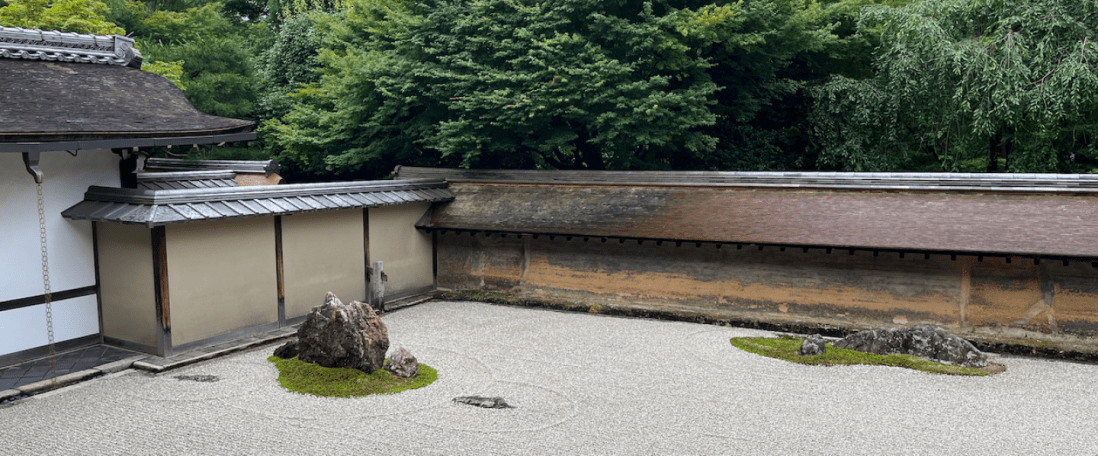
The Four Holy Verses of Chan and Zen Buddhism

Hello readers,

In late 2025, by chance, I found an interesting book at the local Japanese bookstore titled 眠れなくなるほど面白い図解禅の話, “An explanation of Zen so interesting you can’t sleep”, which provides a nice overview for Japanese readers about Zen. It covers a lot of little details like different sects, founders, historical bits, cultural stuff, and so on, that are hard to find in English publications.

Anyhow, the book talks about something I’ve never heard before called the Shiseiku (四聖句) which can be translated as “The Four Holy Verses [of Zen]”. This is a set of verses, imported from Chinese Chan Buddhism and attributed to Bodhidharma, and distill what Zen is all about:

Chinese /
Simplified1
PinyinSino-JapaneseEnglish2
不立文字 /
不立文字
bù lì wén zìfu ryū mon ji“Buddha-nature cannot be expressed in words.”
教外別傳 /
教外别传
jiào wài bié chuánkyō ge betsu den“The teachings of Buddha-nature exist outside scripture.”
直指人心 /
直指人心
zhí zhǐ rén xīnjiki shi nin shin“The heart of the Buddha’s teachings are transmitted directly, person to person.”
見性成佛 /
见性成佛
jiàn xìng chéng fóken shō jō butsu“A person who sees their own true nature is a buddha.”
1 Rough translation by me, apologies for any mistakes

Let’s break these down.

The gist is that the deeper teachings of Buddhism cannot be expressed in words, but must be experienced first-hand. This is not an exclusive concept to Zen, by the way. Take a look at an early sutra of the Buddhist tradition:

“This Dhamma that I have attained is deep, hard to see, hard to realize, peaceful, refined, beyond the scope of conjecture, subtle, to-be-experienced by the wise.

The Ayacana Sutta (SN 6.1), translation by Ven. Thanissaro Bhikkhu

… among other places:

36. “When a monk’s mind is thus freed, O monks, neither the gods with Indra, nor the gods with Brahma, nor the gods with the Lord of Creatures (Pajaapati), when searching will find on what the consciousness of one thus gone (tathaagata) is based. Why is that? One who has thus gone is no longer traceable here and now, so I say.

The Alagaddupama Sutta (MN 22), translation by Nyanaponika Thera

Buddhism provides signposts, maps, or guides through the sutras, through Dharma talks (sermons), and such. However, sooner or later one has to apply the teachings themselves to fully grasp it. This includes one’s own “Buddha nature”: that capacity we have toward becoming buddhas ourselves.

Although Zen tends to have an anti-intellectual image, it’s important to understand that there is a genuine need for scriptural texts and references, especially as one starts out. The Buddha even warns us about making bad assumptions before fully grasping the Dharma, like trying to grasp a poisonous viper incorrectly.

But over the years, through practice this become less essential. Life is something to experience, to live, and to learn from. Even the really ugly shit. In the same way, imagine a pilot training to fly. Reading the manual isn’t enough; they must put in enough hours of “flight time” before they get a license.

But I digress.

The final verse (a buddha is one who sees their own nature) needs some extra explanation. What separates a buddha from a mundane human being is a degree of awakening, not supernatural powers. Or as Dogen Zenji explains in the Genjō Kōan:

To study the Buddha-Way is to study the Self. To study the Self is to forget the Self. To forget the Self is to be enlightened by all things. To be enlightened by all things is to drop off the body and mind of self and others.

In other words, through Buddhism, you see your own nature. By seeing your own nature, you drop the delusions and gain clear insight. By gaining clear insight, you awaken as a Buddha.

Easy? NO.

Possible? Yes.

Namu Shakamuni Butsu

1 For those unfamiliar, Chinese characters come in the traditional form and simplified form. The traditional form is what you mainly see outside of the People’s Republic of China. The simplified form is mostly used within the PRC. Interestingly, Japanese uses halfway solution: some characters are simplified, some are not. Anyhow, in most cases, the characters are the same, but you can probably spot a few differences.

2 This is my own translation. Apologies in advance for any mistakes.
Down To The Core

PHLOX: It’s clearly had an impact on you. You seem more certain of yourself.
T’POL: I’ve never felt less certain.
PHLOX: You’re re-examining your core beliefs. Something most people never do.

Star Trek: Enterprise, “Daedelus” (s4:ep10)

Core beliefs do not change easily.

Whether they are morally right or wrong, our beliefs are tightly woven into our sense of identity. If someone challenges our beliefs, they challenge our fundamental sense of self, everything we’ve been taught or learned up to this point, and the conclusions we’ve made as a result.

Indeed, this is why people have such a vast diversity of beliefs, and why we stubbornly cling to them too: we are constructing the world around us based on our perceptions, environment, and experiences.

But that sense of self, including its beliefs, preferences, etc, is an illusion. This is the fundamental Buddhist doctrine of “no(-lasting)-self” called anātman in Sanskrit, or 無我 in East-Asian Buddhism.1

To clarify, this does not mean we don’t exist. But our sense of self is not permanent or static, like a soul or spirit that exists apart from the body. It shifts and changes, like the famous Ship of Theseus. In other words: it’s not something we can rely upon.

Hence, the Buddha told his son Rahula2 to maintain the view that:

‘This is not mine, this is not me, this is not my self.’

Translation by Ven. Thanissaro Bhikkhu

What we feel and think isn’t something we can truly call our own. The mind and sense of self is fungible, and what we hold personally dear and true can change as well. This challenges our sense of self, and this makes us uncomfortable, like T’Pol from the show Enterprise3 as she began to challenge her own Vulcan beliefs.

But that’s also how people learn and grow.

Namu Shakamuni Butsu

1 Pronounced wúwǒ in Chinese, and muga in Japanese, among other languages.

2 Rahula was born when the Buddha was still a prince, and later when the Buddha awakened and became a spiritual teacher, he reunited with his family. Some of them ordained as monks and nuns, some did not. Rahula was one of those who ordained.

3 I never actually watched Star Trek: Enterprise back in the day. I was in college and very busy, plus I didn’t really like the UPN channel at the time. However, I finally rewatched it during my personal break and I realized that the show is really, really good. If you are a Trek fan, it’s worth watching.

The Many Names of The Nianfo

The nianfo (念佛) is widely recited across many cultures and languages by people who follow the Pure Land Buddhist tradition. In Japanese it is called the nembutsu (念仏), and that is the name I most often use on this blog. In Korean it is the yeombul (염불), and in Vietnamese it is the niệm phật. Just as the name differs by language, the phrase itself has changed pronunciation as it is adopted in other cultures and languages, just like the sutras did.

Let’s look at examples.

The original form of the nianfo (as far as I can tell) comes from Sanskrit language in India. In Sanskrit, “nianfo” was buddhānusmṛti (buddhānussati in Pāli language). The venerable site Visible Mantra states that it was recited like so:1

namo’mitābhāyabuddhāya

In the Siddham script, still used in some esoteric practices, this is written as:

𑖡𑖦𑖺𑖦𑖰𑖝𑖯𑖥𑖯𑖧𑖤𑖲𑖟𑖿𑖠𑖯𑖧

From here, Buddhism was gradually imported into China from India (a fascinating story in and of itself), and because Chinese language and Sanskrit are so different, this was no easy task. Nevertheless, the buddhānusmṛti was translated as nianfo (念佛) and written as:

南無阿彌陀佛

This was how the Chinese at the time approximated the sound of the Sanskrit phrase. In modern, Simplified Chinese characters this looks like:

南无阿弥陀佛

But how does one read these characteres? That’s a fun question to answer.

You see, Chinese has many dialects because of geography, regional differences, and migration of people. Thus, even though Chinese characters are written the same (with only modest regional differences), the way they are read and pronounced varies. Thanks to Wiktionary, I found a helpful list to illustrate:

Dialect or writing systemPronunciation
Mandarin, Pinyin systemNāmó Ēmítuófó or
Námó Ēmítuófó
Mandarin, Zhuyin (Bopomofo) systemㄋㄚ ㄇㄛˊ ㄜ ㄇㄧˊ ㄊㄨㄛˊ ㄈㄛˊ, or
ㄋㄚˊ ㄇㄛˊ ㄜ ㄇㄧˊ ㄊㄨㄛˊ ㄈㄛˊ
Cantonese, Jyutping systemnaam4 mo4 o1 mei4 to4 fat6
naam4 mo4 o1 nei4-1 to4 fat6
naa1 mo4 o1 mei4 to4 fat6, or
naa1 mo4 o1 nei4-1 to4 fat6
Hakka, Sixian or Phak-fa-su systemNà-mò Ô-mì-thò-fu̍t
Nà-mò Ô-nî-thò-fu̍t
Nà-mò Â-mì-thò-fu̍t
Eastern Min, BUC system
Nàng-mò̤-ŏ̤-mì-tò̤-hŭk
Puxian Min, Pouseng Ping’ing systemna2 mo2 or1 bi2 tor2 hoh7, or
na2 mo2 or1 bi2 tor2 huoh7
Southern Min (a.k.a. Hokkien), Peh-oe-ji systemLâm-bû O-bí-tô-hu̍t
Lâm-bû-oo-mì-tôo-hu̍t

Of these dialects, I am only familiar with Mandarin and (to a much lesser extent) Hokkien, so I can only trust the others based on Wikipedia.

Anyhow, China was a powerful, dynamic culture at the time, and it had a profound influence on its smaller neighbors such as the Korean peninsula, Japan, and northern Vietnam (a.k.a. Dai Viet). Just as the neighbors of the Romans (including the Byzantines) absorbed Roman culture, the neighbors of China did the same even though the languages were very different.

Thus, the nembutsu in these languages became:

LanguageHow to Recite
JapaneseKanji: 南無阿弥陀仏
Romaji: Namu Amida Butsu
KoreanHanja: 南無阿彌陀佛
Hangul: 나무아미타불
Romanization: Namu Amita Bul
VietnameseChữ Hán: 南無阿彌陀佛
Quốc ngữNam mô A-di-đà Phật2

What about Tibetan Buddhism? I am really unfamiliar with that tradition, so I might be wrong here, but my understanding is that Tibetan veneration of Amida Buddha stems from a different tradition, so instead of the nianfo, they recite appropriate mantras instead. Beyond that, I don’t know.

Anyhow, this is a brief look at how a simple Sanskrit phrase has evolved into so many traditions and ways to express veneration to the Buddha of Infinite Light. Thanks for reading!

𑖡𑖦𑖺𑖦𑖰𑖝𑖯𑖥𑖯𑖧𑖤𑖲𑖟𑖿𑖠𑖯𑖧
南無阿彌陀佛
Namu Amida Butsu

P.S. Another post despite my intended rest. The time off really has helped, so it’s been well worth it, but now I am eager to write again. 😌

1 As I’ve written before, writing Sanskrit in the more modern Devanagari script is kind of pointless since Sanskrit was never written in that until late in history, long after Buddhism in India was gone. Sanskrit does not have a native script either, so the Roman Alphabet is as god as any.

2 Brushing off my college Vietnamese, this is pronounced as “Nam-moe Ah-zee-dah-fut”.

Highs and Lows

Dr Helen J Baroni’s excellent book Iron Eyes covers the life and writings of Obaku Zen master Tetsugen Dōkō (鉄眼道光, 1630–1682). I’ve mentioned it in a few older posts, but I wanted to share a couple of Tetsugen’s poems really stood out to me:

41. MEETING AN OLD FRIEND

Separated east and west for twenty years.

You exclusively chant the Buddha’s [name, a.k.a. the nembutsu], while I practice meditation.

We meet together, why argue over high and low.

The wind and the moon originate in the same heaven.

Page 167

The “high and low” refers to the perception that the path of monastic self-discipline (as exemplified by the Zen tradition) is the “high road”, while the “low road” is instead relying Amida Buddha’s compassion to be reborn in the Pure Land. Here, Tetsugen argues that they both reach the same destination in the end, so the distinction doesn’t really matter.

Another poem he wrote is:

44. GIVEN TO THE FAITHFUL BELIEVER JONYU, WHO CHANTS THE BUDDHA’S NAME

The body is healthy, the years pour out; your ears and eyes are [still] clear.

Contented and unselfish, you reject personal glory.

Reflected light, in a single moment you penetrate the self.

For the first time you realize that practitioner and Dharma are complete in one body.1

Page 168

What really strikes me about these two poems is that Tetsugen openly acknowledges that his lay friends and followers recite the nembutsu and he’s totally fine with it.

It’s assumed in Japanese Buddhism that a sect practices meditation, or chanting, but not necessarily both. It’s also assumed that Zen people only hang out with Zen people, Pure Land Buddhists with Pure Land Buddhists, etc. There were exceptions: people like Ikkyu and Rennyo who were friends despite totally different practices and backgrounds, but you don’t hear about these often. Yet, in spite of this image, Tetsugen clearly was open to lay people practicing the Pure Land path and saw no conflict with this.

This makes more sense when you consider that Obaku Zen, a cousin of the Rinzai Zen sect, came to Japan from Ming-Dynasty China, when Zen and Pure Land thought had largely reconciled there. The excellent writings of Chinese monk Ouyi Zhixu (蕅益智旭, 1599–1655)2 and Yunqi Zhuhong (雲棲袾宏, 1535–1615)3 are typical of the thought at the time: both Zen and Pure Land Buddhism are different ways of approaching the same Dharma (e.g. Buddhism). One blends into the other.

Even modern Chan (Chinese Zen) teachers such as my favorite, Yin-shun (印順, 1906–2005), had no trouble recommending the nembutsu alongside other practices. In his book The Way to Buddhahood, he wrote:

If therefore, one is timid and finds it difficult to practice the bodhisattva-way, fearing that one will fall into the Two Vehicles or that following the karmic forces will cause one to drift apart from the Buddha Way, then chanting Amitabha Buddha is most secure! It is a wonderfully skillful means that can best embrace and protect those sentient beings who are beginners so that they do not lose their faith.

page 249

But I digress.

It should be noted that Tetsugen in particular was raised in the more native Jodo Shinshu-sect Buddhism and even went to Kyoto to train as a priest but eventually decided to pursue Obaku instead. So, perhaps he still had some connections toward his religious upbringing.

Nonetheless, all this is to say that Obaku Zen, having inherited such an outlook from Chinese Buddhism, takes Amida Buddha as its ideal, but sees Amida in more Zen terms. One is not required to see Amida that way upfront; it just comes in time with practice. Come as you are, and don’t worry if it doesn’t make sense. Someday, it will.

Namu Shakamuni Butsu
Namu Amida Butsu

1 According to Dr Baroni’s footnotes: Kihō, can also be translated as “opportunity and Dharma,” in Pure Land thought, it means that while the sentient beings believe in the Buddha, the Buddha’s power saves sentient beings. Personally, I like to think this relates to Shoku’s comment about the Three Karmic Bonds, too.

2 Pronounced like “Oh-ee Jih-shoo” in English

3 Pronounced like “Yoon-chee Joo-hohng” in English

Making Sense of Zen Lineages

Recently, I found myself stuck in one of my usual nerd “rabbit holes” of trying to make sense of Zen lineages in Japanese Buddhism, but this led to a more complicated rabbit hole of making sense of the source “Chan” (Zen) lineages in China. This started after reading my new book on Rinzai Zen, which included a nice chart. At first, I tried to emulate and translate that chart in Canva, but then I realized it was missing some critical details, so I kept adding more. This is the result (click on the image for more detail):

Let’s go over this a bit so it makes more sense.

The premise behind all Zen sects regardless of country and lineage is that Zen started when the historical Buddha, Shakyamuni, supposedly held a flower up to his disciples and said nothing. Everyone was confused except his disciple Maha-Kashyapa who smiled in understanding. From here, according to tradition, the teachings were passed down from teacher to disciples for 28 generations in India, culminating in a monk named Bodhidharma who came to China.

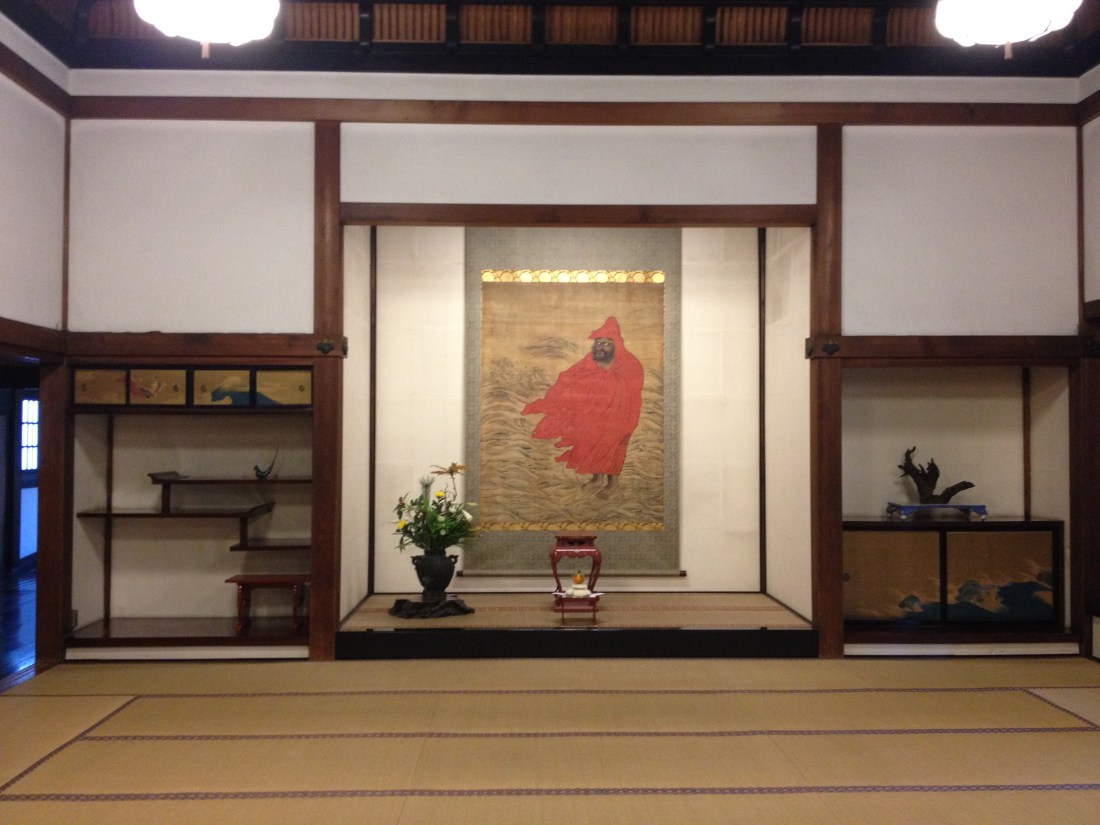
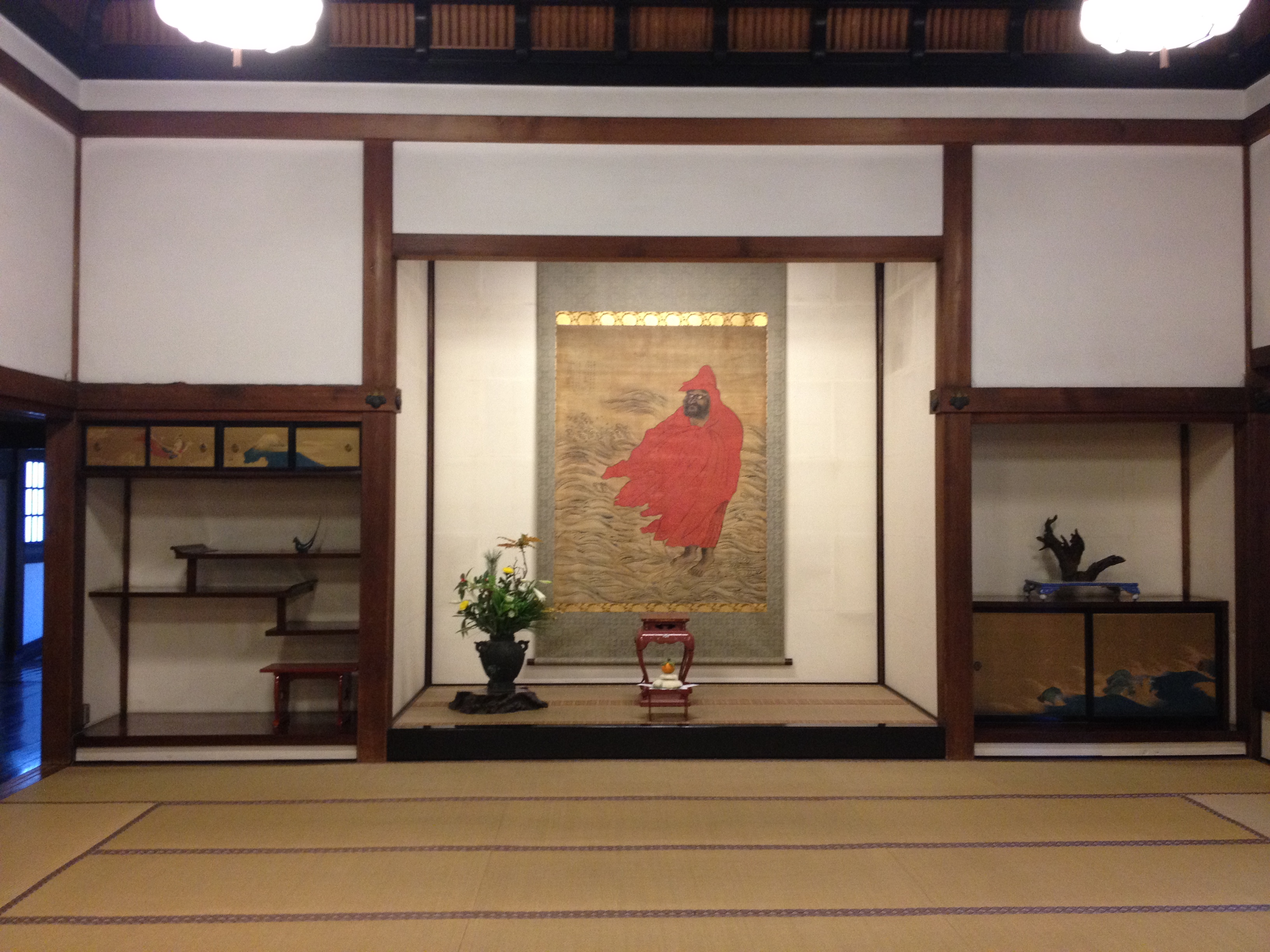
A painting of Bodhidharma at Sojiji temple (head of Soto Zen sect) in Kawasaki, Japan. Taken by me in 2010 (?).

The history up to this point is somewhat vague, and possibly apochryphal, but easy to follow.

This continues for a few more generations in China, until you get to a monk named Hui-Neng (Enō in Japanese)1 who is the supposed author of the Platform Sutra, a Chinese text. As the 6th “patriarch” of the lineage in China, he establishes what we know today as “Chan Buddhism” or Chinese Zen.

Things become more complicated a couple generations later as two descendants: Mazu Daoyi2 and Shitou Xiqian3 directly or indirectly found different schools of Chan Buddhism. This is known as the Five Houses of Chan period during the Tang Dynasty. Thus, the entire Chan/Zen tradition as we know it today is derived from Hui-neng and transmitted through these two men.

Out of the five houses, the Hongzhou,4 Lin-ji and Cao-dong5 all survive in some form. The others are gradually absorbed into the Lin-ji school, which in the long-run is what becomes the most widespread form of Chan Buddhism in China. The Cao-dong school is the one exception, while the Hongzhou school’s success in Korea helps establish 8 out of 9 of the “Nine Schools of Seon (Chan)”6 in Korea. It through Bojo Jinul’s efforts in Korea that these nine schools are unified into the Jogye Order (homepage) which absorbed other Buddhist traditions in Korea into a single, cohesive one.

Meanwhile, in Japan, the Lin-ji and Cao-dong schools find their way to Japan where the names are preserved, but pronounced different: Rinzai and Soto respectively. Rinzai’s history is particularly complicated because they were multiple, unrelated transmissions to Japan often spurred by the Mongol conquest of China. Of these various Rinzai lineages, the two that survive are the “Otokan” Rinzai lineage through Hakuin, and the “Obaku” lineage through Ingen, but eventually the Otokan lineage absorbed the Obaku lineage. Today, Rinzai Zen is more formally called Rinzai-Obaku, or Rinnou (臨黄) for short. This is a bit confusing because Rinzai came to Japan under a monk named Eisai, and his lineage did continue for a while in Japan especially in Kyoto, but the lineage from the rival city of Kamakura ultimately prevailed and absorbed other Rinzai lineages. Obaku Zen arrived pretty late in Japanese-Buddhist history, and as you can see from the chart has some common ancestry with Rinzai, but also some differences due to cultural divergence and history.

Soto Zen’s history is quite a bit more streamlined as it had only one founder (Dogen), and although it did grow to have rival sects for a time, Keizan was credited for ultimately unifying these though not without some controversy even into the 19th century.

Anyhow, to summarize, the entire tradition started from a legendary sermon by the Buddha to Maha-Kashyapa, and was passed on over successive generations in India to a legendary figure who came to China and starting with Hui-neng became a tree with many branches. Yet, the roots are all the same. Speaking as someone who’s relatively new to the tradition, I realize while specific liturgy and practices differ, the general teachings and intent remain the surprisingly consistent regardless of culture or label.

Hope this information helps!

P.S. I had trouble deciding which term to use here: Zen or Chan or Seon since they all literally mean the same thing, but are oriented toward one culture or another. If this all seems confusing, the key to remember is that the entire tradition of Zen/Chan/Seon (and Thien in Vietnam) is all one and the same tree.

P.P.S. I realized that I never covered the Vietnamese (Thien, “tee-ehn”) tradition, but there’s so little information on it in English (and I cannot read Vietnamese), that I will have to differ that to another day.

1 Pronounced like “hwey-nung” in English.

2 Pronounced like “ma-tsoo dow-ee” in English.

3 Pronounced like “shih-tow shee-chee-yen” in English.

4 Pronounced like “hohng-joe” in English.

5 Pronounced like “tsow-dohng” in English.7

6 The Korean word “Seon” is pronounced like “sawn” in English. It is how the Chinese character for Chan/Zen () is pronounced in Korean Language.

7 If you made it this far in the post, congrats! I had to put so many footnotes in here because the Pinyin system of Romanizing Chinese words is a little less intuitive than the old Wade-Giles system. Pinyin is not hard to learn. In fact, I think Pinyin is better than the old Wade-Giles system (more “what you see is what you get”), but if you don’t learn Pinyin it can be confusing.better This is always a challenge with a writing system that strictly uses ideograms (e.g. Chinese characters). How do you write 慧能 into an alphabetic system that foreigners can intuitively understand. Also, which foreigners? (English-speaking, French-speaking, Spanish-speaking, etc). Anyhow, if you are interested in learning Chinese, I highly recommend learning Pinyin anyway because it’s quick and easy to pick up. BTW, since I posted about Hokkien recently it also has two different Rominzation systems: Pe̍h-ōe-jī (old, but widespread) and Tâi-lô (Taiwan’s official revised system).

Soto Zen: A Tale of Two Founders?

A while back, I talked about the history of Zen [particularly Rinzai Zen] and the samurai class in pre-modern Japan. Rinzai has a particularly convoluted history compared to other Buddhist sects in Japan due to its multiple waves of immigration from China, each unrelated to one another. Soto Zen’s history is notably different, but fairly convoluted in its own way, since it has two founders.

This concept of two founders started in the 19th century, after certain Soto Zen temples got into a spat about who was the actual founder of Soto Zen. If you’re reading this and know something about Japanese Buddhism, you might think that the answer is obvious: duh, it’s Dogen since he was the one who went to Song-dynasty China, and brought the tradition back. That was Eiheiji temple’s position at the time.

Conversely, Sojiji Temple took the position that it was Keizan’s influence a couple generations later that actually allowed it to flourish in Japan, establishing it as a proper sect, and not just an isolated temple. Further, until the 19th century, Dogen’s writings were kept secret, so very few Soto priests and students ever read it. So Dogen’s actual influence in the sect would be thus smaller than expected. Or so the argument goes.

Needless to say, eventually the two groups came to a compromise and agreed that both monks contributed to the growth of Soto Zen in Japan, each in their own way. Thus, in the Soto Zen tradition since, they are known as:

  • Dogen – “high founder” (高祖, kōsō)
  • Keizan – “great founder” (太祖, taisō)

Thus every 29th of September the Soto Zen liturgical calendar holds a memorial service for both founders known as Ryōsoki (両祖忌, lit. “dual founders memorial).

Even today, if you look at a Soto Zen obutsudan in Japan, you often see altar images like the ones linked here and here: namely an image of Shakyamuni Buddha in the middle, and Keizan on the left (facing right), and Dogen on the right (facing left). This is not an entirely unusual arrangement, by the way: in the Jodo Shinshu tradition, the Buddha Amida is in the middle, and often flanked by Shinran the founder, and Rennyo the restorer. Sometimes in Tendai Buddhism, you also see Shakyamuni Buddha flanked by Saicho the Japanese founder, and Zhi-yi the original Chinese founder.

The concept of “trinities” often appear in Buddhism, though not in the Western-Christian sense.

In any case, I am glad to see that Soto Zen was able to reconcile this dispute in a way that feels harmonious to me. I have visited Sojiji a couple times over the years (since it is thankfully pretty close to my wife’s house),1 and it is a pretty neat temple. I haven’t visited Eiheiji yet as it is in a remote prefecture in Japan, but I am sure it’s quite a nice place to visit. Just like Keizan and Dogen, each temple enriches the Soto Zen community in its own way, and this helps broaden the community and make it more inclusive.

It is tempting to look at Japanese-Buddhist history and assign one sect to one founder, etc, but both Soto Zen and Rinzai Zen have histories that tend to defy this mold, and it’s important to recognize that religious history is organic and complicated, but also quite fascinating.

Namu Shakamuni Butsu

P.S. Moving back to two posts a week, now that the backlog is caught up.

P.P.S. Posting late, sorry! Made a scheduling mistake. 😅

1 The present location of Sojiji is actually fairly recent. It was in Fukui Prefecture (same as Eiheiji) for many centuries, and was a branch temple of Keizan’s main temple of Yōkōji (永光寺). Ironically, as Yokoji declined, Sojiji gained in prominence. But, history is funny this way.

The Floating World

All conditioned dharmas
Are like dreams, illusions, bubbles, or shadows;
Like drops of dew, or like flashes of lightning;
Thusly should they be contemplated.

The Diamond Sutra, Translation courtesy of Lapis Lazuli Texts

It would be illogical to assume that all conditions remain stable.

Spock, “The Enterprise” Incident”, stardate 5027.3

The “Floating World”, or Ukiyo (浮世) is an old Buddhist term meaning the world of fleeting forms and temporary joys we live in as part of Samsara. It later became, in the 16th century onward, a term for the pleasure quarters of the city of Edo (later Tokyo) when it became the capital of the new Shogunate. The idea was simple: the pleasure quarters offered everything a person could want, if they could afford it, even if it was just part of the mundane, effervescent world.

Block print titled Taking the Evening Cool by Ryōgoku Bridge, c. 1745, by Okumura Masanobu, Public domain, via Wikimedia Commons

But it’s not hard to see that this kind of Floating World, with all its glamour and joys, can be found almost anywhere at any time. Even modern Pop Culture and entertainment, even social media, is just another form of the Floating World.

It’s not that the Floating World, modern Pop Culture, or social media inherently are evil, but they glosses over the pains and realities of life. For every successful actor or actress in Hollywood, it’s not hard to find many others who scrape by. Even those who succeed pay a very heavy price. For every person who greets you at the five-star restaurant with a smile, there are countless people in the back who are slaving away to wash the dishes, cut vegetables, and so on, to say nothing of the waiter’s own personal pains and dilemmas. For every pretty girl who smiles at you, she is glossing over her own pain and trauma. And so on.

Scratch the veneer and see a lot of people working hard to make customers, listeners or viewers happy, but themselves are stressed, exhausted, miserable, or unhappy with their lives.1 Just like the rest of us.

In a sense, the whole thing is a golden sham.

And yet, why do we still gravitate toward such things, even when we know they are transient and don’t provide any lasting happiness? I am no different. When I’ve had a hard day at work, and after dinner with the family, I don’t meditate; I sit down and play a Fire Emblem game. Even Lady Izumi, a thousand years ago, lamented her inattentiveness.

Because we are human, and being human is hard sometimes.

Still, it’s worthwhile to see one’s own behavior and learn from it: the way we flit from something fun to something else fun. Even that can be illuminating. I learned a thing or two just writing this post. 🤔

But yes, life is hard, and it hurts, and it’s exhausting. The joys in life are fleeting, and yet we chase after them for even a temporary respite.

Nonetheless, the house around us is still burning. Time is short.

1 Of course, if you’re thinking to yourself “better them than me”, do not be so sure.

Looking Back As A Buddhist Dad

Way back in 2008, I wrote a blog post (now deleted) about my 1-year old daughter (codenamed “baby”) and teaching her about Buddhism, especially Jodo Shinshu Buddhism which we practiced at the time. I reposted excerpts of it here, with some updates in formatting and such, but also trimmed for brevity.

My 1 year-old daughter, “Baby”, likes to play with the Buddhist rosaries (o-nenju お念珠 in Japanese) we have around the house. Thankfully, most are well-made and can take a good beating from a one-year-old. She likes to chew on them as well, as it helps relieve the itching from teething. I am not sure if this is disrespectful to the rosary, but given that it makes Baby happy and helps with teething, I think it’s for the better.

We’ve been teaching Baby how to do gassho, which is a gesture of respect in Buddhism where we put the hands together close to the heart. We use the Japanese phrase namu namu (南無 南無) when teaching her how to do it. It literally means “hail, hail” or “praise, praise”, but is meant as a gesture of gratitude and respect. In Japanese Buddhism you see/hear phrases like:

  • Namu amida butsu – Praise to Amida Buddha
  • Namu myoho renge kyo – Praise to the Lotus Sutra
  • Namu kanzeon bosatsu – Praise to Kannon Bodhisattva

When I visited Japan in 2005, we visited my wife’s friend, whose family are practicing Shingon Buddhists. In Japan, before eating you are supposed to say itadakimasu (いただきます), which is a very humble form of the word “I am receiving”. In effect, you’re saying grace, Buddhist-style. So, my wife’s friend would tell her three-year old to “namu namu”, or to put her hands together and give thanks. The little girl promptly put her hands together and in her tiny voice said “itadakimasu”. It was really touching to see.

So, with that in mind, we teach the same wholesome habit to Baby as well. Baby is one year old, not three, so she still doesn’t really understand it yet. However, Sunday night she surprised me by draping the rosary over her arm, and waving it around, so I had to take a picture. She’s clearly learning good habits from us, and that’s what makes good parenting so important. Children need good influences or they will have a much harder time in life.

It’s hard for many Western Buddhists, especially those with kids, to know how to raise them as Buddhist. It’s hard too since a lot of people approach Buddhist from an intellectual/philosophical point of view. I am lucky because my wife comes from a Buddhist culture, so I learn a lot of this through her beyond the philosophical side. But for most people who don’t have Asian spouses, how do you develop a Buddhist-family lifestyle?

I think the key is to promote positive values to your kids:

  • Respect for others, your parents, teachers, etc.
  • Humility and gratitude knowing we depend on others for what we have. Who makes your food for example?
  • Kindness, kindness, kindness! In Buddhism, we toss around the word “compassion” a lot, but that’s too abstract for kids. Kindness on the other hand, is a lot easier to convey and just as good.
  • Plenty of research shows that kids like routine, so taking them to a Buddhist service regularly, or having a home routine is good. Meditation retreats on the other hand are a bad idea. Most are not suitable for children anyways.
  • Be a good example for your kids. My wife and I are pretty strict about not swearing or yelling in front of the kids. Sometimes we make mistakes, but we really try.

You get the idea. Most of this stuff is good parenting advice you can apply to any child, Buddhist or not, but the routine with “namu namu” and such is something that kids can understand, and helps convey difficult Buddhist concepts in simple terms. Raising kids is a lot of fun, especially watching them grow into adults who will carry happy memories of their childhood for the rest of their lives.

So, why did I repost this? Sixteen years have passed, and “baby” is now applying for college. It’s amazing to look back and realize how much one’s children have grown. As a teenager, my daughter has never shown any interest in Buddhism at all. We found a couple decent Buddhist books for teens, but I doubt she read them, and sometimes when I mentioned Buddhist teachings, she showed little or no interest.

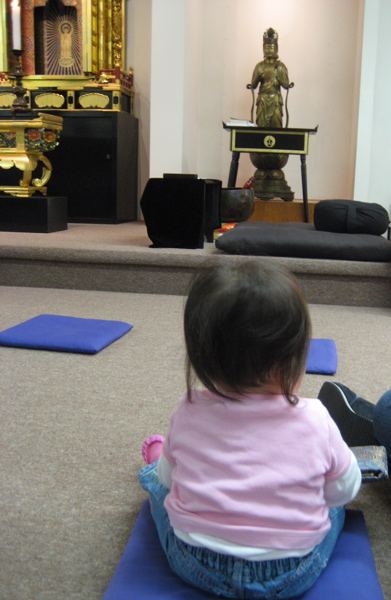
A really old photo of “Baby” at the local Buddhist temple , during a children’s service. The statue is Kannon Bodhisattva. “Baby” attended there for years, but as the kids grew up, we became less active, but this temple has been a part of the local Japanese-American community, and has excellent family-friendly services. This is something many “modern” Buddhist temples lack.

And yet, when she asked me to proofread her college application essay, I was surprised to see that she was quoting something I often say in Japanese: sho-gyō-mu-jō (諸行無常). This phrase is quoted from the famous 12th century war-epic the Tales of the Heike, and means something like the “impermanence of all phenomena”. The English translation is clunky, and since my kids were raised bi-lingual anyway, I just say sho-gyo-mu-jo.1

For example, when someone in the house broke a cup, or something breaks down, I usually just say “no big deal, sho-gyo-mu-jo“, and so on. The kids never really said anything about it, and yet when my daughter wrote her college essay, it’s clear that she really was listening and had processed this teaching as she grew up and matured. I was genuinely impressed, and a bit choked up.

The key, as my original post said, is to keep the teachings simple, set a good personal example, and let kids ease into it on their own. Hitting kids over the head with religious teachings just has the opposite effect. Kids need some kind of moral compass, but they aren’t always mature enough to understand the value of it. By setting a good example, and giving them space to figure things out, they will eventually internalize and process such teachings and figure out how to apply them to their own lives.

It’s also a reminder that good personal conduct really does have a positive impact on others, even if you can’t see the effect.

Namu Amida Butsu

1 Japanese four-character phrases (yojijukugo) are numerous, and only a small number are commonly used, but many educated Japanese have their favorite phrase or two that they will use in writing on conversation. Sometimes you see these in dramas too. It’s also a mark of education (e.g. which ones do you know?), as shown in an episode (season 1, episode 16) of the anime Chihayafuru where the characters quiz one other. Many are taken from Buddhist sources but popularized into common Japanese, others come from Chinese literature.

Neither Priest Nor Layman

I’ve talked a lot recently about the Jodo Shinshu sect (sometimes called “Shin Buddhism” in some circles) of Japanese Buddhism and its founder Shinran, a former Tendai-Buddhist monk of the 13th century.

Portrait of Shinran, Nanbokucho-period artist, Public domain, via Wikimedia Commons

Shinran was one of a multitude of disciples of Honen. Honen was crucial in propagating Pure Land Buddhist teachings to the wider Japanese populace through simple recitation of the nembutsu over elaborate death-bed practices. For his part, Honen was building on older teachings from such illustrious monks as Genshin in Japan (also Tendai), and Shandao in China.

Needless to say, Honen’s hugely popular egalitarian movement really rubbed the Buddhist establishment, which had close ties with the Imperial government (especially with the Fujiwara), the wrong way. Although several complaints by powerful temples such as Kofukuji of the Hosso (Yogacara) sect and Enryakuji of the Tendai sect were rejected, Emperor Gotoba1 finally purged the movement after some alleged shenanigans between a couple disciples and some of his ladies in waiting. This is known in history as the Jogen Persecution (jōgen no hōnan, 承元の法難) of 1207.2

I say this because not only were the offending disciples executed, Honen and many of his followers were banished to the provinces, including Shinran, and were stripped of their monastic certification. The latter point is important to this post and worth exploring.

Way back in the day in ancient India, during the time of Shakyamuni (5th c. BCE), people who wished to follow the Buddha full time would renounce worldly life and become monks (bhikkhu) or nuns (bhikkuni). This was voluntary, and people could choose to give it up and return to lay life, assuming of course they weren’t kicked out for committing some offense. Since antiquity, Indian religious culture respected sages, ascetics, and monastics, such sages, ascetics and monks lived by begging for alms and were generally supported by the community. Since they were supposed to devote themselves full time to religious pursuits, it was assumed that the community would handle their day to day needs.

Fast-forward centuries later to Imperial China, where Confucianism was already entrenched in the government. Confucian bureaucrats generally had a suspicious view of Buddhist monks because they did not work, and didn’t contribute toward rearing families, or other such obligations to society. This clash of cultures played out over centuries, and there was even a dramatic purge during the Tang Dynasty in 845 where many monasteries were destroyed. Centuries later, they gradually reconciled, but it was a very bumpy ride.

This tension between Confucian bureaucracy and Buddhists played out in Japan too. Buddhism was eagerly adopted by the early Imperial court in Japan, but it was a tightly regulated extension of the State, intended to help avert calamities, and bring prosperity to the nations. Monks were frequently called on to recite sutra passages, or chant mantras to help ailing members of the aristocracy, or prevent natural disasters. Of course, many people were sincere followers too, but ordinations, regulations and such were all managed by the central government. It was, first and foremost, another organ of the State.

Why do I mention this?

Because when Shinran and other followers of Honen were stripped of monastic certification, they were no longer recognized as monks by the authorities. Sure they might have training, but no official status.

However, Shinran had been a trainee on Mount Hiei, center of the Tendai sect, since he was a small boy. He knew no other life. And yet now he was technically not a monk anymore in the eyes of the law. And yet, he wasn’t really a lay person either.

This led to a fascinating declaration by Shinran who changed his name to Gutoku Shinran (愚禿釋親鸞, “foolish, stubble-headed disciple of Shakyamuni [Buddha], Shinran”) and declaring himself hisō hizoku (非僧非俗) which means “neither priest, nor layman”. This set the trend that became the Jodo Shinshu movement thereafter.

Rather than relying on monastic institutions or monastic structure, Jodo Shinshu followers self-organized into dōjō (道場)3 which were often just people’s houses. Such members would gather periodically, pay dues, discuss issues at the time, shared letters from Shinran, recited the nembutsu together and so on. It was probably the first truly lay-centered Buddhist movement of this size and scale in Japan, possibly in history.

Lay movements are not new to Buddhism, but usually are often centered around a famous teacher (a monk) or a temple. Or, they tended to dissipate after a few generations. The Jodo Shinshu movement had neither monastic teachers, nor temples. They self-organized, trained their own priests, which included both men and women, and these men and women lived as other people did: they married, had families, worked, etc. Shinran for his part also married and had kids. He had no reason at this point not to since he was legally not a monk any more.

It wasn’t always smooth sailing, and Shinran (and later Rennyo) had to frequently deal with bad teachers, who let the power go to their heads, or taught unorthodox ideas purporting that they came from Shinran. Further, in the time of warlord Oda Nobunaga, and later the Zen monk Tetsugen, mob-violence by Jodo Shinshu followers was a genuine threat.

Nevertheless, the fact that such a self-organized lay-focused Buddhist community existed and thrived across medieval Japan is very noteworthy. It’s openness to women priests was revolutionary for the time, as was its lack of monastic standards for priests. It was run by laypeople for laypeople.

Even while I criticize some aspects of Shinran’s thought, I can’t help but deny that the “neither priest nor layman” concept, even if it was lamenting his own fate, ended up being a brilliant innovation and ahead of his time. Lay-Buddhist movements are very common now across Asia and the West, but these are often very modern innovations. Jodo Shinshu was basically doing it centuries earlier, before it was cool. It met the needs of people in a way that “ivory tower” monastic institutions could not, and solved the issue of accessibility of Buddhist teachings in a robust, sustainable way.

Not surprisingly, Jodo Shinshu is overwhelmingly the largest sect in Japan.

P.S. Shinran wasn’t the only one to really propagate Pure Land teachings in the provinces. Another major disciple of Honen, Bencho, was exiled to the island of Kyushu and established a lineage there which is now the main branch (a.k.a. Chinzei-branch) of the Jodo Shu sect we know today. Another disciple, Shoku, developed a second branch called Seizan-branch Jodo Shu. Shinran’s teachings and organization differed enough from Honen’s that later generations treated it as a separated sect entirely. Hence, “Jodo Shinshu”, not “Jodo Shu”. This might feel like splitting hairs, but if you’re a history nerd, now you know.

1 Emperor Gotoba was also the author of poem 99 in the Hyakunin Isshu, and was definitely a larger-than-life figure… for better or for worse.

2 There is also another persecution in 1227 called the Karoku Persecution (karoku no hōnan, 嘉禄の法難). In the latter case, Honen had already passed away, but after followers who remained in Kyoto built a mausoleum for their beloved teacher, the warrior monks of Enryaku-ji temple raided the mausoleum, destroyed it, and killed some disciples. These were tough times.

3 the modern “dojo” as a martial-arts institution gradually derived from this.

No Working Is True Working: the Tannisho

Writing my recent post about Ikkyu and Rennyo brought back a lot of old memories for me.1 I was also overjoyed when I was recently contacted by another member of my old Jodo Shinshu community. So, I started leafing through the old material I saved, much of it out of print now, and remembered this old quote from the Tannisho (歎異抄), a collection of sayings attributed to the founder, Shinran (1173 – 1263):

10) 念仏ねんぶつには無義むぎをもってとす。しょうせつのゆにとおおそうらき。

“In the nembutsu no selfworking is true-working; it is beyond description, explanation, and conception.”

translation by Dr Taitetsu Unno

This cryptic saying is probably the most emblematic of Shinran’s thinking, and what distinguishes Jodo Shinshu from the rest of the vast Pure Land Buddhist tradition.

Since the days of the early Chinese Buddhist Pure Land teachers such as Dao-chuo (道綽, 562–645) and Shan-dao (善導, 613–681), there has been this notion that Buddhism has two general paths:

  • The path of the Sages (i.e. the classic, monastic path), and
  • The path of the Pure Land

This morphed over time into the concepts of Self-Power and Other-Power. In other words, when following the Buddhist path does one rely on one’s own efforts, or fall back and rely on the grace of the Buddhist deities, primarily Amida Buddha? Every Pure Land Buddhist tradition and teacher that has arisen across history has wrestled with these competing approaches, how to find a balance, or where they might overlap. Charles B Jones’s book really explores this in far greater detail and well worth the read.

In any case, on the Self-Power vs. Other-Power spectrum, Jodo Shinshu Buddhism, as taught by Shinran and later Rennyo, really tipped the scales toward Other Power only. It’s not just 95% Other Power, 5% Self-Power; it’s entirely 100% Other Power. The idea arose through a combination of both Dharma Decline: that people were so far removed from the time of the historical Buddha Shakyamuni that any efforts towards one’s own emancipation were no longer possible, and the aforementioned tension between the Pure Land Path vs. Path of the Sages.

Thus, Shinran is saying that regardless of what one does or doesn’t do, the salvation provided by Amida Buddha is entirely due to Amida Buddha. One cannot add or detract from this grace. Once one experiences such grace, they spontaneously recite the nembutsu, rather than as a Buddhist practice.

Astute readers may find that this sounds an awful lot like Calvanism, and Charles B Jones points this out too. He also points out that the while this can provide great comfort to those who sincerely follow yet doubt their abilities, the challenge of Calvinist-type thinking is that it can leave the believer in doubt about whether they ever will be selected. It almost feels like a religious lottery. A person can be a genuine follower all their life, and yet grace might not come. Not every Jodo Shinshu follower experiences shinjin. And if they did, how would they know?

Back then, I wrestled with this issue quite a bit as a Jodo Shinshu follower. Shinshu teachings have a certain internal logic and beauty to them, but I always had this this nagging feeling that there was some “philosophical gymnastics” involved. And, to be frank, I am no longer convinced that this is what the Buddha taught. Even if you read the Larger Sutra of Immeasurable Life, the most important Pure Land Sutra and the source of the Juseige, it’s pretty clear that Shakyamuni intended for people to bend their efforts toward rebirth in the Pure Land, rather than let go and let Amida Buddha handle everything. The sutra is a bit long, and takes about 1-2 hours to finish reading, but if you’re learning about the Pure Land tradition, it’s worth the read.

I already critiqued Dharma Decline in another post so I won’t belabor that here. Suffice to say, it’s too formulaic to be a realistic assessment of human history.

But what about Other Power versus Self Power? In my humble opinion it’s a false dichotomy. You’re not actually forced in Buddhism to choose one or the other. It is possible, and very common, to find a balance of both in one’s practice. If a Buddhist deity inspires you to keep going, great! And since there many deities in Buddhism, it is possible to find someone who inspires you even if it is the historical Buddha himself. It doesn’t have to be a “cosmic” deity and will still be just as Buddhist.

I don’t want to trash on Shinran though, because a spiritual crisis like the one he had can be a very difficult to resolve even after years. Shinran was an accomplished and fascinating figure, and the Tannisho as a document is a valuable insight into his thinking process.

It’s just that I had my own “mini-crisis” in my younger years as a Buddhist and I came to a different conclusion even as a nembutsu devotee. These days I am pretty happy with my practice, small as it is, plus everything I’ve learned along the way.

Maybe I am totally wrong, but the way I figure it:

  • Slow and steady wins the race.
  • With the breadth of teachings and practices Buddhism has to offer there’s something for everyone and there’s nowhere to go but up.
  • Never be complacent. There’s always more to learn, more to try, and more to experience.

Good luck and happy practicing!

1 This is an old selfie I took of myself in 2015, wearing the robes of a minister’s assistant with the Buddhist Churches of America:

I was still in training (certified later in 2016), but I was very proud to wear it nonetheless. My chanting voice was terrible (still is), but I really tried to take my role seriously. I have a lot of happy memories from that time and am always grateful.

P.S. it’s hard to find a good translation of the Tannisho these days, but you find Dr Taitetsu Unno’s translation here on Web Archive.