A Medieval Buddhist Revolution? The Ikko-Ikki part one

A Japanese mural depicting the Battle of Azukizaka in 1564. In this mural, multiple samurai warriors, carrying banners are combatting one another, so that it is difficult to tell who is who.

Lately, I’ve been enjoying a fantastic history podcast called Grey History, covering the French Revolution in detail. While enjoying this show I started thinking about a famous peasant uprising in medieval Japanese history called the Ikko-Ikki rebellions of the 16th century.

The Ikko-Ikki rebellions are remarkable as being the one time in pre-modern Japanese history where a peasant uprising not only succeeded, but successfully carved out a region of Japan that was ruled by the masses, and not by military samurai, nor the old aristocracy from Kyoto. The binding influence of the uprising was a strong affinity to a certain Buddhist sect, the Jodo Shinshu (浄土真宗, “True Pure Land Sect”), but there was more to the Ikko-Ikki than a “rebel cult” as some labeled them.

Information in English about the Ikko-Ikki is sparse, and often misinformed. I am happy though to have obtained a copy of Dr Carol Tsang’s excellent book War and Faith: Ikko Ikki in Late Muromachi Japan (publisher link), covers the Ikko Ikki, who they were, and their relation to the Jodo Shinshu sect. It’s been a fascinating read even for an old “history nerd” like myself.

This post is part one of two three exploring the Ikko Ikki, but before we talk about the rebellions, we need to cover some Jodo Shinshu history. Speaking as someone who was part of the Jodo Shinshu community for a long time, and also a history nerd, Jodo Shinshu’s history is … different.

The Jodo Shinshu Sect

The Jodo Shinshu sect was one of several Buddhist sects that arose during the Kamakura Period of Japanese history (12th-14th centuries) as a kind of backlash to the Buddhist establishment at the time, and their close association with the ruling aristocracy. Starting with my favorite monk, Honen (法然, 1133 – 1212), a populist Pure Land Buddhist movement took shape, filling a gap that was missing in Japanese society at the time. To be clear, Pure Land Buddhism was not the only new Buddhist movement at the time: we see Nichiren Buddhism and new Zen sects imported from China as well. However, the Pure Land movement was much more widespread in comparison.1 Under Honen this movement was diverse, widespread, and loose-knit comprising of peasants, nobility, and clergy.

However, it was not to last.

The Pure Land Buddhist movement was punished by the Emperor in the Jogen Persecution of 1207 (承元の法難, jōgen no hōnan), and the community was scattered across many parts of Japan and its monks defrocked. Not unlike the many disciples of Socrates in classical Greece,2 these disciples each had their own recollection of Honen’s teachings, and since they were now living different provinces of Japan, individual sects and communities arose.

Some examples include:

  • Jodo Shu, Chinzei branch – started by Bencho.
  • Jodo Shu, Seizan branch – started by Shoku.
  • Jodo Shinshu – started by Shinran and the subject is this post.
  • Single Nembutsu” teaching – started by Kosai (who was later denounced by Honen), but quickly faded.
  • Many Nembutsu” teaching – started by Ryukan, but also petered out later.
  • Ji-shū – started by Ippen, who was not a direct discipled of Honen, but a disciple of Shoku’s disciple.
  • …. among other groups.

As we can see, Shinran (親鸞, 1173 – 1263) was one of these disciples.

A portrait of Shinran, founder of Jodo Shinshu, from the 13th century. Public domain via Wikimedia Commons.

According to some scholars, Shinran had been a mid-level disciple of Honen. When he was defrocked and sent to Echigo province he broke precedence, famously declaring that he was neither priest nor laymen. He then took a wife, and fathered children.

Shiran was not idle though. He was a prolific writer and teacher, spreading Honen’s message (as he understood it) to people in his province. After the exiles were pardoned, Shinran returned to Kyoto with his daughter Kakushin-ni (覚信尼, 1224-1281?) who cared for Shiran until his last days. Shinran spent his time in the capital still teaching, writing hymns and letters. When he passed, he left behind a large community of disciples in the provinces, and Kakushin-ni helped establish a mausoleum for her father in Kyoto. The ownership and maintenance of this mausoleum (later called the Honganji temple) was complicated, but it seems to have been a shared model between the disciples and supporters in the provinces, and Shinran’s descendants.

In time, Shinran’s grandson Kakué (覚恵, 1239 – 1307) assumed the role as caretaker of the mausoleum, the monshu (門首), after Kakushi-ni. Kakue passed on this hereditary role to his son Kakunyo (覚如, 1271 – 1351) and from here the role of Caretaker/Patriarch fell to successive descendants of Shinran even to this day. However at the time, the Honganji mausoleum was not very influential, compared to provincial communities. In time, that would change.

The “Karamon” gate of Nishi-Honganji (West Honganji) Temple in Kyoto, Japan. In the Edo Period, well after events here, the Honganji temple split into two separate temples and lineages due to strife between two brothers: east and west. Photo taken by me in 2010, hence the graininess (old camera phone). The Nishi Honganji temple website has excellent photos.

In any case, Jodo Shinshu from its outset was a firmly lay-Buddhist sect, the first in Japanese history. It was somewhat decentralized and had no monastic institution whatsoever. Other competing Pure Land sects listed above, were founded by monks, and still maintained some form of monastic institutions (some more than others) by contrast.

In the case of Jodo Shinshu, its local communities were organized by lay priests, peasants and craftsman who like Shinran worked and raised families. They organized religious gatherings in small dōjō (道場) rather than formal temples. A dojo in this context could be a room in someone’s home, or a communal space. A network of temples arose over the generations to oversee the various dojo, but early Shinshu communities started out small and informal.

This remained the state of the community for generations up through the Ikko Ikki rebellion.

The Warrings States Period and the Ikki Rebellions

Fast-forward about 200 years since Shinran and Honen. By this point in Japanese history, the reigning Ashikaga Shoguns have become permanently weakened by the disastrous Onin War, and social order was rapidly breaking down as rival warlords who had nominally supported the Ashikaga family, now fought one another for control of Japan. Technically, the Ashikaga still ruled a small region around Kyoto the capital, but the rest of Japan was rapidly descending into all-out war which lasted for another 100 years: the Sengoku or Warring States period (mid-15th through 17th centuries).3

A mural depicting a battle during the Onin War, by Utagawa Yoshitora, Public domain, via Wikimedia Commons

Japanese society at this time had been a feudal, militaristic society. The various domains and provinces had been managed by the Ashikaga Shogunate through a complex web of grants, appointments, and negotiations. Much like medieval society in Europe, the feudal order of Japan was complicated and full of political tension between the Church (i.e. the old Buddhist orders), local land-owning warlords, and peasants who were compelled to work the land in various arrangements. Similar to medieval England at the time, peasants were not all one social class. Many were modestly successful like the English yeoman, while others were saddled with ancestral debt and had to work the land they rented from their landlords (military or Buddhist temples) like European serfs. Other peasants were part of artisan communities that formed associations that might be vaguely compared to European guilds.

A portrait of Toyotomi Hideyoshi, formerly a peasant soldier, now the overlord of Japan and regent of the Emperor in 1598. Painting by Kanō Mitsunobu (狩野 光信, 1565–1608), Public domain, via Wikimedia Commons

Further, the distinction between samurai and peasant wasn’t so clear-cut as it would be in later generations. A low-ranking, provincial samurai or jizamurai (地侍) worked the land and sold goods just as peasants did, though they also had certain obligations to their liege lord, and enjoyed patronage and influence as a result. Even the famous Hojo no Yoshitoki worked his own land (at least some of the time).

Meanwhile, wealthy and powerful land-holding peasants could command local military resources when the needs for mutual defense arose, or lend them to the local warlord if needed, in return for some arrangement. Such peasant soldiers were often called up by local samurai as ashigaru (足軽) foot soldiers. Even the great Toyotomi Hideyoshi once started this way before eventually claiming dominion over all of Japan.

So, while there were social classes, they were fluid, and the boundaries were vague. A low-level jizamurai and a powerful peasant weren’t all that different. In the end, it was a “might makes right” environment.

Thus, in this fast, fluid and shifting environment, communities or like-minded people would form an ikki (一揆), which was a society founded for one single purpose. According to Dr Tsang, ikki were often formed in a ceremony where the participants would gather at a religious site, sign a contract vowing to accomplish their stated aim, burn the contract, mix the ashes into water, and drink it together. The pact was thus sealed in the most solemn of manners.

But why form a society like this?

Local samurai, especially if they had familial ties, might found an ikki promising one another mutual aid and defense. Peasants of a village might form an ikki to push the government for tax relief. An ikki formed in 1428 was large enough to march on Kyoto and burned down debt owners and tax-collecting tolls, for example.

The Ikko ikki (一向一揆) specifically were formed by those who subscribed to the Jodo Shinshu sect, which was also called the Ikkō (一向) sect at the time. The term ikkō referred to their singular reliance on Amida Buddha (lit. all facing one direction: toward Amida and the Pure Land). Ostensibly these followers formed an ikki for mutual defense but soon grew to challenge the most powerful warlords of the era.

With the rise of Shinran’s descendant Rennyo, the ragtag societies grew into a powerful army that even warlords like Oda Nobunaga were unable to defeat. We’ll see more of this in part two.

Stay tuned!

P.S. These longer historical posts take some time to write (let alone proofread), so I may be delayed in posted part two.

1 The rise of the opposing Nichiren sect is an interesting aspect of Japanese-Buddhist history, but it’s out of scope here, and was somewhat smaller in scale. Dr Tsang’s book does point out that there were Nichiren Ikki groups, too, in later ages.

2 Socrates left behind no writing (unlike Honen who was a prolific writer), but his disciples such as Plato and Xenophon described

3 The “sengoku” name was borrowed from a much earlier, though equally fascinating, period of Chinese history. The Warring States Period of Chinese history should not be underestimated in terms of influence too, because many strands of Chinese political philosophy arise from this period, as various thinkers tried to grapple with the collapse of social order, and the debauchery and degradation of the times. These same ideas later had a profound influence on later Asian culture, and the world at large.

A Look At The Meiji Restoration of 1868

As a history nerd, I’ve spent a lot of time blogging about old Japanese history, but I wanted to talk about an oft-ignored yet fascinating period in Japanese history: the Meiji Restoration of 1868. This is called the meiji-ishin in Japanese (明治維新).

Promulgation of the New Japanese Constitution by the Emperor of Japan, photo by Unknown authorUnknown author and signedThe Graphic, Public domain, via Wikimedia Commons

I was thinking about this lately while enjoying the excellent historical podcast Grey History, covering the French Revolution. The French Revolution of 1789 was a violent upheaval, with many unexpected twists and turns, of the old social order, but in the end led to the modern French republic we know today.

In some ways, the Meiji Restoration had similarities to the French Revolution, but also stark differences. Both were started by widespread dissatisfaction with a static, old order, both led to revolutionary changes that overthrew the old order and modernization of a feudal nation, but they had different conditions and led to different outcomes.

I am no expert on French history, but let me at least cover a bit of background on pre-Meiji history of Japan before the Restoration.

The Edo Period

After a century of warfare that tore Japan apart, the conflict finally ended under a single warlord: Tokugawa Ieyasu (德川家康, 1543 – 1616). Japan was unified around the year 1600, and the new Shogun established a new regime, a bakufu (幕府), based in the town of Edo (江戸). Edo eventually became Tokyo later, but at the time it was a provincial castle town.

Ieyasu wasn’t the first to unite Japan, but he made unification stick because he developed a better, more effective administration. Rival warlords were reduced to fiefdoms with only one castle each, and required to abide in Edo every other year. To avoid succession issues, Ieyasu created three cadet branch families (the gosanké 御三家) to provide heirs as a backup, in order of seniority:

  1. Owari (尾張)
  2. Kii (紀伊)
  3. Mito (水戸)

In addition to suppressing and regulating the warlords, politically powerful Buddhist temple complexes were brought to heel and regulated, while everyone in Japan was ordered to register with one temple or another. This helped the Tokugawa Bakufu to regulate temples, and keep an eye on followers by extension.

Outsiders were locked out of Japan (sakoku 鎖国) except for some very limited contact with the Dutch, and only at one port (Deshima) and only once a year. Every one else, especially Christian missionaries were banned from entry upon pain of death.

And finally, society itself. Using Confucian principles, most of society was organized into four general castes (士農工商, shinōkōshō):

  • Samurai – both as administrators and warriors
  • Peasants
  • Artisans
  • Merchants

Of note, the ancient aristocracy of the Fujiwara family, and the Emperor were above this hierarchy, but also sidelined by military government to be pure figureheads. It was a repressive military government by any definition, but it also kept Japan from tearing itself apart for 260+ years.

The problem is that it didn’t adapt to changing conditions.

Over two centuries worth of critical changes happened, both within Japan and outside, that made the regime increasingly unstable.

First, despite the caste system, real wealth and power gradually changed hands. The samurai class, despite being at the top of the hierarchy, were locked into the same pay structure for two centuries, while the merchant class in Japan profited off the stability and economic prosperity. Many samurai families spiraled into debt, and unable to increase their income because their families were doing the same hereditary roles they had generations earlier. Some low-ranking samurai worked menial jobs on the side just to survive, including peasant work.

Second, while Japan was stable, and isolated from Western colonial powers, those same colonial powers grew from being ragtag explorers to powerful maritime empires in two centuries. Science and technology rapidly developed, while Japan fell further and further behind. While some scholars in Japan imported such learnings through Dutch-imported books (rangaku, 蘭学), it wasn’t nearly enough to keep up.

The Tokugawa system prioritized stability, and it succeeded, but the price was centuries of enforced isolation and stagnation.

The Fall of the Tokugawa Bakufu

The last Shogun, Tokugawa Yoshinobu, abdicating his role at Nijo castle in 1867. You can see a really cool recreation of this moment at Nijo Castle in Kyoto. I highly recommend visiting. Photo by 邨田丹陵, Tanryō Murata, Public domain, via Wikimedia Commons

The downfall of the Tokugawa bakufu, to quote Hemingway, came slowly, then suddenly.

Due to prolonged economic depression, followed by encroachment by increasingly assertive Western powers, as well as old rivarlies from centuries before, the Tokugawa grip on power rapidly weakened. The infamous “black ships” of US Commodore Perry who strode nearly unchallenged by Shogunate forces, and demanded treaty rights in 1854 proved damaged the Tokugawa Shogunate’s reputation among rival warlords.

Before long, domains in western Japan such as Choshu, Satsuma and Tosa were sharpening their knives and working to overthrow the Shogunate. They wanted to accomplish two things:

  1. Restore the Emperor back to power after being sidelined by the Tokugawa Shoguns for centuries.
  2. Expel the foreigners who were increasingly encroaching on Japan.

This final period of Tokugawa history, the so-called Bakumatsu Period (幕末, “end of the Bakufu) is pretty fascinating, but complicated, and too much to go into here. Suffice to say, the Tokugawa forces were unable to contain unrest, and eventually civil war broke out between the Tokugawa and the enemy fiefdoms. The war was swift and Tokugawa forces fought bravely, but ultimately failed. The last Shogun, Tokugawa Yoshinobu wanted to end further bloodshed and abdicated, allowing the rebel forces to take control.

From here, the young Emperor Meiji was escorted to the new capitol of Tokyo (東京, lit. “Eastern Capital”) and a new era began which we now call the Meiji Era.

How the Meiji Era Unfolded

Compared to the isolated Edo Period, the Meiji Period was very different. The new oligarchs of the Meiji regime, those former warlords of Choshu, Satsuma and Tosa fiefdoms, recognized that against Western powers, the Japanese military had no chance. They were just too far behind technologically. So, they dropped the “expel the foreigners” slogan and adopted a new one: strengthen the nation.

This led to an intense, rapid Westernization of the country. The old feudal order was abolished, and old samurai were compelled to give up their titles and swords. Most did this eagerly, because it allowed them the freedom to invest in modern businesses and get lucrative positions in the new government. Some did not. The old fiefdoms were reorganized into “prefectures” along the French model, and the army was reorganized into a modern military. Japan adopted a constitution based on the Prussian model, which had a strong, central monarchy. Problems with this constitution arose decades later,1 but this was the first constitution that Japan ever had.

Like monarchies in the West, Japan was now a modern, constitutional monarchy, and sought to renegotiate trade arrangements on equal terms. In this respect, Japan was successful.

The Meiji Consitution, written using old-style Chinese characters and katakana script, a common practice in the Meiji period. Photo by Kantei, CC BY 4.0, via Wikimedia Commons

In addition to changes in government, the entire country went through a rapid modernization. Western technology such as railroads, telegraphs, and steam technology proliferated the country. Modern, forward-thinking Japanese chose to adopt Western dress and actively sought to learn English (Dutch was no longer a prestige language).

In the same way, Western words were actively adopted into Japanese and are now standard vocabulary now. For example:

  • Arubaito (アルバイト) – From German “arbeit” to work. Means a part-time job. Shortened to baito in modern slang (バイト).
  • Zubon (ズボン) – from French jabon (pants). Also means pants, especially slacks, in Japanese.
  • Kōhī (コーヒー) – from Dutch/Flemish koffie. Means coffee, obviously.2
  • Gasorin (ガソリン) – from English “gasoline”.

Speaking of words written in katakana script, the Meiji Period also shows an unusual trend in writing everything in katakana. The Constitution shown above is a mix of katakana script and older-style kanji. You can see similar patterns in books fo the time, or even signs, such as this sign found at the Great Buddha of Kamakura:

Notice the archaic English too, heavily borrowing Christian-style vocabulary to unfamiliar visitors.

Finally, a lot of old traditional Japanese practices were frowned upon at this time as Japan sought to project an image of modernity and Western-style culture.

How Does This Relate to the French Revolution?

I realize that comparing two different historical events a century apart, across two very different cultures is a tricky subject, but it is worth noting a few things.

First, the old order in both societies was based on a backward, feudal system with a hierarchical social structure. The French, similar to other European states, had the Three Estates of the Ancien Régime, and Japan had the four social orders of Shinōkōshō.

Both societies experienced widespread frustration at regime, not just by poor peasants, but also by middle-class intellectuals, and powerful declarations to modernize the country along enlightened principles. In France, you can see examples of this in the Declaration of the Rights of Man and of the Citizen by men such as Marquis de Lafayette and Abbé Sieyès, and in the case of Japan great writers such as Sakamoto Ryoma and Fukuzawa Yukichi. Ryoma in particular was inspired by the United States Declaration of Independence.3

Both changes ushered in a rapid era of modernization as well as a violent but doomed conservative reaction, and both introduced constitutions to countries that didn’t have them previously, as well as a more heightened awareness of national identity that didn’t exist previously.

But there are also big differences. The French Revolution was, among other reasons, driven by primarily internal challenges (starvation, taxation, etc), while the Meiji Restoration was due in part as an effort to protect Japan from foreign aggression in addition to internal issues. The French Revolution faced no such external threat until at least a year or two after it unfolded.

Finally, another interesting contrast is that France increasingly diminished the power of the sovereign (Louis XVI), while in Japan, the sovereign (Emperor Meiji) started with little power during the Edo Period but had his power restored by loyalists. France became a Republic, but Japan is a constitutional Monarchy.

This is a really quick overview, but it’s fascinating how these two events in history overlap and also differ.

1 Basically, the army answered to the Emperor, not to the civilian government. This worked well enough until the army decided to do what it wanted in mainland Asia, with no civilian oversight.

2 When I first met remember my in-laws, I remember trying to explain (in my poor Japanese at the time) that coffee was correct pronounced “Kah-fee”, not “koh-hee” as in Japanese. Thinking back, I didn’t realize that the Japanese word descended, not from English, but from Dutch. I always kind of felt bad about that.

3 A century later, after Vietnam became independent from French colonial power in 1945, Ho Chi Minh famously read aloud the Declaration of Independence of Vietnam, but observers at the time noted its similarities to the US Declaration. Similarly, French Revolutionaries often drew inspiration from the American Revolution as well. As an American, it’s sometimes easy forget what a significant moment in history the American Revolution was, and its message of revolution and Enlightenment thinking at a time of backwards, feudal thinking…. or reactionary thinking in the modern era.

Big Changes, Little Changes

A beach scene with a rocky shore, and waves lapping up to teh shore. In the distance is a cloudy sunset.

Q: The redoubtable Commander Riker, whom I noticed before. You seem to find this all very amusing.
RIKER: I might, if we weren’t on our way to help some suffering and dying humans who–
Q: Your species is always suffering and dying.

Star Trek: The Next Generation, “Hide and Q” (s1ep10), Stardate: 41590.5

Something a little embarrassing I want to confess: sometimes, when I am uneasy or stressed, I go back and read some of my own posts. I don’t do this because of vanity (hopefully) or conceit, but I like to remind myself of certain things I might forget amidst daily turmoil. I suppose I write some of these blog posts as for myself to sort out what’s bothering me, as I do for the dear readers who follow the blog.1

One of my favorite posts of all time is this one. After visiting the Royal British Columbia Museum in 2022, and watching the excellent documentary about the different geologic ages of Antarctica, I walked away deeply impressed. These experiences help give a larger perspective about the world around us, and show how change is a constant of the universe whether we see it or not.

Change happens on the micro-level in our daily lives: one day to the next, we get older, our hobbies change, things at work happen, hairstyles change, etc. When I look at old photos of me and the kids, I am amazed at how much skinner I was, and no grey hear. 🤣

The world around us changes too: political, economically, and so on. The neighborhood you live in will look different 10 years from now, or looking back it’s probably changed in the past 10 years. Thinking about my life as a college kid in the early 2000’s, the Dot-com Era, it’s amazing how much has changed in a mere 20 years. Some things got better, some things got worse.

But if we step back even further, we can see with the benefit of hindsight slow-moving, multi-generational historical changes. From following the excellent History of Byzantium podcast, it’s amazing how much changes in the Eastern Roman (a.k.a. Byzantine) empire across generations. During the time of emperor Justinian the Great, chariot races were still hugely important in Byzantium, the empire had tenuous toeholds in North Africa and Spain, and many people still actively spoke Latin. By the time of emperor Manuel Komnenos, the Eastern Roman empire was far smaller, Greek language had long since replaced Latin, and the single universal church had long since split between Roman Catholic and Orthodox faiths. Between the 6th and 12th centuries, many changes happened, but because they stretch across many generations, it’s not possible for someone living within the city of Byzantium to fully grasp the scale of the changes. It was still the same Eastern Roman empire, and would continue for another 200+ years, but it had changed and evolved as external circumstances changed.

But let’s step even further back. An Egyptian peasant working the fields, or helping to build the Great Pyramid of Khufu, would be utterly stunned at the world today. Such a world would feel totally alien to him or her. It’s not just the level of technology we enjoy today, or the quality of our medicine, but also the way we view the world. Things that seem like common sense to such a peasant would feel strange or silly to us. Things that we inherently believe as 21st century adults would feel strange or bizarre to that peasant. We can’t really pin down when or how such things changed, but it’s series of gradual changes, each one piling on top of the rest.

And yet we can step even further back. If we look at the human race, it is new to the planet Earth. People can deny this using specious reasoning, but science doesn’t care what people believe or don’t believe. The natural world just works the way it does. We humans are just here, living on the Earth, but the Earth does not belong to us. We are its stewards. If not us, perhaps the Apes or Squids will be its stewards. 😏

Which I think brings me to my point: of all the craziness and turmoil going, I think there are two things to take away from all this:

  • We may lament how things have taken for the worse, but in a dispassionate sense, this is just more change unfolding due to causes and conditions that until now we may not have ever noticed. It doesn’t necessarily mean they are good changes, or harmless, but change is change. Also, by extension, the way things are now won’t always be this way in the future. Change is still happening, even if we can’t see it.
  • Of all the things to concern ourselves with most, in my humble opinion, the Environment (with a big “E”) is the most important. If we want to benefit Mankind, the Earth, and all life on it in ways that we’ll never see in our lifetime, if we want to get the most “bang for our buck”, then anything we can do to help the Environment works towards that end. Small changes and efforts now will ripple across generations we will never see, and help shape the Earth, hopefully in a positive way.

At times like this, I truly believe my old minister Rev. Don Castro of Seattle Buddhist Church was onto something when he described Buddhism, including Pure Land Buddhism, as an eco-religion. Amida Buddha, the Buddha of Infinite Light, embodies many things:

  1. As an embodiment of the Dharma, Amida sheds light on the continuous nature of all things: impermanent, fluid, changing.
  2. Also as an embodiment of the Dharma, Amida doesn’t require praise or devotion. The Dharma is just there, whether people notice it or not, whether they believe it or not. But as a Buddha, Amida tirelessly works to help all beings, to awaken them, to provide peace of mind.
  3. Also as an embodiment of the Dharma, Amida embodies how all things relate to one another. The small things that we do day to day to help improve, or degrade, life around us affect others even if they are far removed.
  4. Finally, Amida Buddha as the Dharma teaches rational, not selfish, thinking and non-fear. In a sense, WWTD: What Would Tuvok do?

All this is to say, I suppose, even amidst crazy times, do not fear. Take inspiration from the Buddha, make rational, wholesome choices, yet never assume things will stay a certain way forever. Do not be complacent, nor take things for granted.

Namu Amida Butsu

P.S. featured photo taken at Richmond Beach in Shoreline, WA earlier this year.

1 This blog is small-time, but it’s a labor of love, and I genuinely appreciate each and every reader.

The Trials and Tribulations of Athenian Democracy

The Parthenon of Athens, a tall crumbling stone building with many columns.

Something I’ve been thinking about lately. A lot. Nothing lasts forever and, to paraphrase the Buddha-Dharma, all phenomena are fluid and subject to change. So it is with political systems.

With things as they are now, it’s hard to know how things will turn out 5, 10 or even 50 years from now. However, I find it help to look to the past, and draw lessons and patterns from those.

Enter the city-state of Athens in the 7th century BCE.

Ancient Greece, that is to say Greek history before the Hellenistic Period and Roman times, was a loose patchwork of city-states called polis (Πόλις). Each polis was its own government, raised its own army, and so on. There was no concept of Greek nationalism at this time. They shared a culture and language, they had overlapping religious cults to teh same deities, but not a single “nation” we call Greece today.

Sometimes, powerful polis would absorb small villages around them as part of the polis, but it was still one city, one government. Often times, especially as history progressed, groups of polis would form “leagues” called Koinon (Κοινὸν) for mutual defense, trade and so on. But again, no single nation.

Why do I mention this?

Each polis formed its own government system. Each polis had its own notion of citizenship (i.e. who was a citizen and who wasn’t). Sparta had a diarchy (two kings), plus a complicated system of checks and balances, and a very limited sense of citizenship at the expense of its huge helot slave underclass. Sparta sucked.

As the excellent video below explains, Athens by contrast started out as an oligarchy: a group of affluent families running affairs. However, gradually Athens migrated more and more toward full democracy, expanding citizenship (somewhat) and so on.

I highly recommend the video if you can. It’s an fun, excellent summary of 200 years of Athenian history. What’s really important to understand, I think, is that democracy didn’t spring into existence overnight, and it didn’t start in a perfect form. When the oligarchy was reformed, a man named Solon (Σόλων; c. 630 – c. 560 BC) developed a limited democratic system, which worked well enough until a populist-tyrant named Peisistratus (Πεισίστρατος, c. 600 BC – 527 BC) seized power. “Tyrant”, or tyrannos (τύραννος) in ancient Greek had a slightly different connotation than modern English. A Greek-style tyrant was more simply a dictator or autocrat: not inherently cruel or evil, but did hold absolute power.

Peisistratus, ironically, had a lot of popular support from the masses, and after overthrowing the nascent democratic system, he worked to further curtail the influence of the oligarchs who hadn’t fully relinquished power and influence under Solon’s reforms, plus agricultural and economic reforms. Sounds good at first, but people quickly grew sick of his autocratic behavior, and exiled him. Twice. Peisistratus turned a third time at the head of an army and took over Athens one last time, before we eventually died and his authority passed to his son.

Eventually, his son was kicked out for good, and Democracy returned to Athens under Cleisthenes (Κλεισθένης, c. 570 – c. 508 BC). Cleisthenes had enough sense to not return to the old democratic system, which had been somewhat fragile, and prone to abuse by powerful people. Instead, he reformed the voting districts entirely into new, artificial tribes, each with their own voting districts or demes. He also instituted the system of ostracism to help Athens get rid of bad actors more easily, before it was too late. The rights of citizens were also clarified, and extended to villages within Athens’s sphere for the first time.

Cleisthenes built upon Solon’s earlier work by further reforming the Athenian democratic system, and making it more robust and fair.

This persisted until the 5th century BCE when a brief coup in 411, followed by an imposed government by conquering Sparta, the Thirty Tyrants, in 408 again interrupted the democratic system. However, democracy once again bounced back, made further incremental reforms under Ephialtes (Ἐφιάλτης, d. 461 BC), and persisted until 307 BCE under the domination of the Macedonians. Athens by this point, as a city-state, was simply too small to stand up to empires such as Macedon, followed by Rome. The system continued to exist, but it did not manage anything significant beyond its city borders, until it finally become a simple province under the Eastern Romans (i.e. the Byzantines).

But what I find fascinating is that after every setback Athens always bounced back and reformed its democratic system more and more to avoid internal strife and disruption. They learned from the past, avoided a repeat of the same mistakes, and made their system more robust in the process. Athens isn’t the only country to do this. After the French Revolution of 1789, France has had 5 republics. Each time, they get encounter strife due to a problem in the system, they bounce back, make a new republic, new constitution, and so on. Some republican systems were more successful than others (the Fourth Republic only lasted 12 years), but even in failure there’s lessons to be learned.

So, when I find myself worrying about current events, I try to take solace in that other societies have experienced similar tribulations, but oftentimes the problems are comparatively short-lived, and help spur reforms to the political system that help avoid similar issues in the future, thus revitalizing democracy.

Hubris

“…tin-plated, overbearing, swaggering dictator with delusions of godhood.”

Scotty, “Trouble with Troubles” (s2ep15), Stardate: 4523.3

Thinking of the story of Taira no Kiyomori, among other things today.

Star Trek and Space Lincoln!!

Season three of Star Trek has one of my most favorite, albeit silliest episodes in the entire series: The Savage Curtain. The episode starts off with a bang: Abraham Lincoln (played by Lee Bergere) floating in space on his trademark chair.

From there, the Enterprise crew and in particular Kirk and Spock are confronted by some of “histories worst villains” as well as an encounter with Spock’s idol, Surak (played by Barry Atwater), father of Vulcan philosophy.

A picture of Surak of Vulcan, his right hand in the Vulcan Salute.
Surak of Vulcan, founder of Vulcan Logic, in the Star Trek episode the “Savage Curtain” (season 3, episode 22)

The rock aliens who force the “good” historical figures to combat the “evil” historical figures want to compare and contrast their philosophical ideas against one another to see which is better.

Kahless the Unforgettable (played by Bob Herron) and Colonel Greene (played by Phillip Pine)

The premise might seem a bit silly, but it is a fascinating contrast of ideas:1

  • Surak – a pacifist, non-violent approach
  • Lincoln – fight if necessary, and “on their level”.
  • Col. Greene – power is all matters
  • Kahless – victory by any means
  • Kirk – do what it takes to save his crew
  • Spock – honor his commitments to Starfleet, and fight with Kirk, even if is compromises his personal morals

Although Surak loses his life in the combat, he has some really great quotes in this episode that I think are worth sharing:2

The face of war has never changed.  Surely it is more logical to heal than to kill.

Surak of Vulcan, “The Savage Curtain” (s3ep23), stardate 5906.5

and also:

I am pleased to see that we have differences.  May we together become greater than the sum of both of us.

Surak of Vulcan, “The Savage Curtain” (s3ep22), stardate 5906.4

Lincoln’s performance throughout the episode is great as he embodies the great American president as we want him to be: gentle, but tough when needed. One can’t help but compare this to Bill and Ted’s Excellent Adventure, even if they are completely different movies, because Abraham Lincoln is such a beloved figure.

At the very end of the episode, there is a subtle dialogue worth sharing:

KIRK: They seemed so real. And to me, especially Mister Lincoln. I feel I actually met Lincoln.

SPOCK: Yes, and Surak. Perhaps in a sense they were real, Captain. Since they were created out of our own thoughts, how could they be anything but what we expected them to be?

Source: http://www.chakoteya.net/StarTrek/77.htm

In fact, I think there’s something very Buddhist about this. The inhabitants of the planet didn’t necessarily create historically accurate versions of Lincoln, Surak, etc, but what we wanted them to be in our minds. In a sense, we create our own gods and idols through our hopes and aspirations (for good or for ill). This isn’t always bad, but it does show how unwittingly we bend the world around us to fit our beliefs and views.

Anyhow, The Savage Curtain is such a fun, surreal episode, and a fascinating contrast of ideas and people in history, and how they interact. These ideas and philosophies are timeless in many ways, and crop up over and over again in history, but by pitting a bunch of historical figures in space against once another, it takes on a whole new dimension of weird, silly, fun.

Also:

P.S. Many reviews point out that The Savage Curtain borrows elements from older, venerable episodes, and thus judge it an inferior episode. I can’t disagree that it borrows a lot of elements, but I like to think it is a capstone to several previous “moral tale” episodes. The action sequences aren’t quite as good, but I don’t think that was the point. It was battle of ideas, not sticks.

P.P.S. I bet you could take all 8 characters, including Kirk and Spock, in the battle and somehow arrange them into a classic D&D alignment chart. The rock aliens of Excalbia would probably be true-neutral.

1 I wish “Zorra” (Carol Daniels) and “Genghis Khan” (Nathan Jung) had dialogue, as it would have been interesting to have more contrasting goals and aspirations.

2 More on witnessing war.

Welfare

We Klingons believe as you do — the sick should die.  Only the strong should live.

Kras, “Friday’s Child” (s2ep11), stardate 3497.2

Friday’s Child is an episode of Star Trek from the second season,1 which pits both the Federation and Klingons in political competition over mining rights to a planet of really tall people with funny hats.

Kras the Klingon (played by Tige Andrews) on the left, and Maab (played by Michael Dante) on the right.

Whether it was intentional or not, it is also an episode contrasting two modes of thinking: one is an individualist, darwinian view-point (e.g. only the strong survive) promoted by the Klingon Empire versus a community-oriented, social-democratic viewpoint (e.g. for the good of many). The United Federation of Planets obviously favors the latter.

It’s not hard to find people who favor one approach to society over the other. Some strongly so.

For the sake of transparency, I prefer the community-oriented, social-democratic approach. I grew up pretty poor and had to rely on free school lunches, tuition programs for college and such, and thanks to those, I was able to grow and ultimately succeed. So, if it works for me, I believe others should benefit too.

I think this is also a very Buddhist outlook – the suffering of others is ultimately our suffering too, and vice-versa.

That doesn’t mean we don’t have to care for our own needs though. Looking back to the philosophy of Epicurus,2 we can see that a perfectly reasonable approach is a quietest, isolated lifestyle, focused on just living a good life and not getting tangled in things.

But that’s not usually how it ends up.

For much of history, regardless of time or place, a privileged class rises to the top, whether it be ancient priesthoods, warrior classes, Party members, or corporate CEOs. Some rise to the top due to a mixture of time, place, money, and talent. And, for every one person that rises, many more are pushed down. Some are left behind to wither and die. “That’s the way things go”, some might say. The strong survive and the weak perish, so the thinking goes.

Kras the Klingon in this episode speaks much like the ancient Spartans did. They would not hesitate to leave sickly babies to die to exposure, and train the young constantly in rigid military training. People see this and admire the Spartans for their prowess, and revere them as an archetypal elite class of warriors.

And yet there are some glaring issues with this

First, even by the standards of slavery in the ancient world, Sparta as a city-state had an egregious system, where a large underclass (3-7 times larger than the Spartans) of helot slaves who did all the manual toil. The elite Sparta class thus used their time to focus on training. One can easily imagine plantations like those in the Antebellum South where workers toiled endlessly for nothing, while the landed gentry sat around and pursued the “gentlemanly arts”.

Second, for such a carefully engineered system, the Spartans actually lost a lot of battles. Setting aside the famous battle of Thermopylae which was immortalized as a film of naked, sweaty men in 300, the Spartan army lost frequently. A couple generations later, the Thebans under Epaminondas used clever strategy to smash the Spartans at the Battle of Leuctra in 371 BC despite being a smaller army. Rather than making the Spartans stronger, their system made them more brittle and inflexible.

Third, by creating such an elitist society, the Spartans couldn’t replenish their numbers. They couldn’t rely on helots as soldiers, since they hated the Spartans, and the Spartans couldn’t seriously stomach the idea of serving alongside former slaves. By their cruelty they had painted themselves into a corner.

Thus, each time Sparta lost a battle, its numbers got smaller and smaller until the Roman Republic just steamrolled them. The Roman Republic, by contrast, had a pretty open and flexible recruitment process so they could field huge armies quickly and furnish more if they lost (which admittedly they also did, but their long-term prospects were a lot better than the Spartans).

So, I suppose the moral of the story here (ethics notwithstanding) is that a society based on the premise that only the best and strongest survive ironically leads to an increasingly rigid and brittle society that cannot sustain itself. Diversity and mutual well-being strengthen society, not weaken it.

1 I think most classic Trek fans would agree that the second half of season one through the first half of season two was peak Trek. I still love season 3 for a variety of reasons, but admittedly the quality of writing was best during earlier seasons.

2 Epicurean philosophy gets a bad rap because “epicurean” means something different now. But Epicurus advocated a “quietist” approach, a life of solitude and non-involvement, surrounded by friends. Something vaguely akin to Chinese Taoism. He did not teach hedonism.

The Journeys of Xuanzang, part five: Bamiyan Bound

Having travelled in a westerly direction for a long time, and finally turning south at Samarkand, the 8th century Buddhist monk Xuan-zang is finally approaches the hinterlands of India, birthplace of the Buddha.

A map of northern India including the Gandhara region in the northwest (modern Pakistan and Afghanistan). A red line runs through various cities, starting with Balkh, passing through Himalaya Mountains, reaching Peshawar, Taxila and so on.
A map of northern India including the Gandhara region in the northwest (modern Pakistan and Afghanistan). Created using Inkarnate, apologies for any mistakes.

Previous episodes:

In our last episode, Xuan-zang had gone as far as the city of Balkh (modern Afghanistan) and was deep in “Buddhist country” northwest of India. Times are very different now, but it was a major bastion of Buddhist learning at the time. From here, Xuan-zang moves to Bamiyan and the famous statues there.

Journey to Bamiyan

While staying in Balkh (part 4), Xuan-zang befriended a local monk named Prajñakara. Prajñakara was, according to Xuan-zang, a follower of Hinayana Buddhism (instead of Mayahana Buddhism), and yet Xuan-zang respected him so much they decided to journey the next leg together to India: Bamiyan.

These two besties, along with their caravan, had to traverse the Hindu Kush mountains to reach Bamiyan.

The Hindu Kush mountains between Afghanistan and Pakistan. Photo by Ninara from Helsinki, Finland, CC BY 2.0, via Wikimedia Commons

Not unlike the crossing of the Tian Shan mountains (part 2), the overload route was extremely dangerous. Xuan-zang reported snow drifts up to 20-30 feet tall, and the weather was a constant blizzard:

These mountains are lofty and their defiles deep, with peaks and precipices fraught with peril. Wind and snow alternate incessantly and at midsummer it is still cold. Piled up snow fils the valleys and the mountain tracks are hard to follow. There are gods of the mountains and impish sprites which in their anger send forth monstrous apparitions, and the mountains are infested by troops of robbers who make murder their occupation.

page 45, The Silk Road Journey with Xuanzang by Sally Hovey Wriggins

Thankfully the more experienced Xuan-zang and his team crossed safely and with fewer casualties than past mountain crossings. In time they reached Bamiyan (بامیان in Dari language).

Bamiyan and the Great Buddhas

Bamiyan, since antiquity, has been an oasis town residing where the Hindu Kush and Koh-i-Baba mountain ranges meet, and is a high-altitude, cold-desert climate. Nonetheless, Xuan-zang described Bamiyan as producing wheat, fruit and flowers, as well as pasturage for cattle and such. Due to the climate, Xuan-zang stated that people wore fur and coarse wool, and their personality was similarly coarse and uncultivated. Yet he praised their sincere religious faith.

A panorama collage of the town of Bamiyan, including the Great Buddhas on both ends. Taken before 2001, photo by Original source images: Françoise Foliot (in 1975)Stitching of the two source images: पाटलिपुत्र, CC BY-SA 4.0, via Wikimedia Commons

Up until 2001, the town of Bamiyan was dominated by several sites, including two massive Buddha statues which were built during the reign of the so-called “White Huns” or Hephathalites. The Huns themselves were not Buddhist, but allowed Buddhist worship to continue and devout local patrons helped fund the statues perhaps as an act of piety. Interspersed between the statues were monasteries and grottoes carved into the cliffside.

Of the two “great Buddha” statues, the “eastern” statue depicts Shakyamuni Buddha, the historical founder, measuring 38-meters, while the western statue depicts Vairocana Buddha1 measuring 55-meters. Sadly these no longer exist, as they were destroyed by the Taliban in 2001. In Xuanzang’s time, the status were painted and decorated. The western statue was painted red, while the eastern was white. Both had blue-orange robes, and adorned with gold. This coloration lasted at least until the 12th century.

Interestingly, Xuan-zang described a third, reclining statue of the Buddha at Bamiyan, but no evidence has been found yet of this statue.

In any case, Xuan-zang was greeted by the king of Bamiyan and the local monks, adherents to an obscure sect of “Hinayana Buddhism” that taught that the Buddhas transcended “earthly laws”, took Xuan-zang and his party on a tour of the monastery and valley. My book and online research doesn’t clarify which sect or what this means.

Despite the warm reception, it doesn’t appear that Xuan-zang stayed all that long, and eventually moved on through the Hindu-Kush mountains to Kapisi next.

Kapisi and the Chinese Prince

Next through the Hindu Kush mountains was the city of Kapisi (also known as Kapisa, Chinese: 迦畢試 Jiapishi), which was the capitol of the local Kapisi Kingdom near the modern city of Bagram. Xuan-zang reports that once again, the weather was very difficult, and they even got lost at one point, but some locals helped guide them safely to Kapisi.

Storm clouds part, offering a rare glimpse through the crisp air at Bagram Air Field, Afghanistan, Dec. 18, 2008. The high altitude of the Hindu Kush mountain range creates a harsh climate ranging from more than 100 degrees Fahrenheit in the summer to below-freezing temperatures in the winter. Photo by U.S. Air Force photo by Staff Sgt. Samuel Morse (Released), Public domain, via Wikimedia Commons

As with Bamiyan, Xuan-zang received a cold reception from the people, but was greeted by the local king whom he described as “intelligent and courageous”, and ruled over the neighboring areas.

Bamiyan and Kapisi are both places that have seen countless historical events. Alexander the Greats army marched through Kapisi in the spring of 329 BCE, and the Kushan Empire established Kapisi at its first capital in the first century CE. It was the Kushans in particular who were instrumental in helping Buddhism spread to East Asia (and now the world) especially under the great Emperor Kanishka (reigned 127 – 150 CE).

During the reign of Kanishka, a Chinese prince had resided in a monastery in Kapisi as a political hostage. When the prince returned home, he sent gifts and offerings to the monastery in gratitude. Centuries later during the 7th century CE, Xuan-zang paid homage to this prince at the monastery (called the “Hostage Monastery”), where it as thought that the prince’s treasure was buried. According to Xuan-zang’s account, he suggested they dig under a statue of the Buddhist deity Vaiśravaṇa,2 and after a time, the treasure was discovered. Because Xuan-zang was also Chinese, like the prince, it was assumed that his fellow countrymen from the past helped guide them to the treasure.

Later, Xuan-zang was invited by the king of Kapisi to preside over a religious debate amongst the Buddhist clergy, and (again based on Xuan-zang’s account) he was well-versed in the Buddhist doctrines and won, while his opponents only knew their own limited doctrine. One cannot help but roll their eyes slightly. 🙄

Finally, Xuan-zang ran into Hindu ascetics for the first time. Hinduism as we know it, arose roughly the same time as Buddhism and developed in parallel, not one from the other. A common and incorrect statement is that Buddhism descended from Hinduism; they drew from the same cultural and religious well, but arrived at different conclusions. At this time in history, Hinduism was on the rise as Buddhism began a slow decline. Since Hinduism had never reached China, Xuan-zang was not aware of it and spoke ill of the ascetics he encountered, describing them as decadent, untrustworthy, and selfish. It’s unclear why he had such a negative first impression though. Later, in India, he would invest much time debating against them in philosophical contests.

However, Xuan-zang’s joruney was not done. He needed to reach the next destination before crossing into India: Jalalabad.

…. which we’ll talk about in our next post. Thanks for reading!

1 Vairocana is a “cosmic Buddha” that first appears in a Mahayana version of the “Brahma Net Sutra” (the Pali Canon/Theravada version is unrelated). Vairocana, the “Buddha of the Sun” is also the great Buddha statue at Nara, Japan, and is particularly important in the esoteric Buddhist tradition where it is called Maha-Vairocana.

A photo taken by me in 2010 of the central image of the great hall at Todaiji Temple in Nara, Japan: Vairocana Buddha.

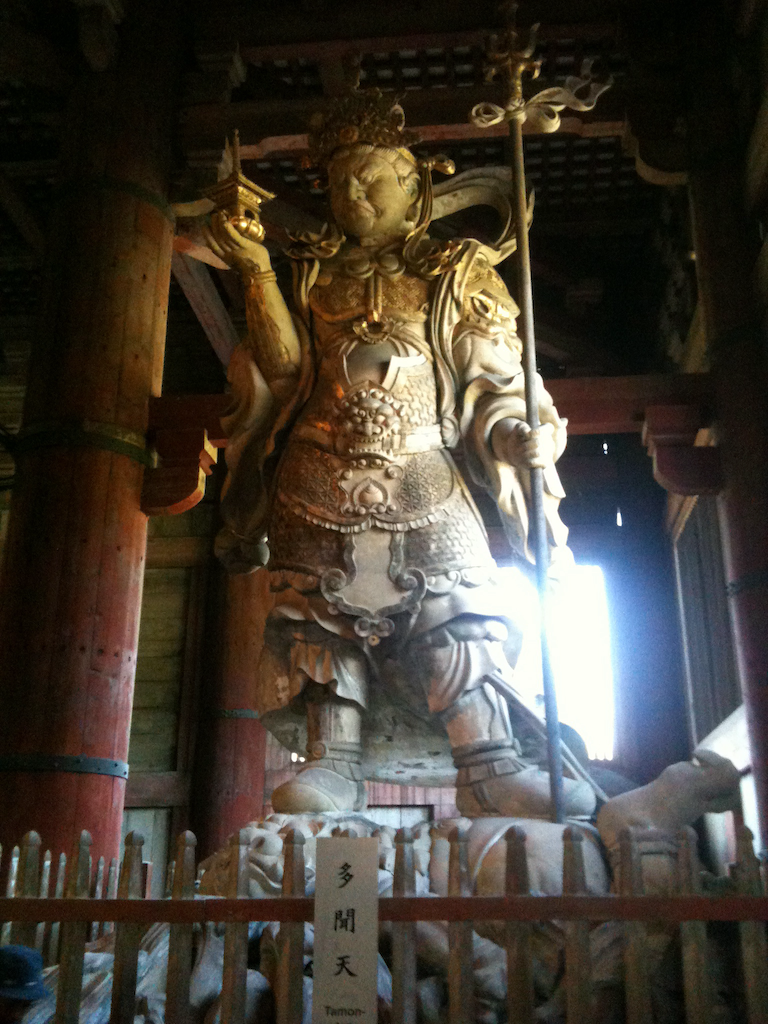
2 Vaiśravaṇa, known in Japanese Buddhism as Bishamonten (毘沙門天), can be seen at the famous temple of Todaiji in Nara. I took this photo back in 2010 when visiting there.

A photo of a statue of the Buddhist deity Vaiśravaṇa, known as either Bishamonten, or Tamonten, in Japanese Buddhism. Photo taken at main hall at Todaiji Temple in Nara, Japan.

Indeed, what we see today of Buddhism in Japan and beyond is directly related to the things that Xuan-zang saw along the Silk Road, even if the connection is not obvious at first sight.

Buddhism Speedrun

I saw this post recently on BlueSky, the hip new social media platform all the kids are talking about,1 and I had to share it with readers 🤣:

Speed-running is a fascinating sub-culture of gamers who finish games in impossibly short times through a combination of intense practice, manipulating errors in game code, and pre-planned strategy. My son and I like to watch speed-run world-records on YouTube for games I used to play as a kid. For example, this is a speed-run video where someone beats the classic NES game Mike Tyson’s Punch-Out in 22 minutes!

And this video shows someone attaining the world record for finishing the original Super Mario Brothers in 4:57. You can see multiple sneaky glitches and exploits here, plus lots of careful jump timing:

Finally, in this video, someone cleverly exploits an obscure glitch in Super Mario 3 to beat the game in 3:32!!!

But what does this have to do with Buddhism?

Buddhism is a 2,500-year old religion, adopted by many cultures and many times. The Buddha Shakyamuni (i.e. our historical founder), laid out the basic premise and trained his disciples on how to liberate themselves from the endless cycle of Samsara, and especially in the Mahayana-Buddhist tradition, to liberate others. We can see in early texts that this was a regimen of meditation training, self-restraint and living a humble, monastic lifestyle, as well as observation into one’s own mind. In video game terms, you can think of this as “grinding” level after level, building your skills, taking countless hours of gameplay.

The Buddhist path is a slow process, and requires a lifetime of dedication. Periodic visits to your favorite “meditation center” are fine, but Buddhism traditionally sees the path to awakening as a multi-lifetime endeavor for all but the truly talented (who may have already cultivated these qualities in previous lifetimes).

The actual length of time it normally took to accomplish awakening in Buddhism was hotly debated across Buddhist history. Early Buddhist texts implied that monks who were well-trained, or even lay-people who assiduously followed the basic code of conduct, could expect to reach awakening in one more lifetime, or may be a few lifetimes. But in Mahayana Buddhism, the length of time got longer and longer times as the bar of difficulty got higher and higher, well beyond what one could reasonably accomplish. A text called the Sutra of the Ten Stages in the Flower Garland Sutra describes the “Ten Stages of a Bodhisattva” over dozens of pages, and what’s required to complete each one before even getting to awakening. But each stage is a huge, huge endeavor by itself. Lifetimes of effort were not measured in eons of lifetimes.

As the road to awakening became longer and more remote, many Buddhist methods were developed to compensate for this and help people achieve the fruition of the Buddhist path much sooner, often through devotion to on Buddhist deity or another, or through specific samadhi methods, meditations and so on. The Pure Land path is by far the most popular and well-known due to its accessibility.

But in particular the Esoteric or Vajrayana traditions developed in the first centuries CE, hundreds of years after the Buddha. Historically speaking, the trend toward a longer and longer Buddhist path reversed and using this or that series of rituals, mantra chants, and mandala visual aids, one could “hack” the code of Buddhism and accomplish awakening in this very lifetime. Of course, the secrets behind such Buddhist speed-running techniques require a guru and a lineage.2 Vajrayana Buddhism is most prevalent in Tibet, but also in Japan through both Shingon and Tendai Buddhism.

But this does beg the question: is it really possible to speed-run the Buddhist path? Further, is the Buddhist path really eons and eons long as Mahayana Buddhism tends to assert, or is the length of time over-inflated?

Frankly, I don’t know.

Esoteric teachings and practices were definitely not part of the early Buddhist tradition (I definitely do not buy the idea of “secrets transmissions”, either). The Buddha’s advice in the early texts is generally pretty straightforward, one might say a little bland and anti-climactic, but also challenging because it gets to the root of who we are. It is definitely a lifetime effort.

But as much as I love the Mahayana tradition, it did have a tendency to out-do itself over and over. Waves and waves of Mahayana texts get increasingly dramatic, increasingly grandiose, and describe the Buddha path (namely through the Bodhisattva path) increasingly challenging terms. A backlash was inevitable, and so I can’t say I’m surprised that anti-intellectual movements such as Zen and Pure Land Buddhism, or “speed-run” methods such as Vajrayana arose in response.

Then there’s inevitable backlash from modern Buddhists who look at this convoluted history and complain, “none of this is real Buddhism anymore, it just cultural accretions”.

Every religion changes and evolves. Christianity as we know it didn’t have Christmas trees, and used Jewish-style liturgy in its early years. It adapted as it moved into new cultures. Islam grew into two different traditions, and as it became more urbanized some of the desert-nomadic traditions of the early community had to be adapted. Even obscure religions such as Zoroastrianism, whose early texts were composed amidst a steppe-nomadic culture, evolved to a more urbane and worldly culture until the Persian Empire.3

Zealous people love to go on a quest to find the “pristine” religious teachings, but you’ll never really find it. At best, you’re just reconstructing from pieces of the ancient past. At worst, you and your community just goes off the rails. It’s a fruitless quest.

So what to make of all this history and breadth of practice in Buddhism? Again, I just don’t know.

I do think that the old Kalama Sutta of the Pali Canon (AN 3.65) does provide some help though (slightly edited for readbility):

“It is proper for you, Kalamas, to doubt, to be uncertain; uncertainty has arisen in you about what is doubtful. Come, Kalamas. Do not go upon what has been acquired by repeated hearing; nor upon tradition; nor upon rumor; nor upon what is in a scripture; nor upon surmise; nor upon an axiom; nor upon specious reasoning; nor upon a bias toward a notion that has been pondered over; nor upon another’s seeming ability; nor upon the consideration, ‘The monk is our teacher.’

Kalamas, when you yourselves know: ‘These things are bad; these things are blamable; these things are censured by the wise; undertaken and observed, these things lead to harm and ill,’ abandon them.

Translation by Soma Thera

Followed by:4

…Kalamas, when you yourselves know: “These things are good; these things are not blamable; these things are praised by the wise; undertaken and observed, these things lead to benefit and happiness,” enter on and abide in them.’

Translation by Soma Thera

or the Buddha preaching to his stepmom in the Gotami Sutta of the Pali Canon (AN 8.53) :

“Gotamī, the qualities of which you may know, ‘These qualities lead to passion, not to dispassion; to being fettered, not to being unfettered; to accumulating, not to shedding; to self-aggrandizement, not to modesty; to discontent, not to contentment; to entanglement, not to reclusiveness; to laziness, not to aroused persistence; to being burdensome, not to being unburdensome’: You may categorically hold, ‘This is not the Dhamma, this is not the Vinaya, this is not the Teacher’s instruction.’

Translation by Thanissaro Bhikkhu

To summarize, if your Buddhist is leading to negative qualities described here, you should probably stop. If it is leading to wholesome qualities described here, keep going.

Namo Shakyamuni Buddha

Edit: I forgot to mention that the ultimate speed-runner in Buddhism is the Dragon Princess from the 12th chapter of the Lotus Sutra:

At that time the members of the assembly all saw the dragon girl in the space of an instant change into a man and carry out all the practices of a bodhisattva, immediately proceeding to the Spotless World of the south, taking a seat on a jeweled lotus, and attaining impartial and correct enlightenment. With the thirty-two features and the eighty characteristics, he expounded the wonderful Law for all living beings everywhere in the ten directions.

Translation by Burton Watson

1 I have a couple BlueSky feeds on there, but nothing related to the blog.

2 The Zen tradition is often compared to the Esoteric tradition since it also has ineffable teachings that can only be conveyed by a proper teacher.

3 I only know this because of the History of Persia podcast, by the way.

4 Because early Buddhist texts (sutras) were memorized and recited, they tended to be very repetitious. Later sutras, those in the Mahayana-Buddhist canon, used a more narrative style and thus longer and less repetitive, but also much more epic in tone.

What Is A Shogun

With the conclusion of the hit mini-series Shogun,1 it seemed like good time to delve into what a Shogun was. I talked a lot about the first few Shoguns of the Kamakura Period, and the Shoguns of the late Edo Period, but there’s a lot more to the story.

In early Japanese history (a.k.a. Japanese antiquity), the government was modeled on a Chinese-style, Confucian-influenced bureaucracy. This is epitomized in the Ritsuryo Code which started in 645, under the Taika Reforms, and continued (nominally) in some form all the way until 1868.

This imperial bureaucracy elevated the Emperor of Japan to the first rank, and other officials and nobility were allocated ranks below this. The ranks dictated all kinds of things: salaries, colors to wear at the Court, other rights and responsibilities, etc. There were bureaucratic offices for all sorts of government functions: land management, taxes, religious functions, military and so on.

The imperial court did not rule all of Japan as we know it today. The north and eastern parts of Japan in particular were dominated by “barbarian” groups called Emishi whose origins are somewhat obscure but are probably ethnically different than early Japanese people.

To subdue these people, certain military commanders in the Imperial bureaucracy were granted a temporary title of sei-i taishōgun (征夷大将軍), or “Supreme Commander of Barbarian-suppressing Forces”. Since a military force needs a clear chain of command, someone had to be made the supreme commander, and this was what the Shogun was meant to do.

But everything changed after the Genpei War, and the fall of the Heike Clan.

After the Genji clan (a.k.a. the Minamoto) crushed the Heike clan, they assumed military control of Japan. The head of the Genji clan, Minamoto no Yoritomo, was granted the title of sei-i taishōgun by the Emperor permanently, and given the task pacifying the rest of Japan. The title became hereditary, not temporary, and thus created a new system of government in Japan.

The original Imperial Court, and its institutions, remained in place in Kyoto. However, practical control of Japan was managed through the new bakufu (幕府) government headquartered in the eastern city of Kamakura. This began a period of history called the Kamakura Period of 1185–1333.

From here, Japan’s history and its bakufu governments can be divided like so:

PeriodCapitolNotes
Kamakura Period (1185–1333)KamakuraAfter Minamoto no Yoritomo‘s death, plagued with infighting and power-plays by vassals. Minamoto line died with Sanetomo’s untimely death, further heirs drawn from obscure Hojo relatives.
Southern Court Insurrection
(1336 – 1392)
YoshinoEmperor Go-Daigo attempts to reassert authority of the Imperial line. Kamakura Bakufu dispatches Ashikaga Takauji to suppress rebellion, but is betrayed by Takauji.
Muromachi Period
(1336 to 1573)
KyotoFirst 3 shoguns were strong rulers, but quality of rulership slowly declines, culminating in 8th shogun Yoshimasa, and the disastrous Onin War. High point of Kyoto culture, ironically.
Warring States
Period
(1467 – 1615)
Kyoto
(barely)
After Onin War of 1467, Ashikaga Shoguns still nominally rule until 1573, but country descends into civil war. Almost no central authority.
Oda Nobunaga
(1573 – 1582)
KyotoAfter driving out last of Ashikaga Shoguns, Oda Nobunaga reaches deal with reigning Emperor and conferred titles of authority. Almost unifies Japan. Later betrayed and murdered by a vassal.
Azuchi-Momoyama Period
(1585 – 1598)
KyotoAfter unifying Japan after Oda Nobunaga’s demise, vassal Toyotomi Hideyoshi unifies, and then rules Japan as the Sesshō (摂政, “regent to Emperor”) then Kampaku (関白, “chief advisor”). Dies in 1598, and son is too young to rule. Country falls into civil war again.
Edo Period
(1600 – 1867)
Edo
(Tokyo)
Tokugawa Ieyasu, a former vassal of Oda Nobunaga, then unifies Japan for the final time, and moves capitol to a newly fortified town of Edo (modern Tokyo). Effective policies by Ieyasu and his early descendants avoids many problems of past Shogunates, and provides stable rule for 268 years until Meiji Restoration of 1868. Similar to Muromachi period, quality of rulership gradually declines, but effective policies help maintain stability far longer.2

The last shogun, Tokugawa Yoshinobu, relinquishes authority back to Emperor at Osaka Castle in 1867.

During this entire period of history, the Imperial line, and its Court of noble families in Kyoto never ended. The Southern Court vs. Northern Court briefly split the Imperial family into two competing thrones, but once they reunified, everything continued on as normal. The Emperors reigned, but the military governments ruled.

Once the Meiji Restoration of 1868 came, this changed, and with a new constitution borrowed from the Prussian model, the Emperor’s assumed direct control again until the modern constitution in 1947 when the Emperor returned to a mostly ceremonial role that we see today.

The series of Shogun takes place at the very end of the Azuchi-Momoyama Period to the very beginning of the Edo Period, but as you can see, Japan’s military history was far longer, and its many ruling families each faced different challenges. For the peasants on the ground, who they paid taxes to may have changed, but life overall probably remained somewhat the same.

1 I read the original book by James Clavell back in the day, including his other books: King Rat, Taipan, and so on. Great story-telling, especially King Rat (based on his personal experiences), but older me kind of facepalms now at the bad stereotypes, linguistic mistakes, and so on.

Abarembo Shogun” Television series set piece, Toei Uzumasa Studios Kyoto Japan. Photo by fg2, Public domain, via Wikimedia Commons

2 It’s also why, today, many historical dramas, comics and stories take place in the Edo Period. My father-in-law likes to watch one Japanese TV show called Abarenbo Shogun (暴れん坊将軍, “Unfettered Shogun”), which is a mostly fictional drama about the unusually talented 8th Shogun of the Edo Period, Tokugawa Yoshimune (1684 – 1751). In the drama Yoshimune, often traveling in disguise, solves mysteries and fights crime. It’s campy, but also a fun show to watch. The “Megumi” lantern shown on the right is a set piece from the show.