This is the last in a series of Japanese-Buddhist sutra books that I wanted to share. I talked about this Soto Zen sutra book, a Rinzai Zen book and a Jodo Shu sutra book. Today, I wanted to share the sutra book I purchased at Asakusa Temple in Tokyo, Japan.
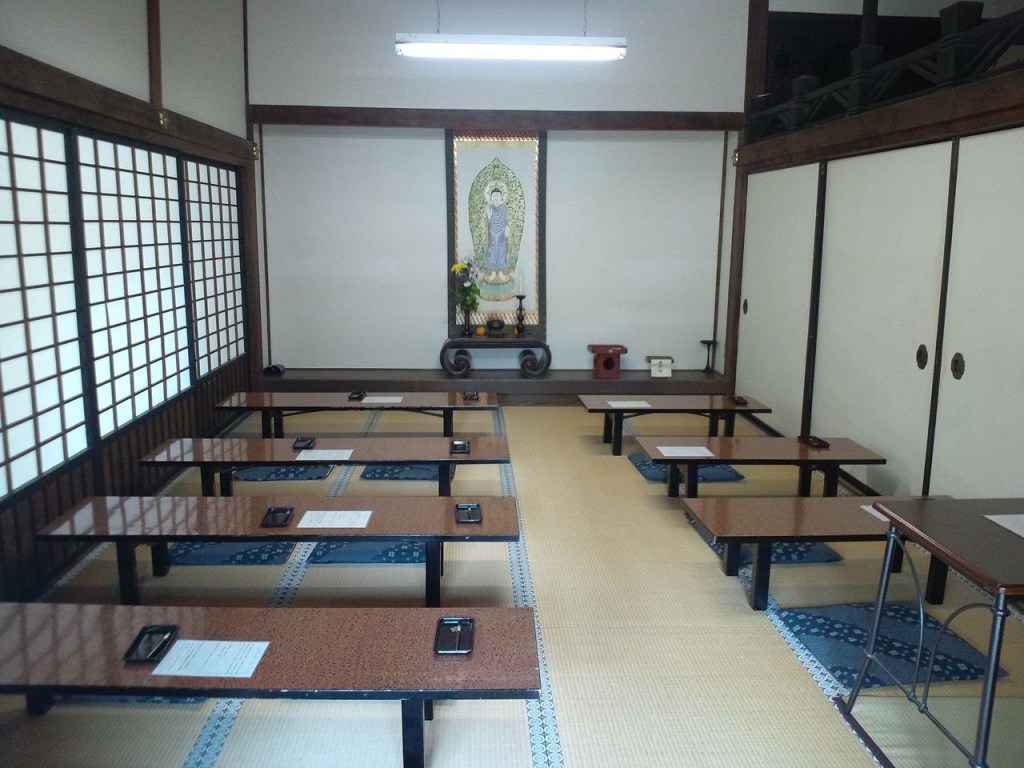
Asakusa Temple (more properly Sensoji Temple, 浅草寺)1 is super famous, and chances are if you have visited Tokyo, you probably went to Asakusa Temple. Asakusa is technically its own Buddhist-sect now, but for much of its history it was a Tendai Buddhist temple that enshrined a legendary statue of Kannon Bodhisattva that supposedly washed up on shore and enshrined in the year 645. This is called the Yanagi no Miei (柳御影, roughly translated “the [sacred] willow image”). The featured photo above shows where it is enshrined at Asakusa Temple.
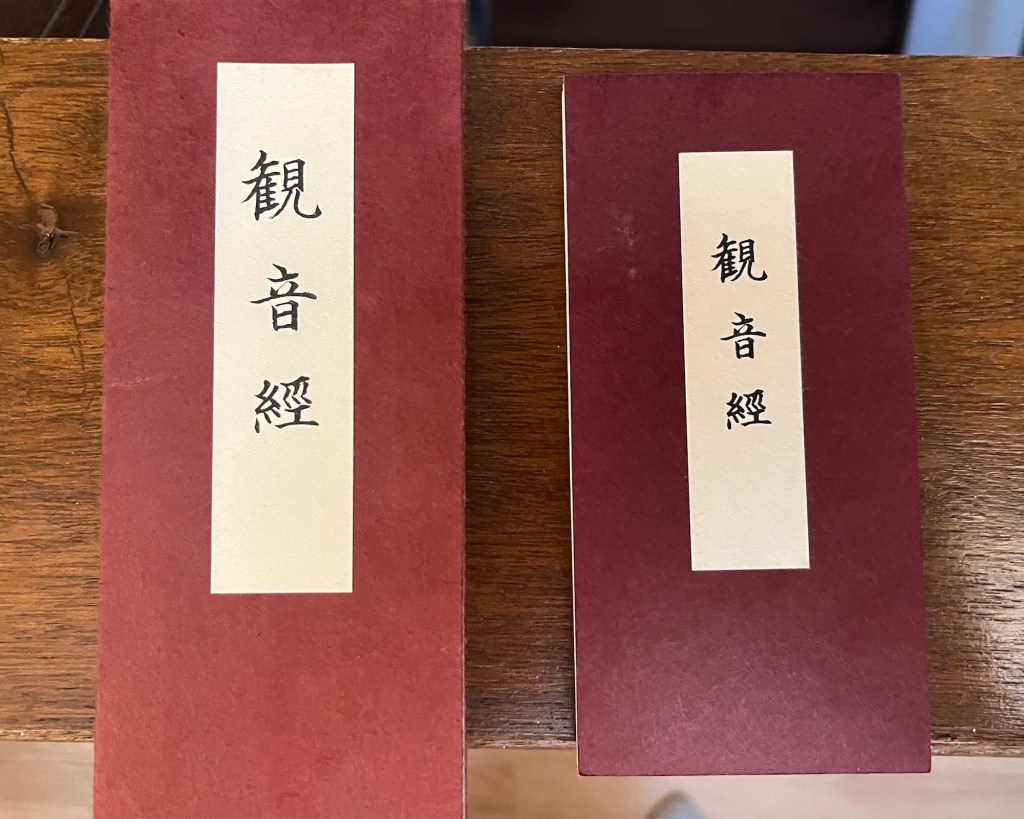
Not surprisingly, the sutra book’s liturgy focuses on Kannon-related chants. This sutra book is sold in two sizes, but the contents are the same:
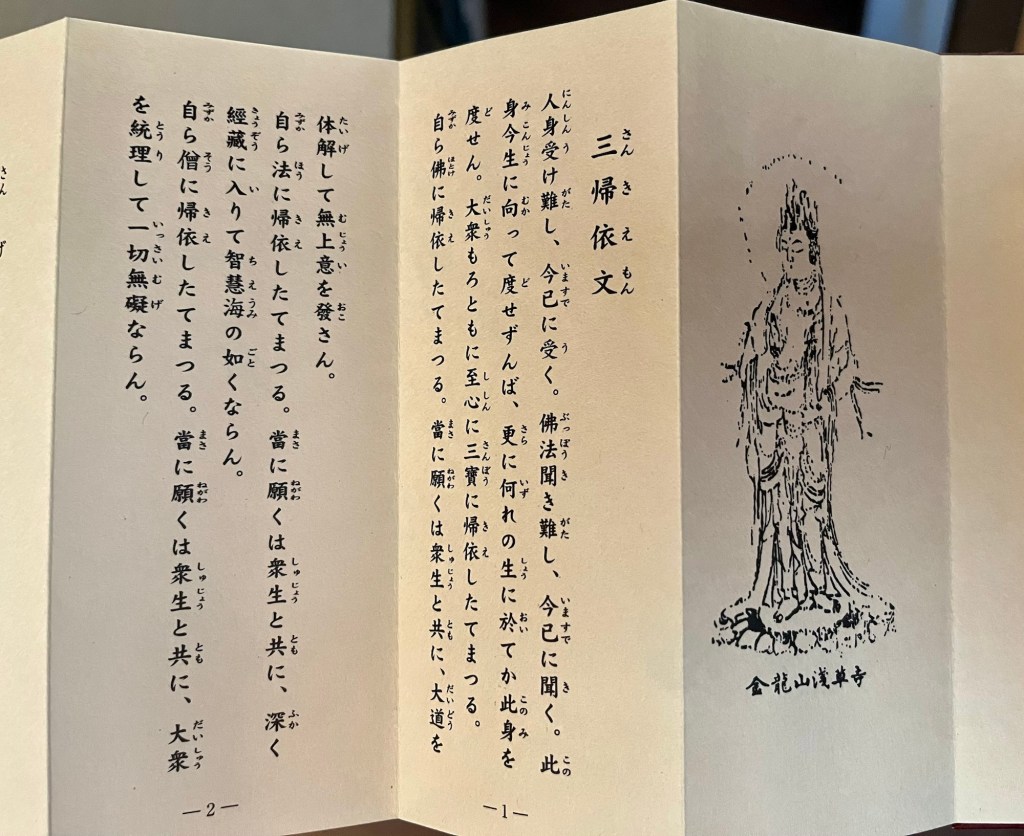
The illustration inside the cover depicts the legendary statue :
The liturgy to the left of the illustration is a form of Taking Refuge in the Three Treasures (san-ki-é-mon, 三帰依文) done in a more native-Japanese style, than the Sino-Japanese version I posted here. Both versions are perfectly valid and are chanted.
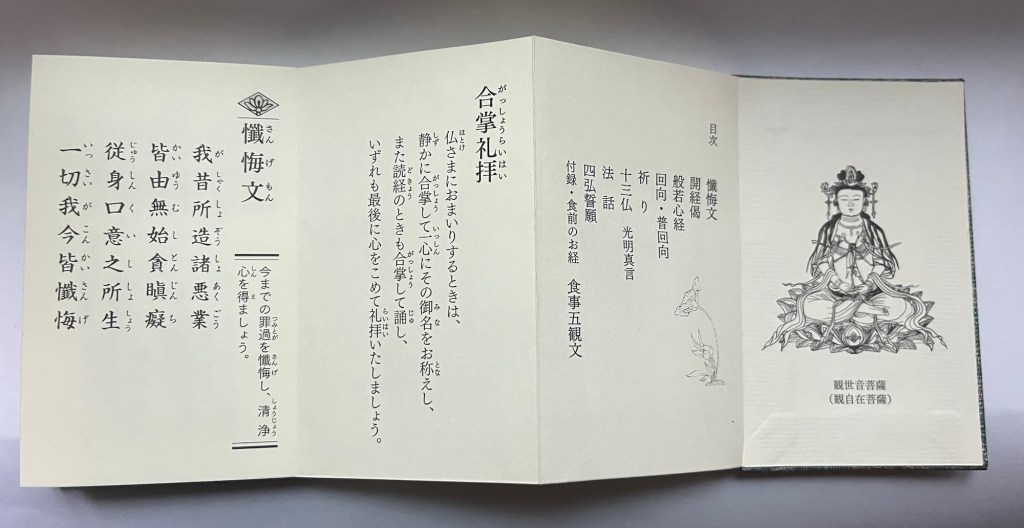
More examples below are chants that we’ve seen in older posts in right to left order:
the Sangémon (repentance) on the right,
Kaikyoge (verses for opening the sutra) second page from right, and
Unlike other examples I’ve seen, this sutra book posts the entire Kannon sutra, not just the verse section. It’s about 3 times as longer than usual.
Next, we see a classic: the Heart Sutra. This makes sense since the Heart Sutra was spoken by Kannon Bodhisattva, not Shakyamuni Buddha. So. it fits the theme.
Finally on the far left page is a simple recitation chant of devotion to Kannon Bodhisattva: namu kanzeon bosatsu (南無観世音菩薩). I’ve often used that to sign off blog posts, and unlike more esoteric mantras, this is a very common statement of devotion, much like the nembutsu for Amida Buddha. Feel free to chant it in your Buddhist practice!
Anyhow, this sutra book is something visitors to Asakusa Temple would probably overlook without the necessary background (or religious inclination), but it’s a fascinating look at Tendai Buddhist liturgy, but in a way that’s adapted to a particular temple, and to a particular deity.
Namu Kanzeon Bosatsu
P.S. That covers all the sutra books I wanted to cover here in the blog. I own a few more, but they’re not interesting or unique enough to justify another blog post. If I pick up another sutra book, I’ll post again. But if you did enjoy this mini-series, thank you for reading!
1 The words “asakusa” and “senso” are literally just two different ways to read the same Chinese characters.
Recently, I wrote about a Soto Zen sutra book I purchased some years ago, and it’s still one of the best books I own. Today, I wanted to highlight another Japanese-Buddhist sutra book that I had for years, but never really understood what it was about.
The book is available online here, among other places. The book was published by Nanzenji temple, a major Rinzai Zen temple, and I found it at a Kinokuniya bookstore here in the US in the Japanese-language section. It is titled 私の般若心経 (watashi no hannya shingyō, “My Heart Sutra [book]”)
The sutra book is really small, and easily fits in the palm of my hand. As the website description states, this is designed to that one can carry it on one’s person as a charm, but also use it for home liturgy. Pretty clever. I’ve seen such “sutra book charms” before but usually they are very small, and the print is lower-quality, since it’s meant to be carried, not read. This by contrast is very nice quality.
Inside, the contents are surprisingly dense for such a small book. Inside contains the texts necessary to do a home service according to Rinzai tradition, though it differs slightly from the one I posted previously.1
The contents, shown below include basic liturgy such as repentance verses, the opening of the sutra, a copy of the Heart Sutra, dedication of merit, four bodhisattva vows, and so on.
Above, we see the first four pages of the sutra book, from right to left: a picture of Kannon Bodhisattva, then the table of contents, an explanation about how to gassho, and finally the sangemon (verses on repentance).
Below, you can see the Heart Sutra from end to end (read right-to-left, vertically). If you can read Japanese hiragana script, you can recite this because each Chinese character is annotated with a pronunciation guide (a.k.a. furigana):
The furigana script is a bit small and hard to read, but that’s understandable given how small this book is.
Surprisingly, the sutra book contains other things I wasn’t expecting, such as mantras for the Thirteen Buddhas and Bodhisattvas, often recited during yearly memorials for the deceased. The book also the Mantra of Light, surprisingly. It also contains the five verses for contemplating food.
Finally, the book contains a sermon by the author, and has a handy blank section at the end for taking notes.
Weirdly, I’ve owned this book for almost 10 years, but back then I couldn’t read Japanese very well, so I didn’t fully appreciate what the contents of the book were, plus I had no familiarity with Rinzai Zen. Now that I have a bit more experience, I can appreciate this book a lot more, and have been using it for home liturgy lately.
For such a compact book, it’s really very nice, and only costs ¥550.
If you’re able to read basic hiragana script, and have an interest in Rinzai Zen, it’s definitely worth a purchase.
1 As noted in a previous post, Rinzai Zen in particular a number of lineages and factions, each one based around a different temple. This may help explain why the liturgy varies as much as it does.
Recently, I finally got a hold of an introduction book on Rinzai Zen from Japan titled うちのお寺は臨済宗 (“My Temple is Rinzai Zen”). This book is part of a series for Japanese-Buddhists to learn more about the particular parish or sect they grow up in, and I have used it extensively covering other sects here. For some reason, I failed to find the Rinzai book in the past, but was finally able to order it.
Anyhow, most Western books on Rinzai Zen tend to focus on the mystical aspects of Zen without explaining the more practical side for lay followers. So, similar to my posts on Soto Zen and Tendai, I wanted to post the details of Rinzai Zen home liturgy based on what I learned from the book. Personally, I find the mundane side of Zen far more interesting than the more mystical aspects taught by the likes of Alan Watts and D.T. Suzuki.
As with Soto Zen, Rinzai Zen emphasizes the importance of zazen (meditation) practice, but it does have its fair share of chanting and devotionals as well as a support. How you, the layperson Zen student, balance these needs is something you will learn over time. I just wanted to share the information as presented in the book. If you are new to Buddhism, and maybe not comfortable with meditation, start with doing home devotional services first, and as you build confidence, you can expand to other practices in including meditation and precepts, etc.
In many ways, Rinzai Zen liturgy very closely resembles Soto Zen. Both are derived from Chinese tradition1 so this isn’t very surprising. Also, some chants will have a “Sinified” (Chinese) version and a native Japanese version, some only appear in Sinified form. I will try to post both when applicable.
A Quick Note on Liturgy
The book recommends consulting your local Rinzai temple for details. I believe this is because there are many subsects in Rinzai Zen (complicated history) and thus many lineages and home temples. Each temple lineague might do things a little differently, so the book cautiously suggests checking with your home temple first.
But if you are reading this, you probably don’t live in Japan, so the book also suggests commonly practiced liturgy format. That is what I am posting here. Again, it’s very similar to Soto Zen, so if you are unsure, you can consult Soto Zen sources too.
Example Rinzai Zen Home Liturgy
So far, based on research, I have seen that there are two versions use in Rinzai Zen. For simplicity, I will call them the “short version” and “long version”. People are welcome to chose which version they want to recite, or adapt as needed. These are examples. For both versions, I was lucky to find some nice video examples from the temple of Yogaku-ji in Tokyo. Thank you!
The video below shows a similar format, without reciting the Four Bodhisattva Vows, so it’s a very short and simple.
Kaikyogé: Opening of the Sutra Verses
I had trouble finding an example in native Japanese, but posting the Sinified form below. It is basically identical to other sects. I included rough translation as well.
Sino-Japanese
Translation
Mu jo jin jin mi myo ho
The supreme and profound teachings (Dharma) of the Buddha
Hyaku sen man go nan so gu
is truly rare to encounter,
Ga kon ken mon toku ju ji
but now we are able to hear and receive it.
Gan ge nyo rai shin jitsu gi
It is our hope that the teachings become clear to us.
As noted above, my book mentioned that one can also recite the Dharani for the Prevention of Disaster, typically chanted three times after reciting the Heart Sutra. But this is entirely optional.
Shiguseigan: The Four Bodhisattva Vows
See this post for more details and translation. Youtube link here. It is the same as other sects in Japan.
Sino-Japanese
Native Japanese
Shu jo mu hen sei gan do
n/a
Bon no mu hen sei gan dan
Ho mon mu ryo sei gan chi
Mu jo bo dai sei gan sho
Fueko: The Dedication of Good Merit Towards Others
See this post for more details. This liturgy is somewhat unusual in that every sutra book I see consistently prints it as a mix of both native Japanese followed by Sino-Japanese (highlighted in bold). So I am posting as-is. Youtube link here.
Dedication of Merit, full version
Negawaku wa kono kudoku wo motte, amaneku issai ni oyoboshi,
Warera to shu jo to, mina tomo ni butsu do wo jozen koto wo
Ji ho san shi i shi fu
Shi son bu sa mo ko sa
Mo ko ho ja ho ro mi
There is also a second version that I found in a liturgy book from Nanzenji temple, another major Rinzai temple that uses a different format:
Sino-Japanese
Translation
Gen ni su kun te
May this good merit that I have accumulated…
Fu gyu o i shii
Be distributed to all beings
Go ten ni shun san
So that we may all walk this path
Kai kyu jin bu do
And equally attain the Buddha Way.
What’s fascinating about this version is that the Chinese characters are exactly the same as found in other sects (for example Tendai liturgy), but the pronunciation is much more Sinified (Chinese-style), rather than Japanese style readings. Feel free to adapt either verse. I prefer the Chinese-style pronunciations as I find them shorter and easier to pronounce.
Another dedication of merit …. (I had trouble finding information about this one… will update later)
Many aspects of this liturgy are the same as the short version, or they are linked in other blog posts (The Great Compassion Dharani is too long to post here). Some of these “dedication of merit” verses are hard to find online, so I wasn’t able to post anything here.
In any case, the temple of Yogaku-ji in Tokyo has put another excellent video with this format, which I encourage you to take a look.
Conclusion
These are just a few examples (I found others) of how Rinzai Zen liturgy works. As with many aspects of Buddhism, find what works, and is sustainable, and feel free to adjust and modify over time. Consistency, preferably daily, is the most important thing.
1 In truth, all Buddhism in Japan derives from Chinese Buddhism (often through the Korean peninsula), but for historical reasons, the two Zen sects (namely Rinzai and Soto) were founded by monks who journeyed to China during the Song Dynasty (10th – 13th century) which is much later than other traditions who imported Buddhism during the Tang Dynasty (7th – 10th c.). This means that they had the latest, freshest practices and monastic traditions compared to other sects, and this earned Zen an outsized cultural impact where other sects were either homegrown or seemingly antiquated. When Rinzai’s cousin Obaku came to Japan in the 16th century, it was even newer and briefly had a heyday in Japan.
It’s been a while since I discussed anything that relates to Tendai Buddhism, but I was doing a bit of nerd-reading with my free time, and thought this was interesting to share.
As Buddhism spread from India via the Silk Road, transmitted by such peoples as the Kushans, Sogdians, and Parthians (the same Parthians who contended with Rome from to time), the vast wealth of Buddhist texts, teachings and information flooded into China in waves.
This import of information was kind of haphazard at first, but as translations improved and information continued to come, China developed its own schools of thought to help make sense of it all.
One of the first successful efforts was by a Chinese monk named Zhi-yi (智顗, 538–597 CE)1 who founded the Tiantai school. He, or possibly by later patriarch Zhan-ran (湛然, c. 711-782 CE),2 analyzed the various teachings and Buddhist texts and developed a chronology called the Five Time Periods and Eight Teachings (五時八教, wǔshí bājiào).3 This chronology looks like so:
The Buddha (Shakyamuni) taught the Flower Garland Sutra first, but it was incomprehensible to disciples.
The Buddha stepped back and taught Agama sutras next. The Agamas are equivalent to the Pali Canon in the Theravada tradition, and nearly the same in terms of content. The Agama sutras were more grounded and practical and thus easier for his community to understand.
Next, the Buddha taught sutras such as the Vimalakirti Sutra as an introduction to Mahayana teachings, and thus higher than the Agamas.
Next, the Buddha taught the Perfection of Wisdom sutras, such as the Heart Sutra, as a more complete teachings.
Finally, the Buddha taughy his ultimate teachings: the Lotus Sutra and Nirvana Sutra because the disciples were now ready.
Thus, out of all the Buddhist texts, Zhi-yi argued that the Lotus Sutra was the complete and ultimate teaching (円教). In Japanese Tendai Buddhism, 円教 is pronounced as engyō, or is sometimes more formally called hokke engyō (法華円教, “the complete teaching that is the Lotus Sutra”). Much of Tendai Buddhism is thus about putting the Lotus Sutra teachings into practice. From the Tendai perspective, things like meditation, venerating Amida Buddha, esoteric practices like mantras, and upholding the precepts are all ways to put the Lotus Sutra into practice, and Zhi-yi wrote quite a bit about this subject.4 The idea, expressed through the phrase shi-shū-yū-gō (四宗融合) or “Four Integrated Schools”.
The historicity of Zhi-yi’s textual analysis is unfortunately pretty dubious. Modern archeology and Buddhology show that the very earliest texts, historically, were the Agamas / Pali Canon (the Dhammapada and Jataka Tales probably came even earlier), but even those were not recorded in writing until three to four centuries after the Buddha. So, even with the earliest texts, we have a gap from when the early disciples passed everything down orally before committing to writing generations later. Granted, Indian oral tradition was quite sophisticated and designed to minimize errors and corruptions in recitation, but the Agamas and Pali Canon do slightly diverge from one another, mostly in ways that are interesting to scholars only.
The Mahayana Sutras such as the Vimalakirti Sutra, Lotus Sutra and Perfection of Wisdom sutras were written down even later. One could argue that they were passed down orally5 and just recorded later for some reason, but textual analysis casts this into doubt. The Mahayana sutras are more like “reboots” or compilations of earlier teachings, more polished and such.
Which is where the Lotus Sutra comes in, I think.
This is personal bias, admittedly, but I do believe that the Lotus Sutra is a capstone of the Buddhist tradition, not because the Buddha saved it for last. Instead, the authors of the sutra did a really nice job of synthesizing earlier teachings into a single narrative, and devised clever parables to bring the teachings to readers in a fresh, new way. The Lotus Sutra doesn’t necessarily introduce a lot of new teachings so much as it brings it all together. Like a capstone or keystone. There’s something in there for everyone, in other words.
So, to me the Five Time Periods and Eight Teachings isn’t very useful in a literal, historical sense, but it is useful for showing how some sutras synthesize other sutras into increasing comprehensive narratives.
P.S. featured photo is the capstone of the main entrance of Giusti’s Palace, photo by Paolo Villa, CC BY-SA 4.0, via Wikimedia Commons
1 Pronounced like “Jer-yee” in English. The “zhi” in pinyin sounds like English “jerk” without the “k” at the end. His name in Japanese is read as Chigi, by the way.
2 Pronounced like “John-ron” in English. In Japanese, his name is read as Tannen.
3 This is read in Japanese language as gojihakkõ.
4 Pure Land practices as we recognize them do not seem to be prominent in Zhiyi’s time and were adopted into Tiantai later, and thus Japanese Tendai even later through such figures as Genshin.
5 The Lotus Sutra, for example is a mix of verse sections with narrative text around them. It’s argued that the verse sections came first, and then authors composed the narrative sections around them. When the verse sections were first composed is anyone’s guess.
Something I haven’t really covered before, but worth talking about lately is a Soto Zen service book I picked up some years ago at Sojiji Temple which is not too far from my wife’s home in Japan.
Back then, we’d visit Japan yearly to see relatives, and let the kids get much-needed language exposure. Also, I was in touch with an expat1 who lived there for 20 years and shared a passion for Buddhist temples. He and I would go “temple hopping” together around the Tokyo area whenever I was in town, and as my firstborn daughter got older, she would come with us.
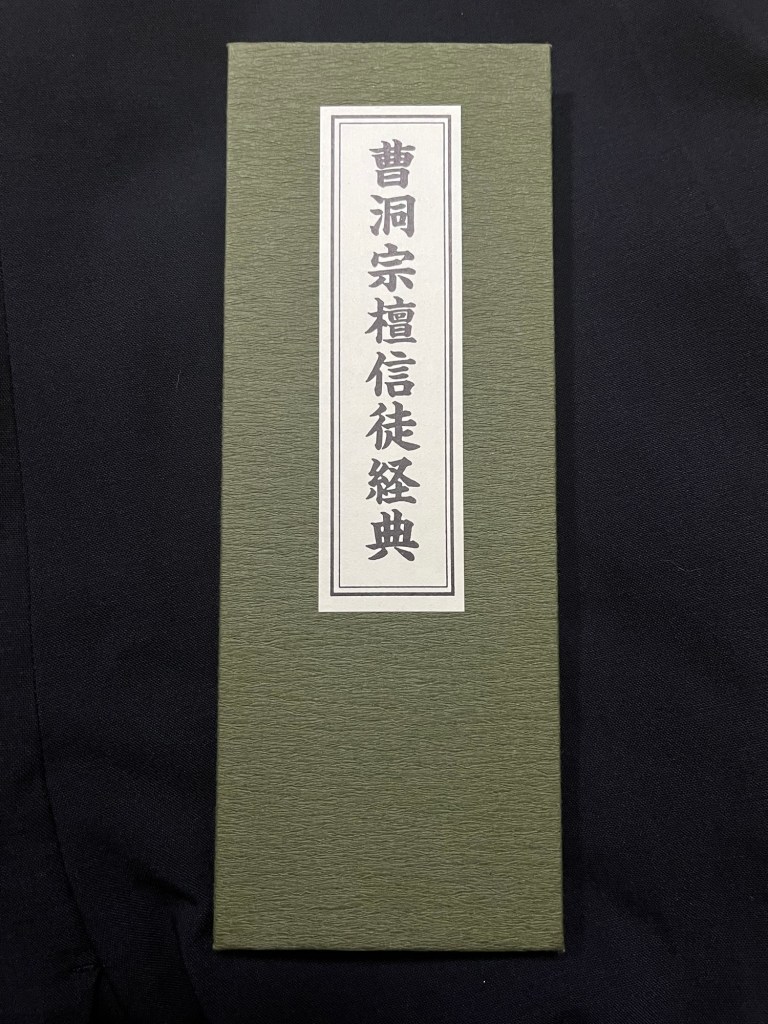
In any case here is the cover of the service book for Soto Zen home liturgy:
Cover of Soto Zen service book, purchased at Sojiji temple. Title roughly translates as “Soto Zen scriptures for parishioners”.
Inside, you can see the table of contents on the right side. Japanese text is tradtionally written right to left, and vertically (not horizontal):
Table of contents of sutra service book for Soto Zen. Purchased at Sojiji temple.
On the left-hand side is the Kaikyoge, a verse recited traditionally when starting a service. The gist of the verse is that encountering the Dharma is quite rare, and yet we are privileged to read and recite it now. Thus, may we all attain the Buddha way. During my years with the Buddhist Churches of America, we read a very similar liturgy in English. The concept is almost universal in Buddhist services.
Also, notice that the text in the Kaikyoge is Chinese characters (kanji), but with hiragana text to the side as a pronunciation aid. This is because most liturgy in Japanese Buddhism was originally adopted from China, and thus requires pronunciation guides (same is true with Korean Buddhism too, iirc). At the very bottom-left is smaller text helping to explain the meaning of this verses.
The photo below is the first part of the verse section of the Kannon Sutra (a.k.a. chapter twenty-five of the Lotus Sutra). Again, we see vertical lines of Chinese characters since the original edition was recorded in old literary (not modern) Chinese, and phonetic hiragana script beside each character. The large circle mark indicates a ring of the bell if you have one. As with above, it is read from right to left, vertically.
A copy of the Kannon Sutra, version section, from a Soto Zen service book, from Sojiji temple.
What I really like about this particular sutra book is how clear and readable the hiragana text is. Some books use a font that’s hard to read if you are a foreigner (or even Japanese possibly). This makes reciting difficult. But here, if you can read hiragana script, it’s easy to follow along.
A close up of the Kannon Sutra as printed in a Soto Zen service book, purchased at Sojiji Temple.
By the way, below is an example of verses that are not recorded in Classical Chinese: an excerpt of the Shushogi, chapters three and four. Since the Shushogi was recorded natively in Japanese, there are fewer Chinese characters, and the style of language is more readable to a native speaker. To me, as a language student, it’s still pretty difficult since the source text by Dogen was composed in the 13th century. The grammar is quite different 800 years ago. This section also includes explanations at the bottom for modern native speakers.
Because of the popularity of the Shushogi among laity in the Soto Zen tradition, all five chapters are recorded in this sutra book.
The rest of the content is pretty typical, and I explained the full contents in an older post, but what I liked about this particular sutra book was the quality, readability, and thorough content.
Side note: it turns out that there is also an eBook version of the service book (originally linked here) available in both Apple Books and Google Play formats. The eBook version is a lot nicer than I expected, and closely follows the physical book (the subject of this post), with a few slight differences:
The kaikyōge (verses on opening of the sutra) uses Sino-Japanese, the service book uses a mixture of native Japanese and Sino-Japanese
Similarly, the Sankiraimon uses native Japanese in tbe eBook version, but Sino-Japanese in the physical book.
the eBook version has a really nice altar image (gohonzon). A person who can’t access Buddhist altar goods could print it out, and install in a Buddhist altar (obutsudan).
But I digress.
For some reason I find sutra books fascinating, and if readers enjoyed this post, please let me know. I might try to make more posts on the various books I’ve collected over the years. I have service books from practically every sect in Japan.
P.S. Happy 4th of July to readers in the US. Also, happy (belated) Canada Day to readers there. To my ancient roman readers happy … (checks notes) … Battle of Adrianople?
1 via online Buddhist circles, namely the long-dead E-Sangha forum. IYKYK.
Speaking of sutras, while reading about the Heart Sutra in Japanese, I learned about an interesting trend in the late-medieval “Edo Period” (17th through 19th century) called eshin-kyō (絵心経), or “picture Heart Sutra”).
An example of a “picture Heart Sutra” from 1795 (photo taken in 1922), composed by physician Tachibana Nankei in his travelogue Tōyūki (東遊記, “Journey to the East”), Public domain, via Wikimedia Commons
The idea was to make the Heart Sutra, a brief, but important and very popular Buddhist text, readable by illiterate peasants using a kind of rebus. The pictures above, to a native Japanese speaker of the time, would evoke certain words, which matched syllables of the sutra. For example, a few I can pick out:
The demon-looking character is a Hannya (mentioned here), hence hannya.
The pregnant woman with a baby is hara, as in a the torso.
The five vertical lines is go as in the number five.
The upright sword is ken.
This is just one example. It turns out that there’s many different versions, using slightly different pictures and styles. According to this blog, the origin of these picture sutras was a man named Zenpachi (善八). During the Genroku Period (mentioned here and on the other blog), a high-water mark of Japanese (especially Tokyo) culture, Zenpachi wanted to make Buddhist teachings easier for kids to understand and helped devise these pictures.
What’s interesting is that the tradition continues to this day, as seen in my Heart Sutra totebag my wife picked up.
This version is very cute, and of course has hiragana pronunciation guides just in case, but I think it’s a clever way to keep the Buddhist tradition alive.
P.S. moved this to Friday to make up for the accidental double-post on Tuesday and space the content out. We’ll be back to Monday-Thursday schedule starting next week.
The copying of Buddhist sutras is a time-honored devotional tradition in Buddhism. In the Olden Days, people did this not only as a form of devotion, but a necessary step in propagation before wood-block printing became widespread. But even with printing, sutra copying has been a popular personal practice.
A formal sutra-copying room at the temple of Seiryō-ji Buddhist Temple (homepage) in Japan. Photo by Yanajin33, courtesy of Wikipedia.
In Japan, this practice is called shakyō (写経), and is often available at major temples. You pay a small fee to cover material costs, and get a sheet of paper and an example sutra to copy from. From there, using an ink brush you copy the text in your own hand, and can either donate to the temple or take it home.
As for which sutras to copy the Heart Sutra is the most popular choice due to its size and popularity.1 However, in some sects, the preferred sutra varies. For example in the Jodo Shinshu tradition, some people copy the Shoshinge hymn (which is pretty long), or the Juseige. For Nichiren Buddhists, they copy excerpts of the Lotus Sutra such as chapter two and sixteen among others.
But I digress.
In a larger sense, a Buddhist follower can copy any sutra or excerpt of a sutra in whatever medium or language they want: Classical Chinese on a $2 notebook, Sanskrit Siddham script on fine washi Japanese paper, Ukrainian Cyrillic cursive, Latin, Koine Greek, or whatever. You can simply copy it by hand into your own sutra book, or make a PDF to share with others. You can copy it once, or a hundred times if you prefer.
There’s no restriction; the act of copying reverently is what matters.
I will also follow-up soon to show an example of more traditional sutra copying of the Heart Sutra, a project I’ve been working on on the side. Please stay tuned.
A Japanese copy of the Heart Sutra. This is the rufubon version (you can see the extra 一切 in the middle), compared to Xuan-zang’s version.
1 Fun fact: the version of the Heart Sutra used in Japan differs very slightly from the popular version attributed to my main man Xuanzang.
The Japanese version, popularized by the Shingon esoteric tradition, is called the rufubon (流布本) version. The rufubon version has two extra Chinese characters (262 total) from Xuanzang’s 260, namely the issai (一切) in the line on ri issai ten dō. It also uses slightly different characters for mantra at the end: 揭諦 instead of original 揭帝 for pronouncing Sanskrit gaté phonetically.
I finished watching the Netflix spinoff series Castlevania: Nocturne, season 2 last week, and I wanted to share this great quote:
Alucard: Your mother and I never met. But when you’ve lived as long as I have, you start to understand. We’re all part of the same story somehow. And these connections run very deep.
Castlevania: Nocturne, season 2, episode 6, “Ancestors”
This inter-connectivity of all beings, all being part of the same story, is a very Buddhist notion.
In Buddhism, especially the Mahanaya tradition (i.e. pretty much all of east Asia, and beyond), there is a famous analogy of the Jeweled Net of Indra (sometimes Brahma). The idea is that within the celestial palace of Indra (or Brahma), there is treasure room, and within that room is a great net woven with jewels at each node.
Now, imagine this great net of jewels, and how each jewel reflects the light of every other jewel. That’s how interdependence works. Shatter, remove, or replace one jewel and the light from the others diminishes as well. So it is with all sentient beings. The effect may not be noticeable, but it does happen.
The entire series of Perfection of Wisdom sutras, including the Heart Sutra, covers this in great detail. The Buddha Vairocana also embodies this truth (especially as described in the massive Flower Garland Sutra); alternatively Amida Buddha does too in some interpretations.
P.S. Castlevania: Nocturne is great. It covers a lot of characters from later Castlevania games that I didn’t play (Richter, Juste, Maria, etc), which confused me at first, but season 2 builds really nicely on season 1. Great series and worthy spinoff to the original.
Recently, I wrote a brief introduction to the Buddhist canon, the sutras. Sutras come in many shapes and forms, but I want to focus on one of the most famous, and most popular to recite: The Heart Sutra.
A sutra book from Japan showing the Heart Sutra, preserved in old Chinese, but with Japanese pronunciation guides.
The full name of this sutra is the Heart of the Perfection of Wisdom Sutra (般若波羅蜜多心經), and was one in a series of “perfection of wisdom sutras” that were published starting around 2nd century BCE. Starting with the “Perfection of Wisdom in 8,000 Verses Sutra“, the authors made longer and longer versions, culminating to a 25,000 verse version of hte same sutra. Then, they started making shorter versions, getting down to the Diamond Sutra, and finally the Heart Sutra.
Or, so the theory goes.
The Heart Sutra is believed to distill the essence or “heart” of the Perfection of Wisdom teachings to its smallest, most essential version. More on that soon. This version is very short, can be read in 1-2 minutes, and is pretty cryptic. Because it is so short, it is easy to learn and memorize, and thus easy to recite. Its utility for everyday Buddhists is among the reasons it has such lasting popularity. I have a copy of a translation of the 8,000 verse sutra,1 and while it is interesting, it is a tome. It is not practical for most Buddhists to read such a tome, so you can imagine why the Heart Sutra was composed, and why it is so much more popular.
But that gets to an interesting question: who composed it? This is a surprisingly difficult question to answer.
The traditional assumption was that it was composed in India, using Sanskrit language, and then brought to China like most other Buddhist sutras. And yet, a scholar named Dr. Jan Nattier proposed an interesting theory that the Heart Sutra in particular was composed in China, not India, and that it was translated back to Sanskrit, not from it, by our favorite wandering monk Xuan-zang when he visited India. There is considerable debate about this, and valid arguments for one or the other, but it’s an interesting idea that some plucky Chinese monk found a clever way to distill the Perfection of Wisdom teachings into a more bite-sized form.
That said, one of the interesting features of the Heart Sutra is that it does contain a genuine Sanskrit mantra at the end (a trend that continues with later Buddhist texts) in the Siddham script:
𑖐𑖝𑖸 𑖐𑖝𑖸 𑖢𑖯𑖨𑖐𑖝𑖸 𑖢𑖯𑖨𑖭𑖽𑖐𑖝𑖸 𑖤𑖺𑖠𑖰𑖭𑖿𑖪𑖯𑖮𑖯 ga te ga te pā ra ga te pā ra saṃ ga te bo dhi svā hā
For various reasons, this mantra was written in Chinese characters that approximated the pronunciation of the Sanskrit:
As I eluded to earlier, the Heart Sutra is the most condensed version of the Perfection of Wisdom teachings, or prajñā-pāramitā in Sanskrit. This was a teaching that provided an important foundation for Mahayana Buddhism (everything from Tibet to Japan). “Perfection of Wisdom” is hard to explain. But, roughly speaking you can think of it as the fundamental understanding of existence, which is sitting right in front of your face, but not obvious until you see it. Like the first time you noticed a small crack in the wall. Once you see it, you don’t “unsee” it.
But instead, the Perfection of Wisdom is about undoing the filters in one’s own mind, so you can see the world unvarnished. That’s easy to say, but extremely tricky to sincerely accomplish. Hence the extraordinary accomplishments of the Buddhas and Bodhisattvas.
The Heart Sutra talks a lot about “not this”, and “not that”, and like other similar sutras (e.g. the Diamond Sutra, another of the series), this is to try and undo the filters of one’s own mind. But, on its surface, the Heart Sutra is cryptic and vague. Yet, because it is so pithy, and so over time bits of it start to sink in, or something that didn’t make sense in the past finally clicks.
So, if you do pick up a copy of the Heart Sutra, don’t worry if it doesn’t really make sense. Recite it from time to time,2 study it with help sutras guides (there are many) and make it a part of your Buddhist life, regardless of what tradition you follow.
For a such tiny, little composition, it’s a pretty neat contribution to Buddhism.
1 Purchased years ago at Powell’s City of Books in Portland, OR. One of the best bookstores, and well worth a visit if you go there.
2 Some people recite in their native language, others recite in one or more “liturgical” languages. It doesn’t really matter. Pick something you can stick with. You can change it later.
The joke here is a Japanese-Buddhist monk looking at a receipt from Muji (a Japanese home goods store), and commenting that this “sacred text” shows they purchased a lot.1 This happens to us too.
Anyhow, what is a sacret text in Buddhism?
Buddhist sacred texts are called sutras (sometimes suttas), from the old Indian Sanskrit word.2
Buddhism doesn’t have one sacred text like you would associate with the Bible, Q’uran, etc. Instead, it has layers and layers of sacred texts.3
I won’t get into why there are so many layers, but suffice to say that the Buddhist tradition holds the sutras as genuine sermons of the Buddha (a.k.a. Shakyamuni Buddha) which have been passed down generation after generation until today.
Sometimes sutras, or teachings contained therein, are repackaged into newer sutras, especially in the Mahayana Tradition, but the underlying teachings, the Dharma, are believed to be just as important. Think of Spiderman: every few years there’s another Spiderman movie, some more popular than others, but the underlying lore of Spiderman is always the same.4 The history of Buddhist sutras is awfully similar in this respect.
What’s important isn’t so much the specific text of a specific sutra, but the Dharma. In the same way, although Shakyamuni Buddha is very important, the Dharma he taught is even more so.
Because there are so many sutras, this also leads to many sects, schools, and traditions within Buddhism. Each sect or school strives to apply the Dharma as best they can, based on whatever sutra is considered most appropriate.
So how do we know if the Dharma is true? Because it can be applied in one’s own life, through good conduct, meditation, lifestyle choices and so on. If your doctor tells you to lose weight and exercise more, the results speak for themselves. Buddhism is a lot like this.
Should a Buddhist read all the sutras? No, there are simply too many. Some ate huge. It’s often best to start with one or two that are already part of the tradition you are interested in. From there, you can branch out as you see fit. Ask your local community if you need recommendations.
Also, an important tradition across all of Buddhism is reciting sutras. Some sutras are very short and can be recited as a whole. Other sutras are much too long, so people recite key passages only.
This tradition of reciting sutras not only helps internalize the teachings (make them a part of you), but also helps connect to the Buddhist tradition at large. People have been reciting the Buddha’s teachings from the very beginning, 2,500 years ago. When we recite and put the teachings into practice, we are another link in the chain.
Buddhism has no “holy” language, so you can recite them in your local translation, or use a liturgical format that fits your preferred tradition. Or switch between one and the other.
A booklet with the Heart Sutra used in Japanese Buddhism, which I posted about here.
What’s important is that followers make the teachings a part of their lives somehow. This helps them apply the Dharma and also generate good merit to help others. The Buddhist path is not a solitary path: we are all in this together.
Namu Shakamuni Butsu
Namu Amida Butsu
1 Muji is a great store, and there are a few oversea outside of Japan. You can find clothes, household items, stationary and so on. We shop at Muji in Japan whenever we visit there, but also have visited Muji stores along the West Coast as well.
2 Related distantly to the English word suture as in a thread. Old sutras were often palm leaves or tree bark threaded together to form a kind of book.
3 HInduism too, iirc.
4 Even when it’s Miles Morales vs. Peter Parker (or Gwen, or other Spider people), the lore is the basically the same.












 Gleanings in Buddha-Fields
-testo_e_photo_Paolo_Villa-nA2-tesi_Accademia_Belle_Arti_Bologna-portone_di_Palazzo_Giusti.jpg)


You must be logged in to post a comment.