From the classic Star Trek episode, “Specter of the Gun” (s3:ep6), stardate 4385.3
Speaking of missed opportunities and the many rebirths of Buddhism, there’s another side to this discussion.
The Buddha really emphasized the importance of the life you live now. Yes, each sentient being lives a long endless stream of rebirths ad nauseum, but it’s not as if you just move to a new body, and pick up where you left off. Long story short, death is real, and not something to take lightly. Yes, your karma will propel another birth to take place, but this is a different person, and they have to start over to some degree.
I can’t really go into the theological questions,1 and I don’t know them very well myself, but in India there was much ink spilled over this distinction. For us 21st century readers, let me try to give an example.
Look at “Rogue-like” games such Hades, or Rogue Legacy 2. In such games, your character dies a lot, and each time you die, you have to start all the way from the beginning. Your character might inherit some rewards for past efforts (e.g. past lives), but this doesn’t doesn’t guarantee success, and your next run might be a total disaster and even set you back. In Rogue Legacy 2 in particular, each time you start over, you choose a new character, randomly generated from a few options.
So, each time you start over, you have to treat each life as something important and make the most of it. I think Buddhism works much the same way.
Namu Shakamuni Butsu
1 the crude summary is that in Hindu religion, the soul (atman) traverses from body to body. The Buddha taught anatman (“no soul”) instead. The Buddhist version implies cleaner “break” between lifetimes, but how it all works is beyond me.
A few months ago I wrote a review of a relatively new TTRPG (table-top role playing game) called The One Ring by Swedish company Free League Publishing.
Since that time, I’ve been having a fun time playing this game in “strider mode” or solo mode. This is named after the iconic character in The Lord of the Rings trilogy, Aragorn, who often went by the dubious nickname “Strider” despite his royal heritage.
Aragorn, played by Viggo Mortensen
I play a session of The One Ring, often at night when my son is asleep, for an hour or two, a couple times a week. I enjoy bookkeeping my own progress, deciding where to travel next in Middle-earth and so on.
This post is a guide on how to get started, tips for play, and so on.
How Does Strider Mode Work?
Strider Mode means that you are both the Loremaster and also the sole player. The idea is that your character has enough grit and resolve to go adventuring alone, and so for 95% of the game rules, everything stays the same. The other 5% is mostly slight alterations to character creation process to make a solo play more feasible:
The TN difficulty is 18 minus attribute (18 – Wits for example), instead of 20 minus attribute.
If you spend a hope point, it is automatically inspired, so you get two extra d6 dice, not just one.
Fellowship points are (iirc) fixed at 3.
Because you are your own Loremaster, the Strider Mode resources (listed below) give lots of really handy tables for helping set the scene, or deciding why something might turn out a certain way. These tables are your best friend in Strider mode. Once I realized what these tables did, I found my story-telling experience in Strider mode got a lot better.
How Do I Play Strider Mode?
Strider Mode only requires a two things:
The core rulebook for The One Ring, 2nd edition. There is a PDF version in DriveThruRPG, and also the physical book. Personally, the print quality of the book is really nice, so it is worth it if you can afford it. Also, if you order the physical books through Free League Publishing’s site, you get a voucher to get the PDF anyway.
The Strider Mode PDF available on DriveThruRPG. This is indispensible, but also very affordable.
D12s and D6 dice, or better yet, use the specially printed One Ring ones to make life easier.
Optional, but recommended:
The character sheet PDFs, downloadable from the publisher website.
Blank journey log sheets, also downloadable from the publisher. You will go through these fast, so print several, or keep a nice log book instead. I have an old engineering sketch book (the kind with grid paper), and it’s a great tool for recording travel.
Tips for Strider Mode Play
I have played a couple characters so far, a Dwarf (mentioned in my last review), and an Elf from Lindon, but so far I’ve noticed some play patterns that help your character succeed.
First, make sure you invest sufficient skill points in skills you’ll need for traveling. This includes Travel, but also Explore, Awareness, and Hunting. Since you are solely responsible for your own welfare in the wild lands, you need to know how to survive each challenge. I nearly lost Frar my dwarf after a nasty fall in the Blue Mountains. For my Elf, I spent too many points in Song and Lore, and not enough in Hunting.
Second, combat is extra difficult. My Elf, Belegon of Lindon, has had three combat encounters, and failed two of them. The first time he fell unconscious and was robbed by bandits. He also had to retreat from a battle with undead Marsh Dwellers. Since The One Ring doesn’t depend on combat like D&D, you should be more considerate about whether to engage in battle or not. Because one bad roll by one monster is enough to put you out. Just like real life, if you think about it. Also, make good use of the skirmish combat feature exclusive to Strider Mode, and make sure you have a ranged weapon.
Third, be frugal in how you travel. Without help from other party members, you have to be careful about how much load you carry, because fatigue can add up fast. This also means it’s a good idea, just in like in real life, to pace yourself in travel, travel smaller distances between towns if you can, etc.
Fourth, get to know the extra tables in the Strider Mode PDF. The Telling Table is a handy way of answering “yes or no” questions that the Loremaster would normally answer. The Oracle tables are a great way to answer “why” or “how” questions: how this elven cloak ended up in a hoard, why the bandits broke camp unexpectedly, and so on. These aren’t required, but they’re all handy narrating tools, so use them as you see fit.
Finally, treat your character the way you’d treat yourself: don’t hesitate to give them some much needed break during a Fellowship phase to research, socialize with characters, undo shadow points, etc.
Conclusion
Strider mode is a great way to experience The One Ring RPG at your own pace, play at as much or at little as you want. Having a fellowship with other players is a really great experience, and The One Ring emphasizes the importance of fellowship and kindred spirits (which is really nice), but even Strider mode lets you have a lot of fun too, especially in side quests or adventures where you get to explore, rather than hack and slash. The expansion books such as Realms of the Three Rings provide many nice, short, introduction adventures that are low-risk, but nicely suited for a lone adventurer.
As I wrote a short while ago, I have grown tired of Dungeons and Dragons, and alluded to a different RPG system called The One Ring. The One Ring (TOR), produced by Swedish company Free League Publishing, is a role-playing game (RPG) designed entirely for The Lord of Rings fantasy setting by J.R.R. Tolkien. Whereas D&D and Pathfinder are more generic rule systems that can be applied toward many fantasy environments, TOR is designed exclusively for the Lord of the Rings “Middle Earth” setting.
The core rulebook for The One Ring costs $60 in the US, but with it you get all the basics you need: how to make a character, how to run an adventure as a Loremaster (a “DM” or “GM” in other systems), and even the basic monster compendium. Compare this to D&D 5th edition, which requires $150 for three books. The D&D core books have a lot of content, to be fair, but if you want to get started in The One Ring, having a single book for a reasonable price is an easier start. Also, it is available as a PDF file on DriveThruRPG, I believe, for even cheaper.
The core rulebook is very well done, and the artwork is really amazing (some of it is on the page linked above), and bring out the “feel” of the game. There are other supplements available as well which are also available through DriveThruPRG as PDF files, or hardcover on the website above.
Let’s discuss the basics of The One Ring system…
The Basics
The focus of TOR is thus much more immersive into the “look and feel” of the Lord of the Rings setting. The emphasis is much less on combat and magic powers, but more on day-to-day adventuring in the Middle-Earth setting. This means you have to take into account things like:
Planning where you are going in Middle Earth
Tracking day to day travel from point A to point B
This sounds tedious, but it isn’t. The rules are pretty straightforward.
Your stuff: things like encumbrance (load) matter. You have to consider how much you are carrying, including treasure.
Downtime, who you will spend Yule with, dealing with mental wellbeing, etc.
Healing from injuries (you cannot just magic away injuries).
Death, and any heirs for a player character.
What you get is a really mood-driven, realistic feel for life in Middle Earth. The adventuring (including combat and exploration) is still a core part of the game, but now you really get to slow down and immerse yourself in that world. That’s no small feat.
I emphasize this because many years ago I played a different LoTR-based RPG system produced by ICE using the “Rolemaster” rule system. This was a generic role-playing system used at the time, but modified for the Middle-Earth setting. I read through the book many times, and while it looked cool, even back then it felt like this wasn’t really an authentic Lord of the Rings game. Since that time, other systems have tried the same thing with mixed results.
Thus, what I like about TOR is that it conveys the Middle-Earth “feel” better than any system I’ve seen so far. It’s really fun to make a character, and imagine how they fit into the setting, and to also go to places that have historical significance in Middle-Earth, and somehow it really feels like you are there.
But how does the game play compared to Dungeons and Dragons and such?
Gameplay
First, TOR relies on a different dice system relying on a combination of d12 “fate dice” and d6 “success dice”. Certain numbers have significance on the dice: for example the 12 on a d12 is something akin to a “natural 20” in D&D, while an 11 is the opposite. The 6 on d6’s also provide extra bonus successes if you get them. There are specialty TOR dice you can get, which replace the 12 and 11 with the Gandalf rune ᚠ, and the 11 with the Eye of Sauron. These are not strictly necessary to play the game; a standard set of d12’s and d6’s will suffice.
The system for handling challenge roles is pretty straightforward, but the vocabulary takes a bit of getting used to (e.g. “favored” vs. “inspired”). After a couple of solo play sessions I got the hang of it.
In fact, the overall stats system in TOR is much simpler than D&D. You can easily fit your character onto a single sheet, and still have plenty to keep you busy. For testing purposes (namely “Strider Mode”, which I’ll cover later), I made a test character, a Dwarf named Frár son of Nár, using the core rulebook naming suggestions.
This is the example character sheet I made for myself. I wrote this in haste late night after my son had gone to sleep, so my handwriting is even worse than usual. Still, I like how it all fits in one sheet and is very easy to manage.
As you can see, the basic stats are three, not six like D&D / Pathfinder: strength, heart and wit. Frár had good scores in strength and wit, but pretty low in heart (he is not a bold person). The core rulebook gives you a preselected list of stats for each heroic culture, and you choose the combination you want. Having only three stats means some skills fall into buckets that might not entirely make sense (awareness for strength), but I am not troubled by this. The streamlined mechanics are nice.
I also like the fact that the challenge ratings for most things is based on your own stats. If you have high strength, the challenge rating for strength-based challenges is thus easier. Similarly for heart and wit. This hurt Frár though, because even with good travel skills, he frequently failed basic travel checks and ran into a few issues on his first journey. On the other hand, as a treasure hunter, his wit skills (and low challenge rating) will definitely come in handy. Frár just isn’t a bold traveller, I guess.
Speaking of streamlined: your stuff. Money isn’t meticulously tracked in TOR, and so when you make your character, you can pretty much equip it with any basic items you want (with a few restrictions based on cultural wealth). Further, during Fellowship phase (i.e. downtime), you automatically manage basic maintenance of consumables, travel rations, etc. Treasure is abstracted as “treasure points”, apart from rare or magic items, so you don’t have to carry around 5,000 copper coins to and from a dungeon. In other words, day to day maintenance of your character is assumed, and you don’t have to put much effort into it. You do have to consider the overall bulk of what you’re carrying (including looted treasure) because fatigue and endurance are really important in TOR. Fatigued characters definitely start to have problems, and it is not so easy to recover from. So travel wisely.
Side note, horses are really helpful, and fun. Frár has a horse that I named “Old Nob” for some reason. Horses will shoulder some of the burden, and help limit long-term fatigue. Plus, the game doesn’t allow harm to come to the horses (animal cruelty is not OK), so it’s nice to own a pony or horse.
Similarly, endurance is a more short-term form of fatigue and is used both in combat (instead of hit-points), and outside of combat. If your endurance falls below your load + fatigue numbers, you take penalties as well. If your endurance falls to 0, you are unconscious. In combat, this will knock you out, but a grievous wound can potentially kill you, or permanently scar you. Again, this simple, but realistic focus really gives combat more consequence than D&D.
Combat itself is somewhat complicated in some ways, but simpler in others. Strategic battle maps are not needed in TOR, and issues around initiative are simpler. The mechanics of who hits who are somewhat “number crunchy”, and it’s mostly based on your own ability to parry, rather than armor class. Getting a grievous wound is bad though, and there’s a significant chance it will outright kill your character. Stronger armor helps avoid this, but at the cost of lugging it around all the time (fatigue). So, choose carefully. Anyhow, positioning is a simple “three tier” setup where you’re either upfront, in the middle, or back. Being upfront lets you hit more, but enemies can hit you more too. Being in the back let’s you be more defensive, but you’re less likely to hit the enemy, and so on. There are also strategic things you can do to increase certain terrain advantages, but the enemy can also do the same to you.
Growth and experience are different than D&D and Pathfinder, in that you build up adventure points per session, which once you’ve you built up enough you can then redeem for increased skills and combat skills using a simple “point buy” system. As you build up points, you can get some better, special equipment or develop some additional features intrinsic to your heroic culture.
Game Phases and Downtime
The flow of time is important in TOR, and there are season and phases that are important. Your game campaign usually starts in the year 2965 in the Third Age,1 and as you complete “adventure phases”, you’ll also undertake “fellowship phases” (downtime) to not only recover, but it helps provide the passage of seasons too. During year’s end is a special fellowship phased called “Yule” which is meant to express wintertime, when people are home and hunkered down for winter. Yule season lets characters return to their homes. do extra-special downtime stuff, including recovering from Shadow, training an heir (if you want to) who will inherit your stuff if you die, and building fellowship with teammates.
Let’s talk about Shadow. The Shadow mechanic expresses the fear and hopelessness that pervades Middle Earth as the Enemy grows stronger and stronger. During certain traumatic events, or direct confrontation with certain monsters, you can accumulate Shadow, and this can eventually affect your character’s wellbeing. You can think of this as the character growing older and wider, but also perhaps a little more bitter, after years of adventuring.
Fellowship phases let you undo Shadow up to a point, but if Shadow grows too much, your character can meet an unhappy ending: non-Elf characters might go mad, while Elf characters will be compelled to immediate head West beyond the sea never to return. This is another form of character death in a sense. Elves are particularly prone to Shadow due to their long memories, and cannot shake it off as easily as other heroic races.
Solo Play
Finally, let’s explore “Strider Mode”. The One Ring community is smaller than more well known RPG games, so you can’t always find people to play with, but it comes with a nice feature called “Strider Mode” which is solo playing. I wrote more about it here. The rules for Strider Mode are available on DriveThruRPG, and are very inexpensive. Most aspects of the game remain the same, but a few rules must be tweaked. Further, to help with solo decision making, Strider Mode provides some extra decision tables you can role. I found that Strider Mode is actually pretty fun compared to typical solo play, and my character above has started playing Strider Mode as I learn to navigate both the player rules, but also with designing adventures. Frár has already started his first journey from The Shire to the Blue Mountains to do some treasure-hunting, accumulated 2 points of Shadow, but also had a friendly encounter with a dwarf from the Blue Mountains who taught him a handy shortcut, cutting down on travel time.
Conclusion
All in all, I am enjoying The One Ring a lot more than I expected. I was skeptical at first, but I’ve been pleasantly impressed both by the quality of the materials, and also the depth of the setting, and how well Middle Earth culture is translated into this RPG, but also how many distracting aspects like money are streamlined. This means the game is both simple to pick up and learn, but also has lots of role-playing and setting “depth”.
If you are curious about it, I recommend checking out play-through videos such as the wonderful Unsung Tales series, which I’ve found helpful:
Also, the official TOR discord channel has been helpful.
But for my money, I really found that the price-point versus the quality of materials has been worth it. I am also glad to support smaller gaming companies too. I truly enjoy this system, have read the core rulebook cover to cover already, and looking toward getting some of the expansion books.
P.S. Free League Publishing also has a D&D 5th edition port of The One Ring, which I also own. I will review this separately, because it differs from regular D&D, and from The One Ring, and is a fascinating topic by itself.
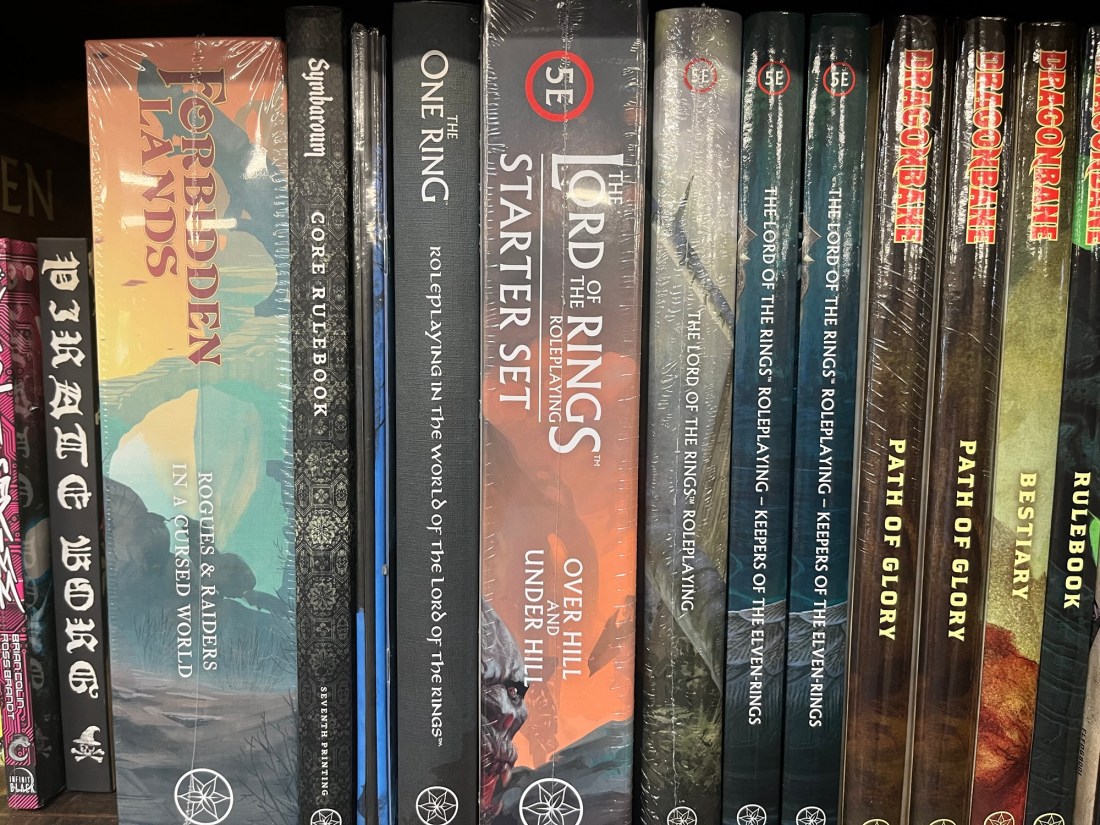
P.P.S. Featured photo is a shelf at my local gaming store, featuring some of The One Ring material.
1 This is meant to be a period of time between The Hobbit and The Fellowship of the Ring.
I’ve been playing 5th edition Dungeons and Dragons since 2016 off and on, first with co-workers, then with friends and family. Later, I branched out into Adventurer’s League, and wrote some modules online for fun.1
But now, I can confidently say that I am thoroughly tired of the game.
My kids and I played weekly during the Pandemic and had some greatadventures together, and when the Pandemic finally subsided I was eager to resume Adventurer’s League with the local community.
But then starting in 2024 something happened: the game just wasn’t as fun as it used to be. The 2024 revised rules made things briefly interesting again, but left me with a soulless, corporate aftertaste. But even the fun of revised and updated rules quickly lost its luster. The revised versions feel very polished, and fixed some issues, but also feel homogenized and bland, with no character left.2
PlayingD&D started feeling increasingly rote. My kids increasingly lost interest, especially my oldest who had one foot out the door towards college, and I didn’t have the drive to start up another group elsewhere. The final straw was returning to Adventurer’s League after a hiatus of 2-3 years. Adventurer’s League now feels hollowed out and running on fumes after WoTC stopped investing in it in favor of their new organized play setting. My local community is much smaller than before, with most of the old-timers having left, leaving only the die-hard players whom (speaking from experience) are hard to get along with.
Even the local gaming store I used to frequent has become so successful, that it is too crowded, too hard to find parking, and overpriced. Compared to five years ago, it is not fun to go there anymore.
I did briefly look into Pathfinder but quickly got tired of the rules-heavy and math-heavy gameplay. Plus, if you are an occasional player, you are forever chasing after new rules, classes and modules or will simply get left behind. The remaster didn’t help matters, because if you want to keep up you have to buy three new books at $60+ each, just to avoid some legal hassles with naming of spells and rules. In short, I did not find Pathfinder worth further investment.3
In spite of all this nay-saying, my son loves D&D, and reads the 2024 books avidly (I will probably give him the books at some point), and even enjoyed the new Dungeons and Dragons movie, Honor Among Thieves (it is a pretty fun movie, tbh). So, I won’t discourage him. I have personally grown sick of D&D and have no desire to play it (or Pathfinder) anytime in the near future. For me, the spark is totally gone.
And yet, I am also realizing that the TTRPG world is a lot more vast than I first thought. I stumbled recently upon an RPG system called The One Ring: a gaming system designed entirely for J.R.R. Tolkien’s Lord of the Rings series. I picked up a couple of the core rule books, including a Dungeons and Dragons-compatible version, and am reading through them now. The community, while not large as Dungeons and Dragons, is large enough that I can find the support I need to questions and people seem to be passionate without being obnoxious. As a lifelong Tolkien fan, the amount of love and attention put into the books is really impressive, and heart-warming. I probably will write a review of the core rules once I finish reading through the book.
There are many other RPG systems as well, by smaller publishers, who are passionate about their craft, and if you look enough, chances are you’ll find a system that’s right for you. My son loves D&D 2024 edition, so I am happy to let him continue reading, exploring, and designing adventures. For someone who enjoys Pathfinder, I hope they continue playing and exploring. I guess the point of all this is that if you are tired of the more corporate gaming systems, try exploring other smaller RPG systems, and see what’s there. You may find a hidden gem you didn’t know about.
For me, I am done with both D&D and Pathfinder systems, and instead enjoy exploring the rules of The One Ring. Whether I can find a local community to play with (the perennial challenge of TTRPG) is another matter entirely….
P.S. Featured photo is my bookshelf of TTRPG books: a mix of D&D 5th edition, 2nd edition (which I fondly remember from my teen years), and some The One Ring books. Most of the newer 5th edition books were sold off already, but I am keeping some older ones that I enjoyed.
1 Writing modules is fun, and I made a bit of money here and there, but nothing even remotely enough to raise a family with. I make enough per month to buy a cup of coffee or two. I gradually stopped as the effort per module exceeded what I felt I got out of it. I still have a few in draft I may finish someday, but in light of this post, I will likely keep them in draft for the foreseeable future. Also, the 50% cut that WoTC takes from my module sales is frankly kind of egregious.
2 The 2024 books have truly fantastic artwork, though.
3 I kept the remastered Player Core book (book 1, since now they’ve printed multiple versions) in case I ever join a group, but I admit it’s pretty unlikely at this point.
Ever since I stumbled upon the Nintendo game Fire Emblem: Three Houses, I’ve been completely hooked onto the Fire Emblem series. The series is quite popular in Japan, but until recently hasn’t been that well-known in the West outside a niche community. Many earlier titles were not even sold overseas. I have gone back and played a couple older titles1 and also last year I got a copy of the latest title: Fire Emblem: Engage for Christmas.
Since I played Engage after finishing Three Houses, I was comparing it with a very high bar, and thus it had a rocky start for me. However, after completing the game, and picking up the new Japanese-language manga (more on that later), I like Engage more and more. This post is meant to be a review to celebrate its 2nd release anniversary.
If you want the short summary of “is the game worth playing?”, then the quick answer is that I am halfway through my second play-through now and definitely enjoying it.
Like every Fire Emblem game, Engage is a turn-based battle game. I like to think of it as Chess, except that :
You get to pick the pieces you want to put on the board
You can build and train your pieces in various ways
There is a nice narrative to go with the entire adventure
Your pieces interact with each other, and might even get married. ❤️
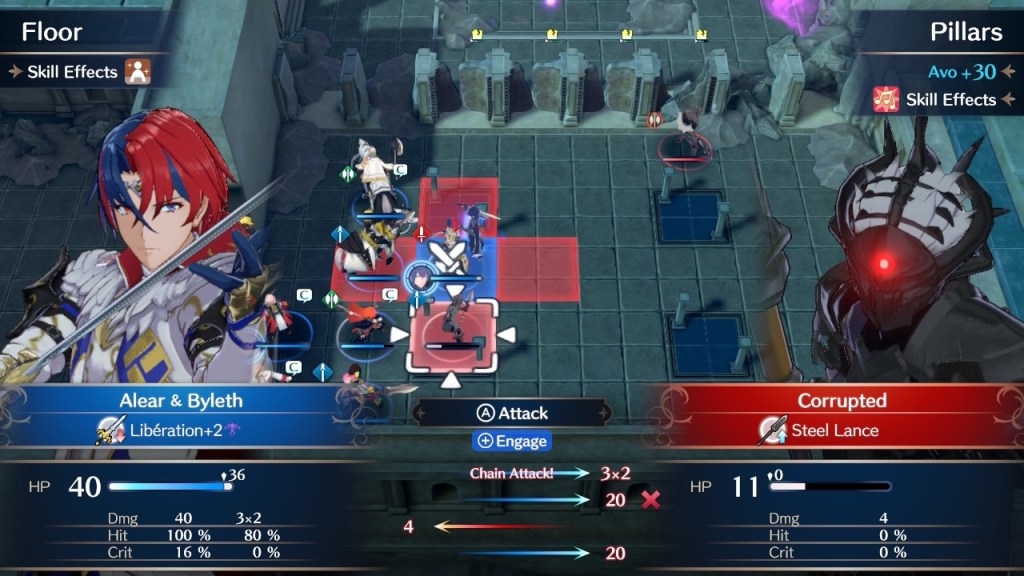
An example screenshot I took of the main character, Alear, battling an enemy. Before the battle begins, the player can see what the results will be, allowing you to proceed, or take back the move.
Each Fire Emblem is somewhat unique, but they all follow a similar pattern. The Engage battle system doesn’t radically differ from earlier titles, but it is significantly smoother and more polished. It’s very well done. Engage leverages the weapon-advantage triangle of earlier titles (swords vs. axes, axes vs. spears, spears vs. swords) but also introduces a new “break” mechanic which causes the disadvantaged weapon holder to temporarily lose their weapon. This is a great way to overpower another opponent and avoid unnecessary damage yourself. Of course, this works both ways. There are also spells you can obtain that simply break an opponent from a distance. Very annoying if you are on the receiving end. The battles are hard, but they are genuinely fun to engage in …. uh? uh?
The big innovation to Engage is the use of Emblem Rings. Engage seems to be a kind of a homage to the entire series, and many of the heroes of past titles make a comeback as warrior spirits bound to specific rings. Characters who bear one of these rings gain increasing stat bonuses and abilities, and also unlock short conversations with the bound Emblem warriors. The more they use the ring, the more abilities and stat bonuses they unlock. There are twelve rings total, and since your groups is far larger, you have to carefully decide who gets to train with what rings, etc.
If you didn’t play earlier Fire Emblem titles, like myself, this a great way to get acquainted with past heroes you didn’t really know about. Ike from Fire Emblem: Dawn of Radiance, and Corrin from Fire Emblem: Fates are a particularly standout examples for me. It was also great to see Byleth from Three Houses as well.
Ike from Fire Emblem: Path of Radiance, featured here in Engage
These Emblem Rings both play a core part of the story, but also are an important aspect of many of the game mechanics. I didn’t understand until my second play-through how bond rings created from the Emblem Rings let other characters get some minor boosts to stats, minor abilities, and help charge SP points when not wearing an Emblem Ring proper. This is very helpful in ensuring none of your characters fall behind in progression too much, since there is only a limited number of rings to go around. Also, inheriting skills was something I didn’t do properly in my first play-through either, causing me to really miss some important enhancements. The Emblem Ring mechanics are both complex and highly customizable, but also take time to grasp. Engage might have done more to help clarify the benefits and features.
The other challenge with the game is the story.
Compared to the complex, Machiavellian story in Three Houses, with its adult themes of war, loss, politics and so on, along with its four possible story paths, Engage doesn’t really have any of this. The story is leaner, more linear hero story, harking back to older titles. That’s not to say the story isn’t interesting. In fact, once I finished the game, I found that I liked the story. The issue, I think is pacing: some dramatic parts of the story are introduced too early, so there’s no emotional connection, others introduced pretty late. Thus, there is a long awkward slog in the middle. The official manga2 actually does fix some of this so that the story aspects are smoothed out more, and long gaps in the plot are filled in.
The cast of characters too, lack some depth of Three Houses. The cuter, more cartoony style and one-dimensional personalities makes it a bit hard at times to take some of the characters seriously, as they feel like something from a mid-level anime. On the other hand, there are some great characters. The twins Clanne and Framme were simply adorable, Etie the bodybuilder lady was always a hoot (especially when she fights with Goldmary), Prince Alfred is always upbeat and positive even in the worst of times, and the brothers Prince Diamant and Alcryst had an interesting dynamic. In fact, there are actually quite a few fun or interesting characters, it’s just that others feel kind of superfluous or blatant fan-service characters.
This goes double for some of the villains. The Four Hounds were annoying to me, until the very end when their origin was revealed, but again due to the pacing, it was a bit too late. Similarly, the story between Hortensia and her big sister Ivy was actually pretty interesting, and helped flesh out the kingdom of Elusia more, but only if you progress far enough in their support conversations. By and large, the atmosphere of the game is lighter and more jovial than Three Houses, so it loses some gravity, but it does have some really nice support arcs nonetheless, and I do like the majority of the cast. The manga below really helps flesh things out and fixes some of the pacing issues, too.
The support conversations also differ from Three Houses a bit. The C and B supports tend to be shorter, but similarly follow a story arc. Some are actually quite good, some kind of bland. Then again, one can say the same in Three Houses: not every support conversation is compelling. I do really like that Engage seems to have more options for romantic supports, so if you’re a person who prefers same-sex relationships,3 you have more choices than Three Houses offered.
Yunaka is hilarious. 🤣
A few other things about Engage are worth noting.
First, the Somniel, the hub of Engage is really fun. It feels more like a vacation resort compared to the venerable Garreg Mach monastery of Three Houses. As with the Emblem Rings, there is a lot of features and quality-of-life improvements that are not found in earlier games, and easy to miss. I found myself frequently diverging from the game itself to mess around in the Somniel for lengthy periods of time.
Welcome to Club Med, er, the Somniel!
Second, as alluded to above, the game has a lot of replay value. That’s true with many Fire Emblem games as there is more than one way to win it, but Engage excels at this. You can go very in-depth of features and customizations. It’s overwhelming and easy to miss at times, but I have found myself enjoying the game a lot more during my second play-through once I grasped the basics.
Engage gets some flak for the thinner story and character development, but I have to admit that I enjoy it more than I expected, but it did take some patience to appreciate. There is a lot in this game, and while it is rough around the edges, it also really has a lot to offer new players and past fans of the series. Even with the rough patches, I definitely recommend the game for new fans and old.
P.S. bonus post, but also timely since Sakura-con starts today. My kids and I go yearly.
1 I was very lucky that someone at work was selling a slightly used 3DS for very cheap. Turns out there’s several good titles for the 3DS, but I picked Awakening because Chrom, Lucina and Robin all appear in Super Smash Brothers. It was nice to finally see who these people were, and appreciate the excellent storyline. Also, while writing this post, I also picked up Fire Emblem: Echoes, Shadow of Valentia for the 3DS as well. It’s a really beautiful story.
2 The official manga is only available in Japanese, but I obtained copies of it last year from Amazon Japan, and have been reading through (with a dictionary, of course). I hear there are unofficial translated versions available, but I don’t know anything about this. In any case, the manga is excellent and has done much to improve my opinion of Engage. Some aspects of the game story were rewritten in more sensible ways, while the art is just amazing.
The first four issues of the Fire Emblem: Engagemanga.
3 I am straight myself, but it’s important to acknowledge the sheer diversity of people in the world, rather than pretend it doesn’t exist.
I saw this post recently on BlueSky, the hip new social media platform all the kids are talking about,1 and I had to share it with readers 🤣:
Speed-running is a fascinating sub-culture of gamers who finish games in impossibly short times through a combination of intense practice, manipulating errors in game code, and pre-planned strategy. My son and I like to watch speed-run world-records on YouTube for games I used to play as a kid. For example, this is a speed-run video where someone beats the classic NES game Mike Tyson’s Punch-Out in 22 minutes!
And this video shows someone attaining the world record for finishing the original Super Mario Brothers in 4:57. You can see multiple sneaky glitches and exploits here, plus lots of careful jump timing:
Finally, in this video, someone cleverly exploits an obscure glitch in Super Mario 3 to beat the game in 3:32!!!
But what does this have to do with Buddhism?
Buddhism is a 2,500-year old religion, adopted by many cultures and many times. The Buddha Shakyamuni (i.e. our historical founder), laid out the basic premise and trained his disciples on how to liberate themselves from the endless cycle of Samsara, and especially in the Mahayana-Buddhist tradition, to liberate others. We can see in early texts that this was a regimen of meditation training, self-restraint and living a humble, monastic lifestyle, as well as observation into one’s own mind. In video game terms, you can think of this as “grinding” level after level, building your skills, taking countless hours of gameplay.
The Buddhist path is a slow process, and requires a lifetime of dedication. Periodic visits to your favorite “meditation center” are fine, but Buddhism traditionally sees the path to awakening as a multi-lifetime endeavor for all but the truly talented (who may have already cultivated these qualities in previous lifetimes).
The actual length of time it normally took to accomplish awakening in Buddhism was hotly debated across Buddhist history. Early Buddhist texts implied that monks who were well-trained, or even lay-people who assiduously followed the basic code of conduct, could expect to reach awakening in one more lifetime, or may be a few lifetimes. But in Mahayana Buddhism, the length of time got longer and longer times as the bar of difficulty got higher and higher, well beyond what one could reasonably accomplish. A text called the Sutra of the Ten Stages in the Flower Garland Sutra describes the “Ten Stages of a Bodhisattva” over dozens of pages, and what’s required to complete each one before even getting to awakening. But each stage is a huge, huge endeavor by itself. Lifetimes of effort were not measured in eons of lifetimes.
As the road to awakening became longer and more remote, many Buddhist methods were developed to compensate for this and help people achieve the fruition of the Buddhist path much sooner, often through devotion to on Buddhist deity or another, or through specific samadhi methods, meditations and so on. The Pure Land path is by far the most popular and well-known due to its accessibility.
But in particular the Esoteric or Vajrayana traditions developed in the first centuries CE, hundreds of years after the Buddha. Historically speaking, the trend toward a longer and longer Buddhist path reversed and using this or that series of rituals, mantra chants, and mandala visual aids, one could “hack” the code of Buddhism and accomplish awakening in this very lifetime. Of course, the secrets behind such Buddhist speed-running techniques require a guru and a lineage.2 Vajrayana Buddhism is most prevalent in Tibet, but also in Japan through both Shingon and Tendai Buddhism.
But this does beg the question: is it really possible to speed-run the Buddhist path? Further, is the Buddhist path really eons and eons long as Mahayana Buddhism tends to assert, or is the length of time over-inflated?
Frankly, I don’t know.
Esoteric teachings and practices were definitely not part of the early Buddhist tradition (I definitely do not buy the idea of “secrets transmissions”, either). The Buddha’s advice in the early texts is generally pretty straightforward, one might say a little bland and anti-climactic, but also challenging because it gets to the root of who we are. It is definitely a lifetime effort.
But as much as I love the Mahayana tradition, it did have a tendency to out-do itself over and over. Waves and waves of Mahayana texts get increasingly dramatic, increasingly grandiose, and describe the Buddha path (namely through the Bodhisattva path) increasingly challenging terms. A backlash was inevitable, and so I can’t say I’m surprised that anti-intellectual movements such as Zen and Pure Land Buddhism, or “speed-run” methods such as Vajrayana arose in response.
Then there’s inevitable backlash from modern Buddhists who look at this convoluted history and complain, “none of this is real Buddhism anymore, it just cultural accretions”.
Every religion changes and evolves. Christianity as we know it didn’t have Christmas trees, and used Jewish-style liturgy in its early years. It adapted as it moved into new cultures. Islam grew into two different traditions, and as it became more urbanized some of the desert-nomadic traditions of the early community had to be adapted. Even obscure religions such as Zoroastrianism, whose early texts were composed amidst a steppe-nomadic culture, evolved to a more urbane and worldly culture until the Persian Empire.3
Zealous people love to go on a quest to find the “pristine” religious teachings, but you’ll never really find it. At best, you’re just reconstructing from pieces of the ancient past. At worst, you and your community just goes off the rails. It’s a fruitless quest.
So what to make of all this history and breadth of practice in Buddhism? Again, I just don’t know.
I do think that the old Kalama Sutta of the Pali Canon (AN 3.65) does provide some help though (slightly edited for readbility):
“It is proper for you, Kalamas, to doubt, to be uncertain; uncertainty has arisen in you about what is doubtful. Come, Kalamas. Do not go upon what has been acquired by repeated hearing; nor upon tradition; nor upon rumor; nor upon what is in a scripture; nor upon surmise; nor upon an axiom; nor upon specious reasoning; nor upon a bias toward a notion that has been pondered over; nor upon another’s seeming ability; nor upon the consideration, ‘The monk is our teacher.’
Kalamas, when you yourselves know: ‘These things are bad; these things are blamable; these things are censured by the wise; undertaken and observed, these things lead to harm and ill,’ abandon them.
Translation by Soma Thera
Followed by:4
…Kalamas, when you yourselves know: “These things are good; these things are not blamable; these things are praised by the wise; undertaken and observed, these things lead to benefit and happiness,” enter on and abide in them.’
Translation by Soma Thera
or the Buddha preaching to his stepmom in the Gotami Sutta of the Pali Canon (AN 8.53) :
“Gotamī, the qualities of which you may know, ‘These qualities lead to passion, not to dispassion; to being fettered, not to being unfettered; to accumulating, not to shedding; to self-aggrandizement, not to modesty; to discontent, not to contentment; to entanglement, not to reclusiveness; to laziness, not to aroused persistence; to being burdensome, not to being unburdensome’: You may categorically hold, ‘This is not the Dhamma, this is not the Vinaya, this is not the Teacher’s instruction.’
Translation by Thanissaro Bhikkhu
To summarize, if your Buddhist is leading to negative qualities described here, you should probably stop. If it is leading to wholesome qualities described here, keep going.
Namo Shakyamuni Buddha
Edit: I forgot to mention that the ultimate speed-runner in Buddhism is the Dragon Princess from the 12th chapter of the Lotus Sutra:
At that time the members of the assembly all saw the dragon girl in the space of an instant change into a man and carry out all the practices of a bodhisattva, immediately proceeding to the Spotless World of the south, taking a seat on a jeweled lotus, and attaining impartial and correct enlightenment. With the thirty-two features and the eighty characteristics, he expounded the wonderful Law for all living beings everywhere in the ten directions.
Translation by Burton Watson
1 I have a couple BlueSky feeds on there, but nothing related to the blog.
2 The Zen tradition is often compared to the Esoteric tradition since it also has ineffable teachings that can only be conveyed by a proper teacher.
3 I only know this because of the History of Persia podcast, by the way.
4 Because early Buddhist texts (sutras) were memorized and recited, they tended to be very repetitious. Later sutras, those in the Mahayana-Buddhist canon, used a more narrative style and thus longer and less repetitive, but also much more epic in tone.
Most players of Dungeons and Dragons within the last couple of years are probably aware that an updated ruleset was on the horizon, to coincide with the 50th anniversary of the game. This new ruleset has included names such as “One D&D”, or jokingly “5.5 edition” and so on. Nonetheless, the new Player’s Handbook came out, and I got a limited edition copy at my local game store a couple weeks ago. My kids and I hadn’t really played any TTRPG in many months, both due to demanding schoolwork for the oldest, busy schedule for the family, malaise with Pathfinder Second Edition1 and just unhappiness with Hasbro shenanigans.
But we all agreed that we missed our old family D&D sessions during the early Pandemic, and my oldest child’s school schedule this year is much lighter now. So, we agreed to block out a time on weekends and start playing again.
We bought the alt-cover 2024 Player’s Handbook early, since FLGS’s were allowed to sell it a week before online release.
Further, my kids wanted to try the new rules, so I went to the local FLGS (friendly local gaming store), skimmed over the new 2024 Player’s Handbook, felt it was intuitive enough that I could adapt, and within a couple weeks, we were running a basic Forgotten Realms campaign, borrowing elements from R.A. Salvatore’s original Icewind Dale trilogy.2
I have my old copy of the Sword Coast Adventurer’s Guide to help with the world-building. old resource books for the Sword Coast. Also, before the game, I tested the new rules by creating a couple characters using 2024 rules to help provide sidekicks to our small party.
Our “session zero” with the new 2024 campaign.
The kids, having experience with 2014 5th Edition D&D quickly picked up the new rules and were able to get a couple fun characters created in an hour:
a dragonborn paladin (my son)
a tiefling cleric (daughter)
plus sidekicks I made: dwarf druid of the sea, and drow eldritch knight.
From there we’re back on familiar turf, having a good time, enjoying a classic bar fight opening and subsequently getting thrown out. Wulfgar and Regis from the Icewind Dale trilogy made a cameo too.
In short, getting up to speed with the 2024 rules was easier than expected. The character creation processed has definitely changed in a couple essential ways :
Character race no longer determines stats, it’s based on chosen background now. The result doesn’t really change the process all that much, but it is a philosophical shift.
The racial subclasses get net abilities to help with “flavor” more: elves for example are still divided by wood, high, and drow elves, but each one gets different innate spells at certain levels. Same with Tieflings, and so on. I found this change more fun than expected.
Many character class paths are homogenized to match other class paths. This means that clerics now choose their domain at level three, not level one for example. Wizards similarly choose school on wizardly later than before. However, even at level one there are choices you can make with character creation, so this isn’t as limiting as one might expect. However, clerics and wizards as of writing only have 4 subclasses only versus 8 previously.
Because classes and backgrounds are so strongly emphasized, these sections comprise most of the book by a long shot. The book covers species (character races), spells and equipment toward the end which is different from the classes 2014 PHB. The intro includes a nice, updated walkthrough of how a typical D&D session looks like so if you’re new to D&D, this is a good read.
Most of the other rules have not drastically changed, so in most cases they will feel familiar. There is a comprehensive list here as well.
Spells have often changed and take some careful reading to get re-acquainted. Many of these updates provide much-needed fixes and balance updates. For example the 3rd level Daylight spell now actually counts as sunlight for mechanics purposes (handy for vampires). The classic Cure Wounds spell heals 2d8 damage, not 1d8.
In short, some spells are weaker or more limited now than before. Spells that were seldom used such as Barkskin now have a new life. Again, if you played fifth edition before, you should definitely reread your spell list and familiarize yourself with the new spells.
All in all, despite my personal misgivings toward Hasbro, I must admit that the 2024 Player’s Handbook is a welcome update. It fixes a number of oddities, balance issues and deficiencies of the original while keeping its essence more than I expected. I can still use my old resource books without much effort to convert, which is greatly appreciated. Meanwhile, new players will have enough to get started with the PHB without needing to refer to older material.
I am eager to see what the 2024 Dungeon Master’s Guide brings as well.
Edit: I “butt-published” this too early. I had to write the last third of the post in a hurry. Apologies for the rushed effort. 🤦🏼♂️
P.S. another reason for investing in the 2024 PHB is that Adventurer’s League requires rebuilding characters to conform to 2024 rules anyway. I don’t play AL too often these days but I don’t want to get left behind.
1 While we did have a goodtime initially, especially with character creation, the biggest challenges with maintaining the Pathfinder campaign was a lack of coherent fantasy settings. Most of the research and prep I did as a DM was to pore over Wiki fan pages, which inevitably referred to modules I never bought (and weren’t interested in purchasing). There just wasn’t enough compelling lore, characters or story modules to get immersed in to replace classic D&D lore, plus they are scattered across so many books anyway that it was impossible to find anything. Plus the fatigue in keeping up with the constant stream of new classes, new ancestries, and so on. A TTRPG hobbyist has the time to keep up with this, but not a working parent who just wants to spend a weekend with the kids. Pathfinder 2e Remaster has good rules, and good design, but outside of this and the Beginner Box there is not enough support for more casual players especially those who have some nostalgia about classic TTRPG lore.
2 I’ve been reading the Icewind Daletrilogy shard to my son at night, after we finished the Lord of the Rings Trilogy, the Hobbit, and the original Dragonlance chronicles. LOtR was great, the Hobbit was great, Dragonlance wasn’t as good as I remember, but the Crystal Shard has been a solid read, though I have to skim over certain scenes that are inappropriate for younger audiences. He loves the main cast, even more so in teh second book Streams of Silver. It does feel like a D&D adventure for him, and he enjoys listening to the story, and (in his opinion), my voice acting.
A long, long time ago in college, I studied abroad in Hanoi, Vietnam for a summer for preparation for grad-school. I was, frankly, a pretty terrible student, skipped classes a lot and then dropped out of grad school in the US before I even took a single class.1
While there, I spent a lot of time goofing around in Hanoi, hanging out at Internet cafes, and talking with the local rickshaw drivers who played Chinese Chess during their downtime.
My Chinese Chess set, courtesy of Yellow Mountain Imports. The pieces are not quite arrange properly; I just snapped this photo for fun.
Two years of college-level Vietnamese courses meant that I could do basic communication but was certainly not fluent. Still, the drivers were happy to let me join in and play. Playing against the young American probably was something to break up the routine. Of course, I lost handily. They had been playing one another for years and were quite good, and I was getting a crash course in the game. Even though I was terrible, Chinese Chess was something I really enjoyed, and played as much as I could.
That was more than twenty years ago.
Sadly, I never played Chinese Chess since returning from Vietnam. Later, I learned to play Japanese Chess (shogi), but the two games are fairly different, each with their own virtues. I always kind of missed playing Chinese Chess, and I was happy to discover that one can buy good, quality sites online at places like Yellow Mountain Imports.
Yellow Mountain Imports includes some excellent instructions for non-native players to learn quickly. Chinese Chess, more properly called Xiang-qi (象棋)2, is another variant of Chess, in the same family as Western Chess, or Japanese Shogi. The basic premises is the same for all three: move your pieces, capture opponents pieces and defeat the opponent by trapping their king/general into an attack that they cannot escape from.
But each game has notable differences. In Shogi, you can replay pieces you capture, plus it includes multiple kinds of generals, each with unique moves. In xiangqi, the pieces have some unusual moves, but also terrain is more prominent: some pieces change their moves after cross the “river” in the middle, and some are unable to move outside their own “palace”.
Xiangqi, based on my limited experience, is a leaner, faster game than Chess or Shogi, because it has comparatively fewer pieces, and the many pieces have large movesets. Some pieces are strictly defensive too, so the actual pieces you use to attack are comparatively few. This makes for a game where every move really starts to count. So while the endgame is faster, there’s lots of “head games” about where to put your pieces, especially when you consider tricky combinations with the cannon. Using one or both cannons, you can do some complicated combinations to attack your opponent’s general. And since the general can’t move very far, you have to be extra careful where you put yours because a checkmate can happen surprisingly easy if you are careless in guessing your opponents moves.
I enjoy Chess, Xiangqi and Shogi each in their own way (honestly, I am probably best at Shogi, but even then I am a lousy player). Each one has its own vibe, but Xiangqi is especially nostalgic for me because I played it so much in Vietnam.
I taught my daughter to play a bit of Xiangqi with me, and I was surprised to see that she enjoyed it too. So I am glad to put this set to use.
Even for Westerners who can’t read Chinese characters, everything is simple enough, and visual enough that you can quickly learn the game, and begin playing.3 Like all good games, it’s simple enough to learn, but complex enough to keep you playing for a long time.
P.S. the Vietnamese name for Xiangqi is cờ tướng, or in old Hán-Nôm style: 碁將
1 Needless to say, I was immature, cocky and unprepared for life outside the US. There were many positives too, but plenty of regrets too. If I could still speak Vietnamese well, I would like to go back and visit, now older and wiser. But I doubt I will have the opportunity any more. I should post some of my old photos one of these days, though.
2 Pronounced like Shyong-chee.
3 I do find it fascinating that the Chinese characters on each side are not always the same. For example the elephant on the red side is 相 and the green side is 象, or the advisor is 士 (red) and 仕 (green). I am unclear why these are different, while other characters such as 車 are the same.
Every Halloween, including this recent one, I like to stop whatever else I am doing (including Fire Emblem), and play through the old, classic Castlevania the game series: namely Castlevania 1, 2 and 3 for the NES and Super Castlevania for the Super Nintendo. There’s something really fun about journeying to Dracula’s castle, fighting hordes of evil, and enjoying the medieval-gothic ambience. For various reasons, I never really got around to playing the newer Castlevania games because I was in college, and had other priorities, so I missed classics like Symphony of Night until it came out much later for mobile devices.
In any case, the first few are really near and dear to my heart. So, this post is a tribute to those early games.
Castlevania
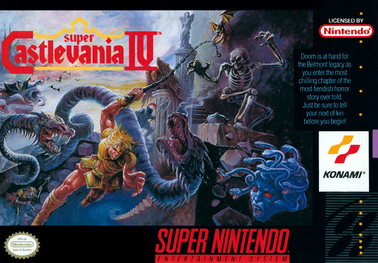
Of all the games listed below, I think this is my favorite box art.
The original Castlevania game, like many early NES games, was short, simple, and brutal. The game did not teach you very much, but instead threw you right into the game, and the difficulty level rapidly progresses beyond level 1 and 2. By the time you get to the Grim Reaper, the levels are quite difficult. The final level is a genuine gauntlet.
I never beat this game as a kid, and I only beat as an adult through a combination of save states and dedication. It’s a classic of its era, and fun to playthrough. Even Terminal Montage did a nice tribute to it:
Castlevania II: Simon’s Quest
For some reason, early NES sequels often followed a pattern of providing overland adventures to expand the world of the first game. The Legend of Zelda had Zelda II: Link’s Quest, Castlevania had Castlevania II: Simon’s Quest and so on. Castlevania II was the least popular of the NES games, but it is in a weird way my personal favorite.
You had to be there, though.
I was a bit too young to play the original Castlevania when it first came out, but I knew about it, and so when Nintendo Power magazine put out the issue (with the controversial cover) with exclusive coverage of Castlevania II, I was hooked. The full color map was so fun to look at:
Source: Nintendo Power Magazine
I still play this game regularly. I enjoy the slower place than other Castlevania games, and that it requires less feats of acrobatics (less falling off of stairs, like Castlevania III). I like to both 100% the game, and beat it within the 8 hours. However sometimes, I just enjoy taking my time and exploring every corner of Transylvania.
Of course, one other thing should be mentioned: the soundtrack. 8-bit games weren’t known for powerful music technology, but every once in a while, someone would compose something inspired. The Bloody Tears song, found on the overload during daytime, would go on to be a classic of Castlevania franchise, and rightly so.
One other interesting bit of trivia. The Dungeons and Dragons module, Ravenloft (I6), came out in 1983:
The box art for Castlevania II came out in 1987. Notice any similarities?
Castlevania III: Dracula’s Curse
Castlevania III: Dracula’s Curse is arguably the hardest of the early Castlevania games. It used the novel idea of featuring a different, earlier Belmont, than Simon, so it has a grittier, more medieval feel. Coupled with the spirit helpers, and multiple routes to choose from, this games was exciting and fun to replay.
This is also the first game where Adrian Tepeš, also known as “Alucard”, is introduced, though mechanically he is a fairly weak helper.
In fact, fans of the Netflix Castlevania series (such as myself), will see many references to Castlevania III, including the same cast of characters. I was a bit surprised that Grant Danasty wasn’t included in the series, other than a brief mention:
“that one guy with the horse-drawn sailboat on wheels that called himself the Pirate of the Roads…”
Trevor Belmon, Castlevania Netflix Series, S3E01
As for the game, I truly do enjoy it, though the punishing difficulty and frequency of “stupid fall deaths” does get a bit frustrating at times. I often like to take the difficult routes just because it’s fun to go all the way up through the basement of Dracula’s castle, more so than the ghost ship. The soundtrack was excellent and many classics from this game appear in later franchises too. Culturally speaking, Castlevania III is the most influential of the early games, and with good reason.
Super Castlevania IV
At last we come to the final game I played: Super Castlevania IV. This was the first game to be made for 16-bit Super Nintendo, versus older 8-bit Nintendo Entertain System. The improvement in graphics, sound and music reflect the improved hardware.
This game also finally allowed your character to whip in multiple directions, not just forward. I wish this feature had existed in earlier games, especially Castlevania II, since whipping the little slimes that were too short to hit was quite frustrating, as well as enemies on a lower platform.
The controls of this game are just so seamlessly smooth and the game levels are a good challenge without being excessive. The graphics of course were meant to show off new features of the 16-bit Super Nintendo, including rotating backgrounds, and other weirdness in Dracula’s castle. In fact, much of Dracula’s castle is just weird, but in a fun, gothic way. Fighting ballroom ghosts in one level, or gold skeletons in the treasure vault are all novel ideas, and lend to the old decadence of the villain.
Finally the music. The jazzier style music actually somehow enhances the mood of the game, rather than detracting from it. Composers definitely had some fun in this one, and I like to go back and listen to it occasionally on Youtube. Enhanced versions of classic Castlevania songs all sound great in this game.
One oddity is that this game is treated as non-canon in the Castlevania universe, since it is seen as a remake of the original Castlevania game.
Conclusion
I do regret not playing the later Castlevania games when they came out, especially Symphony of Night, so I missed out on a lot of the later lore until the Netflix series. However by this point, as an old school gamer, I had four classics under my belt, and was happy with what I had.
Recently, I dragged my first Adventurers League character, Qisandoral Arreistanus, out of a long, long retirement for another adventure in our play-by-post group. Qisandoral is a high elf wizard of the Abjuration school. You can think of him as Mr Spock in a fantasy setting.
“We reach”… with Otiluke’s Freezing Sphere!
Due to pandemic and other issues, I hadn’t played this character in literally years, but due to AL rules, he had jumped from level 9 to level 12 through accumulated downtime. Otherwise he sat idle. With the new 2024 ruleset, and the requirement in Adventurers League to rebuild a character that conforms with this ruleset, here is the latest, update character sheet (link):
The tier-3 adventure module, from the Season 8 Waterdeep setting, took place in the underbelly of the city, where we fought a vampire cult worshipping Shar. With only three players, and no melee fighters, this was hugely risky. My memory of how to play Qisandoral was rusty, I had forgotten his abilities, and my spellbook choices were confusing and weird.1 During the big boss fight, I performed pretty terribly at first, and nearly wiped out my own party due to a poorly timed Otiluke’s Freezing Sphere. Further, our DM skillfully played the boss, a vampire mage, as it fought tooth and nail using every nasty trick in the book to survive. It took a huge effort to finally slay the abomination. At one point, I had to use Wall of Force to pin the vampire long enough for us to recover a couple rounds.2
The good news is that during play, I eventually dusted off the mental cobwebs and started playing my wizard more effectively. This post is to share some hard-learned lessons about playing an Abjuration Wizard in 5th edition Dungeons and Dragons. I think Abjuration wizards are really neat, and fit Qisandoral’s character concept (a dour, elf wizard who is very bland and likes routine) nicely, but they’re also a little different from other wizards as I learned the hard way.
Edit: with the 2024 Player’s Handbook, the rules for the Wizard class have changed considerably. You now choose your wizard subclass at level 3, but the abilities largely remain the same, and the advice remains unchanged. The level 10 ability in the 2024 ruleset has been greatly enhanced, and will certainly increase the power of this subclass at higher levels.
The Basics of Abjuration
First and foremost, Abjuration is about defense, cancellation and denial. Of course, an Abjuration wizard must also have some offense, but they will never excel at offense. Instead, an Abjuration wizard shines when they frustrate and shutdown the enemy.
Your 2nd level wizard ability, Arcane Ward, is your bread and butter. Simply by casting Mage Armor at the start of your day (which wizard’s do anyway), you gain a extra pool of hit points that will automatically absorb (afaik, you don’t get to choose, it just happens) a certain amount of damage before passing through. At low levels this pool is quickly used up, but at higher levels the pool of hit points gets pretty large.
Further, the pool recharges X hit points where X is 2 times the spell level. If I cast Shield, a 1st-level spell, my ward tops up by 2 hit points. If I cast Counterspell, a 3rd-level spell, it tops up the Arcane Ward by 6 hit points.
Later, when your character reaches 6th level, you can then project this ward as a reaction to absorb someone else’s damage. You have to be able to see that person, and they have to be within 30 feet, but otherwise it’s a handy way to keep teammates alive in a pinch (and I projected it a lot in the boss fight above).
Finally, the other big deal with Abjuration wizards is that for certain spells like Dispel Magic and Counterspell, you can boost your chance of success using your proficiency bonus. This does not work with Banishment sadly (I learned this the hard way).
Lastly, starting at 14th level, Abjuration wizards are highly resistant against spell attacks, which from a defensive standpoint is pretty neat and probably live-saving (sadly Qisandoral was 13th level during the aforementioned adventure).
What To Do And Not Do
An abjuration wizard needs to rely on their Arcane Ward a lot, so you should activate each day using Mage Armor or something suitable. Also, have a few cheap spells of the Abjuration school prepared to help recharge it as needed. The challenge is that many of those cheap spells are pretty niche:
Shield is always a good idea to have, but can only be used as a reaction (i.e. you’re being attacked). Further, shield gets less and less useful at higher levels as your AC struggles to keep up with enemy attack levels. You should always have it prepared just in case, but bear its limitations in mind.
Protection from Evil and Good can provide some help in some situations, but you can only cast it on one party member, even if you cast at higher level, and it requires concentration (yuck).
Counterspell only works when someone is casting a spell, and you can’t always stand around waiting for someone to do that.
Alarm is only useful outside of combat. Sneaky wizards know to cast this as a ritual over and over again (time permitting) to charge up the Arcane Ward.
Banishment is a high-level spell, and may fizzle if the saving throw succeeds. If it succeeds, you’re a target for opponents trying to break your concentration.
Globe of Invulnerability is very powerful, but it has a fixed location, so it will not move with the player.
Each of these is pretty niche spells, so if you want to maximize usage of the Arcane Ward, you prepare as many of these as you can to react to various situations.
On the flip side, the more of these you prepare, the fewer offensive spells and other utility spells you can prepare. In earlier adventurers, this was the problem I had with Qisandoral: in many fights, the best he could do was shoot Ray of Frost (a cantrip) half the time.
Thus if you want to have an Abjuration wizard with some offensive capability, you will have to choose your spells carefully, and strike a balance between the needs of your school, and the needs on the battlefield.
It’s best to pick spells that are generally useful in all situations. Magic Missile isn’t glamorous, but few monsters can resist force damage, and it just about always hits its target (unless they have a Shield spell). Even cantrips can be useful since they do scale up damage over time. Qisandoral has both Ray of Frost for distance, and Shocking Grasp for close range.3 Having a variety of offensive cantrips may help free up the need to use precious spell slots for other things, even if you are not a powerhouse.
Also, having a classic like Fireball or Freezing Sphere is good to have in your back-pocket as a kind of panic button.
On the utility side, spells like Misty Step are a great way to get in and out of the battlefield, and well as some common detection spells like See Invisibility or Detect Magic.
Combat
Since you’re default strategy is to leverage Arcane Ward to frustrate attacks, or use your spells to stop magic effects, you may be in combat doing mostly passive or reactionary moves while spending your turn making low-level attacks that don’t require commitment or concentration. The default strategy is one of observation, and being able to respond to threats as they come up, but still reasonably do your part to take out threats offensively.
If you do manage to Banish a creature that you intended too, then don’t hesitate to protect yourself using your own abilities otherwise intelligent monsters may decide to target you next to break concentration.
Finally, remember that if you use Globe of Invulnerability, make sure to put it in a strategic spot where you and party members can take cover for the rest of the battle. In other words, make it count.
Final Thoughts
If your goal is to make a wizard that decimates the battlefield with world-bending magic, an Abjuration wizard probably isn’t a suitable choice unless you want to charge your Arcane Ward once per day and maybe keep an abjuration spell or two handy.
If your goal is to disrupt the battlefield and frustrate your enemies, an Abjuration wizard excels at this, but it does require responding to various niche situations as they come up, and your damage output will be somewhat below average. Just remember you’re focusing on defense first, offense second.
Conversely, since so many Abjuration spells are situational don’t be surprised if you are in a situation where none of them are useful. Have a few generalist spells prepared for this situation.
Finally, as with every wizard, you can never quite prepare enough spells. It’s always a juggling act to balance various competing needs, and accept that you will sooner or later have failed to prepare the right spell for a particular situation. The vast breadth of spells a wizard has comes with the cost of lots of care and feeding.
I hope this was helpful. Good luck!
1 Thanks to simpler AL rules now, I probably should have just rebuilt him again from the ground up before the adventure, but I was in a hurry and busy.
2 I also had Hold Monster prepared, but failed to notice the stipulation that it does not work on undead monsters. 🤦🏼♂️ Word of advice for new players: read your spells carefully beforehand.
3Shocking Grasp is also handy when your opponent has legendary actions, since a hit prevents them from taking reactions for a turn. This was something I could’ve done in our fight, but I failed to grasp this until too late. To be fair, our opponent was invisible most of the time anyway.








 Gleanings in Buddha-Fields
You must be logged in to post a comment.