Autumn Nights in Japan: Otsukimi and Juya-E

In the old Chinese lunar calendar, on the 15th day of the 8th lunar month (i.e. full moon on the 8th month), many cultures across East Asia celebrate something called the Mid-Autumn Festival. This has various names depending on the country and language:

  • Zhōng-qiū-jié (中秋節) in Mandarin Chinese,
    • Tiong-chhiu-cheh in Hokkien, by the way
  • Tết Trung Thu in Vietnam, and
  • Chuseok (추석) in Korea

In Japan, this festival is called formally the Jūgoya (十五夜, “15th night”) festival, but in popular culture is known as Otsukimi (お月見, “moon viewing”). This year, due to the lunar calendar, Otsukimi falls somewhat late on October 6th. This festival is about viewing the moon with friends and family, while enjoying some dango (rice dumplings) using displays like so:

A stack of dango treats, photo by evan p. cordes, CC BY 2.0, via Wikimedia Commons

According to this excellent book on Japanese culture, people also decorate such displays with pampas grass (susuki, ススキ), edamamé beans and taro potatoes. Unlike cherry-blossom viewing, people do not usually get drunk.

Chinese moon cakes, called geppei (月餅) in Japanese, are sometimes eaten as well, though it’s more of an exotic treat. Here, moon cakes are easy to obtain, and quite delicious. Highly recommend. We also get the Korean version of dango (tteok, 떡) too.

In any case, Otsukimi is about relaxing, enjoying the autumn vibes with the ones you love. As my family and I live in the Pacific Northwest, weather here isn’t reliable, and so we often get stuck with cloudy weather. But the image of Otsukimi is still popular. You can even find an emoji for it: 🎑.

Also, fun fact: there are traditionally two days of moon-viewing in Japan. The main one is Jūgoya (十五夜, “15th night”), but traditionally there is also a Jūsanya (十三夜, “13th night”) viewing on the 13th night of the ninth (not eighth) lunar month. This year, 13th night falls on November 2nd. On the 13th night of the lunar month, people enjoy chestnuts instead. Traditionally, people felt you should view the moon on both nights, otherwise, according to my book, you only did katamitsuki (片見月, “one-sided viewing”), which wasn’t ideal.

By the way, there is one other tradition around this time that’s specifically Buddhist: Juya-é (十夜会, “ten nights ceremony”), which is ten nights of observance of Pure Land Buddhist practice, starting from October 5th to 14th in the Western calendar. I usually try to recite the nembutsu a full 1080 times using my old Jodo Shu rosary for ten nights. Easier said than done as a parent, but it’s nice to have a challenge from time to time. Traditionally, people try to attend temple services if possible, or just focus on good behavior.

Anyhow, wishing you all a fun Otsukimi, Mid-Autumn Festival, or Juya-e, etc., or all of the above!

Zen Verses for Mealtime

As I write this post, I am in Dublin, Ireland on a short trip (business, not pleasure), helping my daughter get settled in for college. Thanks to timezone differences my daughter and I were awake at 11:30pm on a Friday and starving.

Taken near Trinity College and the main Bank of Ireland building (right).

Since a lot of pubs close their kitchens early, we went over to the local Supermac’s1 :

My daughter took this photo of her food. Mine is at the far end of the table (upper right corner).

It’s Friday night, so as we’re seated, people are stumbling in drunk looking for some cheap food, and there’s a steady stream of food delivery guys picking up orders. Still, even here, as I open my bag and eat my food, I try to still take a moment and appreciate the food, so I discreetly did gassho.

In Japanese culture, people will usually say itadakimasu before eating food, and gochisōsama deshita after finishing. The word itadakimasu is just the humble form of the verb “I receive”, and gochisōsama deshita means “It was a wonderful meal”.

But there’s also a set of verses that in the Zen tradition are recited before meals called the Shokuji Gokan (食事五観, “five observations at mealtime”). When I was watching a documentary recently, during mealtime, one of the Eiheiji monks walked the documentary host through the five verses. The five verses in Japanese for the Rinzai tradition are:

  1. 一つには、功の多少を計り、彼の来処を量る。
    hitotsu ni wa, kō no tashō wo hakari, kano raisho wo hakaru
  2. 二つには、己が徳行の全闕を忖って供に応ず。
    futatsu ni wa, onore ga tokugyō no zenketsu wo hakatte, ku ni ōzu
  3. 三つには、心を防ぎ、過貪等を離るるを宗とす。
    mitsu ni wa, shin wo fusegi, togatontō wo hanaruru wo shū to su
  4. 四つには、正に良薬を事とするは形枯を療ぜんが為なり。
    yotsu ni wa, masa ni ryōyaku wo koto to suru wa gyōko wo ryōzen ga tame nari
  5. 五つには、道業を成ぜんが為に、応にこの食を受くべし。
    Itsutsu ni wa, dōgyō wo jōzen ga tame ni, ō ni kono jiki wo uku beshi.

The verses in Soto Zen appear to be slightly different. I am fairly certain, these are descended from Chinese Chan Buddhism, but I wasn’t able to find much information.

There are a lot of fine English translations available, though for now I am using the one from Sotozen.net:

  1. We reflect on the effort that brought us this food and consider how it comes to us.
  2. We reflect on our virtue and practice, and whether we are worthy of this offering.
  3. We regard it as essential to free ourselves of excesses such as greed.
  4. We regard this food as good medicine to sustain our life.
  5. For the sake of enlightenment, we now receive this food.

In either case, the meaning is the same: before we take in the food, we should first reflect where it came from (and the countless people who made it possible),2 and whether we are living up to the practice or not. Finally, the verses remind us that food is essentially medicine (hence don’t be a pig), and that it helps us along the path toward Enlightenment. Even some chips (fries) at Supermac’s is something to be grateful for.

So, hello from Ireland, and will post more soon! 🇮🇪🖖🏼

1 The local version of McDonald’s, but ten times better.

2 The Jodo Shinshu tradition focuses on the concept of “gratitude“, so there’s a lot of overlap here.

Ando Momofuku: The Inventor of Instant Ramen

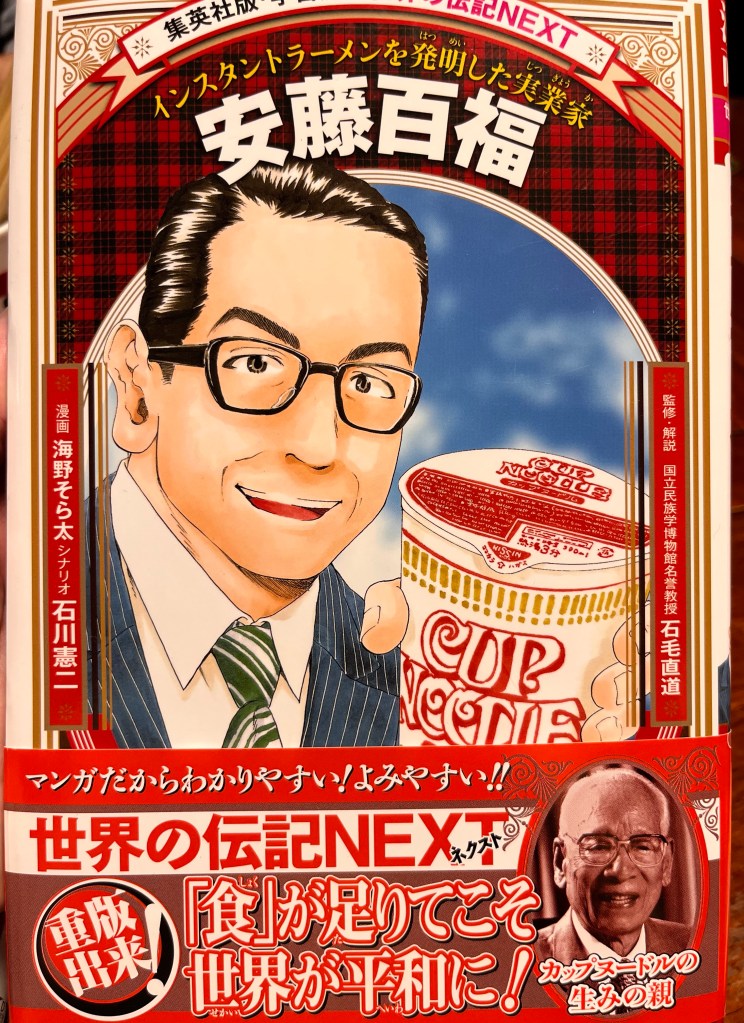
The Ramen Museum in Yokohama is a great way to spend an afternoon, and I have visited a couple times in recent years. I even bought the manga biography about Ando Momofuku (安藤 百福, 1910 – 2007), the creator of “instant ramen”:1

I’ve had a long fascination with instant ramen, and with Ando Momofuku. As a poor kid with a single mom, we ate a lot of “Top Ramen” when times were tough. To be honest, I loved it. I would cook my ramen with an egg, and some frozen peas. In college, my roommate would cook with spam (salty, but tasty).

The story of Ando Momofuku and of instant ramen is pretty interesting. Momofuku was born in Taiwan, at a time when it was still part of the Empire of Japan (1895 – 1945), and thus while he is Taiwanese Chinese, he was also a Japanese citizen. He was born into a merchant family, and from an early age showed an aptitude for business. He took part in knitted textiles (meriyasu in Japanese, メリヤス), and in time was able to expand his business into Osaka since it all belonged to the same empire. From Osaka, the business grew, but then WWII came and many resources were increasingly rationed. His factory was destroyed in the air raids.

Rice production was carefully rationed as the war turned against Japan, and after the war, food supplies were still very limited. During the postwar period, people ate a lot soba noodles and ramen, since they are not made from rice. Ando Momofuku started a partnership business, but this collapsed due to some sketchy financial schemes, and he was jailed for a couple years due to tax evasion (supposedly helping provide scholarships for local students). Bankrupt, but inspired by the idea of making ramen noodles more accessible, he learned how to make ramen, and how to make it more portable and easier cook.

After considerable trial and error, he determined that flash-frying ramen noodles dries them out in a way that’s easy to rehydrate later with hot water. Thus, by August 25th 1958, the first instant ramen was made. Momofuku’s new company, Nissin Foods (Nisshin Shokuhin in Japanese, 日清食品) quickly sold the instant ramen to great success.

Early examples of “Chicken Ramen” sold in 1958, courtesy of the Cup Ramen Museum in Yokohama. Taken by me in 2023.

The “cup style” ramen came later in the 1970’s after Nissin realized that people outside of Asia didn’t eat ramen the traditional way (ramen bowls, chopsticks, etc). After some research, a styrofoam cup was invented, and carefully engineered to keep the brittle noodles safe from crumbling, and also keep the sauce and seasoning together. This allowed people to simply add water, and eat from a fork.

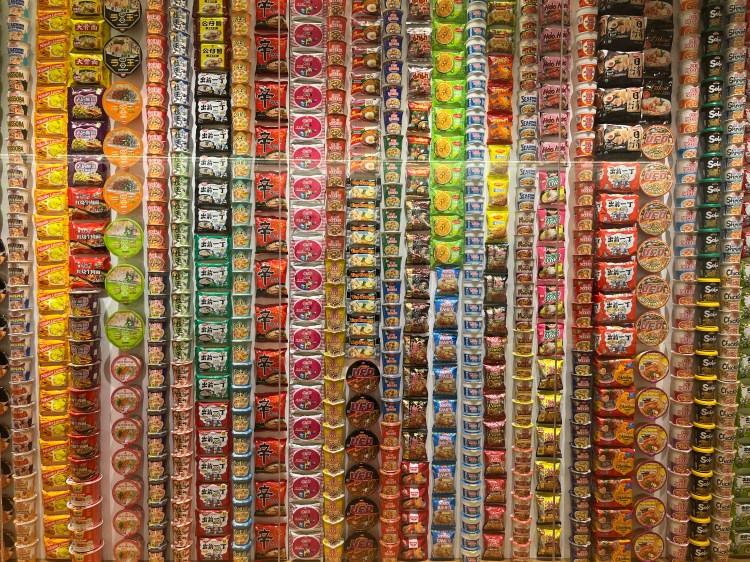
Examples of both packaged “top ramen” and “cup ramen” from the 1990s. Taken at the Cup Ramen Museum in Yokohama.

One of the things, in my opinion, that makes Ando Momofuku more than just a clever businessman is that as the instant ramen business succeeded, and copycat products flooded the market, Momofuku didn’t punish other companies, but instead started a industry-wide standard for instant ramen, and sold licenses to others companies to ensure consistent quality. For Momofuku, the most important thing was that instant ramen help contribute to food availability, and not just pure profit.

Starting with the Great Hanshin Earthquake in 1995, Nissin was responsible for distributing food aid to many sites around the world, and Momofuku often famously said the phrase 食足世界 (shoku tarite yo wa taira ka) which means something like “if there’s enough food, the world will be at peace”.

Speaking as a poor white kid in the 80’s and 90’s, I am grateful to Ando Momofuku for his innovation, and for his commitment to humanity. 🍜

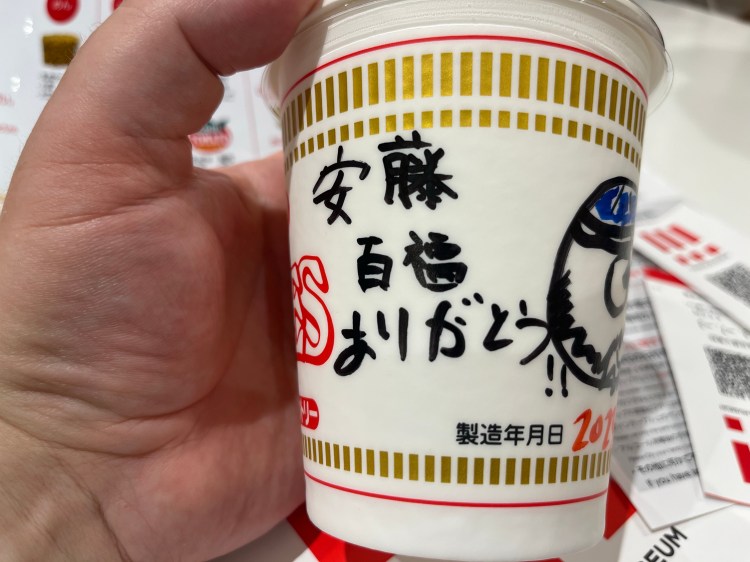
My designed cup at the Cup Ramen Museum in Yokohama. Reads “thank you Ando Momofuku” with my poor handwriting. Taken in 2023.

1 I am using Asian-style naming convention, so family name then given name. Thus, Ando Momofuku’s family name is Ando, which he adopted from his Japanese wife, and his personal name is Momofuku. This is a Japanese name, not his family birth name. In his native Taiwanese-Chinese (aka Hokkien), his name was Go Pek-Hok (吳百福). Taiwanese Pek-Hok (百福) is read as “Momofuku” in Japanese. I want to do a side-post about Hokkien language sometime because I realize lately that it’s pretty underrated but influential, but research will take time.

Healthy Living: Eating Like A Monk

McCoy: “It might eventually cure the common cold, but lengthen lives? Poppycock. I can do more for you if you just eat right and exercise regularly”

Star Trek, “The Omega Glory” (s2ep23), Stardate unknown

Healthy eating is not difficult, at least in theory.

Of course if it were that easy, how come many of us are overweight? Myself included.

I talked about this recently, but I do not have very good self-control. I work a desk job, so I don’t move around much, and I snack a lot. I don’t eat particularly unhealthy: no alcohol, no soft drinks, etc., and I eat minimal red meat. But I tend to just eat too much junk food, or too many portions.

Recently, I dug out an old book of mine from many, many years ago,1 titled What Is Zen? 禅ってなんだろう. It’s a bilingual book I bought in Japan that explores Rinzai Zen life as a monk, but also includes some general thoughts about the tradition for lay followers. My copy has been covered in stickers when my daughter was a little girl, so I kept it both for nostalgia, and because such down-to-earth books on Zen are hard to find in the West.

This is what happens when little girls get a hold of daddy’s books… 😅

Anyhow, this book shows things like daily routines for monks, how they eat and so on. I wish I could repost the photographs because they’re really neat, but obviously that’s inappropriate. Instead, let me shiw you a different example:

An example of shōjin-ryōri (monastic food) at Tenryuji temple in Kyoto, Japan. Photo by 663highland, CC BY-SA 3.0, via Wikimedia Commons

This photo, shows a meal served at Tenryuji Temple, which I coincidentally visited last year. This kind of monastic food is called shōjin-ryōri (精進料理, “ascetic food”) in Japanese, but is a common part of Buddhist cuisine across East Asia. It’s not limited to monks and nuns only, devout lay followers can eat such a lifestyle if they wish. The photos from my book show that the monastic version of this meal is somewhat simpler in presentation (they are monks after all), but essentially the same.

Similarly, when we visited Ryoanji Temple (another Rinzai temple) waaay back in 2005, we enjoyed their version of tofu stew:

Taken by me in 2005, at Ryoanji Temple. This is a vegetarian tofu stew, with turnips artfully sculpted to look like lotus flowers.

This kind of diet is similar to a vegan diet in that it contains no animal products, even the dashi broth is vegetarian. Certain flavors like curry and onions are not used either.

But as with any diet changes, this is not something that should be done hastily or without consulting a physician. The key I wanted to convey here is that (partly as a reminder to myself when I read this six months later….) is that a healthy diet consists of the following:

  • More vegetables than protein
  • Minimal processed starches
  • Little or no animal protein
  • Small portions per meal2
  • Little or no snacking.

But I’ve been inspired by these examples of good Buddhist eating, and so I have been gradually trying to “eat like a monk” lately: smaller portions, avoiding or minimizing animal protein, limit starches, and eating more veggies.

Will it work for a Western desk-jockey like myself? We’ll see.

1 I mentioned this book on my old blog, that’s how long I’ve owned it.

2 My doctor had previous suggested intermittent fasting as a potential solution, or alternatively eating four small meals per day, instead of three big ones. Say, portions the size of two-three fists. The issue hasn’t been the diet, but my lack of diligence especially during the holidays. So, that may be the bigger issue.

Culture, Religion, and Curry

A long time ago, my wife and I watched this TED Talk in Japanese about religion and how Japanese culture approaches it:

The TED Talk is entirely in Japanese, with no subtitles, so unfortunately most folks here won’t be able to easily follow it. Which is a shame because it’s quite good. I had a saved in my personal playlist, and rewatched it recently. There a couple points in particular that I wanted to tease out:

The priest in question, Matsuyama Daiko, was raised in a “priest family” in Japan (e.g. Buddhist priest),1 but attended a Catholic school growing up. This is not unusual. My sister-in-law also attended a Catholic school in Japan, we have good friends who are a Buddhist priest family. Matsuyama makes the point that Japan approaches religion the way it approaches dinner: in the West we tend to feature a main dish, and maybe a few smaller side dishes (or none). In Japan, food is usually not served with a main dish, but several dishes that are more or less same quantity.

An example of a traditional meal in Japanese cuisine. Photo by cyclonebill from Copenhagen, Denmark, CC BY-SA 2.0, via Wikimedia Commons

In the same way, while Matsuyama is an ordained Buddhist priest, he grew up with a wide exposure to other religions but sampled many dishes. It’s not unusual for a Japanese person to do Buddhist stuff, but also visit Shinto shrines during Hatsumode, get married in a Christian chapel, etc. Hence, like many dishes, Japanese tend to sample many traditions, and respect them all. People have their personal inclinations (or none at all), but they are not forced to choose following A versus following B. I don’t want to oversell this too much, but it is a practical approach to religion and one you’ll find not just in Japan, but other Asian cultures as well.

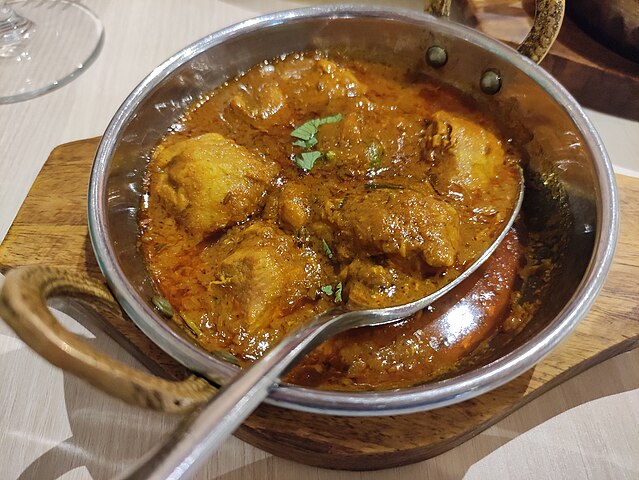
The second point that Matsuyama makes that I thought was interesting was the idea of variation even within the same religion. Matsuyama talked about how Buddhists in Theravada countries might look at Japanese Buddhism (Mahayana), and be confused by some of its practices, and vice-versa. So, he used the example of curry. Curry is a food that is found across all of Asia, but there’s an incredible amount of local variety. I LOVE curry. I eat any kind of curry, and love the sheer variety.

Different curry dishes arise from different environments and circumstances: availability of ingredients, cooking methods, climate, and so on. Matsuyama stated that Indian curry tends to be very spicy, which is handy in a hot, dry climate as some parts of India are, because it helps you sweat. Japanese curry, which tends to be very hearty and mild, works well in a climate that is colder. Thai curry uses a lot of coconut milk, something not available in Japan, and seafood. Curry as consumed in the UK has also been adjusted for local resources and taste.

Yet all of these are unquestionably curry. Anyone can taste any of these dishes and immediately recognize it as curry. In the same way, each tradition and sect with Buddhism is easily recognizable. It may not suit one’s personal taste, but the variety of cultures, historical precedents, people and geography have led to a variety of traditions, and there’s something for everyone. Of course, this is true of other world religions too, but I wanted to use Buddhism as the example.

So, when looking at the variety of ideas, teachings and practices, consider the example of curry. Different curries arise from different conditions, and each is suitable for different people, but also curry is delicious no matter how you try it. So, don’t be afraid to sample other versions.

1 Unlike most Buddhist countries where monks are celibate and usually live a cloistered life, Buddhist monks in Japan are (for complex historical reasons that are too long to go into here) parochial, live among communities and marry.

Gardening with Shiso

Since the Pandemic started in early 2020, my wife and I took up very small-scale gardening in our backyard. My wife likes growing flowers and herbs, I like growing vegetables. This year, we both experimented with growing a popular Asian herb called shiso (シソ) in Japanese.1

Shiso, also known as Perilla frutescens, is a member of the mint family and is also related to the sesame plant. Its taste is hard to explain, but the leaves are often shredded, or cut very thin and eaten raw along side things like natto, sushi, or cooked meat. It tastes very refreshing, but also kind of strong.

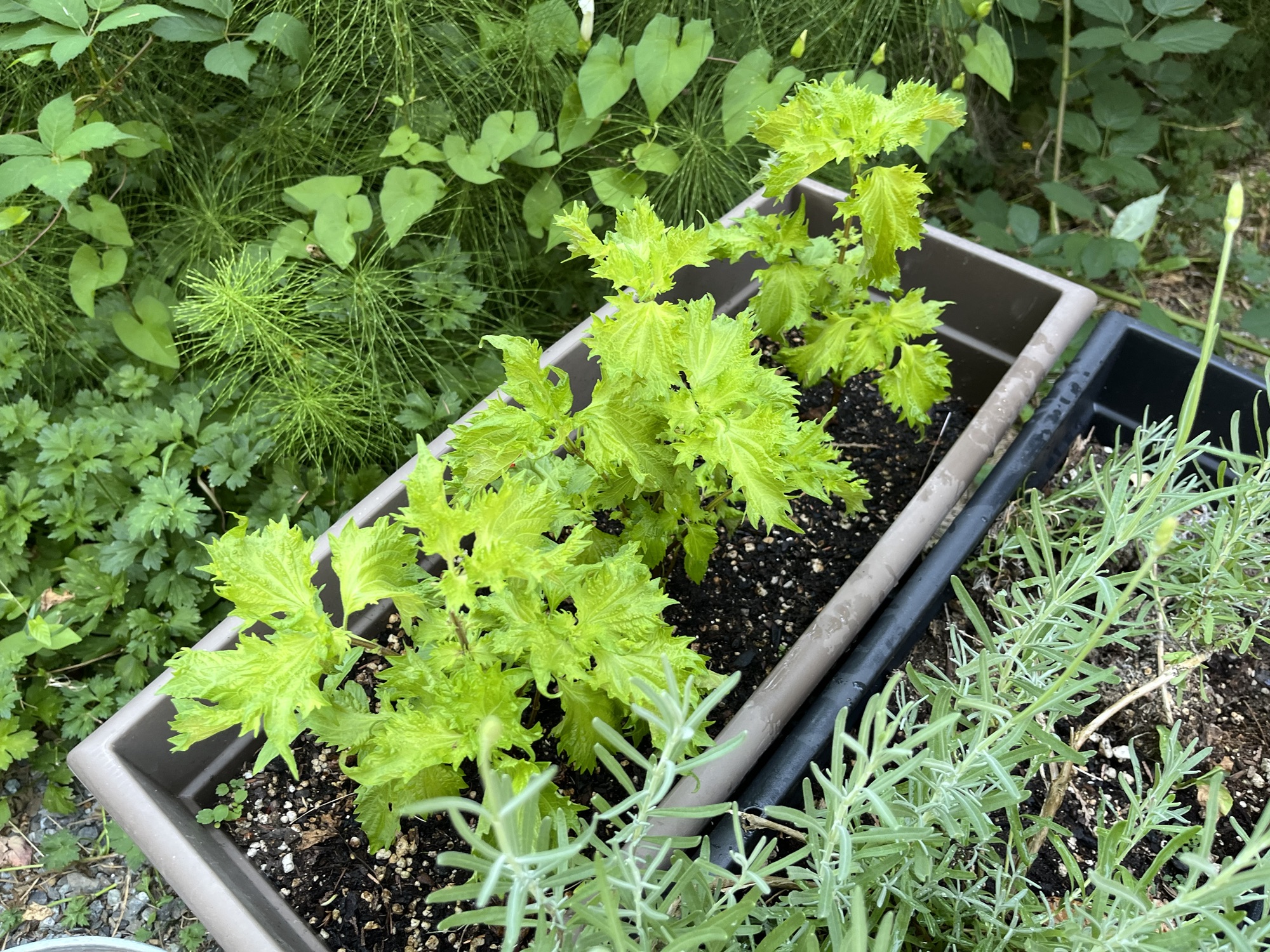
Anyhow, it turns out that there are many varieties of shiso, and my wife and I each planted a different variety. My wife chose this variety from a starter:

I grew this variety, aojiso (“green shiso”) from seeds:

The plants look similar, but are somewhat different. My wife’s variety is more ruffled, and green on the underside, while mine is flatter, more heart-shaped and reddish on the underside. Her shiso plants have a lighter flavor, mine are pretty strong tasting.

Both shiso varieties seemed to struggle to germinate in the colder PNW climate, but suddenly when June came and the weather warmed up noticeably they started growing much faster. They also get thirsty quickly, so they require water often.

Once they start sprouting leaves though, they sprout a lot. We keep harvesting and the plants keep growing more. Shiso is delicious, but it’s not possible for us to finish this much.

Shiso is not something Westerners often eat, but it’s widely used in Japanese, Korean, Vietnamese, and Chinese cuisine, and it is fun to grow. It just needs a much warmer environment, and plenty of water.

A Day at the Cup Noodles Museum!

Sometimes the best experiences are the ones you don’t plan. Early after arriving in Japan, and still pretty jet-lagged, my family and I met up with some friends back home who happened to be in Japan too. We spent the day in Yokohama, which is a large port city in Japan that has a long history as a port of call for Western traders (hence it has a more western look than the rest of Japan). First we went to the Aka-Renga Sōko (lit. “red brick warehouse”), a famous historical building now turned into a small shopping mall. However, there wasn’t much there for kids, so we wandered around Yokohama a bit. Then we stumbled on this:

This is the Cup Noodles Museum, dedicated to the famous product. The museum, sponsored by Nissin, covers the invention of Cup Ramen Noodles (カップ麺, kappu-men in Japanese) by Andō Momofuku (1910-2007) and its growth ever since. As a poor kid growing up with a single mom, we relied on instant noodles frequently, and later in high school/college I ate them while on a limited budget. So, it’s no exaggeration to say instant noodles have been a part of my life.

I knew a little bit about Andō Momofuku, a Taiwanese man who grew up when Taiwan was part of the Empire of Japan and started a business in Japan later in life. I even watched a drama about him and his wife in Japanese (with my wife). Andō Momofuku was a fascinating man who had a strong business sense, but also a commitment to his ideals. His efforts to invent freeze-dried instant noodles took years, and there was no precedent for it before, but finally he succeeded.

Anyhow, the museum isn’t very big, but it’s a great way to spend half a day or so. There are plenty of English services, and it’s pretty easy to following along. One room shows a timeline of cup noodle products over the years:

The first products
When I was in high school
Now

Further, there’s an optional feature at the Museum that lets you design your own ramen. You have to pay a bit extra, but you get a cup that you can decorate, then you choose your flavors, addons, etc. As someone who grew up with instant ramen, I drew the following:

And on the side, I tried to write a short message on the cup. It was meant to say 安藤百福、ありがとう! (“thank you, Andō Momofuku”).

For my ramen flavor, I picked curry flavor with some corn, green beans and dried meat. When done, they seal it for you, and you can carry it inside of an inflatable bag. Since you have to eat within a month, I finished it before coming back to the US. The curry flavor was delicious.

While there I picked up various goods in the gift shop, including a manga (Japanese only) about the life of Andō Momofuku:

It’s been a pretty good read so far, and shows how he was a sharp businessman even before he moved to Japan.

Anyhow, I highly recommend the museum if you’ve ever enjoyed instant noodles. While not very large, it has lots of neat features in it, and helps you appreciate the man who started it all. 🍜

Nanakusa: Holiday of Seven Herbs

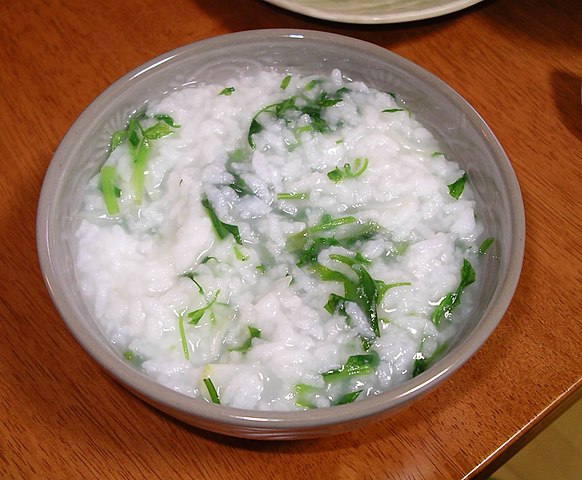
A small bowl of rice porridge with various greens mixed in.

As readers may have noticed from past posts, I have posted about certain traditional Japanese holidays, called sekku (節句). Examples included Girls Day (March 3rd), Children’s Day (May 5th), Tanabata (July 7th) and Day of the Chrysanthemum (September 9th). The last holiday on my list is actually the first on the calendar: Nanakusa (七草) which literally just means “seven grasses / herbs”. More formally it’s called jinjitsu no sekku (人日の節句, “day of the human”) as we’ll see shortly.

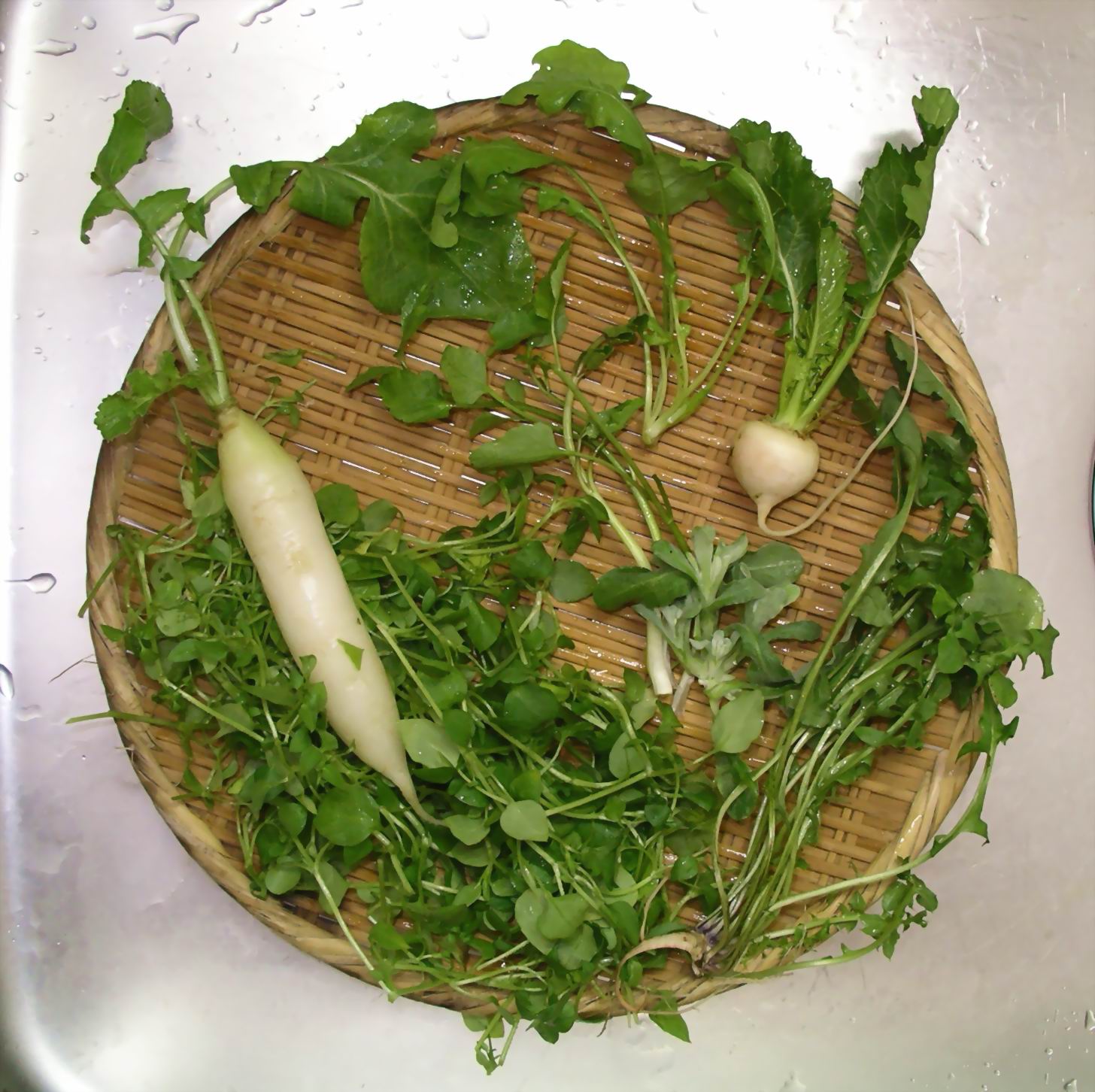
Courtesy of Wikipedia

This holiday is surprisingly old, with origins in ancient custom in southern China whereby people would cook seven herbs as a porridge on the 7th day after the Chinese new year. It also relates to the Chinese lunar calendar, where the first seven days of the year were designated as rooster, dog, boar, sheep, ox, horse and human, the first six being animals of the zodiac. Since the seventh day was (for some reason) marked as the day of the human, criminal punishments were not executed on this day.

The custom of eating a seven-herb porridge carried over to Japan as nanakusa-gayu (七草がゆ), though in some households more than others. I had it once many years ago when we were first married, and visited my wife’s family home in December-January. I saw a bunch of roots and herbs in the kitchen, like the ones shown above, but didn’t give it much thought. The next day, we were served nanakusa-gayu porridge for breakfast. It has a pretty bland in taste, but that was how I learned about Nanakusa.

A small bowl of rice porridge with various greens mixed in.
A bowl of rice porridge served during Nanakusa, Blue Lotus, CC BY 2.0, via Wikimedia Commons

According to the Wikipedia article, the seven herbs are:

Old Japanese NameModern NameEnglishScientific
芹 (せり) 
seri
セリ 
seri
Japanese parsleyOenanthe javanica
薺 (なずな) 
nazuna
ナズナ 
nazuna
Shepherd’s purseCapsella bursa-pastoris
御形 (ごぎょう)
gogyō
ハハコグサ (母子草) 
hahakogusa
CudweedPseudognaphalium affine
繁縷 (はこべら)
hakobera
コハコベ (小蘩蔞)
kohakobe
ChickweedStellaria media
仏の座 (ほとけのざ)
hotokénoza
コオニタビラコ (小鬼田子)
koonitabirako
NipplewortLapsanastrum apogonoides
菘 (すずな)
suzuna
カブ (蕪) 
kabu
Turnip leavesBrassica rapa
蘿蔔 (すずしろ) 
suzushiro
ダイコン (大根) 
daikon
daikon radishRaphanus sativus 
var. longipinnatus
Courtesy of Wikipedia

Of these seven herbs, I’ve eaten turnips and Japanese daikon radish regularly, but the other five are pretty obscure to me. I doubt most Japanese would easily remember them off-hand either. Supposedly there is a song that is sometimes sung while facing the auspicious direction that year (same direction as for Setsubun, I suspect), but no one in my wife’s house sang it, or at least while I wasn’t around.

Edit: I found the song in a book recently:

せり Seri

なずな Nanazu

ごぎょう Gogyou

はこべら Hakobera

ほとけのざ Hotoke-no-za

すずな Suzuna

すずしろ Suzushiro

それは七草 Sore wa nanakusa (“That’s Nanakusa”)

Anyhow, that’s a look at Nanakusa. I joked with my wife if she’d make it this year, and she flatly refused. While it is a very traditional holiday, the porridge takes a lot of work, especially here in the US where the herbs might be hard to gather, and frankly isn’t great tasting. It’s a medicinal porridge more than comfort food. That said, it is a fascinating window into some very old Chinese traditions that still persist in Japan.

1 The adolescent in me giggles whenever I read this plant name. 😂

In Praise of Takoyaki

Japanese takoyaki (たこ焼き) is a dish you rarely find in overseas restaurants but it is a great comfort food.

Explaining what they are to someone who’s never tried them, while making sound appetizing, isn’t easy. Afterall, how often do people eat octopus parts cooked in batter (sometimes with pickled ginger) topped with dried, shaved tuna, dried seaweed and mayo?

But, man, on a Saturday afternoon at home with the wife and kids, they are darn good.

Indian Pizza

As I transition from one team to another at work, a coworker kindly brought in Indian-style pizza as a goodbye treat:

Indian style pizza
Courtesy of CanAm pizza

Pizza courtesy of CanAm Pizza, and comes in such flavors as Tandoori Chicken, Paneer, Chicken Tikka and so on.

If you ever have a chance try some Indian-style pizza! 🇮🇳🍕😁