Buddhism and Parenting

True story, I had some spare time one day recently to sit and meditate,1 first time in a while. I set the app to 10 minutes, and sat on the ol’ cushion. About five minutes into this, my youngest child walked in and asked me to unlock the parental control on his tablet.

Concentration broken, oh well.

This is a frequent issue with being a parent and being a Buddhist, but it’s not a new one.

In the Buddha’s time, he distinguished the “householder” followers with the “renunciant” ones. This wasn’t meant to denigrate one versus the other, but it was intended to differentiate those who fully could devote themselves to the Dharma (the “renunciants”), to those who had other, competing obligations (the “householders”). Because the renunciants could, in theory, devote themselves full time to practice, and had cut loose any personal obligations and bonds, they could progress a lot further along the Buddhist path. The lay followers (householders) could still progress, but they would be hampered by their mundane obligations, social “entanglements”, and such.

However, because the Buddhist path was intended to help all, the renunciants would set aside certain days of the lunar month for outreach, helping lay followers through teaching and shared practice. This is known as Uposattha in the earliest Buddhist communities.

In later centuries, especially through the Mahayana tradition, Buddhist thinkers and communities sought to expand Buddhist practice to be more engaging toward lay Buddhist followers. The goal of such practices was not intended to replace the traditional monastic establishment, but (I believe) to help fill in the gaps. By expanding the available gates of Buddhist practice, people from all walks of life could find a place to start, and progress. In other words, an even more inclusive Buddhism.

Which comes back to my situation.

If we think of daily life as a box, there are only so many Lego bricks we can fit in there. Most of those Lego bricks, as a parent, are already spoken for, so that leaves only a bit of space left for “me time”. Within that spare time, self-help can be time-consuming, impractical. Or, one is just too mentally exhausted to do anything else but space out. In some ways, life as a “householder” hasn’t changed all that much since the Buddha’s time. We suffer less from hazards like dysentery and Viking raids, but the distractions and obligations are still there.

In any case, until the kids leave the nest, and especially after retirement, I have to be realistic in my own expectations. Simple practices such as the nembutsu, the odaimoku (a la Nichiren Buddhism), the Mantra of Light, or the Heart Sutra, combined with upholding the Five Precepts amidst daily life, are a helpful way to keep up one’s training while being realistic about time and energy. Even reciting something as simple as the nembutsu deepens the karmic bond with the Buddha and hopefully makes the world a slightly better place.

Also even a bit of forward momentum is better than to squander one’s life staring at a screen. 😉

1 my meditation routine has always been very … inconsistent.

Looking Back As A Buddhist Dad

Way back in 2008, I wrote a blog post (now deleted) about my 1-year old daughter (codenamed “baby”) and teaching her about Buddhism, especially Jodo Shinshu Buddhism which we practiced at the time. I reposted excerpts of it here, with some updates in formatting and such, but also trimmed for brevity.

My 1 year-old daughter, “Baby”, likes to play with the Buddhist rosaries (o-nenju お念珠 in Japanese) we have around the house. Thankfully, most are well-made and can take a good beating from a one-year-old. She likes to chew on them as well, as it helps relieve the itching from teething. I am not sure if this is disrespectful to the rosary, but given that it makes Baby happy and helps with teething, I think it’s for the better.

We’ve been teaching Baby how to do gassho, which is a gesture of respect in Buddhism where we put the hands together close to the heart. We use the Japanese phrase namu namu (南無 南無) when teaching her how to do it. It literally means “hail, hail” or “praise, praise”, but is meant as a gesture of gratitude and respect. In Japanese Buddhism you see/hear phrases like:

  • Namu amida butsu – Praise to Amida Buddha
  • Namu myoho renge kyo – Praise to the Lotus Sutra
  • Namu kanzeon bosatsu – Praise to Kannon Bodhisattva

When I visited Japan in 2005, we visited my wife’s friend, whose family are practicing Shingon Buddhists. In Japan, before eating you are supposed to say itadakimasu (いただきます), which is a very humble form of the word “I am receiving”. In effect, you’re saying grace, Buddhist-style. So, my wife’s friend would tell her three-year old to “namu namu”, or to put her hands together and give thanks. The little girl promptly put her hands together and in her tiny voice said “itadakimasu”. It was really touching to see.

So, with that in mind, we teach the same wholesome habit to Baby as well. Baby is one year old, not three, so she still doesn’t really understand it yet. However, Sunday night she surprised me by draping the rosary over her arm, and waving it around, so I had to take a picture. She’s clearly learning good habits from us, and that’s what makes good parenting so important. Children need good influences or they will have a much harder time in life.

It’s hard for many Western Buddhists, especially those with kids, to know how to raise them as Buddhist. It’s hard too since a lot of people approach Buddhist from an intellectual/philosophical point of view. I am lucky because my wife comes from a Buddhist culture, so I learn a lot of this through her beyond the philosophical side. But for most people who don’t have Asian spouses, how do you develop a Buddhist-family lifestyle?

I think the key is to promote positive values to your kids:

  • Respect for others, your parents, teachers, etc.
  • Humility and gratitude knowing we depend on others for what we have. Who makes your food for example?
  • Kindness, kindness, kindness! In Buddhism, we toss around the word “compassion” a lot, but that’s too abstract for kids. Kindness on the other hand, is a lot easier to convey and just as good.
  • Plenty of research shows that kids like routine, so taking them to a Buddhist service regularly, or having a home routine is good. Meditation retreats on the other hand are a bad idea. Most are not suitable for children anyways.
  • Be a good example for your kids. My wife and I are pretty strict about not swearing or yelling in front of the kids. Sometimes we make mistakes, but we really try.

You get the idea. Most of this stuff is good parenting advice you can apply to any child, Buddhist or not, but the routine with “namu namu” and such is something that kids can understand, and helps convey difficult Buddhist concepts in simple terms. Raising kids is a lot of fun, especially watching them grow into adults who will carry happy memories of their childhood for the rest of their lives.

So, why did I repost this? Sixteen years have passed, and “baby” is now applying for college. It’s amazing to look back and realize how much one’s children have grown. As a teenager, my daughter has never shown any interest in Buddhism at all. We found a couple decent Buddhist books for teens, but I doubt she read them, and sometimes when I mentioned Buddhist teachings, she showed little or no interest.

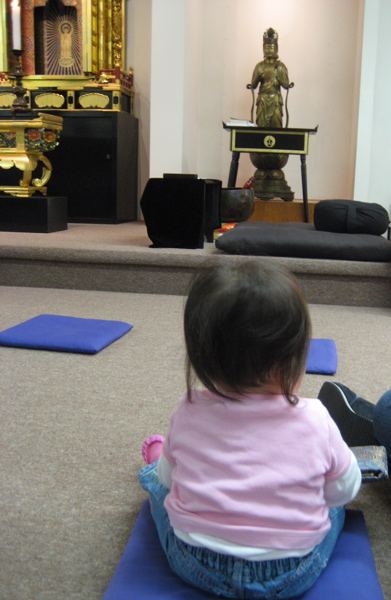
A really old photo of “Baby” at the local Buddhist temple , during a children’s service. The statue is Kannon Bodhisattva. “Baby” attended there for years, but as the kids grew up, we became less active, but this temple has been a part of the local Japanese-American community, and has excellent family-friendly services. This is something many “modern” Buddhist temples lack.

And yet, when she asked me to proofread her college application essay, I was surprised to see that she was quoting something I often say in Japanese: sho-gyō-mu-jō (諸行無常). This phrase is quoted from the famous 12th century war-epic the Tales of the Heike, and means something like the “impermanence of all phenomena”. The English translation is clunky, and since my kids were raised bi-lingual anyway, I just say sho-gyo-mu-jo.1

For example, when someone in the house broke a cup, or something breaks down, I usually just say “no big deal, sho-gyo-mu-jo“, and so on. The kids never really said anything about it, and yet when my daughter wrote her college essay, it’s clear that she really was listening and had processed this teaching as she grew up and matured. I was genuinely impressed, and a bit choked up.

The key, as my original post said, is to keep the teachings simple, set a good personal example, and let kids ease into it on their own. Hitting kids over the head with religious teachings just has the opposite effect. Kids need some kind of moral compass, but they aren’t always mature enough to understand the value of it. By setting a good example, and giving them space to figure things out, they will eventually internalize and process such teachings and figure out how to apply them to their own lives.

It’s also a reminder that good personal conduct really does have a positive impact on others, even if you can’t see the effect.

Namu Amida Butsu

1 Japanese four-character phrases (yojijukugo) are numerous, and only a small number are commonly used, but many educated Japanese have their favorite phrase or two that they will use in writing on conversation. Sometimes you see these in dramas too. It’s also a mark of education (e.g. which ones do you know?), as shown in an episode (season 1, episode 16) of the anime Chihayafuru where the characters quiz one other. Many are taken from Buddhist sources but popularized into common Japanese, others come from Chinese literature.

Mindfulness Meditation Isn’t What You Think

Spock : “… I have noted that the healthy release of emotion is frequently very unhealthy for those closest to you.”

Star Trek, “Plato’s Stepchildren” (s3ep10), Stardate 5784.2

Meditation, specifically mindfulness meditation, is touted as a stress-relief exercise. Busy people believe that if they can block out the time to meditate for X minutes a day, or when stressed, this will make more happy and productive. It has been all the rage in Silicon Valley too.

But it doesn’t work.

It will calm your mind while you are sitting, but as soon as you are back to work, your blood pressure will quickly rise again. Old habits will quickly resurface. Self-help, in short, does not help.

How do I know this?

I tried the same trick in my late 20’s. My first child was born, and I was working at Amazon (yes, that Amazon) for a few years in a technical support role. The environment was stressful, demanding, constantly on the move, the on-call rotation gave little time to decompress because something was always broken,1 and I had to drive into work at all hours of the night to try and fix it.

Since I had recently converted to Buddhism at the time, and listened to a lot of Ajahn Brahm dharma talks, I wanted to try meditation. We had a spare office that no one used, so I would go in there once or twice a day, turn off the lights, dutifully sit, chant certain Buddhist mantras, meditate for 20 minutes or more, and then return to work.

As soon as I was back at my desk, the stress would rise all over again. I kept at the meditation for months, almost a year, before I finally gave up.

The stress, constant sense of inadequacy measuring myself to hyper-competitive co-workers who graduated from Stanford, unrealistic work performance goals, fear of losing my job, and so on simply didn’t go away until I QUIT MY JOB AND TOOK A LESS DEMANDING ONE.2

It took me years as a Buddhist to finally realize that stress-relief is not what mindfulness meditation was intended for.

Mindfulness meditation is a tool to develop insight, not stress relief. It is necessary in the early stages of meditation to quiet the chatter in the mind, but that is just the first stage. It is to remove barriers to insight by develop a focused mind, and a quiet mind, a mind that can perceive things in a more balanced way. Consider this quote from the Buddha in a very early text, the Dhammapada:

  1. There is no meditative concentration for him who lacks insight, and no insight for him who lacks meditative concentration. He in whom are found both meditative concentration and insight, indeed, is close to Nibbana.
  2. The monk who has retired to a solitary abode and calmed his mind, who comprehends the Dhamma with insight, in him there arises a delight that transcends all human delights.
  3. Control of the senses, contentment, restraint according to the code of monastic discipline — these form the basis of holy life here for the wise monk.
Translation by Soma Thera from https://www.accesstoinsight.org/tipitaka/kn/dhp/dhp.25.budd.html

The emphasis is on focus, insight, and contemplation NOT relaxation or stress-relief. Mindfulness meditation has been repackaged and sold to naive Westerners with false promises. Meditation really does provide excellent benefits, but it has to be done as part of a much larger, holistic lifestyle change and with wholesome intentions. This is the “holy life” as described by the Buddha: a life of wholesome, guilt-free conduct, goodwill towards others, and a desire to pursue the Dharma (the teachings of the Buddha).

First, one should take up the Five Precepts of Buddhism. As we see in verse 374 above, the Buddha openly encourages that we curb our worst behaviors first as a foundation for other Buddhist practice. One will gain no lasting benefit from meditation until this is done. Full stop.

Second, one must approach meditation with the mindset of a monk. It is not necessary for lay-people to give up everything and go live in the woods. Buddhism accommodates both the “house-holder” lifestyle and that of a true renunciant (a.k.a. a monk or nun). But both the renunciant and the house-holder are expected to live a life of moderation and restraint.3 Easier said than done (speaking as a gamer and foodie), but it’s a goal to sincerely aspire to.

Speaking of restraint, one should always guard one’s speech. A long time ago, a Buddhist minister I admired once told me that speech was like toothpaste: once it was out of the tube, you couldn’t put it back. One has to learn to carefully monitor what one says both in person and online (and yes, at work). Again, easier said than done, but the alternative will only make your life miserable.

Finally, when such good foundations are established, meditation will help you learn more about yourself, and the world around you.4 It’s incredibly helpful, and life-changing when carried to fruition. I have my own little private insights that have stayed with me through the years, and I hope you will find yours too.

Namu Amida Butsu

Namu Shakamuni Butsu

P.S. if you feel the need to calm yourself right away, try something much simpler. You can recite the nembutsu, the Heart Sutra, a mantra, whatever. Try that for a minute, and see if that works. It is a band-aid fix though, and you still need to approach things from a holisitic standpoint, or you will gain no long-term benefit. Alternatively, just go for a walk.

1 Years later, the sound of a pager going off still triggers me a little bit. No joke.

2 Another ex-Amazonian who had joined the same company years earlier confided in me that after leaving Amazon, he drank himself stupid for months to decompress. I noticed that I was still on a hair-trigger for months after leaving Amazon, and it took me a while to unlearn those habits too. My wife noted that my posture improved after leaving, and that I grumbled about work less. Some jobs are simply not worth staying in.

3 The Buddha was pretty flexible about what exactly this meant, citing whatever cultural standards applied at the time as a benchmark. In short, a lot of it is rooted in common courtesy and good sense. If you cannot act toward others using common courtesy, meditation ain’t gonna fix your issue.

4 You may learn that your whole problem is that your job sucks, for example, and that the burn-out is not worth the money. Of course, if you’re a single mom caring for three kids, you have a lot fewer options available to you, and in such cases I recommend the nembutsu as a starting point.

Realpolitik

Something that’s been on my mind lately is this quote from the original Star Trek series:

Dr. McCoy: Spock, I’ve found that evil usually triumphs – unless good is very, very careful.

Star Trek, “The Omega Glory” (1968)

These days, pretty much the entirety of the 2020’s in particular, it really feels like good has to extra vigilant, doesn’t it? Like wherever one turns, evil seems to always get the upper hand.

Different episode (“Bread and Circuses”), but same energy. RIP DeForrest Kelley …

This isn’t even just a statement of politics. We are definitely living through some pretty difficult times, and it brings out the worst in others.

Consider this iconic quote from the Buddhist text, the Dhammapada:


183. To avoid all evil, to cultivate good, and to cleanse one’s mind — this is the teaching of the Buddhas.

Trans. Acharya Buddharakkhita

The statement is pretty vague, but to me it feels like there’s an order and logic to this statement.

Avoiding all evil begins with things like the Five Precepts and is probably the first step as a Buddhist. It doesn’t solve everything, but it’s a good starting point. You’re stemming the worst instincts at least.

Next, one cultivates good through Buddhist practice such as dedication of merit, the four bodhisattva vows, and just good old-fashioned metta. The idea being that cultivating wholesome states of mind gradually sinks in and reinforces itself. Presumably.

Finally, cleansing the mind. This is where practices like meditation, mindfulness and such really come in handy. Having a good heart is not enough: one needs to balance it with wisdom and clarity.

In another episode of Star Trek, titled “The Savage Curtain” (the one with Space Lincoln), the founder of Vulcan philosophy Surak heedlessly goes alone to try and negotiate peace. His stubbornness costs him his life. Lincoln also tries to save him but gets killed as well.

“Space Lincoln” was awesome.

This theme repeats across multiple episodes: striving to do good not enough, one needs to vigilant. On the other hand, being passive and intellectual doesn’t accomplish much good either.

So, you need both.

Even in these difficult times, it’s helpful to maintain goodwill towards all beings (even the really awful jerks who might not deserve it), have realistic expectations, meet evil with good, but also meet ignorance with wisdom including your own.

Ecumenism

I have been avidly playing the game Fire Emblem: Three Houses since fall of last year. Yes, the game is that good. But also the game makes you think about things too, including religion.

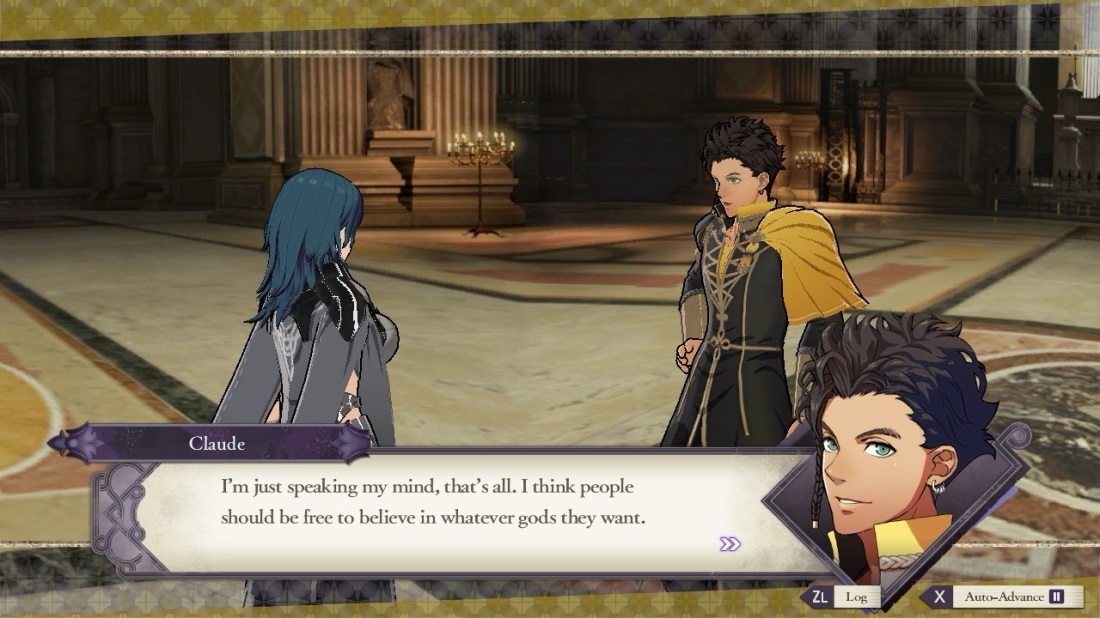
One of my favorite characters in the game, is the leader of the Golden Deer House, Claude von Riegan (also mentioned here and here), voiced in English by Joe Zieja. Claude’s background is unusual for the game’s cast, and he keeps his identity close to his vest, but needless to say he’s had a very worldly upbringing, and sees things different than the other students who mostly grew up in Fódlan. He is just as ambitious as Edelgard, but prefers to meet his goals in a more hands-off, less forceful way.1

Unlike most of his fellow students, who grew up within the Church of Seiros, Claude tends to be pretty cynical about Fódlan’s only religious organization, and regularly questions it (this is also important to certain elements of the plot, but that’s beside the point).

Anyhow, I wanted to share something he said that I think is worth considering (possibly out of order, I lost track of which is which):

Even though I tend to be an ardent Buddhist, I think what Claude is saying here is a healthy to look at the world and its religions. If you consider religions past and present, there have been countless gods and goddesses, rituals, liturgical languages, and so on. Even in in the same religions, practices and views diverge over time. This may offend purists, but it’s impossible to avoid, let alone manage.

Further, Buddhism has never been a particularly evangelical religion. It’s not in a race to win converts (minus a few cults), for a variety of reasons. First, this is in keeping with the Buddhist notion of metta (“goodwill”) that as long as other people have a belief system that helps them, not hinders or makes them feel bad, then that is fine. Second, the danger of imposing one’s beliefs on others is that it’s almost always fueled by ego and one’s own delusion anyway. A person’s religious beliefs, even Buddhist ones, are almost always a reflection of one’s own mind, and have to be taken with a grain of salt. Third, the Buddha clearly wanted people to take refuge in the Dharma of their own volition, and not by coercion. Even the Five Precepts are phrased as “I undertake” not as a command. Similarly with the practice of the nembutsu in Pure Land Buddhism. There’s nothing in the Buddhist canon that tells people to recite, or not recite it. It’s up to each individual to work with the tools offered in the Buddhist toolkit and apply them as best as they can. Like Claude says above, if you find a support system that works, great. This is no less true within Buddhism and its many traditions as well.

It’s generally better, and healthier for one’s own mental state, to let others be who they are, believe what they will, as long as its helpful, not harmful. The tighter one grasps, the more exhaustion and grief they inflict upon themselves, and others.

There are almost as many as variations on religious beliefs as there are people, so like the analogy of the Blind Men and the Elephant, each person is trying to feel their way through life using what resources, background and knowledge they have. Even within Buddhism, each person has their own “spin” on what the Buddha was, or what his teachings were.

It’s imperfect, but we all have to start from somewhere.

P.S. If you own a Switch, try Fire Emblem: Three Houses. 😋

1 Bit of a tangent, but of the three lords in Three Houses, I feel that Dmitri plays the role of the “conservative”, trying to restore his kingdom and the Church the way it was. Claude is the “liberal” trying to open things up and hoping it will change Fódlan, while Edelgard is the “revolutionary” who wants to change things directly (i.e. through force).

A Pinch of Austerity

Anyone who’s ever followed a religious path, regardless of religion, will know that there’s usually some kind of rules, restrictions or prohibition about how to live one’s life. Some people approach this as “Eager Beavers” and dive head-first, others hate the idea of rules imposed on their own life and rebel. Others find some kind of middle-ground.

For Buddhism though, The Buddha treated the entire Buddhist path, from mundane newbie to fully-awakened buddha as nothing more than self-training. It’s something you have to take on yourself, following the Buddha’s advice (like a doctor telling you to eat more vegetables), and you’re responsible for your own efforts, pace, self-discipline, and so on.

Further, no matter what tradition, Buddhism is at heart a path of austerity. Because monks and nuns explicitly give up all worldly attachments to focus on the Buddhist path exclusively, this is seen as the ideal form of practice. However, even for lay followers, Buddhism encourages moderation and austerity as one can reasonably practice.

Another way of looking at it: anyone who pursues the Buddhist path is “living like a monk” to some degree.

But how does a lay person find the right balance?

In an old sutra of the Pali Canon, the Buddha used the example of a vīna (a kind of lute), but we can use modern examples such as a guitar, cello, and so on. If the strings are too tight, they will soon snap. If they are too loose, the music sounds terrible. Tuned just right, the instrument plays well.

I like to think of it as adding spice to a soup. If you add no spice, the soup is kind of bland, unremarkable. If you add too much, the flavor is ruined. A pinch of spice though really enhances the flavor.

In the same way, adding a pinch of austerity to one’s life is a safe, sustainable approach. The Five Precepts are a great start, but you can also add a small amount of Buddhist practice like meditation or chanting. Remember though, if you add too much at first, it will “ruin the soup”, so start small. If it’s not enough, add a bit more. If you can’t follow all Five Precepts, start with four, three, two or even one. Do not be taken in by self-doubt; start small, experiment, try something, evaluate later.

Just a pinch of austerity in one’s life can help a person gain self-respect, dignity, and a sense of stability. It’s not obvious at first, but speaking from almost 20 years of trial-and-error experience, it does pay off.

P.S. This is another draft I started writing before I had my medical emergency.

P.P.S. Featured image is some home-cooked nabé (鍋) soup my wife made. It’s basically just fish broth (dashi), vegetables, tofu and/or some sliced meat. Easy to make, flexible, and very hearty. I make a good vegetarian lentil soup too, and will probably share the recipe someday.

The Hymn of Zazen

Recently I stumbled upon a neat bit of Buddhist liturgy in the Rinzai Zen tradition called the Hakuin Zenji Zazen Go-Wasan (白隠禅師坐禅御和讃), or more simply the Zazen Wasan (坐禅和讃). This means “The Hymn of Zazen [of Zen Master Hakuin]”. In English it is sometimes called the “Song of Zazen”.1

Rinzai Zen is a somewhat unusual sect in Japanese Buddhism because although it was founded in the 12th century by Eisai (栄西, 1141 – 1215, alternatively called “Yosai”), and flourished for centuries alongside other Buddhist sects, the Rinzai Zen we know today is due in large part to the 18th century Zen master Hakuin (白隠, 1686 – 1769). We might think of Hakuin as a kind of reformer, or second founder.

The Hymn of Zazen is an exposition of Hakuin’s beliefs, the virtues of zazen meditation practice (especially compared to other Buddhist practices), and the nature of one’s own mind. It is regularly recited as part of Rinzai Buddhist liturgy as shown below:

Since I have a copy in Japanese, I decided to post here as a reference for others. I’ve posted the text in the original Japanese with Romanized (e.g. romaji) text. I am using the excellent translation by Robert Aitken Roshi as well, originally found here, and some proof-reading of the Japanese text using this site.

JapaneseRomanizationTranslation
衆生本来仏なり水と氷のごとくにてShujō honrai hotoké nari mizu to kōri no gotoku ni te
All beings by nature are Buddha, as ice by nature is water;
水を離れて氷なく衆生の外に仏なしMizu wo hanarete kōri naku shujō no hoka ni hotoké nashiApart from water there is no ice, apart from beings no Buddha.
衆生近きを不知らずして遠く求むるはかなさよShujō chikaki wo shirazu shite tōku motomu hakanasayo
How sad that people ignore the near and search for truth afar,
譬ば水の中に居て渇を叫ぶがごとくなりTatoeba mizu no naka ni ite katsu wo sakebu gotoku nariLike someone in the midst of water crying out in thirst,
長者の家の子となりて貧里に迷うに異ならずChōja no ié no ko to narite hinri ni mayō ni kotonarazuLike a child of a wealthy home wandering among the poor.
六趣輪廻の因縁は己が愚痴の闇路なりRokushū rinne no innen wa onore ga guchi no yamiji nariLost on dark paths of ignorance we wander through the six worlds,
闇路に闇路を踏そへていつか生死をはなるべきYamiji ni yamiji wo fumisoete itsuka shōji wo hanarubekiFrom dark path to dark path we wander, when shall we be freed from birth and death?
夫れ摩訶衍の禅定は称歎するに余りありSore maka-en no zenjō wa shōtan suru ni amari ariFor this the zazen of the Mahayana deserves the highest praise.
布施や持戒の諸波羅蜜念仏懺悔修行等Fuse ya jikai no sho haramitsu nenbutsu sange shugyō tōOfferings, precepts, paramitas, Nembutsu, atonement, practice—
其の品多き諸善行皆この中に帰するなりSono shinaōki sho zengyō mina kono naka ni kisuru narithe many other virtues—all rise within zazen.
一座の功をなす人も積し無量の罪ほろぶIchiza no kō wo nasu hito mo tsumishi muryō no tsumi horobuThose who try zazen even once wipe away immeasurable crimes—
悪趣何処にありぬべき浄土即ち遠からずAkushu izuku ni arinu beki
Jōdo sunawachi tōkarazu
where are all the dark paths then? The Pure Land itself is near.
辱なくも此の法を一たび耳にふるる時Katajikenaku mo kono nori wo hitotabi mimi ni fururu tokiThose who hear this truth even once and listen with a grateful heart,
讃歎随喜する人は福を得る事限りなしSantan zuiki suru hito wa
fuku wo uru koto kagiri nashi
treasuring it, revering it, gain blessings without end.
いはんや自ら回向して直に自性を証すればIwanya mizukara ekō shite
jiki ni jijō wo shō sureba
Much more, if you turn yourself about and confirm your own self-nature—
自性即ち無性にてすでに戯論を離れたりJijō sunawachi mushō ni te
sude ni keron wo hanaretari
that self-nature is no nature—you are far beyond mere argument.
因果一如の門ひらけ無二無三の道直しInga ichinyo no mon hiraké
muni musan no michi naoshi
The oneness of cause and effect is clear, not two, not three, the path is put right;
無相の相を相として行くも帰るも余所ならずMusō no sō wo sō toshite yuku mo kaeru mo yoso narazuwith form that is no form going and coming never astray,
無念の念を念として
謡うも舞ふも法の声
Munen no nen wo nen toshite utau mo mau mo nori no koéWith thought that is no thought singing and dancing are the voice of the Law.
三昧無碍の空ひろく
四智円明の月さえん
Zanmai muge no sora hiroku shichi enmyō no tsuki saenBoundless and free is the sky of samadhi! Bright the full moon of wisdom!
此時何をか求むべ寂滅現前するゆえにKono toki nani wo ka motomu beki jakumetsu genzen suru yue niTruly is anything missing now? Nirvana is here, before your eyes,
当所即ち蓮華国此身即ち仏なりTōsho sunawachi rengekoku
kono mi sunawachi hotoke nari
this very place is the Lotus Land, this very body the Buddha.

As Zen is not my forté, I admit I don’t fully understand the meaning of this hymn, and it’s interesting that Hakuin praises zazen in such a way that other Buddhist practices arise from it. This reminds me of Shinran’s teachings in Jodo Shinshu whereby the nembutsu encompasses all the virtues of other acts. To some degree, every Buddhist sects inevitably makes this assertion.

That said, I think it’s a very nice exposition of Rinzai Zen thought, and along with my experiences at Ryoanji Temple (a Rinzai temple) in Kyoto last year,2 it certainly inspires me to keep exploring Rinzai teachings further.

Namu Shakamuni Butsu

P.S. Featured photo is Hakuin Ekaku (self-portrait), Public domain, via Wikimedia Commons

1 I am quibbling here, but wasan (和讃) is better translated as a hymn in my opinion, not a song (uta 歌), even though a “hymn” means something different in Buddhism than it would in Christianity. You can find examples of wasan in Jodo Shinshu Buddhism, composed by its founder Shinran, as well.

2 Technically, the Golden Pavilion, which we also visited, is also a Rinzai Temple too. I will probably write about the Five Mountains system of the Ashikaga Period soon, but I am brushing up on some old books first for research. It’s not a small topic.

The Value of Religious Discipline

You, Priest in your mufti, you are a chaplain to the self-satisfied. I come not to challenge Muad’Dib but to challenge you! Is your religion real when it costs you nothing and carries no risk? Is your religion real when you fatten upon it? Is your religion real when you commit atrocities in its name? Whence comes your downward degeneration from the original revelation? Answer me, Priest!

Frank Herbert, Children of Dune

A great quote I stumbled upon recently. It pretty much says it all. Also, this is not limited to priests, lay people can benefit from some level of austerity as well. This is how one can enjoy a life well-lived, instead of one of regret.

Freedom To Not Be A Dickhead

While reading Tanahashi’s book on the Heart Sutra, mentioned here, I found a great passage I wanted to share:

The word “freedom” often suggests that we can do anything we want, including being unethical and destructive. But there is also another kind of freedom, one that may prove to be more truly free. If we fully follow rules and ethics, we no longer need to think or worry about them. Thus, we are completely free from rules and ethics.

Banging on a piano keyboard without practicing is one kind of freedom that doesn’t get us anywhere. By diligently practicing the piano, however, we come to play beautifully and improvise freely. That is the kind of freedom the Heart Sutra calls for.

Pages 14 and 15

Being a dickhead is easy. We all do it to some degree or another. Most of us manage to suppress this tendency enough to function in society, but some people can’t even manage this. Further, as we get older our minds break down, and those restraints break down too. Thus, many elderly become mean, paranoid or say off-color things.

Taken at a storefront in Dublin, Ireland in 2025

The root of this dickheaded-ness is of course central to the Buddhist teachings. Previously, I talked about Japanese Buddhism and the concept of bonnō, but to summarize this dickheaded-ness extends from ignorance of how things are, anger when things don’t turn out our way, and greed by putting our needs first and foremost. Worse, like bucket with a small hole in it, if you try to satisfy and appease these urges, it only lasts for so long before you feel empty again.

This is where the training side of Buddhism comes into play. It’s tempting to want the more exotic mantras, thought-provoking teachings, or the faux-Zen quips that blow your mind. But if you really want to make some progress, you should consider getting your house in order by studying and applying basic Buddhist teachings include personal conduct, such as upholding the Five Precepts. As these basic teachings and practices sink in, and internalize, it opens up many other things. Time and patience are good foundations in religious practice.

P.S. Really had trouble coming up with theme picture for this post because there are plenty of example dickheads in the world, but also didn’t want to make an example of anyone, or any country’s flag.

The Ten Bodhisattva Precepts of Buddhism

Demon: “So why do you consider my presence a pollution, a disease? Is it because there is that within you which is like unto myself? …If so, I mock you in your weakness, Binder.”

Sam: “It is because I am a man who occasionally aspires to things beyond the belly and the phallus.”

Roger Zelazny, Lord of Light (1967)

Recently, I wrote a post about the Five Precepts of Buddhism, which are a nearly universal code of conduct that lay disciples can choose to undertake both as a benefit for themselves (dignity, mental well-being) and towards others. In addition to the Five Precepts, the Mayahana branch of Buddhism1 gradually developed a second set of precept rules called the Ten Bodhisattva Precepts.

The history of the Ten Bodhisattva Precepts is a bit convoluted,2 but the primary source is a Buddhist text called the Brahma Net Sutra, specifically the Mahayana-Buddhist version. The sutra lists 10 major precepts, and 42 minor precepts a bodhisattva is meant to undertake as part of their training, but most focus only on the 10 major precepts.

The ten major precepts are (translating from this source):

  1. Do not take life.
  2. Do not steal. 
  3. Do not commit adultery or sexual abuse. 
  4. Do not lie. 
  5. Do not sell (or consume) liquor. 
  6. Do not bring up the faults of others. 
  7. Do not boast of oneself or disparage others. 
  8. Do not begrudge material and spiritual possessions. 
  9. Do not harbor ill-will. 
  10. Do not disparage the Three Treasures [the Buddha, the Dharma, and the Sangha].

Monastic followers, that is monks and nuns, in the Mahayana tradition often take up these Bodhisattva Precepts on top of the more traditional monastic rules. Japan is an exception, where monastics only take up the Bodhisattva Precepts these days. However lay people often undertake these precepts too.

These precepts are called the endonkai (円頓戒, “complete, perfect precepts”) in the Tendai tradition, and jūrokujōkai (十六条戒, “sixteen [bodhisattva] precepts”) in Soto Zen tradition, include six more “preamble” precepts:

  1. I take refuge in the Buddha
  2. I take refuge in the Dharma
  3. I take refuge in the Sangha
  4. I vow to abstain from all evil
  5. I vow to strive to do good
  6. I vow to devote myself toward other living beings
  7. (the 10 bodhisattva precepts listed above then follow…)

This makes for 16 precepts total.

Lay followers typically take the original Five Precepts mentioned above, but may opt to undertake the Bodhisattva Precepts as a kind of “extra credit”, especially since they overlap quite a bit. Unlike the Five Precepts where one openly declares their vows to a monk, nun or a Buddhist statue (if alone), the Bodhisattva Precepts don’t always require a formal ceremony as such. It varies by tradition. Many traditions in Japan have a ceremony called jukai (受戒) where a lay followers undertakes these 10 (or 16) precepts and thus declares themselves an official follower of that tradition.

Even if you are not part of such a tradition, you are welcome to undertake them anyway preferably before a Buddhist image or altar, but it’s not strictly necessary. If you uphold them, great. If not, the Five Precepts alone are still a worthy undertaking.

In summary, the Bodhisattva Precepts are a way to extend one’s daily practice of Buddhism by not just avoiding more gross deeds, but also gradually polishing the mind by avoiding greed, ill-will and conceit and thereby removing the source of further suffering for yourself and others.

Namu Amida Butsu
Namu Kanzeon Bosatsu

P.S. Happy Bodhi Day 2021!

1 The Mayahana Branch encompasses pretty much all of Buddhism you see in places like China, Korea, Japan, Vietnam, Tibet and so on. The other branch, Theravada, is found more in Southeast Asia: Thailand, Cambodia, Sri Lanka and so on.

2 In earlier Buddhism, the Buddha encouraged lay followers to not only take up the Five Precepts, but also practice something called the Ten Good Deeds. It’s likely, in my opinion, that these more nebulous Ten Good Deeds were eventually codified into the 10 major precepts of the Brahma Net Sutra above, and thus became the Bodhisattva Precepts.