Recently, while cleaning out old notes from my mobile phone, I found this quote from the massive Buddhist text, the Avatamsaka Sutra (a.k.a. “The Flower Garland Sutra”) which I apparently saved in 2022 (!). I cannot remember where in the sutra this quote comes from, but I probably meant to post about it sooner than later. So… three years later I am finally posting this quote:
The peaceful nature of the buddhas cannot be known
By the covetous or the malevolent,
Or by those shrouded in the darkness of delusion,
Of those whose minds are defiled by hypocrisy and conceit.
Translation by J.C. Cleary
As we’ve seen with the Yogacara school of Buddhism, what we think and do helps “color” the world we also perceive, and thus becomes a feedback loop. Thus, someone who is prone to lying assumes others lie too. Someone who is aggressive or domineering fears others will dominate him, and so on. This is the world they perceive because their minds harbor such thoughts. In the Pali Canon is a sutra wherein the usurper king Ajātasattu visits the Buddha for some spiritual advice. Later, the Buddha laments that due to Ajātasattu’s prior patricide, his spiritual progress will be limited at best.
Thus, the Flower Garland Sutra says that evil men cannot “see” the Buddha because their minds are too clouded by greed, anger and arrogance. Of course, they can physically see a statue or image, but they may learn little or nothing from it. They may as well be living on another planet. It does not resonate with them, and so they miss out on learning the Dharma. They will fall into evil rebirths, and may not gain another opportunity for generations, centuries, possibly longer.
Conversely, one who lives a clean life, and avoids harboring greed, anger, and arrogance will see the Buddhas. I don’t necessarily mean in terms of visions and such,1 but they will see the Buddha-Dharma everywhere (even in awful places and situations), and learn from it. From there, their perception will only continue to grow and mature, leading to greater wisdom.
This idea isn’t limited to the Flower Garland Sutra. The famous sixteenth chapter of the Lotus Sutra basically says the same thing: those who live upright see the Buddha and his Pure Land here and now.
So, take heart. If you strive to keep your “house in order”, and avoid harboring ill-will and such, you will not fail to see the Buddha someday.
1 True story: in my 20’s, when my oldest daughter was a baby, and I was first exploring Pure Land Buddhism, I once had a really vivid dream, where I was offering armfuls of incense sticks at the feet of a statue of Kannon Bodhisattva. It’s the one and only time I’ve had a “Buddhist dream”, but I suppose it can happen to anyone.
VIR: I believe there are currents in the universe. Eddies and tides that pull us one way or the other. Some we have to fight, some we have to embrace.
Babylon 5, “The Geometry of Shadows”, s2:ep3
I really liked this quote from the science-fiction classic Babylon 5 (which I’ve been re-watching lately)1 because it speaks to the sense that many things happen outside our control. Instead, we’re constantly pulled along by other forces, and some of these can be beneficial, others can be harmful, and simply just pull us in unexpected directions. Some of these currents are very strong and difficult to resist, some are barely noticeable until we look back.
Further, we don’t always know where these currents will take us. So, there’s always danger in choosing one course or another.
DRAAL: What’s the third principle of sentient life? It is the capacity for self-sacrifice. The ability to override evolution and self-preservation…
Babylon 5, “A Voice in the Wilderness (part 1)”, s1:ep18
I think intuition is not enough to navigate this mess. One also needs a set of independent principles to help guide one, and that’s where things like the five precepts of Buddhism really come in handy. It’s not a list of “don’t do” things, it is a list of training rules to help strengthen the mind, and benefit others.
Also, clarity of mind.
Rather than giving in to self-doubt, stay cool, and take things one step at a time, navigate eddies and currents, but also don’t lose your goodwill towards others.
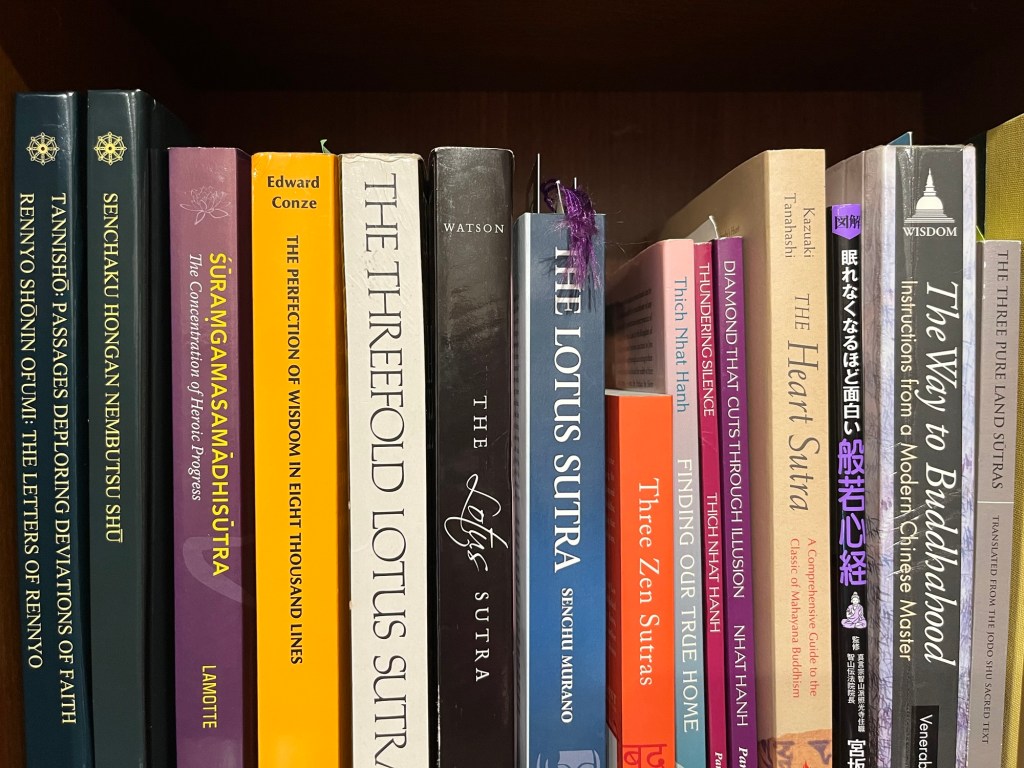
A photo of the Shurangama Sutra (the purple book on the left) from my personal collection. I purchased this years ago at Powell’s City of Books and haven’t found a copy since.
In my last post, I talked about Tetsugen Doko’s open-minded approach to Buddhist practice especially among his lay followers. But there was one thing that Tetsugen Doko did not compromise on.
In 1674 in the castle town of Mori (now Oita Prefecture), Tetsugen gave a controversial Buddhist lecture on the Shurangama Sutra, an influential Buddhist sutra in China not widely discussed in Japan. The lecture caused an uproar.
Tetsugen later summarized the lecture contents in an affadavit as follows (emphasis added):
I lectured first of all about the good and evil of the False Dharma and the True Dharma in the Final Age, which are referred to as the Three Absolutes in the Suramgama Sutra. Those who practice without keeping the precepts set out by the Buddha all represent the False Dharma. The reason for this [is as follows:]
Although practices such as chanting the Nembutsu, seated meditation, and reciting the sutras are each practiced differently depending on the abilities of the believer, the precepts against taking life, stealing, sexual misconduct, lying and the like are absolute, regardless of the sect. Not to keep them is unacceptable. Therefore these precepts are called “absolutes.”
This lecture earned him the ire of the local Jodo Shinshu community whose priests did not, by tradition, uphold any precepts. The local members rioted and multiple arrests were made by the authorities, who feared a return of the Ikko-Ikki riots, and Tetsugen quietly left town to avoid further trouble, especially for the feudal lord who had sponsored the lecture.
Nonetheless, more and more I believe that Tetsugen is correct: the basic lay precepts (a.k.a. the Five Precepts) should be front and center of one’s practice. Everything is grounded on that. Not the other way around, as I believed. What practices you choose to undertake are secondary to how you conduct your life the rest of the time.
I spent many years in my pursuit of the Buddhist path, fretting about doing the right practices, and chanting the right things, but these days I feel that the way to not be a dickhead is to simply stop acting like a dickhead. This is what the “training rules” of the precepts do: file away the sharper edges so that one’s Buddhist practice has a solid foundation.
I intentionally left this post in my blog draft folder for months, but now I am ready to post.
After a small revelation back in early May, I wanted to give it time and ensure that this change in Buddhist path wasn’t a spur of the moment decision.
After that little experience in May, I realized that I had misunderstood Zen Buddhism. Some of this is due to mixed experiences at local (Western) Zen communities,1 and in my opinion, systemic issues with Buddhist publications in English.3 Once I had better access to Japanese-language resources, and based on things I had sort of rediscovered, I decided to try to and go heads down for a few months and do my best to practice Zen as a lay person and parent.
My daily reminder list on my smartphone. A mix of mundane and Buddhist practice. 坐禅 means “zazen” and お勤め means “otsutome” (home service).
It took a lot of trial and error to get this right. At first, I had a tendency to succumb to self-doubt and start doing zazen meditation longer and longer, but then I would burn out, or have a busy day and skip. So, eventually I forced myself to keep it to five minutes, and I found I was able to sustain the practice more. Also, if I missee a day somehow, I would not punish myself over it.
Second, I struggled with how to do a Zen-style home service, so I had to do some research and this led to posts like this and this (these are for my own benefit as much to readers 😏 ). This home service underwent a few updates and changes over time, but I gradually settled on things over time, thanks to an old service I forgot I had.
Finally, I wanted to ensure I focused on Buddhist conduct as a foundational practice, and in particularly by upholding the Ten Bodhisattva Precepts. It’s also emphasized by such pastZenmonks as a foundation for other aspects of Zen, but compared to the basic Five Precepts, I found myself struggling both to remember what the Ten Precepts were, and also remembering to avoid things like not bring up the past faults of others, or harboring ill-will towards others. This is still a work in progress, but I assumed it would be. It took me many years of following the Five Precepts before it became second-nature.
Anyhow, since I started this little project four months ago, I am happy to say that I have mostly stuck with it. I can count the days I missed practice on my two hands, which over four months is pretty good. I realized that small, realistic, daily practice is much more effective than trying to focus on big retreats. So, in a sense, it’s been a big win and a learning lesson for myself.
But also I realized that I also really missed some aspects of the Pure Land practice that I had been doing up until this point. For me, I found that Pure Land Buddhism tends to appeal to the heart, while Zen appeals to the mind.
Dr. Janet Wallace: “The heart is not a logical organ.”
Star Trek, “The Deadly Years” (s2ep12), stardate 3479.4
So, my practice has continued to evolve to mostly Rinzai-Zen style practice, but also with a few Pure Land elements too. I suppose this is more inline with mainland Chinese Buddhism where such distinctions are less important than Japanese Buddhism, which tends to be sectarian. Also, if it works for Obaku Zen, it works for me.
So, that’s my update. Am I Zen Buddhist now? I don’t know. I am hesitant to use that label because I am hesitant to associate myself with that community. On the other hand, I’ve found it very beneficial so far, but I haven’t forgotten what I learned from Pure Land Buddhism either. So, I guess I am both, neither, whatever. At this point, taking inspiration from Chinese Buddhism: I uphold the precepts, meditate a bit each day, dedicate merit to loved ones and those suffering in the world, praise Amida Buddha, Shakyamuni Buddha, Kannon and the Lotus Sutra. Whatever label fits that is what I am these days. 🤷🏼♂️
Frankly, I stopped caring. I like how my practice has evolved these past months, and happy to continue.
P.S. Posting a little off-schedule, but oh well. Enjoy!
1 Not all experiences have been negative, but I have run into more than a few “Bushido Bros” and Japan nerds2 that soured my experience.
2 Yes, I am a Japan nerd too. I fully admit this, but nerds can be kind of intense and exhausting to talk to, so I don’t like to hang out too much with other Japan nerds.
3 It’s hard to quantify, but English books about Buddhism are either very dry, bland, and scholarly, or read like psychology self-help books, or just too mystical. When I read books in Japanese on similar subjects, I find them more down-to-earth and engaging. I know different people have different preferences, but I don’t like most English publications I find at the local bookstore. It is also why I try to share information (or translate if necessary) whenever I find it.
HEMMER: … I will not fight for Starfleet, but I will defend its ideals. Pacifism is not passivity. It is the active protection of all living things in the natural universe.
Star Trek: Strange New Worlds, “Momento Mori” (s1ep4), Stardate 3177.3
I love Star Trek: Strange New Worlds, and I love this quote.
The first precept of Buddhism, regardless of whichlist you talk about, starts with a vow not to destroy life. Further, in such texts as the venerable Dhammapada (collected sayings of the Buddha), you can see quotations like so:
129. All tremble at violence; all fear death. Putting oneself in the place of another, one should not kill nor cause another to kill.
and:
142. Even though he be well-attired, yet if he is poised, calm, controlled and established in the holy life, having set aside violence towards all beings — he, truly, is a holy man, a renunciate, a monk
Per tradition, monks in the Buddhist tradition are often strictly vegetarian and why some devout lay Buddhists choose to be vegetarian, either full-time or on specific holidays.
But, I think Hemmer’s quote goes a step further, peace, goodwill, and pacifism are not simply refraining from violence; it is also respect for all life (even the Gollums in life). This requires empathy, putting yourself in their shoes. You see this expressed in such popular liturgy as the Four Bodhisattva Vows, dedication of merit, and so on.
But like many things in Buddhism, such a lofty goal is hard to uphold at first. So, the precepts more narrowly focus on simple training rules (not to do X, not to do Y), and overtime, as basic training rules become second-nature, and your understanding of the Buddha-Dharma deepens, one’s practice refines more and more over time. So, if you feel you can’t live up to such an ideal, don’t worry. It’s important to know that the ideal exists, and that every starts from somewhere.
Namu Shakamuni Butsu Namu Kanzeon Bosatsu
P.S. Double post today to celebrate Strange New Worlds, season three. I cancelled my subscription of Paramount Plus some months ago (no regrets), but I enjoy the first two seasons on BluRay, and waiting to get the subsequent seasons on BluRay as well.
As I talked about in a recent post, the main core idea of the venerable Tendai (天台) sect in Japanese Buddhism, including its parent Tiantai sect in China, is that the Lotus Sutra is the most important text in the Buddhist canon, a kind of capstone (lit. “complete teaching”, engyō 円教) for the rest of Buddhist literature up to that point. Because the Lotus Sutra is pretty long (equivalent to a modern book), I tried to summarize its teachings here.
Anyhow, Tendai/Tiantai focuses on how to put the Lotus Sutra into practice. For Japanese Tendai in particular, this is encapsulated in a phrase called shishū yūgō (四宗融合) meaning “Four Integrated Practices”. According to my book, these are listed as follows:
Different people under the umbrella represent different Buddhist followers, with different practices and inclinations, but the umbrella itself represents the concept of upāya (“expedient means”) or hōben (方便) in Japanese. This is one the main themes of the Lotus Sutra, and expresses that all Buddhist teachings and practices lead toward the same end goal, and thus whatever works for a person at that time is perfectly fine for that person.
This is encapsulated in the 25th chapter of the Lotus Sutra, the so-called Kannon Sutra, because the Bodhisattva Kannon (a.k.a. Guan-Yin, Avalokiteshvara, Chenrezig, Quan Âm, etc) according to this chapter takes on whatever form is most beneficial for that person and teaches the Dharma to them. Thus, Kannon can appear as a man, woman, monk, rich person, etc. It’s also why statues of Kannon often depict them as having 1,000 arms, each holding a different object. Similarly, many of the early Buddhist monks who were Tendai followers practiced it differently from one another. On the one hand, you have monks like Eisai, who focused on meditation and precepts (and would later found the first Rinzai Zen temples), you also had monks like Genshin who focused a lot more on Pure Land practices, as well as esoteric experts such as Ennin.
Tendai as a sect in Japan was almost universal in the 9th through 12th centuries, but for a variety of historical (often self-inflicted) reasons, it has diminished in size and influence. Yet when you visit historical temples in Japan such as Asakusa Temple in Tokyo, Kiyomizudera Temple in Kyoto, and Sanjusangendo in Kyoto, these are all Tendai temples. Further, its influence lives on in newer sects that we know well: Zen, Pure Land, Nichiren and such, which all inherited practices and concepts even if they apply them in differing ways.
But while Tendai as an organized sect is somewhat diminished,3 its teachings of “umbrella” or “universal” Buddhism continue to live on. Rather than insisting there’s only one way to practice Buddhism, it gives a large, spacious framework for people to figure out their own path and use the vast toolkit available to work it out, all under the Lotus Sutra concept of expedient means. Use what works for you, and do not be afraid to adapt, change, or expand your practice as you go.
P.S. Publishing off-schedule just for fun. Happy Sunday!
1 Tendai/Tiantai has the same meditation tradition as Zen, but tends to call it shikan (止観) not zazen (座禅) meditation. The founder, Zhi-yi, in China wrote multiples treatises, the Mohe Zhiguan, that provides a comprehensive manual about meditation. I have a copy of the The Essentials for Practicing Calming-and-Insight & Dhyana Meditation, but have only read parts of it. It is a nice training manual for those interested, but it is a little dense since the intended audience was the monastic community.
2 In the time of Zhi-yi, the founder of Tiantai, Pure Land Buddhism was approach more as a meditation tradition than a separate set of practices that what we see today. By the time it came to Japan, this had changed somewhat, and we see through the writings of Genshin that there were a variety of approaches both devotional and meditation-focused.
3 According to my book, as of 2015, the number of registered followers in Japan was around 1.5 million give or take. This makes it the second smallest of the major sects in Japan, and one-eighth the size of Jodo Shinshu-sect Buddhism. Only Rinzai Zen is smaller (1.1 million).
I found this chart in one of my handy Japanese-language books on Buddhism and I decided to reproduce on Canva, translate, and post here (the original looked much nicer, btw):
The Noble Eightfold Path is one of those foundational teachings that transcends culture and sect. The Buddha (a.k.a. Shakyamuni) taught that making “right”, as in conducive to the Dharma, lifestyle choices led to greater well-being, peace with others and ultimately progress on the Buddhist path toward Awakening.
Thus he divided it up into this path into eight components:
right view
right intention
right speech
right conduct
right livelihood
right effort
right mindfulness, and
right concentration
Some of these are kind of self-evident, others are somewhat abstract. Plus, the list is hard to remember. So, I found this chart really handy, because the eight aspects can be put into three “buckets” known as the Three Learnings.
The Three Learnings, meaning the three things to cultivate on the Buddhist path, are:
If you think of Buddhism as a table with three legs, you need all three, or the table falls over. But while upholding these three aspects, you are also following the Eightfold path.
The precepts part comprises body and speech and livelihood (making an honest, ethical living), while goodwill comprises of view and intention. Finally, the practice part comprises of mindfulness and concentration, two things that arise with meditation.
But all of these require a level of consistent effort. Hence the chart showed Right Effort as a foundation for the others.
Anyhow, I hope this helps. If you like it, please feel free to use the chart.
Today we explore the third chapter of five of the 19th-century Soto Zen text called the Shushōgi (修証義, “Meaning of Practice and Verification”), which I introduced here. Chapter three delves into the importance of conduct and the precepts. You can read chapter two here.
Next we should deeply respect the Three Treasures — the Buddha, the teaching, and the Buddhist community. They deserve our respect and offerings no matter where we wander from life to life. It was respect for the Buddha, the teaching, and the Buddhist community that was truly transmitted from India to China by the Buddhas and patriarchs.
Translation by Soto Zen Text Project of Stanford University, courtesy of sotozen.net
Westerners may find this a bit awkward. Why bow down and make offerings to a celestial being? Didn’t I leave my religious upbringing to avoid this kind of thing?
Buddhism is a religion that does not demand obedience or worship. People revere the Buddha because they appreciate his teachings, and find them helpful. They revere the Dharma because it is illuminating, and provides kind, objective guidance. People venerate the Sangha (the Buddhist community) because they are inspired by one teacher or another.
These Three Treasures (the Buddha, the Dharma and the Sangha) are the foundation of Buddhism.
If the unfortunate and virtueless cannot even hear of the Three Treasures, how can they take refuge in them. Do not take refuge in the spirits of the mountains or the ghosts of the dead, and worship not at heretical shrines. Such refuge-seeking leads us away from salvation. Let us instead quickly take refuge in the Buddha, the teaching, and the Buddhist community, seeking there not only release from pain but complete enlightenment.
This revisits something from chapter one: that human life is rare, and hearing the Dharma is even rarer, so it’s a precious opportunity.
Further, this passage warns us to be careful of messing around with occult stuff. It was written for a 19th-century Japanese audience from a 13th century source text, where syncretic folk religion and Shinto co-exist alongside Buddhism. But even now one can apply similar warnings toward mixing Buddhism with New Age practices and such. It might seem like a good idea, but better to thoroughly grasp the Dharma first before mixing with other stuff.
Again, this might feel weird to 21st century Buddhists, but in a much, much older text, the Sutra of the Simile of the Water Snake (MN22 of the Pali Canon), the Buddha described grasping the Dharma as similar to grasping a water snake (a.k.a. a viper): something to be done carefully. In modern parlance, one could also compare this to taking up a new exercise routine, a new diet, or a new sport: you should consult with a doctor first lest you risk injuring yourself, or making yourself miserable.
But I digress.
To take refuge in the Three Treasures we must come with pure heart. No matter when — whether at the time of the Buddha’s appearance in the world or after his disappearance — we repeat with clasped hands and bowed head: “I take refuge in the Buddha. I take refuge in the teaching. I take refuge in the Buddhist community.” I take refuge in the Buddha because he is our great teacher. I take refuge in the teaching because of its curative effect. I take refuge in the Buddhist community because here we find wisdom and warmth. To become followers of Buddhism, we must uphold the Three Treasures. We must lay this foundation before receiving the moral precepts.
This is pretty self-explanatory. A person can be a Buddhist (or reaffirm their faith), just as they are now, by taking refuge in the Three Treasures. In so doing, they have started on the Buddhist path and have nowhere to go but up. For most people, and most Buddhist services, this means reciting:
I go to the Buddha for refuge.
I go to the Dharma for refuge.
I go to the Sangha for refuge.
Simple as that. (mic drop)
The merit of the Triple Refuge will always ripen when a responsive communion takes place between the trainee and the Buddha. Those who experience this communion — whether deva, dwellers in hell, or animals — will take this refuge. The embodied merit increases through the various stages of existence and ultimately leads to highest right enlightenment. The Buddha himself confirmed the merit of the Triple Refuge as supremely valuable and inconceivably profound. All living beings should therefore take this refuge.
Same as above: simply taking refuge in the Three Treasures (sincerely) is a great act, and has many benefits in the long-run.
Next we should accept the three collective pure precepts — that embracing good behavior, that embracing good deeds, and that embracing all beings and saving them. We should then accept the 10 grave prohibitions. First, do not kill; second, do not steal; third, do not engage in improper sexual conduct; fourth, do not lie; fifth, do not deal in intoxicants; sixth, do not criticize others; seventh, do not praise self and slander others; eighth, do not be stingy with the dharma or property; ninth, do not give way to anger; and tenth, do not disparage the three treasures. The Buddhas have received and kept the Triple Refuge, the three collective pure precepts, and the 10 grave prohibitions.
The three “pure precepts” are general injunctions for any Buddhist:
Don’t do evil
Embrace good
Cleanse one’s mind.
The “ten grave prohibitions” above are just another way of saying the Ten Bodhisattva Precepts, which I covered here.
By accepting these precepts you will attain supreme enlightenment — the indestructible Buddhahood realized or to be realized by the Buddhas of the past, present, and future. Would any wise man reject this goal? To all living beings the Buddha has shown that when they accept the moral precepts, they attain Buddhahood — a rank equal to the Great Enlightened — and that they are truly the children of the Buddha.
People who first discover Buddhism may be put off. They wanted to learn how to meditate, not take up a bunch of rules, but two things to keep in mind:
First, the precepts above are training rules. As mentioned in chapter two, the rules are meant to be treated like rehearsing lines for a play. With diligence, time and effort you get better and better at it.
Second, an ethical lifestyle leads to many countless benefits, and makes a solid foundation for more advanced practices such as meditation, etc.
All the Buddhas dwell here and embrace everything in their infinite wisdom. All beings, when they make this their dwelling place, see no distinction between subject and object. When this happens, all things — whether earth, vegetation, fence post, brick or pebble — function as Buddhas. The resulting wind and fire, fanned by the profound influence of the Buddhas, drive us to intimate enlightenment. This is the merit of non-doing and non-striving — the awakening of the wisdom mind.
Remember from chapter two, that the difference between a Buddha and a mundane person is the degree of awakening. The Buddhas follow the precepts without fail because they all worked at it for countless lifetimes and eons, and through their conduct, and the awakening that helps arise from it, they see things differently than we do. But the message is: we can do the same. We just need to believe.
Tomorrow we’ll explore chapter four. If you made it this far, thanks for reading!
P.S. If you ever wanted to see how the third chapter is traditionally chanted, please enjoy this video:
Spock: Evil does seek to maintain power by suppressing the truth. McCoy: Or by misleading the innocent.
Star Trek, “And The Children Shall Lead” (s3ep4), stardate 5029.5.
The season three episode of Star Trek, “And The Children Shall Lead” is widely considered a bottom-tier episode. It had a lot of problems, including its casting. Even as a classic Star Trek fan, I kind of despise this episode.
The evil entity “Gorgan”, played by infamous laywer Melvin Mouron Belli who had no prior acting experience. It was season three Trek at its worst.
But the premise of the episode did make a really important point: given the right persuasion, people (including children), can be made to do all kinds of terrible things. It just comes down to what someone asserts is “true” and if their argument is convincing enough. There’s plenty of examples in history, so I won’t belabor the point.
Or, like that old Simpsons gag:
Of course, ignorance as to what is actually true is the basis for our suffering, according to Buddhism. As thinking human beings, we have to piece together our understanding of the world as best we can, and hopefully we have good mentors along the way, but even a good mentor is not perfect. Simply put, subtle misperceptsions and misunderstandings can provide a foundation for a mountain of bad assumptions, stupid conduct, needless suffering. Thus, in Buddhism, this fundamental misunderstanding of things is one of the Three Poisons of the mind: the other two being anger and craving. But even anger and craving derive from misunderstanding too.
This is not something that can be fixed with some clever logic, or vaguely “zen-like” words. It’s a deeply seeded part of ourselves, something we cannot normally perceive in our daily lives, and even when you suppress it with willpower, it will surface again when you least expect it.
The Buddha described the awakening experience as “uprooting”:
….he [the renunciant monk] should develop the perception of inconstancy so as to uproot the conceit, ‘I am.’
Translation by Thanissaro Bhikkhu in the Meghiya Sutta of the Pali Canon (Ud 4:1 Meghiya)
Such a tree of ignorance isn’t cut down, leaving a stump; it is uprooted entirely.
Spock: “Humans do have an amazing capacity for believing what they choose and excluding that which is painful.”
Star Trek, “And The Children Shall Lead” (s3ep4), stardate 5029.5
But how can mundane people, who have yet to fully awaken, discern the truth?
The Buddha taught the Dharma. The Dharma is like a principle of existence (think: laws of physics), and it is something one can objectively measure their thoughts and actions against. In the words of the Buddha:
“Therefore, did we say, Kalamas, what was said thus, ‘Come Kalamas. Do not go upon what has been acquired by repeated hearing; nor upon tradition; nor upon rumor; nor upon what is in a scripture; nor upon surmise; nor upon an axiom; nor upon specious reasoning; nor upon a bias towards a notion that has been pondered over; nor upon another’s seeming ability; nor upon the consideration, “The monk is our teacher.”
Translation by Soma Thera of the Kalama Sutta of the Pali Canon (AN 3.65)
Intuition, logic, reasoning, or trust in a teacher or tradition is insufficient, because our own fundamental ignorance warps our understanding of such things. Instead, the Buddha encourages us to use simple benchmarks:
“What do you think, Kalamas? Does absence of greed [or hate, or delusion] appear in a man for his benefit or harm?” —
“For his benefit, venerable sir.” —
“Kalamas, being not given to greed [or hate, or delusion], and being not overwhelmed and not vanquished mentally by greed [or hate, or delusion], this man does not take life, does not steal, does not commit adultery, and does not tell lies; he prompts another too, to do likewise. Will that be long for his benefit and happiness?” —
“Yes, venerable sir.”
Translation by Soma Thera of the Kalama Sutta of the Pali Canon (AN 3.65)
Here, the Buddha is using the Five Precepts as a simple benchmark. Teachings and actions that lead to adherence of the Five Precepts (not taking life, stealing, adultery, etc) are proper teachings; choices that lead to breaking the Five Precepts are thus improper teachings. The monastic precepts are larger and have more rules, as are the Bodhisattva Precepts, but the essence is the same: a lifestyle that is honest, clean, and does not harm others in body, speech or mind.
The need for an objective benchmark such as the Dharma, is how we can know that words and teachings by others are for good or for ill. Evil can incite others to hate, or to lie and steal, but these clearly violate the benchmark that is the Five Precepts, and thus no matter what they say, we know they are false, conducive to harm, not good.
SPOCK: [being a Vulcan] means to adopt a philosophy, a way of life, which is logical and beneficial.
Star Trek, “Journey to Babel” (s2ep10), Stardate 3842.3
Recently, while I was doing some soul-searching, I found this very helpful article online by Dr. Jacqueline Stone. The article is an overview of how different Japanese-Buddhist monks of the Kamakura Period (12th-14th century), the same monks who founded important Buddhist sects we see today, addressed the concept of Dharma Decline. The site requires registration, but it’s free and easy. The article is worth a read if you are curious about the topic.
In any case, I found this great quote in Dr Stone’s article:
“The Zen sect regards the precepts as being of first priority,” he [Eisai] wrote. And, “By means of the precepts, meditation and wisdom are brought forth.”
Eisai (栄西, 1141 – 1215) also known as Myōan Eisai (明菴栄西) is the original founder of the Rinzai Zen-sect in Japan (more on its convoluted history here), and isn’t someone I really talk about much, but he was one of the founders of this “new” Kamakura-era Buddhism.
Anyhow, this quote really struck me.
In my limited experience, I rarely heard the importance of precepts from Western Zen sources, or that they are the basis for other Zen practice. That’s not to say it’s not there, but it often seemed to get lost in the message of Zen mysticism.
Bluntly speaking, precepts aren’t sexy like mindfulness, koan riddles, or meditation.
And yet, Eisai is taking a more traditional, conservative standpoint and reiterating that one should not put the cart before the horse. This is not limited to Eisai, by the way: the 19th century Soto-Zen text for lay-followers, the Shushogi, stressed the importance of the precepts, reflection on one’s actions, and practicing kindness, patience and generosity whenever possible.
But if you’re familiar with Zen, this might seem odd. Isn’t Zen all about meditation, being in the moment and so on?
Consider the Marvel movie Ant-Man (2015). In the movie the villain, a bald tech-CEO who bears more than a passing resemblance to a certain CEO and founder,1 brags to a coworker about some deep thoughts he had during “morning meditation”. This is not far from the mark: many ambitious people use meditation and mindfulness as a way to get what they want, not what it’s intended for. If a person can’t regulate their day to day conduct towards others, meditation will not avail them.
Put another way: a rotten person might meditate, but a person who follows the precepts is probably not a rotten person.2
Further, this focus on the precepts fosters mindfulness because one is monitoring their own actions, etc. It has concrete impact on one’s sense of self-worth, one’s relationships with others, and leads to greater peace of mind, even when not meditating. So, there’s a clear benefit, both short-term and also long-term to taking up the precepts first, and then letting other disciplines and practices extend from it.
Finally, upholding the precepts is something any Buddhist can do, regardless of background or circumstances. It is very accessible, beneficial (just like Spock says), and opens many doors to Buddhist practice.
Namu Shakamuni Butsu
P.S. I’ll cover this issue of precepts in more detail later, but TL;DR both Rinzai and Soto Zen both encourage people to take up the Ten Bodhisattva Precepts specifically.







 Gleanings in Buddha-Fields
You must be logged in to post a comment.