Happy Holidays 2025

SPOCK: On my planet, to rest is to rest — to cease using energy.  To me, it is quite illogical to run up and down on green grass, using energy, instead of saving it.

Star Trek, “Shore Leave”, stardate 3025.2

Unlike my 2024 post, I intend to really take time off this time.

The truth is, is that I am deeply burned out. My wife and discussed this recently, and the chaos of preparing our firstborn for college, and our second-born ready for middle school, plus work demands have left us deeply exhausted. When we described it to one another, we quickly concluded that we were not depressed, just burned out. As parents, we had been running at full speed for almost two years, and now that things have quieted down, the fatigue finally caught up to us.

So, for the rest of 2025, I want to just sit around and do nothing: no personal projects, blogging, etc. I do plan to do some light reading (including some new books I picked up), play more solo The One Ring RPG, watch more Star Trek,1 maybe finally finish painting some figurines that have sat half-completed for a year. I have one more blog post in the works, but otherwise, I’m taking some much needed personal downtime.

Just some of my unfinished painted figurines…

Thank you all for your understanding, and I wish you both a happy holidays and a wonderful new year!

1 I also recently picked up the Star Trek Adventures role-playing game from Modiphius as well, but I haven’t progressed very far in learning the game yet.

Countdown to Bodhi Day

Buddhist holidays are few and far between, especially in overseas (non-Buddhist cultures), but since we raise our kids both through Japanese and American culture, I try to give them a unique, memorable tradition for the holidays. So, when the kids were young, I borrowed the Japanese-Buddhist holiday of Jodo-é (成道会) and adapted it for American Christmas culture. This holiday is better known in English as Bodhi Day and is observed on December 8th every year.1

Bodhi Day, sometimes incorrectly called Rōhatsu (臘八) in Zen-specific contexts,2 celebrates the awakening of Shakyamuni Buddha, the historical founder of Buddhism. It is the day where the Buddha is said to have meditated under the Bodhi Tree, saw his past lives laid out before him, resisted the temptations of Mara, and in the early morning broke through the wall of ignorance to see things as they were. By awakening thus, he is called a buddha (lit. “an awakened one”).

So, at the time, I took inspiration from our local Japanese-American temple (which had a great kid’s program), and made a “Bodhi Tree”: a miniature Christmas tree that a statue of the Buddha sits under. After that, I setup a small Buddhist-style shrine with an offering plate, water, bell, LED candle, etc. You can see an example above from years ago.

Also, to make it fun for the kids, I always give a gift on Bodhi Day, usually books they like. Such gifts don’t have to be Buddhist books, just something they would enjoy reading.3 Also, we usually have a fun family dinner together, and I usually read the story of the Buddha from an old Japanese-manga I found years ago. These celebrations are not strictly “Buddhist”, but it’s something festive and wholesome with the family, while celebrating the enlightenment of Shakyamuni Buddha,4 in a way that blends American traditions with Japanese ones.

Anyhow, Bodhi Day is 8 days away, so until then, hoping you all have a great week!

Namu Shakamuni Butsu

1 Many other Buddhist traditions still use the lunar calendar, so the dates will vary. I like using the Japanese version with the solar calendar because it’s easier to predict and blends into holiday season more easily.

2 The problem with the term Rohatsu 臘八 is that is refers only to the Zen practice of sesshin or dedicated meditation practice (i.e. a kind of austere retreat). This is obviously unsuitable for kids, and even in Japanese Zen, the holiday is called generally called Jōdō-é (成道会) among lay followers. So, calling it Rohatsu is misleading, and too narrow to be useful anyway.

3 When you are a kid, the last thing you want is religious books. So, I give fun books, comic books, etc.

4 The enlightenment story of Shakyamuni Buddha also serves as a template for other Buddhas and their enlightenment stories in Buddhist literature, too. See the preamble for the Larger Sutra of the Buddha of Immeasurable Life as an example.

A Product Of One’s Era

I stared for half a day once at an old man sitting on a bench in Arrakeen. He was a fifth-generation descendant of Stilgar the Naib and did not even know it. I studied the angle of his neck, the skin flaps below his chin, the cracked lips and moistness about his nostrils, the pores behind his ears, the wisps of gray hair which crept from beneath the hood of his antique stillsuit. Not once did he detect that he was being watched. Hah! Stilgar would have known it in a second or two. But this old man was just waiting for someone who never came. He got up finally and tottered off. He was very stiff after all of that sitting. I knew I would never see him in the flesh again. He was that near death and his water was sure to be wasted. Well, that no longer mattered.

Frank Herbert, “God Emperor of Dune”, chapter 5

It’s not uncommon to hear our grandparents1 talk about the “olden days”, and how we kids “have it easy!”. Chances are, you probably heard this too. As we get older, we start doing it too!

But sometimes I think about this quote from Herbert’s “God Emperor of Dune”. The planet Arrakis was once a harsh, forbidding desert planet where water was extremely scarce, and its Fremen people lived on the edge of survival. And yet, when Leto II Atreides the God Emperor ascended to power, he transformed the planet into a tropical paradise. Insodoing, the Fremen became softer generation after generation, forgetting their hard-learned survival skills.

Yet, I don’t mean this as a judgment. Instead, I think people are unwittingly products of their surroundings. At birth we don’t choose our parents, our native language, or which country, ethnicity, or “caste” we are born into. We are simply thrust into some circumstances outside our control, and even if we reject them, it still shapes who we are.

Further, as society moves from times of war (or pandemic), to times of peace, people change in response. Then, if war breaks out again, they change again. During times of prosperity, people behave one way, but in times of scarcity, they change again. It’s not that one generation is somehow better than another: they just respond to different conditions.

So, sometimes, I think about what forces have shaped myself up until now: my family’s political leanings, the socio-economic circumstances, and why these might have shaped my own personal biases. Even now, as I watch my kids grow up and leave the nest, I can already see generational differences with them, shaped by technology, world events, changes in social attitudes and so on. My grandchildren’s grandchildren will be even more different.

This is neither bad nor good, it’s just how things work.

P.S. Double-post today!

1 Including the dinner table … happy Thanksgiving!

Above Reproach

Recently, while cleaning out old notes from my mobile phone, I found this quote from the massive Buddhist text, the Avatamsaka Sutra (a.k.a. “The Flower Garland Sutra”) which I apparently saved in 2022 (!). I cannot remember where in the sutra this quote comes from, but I probably meant to post about it sooner than later. So… three years later I am finally posting this quote:

The peaceful nature of the buddhas cannot be known

By the covetous or the malevolent,

Or by those shrouded in the darkness of delusion,

Of those whose minds are defiled by hypocrisy and conceit.

Translation by J.C. Cleary

As we’ve seen with the Yogacara school of Buddhism, what we think and do helps “color” the world we also perceive, and thus becomes a feedback loop. Thus, someone who is prone to lying assumes others lie too. Someone who is aggressive or domineering fears others will dominate him, and so on. This is the world they perceive because their minds harbor such thoughts. In the Pali Canon is a sutra wherein the usurper king Ajātasattu visits the Buddha for some spiritual advice. Later, the Buddha laments that due to Ajātasattu’s prior patricide, his spiritual progress will be limited at best.

Thus, the Flower Garland Sutra says that evil men cannot “see” the Buddha because their minds are too clouded by greed, anger and arrogance. Of course, they can physically see a statue or image, but they may learn little or nothing from it. They may as well be living on another planet. It does not resonate with them, and so they miss out on learning the Dharma. They will fall into evil rebirths, and may not gain another opportunity for generations, centuries, possibly longer.

Conversely, one who lives a clean life, and avoids harboring greed, anger, and arrogance will see the Buddhas. I don’t necessarily mean in terms of visions and such,1 but they will see the Buddha-Dharma everywhere (even in awful places and situations), and learn from it. From there, their perception will only continue to grow and mature, leading to greater wisdom.

This idea isn’t limited to the Flower Garland Sutra. The famous sixteenth chapter of the Lotus Sutra basically says the same thing: those who live upright see the Buddha and his Pure Land here and now.

So, take heart. If you strive to keep your “house in order”, and avoid harboring ill-will and such, you will not fail to see the Buddha someday.

Namu Shakamuni Butsu
Namu Amida Butsu
Namu Kanzeon Bosatsu

1 True story: in my 20’s, when my oldest daughter was a baby, and I was first exploring Pure Land Buddhism, I once had a really vivid dream, where I was offering armfuls of incense sticks at the feet of a statue of Kannon Bodhisattva. It’s the one and only time I’ve had a “Buddhist dream”, but I suppose it can happen to anyone.

The Responsibility of Parenting

Recently, I talked about the autobiography of Sayo Masuda, a former bath-house geisha who suffered a very difficult upbringing. Because she was born out of wedlock by a mother who rotated through one man after another, Sayo’s mother had too many kids and no financial support for them. Sayo was thus sold off as a child to indentured labor where she suffered greatly.

Reflecting back on this, she says in her autobiography:

Even now it fills me with anger: I want to rage against the miserable lives we lead, those of us who are born into this world as blots of sin because of a parent’s irresponsibility; I want to cry out that a life like mine must never be repeated. No matter how deep in disgrace, a human being is human, after all. The human spirit wanders ceaselessly in search of light; and if it finds a light of some sort, it strives somehow to get near it, struggling, writhing in anguish. Yet even as it writhes in anguish, it is drowned before it reaches the light. If you have the heart of a human being and you become the parent of a human being, then even if it exhausts every bit of your energy, until that child can walk alone I want you to do your duty as a parent.

Page 18

Speaking as a parent, I feel this too. Kids are born into your care (through your actions, obviously), so you owe it to them to provide the best possible life you can.

Namu Shakamuni Butsu

Out of the Mud Springs the Lotus

Recently, I reread a famous autobiography of a former “bathhouse” geisha titled Autobiography of a Geisha. The geisha in question, Sayo Masuda (1926? – 2008), lived a pretty horrible life and her story as a geisha is far from the glamorous stories normally told in English publications.

The short summary is that Sayo Masuda was a child born from an impoverished mother who cycled through a few husbands, and unable to feed or raise her kids. So, she sold some of the children off to indentured servitude. Sayo was one of them (she didn’t even know her name until her teenage years). The landlord family who took her in was very abusive and did nothing to support or raise her: she was another mouth to feed, and they did the bare minimum to raise her. Sayo never received a formal education, and was thus totally illiterate for life. Later, she was sold again as an indentured servitude to a local geisha house in Nagano Prefecture. Her geisha “mother” similarly abused her for minor infractions and made her work chores all day to support the existing geisha, until she was trained to be one as well.

The term geisha (芸者) is tricky because it means different things to different people. Much of it has been romanticized by Western media, but also by autobiographies like Iwasaki Mineko’s “Geisha, A Life“, which was told from the perspective of a very high-class geisha working in Kyoto.1 Sayo Masuda, by contrast, was a geisha at a provincial red-light district, so there was every expectation that she would be available for sexual favors and would have a danna (“patron”) well before she was 18. What separated provincial geisha from prostitutes mostly was mostly a degree of refinement and artistic skills (song, dance, conversation, etc).

It was a very nasty and cutthroat world she survived in:

Geisha can do horrid, spiteful things: they’ll attack one another tooth and nail, each trying to force the other out of the way. To someone who doesn’t know this world and sees only the surface of it, I suppose we must appear quite carefree; but inwardly were eternally weeping tears of pain and sorrow.

Page 70

Much of the biography covers her struggles to survive in a cutthroat world, but also her increasing shame as she got older, and felt that was not worthy of some of the kind men she would meet. Her sense of despair, guilt, and hopelessness only increased as she got older, and she wondered if she’d ever be more than a nasty, cutthroat geisha.

Diverging a bit, this sense of crushing hopelessness tied with evil is a bit theme in J.R.R. Tolkien’s The Lord of the Rings, too. People who are corrupted and succumb to evil are those who are most often weighed down by guilt (Gollum), desperation (Boromir), or hopelessness (Denethor, steward of Gondor). Frodo the Ringbearer almost succumbs too, if not for the love and optimism of Samwise Gamgee. This is how evil works: not just through raw force, but also by breaking people down.

But I digress.

Sayo Masuda thankfully did have a happy (though bittersweet) ending where she finally found stable employment in spite of her literacy, and friends and family who supported her.

As I read this, I kept thinking over and over of a famous anecdote from the time of Honen, founder of the Pure Land sect (Jodo Shu) in Japan. Namely, when Honen was exiled to the provinces and encountered a woman of the night. She too lived a nasty, cruel life and wondered if she’d ever find salvation. Honen kindly told her:

“Your guilt in living such a life is surely great and the penalties seem incalculable. If you can find another means of livelihood, give this up at once. But if you can’t, or if you are not yet ready to sacrifice your very life for the true way, begin just as you are and call on the sacred name. It is for just such deluded folk as you that Amida Buddha made that wonderfully comprehensive Original Vow (hongan 本願). So put your full trust in it without the smallest reservation. If you rely upon the Original Vow and repeat the nenbutsu, your ojo is absolutely certain.”

Later, when Honen was pardoned and allowed to return to the capital, he found out that the woman had been inspired to take up the Buddhist path, and died as a nembutsu follower. He reportedly said:

“Yes, it is just as I had expected.”

This sense of redemption is one of the strongest aspects of Pure Land Buddhism to me. The transformation of “bits of rubble into gold” is something that appeals to myself and many others who struggle with teh Buddhist path, or just struggle in life. But the basic theme of Mahayana Buddhism is not just that all beings can be awakened as Buddhas, but given enough time they all will be awakened as Buddhas.

But even going allllll the way back to the earliest sermons (sutras) of the Buddha, we can see the symbolism of a lotus flower growing from the mud:

“Monks, just as a blue, red, or white lotus—born in the water, grown up in the water—stands having risen above the water, unsmeared by the water; in the same way, the Tathāgata—born in the world, grown up in the world—dwells having conquered the world, unsmeared by the world.”

The Puppha Sutta  (SN 22:94), translation by Ven. Thanissaro Bhikkhu

And again later in the Amitabha Sutra in the Mahayana tradition, the Pure Land of Amida Buddha is described in terms of its lotus ponds:

The lotus-flowers in the lakes, large as chariot wheels, are blue-colored
with blue splendor, yellow-colored with yellow splendor, red-colored with red splendor, whitecolored with white splendor, and (they are all) the most exquisite and purely fragrant.

English translation from the Chinese Version of Kumarajiva by Nishu Utsuki, The Educational Department of the West Hongwanji, Kyoto, Japan: 1924.

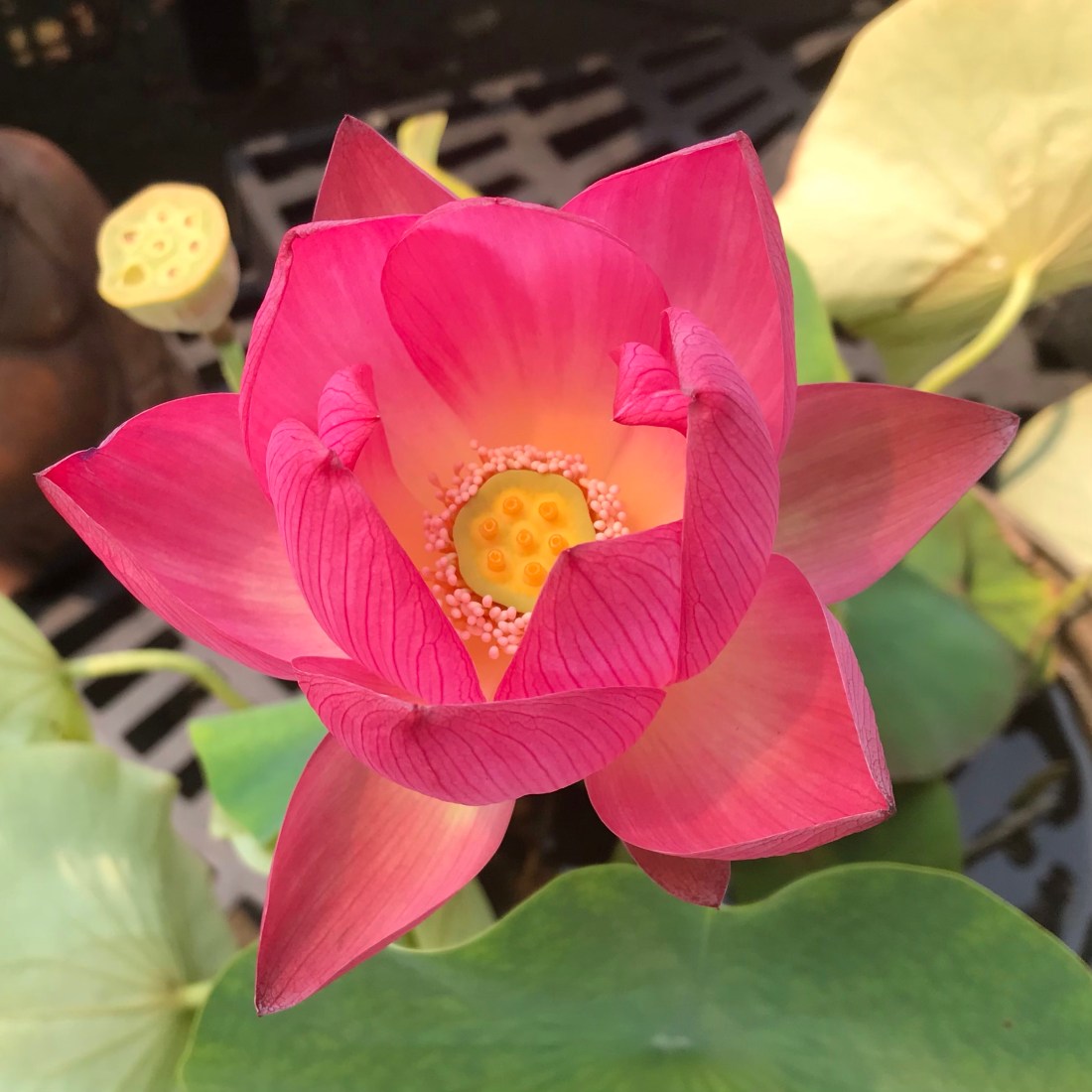
To reiterate, the idea of a lotus growing from the mud, unsullied by the mud was both intended to show the potential of all beings to awaken like the Buddha, but also the many colors of lotuses (in my opinion) show the diversity of followers from many walks of life.

Namu Shakamuni Butsu
Namu Amida Butsu

1 She also had a pretty high opinion of herself, which was grating to read at times. I seriously doubt her experience is representative of a lot of women in the industry.

Family

Ying Nan: You are a product of all who came before you. The legacy of your family, the good and the bad, it is all a part of who you are.

Shang-chi (2021)

My kids and I have been watching the Marvel MCU movies for years. My firstborn is particularly a Marvel fan since she was a little girl. Some of the movies are better than others (my personal favorite is Thor: Ragnarok),1 but we both really like the movie Shang-Chi and the Legend of the Ten Rings.

When my wife (who is Japanese) and I first dated, there was an immediate clash of cultures. I was a generic American white kid who grew up in an impoverished broken home with lots of issues, my wife grew up in a working-class Japanese family that was not overly traditional, but still very Japanese compared to American standards. The fact we were dating in the first place was a bit awkward for her and her parents, whereas I hardly ever talked to my own parents.

The good news is that over time, we learned to understand one another, and that means that I too learned to appreciate her viewpoint sometimes. For example, family.

Even when she disagreed with her parents, she still respected them, and understood her family obligations. This was something frankly new to me because I openly rebelled against my parents, told my dad off, and hardly paid them any heed. I gradually did reconcile with my parents to some degree as I got older (and a bit wiser), to a level where we can get along, but more importantly I learned to accept that I am who I am due to my family. Like the quote above says, you can’t deny your own heritage, both the good and the bad, and that it does shape who you are.

But also, through my wife and through parenting myself, I learned that I do owe some level of gratitude to my parents for what they did. I chose not to be like my parents in how I raise my kids, but even that is something I learned from them.2 Thus, the lesson I learned from my wife is that I also have to be humble, and respectful to my parents enough to acknowledge what they’ve done for me, even if I disagree with them. This is a very Confucian outlook, but I can see the value in this.3

It rubs against my American sense of individualism, but I’ve found it a valuable lesson over the years, and something I think we can all learn from.

P.S. Xu Wenwu, the father in Shang-chi, is a great example of a plausible chaotic-evil person in Dungeons and Dragons: he craves absolute power and yet is also capable of being in love, being a father, etc. Yet, he inevitably bends everything toward evil or ruin, including his lawful-good wife, Ying Li. Tony Leung Chiu-wai‘s performance was excellent.

1 The Thor movies do a really nice job of weaving science fiction with magic and myth, much like Roger Zelazny did in his books generations ago (Lord of Light, the Amber Series, Creatures of Light and Darkness, etc.). Put simply, I like weird, transcendent stuff more than the “grounded” story lines like Captain America or Black Widow.

2 In Japanese there is a four-character phrase for this: hanmen kyōshi (反面教師) meaning to learn from a bad example (i.e. what not to do).

3 This importance in family isn’t even limited to Confucian-influenced cultures. You can find it in many unrelated world cultures where family is emphasized, and respect towards one’s ancestors. For whatever reason, it is not emphasized in Western culture, and maybe to our detriment I think.

Hungry Ghosts are Among Us?

The Obon Season in Japan approaches, and so do ghost stories, and ceremonies around hungry ghosts. But what are Hungry Ghosts?

This is one of the traditional states of rebirth within Buddhism, on the never-ending cycle of people migrating from one life to the next. Rebirth as a hungry ghosts is seen as only one rung up from being in Hell, as it is a state of great suffering and hardship. Unlike hell, though, hungry ghosts are seen as beings that live among us, but only in the darkest shadows, living a precarious existence, constantly starving and thirsty, with no way to gain sustenance. They are often cursed to eat something awful, like garbage, or excrement, as punishment, or they are depicted in art as having emaciated bodies, with bloated bodies, and tiny throats that can’t swallow anything.

Although they are called preta1 in Indian Sanskrit language, in Japanese they are called gaki (餓鬼), which in modern slang is a rude expression for kids that means “a punk” (the Japanese meaning is harsher than the English one).

References to hungry ghosts go all the way back to early Buddhist texts such as the Pali Canon where the Buddha warns that among the hungry ghosts are probably some of your ancestors and kin:

Outside the walls they stand, & at crossroads.
At door posts they stand, returning to their old homes.
But when a meal with plentiful food & drink is served, no one remembers them:
Such is the kamma [karma] of living beings.

Tirokudda Kanda (Petavatthu 1.5), translation by Ven. Thanissaro Bhikkhu

Later, stories of hungry ghosts appear in Sanskrit anthologies such as the Avadanasataka, including the story of Mogallana and his mother (source of the Obon holiday), before a similar version of the story appears in the Mahayana text, the Ullambana Sutra, for which there is a handy translation here. In the Ullambana Sutra, you can see how Mogallana’s mother suffers in her state as a hungry ghost:

Mahamaudgalyayana [Mogallana] felt deep pity and sadness, filled a bowl with food, and went to provide for his mother. She got the bowl, screened it with her left hand, and with her right hand made a fist of food. But before it entered her mouth, it turned into burning coals which could not be eaten….

Source: https://www.cttbusa.org/ullambana/ullambana.asp, Buddhist Text Translation Society, part of City of Ten Thousand Buddhas

Scenes of hungry ghosts appear in old Buddhist art too:

A picture from the Gaki zōshi 餓鬼草紙 “Scroll of Hungry Ghosts”, circa 12th century, courtesy of the Kyoto National Museum, Public domain, via Wikimedia Commons

In this famous image, you can see emaciated hungry ghosts living among us, unseen, scrounging remains from human refuse and so on. Early Buddhist texts never described what hungry ghosts looked like, but this is how they are depicted in medieval artwork.

Because the hungry ghosts wander aimlessly through life endlessly starving, and some of them may include past ancestors and loved ones, Buddhism has developed certain ceremonies thought to help relieve the suffering of one’s ancestors, and by extension other hungry ghosts. In Chinese culture, this is exemplified in the Ghost Festival (中元節, zhōngyuánjié) of Chinese culture, Obon (お盆) in Japanese culture and the Segaki ritual in some Buddhist traditions.

It’s a fascinating example of how Buddhist teachings have suffused cultures, and how cultures have responded to concerns over family and the afterlife.

1 Alternatively peta in Pali language.

The Daily Grind

Lately, I have been re-reading some old Jodo Shinshu Buddhist books that I read many years ago when I first encountered Buddhism. Now that 15-20 years have passed it’s interesting to look back and see things with a more experienced eye. In particular, I am enjoying an old classic titled River of Fire, River of Water, by the late Rev. Taitetsu Unno. Of his books, I think this is the best one.

Midway through the book he quotes the following:

“As long as man lives, he must work and plan for a thousand years. Even this Genza plants persimmon and chestnut trees. I have lots of work to do in this world. But we must listen to the teaching [of the Buddha], as if there’s no tomorrow.”

Inaba no Genza (因幡の源左, 1842-1930)

Inaba no Genza (often just called “Genza” in English) was an example of an archetypal Pure Land follower called a myōkōnin (妙好人), a humble, very pious lay-follower, who becomes an inspiration to others. Myokonin are rarely discussed outside of Jodo Shinshu discourse, but I bet if you look around enough, you’d find examples of such pious followers in many Buddhist countries and cultures. I can even think of a certain American myokonin I once knew.

But I digress.

I like this quote a lot because it acknowledges two things.

First, Buddhist practice in the traditional sense requires considerable time, dedication and energy. An illiterate guy working the fields, just trying to scrape by, couldn’t be expected to take up Zen practice, or to learn the finer points of esoteric doctrine. If you really wanted to take up Buddhist practice, not as a “weekend warrior”, but as a dedicated practitioner, this required renouncing the world and ordaining as a monk or nun. Not so with the Pure Land path (Nichiren Buddhism, too).

So, this helps to explain why certain Buddhist sects struggled to gain mass popularity over the centuries, while Pure Land which relies on the guidance of Amida Buddha, did not.

The reality, I think, is that little has changed even in modern times. We enjoy a material culture far surpassing what 19th century Japanese field workers might have enjoyed, but our modern capitalist culture keeps us as busy and overworked as anyone, and still struggling to survive. We may not die from dysentery these days, but may of us will still die stressed out and broke.

Second, time is short. I’ve used the example of the Parable of the Burning House to help illustrate as well as the Liturgy on White Ashes, but to reiterate, the Buddha taught that life is short, and death can come at any time. So it’s important not to squander it. One should carefully settle one’s affairs, and not lose sight of the big picture. Easier said than done, but what Inaba no Genza says is important: listen to the Dharma1 and heed it well. It may be your last chance.

Namu Amida Butsu

P.S. other than Dr Unno’s translation, I struggled to find the actual source of this quote with Japanese text. I found some limited information about a text called the kaki no ki no hanashi (柿の木の話) written by his son, Saichi, but couldn’t find anything much beyond that. It’s kind of frustrating when Western authors quote Buddhist texts, but do not cite their sources.

P.P.S. Speaking of daily grind, posting again…

1 In Jodo Shinshu, this kind of “deep hearing” of the Dharma is called monpō (聞法) which means “hearing the Dharma”. The nuance here is that you’re not just listening to the sound and words of the Dharma, but you hearing it in a deeper, more spiritual sense. This requires humility and willingness to learn, and challenge your own assumptions.

Happy Golden Week 2025

Happy Golden Week to readers!

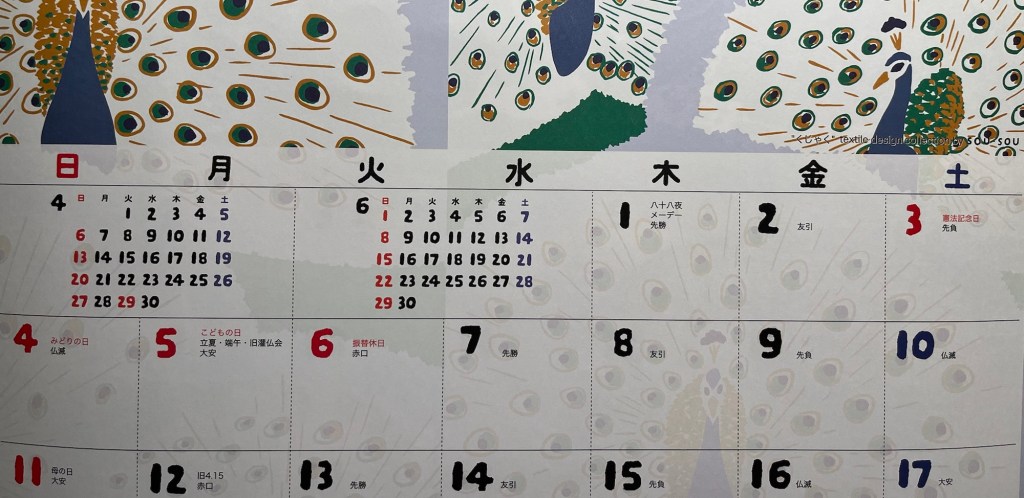
The first week of May in Japan has an interesting phenomenon in the modern calendar called Golden Week (gōruden uīku, ゴールデンウィーク): a series of national holidays that line up very closely. Thus, people often take vacations at this time (a rarity in Japanese business culture), and enjoy the fine weather before the monsoon comes. I wrote about Golden Week in more detail here.

You can see on our home calendar how the holidays (in red) line up:

My sister-in-law in Japan often takes this time off, as do many other Japanese business and white-collar workers. It may be the longest vacation they take in the year, apart from Japanese New Year.

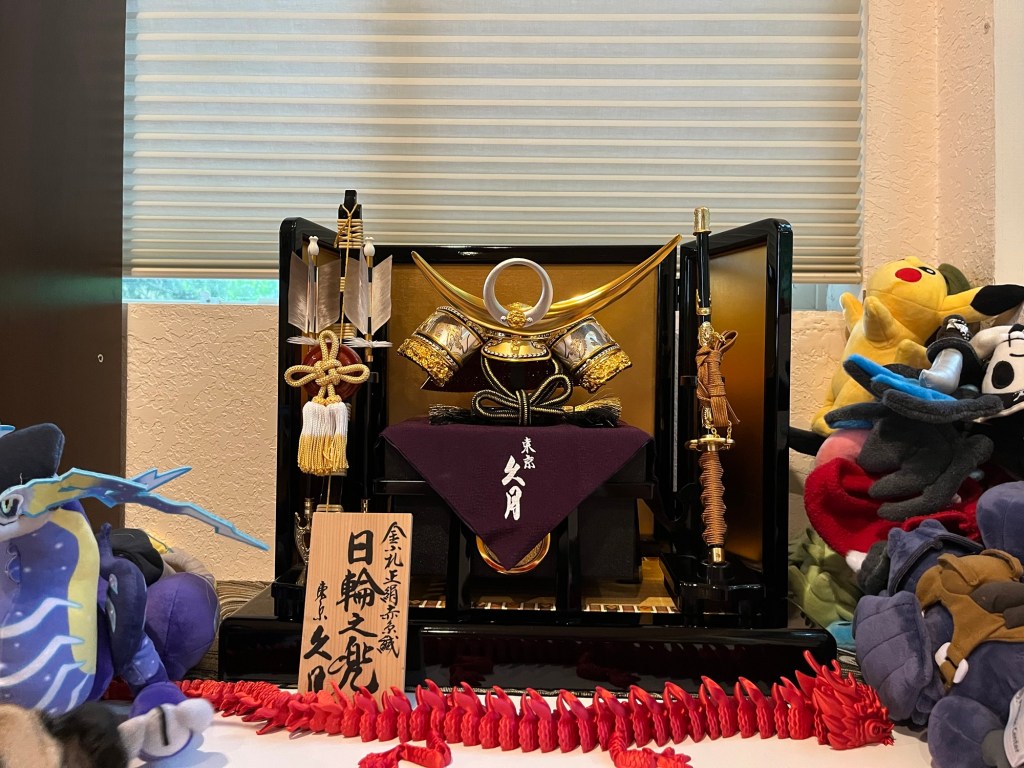
As part of Golden Week, Childrens Day, or Kodomo no Hi (子供の日) also takes place every May 5th. I’ve written about that as well. We have taken out our usual yoroi armor display:

The Pokemon toys and dragons are just my son’s toys (he should clean up more 😋).

I am not sure if we can get kashiwa-mochi this year, as Japanese goods are getting harder and harder to obtain lately, and our schedule is chaotic this week anyway, so I am not sure exactly how we will celebrate. I do know that we will go see the Minecraft movie for a third time in theaters, though. My son and I really enjoy it, and it’s nice to see all the kids yelling certain parts of the dialogue in unison.

I wish I could post more, but as alluded to earlier, I will be away for about a week, and haven’t been able to write more due to work and other competing priorities. However, I hope you all have a terrific Golden Week, and can enjoy the weather in some way. I have other great content coming up, both historical and Buddhist, so please stay tuned, and take care!

P.S. Golden Week also serves as a reminder that what many modern workers need isn’t just equitable pay, but also time off. Happy May Day! ✊🏼