Nature and Balance

SPOCK: War created an imbalance and nature counterbalanced it.

Star Trek, “The Omega Glory” (s2ep23), Stardate unknown

In some form or another, Climate Change has been with us since the beginning of Time. If you look at geologic time, gradual changes to climate happen, moving toward a hotter Earth or a colder one, and in the past once these changes lead to a tipping point, this leads to mass-extinction events. These changes in climate are often driven by natural forces: plate tectonics, accumulation of CO2 (carbon dioxide) in the atmosphere, shifts in the ocean currents and so on. Eventually, the pendulum swings back and the climate shifts toward the other direction. Meanwhile, life gradually recovers, diversifies again and so on.

But it’s important to understand that these changes happen very gradually over tens of thousands of years, or even hundreds of thousands of years.

Climate Change in the modern context refers to human-driven changes. The buildup of CO2 gas in the atmosphere is nothing new, but the output of that gas in the last 100 years is far higher than natural forces can account for. We know that this extra buildup is due to fossil fuels. Burning fossil fuels is literally like throwing gasoline on a fire.

Fossil fuels are not a sustainable energy source anyway, and they are condensing a process that should take a hundred thousand years into only tens of years. It’s small wonder we see such dramatic weather now: mass wildfires, mass rainfalls, mass drought and so on.

As Spock says, if we create an imbalance, nature will balance it out. But may not happen the way we want it to. The greater the imbalance, the greater the correction.

But just as 8-billion humans have, across generations, contributed to the problem, those same humans can contribute to fixing the imbalance (before Nature does it for us):

  • Reduce energy consumption at home. Even switching off lights at home helps.
  • Plant local, native plants in your neighborhood
  • Eat more vegetables (which I am trying to do anyway)
  • Cut back on fossil fuels: the less you use, the less accumulates in the atmosphere
  • and so on…

Find something you can reasonably do, and don’t hesitate to do some small good in the world.

The Healing Power of Nature

In the past, I talked about the four-character phrases, or yojijukugo, popular in Japanese culture. Recently, I learned about a new phrase that I hadn’t heard before: kachō-fūgetsu (花鳥風月). This phrase describes the beauty of nature, literally the Kanji characters for “flower”, “bird”, “wind” and “moon”.

The meaning here is various aspects of nature, but also in a positive healing sense.

Spock: Indeed, gentlemen. May I point out that I had an opportunity to observe your counterparts here quite closely. They were brutal, savage, unprincipled, uncivilized, treacherous; in every way, splendid examples of homo sapiens, the very flower of humanity. I found them quite refreshing. [he returns to the science station]

Kirk: I’m not sure, but I think we’ve just been insulted.

McCoy: I’m sure.

Star Trek, “Mirror Mirror” (s2ep4), stardate unknown

For all our veneer of civilization and advancement, we are still deep down biological creatures. We come from nature, and we need nature. Nature heals us and sustains us.

A small patch of grass in my yard, taken in April of 2025.

These days, it’s not hard to feel stressed by all the things that are going on, but I also found solace knowing that nature continues on regardless of what humans do or become. That doesn’t mean the future of humanity will necessarily be positive or negative, but it does remind me that life goes on nonetheless.

It also underscores how important protecting nature is.

P.S. More tips here for protecting the environment.

Big Changes, Little Changes

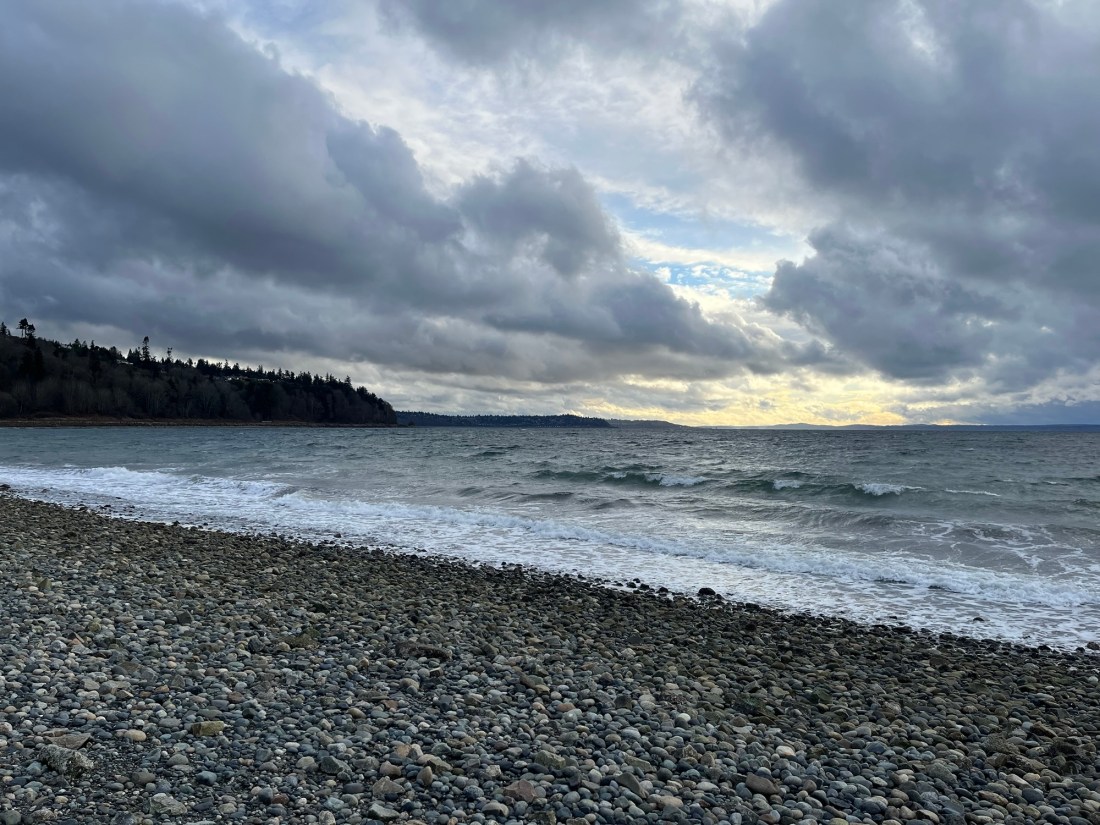
A beach scene with a rocky shore, and waves lapping up to teh shore. In the distance is a cloudy sunset.

Q: The redoubtable Commander Riker, whom I noticed before. You seem to find this all very amusing.
RIKER: I might, if we weren’t on our way to help some suffering and dying humans who–
Q: Your species is always suffering and dying.

Star Trek: The Next Generation, “Hide and Q” (s1ep10), Stardate: 41590.5

Something a little embarrassing I want to confess: sometimes, when I am uneasy or stressed, I go back and read some of my own posts. I don’t do this because of vanity (hopefully) or conceit, but I like to remind myself of certain things I might forget amidst daily turmoil. I suppose I write some of these blog posts as for myself to sort out what’s bothering me, as I do for the dear readers who follow the blog.1

One of my favorite posts of all time is this one. After visiting the Royal British Columbia Museum in 2022, and watching the excellent documentary about the different geologic ages of Antarctica, I walked away deeply impressed. These experiences help give a larger perspective about the world around us, and show how change is a constant of the universe whether we see it or not.

Change happens on the micro-level in our daily lives: one day to the next, we get older, our hobbies change, things at work happen, hairstyles change, etc. When I look at old photos of me and the kids, I am amazed at how much skinner I was, and no grey hear. 🤣

The world around us changes too: political, economically, and so on. The neighborhood you live in will look different 10 years from now, or looking back it’s probably changed in the past 10 years. Thinking about my life as a college kid in the early 2000’s, the Dot-com Era, it’s amazing how much has changed in a mere 20 years. Some things got better, some things got worse.

But if we step back even further, we can see with the benefit of hindsight slow-moving, multi-generational historical changes. From following the excellent History of Byzantium podcast, it’s amazing how much changes in the Eastern Roman (a.k.a. Byzantine) empire across generations. During the time of emperor Justinian the Great, chariot races were still hugely important in Byzantium, the empire had tenuous toeholds in North Africa and Spain, and many people still actively spoke Latin. By the time of emperor Manuel Komnenos, the Eastern Roman empire was far smaller, Greek language had long since replaced Latin, and the single universal church had long since split between Roman Catholic and Orthodox faiths. Between the 6th and 12th centuries, many changes happened, but because they stretch across many generations, it’s not possible for someone living within the city of Byzantium to fully grasp the scale of the changes. It was still the same Eastern Roman empire, and would continue for another 200+ years, but it had changed and evolved as external circumstances changed.

But let’s step even further back. An Egyptian peasant working the fields, or helping to build the Great Pyramid of Khufu, would be utterly stunned at the world today. Such a world would feel totally alien to him or her. It’s not just the level of technology we enjoy today, or the quality of our medicine, but also the way we view the world. Things that seem like common sense to such a peasant would feel strange or silly to us. Things that we inherently believe as 21st century adults would feel strange or bizarre to that peasant. We can’t really pin down when or how such things changed, but it’s series of gradual changes, each one piling on top of the rest.

And yet we can step even further back. If we look at the human race, it is new to the planet Earth. People can deny this using specious reasoning, but science doesn’t care what people believe or don’t believe. The natural world just works the way it does. We humans are just here, living on the Earth, but the Earth does not belong to us. We are its stewards. If not us, perhaps the Apes or Squids will be its stewards. 😏

Which I think brings me to my point: of all the craziness and turmoil going, I think there are two things to take away from all this:

  • We may lament how things have taken for the worse, but in a dispassionate sense, this is just more change unfolding due to causes and conditions that until now we may not have ever noticed. It doesn’t necessarily mean they are good changes, or harmless, but change is change. Also, by extension, the way things are now won’t always be this way in the future. Change is still happening, even if we can’t see it.
  • Of all the things to concern ourselves with most, in my humble opinion, the Environment (with a big “E”) is the most important. If we want to benefit Mankind, the Earth, and all life on it in ways that we’ll never see in our lifetime, if we want to get the most “bang for our buck”, then anything we can do to help the Environment works towards that end. Small changes and efforts now will ripple across generations we will never see, and help shape the Earth, hopefully in a positive way.

At times like this, I truly believe my old minister Rev. Don Castro of Seattle Buddhist Church was onto something when he described Buddhism, including Pure Land Buddhism, as an eco-religion. Amida Buddha, the Buddha of Infinite Light, embodies many things:

  1. As an embodiment of the Dharma, Amida sheds light on the continuous nature of all things: impermanent, fluid, changing.
  2. Also as an embodiment of the Dharma, Amida doesn’t require praise or devotion. The Dharma is just there, whether people notice it or not, whether they believe it or not. But as a Buddha, Amida tirelessly works to help all beings, to awaken them, to provide peace of mind.
  3. Also as an embodiment of the Dharma, Amida embodies how all things relate to one another. The small things that we do day to day to help improve, or degrade, life around us affect others even if they are far removed.
  4. Finally, Amida Buddha as the Dharma teaches rational, not selfish, thinking and non-fear. In a sense, WWTD: What Would Tuvok do?

All this is to say, I suppose, even amidst crazy times, do not fear. Take inspiration from the Buddha, make rational, wholesome choices, yet never assume things will stay a certain way forever. Do not be complacent, nor take things for granted.

Namu Amida Butsu

P.S. featured photo taken at Richmond Beach in Shoreline, WA earlier this year.

1 This blog is small-time, but it’s a labor of love, and I genuinely appreciate each and every reader.

Small Things Make a Difference

With all the turmoil going on lately, I figured it would be a good idea to re-post some helpful tips from the NOAA to help keep the planet healthy. You can also access them here, or the original source here.

A while ago I talked about Eco-Buddhism and the Buddha Amida. Amida Buddha, like any “cosmic” Buddha (a.k.a. Vairocana, or whichever) is often seen not just as another character in the Buddhist pantheon, but the embodiment of existence. Such a Buddha embodies the Dharma (the principle of existence), and the Dharma embodies reality. Seen in this light, Amida Buddha and his rays of light that shine across the Universe reinforce the idea of all things being interconnected. It’s not that “all is One”, in a New Age sense. It’s that what one thinks or does or says affects others even if we never meet them. Similarly, what they do affects us.

This is true in an ecological sense too. The tips provided by NOAA above are small steps, but each one helps others in ways you might not expect. Even one plastic bottle recycled helps keep it out of the landfill for the next 500 years, or the tree you plant now may help generations later. Choosing to not use plastic straws, plastic shopping bags, or adopting public transportation one day a week, shutting off lights in the house, picking up one bit of trash, and so on all benefit others and ultimately ourselves. Imagine if 10 people do this, 100, 1000, and so on.

Even if we cannot rely on government policy to help us keep the Earth healthy, we can do plenty ourselves by making positive choices, and inspiring others to do the same.

Amida Buddha, Ecology, and Shin Buddhism

As I continue my (re-)reading of various Pure Land Buddhist books in my collection, I realized that all my reading was centered around a medieval-Japanese-Buddhist viewpoint, with all its arguments about the minutiae of the tradition. It’s been a fun time for me, and with the benefit of age and hindsight, I have come to understand some things I didn’t when I was younger.

However, one thing pre-modern Buddhist authors seldom wrote about was Ecology.

Photo by Tom Fisk on Pexels.com

To be fair, medieval authors never had to worry about climate change, mass extinction of wildlife, plastic in oceans, etc. They did have to worry about plagues, natural disasters, feudal rulers and other issues. Different generations, different issues.

Buddhism and its concept of metta, or goodwill towards all beings, implicitly includes an ecological outlook, as does the notion of interconnectedness of all things. So, Buddhism definitely lends itself towards a more ecological viewpoint, but it’s never been really emphasized.

However, faced with monumental ecological problems we have now though, we have no choice but to confront them and adapt Buddhist teachings to educate and inspire people to make wiser choices. This is the problem of our era. But where to begin?

I think Jodo Shinshu, or “Shin” Buddhism as Westerns often call it, provides a particularly helpful attitude into how ecology and Buddhism can work. Shin Buddhism focuses awareness of, and gratitude toward everything arounds us that sustains us and carries us forward. This is embodied by Amida Buddha, the same Buddha in other Pure Land traditions, but Shinran the founder’s interpretation heavily leans toward the side of “other-power”. In other words, it’s through Amida’s grace, rather than set of practices, that one is led toward the Pure Land. Thus, one says the nembutsu (namu amida butsu) as an expression of gratitude than an explicit practice.

Further, other Buddhist practices are done out of gratitude, or because one is inspired by the Dharma (the Buddhist teachings), rather than because one is aiming towards something.

With me so far?

Out of any Buddhist tradition, Jodo Shinshu/Shin Buddhism probably has the most “Calvinist” viewpoint of anything I can think of. Granted that, under the hood, Buddhism and Christianity are quite different, but Shin Buddhism shifts the emphasis away from traditional Buddhist practice toward the power of Amida Buddha and his compassion towards all beings. Amida calls to us (just like Parable of the Two Rivers), and if we heed that call we are brought along the Buddhist path.

Thus in popular Shin-Buddhist culture, people often referred to Amida Buddha as Oya-sama (親様, “Honored Parent”). It’s not that we are born from Amida Buddha, but his compassion surrounds and sustains us like a parent. Even the famous haiku poet, Kobayashi Issa (小林 一茶, 1763 – 1828), a Jodo Shinshu follower himself, once family wrote a haiku at New Year’s when he was broke and penniless:

JapaneseRomanizationAmateur translation
ともかくもTomokaku moAt the closing of the year
あなたまかせのAnata makase noI turn to you, Amida Buddha;
年の暮れToshi no kurécome what may.
Rough translation by author, all mistakes are mine

So, what does this have to do with Ecology?

First, Shinran, the founder, didn’t see Amida Buddha as just another Buddha within the larger Mahayana pantheon. He felt that Amida was the embodiment of the Dharma itself, and since the Dharma, the Buddhist teachings, reflect reality as it is (even if us unenlightened beings don’t fully get the full scope of it) whenever we see reality, we see Amida Buddha, and his compassion for all beings. The restorer of Jodo Shinshu, Rennyo, taught similar sentiments.

Thus, goodwill, and awareness of the interconnectedness of all things, is us seeing Amida at work. When we “pay it forward” and help others, or help the environment, this is an expression of our gratitude toward Amida, but also to the life and nature around us that sustains us daily. In this light, the nembutsu isn’t just a bunch of words chanted over and over, it’s a living expression of our gratitude.

It’s something I haven’t fully fleshed out yet in my head, but I realize more and more the years that Rev Castro had been ahead of his time.

P.S. This post is pretty unpolished (I usually try to proofread things at least once), but I wanted to write down this stream of thought in my head before I forget.