Yuki-Onna: A Japanese a Scary Story (sort of)

In the 19th-century book Kwaidan, a collection of strange and scary Japanese stories, one of the most famous stories is called Yuki-Onna (雪女, lit. “Snow Woman”). Unlike other stories that Lafcadio Hearn collected, he claimed that this one was told to him directly by a local who somehow passed on the tale. I’ve posted it here verbatim from Project Gutenberg.1

Unlike other stories in Kwaidan, Yuki-Onna is less of a scary story than it is a weird story, but also if you play D&D/Pathfinder, I think the idea of a beautiful snow spirit wandering the woods and killing people by stealing their warmth, would make an interesting, albeit short, campaign setting too.2

Of the stories in Kwaidan, it is one of the most popular, and frequently shows up in Japanese media. One of my favorite comedy shows did a 3-minute summary of it in Japanese (sorry, no English, but the animation is great), joking how the identity of “O-Yuki” was painfully obvious:

As this is Obon Season in Japan, it’s a great time to enjoy another scary story or two…

In a village of Musashi Province (1), there lived two woodcutters: Mosaku and Minokichi. At the time of which I am speaking, Mosaku was an old man; and Minokichi, his apprentice, was a lad of eighteen years. Every day they went together to a forest situated about five miles from their village. On the way to that forest there is a wide river to cross; and there is a ferry-boat. Several times a bridge was built where the ferry is; but the bridge was each time carried away by a flood. No common bridge can resist the current there when the river rises.

Mosaku and Minokichi were on their way home, one very cold evening, when a great snowstorm overtook them. They reached the ferry; and they found that the boatman had gone away, leaving his boat on the other side of the river. It was no day for swimming; and the woodcutters took shelter in the ferryman’s hut,—thinking themselves lucky to find any shelter at all. There was no brazier in the hut, nor any place in which to make a fire: it was only a two-mat[1] hut, with a single door, but no window. Mosaku and Minokichi fastened the door, and lay down to rest, with their straw rain-coats over them. At first they did not feel very cold; and they thought that the storm would soon be over.

The old man almost immediately fell asleep; but the boy, Minokichi, lay awake a long time, listening to the awful wind, and the continual slashing of the snow against the door. The river was roaring; and the hut swayed and creaked like a junk at sea. It was a terrible storm; and the air was every moment becoming colder; and Minokichi shivered under his rain-coat. But at last, in spite of the cold, he too fell asleep.

He was awakened by a showering of snow in his face. The door of the hut had been forced open; and, by the snow-light (yuki-akari), he saw a woman in the room,—a woman all in white. She was bending above Mosaku, and blowing her breath upon him;—and her breath was like a bright white smoke. Almost in the same moment she turned to Minokichi, and stooped over him. He tried to cry out, but found that he could not utter any sound. The white woman bent down over him, lower and lower, until her face almost touched him; and he saw that she was very beautiful,—though her eyes made him afraid. For a little time she continued to look at him;—then she smiled, and she whispered:—“I intended to treat you like the other man. But I cannot help feeling some pity for you, because you are so young... You are a pretty boy, Minokichi; and I will not hurt you now. But, if you ever tell anybody even your own mother—about what you have seen this night, I shall know it; and then I will kill you... Remember what I say!”

With these words, she turned from him, and passed through the doorway. Then he found himself able to move; and he sprang up, and looked out. But the woman was nowhere to be seen; and the snow was driving furiously into the hut. Minokichi closed the door, and secured it by fixing several billets of wood against it. He wondered if the wind had blown it open;—he thought that he might have been only dreaming, and might have mistaken the gleam of the snow-light in the doorway for the figure of a white woman: but he could not be sure. He called to Mosaku, and was frightened because the old man did not answer. He put out his hand in the dark, and touched Mosaku’s face, and found that it was ice! Mosaku was stark and dead...

By dawn the storm was over; and when the ferryman returned to his station, a little after sunrise, he found Minokichi lying senseless beside the frozen body of Mosaku. Minokichi was promptly cared for, and soon came to himself; but he remained a long time ill from the effects of the cold of that terrible night. He had been greatly frightened also by the old man’s death; but he said nothing about the vision of the woman in white. As soon as he got well again, he returned to his calling,—going alone every morning to the forest, and coming back at nightfall with his bundles of wood, which his mother helped him to sell.

One evening, in the winter of the following year, as he was on his way home, he overtook a girl who happened to be traveling by the same road. She was a tall, slim girl, very good-looking; and she answered Minokichi’s greeting in a voice as pleasant to the ear as the voice of a song-bird. Then he walked beside her; and they began to talk. The girl said that her name was O-Yuki;[2] that she had lately lost both of her parents; and that she was going to Yedo (2), where she happened to have some poor relations, who might help her to find a situation as a servant. Minokichi soon felt charmed by this strange girl; and the more that he looked at her, the handsomer she appeared to be. He asked her whether she was yet betrothed; and she answered, laughingly, that she was free. Then, in her turn, she asked Minokichi whether he was married, or pledged to marry; and he told her that, although he had only a widowed mother to support, the question of an “honorable daughter-in-law” had not yet been considered, as he was very young... After these confidences, they walked on for a long while without speaking; but, as the proverb declares, Ki ga aréba, mé mo kuchi hodo ni mono wo iu: “When the wish is there, the eyes can say as much as the mouth.” By the time they reached the village, they had become very much pleased with each other; and then Minokichi asked O-Yuki to rest awhile at his house. After some shy hesitation, she went there with him; and his mother made her welcome, and prepared a warm meal for her. O-Yuki behaved so nicely that Minokichi’s mother took a sudden fancy to her, and persuaded her to delay her journey to Yedo. And the natural end of the matter was that Yuki never went to Yedo at all. She remained in the house, as an “honorable daughter-in law.”

O-Yuki proved a very good daughter-in-law. When Minokichi’s mother came to die,—some five years later,—her last words were words of affection and praise for the wife of her son. And O-Yuki bore Minokichi ten children, boys and girls, handsome children all of them, and very fair of skin.

The country-folk thought O-Yuki a wonderful person, by nature different from themselves. Most of the peasant-women age early; but O-Yuki, even after having become the mother of ten children, looked as young and fresh as on the day when she had first come to the village.

One night, after the children had gone to sleep, O-Yuki was sewing by the light of a paper lamp; and Minokichi, watching her, said:—

“To see you sewing there, with the light on your face, makes me think of a strange thing that happened when I was a lad of eighteen. I then saw somebody as beautiful and white as you are now—indeed, she was very like you.”...

Without lifting her eyes from her work, O-Yuki responded:—

“Tell me about her... Where did you see her?”

Then Minokichi told her about the terrible night in the ferryman’s hut,—and about the White Woman that had stooped above him, smiling and whispering,—and about the silent death of old Mosaku. And he said:—

“Asleep or awake, that was the only time that I saw a being as beautiful as you. Of course, she was not a human being; and I was afraid of her,—very much afraid,—but she was so white!... Indeed, I have never been sure whether it was a dream that I saw, or the Woman of the Snow.”...

O-Yuki flung down her sewing, and arose, and bowed above Minokichi where he sat, and shrieked into his face:—

“It was I—I—I! Yuki it was! And I told you then that I would kill you if you ever said one word about it!... But for those children asleep there, I would kill you this moment! And now you had better take very, very good care of them; for if ever they have reason to complain of you, I will treat you as you deserve!”...

Even as she screamed, her voice became thin, like a crying of wind;—then she melted into a bright white mist that spired to the roof-beams, and shuddered away through the smoke-hole.... Never again was she seen.

Enjoy!

1 Note: This eBook is for the use of anyone anywhere at no cost and with almost no restrictions whatsoever. You may copy it, give it away or re-use it under the terms of the Project Gutenberg License included with this eBook or online at http://www.gutenberg.net

2 At least, it would make a good one-shot adventure?

Building a Sohei Warrior in Pathfinder 2e

Greetings role-players! A while back, I wrote a piece about making a sohei warrior, a Japanese soldier-monk, in Dungeons and Dragons 5th edition. Since I have transition away from D&D, I have been tinkering with a similar build concept in Pathfinder 2e, and wanted to share. This is just a suggestion, but it’s based on historical precedence as much as possible, while still retaining elements of high fantasy and heroism (important since sohei were often zealots and scallywags). Your mileage may vary, but I’ve enjoyed my character so far.

A statue of Benkei, the archetypal sohei warrior, in Tanabe city in Wakayama, Prefecture. shikabane taro, CC BY 3.0, via Wikimedia Commons

To recap my D&D post, sohei warriors were very similar to samurai despite name “monk” (which is an overloaded term anyway), but they were bodyguards and field-armies for powerful medieval Buddhist temples. In time, they attained a legendary status especially around a semi-legendary figure named Benkei. So many of modern tropes in Japan about sohei warriors are inspired by Benkei.

As soldiers, they frequently are depicted using naginata weapons (similar to a glaive) and katana, as well as wearing typical armor for the time underneath their white cowls. As devotees to a temple, they were not clerics and generally not ordained as priests, but did protect priests and temples, and further political/ecclesiastical issues as needed.

In a fantasy role-playing context, this feels like something akin to a Champion in Pathfinder 2nd-edition. For my character, I chose the Cause of the Paladin (lawful-good)1 since he would not only get Retributive Strike feat (very handy with a naginata), but also from a character-standpoint it made sense to be a protector figure, and also since Buddhism in real-life is a lawfully-inclined religion anyway. I play my character, Shinji, as a straight-laced, through trigger-happy and somewhat clueless character. He is blinded by his devotion at times, but means well.

Shinji as shown on the Nexus site. I couldn’t find the export link, and since the service is still in Beta, many things might change.

For the Retributive Strike feat, if you combine that with 2nd-level feat Ranged Reprisal, the 10-foot range of the naginata now becomes 15 feet.

As for equipment, shields in the Western sense were never really used in Japanese combat, so I didn’t equip Shinji with one, even if he has the option. Instead, I focused on offense by equipping with both a naginata and a katana. If you don’t have the necessary source books, the stats are freely available on Archives of Nethys links above. By second level, I equipped Shinji with scale mail armor.

In the current story, my kids and are playing a small 3-person party exploring the city of Absalom, and Shinji had been dispatched here from Minkai to protect a local priest at the branch temple in Absalom. However, upon arriving, the priest is nowhere to be seen, and the temple is barred shut. So, part of his side story is to unravel what happened, while finding something else useful to do in the meantime (i.e. helping my kids’ characters).

All the guidance above are build suggestions, but if you read the history of the sohei, it is probably (in my opinion), the closest fit I can come up with while still keep it fun for a high-fantasy setting. Your mileage may vary, but I hope you have fun and good luck building a sohei warrior of your own!

1 I know that in the latest Pathfinder updates the alignment system is being deprecated, but for simplicity’s sake, I am mentioning it here.

A Nerd Dad’s Review: Empires Triology

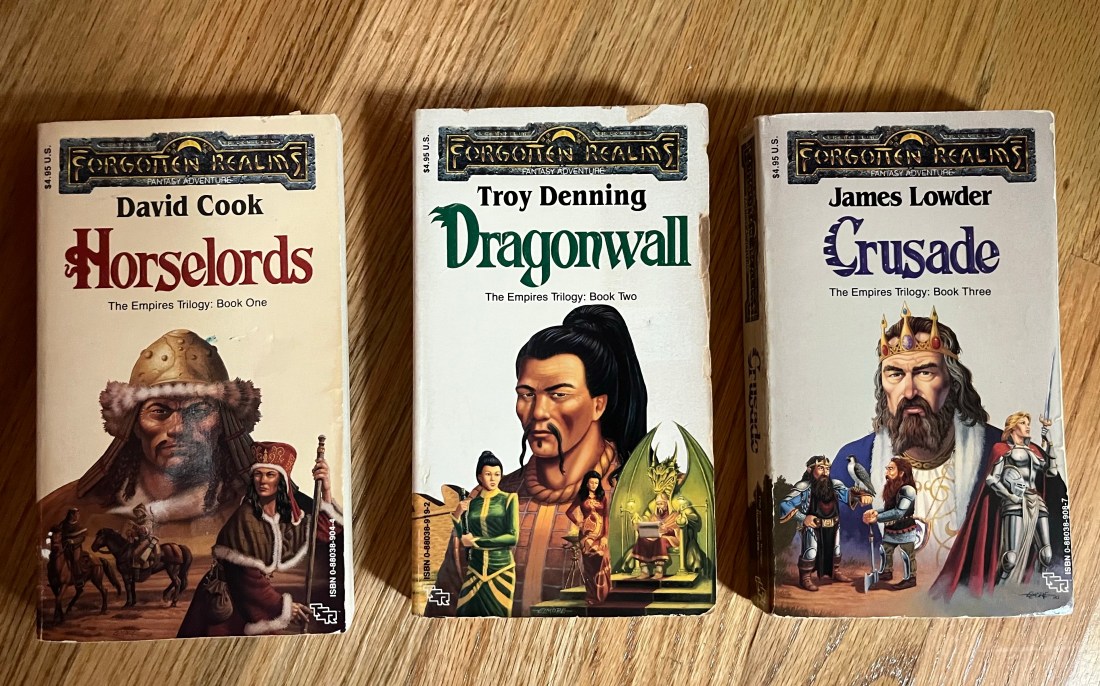
This post started with a surprise find at my local Half Price Books store. I often peruse the old fantasy paperback section, looking for Roger Zelazny novels that I haven’t picked up yet (see Spring Cleaning post), when I stumbled upon this old novel:

I suddenly remembered reading Horselords way back in the 1990’s in college, and although I didn’t remember the story much, I felt like re-reading it. It turned out to be a surprisingly good book. The story had surprisingly little to do with any Dungeons and Dragons lore apart from an odd mention here and there of magic, but instead was essentially a re-telling of the Mongol invasions of China, through a fantasy, fictional tribe called the Tuigan, headed by one Yamun Kahan. The book hints at some lore regarding the great Shou Empire, while the store is largely seen through the eyes of a foreign monk named Koja who is gradually brought into the inner-circle of Yamun Kahan. The story includes a lot of elements of the “noble savage” and “fish out of water” tropes, but overall it was a solid story as Koja gradually becomes more and more Tuigan in spite of himself. Even as his homeland is invaded by the Tuigan, Koja is a semi-willing participant in the invasion.

Having enjoyed the book, I decided to get the next two. I had never read them back in the day, not even sure if I knew they existed, but now, 30 years later, it was time to finish the series.

The second book, Dragonwall, was written by a different author, and was in many ways a different story entirely. The main character is a minor general named Batu Min Ho, who has Tuigan ancestry of his own, but was raised in Shou Lung. Through his tactical skill, he gradually rises through the ranks, earning the jealousy of some of the mandarins above him, culminating in a power struggle, and plenty of treachery that leaves his wife and children killed by the end.

Dragonwall overwhelmingly paints the Shou (fantasy Chinese) people of the Forgotten Realms in a negative light, as treacherous, back-biting, and decadent, which isn’t too surprising where court politics would be concerned but there’s little else to balance this contrast with the rest of Shou culture. This was probably meant to contrast the more brutal, yet honorable Tuigan culture, yet all the characters come off as one-dimensional and cartoonishly evil, especially the female antagonist. It plays into a lot of old, tired stereotypes about Chinese people.

Further, Batu Min Ho, having been discriminated and betrayed by the Shou, loses everything, goes rogue, literally using the Japanese term ronin (🤦🏻‍♂️)1 to describe himself, and joins Yamun Kahan’s horde.

The book ends with a lengthy divergence when the Tuigan under command of Batu Min Ho invade the fantasy realm of Thay briefly, which probably would’ve been interesting as a third story, rather than the end of this one.

In any case, this is where the third novel, Crusade, picks up, but once again, this book is written from the perspective of someone who is not Tuigan. This time the book is written through the perspective of the kingdom of Cormyr, a staple of the Forgotten Realms setting. This book, out of all three, has the most familiar fantasy setting since it is in a “Western” culture, so the author probably was on steadier ground and was able to afford fleshing out the characters more.

For me, Crusade, was a “slow burn” story: very slow start introducing an entirely new cast of characters with no interaction with the Tuigan. However, by the time of the climactic battle at the end, the book did an effective job of bringing everything together, including Batu Min Ho from the second book.

In spite of the rocky transition between settings across the series, shifting perspectives, and new characters each time, the final book did a rather admirable job wrapping up all the loose ends. The first book begins with a character named Koja and the third book essentially ends with him again. Coming full-circle was a nice conclusion.

The Empires Trilogy seems to have suffered from the same challenges that plagued the Star Wars sequels: No over-arching structure, and too many different “hands in the pot”, plus the stereotypical Asian characters, especially female characters, did not age well.

However, even with all the complaints, I still am glad to have finally finished the series. It was a bold attempt to make a semi-historical re-enactment of the Mongol invasions but through the lens of the Dungeons and Dragons Forgotten Realms setting. In spite of my complaints, I enjoyed the series and proudly keep it on my shelf now.

1 Western fascination of the lone warrior ronin is understandable, especially thanks to Kurosawa films, but it makes no sense for a Chinese character to use such a term, especially since it was not used for centuries later in the Edo period (17th century) when the story takes place in 12th century China.

Learning Pathfinder 2e as a D&D Player

In the past couple of months, starting with the Beginner Box, I have been learning how to play Pathfinder, second edition, which came out in 2019. It is a successor to the original Pathfinder edition, which in turn was based on Dungeons and Dragons 3.5 through the Open Gaming License (the same one under attack recently by Wizards of the Coast).

Speaking from personal experience, Pathfinder has suffered from a bit of an image problem…

But I picked up the Core Rulebook lately, which has been a fun read. The artwork is top-notch, and the guide does a pretty careful job walking you through the rules. However, the sheer size of the rulebook makes it hard to mentally absorb all at once, so I found this excellent series of videos by Jason Buhlman, lead game designer, that walk through all the essential aspects of playing Pathfinder.

First lesson, character creation
Second lesson: understanding magic
Lesson three: designing encounters
Lesson four: combat

I enjoyed this series, and it really helped the rules Pathfinder 2e “gel” in my mind. It also made it easier to go back and make sense of the text in Core Rulebook without having to reread multiple times.

So, I went ahead and made a first-time character to get used to the new ruleset: Tharivol a Wood Elf Druid. Pathfinder does not yet have an equivalent online character sheet storage system like D&D Beyond, but it has been fun to make on paper.

Transitioning from D&D

But, what’s it like going from Dungeons and Dragons 5th edition, which I have played since 2017, to Pathfinder 2nd edition?

Mechanically speaking, many of the rules, especially combat rules, make a lot more sense in Pathfinder than they did in 5e. The feel is more or less the same, but when you get into the grey areas, the Pathfinder approach often makes more sense, and there’s usually a contingency for everything a player wants to do. Some rules look more familiar to old time players like me (for example the spell “slots”) who played older editions, others look like fresh design improvements over older games. It’s an interesting mix of complexity with novelty.

Weapons also make more sense. For example, I complained previously about the lack of Asian-style mundane items, weapons and magic items in 5th edition and I was surprised to find, for example katana weapon stats in Pathfinder right in the Core Rulebook. This means, my old elf-samurai character, if adapted for Pathfinder, would probably look a bit more realistic (as much as fantasy elves in a Japanese-style setting would 😅…) than before.

Speaking of character creation the Pathfinder system relies less on character “tracks” to follow as one levels up, and more on a kind of buffet where one picks feats over time. Sometimes, the feat choices and skill increases are limited in scope, but you still usually have room to choose. This makes it hard to create the same character twice, and means each one will have a bit more individuality.

In the Advanced Player’s Guide and Lost Omens: Ancestry Guide there are quiet a few more character races and classes to choose from beyond the Core Rulebook. I was surprised to see a more diverse set of options. My son who is half-Japanese, was excited to be able to play a Japanese-style kitsune (fey fox) character, for example.

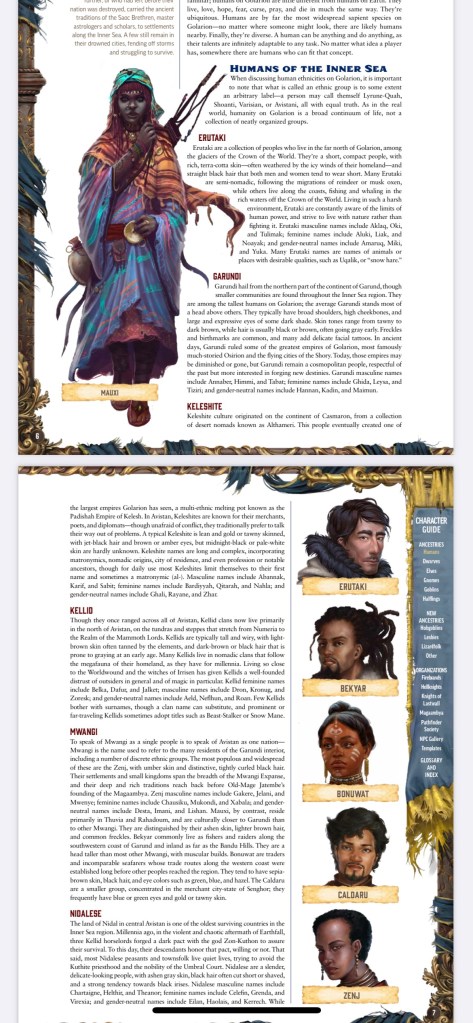
Even the human characters, unlike 5th edition Dungeons and Dragons, get a lot of attention and care and are a lot more compelling to play. The artwork alone depicting humans in Pathfinder is amazingly diverse and fascinating. Take a look at a couple pages from the Lost Omens: Character Guide

Holy cow, the amazing detail and artwork really brings the various cultures of Pathfinder to life, and makes it much easier to find cultures you can identify with. Paizo really needs to pat itself on the back for this effort. Speaking of artwork, the Lost Omens Travel Guide is simply amazing. The Guide is written as a travel guide for players who might venture in the default setting of Absalom and surrounding areas, but provides amazing detail about everything from fashion, to card games, and even recipes that you can try out in real life.

Speaking of which, the fact that Pathfinder is not limited to hardcover books (which are fairly expensive) and openly available online through PDFs, or just through official reference sites makes a lot of this easy to fit your budget level. You can start as you are and learn pretty quickly and cheaply, but if you’re like me and like physical books, you can easily order those either through your local game store or directly through paizo.com.

For all these wonderful aspects of Pathfinder, there is one area I have personally been frustrated and that’s the world building and lore.

A lot of the familiar old settings that I knew from Dungeons and Dragons, such as Eberron and Barovia, both of which predate 5th edition, simply don’t exist in Pathfinder. There are probably good reasons for this due to licensing issues, intellectual property, and so on, but the loss is definitely felt. Fan created conversions for such settings do exist, but they ran the gamut in terms of support and quality. It would have been nice if Pathfinder had found a way to provide more official versions that were maybe similar to the D&D settings, but obviously not carbon copies. Such things may exist, but it’s a bit hard to sift through all the different adventure packs and settings that are printed already.

Some of my Ravenloft novels, along with Sazh from Final Fantasy XIII.

It isn’t all that hard for an enterprising DM to also just convert 5th edition settings into Pathfinder ones, but I do miss being able to just have the reference books handy, for lore if nothing else. Pathfinder focuses on the Lost Omens setting as its introductory setting, and if you played 5th edition, this will feel in some ways like the classic Forgotten Realms Sword Coast. Beyond that though, things get a bit muddier in terms of lore that’s familiar to old D&D players.

Conclusion

In short, compared to Dungeons and Dragons, I have found that Pathfinder has more to learn up front due to slightly more complicated rulesets, and the vast array of books that Paizo has printed for 2nd edition already in the last 3-4 years. But Paizo recognizes this and provides a number of choices and options to help ease the transition. It took me about 2-3 weeks reading Core Rulebook and watching the videos in my spare time, but once I got past that initial hurdle, the rest of Pathfinder 2nd edition just made sense.

I’ve played a bit with my kids, but I would like to find other groups to play in the near future, but as with any TTRPG, finding players is…. challenging.

In any case, Pathfinder is dynamic, exciting and has a lot of offer. They are hungry for customers and are making great efforts to help educate people, and stay responsive to their needs. Where 5th edition has lost its luster for me, Pathfinder is a lot more exciting and compelling.

Of course I still enjoy 5th edition, and it has a lot of memories for me and the kids, but it also feels increasingly like it’s run it’s course, the corporate greed has homogenized the game to the point of being moribund.

The Challenges of Romanizing Chinese Language

Recently, I was reading a couple old-school fantasy novels set in the Forgotten Realms setting of Dungeons and Dragons: Horselords and Dragonwall. These novels, part of the Empires trilogy, revolve around a fantasy re-telling of the Mongol invasion of Song-Dynasty China.

Dragonwall, in particular, centered on the fictional land of Shou Lung, an analog to Imperial China, and introduced a lot of aspects of Chinese culture, such as Chinese military weapons and armor. The challenge was that these were not always explained and so, I found myself wondering what this sword was, or that piece of armor.

For example, a type of Chinese sword called a chien was frequently mentioned but I had trouble visualizing what it was, so I tried to use Wikipedia. There, the sword is listed as jian, not chien.

Which spelling is correct? In a way, both. In a way, neither.

Welcome to the challenges of expressing Chinese language using the Roman alphabet!

In native Chinese, the jian/chien is written as 劍 or 剑 in Simplified Chinese. . A native speaker probably can read this and know exactly what it means, how it is pronounced, etc. If you are a native English speaker, though, and don’t know Chinese, how do you write 劍/剑 in a way that other native English speakers can understand?

This is a surprisingly tricky issue, and not just limited to Chinese-English. Transliterating words in one language to another is always tricky.

Anyhow, there have been a few attempts to solve this issue of transliterating Chinese to English over the years, and Wikipedia has a very extensive article on the subject, but today we’ll focus on the two most common: Wade-Giles and Pinyin.

Wade-Giles Romanization

Wade-Giles is the older of the two systems, and was the most popular system until the late 20th century, and as a system it is vaguely based on the system used for writing Ancient Greek using the Latin alphabet. Since Ancient Greek had the notion of “rough breathing” as opposed to “smooth breathing” (there was no distinct letter “H” in Greek), apostrophes were used to help distinguish them.

In the same way, letters in Chinese such as “ch” and “j” were distinguished using an apostrophe. Thus “ch’ien” and “chien” would be different. The first uses the English “ch” sound (as in “chop”), while the second uses a “j” sound (as in “jot”). Another example is “t’” versus “t”, as in t’ong versus tong. The first is a hard “t” sound, the second is more like “d”.

If this seems confusing, believe me, it is. Another confusion happens with vowels. The letter “u” is pronounced more like “oh”, whereas “ü” is more like “oo”. Thus, using an example from Wikipedia, the word “k’ung” is pronounced as “kohng”, and “yü” as “yoo”.

Wade-Giles had been the de-facto system for so long, that a lot of English literature that uses Chinese names and words (including my D&D novels above) continues to use it even though it’s frankly pretty antiquated. Wade-Giles is easier to learn upfront because it looks more like natural English, but it uses a confusing system to represent Chinese sounds, and therefore it’s easier misread. Just remember sounds with apostrophes versus sounds without is confusing enough.

Hanyu Pinyin

The other system that’s increasingly in use, and frankly better in my opinion, is the Hanyu Pinyin (or “pinyin”) system. This system requires more work upfront, but provides a more consistent experience because what you see is what you get.

For example, each consonant sound is expressed only one, distinct way. In the “ch’” versus “ch”, pinyin expresses these as “ch” and “j” which is definitely more intuitive. Similarly, “t” versus “d” is pretty straightforward.

Vowels are where pinyin becomes tricky because Latin has only 5 letters to express vowel sounds, and Chinese (just like English) has a lot more than 5 vowel sounds. Unlike ancient Latin which differentiated “I” (as in “fish”) versus “Ī” (as in “ring”), English lost the diacritics and so the sounds just double-up on the same letters.

To work around this, Pinyin uses consonant-vowel combinations to make this work. “Chi” expresses the sound “chih” which rhymes with “fish”. By contrast, “Qi” expresses the sound “chee” as in “cheese”. In the same way “zhi” sounds like “jury” without the y, and “ji” sounds like “jee” as in “jeans”.

The vowel “e” is tricky too since it sounds like “uh” as in “done”. So the surname Cheng does not rhyme with “send”, it rhymes with “sung”.

So, whereas Wade-Giles relies on consonants and apostrophes to express sounds, Pinyin relies on consonant-vowel combinations.

Conclusion

Both systems, like every other attempt at romanization, are imperfect efforts. This is not a fault of the creators of these systems though: transliterating languages is always tricky.

However, of the two systems, I find Pinyin more intuitive overall once you get past the initial hurdles. You don’t have to worry about apostrophes, and most consonants are just more intuitive to read.

Unfortunately, due to cultural inertia, you’ll still find Chinese words expressed through the Wade-Giles system in all sorts of unexpected places.

P.S. if you think Chinese romanization is confusing, wait until you see Korean romanization.

P.P.S. If you’re wondering how good the books are, that’s a subject for an upcoming post. 😏

A Nerd Dad’s Review of Pathfinder 2e Beginner Box

The recent fiasco by Wizards of the Coast (who owns Dungeons and Dragons) has left me pretty bitter toward 5th edition1 and the company that owns it. If Mordenkainen’s Tome of Foes wasn’t frustrating enough (“buy your $50 book again!”), this was the final straw.

I decided it was time to try Pathfinder again.

Again, you say? Allow me to explain.

Aeons ago, circa 2016, my coworkers and I played an after-work campaign of Pathfinder, 1st edition. The campaign lasted about 2-3 months but it was a miserable, stressful experience for me. The DM pushed us to optimize (e.g. “min-max”) our characters for awesome battles, using lots of custom 3rd party content, feats and builds that made really confused even as I was still to wrap my head around the basic rules. The DM knew the rules and feats like the back of his hand, but frankly wasn’t very empathetic to new players, and just wanted to host cool battles. Looking back, I believe the issue was more with the DM than with the game.2

I gave up, but I always felt someday that I should give it another try … someday.

Enter Pathfinder, 2nd edition (Pf2e): a major update to Pathfinder that came out in 2019. It streamlined and updated a lot of challenges with 1st edition, and includes a lot of good introductory material to help new players ease into this. A prime example is the Beginner Box which I ordered direct from Paizo.com after my local game store already sold out (believe me, I am not the only one locally who is mad at WotC).

My goal was to learn Pathfinder 2e properly, and at my own pace, so I could avoid the unnecessary stress of learning a new system, and actually keep things fun.

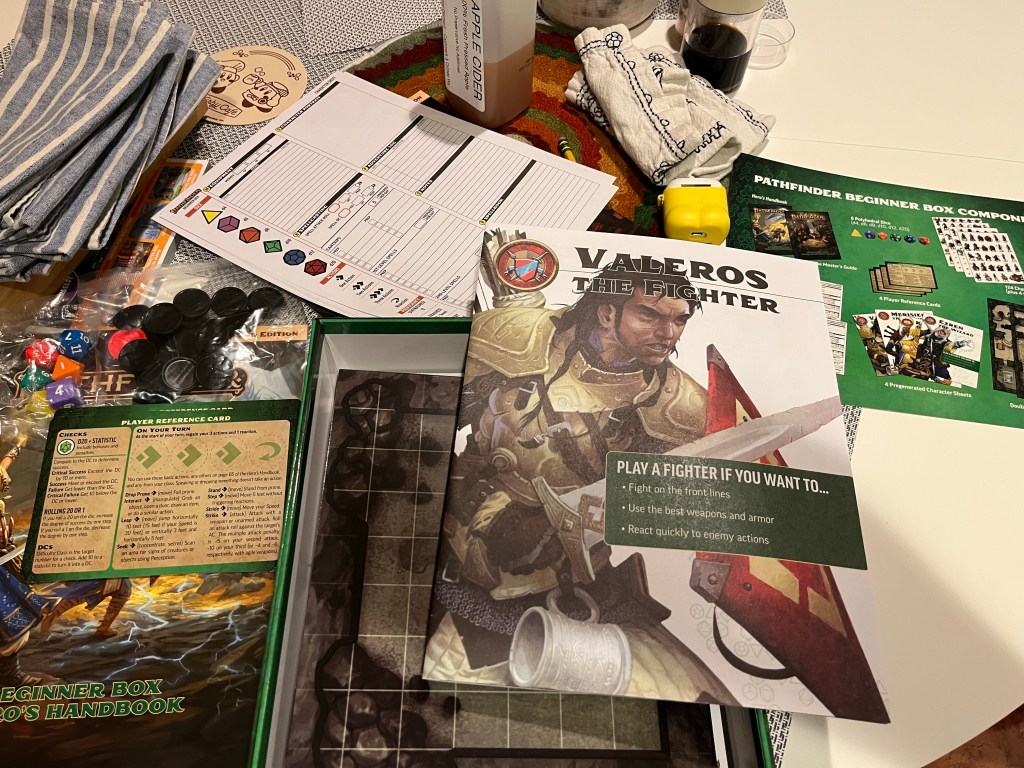
A week later, my box came in the mail:3 🎉

Yay, new package in the mail! Sadly, the little Starfinder figurine that was included was already smashed upon delivery.

The Beginner Box contains everything you could possibly need for both a DM and a group of players to start from scratch:

  • a self-contained adventure (more on that later): Troubles in Otari.
  • a full set of dice, color-coded to match the symbols on the character sheets
  • pre-made character sheets with very easy to read stats, plus blank sheets if you still want to make your own. These look really nice by the way.
  • Two step by step guide adventure guide for Troubles in Otari, one for the DM and one for the players. These two books also function as a very slimmed down core Rulebook for Pathfinder 2e, including character building options, combat rules, etc.
  • fold-out adventure map for Troubles in Otari.
  • monster stand-up cardboard “tokens” for map, both a variety of player characters and all the monsters necessary for the adventure.
  • laminated “action cards” to help players decide what they can do during their turn
(please pardon the messy table…)

My kids, both experienced 5e players, were a bit hesitant to try Pathfinder since the only game system they knew and grew up with was D&D 5th edition, and as a busy parent I didn’t have much time to prepare Troubles in Otari either. So, both the kids and I essentially went into this first adventure blind.

I let my kids each pick from the pre-made character sheets for now, and I ran any character not chosen (Valeros the Fighter in my case) to ensure the party was rounded out. I read over the adventure guide for a couple minutes to get my bearings and off we went.

As a stand-alone adventure Troubles in Otari is a good, classic dungeon crawl. What makes it genius though is how each encounter teaches you another aspect of gameplay, each one slightly more advanced than the previous. So it is also a tutorial to the game.

The adventure guide for Troubles in Otari walks you through each step of the way: what happens if players do X, what happens if they hit a skeleton with Y, etc. Experienced DMs can gloss over if they want, but it helped me a ton in making the mental transition from 5th edition to Pf2e and keep things running along. I hand-waved a few spots for pacing, but what DM hasn’t?

Also, the DM and Players Guide both can standalone as introductions to Pathfinder 2e without having to invest in the Core Rulebook. Since it is a minimal introduction, a lot of character build options and combat details are missing, but this does ease new players up into the game, without having to read all the rules upfront.

My kids loved the “3-action” combat system, the change to perception rules, and the pre-made character sheets. Pathfinder 2e, as a whole, was familiar enough for kids who’ve played 5e to quickly adapt, but also fresh enough to keep their attention. The cardboard tokens were also popular as they made the combat fun, without investing a ton in figurines that I may or may not have.

We completed most of the 1st floor of Otari in about 2.5 hours before we got tired and took a break (my teenager also had homework to do). We will try to finish next weekend, and the kids are already looking forward to generating their own characters using the Core Rulebook (which I purchased at the same time, and will review separately).

As an introduction to Pathfinder, this was a pleasant experience and a useful teaching mechanism to myself and my kids. It was a far cry from the stress-inducing experience I had ages ago, and a fresh start to Pathfinder, as well as a great alternative to 5th edition Dungeons and Dragons.

Even if you are a pretty experienced TTRPG player, it really helps to have a nice hand-holding tool like the Beginner’s Box, to help with the mental transition in rules. Also, the materials included are re-usable in other contexts as well, so it’s not a one-and-done investment either.

P.S. Basic Liches did a really nice review of the Beginner Box here too, and it pretty much lines up with my experiences as well:

1 My kids had to talk me down from selling most of my D&D 5e books to the local used bookstore. It was a sunk cost, and doesn’t do much good to sell now, as we might still play in the future. Instead, we agreed that we’d buy no more D&D products for the foreseeable future. In any case, One D&D doesn’t interest me anyway, so I see little point in that either. My D&D Beyond subscription has already been cancelled too.

2 The same DM also took us through a D&D 5th edition play-through of the Mines of Phandelver, which started out well enough but eventually spiralled out of control too. So, there might have been a pattern.

3 Given that I live about 45 minutes by car from the Paizo headquarters, it’s quite amusing to watch my package go through an elaborate, Byzantine series of handoffs with one carrier to another before it finally arrived. In theory, I could have driven down to pick it up myself, and saved a week of waiting. I don’t blame Paizo for this, but I do blame the amazingly inefficient shipping process. Also, to be fair, I did pick the cheapest shipping option, and well, you get what you pay for…

When It’s Over…

I loved this song back in the day, but the music video sure hasn’t aged well…

Last night I finally got to play Adventurer’s League at the local gaming store for the first time in maybe a year, patiently waiting since for my kids’ school activities to end for the school term, and getting my character dusted off and ready to go.

But it was a terrible night. The adventure module we played, something from Season 7 Tomb of Annihilation, was poorly designed, and our DM was just an inexperienced kid who tried his best but hadn’t prepared enough.

The worst part though were some of the other players. I sat in the farthest back, surrounded by a number of “power players” (including one dad who brought his teenage daughter), who kept talking over me and one another. They kept pushing the rules envelope, and the DM didn’t really have the confidence or experience to make decisive choices about allowing this, or saying no to that, so the power players ran roughshod over the game. Within the first hour, I checked out, and spent the evening on the phone, venting on Twitter (rant since deleted) and hardly said anything for the rest of the night. I was all too glad to leave when it was over. The module had been scheduled for 2 hours, but we stayed almost for 5.

And yet it was more than that. The gaming store, which thankfully weathered the pandemic, still felt very different. Overly-complicated food menu, unfamiliar staff, flashier “gamer” vibe, etc. The large community of AL players I used to know back before the pandemic has almost entirely disappeared, or play their own table exclusively leaving occasional players like me at the “little kids table”. Where before we usually had 4-5 tables a night, and I knew all the senior DMs, I recognize almost no one now. That goes double for the other players.

In short, the local AL community really sucks now, and the gaming store isn’t what it used to be. When I last played during the pandemic, it had also been a bad experience, though not quite as bad. So, I just chalked it up to the occasional bad night. They happen, and you move on.

However, it’s clearly become a pattern and I finally had to face the fact that the local gaming community that I once knew is over. The pandemic and WotC’s tinkering with AL rules drove off a lot of committed players, and in a sense gutted my local community. Further, I’ve lost interest in newer D&D rule books,1 and our local regional Discord channel is very quiet now.

As I wrote back in the day, sometimes it’s better to just not play D&D than subject yourself to a frustrating and disappointing experience, but I kept trying through the pandemic hoping things would eventually recover. They haven’t. And as with Magic, I have to face that sunk-cost of investing any further in it, and give it up.

Never say never, of course. Even if I don’t like the community now, who know how things will look say five years from now. Maybe I’ll find another, healthier AL community someday. But for now, I’m putting that hobby on a shelf for the foreseeable future.

Contrarily, playing at home with my kids has been a lot of fun, and my daughter’s friends want to play with us too, so while my local gaming community has faded away, I suppose a new one is being formed right under my nose.

1 The new Mordenkainen’s book somehow just feels flat, homogenized, and takes a lot of fun out of playing certain character builds. I did get Witchlight and Candlekeep Mysteries, but have hardly cracked open either book since.

Playing a Warforged in D&D

Front cover art for Eberron: Rising from the Last War, adapted from free wallpaper art (see link), all rights reserved

My kids and I have been playing a longer D&D campaign in the world of Eberron, a noir steam-punk magic setting for almost a year now, and the kids consistently seem to enjoy this setting more than other D&D campaigns we’ve run. Since we have only two players (my daughter and my son), the party consists of:

  • Daughter: Swiftstride shifter fighter / ranger, Latisse
  • Son: Halfling bard, Kirby1
  • Sidekick: Hobgoblin cleric (knowledge) / wizard, Borsheg
  • Sidekick: Warforged fighter (samurai), Malbus 414
  • Sidekick: Valenar (wood) elf fighter, Tantalus

I run the sidekick characters myself, and some have come in and others rotated out.2 The hobgoblin and warforged sidekicks have been with the party since the beginning and have been a pretty integral part of the story.

Our hobgoblin cleric’s backstory is that he secretly wanted to be a wizard instead and only did the cleric role out of familial obligation. However, since Borsheg was rejected by the wizards guild, he has since gotten private tutorship on the side with a shady teacher named “Dak” who, currently unknown to the party, is a Rakshasa.

Our Warforged has become the most central character to the party though. Originally, Malbus 414’s backstory was that he had, like all Warforged, fought in the Last War, particularly as part of the 523rd Battalion in East Breland. However, it became clear that his entire platoon had been secretly conditioned by their gnomish creator, Dr Vilnius Volrani Vishkik, to attack any gnomes from a certain rival house on sight. Eventually, the kids were able to find an artificer who could remove Malbus’s conditioning, and scrape up enough money to pay for it, but at the cost of partial memory loss. The kids really got choked up when they realized that Malbus wasn’t going to be quite the same.

Out of all the stories that I’ve teased in front of kids, including demonic cults, Borsheg’s evil tutor, smuggling jobs, etc, the kids have really attached themselves to Malbus’s and have since pursued Dr Vishkik (who unknown to the kids, is now a glorified brain-in-a-jar) across continent only to discover that he has reconstituted most of the old 523rd platoon, and means to take on the Lord of Blades in Cyre in order to become a new ruler there, assert dominance over all Warforged at large. Malbus is torn between his loyalties to his old platoon, but also his new purpose in stopping Dr Vishkik, especially where violence is required.

Mechanically speaking, a Warforged is an interesting character race since it’s fully artificial, yet is also a living being. According to the 5e guide, if you play a Warforged, you (among other things):

  • Gain a +1 bonus to Armor Class.
  • Have advantage on saving throws against being poisoned, and you have resistance to poison damage, and are immune to disease
  • Do not require sleep, but when you take a long rest, you must spend at least six hours in an inactive, motionless state, rather than sleeping. In this state, you appear inert, but it doesn’t render you unconscious, and you can see and hear as normal. Further, you don’t need to sleep, and magic can’t put you to sleep.

These things all come from the Warforged’s artificial nature. However, as a living sentient being, you can still benefit from things like healing magic, potions, etc., so you are not a construct either. It’s not entirely clear to what degree a Warforged is a machine vs. a living being, but I’ve mostly leaned toward the artificial, and focused on the “power core” as a source of their sentience and humanity.

The mechanics of a Warforged are fun, but the role-playing side of the Warforged is what I find most compelling. Because the Last War is over, Warforged are kind of superfluous now. Society doesn’t need them anymore, and they are no longer manufactured (at least in mass-production), so they have been tossed out on the street with no clear picture of what to do with themselves. This leaves plenty of room to decide how you would want to play a Warforged. Malbus 414 initially took mercenary jobs because war was the only thing he knew, but once he met the party during the initial session, he gradually took his life in a new direction with them.

The official interview with creator Keith Baker helps clarify this and is worth a watch:

I tend to roleplay Malbus 414 similar to Commander Data from Star Trek: The Next Generation, in that he is searching for his humanity, and trying to forge a new identity for himself bit by bit as something more than just a war machine. One could conceivably do the opposite and play a Warforged who never really left the Last War. The noir, brooding atmosphere of Eberron really lends itself to this, because of the heavier emphasis on character backstory, personal challenges, etc, but if you play a Warforged within the larger universe, such as Planescape or even the Forgotten Realms somehow, the brooding war backstory can still come into play and create a good starting point for the character.

Or you could just make a character like this one:

Comment posted in linked video above

I wish Warforged were more available in other settings, not just for its useful mechanical reasons, especially in Adventurer’s League, but I am happy to play one when the opportunity comes up. Its nature lends itself to good role-playing, and its mechanics allow for all kinds of interesting character / class options.

1 My son is a huge Kirby fan.

2 Our half-orc rouge-scout sidekick died a few weeks back in a random encounter, and the elf fighter replaced him since the party was near Valenar anyway. I keep a pool of sidekicks in the backlog in case I need to replace one. Still, the half-orc scout was a good character in his own right, and the kid and I kind of miss him already, even as we enjoy the new character.

Meet Darahl Firecloak: the Elven Forge Deity

Photo by thevibrantmachine on Pexels.com

For some time now, I’ve been actively playing a high-elf cleric of the forge domain named Fenmaer Wasanthi in a small play-by-post community for Dungeons and Dragons’s Adventurer’s League. It’s been great fun, and one of the few consistent bright spots in the last two years for me. Fenmaer had initially been something of a throw-away character that I had intended to use for the new season 10 rules of Adventurer’s League (and never did), but when the season 11 rules came out, fixing a lot of issues, I decided to bring back Fenmaer and try things out.

My characters home is Elventree, near the city of Mulmaster, where a small, dwindling community of high-elf forge masters still maintains an obscure cult to Darahl Firecloak. Fenmaer being (comparatively) the youngest has been tasked to rekindle the community through acquired knowledge and experience. When our PbP group started doing adventure season 7 modules (“Tomb of Annihilation”) in Chult, I also had a small side-story where Fenamer got in touch with a scattering of Darahl worshippers in Port Nyanzaru as well.

Darahl’s sketchy history makes him an interesting “anti-hero” elven deity, who is not affiliated with evil, but also sundered from the rest of Elven pantheon too and forced to “go it alone”. That said, when trying to flesh out Fenmaer’s backstory and role-playing, I realized that there is not a lot of information about his deity, Darahl Firecloak.

The main source of information comes from one issue of Dragon Magazine, issue 251, which can be found online in PDF form. Fifth Edition material on Darahl (i.e. Mordenkainen’s Tome of Foes) largely preserves this without adding much too it. Below, I’ve included basic information both canonical (Dragon Magazine + Mordenkainen’s) followed by additions that I’ve added for Fenmaer specifically. If you like, feel free to use it, adapt, etc. Spread the faith of Darahl to player characters far and wide. He’s not a picky deity, as you’ll see. 😋

Canonical Information

Starting with the basic stats:

  • Name: Darahl Firecloak, originally Tilvenar
  • Nicknames: The Even-Tempered, Lord of the Green Flame
  • Alignment: Lawful Neutral, leaning toward good
  • Follower Alignments (optional): typically LN, LG or NG
  • Symbol: A greenflame between two outstretched hands
  • Domain: Forge (5th edition), Earth and Fire (3rd edition?)
  • Symbolic Weapon: longsword

Darahl Firecloak was originally part of the elven panthan, the Seldarine, and served under Rillifane Rallathil, but after being offered a cursed artifact by Lloth and the Unseelie Queen of Air, his avatars went beserk and caused a great deal of destruction before being pacified again. However, the damage had been done and Darahl lost many followers, while also being shunned by the other elven deities. Darahl left the plane of Arvandor and made his home in the 1st layer of Arcadia where he first took the name “Darahl Firecloak” and began to reinvent himself. Darahl is now much more open to non-elvish followers, and alliances with non-elven deities such as Dumathoin of the Dwarves, Urogalan of the Halflings, and Flandal Steelskin of the Gnomes for example.

Because Darahl is so open to other followers, he has even some followers from the Underdark, particularly Duergar. For this reason, both Lloth and Laduguer oppose him. Darahl, according to Dragon magazine, is often invoked by followers at the start of a new undertaking such as digging a new mine, or crafting a magical artifact, or to help avert disasters such as earthquakes and forest fires. Offerings by the faithful include precious minerals or minor magical items. Priests are also called firecloaks and often dress in motifs of yellow, red and brown with a green flame somewhere.

That’s the canonical stuff. Let’s move on to Fenmaer’s religion in particular.

The Molten Path

Fenmaer’s high-elf community in Elventree were more prosperous in the past and their craft earned the respect of their neighbors as well as other traders from afar. I was heavily inspired by the Noldor of J.R.R. Tolkien’s The Silmarillion who also had unparalleled crafting skills in comparison to other elves and races. The Elventree high elves remained somewhat apart from their more numerous wood elf neighbors and fellow residents in Elventree, yet as the human community of Mulmaster later flourished, the elves diminished. Thus, the high elf community did what elves do best: retreat further in isolation, only to their detriment.

The elders of Fenmaer’s community teach an offshoot of Darahl’s religion called the Molten Path. Contemplatives, priests and some mages as well, seek to burn away their own “impurities” (just as metal is purified by fire) through a hard work ethic, devotion to their craft, and community. Through this they believe they see the handiwork of Darahl in all things, and in themselves.

According to the high elves of Elventree, Darahl dwells in Arcadia at a place called Maldinnon, the Peerless Forge, where he guards the Eternal Flame,1 and uses it to mold and craft the many things of the world. In Platonic philosophical style, that which He crafts is said to be the peerless example of that object to which all others seek to emulate in their craft. By contrast the elemental evil represents attempts to corrupt the peerless works of Darahl and profane his craft, and must therefore be opposed by all followers.

Through the PbP adventures, I’ve had Fenmaer recite a few prayers and liturgy, sometimes more serious, sometimes more joking:

“Hail Tilvenar full of fiery grace…deliver us from elemental evil… and lead us not down the path of rust and ruin…”

and a benediction like so:

I call upon Darahl Tilvenar, the blessed Firecloak, who keeps the Sacred Flame free from impurities, and molds metal as he molds souls into fine vessels for the good of others. Be ye most kindly disposed to us, let your warmth and radiance fill the hearts of this family and guide them through the darkness with your light. Let not the elemental evil obstruct their path. May their coffers be bountiful and their worries few. (then in Elvish…) Vardo nu luini yassen Tilvenárii eleni ómaryo airetári-lírinen.

or:

Tilvinarë na-molonen! (Tilvenar don’t fail me)

Fake elvish

or:

Tilvenar, may your fiery Cloak descend upon us!

and:

In the Name of the Firecloak

When Fenmaer reached 7th level, he acquired the Divination spell, and used it to contact Darahl for some questions concerning their next adventure. I described the ritual like so:

Using the ground iron, copper, silver, gold and copious coal dust, Fenmaer draws a large, intricate “sand mandala” on the ground between him and a small lit brazier. The different ground materials form different colors in the mandala. Once that’s done, his chanting continues on in Old Elvish for a while until observers notice that the filings have somehow heated up and are glowing red hot. Not melting, just red hot. Finally, he poses his question…

So, those are some non-canonical examples of how I applied Darahl’s religion in role-playing Fenmaer. Like any religion, one can imagine many regional differences, or even liturgical differences among communities, so in role-playing a follower of Darahl, feel free to adapt, adjust or innovate your own liturgy or community teachings. Or feel free to use what’s here and help spread the Word.

P.S. a big thanks to my DM and my fellow players who put up with Fenmaer’s religious antics. 😄

1 I had envisioned it as a white-hot flame until I saw the Dragon Magazine article later. You are welcome to decide what the actual color is, dear readers.

Yo Mando! The D&D Version

Lately, I’ve been re-watching The Mandalorian and while I enjoyed it the first time through, I enjoy it a lot more the second time around. I’ve been thinking about how I might make a Dungeons and Dragons character for Adventurer’s League that mirrors the Mandalorian, Din Djarin.

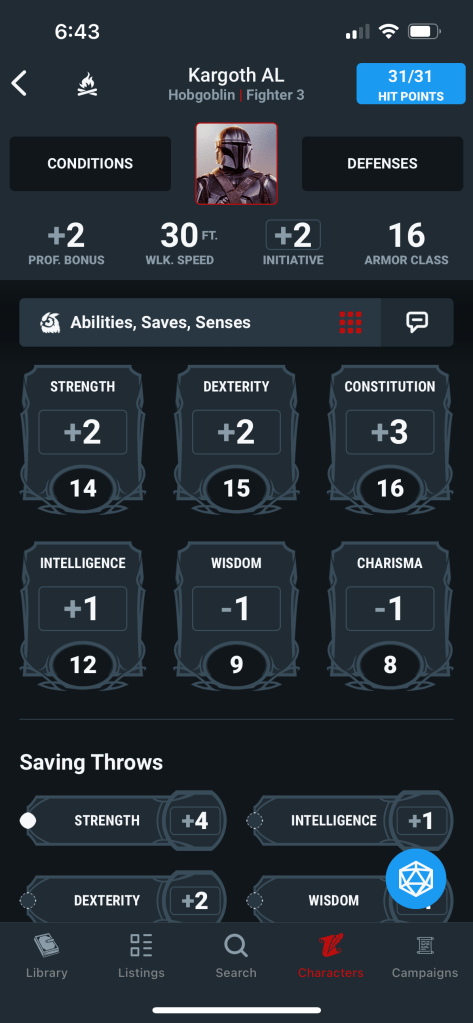
I wrote recently about hobgoblins in D&D and how they mirrored Klingons in some way, and at that time I made a character named Kargoth toward that end. I played a couple tier-1 sessions, and it was fun, but the character wasn’t as interesting as I would have liked.

Then, after re-watching The Mandalorian, I got an idea. Since the new, season 11 rules allow for much easier rebuilding of characters, I decided to use the opportunity to rebuild Kargoth as a Mandalorian-style hobgoblin fighter, eldritch knight:

Kargoth’s backstory is that he was adopted after being a child on the losing side of a war by a fanatical cult of warriors (e.g. Children of the Watch), but hides his hobgoblin identity in public using a helmet, as well as following the religious ethos he was raised with. Helmet is cosmetic only and provides no additional armor class. Kargoth also has the hermit character background unsurprisingly.

Eldritch Knight as a subclass made surprising sense because first and foremost he would have to be a warrior anyway, but as an Eldritch Knight he would have many additional tricks up his sleeves that can be approximated as magic spells:

It’s fun to be a little creative here since every Mandalorian will be a little different anyway.

The real challenge is the hobgoblin racial character stats. A bonus to Intelligence helps with playing an Eldritch Knight, but the bonus to Constitution doesn’t have an overt benefit beyond more hit points.

I debated back and forth and opted to make Kargoth mostly a ranged fighter, to match the Mandalorian as a crack-shot. I gave him the Archery fighting style, equipped him with both a hand-crossbow (for later Crossbow feat) and a heavy crossbow. But, I also gave Kargoth enough Strength to handle melee combat too.

For armor I settled on Medium armor with the goal of getting good half-plate someday. The Mandalorian seems to wear half-plate rather than full-body armor and this allows me to continue focusing on Kargoth’s Dexterity based build.

Lastly, the kid. I debated using my “free spell choice” as an Eldritch Knight to cast _Find Familiar_ but a pet raven is a lousy substitute for Grogu (a.k.a. baby Yoda). So, for now Kargoth doesn’t have a sidekick … yet. Then again if I want to rebuild I can certainly do that too.

Enjoy!

This is the Way.