My son and I visited our neighborhood bookstore recently (shop at local, independent bookstores!) and I found this neat book worth mentioning called The Blue Cliff Record, translated by David Hinton.
The Blue Cliff Record, known in Chinese as the Bìyán Lù (碧巖錄) is actually a pretty old text in the Chinese Chan (Zen) tradition, and is a collection of Koans compiled in the year 1125 by Yuanwu Keqin (圓悟克勤, 1063–1135).1 Obviously, the koans themselves were older and handed down over time, and appear in other collections, but the Blue Cliff Record is a kind of “selected wine list” of koans. The Blue Cliff Record was compiled during the Song Dynasty in China, which while politically unstable due to the Mongols, was a cultural high-water mark of Chinese Buddhism and especially the Chan tradition. Not surprisingly, Japan’s Zen traditionimported much from this time period as well.
This is not the first time I’ve studied koans, though.
In my youth, when I first explored Zen, I had a copy of the Gateless Gate by Mumonkan, and my religion studies teacher in high school assigned us each a koan to solve in class. Of course, none of us actually solved them, but it was a fun exercise. But as with my studies in Zen, I gradually forgot about it until recently, so it’s like coming back full circle after more than 30 years (!).
But what the heck are koans?
“Koans” are more properly called Gōng-àn (公案) in Chinese. The word “kōan” is how those Chinese characters are pronounced in Japanese, and this term is more widely known to Westerners.2 Koans are cryptic dialogues, often between a master and student, and widely used in the Lin-ji school of Chan Buddhism. As we saw in my recent post, Lin-ji is predominant in China, but also spread to neighboring countries, and in Japan’s case it became both the Rinzai and Obaku sects (albeit different centuries). Temples such as Kenninji and Ryoanji are examples of famous Rinzai temples in Japan. The Soto Zen tradition doesn’t rely on them as much, but inherits the same collections, as it is desecnded from the Cao-dong (not Lin-ji) school in China.
David Hinton in his foreword on the Blue Cliff Record explains that the key to understanding a Koan is to see it like a kind of public law case. When law students review famous court cases, they have to review the nature of the complaint, evidence presented, the judge’s decision, past precedence, etc. If you’re not a law student, this is hard. But if you’ve been practicing law for a long time, immersed yourself in it, then you see it with a different eye.
In the same way, Mr Hinton writes, a Koan is like a “public sangha case”. The “sangha” is one of the Three Treasures of Buddhism, and means the Buddhist community at large. So, these are public sangha cases for students to review, contemplate, and so on.
The truth is, when you read a Koan for the first time, it basically makes no sense whatsoever. You might think you get it, then you gradually realize that you really don’t. Then it gets under your skin, and bothers you enough that you might stick with it, until maybe one day, you look at it and you think “duh, of course!”
But also, some “public sangha cases” will resonate with you more than others, or at different times in your life.
Since I don’t participate in any Zen communities at present, I decided to do a little experiment. The Blue Cliff Record has exactly 100 cases in it, and being a giant nerd, I decided to pick one at random as my koan to contemplate. I took 2d10 dice from my Dungeons and Dragons set. Then, I briefly prayed to Kannon Bodhisattva and Shakyamuni Buddha and rolled the dice. I got koan #20 which David Hinton translates as “Dragon-Fang Meditation Clapper”:
When he was a monk traveling, Dragon-Fang Mountain asked Kingfisher Shadowed-Emergence: “What is the ch’i-weave mind [意] Bodhidharma brought from the West?”
“Pass me the clapper to announce meditation,” said Shadowed-Emergence.
Dragon-Fang passed the wooden clapper to Shadowed-Emergence, who swung it and struck Fang a blow.
“You can strike me all you want,” hissed Dragon-Fang, “But there’s still no ch’i-weave mind for Bodhidharma to bring from the West.”
Traveling years later, after his awakening under Fathom Mountain, Dragon-Fang asked Purport Dark-Enigma: “What is the ch’i-weave mind Bodhidharma brought from the West?”
“Pass me the meditation cushion,” replied Dark-Enigma, who swung it and struck Fang a blow.
“You can strike me all you want,” hissed Dragon-Fang, “But there’s still no ch’i-weave mind for Bodhidharma to bring from the West.”
Translation by David Hinton
Confusing? Yes. Mr Hinton takes the unusual approach of translating the monks’ names into English, hence “Dragon-Fang” and “Shadowed-Emergence”, etc. so it takes a bit of getting used to. The term “ch’i-weave mind” (意)3 takes 2 pages to explain at the end of the book, and I can’t do it justice, but for simplicity here I will crudely summarize it as the Big Mind, as opposed to one’s normal everyday mind.
Even so, this koan doesn’t make a whole lot of sense. I think I get it, but do I really get it?
I suppose time will tell…
Namu Shakamuni Buddha Namu Amida Buddha Namu Kanzeon Bosatsu
1 Pronounced like “yuen-wu kuh-cheen”
2 Many Buddhist terms in Japanese are just local pronunciations of Chinese-Buddhist words (often from Hokkien dialect, not Mandarin, due to its proximity to the Japan islands). This same trend happens with Korean-Buddhist words, Vietnamese-Buddhist words, and so on. If this sounds strange, consider religious words in English. They are often derived from Latin, for obvious reasons, but the pronunciation gets muddled over many generations, especially since they were often filtered through Middle-French (via conquering Normans). This is how religious ideas and words spread.
3 This Chinese-character is used in such Japanese words as:
意味 – imi or “meaning”
意識 – ishiki or “consciousness”
注意 – chūi or “caution”
用意 – yōi or “to prepare or provision something”
…. you get the idea. It’s used a lot, but kind of abstract too.
As I wrote a short while ago, I have grown tired of Dungeons and Dragons, and alluded to a different RPG system called The One Ring. The One Ring (TOR), produced by Swedish company Free League Publishing, is a role-playing game (RPG) designed entirely for The Lord of Rings fantasy setting by J.R.R. Tolkien. Whereas D&D and Pathfinder are more generic rule systems that can be applied toward many fantasy environments, TOR is designed exclusively for the Lord of the Rings “Middle Earth” setting.
The core rulebook for The One Ring costs $60 in the US, but with it you get all the basics you need: how to make a character, how to run an adventure as a Loremaster (a “DM” or “GM” in other systems), and even the basic monster compendium. Compare this to D&D 5th edition, which requires $150 for three books. The D&D core books have a lot of content, to be fair, but if you want to get started in The One Ring, having a single book for a reasonable price is an easier start. Also, it is available as a PDF file on DriveThruRPG, I believe, for even cheaper.
The core rulebook is very well done, and the artwork is really amazing (some of it is on the page linked above), and bring out the “feel” of the game. There are other supplements available as well which are also available through DriveThruPRG as PDF files, or hardcover on the website above.
Let’s discuss the basics of The One Ring system…
The Basics
The focus of TOR is thus much more immersive into the “look and feel” of the Lord of the Rings setting. The emphasis is much less on combat and magic powers, but more on day-to-day adventuring in the Middle-Earth setting. This means you have to take into account things like:
Planning where you are going in Middle Earth
Tracking day to day travel from point A to point B
This sounds tedious, but it isn’t. The rules are pretty straightforward.
Your stuff: things like encumbrance (load) matter. You have to consider how much you are carrying, including treasure.
Downtime, who you will spend Yule with, dealing with mental wellbeing, etc.
Healing from injuries (you cannot just magic away injuries).
Death, and any heirs for a player character.
What you get is a really mood-driven, realistic feel for life in Middle Earth. The adventuring (including combat and exploration) is still a core part of the game, but now you really get to slow down and immerse yourself in that world. That’s no small feat.
I emphasize this because many years ago I played a different LoTR-based RPG system produced by ICE using the “Rolemaster” rule system. This was a generic role-playing system used at the time, but modified for the Middle-Earth setting. I read through the book many times, and while it looked cool, even back then it felt like this wasn’t really an authentic Lord of the Rings game. Since that time, other systems have tried the same thing with mixed results.
Thus, what I like about TOR is that it conveys the Middle-Earth “feel” better than any system I’ve seen so far. It’s really fun to make a character, and imagine how they fit into the setting, and to also go to places that have historical significance in Middle-Earth, and somehow it really feels like you are there.
But how does the game play compared to Dungeons and Dragons and such?
Gameplay
First, TOR relies on a different dice system relying on a combination of d12 “fate dice” and d6 “success dice”. Certain numbers have significance on the dice: for example the 12 on a d12 is something akin to a “natural 20” in D&D, while an 11 is the opposite. The 6 on d6’s also provide extra bonus successes if you get them. There are specialty TOR dice you can get, which replace the 12 and 11 with the Gandalf rune ᚠ, and the 11 with the Eye of Sauron. These are not strictly necessary to play the game; a standard set of d12’s and d6’s will suffice.
The system for handling challenge roles is pretty straightforward, but the vocabulary takes a bit of getting used to (e.g. “favored” vs. “inspired”). After a couple of solo play sessions I got the hang of it.
In fact, the overall stats system in TOR is much simpler than D&D. You can easily fit your character onto a single sheet, and still have plenty to keep you busy. For testing purposes (namely “Strider Mode”, which I’ll cover later), I made a test character, a Dwarf named Frár son of Nár, using the core rulebook naming suggestions.
This is the example character sheet I made for myself. I wrote this in haste late night after my son had gone to sleep, so my handwriting is even worse than usual. Still, I like how it all fits in one sheet and is very easy to manage.
As you can see, the basic stats are three, not six like D&D / Pathfinder: strength, heart and wit. Frár had good scores in strength and wit, but pretty low in heart (he is not a bold person). The core rulebook gives you a preselected list of stats for each heroic culture, and you choose the combination you want. Having only three stats means some skills fall into buckets that might not entirely make sense (awareness for strength), but I am not troubled by this. The streamlined mechanics are nice.
I also like the fact that the challenge ratings for most things is based on your own stats. If you have high strength, the challenge rating for strength-based challenges is thus easier. Similarly for heart and wit. This hurt Frár though, because even with good travel skills, he frequently failed basic travel checks and ran into a few issues on his first journey. On the other hand, as a treasure hunter, his wit skills (and low challenge rating) will definitely come in handy. Frár just isn’t a bold traveller, I guess.
Speaking of streamlined: your stuff. Money isn’t meticulously tracked in TOR, and so when you make your character, you can pretty much equip it with any basic items you want (with a few restrictions based on cultural wealth). Further, during Fellowship phase (i.e. downtime), you automatically manage basic maintenance of consumables, travel rations, etc. Treasure is abstracted as “treasure points”, apart from rare or magic items, so you don’t have to carry around 5,000 copper coins to and from a dungeon. In other words, day to day maintenance of your character is assumed, and you don’t have to put much effort into it. You do have to consider the overall bulk of what you’re carrying (including looted treasure) because fatigue and endurance are really important in TOR. Fatigued characters definitely start to have problems, and it is not so easy to recover from. So travel wisely.
Side note, horses are really helpful, and fun. Frár has a horse that I named “Old Nob” for some reason. Horses will shoulder some of the burden, and help limit long-term fatigue. Plus, the game doesn’t allow harm to come to the horses (animal cruelty is not OK), so it’s nice to own a pony or horse.
Similarly, endurance is a more short-term form of fatigue and is used both in combat (instead of hit-points), and outside of combat. If your endurance falls below your load + fatigue numbers, you take penalties as well. If your endurance falls to 0, you are unconscious. In combat, this will knock you out, but a grievous wound can potentially kill you, or permanently scar you. Again, this simple, but realistic focus really gives combat more consequence than D&D.
Combat itself is somewhat complicated in some ways, but simpler in others. Strategic battle maps are not needed in TOR, and issues around initiative are simpler. The mechanics of who hits who are somewhat “number crunchy”, and it’s mostly based on your own ability to parry, rather than armor class. Getting a grievous wound is bad though, and there’s a significant chance it will outright kill your character. Stronger armor helps avoid this, but at the cost of lugging it around all the time (fatigue). So, choose carefully. Anyhow, positioning is a simple “three tier” setup where you’re either upfront, in the middle, or back. Being upfront lets you hit more, but enemies can hit you more too. Being in the back let’s you be more defensive, but you’re less likely to hit the enemy, and so on. There are also strategic things you can do to increase certain terrain advantages, but the enemy can also do the same to you.
Growth and experience are different than D&D and Pathfinder, in that you build up adventure points per session, which once you’ve you built up enough you can then redeem for increased skills and combat skills using a simple “point buy” system. As you build up points, you can get some better, special equipment or develop some additional features intrinsic to your heroic culture.
Game Phases and Downtime
The flow of time is important in TOR, and there are season and phases that are important. Your game campaign usually starts in the year 2965 in the Third Age,1 and as you complete “adventure phases”, you’ll also undertake “fellowship phases” (downtime) to not only recover, but it helps provide the passage of seasons too. During year’s end is a special fellowship phased called “Yule” which is meant to express wintertime, when people are home and hunkered down for winter. Yule season lets characters return to their homes. do extra-special downtime stuff, including recovering from Shadow, training an heir (if you want to) who will inherit your stuff if you die, and building fellowship with teammates.
Let’s talk about Shadow. The Shadow mechanic expresses the fear and hopelessness that pervades Middle Earth as the Enemy grows stronger and stronger. During certain traumatic events, or direct confrontation with certain monsters, you can accumulate Shadow, and this can eventually affect your character’s wellbeing. You can think of this as the character growing older and wider, but also perhaps a little more bitter, after years of adventuring.
Fellowship phases let you undo Shadow up to a point, but if Shadow grows too much, your character can meet an unhappy ending: non-Elf characters might go mad, while Elf characters will be compelled to immediate head West beyond the sea never to return. This is another form of character death in a sense. Elves are particularly prone to Shadow due to their long memories, and cannot shake it off as easily as other heroic races.
Solo Play
Finally, let’s explore “Strider Mode”. The One Ring community is smaller than more well known RPG games, so you can’t always find people to play with, but it comes with a nice feature called “Strider Mode” which is solo playing. I wrote more about it here. The rules for Strider Mode are available on DriveThruRPG, and are very inexpensive. Most aspects of the game remain the same, but a few rules must be tweaked. Further, to help with solo decision making, Strider Mode provides some extra decision tables you can role. I found that Strider Mode is actually pretty fun compared to typical solo play, and my character above has started playing Strider Mode as I learn to navigate both the player rules, but also with designing adventures. Frár has already started his first journey from The Shire to the Blue Mountains to do some treasure-hunting, accumulated 2 points of Shadow, but also had a friendly encounter with a dwarf from the Blue Mountains who taught him a handy shortcut, cutting down on travel time.
Conclusion
All in all, I am enjoying The One Ring a lot more than I expected. I was skeptical at first, but I’ve been pleasantly impressed both by the quality of the materials, and also the depth of the setting, and how well Middle Earth culture is translated into this RPG, but also how many distracting aspects like money are streamlined. This means the game is both simple to pick up and learn, but also has lots of role-playing and setting “depth”.
If you are curious about it, I recommend checking out play-through videos such as the wonderful Unsung Tales series, which I’ve found helpful:
Also, the official TOR discord channel has been helpful.
But for my money, I really found that the price-point versus the quality of materials has been worth it. I am also glad to support smaller gaming companies too. I truly enjoy this system, have read the core rulebook cover to cover already, and looking toward getting some of the expansion books.
P.S. Free League Publishing also has a D&D 5th edition port of The One Ring, which I also own. I will review this separately, because it differs from regular D&D, and from The One Ring, and is a fascinating topic by itself.
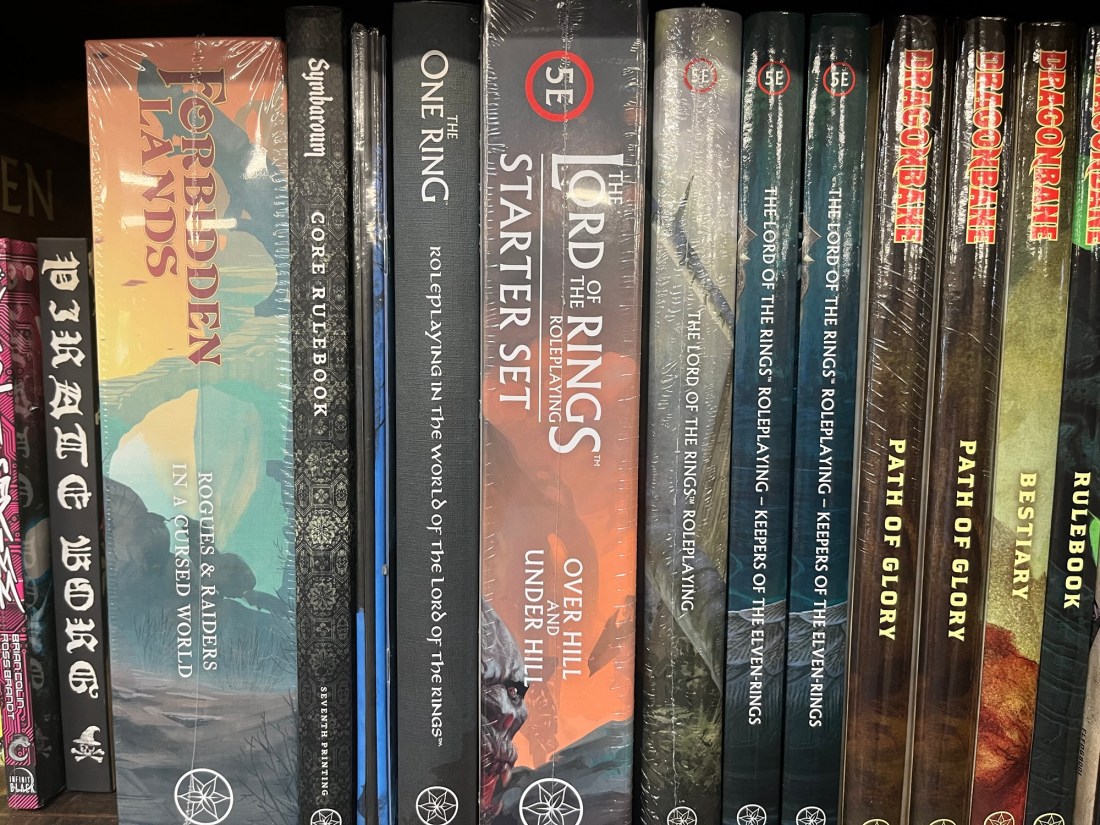
P.P.S. Featured photo is a shelf at my local gaming store, featuring some of The One Ring material.
1 This is meant to be a period of time between The Hobbit and The Fellowship of the Ring.
I’ve been playing 5th edition Dungeons and Dragons since 2016 off and on, first with co-workers, then with friends and family. Later, I branched out into Adventurer’s League, and wrote some modules online for fun.1
But now, I can confidently say that I am thoroughly tired of the game.
My kids and I played weekly during the Pandemic and had some greatadventures together, and when the Pandemic finally subsided I was eager to resume Adventurer’s League with the local community.
But then starting in 2024 something happened: the game just wasn’t as fun as it used to be. The 2024 revised rules made things briefly interesting again, but left me with a soulless, corporate aftertaste. But even the fun of revised and updated rules quickly lost its luster. The revised versions feel very polished, and fixed some issues, but also feel homogenized and bland, with no character left.2
PlayingD&D started feeling increasingly rote. My kids increasingly lost interest, especially my oldest who had one foot out the door towards college, and I didn’t have the drive to start up another group elsewhere. The final straw was returning to Adventurer’s League after a hiatus of 2-3 years. Adventurer’s League now feels hollowed out and running on fumes after WoTC stopped investing in it in favor of their new organized play setting. My local community is much smaller than before, with most of the old-timers having left, leaving only the die-hard players whom (speaking from experience) are hard to get along with.
Even the local gaming store I used to frequent has become so successful, that it is too crowded, too hard to find parking, and overpriced. Compared to five years ago, it is not fun to go there anymore.
I did briefly look into Pathfinder but quickly got tired of the rules-heavy and math-heavy gameplay. Plus, if you are an occasional player, you are forever chasing after new rules, classes and modules or will simply get left behind. The remaster didn’t help matters, because if you want to keep up you have to buy three new books at $60+ each, just to avoid some legal hassles with naming of spells and rules. In short, I did not find Pathfinder worth further investment.3
In spite of all this nay-saying, my son loves D&D, and reads the 2024 books avidly (I will probably give him the books at some point), and even enjoyed the new Dungeons and Dragons movie, Honor Among Thieves (it is a pretty fun movie, tbh). So, I won’t discourage him. I have personally grown sick of D&D and have no desire to play it (or Pathfinder) anytime in the near future. For me, the spark is totally gone.
And yet, I am also realizing that the TTRPG world is a lot more vast than I first thought. I stumbled recently upon an RPG system called The One Ring: a gaming system designed entirely for J.R.R. Tolkien’s Lord of the Rings series. I picked up a couple of the core rule books, including a Dungeons and Dragons-compatible version, and am reading through them now. The community, while not large as Dungeons and Dragons, is large enough that I can find the support I need to questions and people seem to be passionate without being obnoxious. As a lifelong Tolkien fan, the amount of love and attention put into the books is really impressive, and heart-warming. I probably will write a review of the core rules once I finish reading through the book.
There are many other RPG systems as well, by smaller publishers, who are passionate about their craft, and if you look enough, chances are you’ll find a system that’s right for you. My son loves D&D 2024 edition, so I am happy to let him continue reading, exploring, and designing adventures. For someone who enjoys Pathfinder, I hope they continue playing and exploring. I guess the point of all this is that if you are tired of the more corporate gaming systems, try exploring other smaller RPG systems, and see what’s there. You may find a hidden gem you didn’t know about.
For me, I am done with both D&D and Pathfinder systems, and instead enjoy exploring the rules of The One Ring. Whether I can find a local community to play with (the perennial challenge of TTRPG) is another matter entirely….
P.S. Featured photo is my bookshelf of TTRPG books: a mix of D&D 5th edition, 2nd edition (which I fondly remember from my teen years), and some The One Ring books. Most of the newer 5th edition books were sold off already, but I am keeping some older ones that I enjoyed.
1 Writing modules is fun, and I made a bit of money here and there, but nothing even remotely enough to raise a family with. I make enough per month to buy a cup of coffee or two. I gradually stopped as the effort per module exceeded what I felt I got out of it. I still have a few in draft I may finish someday, but in light of this post, I will likely keep them in draft for the foreseeable future. Also, the 50% cut that WoTC takes from my module sales is frankly kind of egregious.
2 The 2024 books have truly fantastic artwork, though.
3 I kept the remastered Player Core book (book 1, since now they’ve printed multiple versions) in case I ever join a group, but I admit it’s pretty unlikely at this point.
Ying Nan: You are a product of all who came before you. The legacy of your family, the good and the bad, it is all a part of who you are.
Shang-chi (2021)
My kids and I have been watching the Marvel MCU movies for years. My firstborn is particularly a Marvel fan since she was a little girl. Some of the movies are better than others (my personal favorite is Thor: Ragnarok),1 but we both really like the movie Shang-Chi and the Legend of the Ten Rings.
When my wife (who is Japanese) and I first dated, there was an immediate clash of cultures. I was a generic American white kid who grew up in an impoverished broken home with lots of issues, my wife grew up in a working-class Japanese family that was not overly traditional, but still very Japanese compared to American standards. The fact we were dating in the first place was a bit awkward for her and her parents, whereas I hardly ever talked to my own parents.
The good news is that over time, we learned to understand one another, and that means that I too learned to appreciate her viewpoint sometimes. For example, family.
Even when she disagreed with her parents, she still respected them, and understood her family obligations. This was something frankly new to me because I openly rebelled against my parents, told my dad off, and hardly paid them any heed. I gradually did reconcile with my parents to some degree as I got older (and a bit wiser), to a level where we can get along, but more importantly I learned to accept that I am who I am due to my family. Like the quote above says, you can’t deny your own heritage, both the good and the bad, and that it does shape who you are.
But also, through my wife and through parenting myself, I learned that I do owe some level of gratitude to my parents for what they did. I chose not to be like my parents in how I raise my kids, but even that is something I learned from them.2 Thus, the lesson I learned from my wife is that I also have to be humble, and respectful to my parents enough to acknowledge what they’ve done for me, even if I disagree with them. This is a very Confucian outlook, but I can see the value in this.3
It rubs against my American sense of individualism, but I’ve found it a valuable lesson over the years, and something I think we can all learn from.
P.S. Xu Wenwu, the father in Shang-chi, is a great example of a plausible chaotic-evil person in Dungeons and Dragons: he craves absolute power and yet is also capable of being in love, being a father, etc. Yet, he inevitably bends everything toward evil or ruin, including his lawful-good wife, Ying Li. Tony Leung Chiu-wai‘s performance was excellent.
1 The Thor movies do a really nice job of weaving science fiction with magic and myth, much like Roger Zelazny did in his books generations ago (Lord of Light, the Amber Series, Creatures of Light and Darkness, etc.). Put simply, I like weird, transcendent stuff more than the “grounded” story lines like Captain America or Black Widow.
2 In Japanese there is a four-character phrase for this: hanmen kyōshi (反面教師) meaning to learn from a bad example (i.e. what not to do).
3 This importance in family isn’t even limited to Confucian-influenced cultures. You can find it in many unrelated world cultures where family is emphasized, and respect towards one’s ancestors. For whatever reason, it is not emphasized in Western culture, and maybe to our detriment I think.
Recently, my family and I attended a wedding in my hometown for a relative of mine, who is marrying for the third time. The wedding took place at a famous golf course, which is situated on the top of a hill with a commanding view of the area.
It was a surreal experience for me. My sisters and I grew up with our single mom in slummy apartments just ten minutes away, and we never went to that golf course in our youth. Now, we were there many years later, surrounded by wealthy men in tailored jackets, holding brandy glasses, bragging loudly about business, surrounded by women with fake boobs, and cocktail dresses. As a Marxist-Buddhist with an Asian wife, we felt out of place.
But it was fascinating too. Here’s a group of people who live a completely different lifestyle than me. It wasn’t a question of class differences either. It was just a choice of lifestyles and values. When my relative comes to our house in a couple weeks for my daughter’s graduation party, they will no doubt find my lifestyle strange too.
I keep thinking about this quote from Stephen King’s book The Gunslinger, which I posted above. People might physically exist in the same proximity, but they might as well be living in different worlds.
If you have ever played the game Dungeons and Dragons, you are probably familiar with planes of existence called the Feywild and the Shadowfell. The setting of Dungeons and Dragons usually takes place on a plane called the Prime Material Plane: the normal world of stuff, people, etc. But in the D&D setting there are other worlds that closely mirror it, yet are subtly different.
The Feywild (which I wrote about ages ago) represents a version of the Prime Material Plane that is overflowing with life, change, chaos, hence it has many “fey” creatures (fairies, goblins, elves, etc). By contrast, the Shadowfell (another old post) is a colder, more static and gloomy version of the Prime Material Plane. In Dungeons and Dragons, objects and places in one of these planes will appear in some form in the other: a small castle on the Prime Material Plane might be a grand fairy palace in the Feywild, or an abandoned, gloomy fortress in the Shadowfell, and so on. If you’ve watched the Netflix series Stranger Things, it’s the same concept.
So, as I stood there watching the golf course employees serving drinks to wealthy men, it was like they were in different worlds. Some people there are unhappy and stuck in a rut, and might see things through the lens of the Shadowfell, while others are flitting from one party to another, like the fey of the Feywild. And then everyone in between, too.
This isn’t limited to Dungeons and Dragons either: if you look at Buddhism, and its many realms of rebirth (heaven, humans, warrior titans, animals, hell, hungry ghosts, etc), you can think of it the same way: we might occupy the same space, but we might as well be living in different worlds.
Adventurer’s League is the community play program for Dungeons and Dragons, and has been around for years, but with the recent publishing of the 2024 updated ruleset, this forces some updates for AL players. In recent months, I have been able to get back into AL after a really long lull,1 and I wanted to share some experiences with the 2024 results.
Per AL regulations, players are expected to field characters using the latest ruleset available, and to rebuild any characters accordingly when required. In the case of 2024 ruleset, that means that all characters built before 2024 ruleset need to be rebuilt to some extent before playing the next session.
In some cases, I’ve found this to be pretty easy, in some cases somewhat challenging. Here’s a couple examples in my case.
note: I wrote this before I learned about the new Legends of Greyhawk community play. While the FAQ states that this is not related to Adventurer’s League, and that “Adventurers League will continue as a community-content program”, this leads me to believe that AL will nonetheless continue to wither and die on the vine for the forseeable future. Given WoTC’s history, I do not fully trust them to support AL going forward as they prioritize the new, shiny program. Still, I am posting this anyway to illustrate how rebuilding my long-term 2014 characters for 2024 rules was sometimes very easy, and sometimes a pain in the neck.
Abjurer Elf Wizard
My original AL character, Qisandoral Arriestanus (DDB link), is a 13th level high-elf wizard (abjuration school) as of writing, was the easiest to rebuild in some ways, and painfully difficult in others. I have written about him here and here. He’s been rebuilt, retired, and revived a number of times.
The 2024 ruleset in the Player’s Handbook fully supports both High Elves and the Wizard class. The eight wizard schools have been changed into four subclasses at 3rd level2 and collapsed into , and for the Abjuration subclass it is covered in the PHB. So, just using the new PHB, I can fully rebuild the wizard without any extra rules or books. Easy.
The challenge of rebuilding a high-level wizard is picking spells for the spellbook. Using standard rules, I can calculate how many spells I should have in my spellbook at level 13, but I also had copied some spells into my spellbook from purchased spell scrolls. Plus, 2024 background choices give you additional spells through feats on top of that. And then there’s spells you get as a high elf innately.
In the end, I had to abandon any spells I had copied from spell scrolls as they are not considered part of the rebuild. As consumables not tied to any adventure rewards, they are treated as a sunk cost when rebuilding.
For everything else, I had to carefully calculate my starting 6 spells at level one, 24 spells for every level after one (2 per level, 12 levels total), plus 3 from elf lineage, and finally spells from my Magic Initiate background feat. This took hours to sort out, and I had to double-check with fellow AL players on Discord, but in the end I was able to rebuild my spellbook. I also leveraged DnD Beyond to validate that the configuration made sense.
Drow Nature Cleric
My other favorite character from earlier AL seaons was a Drow nature domain cleric named Shava Do’Mindrun (DDB link), who worshipped Eilistraee as an alternate to the dread Spider Queen Lloth. Nature clerics are not a particularly popular choice for character builds, but I had surprising fun with it, and it fit Eilistraee’s domains so it was an easy choice at the time.
However, Nature Domain is not a part of the 2024 ruleset, but Eilistree’s other cleric domains, Light and Life, are. So, if I wanted to make a vanilla 2024 character, I would have to rebuild Shava as a Light Domain cleric.
Alternatively, I can still use the Nature Domain, since both 2024 ruleset and AL rules allow it (the 2014 Player’s Handbook is still the newest rules for a Nature Domain cleric). The 2024 Player’s Handbook in particular clarifies that older domains not listed in the handbook are still legal choices, so long as their abilities are granted at 3rd level, not earlier. This is to keep things internally consistent with other new Cleric subclasses.
As of writing, I ultimately decided to reset entirely, and Shava as a light domain cleric at 1st level. Eilistraee’s imagery of the moon dovetails nicely with the Light cleric domain, and it seems that the Nature cleric domain feels a bit more anemic in the 2024 ruleset, while the Light domain is fully supported by comparison. This may change though, as AL allows character rebuilds. Time will tell. As for resetting to first level as an essentially a new character, I did this mainly for personal reasons as I had made some choices with the original character I regretted, and frankly I just wanted to play her over again from the beginning, rather than let her languish in higher tiers were game options are fewer.
High Elf Forge Cleric
Similar to the Nature Cleric above, my High Elf forge domain cleric named Fenmaer Wasanthi (DDB link) was faced with a cleric domain that isn’t fully supported in the 2024 ruleset, but still allowed.
To make a long story short, in this character’s case, I decided to keep the Forge domain and rebuilt him accordingly. The deity in question, Darahl Firecloak, does have the domains of Forge and Light, so I could play another Light domain cleric, but as of writing I felt that the Forge domain was still compelling enough that it was worth keep this build even under 2024 rules.
Simply put, I rebuilt as-is with little or no change.
Wood Elf Samurai
My last character that I regularly play is a Wood Elf samurai fighter named Heian Amakiiro (DDB link), whom I’ve written about here.
1 Pandemic + parenting meant that I played once a year, maybe twice if lucky. I required quite a few characters at the time. Nowadays I play somewhat more often, but still not at pre-pandemic levels. I hope to change that in the coming year once my oldest leaves the nest.
2 To be more consistent with other character classes, presumably. Much of the 2024 updates to 5th edition Dungeons and Dragons seems intended to make character creation process more consistent regardless of choice, and to homogenize some aspects.
P.S. Double-post today. Cleaning out the “draft” folder. 😉
Season three of Star Trek has one of my most favorite, albeit silliest episodes in the entire series: The Savage Curtain. The episode starts off with a bang: Abraham Lincoln (played by Lee Bergere) floating in space on his trademark chair.
From there, the Enterprise crew and in particular Kirk and Spock are confronted by some of “histories worst villains” as well as an encounter with Spock’s idol, Surak (played by Barry Atwater), father of Vulcan philosophy.
Surak of Vulcan, founder of Vulcan Logic, in the Star Trek episode the “Savage Curtain” (season 3, episode 22)
The rock aliens who force the “good” historical figures to combat the “evil” historical figures want to compare and contrast their philosophical ideas against one another to see which is better.
Kahless the Unforgettable (played by Bob Herron) and Colonel Greene (played by Phillip Pine)
The premise might seem a bit silly, but it is a fascinating contrast of ideas:1
Surak – a pacifist, non-violent approach
Lincoln – fight if necessary, and “on their level”.
Col. Greene – power is all matters
Kahless – victory by any means
Kirk – do what it takes to save his crew
Spock – honor his commitments to Starfleet, and fight with Kirk, even if is compromises his personal morals
Although Surak loses his life in the combat, he has some really great quotes in this episode that I think are worth sharing:2
The face of war has never changed. Surely it is more logical to heal than to kill.
Surak of Vulcan, “The Savage Curtain” (s3ep23), stardate 5906.5
and also:
I am pleased to see that we have differences. May we together become greater than the sum of both of us.
Surak of Vulcan, “The Savage Curtain” (s3ep22), stardate 5906.4
Lincoln’s performance throughout the episode is great as he embodies the great American president as we want him to be: gentle, but tough when needed. One can’t help but compare this to Bill and Ted’s Excellent Adventure, even if they are completely different movies, because Abraham Lincoln is such a beloved figure.
At the very end of the episode, there is a subtle dialogue worth sharing:
KIRK: They seemed so real. And to me, especially Mister Lincoln. I feel I actually met Lincoln.
SPOCK: Yes, and Surak. Perhaps in a sense they were real, Captain. Since they were created out of our own thoughts, how could they be anything but what we expected them to be?
In fact, I think there’s something very Buddhist about this. The inhabitants of the planet didn’t necessarily create historically accurate versions of Lincoln, Surak, etc, but what we wanted them to be in our minds. In a sense, we create our own gods and idols through our hopes and aspirations (for good or for ill). This isn’t always bad, but it does show how unwittingly we bend the world around us to fit our beliefs and views.
Anyhow, The Savage Curtain is such a fun, surreal episode, and a fascinating contrast of ideas and people in history, and how they interact. These ideas and philosophies are timeless in many ways, and crop up over and over again in history, but by pitting a bunch of historical figures in space against once another, it takes on a whole new dimension of weird, silly, fun.
Also:
Courtesy of “Swear Trek”
P.S. Many reviews point out that The Savage Curtain borrows elements from older, venerable episodes, and thus judge it an inferior episode. I can’t disagree that it borrows a lot of elements, but I like to think it is a capstone to several previous “moral tale” episodes. The action sequences aren’t quite as good, but I don’t think that was the point. It was battle of ideas, not sticks.
P.P.S. I bet you could take all 8 characters, including Kirk and Spock, in the battle and somehow arrange them into a classic D&D alignment chart. The rock aliens of Excalbia would probably be true-neutral.
1 I wish “Zorra” (Carol Daniels) and “Genghis Khan” (Nathan Jung) had dialogue, as it would have been interesting to have more contrasting goals and aspirations.
Most players of Dungeons and Dragons within the last couple of years are probably aware that an updated ruleset was on the horizon, to coincide with the 50th anniversary of the game. This new ruleset has included names such as “One D&D”, or jokingly “5.5 edition” and so on. Nonetheless, the new Player’s Handbook came out, and I got a limited edition copy at my local game store a couple weeks ago. My kids and I hadn’t really played any TTRPG in many months, both due to demanding schoolwork for the oldest, busy schedule for the family, malaise with Pathfinder Second Edition1 and just unhappiness with Hasbro shenanigans.
But we all agreed that we missed our old family D&D sessions during the early Pandemic, and my oldest child’s school schedule this year is much lighter now. So, we agreed to block out a time on weekends and start playing again.
We bought the alt-cover 2024 Player’s Handbook early, since FLGS’s were allowed to sell it a week before online release.
Further, my kids wanted to try the new rules, so I went to the local FLGS (friendly local gaming store), skimmed over the new 2024 Player’s Handbook, felt it was intuitive enough that I could adapt, and within a couple weeks, we were running a basic Forgotten Realms campaign, borrowing elements from R.A. Salvatore’s original Icewind Dale trilogy.2
I have my old copy of the Sword Coast Adventurer’s Guide to help with the world-building. old resource books for the Sword Coast. Also, before the game, I tested the new rules by creating a couple characters using 2024 rules to help provide sidekicks to our small party.
Our “session zero” with the new 2024 campaign.
The kids, having experience with 2014 5th Edition D&D quickly picked up the new rules and were able to get a couple fun characters created in an hour:
a dragonborn paladin (my son)
a tiefling cleric (daughter)
plus sidekicks I made: dwarf druid of the sea, and drow eldritch knight.
From there we’re back on familiar turf, having a good time, enjoying a classic bar fight opening and subsequently getting thrown out. Wulfgar and Regis from the Icewind Dale trilogy made a cameo too.
In short, getting up to speed with the 2024 rules was easier than expected. The character creation processed has definitely changed in a couple essential ways :
Character race no longer determines stats, it’s based on chosen background now. The result doesn’t really change the process all that much, but it is a philosophical shift.
The racial subclasses get net abilities to help with “flavor” more: elves for example are still divided by wood, high, and drow elves, but each one gets different innate spells at certain levels. Same with Tieflings, and so on. I found this change more fun than expected.
Many character class paths are homogenized to match other class paths. This means that clerics now choose their domain at level three, not level one for example. Wizards similarly choose school on wizardly later than before. However, even at level one there are choices you can make with character creation, so this isn’t as limiting as one might expect. However, clerics and wizards as of writing only have 4 subclasses only versus 8 previously.
Because classes and backgrounds are so strongly emphasized, these sections comprise most of the book by a long shot. The book covers species (character races), spells and equipment toward the end which is different from the classes 2014 PHB. The intro includes a nice, updated walkthrough of how a typical D&D session looks like so if you’re new to D&D, this is a good read.
Most of the other rules have not drastically changed, so in most cases they will feel familiar. There is a comprehensive list here as well.
Spells have often changed and take some careful reading to get re-acquainted. Many of these updates provide much-needed fixes and balance updates. For example the 3rd level Daylight spell now actually counts as sunlight for mechanics purposes (handy for vampires). The classic Cure Wounds spell heals 2d8 damage, not 1d8.
In short, some spells are weaker or more limited now than before. Spells that were seldom used such as Barkskin now have a new life. Again, if you played fifth edition before, you should definitely reread your spell list and familiarize yourself with the new spells.
All in all, despite my personal misgivings toward Hasbro, I must admit that the 2024 Player’s Handbook is a welcome update. It fixes a number of oddities, balance issues and deficiencies of the original while keeping its essence more than I expected. I can still use my old resource books without much effort to convert, which is greatly appreciated. Meanwhile, new players will have enough to get started with the PHB without needing to refer to older material.
I am eager to see what the 2024 Dungeon Master’s Guide brings as well.
Edit: I “butt-published” this too early. I had to write the last third of the post in a hurry. Apologies for the rushed effort. 🤦🏼♂️
P.S. another reason for investing in the 2024 PHB is that Adventurer’s League requires rebuilding characters to conform to 2024 rules anyway. I don’t play AL too often these days but I don’t want to get left behind.
1 While we did have a goodtime initially, especially with character creation, the biggest challenges with maintaining the Pathfinder campaign was a lack of coherent fantasy settings. Most of the research and prep I did as a DM was to pore over Wiki fan pages, which inevitably referred to modules I never bought (and weren’t interested in purchasing). There just wasn’t enough compelling lore, characters or story modules to get immersed in to replace classic D&D lore, plus they are scattered across so many books anyway that it was impossible to find anything. Plus the fatigue in keeping up with the constant stream of new classes, new ancestries, and so on. A TTRPG hobbyist has the time to keep up with this, but not a working parent who just wants to spend a weekend with the kids. Pathfinder 2e Remaster has good rules, and good design, but outside of this and the Beginner Box there is not enough support for more casual players especially those who have some nostalgia about classic TTRPG lore.
2 I’ve been reading the Icewind Daletrilogy shard to my son at night, after we finished the Lord of the Rings Trilogy, the Hobbit, and the original Dragonlance chronicles. LOtR was great, the Hobbit was great, Dragonlance wasn’t as good as I remember, but the Crystal Shard has been a solid read, though I have to skim over certain scenes that are inappropriate for younger audiences. He loves the main cast, even more so in teh second book Streams of Silver. It does feel like a D&D adventure for him, and he enjoys listening to the story, and (in his opinion), my voice acting.
Edit:I wrote this post almost a year ago and my thoughts have changed somewhat in that time. While we did have a good time initially, especially with character creation, the biggest challenges with maintaining the Pathfinder campaign was a lack of coherent fantasy settings. Most of the research and prep I did as a DM was to pore over Wiki fan pages, which inevitably referred to modules I never bought (and weren’t interested in purchasing). There just wasn’t enough compelling lore, characters or story modules to get immersed in to replace classic D&D lore, plus they are scattered across so many books anyway that it was impossible to find anything. Plus the fatigue in keeping up with the constant stream of new classes, new ancestries, and so on. A TTRPG hobbyist has the time to keep up with this, but not a working parent who just wants to spend a weekend with the kids. Pathfinder 2e Remaster has good rules, and good design, but outside of this and the Beginner Box there is not enough support for more casual players especially those who have some nostalgia about classic TTRPG lore.
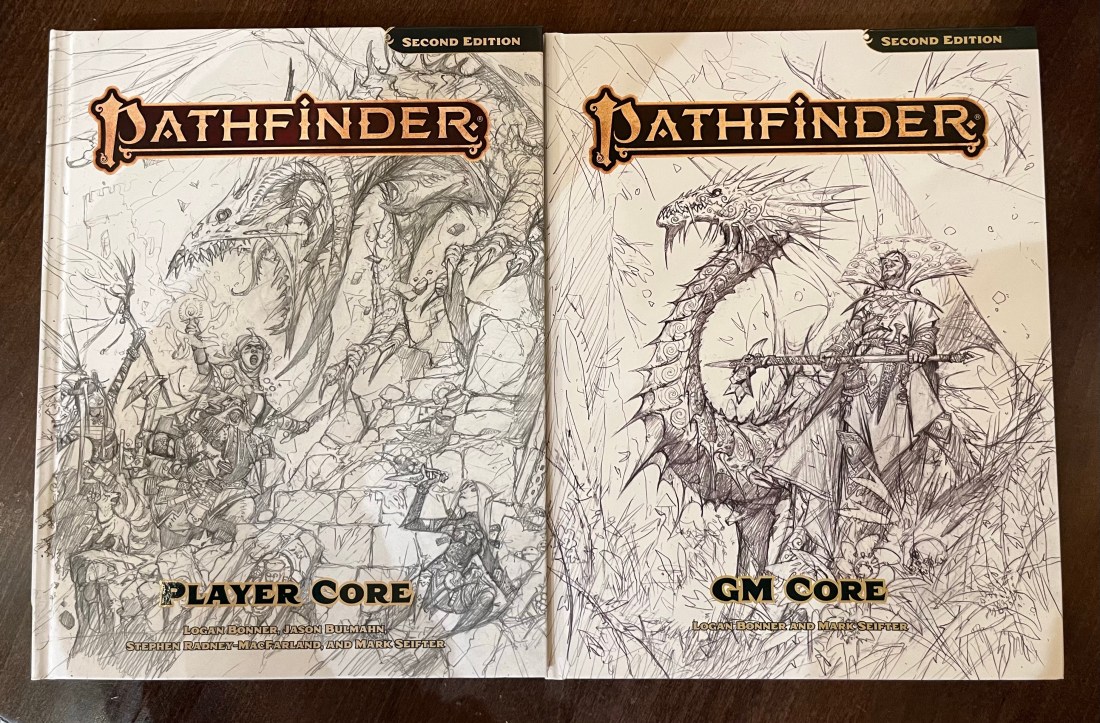
The debacle in January 2023 with the OGL license and Wizards of the Coast pushed a lot of people away from Dungeons and Dragons, towards other role-playing games, particularly Pathfinder 2nd edition. I reviewed PF2e here and here. Recently, I also picked up the new Remastered edition:
The Remastered edition is Paizo’s clean break from the OGL license and anything related to Dungeons and Dragons mechanics. Classic staples such as alignment, and ability scores, are simply gone, and with it some aspects of Pathfinder 2e have been streamlined. The old ability scores (0-18) are simply replaced with ability bonuses, starting at 0. This actually makes a lot of sense. The only thing we care about are the bonuses anyway, and the old numerical ability scores were more relevant in older versions of D&D where the number didn’t just dictate a bonus, but also dictated other factors (ability to be resurrected, chance of failure to cast a spell, avoid traps, etc).
Removing alignment also makes sense, since it’s been 40+ years, and still no one can agree on how to interpret alignment anyway. 😁 But it also removes some of the artificial guardrails placed on characters and allows greater diversity in motivations and personalities.
With the removal of alignment, this also affects religiously-inclined character classes such as clerics, and focuses on the particular anathemas and religious edicts of each deity. As with character motivation, this does breathe more life into each deity and religious characters path, but it’s also a bit of an adjustment for old-school players like myself.
Further, these changes also mean that some aspects of the Pathfinder character sheets have been streamlined. Previously, my kids character sheets were up to 6 pages long, but the newly designed sheets are 4 pages at most. This is on par with D&D 5th edition.
Finally, let’s talk about the book formats.
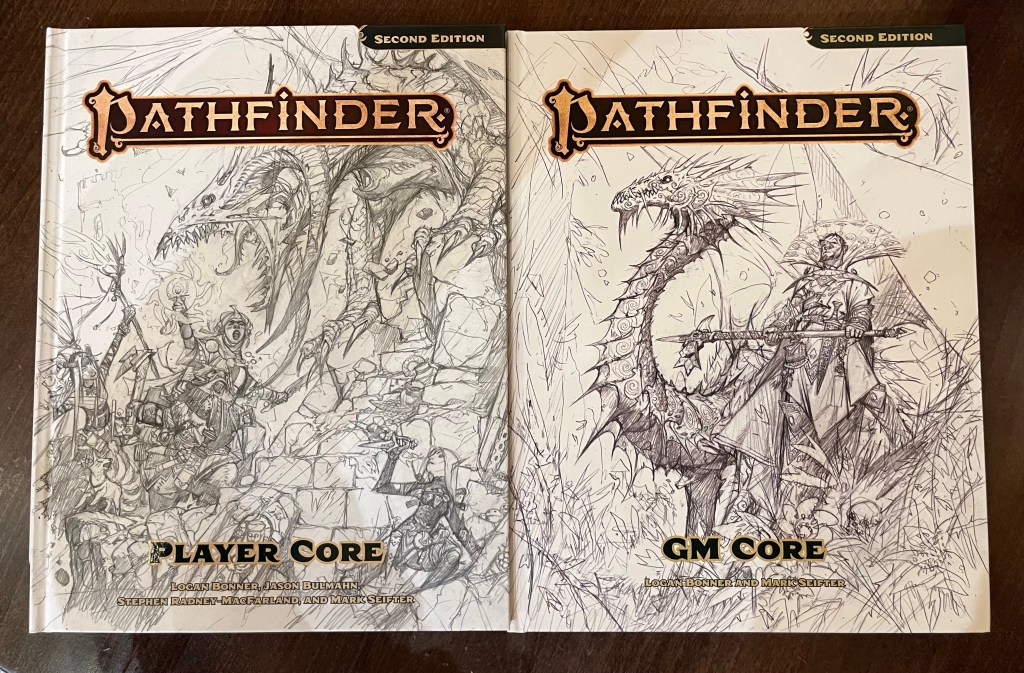
The old Core Rulebook, Advanced Player’s Guide, and GameMastery Guide have been all sliced up and recombined into different books. For example, the new Player Core book (special edition cover shown above), combines elements of the old Core Rulebook and Advanced Player’s Guide. By default, one can play a Witch for example, but remastered Champions (paladins) aren’t available yet, pending further remastered publications. The GM aspects of the old Core Rulebook have been combined with the GameMaster Guide to form the new GM Core book.
What you get is a more logical division between the two books: a player-centric handbook and a GM-centric one. The old tome, the Core Rulebook, thus has been broken up into two logical divisions with newer content added into them.
Further, the format of the books themselves is way more readable than before. Much of the content will look familiar, but is significantly easier to find thanks to book structure, and also due to the handy sidebar on each page. Some rules have been slightly modified to address inconsistencies that have arisen. Other rules have been simply rewritten for better clarity. I can’t tell you how much easier it is to find things on the fly as a GM now rather than stopping the game to flip through a book for 10 minutes then give up and search online. The GM Core in particular does provide more helpful content for planning and designing campaigns, and I found this part particular fun to read. It was previously scattered elsewhere (and similar tough to find), but now I know exactly where to turn to.
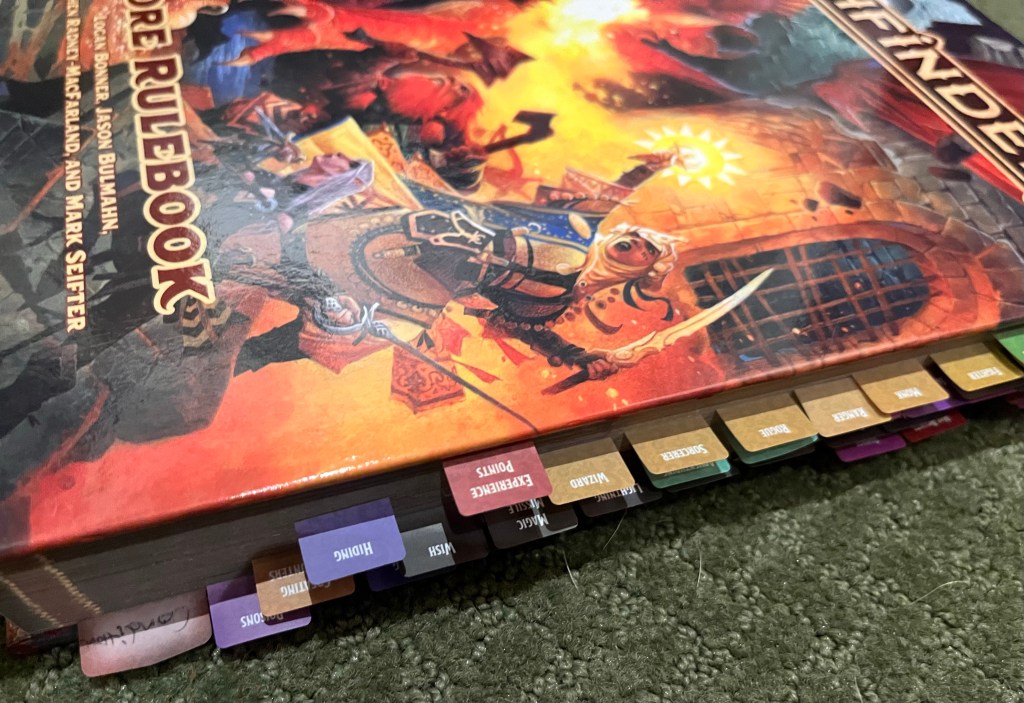
No joke, I struggled a lot with the old Core Rulebook to find things so I had to buy some tabs at a game store to mark the chapter out:
The updated books make this task a lot easier.
Finally, the spell list. In order to make a clean break from the OGL, many classic D&D spells have been renamed to non-OGL ones. For example, the iconic Magic Missile is now Force Barrage. Magic Weapon is given a cooler name of Runic Weapon, and some spells are given names that are more intuitive such as Gentle Repose becoming Peaceful Rest. Mechanically, very little if anything changes, but having to remember a new set of names is probably the biggest challenge for both GMs and magic-using players.
In any case, part of me misses the Pathfinder tie-back to old D&D, so it’s bittersweet that this connection is finally severed at last, but on the other hand, the remastered Pathfinder 2e is a significant improvement over the original 2e in terms of streamlined mechanics and streamlined publications.
On the other hand, it does feel like Pathfinder is finally getting out of the shadow of D&D and maturing as a role-playing game in its own right, and I salute these updates, and will be looking forward to more games with the kids (or maybe finally getting off my seat to check out the local Pathfinder Society).
Recently, I dragged my first Adventurers League character, Qisandoral Arreistanus, out of a long, long retirement for another adventure in our play-by-post group. Qisandoral is a high elf wizard of the Abjuration school. You can think of him as Mr Spock in a fantasy setting.
“We reach”… with Otiluke’s Freezing Sphere!
Due to pandemic and other issues, I hadn’t played this character in literally years, but due to AL rules, he had jumped from level 9 to level 12 through accumulated downtime. Otherwise he sat idle. With the new 2024 ruleset, and the requirement in Adventurers League to rebuild a character that conforms with this ruleset, here is the latest, update character sheet (link):
The tier-3 adventure module, from the Season 8 Waterdeep setting, took place in the underbelly of the city, where we fought a vampire cult worshipping Shar. With only three players, and no melee fighters, this was hugely risky. My memory of how to play Qisandoral was rusty, I had forgotten his abilities, and my spellbook choices were confusing and weird.1 During the big boss fight, I performed pretty terribly at first, and nearly wiped out my own party due to a poorly timed Otiluke’s Freezing Sphere. Further, our DM skillfully played the boss, a vampire mage, as it fought tooth and nail using every nasty trick in the book to survive. It took a huge effort to finally slay the abomination. At one point, I had to use Wall of Force to pin the vampire long enough for us to recover a couple rounds.2
The good news is that during play, I eventually dusted off the mental cobwebs and started playing my wizard more effectively. This post is to share some hard-learned lessons about playing an Abjuration Wizard in 5th edition Dungeons and Dragons. I think Abjuration wizards are really neat, and fit Qisandoral’s character concept (a dour, elf wizard who is very bland and likes routine) nicely, but they’re also a little different from other wizards as I learned the hard way.
Edit: with the 2024 Player’s Handbook, the rules for the Wizard class have changed considerably. You now choose your wizard subclass at level 3, but the abilities largely remain the same, and the advice remains unchanged. The level 10 ability in the 2024 ruleset has been greatly enhanced, and will certainly increase the power of this subclass at higher levels.
The Basics of Abjuration
First and foremost, Abjuration is about defense, cancellation and denial. Of course, an Abjuration wizard must also have some offense, but they will never excel at offense. Instead, an Abjuration wizard shines when they frustrate and shutdown the enemy.
Your 2nd level wizard ability, Arcane Ward, is your bread and butter. Simply by casting Mage Armor at the start of your day (which wizard’s do anyway), you gain a extra pool of hit points that will automatically absorb (afaik, you don’t get to choose, it just happens) a certain amount of damage before passing through. At low levels this pool is quickly used up, but at higher levels the pool of hit points gets pretty large.
Further, the pool recharges X hit points where X is 2 times the spell level. If I cast Shield, a 1st-level spell, my ward tops up by 2 hit points. If I cast Counterspell, a 3rd-level spell, it tops up the Arcane Ward by 6 hit points.
Later, when your character reaches 6th level, you can then project this ward as a reaction to absorb someone else’s damage. You have to be able to see that person, and they have to be within 30 feet, but otherwise it’s a handy way to keep teammates alive in a pinch (and I projected it a lot in the boss fight above).
Finally, the other big deal with Abjuration wizards is that for certain spells like Dispel Magic and Counterspell, you can boost your chance of success using your proficiency bonus. This does not work with Banishment sadly (I learned this the hard way).
Lastly, starting at 14th level, Abjuration wizards are highly resistant against spell attacks, which from a defensive standpoint is pretty neat and probably live-saving (sadly Qisandoral was 13th level during the aforementioned adventure).
What To Do And Not Do
An abjuration wizard needs to rely on their Arcane Ward a lot, so you should activate each day using Mage Armor or something suitable. Also, have a few cheap spells of the Abjuration school prepared to help recharge it as needed. The challenge is that many of those cheap spells are pretty niche:
Shield is always a good idea to have, but can only be used as a reaction (i.e. you’re being attacked). Further, shield gets less and less useful at higher levels as your AC struggles to keep up with enemy attack levels. You should always have it prepared just in case, but bear its limitations in mind.
Protection from Evil and Good can provide some help in some situations, but you can only cast it on one party member, even if you cast at higher level, and it requires concentration (yuck).
Counterspell only works when someone is casting a spell, and you can’t always stand around waiting for someone to do that.
Alarm is only useful outside of combat. Sneaky wizards know to cast this as a ritual over and over again (time permitting) to charge up the Arcane Ward.
Banishment is a high-level spell, and may fizzle if the saving throw succeeds. If it succeeds, you’re a target for opponents trying to break your concentration.
Globe of Invulnerability is very powerful, but it has a fixed location, so it will not move with the player.
Each of these is pretty niche spells, so if you want to maximize usage of the Arcane Ward, you prepare as many of these as you can to react to various situations.
On the flip side, the more of these you prepare, the fewer offensive spells and other utility spells you can prepare. In earlier adventurers, this was the problem I had with Qisandoral: in many fights, the best he could do was shoot Ray of Frost (a cantrip) half the time.
Thus if you want to have an Abjuration wizard with some offensive capability, you will have to choose your spells carefully, and strike a balance between the needs of your school, and the needs on the battlefield.
It’s best to pick spells that are generally useful in all situations. Magic Missile isn’t glamorous, but few monsters can resist force damage, and it just about always hits its target (unless they have a Shield spell). Even cantrips can be useful since they do scale up damage over time. Qisandoral has both Ray of Frost for distance, and Shocking Grasp for close range.3 Having a variety of offensive cantrips may help free up the need to use precious spell slots for other things, even if you are not a powerhouse.
Also, having a classic like Fireball or Freezing Sphere is good to have in your back-pocket as a kind of panic button.
On the utility side, spells like Misty Step are a great way to get in and out of the battlefield, and well as some common detection spells like See Invisibility or Detect Magic.
Combat
Since you’re default strategy is to leverage Arcane Ward to frustrate attacks, or use your spells to stop magic effects, you may be in combat doing mostly passive or reactionary moves while spending your turn making low-level attacks that don’t require commitment or concentration. The default strategy is one of observation, and being able to respond to threats as they come up, but still reasonably do your part to take out threats offensively.
If you do manage to Banish a creature that you intended too, then don’t hesitate to protect yourself using your own abilities otherwise intelligent monsters may decide to target you next to break concentration.
Finally, remember that if you use Globe of Invulnerability, make sure to put it in a strategic spot where you and party members can take cover for the rest of the battle. In other words, make it count.
Final Thoughts
If your goal is to make a wizard that decimates the battlefield with world-bending magic, an Abjuration wizard probably isn’t a suitable choice unless you want to charge your Arcane Ward once per day and maybe keep an abjuration spell or two handy.
If your goal is to disrupt the battlefield and frustrate your enemies, an Abjuration wizard excels at this, but it does require responding to various niche situations as they come up, and your damage output will be somewhat below average. Just remember you’re focusing on defense first, offense second.
Conversely, since so many Abjuration spells are situational don’t be surprised if you are in a situation where none of them are useful. Have a few generalist spells prepared for this situation.
Finally, as with every wizard, you can never quite prepare enough spells. It’s always a juggling act to balance various competing needs, and accept that you will sooner or later have failed to prepare the right spell for a particular situation. The vast breadth of spells a wizard has comes with the cost of lots of care and feeding.
I hope this was helpful. Good luck!
1 Thanks to simpler AL rules now, I probably should have just rebuilt him again from the ground up before the adventure, but I was in a hurry and busy.
2 I also had Hold Monster prepared, but failed to notice the stipulation that it does not work on undead monsters. 🤦🏼♂️ Word of advice for new players: read your spells carefully beforehand.
3Shocking Grasp is also handy when your opponent has legendary actions, since a hit prevents them from taking reactions for a turn. This was something I could’ve done in our fight, but I failed to grasp this until too late. To be fair, our opponent was invisible most of the time anyway.









 Gleanings in Buddha-Fields
You must be logged in to post a comment.