As of writing, it is late January in 2025, and it occurred to me recently that I’ve been a Buddhist now for twenty years. I can’t exactly remember exactly when this happened, but I definitely how it came about.
Let me clarify. I grew up as a Mormon in my youth, though my family wasn’t devout. I think my parents just wanted us kids to have some kind of spiritual upbringing, rather than explicitly following Mormonism. By my teens, I was exploring “Eastern thought”, and dabbling in many ideas and concepts. I was inspired by the TV show Kung Fu, and the cool flashbacks by Master Po (played by Keye Luke):
Note the first scene with the image of the Buddha in the background. I saw scenes like this, and having never seen Buddhism, I became very curious. In my teens, I continued to explore and dabble in Buddhism, Taoism, but still went to various churches (Mormon, Protestant, Catholic, etc) and such.
I didn’t really become a Buddhist, as in explicitly taking refuge in the Three Treasures, until my 20’s. When I met my future wife, she was raised Buddhist, and approached it very differently. I quickly realized that I had serious gaps in my understanding of Buddhism. Reading books about Buddhism, and being Buddhist in one’s life are two different things. I realize now that, until you take refuge in the Three Treasures, and choose to uphold the Five Precepts, the Buddhist path won’t 100% make sense.
Still, the big moment came when, after we got married, we went to Japan to meet her extended family. We also used the opportunity to visit Kyoto, Nikkō and such. Being at Chion-in temple in Kyoto, I saw a monk chanting before a statue of Amida Buddha, while striking a wooden fish to maintain rhythm. That really made an impression on me. Later, we visited my father-in-law’s hometown, which had a large temple devoted to the Medicine Buddha. The fact there was a Buddha entirely devoted to healing and well-being in Buddhism had never occurred to me.
Soon after coming home, I found the Jodo Shu Research Institute’s (JSRI) English website about Jodo Shu-Buddhism1 and that very night, I was so inspired that I recited the nembutsu for the first time. The rest, I guess, was history.
If not for my wife, the JSRI, and later Seattle Buddhist Church, I don’t know how my Buddhist path would have turned out. There was so much information that I was missing, and through all these wonderful encounters, I learned a great deal. There’s been many twists and turns, many mistakes, many experiments, bad assumptions, but overall I feel much more richer for the experience. I wonder how things will look 20 years from now.
I’ve tried sharing my experiences since that fateful January night 20 years ago, first on Blogger, and then on WordPress in one form or another. I want other Buddhists, and others curious about Buddhism, to have the full range of information.
When you look at the local bookstore for books on Buddhism, they tend to be dominated by a handful of authors, and tend to be written for either the Zen crowd, or the Tibetan-Buddhist crowd. Such books also frequently downplay cultural aspects of Buddhism, for fear or turning off their Western (read: liberal white) convert audience. Buddhism is much broader than this, and it’s a shame more books aren’t written from the perspective of Asian Buddhists, and aren’t shy about these cultural aspects. Buddhism isn’t just a philosophy for nerds, it’s a living, breathing tradition that encompasses all walks of life.
There’s something for everyone in it, and I hope people feel encouraged to explore the greater tradition, not just what’s filtered through pop culture.
Namu Amida Butsu
1 The site is long gone, sadly, but the Wayback Machine has an archive of the site.
Vanna: “It’s hard to believe that something which is neither seen nor felt can do so much harm.”
Kirk: “That’s true. But an idea can’t be seen or felt. And that’s what kept the Troglytes in the mines all these centuries. A mistaken idea.”
Star Trek, “The Cloud Minders” (s3ep21), stardate 5819.0
I’ve talked about this episode before, but I thought this quote was worthy of its own post.
Because all sentient beings who come into this world must struggle to piece together an understanding of things based on limited information, it’s easy to pick up ideas that are wrong or mistaken but make logical sense. Or, alternatively these ideas are foisted upon them by those they trust, such as parents or your society without the tools necessary to discern the truth.
Thus two rational people can have radically different views of things. One or both of these people can have very harmful negative views, and yet from their own perspective, they may sincerely believe they’re doing the right thing, and assume everyone else around them is stupid or insane..
But then how does one discern what is true or not?
The Buddha taught, on the one hand, that all viewpoints are just a form of conceit (lit. “I-making”) and diverge from reality. They’re based on limited information, logic and so on, and so none of them quite hit the mark. The Parable of the Blind Men and the Elephant is often cited as an example of how people form opinions based on limited facts and are willing to fight over this. In fact, the Buddha himself cited this story in an old, obscure sutra called the Tittha Sutta (Ud 6.4 of the Pali Canon):
…”Saying ‘An elephant is like this, an elephant is not like that! An elephant is not like this, an elephant is like that!’ they fought each other with their fists. And the king was delighted (with the spectacle).
“Even so, bhikkhus, are those wanderers of various sects blind, unseeing… saying, “Dhamma is like this!… Dhamma is like that!'”
Translation by John D. Ireland
The Buddha then recites a verse like so:
Some recluses and brahmans, so called, Are deeply attached to their own views; People who only see one side of things Engage in quarrels and disputes.
Translation by John D. Ireland
So, the Buddha warned against becoming attached to one’s own views because it just feeds the ego, and leads to conflict.
On the other hand, he taught the importance of using the Dharma as an objective benchmark (e.g. a “yardstick”) for how to judge one’s own conduct and views, and especially to see what the results are: do they lead to beneficial results, or harmful results? For example in the classic text, the Kalama Sutta (AN 3.65 in the Pali Canon), we see the Buddha explaining how to properly discern a teaching:
10. “Come, Kalamas. Do not go upon what has been acquired by repeated hearing; nor upon tradition; nor upon rumor; nor upon what is in a scripture; nor upon surmise; nor upon an axiom; nor upon specious reasoning; nor upon a bias toward a notion that has been pondered over; nor upon another’s seeming ability; nor upon the consideration, ‘The monk is our teacher.’ Kalamas, when you yourselves know: ‘These things are good; these things are not blamable; these things are praised by the wise; undertaken and observed, these things lead to benefit and happiness,’ enter on and abide in them.
Translation by Soma Thera
We can see that just because something seems logical doesn’t mean it necessary leads to wholesome results (praised by the wise, leading to wellbeing, etc). One’s intuition isn’t always a reliable guide. Teachings and ideas that lead to wholesome outcomes are in accord with the Dharma, and because they are in accord with the Dharma, they lead to wellbeing, peace of mind, liberation, etc.
Of course, in Buddhist history, there’s examples of eminent monks going off the rails, too. So, just. because one is a Buddhist, doesn’t mean one automatically does it right. It takes time, reflection, and a willingness to keep trying.
The Buddha told Ananda, “You constantly hear me explain in the Vinaya that there are three unalterable aspects to cultivation. That is, collecting one’s thoughts constitutes the precepts; from the precepts comes Samadhi; and out of Samadhi arises wisdom. Samadhi arises from precepts, and wisdom is revealed out of Samadhi….”
The Shurangama Sutra, translation by the Buddhist Text Translation Society USA
Recently, I was watching another video by the Nichiren-Buddhist priest about weird ghost stories and experiences, and he told another story about a man who used to hit his wife regularly which I linked here. The closed captions are available in multiple languages.
The thing that really stood out to me about this video, was when the abusive husband, realizing he should change, begged the priest to recite some sutras for him, believing that this would cure him. The priest pointed out that the man’s problem wasn’t going to be solved by reciting sutras (even the venerated Lotus Sutra), but self-discipline and a genuine change of heart. The priest also says that he gets this kind of request often.
In the much older text, the Dhammapada, there is a related passage too:
19. Much though he recites the sacred texts, but acts not accordingly, that heedless man is like a cowherd who only counts the cows of others — he does not partake of the blessings of the holy life.
20. Little though he recites the sacred texts, but puts the Teaching into practice, forsaking lust, hatred, and delusion, with true wisdom and emancipated mind, clinging to nothing of this or any other world — he indeed partakes of the blessings of a holy life.
Translation by Acharya Buddharakkhita
The quote from the Shurangama Sutra, an influential Mahayana-Buddhist text, shows that there is a causal relationship in Buddhist practice starting with personal conduct first, such as taking up the Five Precepts, leading to samadhi, samadhi to wisdom and so on. This is not even a Mahayana-only concept, you can find similar teachings in Theravada Buddhism as well.
In my own head, I sometimes recite to myself “discipline the body, discipline the mind”. By this, I mean that by controlling my conduct in a basic, mundane sense: the five precepts, living a life of moderation,1 etc., I can then provide a firm foundation for deeper wisdom. In another sense, you have to get your personal house in order before you take on a big venture.
It’s counterintuitive, and people often want to jump into things like meditation and chanting, but as the Buddha taught, if you don’t prioritize conduct, the rest won’t amount to a hill of beans.
Now, I, Vairocana Buddha am sitting atop a lotus pedestal;
On a thousand flowers surrounding me are a thousand Sakyamuni Buddhas.
Each flower supports a hundred million worlds; in each world a Sakyamuni Buddha appears.
All are seated beneath a Bodhi-tree, all simultaneously attain Buddhahood.
All these innumerable Buddhas have Vairocana as their original body.
The Mahayana version of the “Brahma Net Sutra”, translation by Young Men’s Buddhist Association
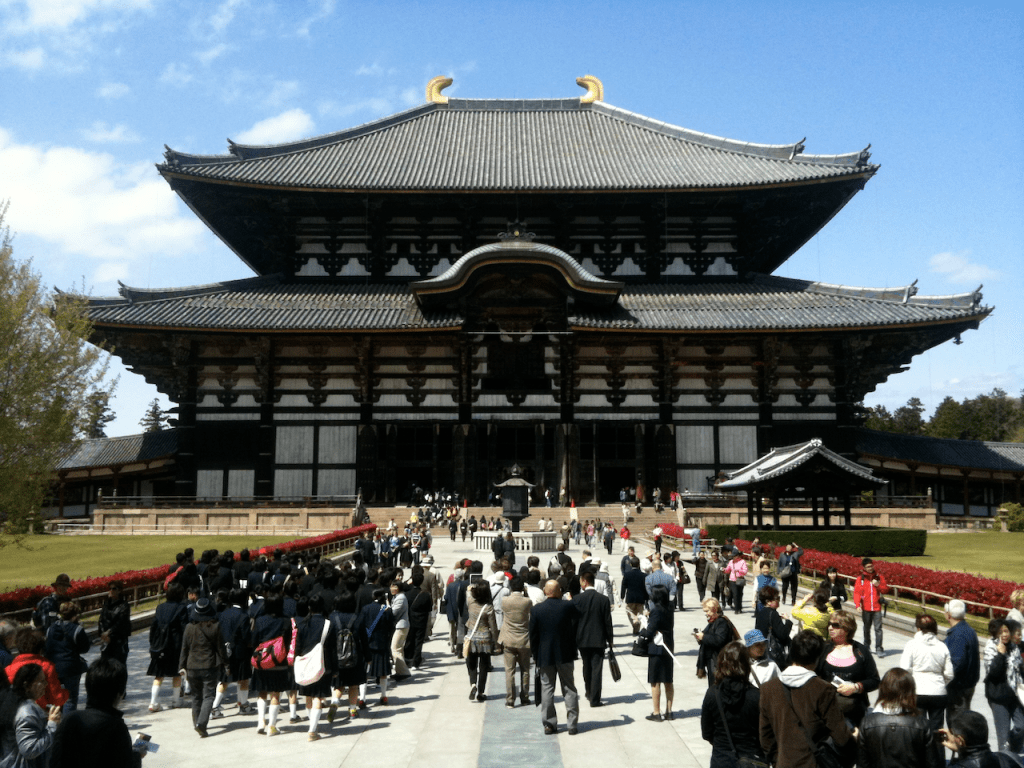
If you ever visit the famous Todaiji temple in Nara, Japan, you will see a truly colossal structure like so:
Taken by me on April 2010.
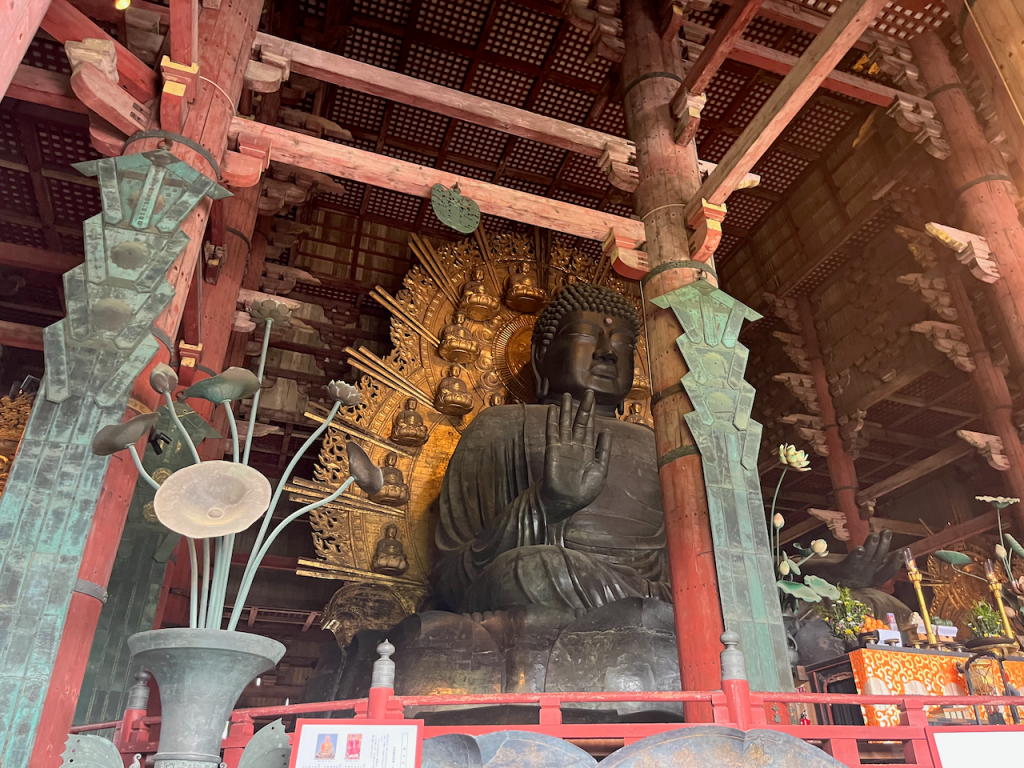
Inside as you approach is a colossal Buddha statue:
A side profile of the Great Buddha (daibutsu) of Todaiji Temple in Nara, Japan. This Buddha is Vairocana Buddha, the “Buddha of the Sun”. Taken in 2023.
This picture does not convey the size very well. It’s truly massive. But what is this Buddha?
This Buddha is a somewhat obscure figure named Vairocana (pronounced Wai-ro-chana) in Sanskrit, which means something like “of the Sun”. So, Vairocana is the Buddha of the Sun.
Vairocana features in a few Buddhist texts in the Mahayana canon: the Brahma Net Sutra quoted above and the voluminous Flower Garland Sutra, for example. It is also very prominent in esoteric traditions in Japan (Shingon and Tendai sects) as Maha-Vairocana (“Great Buddha of the Sun”).
The Brahma Net Sutra introduced Vairocana and explains that all Buddhas that appear in such-and-such time and place are embodiments of Vairocana. Thus Vairocana isn’t just another buddha, but is their source. Vairocana, in other words, embodies the Dharma.
That is why in the Great Buddha statue above at Todaiji Temple, you see rays of light emanating outward with “mini Buddhas” among them. Each of these Buddhas is thought to have the same basic origin story as the historical Shakyamuni Buddha. Hence in the text they are all just called “Shakymunis”. All these Buddhas have the same basic qualities ( Chapter Two of the Lotus Sutra teaches the same thing, by he way), one is the same as all the others.
This is primarily a Mahayana-Buddhist concept, but has precedence in pre-Mahayana sources. Consider the Vakkali Sutta from the Pali Canon:
“Enough, Vakkali! What is there to see in this vile body? He who sees Dhamma, Vakkali, sees me; he who sees me sees Dhamma. Truly seeing Dhamma, one sees me; seeing me one sees Dhamma.”
Translation by Maurice O’Connell Walshe
So the historical Buddha, founder of the Buddhist religion, Shakyamuni, is telling his disciples that his personage is less important than the Dharma. Mahayana Buddhism simply applies this same teaching towards all the Buddhas.
Also, some Buddhist texts assign different Buddhas to this role: the “cosmic” Shakyamuni Buddha of the Lotus Sutra or Amida Buddha in interpretations.
But it doesn’t really matter what you call this embodiment of the Dharma.
What matters, I think, is that the source of Buddhist wisdom is the Dharma, not a specific teacher, and that the Dharma pervades everywhere, regardless of the particular community, or lack thereof….
“Many times have I repented of having spoken, but never have I repented of having remained silent.”1
Saint Arsenius the Great
I found this really neat quote from Saint Arsenius, one of the most famous of the “Desert Fathers” in the early Christian tradition from the 3rd century CE, and wanted to share it. It overlaps very nicely with similar teachings in Buddhism.
The Buddha spoke about “right speech” in several suttas in the Pali Canon, but this a good summary of what the Buddha said were appropriate times to speak, and inappropriate times to speak:
“In the same way, prince:
[1] In the case of words that the Tathāgata knows to be unfactual, untrue, unbeneficial [or: not connected with the goal], unendearing & disagreeable to others, he does not say them.
[2] In the case of words that the Tathāgata knows to be factual, true, unbeneficial, unendearing & disagreeable to others, he does not say them.
[3] In the case of words that the Tathāgata knows to be factual, true, beneficial, but unendearing & disagreeable to others, he has a sense of the proper time for saying them.
[4] In the case of words that the Tathāgata knows to be unfactual, untrue, unbeneficial, but endearing & agreeable to others, he does not say them.
[5] In the case of words that the Tathāgata knows to be factual, true, unbeneficial, but endearing & agreeable to others, he does not say them.
[6] In the case of words that the Tathāgata knows to be factual, true, beneficial, and endearing & agreeable to others, he has a sense of the proper time for saying them. Why is that? Because the Tathāgata has sympathy for living beings.”
1 I wasn’t able to find the original source text, but it seems related to a text called the Sayings of the Desert Fathers. Beyond that, I don’t know much else, but I am hoping someone with more experience can help point the way.
I saw this post recently on BlueSky, the hip new social media platform all the kids are talking about,1 and I had to share it with readers 🤣:
Speed-running is a fascinating sub-culture of gamers who finish games in impossibly short times through a combination of intense practice, manipulating errors in game code, and pre-planned strategy. My son and I like to watch speed-run world-records on YouTube for games I used to play as a kid. For example, this is a speed-run video where someone beats the classic NES game Mike Tyson’s Punch-Out in 22 minutes!
And this video shows someone attaining the world record for finishing the original Super Mario Brothers in 4:57. You can see multiple sneaky glitches and exploits here, plus lots of careful jump timing:
Finally, in this video, someone cleverly exploits an obscure glitch in Super Mario 3 to beat the game in 3:32!!!
But what does this have to do with Buddhism?
Buddhism is a 2,500-year old religion, adopted by many cultures and many times. The Buddha Shakyamuni (i.e. our historical founder), laid out the basic premise and trained his disciples on how to liberate themselves from the endless cycle of Samsara, and especially in the Mahayana-Buddhist tradition, to liberate others. We can see in early texts that this was a regimen of meditation training, self-restraint and living a humble, monastic lifestyle, as well as observation into one’s own mind. In video game terms, you can think of this as “grinding” level after level, building your skills, taking countless hours of gameplay.
The Buddhist path is a slow process, and requires a lifetime of dedication. Periodic visits to your favorite “meditation center” are fine, but Buddhism traditionally sees the path to awakening as a multi-lifetime endeavor for all but the truly talented (who may have already cultivated these qualities in previous lifetimes).
The actual length of time it normally took to accomplish awakening in Buddhism was hotly debated across Buddhist history. Early Buddhist texts implied that monks who were well-trained, or even lay-people who assiduously followed the basic code of conduct, could expect to reach awakening in one more lifetime, or may be a few lifetimes. But in Mahayana Buddhism, the length of time got longer and longer times as the bar of difficulty got higher and higher, well beyond what one could reasonably accomplish. A text called the Sutra of the Ten Stages in the Flower Garland Sutra describes the “Ten Stages of a Bodhisattva” over dozens of pages, and what’s required to complete each one before even getting to awakening. But each stage is a huge, huge endeavor by itself. Lifetimes of effort were not measured in eons of lifetimes.
As the road to awakening became longer and more remote, many Buddhist methods were developed to compensate for this and help people achieve the fruition of the Buddhist path much sooner, often through devotion to on Buddhist deity or another, or through specific samadhi methods, meditations and so on. The Pure Land path is by far the most popular and well-known due to its accessibility.
But in particular the Esoteric or Vajrayana traditions developed in the first centuries CE, hundreds of years after the Buddha. Historically speaking, the trend toward a longer and longer Buddhist path reversed and using this or that series of rituals, mantra chants, and mandala visual aids, one could “hack” the code of Buddhism and accomplish awakening in this very lifetime. Of course, the secrets behind such Buddhist speed-running techniques require a guru and a lineage.2 Vajrayana Buddhism is most prevalent in Tibet, but also in Japan through both Shingon and Tendai Buddhism.
But this does beg the question: is it really possible to speed-run the Buddhist path? Further, is the Buddhist path really eons and eons long as Mahayana Buddhism tends to assert, or is the length of time over-inflated?
Frankly, I don’t know.
Esoteric teachings and practices were definitely not part of the early Buddhist tradition (I definitely do not buy the idea of “secrets transmissions”, either). The Buddha’s advice in the early texts is generally pretty straightforward, one might say a little bland and anti-climactic, but also challenging because it gets to the root of who we are. It is definitely a lifetime effort.
But as much as I love the Mahayana tradition, it did have a tendency to out-do itself over and over. Waves and waves of Mahayana texts get increasingly dramatic, increasingly grandiose, and describe the Buddha path (namely through the Bodhisattva path) increasingly challenging terms. A backlash was inevitable, and so I can’t say I’m surprised that anti-intellectual movements such as Zen and Pure Land Buddhism, or “speed-run” methods such as Vajrayana arose in response.
Then there’s inevitable backlash from modern Buddhists who look at this convoluted history and complain, “none of this is real Buddhism anymore, it just cultural accretions”.
Every religion changes and evolves. Christianity as we know it didn’t have Christmas trees, and used Jewish-style liturgy in its early years. It adapted as it moved into new cultures. Islam grew into two different traditions, and as it became more urbanized some of the desert-nomadic traditions of the early community had to be adapted. Even obscure religions such as Zoroastrianism, whose early texts were composed amidst a steppe-nomadic culture, evolved to a more urbane and worldly culture until the Persian Empire.3
Zealous people love to go on a quest to find the “pristine” religious teachings, but you’ll never really find it. At best, you’re just reconstructing from pieces of the ancient past. At worst, you and your community just goes off the rails. It’s a fruitless quest.
So what to make of all this history and breadth of practice in Buddhism? Again, I just don’t know.
I do think that the old Kalama Sutta of the Pali Canon (AN 3.65) does provide some help though (slightly edited for readbility):
“It is proper for you, Kalamas, to doubt, to be uncertain; uncertainty has arisen in you about what is doubtful. Come, Kalamas. Do not go upon what has been acquired by repeated hearing; nor upon tradition; nor upon rumor; nor upon what is in a scripture; nor upon surmise; nor upon an axiom; nor upon specious reasoning; nor upon a bias toward a notion that has been pondered over; nor upon another’s seeming ability; nor upon the consideration, ‘The monk is our teacher.’
Kalamas, when you yourselves know: ‘These things are bad; these things are blamable; these things are censured by the wise; undertaken and observed, these things lead to harm and ill,’ abandon them.
Translation by Soma Thera
Followed by:4
…Kalamas, when you yourselves know: “These things are good; these things are not blamable; these things are praised by the wise; undertaken and observed, these things lead to benefit and happiness,” enter on and abide in them.’
Translation by Soma Thera
or the Buddha preaching to his stepmom in the Gotami Sutta of the Pali Canon (AN 8.53) :
“Gotamī, the qualities of which you may know, ‘These qualities lead to passion, not to dispassion; to being fettered, not to being unfettered; to accumulating, not to shedding; to self-aggrandizement, not to modesty; to discontent, not to contentment; to entanglement, not to reclusiveness; to laziness, not to aroused persistence; to being burdensome, not to being unburdensome’: You may categorically hold, ‘This is not the Dhamma, this is not the Vinaya, this is not the Teacher’s instruction.’
Translation by Thanissaro Bhikkhu
To summarize, if your Buddhist is leading to negative qualities described here, you should probably stop. If it is leading to wholesome qualities described here, keep going.
Namo Shakyamuni Buddha
Edit: I forgot to mention that the ultimate speed-runner in Buddhism is the Dragon Princess from the 12th chapter of the Lotus Sutra:
At that time the members of the assembly all saw the dragon girl in the space of an instant change into a man and carry out all the practices of a bodhisattva, immediately proceeding to the Spotless World of the south, taking a seat on a jeweled lotus, and attaining impartial and correct enlightenment. With the thirty-two features and the eighty characteristics, he expounded the wonderful Law for all living beings everywhere in the ten directions.
Translation by Burton Watson
1 I have a couple BlueSky feeds on there, but nothing related to the blog.
2 The Zen tradition is often compared to the Esoteric tradition since it also has ineffable teachings that can only be conveyed by a proper teacher.
3 I only know this because of the History of Persia podcast, by the way.
4 Because early Buddhist texts (sutras) were memorized and recited, they tended to be very repetitious. Later sutras, those in the Mahayana-Buddhist canon, used a more narrative style and thus longer and less repetitive, but also much more epic in tone.
SPOCK: To expect sense from two mentalities of such extreme viewpoints is not logical.
Star Trek, “Let That Be Your Last Battlefield” (s3ep15), Stardate: 5730.2
In the infamous episode of Star Trek, season three, Let That Be Your Last Battlefield, we see two aliens who have been chasing and attempting to defeat one another for “50,000 standard years” because the patterns on their faces are different.
“Bele” (L), played by Frank Gorshin, and “Lokai” (R), played by Lou Antonio
In the big climax at the end, they commandeer the Enterprise and return to their home world which is now a dead, lifeless world: their people have annihilated one another in Bele and Lokai’s absence. Rather than giving up, Bele and Lokai beam down to the surface (after an awkward running scene through the hallways) and continue their battle for all eternity.
This scene included stock footage from the Second World War, iirc. Because the war was only a generation earlier, the message was not lost on viewers.
The final dialogue of the episode between the crew is:
SULU: But their planet’s dead. Does it matter now which one’s right?
SPOCK: Not to Lokai and Bele. All that matters to them is their hate.
UHURA: Do you suppose that’s all they ever had, sir?
KIRK: No, but that’s all they have left.
While the episode exaggerates the topic, it does beg the question: how can people get into such a death spiral of conflict and hatred?
The single most important thing in Buddhism is the mind. Not a god or deity, but the mind. We see the world through our mind, we shape our view of the world through our mind, etc, etc. In a sense, even the gods are a product of the mind.1
The implications of this are really profound, but on a practical level it also helps explain why two seemingly rational adults can have such profoundly different views, to the point of being entirely hostile to one another.
When the Buddha spoke to a wandering ascetic named Vaccha, the Buddha called this need to assert a view-point “I-Making”. In the Aggi-Vacchagotta Sutta(MN 72 of the Pali Canon), Vaccha is trying to pin down the Buddha’s stance on this philosophical debate or that. But the Buddha is having none of that:
“A ‘position,’ Vaccha, is something that a Tathāgata [a Buddha] has done away with. What a Tathāgata sees is this: ‘Such is form, such its origination, such its disappearance….Because of this, I say, a Tathāgata—with the ending, fading away, cessation, renunciation, & relinquishment of all suppositions, all excogitations, all I-making & mine-making & obsessions with conceit—is, through lack of clinging/sustenance, released.”
Translation by Ven. Thanissaro Bhikkhu
In modern English, the Buddha is saying that holding onto views and beliefs just “feeds the ego”. By feeding the ego, it also imprisons us.
It’s hard to see this, because we naturally piece together the world around us through our experiences, but no matter who we are, the picture is incomplete and we fill in the rest based on conjecture, belief and hearsay. Nonetheless, if someone attacks our beliefs, it is an attack on our deepest sense of self too. This leads to the death spiral I alluded to earlier: the stronger we try to assert our beliefs (even if they are logical and sound), the more we stir conflict, forcing us to push even harder against perceived resistance.
But, like the honey badger, the Buddha don’t care. And because he has stopped clinging, he has no ego to bruise. Without an ego to bruise, he no longer suffers and is fully liberated.
This sounds far easier than it is, but that’s the gist. Sometimes it’s just better to shut up, don’t assume you know the answer, and just pay attention to the world around you. Imagine a blade of grass bending in the wind.
Afterall, what is the alternative?
P.S. as with the previous post, I started this months ago, and just now catching up.
1 put another way: we create our god by projecting our own ego.
One of my personal tradition every Halloween season is to read Roger Zelazny’s book A Night In the Lonesome October, one chapter per day. The book, like all of Roger Zelazny’s writings, is a terrific book and I always find something new every time I read through it.
I felt like sharing this quote with readers:
We made our way cross-country through the colors of autumn browns, reds, yellows and the ground was damp, though not spongy. I inhaled the odors of forest and earth. Smoke curled from a single chimney in the distance, and I thought about the Elder Gods and wondered at how they might change things if the way were opened for their return. The world could be a good place or a nasty place without supernatural intervention; we had worked out our own ways of doing things, defined our own goods and evils. Some gods were great for individual ideals to be aimed at, rather than actual ends to be sought, here and now. As for the Elders, I could see no profit in intercourse with those who transcend utterly. I like to keep all such things in abstract, Platonic realms and not have to concern myself with physical presences…. I breathed the smells of woodsmoke, loam, and rotting windfall apples, still morning-rimed, perhaps, in orchard’s shade, and saw a high, calling flock V-ing its way to the south. I heard a mole, burrowing beneath my feet….
Even though I am a pretty devout (read: religious) Buddhist, I like this quotation a lot. It’s something I’ve felt for a long time: that religion works best when gods are kept at a distance, rather than an oppressive reality that must be feared and interpreted and re-interpreted over again. What’s front and center matters most. The world exists, it’s our job to learn how to live in it.
Further, I suspect everyone has a tendency to build God in their own image, hence the diversity of interpretations and approaches, but it’s all in our minds. The Buddha-Dharma is nice because it just works like the Laws of Physics or Gravity. Gravity doesn’t care whether you believe in it or not, it just works. In the same way, the Buddha-Dharma doesn’t demand fealty, respect or praise. Its teachings and goodwill are free for all. We do our best to work things out, and put the teachings into practice. How we interpret it isn’t so important. It’s just there.
Just like Fall weather, Halloween and nature.
Namu Amida Butsu
P.S. More on the virtues of knowing nothing, and just being humble.
Star Trek “For the World is Hollow and I have Touchedthe Sky” (s3ep8), Stardate 5476.4.
I started blogging way back in 2005 after visiting Japan for the first time, and discovering the Jodo Shu Buddhist path shortly thereafter from a now-defunct English-language site. Back then, I blogged on Blogger for a year or two, but soon moved to WordPress and have been here for almost 15 years. I have started, and then removed blogs a few times (Level 8 Buddhist, Japan: Life and Religion, etc), but I always come back and start again.
I am not sure why I have such a strong impulse to blog on such nerdy topic over and over again. In the beginning, it was my way of trying to reconcile my religious-cultural experiences in Japan, with the kind of stuff I learned about in Western textbooks. The two seemed pretty different, but over the years I learned a lot about Japanese religion and culture, and every time I learned something new, I’d put it on the blog so others could find it. I have often updated certain articles on Wikipedia as well.
Later, when I was part of a local Japanese-American temple (Jodo Shinshu sect), I learned even more from the experience. The Buddhism is often presented to Westerners is somewhat skewed by a combination of outmoded translations, native “Protestant” bias, and just lack of information. I had to relearn a lot of assumptions over the years myself, and I really miss that time with the temple community, even if I decided to follow a slightlydifferent path.
Over the years through blogging I have been lucky to meet disparate people in places like Europe, Africa and Asia who wanted to learn more, and were themselves struggling with finding the right information. Some of these areas do not have large Buddhist communities. But what matters is that anyone from any walk of life can find information they want, and put it into practice in a way that suits their life. A single mom in rural Arkansas, or a student in Sweden, or an elderly Asian-American all have the right to learn the Dharma, and shouldn’t be limited by time, place, background or cost.
I prefer this open approach. Instead of relying on gurus, special transmissions, seminars, meditation centers, retreats and so on, I want to present Buddhist teachings as-is from sources and sites I come across. I do not make money from this, and I don’t want people’s money (my current employment is enough). Instead, what I learn for myself, I also share with others. Truth must be truth for all with no strings attached.
The way I figure it: people can make their own informed decisions about how to put the Dharma into practice in their lives. They just need sufficient information to make informed choices.
Spock : “… I have noted that the healthy release of emotion is frequently very unhealthy for those closest to you.”
Star Trek, “Plato’s Stepchildren” (s3ep10), Stardate 5784.2
Meditation, specifically mindfulness meditation, is touted as a stress-relief exercise. Busy people believe that if they can block out the time to meditate for X minutes a day, or when stressed, this will make more happy and productive. It has been all the rage in Silicon Valley too.
But it doesn’t work.
It will calm your mind while you are sitting, but as soon as you are back to work, your blood pressure will quickly rise again. Old habits will quickly resurface. Self-help, in short, does not help.
How do I know this?
I tried the same trick in my late 20’s. My first child was born, and I was working at Amazon (yes, that Amazon) for a few years in a technical support role. The environment was stressful, demanding, constantly on the move, the on-call rotation gave little time to decompress because something was always broken,1 and I had to drive into work at all hours of the night to try and fix it.
Since I had recently converted to Buddhism at the time, and listened to a lot of Ajahn Brahm dharma talks, I wanted to try meditation. We had a spare office that no one used, so I would go in there once or twice a day, turn off the lights, dutifully sit, chant certain Buddhist mantras, meditate for 20 minutes or more, and then return to work.
As soon as I was back at my desk, the stress would rise all over again. I kept at the meditation for months, almost a year, before I finally gave up.
The stress, constant sense of inadequacy measuring myself to hyper-competitive co-workers who graduated from Stanford, unrealistic work performance goals, fear of losing my job, and so on simply didn’t go away until I QUIT MY JOB AND TOOK A LESS DEMANDING ONE.2
It took me years as a Buddhist to finally realize that stress-relief is not what mindfulness meditation was intended for.
Mindfulness meditation is a tool to develop insight, not stress relief. It is necessary in the early stages of meditation to quiet the chatter in the mind, but that is just the first stage. It is to remove barriers to insight by develop a focused mind, and a quiet mind, a mind that can perceive things in a more balanced way. Consider this quote from the Buddha in a very early text, the Dhammapada:
There is no meditative concentration for him who lacks insight, and no insight for him who lacks meditative concentration. He in whom are found both meditative concentration and insight, indeed, is close to Nibbana.
The monk who has retired to a solitary abode and calmed his mind, who comprehends the Dhamma with insight, in him there arises a delight that transcends all human delights. …
Control of the senses, contentment, restraint according to the code of monastic discipline — these form the basis of holy life here for the wise monk.
The emphasis is on focus, insight, and contemplation NOT relaxation or stress-relief. Mindfulness meditation has been repackaged and sold to naive Westerners with false promises. Meditation really does provide excellent benefits, but it has to be done as part of a much larger, holistic lifestyle change and with wholesome intentions. This is the “holy life” as described by the Buddha: a life of wholesome, guilt-free conduct, goodwill towards others, and a desire to pursue the Dharma (the teachings of the Buddha).
First, one should take up the Five Precepts of Buddhism. As we see in verse 374 above, the Buddha openly encourages that we curb our worst behaviors first as a foundation for other Buddhist practice. One will gain no lasting benefit from meditation until this is done. Full stop.
Second, one must approach meditation with the mindset of a monk. It is not necessary for lay-people to give up everything and go live in the woods. Buddhism accommodates both the “house-holder” lifestyle and that of a true renunciant (a.k.a. a monk or nun). But both the renunciant and the house-holder are expected to live a life of moderation and restraint.3 Easier said than done (speaking as a gamer and foodie), but it’s a goal to sincerely aspire to.
Speaking of restraint, one should always guard one’s speech. A long time ago, a Buddhist minister I admired once told me that speech was like toothpaste: once it was out of the tube, you couldn’t put it back. One has to learn to carefully monitor what one says both in person and online (and yes, at work). Again, easier said than done, but the alternative will only make your life miserable.
Finally, when such good foundations are established, meditation will help you learn more about yourself, and the world around you.4 It’s incredibly helpful, and life-changing when carried to fruition. I have my own little private insights that have stayed with me through the years, and I hope you will find yours too.
Namu Amida Butsu
Namu Shakamuni Butsu
P.S. if you feel the need to calm yourself right away, try something much simpler. You can recite the nembutsu, the Heart Sutra, a mantra, whatever. Try that for a minute, and see if that works. It is a band-aid fix though, and you still need to approach things from a holisitic standpoint, or you will gain no long-term benefit. Alternatively, just go for a walk.
1 Years later, the sound of a pager going off still triggers me a little bit. No joke.
2 Another ex-Amazonian who had joined the same company years earlier confided in me that after leaving Amazon, he drank himself stupid for months to decompress. I noticed that I was still on a hair-trigger for months after leaving Amazon, and it took me a while to unlearn those habits too. My wife noted that my posture improved after leaving, and that I grumbled about work less. Some jobs are simply not worth staying in.
3 The Buddha was pretty flexible about what exactly this meant, citing whatever cultural standards applied at the time as a benchmark. In short, a lot of it is rooted in common courtesy and good sense. If you cannot act toward others using common courtesy, meditation ain’t gonna fix your issue.
4 You may learn that your whole problem is that your job sucks, for example, and that the burn-out is not worth the money. Of course, if you’re a single mom caring for three kids, you have a lot fewer options available to you, and in such cases I recommend the nembutsu as a starting point.





 Gleanings in Buddha-Fields
You must be logged in to post a comment.