Truth and Truthier

Spock: Evil does seek to maintain power by suppressing the truth.
McCoy: Or by misleading the innocent.

Star Trek, “And The Children Shall Lead” (s3ep4), stardate 5029.5.

The season three episode of Star Trek, “And The Children Shall Lead” is widely considered a bottom-tier episode. It had a lot of problems, including its casting. Even as a classic Star Trek fan, I kind of despise this episode.

The evil entity “Gorgan”, played by infamous laywer Melvin Mouron Belli who had no prior acting experience. It was season three Trek at its worst.

But the premise of the episode did make a really important point: given the right persuasion, people (including children), can be made to do all kinds of terrible things. It just comes down to what someone asserts is “true” and if their argument is convincing enough. There’s plenty of examples in history, so I won’t belabor the point.

Or, like that old Simpsons gag:

Of course, ignorance as to what is actually true is the basis for our suffering, according to Buddhism. As thinking human beings, we have to piece together our understanding of the world as best we can, and hopefully we have good mentors along the way, but even a good mentor is not perfect. Simply put, subtle misperceptsions and misunderstandings can provide a foundation for a mountain of bad assumptions, stupid conduct, needless suffering. Thus, in Buddhism, this fundamental misunderstanding of things is one of the Three Poisons of the mind: the other two being anger and craving. But even anger and craving derive from misunderstanding too.

This is not something that can be fixed with some clever logic, or vaguely “zen-like” words. It’s a deeply seeded part of ourselves, something we cannot normally perceive in our daily lives, and even when you suppress it with willpower, it will surface again when you least expect it.

The Buddha described the awakening experience as “uprooting”:

….he [the renunciant monk] should develop the perception of inconstancy so as to uproot the conceit, ‘I am.’

Translation by Thanissaro Bhikkhu in the Meghiya Sutta of the Pali Canon (Ud 4:1 Meghiya)

Such a tree of ignorance isn’t cut down, leaving a stump; it is uprooted entirely.

Spock: “Humans do have an amazing capacity for believing what they choose and excluding that which is painful.”

Star Trek, “And The Children Shall Lead” (s3ep4), stardate 5029.5

But how can mundane people, who have yet to fully awaken, discern the truth?

The Buddha taught the Dharma. The Dharma is like a principle of existence (think: laws of physics), and it is something one can objectively measure their thoughts and actions against. In the words of the Buddha:

“Therefore, did we say, Kalamas, what was said thus, ‘Come Kalamas. Do not go upon what has been acquired by repeated hearing; nor upon tradition; nor upon rumor; nor upon what is in a scripture; nor upon surmise; nor upon an axiom; nor upon specious reasoning; nor upon a bias towards a notion that has been pondered over; nor upon another’s seeming ability; nor upon the consideration, “The monk is our teacher.”

Translation by Soma Thera of the Kalama Sutta of the Pali Canon (AN 3.65)

Intuition, logic, reasoning, or trust in a teacher or tradition is insufficient, because our own fundamental ignorance warps our understanding of such things. Instead, the Buddha encourages us to use simple benchmarks:

“What do you think, Kalamas? Does absence of greed [or hate, or delusion] appear in a man for his benefit or harm?” —

“For his benefit, venerable sir.” —

“Kalamas, being not given to greed [or hate, or delusion], and being not overwhelmed and not vanquished mentally by greed [or hate, or delusion], this man does not take life, does not steal, does not commit adultery, and does not tell lies; he prompts another too, to do likewise. Will that be long for his benefit and happiness?” —

“Yes, venerable sir.”

Translation by Soma Thera of the Kalama Sutta of the Pali Canon (AN 3.65)

Here, the Buddha is using the Five Precepts as a simple benchmark. Teachings and actions that lead to adherence of the Five Precepts (not taking life, stealing, adultery, etc) are proper teachings; choices that lead to breaking the Five Precepts are thus improper teachings. The monastic precepts are larger and have more rules, as are the Bodhisattva Precepts, but the essence is the same: a lifestyle that is honest, clean, and does not harm others in body, speech or mind.

The need for an objective benchmark such as the Dharma, is how we can know that words and teachings by others are for good or for ill. Evil can incite others to hate, or to lie and steal, but these clearly violate the benchmark that is the Five Precepts, and thus no matter what they say, we know they are false, conducive to harm, not good.

Namu Shakamuni Butsu

Buddhist Priorities in a Modern Era

SPOCK: [being a Vulcan] means to adopt a philosophy, a way of life, which is logical and beneficial.

Star Trek, “Journey to Babel” (s2ep10), Stardate 3842.3

Recently, while I was doing some soul-searching, I found this very helpful article online by Dr. Jacqueline Stone. The article is an overview of how different Japanese-Buddhist monks of the Kamakura Period (12th-14th century), the same monks who founded important Buddhist sects we see today, addressed the concept of Dharma Decline. The site requires registration, but it’s free and easy. The article is worth a read if you are curious about the topic.

In any case, I found this great quote in Dr Stone’s article:

“The Zen sect regards the precepts as being of first priority,” he [Eisai] wrote. And, “By means of the precepts, meditation and wisdom are brought forth.”

Eisai (栄西, 1141 – 1215) also known as Myōan Eisai (明菴栄西) is the original founder of the Rinzai Zen-sect in Japan (more on its convoluted history here), and isn’t someone I really talk about much, but he was one of the founders of this “new” Kamakura-era Buddhism.

Anyhow, this quote really struck me.

In my limited experience, I rarely heard the importance of precepts from Western Zen sources, or that they are the basis for other Zen practice. That’s not to say it’s not there, but it often seemed to get lost in the message of Zen mysticism.

Bluntly speaking, precepts aren’t sexy like mindfulness, koan riddles, or meditation.

And yet, Eisai is taking a more traditional, conservative standpoint and reiterating that one should not put the cart before the horse. This is not limited to Eisai, by the way: the 19th century Soto-Zen text for lay-followers, the Shushogi, stressed the importance of the precepts, reflection on one’s actions, and practicing kindness, patience and generosity whenever possible.

But if you’re familiar with Zen, this might seem odd. Isn’t Zen all about meditation, being in the moment and so on?

Consider the Marvel movie Ant-Man (2015). In the movie the villain, a bald tech-CEO who bears more than a passing resemblance to a certain CEO and founder,1 brags to a coworker about some deep thoughts he had during “morning meditation”. This is not far from the mark: many ambitious people use meditation and mindfulness as a way to get what they want, not what it’s intended for. If a person can’t regulate their day to day conduct towards others, meditation will not avail them.

Put another way: a rotten person might meditate, but a person who follows the precepts is probably not a rotten person.2

Further, this focus on the precepts fosters mindfulness because one is monitoring their own actions, etc. It has concrete impact on one’s sense of self-worth, one’s relationships with others, and leads to greater peace of mind, even when not meditating. So, there’s a clear benefit, both short-term and also long-term to taking up the precepts first, and then letting other disciplines and practices extend from it.

Finally, upholding the precepts is something any Buddhist can do, regardless of background or circumstances. It is very accessible, beneficial (just like Spock says), and opens many doors to Buddhist practice.

Namu Shakamuni Butsu

P.S. I’ll cover this issue of precepts in more detail later, but TL;DR both Rinzai and Soto Zen both encourage people to take up the Ten Bodhisattva Precepts specifically.

1 Played by the excellent Corey Stoll.

2 Put another way: watch your temper, and don’t be a dick.

Full Circle

SPOCK: There’s no further need to observe me, Doctor. As you can see, I’ve returned to the present in every sense. 

Star Trek, “All Our Yesteryears” (s3ep23), Stardate 5943.7

I spent this past week volunteering as a chaperone for my son’s school camping trip, which was chaotic and busy, but also bought me some much-needed quiet time to read and reflect on some things. Exhausting, but nice.

Lately, while reviewing some old Buddhist material, I realized that I had conflicting thoughts about my own Buddhist path. I have spent much of my past 20 years as a Buddhist following the Pure Land path, especially Jodo-Shu/Jodo-Shinshu sect Buddhism, and this is reflected in many posts here, including recent posts like this one. This has been really formative to my understanding of Buddhist religion and teachings.

And yet, the reason why I left my old community nearly 10 years ago was that I felt there was more to Buddhism than just passively allowing the power of Amida Buddha to lead me (i.e. tariki 他力 in Japanese-Buddhist parlance). I wanted to pursue other facets, more active practices, and so on. This is reflected in my exploration of Buddhism in general, including recent posts like this one. But even then, I never could quite pin down what I should do for Buddhist practice, or what to prioritize. I had a general sense of things, but struggled to articulate what I think I should do.

So, for some time now, I have been plagued with self-doubt, and feeling conflicted about how best to be a “good Buddhist”. I was worried that I had lost my way. I read a few sources from different Buddhist traditions in my spare time, but it only made me feel more confused.

So, I decided to get back to basics. Using my spare time at camp, I started writing down what I genuinely believed in, and not what a particular tradition dictated to me. I didn’t have a lot of time, so I would just jot down notes on my phone, a sentence here or there. Over a few days, I had a list of items, and they had certain recurring themes. I was relieved to see that I came to the same conclusions as before, but now with a greater sense of conviction. What a relief.

I felt a bit like Captain Kirk in the season one Star Trek episode “This Side of Paradise” (s1ep24), after he has been affected by the mind-control spores. He is just about to leave the ship for good, but at the last minute, he comes to his senses and realizes that what he really valued was the ship, and his role as captain. It was as if he came out of a fever dream. This is how it felt for me.

But also with this new sense of conviction, I will probably be changing tack a little bit on the blog. Nothing dramatic, but I feel that it’s time to close the book on certain topics, and focus on other things that I want to explore more. Time will tell, but that’s what I want to do for some upcoming blog posts.

Thanks for reading!

Namu Shakamuni Butsu

P.S. Photos from camp.

P.P.S. Bonus episode this week. I felt like posting sooner than later. Enjoy!

The Daily Grind

Lately, I have been re-reading some old Jodo Shinshu Buddhist books that I read many years ago when I first encountered Buddhism. Now that 15-20 years have passed it’s interesting to look back and see things with a more experienced eye. In particular, I am enjoying an old classic titled River of Fire, River of Water, by the late Rev. Taitetsu Unno. Of his books, I think this is the best one.

Midway through the book he quotes the following:

“As long as man lives, he must work and plan for a thousand years. Even this Genza plants persimmon and chestnut trees. I have lots of work to do in this world. But we must listen to the teaching [of the Buddha], as if there’s no tomorrow.”

Inaba no Genza (因幡の源左, 1842-1930)

Inaba no Genza (often just called “Genza” in English) was an example of an archetypal Pure Land follower called a myōkōnin (妙好人), a humble, very pious lay-follower, who becomes an inspiration to others. Myokonin are rarely discussed outside of Jodo Shinshu discourse, but I bet if you look around enough, you’d find examples of such pious followers in many Buddhist countries and cultures. I can even think of a certain American myokonin I once knew.

But I digress.

I like this quote a lot because it acknowledges two things.

First, Buddhist practice in the traditional sense requires considerable time, dedication and energy. An illiterate guy working the fields, just trying to scrape by, couldn’t be expected to take up Zen practice, or to learn the finer points of esoteric doctrine. If you really wanted to take up Buddhist practice, not as a “weekend warrior”, but as a dedicated practitioner, this required renouncing the world and ordaining as a monk or nun. Not so with the Pure Land path (Nichiren Buddhism, too).

So, this helps to explain why certain Buddhist sects struggled to gain mass popularity over the centuries, while Pure Land which relies on the guidance of Amida Buddha, did not.

The reality, I think, is that little has changed even in modern times. We enjoy a material culture far surpassing what 19th century Japanese field workers might have enjoyed, but our modern capitalist culture keeps us as busy and overworked as anyone, and still struggling to survive. We may not die from dysentery these days, but may of us will still die stressed out and broke.

Second, time is short. I’ve used the example of the Parable of the Burning House to help illustrate as well as the Liturgy on White Ashes, but to reiterate, the Buddha taught that life is short, and death can come at any time. So it’s important not to squander it. One should carefully settle one’s affairs, and not lose sight of the big picture. Easier said than done, but what Inaba no Genza says is important: listen to the Dharma1 and heed it well. It may be your last chance.

Namu Amida Butsu

P.S. other than Dr Unno’s translation, I struggled to find the actual source of this quote with Japanese text. I found some limited information about a text called the kaki no ki no hanashi (柿の木の話) written by his son, Saichi, but couldn’t find anything much beyond that. It’s kind of frustrating when Western authors quote Buddhist texts, but do not cite their sources.

P.P.S. Speaking of daily grind, posting again…

1 In Jodo Shinshu, this kind of “deep hearing” of the Dharma is called monpō (聞法) which means “hearing the Dharma”. The nuance here is that you’re not just listening to the sound and words of the Dharma, but you hearing it in a deeper, more spiritual sense. This requires humility and willingness to learn, and challenge your own assumptions.

Uniquely You

McCoy: “…In this galaxy, there’s a mathematical probability of three million Earth-type planets. And in all of the universe, three million million galaxies like this. And in all of that, and perhaps more, only one of each of us. Don’t destroy the one named Kirk.”

Star Trek, “Balance of Terror” (s1ep14), Stardate 1709.2

This excellent quote by Star Trek reminds me of a famous Jodo Shinshu-sect Buddhist poem called either “Sonno-mama” or “Just As You Are”, which I posted here many moons ago.

Of course, we can quibble with the mathematics of what Dr McCoy said. (spoiler: the Universe is way bigger than what writers in the 1960’s thought…), but the implication is the same.

So take a moment to admire your life, this moment, and your place in the universe. 🙏

Have a good weekend!

Namu Amida Butsu

The Junirai: The Twelve Adorations of Amida Buddha

Studying about the Ikko-Ikki rebellion (parts one, two and three as of writing) has brought back lots of memories of the local Jodo Shinshu temple that I spent many years at. I also remember the liturgy I used to train in while getting certified as a minister’s assistant. I was a terrible singer (always have been), so I never sang well. Not just OK, I was genuinely bad. But I still enjoyed many of the different liturgies we sang in Sunday services including the Shoshinge, Juseige, and so on.

One of my personal favorite was a liturgy called the Jūnirai (十二礼), which means The Twelve Adorations of Amida Buddha. We didn’t sing this one too often, but it did come up from time to time.1

As far as I can tell, this liturgy is found only in the Jodo Shinshu tradition, and is based on a document attributed to the Indian-Buddhist monk Nagarjuna. Nagarjuna (c. 150 – 250 CE) was a very influential monk in early, early Mahayana Buddhist tradition, and some documents related to Pure Land thought and Amida Buddha are attributed to him. I say “attributed”, because there is some doubt as to whether Nagarjuna authored such works, or possibly there was another monk named Nagarjuna who did. Early Indian-Buddhist textual history is tricky at best.

Nonetheless, the Hymn of The Twelve Adorations is a nice, easy melodic song. You can find translations here and here among other places. The actual hymn, sung in Sino-Japanese2 has twelve verses and a straightforward melody. There is a great example of this on Youtube below (fast forward to 1:10 for the hymn if you like):

It’s a very nice, easy tune to pick up. I’ve even heard the same tune occasionally used by elderly Japanese-Americans reciting other hymns, including the Shoshinge, but the origins are not clear to me.

Anyhow, the Junirai is simple enough that even someone tone-deaf like me can passably sing it, but also very poetic and lovely. If you’re near a Jodo Shinshu temple, check it out and see it sung in person sometime, but if not, you can find the Sino-Japanese lyrics in the links above, and can sing along as a devotional at home if you like.

Namu Amida Butsu

P.S. Old, old photo of me as a minister’s assistant in training (I still have my certificate somewhere).

I can’t remember when this photo was taken, but suffice to say, it’s old.

1 One difference I have noticed over the years between Jodo Shinshu temples in the West versus Japan is that in the West weekly services (i.e. “sunday services”) are common, but in Japan they usually only happen at major temples, not parochial ones. Thus, in Japan the emphasis is on home liturgy and chanting. People will chant the same hymns and sutras as described above, but in a home setting before an altar. Of course, Western Buddhists do home services too. It’s just that in Japan and other places in Asia, you’re not obligated to attend weekly communal services.

2 That is, Chinese characters with Japanese pronunciation, not native Japanese language.

April 2025 Updates

Hello Dear Readers, and Happy Earth Day! 🌎

Just a small update: Recently I was looking for some old Buddhist resources I used to rely upon a lot, and was shocked to discover that these resources have all but disappeared. Internet attrition has taken its toll, so many old websites I used can only be found on places like the Wayback Machine and such. This makes them pretty hard to find. Also, with modern web-technology, it is far easier now to post Japanese characters side by side with English text.

So, I’ve been working on a side project to “rescue” old information from obscurity and modernize it for easier study and (when possible) for other languages. So, the first one I have completed is Honen’s famous One Sheet Document or ichimai-kishōmon. I was able to use a good translation by the now-defunct JSRI (Jodo Shu Research Institute) and draw from Japanese-language sources too since I can now read such things, unlike 15 years ago. Please check out the link above. I also added Cyrillic text for Ukrainian/Russian Buddhists who might want to recite the document.

The other text I am trying to recover is larger, and taking more time: the Tannisho. The Tannisho is centrally important to the Jodo Shinshu tradition, but Taitetsu Unno’s fabulous translation is almost gone. I got a Japanese-language introduction at Tsukiji Honganji in 2023, and I’ve been using that, plus Dr Unno’s translation. It is only partially complete, but work is proceeding. I’ve also, thankfully been able to find more information in Japanese that helps explain the history, and so on.

That’s about it. I hope to rescue more resources soon, in particular some of Rennyo’s ofumi letters, but it’s slow and time-consuming, and my own resources are somewhat limited.

Amida Buddha in Jodo Shinshu

Recently I had talked about Rennyo and his famous letters, also known as the gobunsho (御文書). These letters are sometimes overlooked by Western Jodo Shinshu Buddhists, but are a core part of the tradition.

6. On Norms of Conduct

If there are any of you who have heard the meaning of our tradition’s other-power faith and become decisively settled, you must store the truth of that faith in the bottom of your hearts; do not talk about it with those of other sects or others [not of our tradition]. Furthermore, you must not praise it openly [in the presence of such people] on byways and main roads and in the villages where you live. Next, do not slight the provincial military governors and local land stewards, claiming that you have attained faith; meet your public obligations in full without fail. Further, do not belittle the various kami and buddhas and bodhisattvas, for they are all encompassed within the six characters na-mu-a-mi-da-butsu [the nembutsu]. Besides this, in particular, take the laws of the state as your outer aspect, store other-power faith deep in your hearts, and take [the principles of] humanity and justice as essential. Bear in mind that these are the rules of conduct that have been established within our tradition.

Respectfully.

Written on the seventeenth day of the second month of Bunmei 6 (1474). [i.e. the 6th year of the Bunmei era]

Source: https://www.georgegatenby.id.au/pdf/gobunsho.pdf

There are three aspects of this letter that I find interesting:

First, is Rennyo’s advice about daily life. Because Rennyo is writing to lay poeple, not monastic renunciants, the advice is simple: be socially responsible, and don’t use your religious faith as an excuse to misbehave. “Render unto Caeser, that which is Caesar’s” in other words. This seems kind of obvious, but the Pure Land movement originally had a number offshoots and communities, and some tended to flout convention on the belief that they were saved by Amida Buddha anyway. In other words: antinomianism.

Second, Rennyo stresses the importance about not bragging about one’s faith. Jodo Shinshu was (comparatively speaking) novel and new within Japanese Buddhism, and somewhat unorthodox due to its entirely lay community. Rennyo’s warning is to avoid taking pride in this, since there was nothing worth bragging about. It was all due to Amida Buddha’s compassion, and not any accomplishment by the disciple.

Finally, Rennyo makes an interesting point about the Amida Buddha in relation to other buddhas, bodhisattvas, and the kami of Shinto. Rather than treating Amida as yet another buddha within the larger Mahayana Buddhist pantheon, Rennyo describes Amida as the source of all such divinities. His ancestor, Shinran, had also hinted at a similar view toward Amida Buddha, and indeed when we look at another buddha named Vairocana, we see that this concept is not new. They are just different names for the same concept.

But it’s interesting to hear that Rennyo, generations later, is reiterating this point: in the Jodo Shinshu interpretation of Amida Buddha, Amida isn’t just another deity, it embodies the Dharma, and all contained within it.

Namu Amida Butsu

Picture Sutras

Speaking of sutras, while reading about the Heart Sutra in Japanese, I learned about an interesting trend in the late-medieval “Edo Period” (17th through 19th century) called eshin-kyō (絵心経), or “picture Heart Sutra”).

An example of a “picture Heart Sutra” from 1795 (photo taken in 1922), composed by physician Tachibana Nankei in his travelogue Tōyūki (東遊記, “Journey to the East”), Public domain, via Wikimedia Commons

The idea was to make the Heart Sutra, a brief, but important and very popular Buddhist text, readable by illiterate peasants using a kind of rebus. The pictures above, to a native Japanese speaker of the time, would evoke certain words, which matched syllables of the sutra. For example, a few I can pick out:

  • The demon-looking character is a Hannya (mentioned here), hence hannya.
  • The pregnant woman with a baby is hara, as in a the torso.
  • The five vertical lines is go as in the number five.
  • The upright sword is ken.

This is just one example. It turns out that there’s many different versions, using slightly different pictures and styles. According to this blog, the origin of these picture sutras was a man named Zenpachi (善八). During the Genroku Period (mentioned here and on the other blog), a high-water mark of Japanese (especially Tokyo) culture, Zenpachi wanted to make Buddhist teachings easier for kids to understand and helped devise these pictures.

What’s interesting is that the tradition continues to this day, as seen in my Heart Sutra totebag my wife picked up.

This version is very cute, and of course has hiragana pronunciation guides just in case, but I think it’s a clever way to keep the Buddhist tradition alive.

P.S. moved this to Friday to make up for the accidental double-post on Tuesday and space the content out. We’ll be back to Monday-Thursday schedule starting next week.

Sutra Copying

The copying of Buddhist sutras is a time-honored devotional tradition in Buddhism. In the Olden Days, people did this not only as a form of devotion, but a necessary step in propagation before wood-block printing became widespread. But even with printing, sutra copying has been a popular personal practice.

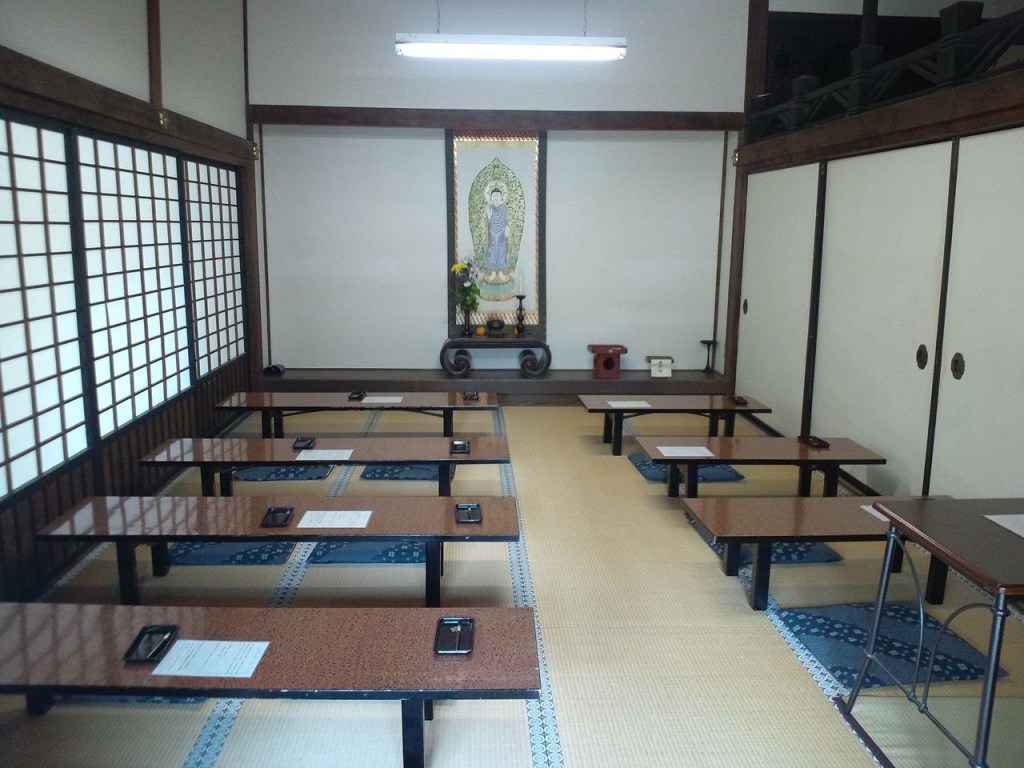
A formal sutra-copying room at the temple of Seiryō-ji Buddhist Temple (homepage) in Japan. Photo by Yanajin33, courtesy of Wikipedia.

In Japan, this practice is called shakyō (写経), and is often available at major temples. You pay a small fee to cover material costs, and get a sheet of paper and an example sutra to copy from. From there, using an ink brush you copy the text in your own hand, and can either donate to the temple or take it home.

As for which sutras to copy the Heart Sutra is the most popular choice due to its size and popularity.1 However, in some sects, the preferred sutra varies. For example in the Jodo Shinshu tradition, some people copy the Shoshinge hymn (which is pretty long), or the Juseige. For Nichiren Buddhists, they copy excerpts of the Lotus Sutra such as chapter two and sixteen among others.

But I digress.

In a larger sense, a Buddhist follower can copy any sutra or excerpt of a sutra in whatever medium or language they want: Classical Chinese on a $2 notebook, Sanskrit Siddham script on fine washi Japanese paper, Ukrainian Cyrillic cursive, Latin, Koine Greek, or whatever. You can simply copy it by hand into your own sutra book, or make a PDF to share with others. You can copy it once, or a hundred times if you prefer.

There’s no restriction; the act of copying reverently is what matters.

I will also follow-up soon to show an example of more traditional sutra copying of the Heart Sutra, a project I’ve been working on on the side. Please stay tuned.

P.S. Bonus post today since it is the Buddha’s Birthday. 🎉

A Japanese copy of the Heart Sutra. This is the rufubon version (you can see the extra 一切 in the middle), compared to Xuan-zang’s version.

1 Fun fact: the version of the Heart Sutra used in Japan differs very slightly from the popular version attributed to my main man Xuanzang.

The Japanese version, popularized by the Shingon esoteric tradition, is called the rufubon (流布本) version. The rufubon version has two extra Chinese characters (262 total) from Xuanzang’s 260, namely the issai (一切) in the line on ri issai ten dō. It also uses slightly different characters for mantra at the end: 揭諦 instead of original 揭帝 for pronouncing Sanskrit gaté phonetically.