The Ten Oxen of Buddhism

While reading my introduction book in Japanese about Rinzai Zen, I came across a famous set of paintings that I had totally forgotten about for thirty years.

Me at the age of 17 demonstrating the “Lion Roar Yoga” pose (?) at my world religions class in high school with my teacher. The Burger King crown was something I got from the nearby restaurant because my friends and I would race there during lunch break, eat for 5 minutes, and run back to class. Ah, teenage life….

Many, many moons ago, I was a cocky 17-year old first learning about Buddhism, and Mr Pierini was my World Religions teacher in high school. Mr Pierini was a charming, older Italian-American gentleman who had a lovely opera voice, and loved sharing cool ideas with us kids. This is how I first started to explore Buddhism beyond reading books at home.1

There were a number of things I learned about Zen then that seemed really cool and mystical. Looking back they made no sense to me, but they were fascinating. It sounded “cool” to be Zen, but admittedly, I was young, clueless, showing off, and knew nothing. Among the things I read about at the time were the Mumonkan and the Ten Oxen, texts that (I realize now) are both related to the Rinzai Zen tradition.

The Ten Oxen (shíniú 十牛 in Chinese) is a famous set of ten paintings, with poetic captions that were composed in the Southern Song Dynasty of China. The powerful Song Dynasty lost the northern half of China to the barbarian Jin Dynasty,2 and retreated to the south beyond the Yangtze River, where it held on for another 150 years. Despite having their back to a wall, the southern Song Dynasty oversaw a wonderful flowering of Chinese culture, including Buddhism, and especially Chinese “Chan” (Zen) Buddhism. This is also noteworthy, because historically this is the time when such monks as Eisai and Dogen both came to China from Japan to study Zen.3

The use of oxen as a symbol for taming the mind in Buddhism, according to Wikipedia, dates way back to early India including such texts in the Pali Canon as the Maha-gopalaka Sutta, but the Ten Oxen were a way to visually explain the Buddhist path (as described in the Chan/Zen tradition) to readers as a nice easy introduction. There were, evidentially several versions in circulation, but in Japan the version by one Kakuan (Chinese: Kuòān Shīyuǎn, 廓庵師遠) from the 12th century was all the rage during the Five Mountains Period of Japanese-Buddhist history. It is since known as the jūgyūzu (十牛図).

My book has a nice, down to earth explanation of the ten oxen and what they mean, so rather than posting the images with poetry, I wanted to share the simple explanations here. The illustrations are from Wikimedia Commons, and were originally painted by one Tenshō Shūbun (天章周文; died c. 1444–50).

Searching for the ox

The cowherd is searching for his lost ox. The book explains that this is like someone looking for their lost Buddha-nature: that potential within us to awaken to full Buddha-hood (a.k.a. “Enlightenment”).

Footprints sighted

The cowherd now finds the footprints of his missing ox. This is like the Buddhist disciple who studies the Dharma (e.g. “Buddhism”), and gets the first hints at the true nature of things.

Ox sighted

Just as the cowherd sees his lost ox at last, the disciple of the Buddha grasps the point of the Dharma is (i.e. what’s it all about).

Grasping the Ox

One moment the cowherd has grasped the ox, another moment he is about to lose it. In the same way, my book explains that a person may perceived their true nature one moment, but lose sight of it again. The Buddhist disciple is still inexperienced and lacks certainty.

Taming the Ox
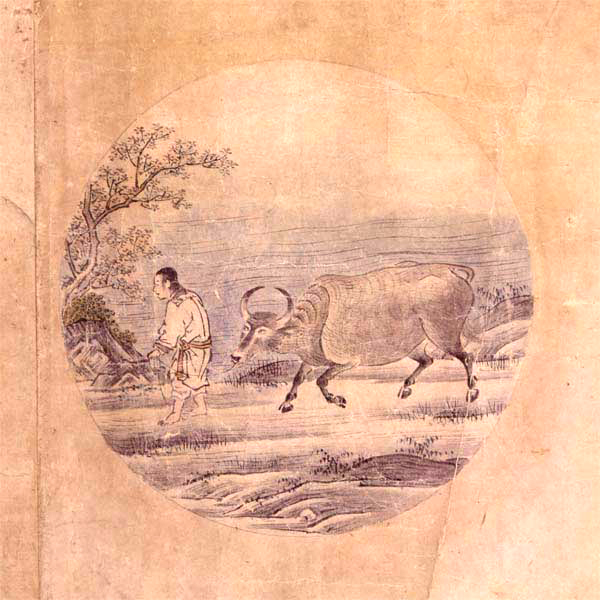
The wayward ox is now under control and lassoed, so the cowherd escorts it back home. For the Buddhist disciple, my book explains that through self-discipline such as the precepts, one’s delusions and conduct are brought to heel. This doesn’t mean they have resolved things, and one can still backslide, but at least they are under control now.

Riding the Ox

The cowherd is now confidently riding atop the ox, playing a flute. This means that one’s Buddha-nature is expressed through one’s form and behavior.

Forgetting the ox

Now that the cowherd is safely home with the ox, the ox is no longer a concern. My book explains that this symbolizes Enlightenment as one attains peace of mind.

Forgetting the distinction between self and ox

Here this empty circle expresses the Zen ideal that all is empty, and that there’s no distinction between oneself and the ox, or anything else for that matter; this is the Heart Sutra in a nutshell.

Back to basics

Having awakening to the nature of all things, things “return to the source” in a sense, or put another way, one sees mountains and mountains, trees as trees, etc. No more, no less.

Returning to society

My book explains that the cowherd now appears like Hotei (Chinese: Budai), the famous, jolly-looking figure in Chinese Buddhism and is in turn sharing the Dharma with another young cowherd. This cowherd will undergo the same quest, starting at picture one above.

In other words, everything comes full-circle.

In the same way, I don’t think teenage me imagined myself blogging about this 30 years later, and a bit more experienced, but life is funny that way.

Namu Shakamuni Butsu

1 Mr Pierini, thank you. 🙏🏼

2 Both would ultimately be destroyed by the Mongols especially under Kublai Khan who formed the Yuan Dynasty. This period of time is important to Japanese Zen history too because the influx of Chinese monks, especially Rinzai monks, to Kamakura-period Japan helped fuel a rise in Zen there. In the same way, the Fall of Constantinople in 1453 helped fuel the Renaissance in the West as refugees from the Eastern Roman Empire brought lost knowledge and know-how to the West. If there was any proof that we’re all connected in some way, look no further.

3 Earlier generations of Buddhist monks like Kukai (founder of Shingon) and Saicho (founder of Tendai) came to China during the Tang Dynasty, when connections to India were still flourishing. Hence, in Kukai’s case, he could study esoteric doctrine and Sanskrit directly from Indian-Buddhist monks. Centuries later, when Dogen and Eisai came to China, Buddhism had declined in India, and had gradually taken root in China in a more Chinese way. Of course, the Dharma is the Dharma, regardless of which culture and time it is taught, but it’s noteworthy that the Buddhism Dogen and Eisai was different: esoteric and scholarly Indian Buddhism had fallen out of favor, and a growing Zen (Chan in Chinese) community had largely replaced them.
Four Months Practicing Zen

I intentionally left this post in my blog draft folder for months, but now I am ready to post.

After a small revelation back in early May, I wanted to give it time and ensure that this change in Buddhist path wasn’t a spur of the moment decision.

After that little experience in May, I realized that I had misunderstood Zen Buddhism. Some of this is due to mixed experiences at local (Western) Zen communities,1 and in my opinion, systemic issues with Buddhist publications in English.3 Once I had better access to Japanese-language resources, and based on things I had sort of rediscovered, I decided to try to and go heads down for a few months and do my best to practice Zen as a lay person and parent.

My daily reminder list on my smartphone. A mix of mundane and Buddhist practice. 坐禅 means “zazen” and お勤め means “otsutome” (home service).

It took a lot of trial and error to get this right. At first, I had a tendency to succumb to self-doubt and start doing zazen meditation longer and longer, but then I would burn out, or have a busy day and skip. So, eventually I forced myself to keep it to five minutes, and I found I was able to sustain the practice more. Also, if I missee a day somehow, I would not punish myself over it.

Second, I struggled with how to do a Zen-style home service, so I had to do some research and this led to posts like this and this (these are for my own benefit as much to readers 😏 ). This home service underwent a few updates and changes over time, but I gradually settled on things over time, thanks to an old service I forgot I had.

Finally, I wanted to ensure I focused on Buddhist conduct as a foundational practice, and in particularly by upholding the Ten Bodhisattva Precepts. It’s also emphasized by such past Zen monks as a foundation for other aspects of Zen, but compared to the basic Five Precepts, I found myself struggling both to remember what the Ten Precepts were, and also remembering to avoid things like not bring up the past faults of others, or harboring ill-will towards others. This is still a work in progress, but I assumed it would be. It took me many years of following the Five Precepts before it became second-nature.

Anyhow, since I started this little project four months ago, I am happy to say that I have mostly stuck with it. I can count the days I missed practice on my two hands, which over four months is pretty good. I realized that small, realistic, daily practice is much more effective than trying to focus on big retreats. So, in a sense, it’s been a big win and a learning lesson for myself.

But also I realized that I also really missed some aspects of the Pure Land practice that I had been doing up until this point. For me, I found that Pure Land Buddhism tends to appeal to the heart, while Zen appeals to the mind.

Dr. Janet Wallace: “The heart is not a logical organ.”

Star Trek, “The Deadly Years” (s2ep12), stardate 3479.4

So, my practice has continued to evolve to mostly Rinzai-Zen style practice, but also with a few Pure Land elements too. I suppose this is more inline with mainland Chinese Buddhism where such distinctions are less important than Japanese Buddhism, which tends to be sectarian. Also, if it works for Obaku Zen, it works for me.

So, that’s my update. Am I Zen Buddhist now? I don’t know. I am hesitant to use that label because I am hesitant to associate myself with that community. On the other hand, I’ve found it very beneficial so far, but I haven’t forgotten what I learned from Pure Land Buddhism either. So, I guess I am both, neither, whatever. At this point, taking inspiration from Chinese Buddhism: I uphold the precepts, meditate a bit each day, dedicate merit to loved ones and those suffering in the world, praise Amida Buddha, Shakyamuni Buddha, Kannon and the Lotus Sutra. Whatever label fits that is what I am these days. 🤷🏼‍♂️

Frankly, I stopped caring. I like how my practice has evolved these past months, and happy to continue.

Namu Shakamuni Butsu
Namu Amida Butsu
Namu Kanzeon Bosatsu

P.S. Posting a little off-schedule, but oh well. Enjoy!

1 Not all experiences have been negative, but I have run into more than a few “Bushido Bros” and Japan nerds2 that soured my experience.

2 Yes, I am a Japan nerd too. I fully admit this, but nerds can be kind of intense and exhausting to talk to, so I don’t like to hang out too much with other Japan nerds.

3 It’s hard to quantify, but English books about Buddhism are either very dry, bland, and scholarly, or read like psychology self-help books, or just too mystical. When I read books in Japanese on similar subjects, I find them more down-to-earth and engaging. I know different people have different preferences, but I don’t like most English publications I find at the local bookstore. It is also why I try to share information (or translate if necessary) whenever I find it.

Back to Nature

SPOCK: There are many who are uncomfortable with what we have created. It is almost a biological rebellion. A profound revulsion against the planned communities, the programming, the sterilised, artfully balanced atmospheres. They hunger for an Eden where spring comes.

Star Trek, “The Way to Eden” (s3e20), Stardate 5832.3

世の中よ道こそなけれ思ひ入る山の奥にも鹿ぞ鳴くなる。

Within this world there is, indeed, no path! Even deep in this mountains I have entered, heart set, I seem to hear the deer cry!

Poem 83 of the Hyakunin Isshu, translation by Joshua Mostow

Recently, I came back from a camping trip, the last for our family before my daughter goes off to college. It was both good and bad. We stayed at Moran State Park on Orcas Island, Washington. I had been to Orcas Island a number of times over the years, but I had never really stayed there for personal reasons, so it was nice to explore at leisure for a change.

Cascade Lake near our campsite, which was very pristine and peaceful in the mornings. Our dog, Cherry, liked exploring here.
The so-called “Indian Island” in Eastsound bay. This area was once a village belonging to a Salish people called the Lummi (official homepage), who grew camassia crops on that islet. A combination of disease from Westerners and raids by northern Salish tribes drove them to the mainland. That lone pine tree feels like a momument to the Lummi to me…
A view from Mount Constitution, the highest peak on Orcas Island, facing eastward towards Washington State. I visited here many years ago as a kid on a school camping trip, but don’t remember much.

I posted the Star Trek quote above, not just because it sounds cool, but it does explore a side of us all: yearning for the simple country life. We all feel that revulsion toward modern life, and want to escape, yet even just after a couple days of camping in the woods, the smell of body-odor, noise from neighboring campers,1 and lack of food variety, Internet access, and electricity made us really eager to go back home. Even with modern amenities like gas stoves, freezer coolers and ready-made food (including instant ramen), it quickly gets old.

It wasn’t just me either. There was a lone woman camping just next to us. She brought her dog, and a stack of books to read, and seemed like an experienced camper, but it was clear that she wasn’t finding the solace she sought, and spent most of her time away from campsite to (presumably) find a quieter spot.

The fabled Eden sounds nice, but such a bucolic past probably never existed. Pre-modern life was in reality hard, exhausting, and safety was not always guaranteed.

Yet, modern life has its own challenges and dangers too. We might not die from dysentery anymore, but we often suffer obesity, isolation, and constant anxiety. We might not starve like our ancestors did, but we also eat some egregiously bad food thanks to mass-production and chemicals (including microplastics). Similarly, our fellow Man has replaced natural predators as the threat to our lives.

I don’t want to downplay the benefits of modern life, though.

The average2 lifespan of a human being in the 21st century is significantly longer than before. My little incident a couple years ago likely would have killed me before modern medicine. Dying in one’s forties was not uncommon in the pre-modern era. But the dangers of modern life are still there but now more subtle, yet catch up to us eventually.

In short, life is a struggle, no matter how long we live. Getting to old age without suffering any major health issues is something to be grateful for, but even more important is how you choose to live your life up to that point. As the Zen aphorism goes: every day is (sort of) a good day, so enjoy the moment, and try to live with some element of dignity and free of regrets.

Namu Shakamuni Butsu

1 There was a very rude family camped next to us. The mom kept yelling and swearing at her two toddler children, who in turn were constantly crying and talking back … at 4am in the morning. Ironically, the lady had a “Live Laugh Love” bumper sticker on her car.

2 The keyword here is “average”. A person in pre-modern times some people did live to their 80’s or 90’s, but the odds were against them. A single scratch leading to an infection, or a crippling injury, or a genetic precondition that we can treat now would often kill a younger person. So, if you did manage to live to a ripe old age, it was indeed a cause for celebration.

Vengeance

MCCOY: What if you decide he is Kodos? What then? Do you play God, carry his head through the corridors in triumph? That won’t bring back the dead, Jim.

KIRK: No, but they may rest easier.

Star Trek, “The Conscience of the King” (s1ep13), Stardate 2817.6

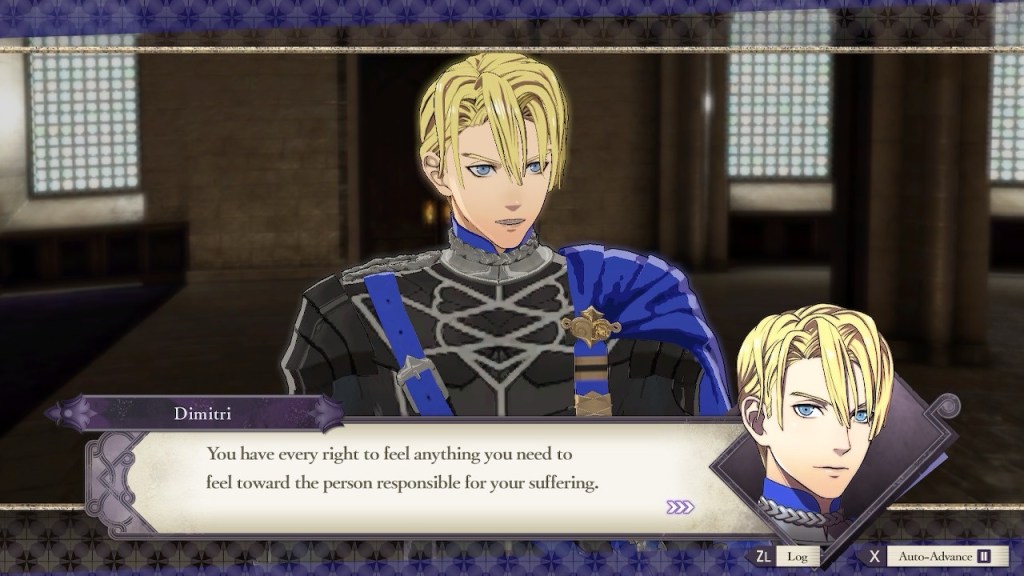
In the game Fire Emblem: Three Houses, one of the three main characters you interact with is the prince of Faerghus, Dimitri, who has suffered terrible tragedy in the youth. Behind his veneer of civility, he is gradually losing his mind.

He cannot get past the loss of his loved ones, and is determined to kill Edelgard personally, whom he blames for all his misery. Depending on which story path you choose in the game, Dimitri’s fate, and the fate of everyone he drags down with him, is very tragic indeed.

Dmittri in the “Azure Moon” route of Fire Emblem: Three Houses

The Buddha saw through this death-spiral of vengeance and hatred, and how utterly pointless it was:

“He abused me, he struck me, he overpowered me, he robbed me.” Those who harbor such thoughts do not still their hatred.

The Dhammapada, verse 3, translation by Acharya Buddharakkhita

Indeed, ill-will is one of the Five Hindrances, and can only be countered by goodwill. But what happens when someone has been genuinely hurt and abused by someone else?

Dimitri at an earlier point in the game.

Dimitri suffered terrible loss and hardship in his youth due to the political machinations outside his control, and the pain and grief are genuine, not something you can just wish away, or use platitudes to make it better. It’s not hard for readers to think back to moments of trauma in their own lives (I have my fair share), and feel raw anger, rage, or sadness (why did this happen to me? why do I have to live with these scars for the rest of my life?).

If you pick the story path that sides with Dimitri, there is a happier fate for him. I don’t want to spoil too much, but through his friends (including you, the main player), he learns to unravel his past and gradually learns to look forward toward the future his kingdom including a dramatic moment with Edelgard.

Thus, I think what the Buddha says in the Dhammapada is true: vengeance, anger and bitterness are indeed self-destructive, but if the trauma and pain are real, they can be very difficult to let go. It is too raw and painful to simply dismiss with logic and reason. But, in Dimitri’s case, support from loved ones helps him through the darkest moments, and helped him let go. He learned not to face it alone, and grew from it.

With whatever trauma you have to live through, I hope you dear readers find similar resolve and happiness.

The Size of One’s Heart

Just a neat clip on Youtube that I found recently.

Enjoy!

Rinzai Zen Home Liturgy

Recently, I finally got a hold of an introduction book on Rinzai Zen from Japan titled うちのお寺は臨済宗 (“My Temple is Rinzai Zen”). This book is part of a series for Japanese-Buddhists to learn more about the particular parish or sect they grow up in, and I have used it extensively covering other sects here. For some reason, I failed to find the Rinzai book in the past, but was finally able to order it.

Anyhow, most Western books on Rinzai Zen tend to focus on the mystical aspects of Zen without explaining the more practical side for lay followers. So, similar to my posts on Soto Zen and Tendai, I wanted to post the details of Rinzai Zen home liturgy based on what I learned from the book. Personally, I find the mundane side of Zen far more interesting than the more mystical aspects taught by the likes of Alan Watts and D.T. Suzuki.

As with Soto Zen, Rinzai Zen emphasizes the importance of zazen (meditation) practice, but it does have its fair share of chanting and devotionals as well as a support. How you, the layperson Zen student, balance these needs is something you will learn over time. I just wanted to share the information as presented in the book. If you are new to Buddhism, and maybe not comfortable with meditation, start with doing home devotional services first, and as you build confidence, you can expand to other practices in including meditation and precepts, etc.

In many ways, Rinzai Zen liturgy very closely resembles Soto Zen. Both are derived from Chinese tradition1 so this isn’t very surprising. Also, some chants will have a “Sinified” (Chinese) version and a native Japanese version, some only appear in Sinified form. I will try to post both when applicable.

A Quick Note on Liturgy

The book recommends consulting your local Rinzai temple for details. I believe this is because there are many subsects in Rinzai Zen (complicated history) and thus many lineages and home temples. Each temple lineague might do things a little differently, so the book cautiously suggests checking with your home temple first.

But if you are reading this, you probably don’t live in Japan, so the book also suggests commonly practiced liturgy format. That is what I am posting here. Again, it’s very similar to Soto Zen, so if you are unsure, you can consult Soto Zen sources too.

Example Rinzai Zen Home Liturgy

So far, based on research, I have seen that there are two versions use in Rinzai Zen. For simplicity, I will call them the “short version” and “long version”. People are welcome to chose which version they want to recite, or adapt as needed. These are examples. For both versions, I was lucky to find some nice video examples from the temple of Yogaku-ji in Tokyo. Thank you!

Short Version

The format of the “short” liturgy is as follows:

The video below shows a similar format, without reciting the Four Bodhisattva Vows, so it’s a very short and simple.

Kaikyogé: Opening of the Sutra Verses

I had trouble finding an example in native Japanese, but posting the Sinified form below. It is basically identical to other sects. I included rough translation as well.

Sino-JapaneseTranslation
Mu jo jin jin mi myo hoThe supreme and profound teachings (Dharma) of the Buddha
Hyaku sen man go nan so guis truly rare to encounter,
Ga kon ken mon toku ju jibut now we are able to hear and receive it.
Gan ge nyo rai shin jitsu giIt is our hope that the teachings become clear to us.

Sutra Chanting

As stated above, the Heart Sutra, Kannon Sutra, or Hakuin’s Hymn of Zazen are the most common choices. Feel free to choose one, or rotate them each day.

As noted above, my book mentioned that one can also recite the Dharani for the Prevention of Disaster, typically chanted three times after reciting the Heart Sutra. But this is entirely optional.

Shiguseigan: The Four Bodhisattva Vows

See this post for more details and translation. Youtube link here. It is the same as other sects in Japan.

Sino-JapaneseNative Japanese
Shu jo mu hen sei gan don/a
Bon no mu hen sei gan dan
Ho mon mu ryo sei gan chi
Mu jo bo dai sei gan sho

Fueko: The Dedication of Good Merit Towards Others

See this post for more details. This liturgy is somewhat unusual in that every sutra book I see consistently prints it as a mix of both native Japanese followed by Sino-Japanese (highlighted in bold). So I am posting as-is. Youtube link here.

Dedication of Merit, full version
Negawaku wa kono kudoku wo motte, amaneku issai ni oyoboshi,
Warera to shu jo to, mina tomo ni butsu do wo jozen koto wo
Ji ho san shi i shi fu
Shi son bu sa mo ko sa
Mo ko ho ja ho ro mi

There is also a second version that I found in a liturgy book from Nanzenji temple, another major Rinzai temple that uses a different format:

Sino-JapaneseTranslation
Gen ni su kun teMay this good merit that I have accumulated…
Fu gyu o i shiiBe distributed to all beings
Go ten ni shun sanSo that we may all walk this path
Kai kyu jin bu doAnd equally attain the Buddha Way.

What’s fascinating about this version is that the Chinese characters are exactly the same as found in other sects (for example Tendai liturgy), but the pronunciation is much more Sinified (Chinese-style), rather than Japanese style readings. Feel free to adapt either verse. I prefer the Chinese-style pronunciations as I find them shorter and easier to pronounce.

Long Version

The format of the “long” liturgy is as follows:

Many aspects of this liturgy are the same as the short version, or they are linked in other blog posts (The Great Compassion Dharani is too long to post here). Some of these “dedication of merit” verses are hard to find online, so I wasn’t able to post anything here.

In any case, the temple of Yogaku-ji in Tokyo has put another excellent video with this format, which I encourage you to take a look.

Conclusion

These are just a few examples (I found others) of how Rinzai Zen liturgy works. As with many aspects of Buddhism, find what works, and is sustainable, and feel free to adjust and modify over time. Consistency, preferably daily, is the most important thing.

Good luck, and happy chanting!

P.S. Featured photo from my visit to Kennin-ji Temple in 2024.

1 In truth, all Buddhism in Japan derives from Chinese Buddhism (often through the Korean peninsula), but for historical reasons, the two Zen sects (namely Rinzai and Soto) were founded by monks who journeyed to China during the Song Dynasty (10th – 13th century) which is much later than other traditions who imported Buddhism during the Tang Dynasty (7th – 10th c.). This means that they had the latest, freshest practices and monastic traditions compared to other sects, and this earned Zen an outsized cultural impact where other sects were either homegrown or seemingly antiquated. When Rinzai’s cousin Obaku came to Japan in the 16th century, it was even newer and briefly had a heyday in Japan.

Respect For Life

HEMMER: … I will not fight for Starfleet, but I will defend its ideals. Pacifism is not passivity. It is the active protection of all living things in the natural universe.

Star Trek: Strange New Worlds, “Momento Mori” (s1ep4), Stardate 3177.3

I love Star Trek: Strange New Worlds, and I love this quote.

The first precept of Buddhism, regardless of which list you talk about, starts with a vow not to destroy life. Further, in such texts as the venerable Dhammapada (collected sayings of the Buddha), you can see quotations like so:

129. All tremble at violence; all fear death. Putting oneself in the place of another, one should not kill nor cause another to kill.

and:

142. Even though he be well-attired, yet if he is poised, calm, controlled and established in the holy life, having set aside violence towards all beings — he, truly, is a holy man, a renunciate, a monk

Translations by Acharya Buddharakkhita

Per tradition, monks in the Buddhist tradition are often strictly vegetarian and why some devout lay Buddhists choose to be vegetarian, either full-time or on specific holidays.

But, I think Hemmer’s quote goes a step further, peace, goodwill, and pacifism are not simply refraining from violence; it is also respect for all life (even the Gollums in life). This requires empathy, putting yourself in their shoes. You see this expressed in such popular liturgy as the Four Bodhisattva Vows, dedication of merit, and so on.

But like many things in Buddhism, such a lofty goal is hard to uphold at first. So, the precepts more narrowly focus on simple training rules (not to do X, not to do Y), and overtime, as basic training rules become second-nature, and your understanding of the Buddha-Dharma deepens, one’s practice refines more and more over time. So, if you feel you can’t live up to such an ideal, don’t worry. It’s important to know that the ideal exists, and that every starts from somewhere.

Namu Shakamuni Butsu
Namu Kanzeon Bosatsu

P.S. Double post today to celebrate Strange New Worlds, season three. I cancelled my subscription of Paramount Plus some months ago (no regrets), but I enjoy the first two seasons on BluRay, and waiting to get the subsequent seasons on BluRay as well.

Helping Others

In these times of uncertainty, I’ve been trying various ways to help causes I care about: donating more,1 making better environmental choices at home, and trying to be a better person, but even then, it feels like it’s never enough. Like Ashe from Fire Emblem: Three Houses, I feel like in spite of my efforts, I’ve accomplished nothing.

A conversation with “Ashe”, one of my favorite characters in FE3H.

Being able to start small and focus on helping someone is a great start. From there, you might branch out and help others too.

Photo courtesy of the hilarious “Skeletor is Love” Tumblr.2

Yet in the big picture, this still doesn’t feel like it is enough sometimes.

Mahayana Buddhism, which is everything you see from Tibet to Japan and between, tends think very big picture. Thus, it often holds up the bodhisattva as the archtype for Buddhism: a being who lifetime after lifetime helps others, fulfilling very grandiose vows. The idea is that you can’t help everyone in one lifetime, but on the grand scale of time, it is possible to help everyone eventually. But of course, because time and space are so vast, it is a kind of never-ending story. The Buddha, Amitabha (aka Amida) completed his vows in 10 kalpas (aeons), roughly 160 million years.3

Meme from Return of the King 🤣

Anyhow, point being: if we look at it from a Mahayana-Buddhist endpoint, every little thing we do now does add up, but it happens on a scale of time that we can’t fully grasp. Nonetheless, it does add up in the long-run.

But maybe that’s small comfort here and now.

In truth, I don’t have a good answer here. I still try to help where I can while not burning myself out in the process, but I can only hope it makes a difference someday, even if I can’t see it.

1 I used to have a donations page on the blog pointing to various causes, but I’ve had to take it down temporarily to update some broken links, change some charities, and revise the content a little. The page is now back online!

2 I used to watch the original cartoon “He-Man and the Masters of the Universe” as a little kid, so this takes me back. I remember one Christmas I received the Castle Greyskull playset, which was really neat, but then fell apart later. Ah, the impermanence of all phenomena and kids’ toys.

3 Kalpas are interpreted differently in different texts, so I am just using the more conservative estimate of 16 million years. Kalpas are meant to convey astronomical amounts of time, not literal ones.

The Flexibility of Tendai

As I talked about in a recent post, the main core idea of the venerable Tendai (天台) sect in Japanese Buddhism, including its parent Tiantai sect in China, is that the Lotus Sutra is the most important text in the Buddhist canon, a kind of capstone (lit. “complete teaching”, engyō 円教) for the rest of Buddhist literature up to that point. Because the Lotus Sutra is pretty long (equivalent to a modern book), I tried to summarize its teachings here.

Anyhow, Tendai/Tiantai focuses on how to put the Lotus Sutra into practice. For Japanese Tendai in particular, this is encapsulated in a phrase called shishū yūgō (四宗融合) meaning “Four Integrated Practices”. According to my book, these are listed as follows:

  • Meditation1
  • Esoteric Practices (mantras, dharani, mandala, etc)
  • Precepts
  • Pure Land2

This a lot. It helps to think of Tendai as a big umbrella or parasol with a bunch of people standing under it.

Photo by Ryutaro Tsukata on Pexels.com

Different people under the umbrella represent different Buddhist followers, with different practices and inclinations, but the umbrella itself represents the concept of upāya (“expedient means”) or hōben (方便) in Japanese. This is one the main themes of the Lotus Sutra, and expresses that all Buddhist teachings and practices lead toward the same end goal, and thus whatever works for a person at that time is perfectly fine for that person.

This is encapsulated in the 25th chapter of the Lotus Sutra, the so-called Kannon Sutra, because the Bodhisattva Kannon (a.k.a. Guan-Yin, Avalokiteshvara, Chenrezig, Quan Âm, etc) according to this chapter takes on whatever form is most beneficial for that person and teaches the Dharma to them. Thus, Kannon can appear as a man, woman, monk, rich person, etc. It’s also why statues of Kannon often depict them as having 1,000 arms, each holding a different object. Similarly, many of the early Buddhist monks who were Tendai followers practiced it differently from one another. On the one hand, you have monks like Eisai, who focused on meditation and precepts (and would later found the first Rinzai Zen temples), you also had monks like Genshin who focused a lot more on Pure Land practices, as well as esoteric experts such as Ennin.

Tendai as a sect in Japan was almost universal in the 9th through 12th centuries, but for a variety of historical (often self-inflicted) reasons, it has diminished in size and influence. Yet when you visit historical temples in Japan such as Asakusa Temple in Tokyo, Kiyomizudera Temple in Kyoto, and Sanjusangendo in Kyoto, these are all Tendai temples. Further, its influence lives on in newer sects that we know well: Zen, Pure Land, Nichiren and such, which all inherited practices and concepts even if they apply them in differing ways.

But while Tendai as an organized sect is somewhat diminished,3 its teachings of “umbrella” or “universal” Buddhism continue to live on. Rather than insisting there’s only one way to practice Buddhism, it gives a large, spacious framework for people to figure out their own path and use the vast toolkit available to work it out, all under the Lotus Sutra concept of expedient means. Use what works for you, and do not be afraid to adapt, change, or expand your practice as you go.

Namu Shakamuni Butsu
Namu Amida Butsu
Namu Kanzeon Bosatsu

P.S. Publishing off-schedule just for fun. Happy Sunday!

1 Tendai/Tiantai has the same meditation tradition as Zen, but tends to call it shikan (止観) not zazen (座禅) meditation. The founder, Zhi-yi, in China wrote multiples treatises, the Mohe Zhiguan, that provides a comprehensive manual about meditation. I have a copy of the The Essentials for Practicing Calming-and-Insight & Dhyana Meditation, but have only read parts of it. It is a nice training manual for those interested, but it is a little dense since the intended audience was the monastic community.

2 In the time of Zhi-yi, the founder of Tiantai, Pure Land Buddhism was approach more as a meditation tradition than a separate set of practices that what we see today. By the time it came to Japan, this had changed somewhat, and we see through the writings of Genshin that there were a variety of approaches both devotional and meditation-focused.

3 According to my book, as of 2015, the number of registered followers in Japan was around 1.5 million give or take. This makes it the second smallest of the major sects in Japan, and one-eighth the size of Jodo Shinshu-sect Buddhism. Only Rinzai Zen is smaller (1.1 million).

Made to Become So

Speaking of the Tannisho recently, here’s another interesting quote worth exploring:

6. 自然のことわりにあひいかなはわば、仏恩をもしり、また師の恩をもしるべきなりと云々。

“When we live according to the truth of ‘made to become so by itself’, we shall know gratitude to the Buddha and to our teachers.”

Translation by Dr Taitetsu Unno

“Made to become so by itself…” what does he mean by that? Let’s look at another example.

In an separate Jodo Shinshu work, Shinran’s Notes on Essentials of Faith Alone (唯信鈔文意, yuishinshō mon’i) which we explored recently, he explains this “made to become so by itself” in greater detail:

Ji also means of itself. “Of itself” is a synonym for jinen, which means to be made to become so. “To be made to become so” means that without the practicer’s calculating in any way whatsoever, all that practicer’s past, present, and future evil karma is transformed into the highest good, just as all waters, upon entering the great ocean, immediately become ocean water. We are made to acquire the Tathagata’s [Buddha’s] virtues through entrusting ourselves to the Vow-power; hence the expression, “made to become so.” Since there is no contriving in any way to gain such virtues, it is called jinen. Those persons who have attained true and real shinjin are taken into and protected by this Vow that grasps never to abandon; therefore, they realize the diamond-like mind without any calculation on their own part, and thus dwell in the stage of the truly settled. Because of this, constant mindfulness of the Primal Vow arises in them naturally (by jinen). Even with the arising of this shinjin, it is written that supreme shinjin is made to awaken in us through the compassionate guidance of Sakyamuni, the kind father, and Amida, the mother of loving care. Know that this is the benefit of the working of jinen.

Source: https://shinranworks.com/commentaries/notes-on-essentials-of-faith-alone/

The specific phrase Shinran uses is jinen hōni (自然法爾), which is tricky to translate into English. As the Notes explains above, “jinen” means to be become so, naturally, not through contrivance. The term “hōni” (法爾), alternatively hōnen (法然),1 means something like “by virtue of the Dharma”, but in Jodo Shinshu lingo specifically it means through the power of Amida Buddha’s vows to rescue all beings.

Here, Shinran is strongly advocating a sense of total reliance on Amida Buddha, with the belief that by fully entrusting oneself to Amida Buddha’s compassionate vows (as depicted in the Three Pure Land Sutras), called shinjin (信心), rather than through calculation or conscious effort (i.e. a “weekend warrior”), then one is transformed by Amida gradually without realizing it. So, rather than trying to reborn in the Pure Land, Shinran is saying that one should trust in Amida to guide you to the Pure Land.

I’ve always found this concept very interesting.

While I might quibble with Shinran’s interpretations of things (especially since other Pure Land teachers in the past did not have such a one-sided view), I do think there’s merit in the idea of transformation without one realizing it. This is accomplished simply by exposure to the Dharma, what Jodo Shinshu Buddhists like to call “deep listening” or monpō (聞法), which I also mentioned here.

1 Not to be confused with Honen (same kanji).