Ryōhen (良遍, 1194-1252), was a prominent Yogacara-Buddhist scholar and faithful disciple of Jōkei, often credited as a reformer of Japan’s Hossō sect during the medieval period in Japanese Buddhist history. In James L. Ford’s book on Jokei and Medieval Japanese Buddhism, Professor Ford quotes this famous “restorer” when he describes the famous Buddhist metaphor of waves and water succinctly (Japanese terms added by Prof. Ford):
Although there seem to be a multitude of waves, it is not a real multitude, for the waves are causally produced (enshō), phantom-like (nyogen) dharmas that defy the comprehension of the unenlightened mind. If the waves were unchanging, real (kenjitsu) objects they would be completely different from water. But since the waves are nonsubstantial (koke), they are in harmony (sōwa) with the water and are neither completely identical to, nor completely different from, it (fusoku furi). From this analogy, you can understand the relationship between phenomena and their underlying substance. (pg. 60)
The key to understanding this is that phenomena (things, thoughts, feelings, ideas, everything) exists like the waves. It’s existence is contingent on external factors (like the wind and water), and therefore temporary, not permanent. They are causally produced, in other words. Once those external factors are no longer in harmony, the phenomena in question will change or fade.
The ‘underlying’ substance here is not meant to imply ‘pantheism’ or ‘oneness’ (in the New Age sense), but rather the causes and conditions that cause something to arise. All waves, like all phenomena, have a commonality of having a contingent, temporary existence. Such phenomena are not entirely separate in existence, but aren’t “one” either. The truth lies somewhere in between.
This is what Buddhism defines as “emptiness” (e.g. of a permanent, separate nature) or in the classic Sanskrit term “sunyata” (pronounced ‘shoon-yata’). In the Heart Sutra text, one of the most fundamental to East Asian Buddhism, this is all summed up very succinctly:
色 不 異 空
shiki fu i ku
空 不 異 色
ku fu i shiki
色 即 是 空
shiki soku ze ku
空 即 是 色
ku soku ze shiki
Which means something like: Form is not different than emptiness; Emptiness is not different from Form. Indeed, form is emptiness; Emptiness is form.
So when you have angry thoughts, or see something you don’t like, just remember the water and wave analogy. You can’t be angry if you don’t have angry thoughts. 😉 For the good things in life, remember that they too are waves and will only stay around if conditions allow them to do so. Reflection on such things I hope will lead people to a more balanced view of the world and self.
One of the earliest recorded teachings in the Buddhist canon is something called the Sutta-nipata a collection of discourses by the Buddha to various disciples. These are not sutras in the strictest sense, but are part of the earliest collections, and represent some of the closest things we have to the Buddha’s original teachings.
In the Simile of the Boat, verses 316-323, the Buddha talks about the importance of good, reliable teachers:
“He from whom a person learns the Dhamma should be venerated, as the devas [the gods] venerate Indra, their Lord. He, (a teacher) of great learning, thus venerated, will explain the Dhamma, being well-disposed towards one. Having paid attention and considered it, a wise man, practicing according to Dhamma, becomes learned, intelligent and accomplished by associating himself diligently with such a teacher.
Translation by John D. Ireland
The importance of a good teacher in Buddhism is to help clarify and explain the Dharma, the teachings of the Buddha, in a way that you can learn and apply in your own life (and thereby benefit from it). The teacher holds no power over you (nor should they), but they are responsible for teaching the Dharma properly. The Buddha described this as catching a poisonous snake properly.
If a teacher can’t do it properly, not only can they be “bitten”, but their students who received the bad advice, get bitten too:
“But by following an inferior and foolish teacher who has not gained (fine) understanding of the Dhamma and is envious of others, one will approach death without comprehending the Dhamma and unrelieved of doubt.
Translation by John D. Ireland
As a student, one has to ask: how do I find a good teacher, especially in the West where teachers are few and far between? As Brad Warner writes, there are plenty of people who enjoy the allure of being a teacher. Such teachers may start with good intentions, but go astray, and lead plenty of people with them.1
“Besides, I have never encountered anyone who started out wanting real bad to be a dharma teacher and then ended up being a good dharma teacher. Their desire to be seen as A Dharma Teacher always overshadowed whatever they were supposedly teaching. It was more about performance than substance.”
brad warner
And so the most important thing is substance: a genuine commitment to the path, experience, and sincere desire to help others rather than their own image:
“But if (the man at the river) knows the method and is skilled and wise, by boarding a strong boat equipped with oars and a rudder, he can, with its help, set others across. Even so, he who is experienced and has a well-trained mind, who is learned and dependable, clearly knowing, he can help others to understand who are willing to listen and ready to receive.
Translation by John D. Ireland
Such a teacher is worth placing your trust in.
1 This is a big reason why I quit training in 2017 to be a minister with the Buddhist Churches of America, and with Jodo Shinshu Buddhism in general. In spite of my personal misgivingsabout that particular sect’s teachings, the allure of being an ordained minister had clouded my judgment and made me compromise my beliefs in order to keep going. In the end, I realized my error, and decided it was better to be a sincere lay person than an insincere priest faking it for an audience. I lost a lot of blog readers, and friends at the temple, but in the end I am a lot happier with myself now, even if greatly diminished.
Recently, my wife was talking with an extended relative she hadn’t talked to in a while. This relative also lives overseas, albeit in a different English-speaking country, and when we last spoke a year ago, she had been talking about mundane things like taking the kids out for picnics, etc.
This time around, the same relative was spouting incoherent ramblings about weather-control machines, forest fires caused by human agents, and all sorts of things she had found on Youtube and on the Internet. Since the last time we spoke with her, she had gone down some kind of rabbit hole of conspiracy theories, and it had changed her for the worse.
The number one reason why I hate conspiracy theories, and all they represent, is that they are inherently irrational, narcissistic, and antithetical to the Buddha-Dharma.
In the original Star Trek series, in the episode Journey to Babel (2×10), Spock speaks with his mother and says the following (emphasis added):
It [being a Vulcan] means to adopt a philosophy, a way of life, which is logical and beneficial. We cannot disregard that philosophy merely for personal gain, no matter how important that gain might be.
To me, this is the essence of the Buddhist way of life: a way of life that is meant to be logical, rational, and of benefit to all sentient beings. Consider such liturgy as the Four Bodhisattva Vows:
Sentient beings are innumerable, and yet I vow to save them all. My mental defilements (lit. bonnō) are innumerable, I vow to extinguish them all. The gates of the dharma are without measure, I vow to master them all. The path to Buddhahood is peerless, I vow to fulfill it.
Similarly, in the famous liturgy, the Heart Sutra, there is the following verse (emphasis added):
Because there is no attainment, bodhisattvas rely on Prajñāpāramitā [the perfection, or culmination, of wisdom], and their minds have no obstructions. Since there are no obstructions, they have no fears.
translation by Lapis Lazuli texts
Wisdom leads to freedom from fear. This is not wisdom as in the sense of knowing more than other people, which is just empty narcissism, but rather seeing outside your self-centered viewpoint.
Take for example a famous Buddhist story about the monk and the snake. It is said that a long time ago there was a monk in India who, one night, had to step out into the woods to use the restroom. As a monk, he has no possessions, and thus has to walk out into the dark by himself. Since India has many poisonous snakes, this can be a risky business. In any case, as the monk was carefully treading through the grass, he steps on a snake and faints in terror. The following morning, he wakes up, and realizes that the “snake” he stepped on, was in fact an old piece of rope.
This is how the mind works, and why its important not to blindly rely on your own logic and viewpoint too much. People can be certain that X is true, and yet the facts say otherwise. The greater one’s faith, the more they cut themselves off from reality. The more rational approach is to look at the data, look at facts, make observations, and then make informed decisions, not what one feels or one is sure is the truth.
A ‘position,’ Vaccha, is something that a Tathagata [the Buddha] has done away with. What a Tathagata sees is this: ‘Such is form, such its origination, such its disappearance; such is feeling, such its origination, such its disappearance; such is perception…such are fabrications…such is consciousness, such its origination, such its disappearance.’ [e.g. the Twelvefold of Causation]
Aggi-Vacchagotta Sutta (MN 72), translated from the Pali by Ven. Thanissaro Bhikkhu
Or as Mr. Spock would say:
Insufficient facts always invites danger
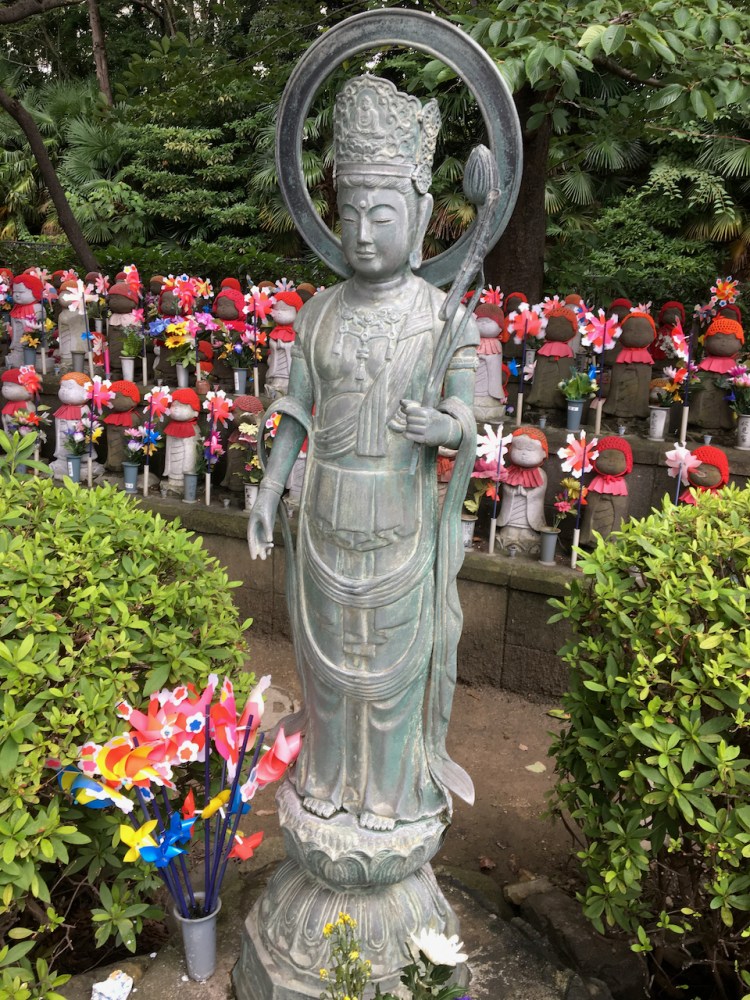
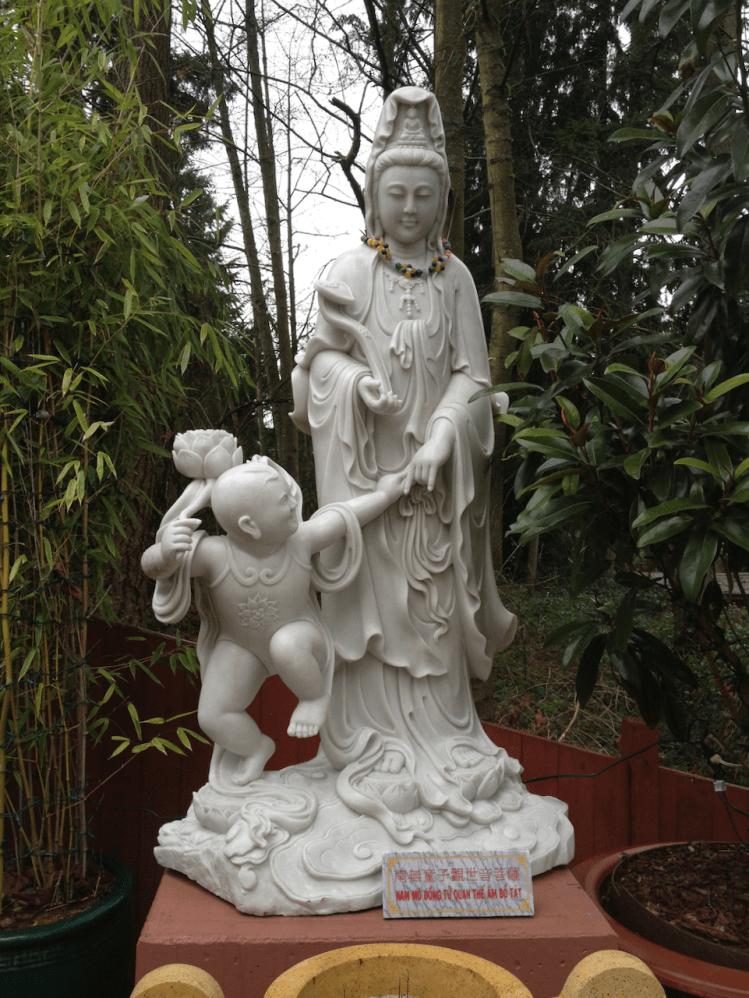
Thus, the Buddhist path is one that relies on rational thinking, not narcissistic beliefs. However, it is not limited to just rational thinking, and that’s why Mr Spock’s quote about “rational and beneficial” is so important. Consider the following Buddhist statue that I photographed in Japan in 2019 at Zojoji Temple (one of my favorites):
Here, the bodhisattva Kannon, is holding a lotus flower in one hand, while the other hand is down with two finger-tips touching. Buddhists statuary is replete with meanings and non-verbal symbols. The lotus symbolizes wisdom, and the potential for all beings to awaken, just as a lotus blooms from mud. The fingertips touching is another mudra meaning the “turning of the Wheel of the Dharma”, meaning to teach others and keep Buddhism going. The latter action, teaching the Dharma, helps sentient beings achieve awakening (i.e. the lotus), freedom from fear and wellbeing.
Hence, Kannon’s image here is a balance of both rational wisdom and compassion for all beings. Compassion not tempered by wisdom is irrational and can sometimes do more harm than good, while wisdom not compelled by concern for others is just dry scholasticism.
All of this is encapsulated in the 16th chapter of the Lotus Sutra where the Buddha says in verse:
My pure land is not destroyed, yet the multitude see it as consumed in fire, with anxiety, fear and other sufferings filling it everywhere. […] But those who practice meritorious ways, who are gentle, peaceful, honest and upright, all of them will see me here in person, preaching the Law [the Dharma].
translation by Burton Watson
Part of the freedom from fear that comes from wisdom is the ability to see past the ups and downs of life, and see the bigger picture, to live a life that is gentle and peaceful towards others, and to maintain an upright life out of compassion for oneself.
None of this is easy, and requires years and years of practice, emotional growth, introspection, and willingness to take one’s own beliefs with a small grain of salt. It is a path that is not limited to Buddhists either, and there are plenty of Buddhists who don’t follow this path. What matters is not one’s affiliation to a religious org, but one’s willingness to live a life rooted in rationality and benefit for others. None of this can be accomplished by living in the paranoia and hostility, misinformation and sense of superiority that it brings from “not being a sheep” that comes with immersion in conspiracy theories
If you find yourself lost, scared, and confused with all the things going on in the world, take a moment and breathe. Turn off social media, go outside. Ground yourself in the world around you. If it helps, maybe recite the Heart Sutra a couple times (it is short enough you can chant it in about 1-minute) or the nembutsu. The life you live now, warts and all, is sustained by the goodwill of others around you, even if you don’t know who they are. Take a moment, and consider this, and maybe give something back to the world.
Kannon Bodhisattva (観音菩薩), also known by such names as Guan-Yin, Chenrezig, Avalokiteshvara, and so on, is one of the most popular bodhisattvas in all of Buddhism, and whose devotion cuts across many sectarian lines, but Kannon is also one of the most difficult figures in Buddhism to explain to someone who is not a Buddhist.
Older English translations describe Kannon as the Goddess of Mercy, but this is pretty far off the mark. First, bodhisattvas are not gods, though they are high revered figures in Buddhism.
Second, Kannon is somewhat unusual in how he/she is very fluid in gender.
The main Buddhist text that introduces Kannon is the 25th chapter of the Lotus Sutra. This chapter is sometimes colloquially known as the “Kannon Sutra“. In this sutra, it describes how Kannon takes whatever form is necessary to teach and inspire another being. Considering the following passage:
If they need a rich man to be saved, immediately he becomes a rich man and preaches the Law [the Buddha-Dharma] for them.
If they need a householder to be saved, immediately he becomes a householder and preaches the Law for them.
If they need a chief minister to be saved, immediately he becomes a chief minister and preaches the Law for them.
If they need a Brahman [a priest] to be saved, immediately he becomes a Brahman and preaches the Law for them.
If they need a monk, a nun, a layman believer, or a laywoman believer and preaches the Law for them.
If they need the wife of a rich man, of a householder, a chief minister, or a Brahman to be saved, immediately he becomes those wives and preaches the Law for them.
Translation by Burton Watson
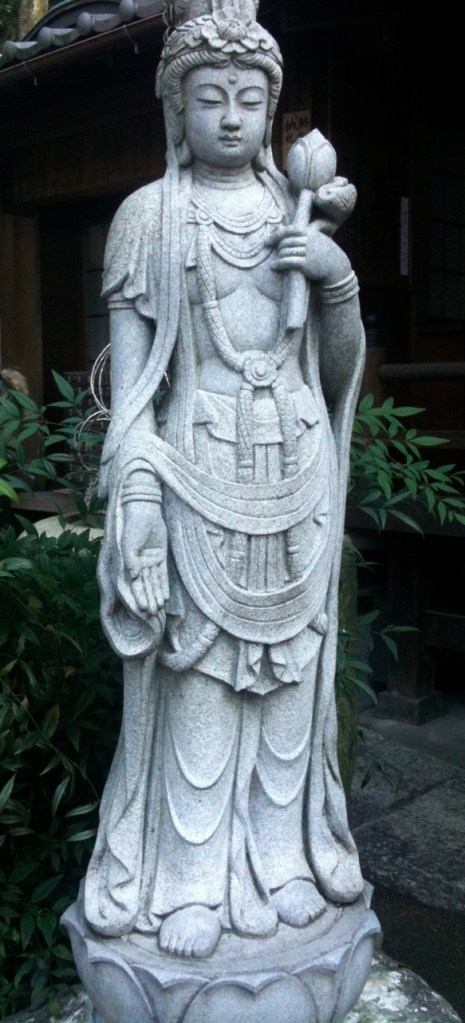
Because of the fluidity of Kannon’s identity, he/she is portrayed different across many Buddhist cultures, and even in the same Buddhist culture under different forms.
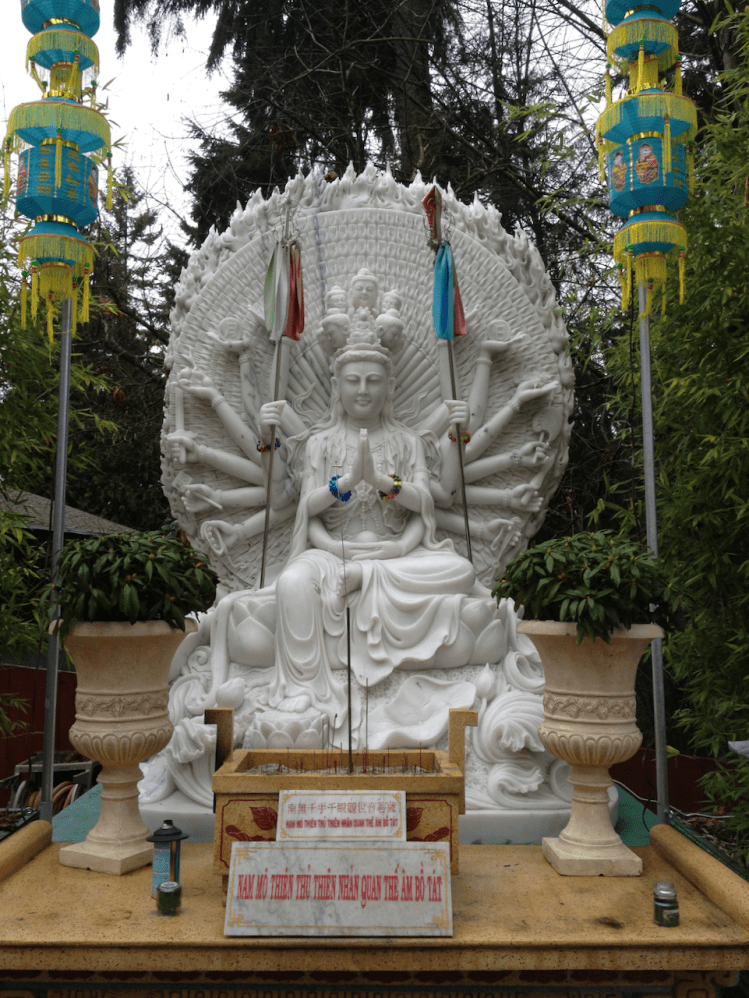
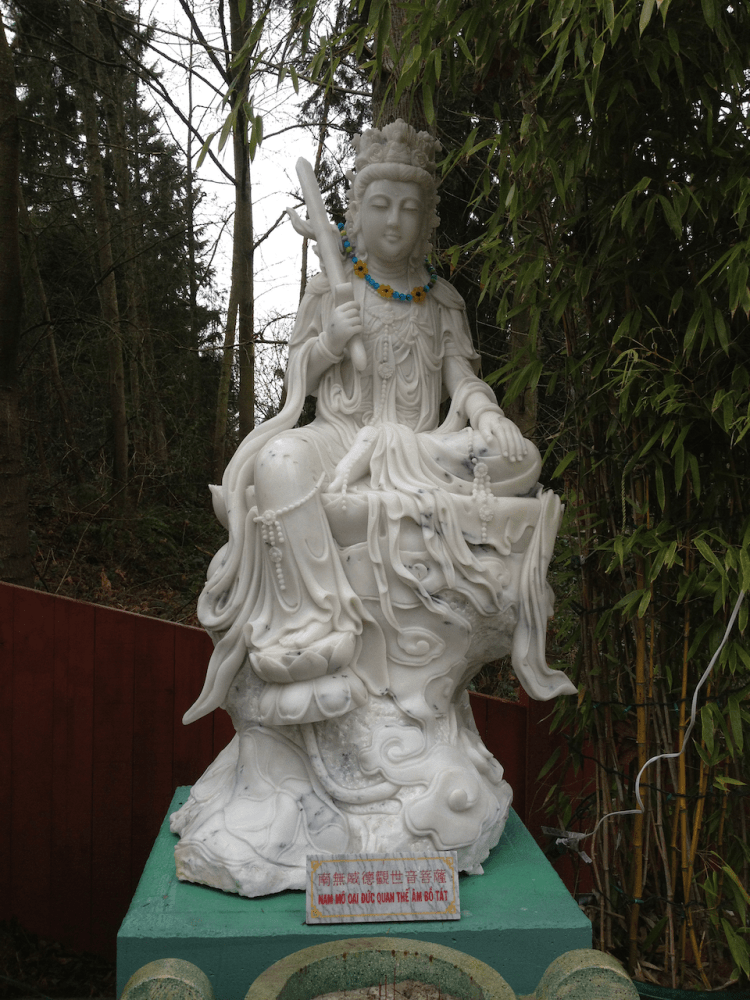
For example, when visiting a certain Vietnamese Buddhist temple near my home, I took a couple different photos of Kannon:
The picture on the left shows a more princely Kannon with 1,000 arms, each holding a different object. This version of Kannon symbolizes the countless ways and means of helping sentient beings. The statue of Kannon in the middle is a more masculine form symbolizing virtue and authority. Notice the sword. And finally, the picture on the right, depicts Kannon in a more motherly form, an embodiment of compassion. This final form, popularly depicted in Chinese culture is probably what gave rise to the notion of the “goddess of mercy” in English, despite its imprecise nature.
As we see in the Lotus Sutra, these are just some of the many forms Kannon Bodhisattva takes to inspire, teach and lead sentient beings to Awakening.
Namu Kanzeon Bosatsu
P.S. The 25th chapter of the Lotus Sutra is also thought to be the source of an even shorter devotional called the Ten Verse Kannon Sutra.
Recently, I talked a little bit about an old, but highly influential stream of Mahayana Buddhist thought called Yogacara Buddhism (sounds like “Yogaachaara“) also known as “Conscious-ness Only Buddhism”. A lot of modern Buddhism that people practice now from Tibet to Japan is deeply influenced by Yogacara, even if not overtly aware of it.
The book goes on to describe a more down to earth example of how Yogacara Buddhism describes the world:
We touch upon various things every day, meet various kinds of people, and are encountering various situations and events as we carry out our day-to-day living. At that time, it is quite natural for us to think that in regard to the objects of our mental functions of perceiving, thinking, and making judgments, that we are directly seeing, hearing, and making judgements in regard to this and that object. However, according to Yogācāra Buddhism, those cognized objects have already been colored and transformed by our minds in the process of their manifestation.
Page 10, translation by A Charles Muller
In the same chapter, the author uses the example of looking at a clock and recognizing that it is 7:30pm. The raw, digital output from the clock is internalized by our minds and interpreted as “7:30 in the evening” as the initial cognization, with follow up thoughts such as “oh, I am late” or “it’s time to get ready for bed”, and so on, as the followup stream of consciousness.
Elsewhere, Rev. Tagawa, also writes:
We lead our lives surrounded by all sorts of things. We annoyed, we may try to escape them by moving to the quiet and simple life in the middle of the mountains, but the fact of our being surrounded by many things does not change at all. As long as we are alive, there is no way that we can ever sever ourselves from our environment. In managing our daily lives, we have no recourse by to proceed while maintaining some kind of relationship with all those things that surround us. At such a time, there will always be things, people, and events. Rather than seeking to escape from them, what we need to do is examine the way we cognize these things, and the way we understand their content.
Page 11, trans. by A Charles Muller
This harks allllllllll the way back to one of the very earliest Buddhist texts, the Dhammapada, which is a collection of sayings attributed to the Buddha, wherein the opening lines are:
1. Mind precedes all mental states. Mind is their chief; they are all mind-wrought. If with an impure mind a person speaks or acts suffering follows him like the wheel that follows the foot of the ox.
2. Mind precedes all mental states. Mind is their chief; they are all mind-wrought. If with a pure mind a person speaks or acts happiness follows him like his never-departing shadow.
Translation by Acharya Buddharakkhita
Indeed, one cannot escape the mind or its mental states, regardless of whether one is in a mountain retreat, or stuck in the office. Buddhism is, first and foremost, a religion of the mind, not magical phenomena.
In the second Dune novel, there’s a quotation I think about sometimes think about at times like this:
The greatest palatinate earl and the lowliest stipendiary serf share the same problem. You cannot hire a mentat or any other intellect to solve it for you. There’s no writ of inquest or calling of witnesses to provide answers. No servant — or disciple — can dress the wound. You dress it yourself or continue bleeding for all to see.
Dune Messiah by Frank Herbert
In other words, we have to learn to live with ourselves and the environment around us somehow.
In the original Star Trek series (a.k.a. TOS), there’s an infamous episode1 in season 3 where Spock wears a new pin to symbolize the Vulcan philosophy of I.D.I.C., or “infinite diversity [in] infinite combinations”. Evidentially, it was Gene Roddenberry’s attempt at a cash grab by promoting a new product, but the catch phrase has taken on a life of its own in the Star Trek universe. You can see references to it in other Star Trek series, especially in the classic Star Trek: Deep Space Nineepisode featuring a Vulcan baseball team.
To its credit, you get to see Spock sport a neat visor though…
The interesting thing about this philosophy, isn’t just the contribution it makes to the Star Trek universe, it has some interesting groundings in Buddhism as well.
Consider this phrase by the famous Indian Buddhist Nagarjuna (c. 150 – c. 250 CE):
sarvaṃ ca yujyate tasya śūnyatā yasya yujyate sarvaṃ na yujyate tasya śūnyaṃ yasya na yujyate
All is possible when emptiness is possible. Nothing is possible when emptiness is impossible.
Quoted from the book, Nagarjuna’s Middle Way, translated by Mark Siderits and Shoryu Katsura
Much of Buddhism, especially Mahayana Buddhism, is grounded in the notion that all things, both concrete and abstract, arise through outside causes and conditions, and thus have a contingent existence. This is why all things are fluid, and constantly in flux. It’s also why, as Nagarjuna notes, that all things are possible.
Infinite diversity in infinite combinations, in other words.
1 Among the episode’s many other problems was the creepy way the male cast of the Enterprise are constantly talking about Diana Muldaur’s character’s beauty. TOS always had a problem with sexism, but this was over the top and creepy. It’s not a fault of the actors, just the terrible writing and direction that plagued season 3.
For this year’s fall Ohigan season, I wanted to provide a brief introduction to fascinating and highly influential school of thought within Mahayana Buddhism called Yogacara (as in “yoh-ga-cha-ra”), also known as “Conscious-Only Buddhism”.
I first encountered Yogacara Buddhism through a book that was translated from Japanese by Professor A. Charles Muller titled Living Yogacara: An Introduction to Consciousness-Only Buddhism. The book was written by head of the temple Kofukuji, Rev. Shun’ei Tagawa. Kofukuji Temple, a place I happened to visit in 2010, is one of the last temples in Japan of the once powerful Yogacara, or Hossō-shū (法相宗), sect in Japan. It once dominated political and religious thought in Japan until about 10th century, when it was increasingly eclipsed by the Tendai sect, while its political entanglements with the powerful aristocracy eventually led to its downfall.
However, the Yogacara tradition extends all the way back to when Buddhism flourished in India, starting with two half-brothers Vasubandhu and Asaṅga in the 4th century CE, who wrote the first treatises in the region of Gandhara (a place mentioned here, here, here), where modern Pakistan is now. It was one of the many innovations in Buddhism that happened in Gandhara that then traveled the Silk Road to China and beyond. The famous Chinese monk, Xuan-zang, who journeyed all the way back to India to collect more teachings was also a Yogacara monk. What we read and enjoy today is due to the efforts of all these monks and teachers.
But enough about history. What is Yogacara Buddhism?
Screenshots from Chrono Trigger, the iOS edition.
In the book, Rev. Shun’ei Tagawa bluntly summarizes the Yogacara teaching that reality is:
“nothing but that which has been transformed by consciousness.”
Further Rev. Shun’ei then quotes a famous poem that encapsulates the teachings:
Japanese
Meaning
手を打てば
At the clapping of hands,
鯉はえさと聞き
The carp come swimming for food;
鳥は逃げ
The birds fly away in fright, and
女中は茶と聞く
A maiden comes carrying tea —
猿沢の池
Sarusawa Pond.
Translation by A Charles Muller
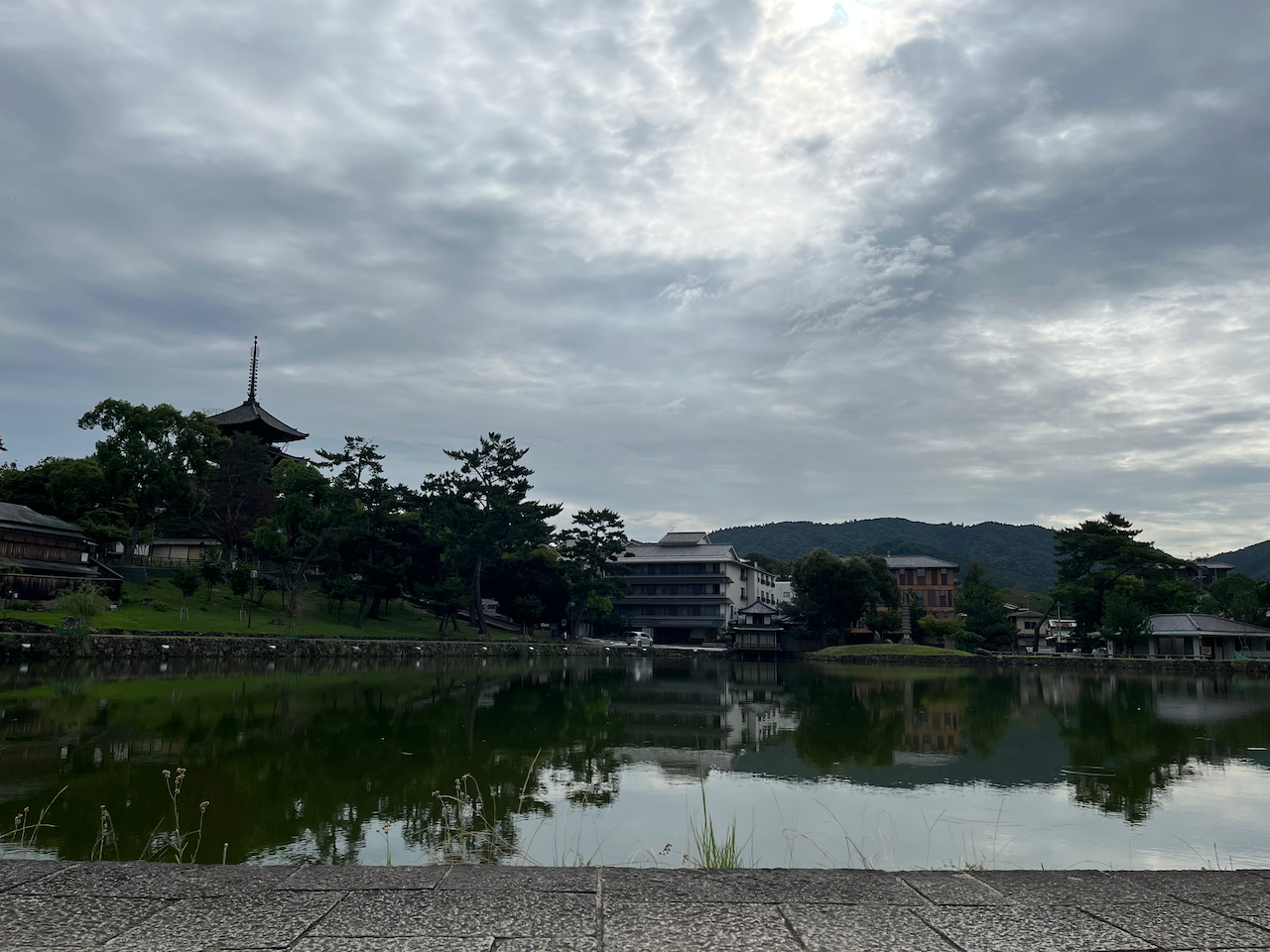
The famous Sarusawa Pond in Nara, Japan. Taken in July 2023. Kofukuji Temple can be seen to the left behind the trees.
The idea is that with a simple noise like the clapping of hands, each creature (or person) responds differently according to their background or how they view the world.
Using a more modern example from the book, imagine two people looking at a mountain together. One is a mountain climber, another is a painter. As a pile of rocks and magma formed by geological processes, a mountain is just a mountain. And yet, each person will perceive the mountain differently from one another. And such people will also interpret it differently than a goat on the mountain. It’s not a conscious effort either, it’s how our mind naturally works. Sort of a bubble of perception that we each live in, colored and reinforced by the constant feedback of our own thoughts, feelings and actions on the bubble’s inner surface.
Yet another example might be a fresh pair of jeans you bought and started wearing. Depending on what you do, or how you live your life, the jeans will absorb that. If you spend a lot of time in bars, your jeans start to smell like tobacco (or puke), if you work in a fast-food place your jeans smell like french fries, and if you visit Buddhist temples a lot, it will smell like incense. Your conduct, how you live your life and such, all play into a feedback loop that tends to reinforce itself, and in so doing “filter” your perception of the world. And this dynamic process is still ongoing every moment of your life.
Through this process, we also unknowingly isolate ourselves from the world around us, because, whether we are aware of it or not, we see ourselves as the center of the universe. This is why later Buddhist schools, such as the Zen Buddhists would use terms like the “mind as mirror” and such: what we perceive, we transform and filter in our conscious and project back out. We project ourselves back out onto the world around us all the time.
or, put another way…
What makes Yogacara Buddhist so fascinating is not just the concept, or its surface-similarity to Western philosophical ideas like Idealism, but how the early Yogacara Buddhists analyzed the “how” and “why” living beings do this, and further, how to apply this toward the Buddhist path toward liberation. Later Buddhist schools, I believe, applied Yogacara Buddhist teachings in their own ways, but the teaching remains more or less the same to this day even if couched in different language.
Anyhow, we’ve only scratched the surface here, but it’s a fascinating thing to look at, and hopefully I’ll be posting more content from Shun’ei Tagawa’s book.
Hope you’re all safe and well this Ohigan season, that the weather is pleasant, and you can take a moment to breathe easy and take it all in. Take care!
P.S. In the Chrono Trigger screenshots above, if you’re curious what the original Japanese text is (because you’re a big nerd like I am), it is:
When people think of Zen, they think of meditation, and sand gardens. And with good reason. Zen uses the Buddhist teachings as a guide, but seeks to experience first-hand what Shakyamuni Buddha experienced.
However, that’s not to say that there isn’t a devotional side to Zen either. As a peerless teacher, Shakyamuni Buddha pointed the way, “turned the wheel of the Dharma” as they say, and so he is an inspiration to Buddhists everywhere. This is true for other Buddhist deities as well. Whether such deities actually exist or not is less important than you might think.1 Further, when you look at lay-oriented texts such as the Shushogi, it’s clear that Soto Zen evolved over time to accommodate people of all backgrounds, including those that don’t realistically have the time to devote themselves to meditation retreats, etc.
For this post, I reviewed a few Japanese-language sources on how to do home liturgy, or otsutomé (お勤め), for the Soto Zen tradition. I found that the Soto-sect of Japanese Zen has particularly good resources, both in English, and especially in Japanese, for home practice, and provides flexible approach to home devotional practices. We’ll talk about that more shortly.
Edit: This post has been rewritten and cleaned up in June 2025 now that I have access to more information, and a better understanding of how Soto Zen liturgy works.
According to Soto-Zen sources above, the home liturgy goes like so:
Ring the bell (if you have one) three times gently if you have one at your home altar.
What follows below is an example taken from Japanese sources. However, the same sources also state that you can add or remove as many of these you want.
Recently I found a great video by a Soto Zen priest (Japanese-language only, sorry), where he stated that if a practitioner simply recited the Heart Sutra each day, that would be great. But if even that was difficult, one can also simply recite na mu sha ka mu ni butsu three times (南無釈迦牟尼仏, “Praise to Shakyamuni Buddha”) before an altar image. The most important thing, the priest stated, is daily and sustainable practice. You can always adjust, add, or trim later.
Another option if you are short on time, is to just recite the Three Treasures, which is a nearly universal practice in Buddhism:
Japanese
Pronunciation
Meaningb
南無帰依仏
Namu ki-e butsu
I go to the Buddha [teacher] for refuge
南無帰依法
Namu ki-e ho
I go to the Dharma [the teaching] for refuge
南無帰依僧
Namu ki-e so
I go to the Sangha [the community] for refuge
a The ṃ (an m with a dot underneath) is pronounced more like “ng” than “m”. So, “Buddhaṃ” in this context sounds more like “Buddhang”. The regular “a” without an accent mark sounds “uh” as in “duh”, and ā is more like “ah” as in “father”.
Also, there seems to be an alternate, more stylized form of the Three Treasures found in Soto Zen liturgy called the ryakusanbō (略三宝), for which this a rough translation:
Japanese
Pronunciation
Meaning
十方三世一切仏
Ji Ho San Shi I Shi Fu
[Praise to] the Buddhas of the Ten Directions,1 and the Three Realms!2
諸尊菩薩摩訶薩
Shi Son Bu Sa Mo Ko Sa
[Praise to] past teachers, bodhisattvas, and all who follow the Buddhist path!
摩訶般若波羅蜜
Mo Ko Ha Ja Ho Ro Mi
[Praise to] the Dharma, whose wisdom leads to awakening!
1Ten Directions – the cosmos as a whole. In other words, all Buddhas everywhere. 2Three Realms – the realms of desire, form and formlessness. This is another fancy way of saying Samsara (existence) as a whole.
Now onto the example liturgy…
Example Soto Zen Liturgy
What follows is the example provided by the sutra book I got from Sojiji temple years ago, and the online version which only differs very slightly. This difference mainly is how some liturgies are written in Sino-Japanese (Chinese with Japanese pronunciation) or with more native, liturgical Japanese. To help readers choose, I will try to post both where pertinent. Also, where possible, I tried to provide Youtube links where I could find them.
Kaikyogé: Opening of the Sutra Verses
Sino-Japanese
Native Japanese
Mu jo jin jin mi myo ho
Mu jo jin jin mi myo ho wa
Hyaku sen man go nan so gu
Hyaku sen man go ni mo ai ou koto katashi
Ga kon ken mon toku ju ji
Ware ima ken mon shi ju ji suru ko wo etari
Gan ge nyo rai shin jitsu gi
Negawaku wa nyo rai shin jitsu no gi wo gesen
Translation: The supreme and profound teachings (Dharma) of the Buddha is truly rare to encounter, but now we are able to hear and receive it. It is our hope that the teachings become clear to us.
Sangémon: Renunciation of One’s Past Transgressions
Note: both my book and the website state that any sutra in the Buddhist canon (or excerpt of a sutra) is OK to recite. However, the most common choices are:
The Shushogi, one chapter per day in rotation (day one chapter one, day two chapter two, etc). I have provided links and translation to each one below:
For Japanese Buddhism, simply reciting the sutra without any other liturgy is a perfectly acceptable home practice, by the way. So, your home service could just be this part.
Fueko: The Dedication of Good Merit Towards Others
See this post for more details. This liturgy is somewhat unusual in that every sutra book I see consistently prints it as a mix of both native Japanese followed by Sino-Japanese (highlighted in bold). So I am posting as-is. Youtube link here.
Dedication of Merit, full version
Negawaku wa kono kudoku wo motte, amaneku issai ni oyoboshi,
Warera to shu jo to, mina tomo ni butsu do wo jozen koto wo
Ji ho san shi i shi fu
Shi son bu sa mo ko sa
Mo ko ho ja ho ro mi
Cadence
The sources state that doing the same liturgy in the morning when you wake up, and also before you go to bed is the ideal cadence. It is also customary to wash one’s face a bit before the liturgy as a respectful gesture, but this is optional too.
However, for people who are busy, it is perfectly fine to do morning or evening, not both. The sources also state that if one is truly busy, simply doing gassho in front of the altar is fine too.
Good luck and happy chanting!
1 As a Star Trek nerd, I like to imagine even Mr Spock as a Bodhisattva. 😉
This was a fun little book I received on Christmas. Definitely recommend.
2 Українською:
Я шукаю Притулку у Будді. Я шукаю Притулку в Дхармі. Я шукаю Притулок у Сангхе.
На русском:
Я ищу Прибежища в Будде. Я ищу Прибежища в Дхарме. Я ищу Прибежища в Сангхе.
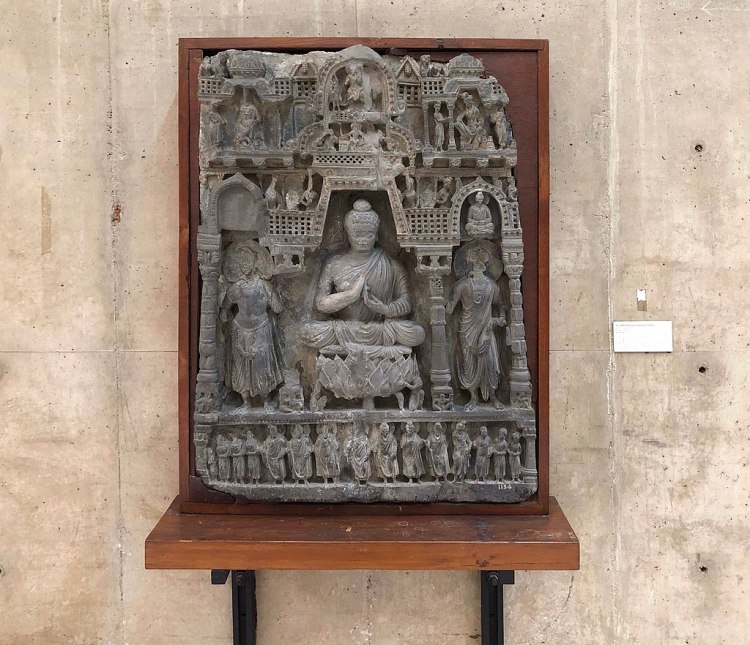
Recently, while bumbling around Wikipedia (as one does), I came upon this random but very fascinating example of Buddhist art from the Gandhara region. This is a depiction of Amitabha Buddha preaching upon a lotus throne in the Pure Land (Sukhāvatī in Sanskrit).
A 2nd-century Gandharan sculpture depicting Amitabha Buddha preaching from the Pure Land, UnpetitproleX, CC BY-SA 4.0, via Wikimedia Commons
This picture dates from the Kushan Empire, which inherited the earlier Greco-Bactrian and Indo-Greek kingdoms, who in turn arose from the empire of Alexander the Great. I’ve talked about the interaction between India and Greeks before, but the cultural interactions were even deeper than I originally hinted at. The Hellenistic Age Podcast recently posted a fascinating interview with Dr. Osmund Bopearachchi (website) that explored this cultural interaction even further. Highly recommend if you can.
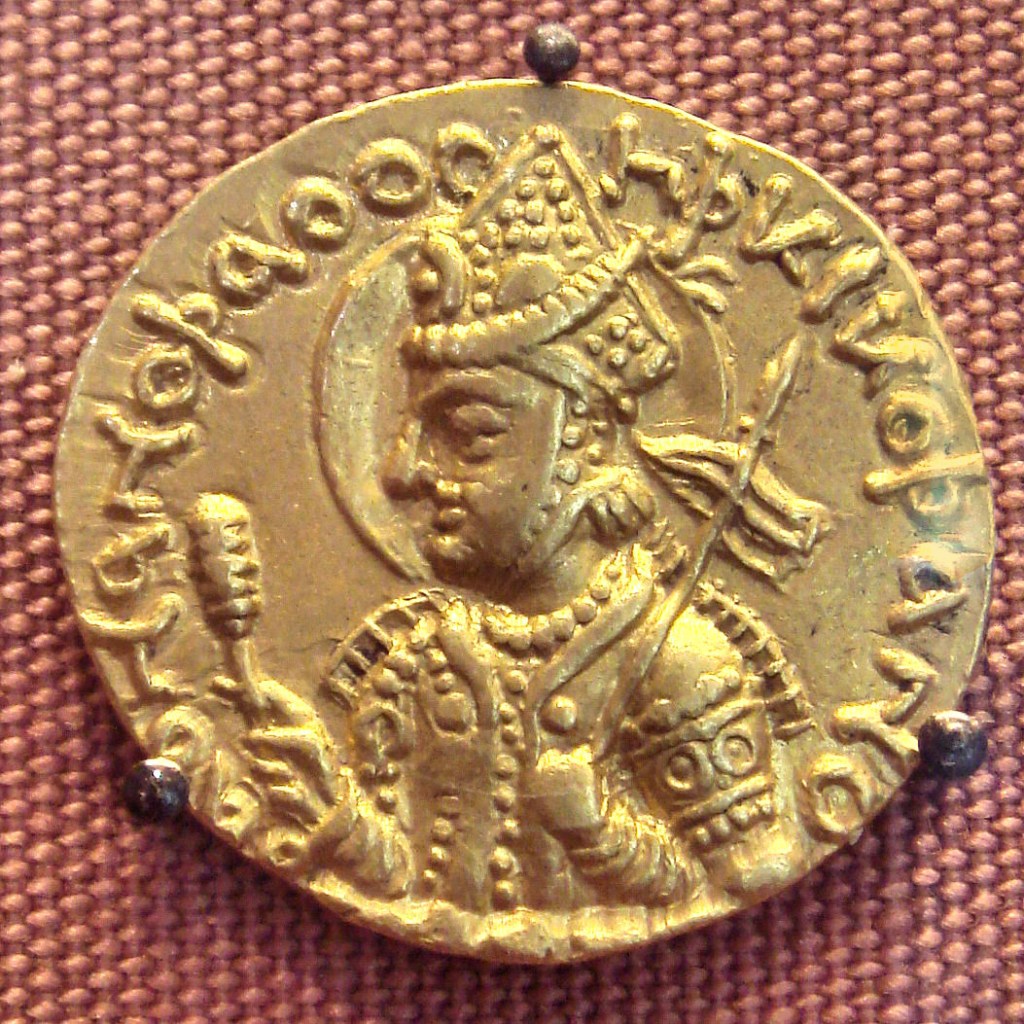
But this picture of Amitabha Buddha got me thinking about a more specific question: where does Amitabha Buddha come from? Amitabha is not mentioned in the earliest Buddhist texts at all, and the earliest statuary appears in the Kushan Empire under the reign of King Huvishka, while other artwork dates back to the Gandhara period of northwest India.
King Huvishka depicting in coinage from the era. Notice the halo behind his head. Public domain, via Wikimedia Commons
A number of interesting theories have arisen over time, some of which have been encapsulated in an essay from 1988 by Soho Machida titled Life and Light, the Infinite: A Historical and Philological Analysis of the Amida Cult. Machida points out some interesting facts:
No statuary of Amitabha Buddha have ever been found in India’s interior, only in northwest India.
Chinese monks who later visited India never mentioned Amitabha Buddha.
Luminosity as an Buddhist symbol is never described in early Buddhist texts, but does appear in later Mahayana ones.
Similarly, Buddhist statues that feature a luminous “halo”, known in Sanskrit as śiraś-cakra (Chinese: 光背), do not appear until the 1st century CE.
The people of Gandhara interacted not just with India, but also with the Scythians (who conquered the Indo-Greeks) as well as the Parthians. The Parthian Empire in particular did have a Buddhist presence, albeit small, and yet the state religion was Zoroastrianism, which frequently uses light as religious symbolism, especially in the royal symbolism of khvarenah. For example, the god Mithra, who also had a cult-following in the Roman Empire, symbolized light, justice, and the sun.
It’s conceivable that the neighboring people of Gandhara in creating new Buddhist art borrowed elements and styles from their neighbors and contemporaries:
from the Greek descendants of Bactria and Indo-Greek kingdoms, they learned to depicted the Buddha in an anthropromorphic way (i.e. similar to Greek statues) as Dr. Osmund Bopearachchi attests to
from the Parthians, they may have learned to depict wisdom, truth and compassion through the imagery of light, using the religious imagery of Zoroastrianism.
from India, they would have imported Buddhist teachings and concepts in an abstract sense, in addition to the literary tradition of the sutras.
If that is the case, then Amitabha Buddha represents a fusion of Indian-Buddhist thought, especially Mahayana Buddhism, with Parthian religious symbolism and Greek artistic methods.
The preamble of the Sutra of Immeasurable Life, one of the three core Pure Land sutras, depicts the gradual progression of a being to becoming a fully enlightened Buddha:
After attaining the Buddha-garland samādhi, he [the prospective bodhisattva] proclaims and expounds all the sutras. While dwelling deep in meditation, he visualizes all the innumerable Buddhas and in an instant visits every one of them. By elucidating and teaching the ultimate truth to sentient beings, he delivers them from the state of extreme pains, from the conditions in which suffering is so great as to prevent people from finding time for Buddhist practices, and also from the conditions in which suffering is not so great as to prevent them from doing so. Having attained the Tathāgata’s thorough knowledge and eloquence, he has fluent command of languages, with which he enlightens all beings. He is above all worldly affairs and his mind, always serene, dwells on the path of emancipation; this gives him complete control over all dharmas.
Translation by Rev. Hisao Inagaki
The Sutra, as one of the founding texts of Pure Land Buddhism epitomizes the path to Buddhahood, using the story of the historical Shakyamuni Buddha as the template, and through this sutra, Amitabha is clearly meant to be the epitome of Buddhas. What better way to epitomize a Buddha than to use infinite light as symbolism?
Fascinating stuff.
Update: posted some additional content I forgot add with the initial draft. Enjoy!
Please remember that a sutra [a Buddhist text] or a Dharma talk [a Buddhist sermon] is not insight in and of itself. It is a means of presenting insight, using words and concepts. When you use a map to get to Paris, once you have arrived, you can put the map away and enjoy being in Paris. If you spend all your time with your map, if you get caught by the words and notions presented by the Buddha, you’ll miss reality….Sutras are essential guides for our practice, but we must read them carefully and use our own intelligence and the help of a teacher and a Sangha [community] to understand the true meaning and put it into practice. After reading a sutra or any spiritual text, we should feel lighter, not heavier.
Pages 17-18
Having been reflecting lately on what mattersmost in Buddhism (or religion in general I suppose), I realized that if you get caught up on the “trivia” of Buddhism you fall into the trap of just parroting, not learning. This is something I often do without realizing it. It’s probably also why my practice tends to suffer.
My wife, whom I often joke is my “bodhisattva” for her often insightful takes on things, shared some good advice on the importance of here and now too, which has been really thought-provoking for me. I have some changes I am trying out, and hope to share more soon (or maybe just cut my losses before it’s too late), plus some further insights and posts. The “retreat” hasn’t gone according to plan, but then again, it hasn’t been for nothing either. 😉
P.S. Photo of the Arc du Triomphe, taken in 2008-2009. Paris really is a great city.














 Gleanings in Buddha-Fields


.jpg)
You must be logged in to post a comment.