Take Two: What Is the Nembutsu?

For months, I’ve had on my to-do list to go and fix up the Wikipedia article about the nembutsu (or nian-fo in Chinese). I had started contributing to that article way back in 2006 shortly after I first got interested in Pure Land Buddhism, and occasionally update or add details. The article was flagged for some quality control issues recently, and I decided to help clean it up.

Some of my early contributions in Wikipedia way back in the day… can’t believe it’s been 18 years.

As I began to write some updates to the article, though, and trying to distill what the nembutsu is within the Pure Land tradition, I realized that this is a really tough question. There’s centuries of interpretations, layers of culture, and divergent viewpoints. I tried to summarize this in an older article, but after reading over that article, I realized that I didn’t quite hit the mark there either.

So, let’s try this again.

Pure Land Buddhism is a large, broad, organic tradition within Mahayana Buddhism (an even bigger tradition). It is not centrally-organized, but follows many trends and traditions across many places and time periods. However, these traditions all have a couple things in common:

  1. Reverence toward the Buddha of Infinite Light (a.k.a. Amitabha Buddha, Amida, Emituofo, etc.). The nature of who or what Amitabha Buddha is is open to interpretation though.
  2. Aspiration to be reborn (as in one’s next life) in the Pure Land of Amitabha Buddha. There have been many ways to interpret what exactly this means, but I am sticking to the most simple, literal interpretation for now.

In any case, these two things are what make the “Cult of Amitabha” what it is. By “cult” I mean the more traditional, academic definition, not the modern, negative definition. Amitabha is to Mahayana Buddhism, what the Virgin Mary is to Catholicism.

Every Pure Land tradition across Buddhist history is mostly focused on #2: how to get to the Pure Land. The early Pure Land Sutras spend much time describing how great Amitabha Buddha is, and how getting to the Pure Land is so beneficial towards one’s practice, but differ somewhat on how get reborn there.

One early sutra, the Pratyutpanna Sutra is one of the first to mention Amitabha and the Pure Land at all, but it very strongly emphasizes a meditative approach, in order to achieve a kind of samadhi. According to Charles B Jones, being reborn in the Pure Land wasn’t even mentioned in this sutra, nor Amitabha’s origin story. It was a purely meditate text. Nonetheless, this sutra was highly favored by the early Chinese Pure Land Buddhists, namely the White Lotus Society started in the 5th century by Lushan Huiyuan.

The main textual source for being reborn in the Pure Land is from the Immeasurable Life Sutra, also called the Larger [Sukhavati Vyuha] Sutra. This is where we see the famous 48 vows of the Buddha, including the most important, the 18th vow (highlights added):

設我得佛。十方衆生至心信樂。欲生我國乃至十念。若不生者不取正覺。唯除五逆誹謗正法

(18) If, when I attain Buddhahood, sentient beings in the lands of the ten quarters who sincerely and joyfully entrust themselves to me, desire to be born in my land, and call my Name, even ten times, should not be born there, may I not attain perfect Enlightenment. Excluded, however, are those who commit the five gravest offences and abuse the right Dharma.

translation by Rev. Hisao Inagaki

This is where things get interesting, in my opinion.

The Chinese character (niàn) was used to translate the Buddhist-Sanskrit term Buddhānusmṛti or “recollection of the Buddha”. But, according to Jones, the Chinese character 念 had multiple nuances in Chinese:

  • To mentally focus on something.
  • A moment in time.
  • Reciting the Confucian Classics aloud.

And in fact each one of these interpretations can be applied to the nembutsu (Chinese niànfó) because it means niàn (念) of the Buddha (, 佛).

But which is it: concentration, a moment of recollection, or verbal recitation?

Most of the early Chinese Buddhist teachers like Tanluan, Daochuo and Shandao all promoted a mix: usually visualization was the superior method, but verbal recitation was a fallback for people who couldn’t dedicate themselves to visualization-meditation and ritual. The earliest Buddhist teachers mostly emphasized the visualization-meditation approach, but by Shandao’s time (7th century) the verbal recitation was deemed the most effective method.

Later, in Japan, the monk Genshin (not to be confused with the game…) summarizes these various methods in his 10th century work, the Ojoyoshu. It was a high quality work and even praised by Chinese monks when it was sent over as part of Japan’s diplomatic missions. But Genshin came to the same basic conclusion: the nembutsu can be any one of the three.

Finally we get to Buddhist teachers like Honen (12th century), who taught that the verbal recitation was the only viable choice. Honen praised past methods, but his target audience was a mostly illiterate population, as well as monks whose monastic institutions had largely declined into corruption and empty ritual. So, for such people, better to rely on Amitabha Buddha’s compassion and recite the verbal nembutsu wholeheartedly.
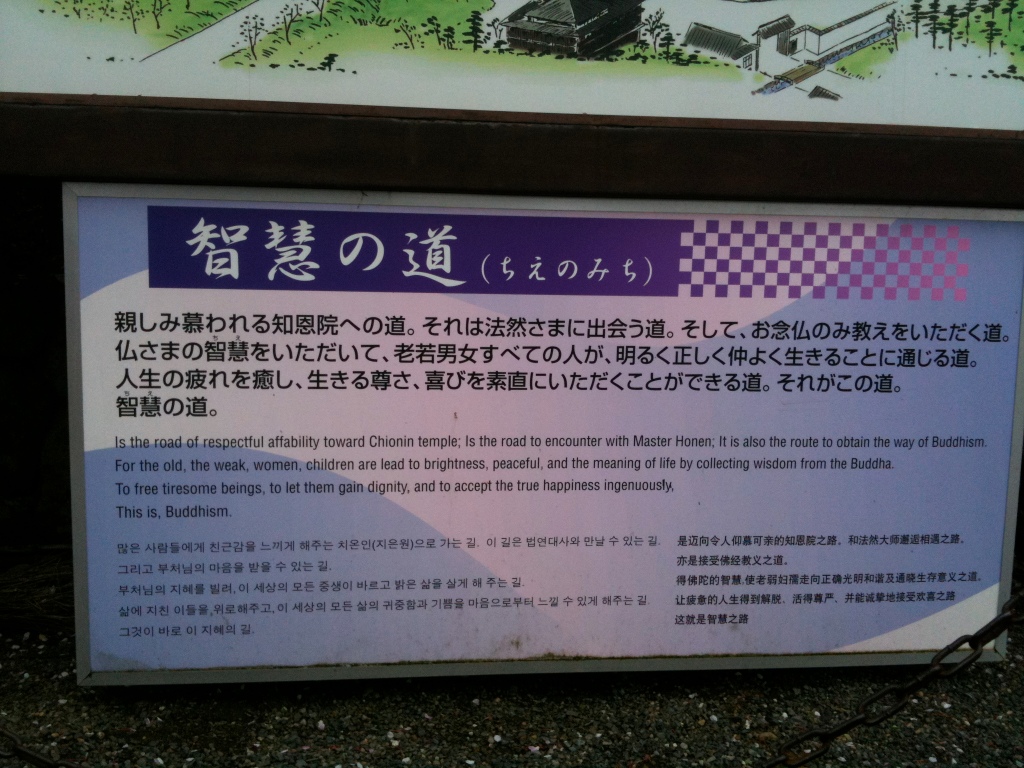
Multi-lingual sign at the temple of Chion-in in Kyoto, Japan where Honen’s mausoleum rests.

This approach isn’t that different from the Chinese approach which varied by teacher or patriarch but through Shandao’s influence had a parallel development. Some teachers emphasized the efficacy of simply reciting the nembutsu (much like Honen), others added the importance of concentration while reciting the nembutsu.

However, turning back to the Larger Sutra, let’s go back to the 48 vows. The 19th and 20th vows state:

(19) If, when I attain Buddhahood, sentient beings in the lands of the ten quarters, who awaken aspiration for Enlightenment, do various meritorious deeds and sincerely desire to be born in my land, should not, at their death, see me appear before them surrounded by a multitude of sages, may I not attain perfect Enlightenment.

(20) If, when I attain Buddhahood, sentient beings in the lands of the ten quarters who, having heard my Name, concentrate their thoughts on my land, plant roots of virtue, and sincerely transfer their merits towards my land with a desire to be born there, should not eventually fulfill their aspiration, may I not attain perfect Enlightenment.

So, taken together, the 18-20th vows cover the various interpretations of 念 we discussed above. All of them are included in Amitabha’s vows to bring across anyone who desires to be reborn there. The common theme is sincerity (至心 zhì xīn). If you look at the original Chinese text, all three include “sincerity”.

Further, when asked about how many times one should recite the nembutsu, Honen replied:1

“….believe that you can attain ojo [往生, rebirth in the Pure Land] by one repetition [of the nembutsu], and yet go on practicing it your whole life long.”

So, let’s get down to business: what is the nembutsu / niànfó ?

Based on the evidence above, I believe that the nembutsu is any of these Buddhist practices described above, taken under a sincere aspiration to be reborn in the Pure Land. It’s about bending one’s efforts and aspirations toward the Pure Land.

If you are calculating how to be reborn, or if your heart’s not 100% into it, then it may be a waste of effort.

Instead, if you feel unsure, study the Buddhist doctrines, get to know the Pure Land sutras, read about past teachers and if you feel fired up about, recite the nembutsu, or do whatever moves you. You will just know when. The more you put into it, the more you get out of it too.

Amitabha’s light shines upon all beings, like moonlight, and if you feel inspired by it, just know that you’re already halfway to the Pure Land.

Namu Amida Butsu

1 The site is long gone, sadly, but the Wayback Machine has an archive of the site. The updated Japanese-only site is here.
Ecumenism

I have been avidly playing the game Fire Emblem: Three Houses since fall of last year. Yes, the game is that good. But also the game makes you think about things too, including religion.

One of my favorite characters in the game, is the leader of the Golden Deer House, Claude von Riegan (also mentioned here and here), voiced in English by Joe Zieja. Claude’s background is unusual for the game’s cast, and he keeps his identity close to his vest, but needless to say he’s had a very worldly upbringing, and sees things different than the other students who mostly grew up in Fódlan. He is just as ambitious as Edelgard, but prefers to meet his goals in a more hands-off, less forceful way.1

Unlike most of his fellow students, who grew up within the Church of Seiros, Claude tends to be pretty cynical about Fódlan’s only religious organization, and regularly questions it (this is also important to certain elements of the plot, but that’s beside the point).

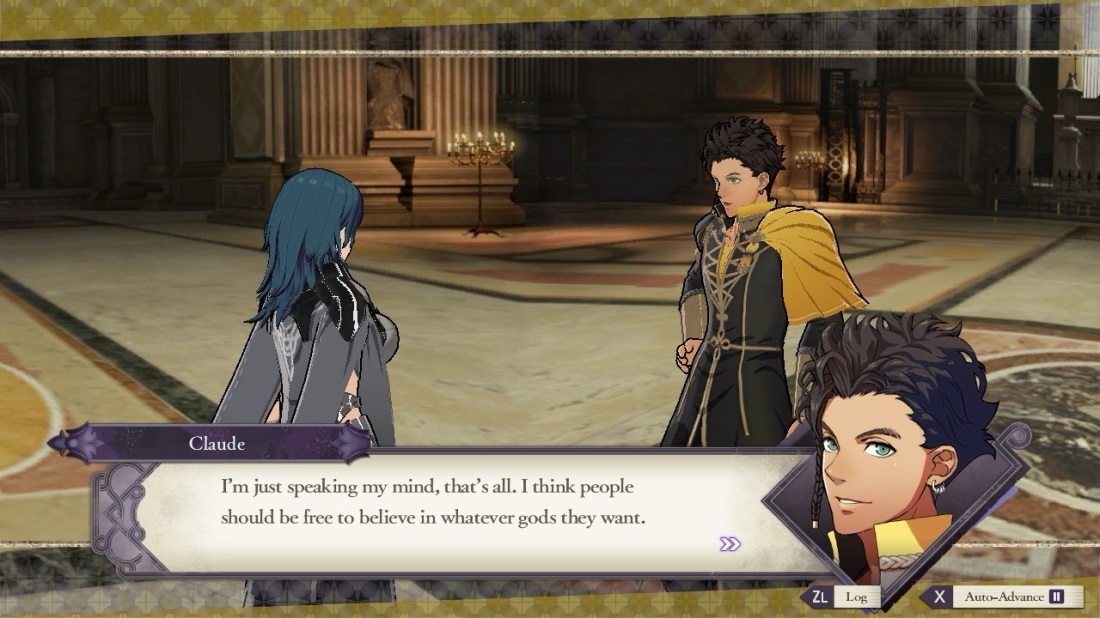
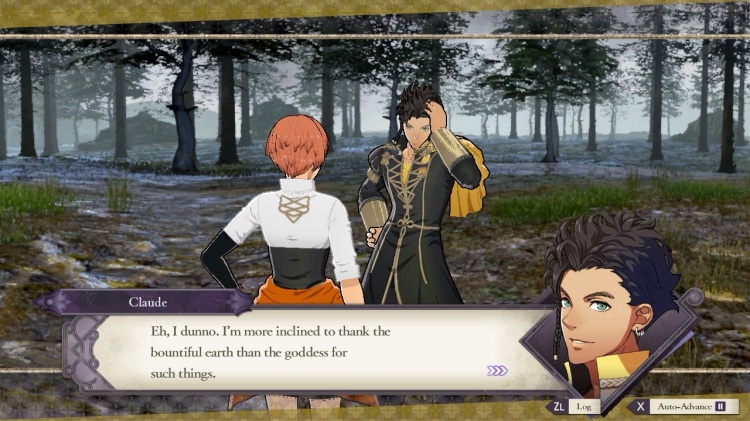
Anyhow, I wanted to share something he said that I think is worth considering (possibly out of order, I lost track of which is which):

Even though I tend to be an ardent Buddhist, I think what Claude is saying here is a healthy to look at the world and its religions. If you consider religions past and present, there have been countless gods and goddesses, rituals, liturgical languages, and so on. Even in in the same religions, practices and views diverge over time. This may offend purists, but it’s impossible to avoid, let alone manage.

Further, Buddhism has never been a particularly evangelical religion. It’s not in a race to win converts (minus a few cults), for a variety of reasons. First, this is in keeping with the Buddhist notion of metta (“goodwill”) that as long as other people have a belief system that helps them, not hinders or makes them feel bad, then that is fine. Second, the danger of imposing one’s beliefs on others is that it’s almost always fueled by ego and one’s own delusion anyway. A person’s religious beliefs, even Buddhist ones, are almost always a reflection of one’s own mind, and have to be taken with a grain of salt. Third, the Buddha clearly wanted people to take refuge in the Dharma of their own volition, and not by coercion. Even the Five Precepts are phrased as “I undertake” not as a command. Similarly with the practice of the nembutsu in Pure Land Buddhism. There’s nothing in the Buddhist canon that tells people to recite, or not recite it. It’s up to each individual to work with the tools offered in the Buddhist toolkit and apply them as best as they can. Like Claude says above, if you find a support system that works, great. This is no less true within Buddhism and its many traditions as well.

It’s generally better, and healthier for one’s own mental state, to let others be who they are, believe what they will, as long as its helpful, not harmful. The tighter one grasps, the more exhaustion and grief they inflict upon themselves, and others.

There are almost as many as variations on religious beliefs as there are people, so like the analogy of the Blind Men and the Elephant, each person is trying to feel their way through life using what resources, background and knowledge they have. Even within Buddhism, each person has their own “spin” on what the Buddha was, or what his teachings were.

It’s imperfect, but we all have to start from somewhere.

P.S. If you own a Switch, try Fire Emblem: Three Houses. 😋

1 Bit of a tangent, but of the three lords in Three Houses, I feel that Dmitri plays the role of the “conservative”, trying to restore his kingdom and the Church the way it was. Claude is the “liberal” trying to open things up and hoping it will change Fódlan, while Edelgard is the “revolutionary” who wants to change things directly (i.e. through force).

Celebrating the Buddha’s Birthday

Next week, according to the solar calendar, is the Buddha’s birthday. Many communities observe this holiday using the lunar calendar, and different communities use different lunar calendars, so the dates will vary quite a bit. I use the Japanese-Buddhist calendar which in turn uses the Western calendar since the 19th century, thus April 8th.1

But I digress.

How does one celebrate the Buddha’s birthday?

Based on my limited experience in Japan and such, Buddhist holidays tend to be pretty laid back affairs. Buddhist temples usually do not hit you over the head with religious teachings, but often do hold local festivals maybe with a sermon or two. There’s no pressure for holiday shopping or even attending a temple. The reality is that Buddhism is not an evangelical religion; people are welcome to come as they are, and approach at their own pace.

Instead, the Buddha’s birthday is a time of joy and reflection.

The appearance of a buddha is, according to tradition, exceedingly rare and even if one is not alive during the time of a buddha, the buddha’s teachings and influence on the world last for many generations. If one lived in an age where the Dharma, the teachings of the Buddha, did not exist or were obscured, then one could not benefit from them.

Thus, even for us living 2,500 years2 after the Buddha Shakyamuni (e.g. Siddhartha Gautama), we can still learn from the Buddha, apply the teachings as best we can, and thereby break the cycle of rebirth. The Buddha-Dharma is good medicine that one can take as one needs, and apply to their life as they see fit.

So, on April 8th, or whatever day you celebrate, take a moment to reflect on the historical Buddha, enjoy the warm weather, and don’t hesitate to do something good and noble that day.

Namo Shakyamuni Buddha

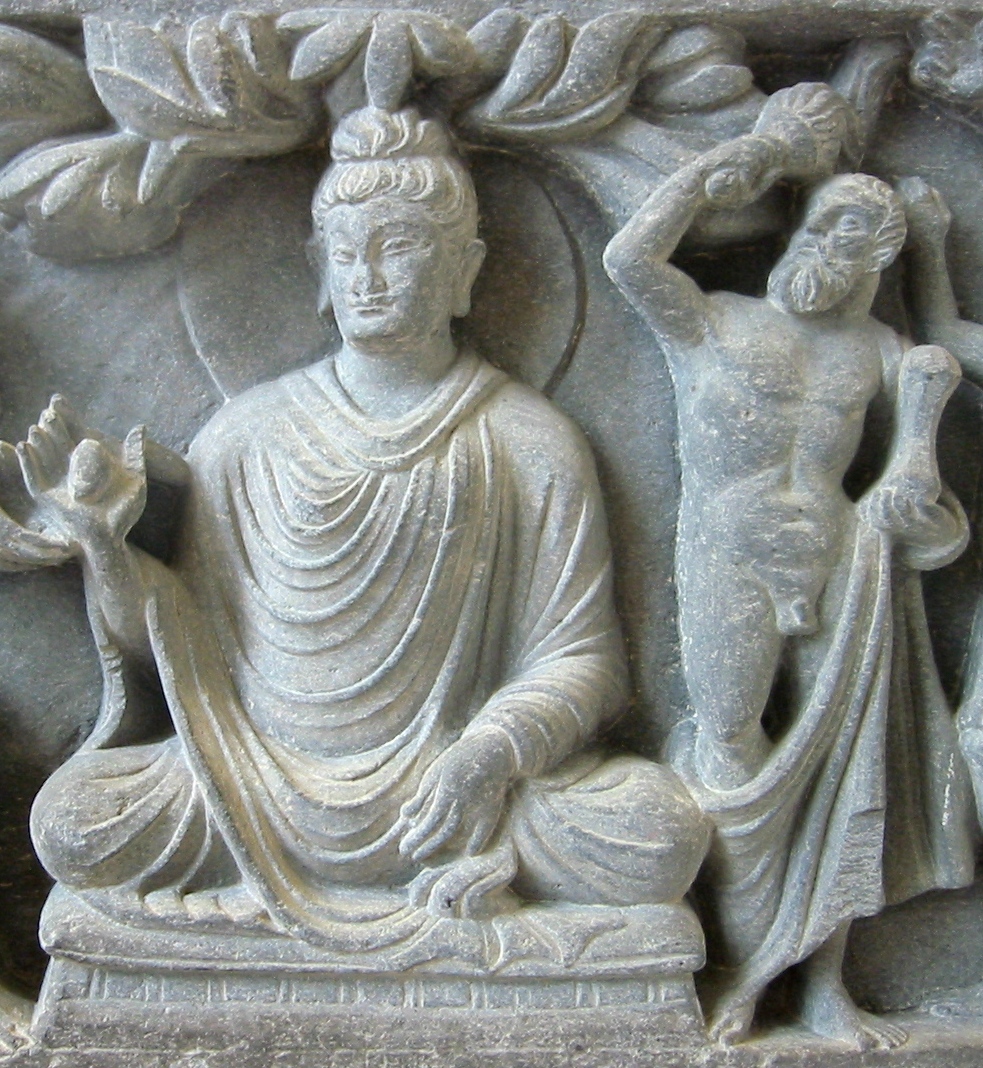
P.S. Featured image is Shakyamuni Buddha flanked by a guardian named Vajrapani. Notice the strongly Greek artistic style, including Vajrapani who looks similar to Hercules. This was made in Gandhara almost 2,000 years ago. Countless cultures and people have paid homage to Shakyamuni Buddha just as we do now. 🥳

1 Rant: Given that Christmas is observed on December 25th, despite Jesus’s birth very obviously not taking place in December (the Romans did not collect taxes in winter), the specific date for celebrating an event really isn’t that important. One date is as good as another, as long as the tradition is meaningful for people. I do prefer observing holidays using the solar calendar since it’s just so much easier to observe and plan out, though. Lunar calendars are fascinating in their own way, but they’re opaque and confusing to anyone who doesn’t fully understand them.

2 random history fact: by the time the Romans had subjugated places like Egypt and Mesopotamia, these places already had 2,000 years of culture and tradition. The Akkadian language was still in use for religious ceremonies and documents, despite the Akkadian empire of Sargon being gone for more than a thousand years. And all of this is but a drop in the bucket compared to geologic time of the Earth.

Chanting the “Jigage”: Chapter Sixteen of the Lotus Sutra

The Lotus Sutra, one of the most important sutras of Mahayana Buddhism, is the size of an epic novel, and thus much too large to recite cover to cover. Even reciting a single chapter can be daunting because each chapter contains a large narrative section, and one or more verse sections that recap the narrative.

For this reason, certain verse sections have become popular for chanting because they get to the heart of the Lotus Sutra and convey its essential teachings, in a manageable size.

Popular examples (among others) include the Kannon Sutra, the verse section of chapter 16, and the opening section of chapter 2. Both are actively recited in Nichiren and Tendai sect home services. Today we will focus on the big verse section at the end of chapter 16, called the jigagé (自我偈) in Japanese.

Chapter 16 of the Lotus Sutra is the big reveal of the sutra: Shakyamuni Buddha is not just a historical figure that lived in 5th century India, and member of the warrior-caste Shakya clan, but is also, on another level, a timeless Buddha that has pretty much existed since a remote, incalculable past:

Since I attained Buddhahood the number of kalpas [aeons] that have passed is an immeasurable hundreds, thousands, ten thousands, millions, trillions, asamkhyas [in other words, a mind-boggling amount of time]. Constantly I have preached the Law [a.k.a. the Dharma], teaching, converting countless millions of living beings, causing them to enter the Buddha way, all this for immeasurable kalpas.

Translation by Burton Watson

I believe this part of an important theme not just in the Lotus Sutra but Mahayana Buddhism in general: the Dharma is a timeless, eternal law of reality and the various Buddhas simply embody it. The Dharma is what matters, not one particular Buddha or another. You can see hints of this in older Buddhist sutras such as the Vakkali Sutta (SN 22.87) in the Pali Canon, but I believe that Mahayana Buddhism took it to its logical conclusion.

Later in the same verse section is the famous lines:

My pure land is not destroyed, yet the multitude see it as consumed in fire, with anxiety, fear and other sufferings filling it everywhere….But those who practice meritorious ways, who are gentle, peaceful, honest and upright, all of them will see me here in person, preaching the Law [a.k.a. The Dharma]

Translation by Burton Watson

To me, this reinforces that even in the worst, most desolate times, the Dharma is always there, and anyone who seeks it sincerely will find it even when others cannot see it. I’ve talked about this passage often in the Nirvana Day posts I’ve made in the past, among other places.

Anyhow, let’s move on now to the liturgy itself.

Liturgical Language

Because this is a chant used in Japanese Nichiren and Tendai traditions, among others, I am posting it as-is in Japanese, more specifically Sino-Japanese: the original Classical Chinese that it was recorded in, but with historical Japanese pronunciation. You are welcome to recite in English, or any other language, there is no restriction.

For this liturgical text, I relied on a few sources, plus I double-checked the spellings using physical sutra books I have at home. I am fairly certain it’s accurate.

Also, I formatted the text similar to how it is formatted in real service books.

Translation

I decided not to post the translation side-by-side with the text, the way I do with the Heart Sutra and such. This is due to formatting reasons on the blog, plus also length of the text makes this more difficult. I may revise this later.

For now, I highly recommend checking out a modern translation here by the excellent Dr Burton Watson. The Buddhist Text Translation Society also has an excellent translation here. The chant below is the first narrative section that goes all the way to the first verse section.

Disclaimer and Legal Info

I hereby release this into the public domain. Please use it as you see fit, but if you attribute it to this site, greatly appreciated. Also, please bear in mind this is an amateur work, and should not be taken too seriously.

Dedication

I dedicate this effort to all sentient beings everywhere. May all beings be well, and may they all attain perfect peace.

Namu Shakamuni Buddha

The Lotus Sutra sixteenth chapter, verse section

Preamble

Classical ChineseJapanese Romanization
妙法蓮華経
如来寿量品
第十六
Myo ho ren ge kyo
nyo rai ju ryo hon
dai ju roku

Verse Section

Classical ChineseJapanese Romanization
自我得仏来
所経諸劫数
無量百千万
億載阿僧祇
Ji ga toku butsu rai
sho kyo sho kos-shu
mu ryo hyaku sen man
oku sai a so gi
常説法教化
無数億衆生
令入於仏道
爾来無量劫
jo sep-po kyo ke
mu shu oku shu jo
ryo nyu o butsu do
ni rai mu ryo ko
為度衆生故
方便現涅槃
而実不滅度
常住此説法
i do shu jo ko
ho ben gen ne han
ni jitsu fu metsu do
jo ju shi sep-po
我常住於此
以諸神通力
令顛倒衆生
雖近而不見
ga jo ju o shi
i sho jin zu riki
ryo ten do shu jo
sui gon ni fu ken
衆見我滅度
広供養舎利
咸皆懐恋慕
而生渇仰心
shu ken ga metsu do
ko ku yo sha ri
gen kai e ren bo
ni sho katsu go shin
衆生既信伏
質直意柔軟
一心欲見仏
不自惜身命
shu jo ki shin buku
shichi jiki i nyu nan
is-shin yoku ken butsu
fu ji shaku shin myo
時我及衆僧
倶出霊鷲山
我時語衆生
常在此不滅
ji ga gyu shu so
ku shutsu ryo ju sen
ga ji go shu jo
jo zai shi fu metsu
以方便力故
現有滅不滅
余国有衆生
恭敬信楽者
i ho ben riki ko
gen u metsu fu metsu
yo koku u shu jo
ku gyo shin gyo sha
我復於彼中
為説無上法
汝等不聞此
但謂我滅度
ga bu o hi chu
i setsu mu jo ho
nyo to fu mon shi
tan ni ga metsu do
我見諸衆生
没在於苦海
故不為現身
令其生渇仰
ga ken sho shu jo
motsu zai o ku kai
ko fu i gen shin
ryo go sho katsu go
因其心恋慕
乃出為説法
神通力如是
於阿僧祇劫
in go shin ren bo
nai shitsu i sep-po
jin zu riki nyo ze
o a so gi ko
常在霊鷲山
及余諸住処
衆生見劫尽
大火所焼時
jo zai ryo ju sen
gyu yo sho ju sho
shu jo ken ko jin
dai ka sho sho ji
我此土安穏
天人常充満
園林諸堂閣
種種宝荘厳
ga shi do an non
ten nin jo ju man
on rin sho do kaku
shu ju ho sho gon
宝樹多花果
衆生所遊楽
諸天撃天鼓
常作衆伎楽
ho ju ta ke ka
shu jo sho yu raku
sho ten kyaku ten ku
jo sa shu gi gaku
雨曼陀羅華
散仏及大衆
我浄土不毀
而衆見焼尽
u man da ra ke
san butsu gyu dai shu
ga jo do fu ki
ni shu ken sho jin
憂怖諸苦悩
如是悉充満
是諸罪衆生
以悪業因縁
u fu sho ku no
nyo ze shitsu ju man
ze sho zai shu jo
i aku go in nen
過阿僧祇劫
不聞三宝名
諸有修功徳
柔和質直者
ka a so gi ko
fu mon san bo myo
sho u shu ku doku
nyu wa shichi jiki sha
則皆見我身
在此而説法
或時為此衆
説仏寿無量
sok-kai ken ga shin
zai shi ni sep-po
waku ji i shi shu
setsu butsu ju mu ryo
久乃見仏者
為説仏難値
我智力如是
慧光照無量
ku nai ken bus-sha
i setsu butsu nan chi
ga chi riki nyo ze
e ko sho mu ryo
寿命無数劫
久修業所得
汝等有智者
勿於此生疑
ju myo mu shu ko
ku shu go sho toku
nyo to u chi sha
mot-to shi sho gi
当断令永尽
仏語実不虚
如医善方便
為治狂子故
to dan ryo yo jin
butsu go jip-pu ko
nyo i zen ho ben
i ji o shi ko
実在而言死
無能説虚妄
我亦為世父
救諸苦患者
jitsu zai ni gon shi
mu no sek-ko mo
ga yaku i se bu
ku sho ku gen sha
為凡夫顛倒
実在而言滅
以常見我故
而生憍恣心
i bon bu ten do
jitsu zai ni gon metsu
i jo ken ga ko
ni sho kyo shi shin
放逸著五欲
墮於悪道中
我常知衆生
行道不行道
ho itsu jaku go yoku
da o aku do chu
ga jo chi shu jo
gyo do fu gyo do
随応所可度
為説種種法
毎自作是念
以何令衆生
zui o sho ka do
i ses-shu ju ho
mai ji sa ze nen
i ga ryo shu jo
得入無上道
速成就仏身
toku nyu mu jo do
soku jo ju bus-shin

P.S. I’ve been posting a lot of Japanese-Buddhist liturgy from various sources, and this is the last one I will post for a while. The ones I have posted so far on the blog cover the most common sutra chants, so anyone curious to get started in a tradition (or rediscover a tradition) should hopefully find what they need. Good luck!

When It Rains It Pours

What a week.

My wife and daughter both tested positive for COVID on Wednesday and had to isolate themselves since then. I took time off from work, bring them food, do the housework, and look after our son, ferry him to various social events and playdates, while also looking after a one year old puppy. Then, the puppy developed conjunctivitis (pink eye) as of yesterday. Further, my old acid reflux problem reared its head recently causing plenty of misery for me.

The week has been a train wreck but we’ve managed. Thankfully my wife and daughter’s both had miles symptoms and will be out of quarantine soon.

Amidst all the chaos, I tried to keep up daily Buddhist practice, with mixed success. This morning I just had only enough time to recite the Three Treasures: namu-ki-e-butsu, namu-ki-e-ho, namu-ki-e-so (praise to the Buddha, Dharma, and Sangha).

But that’s how it is sometimes.

If you’re a parent, especially a single parent like my mother was, sometimes that’s all you can realistically do. That’s also true if you’re young and just getting on your feet, working a grueling 9-5 job, or you’re caring for ill or elderly family members.

Such people don’t have the time or energy to contemplate Tibetan yidam or participate in a Zen sesshin. How can someone working a demanding warehouse job at Amazon maintain mindfulness when you barely have time for a lunch break? How can a school teacher afford a retreat to Bhutan when they’re scraping money to get adequate school supplies in the classroom?

For most working-class people dealing with stress, financial woes, or parenting, such Buddhist practices are a privilege they can’t afford, but they shouldn’t be excluded either. This was a problem faced centuries ago and continues in the West today.

Instead, when your world is falling apart, or you’re cleaning poop from a baby’s diaper, or trying to mentally shut out the weirdo on public transit, sometimes it’s just enough to say the nembutsu: na-mu-a-mi-da-butsu. Maybe you can’t maintain a Buddhist altar, but it’s just enough to keep a small image in your wallet that you drew or printed out. If you can’t afford good Buddhist books, make your own.

I am not joking or making light of Buddhist practice either. Consider this verse from the second chapter of the Lotus Sutra:

If someone with a confused and distracted mind should take even one flower and offer it to a painted image, in time he would come to see countless Buddhas.

Or if a person should bow or perform obeisance, or should merely press his palms together, or even should raise a single hand, or give no more than a slight nod of the head, and if this were done in offering to an image, then in time he would come to see countless Buddhas.

And if he himself attains the unsurpassed way and spreads salvation abroad to countless multitudes, he will enter the nirvana of no remainder as a fire dies out when the firewood is exhausted.

If persons with confused and distracted minds should enter a memorial tower and once exclaim, “Hail to the Buddha!”

Then all have attained the Buddha way.

Translation by Burton Watson

Or this quote from the Sutra on the Buddha of Immeasurable Life:

“If, sentient beings encounter his [Amida Buddha’s] light, their three defilements are removed; they feel tenderness, joy and pleasure; and good thoughts arise. If sentient beings in the three realms of suffering see his light, they will all be relieved and freed from affliction. At the end of their lives, they all reach emancipation.

Translation by Rev. Hisao Inagaki

Sometimes it’s OK to just recite the nembutsu, or the Three Treasures above. It may not do much to relieve stress, or fix your situation but be assured that every tiny little bit you do to recite the Buddha’s name, or uphold the Five Precepts (or even one of them), anything you do to live an upright, honest life does count for something.

This isn’t empty platitudes either. This is straight from the Lotus Sutra and the Mahayana Buddhist tradition at large. Like contributing to a savings accounts, every little bit you do, however small, is just one step closer to your goal. Every good, wholesome seed you plant will bear fruit someday. Every time you dedicate that good merit towards the benefit of others, it will multiply even further.

No matter how shitty your life is, believe in yourself, believe in the power of the Buddha-Dharma, and trust that even a moment’s recitation or a a single good act can and does make a difference.

Namu Amida Butsu

Religion and the Scale of the Universe

The Whirlpool Galaxy, photo courtesy of Wikimedia Commons

As a kid, I was always fascinated by Astronomy, and I remember often watching the stars at night, when I would visit my dad’s house on the weekends. Back then, I didn’t really understand astronomy well, but I learned what I could about constellations, I visited the planetarium at the Pacific Science Center, and of course I became a big fan of classic Star Trek through my uncle. In college, I even majored in Astronomy for a time until I realized that Physics wasn’t my forté.

Space and the universe have always fascinated me, and for a long time, I’ve felt that in light of space, science, etc, Buddhism has been particularly suited for this worldview. 

The Buddha-Dharma functions in a lot of ways like the laws of physics or other natural laws. It’s less something to believe in, and something more to understand or at least acknowledge. It can fit into any time or place.

The various Buddhas and Bodhisattvas, primarily found in the Mahayana tradition, might seem superstitious, but embody important Buddhist truths and can be just as weird and cosmic as anything the universe has to offer. Further, belief is such beings is neither required nor expected. It is up to each person to adopt what they want. They are quite literally a form of expedient means.

Finally, when you look at the sheer vastness of space, it’s hard not feel small. But that is alright too. Buddhism thinks big, but also because everything is interconnected in some way, it assures that the choices we make, wholesome or unwholesome, do affect all other things. We can light one corner of the world (and universe) through our actions and our thoughts.

Namu Kanzeon Bosatsu
Namu Amida Butsu

P.S. Featured photo is Whirlpool Galaxy (NASA and European Space Agency, Public domain, via Wikimedia Commons)

P.P.S. I’ve often wondered if the Buddhas and Bodhisattvas really do exist, would they be humanoids like us, or would they be strange aliens like in Star Trek? Would Amida Buddha’s original from be a green alien with four arms? 😋

Repentance in Buddhism

The Buddha “What do you think, Rāhula? What is a mirror for?”

Rahula: “For reflection, sir.”

“In the same way, Rāhula, bodily actions, verbal actions, & mental actions are to be done with repeated reflection.

The Ambalaṭṭhikā Rāhulovāda Sutta (MN 61), translation by Thanissaro Bhikkhu

I was surprised while writing this post that I had never covered this subject in the blog. This post is meant to be a handy reference.

As you can see in the quote above from the Pali Canon, one of the earlier collections of Buddhist texts (a.k.a. sutras), the Buddha stressed repeated reflection as part of the discipline that comes with the path. There’s no set way to do this, what matters is sincere reflection, and a willingness to compare your actions and words against a benchmark like the Dharma to see if they are in fact “wholesome” or “harmful”.

That said, this process of self-refletion and repentance developed over the centuries into a kind of ritualistic liturgy often used in Mahayana Buddhism. In Japanese Buddhism this is known as sangé (懺悔), and the English translation goes something like this:

All of the misdeeds I have committed in the past,

Arose from my own beginningless greed, hatred and delusion,

And manifested through body, speech and mind.

These [misdeeds] I now repent in full.

alternative translation here (which I also used as a reference here): https://www.sotozen.com/eng/library/glossary/individual.html?key=verse_of_repentance

Different Buddhist sects will recite this slightly differently, but the basic meaning is all the same. As we are beings burdened by our own karma, and past ignorances, this manifests over and over in our actions, speech and thoughts. Another way to explain it is that each of us come into this world according to our own circumstances, some of which are carried from past lives, and these circumstances color our view of the world leading to ignorance, greed, and false assumptions. This is turn leads us to being a dickhead at times.

So, the repentance liturgy above serves two functions: to acknowledge that we suffer from greed, anger, etc., but also that, in the end, we are still responsible for our choices.

Some Buddhists see this as an opportunity to wipe the slate clean, and limit negative effects of future karma; others may simply see this as a way to reinforce self-reflection. It doesn’t really matter how you interpret it. It is a method to objectively, almost scientifically, evaluate your conduct and then resolve not to commit such harmful actions again. Rather than flogging yourself, it’s a healthier way to reflect on your own behavior.

And, like rehearsing a play, or practicing baseball swings, people make mistakes often, but bit by bit they get better at it. In the same way, Buddhism helps people improve their way of interacting with the world bit by bit.

Namu Shakamuni Butsu

Namu Amida Butsu

P.S. featured photo taken by me at Alki Beach.

Holiday FOMO Sucks

FOMO, the feeling of missing out, can happen any time, but it feels like the holidays really exacerbate this feeling.

This year my wife and I chose not to go to company holiday party. It is a 21+ event that my company hosts, and is a big social event around the workplace, but since my kids obviously can’t go, we felt that we’d rather stay home and enjoy our time as a family than leave the kids at home just so the parents could have fun.

The notion of skipping the party got some odd looks from people at work, but generally people were supportive (while obviously planning to go themselves).

But the Monday after the party, I was inundated with post-holiday party discussions, anecdotes, photos on the company social media, and so on. Even if no one intends it, it’s grating to be constantly reminded of all the fun people had while I chose to miss out.

I willingly chose to stay home and hang out with my kids, and I don’t regret that, but I also don’t enjoy the feeling that everyone else celebrated anyway without me. Selfish, but still.

This also goes for the holidays themselves. I grew up Christian, but in my teens and 20’s I left that behind1 and eventually took up the Buddhist path. For most of the year, I have no qualms about this, but then every Christmas and Easter, I feel a pang of FOMO. Maybe it’s because I grew up with Sunday school, and the old biblical stories still have a place in my heart,2 or maybe it’s because holidays just aren’t prominent in the Buddhist faith. I don’t know. But every year I miss it, then when the holiday passes, I am back to my old self.3

It feels sometimes like someone who’s exiled themselves, and looking back at everything they have missed.

But when I think about it, it’s something I willingly left behind, and am glad for doing so. From a personal growth and theological standpoint, I feel like Buddhism was much more helpful to me, even with all the twists and turns I’ve gone through over the years. It’s hard to imagine what my life would have been like if I hadn’t had the encounters I did. It’s a lonely path sometimes, especially living in the West, but I am glad I chose it.

Namu Amida Butsu

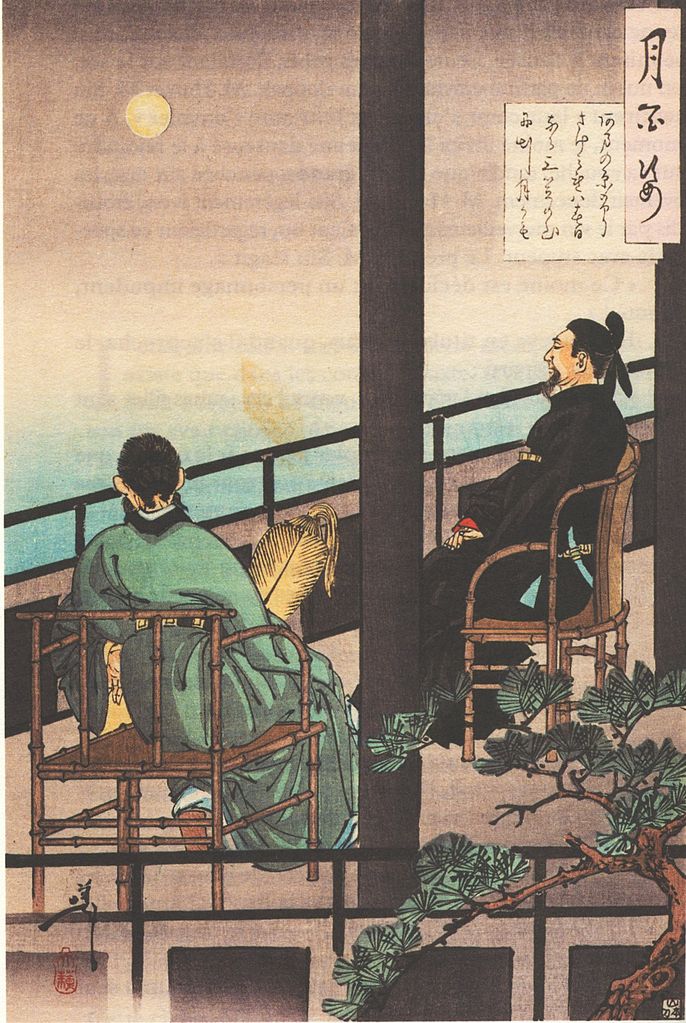
Featured image: Yoshitoshi block print from 100 Aspects of the Moon, depicting Abe no Nakamaro overseas in China viewing the moon and longing for home.

P.S. Speaking of holidays, enjoy the Maha Santa Claus Sutra.

1 I am sure someone reading this will eventually want to ask “why”, and whether I’d consider coming back. Short answer is “no”, and save your breath. That ship sailed a long time ago.

2 It’s hard to explain. It’s not something I personally believe in, I just enjoy imagining the time and place, maybe in the same way I feel about reading Tolkien or something. Or, I miss it the way I miss Christmas as depicted in the Peanuts cartoons: something that’s idyllic, but doesn’t actually exist.

3 I even picked up the Bible a couple times over the years and read through some old, familiar chapters, but they feel hollow to me now with the benefit of perspective. The Dharma is just so much deeper and meaningful to me now.

Who Is Amida Buddha: the Buddha of Infinite Light?

Hello Readers,

Recently I talked about the Pure Land Buddhist tradition, and in particular the Three Pure Land Sutras that are central to the tradition.

But then I realized that I’ve never really explained who Amida (Amitabha) Buddha is. Now that the English language site for Jodo Shu has been retired, I wanted to fill in some gaps in information, and explain Amida Buddha’s significance to the Buddhist religion at large.

Who Is Amida?

Amida (阿弥陀) Buddha is short for Amitabha Buddha: the Buddha of Infinite Light. Sometimes he is alternatively called Amitayus: the Buddha of Infinite Life too.

Amida Buddha is a cosmic, almost timeless Buddha who is said to dwell “very far” to the west in a realm called Sukhavati in Sanskrit, which means “Land of Bliss [or Joy]”. Over time, people just call it the Pure Land.

A reproduction of the Taima Mandala, an 8th century tapestry in Japan depicting the Pure Land

The Pure Land should not be confused with Heaven. It is a peaceful, safe refuge. In the Pure Land, people can escape difficult circumstances and be surrounded by many excellent Buddhist teachers. Even the very air and animals preach the Buddha-Dharma. Best of all, the sutras emphasize that one can be reborn there easily … if they so choose. It is not required in Buddhism, but it is available

The vast light of Amida Buddha (hence “Buddha of Infinite Light”) reaches out in all directions of the cosmos:

“The light of Amitāyus shines brilliantly, illuminating all the buddha lands of the ten directions. There is no place where it is not perceived. I am not the only one who now praises his light….”

The Sutra of the Buddha of Immeasurable Life, translation by Rev. Hisao Inagaki

and provides comfort to those who encounter it, inviting them to be reborn in the Pure Land:

“….If, sentient beings encounter his light, their three defilements are removed; they feel tenderness, joy and pleasure; and good thoughts arise. If sentient beings in the three realms of suffering see his light, they will all be relieved and freed from affliction. At the end of their lives, they all reach emancipation.”

The Sutra of the Buddha of Immeasurable Life, translation by Rev. Hisao Inagaki

This Buddha’s promise to rescue all beings, regardless of who they are, has been very attractive to people in difficult social circumstances: women (who were thought spiritually inferior in those days), the poor, and illiterate who toiled all day with no chance to invest in other spiritual development.

However many monks devote at least part of their time and effort toward Amida as well. As a Buddhist tradition, devotion to Amida is very broad and inclusive.

Further, everyone has a slightly different idea on who Amida Buddha is, what the Pure Land is, and so on. This is fine. There is no orthodox interpretation. Buddhism is more concerned with practice, so how one interprets this tradition up to them.

Some people devote themselves fully to Amida Buddha, others venerate Amida Buddha as one among a larger tradition. Again, it is up to the individual.

What Does Amida Look Like?

Amida Buddha is often depicted with gold color imagery, sometimes red. Compare with someone like the Medicine Buddha who is often depicted with lapis lazuli color (deep blue).

The gold color is based on the Pure Land Sutras that describe every person there, including the Buddha, as having gold-colored skin. Further, gold shines, so it fits the Buddha’s symbolism as a Buddha of light.

In some art, Amida is seated in meditation.

Amida Buddha statue at Sensoji (Asakusa Temple) in Tokyo, Japan
Amida Buddha statue at Kamakura, Japan, also known as the Great Buddha (daibutsu) of Kamakura

In some art, Amida is standing, with his hands in specific gestures.

Amida Buddha welcoming the deceased, with his attendants, to the Pure Land. A medieval Japanese painting.
A small home altar I purchased from Tsukiji Honganji in Tokyo about 10 years ago.
A tiny, pocket image of Amida Buddha I purchased at Zojoji Temple near Tokyo Tower in Japan.

Buddhist statues are full of symbolism, they are not intended to be accurate portrayals. They convey meaning. The double-“OK” hand gestures used by Amida, one hand up, one hand down with palm up, means something like all beings are welcome.

Why Amida?

Someone learning about Buddhism will probably find this very confusing: why is there a “Buddhist Jesus” when the religion is supposed to be about meditation and finding enlightenment? Is this a sign of Buddhism’s decadence and decline?

Buddhism can be a tough religion to explain because it is really broad. Much broader than a “Buddhism for Dummies” book can explain.

The historical founder, Shakyamuni Buddha, was like a doctor describing the state of things (e.g. the Dharma), and providing a “prescription” (e.g. Buddhist practice) to help cure the “ills” of the world.

But within that, Shakyamuni Buddha gave people a lot of autonomy. He described the world as like a river with two shores: one shore full of strife and dissatisfaction, the other peace and wellbeing. He described the need to build a raft to cross from one shore to the other. But how exactly to build that raft is up to you.

He held students, especially monks, to high standards of conduct, but as for putting teachings into practice he tailored different practices to different audiences, or to suit the person. Contrary to popular conception there are various forms of meditation taught even in the earliest traditions, not just mindfulness.

Mahayana Buddhism, one of two major branches of Buddhism, really emphasizes this diversity of practices because it recognizes the concept of upaya (expedient means): whatever works at that time for that person and helps them stay in the Buddhist path is right for them.

It’s partly why there are so many Buddhist figures, so many chants and sutras, and so many different sects. Each of these represent a different “gate” for entering the Buddhist path.

Anyhow, the existence of Amida Buddha, along with other figures such as Kannon, helps fill in a gap where some Buddhist practices and regiments just aren’t practical for most people, and also provides a sense of assurance in an uncertain world (speaking from experience). Those who find the “mind-only” interpretation of Amida attractive can also take comfort that nurturing Amida Buddha in one’s own mind helps awaken the Buddha within. Further, a timeless Buddha like Amida avoids the challenges of the interpreting the historical Buddha, Shakyamuni, through various layers of culture and history.2

As Amida Buddha is a tradition within the larger tradition, some Buddhists gravitate toward Amida, and some do not. Each person according to their own path. Mahayana Buddhism is large enough to embrace them all.

Namu Amida Butsu

P.S. Featured photo is the famous “Black Amida” statue at Zojoji Temple near Tokyo Tower in Japan. This was the statue that was venerated by the Tokugawa Shoguns back in the day.

1 The use of light symbolism in Amida Buddha is thought to possibly borrow from Zoroastrianism, which is possible given the contacts between the Parthians and the Buddhist community. Light is central to Zoroastrianism, but not mentioned in early Buddhist culture. The concept of Amida Buddha is definitely Indian-Buddhist, but Buddhists in the northwest of India often borrowed artistic concepts from neighboring cultures. Another example is Greco-Buddhist art.

2 Early Mahayana Buddhism was a critic of the “pilgrimage” culture at the time in India, where there was increasing importance of the holy sites, and the holy relics of the historical Buddha. Mahayana shifted the emphasis toward the timeless Dharma, and Buddhas as embodying this Dharma.

It’s similar to how people in other religions split hairs over what the religious founder said, based on layers in interpretation, or how people try in vain to recreate the original community (again through layers and layers of interpretation).

The Three Pure Land Sutras

While writing a recent blog post, I realized that I had mentioned, but never explained, what the Three Pure Land Sutras are in the Buddhist tradition, and their significance to Mahayana Buddhism as a whole.

Think of this as a handy reference post. I haven’t done one of these in a while. 😊

The Buddhist Canon

When you think of most world religions, they are usually based on one or two books. Christianity has the Bible (including both Old and New Testaments), Islam has the Qur’an plus Hadiths, and so on. Things get fuzzier with religions like Hinduism and Buddhism where they are not based on one or two books, but instead layers of texts written at different periods of time. Such religions have a kind of “accumulated” religious tradition.

As an organized religion, Buddhism begins and ends with the historical Buddha, Shakyamuni. His birth name is Siddhartha Gautama, but in the Buddhist tradition he is called “Shakyamuni”, or “Sage of the Shakya clan”.

Long story short, all Buddhist texts, called “sutras”, are considered sermons of Shakyamuni Buddha, passed down through the generations, first by word, and later written down. Modern historians question the historicity of this, since the very earliest sutras were recorded around 100 BC, 400 years after the Buddha lived. Also some sutras, especially those in the Mahayana Buddhist tradition, were definitely later compositions since they have a more narrative flow quite different from earlier ones.

Why did the early Mahayana Buddhist compose a new set of sutras? My personal guess is that these authors took fragments of early teachings and repackaged them in a more “hip” (relative to the times) and smoother format for easier distribution.

In any case, Buddhism doesn’t have a strict dependency on the sutras the way other religions might. The Dharma, the teachings of the Buddha, is more like the Laws of Physics: something all around us whether we believe it or not. Shakyamuni Buddha’s contribution was to both uncover the Dharma and articulate it. So, the sutras, as purported sermons of the Buddha, are our best guide to understanding the Dharma, but they have their limits.

Sutra Format

Buddhist sutras can be volumes long, or extremely short, very specific to a topic, or kind of general in their teachings. Many were composed in India to address specific audiences, while others were composed in China, but made to look like they were from India for authenticity. As the featured photo above shows, many sutras are preserved in Classical Chinese (not modern Chinese) instead of Sanskrit, despite originating from India. The sutra book above is from a Japanese temple, so each Chinese character includes pronunciation guides (furigana) for Japanese audiences.

Finally, because there are so many sutras, many Buddhist traditions tend to gravitate toward one sutra or set of sutras for their theological foundation. This is especially true in Mahayana Buddhism.

Mahayana Buddhism teaches the notion of “expedient means” (lit. Upaya in Sanskrit): this means that any and all of these sutras are suitable to someone somewhere for progressing along the Buddhist path. “Different strokes for different folks”.1 Mahayana Buddhism is (speaking frankly) broad and messy, but it also strives to be as accessible as possible to a variety of people since one of its founding tenets is that all beings are capable of enlightenment. They just each start from different circumstances.

Sutras of the Pure Land Tradition

The Pure Land Buddhist tradition is probably one of the largest, if not the largest in East Asian Buddhism, but it’s not a single sect or school. It is a loose network of traditions across several countries, from Tibet to Japan, all centered around three key sutras and devotion to Amitabha Buddha, the Buddha of Infinite Light. Professor Charles B Jones compared it to the tradition in Catholicism venerating the Virgin Mary within the larger Christian tradition: some Christians do, some do not. In the same way, some Buddhists are devoted to the Buddha of Infinite Light, and some are not.

In any case, across all Pure Land traditions, the primary textual sources are called the Three Pure Land Sutras. In short, they are:

English TitleSanskrit TitleChinese with
pinyin
Likely Country of Origin
Immeasurable Life SutraSukhāvatīvyūha Sūtra, longer version佛說無量壽經
(Fó shuō wú liàng shòu jīng)
India, before 2nd century
Amitabha SutraSukhāvatīvyūha Sūtra, shorter version佛說阿彌陀經
(Fó shuō Ā mí tuó jīng)
India, before 4th century
Contemplation SutraAmitāyurdhyāna Sūtra佛說觀無量壽佛經
(Fó shuō guān wú liàng shòu fó jīng)
China, possibly 4th century

Note that many other sutras mention or focus on Amitabha Buddha too, but the three above are the primary sources.

Let’s look at each one individually…

The Immeasurable Life Sutra

This sutra, known more formally as The Sutra of the Buddha of Immeasurable Life, is the oldest and longest of the three. In English, it would probably take about 2 hours to read, so it’s not short, but not a tome like the Lotus Sutra either.

The general format is (in order):

  • A long preamble about the progress of a Bodhisattva to full Buddhahood (patterned from Shakyamuni’s life)
  • The origin of Amitabha Buddha, and his 48 vows to help all beings
  • The virtues of Amitabha Buddha, and benefits of those who encounter his light
  • Why someone would want to be reborn in his Pure Land, and the three grades of people reborn there
  • Contrasting this world with the Pure Land (spoiler: our world sucks)
  • General Buddhist exposition about the hassles of this life (again, trying to emphasize the Pure Land)
  • Admonition by Shakyamuni Buddha to be reborn there

What’s interesting about the Immeasurable Life Sutra is that it’s a fairly good primer, covering many general Buddhist subjects, from a Mahayana-Buddhist perspective, while also explaining in detail who Amitabha Buddha is, and why the Pure Land is a worthwhile goal.

Sometimes I still find little hidden gems in there when I read it.

Note, for ritual and chanting, the sutra is much too long to chant, so people often chant key sections, for example the Shiseige in Japanese-Buddhist traditions. The featured photo above is part of the Immeasurable Life Sutra.

The Amitabha Sutra

The Amitabha Sutra, known by the more clunky name Shorter Sukhāvatīvyūha Sūtra, is by far the shortest and simplest of the three Pure Land sutras. It is not quite as short as the Heart Sutra (it takes about 10 minutes to recite/chant compared to the Heart Sutra which takes 1-2 minutes), but it is often chanted as a whole.

The Amitabha Sutra condenses many things about the Immeasurable Life Sutra into a much simpler and shorter narrative, mostly describing the wonder of the Pure Land of Amitabha Buddha. and why one would want to be reborn there:

  • The land is very beautiful and safe, with nothing to fear. It reflects Amitabha Buddha’s goodwill toward all beings.
  • The land is very conducive to Buddhist practice since everything there relates to Buddhism somehow, even the birds singing, or the wind blowing.
  • You will be in the presence of a great many teachers, Bodhisattvas, and even the Buddha Amitabha himself.

From there, the sutra lists many, many Buddhas who attest to the Pure Land, and reiterate that it’s worth being reborn there.

Finally the sutra states that one can be reborn there by simply being mindful of the Buddha.

The Contemplation Sutra

The Contemplation Sutra, also known as the The Sutra on the Contemplation of the Buddha of Immeasurable Life, is the newest sutra, and believed to have been composed in China, not India. It is the most “visual” of the three sutras since it describes a long, complex meditation exercise one can do to be reborn in the Pure Land of Amitabha Buddha. The sutra starts with a story about the Buddha (Shakyamuni) helping Queen Vaidehi who is in prison due to her son’s treachery. She wants to escape this world of misery, and so the Buddha teaches her the following visualization exercises, which are meant to be done in order:

  1. The setting sun in the west
  2. Placid water that becomes clear ice, then beryl.
  3. The ground as made of precious jewels, like sand
  4. Trees that are jeweled, countless in number
  5. Pools of water with precious jewels as sediment
  6. Jewelled pavilions, countless in number
  7. A great dais made of a lotus flower
  8. The Buddha, golden in color, seated upon that dais, then flanked by his two bodhisattvas on each side, also on their lotus seats.
  9. Details of the Buddha, Amitabha
  10. Details of the Bodhisattva, Avalokitesvara
  11. Details of the Bodhisattva, Mahastamaprapta
  12. Oneself being reborn in the Pure Land in a lotus bud
  13. Visualizing the Buddha Amitabha in a specific way, leading beings to the Pure Land
  14. Rebirth in the Pure Land for those of superior grade
  15. Rebirth in the Pure Land for those of middle grade
  16. Rebirth in the Pure Land for those of lower grade

Because the visualization exercises listed in the sutra are so detailed, they have often been depicted in Buddhist artwork such as the Taima Mandala.

Significance

Of course the Three Pure Land Sutras are important to the Pure Land tradition, but they are also influential in other Buddhist traditions, and also in Buddhist art and culture in the medieval period. Even today in various communities, people relive the origin story of Amitabha Buddha in chanting and liturgy, and art related to the Pure Land still persist in such things as video games and other media. It has greatly influenced East Asian Buddhism and continues to influence Buddhism at large.

I like the Immeasurable Life Sutra in particular, and every once in a while like to read through it again. I suppose it’s my “go to” sutra.

Namu Amida Butsu

1 This is does not mean an “anything goes” approach to Buddhism, of course. Stories of “crazy wisdom” and other such things are exaggerated and rarely practiced in Buddhism. Instead, teachings such as the The Four Dharma Seals provide a theological “anchor”, as well as the Buddhist tradition. Not everyone may like the idea of following a religion tradition, but as with any long tradition, it has the benefit of collective experience across generations, so long as we are not overly bound to it.