Frodo: ‘It’s a pity Bilbo didn’t kill Gollum when he had the chance.’
Gandalf: ‘Pity? It’s a pity that stayed Bilbo’s hand. Many that live deserve death. Some that die deserve life. Can you give it to them, Frodo? Do not be too eager to deal out death in judgment. Even the very wise cannot see all ends. My heart tells me that Gollum has some part to play in it, for good or evil, before this is over. The pity of Bilbo may rule the fate of many.’
J.R.R. Tolkien, The Fellowship of the Ring
We live around plenty of detestable people all the time, the Gollums of the world: in our neighborhood, workplace, etc, or in society at large. Some of us even have parents like this too.
It’s hard to put up with these people. Of course, we want to have goodwill toward them, but they just keep doing things that are annoying, rude, selfish, or directly harmful.
So, I like how Dogen in the Shobogenzo (recompiled as the Shushogi), suggests a realistic approach. Sometimes you simply can’t be friends with detestable people, or you can’t be around difficult family relatives. You can at least pity them, not hate them, though. They may never change, and that’s a tragedy, but it’s also important to avoid harboring ill-will. Easier said than done. But like Gandalf says, even terrible people have their part to play. So, at the very least, keep your distance for your own sanity, but also wish them well, even a little.
Confession: I starting writing this post before this one, and also before I had huge fight with my dad (again), and we are once again not on speaking terms, so I feel like a hypocrit for writing this post. but I still believe in those ideals. Because they are there, we can reflect, learn and grow. Myself included.
This is a passage from the lesser-known tenth chapter of the Lotus Sutra, but it’s something I think about from time to time:
… if you wish to expound this sūtra Enter the room of the Tathāgata, Wear the robe of the Tathāgata, Sit on the seat of the Tathāgata, [And after doing these three things,] Expound it to people without fear!
To enter the room of the Tathāgata means to have great compassion.
To wear his robe means to be gentle and patient.
To sit on his seat means to see the voidness of all things.
Expound the Dharma only after you do these [three] things!
Translation by Rev. Senchu Murano
The Lotus Sutra is interesting because it talks about itself a lot, but when the Lotus Sutra talks about the Lotus Sutra, it’s not necessarily talking about the literal text on the page. The text hints at a deeper, ineffable teaching that only becomes clear as one progresses through the Buddhist path. So, I believe, that there’s the “literal” Lotus Sutra on the page, and the deeper meaning behind it.
Anyhow, what really matters here is that the Buddha, Shakyamuni, is giving advice on how to properly teach the Dharma. I know that some readers have a background in teaching, or therapy, or other similar fields, so this probably applies some readers more than others. But the sixteenth chapter of the Lotus Sutra and its countless “Bodhisattvas of the Earth” strongly hints that anyone can be a teacher, and anyone can uphold the Lotus Sutra. You just have to believe in yourself and follow the Buddha’s advice.
This is important as a bad teacher, someone charismatic but drowning in their own ego, can really damage a community and the reputation of the Buddha-Dharma. If you decide to take on the role of a teacher,1 it’s super important that you understand the responsibility. Hence, the Buddha’s advice:
Goodwill towards all beings, which includes upholding your own personal conduct.
Patience towards all beings, because everyone starts from somewhere.
Appreciating the emptiness of it all: any fame, fortune (or babes), or power you get from being a teacher are temporary and futile anyway. You will still grow old, sick and die, so it is not a dignified pursuit.
On the other hand, one of the best things you can do to teach the Buddha-Dharma is to simply live it in your own life. Even if you don’t say a word, people will pick up on it, and in so doing, you’ll be following the Buddha’s advice anyway.
That, in my opinion, is a true Bodhisattva of the Earth.
Namu Shakamuni Butsu
1 I feel a pang of hypocrisy as I write this. I am not teacher, just a nerd, but I often like sharing things so I guess I am a teacher? I dunno. I have taught classes before in my old Buddhist temple, but only short, historical seminars, but even that feels like a big responsibility. I respect what real clergy do.
This blog, and its blogger, have focused on the Pure Land tradition of Buddhism for many years. I didn’t really start practicing Buddhism seriously until I encountered the Jodo Shu-sect teachings of Honen way back in 2005. It really inspired something in me that’s never stopped even as my practice has taken many twists and turns.
But, strangely, I’ve never actually talked about what a “pure land” is. That’s the subject of today’s post.
The concept of a “Buddha land” or “Pure land” is actually a broad and rich tradition within Mahayana Buddhism, and well worth exploring. Here, I am not talking just about Amida Buddha and his Pure Land, but the general concept. It shows up a lot in Mahayana Buddhism and its many traditions, including the Zen tradition. It also shows up in contemporary Asian literature as well, including Akutagawa Ryunosuke’s famous short story “The Spider’s Thread” (蜘蛛の糸) as well as the Legend of Zelda series. Once you recognize it, references to Buddha lands show up in many unexpected places.
And yet, it all started long ago in India.
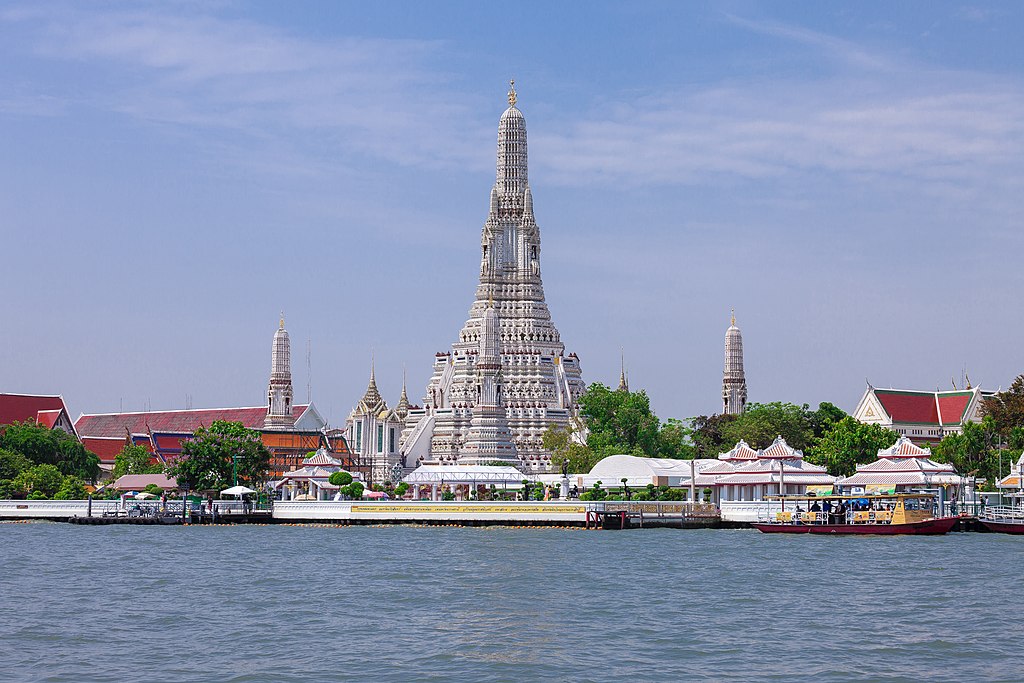
Traditional cosmology (i.e. “how the world is arranged”) in India tended to see a flat world with continents strung together in all directions, including above and below. Some of these continents would be anchored by a massive mountain in the middle, called Mount Sumeru (or Mount Meru). You can see this also in Buddhist architecture such as this famous temple in Bangkok, Thailand:
Incidentially, people in India thought that they lived in one of these continents called Jambudvipa, which was on the southern end of Mount Sumeru. For example, in the Earth Store Bodhisattva Sutra, you see text like so (chapter 4):
Thus, in this Saha world, on the continent of Jambudvipa, this Bodhisattva teaches and transforms beings by means of millions of billions of expedient devices.
Translation by City of Ten Thousand Buddhas
Anyhow, different continents were more peaceful and civilized than others. In some continents dwelt a living buddha, and by their sheer presence, the land would be purified, and all would be peaceful. Such lands are called buddhakṣetra in Sanskrit.
At that time the Buddha told the Elder Shāriputra, “Passing from here through hundreds of thousands of millions of Buddhalands to the West, there is a world called Ultimate Bliss. In this land a Buddha called Amitābha right now teaches the Dharma
Translation by City of Ten Thousand Buddhas
In this sutra, the Pure Land of Amitabha is just one of many such lands that exist to the west, but a particularly splendid Buddha land. Buddhas and Buddha lands were thought to exist in all cardinal directions, and the Amitabha Sutra above goes to great lengths to describe some of them, but highlights Amida Buddha’s Pure Land in particular.
Another example of a Buddha land is the realm of the Medicine Buddha, called Lapis Lazuli, which was thought as existing to the east (not west). The Medicine Buddha Sutra describes it at length. It even goes out of its way to say it’s easier to be reborn in the realm of Lapis Lazuli than the Pure Land of Amitabha:
“If their rebirth in the Pure Land is still uncertain, but they hear the name of the World-Honored Medicine Buddha, then, at the time of death, eight great Bodhisattvas, namely, [list of names] will traverse space and descend to show them the way. They will thereupon be reborn spontaneously in jeweled flowers of many hues. [i.e. be reborn in the Buddha land of the Medicine Buddha]
Translated and annotated under the guidance of Dharma Master Hsuan Jung by Minh Thanh & P.D. Leigh
If a person could be reborn in their next life in a Buddha land, any Buddha land, and thus be in the presence of a living Buddha, it is thought they would find refuge, but also they would advance much better along the Buddhist path. The idea of Pure Lands never supplanted or replaced more tradition Buddhism, but if your current circumstances prevented you from following the Buddhist path, you could opt to be reborn in a Buddha land and make up for it in the future.
… but then we come to another Buddha land worth noting: the Buddha land of Shakyamuni Buddha himself. The sixteenth chapter of the Lotus Sutra drops a plot twist wherein the Buddha never really died, and exists for all time on Vulture Peak in India (a real place where historically he and the Buddhist community often dwelt), and preaching the Dharma to any who see him (details added by me in parantheses):
I live on Mt. Sacred Eagle (another name for Vulture Peak) And also in the other abodes For asaṃkhya (countless) kalpas (eons).
…”This world is in a great fire. The end of the kalpa [of destruction] is coming.” In reality this world of mine is peaceful. It is filled with gods and men.
Translation by Rev. Senchu Murano
The Lotus Sutra version of the Pure Land is less about esoteric geography, and more about Shakyamuni Buddha always being here, whether we see them or not. It comes down to wisdom, clarity, and good conduct.
This viewpoint is found in Zen as well. When we look at the Hymn of Zazen by Japanese monk, Hakuin, who was a lifelong devotee of the Lotus Sutra, we can see the influence:
浄土即ち遠からず Jōdo sunawachi tōkarazu
“Indeed, the Pure Land is not far away”
Amateur translation by me
and:
当所即ち蓮華国此身即ち仏なり Tōsho sunawachi rengekoku, kono mi sunawachi hotoke nari
“This place is none other than the Land of Lotuses [the Pure Land], this body is none other than the Buddha.”
Amateur translation by me
But this isn’t just Hakuin talking. As we saw with the Obaku Zen tradition (a cousin of Hakuin’s Rinzai tradition), they felt the same way, only replacing Shakyamuni with Amida Buddha. But the sentiment was the same. You’ll find similar sentiments in esoteric traditions too, but I have little experience with those and cannot explain in much detail.
So, that brings us to the point: how does one interpret all these Pure Lands, these Buddha lands? My views have gradually changed over time, but I don’t pretend to have the answer. I think in a way that all viewpoints are correct. It is like the famous parable of the blind men describing an elephant: everyone has some idea, but the big picture is beyond our grasp. So, there’s no wrong way to interpret it. If one believes it’s a faraway refuge to be reborn into, that’s totally fine.1 If one believes it’s all in the mind, that’s fine too.
Even the Buddhist sutras, including some I linked above, state that simply “hearing” of the Buddha lands is a merit unto itself. So, if you’ve made it this far, you’re already doing just fine. Just apply the teachings in the way that best fits you.
Namu Shakamuni Butsu Namu Amida Butsu
1 Maybe this is my background as a scifi fan or something, but I do like to imagine that instead of physical continents, the various worlds and Buddha lands are just planets and worlds across the entire Universe. But that’s a personal view, more fantasy than firm belief, so please take it with a grain of salt.
In late 2025, by chance, I found an interesting book at the local Japanese bookstore titled 眠れなくなるほど面白い図解禅の話, “An explanation of Zen so interesting you can’t sleep”, which provides a nice overview for Japanese readers about Zen. It covers a lot of little details like different sects, founders, historical bits, cultural stuff, and so on, that are hard to find in English publications.
Anyhow, the book talks about something I’ve never heard before called the Shiseiku (四聖句) which can be translated as “The Four Holy Verses [of Zen]”. This is a set of verses, imported from Chinese Chan Buddhism and attributed to Bodhidharma, and distill what Zen is all about:
Chinese / Simplified1
Pinyin
Sino-Japanese
English2
不立文字 / 不立文字
bù lì wén zì
fu ryū mon ji
“Buddha-nature cannot be expressed in words.”
教外別傳 / 教外别传
jiào wài bié chuán
kyō ge betsu den
“The teachings of Buddha-nature exist outside scripture.”
直指人心 / 直指人心
zhí zhǐ rén xīn
jiki shi nin shin
“The heart of the Buddha’s teachings are transmitted directly, person to person.”
見性成佛 / 见性成佛
jiàn xìng chéng fó
ken shō jō butsu
“A person who sees their own true nature is a buddha.”
1 Rough translation by me, apologies for any mistakes
Let’s break these down.
The gist is that the deeper teachings of Buddhism cannot be expressed in words, but must be experienced first-hand. This is not an exclusive concept to Zen, by the way. Take a look at an early sutra of the Buddhist tradition:
“This Dhamma that I have attained is deep, hard to see, hard to realize, peaceful, refined, beyond the scope of conjecture, subtle, to-be-experienced by the wise.
The Ayacana Sutta (SN 6.1), translation by Ven. Thanissaro Bhikkhu
… among other places:
36. “When a monk’s mind is thus freed, O monks, neither the gods with Indra, nor the gods with Brahma, nor the gods with the Lord of Creatures (Pajaapati), when searching will find on what the consciousness of one thus gone (tathaagata) is based. Why is that? One who has thus gone is no longer traceable here and now, so I say.
Buddhism provides signposts, maps, or guides through the sutras, through Dharma talks (sermons), and such. However, sooner or later one has to apply the teachings themselves to fully grasp it. This includes one’s own “Buddha nature”: that capacity we have toward becoming buddhas ourselves.
Although Zen tends to have an anti-intellectual image, it’s important to understand that there is a genuine need for scriptural texts and references, especially as one starts out. The Buddha even warns us about making bad assumptions before fully grasping the Dharma, like trying to grasp a poisonous viper incorrectly.
But over the years, through practice this become less essential. Life is something to experience, to live, and to learn from. Even the really ugly shit. In the same way, imagine a pilot training to fly. Reading the manual isn’t enough; they must put in enough hours of “flight time” before they get a license.
But I digress.
The final verse (a buddha is one who sees their own nature) needs some extra explanation. What separates a buddha from a mundane human being is a degree of awakening, not supernatural powers. Or as Dogen Zenji explains in the Genjō Kōan:
To study the Buddha-Way is to study the Self. To study the Self is to forget the Self. To forget the Self is to be enlightened by all things. To be enlightened by all things is to drop off the body and mind of self and others.
In other words, through Buddhism, you see your own nature. By seeing your own nature, you drop the delusions and gain clear insight. By gaining clear insight, you awaken as a Buddha.
1 For those unfamiliar, Chinese characters come in the traditional form and simplified form. The traditional form is what you mainly see outside of the People’s Republic of China. The simplified form is mostly used within the PRC. Interestingly, Japanese uses halfway solution: some characters are simplified, some are not. Anyhow, in most cases, the characters are the same, but you can probably spot a few differences.
2 This is my own translation. Apologies in advance for any mistakes.
PHLOX: It’s clearly had an impact on you. You seem more certain of yourself. T’POL: I’ve never felt less certain. PHLOX: You’re re-examining your core beliefs. Something most people never do.
Star Trek: Enterprise, “Daedelus” (s4:ep10)
Core beliefs do not change easily.
Whether they are morally right or wrong, our beliefs are tightly woven into our sense of identity. If someone challenges our beliefs, they challenge our fundamental sense of self, everything we’ve been taught or learned up to this point, and the conclusions we’ve made as a result.
Indeed, this is why people have such a vast diversity of beliefs, and why we stubbornly cling to them too: we are constructing the world around us based on our perceptions, environment, and experiences.
But that sense of self, including its beliefs, preferences, etc, is an illusion. This is the fundamental Buddhist doctrine of “no(-lasting)-self” called anātman in Sanskrit, or 無我 in East-Asian Buddhism.1
To clarify, this does not mean we don’t exist. But our sense of self is not permanent or static, like a soul or spirit that exists apart from the body. It shifts and changes, like the famous Ship of Theseus. In other words: it’s not something we can rely upon.
Hence, the Buddha told his son Rahula2 to maintain the view that:
‘This is not mine, this is not me, this is not my self.’
What we feel and think isn’t something we can truly call our own. The mind and sense of self is fungible, and what we hold personally dear and true can change as well. This challenges our sense of self, and this makes us uncomfortable, like T’Pol from the show Enterprise3 as she began to challenge her own Vulcan beliefs.
But that’s also how people learn and grow.
Namu Shakamuni Butsu
1 Pronounced wúwǒ in Chinese, and muga in Japanese, among other languages.
2 Rahula was born when the Buddha was still a prince, and later when the Buddha awakened and became a spiritual teacher, he reunited with his family. Some of them ordained as monks and nuns, some did not. Rahula was one of those who ordained.
3 I never actually watched Star Trek: Enterprise back in the day. I was in college and very busy, plus I didn’t really like the UPN channel at the time. However, I finally rewatched it during my personal break and I realized that the show is really, really good. If you are a Trek fan, it’s worth watching.
185. Not despising, not harming, restraint according to the code of monastic discipline, moderation in food, dwelling in solitude, devotion to meditation — this is the teaching of the Buddhas.
Translation by Acharya Buddharakkhita
Plain and simple, Buddhism is about restraint, non-violence, and devotion to the training. This can come in many forms, but if it leads to moderation, dignity, self-mastery, and goodwill towards others, this is in accord with the Buddha’s teachings.
Recently, we had a holiday work party at a local Brazilian steakhouse. I have never been to one before but it had many finely cuts meats, and they were served in large quantities over and over.
I am not vegetarian yet (work in progress), but I have been gradually reducing my meat consumption since early 2025. I definitely do not eat steaks and sausages very much. But everyone else was consuming in large quantities. I had a few samples and soon quit because I knew I couldn’t digest so much meat (it was kind of gross). I am really glad I did because although I missed out on some good food, I saved myself from indigestion, nausea and “meat sweats”.
Indeed the Buddha famous said:
186-187. There is no satisfying sensual desires, even with the rain of gold coins. For sensual pleasures give little satisfaction and much pain. Having understood this, the wise man finds no delight even in heavenly pleasures. The disciple of the Supreme Buddha delights in the destruction of craving.
Translation by Acharya Buddharakkhita
Indulging in a ton of food seems like a refuge for us, it makes us happy, but it is not a reliable one. Overindulgence leads to future health problems and misery.
As the Buddha warns through the sutras, there is no safe, reliable refuge. We still dwell in the “burning house” of the Lotus Sutra: death, old age, and disease are things we have to face, amusing ourselves with our toys, but the house burns around us nonetheless.
If you are a high-rolling CEO or a pleb, it is the same problem, just a different scale.
But the Buddha by his accomplishments and his awakening, and thus letting go, has reached safety:
I have already left the burning house of the triple world.1 I am tranquil and peaceful In a bower in a forest.
translation by Rev. Senchu Murano, chapter three of the Lotus Sutra
Hence, the Buddha (like all buddhas) seeks to lead people out of the burning house too, to the safety of the forest.
The first step in the Buddhist path (i.e. leaving the burning house) is, in my opinion (amongothers), taking the small steps toward moderation and self-restraint. Such things pay dividends in the short-term through having fewer hassles, a balanced personal budget, and provide mental well-being both through increased self-confidence and also fewer regrets.
In the long-term it provides far more.
Namu Shakamuni Butsu
1 This is a Buddhist term that shows up in the sutras a lot. It just means the cosmos, the Universe, the “Whole Enchilada“, etc.
All my deeds and past days were dark and full of evil. But a new day is come.
J.R.R. Tolkien, The Children of Húrin
Within the Silmarillion by J.R.R. Tolkien, is the tale (later edited and compiled as The Children of Húrin) of one human warrior named Túrin. The wicked father of dragons, Glaurung, has poisoned his mind and he goes mad with grief and (among other terrible crimes) mistakenly kills his elven friend.
Later, in a flash of awakening, through an encounter with another friend, he realizes what Glaurung has done to confuse him and lead him astray. He can’t change the past, but his mind is clear and he resolves to start over and focus on the task at hand: defeating the dragon and the dark forces of his land.
The Buddhist archetype for this is Angulimala: a ruthless madman that inflicted great harm, but in a moment of clarity changed his ways. This is how the Buddha-Dharma often works.
Anyway, the reason why I mention all this is that like the quote by Tolkien, each day is a new day. That doesn’t mean the karma you’ve created in the past will magically go away, but today is a chance to start over and try again.
KIRK: [War] is instinctive. But the instinct can be fought. We’re human beings with the blood of a million savage years on our hands! But we can stop it. We can admit that we’re killers… but we’re not going to kill today. That’s all it takes! Knowing that we’re not going to kill – today!
Star Trek, “A Taste of Armageddon” (s3:ep15), Stardate 3192.1
We still have our debts to pay off, but today we can choose to be a better person.
SPOCK: “Change is the essential process of all existence.”
Star Trek, “Let That Be Your Last Battlefield” (s3:ep15), Stardate 5730.2
It is that time once again as we celebrate a new year. It’s an exciting time: plenty to celebrate and look forward to, but some very difficult times too:
Mark Twain: “I come from a time when men achieve power and wealth by standing on the backs of the poor, where prejudice and intolerance are commonplace and power is an end unto itself.”
Star Trek: The Next Generation, “Time’s Arrow, part two” (s6:ep1), Stardate 46001.3
In my spare time, I have been avidly studying (re-studying) the Soto Zen text, the Shushogi. As I talked about before, this is streamlined collection of Dogen’s writings from the Shobogenzo, but with a focus on lay followers.
One of the themes repeated over and over is that time passes, and it only passes in one direction:
Time flies with more speed than an arrow; life moves on, more transient than dew. By what skillful means can you reinstate a day that has passed? To live one hundred years wastefully is to regret each day and month. Your body becomes filled with sorrow. Although you wander as the servant of the senses during the days and months of a hundred years — if you truly live one day, you not only live a life of a hundred years but save the hundred years of your future life…..true practice of the Law for one day is the seed of all the Buddha and their activities.
The Shushōgi, chapter five, fascicle thirty
A long life wasted in empty pursuits is nothing compared to a day spent in earnest practice. Even applying the Buddhist teachings a little bit, benefiting yourself and others, is still a great investment. Like exercise, a little bit goes a long way, and each day is an opportunity. Each one of us, just as we are now, is capable of doing something good and noble.
By the way, a quick blog update: I’ve been struggling in recent months to maintain a consistent schedule for posts (it was self-imposed anyway), so starting in 2026 I am going to try and be more flexible with posting. I am not sure how that will look, but you may see “bursts of inspiration” followed by some dry spells. We’ll see how things unfold. In the meantime, I’ve been adding more pages to the blog under the Buddhism section including the Letter on White Ashes, and the Shushogi above. Not the rest I intended,1 but something I enjoy doing. 🙂
Stay safe and happy 2026 to everyone!
1 I also played a lot of The One Ring RPG in my spare time, plus watching Star Trek: Enterprise for the first time ever. It is a terrific series, and I regret not watching it when it was on-air. So, I did have some downtime too. 😉
Years ago, I used to write down sutra verses I’d find (in English) into my little sutra book, but after a while I often forget what I wrote down. Recently I found this really fascinating verse from the twenty-third chapter of the Lotus Sutra, which I had apparently written down:
The woman who hears and keeps this chapter of the Previous Life of Medicine-King Bodhisattva will not be a woman in her next life. The woman who hears this sutra and acts according to the teachings of it in the later five hundred years after my extinction, will be able to be reborn, after her life in this world, [as a man sitting] on the jeweled seat in the lotus flower blooming in the World of Happiness [the Pure Land] where Amitāyus Buddha lives surrounded by great Bodhisattvas. He [no more she] will not be troubled by greed, anger, ignorance, arrogance, jealousy, or any other impurity. He will be able to obtain the supernatural powers of a Bodhisattva and the truth of birthlessness. When he obtains this truth, his eyes will be purified. With his purified eyes, he will be able to see seven billion and two hundred thousand million nayuta Buddhas or Tathāgatas, that is, as many Buddhas as there are sands in the river Ganges.
Transalation by Rev. Sencho Murano
There is a lot to unpack here.
In Indian culture, it was felt that birth as a women was disadvantageous. This was probably due to the realities of the time: patriarchal society, extreme risks of childbirth in a pre-modern society with medical technology, dowry customs, etc.1 So, the idea was that rather than being reborn again as a woman in the next life, the sutra promises that such a woman could be reborn as a man by being reborn in the Pure Land of Amitāyus Buddha.
Amitāyus Buddha is one of the names of Amida Buddha. It is also used in the Immeasurable Life Sutra, where one of the vows of Amida Buddha is the following:
(35) If, when I attain Buddhahood, women in the immeasurable and inconceivable Buddha-lands of the ten quarters who, having heard my Name, rejoice in faith, awaken aspiration for Enlightenment and wish to renounce womanhood, should after death be reborn again as women, may I not attain perfect Enlightenment.
Translation by Rev. Hisao Inagaki
Here, we see essentially the same thing: if a woman is weary of the challenges of womanhood, she can choose to be reborn as a man in the Pure Land of Amida (Amitāyus) Buddha in accordance with his vow. Should his vow fail, the Pure Land would not be. Since it does exist, the vow is certain.
You can read this in two ways, I think:
This reaffirms a patriarchal attitude that woman are inferior, and therefore being a man is better on the Buddhist path, or
Buddhism was realistic about the challenges of woman in a patriarchal society of the time, and therefore offered something not found in other religious paths.
I think it is up to the reader to decide. To be honest, in light of other aspects of the Lotus Sutra, such as the Parable of the Dragon Princess, or Shakyamuni’s prophecy of Buddhahood to his nun disciples, I am inclined to think that the latter interpretation is what the authors of the Lotus Sutra intended. The Lotus Sutra reads as something (relatively) progressive for the time.
Separately, it’s interesting that the Pure Land of Amida Buddha is even referenced in the Lotus Sutra at all, and both sutras use the same name, Amitāyus, not the more common Amitābha. Typically, Buddhism tends to treat the Lotus Sutra and the Pure Land as separate traditions. They overlap because they are both Mahayana-Buddhist traditions, but often people focus on one or the other.
Further, the Pure Land of Amida Buddha is not prominent in the Lotus Sutra. Instead, the “pure land” of Shakyamuni Buddha in chapter sixteen is the big reveal. So, Amida Buddha’s Pure Land is more like a backup singer in the band, or a spinoff character.
But, having had some exposure to Tendai-Buddhist thought, and seeing overlapping texts like these, I feel it’s clear that they were meant to be one tradition, not two. From the Lotus Sutra perspective, the Pure Land path is part of the larger progression toward Buddhahood. From the Pure Land perspective, Buddhahood is all but assured if you are reborn there because of the radiance and magnetism of Amida Buddha. So, it feels like they are two sides of the same coin in a way. If you add the Zen perspective of the Pure Land, things get even more interesting.
How one approaches all this is up to you. If nothing else, the Lotus Sutra shows that there are many gates, and many ways to approach the Buddhist path, but they are like rivers all feeding into the same ocean.
Namu Shakamuni Butsu Namu Amida Butsu
P.S. Despite my “break” in December, I decided not to wait on this one. 😅
1 One could make the argument that even now in 21st century modern society, life as a woman is still not an easy one. But imagine life when you were expected to have many children, and the average childbirth had a 10% chance of killing you each time, so many women did not live past their 20s and 30s. Further, if your husband was a terrible person, you had little if any recourse.
From the classic Star Trek episode, “Specter of the Gun” (s3:ep6), stardate 4385.3
Speaking of missed opportunities and the many rebirths of Buddhism, there’s another side to this discussion.
The Buddha really emphasized the importance of the life you live now. Yes, each sentient being lives a long endless stream of rebirths ad nauseum, but it’s not as if you just move to a new body, and pick up where you left off. Long story short, death is real, and not something to take lightly. Yes, your karma will propel another birth to take place, but this is a different person, and they have to start over to some degree.
I can’t really go into the theological questions,1 and I don’t know them very well myself, but in India there was much ink spilled over this distinction. For us 21st century readers, let me try to give an example.
Look at “Rogue-like” games such Hades, or Rogue Legacy 2. In such games, your character dies a lot, and each time you die, you have to start all the way from the beginning. Your character might inherit some rewards for past efforts (e.g. past lives), but this doesn’t doesn’t guarantee success, and your next run might be a total disaster and even set you back. In Rogue Legacy 2 in particular, each time you start over, you choose a new character, randomly generated from a few options.
So, each time you start over, you have to treat each life as something important and make the most of it. I think Buddhism works much the same way.
Namu Shakamuni Butsu
1 the crude summary is that in Hindu religion, the soul (atman) traverses from body to body. The Buddha taught anatman (“no soul”) instead. The Buddhist version implies cleaner “break” between lifetimes, but how it all works is beyond me.




 Gleanings in Buddha-Fields

You must be logged in to post a comment.