The Dynamic Duo of Zen and Pure Land

A few months ago, I made this post about how the Obaku Zen sect interprets Amida Buddha and the Pure Land. To my surprise, I keep reflecting on this phrase from time to time, almost like a Zen koan:

This mind is the Pure Land,
this body is Amida Buddha

This idea of merging Zen and Pure Land ideas is somewhat rare in Japanese Buddhism, but it’s surprisingly common in Chinese-Buddhist thought. Originally, I thought it was limited to later Ming-Dynasty Buddhism (which Obaku descends from), but similar strands of thought exist much further back.

A famous Chinese monk named Yongming Yanshou (永明延壽. 904 – 976) once wrote a poem titled the “Four Alternatives” (sì liào jiǎn 四料揀):1

Lacking both Chan and the Pure Land, it will be the iron beds and bronze pillars [of hell] for ten thousand kalpas [eons] and a thousand lives with no one to turn to.

Having Chan but lacking the Pure Land, nine out of ten will stray from the path; when the realm of the aggregates appears before them, they will instantly follow it.

Lacking Chan but having the Pure Land, ten thousand out of ten thousand who practice it will go [to rebirth]. Having seen Amitābha, why worry that one might not attain enlightenment?

Having both Chan and Pure Land, one is like a tiger with horns [i.e., doubly capable]. Such a person will be a teacher in the present life, and a buddha or patriarch in future lives.

translation by Charles B. Jones, “Chinese Pure Land Buddhism, Understanding a Tradition of Practice”, pg 210

Yongming is advocating a supportive model where both Zen practice and Pure Land practice work in concert. The Pure Land path is the “safer” path to follow, due to the vows of Amida Buddha, but if supported by Zen practice here and now, one is really making progress on the Buddhist path.

Further, a later writer named Yunqi Zhuhong2 (雲棲袾宏, 1535 – 1615) explained that these things were not mutually exclusive (Chinese added by me):3

To contemplate the Buddha (nianfo 念佛) is to contemplate the mind (nian-xin 念心). Birth there (in the Pure Land) does not entail birth away from here. Mind, Buddha, and sentient beings are all of one substance; the middle stream (non-duality) does not abide on the two banks (this world and the Pure Land).

Similarly, Ouyi Zhixu (蕅益智旭, 1599 – 1655) in his excellent work “Mind Seal of Buddhas” makes a similar argument: Zen and Pure Land practice are the same thing, just operating at different levels. You’re not forced to chose one or the other in your practice.

But such ideas aren’t limited to medieval Chinese-Buddhist monks. You can find such sentiments in Pure Land sutras themselves! In the Immeasurable Life Sutra is this passage (emphasis added):

“In this world, you should extensively plant roots of virtue, be benevolent, give generously, abstain from breaking the precepts, be patient and diligent, teach people with sincerity and wisdom, do virtuous deeds, and practice good. If you strictly observe the precepts of abstinence with upright thought and mindfulness even for a day and a night, the merit acquired will surpass that of practicing good in the land of Amitāyus [a.k.a. the Pure Land] for a hundred years. The reason is that in that buddha land of effortless spontaneity all the inhabitants do good without committing even a hair’s breadth of evil. If in this world you do good for ten days and nights, the merit acquired will surpass that of practicing good in the buddha lands of other directions for a thousand years.

Translation by Rev. Hisao Inagaki

In this passage, the Buddha is clearly advocating both bending your efforts toward rebirth in the Pure Land, but also making the most of the time you have here to undergo traditional Buddhist practices too because even a modest effort here is a great benefit in the future (both for yourself and others).

As I often tell my kids: “go nuts”!4

What I mean is: recite the nembutsu, meditate, uphold the precepts, or some combination thereof. You have nowhere to go but up.

But what if you can’t decide or don’t have the time?

In my opinion, start with the nembutsu. Begin just as you are, and recite it just 10 times daily. From there, add the Five Precepts when you are ready, and once you have that foundation, and are ready to branch out, then look into Zen practices. This make take months or even years. Take your time, go slow, and don’t be afraid to explore.

When I talk about the flexibility of Tendai Buddhism in Japan as well, this is what I am alluding to: start with something simple and small at first (such as a devotional practice), and gradually building upon it as you gain confidence and see the positive transformation in your life. Buddhism is kind of a SLOW, gradual religion, but like a glacier, once it starts moving, it has a wonderful momentum all its own even if you can’t see it.

Namu Shakumuni Butsu
Namu Amida Butsu

P.S. Featured blog image is another famous “Dynamic Duo”: Batman and Robin from the 1960’s series.

P.P.S. Posting kind of off-schedule just because it is fun. 😊

1 I found this on Wikipedia actually and I thought to myself “wow, this person quoted exactly the same way that I would do!”, then I realized that I had put this on Wikipedia a few years ago. 🤦🏼‍♂️

2 Pronounced like “yoon-chee joo-hong”.

3 Again, I managed to pull a quote from Wikipedia that I had unwittingly added years ago and then promptly forgot.

4 My kids ask me if they can watch TV, play Switch or whatever, and my frequent answer is “go nuts” [go crazy, have fun].

Highs and Lows

Dr Helen J Baroni’s excellent book Iron Eyes covers the life and writings of Obaku Zen master Tetsugen Dōkō (鉄眼道光, 1630–1682). I’ve mentioned it in a few older posts, but I wanted to share a couple of Tetsugen’s poems really stood out to me:

41. MEETING AN OLD FRIEND

Separated east and west for twenty years.

You exclusively chant the Buddha’s [name, a.k.a. the nembutsu], while I practice meditation.

We meet together, why argue over high and low.

The wind and the moon originate in the same heaven.

Page 167

The “high and low” refers to the perception that the path of monastic self-discipline (as exemplified by the Zen tradition) is the “high road”, while the “low road” is instead relying Amida Buddha’s compassion to be reborn in the Pure Land. Here, Tetsugen argues that they both reach the same destination in the end, so the distinction doesn’t really matter.

Another poem he wrote is:

44. GIVEN TO THE FAITHFUL BELIEVER JONYU, WHO CHANTS THE BUDDHA’S NAME

The body is healthy, the years pour out; your ears and eyes are [still] clear.

Contented and unselfish, you reject personal glory.

Reflected light, in a single moment you penetrate the self.

For the first time you realize that practitioner and Dharma are complete in one body.1

Page 168

What really strikes me about these two poems is that Tetsugen openly acknowledges that his lay friends and followers recite the nembutsu and he’s totally fine with it.

It’s assumed in Japanese Buddhism that a sect practices meditation, or chanting, but not necessarily both. It’s also assumed that Zen people only hang out with Zen people, Pure Land Buddhists with Pure Land Buddhists, etc. There were exceptions: people like Ikkyu and Rennyo who were friends despite totally different practices and backgrounds, but you don’t hear about these often. Yet, in spite of this image, Tetsugen clearly was open to lay people practicing the Pure Land path and saw no conflict with this.

This makes more sense when you consider that Obaku Zen, a cousin of the Rinzai Zen sect, came to Japan from Ming-Dynasty China, when Zen and Pure Land thought had largely reconciled there. The excellent writings of Chinese monk Ouyi Zhixu (蕅益智旭, 1599–1655)2 and Yunqi Zhuhong (雲棲袾宏, 1535–1615)3 are typical of the thought at the time: both Zen and Pure Land Buddhism are different ways of approaching the same Dharma (e.g. Buddhism). One blends into the other.

Even modern Chan (Chinese Zen) teachers such as my favorite, Yin-shun (印順, 1906–2005), had no trouble recommending the nembutsu alongside other practices. In his book The Way to Buddhahood, he wrote:

If therefore, one is timid and finds it difficult to practice the bodhisattva-way, fearing that one will fall into the Two Vehicles or that following the karmic forces will cause one to drift apart from the Buddha Way, then chanting Amitabha Buddha is most secure! It is a wonderfully skillful means that can best embrace and protect those sentient beings who are beginners so that they do not lose their faith.

page 249

But I digress.

It should be noted that Tetsugen in particular was raised in the more native Jodo Shinshu-sect Buddhism and even went to Kyoto to train as a priest but eventually decided to pursue Obaku instead. So, perhaps he still had some connections toward his religious upbringing.

Nonetheless, all this is to say that Obaku Zen, having inherited such an outlook from Chinese Buddhism, takes Amida Buddha as its ideal, but sees Amida in more Zen terms. One is not required to see Amida that way upfront; it just comes in time with practice. Come as you are, and don’t worry if it doesn’t make sense. Someday, it will.

Namu Shakamuni Butsu
Namu Amida Butsu

1 According to Dr Baroni’s footnotes: Kihō, can also be translated as “opportunity and Dharma,” in Pure Land thought, it means that while the sentient beings believe in the Buddha, the Buddha’s power saves sentient beings. Personally, I like to think this relates to Shoku’s comment about the Three Karmic Bonds, too.

2 Pronounced like “Oh-ee Jih-shoo” in English

3 Pronounced like “Yoon-chee Joo-hohng” in English

Making Sense of Zen Lineages

Recently, I found myself stuck in one of my usual nerd “rabbit holes” of trying to make sense of Zen lineages in Japanese Buddhism, but this led to a more complicated rabbit hole of making sense of the source “Chan” (Zen) lineages in China. This started after reading my new book on Rinzai Zen, which included a nice chart. At first, I tried to emulate and translate that chart in Canva, but then I realized it was missing some critical details, so I kept adding more. This is the result (click on the image for more detail):

Let’s go over this a bit so it makes more sense.

The premise behind all Zen sects regardless of country and lineage is that Zen started when the historical Buddha, Shakyamuni, supposedly held a flower up to his disciples and said nothing. Everyone was confused except his disciple Maha-Kashyapa who smiled in understanding. From here, according to tradition, the teachings were passed down from teacher to disciples for 28 generations in India, culminating in a monk named Bodhidharma who came to China.

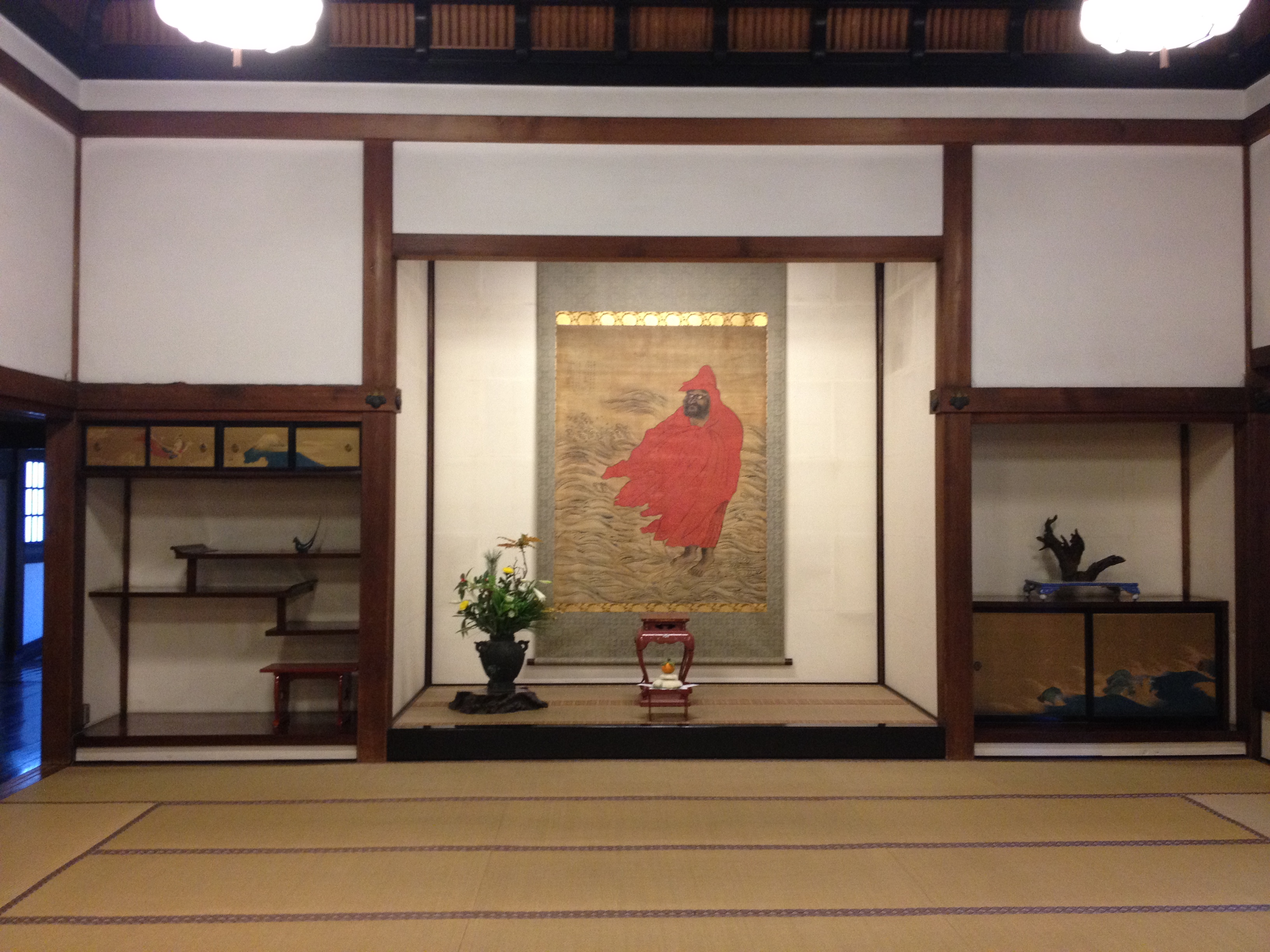
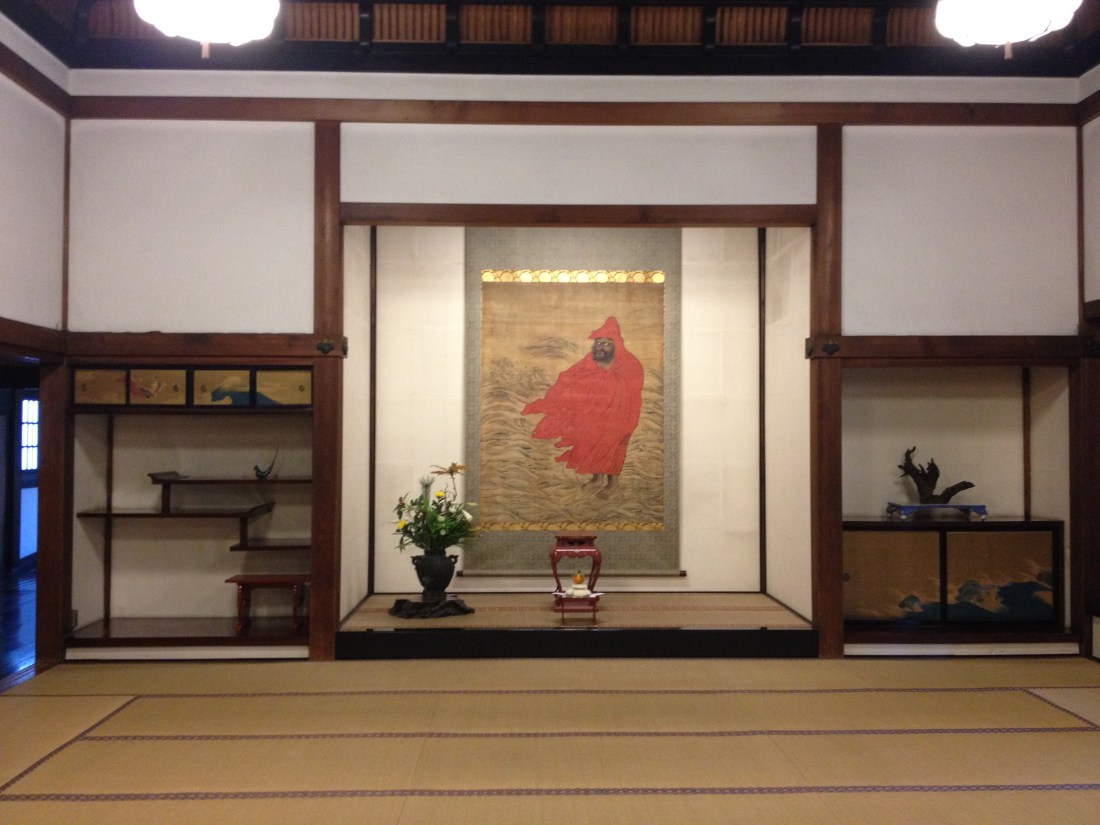
A painting of Bodhidharma at Sojiji temple (head of Soto Zen sect) in Kawasaki, Japan. Taken by me in 2010 (?).

The history up to this point is somewhat vague, and possibly apochryphal, but easy to follow.

This continues for a few more generations in China, until you get to a monk named Hui-Neng (Enō in Japanese)1 who is the supposed author of the Platform Sutra, a Chinese text. As the 6th “patriarch” of the lineage in China, he establishes what we know today as “Chan Buddhism” or Chinese Zen.

Things become more complicated a couple generations later as two descendants: Mazu Daoyi2 and Shitou Xiqian3 directly or indirectly found different schools of Chan Buddhism. This is known as the Five Houses of Chan period during the Tang Dynasty. Thus, the entire Chan/Zen tradition as we know it today is derived from Hui-neng and transmitted through these two men.

Out of the five houses, the Hongzhou,4 Lin-ji and Cao-dong5 all survive in some form. The others are gradually absorbed into the Lin-ji school, which in the long-run is what becomes the most widespread form of Chan Buddhism in China. The Cao-dong school is the one exception, while the Hongzhou school’s success in Korea helps establish 8 out of 9 of the “Nine Schools of Seon (Chan)”6 in Korea. It through Bojo Jinul’s efforts in Korea that these nine schools are unified into the Jogye Order (homepage) which absorbed other Buddhist traditions in Korea into a single, cohesive one.

Meanwhile, in Japan, the Lin-ji and Cao-dong schools find their way to Japan where the names are preserved, but pronounced different: Rinzai and Soto respectively. Rinzai’s history is particularly complicated because they were multiple, unrelated transmissions to Japan often spurred by the Mongol conquest of China. Of these various Rinzai lineages, the two that survive are the “Otokan” Rinzai lineage through Hakuin, and the “Obaku” lineage through Ingen, but eventually the Otokan lineage absorbed the Obaku lineage. Today, Rinzai Zen is more formally called Rinzai-Obaku, or Rinnou (臨黄) for short. This is a bit confusing because Rinzai came to Japan under a monk named Eisai, and his lineage did continue for a while in Japan especially in Kyoto, but the lineage from the rival city of Kamakura ultimately prevailed and absorbed other Rinzai lineages. Obaku Zen arrived pretty late in Japanese-Buddhist history, and as you can see from the chart has some common ancestry with Rinzai, but also some differences due to cultural divergence and history.

Soto Zen’s history is quite a bit more streamlined as it had only one founder (Dogen), and although it did grow to have rival sects for a time, Keizan was credited for ultimately unifying these though not without some controversy even into the 19th century.

Anyhow, to summarize, the entire tradition started from a legendary sermon by the Buddha to Maha-Kashyapa, and was passed on over successive generations in India to a legendary figure who came to China and starting with Hui-neng became a tree with many branches. Yet, the roots are all the same. Speaking as someone who’s relatively new to the tradition, I realize while specific liturgy and practices differ, the general teachings and intent remain the surprisingly consistent regardless of culture or label.

Hope this information helps!

P.S. I had trouble deciding which term to use here: Zen or Chan or Seon since they all literally mean the same thing, but are oriented toward one culture or another. If this all seems confusing, the key to remember is that the entire tradition of Zen/Chan/Seon (and Thien in Vietnam) is all one and the same tree.

P.P.S. I realized that I never covered the Vietnamese (Thien, “tee-ehn”) tradition, but there’s so little information on it in English (and I cannot read Vietnamese), that I will have to differ that to another day.

1 Pronounced like “hwey-nung” in English.

2 Pronounced like “ma-tsoo dow-ee” in English.

3 Pronounced like “shih-tow shee-chee-yen” in English.

4 Pronounced like “hohng-joe” in English.

5 Pronounced like “tsow-dohng” in English.7

6 The Korean word “Seon” is pronounced like “sawn” in English. It is how the Chinese character for Chan/Zen () is pronounced in Korean Language.

7 If you made it this far in the post, congrats! I had to put so many footnotes in here because the Pinyin system of Romanizing Chinese words is a little less intuitive than the old Wade-Giles system. Pinyin is not hard to learn. In fact, I think Pinyin is better than the old Wade-Giles system (more “what you see is what you get”), but if you don’t learn Pinyin it can be confusing.better This is always a challenge with a writing system that strictly uses ideograms (e.g. Chinese characters). How do you write 慧能 into an alphabetic system that foreigners can intuitively understand. Also, which foreigners? (English-speaking, French-speaking, Spanish-speaking, etc). Anyhow, if you are interested in learning Chinese, I highly recommend learning Pinyin anyway because it’s quick and easy to pick up. BTW, since I posted about Hokkien recently it also has two different Rominzation systems: Pe̍h-ōe-jī (old, but widespread) and Tâi-lô (Taiwan’s official revised system).

Hokkien: the Forgotten Chinese Dialect

This is not something I usually post about, but after my recent post about Ando Momofuku, I learned some fascinating things about Chinese language and wanted to share with a wider audience. In high school, I took two years of Chinese language and was an enthusiastic student. We learned the Mandarin dialect, though our teacher was from Taiwan, and we never really explored other dialetcs.

However, over the years, I’ve met various overseas Chinese who don’t speak Mandarin-dialect Chinese as a first language, and instead know Cantonese, Toisan, Taiwanese and so on. The history of Chinese languages and its various dialects is complicated. Fascinating, but far too much to cover here and I am not expert. In fact, it’s fair to say that all these dialects aren’t really dialects, but more like a language family, in the same was as Latin to French, Italian and Spanish, or Sanskrit to Hindi, Bengali, and Marathi, etc.

But I did want to cover a particular dialect that’s actually pretty widespread and influential, but not well-known: Hokkien (福建話, hoh-kee-en), sometimes also called Minnan or Bân-lâm (閩南) among other names. In Mandarin, this dialect is called Fújiànhuà (“Fujian speech”). So, we might think of Hokkien as Fujian-dialect Chinese, although as this video explains, that’s not 100% accurate:

It helps to think of Hokkien as one form of “Southern Chinese” vs. Mandarin “Northern Chinese”. This is a very rough comparison, but helps illustrate the history behind the two dialects. Hokkien is one of many, many dialects in southern China, where mountainous geography kept many communities isolated from one another over time. Meanwhile, Mandarin has its origins in northern plains of China, which also happens to be where most Imperial capitals resided in Chinese history, hence it had more influence and prestige.

Another thing to note is that the vast majority of the Chinese characters used are the same regardless of dialect, but they are read and pronounced differently depending on the dialect:

But out of all the fascinating dialects in Southern China, why am I writing about Hokkien? Two reasons.

The first reason is that the influence of Hokkien is surprisingly wide. It’s a very common dialect spoken across Southeast Asia. One of my long-time friends is Indonesian Chinese, and he told me that many people use it in Indonesia, and explained how Hokkien terms often get mixed in Indonesian conversational speech (which is natively Malay, not Chinese). This video below is a fascinating explanation of how Hokkien spread, and has continued to thrive across Southeast Asia.

Hokkien is also an important language in Taiwan. Mandarin became one of the national languages after the Nationalists fled there after 1950, but Hokkien (via Taiwanese) is very widespread too. I have a childhood friend who’s a second-generation Taiwanese-American, and he grew up learning both Mandarin (for practical reasons, every Chinese person knows at least some Mandarin), but also Taiwanese language. When his father passed away last year, I attended the funeral,1 and it was the first time I ever heard Hokkien spoken since most of the attendees were fellow Taiwanese people, and the eulogy was spoken in Taiwanese. Taiwanese is a form of Hokkien, probably the most widely spoken.

So, it’s used far more often than one might expect. But if you didn’t know how to distinguish Hokkien from Mandarain from Cantonese, you might easily miss it.

The second reason I am talking about this might surprise you.

Hokkien has a big influence on Japanese language, because that’s where all the on-yomi (“Chinese readings”) of Kanji come from, not Mandarin.

It’s easier to see when you actually compare words in Japanese, Hokkien, and Mandarin.

A common word in Japanese is 感謝 (かんしゃ, kansha) meaning “gratitude” or to be thankful. In Mandarin this is pronounced as gǎn xiè. That sounds fairly close. But in Hokkien it’s gam sia, (“gum shyah”) which sounds even closer.

Another example is the character 我 (“wa” or “ga”) in Japanese and is used for things like “self”, “mine”, “our”, etc. In Mandarin this is pronounced as , but in Hokkien it’s wa or gwá. Again, this sounds closer to Japanese than Mandarin does.

If you are curious to learn some basic Hokkien words, this is a nice video below, though it does not include Chinese characters (Romanization only):

This video is a fun, light-hearted comparison between Hokkien and other dialects by someone trying to learn Hokkien but who grew up learning Cantonese instead.

Side note, I asked my Taiwanese friend about how well he could understand other southern dialects. To him, Teochew was fairly easy to follow, but Cantonese was 50-50 for him: sometimes he could pick up what was being said, other times he could not.

Anyhow, that’s a very brief look at Hokkien by someone who’s obviously not Chinese, but fascinating by its influence across Asia. I hope to write more about Hokkien as I learn more, but I am quickly discovering how limited resources are. The only dictionary I could find was from 1922 and used for missionary work. Clearly, more research needs to be done, but I am happy to see younger generation Chinese making all these helpful Youtube videos to share information rather than Westerners doing it.

P.S. Featured photo is the city of Quanzhou (“chwan-joe”, 泉州), birthplace of Hokkien.

1 His parents had always been kind to me in school, and patient when I practiced my Chinese language skills with them.

The Ten Oxen of Buddhism

While reading my introduction book in Japanese about Rinzai Zen, I came across a famous set of paintings that I had totally forgotten about for thirty years.

Me at the age of 17 demonstrating the “Lion Roar Yoga” pose (?) at my world religions class in high school with my teacher. The Burger King crown was something I got from the nearby restaurant because my friends and I would race there during lunch break, eat for 5 minutes, and run back to class. Ah, teenage life….

Many, many moons ago, I was a cocky 17-year old first learning about Buddhism, and Mr Pierini was my World Religions teacher in high school. Mr Pierini was a charming, older Italian-American gentleman who had a lovely opera voice, and loved sharing cool ideas with us kids. This is how I first started to explore Buddhism beyond reading books at home.1

There were a number of things I learned about Zen then that seemed really cool and mystical. Looking back they made no sense to me, but they were fascinating. It sounded “cool” to be Zen, but admittedly, I was young, clueless, showing off, and knew nothing. Among the things I read about at the time were the Mumonkan and the Ten Oxen, texts that (I realize now) are both related to the Rinzai Zen tradition.

The Ten Oxen (shíniú 十牛 in Chinese) is a famous set of ten paintings, with poetic captions that were composed in the Southern Song Dynasty of China. The powerful Song Dynasty lost the northern half of China to the barbarian Jin Dynasty,2 and retreated to the south beyond the Yangtze River, where it held on for another 150 years. Despite having their back to a wall, the southern Song Dynasty oversaw a wonderful flowering of Chinese culture, including Buddhism, and especially Chinese “Chan” (Zen) Buddhism. This is also noteworthy, because historically this is the time when such monks as Eisai and Dogen both came to China from Japan to study Zen.3

The use of oxen as a symbol for taming the mind in Buddhism, according to Wikipedia, dates way back to early India including such texts in the Pali Canon as the Maha-gopalaka Sutta, but the Ten Oxen were a way to visually explain the Buddhist path (as described in the Chan/Zen tradition) to readers as a nice easy introduction. There were, evidentially several versions in circulation, but in Japan the version by one Kakuan (Chinese: Kuòān Shīyuǎn, 廓庵師遠) from the 12th century was all the rage during the Five Mountains Period of Japanese-Buddhist history. It is since known as the jūgyūzu (十牛図).

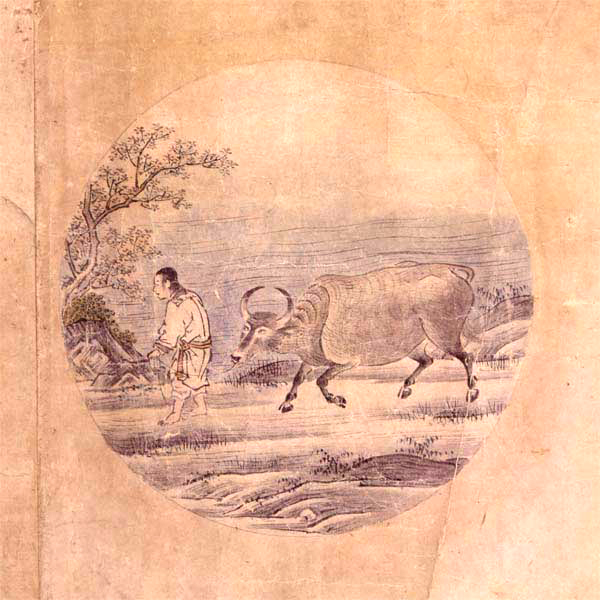
My book has a nice, down to earth explanation of the ten oxen and what they mean, so rather than posting the images with poetry, I wanted to share the simple explanations here. The illustrations are from Wikimedia Commons, and were originally painted by one Tenshō Shūbun (天章周文; died c. 1444–50).

Searching for the ox

The cowherd is searching for his lost ox. The book explains that this is like someone looking for their lost Buddha-nature: that potential within us to awaken to full Buddha-hood (a.k.a. “Enlightenment”).

Footprints sighted

The cowherd now finds the footprints of his missing ox. This is like the Buddhist disciple who studies the Dharma (e.g. “Buddhism”), and gets the first hints at the true nature of things.

Ox sighted

Just as the cowherd sees his lost ox at last, the disciple of the Buddha grasps the point of the Dharma is (i.e. what’s it all about).

Grasping the Ox

One moment the cowherd has grasped the ox, another moment he is about to lose it. In the same way, my book explains that a person may perceived their true nature one moment, but lose sight of it again. The Buddhist disciple is still inexperienced and lacks certainty.

Taming the Ox

The wayward ox is now under control and lassoed, so the cowherd escorts it back home. For the Buddhist disciple, my book explains that through self-discipline such as the precepts, one’s delusions and conduct are brought to heel. This doesn’t mean they have resolved things, and one can still backslide, but at least they are under control now.

Riding the Ox

The cowherd is now confidently riding atop the ox, playing a flute. This means that one’s Buddha-nature is expressed through one’s form and behavior.

Forgetting the ox

Now that the cowherd is safely home with the ox, the ox is no longer a concern. My book explains that this symbolizes Enlightenment as one attains peace of mind.

Forgetting the distinction between self and ox

Here this empty circle expresses the Zen ideal that all is empty, and that there’s no distinction between oneself and the ox, or anything else for that matter; this is the Heart Sutra in a nutshell.

Back to basics

Having awakening to the nature of all things, things “return to the source” in a sense, or put another way, one sees mountains and mountains, trees as trees, etc. No more, no less.

Returning to society

My book explains that the cowherd now appears like Hotei (Chinese: Budai), the famous, jolly-looking figure in Chinese Buddhism and is in turn sharing the Dharma with another young cowherd. This cowherd will undergo the same quest, starting at picture one above.

In other words, everything comes full-circle.

In the same way, I don’t think teenage me imagined myself blogging about this 30 years later, and a bit more experienced, but life is funny that way.

Namu Shakamuni Butsu

1 Mr Pierini, thank you. 🙏🏼

2 Both would ultimately be destroyed by the Mongols especially under Kublai Khan who formed the Yuan Dynasty. This period of time is important to Japanese Zen history too because the influx of Chinese monks, especially Rinzai monks, to Kamakura-period Japan helped fuel a rise in Zen there. In the same way, the Fall of Constantinople in 1453 helped fuel the Renaissance in the West as refugees from the Eastern Roman Empire brought lost knowledge and know-how to the West. If there was any proof that we’re all connected in some way, look no further.

3 Earlier generations of Buddhist monks like Kukai (founder of Shingon) and Saicho (founder of Tendai) came to China during the Tang Dynasty, when connections to India were still flourishing. Hence, in Kukai’s case, he could study esoteric doctrine and Sanskrit directly from Indian-Buddhist monks. Centuries later, when Dogen and Eisai came to China, Buddhism had declined in India, and had gradually taken root in China in a more Chinese way. Of course, the Dharma is the Dharma, regardless of which culture and time it is taught, but it’s noteworthy that the Buddhism Dogen and Eisai was different: esoteric and scholarly Indian Buddhism had fallen out of favor, and a growing Zen (Chan in Chinese) community had largely replaced them.

Obaku Zen Morning Service

This is just another small, bonus post. A little while back, I was looking into the Obaku school of Zen, but even in Japanese information is pretty hard to find. However, I was able to find this sound clip from the NHK. This is a sound clip of a morning service at Manpuku-ji Temple, the head temple of the sect.

What distinguishes Obaku Zen (ōbaku-shū, 黄檗宗) from other Zen sects, and Japanese Buddhism in general is how late it was imported into Japan from China. Most sects imported during the Tang or Song dynasties, namely 8th or 11th centuries. But Obaku Zen came to Japan during the Ming Dynasty (14th century). It shares the same common lineage as Japanese Rinzai Zen, so they’re sibling sects. Yet, across centuries some things had diverged, and Obaku imports a lot more Ming-era Buddhist aspects, such as a fusion of Pure Land and Zen teachings (which came later in Chinese-Buddhist history), and changes to liturgy and pronunciation.1

So, if you ever see Obaku Zen liturgy (I’ve only seen a few screenshots), it sounds somewhat different even when it’s the same liturgy, because pronunciation changed over time in China.

Anyhow, just a minor nerd moment. Please enjoy!

1 Languages change and shift, including Chinese. Chinese-Buddhist liturgy imported to Japan from the Tang Dynasty would sound different than the same imported into Japan during the Ming. If that seems far-fetched, look at English language.

The Lotus Sutra: the Capstone Teaching?

It’s been a while since I discussed anything that relates to Tendai Buddhism, but I was doing a bit of nerd-reading with my free time, and thought this was interesting to share.

As Buddhism spread from India via the Silk Road, transmitted by such peoples as the Kushans, Sogdians, and Parthians (the same Parthians who contended with Rome from to time), the vast wealth of Buddhist texts, teachings and information flooded into China in waves.

This import of information was kind of haphazard at first, but as translations improved and information continued to come, China developed its own schools of thought to help make sense of it all.

One of the first successful efforts was by a Chinese monk named Zhi-yi (智顗, 538–597 CE)1 who founded the Tiantai school. He, or possibly by later patriarch Zhan-ran (湛然, c. 711-782 CE),2 analyzed the various teachings and Buddhist texts and developed a chronology called the Five Time Periods and Eight Teachings (五時八教, wǔshí bājiào).3 This chronology looks like so:

  1. The Buddha (Shakyamuni) taught the Flower Garland Sutra first, but it was incomprehensible to disciples.
  2. The Buddha stepped back and taught Agama sutras next. The Agamas are equivalent to the Pali Canon in the Theravada tradition, and nearly the same in terms of content. The Agama sutras were more grounded and practical and thus easier for his community to understand.
  3. Next, the Buddha taught sutras such as the Vimalakirti Sutra as an introduction to Mahayana teachings, and thus higher than the Agamas.
  4. Next, the Buddha taught the Perfection of Wisdom sutras, such as the Heart Sutra, as a more complete teachings.
  5. Finally, the Buddha taughy his ultimate teachings: the Lotus Sutra and Nirvana Sutra because the disciples were now ready.

Thus, out of all the Buddhist texts, Zhi-yi argued that the Lotus Sutra was the complete and ultimate teaching (円教). In Japanese Tendai Buddhism, 円教 is pronounced as engyō, or is sometimes more formally called hokke engyō (法華円教, “the complete teaching that is the Lotus Sutra”). Much of Tendai Buddhism is thus about putting the Lotus Sutra teachings into practice. From the Tendai perspective, things like meditation, venerating Amida Buddha, esoteric practices like mantras, and upholding the precepts are all ways to put the Lotus Sutra into practice, and Zhi-yi wrote quite a bit about this subject.4 The idea, expressed through the phrase shi-shū-yū-gō (四宗融合) or “Four Integrated Schools”.

The historicity of Zhi-yi’s textual analysis is unfortunately pretty dubious. Modern archeology and Buddhology show that the very earliest texts, historically, were the Agamas / Pali Canon (the Dhammapada and Jataka Tales probably came even earlier), but even those were not recorded in writing until three to four centuries after the Buddha. So, even with the earliest texts, we have a gap from when the early disciples passed everything down orally before committing to writing generations later. Granted, Indian oral tradition was quite sophisticated and designed to minimize errors and corruptions in recitation, but the Agamas and Pali Canon do slightly diverge from one another, mostly in ways that are interesting to scholars only.

The Mahayana Sutras such as the Vimalakirti Sutra, Lotus Sutra and Perfection of Wisdom sutras were written down even later. One could argue that they were passed down orally5 and just recorded later for some reason, but textual analysis casts this into doubt. The Mahayana sutras are more like “reboots” or compilations of earlier teachings, more polished and such.

Which is where the Lotus Sutra comes in, I think.

This is personal bias, admittedly, but I do believe that the Lotus Sutra is a capstone of the Buddhist tradition, not because the Buddha saved it for last. Instead, the authors of the sutra did a really nice job of synthesizing earlier teachings into a single narrative, and devised clever parables to bring the teachings to readers in a fresh, new way. The Lotus Sutra doesn’t necessarily introduce a lot of new teachings so much as it brings it all together. Like a capstone or keystone. There’s something in there for everyone, in other words.

So, to me the Five Time Periods and Eight Teachings isn’t very useful in a literal, historical sense, but it is useful for showing how some sutras synthesize other sutras into increasing comprehensive narratives.

P.S. featured photo is the capstone of the main entrance of Giusti’s Palace, photo by Paolo Villa, CC BY-SA 4.0, via Wikimedia Commons

1 Pronounced like “Jer-yee” in English. The “zhi” in pinyin sounds like English “jerk” without the “k” at the end. His name in Japanese is read as Chigi, by the way.

2 Pronounced like “John-ron” in English. In Japanese, his name is read as Tannen.

3 This is read in Japanese language as gojihakkõ.

4 Pure Land practices as we recognize them do not seem to be prominent in Zhiyi’s time and were adopted into Tiantai later, and thus Japanese Tendai even later through such figures as Genshin.

5 The Lotus Sutra, for example is a mix of verse sections with narrative text around them. It’s argued that the verse sections came first, and then authors composed the narrative sections around them. When the verse sections were first composed is anyone’s guess.

Power

Another Roman history nerd moment, if you will indulge me….

By 45 BCE, Gaius Julius Caesar (aka Julius Caesar) had defeated his rival Gnaeus Pompeius Magnus (aka Pompey the Great) in a lengthy civil war and returned to Rome.

From here, Julius Caesar kept pushing the limits of power, with no one pushing back, inching closer and closer to a king. Special thanks to Historia Civilis for these fun, awesome history videos:

His power grab was crass and violated centuries of tradition and laws, yet the Senate was packed with loyalists who just went along with it for personal gain, while opposition was uncoordinated and ineffective (special nod to Tribune of the Plebs, Pontius Aquila, though).

Even after Caesar’s demise, nothing really got better.

Instead, the facade of government was no longer there and lacked any real legitimacy, so men just grabbed power.

In time the Second Triumvirate (aka “rule by three men”) formed under:

Through a combination of purges, rivals were eliminated until eventually the Triumvirate turned on one another with only Octavian left standing.

Contrary to popular belief, the Roman Senate and other functions of state continued to exist. The res publica that is Rome never stopped being the res publica until 1453 CE with the Fall of Constantinople. Octavian didn’t even declare himself Emperor. He adopted the title princeps (“first among many”) as the leader of the Senate.

However, real power rested with Octavian and his descendants, the Julio-Claudian dynasty, and the Senate just kept getting weaker and weaker over the generations until by the time of the Eastern Romans (aka the Byzantines), it was pretty much ceremonial: honorific titles to confer on allied and friends. Even the title princeps kept going until Diocletian in the third century dropped the act and just called himself Emperor.

Speaking of the Eastern Romans, the line of Emperors continuing all the way to Konstatinos (“Constatine”) XI Palailogos in 1453 had its ups and downs. During a time of succession crisis, someone would once again fill the power vacuum and rule with blatant power, rather than legitimate rule. Emperor Konstatinos VII Porphyrogenitus in the 10th century had legitimacy, but he practically did nothing because his father-in-law Romanos Lekapenos held real power, and just propped his son-in-law up for legitimacy. Centuries later, when Constantinople was on the brink, Ioannes (“John VI”) Kantakouzenos in the late 13th launched a civil, and hired tons of Turkish mercenaries to fight for him. Needless say these, these Ottoman Turks didn’t leave, and, the Eastern Romans lasted only another 100 years.

This, by the way, is not limited to Western political history. In fact, centuries before the Roman Republic, if you look the famous Spring and Autumn Period in Chinese history, you see many examples of this too. Local nobility gradually morphed into warlords as the central Zhou (pronounced “Joe”) Dynasty lost its central grip on power. Kǒngzǐ (aka “Confucius”), living generations later when the system has practically collapsed, laments how local warlords perform religious rites that used to be accorded to the Emperor, and not someone of their station. These were gross power grabs, and Confucius criticized their lack of propriety and respect for the traditions and rites of the times.

Why do I mention all this?

It seems there is a pattern in history and politics than when governments are weak, someone with ambition fills the vacuum and just pushes things over. Such strongmen rule with power, not laws. As Frank Herbert wrote in the Dune series:

“All governments suffer a recurring problem: Power attracts pathological personalities. It is not that power corrupts but that it is magnetic to the corruptible.”

Frank Herbert, Chapterhouse: Dune

Going all the way back to Pompey the Great, there is a famous quote attributed to him by Plutarch which in Greek said:1

‘οὐ παύσεσθε,’ εἶπεν, ‘ἡμῖν ὑπεζωσμένοις ξίφη νόμους ἀναγινώσκοντες;’
“…at which Pompey said: “Cease quoting laws to us that have swords girt about us!””

Source for English here

This quote has been on my mind a lot lately, and is what spurred this lengthy diatribe, I suppose.

Laws and rules are only effective when people respect them. When people stop respecting them, they cease to be effective. In such times, political principles and theory hardly matter anymore. Power becomes the only true constant.

And of course, as we all know, power is a fickle thing, and easily lost.

The Journeys of Xuanzang, part five: Bamiyan Bound

Having travelled in a westerly direction for a long time, and finally turning south at Samarkand, the 8th century Buddhist monk Xuan-zang is finally approaches the hinterlands of India, birthplace of the Buddha.

A map of northern India including the Gandhara region in the northwest (modern Pakistan and Afghanistan). A red line runs through various cities, starting with Balkh, passing through Himalaya Mountains, reaching Peshawar, Taxila and so on.
A map of northern India including the Gandhara region in the northwest (modern Pakistan and Afghanistan). Created using Inkarnate, apologies for any mistakes.

Previous episodes:

In our last episode, Xuan-zang had gone as far as the city of Balkh (modern Afghanistan) and was deep in “Buddhist country” northwest of India. Times are very different now, but it was a major bastion of Buddhist learning at the time. From here, Xuan-zang moves to Bamiyan and the famous statues there.

Journey to Bamiyan

While staying in Balkh (part 4), Xuan-zang befriended a local monk named Prajñakara. Prajñakara was, according to Xuan-zang, a follower of Hinayana Buddhism (instead of Mayahana Buddhism), and yet Xuan-zang respected him so much they decided to journey the next leg together to India: Bamiyan.

These two besties, along with their caravan, had to traverse the Hindu Kush mountains to reach Bamiyan.

The Hindu Kush mountains between Afghanistan and Pakistan. Photo by Ninara from Helsinki, Finland, CC BY 2.0, via Wikimedia Commons

Not unlike the crossing of the Tian Shan mountains (part 2), the overload route was extremely dangerous. Xuan-zang reported snow drifts up to 20-30 feet tall, and the weather was a constant blizzard:

These mountains are lofty and their defiles deep, with peaks and precipices fraught with peril. Wind and snow alternate incessantly and at midsummer it is still cold. Piled up snow fils the valleys and the mountain tracks are hard to follow. There are gods of the mountains and impish sprites which in their anger send forth monstrous apparitions, and the mountains are infested by troops of robbers who make murder their occupation.

page 45, The Silk Road Journey with Xuanzang by Sally Hovey Wriggins

Thankfully the more experienced Xuan-zang and his team crossed safely and with fewer casualties than past mountain crossings. In time they reached Bamiyan (بامیان in Dari language).

Bamiyan and the Great Buddhas

Bamiyan, since antiquity, has been an oasis town residing where the Hindu Kush and Koh-i-Baba mountain ranges meet, and is a high-altitude, cold-desert climate. Nonetheless, Xuan-zang described Bamiyan as producing wheat, fruit and flowers, as well as pasturage for cattle and such. Due to the climate, Xuan-zang stated that people wore fur and coarse wool, and their personality was similarly coarse and uncultivated. Yet he praised their sincere religious faith.

A panorama collage of the town of Bamiyan, including the Great Buddhas on both ends. Taken before 2001, photo by Original source images: Françoise Foliot (in 1975)Stitching of the two source images: पाटलिपुत्र, CC BY-SA 4.0, via Wikimedia Commons

Up until 2001, the town of Bamiyan was dominated by several sites, including two massive Buddha statues which were built during the reign of the so-called “White Huns” or Hephathalites. The Huns themselves were not Buddhist, but allowed Buddhist worship to continue and devout local patrons helped fund the statues perhaps as an act of piety. Interspersed between the statues were monasteries and grottoes carved into the cliffside.

Of the two “great Buddha” statues, the “eastern” statue depicts Shakyamuni Buddha, the historical founder, measuring 38-meters, while the western statue depicts Vairocana Buddha1 measuring 55-meters. Sadly these no longer exist, as they were destroyed by the Taliban in 2001. In Xuanzang’s time, the status were painted and decorated. The western statue was painted red, while the eastern was white. Both had blue-orange robes, and adorned with gold. This coloration lasted at least until the 12th century.

Interestingly, Xuan-zang described a third, reclining statue of the Buddha at Bamiyan, but no evidence has been found yet of this statue.

In any case, Xuan-zang was greeted by the king of Bamiyan and the local monks, adherents to an obscure sect of “Hinayana Buddhism” that taught that the Buddhas transcended “earthly laws”, took Xuan-zang and his party on a tour of the monastery and valley. My book and online research doesn’t clarify which sect or what this means.

Despite the warm reception, it doesn’t appear that Xuan-zang stayed all that long, and eventually moved on through the Hindu-Kush mountains to Kapisi next.

Kapisi and the Chinese Prince

Next through the Hindu Kush mountains was the city of Kapisi (also known as Kapisa, Chinese: 迦畢試 Jiapishi), which was the capitol of the local Kapisi Kingdom near the modern city of Bagram. Xuan-zang reports that once again, the weather was very difficult, and they even got lost at one point, but some locals helped guide them safely to Kapisi.

Storm clouds part, offering a rare glimpse through the crisp air at Bagram Air Field, Afghanistan, Dec. 18, 2008. The high altitude of the Hindu Kush mountain range creates a harsh climate ranging from more than 100 degrees Fahrenheit in the summer to below-freezing temperatures in the winter. Photo by U.S. Air Force photo by Staff Sgt. Samuel Morse (Released), Public domain, via Wikimedia Commons

As with Bamiyan, Xuan-zang received a cold reception from the people, but was greeted by the local king whom he described as “intelligent and courageous”, and ruled over the neighboring areas.

Bamiyan and Kapisi are both places that have seen countless historical events. Alexander the Greats army marched through Kapisi in the spring of 329 BCE, and the Kushan Empire established Kapisi at its first capital in the first century CE. It was the Kushans in particular who were instrumental in helping Buddhism spread to East Asia (and now the world) especially under the great Emperor Kanishka (reigned 127 – 150 CE).

During the reign of Kanishka, a Chinese prince had resided in a monastery in Kapisi as a political hostage. When the prince returned home, he sent gifts and offerings to the monastery in gratitude. Centuries later during the 7th century CE, Xuan-zang paid homage to this prince at the monastery (called the “Hostage Monastery”), where it as thought that the prince’s treasure was buried. According to Xuan-zang’s account, he suggested they dig under a statue of the Buddhist deity Vaiśravaṇa,2 and after a time, the treasure was discovered. Because Xuan-zang was also Chinese, like the prince, it was assumed that his fellow countrymen from the past helped guide them to the treasure.

Later, Xuan-zang was invited by the king of Kapisi to preside over a religious debate amongst the Buddhist clergy, and (again based on Xuan-zang’s account) he was well-versed in the Buddhist doctrines and won, while his opponents only knew their own limited doctrine. One cannot help but roll their eyes slightly. 🙄

Finally, Xuan-zang ran into Hindu ascetics for the first time. Hinduism as we know it, arose roughly the same time as Buddhism and developed in parallel, not one from the other. A common and incorrect statement is that Buddhism descended from Hinduism; they drew from the same cultural and religious well, but arrived at different conclusions. At this time in history, Hinduism was on the rise as Buddhism began a slow decline. Since Hinduism had never reached China, Xuan-zang was not aware of it and spoke ill of the ascetics he encountered, describing them as decadent, untrustworthy, and selfish. It’s unclear why he had such a negative first impression though. Later, in India, he would invest much time debating against them in philosophical contests.

However, Xuan-zang’s joruney was not done. He needed to reach the next destination before crossing into India: Jalalabad.

…. which we’ll talk about in our next post. Thanks for reading!

1 Vairocana is a “cosmic Buddha” that first appears in a Mahayana version of the “Brahma Net Sutra” (the Pali Canon/Theravada version is unrelated). Vairocana, the “Buddha of the Sun” is also the great Buddha statue at Nara, Japan, and is particularly important in the esoteric Buddhist tradition where it is called Maha-Vairocana.

A photo taken by me in 2010 of the central image of the great hall at Todaiji Temple in Nara, Japan: Vairocana Buddha.

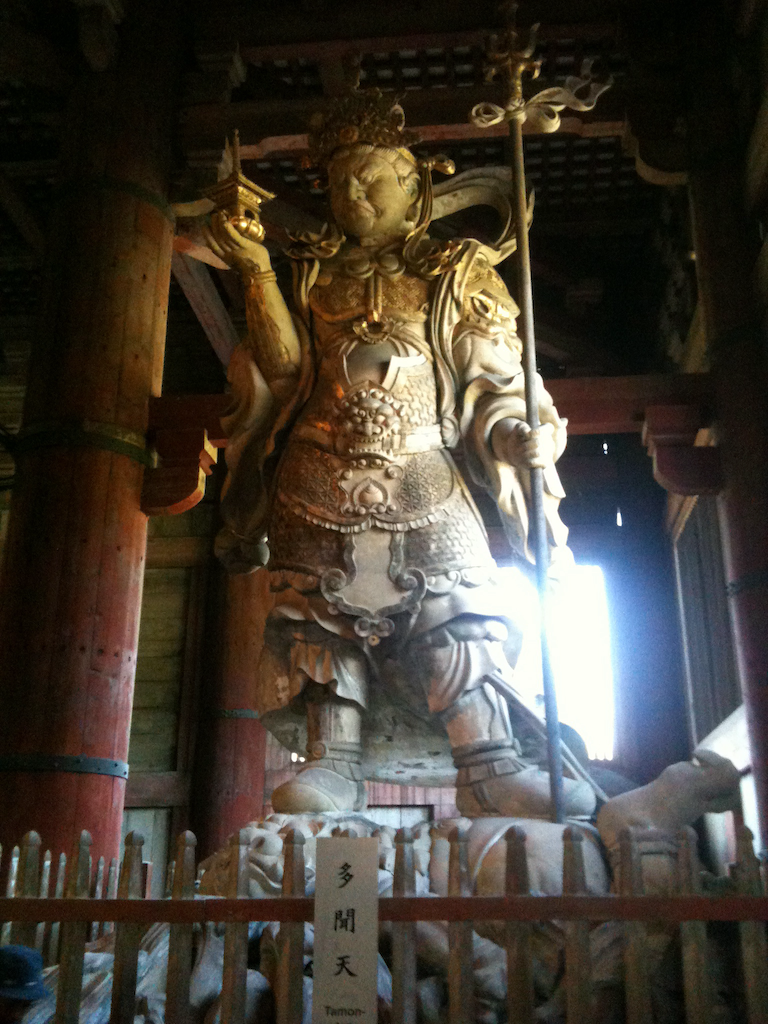
2 Vaiśravaṇa, known in Japanese Buddhism as Bishamonten (毘沙門天), can be seen at the famous temple of Todaiji in Nara. I took this photo back in 2010 when visiting there.

A photo of a statue of the Buddhist deity Vaiśravaṇa, known as either Bishamonten, or Tamonten, in Japanese Buddhism. Photo taken at main hall at Todaiji Temple in Nara, Japan.

Indeed, what we see today of Buddhism in Japan and beyond is directly related to the things that Xuan-zang saw along the Silk Road, even if the connection is not obvious at first sight.

Withdrawing

Kang a Klingon warrior leaning on a sword, point down, against an Enterprise console, staring bravely in the distance.

Kang: “Only a fool fights in a burning house.”

Star Trek, “Day of the Dove” (s3ep11), stardate unknown 

Ever since … recent events, I’ve been thinking about this quote a lot.

This also reminded of a passage from the Analects of Confucius:

[8:13] The Master said: “Be of unwavering good faith and love learning. Be steadfast unto death in pursuit of the good Way.1 Do not enter a state which is in peril, nor reside in one which people have rebelled. When the Way prevails in the world, show yourself. When it does not, then hide. When the Way prevails in your own state, to be poor and obscure is a disgrace. But when the Way does not prevail in your own state, to be rich and honored is a disgrace.”

Translation by Dr Charles Muller

The Analects is a compilation of Confucius’s (a.k.a. “the Master”, or “Master Kong”, etc) teachings by his disciples, completed around the 1st or 2nd century BCE. This particular passage does a nice job of summarizes Confucius’s general teachings: at all times a “gentleman” (jūn zǐ, 君子) should always stick to their principles regardless of the conditions of the world.

There are times where one openly expresses their views and strives to do what’s right, where one can share their talents for public good. But there are also times when one should bide their time, avoid getting entangled, and focus inward. Whatever is necessary to maintain one’s integrity at all times. Better to be broke but maintain integrity, than to compromise personal values for the sake of gain.

In Confucius’s time the central state of the Zhou Dynasty kingship was breaking down, and the different nobles governing each fiefdom were either breaking away and declaring themselves kings, or being overthrown by their own ministers who would in turn assert authority. It was a cutthroat time in Chinese history, and Confucius wanted no part in it.

One cannot help but find parallels even today.

P.S. Featured photo is of Kang the Klingon from the Stat Trek episode “Day of the Dove”, played by the brilliant Michael Ansara.

1 When Confucius speaks of the “Way” (daò, 道) he is using a common Chinese religious term for things like righteousness, justice, stability, and so on. The Taoist usage of the term is similar, and draws from the same “cultural well” even if nuances differ.