The Dynamic Duo of Zen and Pure Land

A few months ago, I made this post about how the Obaku Zen sect interprets Amida Buddha and the Pure Land. To my surprise, I keep reflecting on this phrase from time to time, almost like a Zen koan:

This mind is the Pure Land,
this body is Amida Buddha

This idea of merging Zen and Pure Land ideas is somewhat rare in Japanese Buddhism, but it’s surprisingly common in Chinese-Buddhist thought. Originally, I thought it was limited to later Ming-Dynasty Buddhism (which Obaku descends from), but similar strands of thought exist much further back.

A famous Chinese monk named Yongming Yanshou (永明延壽. 904 – 976) once wrote a poem titled the “Four Alternatives” (sì liào jiǎn 四料揀):1

Lacking both Chan and the Pure Land, it will be the iron beds and bronze pillars [of hell] for ten thousand kalpas [eons] and a thousand lives with no one to turn to.

Having Chan but lacking the Pure Land, nine out of ten will stray from the path; when the realm of the aggregates appears before them, they will instantly follow it.

Lacking Chan but having the Pure Land, ten thousand out of ten thousand who practice it will go [to rebirth]. Having seen Amitābha, why worry that one might not attain enlightenment?

Having both Chan and Pure Land, one is like a tiger with horns [i.e., doubly capable]. Such a person will be a teacher in the present life, and a buddha or patriarch in future lives.

translation by Charles B. Jones, “Chinese Pure Land Buddhism, Understanding a Tradition of Practice”, pg 210

Yongming is advocating a supportive model where both Zen practice and Pure Land practice work in concert. The Pure Land path is the “safer” path to follow, due to the vows of Amida Buddha, but if supported by Zen practice here and now, one is really making progress on the Buddhist path.

Further, a later writer named Yunqi Zhuhong2 (雲棲袾宏, 1535 – 1615) explained that these things were not mutually exclusive (Chinese added by me):3

To contemplate the Buddha (nianfo 念佛) is to contemplate the mind (nian-xin 念心). Birth there (in the Pure Land) does not entail birth away from here. Mind, Buddha, and sentient beings are all of one substance; the middle stream (non-duality) does not abide on the two banks (this world and the Pure Land).

Similarly, Ouyi Zhixu (蕅益智旭, 1599 – 1655) in his excellent work “Mind Seal of Buddhas” makes a similar argument: Zen and Pure Land practice are the same thing, just operating at different levels. You’re not forced to chose one or the other in your practice.

But such ideas aren’t limited to medieval Chinese-Buddhist monks. You can find such sentiments in Pure Land sutras themselves! In the Immeasurable Life Sutra is this passage (emphasis added):

“In this world, you should extensively plant roots of virtue, be benevolent, give generously, abstain from breaking the precepts, be patient and diligent, teach people with sincerity and wisdom, do virtuous deeds, and practice good. If you strictly observe the precepts of abstinence with upright thought and mindfulness even for a day and a night, the merit acquired will surpass that of practicing good in the land of Amitāyus [a.k.a. the Pure Land] for a hundred years. The reason is that in that buddha land of effortless spontaneity all the inhabitants do good without committing even a hair’s breadth of evil. If in this world you do good for ten days and nights, the merit acquired will surpass that of practicing good in the buddha lands of other directions for a thousand years.

Translation by Rev. Hisao Inagaki

In this passage, the Buddha is clearly advocating both bending your efforts toward rebirth in the Pure Land, but also making the most of the time you have here to undergo traditional Buddhist practices too because even a modest effort here is a great benefit in the future (both for yourself and others).

As I often tell my kids: “go nuts”!4

What I mean is: recite the nembutsu, meditate, uphold the precepts, or some combination thereof. You have nowhere to go but up.

But what if you can’t decide or don’t have the time?

In my opinion, start with the nembutsu. Begin just as you are, and recite it just 10 times daily. From there, add the Five Precepts when you are ready, and once you have that foundation, and are ready to branch out, then look into Zen practices. This make take months or even years. Take your time, go slow, and don’t be afraid to explore.

When I talk about the flexibility of Tendai Buddhism in Japan as well, this is what I am alluding to: start with something simple and small at first (such as a devotional practice), and gradually building upon it as you gain confidence and see the positive transformation in your life. Buddhism is kind of a SLOW, gradual religion, but like a glacier, once it starts moving, it has a wonderful momentum all its own even if you can’t see it.

Namu Shakumuni Butsu
Namu Amida Butsu

P.S. Featured blog image is another famous “Dynamic Duo”: Batman and Robin from the 1960’s series.

P.P.S. Posting kind of off-schedule just because it is fun. 😊

1 I found this on Wikipedia actually and I thought to myself “wow, this person quoted exactly the same way that I would do!”, then I realized that I had put this on Wikipedia a few years ago. 🤦🏼‍♂️

2 Pronounced like “yoon-chee joo-hong”.

3 Again, I managed to pull a quote from Wikipedia that I had unwittingly added years ago and then promptly forgot.

4 My kids ask me if they can watch TV, play Switch or whatever, and my frequent answer is “go nuts” [go crazy, have fun].

Buddhism in a Nutshell

If you’re new to Buddhism, or curious about what it is, it’s tempting to compare with other world religions. However, it differs in some key ways.

One of my favorite books in my collection is an old translation of The Way to Buddhahood by the late Ven. Yin-Shun (“een-shoon”), a prominent Chinese monk who was an influential figure in Taiwan. His book is dense,1 and geared for Chinese audiences, but the translation is good, and Yin-Shun’s reputation as a scholar and respected monk is well-earned.

The opening pages of the book read as follows:

To study Buddhism means to learn from the Buddha. One takes the Buddha as one’s ideal and one’s mentor and learns from him incessantly. When one reaches the same level as the Buddha, then one has become a buddha.

The Buddha, founder of Buddhism, is a man we call “Shakyamuni”. Sometimes books call him by his birth name, Siddhartha Gautama, but Buddhists call him Shakyamuni or Shakyamuni Buddha.

The key to understand is that the Buddha is not a god. And, if we follow the Buddha’s teachings and apply them correctly, we too will rise to the same level as a buddha ourselves.

This is not a quick, “weekend-warrior” effort though.

….For an ordinary person with little good fortune and no wisdom, reaching this supreme and unsurpassed state of buddhahood through practice and study is difficult. But by practicing and studying the necessary methods and by following the right way to buddhahood, one can reach the goal of buddhahood. Only in this way, and without skipping any steps, can one advance to this distant and profound goal….

The goal is profound and difficult, but not impossible. One has to be realistic about the goal, and be willing to accept that it’s a long-term goal. Yet, if one does this, and stays the course, one will assuredly reach Buddha-hood. Yin-shun’s comment about “not skipping steps” is to counter promises by some teacher or cults that by “chanting this magic spell” or “praying to that” one just quickly jumps to Buddhahood. It is a gradual process, regardless of how one approaches it.

The good news is that within Buddhism there is a way array of practices, methods and traditions to help you along the way.

Because beings have different abilities, the Buddha Dharma has different ways: the way of blessedness and virtue, the way of wisdom, the difficult way, the easy way, the mundane way, the supramundane way, the way of the sravaka, the way of the bodhisattva, and so on. But ultimately, there is only one way. All of these ways are nothing but methods to become a buddha “in order to open up and make manifest the Buddhas knowledge and insight to sentient beings, so that they can also apprehend and attain the same.”

The specific ways that Ven. Yin-Shun cites are explained throughout the book, but needless to say, Buddhism is like the Colosseum in Rome, with many gates, all leading inward towards the middle. One only needs to step through one of them, and keep at it in a long-term sustainable way.

This is essentially what Buddhism is all about.

P.S. Happy spring Ohigan season!

1 I wouldn’t recommend the book as a first-pass introduction to Buddhism, but it covers a lot of subjects that are omitted in other books in a single volume.

Taoism and Numerology

Over the years, I’ve written about certain sekku (節句) or seasonal holidays in the traditional Japanese calendar. These are:

  1. Girl’s Day : March 3rd (3/3)
  2. Children’s Day : May 5th (5/5)
  3. Tanabata : July 7th (7/7), and
  4. Day of the Chrysanthemum (9/9)

Notice the dates of each holiday: odd-numbered month with matching odd-numbered day. Turns out that there’s a reason for this.

In Chinese Taoist numerology, numbers are divided into “yang” and “yin” numbers: odd numbers are yang (陽) because they are considered unstable and dynamic, while even numbers are stable and static, thus yin (陰). But because yin and yang depend on one another, and change into one another, if you add yang and yang together, you get yin. If you add yin and yin together, you get yang.

Thus, it was thought that dates on the calendar with double-yang numbers (7 and 7, 5 and 5, etc) would become yin and thus were inauspicious. Holidays were developed to counteract the yin effect, and that’s why seasonal holidays were held on double-odd dates.

Taoism is not a major influence in Japanese culture (at least in modern times), but it’s interesting so see how it still influences traditions, especially those from antiquity.

Anyhow, TIL. 😎

P.S. Learned all this from this excellent book. Highly recommend.

Making Sense of Zen Lineages

Recently, I found myself stuck in one of my usual nerd “rabbit holes” of trying to make sense of Zen lineages in Japanese Buddhism, but this led to a more complicated rabbit hole of making sense of the source “Chan” (Zen) lineages in China. This started after reading my new book on Rinzai Zen, which included a nice chart. At first, I tried to emulate and translate that chart in Canva, but then I realized it was missing some critical details, so I kept adding more. This is the result (click on the image for more detail):

Let’s go over this a bit so it makes more sense.

The premise behind all Zen sects regardless of country and lineage is that Zen started when the historical Buddha, Shakyamuni, supposedly held a flower up to his disciples and said nothing. Everyone was confused except his disciple Maha-Kashyapa who smiled in understanding. From here, according to tradition, the teachings were passed down from teacher to disciples for 28 generations in India, culminating in a monk named Bodhidharma who came to China.

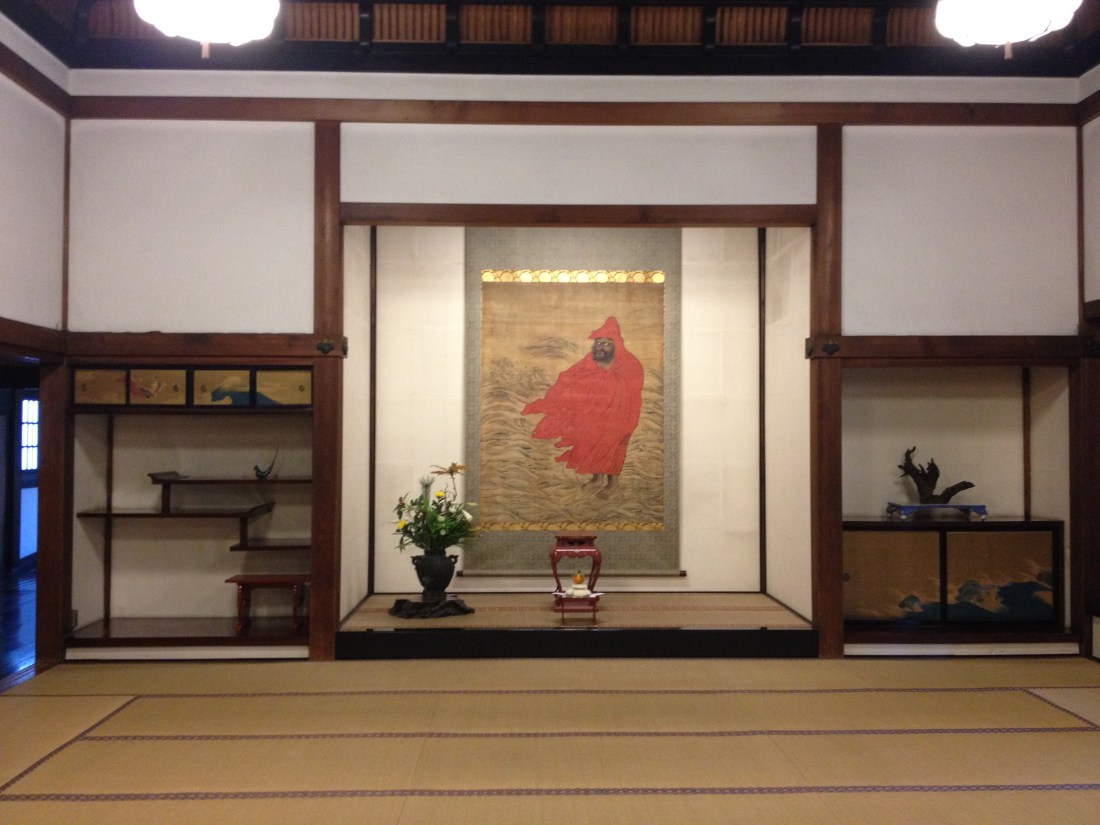
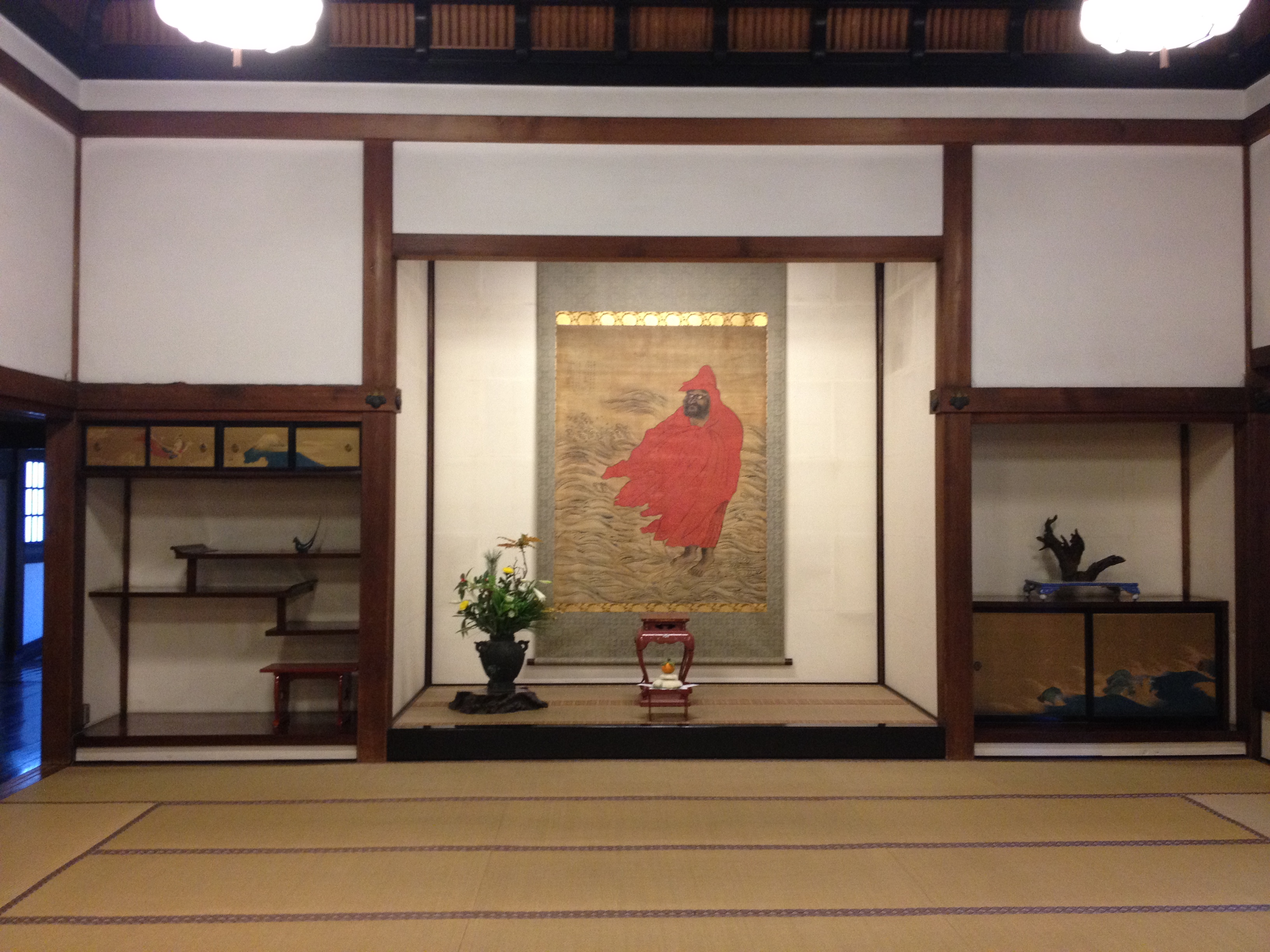
A painting of Bodhidharma at Sojiji temple (head of Soto Zen sect) in Kawasaki, Japan. Taken by me in 2010 (?).

The history up to this point is somewhat vague, and possibly apochryphal, but easy to follow.

This continues for a few more generations in China, until you get to a monk named Hui-Neng (Enō in Japanese)1 who is the supposed author of the Platform Sutra, a Chinese text. As the 6th “patriarch” of the lineage in China, he establishes what we know today as “Chan Buddhism” or Chinese Zen.

Things become more complicated a couple generations later as two descendants: Mazu Daoyi2 and Shitou Xiqian3 directly or indirectly found different schools of Chan Buddhism. This is known as the Five Houses of Chan period during the Tang Dynasty. Thus, the entire Chan/Zen tradition as we know it today is derived from Hui-neng and transmitted through these two men.

Out of the five houses, the Hongzhou,4 Lin-ji and Cao-dong5 all survive in some form. The others are gradually absorbed into the Lin-ji school, which in the long-run is what becomes the most widespread form of Chan Buddhism in China. The Cao-dong school is the one exception, while the Hongzhou school’s success in Korea helps establish 8 out of 9 of the “Nine Schools of Seon (Chan)”6 in Korea. It through Bojo Jinul’s efforts in Korea that these nine schools are unified into the Jogye Order (homepage) which absorbed other Buddhist traditions in Korea into a single, cohesive one.

Meanwhile, in Japan, the Lin-ji and Cao-dong schools find their way to Japan where the names are preserved, but pronounced different: Rinzai and Soto respectively. Rinzai’s history is particularly complicated because they were multiple, unrelated transmissions to Japan often spurred by the Mongol conquest of China. Of these various Rinzai lineages, the two that survive are the “Otokan” Rinzai lineage through Hakuin, and the “Obaku” lineage through Ingen, but eventually the Otokan lineage absorbed the Obaku lineage. Today, Rinzai Zen is more formally called Rinzai-Obaku, or Rinnou (臨黄) for short. This is a bit confusing because Rinzai came to Japan under a monk named Eisai, and his lineage did continue for a while in Japan especially in Kyoto, but the lineage from the rival city of Kamakura ultimately prevailed and absorbed other Rinzai lineages. Obaku Zen arrived pretty late in Japanese-Buddhist history, and as you can see from the chart has some common ancestry with Rinzai, but also some differences due to cultural divergence and history.

Soto Zen’s history is quite a bit more streamlined as it had only one founder (Dogen), and although it did grow to have rival sects for a time, Keizan was credited for ultimately unifying these though not without some controversy even into the 19th century.

Anyhow, to summarize, the entire tradition started from a legendary sermon by the Buddha to Maha-Kashyapa, and was passed on over successive generations in India to a legendary figure who came to China and starting with Hui-neng became a tree with many branches. Yet, the roots are all the same. Speaking as someone who’s relatively new to the tradition, I realize while specific liturgy and practices differ, the general teachings and intent remain the surprisingly consistent regardless of culture or label.

Hope this information helps!

P.S. I had trouble deciding which term to use here: Zen or Chan or Seon since they all literally mean the same thing, but are oriented toward one culture or another. If this all seems confusing, the key to remember is that the entire tradition of Zen/Chan/Seon (and Thien in Vietnam) is all one and the same tree.

P.P.S. I realized that I never covered the Vietnamese (Thien, “tee-ehn”) tradition, but there’s so little information on it in English (and I cannot read Vietnamese), that I will have to differ that to another day.

1 Pronounced like “hwey-nung” in English.

2 Pronounced like “ma-tsoo dow-ee” in English.

3 Pronounced like “shih-tow shee-chee-yen” in English.

4 Pronounced like “hohng-joe” in English.

5 Pronounced like “tsow-dohng” in English.7

6 The Korean word “Seon” is pronounced like “sawn” in English. It is how the Chinese character for Chan/Zen () is pronounced in Korean Language.

7 If you made it this far in the post, congrats! I had to put so many footnotes in here because the Pinyin system of Romanizing Chinese words is a little less intuitive than the old Wade-Giles system. Pinyin is not hard to learn. In fact, I think Pinyin is better than the old Wade-Giles system (more “what you see is what you get”), but if you don’t learn Pinyin it can be confusing.better This is always a challenge with a writing system that strictly uses ideograms (e.g. Chinese characters). How do you write 慧能 into an alphabetic system that foreigners can intuitively understand. Also, which foreigners? (English-speaking, French-speaking, Spanish-speaking, etc). Anyhow, if you are interested in learning Chinese, I highly recommend learning Pinyin anyway because it’s quick and easy to pick up. BTW, since I posted about Hokkien recently it also has two different Rominzation systems: Pe̍h-ōe-jī (old, but widespread) and Tâi-lô (Taiwan’s official revised system).

Family

Ying Nan: You are a product of all who came before you. The legacy of your family, the good and the bad, it is all a part of who you are.

Shang-chi (2021)

My kids and I have been watching the Marvel MCU movies for years. My firstborn is particularly a Marvel fan since she was a little girl. Some of the movies are better than others (my personal favorite is Thor: Ragnarok),1 but we both really like the movie Shang-Chi and the Legend of the Ten Rings.

When my wife (who is Japanese) and I first dated, there was an immediate clash of cultures. I was a generic American white kid who grew up in an impoverished broken home with lots of issues, my wife grew up in a working-class Japanese family that was not overly traditional, but still very Japanese compared to American standards. The fact we were dating in the first place was a bit awkward for her and her parents, whereas I hardly ever talked to my own parents.

The good news is that over time, we learned to understand one another, and that means that I too learned to appreciate her viewpoint sometimes. For example, family.

Even when she disagreed with her parents, she still respected them, and understood her family obligations. This was something frankly new to me because I openly rebelled against my parents, told my dad off, and hardly paid them any heed. I gradually did reconcile with my parents to some degree as I got older (and a bit wiser), to a level where we can get along, but more importantly I learned to accept that I am who I am due to my family. Like the quote above says, you can’t deny your own heritage, both the good and the bad, and that it does shape who you are.

But also, through my wife and through parenting myself, I learned that I do owe some level of gratitude to my parents for what they did. I chose not to be like my parents in how I raise my kids, but even that is something I learned from them.2 Thus, the lesson I learned from my wife is that I also have to be humble, and respectful to my parents enough to acknowledge what they’ve done for me, even if I disagree with them. This is a very Confucian outlook, but I can see the value in this.3

It rubs against my American sense of individualism, but I’ve found it a valuable lesson over the years, and something I think we can all learn from.

P.S. Xu Wenwu, the father in Shang-chi, is a great example of a plausible chaotic-evil person in Dungeons and Dragons: he craves absolute power and yet is also capable of being in love, being a father, etc. Yet, he inevitably bends everything toward evil or ruin, including his lawful-good wife, Ying Li. Tony Leung Chiu-wai‘s performance was excellent.

1 The Thor movies do a really nice job of weaving science fiction with magic and myth, much like Roger Zelazny did in his books generations ago (Lord of Light, the Amber Series, Creatures of Light and Darkness, etc.). Put simply, I like weird, transcendent stuff more than the “grounded” story lines like Captain America or Black Widow.

2 In Japanese there is a four-character phrase for this: hanmen kyōshi (反面教師) meaning to learn from a bad example (i.e. what not to do).

3 This importance in family isn’t even limited to Confucian-influenced cultures. You can find it in many unrelated world cultures where family is emphasized, and respect towards one’s ancestors. For whatever reason, it is not emphasized in Western culture, and maybe to our detriment I think.

Hungry Ghosts are Among Us?

The Obon Season in Japan approaches, and so do ghost stories, and ceremonies around hungry ghosts. But what are Hungry Ghosts?

This is one of the traditional states of rebirth within Buddhism, on the never-ending cycle of people migrating from one life to the next. Rebirth as a hungry ghosts is seen as only one rung up from being in Hell, as it is a state of great suffering and hardship. Unlike hell, though, hungry ghosts are seen as beings that live among us, but only in the darkest shadows, living a precarious existence, constantly starving and thirsty, with no way to gain sustenance. They are often cursed to eat something awful, like garbage, or excrement, as punishment, or they are depicted in art as having emaciated bodies, with bloated bodies, and tiny throats that can’t swallow anything.

Although they are called preta1 in Indian Sanskrit language, in Japanese they are called gaki (餓鬼), which in modern slang is a rude expression for kids that means “a punk” (the Japanese meaning is harsher than the English one).

References to hungry ghosts go all the way back to early Buddhist texts such as the Pali Canon where the Buddha warns that among the hungry ghosts are probably some of your ancestors and kin:

Outside the walls they stand, & at crossroads.
At door posts they stand, returning to their old homes.
But when a meal with plentiful food & drink is served, no one remembers them:
Such is the kamma [karma] of living beings.

Tirokudda Kanda (Petavatthu 1.5), translation by Ven. Thanissaro Bhikkhu

Later, stories of hungry ghosts appear in Sanskrit anthologies such as the Avadanasataka, including the story of Mogallana and his mother (source of the Obon holiday), before a similar version of the story appears in the Mahayana text, the Ullambana Sutra, for which there is a handy translation here. In the Ullambana Sutra, you can see how Mogallana’s mother suffers in her state as a hungry ghost:

Mahamaudgalyayana [Mogallana] felt deep pity and sadness, filled a bowl with food, and went to provide for his mother. She got the bowl, screened it with her left hand, and with her right hand made a fist of food. But before it entered her mouth, it turned into burning coals which could not be eaten….

Source: https://www.cttbusa.org/ullambana/ullambana.asp, Buddhist Text Translation Society, part of City of Ten Thousand Buddhas

Scenes of hungry ghosts appear in old Buddhist art too:

A picture from the Gaki zōshi 餓鬼草紙 “Scroll of Hungry Ghosts”, circa 12th century, courtesy of the Kyoto National Museum, Public domain, via Wikimedia Commons

In this famous image, you can see emaciated hungry ghosts living among us, unseen, scrounging remains from human refuse and so on. Early Buddhist texts never described what hungry ghosts looked like, but this is how they are depicted in medieval artwork.

Because the hungry ghosts wander aimlessly through life endlessly starving, and some of them may include past ancestors and loved ones, Buddhism has developed certain ceremonies thought to help relieve the suffering of one’s ancestors, and by extension other hungry ghosts. In Chinese culture, this is exemplified in the Ghost Festival (中元節, zhōngyuánjié) of Chinese culture, Obon (お盆) in Japanese culture and the Segaki ritual in some Buddhist traditions.

It’s a fascinating example of how Buddhist teachings have suffused cultures, and how cultures have responded to concerns over family and the afterlife.

1 Alternatively peta in Pali language.

Introducing the Heart Sutra

Recently, I wrote a brief introduction to the Buddhist canon, the sutras. Sutras come in many shapes and forms, but I want to focus on one of the most famous, and most popular to recite: The Heart Sutra.

A sutra book from Japan showing the Heart Sutra, preserved in old Chinese, but with Japanese pronunciation guides.

The full name of this sutra is the Heart of the Perfection of Wisdom Sutra (般若波羅蜜多心經), and was one in a series of “perfection of wisdom sutras” that were published starting around 2nd century BCE. Starting with the “Perfection of Wisdom in 8,000 Verses Sutra“, the authors made longer and longer versions, culminating to a 25,000 verse version of hte same sutra. Then, they started making shorter versions, getting down to the Diamond Sutra, and finally the Heart Sutra.

Or, so the theory goes.

The Heart Sutra is believed to distill the essence or “heart” of the Perfection of Wisdom teachings to its smallest, most essential version. More on that soon. This version is very short, can be read in 1-2 minutes, and is pretty cryptic. Because it is so short, it is easy to learn and memorize, and thus easy to recite. Its utility for everyday Buddhists is among the reasons it has such lasting popularity. I have a copy of a translation of the 8,000 verse sutra,1 and while it is interesting, it is a tome. It is not practical for most Buddhists to read such a tome, so you can imagine why the Heart Sutra was composed, and why it is so much more popular.

But that gets to an interesting question: who composed it? This is a surprisingly difficult question to answer.

The traditional assumption was that it was composed in India, using Sanskrit language, and then brought to China like most other Buddhist sutras. And yet, a scholar named Dr. Jan Nattier proposed an interesting theory that the Heart Sutra in particular was composed in China, not India, and that it was translated back to Sanskrit, not from it, by our favorite wandering monk Xuan-zang when he visited India. There is considerable debate about this, and valid arguments for one or the other, but it’s an interesting idea that some plucky Chinese monk found a clever way to distill the Perfection of Wisdom teachings into a more bite-sized form.

That said, one of the interesting features of the Heart Sutra is that it does contain a genuine Sanskrit mantra at the end (a trend that continues with later Buddhist texts) in the Siddham script:

𑖐𑖝𑖸 𑖐𑖝𑖸 𑖢𑖯𑖨𑖐𑖝𑖸 𑖢𑖯𑖨𑖭𑖽𑖐𑖝𑖸 𑖤𑖺𑖠𑖰𑖭𑖿𑖪𑖯𑖮𑖯
ga te ga te pā ra ga te pā ra saṃ ga te bo dhi svā hā

For various reasons, this mantra was written in Chinese characters that approximated the pronunciation of the Sanskrit:

𑖐𑖝𑖸 𑖐𑖝𑖸 𑖢𑖯𑖨𑖐𑖝𑖸 𑖢𑖯𑖨𑖭𑖽𑖐𑖝𑖸 𑖤𑖺𑖠𑖰𑖭𑖿𑖪𑖯𑖮𑖯
羯諦 羯諦 波羅羯諦 波羅僧羯諦 菩提薩婆訶

So, what is the teaching of the Heart Sutra?

As I eluded to earlier, the Heart Sutra is the most condensed version of the Perfection of Wisdom teachings, or prajñā-pāramitā in Sanskrit. This was a teaching that provided an important foundation for Mahayana Buddhism (everything from Tibet to Japan). “Perfection of Wisdom” is hard to explain. But, roughly speaking you can think of it as the fundamental understanding of existence, which is sitting right in front of your face, but not obvious until you see it. Like the first time you noticed a small crack in the wall. Once you see it, you don’t “unsee” it.

But instead, the Perfection of Wisdom is about undoing the filters in one’s own mind, so you can see the world unvarnished. That’s easy to say, but extremely tricky to sincerely accomplish. Hence the extraordinary accomplishments of the Buddhas and Bodhisattvas.

The Heart Sutra talks a lot about “not this”, and “not that”, and like other similar sutras (e.g. the Diamond Sutra, another of the series), this is to try and undo the filters of one’s own mind. But, on its surface, the Heart Sutra is cryptic and vague. Yet, because it is so pithy, and so over time bits of it start to sink in, or something that didn’t make sense in the past finally clicks.

So, if you do pick up a copy of the Heart Sutra, don’t worry if it doesn’t really make sense. Recite it from time to time,2 study it with help sutras guides (there are many) and make it a part of your Buddhist life, regardless of what tradition you follow.

For a such tiny, little composition, it’s a pretty neat contribution to Buddhism.

1 Purchased years ago at Powell’s City of Books in Portland, OR. One of the best bookstores, and well worth a visit if you go there.

2 Some people recite in their native language, others recite in one or more “liturgical” languages. It doesn’t really matter. Pick something you can stick with. You can change it later.

Withdrawing

Kang a Klingon warrior leaning on a sword, point down, against an Enterprise console, staring bravely in the distance.

Kang: “Only a fool fights in a burning house.”

Star Trek, “Day of the Dove” (s3ep11), stardate unknown 

Ever since … recent events, I’ve been thinking about this quote a lot.

This also reminded of a passage from the Analects of Confucius:

[8:13] The Master said: “Be of unwavering good faith and love learning. Be steadfast unto death in pursuit of the good Way.1 Do not enter a state which is in peril, nor reside in one which people have rebelled. When the Way prevails in the world, show yourself. When it does not, then hide. When the Way prevails in your own state, to be poor and obscure is a disgrace. But when the Way does not prevail in your own state, to be rich and honored is a disgrace.”

Translation by Dr Charles Muller

The Analects is a compilation of Confucius’s (a.k.a. “the Master”, or “Master Kong”, etc) teachings by his disciples, completed around the 1st or 2nd century BCE. This particular passage does a nice job of summarizes Confucius’s general teachings: at all times a “gentleman” (jūn zǐ, 君子) should always stick to their principles regardless of the conditions of the world.

There are times where one openly expresses their views and strives to do what’s right, where one can share their talents for public good. But there are also times when one should bide their time, avoid getting entangled, and focus inward. Whatever is necessary to maintain one’s integrity at all times. Better to be broke but maintain integrity, than to compromise personal values for the sake of gain.

In Confucius’s time the central state of the Zhou Dynasty kingship was breaking down, and the different nobles governing each fiefdom were either breaking away and declaring themselves kings, or being overthrown by their own ministers who would in turn assert authority. It was a cutthroat time in Chinese history, and Confucius wanted no part in it.

One cannot help but find parallels even today.

P.S. Featured photo is of Kang the Klingon from the Stat Trek episode “Day of the Dove”, played by the brilliant Michael Ansara.

1 When Confucius speaks of the “Way” (daò, 道) he is using a common Chinese religious term for things like righteousness, justice, stability, and so on. The Taoist usage of the term is similar, and draws from the same “cultural well” even if nuances differ.

No Working Is True Working: the Tannisho

Writing my recent post about Ikkyu and Rennyo brought back a lot of old memories for me.1 I was also overjoyed when I was recently contacted by another member of my old Jodo Shinshu community. So, I started leafing through the old material I saved, much of it out of print now, and remembered this old quote from the Tannisho (歎異抄), a collection of sayings attributed to the founder, Shinran (1173 – 1263):

10) 念仏ねんぶつには無義むぎをもってとす。しょうせつのゆにとおおそうらき。

“In the nembutsu no selfworking is true-working; it is beyond description, explanation, and conception.”

translation by Dr Taitetsu Unno

This cryptic saying is probably the most emblematic of Shinran’s thinking, and what distinguishes Jodo Shinshu from the rest of the vast Pure Land Buddhist tradition.

Since the days of the early Chinese Buddhist Pure Land teachers such as Dao-chuo (道綽, 562–645) and Shan-dao (善導, 613–681), there has been this notion that Buddhism has two general paths:

  • The path of the Sages (i.e. the classic, monastic path), and
  • The path of the Pure Land

This morphed over time into the concepts of Self-Power and Other-Power. In other words, when following the Buddhist path does one rely on one’s own efforts, or fall back and rely on the grace of the Buddhist deities, primarily Amida Buddha? Every Pure Land Buddhist tradition and teacher that has arisen across history has wrestled with these competing approaches, how to find a balance, or where they might overlap. Charles B Jones’s book really explores this in far greater detail and well worth the read.

In any case, on the Self-Power vs. Other-Power spectrum, Jodo Shinshu Buddhism, as taught by Shinran and later Rennyo, really tipped the scales toward Other Power only. It’s not just 95% Other Power, 5% Self-Power; it’s entirely 100% Other Power. The idea arose through a combination of both Dharma Decline: that people were so far removed from the time of the historical Buddha Shakyamuni that any efforts towards one’s own emancipation were no longer possible, and the aforementioned tension between the Pure Land Path vs. Path of the Sages.

Thus, Shinran is saying that regardless of what one does or doesn’t do, the salvation provided by Amida Buddha is entirely due to Amida Buddha. One cannot add or detract from this grace. Once one experiences such grace, they spontaneously recite the nembutsu, rather than as a Buddhist practice.

Astute readers may find that this sounds an awful lot like Calvanism, and Charles B Jones points this out too. He also points out that the while this can provide great comfort to those who sincerely follow yet doubt their abilities, the challenge of Calvinist-type thinking is that it can leave the believer in doubt about whether they ever will be selected. It almost feels like a religious lottery. A person can be a genuine follower all their life, and yet grace might not come. Not every Jodo Shinshu follower experiences shinjin. And if they did, how would they know?

Back then, I wrestled with this issue quite a bit as a Jodo Shinshu follower. Shinshu teachings have a certain internal logic and beauty to them, but I always had this this nagging feeling that there was some “philosophical gymnastics” involved. And, to be frank, I am no longer convinced that this is what the Buddha taught. Even if you read the Larger Sutra of Immeasurable Life, the most important Pure Land Sutra and the source of the Juseige, it’s pretty clear that Shakyamuni intended for people to bend their efforts toward rebirth in the Pure Land, rather than let go and let Amida Buddha handle everything. The sutra is a bit long, and takes about 1-2 hours to finish reading, but if you’re learning about the Pure Land tradition, it’s worth the read.

I already critiqued Dharma Decline in another post so I won’t belabor that here. Suffice to say, it’s too formulaic to be a realistic assessment of human history.

But what about Other Power versus Self Power? In my humble opinion it’s a false dichotomy. You’re not actually forced in Buddhism to choose one or the other. It is possible, and very common, to find a balance of both in one’s practice. If a Buddhist deity inspires you to keep going, great! And since there many deities in Buddhism, it is possible to find someone who inspires you even if it is the historical Buddha himself. It doesn’t have to be a “cosmic” deity and will still be just as Buddhist.

I don’t want to trash on Shinran though, because a spiritual crisis like the one he had can be a very difficult to resolve even after years. Shinran was an accomplished and fascinating figure, and the Tannisho as a document is a valuable insight into his thinking process.

It’s just that I had my own “mini-crisis” in my younger years as a Buddhist and I came to a different conclusion even as a nembutsu devotee. These days I am pretty happy with my practice, small as it is, plus everything I’ve learned along the way.

Maybe I am totally wrong, but the way I figure it:

  • Slow and steady wins the race.
  • With the breadth of teachings and practices Buddhism has to offer there’s something for everyone and there’s nowhere to go but up.
  • Never be complacent. There’s always more to learn, more to try, and more to experience.

Good luck and happy practicing!

1 This is an old selfie I took of myself in 2015, wearing the robes of a minister’s assistant with the Buddhist Churches of America:

I was still in training (certified later in 2016), but I was very proud to wear it nonetheless. My chanting voice was terrible (still is), but I really tried to take my role seriously. I have a lot of happy memories from that time and am always grateful.

P.S. it’s hard to find a good translation of the Tannisho these days, but you find Dr Taitetsu Unno’s translation here on Web Archive.

The Journeys of Xuanzang, part four: Southward

In our last episode (… a few months ago 😓) Xuan-zang met the Qaghan of the Western Turkic Khaganate, and made a good impression, allowing him to travel safely further south and westward toward the city of Samarkand.

Map of Xuan-zang’s journeys from Tashkent to Balkh. Inkarnate put out a new version of its software while I was on break, so some things may look different than past maps. As always, this is an amateur map, and may contain geographic mistakes.

If you need to brush up on earlier episodes, click below:

Samarkand

Samarkand is a fascinating place: a fabulously old city, and a major hub on the Silk Road. All the way back in the time of Alexander the Great’s conquests in 329 BCE, 1,000 years before Xuan-Zang, the city was called Marakanda (Μαράκανδα) in Greek and was part of the Achaemenid Persian Empire before that. By Xuan-zang’s time the city was part of the Sassanian Persian empire, and still a major trading hub, known even to the Chinese, but I was unable to find a reliable source on the Chinese name at the time. Modern term is 撒马尔干 (sǎ mǎ ěr gàn ?). The city at this time was almost entirely populated by Sogdian Iranian people, whom we’ve also seen in past episodes. This far west from China, Xuan-Zang probably saw very few if any Chinese people, and instead encountered many people from other cultures and parts of the world. He was very much a “stranger in a strange land”.1

However, because this city was part of the Sassanian Empire, the official religion was Zoroastrianism, not Buddhism, and as Xuan-zang came to the city, he noticed that the Buddhist monasteries there were abandoned and neglected. Some of Xuan-zang’s followers went to pay their respects at these monasteries, but they were chased off by a mob of Zoroastrian followers with flaming brands. Later, the king heard what happened and arrested the mob leaders and was going to pass sentence to mutilate them. Xuan-zang begged for leniency, and so they were flogged and expelled from the city.

The king of Samarkand wasn’t particularly friendly to Xuan-zang, but their relations did improve. Further, it seems that later the king of Samarkand made friendly, diplomatic overtures to Tang-Dynasty China as a foil to the Western Turkic Khaganate, but these did not go very far. Decades later, Great Tang’s expansion reached all the way to Samarkand and they briefly ruled for a few decades until the Battle of Talas later. All this happened decades after Xuan-zang visited the city though.

In any case, Xuan-zang wisely did not stay long in the city and turned at least to towards the south.

Heading South

Up until now, Xuan-zang’s journey from the Yumen Pass in China to Samarkand, over the Tian Shan mountains and across two deserts, has mostly been a westerly journey. But this was as far west as Xuan-zang would go. The road to India was now in a south-southeasterly direction passing through places like modern Afghanistan, Pakistan, and Uzbekistan. These areas were not part of Sassanian Empire, and instead were local princes and minor rulers with complicated relations with regional powers. These areas were more Buddhist-friendly as well due to the legacy of Bactrian Greeks,2 but more importantly due to the Kushans who came later. Much of these lands were former Kushan territory, and their good governance and patronage of Buddhism at the time allowed things to flourish on the Silk Road.

The first obstacle Xuan-Zang and his party ran into was the famous “Iron Gates“.

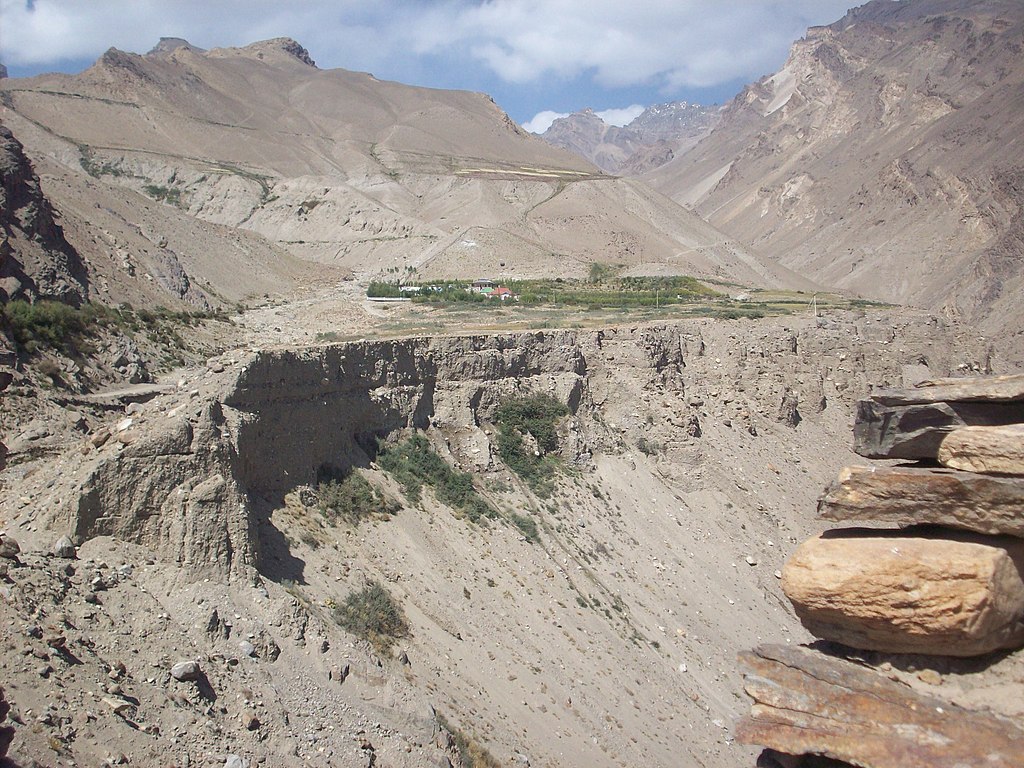
A valley in the Badakshan Province in Afghanistan, close to the where the Iron Gates would be. Photo by Zack Knowles, CC BY-SA 3.0, via Wikimedia Commons

Because this area was a choke-point for travel, it was often garrisoned, and he described “double wooden doors, strengthened with iron and furnished with bells”. In any case, Xuan-zang seemed able to pass through without much issue.

After crossing the Oxus River (now the Amu Darya), he returned to regions where Buddhism was still flourishing namely in the small city of Termez. Termez was once a major city of the Kushan Empire, but was much more diminished by the time Xuan-zang arrived. The Buddhist community here numbered about 1,000 monks. It was here that he saw the Ajina Tepe monastery and its excellent works of art.

In fact, from here Xuan-zang would behold some pretty amazing spectacles. Many people may not realize that the lands we now call Afghanistan were once bastions of Buddhism along the Silk Road, and boasted many treasures, monasteries, and a very eclectic culture.

But first, Xuan-zang had to deal with a series of problems in the city of Kunduz.

Intrigue and Murder at Kunduz

The Kunduz River valley today, Afghanistan Matters, CC BY 2.0, via Wikimedia Commons

Xuan-zang’s visit to the city of Kunduz was no accident. After meeting the king of Turfan way back in episode one, and the Qaghan of the Western Turks in episode three, he had many letters of introduction to the Prince of Kunduz named Tardu. As rulers on the Silk Road, they were all related by family or marriage, so Xuan-zang had little trouble getting an audience with Prince Tardu.

Except for one problem: the Prince’s wife had recently died, and he was in mourning. Later, Tardu abruptly married another daughter of the king of Turfan (episode one), and she in turn plotted with his son from the first marriage. This is starting to sound like the plot of a historical K-drama, doesn’t it?

Before long, Prince Tardu was poisoned and died. The new queen married the prince, and ruled Kunduz thereafter.

Xuan-zang did his best to lay low, and stay out of the issue. His delays at Kunduz meant that he had time to get to know another Buddhist monk named Dharmasimha. Dharmasimha and Xuan-zang debated Buddhist thought and treatises for some time, but Xuan-zang felt Dharmasimha didn’t know as much as he was hyped up to. Dharmasimha for his part, acknowledged his shortcomings, and tried to stay humble about it.

Moving On

Before Prince Tardu’s death, he had encouraged Xuan-zang to visit another city named Balkh, also in modern Afghanistan. Balkh had quite a few sites to see, and since some Buddhist monks were already planning to head back there, Xuan-zang accompanied them. After passing through a city named Tashkurghan (modern Kholm, not related to a similar city in China), they reached the verdant lands of Balkh.

The city of Balkh, known to the Greeks of Alexander the Great as Baktra (Βάκτρα) and Baítíguó (白題國) in Chinese to Tang-dynasty China, was important since very far back in antiquity. Balkh was the traditional birthplace of the Zoroastrian religion, and an important cultural center to Persian people since very ancient times, rivaling cities further to the west such as Babylon and Ecbatana in importance. According to Buddhist tradition, the first two of the Buddha’s disciples also hailed from Balkh, and made the first stupa. Centuries later, it was here that Alexander had married a bride named Roxana, seeking to unify western Greek culture with the eastern Persian culture. Later in the Hellenstic Age, it was an important center of the Greco-Bactrian kingdom.

Needless to say, while few people have heard of Balkh today, it was a very important city across many centuries.

During Xuan-zang’s time, the lands around Balkh were still very fertile (desertification happened gradually later). Even with the widespread destruction the Hephthalities (a.k.a. “white huns”), the lands were still prosperous, if somewhat depopulated. There were two major monasteries in the area collectively known as the Nava Vihara, that belonged to the Sarvastivadin tradition of “Hinayana” (early Indian) Buddhism.3 There were tens of thousands of monks in attendance, and Balkh was one fo the remaining places where teachers were regularly installed from India. Similar to Bamiyan, the Naha Vihara boasted massive statues of the Buddha as well. Interestingly, even as far as the 8th century, long after Xuan-zang was dead, an Arab historian named Umar ibn al-Azraq al-Kermani recorded a place of worship here similar to the Kabaa in Mecca. But instead a Buddhist stupa was enshrined inside, with a cloth draped over it, in accordance with Persian custom of showing veneration.

Xuan-zang stayed at the Nava Vihara for a month, and became good friends with a monk there named Prajnakara. Xuan-zang seemed to finally find a monk of high-caliber, who had a good depth of understanding of Buddhist doctrine, even if he was a “Hinayana”, not Mahayana Buddhist. The two journeyed together further south to Bamiyan.

In our next episode, we’ll explore Xuan-zang’s visit to the great Buddha status of Bamiyan, and Xuan-zang is reaching the borders of India. But first, he has to cross the Himalayas…

1 A nod to Robert Heinlein.

2 A few articles on the Gandharan culture, and the cultural connections between the Bactrian Greeks and Buddhism.

3 Although the Sarvastivada school was not Mahayana Buddhism, Mahayana Buddhism inherited a lot from it anyway: canon of texts, certain viewpoints, etc. Another important early school that influence Mahayana were the Dharmaguptaka, who mostly gave their monastic traditions and rules to the Mahayana.