
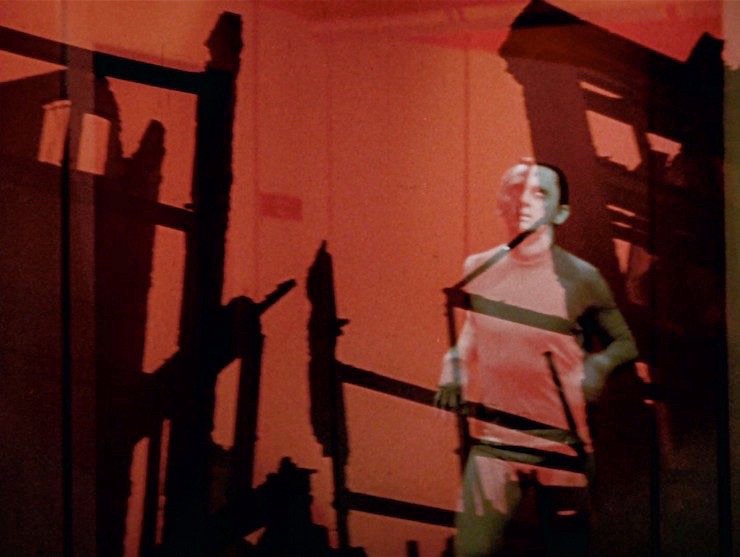
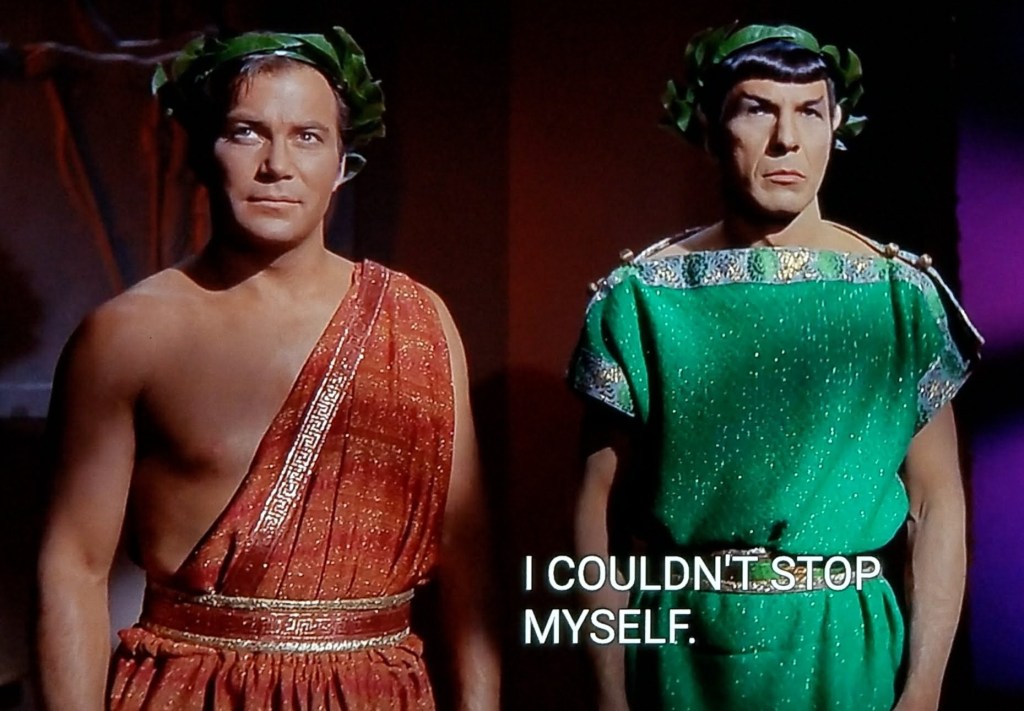
Vanna: “It’s hard to believe that something which is neither seen nor felt can do so much harm.”
Kirk: “That’s true. But an idea can’t be seen or felt. And that’s what kept the Troglytes in the mines all these centuries. A mistaken idea.”
Star Trek, “The Cloud Minders” (s3ep21), stardate 5819.0
I’ve talked about this episode before, but I thought this quote was worthy of its own post.
Because all sentient beings who come into this world must struggle to piece together an understanding of things based on limited information, it’s easy to pick up ideas that are wrong or mistaken but make logical sense. Or, alternatively these ideas are foisted upon them by those they trust, such as parents or your society without the tools necessary to discern the truth.
Thus two rational people can have radically different views of things. One or both of these people can have very harmful negative views, and yet from their own perspective, they may sincerely believe they’re doing the right thing, and assume everyone else around them is stupid or insane..
But then how does one discern what is true or not?
The Buddha taught, on the one hand, that all viewpoints are just a form of conceit (lit. “I-making”) and diverge from reality. They’re based on limited information, logic and so on, and so none of them quite hit the mark. The Parable of the Blind Men and the Elephant is often cited as an example of how people form opinions based on limited facts and are willing to fight over this. In fact, the Buddha himself cited this story in an old, obscure sutra called the Tittha Sutta (Ud 6.4 of the Pali Canon):
…”Saying ‘An elephant is like this, an elephant is not like that! An elephant is not like this, an elephant is like that!’ they fought each other with their fists. And the king was delighted (with the spectacle).
“Even so, bhikkhus, are those wanderers of various sects blind, unseeing… saying, “Dhamma is like this!… Dhamma is like that!'”
Translation by John D. Ireland
The Buddha then recites a verse like so:
Some recluses and brahmans, so called, Are deeply attached to their own views; People who only see one side of things Engage in quarrels and disputes.
Translation by John D. Ireland
So, the Buddha warned against becoming attached to one’s own views because it just feeds the ego, and leads to conflict.
On the other hand, he taught the importance of using the Dharma as an objective benchmark (e.g. a “yardstick”) for how to judge one’s own conduct and views, and especially to see what the results are: do they lead to beneficial results, or harmful results? For example in the classic text, the Kalama Sutta (AN 3.65 in the Pali Canon), we see the Buddha explaining how to properly discern a teaching:
10. “Come, Kalamas. Do not go upon what has been acquired by repeated hearing; nor upon tradition; nor upon rumor; nor upon what is in a scripture; nor upon surmise; nor upon an axiom; nor upon specious reasoning; nor upon a bias toward a notion that has been pondered over; nor upon another’s seeming ability; nor upon the consideration, ‘The monk is our teacher.’ Kalamas, when you yourselves know: ‘These things are good; these things are not blamable; these things are praised by the wise; undertaken and observed, these things lead to benefit and happiness,’ enter on and abide in them.
Translation by Soma Thera
We can see that just because something seems logical doesn’t mean it necessary leads to wholesome results (praised by the wise, leading to wellbeing, etc). One’s intuition isn’t always a reliable guide. Teachings and ideas that lead to wholesome outcomes are in accord with the Dharma, and because they are in accord with the Dharma, they lead to wellbeing, peace of mind, liberation, etc.
Of course, in Buddhist history, there’s examples of eminent monks going off the rails, too. So, just. because one is a Buddhist, doesn’t mean one automatically does it right. It takes time, reflection, and a willingness to keep trying.
Namu Shakamuni Butsu




 Gleanings in Buddha-Fields
You must be logged in to post a comment.