Notice the dates of each holiday: odd-numbered month with matching odd-numbered day. Turns out that there’s a reason for this.
In Chinese Taoist numerology, numbers are divided into “yang” and “yin” numbers: odd numbers are yang (陽) because they are considered unstable and dynamic, while even numbers are stable and static, thus yin (陰). But because yin and yang depend on one another, and change into one another, if you add yang and yang together, you get yin. If you add yin and yin together, you get yang.
Thus, it was thought that dates on the calendar with double-yang numbers (7 and 7, 5 and 5, etc) would become yin and thus were inauspicious. Holidays were developed to counteract the yin effect, and that’s why seasonal holidays were held on double-odd dates.
Taoism is not a major influence in Japanese culture (at least in modern times), but it’s interesting so see how it still influences traditions, especially those from antiquity.
The Japanese concept of yakudoshi (厄年, inauspicious years based on age), is something I’ve written about a couple times over the years. During my last yakudoshi year, I had a particularly bad slip and fall on an icy deck, which took me months to recover.1 It was also around that time that I got laid off at work.
This time around, my daughter was undergoing a yakudoshi year recently. Yakudoshi doesn’t necessarily affect oneself, it’s thought to also affect those around you. My late mother-in-law’s fall which broke her hip happened supposedly during my sister-in-law’s yakudoshi year, and so on. In my daughter’s case, she had a generally good year overall, but at the beginning of yakudoshi, I was in the hospital for a week, and then again right at the very end, I had yet another slip and fall in the backyard. This time, wearing old sandals that had no traction left, I slipped on some moss and as I fell, the back of my head hit a rock.
Ouch.
A week has passed and the swollen lump in the back of my head is almost gone, and I don’t believe I suffered any effects from a concussion.2. Because I fell on my back first, and then hit my head, I think it helped cushion what could have been a much worse injury.
That said, we have been joking around the house that yakudoshi struck again. Maybe it did.
Of course, there are other ways to explain all this. The fact I was wearing old, worn sandals on a wet, cold day in early January in the PNW (with moss everywhere) was pretty stupid. I threw out the sandals since then. Also, I have a track record for being clumsy, so I have had plenty of accidents, yakudoshi or no.
The “inner Spock” in me would thus suggest that this is just a case of probability, weather and bad footwear, and in the case of the surgery, it was a known health risk identified many years ago that finally came to fruition. The probability was always there.
Finally, the Buddhist perspective might explain it as bad karma. Maybe I did something, or some things previously that lined up just right at that moment to compel me to walk outside in bad sandals at that particular day/time so that I would slip and fall.
Believing in the result means having deep faith that the Pure Land and all the forms of goodness (spiritually superior beings) that are assembled there are born from the Buddha Remembrance Samadhi, the meditative concentration that comes from reciting the Buddha-name. When you plant melon seeds you get melons, and when you plant beans you get beans. [Effect follows causes] like a shadow follows a physical shape, like an echo responds to a sound. Nothing is sown in vain. This is called “believing in the result”.
“Mind Seal of the Buddhas” by Ou-I, translation by J. C. Clearly
1 Acupuncture actually did help a lot, as I was getting tired of just relying on ibuprofen all the time.
2 I probably should have gone to see a doctor, but it was a Saturday, and after watching myself for an hour or two, I decided it wasn’t serious enough to warrant going to the emergency room. Time will tell if that was a bad idea, or not.
Of the manytraditions in Japanese New Year (Jan 1st through 3rd, unlike Chinese New Year) is the first temple or shrine visit: hatsumōdé (初詣).
Japan essentially has two religions that have co-existed for many centuries: Shinto and Buddhism. Although they are very different on paper, on the ground, customs and traditions have blended as a result of this (mostly) peaceful coexistence and this includes New Year’s traditions.
People will try to go to their preferred Shinto shrine (jinja 神社) or Buddhist temple (otera お寺) within the first 3 days of the New Year, but most often on January 1st. You can visit any shrine or temple, there’s no pressure to “commit” to one or the other in Japanese culture. At times, we’ve visited Meiji Shrine in Tokyo, Kawasaki Daishi in Kawasaki city (a Shingon-sect Buddhist temple), Asakusa Temple in Tokyo, and Tsurugaoka-Hachimangu Shrine in Kamakura. The featured photo above is from Hatsumode at Asakusa Temple in 2009. We’ve also visited more local temples back home.1
Temples and shrines, especially famous ones, during this time are jammed packed with people trying to start off the new year with a blessing and maybe a few omamoricharms too. Old charms are often disposed of at this time too. Here’s an old photo from a past Hatsumode visit to Kawasaki Daishi in 2012:
This photo may not seem like much, but Kawasaki Daishi’s pagoda is visible way in the background, and the road leading up to the shrine is packed with people. It took maybe an hour to get through the procession to the temple itself.
For this year, 2024, we are at home, so I visited a small Shingon-sect Buddhist temple in the area. Shingon temples are pretty hard to find in the US, but somehow we have two temples in the area, and one of them offers a nice Hatsumode service. I don’t normally follow Shingon-sect Buddhism,2 but as I mentioned above, there’s no sense of commitment or obligation within Japanese religions: you can visit whatever service, and if you choose to follow more closely that’s up to you.
In our particular Hatsumode service, the priest led a series of Shingon-specific rituals to help cleanse any bad karma for the year, reciting the Heart Sutra (prominent in Shingon), and then a brief sermon based on the 60-year zodiac cycle. This year is apparently the year of kino-é-tatsu (甲辰), or wood-yang-dragon, which implies a lot of upheaval. After the last few years, that’s the sort of news I was not hoping to hear. 😒 Then again, shit happens.
I picked up a couple omamori charms for my daughter: a charm for success in studies since she is applying to college next year, and a charm for Yakudoshi since she is of the correct age (unlucky for her). I have learned the hard way not to laugh off Yakudoshi years.
Anyhow, like many Christians in the West during Christmas, Hatsumode might be the only time of the year when most Japanese visit a temple or shrine, but it’s an important time to reconnect and a break away from the usual bustle. I always enjoy this time, even with the crowds, freezing cold, and the hope that the next year will be better than the old one.
P.S. The history between Buddhism and Shinto in Japan is a great case study of two religions co-existing peacefully since they usually just operate at different levels. Shinto’s focus on there life now (and one’s connection to the kami) has little in common with Buddhism’s emphasis on the cycle of rebirth, and the eventual progress toward Buddhahood (e.g. Enlightenment). Chinese culture has a similar balance between Buddhism, and more native religions like Taoism. It’s only in Western religions that approach things with an “all or nothing” attitude that conflict tends to arise, but even then in traditional Christian cultures, native pagan beliefs tended to find a balance with Christian religion. They were not necessarily mutually exclusive, except on paper. Food for thought.
1 We used to visit Japan in the Winter so we could spend New Year’s in Japan with my wife’s family, but as our daughter grew up, and started going to school, we shifted the visits to Summer to avoid affecting attendance. We haven’t been back to Japan in Winter for almost a decade until 2022 and that was due in part to a funeral.
2 I am not against Shingon either, but I’ve found it difficult to commit to since it is an esoteric-only Buddhist sect, and I tend to be kind of an eclectic. It’s also why I frequently struggle with Zen and even Jodo Shu/Shinshu. Hence, my default “preferred sect” is Tendai due to its umbrella-approach to Buddhist practice. Still, due to available resources in my area, Shingon’s always been something I’ve considered.
In the old Japanese calendar, based on the 24 periods of the ancient Chinese calendar, the third day of the second month is marked as risshun (立春) or the coming of Spring. Granted, it was still cold outside and flowers hadn’t really blossomed yet, but it is considered the start of the Spring season.1 It marks the time when nature is just starting to defrost, and wake up.
Among the first things that traditionally bloom are plum blossoms, such as those featured in the photo above (courtesy of Wikipedia).
One of the poems from the Hyakunin Isshu anthology, poem 35, touches upon this exciting feeling of the first blossoms of the year:
Finally, let’s talk about Setsubun. Every year we celebrate this Japanese holiday with the kids, and over time the Oni mask I use to “scare” the kids has evolved over time, including one my daughter made many years ago and was (unintentionally) a bit terrifying.
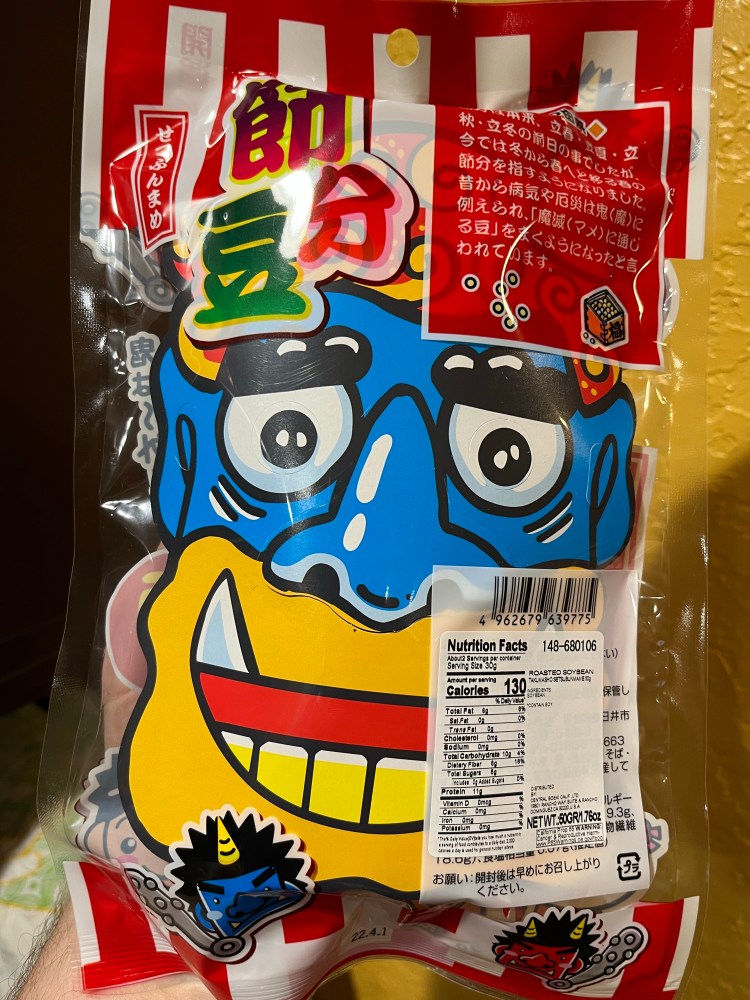
This year, we finally got a real mask rather than a homemade one:
This handy Setsubun “kit” provides the cooked soybeans that the kids throw and a nice Oni mask for me to wear. Basically everything you need for mamemaki! As mentioned in past posts, the tradition is for the dad to dress up as an Oni, a kind Japanese ogre, and knock on the door while the kids throw roasted soybeans at him to drive out bad luck and welcome in good luck for the year. Since Lunar New Year used to fall a couple days before Setsubun, this was part of the New Year tradition.
Supply of traditional goods like this from Japan vary quite a bit each year, even before the pandemic, so we were lucky to get a hold of one this year. It’s unclear if the mask will fit my big American face, but we’ll see. If I can, I’ll try to post some photos or a video.
Happy (early) Spring everyone!
1 Here in the PNW, the last day of frost is said to be March 10th, according to my gardening book. Spring comes extra late here.
As readers may have noticed from past posts, I have posted about certain traditional Japanese holidays, called sekku (節句). Examples included Girls Day (March 3rd), Children’s Day (May 5th), Tanabata (July 7th) and Day of the Chrysanthemum (September 9th). The last holiday on my list is actually the first on the calendar: Nanakusa (七草) which literally just means “seven grasses / herbs”. More formally it’s called jinjitsu no sekku (人日の節句, “day of the human”) as we’ll see shortly.
This holiday is surprisingly old, with origins in ancient custom in southern China whereby people would cook seven herbs as a porridge on the 7th day after the Chinese new year. It also relates to the Chinese lunar calendar, where the first seven days of the year were designated as rooster, dog, boar, sheep, ox, horse and human, the first six being animals of the zodiac. Since the seventh day was (for some reason) marked as the day of the human, criminal punishments were not executed on this day.
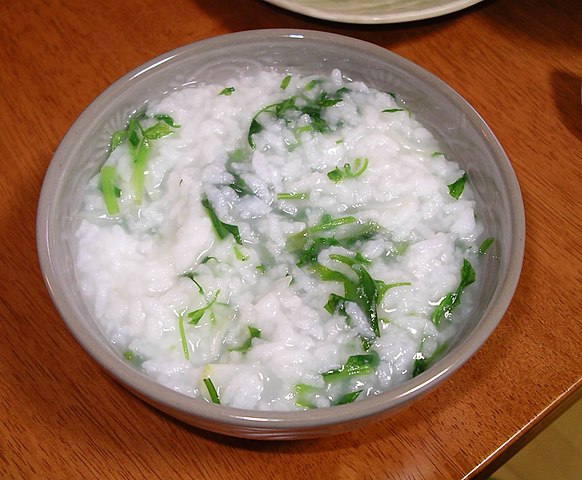
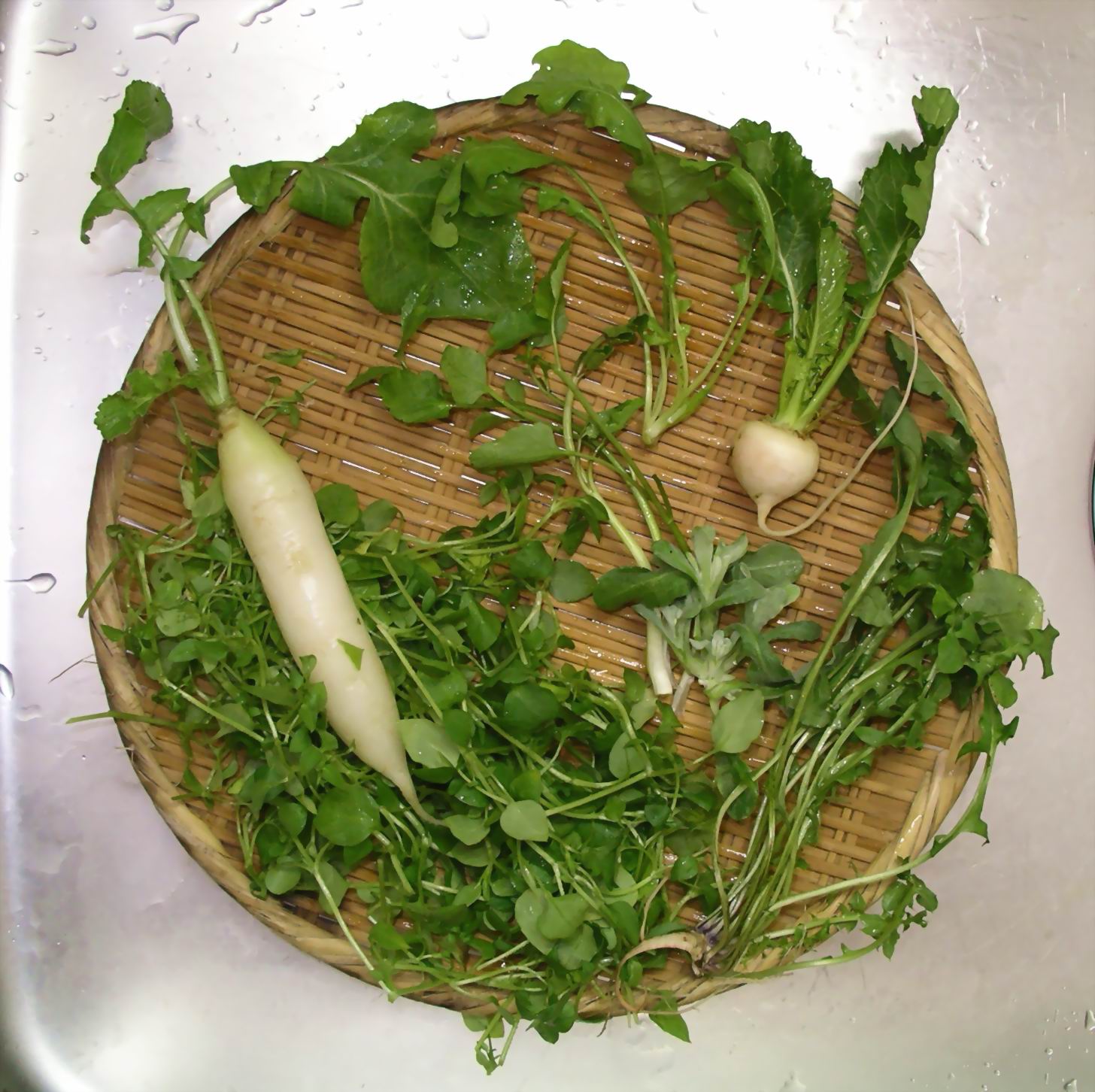
The custom of eating a seven-herb porridge carried over to Japan as nanakusa-gayu (七草がゆ), though in some households more than others. I had it once many years ago when we were first married, and visited my wife’s family home in December-January. I saw a bunch of roots and herbs in the kitchen, like the ones shown above, but didn’t give it much thought. The next day, we were served nanakusa-gayu porridge for breakfast. It has a pretty bland in taste, but that was how I learned about Nanakusa.
A bowl of rice porridge served during Nanakusa, Blue Lotus, CC BY 2.0, via Wikimedia Commons
According to the Wikipedia article, the seven herbs are:
Of these seven herbs, I’ve eaten turnips and Japanese daikon radish regularly, but the other five are pretty obscure to me. I doubt most Japanese would easily remember them off-hand either. Supposedly there is a song that is sometimes sung while facing the auspicious direction that year (same direction as for Setsubun, I suspect), but no one in my wife’s house sang it, or at least while I wasn’t around.
Edit: I found the song in a book recently:
せり Seri
なずな Nanazu
ごぎょう Gogyou
はこべら Hakobera
ほとけのざ Hotoke-no-za
すずな Suzuna
すずしろ Suzushiro
それは七草 Sore wa nanakusa (“That’s Nanakusa”)
Anyhow, that’s a look at Nanakusa. I joked with my wife if she’d make it this year, and she flatly refused. While it is a very traditional holiday, the porridge takes a lot of work, especially here in the US where the herbs might be hard to gather, and frankly isn’t great tasting. It’s a medicinal porridge more than comfort food. That said, it is a fascinating window into some very old Chinese traditions that still persist in Japan.
1 The adolescent in me giggles whenever I read this plant name. 😂
Call it karma, superstition, what have you, but the last week of yakudoshi got the last laugh on me. You see, I was in the last year of yakudoshi (a.k.a. atoyaku, 後厄 ) until the Chinese New Year of 2020, or January 25th. Although Japan doesn’t celebrate the New Year according to the Chinese calendar anymore, a few traditions still relate to the “old” New Year (kyūshōgatsu, 旧正月). The yakudoshi years begin and end at the old New Year according to the Chinese lunar calendar.
Photo by Min An on Pexels.com
Here in the Pacific Northwest, it has been raining a lot. Apart from a little bit of snow around “big cold” time, it’s been raining day after day after day. As such, the deck of my home, which isn’t in great shape anyway, gets really slimy and slippery due to algae. One weekend not too long ago, a few days before the “old” New Year, I was taking out the garbage when I slipped on the deck steps like Charlie Chaplin and landed on my back and rear. My left shoulder and elbow hurt, but my elbow in particular started to swell. While the rest of me soon recovered quickly, my elbow just got more sore and swollen. I could still move it well enough, but the back of my elbow hurt like hell.
Finally after a week of this, I decided to see the doctor, and after a quick examination he determined that I had bursitis. The fluid sac inside my elbow had gotten very swollen and irritated due to the fall and would take weeks to heal. Thankfully nothing was torn nor broken, so that was a relief, but here I sit with a Japanese-style poultice on my elbow to help ease the swelling.
The lesson of this is that:
Don’t wait to see a doctor if you suspect something is wrong. For me, the week long pain in my elbow made me miserable. If I had known better, I could’ve gotten a medical examination earlier and saved some unnecessary grief.
Keep your deck and stairs maintained and clean. I previously tried various schemes to keep moss and algae off the wood, but this time around, I tried a bucket of water and a kitchen sponge with a rough side. Just scrubbing those steps got the algae off immediately. Of course, keeping it clean in the first place prevents algae from growing, but if I had spent 20 minutes sometime in the last several weeks scrubbing the deck and stairs, I could’ve saved myself a serious fall.
Finally, yakudoshi is finally done, but I like to think (joking) that it got in one last dig at me. To be honest, I never really took the tradition seriously, and still don’t. A little home maintenance would’ve saved a lot of trouble, and that’s on me. Further, 2018-2019 were pretty good years overall. True, I lost both of my remaining grandparents (different sides of the family) and that put me in a long funk, and looking back I think I had gone through a longer grieving process than I would’ve thought. Plus, the company I work for had undergone a major restructuring and that meant the constant fear of being “redundant” for months. Finally, I had some minor surgery after an old medical issue came back to haunt me which was no small stress (plus medical bills).
But are these really due to an inauspicious year based on an old Chinese-style wordplay? Sooner or later we lose our loved ones, and companies grow, change and shed employees from time to time to stay competitive. Our bodies can’t stay 100% healthy all the time, either. It’s easy for me to say these things here and now, but even when they suck they’re a part of life. There’s no guarantees of security and long life. These are things we cannot truly rely upon, like so many other things in life.
Further, in spite of these difficulties, I also got to see my kids grow. One graduated elementary school, while the other started it. We made a lot memories together as a family, and my wife and I celebrated our 15th year anniversary too.
A certain famous Indian Buddhist named Nagarjuna described such things as the Eight Worldly Concerns, sometimes called “Eight Winds” in various Buddhist circles:
Happiness and Suffering
Gain and Loss
Praise and Blame
Benefit and Harm
The idea is that these “winds” blow us back and forth. At times, we’re happy, at times we’re sad. Sometimes we gain some kind of boon, and other times we lose something dear. Similarly, our boss tells us we did a good job, and a few weeks later we get scolded for some mistake, only to later be praised again some time later.
There’s no rest when being blown about by these winds. Praise and fame are not something we can rely on, and blame and loss don’t last forever.
Knowing this to be true is one thing, but actually being able to stand calm the eight winds like a mountain is something that takes time, reflection, persistence, and perspective into the nature of things. Easier said than done. But the alternative is to spend a life time chasing after the “good” side of the eight winds, and forever lamenting the “bad” side.
So, Yakudonshi or not, the last few years had their ups and downs, but it all worked out somehow in the end. 😎
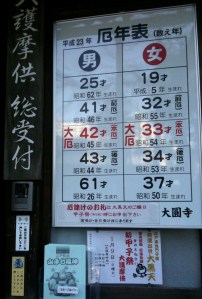
In Japanese culture, certain years are considered inauspicious based on the year you were born and are called yakudoshi (厄年).
Example calendar at a Japanese temple or shrine
The logic behind these particular years comes from Chinese homophones (words that sounds alike). According to this helpful book, the years listed can also be homophones for bad things. For example “42”, if you say the numbers “4” and “2”, you get shi ni (四二). The word “shini” is also a homophone for “death”, (死に). For 33, it can be read as sanzan (三三), which also happens to sound like a word for “disaster” (散々). You see a lot of this in Japanese/Chinese culture not just with auspicious/inauspicious years and numbers, but other events like holidays and so on.
Out of all the yakudoshi years, the worst of the worst year (taiyaku, 大厄) is 42 for men, and 33 for women per homophones shown above.
Further, each yakudoshi year also have a “before” year (maeyaku, 前厄) and “after” year (atoyaku, 後厄) that are somewhat inauspicious but less severe. Thus, it’s a three year-span: maeyaku, honyaku (“main calamity”, 本厄) and then atoyaku.
Finally, the particular yakudoshi years differ between men and woman, and are calculated based on the year of one’s birth. However, in Japanese culture, these are usually based on Imperial reign dates. For example, I am born in 1979 according to the Western calendar, but in Japan, I would be born in year 54 of the Showa Period (shōwa 54 nen, 昭和54年). A kid born in 2004 would be year 16 of the Heisei Period (heisei 16 nen, 平成16年). So, if you wanted to calculate whether the coming year is inauspicious or not, you must look up by the Japanese-style Imperial year.
You can see a good example of this on this temple website, though it’s Japanese-only. As of 2025, according to the website, the inauspicious years are for men:
Maeyaku (before calamity)
Honyaku (main calamity)
Atoyaku (after calamity)
Heisei 13 (2001)
Heisei 12 (2000)
Heisei 11 (1999)
Showa 59 (1984)
Showa 58 (1983)
Showa 57 (1982)
Showa 41 (1966)
Showa 40 (1965)
Showa 39 (1964)
Based on year of birth
And for women:
Maeyaku (before calamity)
Honyaku (main calamity)
Atoyaku (after calamity)
Heisei 19 (2007)
Heisei 18 (2006)
Heisei 17 (2005)
Heisei 5 (1993)
Heisei 4 (1992)
Heisei 3 (1991)
Showa 41 (1966)
Showa 40 (1965)
Showa 39 (1964)
Based on year of birth
Anyway, when you are in the middle of a Yakudoshi year, many Japanese choose to undergo a ritual purification called yakuyoke (厄除け). This process doesn’t differ much depending on whether it’s done through a Shinto shrine or a Buddhist temple (since Japan has two religions).
In the of Shintoism, much revolves around the notion of purification. In Shinto if the shrine is not sufficiently purified, physically and spiritually, a kami spirit might not descend for a ritual. Also, when one has encountered calamities such as death, one should be purified as well. So, for Yakudoshi, this is no exception. The particular ritual in Shinto that is applied toward purification for Yakudoshi is called yakubarai (厄払い), which is intended to exorcise any negative spirits that might take advantage of this inauspicious year.
In the case of Buddhism, similar rituals exist, though the interpretation is more about exorcising negative karma and such. In her youth, my wife went to Kawasaki Daishi, a Shingon-Buddhist Temple that has a positive reputation for this kind of thing. Update: our daughter, who’s had a yakudoshi year, did something similar at a Japanese-Buddhist temple in the US. She was worried about college applications, and since it was a yakudoshi year for her, we opted to pay for the full ritual.
So, it just comes down to personal preference.
As for me, my taiyaku year recently ended (2019 as of writing), and it definitely had some hiccups, but overall it wasn’t a particularly bad year. No one got seriously ill, finances were better than past years, and work plods on like usual. I was by no means a great year, but it certainly didn’t live up to the moniker of “year of suffering”. However, full disclosure, I did undergo a purification ritual at a certain Buddhist temple, and paid extra for the ritual protection just to go the extra mile. Update: had a bad experience at the very tail end of the yakudoshi year.
On the other hand, I like to think that the Buddha-Dharma was better protection in that regard. ;-p





 Gleanings in Buddha-Fields


You must be logged in to post a comment.