Since my mother in law passed away recently, and my wife is back in the US, I’ve had a crash-course on memorial practices in Japanese culture, and wanted to share in case others run into this too. Much of these practices are rooted in a fascinating combination of native Japanese religion, blended with Indian-Buddhist practices and with Chinese-Confucian customs. It’s noticeably different and more structured than what Americans might be familiar with, but let’s take a closer look.
Buddhism, Not Shinto
One thing to clarify first, is that even though Japan has essentially two religions, Shinto and Buddhism, they tend to operate in different social spheres, and people are not required to profess faith in one other the other, so people freely operate between them.
In any case, Shinto places great importance on ritual purity, and death is a traumatic, impure experience. Shinto tends to focus a lot more on this-worldly relationships with the kami, so it doesn’t say much about the afterlife.
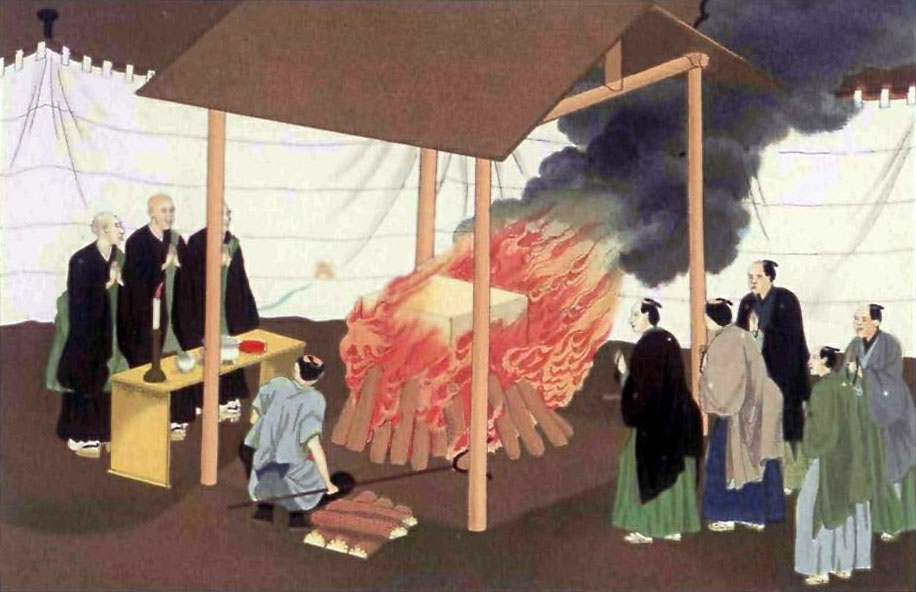
By contrast, Buddhism doesn’t emphasize ritual purity, and does have a much more detailed understanding of the afterlife. Hence, regardless of one’s personal beliefs, funerals are almost always conducted with a Buddhist temple. In Buddhist funerary practices, bodies are typically cremated, not buried, and the grieving family will help transfer the bones of the deceased into the urn in a special ceremony. Also, unlike in the West, white is the color of death and funerals, not back. You can see this in folklore regarding ghosts and such.
Parishes
Since premodern times, families in Japan have frequently registered with a local Buddhist parish or danka (檀家) for a particular Buddhist sect. Thus, even if one is not actively involved in a particular Buddhist community, the default Buddhist parish the family belongs to normally handles the funeral affairs.
This tends to give Buddhism a reputation in Japan as a “funeral religion”, but has a lot more to do with politics and history than religion itself. That’s a story for another day.
Proper Dress for Funeral
Funerals in Japan are very formal affairs, including dress code. If you ever attend a funeral there, it is proper to wear conservative, business formal attire (e.g. suit) in black, with matching black shoes. This is in contrast, for example, with my grandpa’s funeral six years ago, when half the family just wore jeans. 🤦🏼♂️
A Buddhist rosary is often carried as well, even if one is normally a practicing Buddhist. For those who don’t normally practice Buddhism, a simple “funeral” rosary can be easily obtained.
Funerary Gifts
An example envelope for okōden. Normally the names of the recipient family and giver would also be written too.
One practice that surprised me a bit after my mother-in-law passed away was the practice of okōden (お香典) which is money, wrapped in a special black-and-white envelope, given to the grieving family. In some cases, the monetary gift can be quite large, and is (as far as I can tell) meant to help defray funeral expenses and just support the family. It’s similar in spirit to how families in America would often “bake a casserole” for the grieving family.
In keeping with Japanese customs, the recipient will sometime later give a gift in return (okaeshi お返し) that costs roughly half what original gift was.
Purification After Funeral
It is a common practice in Japan to toss a pinch of salt over one’s shoulder after a funeral. Salt is thought to function in the same way that holy water might in the West: purification against evil spirits. This may be another practice adopted from Chinese culture, wherein it is thought that evil spirits follow tragedy or those who loss in their lives.
Posthumous Names
Another practice that has carried on since medieval times in Japan is the bestowing of a posthumous Buddhist name. Each sect has a different naming convention, but these are always bestowed to the deceased (and is written on their funerary tablet) to signify their connection to the Buddhist community and so on. These names originally were probably ordination names, allowing the deceased’s spirit to “take tonsure” as a Buddhist monk or nun. I am unclear how widely this is believed now, but in any case, it is almost universal to receive some kind of posthumous Buddhist name as part of the funeral process.
Home Veneration
A common practice, likely inherited from Chinese-Confucian reverence for one’s ancestors, is to enshrine a picture or funerary tablet to the deceased in one’s home altar. In our altar here at home, we have a small picture of my mother-in-law there below and to the left of the central Buddha statue. I remember visiting my wife’s extended family in Japan, and seeing a similar arrangement for her uncle who had died some years back due to leukemia.
No Celebration of New Year
For the first New Year following a loss in teh family, the grieving family is not supposed to take part in New Year’s celebrations. I believe this is also tied to Confucian practices. Consider this quote from the Analects:
[3:26] The Master [Confucius] said: “Men of high office who are narrow-minded; propriety without respect and funerals without grief: how can I bear to look at such things?!”
[1:11] The Master said: “When your father is alive, observe his will. When your father is dead observe his former actions. If, for three years you do not change from the ways of your father, you can be called a ‘real son’ (xiao; 孝).”
Funerals must show proper grief if they are to properly venerate one’s ancestors, and so a number of strict practices continue to this day within the first year of mourning:
New Year’s cards (nengajo) are not sent out that year.
Families in mourning do not go to shrines or temples on New Year’s day (e.g. hatsumōdé)
Families in mourning do not setup New Year’s altars (kagami-mochi), nor is New Year’s food (osechi-ryōri) consumed.
Although Confucian texts imply that three years of mourning for one’s parents is proper, in practice, this is usually done for one year as far as I can tell.
Periodic Mourning
Another feature possibly adopted from Chinese culture is the set calendar of mourning that is undertaken throughout the year. These are called meinichi (命日) or kinichi (忌日) among other things, and start from every 7th day from the funeral date, up to the 49th day, and then follow a set, yearly calendar:
In practice, people in Japan usually only observe the first 7th day memorial, the 49th day memorial, and yearly memorials. Funerals are expensive and it’s not always practical to observe them all.
In addition to the formal memorials above, a common practice at home for the first year is tsukimeinichi (月命日), or monthly observances. These are done at home, on the same day of the month as the original funeral, and may be as simple as lighting some incense in the home altar and a short prayer. After the first year, the memorials at home also move to a yearly cadence (just like death anniversaries in other cultures).
One other note is that for these periodic memorials, certain Buddhas and Bodhisattvas are often associated with key dates. This is emphasized, or de-emphasized depending on the Buddhist sect, but these Thirteen Buddhas and Bodhisattvas are listed above where appropriate. Esoteric traditions such as Shingon and Tendai, also associate mantras with each Buddha or Bodhisattva, but that’s a topic for another day, and it’s not something your average Japanese person would know. Usually the priest keeps track of such things, or they are listed in one’s sutra book if needed.
Conclusion
This is by no means an exhaustive look at Japanese funerary practices, and there are likely mistakes or omissions here, but I hope this post sheds some light on the deep well of tradition that Japan draws upon, and how it relates both to Indian-Buddhism, and Chinese-Confucianism.
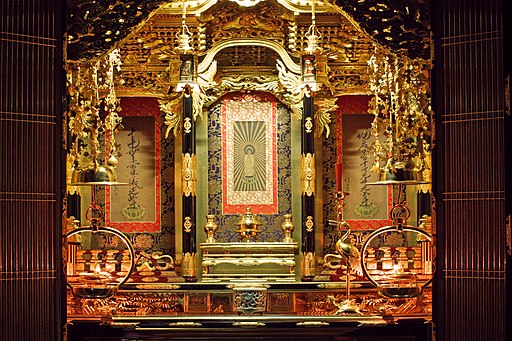
Recently I had an interesting encounter with someone who had a Japanese o-butsudan displayed behind them on a Zoom meeting. An o-butsudan (お仏壇) is a kind of Buddhist altar in Japanese culture, usually a tall cabinet with doors. They can be small cabinets that fit in one’s home, or much larger, ornate ones found in temples like the one below:
I assumed the person was a fellow Buddhist like myself, so afterwards I asked about it, and it turns out they had inherited it from a Japanese friend who had passed away. The obutsudan was open in the Zoom meeting, revealing a gohonzon central image, marking it as a Nichiren-Buddhist altar of some kind. I didn’t have a chance to follow up, though, and learn more about her relationship with the o-butsudan.
Buddhist shrines of some form or another are pretty universal across many cultures. They also come in many shapes or sizes. For example, if you go to a Thai restaurant, you’ll see often see a small, elevated alcove with a small statue of the Buddha there for example. The Buddha is often revered as a special guest or venerable teacher in such altars. For a Buddhist, maintaining an altar has many benefits towards one’s Buddhist practice (more on this in a future post), and it’s also a kind of sacred space too. In the case of Japanese culture, depending on the particular sect, relatives who passed away might have a photo enshrined below the Buddha of course, or funerary tablets (ihai, 位牌) which are based on Chinese funerary traditions. Offerings are also made during Obon Season as well.
It’s not a sacred icon in quite the same way as the Holy Host or the Torah, but it is a sacred space within Buddhist tradition, it’s very personal, and very specific to one’s sect or tradition. If you think of a Buddhist altar as a mirror for oneself and one’s practice, then regardless of what it looks like, the care you put into it is what matters.
For my part, I inherited a small o-butsudan from a Japanese-American family in my old temple community whose grandmother passed away. They did not need the obutsudan, and it fit nicely in a cubby in my bookshelf, so we adopted it, and installed it in there. I was surprised to learn later that the grandmother had been in the internment camps during WWII.
I wish I knew about Buddhist altars in non-Japanese cultures, but unfortunately, I don’t.
While homes in Japan often have an o-butsudan, or Buddhist altar cabinet, these are less common in the West. They are not strictly necessary either. Many Japanese don’t have them either due to cost or space. Also, if you’re new to Buddhism, you don’t need an elaborate Buddhist altar. As long as you have an image of the Buddha, a statue, or even a scroll of some kind, that’s a good start.
Cabinet or not, per tradition usually comprise of at least four objects:
An central image, hanging scroll, or statue of a Buddha. Any one of these is fine. You can see some traditional examples in Japanese Buddhism listed by sect here.
A small candle holder. I like using LED candles personally because they are safer and more environmental.
A small flower vase, and flowers. I use a small glass vase, and fake flowers that I got from my local arts and craft store.
A small incense holder and incense. I got mine at a local Asian market, but there’s plenty of options here.
Optional: a small Buddhist bell. These are usually small, bowl-shaped metal objects with a cloth or wooden striker.
As for placement: the central image is elevated slightly above the rest. The other objects are placed in front of it, in order: flowers (left), incense (center), and candle (right). The sutra book and bell would be somewhere in front of that, space permitting.
When people think of Zen, they think of meditation, and sand gardens. And with good reason. Zen uses the Buddhist teachings as a guide, but seeks to experience first-hand what Shakyamuni Buddha experienced.
However, that’s not to say that there isn’t a devotional side to Zen either. As a peerless teacher, Shakyamuni Buddha pointed the way, “turned the wheel of the Dharma” as they say, and so he is an inspiration to Buddhists everywhere. This is true for other Buddhist deities as well. Whether such deities actually exist or not is less important than you might think.1 Further, when you look at lay-oriented texts such as the Shushogi, it’s clear that Soto Zen evolved over time to accommodate people of all backgrounds, including those that don’t realistically have the time to devote themselves to meditation retreats, etc.
For this post, I reviewed a few Japanese-language sources on how to do home liturgy, or otsutomé (お勤め), for the Soto Zen tradition. I found that the Soto-sect of Japanese Zen has particularly good resources, both in English, and especially in Japanese, for home practice, and provides flexible approach to home devotional practices. We’ll talk about that more shortly.
Edit: This post has been rewritten and cleaned up in June 2025 now that I have access to more information, and a better understanding of how Soto Zen liturgy works.
According to Soto-Zen sources above, the home liturgy goes like so:
Ring the bell (if you have one) three times gently if you have one at your home altar.
What follows below is an example taken from Japanese sources. However, the same sources also state that you can add or remove as many of these you want.
Recently I found a great video by a Soto Zen priest (Japanese-language only, sorry), where he stated that if a practitioner simply recited the Heart Sutra each day, that would be great. But if even that was difficult, one can also simply recite na mu sha ka mu ni butsu three times (南無釈迦牟尼仏, “Praise to Shakyamuni Buddha”) before an altar image. The most important thing, the priest stated, is daily and sustainable practice. You can always adjust, add, or trim later.
Another option if you are short on time, is to just recite the Three Treasures, which is a nearly universal practice in Buddhism:
Japanese
Pronunciation
Meaningb
南無帰依仏
Namu ki-e butsu
I go to the Buddha [teacher] for refuge
南無帰依法
Namu ki-e ho
I go to the Dharma [the teaching] for refuge
南無帰依僧
Namu ki-e so
I go to the Sangha [the community] for refuge
a The ṃ (an m with a dot underneath) is pronounced more like “ng” than “m”. So, “Buddhaṃ” in this context sounds more like “Buddhang”. The regular “a” without an accent mark sounds “uh” as in “duh”, and ā is more like “ah” as in “father”.
Also, there seems to be an alternate, more stylized form of the Three Treasures found in Soto Zen liturgy called the ryakusanbō (略三宝), for which this a rough translation:
Japanese
Pronunciation
Meaning
十方三世一切仏
Ji Ho San Shi I Shi Fu
[Praise to] the Buddhas of the Ten Directions,1 and the Three Realms!2
諸尊菩薩摩訶薩
Shi Son Bu Sa Mo Ko Sa
[Praise to] past teachers, bodhisattvas, and all who follow the Buddhist path!
摩訶般若波羅蜜
Mo Ko Ha Ja Ho Ro Mi
[Praise to] the Dharma, whose wisdom leads to awakening!
1Ten Directions – the cosmos as a whole. In other words, all Buddhas everywhere. 2Three Realms – the realms of desire, form and formlessness. This is another fancy way of saying Samsara (existence) as a whole.
Now onto the example liturgy…
Example Soto Zen Liturgy
What follows is the example provided by the sutra book I got from Sojiji temple years ago, and the online version which only differs very slightly. This difference mainly is how some liturgies are written in Sino-Japanese (Chinese with Japanese pronunciation) or with more native, liturgical Japanese. To help readers choose, I will try to post both where pertinent. Also, where possible, I tried to provide Youtube links where I could find them.
Kaikyogé: Opening of the Sutra Verses
Sino-Japanese
Native Japanese
Mu jo jin jin mi myo ho
Mu jo jin jin mi myo ho wa
Hyaku sen man go nan so gu
Hyaku sen man go ni mo ai ou koto katashi
Ga kon ken mon toku ju ji
Ware ima ken mon shi ju ji suru ko wo etari
Gan ge nyo rai shin jitsu gi
Negawaku wa nyo rai shin jitsu no gi wo gesen
Translation: The supreme and profound teachings (Dharma) of the Buddha is truly rare to encounter, but now we are able to hear and receive it. It is our hope that the teachings become clear to us.
Sangémon: Renunciation of One’s Past Transgressions
Note: both my book and the website state that any sutra in the Buddhist canon (or excerpt of a sutra) is OK to recite. However, the most common choices are:
The Shushogi, one chapter per day in rotation (day one chapter one, day two chapter two, etc). I have provided links and translation to each one below:
For Japanese Buddhism, simply reciting the sutra without any other liturgy is a perfectly acceptable home practice, by the way. So, your home service could just be this part.
Fueko: The Dedication of Good Merit Towards Others
See this post for more details. This liturgy is somewhat unusual in that every sutra book I see consistently prints it as a mix of both native Japanese followed by Sino-Japanese (highlighted in bold). So I am posting as-is. Youtube link here.
Dedication of Merit, full version
Negawaku wa kono kudoku wo motte, amaneku issai ni oyoboshi,
Warera to shu jo to, mina tomo ni butsu do wo jozen koto wo
Ji ho san shi i shi fu
Shi son bu sa mo ko sa
Mo ko ho ja ho ro mi
Cadence
The sources state that doing the same liturgy in the morning when you wake up, and also before you go to bed is the ideal cadence. It is also customary to wash one’s face a bit before the liturgy as a respectful gesture, but this is optional too.
However, for people who are busy, it is perfectly fine to do morning or evening, not both. The sources also state that if one is truly busy, simply doing gassho in front of the altar is fine too.
Good luck and happy chanting!
1 As a Star Trek nerd, I like to imagine even Mr Spock as a Bodhisattva. 😉
This was a fun little book I received on Christmas. Definitely recommend.
2 Українською:
Я шукаю Притулку у Будді. Я шукаю Притулку в Дхармі. Я шукаю Притулок у Сангхе.
На русском:
Я ищу Прибежища в Будде. Я ищу Прибежища в Дхарме. Я ищу Прибежища в Сангхе.
Greetings readers! I have had a bit of extra time this week due to much-needed time off from work, and have been going through old projects, half-finished blog posts and such. One project I found today, which I decided to finish, was post a romaji (Romanized Japanese) version of the Tendai Buddhist home liturgy for anyone who needs it.
The Tendai sect in Japan has a nice homepage (Google Translated page), but almost nothing in English for doing the home service. Tendai information in English is pretty scattered (though there are some great websites),1 so I decided to go back to the source, and just translate it directly using romaji (romanized Japanese) for easy pronunciation.
Some quick notes:
I chose the shortest, simplest elements of the service, based on Tendai’s recommendation in the link above, and also through the book うちのお寺は天台宗 (双葉文庫) which I picked up some years ago. There’s a more extended version of the home service, but both the book and website explain that the essentials are the following elements that I am posting below.
Where possible, I chose to use the Sino-Japanese pronunciation. The website above lists both, and either option is fine (obviously English is fine too). The Sino-Japanese version, in my opinion, is the easiest to pronounce and chant, and ties back to the larger Buddhist tradition, so that’s my personal preference. The YouTube videos on the Tendai site sometimes provide an alternate native, liturgical Japanese version, and it’s perfectly fine to use this too.
Finally, traditions and liturgical styles vary, so don’t be surprised if another Tendai community does it differently. If in doubt, just do it like your local community does.
The webpage also lists some tips (roughly translated below):
First, before you begin, double-check the offerings at your home altar make sure everything is in order: flowers, water, a candle,2 and any other offerings you wanted to make.
Before the service, take a moment to freshen up, rinse your mouth and hands with water, etc. That way, you can sit before the altar in a more purified state.
Drape any rosary you have over your left hand, and if you are holding a sutra book, lift it up gently and bow ever so slightly.3
When you do gassho, put your hands together in front of your chest at a natural angle (45 degrees is common based on personal experience).
When chanting, use a mild, even chanting voice, enunciating each word equally. (If you feel like you don’t chant as well as the video links, don’t feel bad: these are professional monks chanting.)
If you have a bell, there are certain times to ring it: twice at the beginning, once after reading each part, and three times at the end. (I’ve added prompts to the liturgy below.)
When done, close the Buddhist altar (if possible), and place the sutra book back on its stand.
Lastly, the book in particular mentions that any Buddhist sutra is OK to recite. The most common one is obviously the Heart Sutra, but any other Buddhist sutra, or an excerpt of a sutra, is fine too. Find what you like, and feel free to recite that.
Minimal Tendai Buddhist Home Liturgy
The service provided below is given as an example home service, but my book on Tendai Buddhism also states that among these different bits of liturgy, you can add or reduce as many as you see fit. Even if you only recite one bit of liturgy per day, that’s enough. The important thing is to make it sustainable. You can always adjust later if it’s too simple or too difficult.
Sanrai: Gratitude Toward the Three Treasures
(ring twice)
Ish-shin cho rai jip-po ho kai jo ju san bo
(repeat 3 times, ring once)
“I reverently praise the Buddha, Dharma and Sangha, which permeate the cosmos”
Thanks everyone and I hope you find it useful. I will likely post updates and corrections as time goes on.
Namu amida butsu Namu kanzeon bosatsu
1 There are, from what I can see from a cursory search, a number of Tendai communities in both the US and the UK. If you’d like to know more, I encourage you to contact such communities. I have no affiliation with any of these groups, however. I am just DIY.
2 Japan also sells LED Buddhist altar candles. Halloween goods also offer LED candles. Great for avoiding fire hazards.
3 This custom is also found in other Japanese-Buddhist sects as a gesture of humility.
Author’s Note: this was another post I found recently from my old blog, possibly something I wrote in 2013 or 2014. It was shortly after this that I decided to leave the local Jodo Shinshu Buddhist community, give up the prospect of ordination, and strike out on my own. My feelings on the subject have changed somewhat, but I still agree with the general sentiment. I do miss many of my old friends at the local temple, but these days I am kind of done with Jodo Shinshu Buddhism. Apart from minor edits, and fixing broken links, this is posted as-is. Oh, and I added a cover image from that time and updated the title slightly for clarity. 😋
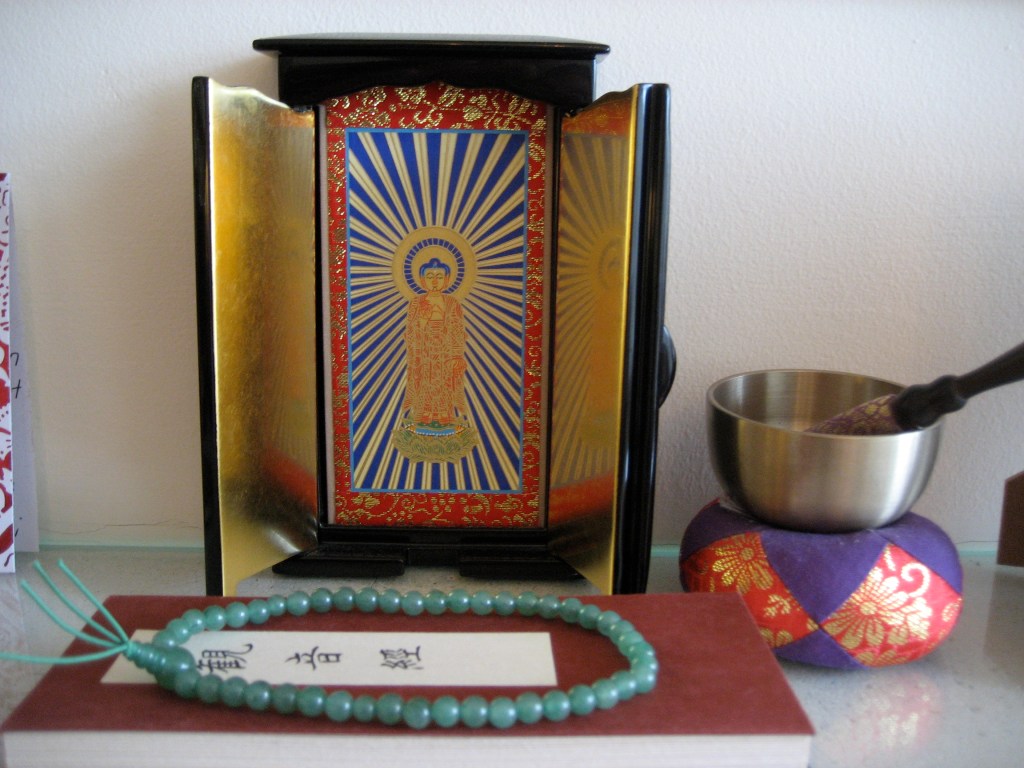
An old altar we setup years ago while living in Ireland. The central image was purchased from Tsukiji Honganji in Japan and venerates Amitabha Buddha, the Buddha of Infinite Light.
Lately, as I have been able to enjoy a small break in life, work and so on, I delved into some books I haven’t finished reading in a long while, including an excellent study on the life of Hossō Buddhist scholar, Jōkei. The book, titled Jokei and Buddhist Devotion in Early Medieval Japan by James L. Ford, is both a biography, but also a critical look at the late Heian, early Kamakura periods from a Buddhist perspective, and an effort to shed new light on this oft-studied and oft-misunderstood period.
In a way, I feel like I am betraying friends I have had the privilege of encountering over the years who are devout Jodo Shu and Shinshu Buddhists, but at the same time, I think Buddhism should be able to stand on its own two feet and take the acid test of criticism sometimes.1 To my friends on the Pure Land path, please forgive this post. It is not a personal attack, and I know many people in Jodo Shu and Jodo Shinshu who are admirable Buddhists in their own right. It’s just that while reading Ford’s book, I really felt he hit the nail on the head with certain things about Honen and Shinran’s teachings that made me uneasy, particularly the “exclusive” Pure Land approach that orthodox Jodo Shu and Jodo Shinshu followers adopt. Until recently though, I couldn’t quite articulate it myself.
This uneasiness came about back when I first started reading Rev. Tagawa’s book on Yogacara Buddhism, and on my recent trip to Kyoto and Nara, this old uneasiness arose in me moreso as I stood at the feet of great temples such in Kyoto and Nara. When I stood in the Treasure House of Kofukuji, beheld all the amazing artwork there, and the vast corpus of teachings they represented, I knew something was still amiss in my Buddhist path and it’s been gnawing on my mind for a while now.
Jōkei is best known as a sharp critic of Hōnen and the exclusive Pure Land movement, or senju nembutsu (専修念仏). As such, he was the primary author in 1205 of the Kōfukuji Sōjō (興福寺奏状), or the “Kofukuji Petition” to the Emperor which sought to suppress the “exclusive nembutsu” Pure Land school started by Honen. History has not been kind to Jokei, and Professor Ford argues that the study of Kamakura Buddhism is flawed because of some underlying biases and assumptions about “old” vs. “new” Buddhism. Meiji-era and later studies tend to apply a kind of “Buddhist revolution” to Honen and Shinran, and paint traditional Buddhist sects as elitist or oppressive. Sometimes, parallels between Shinran and Martin Luther have been drawn in scholarly circles, though more modern research has refuted this analogy as superficial at best.
A while back, after reading Dr. Richard Payne’s collection of essays on the subject of Kamakura-era Buddhism, I started to question these assumptions, but more so after reading Ford’s book. He explores the Petition toward the last-half of the book and Jokei’s relationship with Honen to show how history has normally written about the incident, and carefully dissects it to show another viewpoint. In essence, he argues that Jokei’s criticism of Honen isn’t an “old-guard” or “elitist” perspective, but more accurately reflects a “normative” Buddhist doctrinal stance.
Ford explores at length about the content of Jokei’s Kofukuji Petition and its nine articles faulting the new senju nembutsu (専修念仏) or “exclusive nembutsu” movement, which are Ford summarizes in four points (I am quoting verbatim here):
[According to Jokei,] Honen abandoned all traditional Buddhist practices other than verbal recitation of the nembutsu.
Honen rejected the importance of karmic causality and moral behavior in pursuit of birth in the Pure Land.
Honen false appropriated and misinterpreted Shan-tao with respect to nembutsu practice.
Honen’s teachings had negative social and political implications.
To bolster his stance in the Petition, Jokei uses the same textual sources as Honen to demonstrate that Honen only selectively drew certain teachings from Chinese Pure Land patriarchs, Shan-Tao, Tao-ch’o and T’an-luan to prove his beliefs concerning the verbal nembutsu, while ignoring the whole of their teachings and writings, which included a more comprehensive Pure Land Buddhist path. Ford then turns to modern scholars to show that in China, the nembutsu (nian-fo) was never seen as a verbal-only practice even in Shan-tao’s time, but was interpreted as a well-developed meditation system. This is reflected even in modern day Chinese Buddhist writings, such as those of the late Ven. Yin-Shun.
As Ford then concludes:
Thus Jōkei’s claim that the Pure Land schools had no precedence in China is probably true. All in all, Jōkei’s critique of Honen’s construction of an independent Pure Land sect based on exclusive practice of the oral nembutsu is generally well grounded both doctrinally and historically. (pg. 178)
Jokei’s accusation that Honen abandoned the karmic law of causality and undermined the Buddhist teachings for upholding moral conduct, also weighs heavily. Jokei asserts the traditional Buddhist view2 of time as infinite, and that people are responsible for their own karma and the pursuit of wisdom. From Jokei’s perspective, one’s poor conduct can forestall one’s rebirth in the Pure Land, or reduce the conditions of rebirth itself. He notes the Nine Grades of Rebirth in the Contemplation of Amitabha Sutra, but I am personally also reminded of the proviso in Amida Buddha’s 18th Vow in the Immeasurable Life Sutra:
Excluded, however, are those who commit the five gravest offences and abuse the right Dharma.
Or Shakyamuni’s admonition in the same Immeasurable Life Sutra:
Anyone who sincerely desires birth in the Land of Peace and Bliss is able to attain purity of wisdom and supremacy in virtue. You should not follow the urges of passions, break the precepts, or fall behind others in the practice of the Way. If you have doubts and are not clear about my teaching, ask me, the Buddha, about anything and I shall explain it to you.”
One’s poor conduct doesn’t prevent the Vow of Amitabha Buddha from being fulfilled, but delayed and hindered for a time, Jokei argues. Either way, Jokei reinforces a traditional Buddhist view of the importance of karmic causality as central to Buddhism, inline with the teachings of Shakyamuni Buddha himself in countless, countless, countless sutras. As evinced elsewhere in the book, Jokei like many Buddhists believes in the power of Amitabha and his Vows to bring people to the Pure Land, but also asserts that one is still responsible for their karma, so one has to meet Amitabha Buddha half-way in a sense. Jokei’s many sermons and devotions to Kannon, Maitreya and others show that he often advocated this “middle” approach between devotion and personal practice/responsibility and Ford argues that this was the normative approach to Buddhism taken through out Asian Buddhist history.
Indeed, in Jokei’s words describing himself:
[My opinion] is not like the doubt of scholars concerning nature and marks, nor is it like the single-minded faith of people in the world. (pg. 179)
Meanwhile, later Ford shows how Jokei by contrast:
…represents a ‘middle-way’ between the extremes of ‘self-power’ and ‘other-power.’ He was not unique in this respect, since this perspective, though perhaps unarticulated, predominated within traditional Buddhism — despite the rhetorical efforts of figures like Honen and Shinran to paint the established schools as jiriki (self-power) extremists. (pg. 202)”.
But nevertheless, Ford shows how modern scholars in Japan and in the West have skewed this view of history with the belief that the politics of medieval Japan were reactionary, and stifling Buddhism in Japan at the time, leading to the Pure Land movement. Here, I quote Ford directly (emphasis added):
Hōnen’s response to the apparent social inequity and underlying monastic/lay tension — always a feature of Buddhism — was, in effect, to abolish the traditional lay-monastic framework. I am not convinced that he meant to destroy the system, particularly given his devotion to the monastic life, but the effect of his message, as revealed in the Senchakushū, was to undermine the practices and doctrines that sustained the monastic ideal. Pronouncing them obsolete because of the limitations of the age, he concluded that salvation was no longer contingent upon precept adherence, meditative practice, or diligent effort toward realization. Realization was now deemed a secondary goal, since it could not be attained in this world; it could only be attained in Amida’s Pure Land. Although others before Hōnen had devised “simple” practices to address the needs of lay practitioners and lessen the tension noted above, an implicit contradiction remained. If these practices could deliver as promised, why go through the arduous training of a monk? The monastic ideal could be interpreted as an ever-present source of doubt with respect to the efficacy of the “simple” practices. Hōnen can be seen, at least in terms of effect, as one who address this doubt directly, but Shinran appears much more explicitly conscious of this issue. (pg. 183)
Ford then adds:
We certainly cannot fault Hōnen and Shinran for creatively adapting these well-established labels [self-power/other-power, “easy” and “difficult” practices] for their own proselytizing ends. However, we must dismiss these sectarian rhetorical categories as legitimate analytical categories in the study of Kamakura Buddhism. (pg. 202)
Summing up here, I think Ford gets at two critical points here. First, in mainland Asia, historically Pure Land teachings have never been divided along exclusive or sectarian lines, and such was even the case for early medieval Japanese Buddhism:
Scholars generally agree that the tradition of the Pure Land in China represented more of a “scriptural tradition” than a “doctrinal school” and that people of many different schools practiced the nien-fo [nembutsu]. Thus, Jōkei’s claim that the Pure Land schools had no precedence in China is probably true.
A sectarian, exclusive Pure Land Buddhism quite literally did not arise until Honen and later Shinran’s time. Ford is right in crediting them with adapting teaching to suit a need, and I write this with a heavy heart because I actually like both Honen and Shinran, but I agree that the effect, perhaps unintended, was to foster a kind of narrow sectarianism that didn’t exist in Pure Land Buddhist teachings and practices before. I guess it was the sign of the times.
And yet in the modern world, there are many Buddhists in Asia, Japan and the mainland, who are devoted to Amitabha Buddha and still follow traditional Buddhist practices in some form or another. Such people have not forgotten the important balance of sila (moral conduct), samadhi (practice) and paññā (wisdom) even as they strive for rebirth in the Pure Land. Indeed the late Ven. Yin-Shun in his book The Way to Buddhahood, taught a comprehensive approach not unlike that which Shan-tao and Tao-ch’o offered many centuries ago:
The chanting of “Amitabha Buddha” should also be accompanied by prostrations, praise, repententance, the making of sincere requests, rejoicing, and the transference of merit. According to the five sequences in the “Jing tu lun” (Pure Land Treatise),3 one should start with prostrations and praise and then move into practicing cessation [meditation], contemplation [more meditation], and skillful means. One can thereby quickly reach the stage of not retreating from the supreme bodhi. As Nāgārjuna’s Śāstra puts it “those aiming for the stage of avivartin [non-retrogression] should not just be mindful, chant names and prostrate.
It’s a well-established trend, and works for many people in the world, but only in Japan is there a separate trend toward exclusivity and the idea of traditional Buddhism being invalidated. The sense of Dharma Decline so critical to Japanese Pure Land in today’s climate seems like a subjective anachronism now, and difficult to base a doctrine on with so great a diversity of sanghas and teachings in the world.
Second, what I believe to be the stronger refutation of Japanese Pure Land Buddhism as traditionally practiced in Jodo Shinshu and Jodo Shu is summed up in the following passage which deals with the issue of hōben (方便) or “expedient means” (again, emphasis added):
Both in his religious practice and, specifically, the Sōjō, Jōkei’s articulation of the normative voice of inclusivism and diversity within Buddhism is again instructive. The content of this vision of Buddhism, grounded in the tradition’s emphasis on karmic causality, appears almost boundless at times. Hōnen’s exclusive claims of efficacy, resonating with much of the contemporary Tendai hongaku discourse and effectively undermining the moral implications of karma and its ramifications for Buddhist soteriolology, was a wholesale rejection of Buddhist tradition. It invalidated not only the devotion to the variety of Buddhas and Bodhisattvas that manifest different qualities of wisdom and compassion but also the importance of various kinds of ascetic practices, long the centerpiece of monastic life. In short, Hōnen’s teaching “delocated” Buddhist sacrality from its traditional broad manifestations — temporal and spatial — to one single exclusive manifestation. (pg. 203)
Again, I think back to my experiences in Nara, Japan in particular. At Todaiji alone, I saw six or seven temples on the temple grounds devoted to various figures of Buddhism. The plurality was amazing, and welcoming in a way. It felt inclusive, not exclusive, and there was no sense of guilt in praying to Jizo Bodhisattva, or the Lotus Sutra, one might feel in a Jodo Shinshu temple for example4 While there, if all I wanted to do was see Kannon, I could do so, but if I wanted to see other figures too, no problem. In other words, the broad, inclusive nature of Nara-style Buddhism allows Buddhists to offer as much or as little devotion to their heart’s content. No need to worry about doctrinal clashes or implicit guilt.
Thus, my faith in Amitabha Buddha and the Pure Land is no less than it once was, but Ford’s and Jokei’s writings and my experiences in Nara and Kyoto remind me that Buddhism is strongest in diversity, and later Kamakura schools of Buddhism have a tendency toward exclusivity. Japanese Pure Land Buddhists, along with some Zen and Nichiren Buddhists, argue that exclusive approach is simpler and more accessible, but given what other Buddhists faiths I’ve seen, I believe the exclusive approach is ironically less simple and less accessible by virtue of their exclusivity. Too much rationalization, cutting off, and justification while the rest of the Buddhist world quietly hums along to a relatively consistent tune, even with all its own faults.
The inclusive approach exemplified by Jokei, and Ford’s argument that it’s the normative Buddhist approach for most of the Buddhist world, allows considerable flexibility to follow an approach that works for you, without having to deny other paths as too difficult, elitist or only valid during a “better era” of Buddhism. Just follow which aspect you tend to have a karmic connection toward, whether it be Amitabha Buddha, Shakyamuni Buddha, Kannon, zazen, tantra, or some combination.
First and foremost, I guess I consider myself a Mahayana Buddhist and second a Pure Land follower, not the other way around. So, what does this mean for me? I think I already know the answer, but I’m holding off for now to think further. Jokei’s “middle of the road” approach to Buddhist devotion and practice, and inclusiveness, provides a lot of inspiration right now, along with my experiences in Japan, and I hope to explore this more as time goes on.
Namo Shaka Nyorai Namo Amida Butsu
P.S. More regarding the critical role karmic causality plays in Buddhism from Ven. Thanissaro Bhikkhu
1 This would normally be the time to bring up the classic Kalama Sutta text, an awesome, though often quoted out of context in Buddhist writings. Instead, I’ll encourage you to read it yourself in full. It really is one of the best sutras in Buddhism. 🙂
2 Exemplified in the Yogacara/Hossō school in particular amongst the Nara Buddhist schools, and in opposition to Tendai “hongaku” or “innate enlightenment” teachings, and Shingon teachings regarding the “womb of Buddhahood”. It was one of the most tense and long-standing doctrinal feuds in Japanese Buddhism all the way until after Jokei’s time when some reconciliation was made. Ford does not elaborate on how this was done.
3 To be precise the Pure Land Treatise is: 淨土論, Ching-t’u-lun (Wade-Giles) or Jìngtǔ lùn (Pinyin), composed by Jiacai (迦才, ca.620-680).
4 Some Shinshu Buddhists I’ve met have explained it’s OK, as long as it’s an expression of gratitude but again there’s that subtle “if” in there.
Author’s Note: this is another old post I discovered recently, written way back in 2009 in an older blog I used to own, that I felt was worth reposting here. All the content below, aside from some minor edits, is the original text. Enjoy!
Lately, I have been continuing my read of Professors Reader and Tanabe’s book on practical Japanese religion Practically Religious: Worldly Benefits and the Common Religion of Japan. I mentioned this book before when talking about a trend called “American-Protestant Buddhism”, and in Chapter 2, the book takes up the subject of “orthodox” Buddhism and popular Buddhism.
People who see Buddhists praying at altars for things like good jobs, health and so on, may conclude that Buddhism is corrupted or that this is not true Buddhism. You can see this in criticisms by some scholars and priests in such sects as Jodo Shinshu and Soto Zen. Afterall, Buddhism is about letting go of the world as it shifts under your feet. So, why all the prayers for practical worldly benefits? This is a deceptively difficult question, and Reader and Tanabe show various ways that Asian and Western scholars have attempted to explain the two. They show how the typical rationalizations tend to fall into a few different types:
Buddhism was pure, but has been corrupted by outside practices.
Buddhist texts talk about practical benefits to attract followers.
Buddhism uses the notion of expedient means to lure people one way, while secretly teaching them another.
Reader and Tanabe show how all these arguments are essentially forced interpretations because the very sutras themselves speak of practical worldly benefits. Of course, the ultimate goal of Buddhism is to attain liberation and full peace of mind. But the same sutras also show through vivid examples how people who have faith in these teachings, in these Buddhas and Bodhisattvas, also gain more immediate benefits in this life too. In their words:
Strictly speaking, then, our contention here is not that sutra Buddhism is a folk religion but that it takes its place along with folk religion within the common religion, which is entirely comfortable with and embraces both Buddhist scriptures and the popular practices of this-worldly benefits. The conflict, as noted earlier, is between these popular practices and sectarian orthodox doctrines based on notions of true and false religions….What is remarkable about sectarian interpretations is their adamant refusal to accept what the sutras say about practical benefits. (pg. 101)
So in a sense, Reader and Tanabe are telling “orthodox” Buddhists to get over themselves, albeit politely. 🙂
Earlier in the chapter, they presented an interesting example of Buddhism in action in Japan at a temple in Tokyo called Todoroki Fudōson Temple (等々力不動尊) in the Setagaya Ward of Tokyo. Todoroki Fudosan Temple is a famous temple of the Shingon sect, possibly established in the 11th century and even today remains a popular pilgrimage point. People frequently come to have fortunes read through omikuji (more on that in a later post), purchase charms, pray for health, wealth and so on. But also, on Saturdays the temple is also used for seminars. The authors noted a lecture on the Lotus Sutra that took place at the time they were researching the book, where about 40 people, mostly women, attended and together they studied the important Parable of the Burning House in chapter 3. This lecture came with full text, and careful line by line explanations. Then afterward, they sat for a time in quiet sitting even as people outside “jangled the bells, tossed their coins noisily into the offertory box… (pg. 72-73)”.
The point, the authors make is that there is no sense of incongruity between the two. Only in the minds of scholars and skeptics is there a problem.
So why do both exist? If Buddhism really does offer worldly benefits as the sutras state, then why even bother with the monastic life, letting go of cravings, purifying the mind and so on? As I read this chapter, I thought about that question a lot. In fact, I’ve pondered it for years.
I think for me the answer is that the worldly benefits provided by the Buddhas and Bodhisattvas are still subject to the usual laws of impermanence, and the mind that is never satisfied for long. If through your sincere prayers Kannon Bodhisattva does indeed help one achieve a successful business, or a good job, this is a mixed blessing. If you get lots of money, you have a more comfortable life, but you also have to now protect your wealth. If you have a successful business, you now have more responsibilities. If you pray for long-life, you still must die regardless of your lifespan.
But at the same time, what’s clear in Buddhism is that the Buddha Shakyamuni, and all the Buddhas and Bodhisattvas strive to help people nevertheless so as to lessen their suffering even a little. If a Bodhisattva like Kannon turned a blind eye to people for the sake of doctrinal purity, that would seem pretty rotten wouldn’t it? It’s not about being right, it’s about helping people. Also, Reader and Tanabe bring up a clever point:
As we noted earlier in our discussion of the Flower Garland Sutra, to have the gods give us what we want is to be spared the vice of selfishness and to obligate ourselves morally to earn our rewards. This is a favor but it is not a free gift. To pray for practical benefits means to study diligently, to keep going to the doctor, to work hard at the job, and all of the other kinds of right conduct that prayers do not obviate but invoke instead. Commercialization does not require control of the gods; what it demands is the obligation to pay for what one gets. (pg. 87)
I admit I pray for certain mundane things myself. I pray for my wife’s and daughter’s safety often, and I often pray to get a suitable job in Japan (I work in IT), so that my wife and daughter can be happy and I can study the Dharma more easily. But I also have considered the fact that moving to a foreign country will also bring new challenges and problems. I lived in Ireland, an English-speaking country, for a year and even that was difficult at times (rewarding in many other ways…I often miss Ireland), so living in a non-English speaking country is even harder.
Still, I believe that praying for this-worldly benefits is like a bandage. The wound is still bleeding underneath, as it were. Any benefits I gain through good karma and Buddhism are temporary and still have some cost with them, or they will get exhausted in time. The only real solution in the long-run is to stop them at the source and prevent further “injuries” in the first place.
If I have problems in life, it is the result of my own bad conduct in this life or a past one. So, if I pray for help with my problems in life, it will help me recover from my own mistakes. But if I were to avoid making the same mistake later and follow better conduct, wouldn’t that be better in the long-run?
One of my favorite sutras in the Theravadin Pali Canon is the Maha-Mangala Sutta (Snp 2.4) which shows what the Buddha considered the highest blessing in Buddhism (trans. by Ven. Narada Thera):
…To support mother and father, to cherish wife and children, and to be engaged in peaceful occupation — this is the greatest blessing. To be generous in giving, to be righteous in conduct, to help one’s relatives, and to be blameless in action — this is the greatest blessing. To loathe more evil and abstain from it, to refrain from intoxicants, and to be steadfast in virtue — this is the greatest blessing….
Notice that this is taught as the highest blessing, not the only blessing. Also, consider the words of the Lotus Sutra, which is frequently cited by Reader and Tanabe for its frequent mentions of this-worldly benefits. This quotation comes from chapter 17 (Gene Reeves translation), emphasis added by me:
“Therefore I say that after the extinction of the Tathagata [the Buddha], if anyone receives and embraces, reads and recites this sutra, teaches it for the sake of others, either copies it himself or causes others to copy it, and makes offerings to it, they no longer need to put up stupas and temples or build monasteries and make offerings to the monks. How much more true this is of those who are able to embrace this sutra and also practice generosity, morality, patience, perseverance, single-mindedness, and wisdom. Their virtue will be the greatest, immeasurable and unlimited, just as space, which in the east, west, south and north, the four intermediate directions, and up and down, is immeasurable and unlimited. So too the blessings of such people will be innumerable and unlimited, and they will quickly reach all-inclusive wisdom….
Thus, in the Buddhist religion, the Buddhas and Bodhisattvas strive to help all beings out of compassion and thus one cannot separate the so-called “folk religion” from the institutional one. Westerners who try to do so only shoot themselves in the foot. However, what many don’t realize is that in addition to everyday blessings, the Buddha offers so much more for those who are willing to listen, and who eventually grow tired of the petty gains in life. It might be today, it might be 20 years from now, but people change, and the door of the Dharma is always open.
Namu Amida Butsu
P.S. Another parting thought by Prof. Tanabe and Reader:
The blame cannot be laid solely upon a modern notion of true religion, although in our own times it is far more difficult to justify superstitions than it might have been in the past, for the opposition is an ancient one. It is a long-standing schizophrenia born to a religious tradition that has declared war with the world but cannot quite bring itself to kill it. (pg. 101-102)
Bodhi Day, sometimes called Rohatsu in some traditions, is celebrated in the Japanese-Buddhist calendar every year on December 8th in accordance with the tradition that Shakyamuni (a.k.a. Siddhartha Gautama) attained full enlightenment on the morning of the 8th day of the 12th month of the lunar calendar. In Japan, this is known formally as shaka jōdō-e (釈迦成道会) or just jōdō-e (成道会) for short. In other Asian-Buddhist cultures that still use the lunar calendar, this date will change. For 2021, it will be observed on January 20th.
I would argue in general Buddhism isn’t a very flashy religion1 and this goes double for Buddhist holidays. This makes it hard for kids like mine who grow up in the US raised in both American and Japanese traditions. Having a holiday like Bodhi Day overshadowed every year by Christmas is a bit demoralizing as a parent, but I still like to give the kids at least one or two Buddhist holidays of their own per year. They may not appreciate it now, but I hope they will later.
If you are celebrating Bodhi Day this year, you may be wondering what to do. Our little traditions at home are by no means the norm. It’s something I’ve gradually come up with for the kids, sometimes borrowing from Christmas traditions, which let’s be frank, borrowed a lot of things from earlier pagan Roman ones. In any case, take what I write below with a big grain of salt.
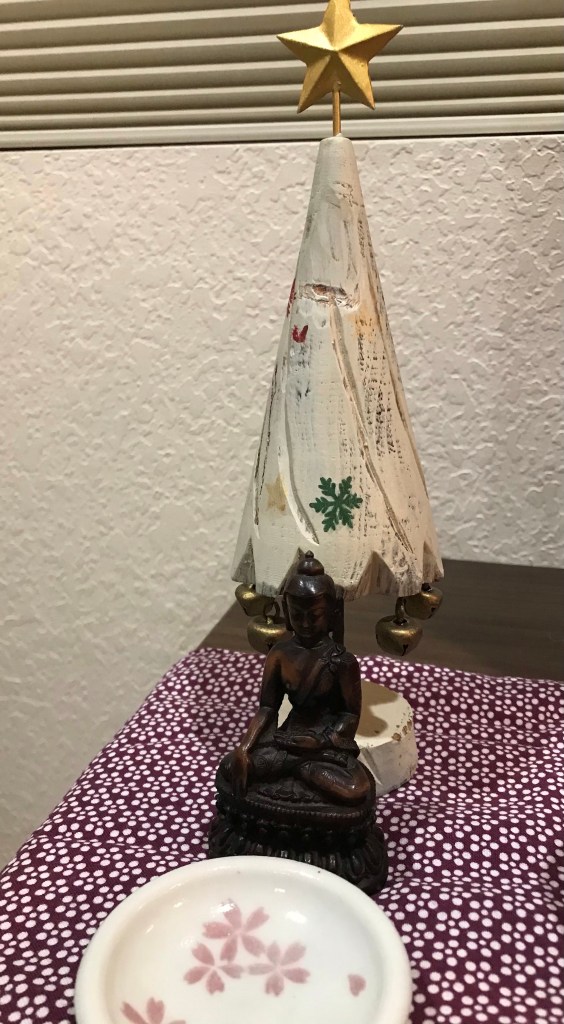
First, starting on December 1st, I make a special little altar with a statue of the Buddha sitting under a mini “Bodhi Tree”. We got a nice new, wooden tree this year from our local gardening nursery. In the past we had cheap-o plastic mini trees, so this felt like a much needed upgrade.
Around the altar, I try to keep the usual accoutrements: a small bell, an offering dish,2 and maybe a small incense holder.
Originally I tried doing a “Santa Claus”-like tradition, where the kids (just one at the time) would wake up with a new gift from the Buddha. Eventually I dropped the “Santa facade”, though. I never felt quite right about it. Nowadays, we just surprise the kids with a wrapped gift from mom and dad on Bodhi Day morning, usually restricted to books or something wholesome. However, last year I got my teenage daughter some girl Marvel graphic novels. Not very Buddhist, but she thought it was cool. 🥰
Finally, on Bodhi Day itself, we have a nice little celebration, including a special dinner for the wife and kids (this year doing delivery, obviously). Nothing fancy nor any dietary restrictions here. If I can share a little joy with the family, especially this year, I am usually content with that.
As for my personal practice, I’ve tried to observe different precepts on Bodhi Day. Some years, I’ve observed the Eight Precepts, other years the similar, though Mahayana-only Bodhisattava Precepts, but in more recent years I am less stringent with myself and instead just try to “live like a monk” for a day in that I avoid excess, speak kindly to loved ones, spend more time with the kids, and just strive to have wholesome, “blameless” conduct for a day. Undertaking any Buddhist ascetic training is pretty tough when you have kids, and so over time, I’ve learned to set more reasonable expectations on myself and try to live a sustainable life of good conduct. That doesn’t stop me from doing a little extra Buddhist chanting or meditation around this time though. 😌
That’s Bodhi Day in a nutshell over here. I’ll be posting more Buddhist-themed posts this week. Hope you enjoy and have a blessed Bodhi Day! 🖖
1 Buddhist altars, depending on the tradition, can be very ornate. This often surprises people who are new to Buddhism, and weren’t expecting gold-plated statues of the Buddha and such. Some of this comes down to particular traditions, but also as with all Buddhist art, there’s meaning behind everything.
2 Sadly, the offering dish pictured is just a like saké cup which is the perfect size and looks nice, but kind of rubs against the general Buddhist proscription against alcohol.
A print of a kasa-obake (傘お化け, “umbrella ghost”) made around 1850.
For Westerners, the “scary” time of year (besides tax season) is Halloween, but Japan has a similar tradition, called Obon (お盆) season which arose from a totally different set of circumstances, yet is an interesting example of convergent (and yet divergent) cultural traditions. Obon season in Japan varies by region: in the eastern “Kantō” part of Japan it’s around July 15th, while in the western “Kansai” part of Japan it is around August 15th. The reasons for this are due to certain political/historical reasons we won’t get into here. Despite the differences in timing, the traditions are still basically the same.
Obon, which literally means “serving tray”, is loosely derived from a Buddhist sutra called the Ullambana Sutra (盂蘭盆経; urabon-kyō in Japanese) wherein one of Shakyamuni Buddha’s chief disciples, named Maudgalyayana (or Mogallana), experiences a vision during a deep state of meditation. In this vision, he sees his mother trapped in one of the many Hell realms.1 His mother, while doting on lil’ Maudgalyayana, tended to bad-mouth others and did a lot of negative things all for the sake of her son.2
Maudgalyayana felt terrible about this, and resolved to help get his mother out of Hell, so he consulted with Shakyamuni Buddha, who said that if Maudgalyayana made offerings to the rest of the monastic community and dedicated the good merit to his mother, his mother would be liberated and could move onto a better rebirth. As the story goes, Maudgalyayana carried out the Buddha’s advice (hence the “serving tray” referring to Maudgalyayana’s offerings to the other monks). Having accomplished this, he later had a vision of his mother being liberated from Hell as a result.
Thus, in China and Japan this story has served as an inspiration for late-summer festivities that revere the ghosts of ancestors, offering gratitude to them, and so on. It’s an interesting example of how Buddhist teachings intermingle with local beliefs to create a cultural tradition (much the same way that Halloween is a mix of pre-Christian Celtic + early-medieval Christian traditions). It’s also why ghost stories are popular around this time. The famous book Kaidan (older spelling Kwaidan) by Greco-Irish author Lafcadio Hearn is a rare English-language window into some of these classics ghost-stories. I’ll post a few such stories later this week.
In practical terms, Obon has a lot of parallels with the Mexican Day of the Dead festivities. Offerings are made to one’s ancestors in the family Buddhist altar (butsudan, 仏壇), and families will also visit ancestral graves to clean them up and make further offerings there (ohaka-mairi, お墓参り). People often take time off around this time, or companies have work holidays (obon-yasumi お盆休み) to allow people to return to their hometowns, relax and get in touch with family again.
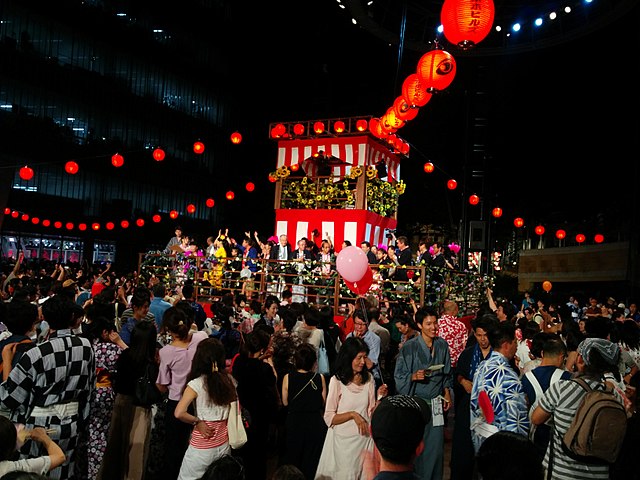
Bon-odori in Tokyo (Roppongi), courtesy of Wikipedia
The most well-known custom of Obon is the communal dance or bon-odori (盆踊り) which you’ll often find in overseas Japanese communities as well. I’ll post some videos or something soon of the Bonodori dances in my wife’s neighborhood, which we often visit around this time. My daughter, who’s now a teenager and knows a lot of the neighbors, helps volunteer at the local bonodori every year.
Anyhow, while Obon season is very much a Japanese tradition, it also has fascinating roots from both China and Buddhist India as well.
P.S. The July vs. August celebration of Obon happens not just between east and west, but can vary by region. Northern Japan also celebrates in August while the Tokyo area celebrates in July, and so on.
1 Buddhism, borrowing from earlier Indian cosmology, describes many hell realms and many heavenly realms. All of these are seen as temporary destinations on the even longer cycle of rebirth. For Buddhism, the larger goal is liberation from the near-infinite cycle of rebirth (Samsara, or “aimless wandering”) more than seeking out the “good” realms over the bad ones.
2 I think this often gets overlooked, but the Ullambana Sutra is a poignant reminder that not everything done for the sake of one’s kids is the right thing to do. Parents need to uphold good moral conduct in addition to good parenting. They’re not necessarily exclusive either. In simpler terms: don’t be a dick.
An old altar we setup years ago. The central image was purchased from Tsukiji Honganji in Japan and venerates Amitabha Buddha, the Buddha of Infinite Light.
I continue reading my new book on the eminent Buddhist scholar-monk Genshin (源信; 942 – 1017), and one part of the book summarizes Genshin’s approach to Pure Land Buddhism:
Aspiration for enlightenment.
Controlling one’s conduct.
Having deep faith.
Being sincere.
Remaining constant in one’s practice.
Remaining mindful of the Buddha.
Arousing the vow to be reborn in the Pure Land.
Let’s look at each one of these briefly.
Aspiration for Enlightenment has historically been a common topic in Mahayana Buddhism, and just means that one perceives the nature of reality and realizes that life is hard not just for oneself, but also for others. In so doing, one resolves to pursue the Buddhist path and in time help teach and liberate others too.
Controlling one’s conduct means slightly different things to different Buddhist teachers, but in general it means living a wholesome, clean, upright life particularly with respect to how you treat other people. The Five Precepts are an excellent benchmark to follow.
Having deep faith is a bit different than the concept of “faith” in Western religious culture. It is a sense of increasing confidence in the teachings that grows as one explores them. One’s faith is shaky at first, and that’s fine, but as one explores the Dharma further and further it is like a shot in the arm that helps them through good times and bad.
Being sincere is pretty self-explanatory: don’t be an ass.
Remaining constant in one’s practice is probably one of the harder elements, but in practical terms it means riding the highs and lows of life and finding a sustainable approach to Buddhist practice according to one’s circumstances.
Remaining mindful of the Buddha can mean somewhat differentthings to different Buddhists but in general it means holding the Buddha in one’s thoughts as they go about their practice and their daily lives. In modern American English: WWBD (what would [the] Buddha do?)
Arousing the vow to be reborn in the Pure Land simply means that rather than simply dabbling in Pure Land Buddhist practices, one explicitly wants to go there. This is closely related to the aspiration for Enlightenment because the intention of the Pure Land is not a blissful, heavenly realm so much as a place that is highly conducive toward the pursuit of the Buddhist path.
Way back when in 2005, I got my first exposure to Pure Land Buddhism in the city of Kyoto at a famous temple named Chion-in, where I saw a lone monk chanting evening prayers before a statue of the Buddha. Something about that moment made a real impression on me and I carried that back to the US, where I found some good resources on the Jodo Shu school of Pure Land Buddhism.¹ As a zealous new follower, I started out reciting the nembutsu (or, “namu amida butsu”) almost daily. I would often recite using my double-ringed rosary 1080 times in roughly 15 minutes intervals, sometimes more than one.
Back when I was living on a smaller budget, I made a Buddhist altar using a balsawood box lid and an image of Amitabha Buddha taped on the inside.
But then life happened: I got busier with work, raising two kids, etc. By and by my recitations have gotten fewer and fewer, and further and further apart.
Some Buddhists that I meet are shocked when I tell them that there are weeks where I don’t recite the nembutsu at all, and sometimes I myself have gone through periods of regret and guilt over this. At such moments, Imposter Syndrome rears its ugly head and I wonder if I should quit Buddhism.
But where does all this come from and why does it matter?
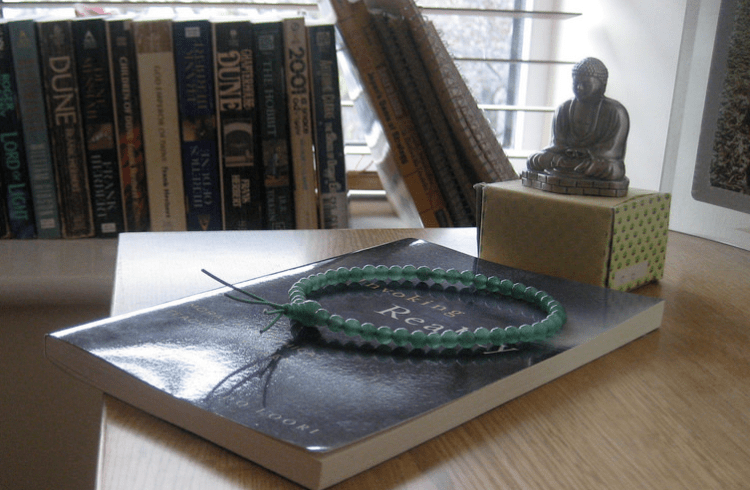
A slight upgrade from the previous altar we used while living in Ireland from 2008-2009. The statue is a souvenir from the Great Buddha of Kamakura.
Unlike some religions based on a single book, Buddhism has a large collection of “sutras” which are reputed to be sermons of the Buddha that have been passed down.² For Pure Land Buddhism, the core sutra is the Sutra on the Buddha of Immeasurable Life sometimes called the “Larger Sutra”, which is the largest of the three Buddhist texts that are central Pure Land Buddhism. You can’t have Pure Land Buddhism without the Larger Sutra, basically.
The Larger Sutra, among other things, is an origin story (think: Marvel comic superheroes 😋) of Amitabha Buddha, the Buddha of Infinite Light. As part of this origin story, it is said in that sutra that Amitabha Buddha made 48 vows that he would accomplish before completing his quiet for Enlightenment,³ but traditionally the most important is the so-called primal vow or 18th vow:
設我得佛。十方衆生至心信樂。欲生我國乃至十念。若不生者不取正覺。唯除五逆誹謗正法
(18) If, when I attain Buddhahood, sentient beings in the lands of the ten quarters who sincerely and joyfully entrust themselves to me, desire to be born in my land, and call my Name, even ten times, should not be born there, may I not attain perfect Enlightenment. Excluded, however, are those who commit the five gravest offences and abuse the right Dharma.
(trans. by Professor A.C. Muller)
Honen, who was something like the father (or grandfather?) of Pure Land Buddhism as a distinct sect in Japan, gathered a large array of followers and disciples, both monastic and secular, and among these disciples there was a broad spectrum of interpretation.
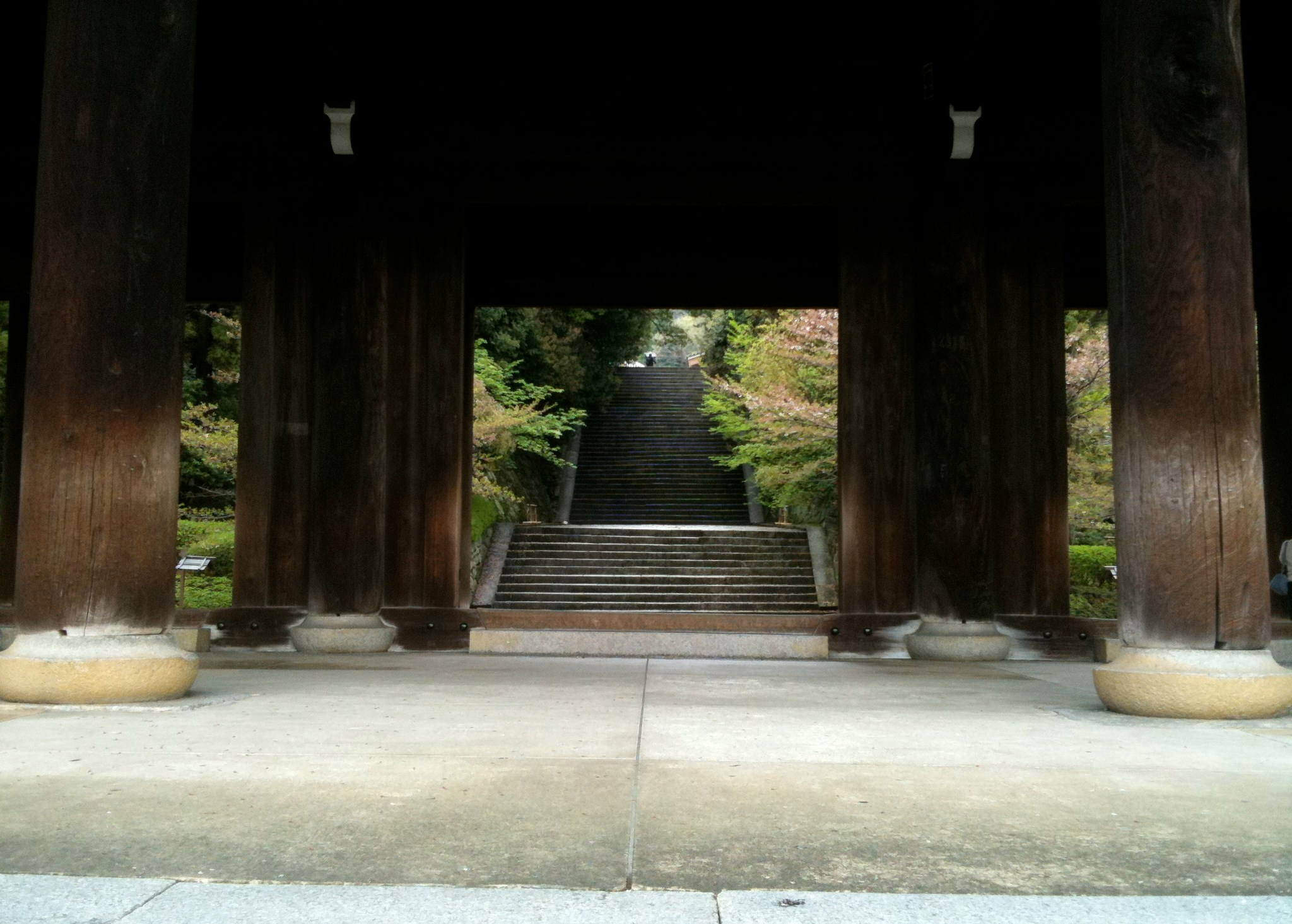
Chion-in Temple in Japan is famous for its large “sanmon” (山門) gate. I took this photo on our second visit to Chion-in in 2010. Chion-in is one of two head temples or “daihonzan” (大本山) of the Jodo Shu sect of Buddhism, the other being Zojoji in Tokyo.
At one extreme end among Honen’s followers was Kōsai (幸西, 1163 – May 20, 1247) who briefly started a movement called the “One-Recitation Doctrine” (ichinen-gi, 一念義). The idea was that if one truly had faith in Amitabha Buddha, they would recite only once and entrust Amitabha Buddha’s compassion from there forward. Even if one lived a rotten life thereafter, if they maintained that faith, they would certainly be reborn in the Pure Land. Shinran, who later founded the off-shoot Jodo Shinshu sect, leaned in this direction, but under his 8th successor, Rennyo, this idea was further developed. For Rennyo, reciting the name of Amitabha Buddha was really nothing more than an expression of gratitude toward the Buddha’s compassion. This sense of faith and gratitude underscores a lot of Jodo Shinshu (and general Japanese-Buddhist) thinking even in modern times.
At the other end was Ryūkan (隆寛, 1148 – January 21st, 1228) who led the “Many-Recitation Doctrine” (tanen-gi, 多念義) who felt that the name should be recited constantly. This was a tool to help fix one’s mind on Amitabha Budha, accumulate more and more positive karma which paved the way for rebirth in the Pure Land, but also an affirmation of Amitabha’s vow. In medieval times, both in China and later Japan, this could mean tens of thousands of recitations per day for monks and nuns. Even lay people were encouraged to recite as much as was reasonably possible as long as it didn’t affect one’s livelihood. Benchō (弁長, June 20, 1162 – March 16, 1238) who went on to found the main “Chinzei branch” of the Jodo Shu sect leaned in this direction, though arguably took a more middle-of-the-road approach. Nevertheless, Bencho did expound the value of reciting the Buddha’s name as a routine practice.
Honen, himself, tried to strike a balance between these extremes with the following quotation attributed to him: (source)4
Again, to say that frequent repetitions of the nembutsu [the Buddha’s name] mean the encouragement of the principle of self-power (jiriki) shows total ignorance of facts and is an awful mistake. Even one repetition or two of the sacred name can be said to be the nembutsu of salvation by one’s own power, if one does it with that thought in one’s mind. But a hundred or a thousand repetitions day and night for a hundred or a thousand days can be the nembutsu of salvation by Amida’s power alone (tariki), as long as one does it with an entire trust in the merits of the great Vow, looking up in confidence to Amida with every repetition.
as well as:
Honen once said, “It’s important that you should never forget the repetition of the nembutsu. Keep it in mind continually. Even though you do impure things or speak impure words, it is a fine thing to keep your heart pure and to say the nembutsu over and over again without stopping it even for a moment. If you go on repeating it at all times and under all circumstances, it will finally bring you to ojo [往生, rebirth in the Pure Land] – no doubt about it.”
So, Honen definitely seems to lean closer to the “many recitations” camp, but only so long as one does it with faith in mind. Dry, repetitions for the sake of just doing it, or some contrived strategy, doesn’t really mean much. On the other hand, Honen also seems to imply that there’s always value in reciting the nembutsu, even if one’s heart is not entirely in it.
In other writings, Honen warned that relying too much on faith tended to make one lazy and risk back-sliding. Too much reliance on practice might make one forget the power of Amida’s vow.
Back to the original question, Honen and other past Pure Land teachers definitely implied some kind of daily practice, as a way of avoiding complacency if nothing else. For monks that often meant hours and countless thousands of repetitions per day, while the answer was more vague for lay followers. The expectation was that followers would adapt it somehow into their lives and recite at a suitable cadence. However, a daily routine was only as good as one’s devotion to Amitabha Buddha. It is important not to let the practice get rote or stale, so Honen even encouraged the occasional “nembutsu retreat” where one would shut themselves from the world for a bit for extra contemplation and recitation.5
As for me, perhaps it’s time to revisit my practice and make a new commitment. I wrote this post partly for my own benefit, but also for new Pure Land Buddhists who may be struggling with a sense of inadequacy in their own practice. Imposter Syndrome is a real thing, and it gets in the way of Buddhist practice. Reciting the nembutsu even once a day is much better than not doing it at all, or doing it in lengthy “bursts” that wear one out and aren’t sustainable.
Like a river that slowly shapes a valley, even small bits of Buddhist practice applied over a very long period of time can have a powerful outcome.
¹ I’ve visited Chion-in again some years later, and it was still great. We also visit the other head temple of Jodo Shu Buddhism, Zojoji near Tokyo Tower yearly as well. It’s our “power spot” as the Japanese say: our place to spiritually recharge. More on that in another post.
² Sutras in Buddhism are a complicated topic for another day, but all you need to know is that there are a lot of them, covering various subjects, composed at different periods of time, and reflecting different times and places in Buddhism. The idea isn’t so much that they represent literal sayings of the Buddha, but that they “rehash” and retell the Buddhist teachings across the generations. Think of it like a famous TV or movie franchise, which reboots itself from time to time. Sometimes the reboots are good, sometimes they’re lousy, but they’re still the same basic story retold over and over.
3 Also known as the path of the Bodhisattva, but that’s a story for another day.
4 The site is long gone, sadly, but the Wayback Machine has an archive of the site. The updated Japanese-only site is here.
5 As opposed to modern Buddhist “retreats” that cost thousands of dollars and are sometimes led by monks of questionable ethics. Indeed, Honen’s disciple Bencho once famously remarked:
People maintain that the best place for a life of retirement is the Kokawa Temple or Mount Koya. But as for me, there is nothing to compare with the bed from which I rise every morning.
Truly, the best Buddhism is the Buddhism you carry with you every day.🥰





 Gleanings in Buddha-Fields


You must be logged in to post a comment.