A few years ago, when the family and I visited Japan for my mother-in-law’s funeral, we had a long visit with the temple family who presided over the funeral. Their family and my wife’s have known each other for generations; their kids have grown up with my kids and so on. We are pretty close.
The father, who runs this small parochial Jodo Shinshu-sect temple,1 enjoys sharing Buddhist insights and discussions with me, and in spite of my language limitations, I always look forward to the conversation. He also makes excellent homemade umeboshi in his spare time.
Anyhow, he mentioned that many families in Japan have leftover Buddhist altar goods after grandparents pass away, and so he entrusted us with a statue of Amida Buddha shown below. It had been sitting in storage for a long time, and since such goods are far less common in the West, I think he wanted to help deal with surplus, but also help Buddhism overseas. Needless to say, we were grateful.
The challenge after we came home was that we didn’t know where to put it. It was too big for our altar, so we put it on top of a bookshelf, but the bookshelf was remote so we didn’t see it much. But then, my wife decided to put it near the front door mezzanine like so:
Once we did this I noticed a change in pattern. Because we pass by it constantly, I started reciting the nembutsu more. Since we go up and down the stairs all day, having the Amida Buddha statue there is a nice reminder, and it’s easy to find 30 seconds in the day to recite the nembutsu. Plus we sometimes light incense, and so on.
This is a long-winded post, but this experience made me realize that Buddhist practice doesn’t just depend on willpower and self-discipline, environment matters too. Simple changes in environment or routine can go a long way.
Namu Amida Butsu
1 it might surprise some readers to learn that many Buddhist priests in Japan marry and have kids. There’s a lot of complex, historical reasons that I can’t go into here. Plus, Jodo Shinshu has, since inception, been an exclusively lay-oriented sect anyway. I neither condone nor condemn it, it’s just how Buddhism is practiced there.
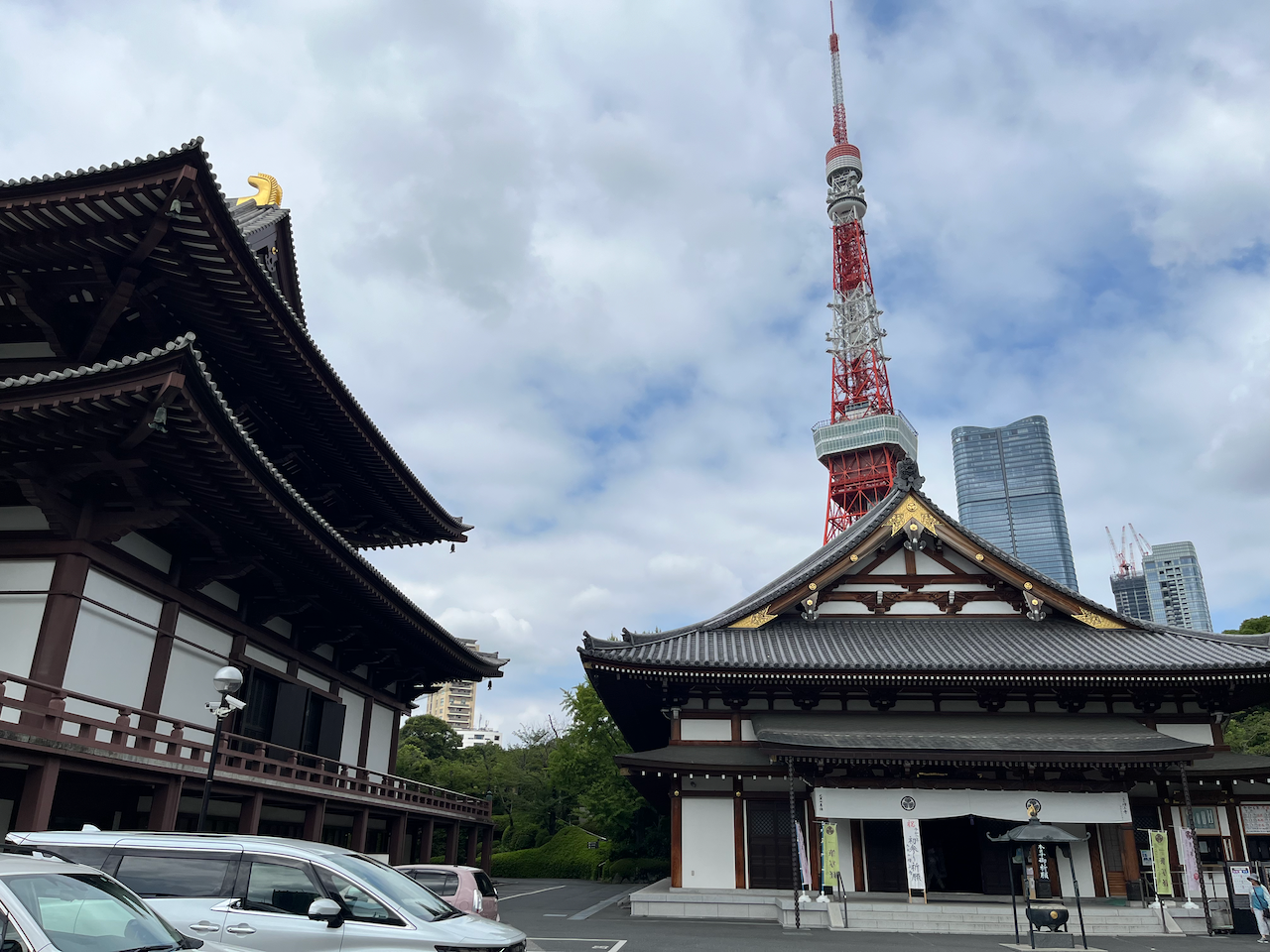
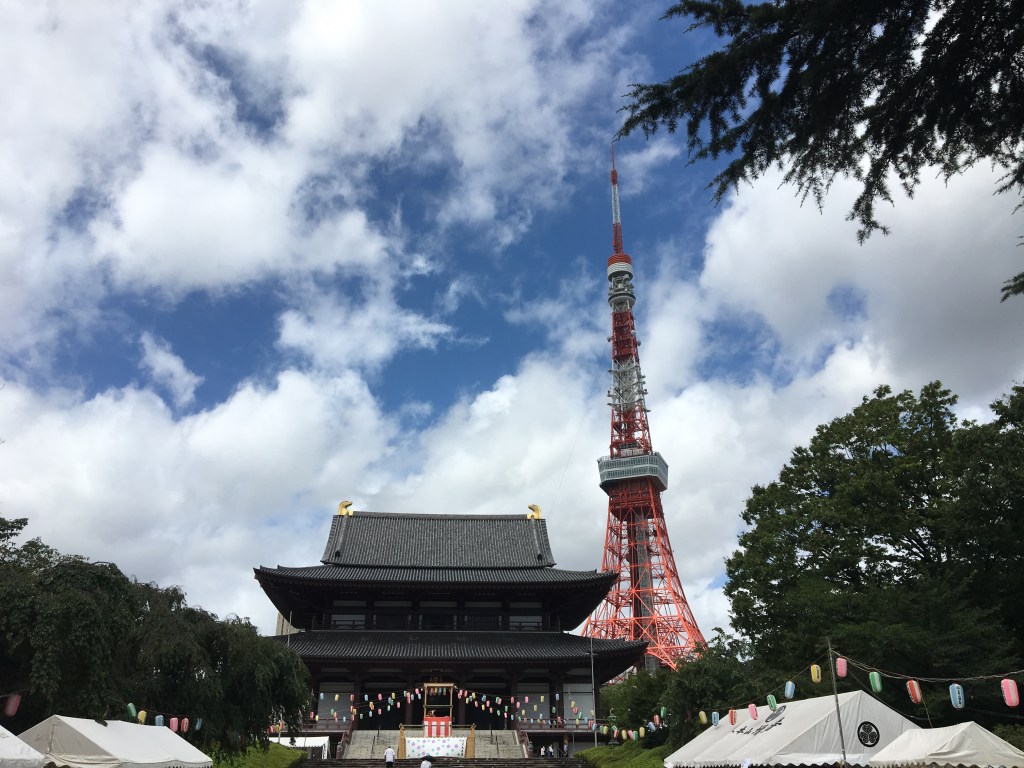
Visiting the city of Tokyo is not complete without taking a stop at the iconic Tokyo Tower. But what a lot of visitors might not know is that right next to Tokyo Tower is a Buddhist temple of great historical and cultural value: Zojoji
The temple of Zōjō-ji (増上寺) was the family temple for the Tokugawa shoguns who ruled Japan from 1600 to 1868 (e.g. the Edo Period), and many of the shoguns are interred here. The temple is also one of two main temples of the Jodo-shu sect of Buddhism. Jodo-shu Buddhism really helped me find my foundation back in the day, so I am more than a little fond of it. I have also visited the other main temple, Chion-in, in Kyoto a couple times. My first visit in 2005 is what really started me on the path to Buddhism back in the day. So, it’s no exaggeration that without the Honen the founder and Jodo Shu sect, I wouldn’t have found my path. I am always grateful.
In any case, wife (who’s Japanese) and I both like to come to Zojoji whenever we can. We joke it’s our “power spot”.1
The prestige and political power of Zojoji meant that it has been a very important temple in the Tokyo area for centuries, probably more so than Sensoji / Asakusa Temple (which I am also quite fond of).
The English website for Zojoji is actually pretty good, but it leaves out some details found in the Japanese version. Every time I go, I see foreign tourists dropping by, but I suspect some of them are unaware of the history and teachings of the temple, which is a shame because it’s actually a pretty neat place. So, this post is a lengthy tour of Zojoji. If you are reading this through email, you may want to visit the link instead. This post is VERY picture-heavy.
The Japanese site has a nice map of temple. I started at the bottom-center, at the Sangédatsu-mon (三解脱門), which might translate into something like the Three Gates of Liberation:
To the left of the gate is a sign that posts a monthly Buddhist teaching.
This month’s (August 2024) teaching is a quote from the very early Buddhist text, the Dhammapada, verse 54:
Not the sweet smell of flowers, not even the fragrance of sandal, tagara, or jasmine blows against the wind. But the fragrance of the virtuous blows against the wind. Truly the virtuous man pervades all directions with the fragrance of his virtue.
From here, I passed through the gate and took a photo of this statue of the Bodhisattva Kannon:
Next, based on the map linked above, I went clockwise around the perimeter of the temple. The next thing I saw was this pagoda (gojū-no-tō 五重塔 in Japanese) which seems to have been built in 1938:
It sits next to the other gate to Zojoji, the Kuro-mon (黒門, “black gate”) which was built in the 1700’s.
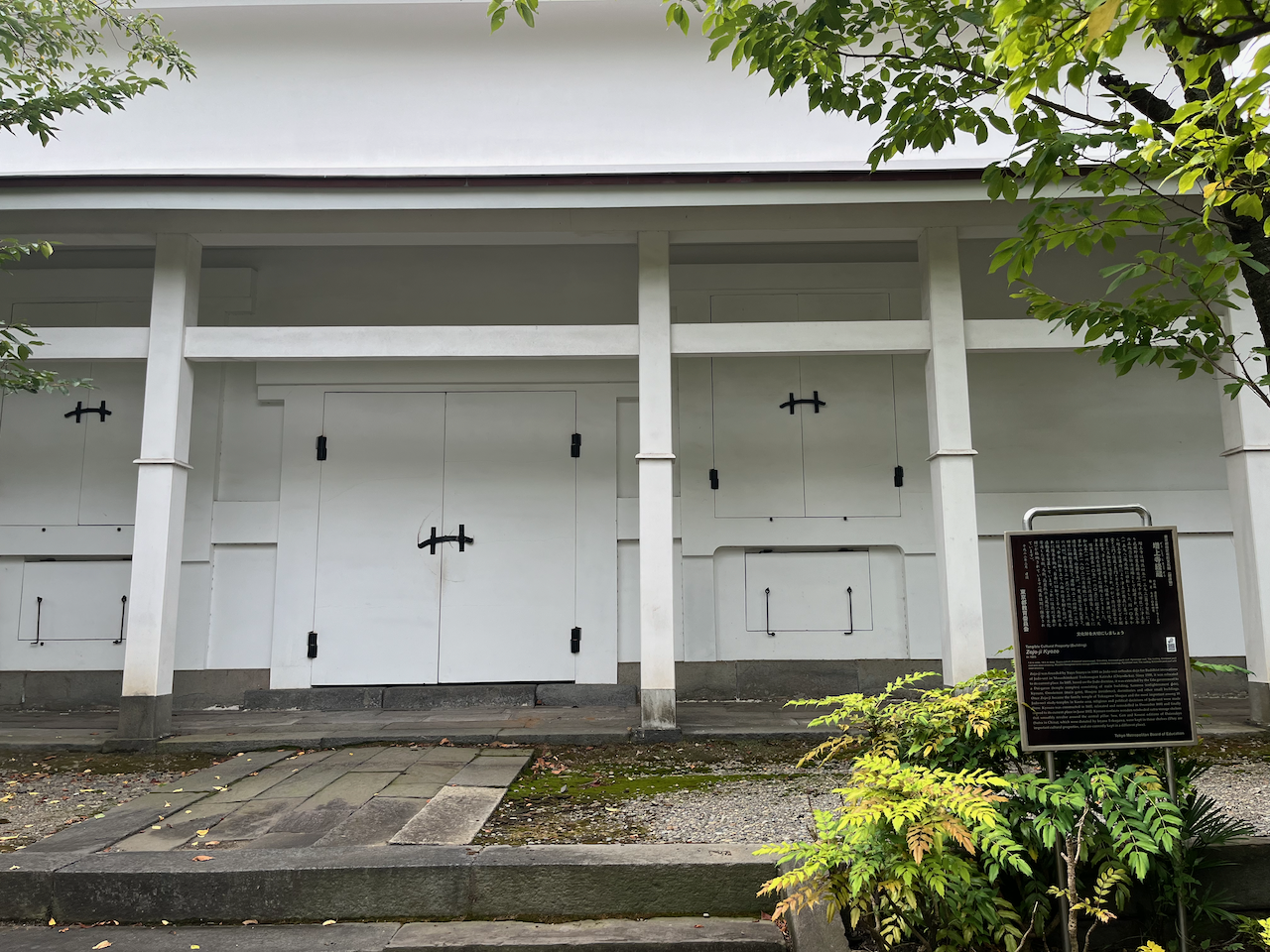
Just north of this (still going clockwise), you can see the Sutra Storehouse (kyōzō 経蔵):
This is something major temples often have: a large store house that contains the vast corpus of Buddhist literature (sutras): the Tripitaka. Sadly, I came too early in the day, and so the doors were closed. If you click on the map above, and look in the bottom left for 経蔵 you can see photo of the interior. It contains a full copy of the Taisho Tripitaka, in three different versions, in a rotating shelf.
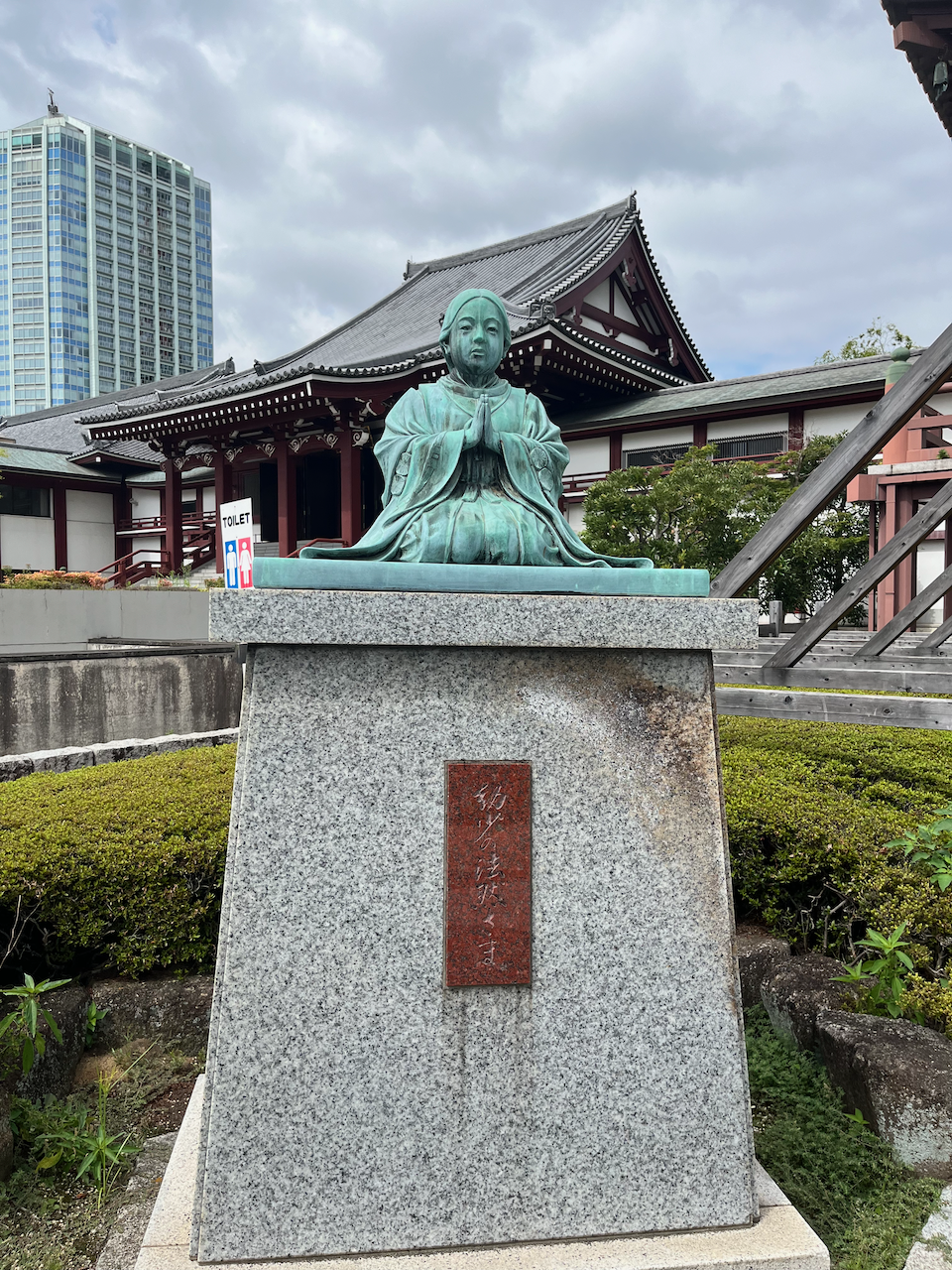
The left area of the map mostly contained meeting halls and offices, so I kind of skipped past this quickly, and headed toward the main hall (hondō 本堂). This is in the very center of the map. Just to the left of the stairs is a nice statue of the 12th century founder of the Jodo-shu sect, Honen, in his youth:
There are some famous stories about his life (somewhat embellished, I believe), including his piousness at a young age. Hence, you often see Jodo-shu temples with status of young Honen. That said, Honen is a cool guy, and he gets my respect any day.
Next is the main hall itself:
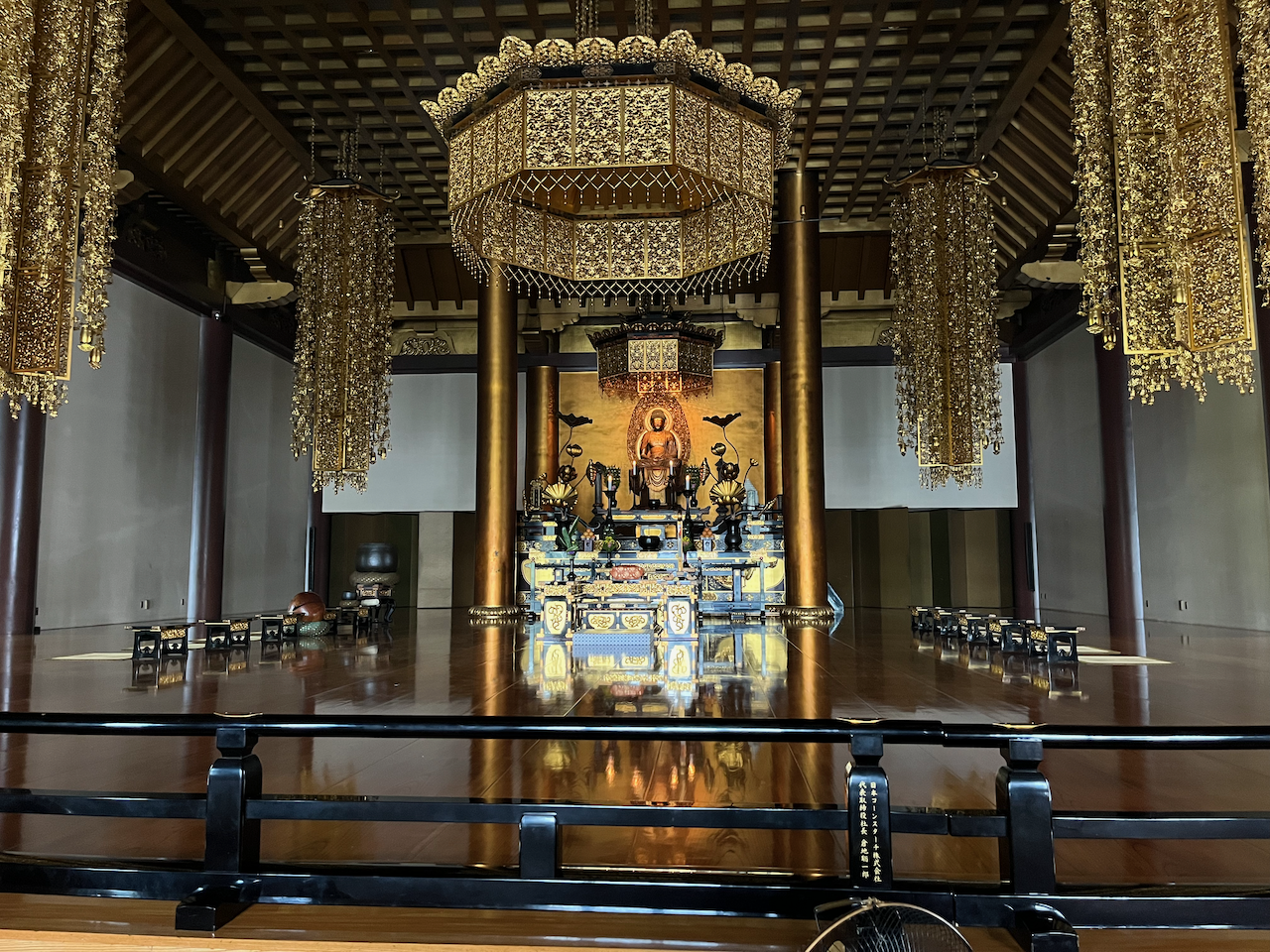
This place is pretty amazing inside. Also, unlike many temples, you do not need to remove your shoes at the door and you are welcome to take photos (except during funeral services, obviously):
The main altar is to Amida Buddha, the Buddha of Infinite Light, and the devotion of all Pure Land Buddhists across traditions. The gold color and lotus artwork are all taken from descriptions of the Pure Land, as described in the Sutras. It is said all beings reborn in the Pure Land will have the color of gold, just like Amida, and will be born from lotus buds. The Taima Mandala, not related to Zojoji, provides a nice visual representation.
To the left and right of the main altar are Honen, mentioned above, and Shan-dao the Chinese Pure Land master who inspired Honen back in the day, respectively. They lived centuries apart, but both are revered for their contributions to the tradition.
To the right of the main hall you have two choices: one you go down the stairs to the Museum. Or go to the Ankokuden Hall:
We’ll talk about the museum a bit later. For now let’s focus on the hall. Inside is both a gift shop and another altar to Amida Buddha:
This statue of Amida Buddha is historically significant though: it was the same statue venerated long ago by Tokugawa Ieyasu, the first Shogun of the Edo Period, and final unifier of Japan. This black-colored Amida statue had been a central devotional figure of the Tokugawa Shoguns for generations, so while it’s not the “main attraction” for tourists, from a historical standpoint, it is. I’ve seen it multiple times, and I never get tired of being here.
As alluded to earlier, there are shrines to the left and right of the Amida Buddha. The one on the left is of the founder of the Tokugawa shoguns,2 Tokugawa Ieyasu described above. The one on the right is less clear. It enshrines someone named Princess Kazunomiya. I had to do a bit of research and it turns out that Kazunomiya was a member of the Imperial family (not the Tokugawa family), but had been wed to Tokugawa Iemochi the 14th Shogun as a political marriage intended to heal the centuries old breach between the two families. The arranged marriage had a rocky start, but in the end proved to be a surprisingly happy and successful marriage at a time when Japan was in the waning days of the Shogunate. So, within the Tokugawa family temple, she is enshrined as an important matriarch.
We’ll see more monuments to Princess Kazunomiya shortly, so remember the name.
Anyhow, after picking up some nice incense and another seal in my pilgrimage book, I left the Ankokuden Hall. To its right is a line of statues.
The statue in the front is Bodhisattva Kannon, similar to what we saw earlier.3 There is a small altar to the right as well with another statue of Kannon that is often overlooked:
This is the “Western-facing Kannon”. The western-direction in Mahayana Buddhism is strongly associated with the Pure Land of Amida Buddha (by contrast, the eastern direction is associated with the Medicine Buddha’s own Lapis Lazuli Pure Land), and since Kannon is an attendant of Amida Buddha, this tracks.
But what about the little statues with red bibs?
These statues represent another Bodhisattva named Jizō. I haven’t talked about Jizo as much in this blog, but he’s very important in Japanese religion as a kind of protector deity, especially of children. Each statue adorned with a bib represent a child that was lost in pregnancy or in childbirth, and so the grieving parents pray to Jizo to protect their child in the life beyond. The clothing is an offering to Jizo, perhaps to pass on to the child?
While the statues are very cute, there is a tragic meaning behind them as well.
The line of statues continues back behind the Ankokuden and Hondo (main hall). It is here that you come upon the mausoleum of the Tokugawa Shoguns.
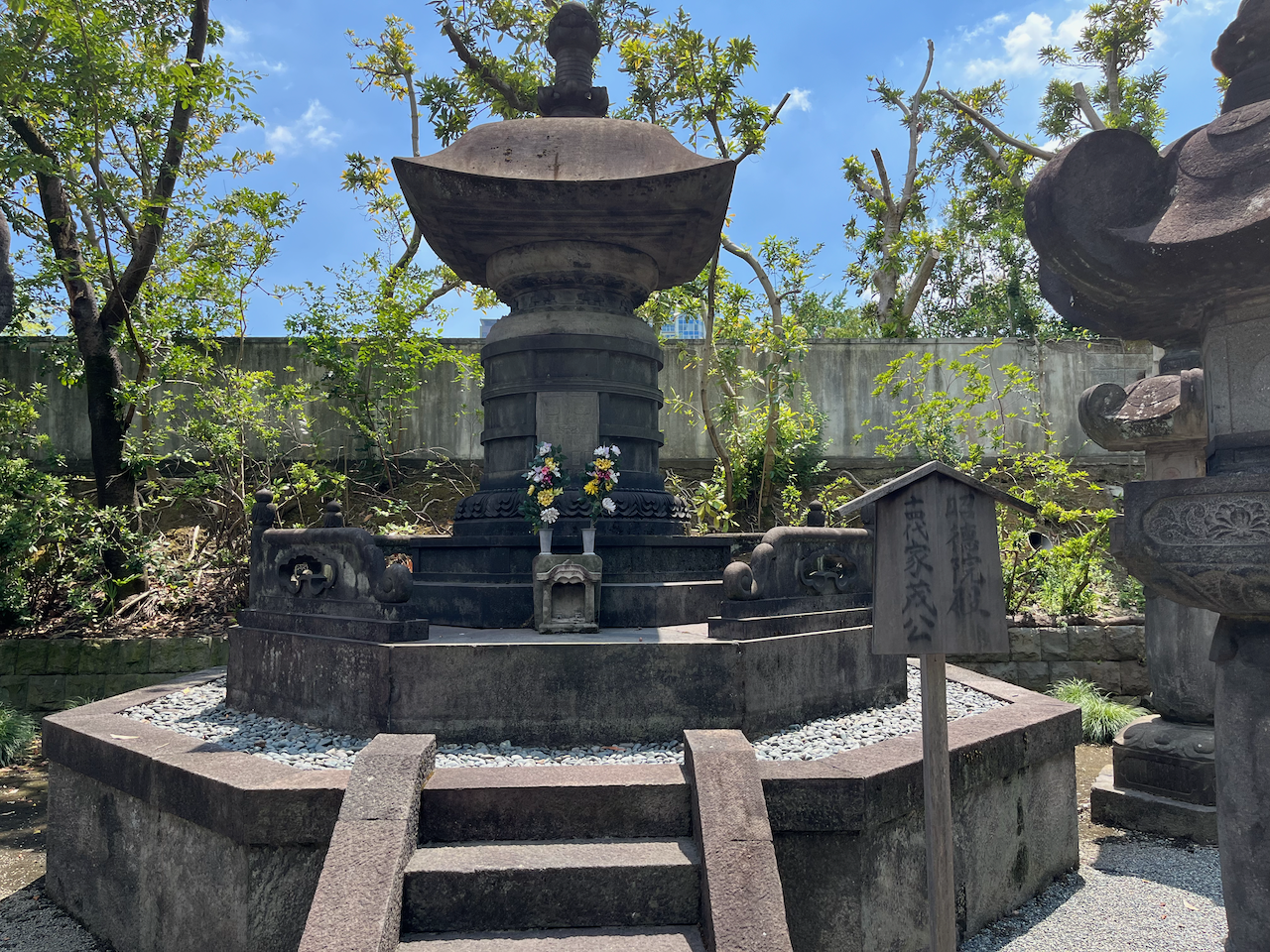
Not all shoguns are interred here. Some are interred in a shrine called Toshogu up north in Nikko. I would estimate that roughly half of the shoguns are interred here. I won’t show them all, since the map and pamphlet you receive at the ticket booth shows a full list. But to give a few examples…
The second shogun, Tokugawa Hidetada and his wife are interred here. Edo (Tokyo) was greatly expanded during his administration from a tiny fishing village to the city we know today.
From the mausoleum entrance, if you were to go further left you will see this statue:
Without getting too bogged down in details, the four statues here represent four major Bodhisattvas in the Mahayana-Buddhist tradition. From left to right with Sanskrit (and Japanese) names:
Manjushri (Monju)
Avalokitesvara (Kannon)
Ksitigarbha (Jizo)
Samanthabhadra (Fugen)
It’s actually quite rare to see all four arrayed like this. I was kind of impressed. It is said these statues were created in the year 1258 according to the plaque.
Further left:
If you go up the stairs and turn right…
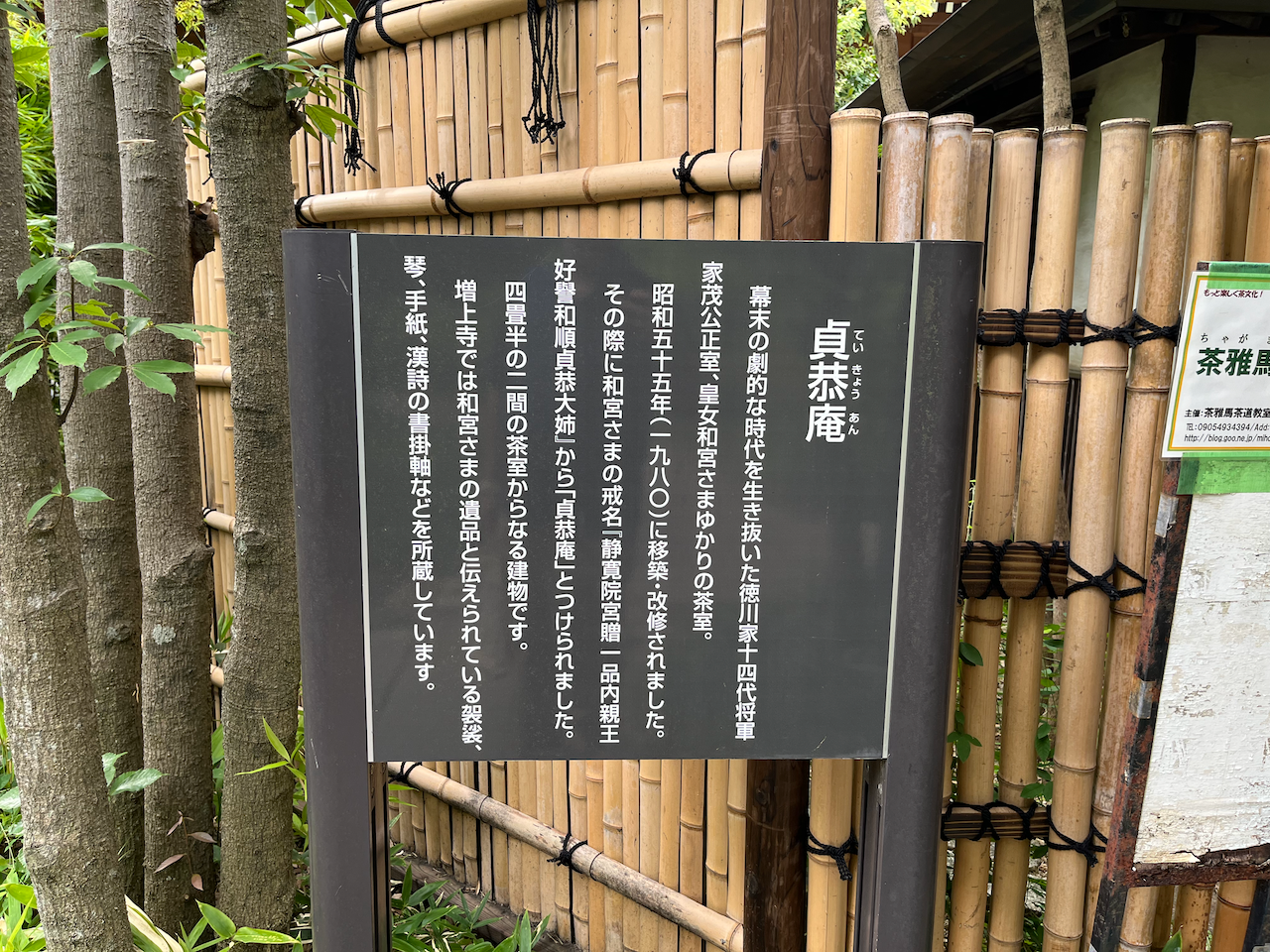
You can find the tea house of Princess Kazunomiya called the Teikyōan (貞恭庵):
Since Princess Kazunomiya took tonsure as a Buddhist nun in her final years, she took the ordination name Teikyo, so the name of the place is basically “Princess Kazunomiya’s hearth”. The sign said that it was refurbished in 1980 and is used for some public functions. It was closed when I came so I didn’t get to see much.
Facing the tea house is another statue of Kannon Bodhisattva in a more motherly form.
Past the tea house and up some stairs is this place, which is the upper part of the map:
It turns out that this is a columbarium: a storage house for the bones of the deceased after cremation. This is common in Buddhist temples. This columbarium in particular houses the bones of those who are somehow connected to the temple across the generations. Beyond that, the website didn’t provide an explanation.
By this point I wanted to see the museum but again I had arrived too early so I stopped by a local McDonald’s for brunch:
On the way out, I also took photos of the Buddhist bell (bonshō 梵鐘) as well:
And a small Shinto shrine to the right of the main entrance:
This Shinto shrine, called the Yuya (熊野) Shrine, was founded in 1624 by the 13th head priest of Zojoji, one Shoyo Kurayama, to protect the north-east corner of the temple from disasters. The north-east is seen as a particularly dangerous direction in Chinese geomancy (a.k.a. feng-shui), so the kami here provide protection. It is not unusual to see small Shinto shrines within Buddhist temples, and many Shinto deities are viewed as manifestations of Buddhist deities (gongen 権現) by Japanese in medieval times. The sign next to the shrine states that 3 kami reside here:
Ketsumiko-no-ōkami
Ōnamura-no-mikoto
Izanagi-no-mikoto (as in Izanagi from early Japanese mythology? I am not sure)
These three kami all seemed to have been imported from a trio of Shinto shrines called the Kumano shrines, which have a strongly syncretic Buddhist-Shinto worship. I didn’t even know the Kumano shrines existed until I wrote this article. Side note: the Chinese characters for Kumano (熊野) can be alternately read as “Yuya”, hence “Yuya Shrine”.
Anyhow, having satiated myself on McD’s, it was time to go back and visit the Museum…
Much of the museum doesn’t allow photography, but showed the history of Zojoji. As it is being restored from earlier destruction, there wasn’t actually that much in the museum.
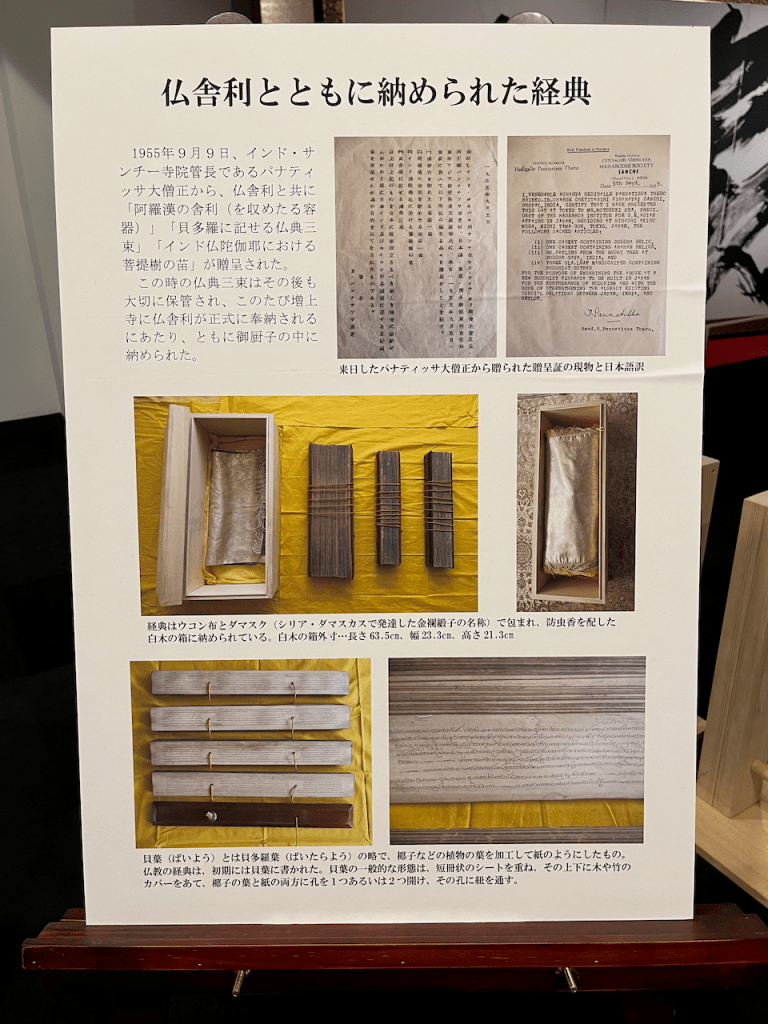
However, what the museum also had (and OK to photograph) was a genuine relic of the Buddha, as in Shakyamuni Buddha, the historical founder. It also contains relics of Rahula, the Buddha’s son before his enlightenment, and Ananda, his trusted retainer. As the sign shows above, the relics were uncovered at Sanchi, which is an important Buddhist archeological site. The relics were given to Japan as a gift in 1955 and enshrined right under Zojoji. You can see
A display to the right shows the contents, and the letter from India to Japan. In addition to fragments of the bones of Shakyamuni Buddha, Rahula and Ananda, the contents included recovered copies of Buddhist sutras that were inscribed on palm leaf at the time, and a seed descended from the original Bodhi Tree.
In my nearly 20-25 years as a Buddhist, I had never come face to face with a relic of the Buddha before, so I was kind of awestruck. The small wooden plaque just in front of the small statue of the Buddha contained a small prayer that reads:
Recite 3 times: namu shaka muni bu (praise to Shakyamuni Buddha)
I don’t have a translation of this hymn, but after a bit of late night sleuthing, I suspect it’s a verse from a Buddhist text called the Humane King Sutra. I don’t think there’s an English translation anyway.
In any case, I recited the verses of praise to Shakyamuni Buddha and finally went home.4
But that concluded the trip to Zojoji. Usually, I go with the family, and we can’t afford to spend half a day there, but this time I had some free time and was able to really take in all the sites of Zojoji. As a historical site, Zojoji is very dense and fascinating. It’s hard to imagine centuries of history, all closely tied to the Tokugawa shoguns and the Jodo-shu sect all in one place. The relic of the Buddha alone is pretty amazing too.
This post was pretty long, but I hope you enjoyed.
P.S. I didn’t really provide a lot of links to Jodo Shu Buddhism, since I talkaboutitquiteabit in the blog already, and many of the English sites have sadly atrophied or disappeared over time. I would definitely recommend various books such as A Raft from the Other Shore or Traversing the Pure Land Path, but these are mostly out of print now. I have done what I could over the years to distill many of these lost sources into an accessible format here, but there’s still plenty to find if you know where to look.
1 This is actually a slang phrase in Japanese too, taken from English: pawaa supotto (パワースポット), meaning any place that inspires you spiritually.
2 Without getting too bogged down in history, think of a shōgun (将軍) as the Imperial-appointed “General Commander of the Armed Forces”. The role has changed and evolved over generations, but suffice to say if you were the shogun, you were the real, not symbolic, authority in Japan.
3 The astute might be wondering why a temple devoted to Amida Buddha also contains so many statues to another figure like Kannon. In Mahayana Buddhism, the two share a close relationship. It is described in the sutras who Amida Buddha is attended to by two Bodhisattvas: Kannon and another named Seishi. Kannon has an outsized following of their own, but the two are frequently depicted together, as both embody the universal goodwill and compassion that are hallmarks of Mahayana Buddhism. Seishi, admittedly, isn’t described much in the Buddhist texts, and thus isn’t revered much on their own.
4 Actually, I stopped along the way at Akihabara because I had never been there. That place was … not for me. Nerdy, but in a very different way. I did have some good fries at a Turkish cafe in Akihabara for dinner, thanks to Mustafa the chef. Very nice fellow. If you are in Akihabara, stop by his cafe and get some good Turkish food.
In June, I posted about the “day” and “night” concept used in Tendai Buddhist practice, using the example of the Jimon sect. I felt inspired to experiment a bit and try this out myself. My adjustments to home practice took a few twists and turns, but within a week or so I settled onto a consistent routine that I’ve been happy with.
Here’s what I’ve been doing for the past month, more or less.
I have found that splitting the practice like this has had some benefits. For me, this style of practice lets me cover both the here and now, through veneration of Kannon and reciting the Heart Sutra, while also looking to the future through venerating Amida Buddha through the evening practice. I feel pretty content covering both aspects.
I made both morning and evening routines intentionally short and lightweight so they are more sustainable, rather than doing something elaborate.
Still, to be honest, sometimes I am still too busy to even do this much. Or I just forget. 😅
I am not proud of that, but I felt I should be honest with readers and let them know that mistakes in Buddhist practice are perfectly OK. Life is unpredictable, and for us are “householders” (e.g. lay-Buddhists), life gets in the way. That’s why the monastic community was (presumably) created: to give people the option of practicing Buddhism full-time, not part-time.
That said, Buddhist practice is like exercise: the more you can do, the better. Even a little bit is a positive thing.
Anyhow, when I am simply busy, sometimes I will just recite either the Kannon mantra in the morning, or the nembutsu in the evening. Sometimes, I can only just bow at the altar for a moment.1 The Soto Zen resources I read previously often said much the same thing: adjust as needed, depending on how busy you are. Sometimes your home practice will be longer, sometimes shorter.
Just don’t give up.
Keep experimenting, keep trying, make it personal, and always be flexible.
Good luck and happy … er, “Buddhist-ing”.
P.S. I took a nice, relaxing weekend off to catch up on some things, avoid social media, and just unplug for a bit. I didn’t really have a plan, I just took a break. I may have also played some Fire Emblem games as well. The fun continues. 😀
1 To make this “split service” work, I have two altars now at home: the main one for Amida Buddha and tiny little “side altar” for Kannon on my bookshelf. It’s basic, but it’s something I can keep building on over time.
Lately I’ve been talking a lotabouthomeBuddhistpractice, including home Buddhist services and such. These are things that devout lay-Buddhists often do (myself included), but then I realized I never talked about making one’s own sutra book.
There are a couple reasons why one might make their own.
First, Buddhist resources outside of Buddhist countries are hard to find. For someone like me who lives on a large city with a large Asian community this is not so hard. But if you lived in, say, rural Iowa, it might be a lot harder. So, sometimes you have to just DIY.
Second, it’s a nice way to personalize your Buddhist practice in a way that suits you.
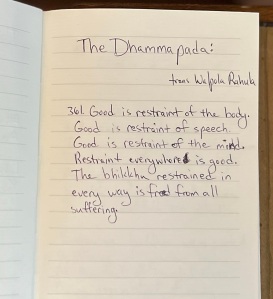
I started making my own maybe about 9-10 years ago. I picked up a nice little Paperblanks notebook at the airport at the time, and I decided to collect Buddhist sutras and quotes that I liked. I started out small, just copying things now and then from sites like accesstoinsight.org, or copied from books.
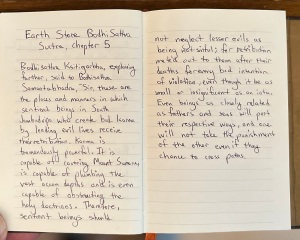
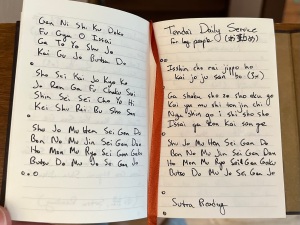
I also recorded Mahayana Buddhist sutras as well, such as this quote from chapter 5 of the Earth Store Bodhisattva Sutra:
I copied each of these by hand. I even tried to copy much longer texts, such as the 4th chapter of the Golden Light Sutra, which is a very beautiful prose about repentance and goodwill, but the text was much longer than I thought, and I eventually gave up halfway.
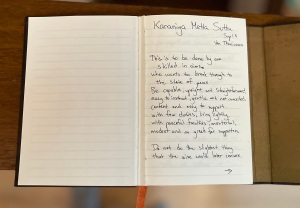
But eventually, around 2017-2018, when I left my old Jodo Shinshu-Buddhist community and started exploring other sects, I focused more on home practice and I started to add Japanese-style liturgies as well:
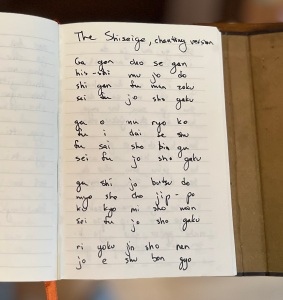
I also wrote specific sutra chants too, such as the Shiseige:
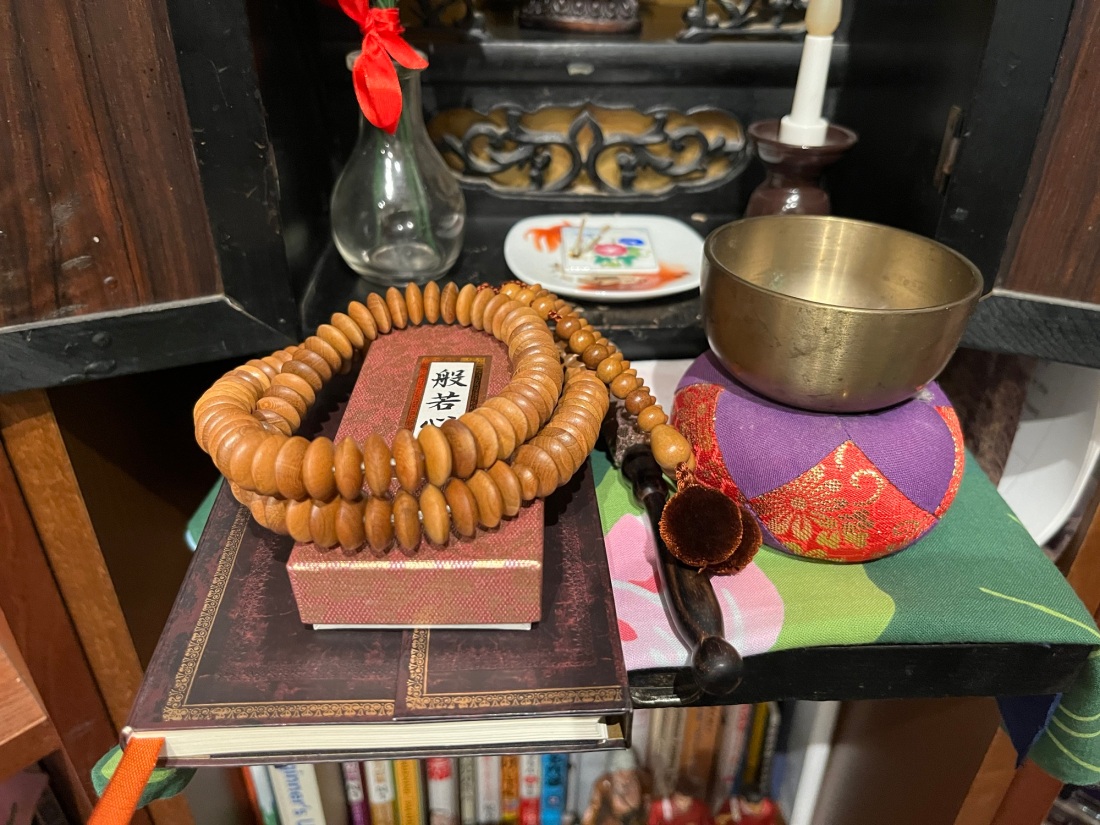
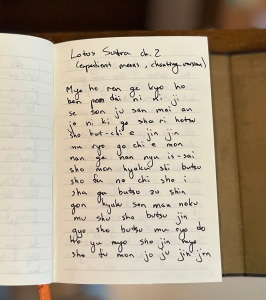
As you can see from the featured photo above,1 I keep this sutra book on my home altar (bottom left in photo), and use it almost daily. A personal sutra book works best when it’s meaningful, simple and useful for you, so the important thing is to not do what other people do, but make it useful for yourself. Find sutras or Buddhist quotes you like, collect them into a notebook, and copy them by hand (word of advice, use a gel pen, not a ballpoint pen, it’s easier to read), and make it your own. There’s no wrong way to do it.
Further, the sutra book I made has gradually progressed over time, just as my own path and practice have and I still have more room to write things in the future.
1 You can also see my Buddhist rosary, a Tendai-style rosary I ordered online, along with a boxed copy of the Heart Sutra, which I got in 2023 while visiting Nara‘s Kofukuji Temple, one of my personal favorite.
This is another reference post. I noticed that one of my most popular posts is the entry on a Buddhist chant called the Mantra of Light, and there’s multiple ways to read and recite it depending on what language you choose. Anyhow, it made me realize that there’s a big knowledge gap about Sanskrit in a specifically Buddhist context. There’s plenty of Sanskrit language resources out there, but they’re focused on Hinduism, and Hindu-related literature. Even the writing system used in language textbooks, Devanagari, tends to assume certain things.
Sanskrit is a language that’s used in a variety of contexts, and religious traditions, including Buddhism, especially Mahayana Buddhism.
As a language, it is way too big to cover in this blog, and I am just a novice, but I wanted to provide some real, fundamental basics of how Sanskrit works, with an emphasis on Buddhism.
What is Sanskrit?
Sanskrit is a very old language still widely used in some contexts. It is related to Greek and Latin, among other things, but mostly as a distant cousin. The Arya people who come into northwest India spoke it natively, and then as they took over north India, they imposed their language on people there.
Just as Latin eventually morphed into languages like Spanish, French, and Italian (among others), or influenced languages such as English, German or Russian, Sanskrit followed a similar trajectory. Languages descended from Sanskrit are called Prakrits. Prakrits were the colloquial forms of Sanskrit, each with regional differences, while Sanskrit remained the “high” language, increasingly relegated to things like religious ceremonies or literature.
Why Sanskrit and Buddhism?
The historical Buddha, Shakyamuni, did not use Sanskrit when teaching his disciples. His native language was probably Magadhi (still spoken today), but he often used Pāli when speaking to others since it was so widely known. Both Magadhi and Pāli are prakrits, descended from Sanskrit.
Since Pāli was such a popular language, it was how most early Buddhist sermons were memorized and passed down to future generations. Some Buddhist traditions, especially Theravada Buddhism, preserve these sermons using Pāli.
However, as Buddhism spread northward along the Silk Road, it was recorded in yet more prakrits such as Gandhari (Pakistan area), and such, not Pāli. By this point, there were Buddhist texts preserved in all sorts of local prakrits, not necessarily Pāli, and it probably became unmanageable.
The early Mahayana Buddhists started converting texts and teachings to Sanskrit instead. While Sanskrit wasn’t a common, spoken language, it was something that everyone more or less knew, just as medieval writers in Europe all knew at least some Latin. Thus as the layers of literature built up over time, and especially outside the core areas of India, it made more and more sense to just use Sanskrit for everything. Their Sanskrit wasn’t always “pure” Sanskrit, but it was good enough.
The featured image above is of the temple of Sensoji, better known as Asakusa Temple, in Tokyo, Japan. The central altar has the Sanskrit letter “sa” for satyam (truth) prominently displayed using Siddham script. Thus, even in a place like Japan, Sanskrit is still being used.
What Writing System Does Sanskrit Use?
This is a surprisingly hard question to answer. Unlike some languages, like Greek or Chinese, it had no fixed writing system. Every knew at least some Sanskrit, but everyone wrote it down in their own way. The Pillars of Ashoka used the Brahmi script to convey Buddhist teachings to the masses, while Buddhist texts on the Silk Road were often recorded in Karoshthi, and Buddhist mantras were recorded in Siddham.
So, what writing system should Sanskrit be written in? Whatever conveys it best to the reader.
For the purposes of this blog article, we’ll stick with the Roman Alphabet, with extended diacritics. For Buddhists, there is no benefit to using modern Devanagari, since early Buddhists didn’t even use it, and it’s just an extra layer to learn. Just don’t bother. The Roman Alphabet is sufficient for Western audiences.
Sanskrit Alphabet
The Sanskrit alphabet (regardless of what script you use) is broader than English because each sound has its own letter (sometimes two), and thanks to the grammarian Pāṇini, it’s all carefully organized in a sensible system.
Many of these sounds exist in English, but do not have their own letter to distinguish them; we just pronounce them automatically. Some sounds definitely do not exist in English and require extra care.
We can’t cover all these letters in detail here, especially pronunciation. There are some excellent pronunciation guides like the video series below. While it’s a Hare Krishna channel, not a Buddhist one, the explanations are excellent and clear.
A notes worth calling out here though:
ḥ – this is like a “breathy” h-sound that shows up at the end of certain words.
ṃ – although it looks like an “m”, it sounds more like an “ng” sound as in running. In the Buddhist tradition of praising the three treasures, the phrase Buddhaṃ Saranaṃ Gacchāmi, it is pronounced like “boo-dang” not “boo-dam”.
Sanskrit distinguishes between letters like k and kh, g and gh, d and dh and so on. These are separate letters in Sanskrit. Letters with an “h” are pronounced with a puff of air. Think of the English word redhead. That’s a fairly close analogy to “dh”. Similarly, egghead, for “gh”, dickhead for “kh” and so on. Not very civilized, but it works. 😆. Thus, Buddha, can be broken down to letters bu-d-dh-a, where “dh” sounds like redhead.
Side note: the ph in Sanskrit is not an “f” sound. This confused me a lot when I looked at works like “phalam” (fruit). It’s a breathier “p” sound.
ś and ṣ are both like the English sound “sh”. A common example in Buddhism is the word Śastra, which is a kind of important treatise. This is pronounced like “shastra”, not “sastra”. I am not 100% sure how ś and ṣ differ, but for practical purposes they’re more or less the same.
ñ – Just like Spanish in words like El Niño.
The letters ṭ, ṭh, ḍ, ḍh and ṇ (the ones with a dot beneath them) are extra difficult to pronounce for English speakers since we don’t really have “retroflex” sounds (sounds where the tongue touches the roof of the mouth). Thankfully these don’t come up too often in Buddhist Sanskrit.
r – a nice rolled “r” sound like in Spanish, Latin, etc, not the American “r” sound.
v – This one is confusing, but the “v” is actually pronounced like a “w” sound. The aforementioned “Bodhisattva” is correctly pronounced like “Bodhisattwa”.
This not a complete summary, but will hopefully address some pitfalls. Let’s look at vowels too.
Vowels in Sanskrit are fairly straightforward, but with a few caveats worth noting:
Sanskrit vowels are distinguished by “short” and “long” sounds. As with the consonants, each one has its own letter to distinguish it, unlike English “o” which can be pronounced multiple ways. The video series I linked above shows vowel pronunciations as well. Just remembere that long and short vowels might look similar in the Roman alphabet, but they are distinct letters.
a is the default sound that’s used when there is no other vowel explicitly used. It sounds like “uh” as in “duh” not as in “father”; that’s the letter ā instead.
Sanskrit has a vowel ṛ that doesn’t really exist in English. Imagine the English word “rip”, remove the ending “p” and roll the “r”. That’s ṛ. Even the Sanskirt word for Sanskrit, saṃskṛta, uses ṛ instead of an i. Usually in English people transliterate this as “ri” instead of “ṛ”, but be aware that this is its own vowel. Also note that r is a consonant, and ṛ is a vowel. They are not the same.
The au sound is like English “ow”, not “aw”. Imagine hitting your head on the door-frame. That’s “au”.
The ai sound like the same as “yipe!”. Imagine touching a hot pan. That’s the “ai!” sound.
A Note on Pronunciation
The reality is is that, like Latin, there are few, if any native speakers today. Many people in India, and even abroad, learn Sanskrit (and for good reason), but each person colors their Sanskrit pronunciation with their own native language. That’s ok. It’s normal. So, nobody today pronounces it perfectly.
That said, even knowing a few basics rules, like the ones I highlighted above, will go a long way to really appreciating how beautiful Sanskrit is, and when reciting Buddhist mantras or prayers, it really brings them to life. Give it a try!
But also don’t worry: the Sanskrit Police will not arrest you if you make a mistake.
Sandhi Rules
Every language has at least some rules where sounds blend together or change sightly to make things smoother. Some languages have more rules than others. Sanskrit has a lot. These are called “Sandhi” rules (the grammatical term “sandhi” even comes from Sanskrit). While Sandhi rules for Sanskrit are a huge pain to learn, they are super important for making sense of Sanskrit, including Buddhist Sanskrit. Why? Let’s look at an example below.
buddhāya – Buddha, but with a dative-case ending: to the Buddha. We’ll get to conjugation soon.
Glomming words together like this is common in Sanskrit, and the Sandhi rules help “glue” them together. Of particular note is the final aḥ in the first word, followed by a vowel. According to Sandhi rules (very handy chart here), aḥ + vowel sound changes to o. So, namaḥ + amitābha becomes namo‘mitābha. The apostrophe is a visual tool to help with readability.
For Avalokiteśvara, the famous bodhisattva, if we were to praise them, the same Sandhi rule would apply: namo‘valokiteśvara.
On the other hand, if we were to praise Śariputra, the Buddha’s important monastic disciple, then according to Sandhi rules aḥ + ś would not actually change and simply be namaḥ śariputra written as two words.
Similarly, if a bunch of Buddhas (buddhāḥ) were going somewhere (gacchanti), the Sandhi rules would simply drop the ḥ: buddhāgacchanti
Anyhow, these are pretty basic examples, but Sandhi rules get complicated, and memorizing the entire Sandhi chart isn’t necessary for most people. The important thing to understand is that when two words abut one another, the final sound of the first word, and initial sound of the second often blend together to make pronunciation smoother. Further, Sanskrit often strings multiple words together in written form.
Conjugation
If you ever dealt with noun declensions in classic languages like Latin and Greek, guess what? Sanskrit has them too. Since they are distant cousins, this isn’t really all that surprising.
Modern languages have comparatively fewer conjugations because over the centuries languages become smoother and more streamlined. Modern Indian languages based off Sanskrit such as Hindi, Gujarati, and Bengali are relatively simple to learn, while Romance languages like Spanish, French and Italian are streamlined versions of Latin. In the same way, modern Greek is a simpler, more streamlined version of classic Koine Greek, which itself was a simpler, more standardized form of ancient dialects such as Homeric Greek.
Older Indo-European languages often had complicated conjugation and inflection systems, and since Sanskrit is among the oldest, it’s inflection system is quite complex.
Like every language, Sanskrit has to describe who does what to whom, and with what. Languages like English usually use prepositions like “to”, “from”, “with”, etc. Japanese and Korean uses particles. Sanskrit, Latin, and Greek use inflected endings. For example, let’s look at the word Buddha:
buddhaḥ , usually just written as buddha – this is the nominative form (e.g. “the Buddha”).
buddham, this is the accusative form (e.g. a verb does something to the Buddha)
buddhāya – this is the dative form meaning “to” or “for” someone. Or for indirect objects. (e.g. we give a direct object to the Buddha)
buddheṇa, this is the instrumental form (e.g. “with the Buddha”)
buddhe, this is the locative form (e.g. “on the Buddha”)
buddhāt, this is the ablative form (e.g. “away from the Buddha”)
And so on. You can convey a lot with inflection in just one word, but the drawback is that the rules are complicated to learn.
Further, Sanskrit divides nouns into the following declensions:
Masculine nouns with “a” endings – Buddhaḥ, bodhisattva, nṛpaḥ (king), etc.
Neuter nouns with “a” endings, satyam (truth), vanam (forest), śāstram (a Buddhist treatise)
Feminine nouns with “ā” endings – adityā (sun)
Feminine nouns with “ī” endings – bhikṣunī (a buddhist nun), nadī (river)
Masculine, neuter, and feminine “u” endings – bhikṣhu (a buddhist monk), Vasubandhu (the famous monk), dhenu (cow)
Nouns with “ṛ” endings – pitṛ (father), mātṛ (mother)
In short, it’s a lot. There are 12 different categories of noun declensions (Latin had 5, iirc, or slightly more if you count things like masculine first declension, etc).
Note that “grammatical gender” is not always the same as the actual gender of an object. It’s just how nouns are organized. The word for sun is “feminine”, but moon is “masculine”. There’s usually no logic to which gender a word fits, it is just what category it happens to fit.
Conclusion
Knowing Sanskrit is not required to be a devout Buddhist. Buddhism doesn’t really rely on the notion of a “holy language”, so Sanskrit is just as good as Pāli, which is just as good as Classical Chinese (a frequently underrated language), which is just as good as Korean, Japanese, English, French, Ukrainian, etc.
But Mahayana Buddhism does owe much to Sanskrit due to how the tradition grew and then consolidated along the Silk Road before coming to China. Thus, knowing even a little bit of Sanskrit is a really nice way to connect with the past, and appreciate what we’ve inherited thus far.
This page is pretty unpolished, and probably has a few errors, but I hope you find it useful.
Namo’mitābhabuddhāya
Edit: Somehow my blog app kept re-posting an old draft, making publishing difficult. This should all be cleaned up now, and other typos have been corrected as well.
Recently I talked about the Pure Land Buddhist tradition, and in particular the Three Pure Land Sutras that are central to the tradition.
But then I realized that I’ve never really explained who Amida (Amitabha) Buddha is. Now that the English language site for Jodo Shu has been retired, I wanted to fill in some gaps in information, and explain Amida Buddha’s significance to the Buddhist religion at large.
Who Is Amida?
Amida (阿弥陀) Buddha is short for Amitabha Buddha: the Buddha of Infinite Light. Sometimes he is alternatively called Amitayus: the Buddha of Infinite Life too.
Amida Buddha is a cosmic, almost timeless Buddha who is said to dwell “very far” to the west in a realm called Sukhavati in Sanskrit, which means “Land of Bliss [or Joy]”. Over time, people just call it the Pure Land.
A reproduction of the Taima Mandala, an 8th century tapestry in Japan depicting the Pure Land
The Pure Land should not be confused with Heaven. It is a peaceful, safe refuge. In the Pure Land, people can escape difficult circumstances and be surrounded by many excellent Buddhist teachers. Even the very air and animals preach the Buddha-Dharma. Best of all, the sutras emphasize that one can be reborn there easily … if they so choose. It is not required in Buddhism, but it is available
The vast light of Amida Buddha (hence “Buddha of Infinite Light”) reaches out in all directions of the cosmos:
“The light of Amitāyus shines brilliantly, illuminating all the buddha lands of the ten directions. There is no place where it is not perceived. I am not the only one who now praises his light….”
The Sutra of the Buddha of Immeasurable Life, translation by Rev. Hisao Inagaki
and provides comfort to those who encounter it, inviting them to be reborn in the Pure Land:
“….If, sentient beings encounter his light, their three defilements are removed; they feel tenderness, joy and pleasure; and good thoughts arise. If sentient beings in the three realms of suffering see his light, they will all be relieved and freed from affliction. At the end of their lives, they all reach emancipation.”
The Sutra of the Buddha of Immeasurable Life, translation by Rev. Hisao Inagaki
This Buddha’s promise to rescue all beings, regardless of who they are, has been very attractive to people in difficult social circumstances: women (who were thought spiritually inferior in those days), the poor, and illiterate who toiled all day with no chance to invest in other spiritual development.
However many monks devote at least part of their time and effort toward Amida as well. As a Buddhist tradition, devotion to Amida is very broad and inclusive.
Further, everyone has a slightly different idea on who Amida Buddha is, what the Pure Land is, and so on. This is fine. There is no orthodox interpretation. Buddhism is more concerned with practice, so how one interprets this tradition up to them.
Some people devote themselves fully to Amida Buddha, others venerate Amida Buddha as one among a larger tradition. Again, it is up to the individual.
What Does Amida Look Like?
Amida Buddha is often depicted with gold color imagery, sometimes red. Compare with someone like the Medicine Buddha who is often depicted with lapis lazuli color (deep blue).
The gold color is based on the Pure Land Sutras that describe every person there, including the Buddha, as having gold-colored skin. Further, gold shines, so it fits the Buddha’s symbolism as a Buddha of light.
In some art, Amida is seated in meditation.
Amida Buddha statue at Sensoji (Asakusa Temple) in Tokyo, JapanAmida Buddha statue at Kamakura, Japan, also known as the Great Buddha (daibutsu) of Kamakura
In some art, Amida is standing, with his hands in specific gestures.
Amida Buddha welcoming the deceased, with his attendants, to the Pure Land. A medieval Japanese painting. A small home altar I purchased from Tsukiji Honganji in Tokyo about 10 years ago. A tiny, pocket image of Amida Buddha I purchased at Zojoji Temple near Tokyo Tower in Japan.
Buddhist statues are full of symbolism, they are not intended to be accurate portrayals. They convey meaning. The double-“OK” hand gestures used by Amida, one hand up, one hand down with palm up, means something like all beings are welcome.
Why Amida?
Someone learning about Buddhism will probably find this very confusing: why is there a “Buddhist Jesus” when the religion is supposed to be about meditation and finding enlightenment? Is this a sign of Buddhism’s decadence and decline?
Buddhism can be a tough religion to explain because it is really broad. Much broader than a “Buddhism for Dummies” book can explain.
The historical founder, Shakyamuni Buddha, was like a doctor describing the state of things (e.g. the Dharma), and providing a “prescription” (e.g. Buddhist practice) to help cure the “ills” of the world.
But within that, Shakyamuni Buddha gave people a lot of autonomy. He described the world as like a river with two shores: one shore full of strife and dissatisfaction, the other peace and wellbeing. He described the need to build a raft to cross from one shore to the other. But how exactly to build that raft is up to you.
He held students, especially monks, to high standards of conduct, but as for putting teachings into practice he tailored different practices to different audiences, or to suit the person. Contrary to popular conception there are various forms of meditation taught even in the earliest traditions, not just mindfulness.
Mahayana Buddhism, one of two major branches of Buddhism, really emphasizes this diversity of practices because it recognizes the concept of upaya (expedient means): whatever works at that time for that person and helps them stay in the Buddhist path is right for them.
It’s partly why there are so many Buddhist figures, so many chants and sutras, and so many different sects. Each of these represent a different “gate” for entering the Buddhist path.
Anyhow, the existence of Amida Buddha, along with other figures such as Kannon, helps fill in a gap where some Buddhist practices and regiments just aren’t practical for most people, and also provides a sense of assurance in an uncertain world (speaking from experience). Those who find the “mind-only” interpretation of Amida attractive can also take comfort that nurturing Amida Buddha in one’s own mind helps awaken the Buddha within. Further, a timeless Buddha like Amida avoids the challenges of the interpreting the historical Buddha, Shakyamuni, through various layers of culture and history.2
As Amida Buddha is a tradition within the larger tradition, some Buddhists gravitate toward Amida, and some do not. Each person according to their own path. Mahayana Buddhism is large enough to embrace them all.
Namu Amida Butsu
P.S. Featured photo is the famous “Black Amida” statue at Zojoji Temple near Tokyo Tower in Japan. This was the statue that was venerated by the Tokugawa Shoguns back in the day.
1 The use of light symbolism in Amida Buddha is thought to possibly borrow from Zoroastrianism, which is possible given the contacts between the Parthians and the Buddhist community. Light is central to Zoroastrianism, but not mentioned in early Buddhist culture. The concept of Amida Buddha is definitely Indian-Buddhist, but Buddhists in the northwest of India often borrowed artistic concepts from neighboring cultures. Another example is Greco-Buddhist art.
2 Early Mahayana Buddhism was a critic of the “pilgrimage” culture at the time in India, where there was increasing importance of the holy sites, and the holy relics of the historical Buddha. Mahayana shifted the emphasis toward the timeless Dharma, and Buddhas as embodying this Dharma.
It’s similar to how people in other religions split hairs over what the religious founder said, based on layers in interpretation, or how people try in vain to recreate the original community (again through layers and layers of interpretation).
Recently, I posted a train of thought, trying to reconcile some challenges in staying true to the Buddhist path while also making it simple and accessible too, plus reflecting on my own failings from time to time. I didn’t have much of a solution, just some ideas.
A photo in the old quarter of Kyoto city, near Kiyomizudera Temple. This pagoda (a Buddhist stupa) was reputedly built by the pious Prince Shotoku.
Anyhow, soon afterwards, it kind of hit me that much of what I suggested or valued was pretty consistent with my limited experiences with Tendai-sect Buddhism. In fact, one could easily argue that any Buddhist sect has grappled with this same challenge, and found novel ways to keep Buddhism fresh and accessible.
I have been off-and-on a follower of TendaiBuddhism for a few years now, particularly because it tends to be really broad and open to various practices and such. It’s perfectly to fine to venerate Amida Buddha, and recite the Heart Sutra, meditate zazen, and/or recite the Mantra of Light. This flexibility is a bit different from other sects in Japanese Buddhism which tend to specialize in one thing: nembutsu for Pure Land, zazen for Zen, etc.
The price for that openness and flexibility, is that it also tends to be more complicated, I have noticed. Tendai in Japanese tends to have a lot of technical jargon, and theories. These are fascinating on an intellectual level, but sometimes, as a working parent with barely enough sleep, you just need a more straightforward approach.
While reading my sole book in Japanese on Tendai Buddhism, I did find a nice quote on how to apply the Tendai concept of “Morning Daimoku, Evening Nembutsu” (previously discussed here) in daily practice though. Here is the quote with a rough translation:
Since Tendai touts the notion of “Four Schools Unified”1 (also known as One Vehicle Buddhism), you may recite whatever sutra you like. Each day, facing your Buddhist altar, reciting a sutra, repenting one’s own faults,2 expressing gratitude toward the Buddha and/or ancestors, wishing happiness to all, this is the daily practice of Tendai.
Much like the Shushogi in Soto Zen, composed in the late 19th century, this emphasizes for lay-followers a combination of daily cultivation (otsutomé, おつとめ) coupled with self-reflection. If you choose to specifically recite the basic Tendai daily liturgy, it takes about 5 minutes or so. Even if not, daily, long-term, sustainable practice is the recommended approach.
Anyhow, just something I wanted to share. 🙂
P.S. featured photo is a Buddhist stupa (pagoda) we saw in Kyoto in July 2023 near Kiyomizudera. If I recall correctly, this pagoda is attributed to the semi-legendary Prince Shotoku.
1 四宗融合 (shishū-yūgō) – the four schools meaning Zen, Pure Land, Esoteric Buddhism and Precepts, if I recall correctly.
2 Namely, how does one’s actions compare with the Buddhist precepts regarding conduct?
Recently, I’ve been reading some old books of mine about the life of Honen, a 12th century Japanese-Buddhist monk who started the Pure Land movement in Japan which includes Jodo Shu and Jodo Shinshu Buddhism. Honen had a pretty eclectic following: from nobility in the elite Fujiwara family, to prostitutes, ex-monks, etc.
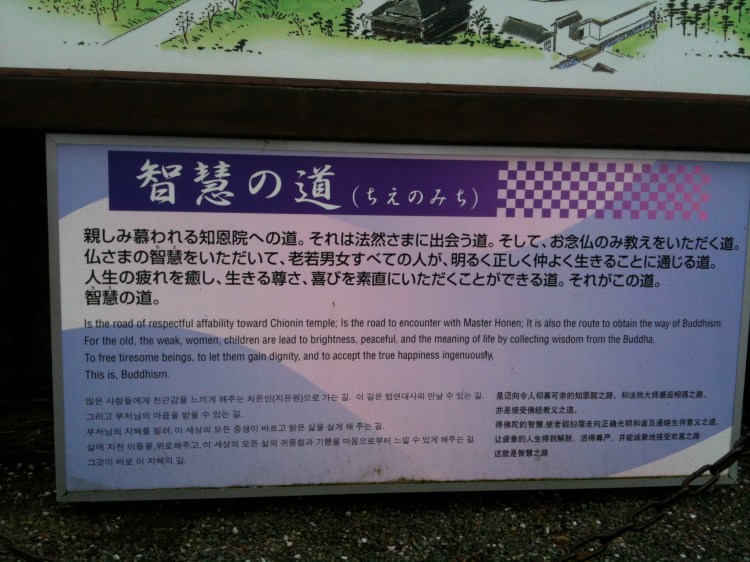
Taken in 2010 at Chion-in Temple in Kyoto, Japan, this is one of two head temples of Jodo Shu, and where Honen’s mausoleum is said to be. This was a sign posted near the main gate.
In one famous dialogue, Honen is talking with a former robber named Amano Shiro (天野四郎), who had previously been a leader of a gang in Kawachi Province and had reputedly killed some people as well. In his old age, he became inspired by Honen’s teachings and became a devout follower named Kyo Amidabutsu (教阿弥陀仏). One night, while staying with Honen, Kyo Amidabutsu had woken up in the middle of the night to hear Honen reciting the nembutsu by himself. When Honen realized he was no longer alone, he quietly went to bed.
A few days later, Kyo Amidabutsu went to talk to Honen. He had no family to care for him in his old age, and so he would be leaving soon to stay with a friend in a remote province in the east. Before he would leave though, he had some questions for Honen.
In the dialogue, as recorded in both Honen The Buddhist Saint and Traversing the Pure Land Path, is pretty long, Honen carefully explains what the nembutsu is all about, and patiently answers Kyo Amidabutsu’s questions. For example, Honen explains the significance of the nembutsu:
First of all, notice that there is nothing so extremely profound in the nembutsu at all. The only thing to now is that everyone who calls upon the sacred name [namu amida butsu] is certain to be Born into the Pure Land. No matter how educated a scholar may be, he has no right to assert that there are things in our school [e.g. Pure Land Buddhism] which really do not belong to it.
Page 61-62, “Traversing the Pure Land Path”
Here, Honen is trying to counter some of the other Buddhist schools at the time, which tended to emphasize a more esoteric, intellectual meaning, something that would require considerable time and effort for a monk to discover through practice, esoteric initiations, and meditation. Kyo Amidabutsu, as an elderly commoner in the 12th century, would probably had a minimal education, and thus would’ve found all that intimidating, assuming that he could even take tonsure and become a monk.
I really like the fact that Honen is not hitting Kyo Amidabutsu over the head with a bunch of doctrinal explanations about the Four Noble Truths, Karma, Rebirth, etc., either. Instead, he’s providing a simple, straightforward path with no hidden, mystical or esoteric meanings. It’s not that these aren’t important, but Buddhism is first and foremost a religion of practice, not belief, so these can be learned gradually.
Next, Kyo Amidabutsu asks a series of questions about when is it the right time to recite the nembutsu, whether to setup an altar, wear clerical robes, etc. Honen’s reply is similarly straightforward:
The nembutsu may be practiced whether you are walking, standing, sitting, or lying [down]. So it can be left to everyone according to their circumstances to do it either reclining or sitting or in any way they choose. And as to holding the rosary or putting on the robes, this also should be decided according to circumstances. The main point is not the outward manner at all but the fixing of the mind on the one thing — firmly determined to gain ojo [往生, rebirth in the Pure Land] and with all seriousness calling upon the sacred name [namu amida butsu].
Page 65-66, “Traversing the Pure Land Path”
This sense of sincerity is the key, as Honen teaches. For Kyo Amidabutsu’s sake, he uses an analogy of a thief who means to rob a house:
“Down deep in his heart [the thief] means to steal, but as far as his outward appearance is concerned, he gives not the slightest indication to others of his purpose by look or gesture. As others know absolutely nothing about the purpose to steal that is in his heart, we may say that the purpose is for him alone, without any reference to outward appearance. Such an undivided heart as this is necessary in the man who would make sure of birth into the Pure Land [of Amida Buddha].
Page 63, “Traversing the Pure Land Path”
In my limited experiences talking with people who are curious about Buddhism here in 21st Century America, I often notice that they are curious, but don’t know where to begin, and find it a bit overwhelming. Buddhism is hard to explain, and yet most of that information isn’t necessary upfront either. If people want to know more, they can (and will) ask. Instead of hitting people over the head with a bunch of esoteric, mystical or complicated psychological explanations, it’s probably better to just KISS: Keep It Simple, Stupid.
Buddhism isn’t meant to be an intellectual playground for the upper classes, it’s meant to help people from all walks of life. Everyone should feel free to begin the Buddhist path just as they are, and go at their own pace, using the tools they have.
Honen was sensitive to Kyo Amidabutsu’s situation and provided a straightforward, simple practice that provides both a sense of spiritual comfort, but also something very flexible and adaptable to his circumstances. Kyo Amidabutsu is old, has no kin, financially broke, and has no where to live. He probably doesn’t even know when he might eat next, or where he might sleep next. So, it has to be something that can be adapted to his existing lifestyle, and straightforward (not esoteric) enough that it is easy to understand yet provides a sense of refuge in a chaotic world. It may be looked down upon by more “elite” Buddhist followers, but for Kyo Amidabutsu, it’s just right.
Indeed, in founding the Jodo Shu sect, Honen reportedly once said:
The reason I founded the Jōdo [浄土, Pure Land] sect was that I might show the ordinary man how to be born into the Buddha’s real land of recompense [e.g. the Pure Land]. According to the Tendai sect, the ordinary man may be born into the so-called Pure Land, but that land is conceived of as a very inferior place. Although the Hossō [Yogacara] sect conceives of it as indeed a very fine superior place, they do not allow that the common man can be born there at all. And all the sects, though differing in many points, all agree in not allowing that the common man can be born into the Buddha’s land of real compensation….Unless I start a separate sect, the truth that the common man may be born into the Buddha’s land of compensation will be obscured, and it will be hard to realize the deep meaning Amida [Buddha]’s Original Vow [to provide a refuge for all beings].
Honen: The Buddhist Saint, page 23-24
For this reason, I come back again and again to Jodo Shu Buddhism over the years because even when I quibble about specific details, it’s accessibility, and simple message is pretty hard to beat within the Buddhist world. It meets the needs of all walks of life, and does not overwhelm people with philosophical details, yet it also provides plenty of flexibility to grow and learn as well. I feel this is an exemplary example of Buddhist metta if nothing else.
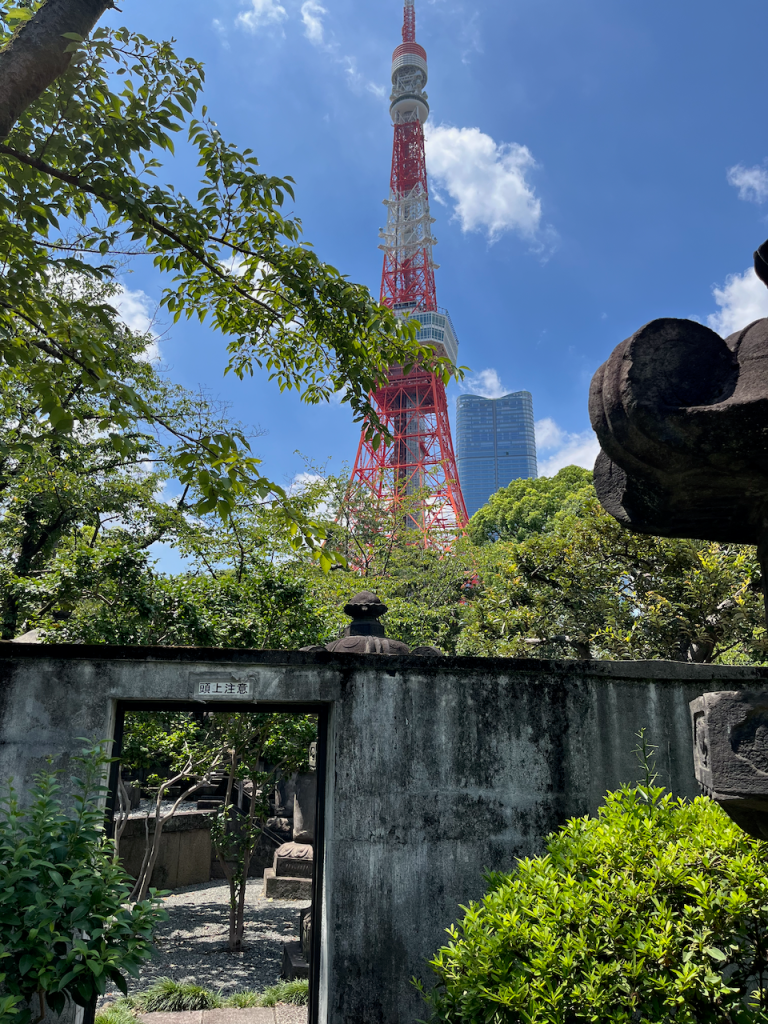
A few years ago, during our last trip to Japan before the Pandemic, we came to the famous Buddhist temple of Zojoji: one of two head temples of the Jodo Shu sect.
My wife and I like Zojoji in particular, and since it is right next to the famous Tokyo Tower, it is always worth a visit.
Taken in 2019, Tower Tower is in the back, about 2-3 blocks away.
Along its famous treasures is a “black Amida [Buddha]” statue which has a separate altar room, in the annex room to the right of the main hall:
Taken in 2019
Anyhow, on that visit, I picked up a neat little portable altar/image of Amida Buddha: it is normally wrapped in a small brocade envelope:
Inside you can see an image of Amida Buddha:
The writing on the left is a verse from the Shiseige (aka Juseige) a devotional set of verses, which is in turn an excerpt from a Buddhist text, the Immeasurable Life Sutra. The verse above reads:
神力演大光 Jin riki en dai ko 普照無際土 Fu sho mu sai do 消除三垢冥 Sho jo san ku myo 広済衆厄難 Ko sai shu yaku nan
With my divine power I [Amida Buddha] will display great light,
Illuminating the worlds without limit,
And dispel the darkness of the three defilements [greed, anger, delusion];
Thus I will deliver all beings from misery.
On the right is a poem by Honen (法然, 1133-1212), founder of Jodo Shu, called “Moonlight”. I talked about the poem here.
This folds out like a mini triptych, though it doesn’t stand up very well on its own.
Because it’s so small, yet very beautiful, it is a nice thing to carry with you sometimes for those moments of inspiration or private devotion.
Recently, I alluded to joining a local Soto Zen group and deepening my practice there. I am happy to report that after several weeks, I finally decided to formally join the community as a member. Thus, I guess I am now a student of Soto Zen.1 It is kind of exciting to be part of a Buddhist community again after years of isolation, but also a bit of an adjustment since I’ve been doing things a different way for a very, very long time.
As part of this I wanted to get familiar with the yearly liturgy of the Soto Zen tradition. To my surprise, the local community seemed to not follow this yearly calendar, but I guess it’s up to each follower, and each community to apply this calendar as much possible.2
This was taken near the famous Chujakumon (中雀門) Gate at Sojiji Temple, looking westward. Photo from 2012.
Anyhow, I think it’s helpful to get familiar with the calendar of events not just to have a foundation in one’s life and practice, but also to stay connected with the much larger community. So, for that reason I’m posting the yearly event calendar here for readers. Many of these holidays line up with other Buddhist traditions in Japan, and I’ve already talked about them in other blog posts, while a few are exclusive to Soto Zen only.
The Great Perfection of Wisdom Sutra requires some explanation. The Sutra is not one Buddhist text, but a collection of sutras that appeared in India starting in the 1st century CE. Each of these “great perfection of wisdom” sutras (a.k.a. prajña-paramita in Sanskrit) basically teaches the same message, but each version was composed in varying sizes: 8,000 verses, 15,000 verses, 25,000 verses, etc. The trend happens in reverse too: some versions get shorter and shorter until you get to the famous Diamond Sutra and Heart Sutra. Due to their slimmer size and easier recitation, these two sutras have retained more popularity over time.
Nevertheless, regardless of which version we’re talking about, the Great Perfection of Wisdom Sutra is a powerful foundation for Mahayana Buddhist traditions everywhere, including the Zen tradition. Thus, many traditions have some kind of “sutra reading” ceremony.
Because the Perfection of Wisdom Sutra is so large, it’s impractical to read/recite the entire sutra in a single session, so the ceremony usually involves Buddhist monks opening each fascicle and fanning through the pages to symbolize reading it. It’s a very formal ceremony. You can see an example of this below, though I am unclear which Buddhist sect this is:
If you want to the ceremony itself, skip to 11:30 or later, until about 16:00
English-language copies of the Great Perfection of Wisdom Sutra are very hard to find, by the way. I consider myself very lucky to find a copy of the 8,000-verse sutra at Powell’s City of Books some years back (that bookstore is amazing by the way):
Most Zen communities in the West can’t be expected to have such a copy. In any case, since the Heart Sutra is a summation of the Great Perfection of Wisdom Sutra anyway, it makes sense for most Zen practitioners to simply recite the Heart Sutra as appropriate. In the Youtube video above, the monks even recite the Heart Sutra at one point too.
Dual Founders Memorial
Soto Zen is somewhat unusual in Japan for having two founders, not one. The sect-founder-practice dynamic is something unique to Japanese Buddhism,3 usually each recognized Buddhist sect in Japan has one founder, not two.
Normally, when Westerners think of Soto Zen in Japan, they think of Dogen as the founder since he was the one who traveled to Song-Dynasty China, studied Caodong-sect Zen teachings, and brought those back to Japan.4 The challenge is that during this time, Soto Zen was a strictly monastic institution that had minimal appeal to the wider Japanese society.
Keizan, who came a few generations later, reformed Soto Zen as an institution that had more broad appeal. It was still centered around the monastic institution, but also included more community connections to the warrior samurai class and the peasantry as well. Soto Zen flourished in a way that other Zen sects in Japan simply never did. For this reason, Keizan is considered the second founder.
Thus, during formal ceremonies, a Soto Zen text, the ryōsokisho (両祖忌疏) is read aloud, which describes the virtuous life of both founders through the use of Chinese-style poetry.
Bodhidharma Memorial
Bodhidharma, unusually depicted standing. Taken at Sojiji Temple in 2012.
Within the world of Zen, Bodhidharma is a guy who needs no introduction. This semi-legendary monk from India supposedly came to China in the 4th century, and helped establish the lineage there, and subsequently all such lineages through East Asia.
The historicity of Bodhidharma though is pretty suspect, and some historians contend that he was made up in order to refute criticism that Zen had no prior connection to Buddhism in India. I don’t know which is true.
Regardless of whether Bodhidharma was real or not, he is the embodiment of Buddhism (particularly Zen) passing the torch from the community in India to the community in China and beyond.
End Of Year Temple Bell Ringing
The “joya” tradition is found across all Buddhist sects in Japan, and is a way of ringing in the new year. I took part in it once myself at a local Jodo Shu temple thanks to my father-in-laws connections.
The temple bell, or bonshō (梵鐘), is run 108 times, to signify the 108 forms of mental delusions (kleshas in Sanskrit, bonnō in Japanese) that all sentient beings carry with them. Things like anger, jealousy, covetousness, envy, ill-will, etc. In other words, the stupid petty shit we all do.
When I participated ages ago, this particular temple lined 108 volunteers up, and one by one we proceeded to the temple bell and rang it. As the temple bell is very large, and the striker is a large wooden log suspended by rope, this wasn’t easy, but it was cool.
Obviously, many communities in the West don’t have huge temple bells, and only tiny ones at home at their home altar. Still, one can relive the experience using a small bell, such as one found on your Buddhist altar, and ringing it 108 times (Buddhist rosaries can help keep count, by the way; that’s literally what they’re for), or some division of 108 if that’s not easy: 54, 27, etc.
Conclusion
The liturgical calendar of Soto Zen, as promulgated by the home temples in Japan, includes a lot of holidays that are practiced by the wider Mahayana Buddhist tradition anyway, plus a few novelties found only in Japan, or even just in Soto Zen itself.
Outside of Japan, how one incorporates this into one’s own community, or just in one’s personal life is entirely up to them. Personally, I like having some structure, including a set calendar like this to keep me from getting too idle, but also as a way to tie in to the larger Buddhist community as a whole. However, other people may differ.
Good luck and happy practicing!
Namu Amida Butsu
1 I should clarify that I haven’t stopped reciting the nembutsu and such, I just feel I moved onto the next phase of my Buddhist practice.
2 I have noticed over the years that communities here in the West are more or less connected to the home temple overseas. Some strive to stay in lock-step, some go the opposite route. I have mixed feelings on the subject.
3 TL;DR – The Edo Period government decided to divide-and-conquer previously militarized Buddhist establishments into distinct sects, where each one required to define their founder, their particular practice, and key sutras they base their teachings around. This led to the parochial style Buddhist institutions that still exist today, but also bucked the trend in continental East Asia where Buddhist sects tended to synthesize into a single “super-Buddhist” tradition.
4 Fun fact: the “Soto” is just the Japanese-style reading of Cao-dong: 曹洞. For a look at how Japan imported Chinese characters, and why they sound so different, you can watch this Youtube video. I have personal quibbles about some details, but it’s otherwise a great historical overview.

















 Gleanings in Buddha-Fields
You must be logged in to post a comment.