Person to Person

Some years ago, I received a tenugui (手ぬぐい), a kind of cotton cloth traditdionally used in Japan, with the following calligraphy on it:

我逢人
gahōjin

“self meets person”

I have briefly mentioned here this notion, but today I wanted to delve into it more. I have struggled to find a clear reference, but according to one story I found, these were the words uttered by founder of Soto Zen in Japan, Dogen, after first encountering his new teacher Rújìng (如淨, 1163–1228) in China.1 Dogen had studied under the Tendai sect in Japan for years, but he was dissatisfied with the lack of rigor, and journeyed with his mentor to Song-dynasty China to learn more there. At the Tiantong Temple (天童寺, Tiāntóngsì) he met Rujing, and after their first meeting, Dogen was said to have uttered these words meaning “At last, I have met someone”.

The sentiment here is that even though we might be physically in a room full of people, we may not really connect with them. We all go through this feeling. In modern society, that sense of isolation in a crowded room may feel even more acute. It is indeed a noisy yet lonely world we live in, and as the Buddha described it, a world of aimless wandering.

Only when you connect with someone does it really feel like you meet them. This could be someone romantic, or someone like a mentor, or just a really good friend. When you connect with that person, you can speak your mind 100%, and they will understand you. Such encounters are indeed rare (I can probably think of maybe 10-15 people in my own life), but it’s an example of how karma can work in mysterious ways, maybe across many lifetimes.

It is also why, in my opinion, when one encounters the light of Amida Buddha, or the Dharma in general, it subtly alters one’s aimless trajectory. Imagine an asteroid hurtling through the void of space for eons, then one day it’s finally caught within the gravity of a star. It’s still moving, but now its trajectory gradually bends more and more toward the star. I like to think of encountering the Dharma like that.

It’s also a great example of how Zen phrases and idioms proliferate Japanese language.

Namu Shakamuni Butsu

P.S. Please enjoy the Maha Santa Claus Sutra, an old classic I wrote 6 years old (!). Happy Holidays!

1 In Chinese, he is known better is Tiāntóng Rújìng (天童如净, “Rujing of Tiantong [temple]”).

The Many Names of The Nianfo

The nianfo (念佛) is widely recited across many cultures and languages by people who follow the Pure Land Buddhist tradition. In Japanese it is called the nembutsu (念仏), and that is the name I most often use on this blog. In Korean it is the yeombul (염불), and in Vietnamese it is the niệm phật. Just as the name differs by language, the phrase itself has changed pronunciation as it is adopted in other cultures and languages, just like the sutras did.

Let’s look at examples.

The original form of the nianfo (as far as I can tell) comes from Sanskrit language in India. In Sanskrit, “nianfo” was buddhānusmṛti (buddhānussati in Pāli language). The venerable site Visible Mantra states that it was recited like so:1

namo’mitābhāyabuddhāya

In the Siddham script, still used in some esoteric practices, this is written as:

𑖡𑖦𑖺𑖦𑖰𑖝𑖯𑖥𑖯𑖧𑖤𑖲𑖟𑖿𑖠𑖯𑖧

From here, Buddhism was gradually imported into China from India (a fascinating story in and of itself), and because Chinese language and Sanskrit are so different, this was no easy task. Nevertheless, the buddhānusmṛti was translated as nianfo (念佛) and written as:

南無阿彌陀佛

This was how the Chinese at the time approximated the sound of the Sanskrit phrase. In modern, Simplified Chinese characters this looks like:

南无阿弥陀佛

But how does one read these characteres? That’s a fun question to answer.

You see, Chinese has many dialects because of geography, regional differences, and migration of people. Thus, even though Chinese characters are written the same (with only modest regional differences), the way they are read and pronounced varies. Thanks to Wiktionary, I found a helpful list to illustrate:

Dialect or writing systemPronunciation
Mandarin, Pinyin systemNāmó Ēmítuófó or
Námó Ēmítuófó
Mandarin, Zhuyin (Bopomofo) systemㄋㄚ ㄇㄛˊ ㄜ ㄇㄧˊ ㄊㄨㄛˊ ㄈㄛˊ, or
ㄋㄚˊ ㄇㄛˊ ㄜ ㄇㄧˊ ㄊㄨㄛˊ ㄈㄛˊ
Cantonese, Jyutping systemnaam4 mo4 o1 mei4 to4 fat6
naam4 mo4 o1 nei4-1 to4 fat6
naa1 mo4 o1 mei4 to4 fat6, or
naa1 mo4 o1 nei4-1 to4 fat6
Hakka, Sixian or Phak-fa-su systemNà-mò Ô-mì-thò-fu̍t
Nà-mò Ô-nî-thò-fu̍t
Nà-mò Â-mì-thò-fu̍t
Eastern Min, BUC system
Nàng-mò̤-ŏ̤-mì-tò̤-hŭk
Puxian Min, Pouseng Ping’ing systemna2 mo2 or1 bi2 tor2 hoh7, or
na2 mo2 or1 bi2 tor2 huoh7
Southern Min (a.k.a. Hokkien), Peh-oe-ji systemLâm-bû O-bí-tô-hu̍t
Lâm-bû-oo-mì-tôo-hu̍t

Of these dialects, I am only familiar with Mandarin and (to a much lesser extent) Hokkien, so I can only trust the others based on Wikipedia.

Anyhow, China was a powerful, dynamic culture at the time, and it had a profound influence on its smaller neighbors such as the Korean peninsula, Japan, and northern Vietnam (a.k.a. Dai Viet). Just as the neighbors of the Romans (including the Byzantines) absorbed Roman culture, the neighbors of China did the same even though the languages were very different.

Thus, the nembutsu in these languages became:

LanguageHow to Recite
JapaneseKanji: 南無阿弥陀仏
Romaji: Namu Amida Butsu
KoreanHanja: 南無阿彌陀佛
Hangul: 나무아미타불
Romanization: Namu Amita Bul
VietnameseChữ Hán: 南無阿彌陀佛
Quốc ngữNam mô A-di-đà Phật2

What about Tibetan Buddhism? I am really unfamiliar with that tradition, so I might be wrong here, but my understanding is that Tibetan veneration of Amida Buddha stems from a different tradition, so instead of the nianfo, they recite appropriate mantras instead. Beyond that, I don’t know.

Anyhow, this is a brief look at how a simple Sanskrit phrase has evolved into so many traditions and ways to express veneration to the Buddha of Infinite Light. Thanks for reading!

𑖡𑖦𑖺𑖦𑖰𑖝𑖯𑖥𑖯𑖧𑖤𑖲𑖟𑖿𑖠𑖯𑖧
南無阿彌陀佛
Namu Amida Butsu

P.S. Another post despite my intended rest. The time off really has helped, so it’s been well worth it, but now I am eager to write again. 😌

1 As I’ve written before, writing Sanskrit in the more modern Devanagari script is kind of pointless since Sanskrit was never written in that until late in history, long after Buddhism in India was gone. Sanskrit does not have a native script either, so the Roman Alphabet is as god as any.

2 Brushing off my college Vietnamese, this is pronounced as “Nam-moe Ah-zee-dah-fut”.

The Pure Land and the Lotus Sutra

Years ago, I used to write down sutra verses I’d find (in English) into my little sutra book, but after a while I often forget what I wrote down. Recently I found this really fascinating verse from the twenty-third chapter of the Lotus Sutra, which I had apparently written down:

The woman who hears and keeps this chapter of the Previous Life of Medicine-King Bodhisattva will not be a woman in her next life. The woman who hears this sutra and acts according to the teachings of it in the later five hundred years after my extinction, will be able to be reborn, after her life in this world, [as a man sitting] on the jeweled seat in the lotus flower blooming in the World of Happiness [the Pure Land] where Amitāyus Buddha lives surrounded by great Bodhisattvas. He [no more she] will not be troubled by greed, anger, ignorance, arrogance, jealousy, or any other impurity. He will be able to obtain the supernatural powers of a Bodhisattva and the truth of birthlessness. When he obtains this truth, his eyes will be purified. With his purified eyes, he will be able to see seven billion and two hundred thousand million nayuta Buddhas or Tathāgatas, that is, as many Buddhas as there are sands in the river Ganges.

Transalation by Rev. Sencho Murano

There is a lot to unpack here.

In Indian culture, it was felt that birth as a women was disadvantageous. This was probably due to the realities of the time: patriarchal society, extreme risks of childbirth in a pre-modern society with medical technology, dowry customs, etc.1 So, the idea was that rather than being reborn again as a woman in the next life, the sutra promises that such a woman could be reborn as a man by being reborn in the Pure Land of Amitāyus Buddha.

Amitāyus Buddha is one of the names of Amida Buddha. It is also used in the Immeasurable Life Sutra, where one of the vows of Amida Buddha is the following:

(35) If, when I attain Buddhahood, women in the immeasurable and inconceivable Buddha-lands of the ten quarters who, having heard my Name, rejoice in faith, awaken aspiration for Enlightenment and wish to renounce womanhood, should after death be reborn again as women, may I not attain perfect Enlightenment.

Translation by Rev. Hisao Inagaki

Here, we see essentially the same thing: if a woman is weary of the challenges of womanhood, she can choose to be reborn as a man in the Pure Land of Amida (Amitāyus) Buddha in accordance with his vow. Should his vow fail, the Pure Land would not be. Since it does exist, the vow is certain.

You can read this in two ways, I think:

  1. This reaffirms a patriarchal attitude that woman are inferior, and therefore being a man is better on the Buddhist path, or
  2. Buddhism was realistic about the challenges of woman in a patriarchal society of the time, and therefore offered something not found in other religious paths.

I think it is up to the reader to decide. To be honest, in light of other aspects of the Lotus Sutra, such as the Parable of the Dragon Princess, or Shakyamuni’s prophecy of Buddhahood to his nun disciples, I am inclined to think that the latter interpretation is what the authors of the Lotus Sutra intended. The Lotus Sutra reads as something (relatively) progressive for the time.

Separately, it’s interesting that the Pure Land of Amida Buddha is even referenced in the Lotus Sutra at all, and both sutras use the same name, Amitāyus, not the more common Amitābha. Typically, Buddhism tends to treat the Lotus Sutra and the Pure Land as separate traditions. They overlap because they are both Mahayana-Buddhist traditions, but often people focus on one or the other.

Further, the Pure Land of Amida Buddha is not prominent in the Lotus Sutra. Instead, the “pure land” of Shakyamuni Buddha in chapter sixteen is the big reveal. So, Amida Buddha’s Pure Land is more like a backup singer in the band, or a spinoff character.

But, having had some exposure to Tendai-Buddhist thought, and seeing overlapping texts like these, I feel it’s clear that they were meant to be one tradition, not two. From the Lotus Sutra perspective, the Pure Land path is part of the larger progression toward Buddhahood. From the Pure Land perspective, Buddhahood is all but assured if you are reborn there because of the radiance and magnetism of Amida Buddha. So, it feels like they are two sides of the same coin in a way. If you add the Zen perspective of the Pure Land, things get even more interesting.

How one approaches all this is up to you. If nothing else, the Lotus Sutra shows that there are many gates, and many ways to approach the Buddhist path, but they are like rivers all feeding into the same ocean.

Namu Shakamuni Butsu
Namu Amida Butsu

P.S. Despite my “break” in December, I decided not to wait on this one. 😅

1 One could make the argument that even now in 21st century modern society, life as a woman is still not an easy one. But imagine life when you were expected to have many children, and the average childbirth had a 10% chance of killing you each time, so many women did not live past their 20s and 30s. Further, if your husband was a terrible person, you had little if any recourse.

Countdown to Bodhi Day

Buddhist holidays are few and far between, especially in overseas (non-Buddhist cultures), but since we raise our kids both through Japanese and American culture, I try to give them a unique, memorable tradition for the holidays. So, when the kids were young, I borrowed the Japanese-Buddhist holiday of Jodo-é (成道会) and adapted it for American Christmas culture. This holiday is better known in English as Bodhi Day and is observed on December 8th every year.1

Bodhi Day, sometimes incorrectly called Rōhatsu (臘八) in Zen-specific contexts,2 celebrates the awakening of Shakyamuni Buddha, the historical founder of Buddhism. It is the day where the Buddha is said to have meditated under the Bodhi Tree, saw his past lives laid out before him, resisted the temptations of Mara, and in the early morning broke through the wall of ignorance to see things as they were. By awakening thus, he is called a buddha (lit. “an awakened one”).

So, at the time, I took inspiration from our local Japanese-American temple (which had a great kid’s program), and made a “Bodhi Tree”: a miniature Christmas tree that a statue of the Buddha sits under. After that, I setup a small Buddhist-style shrine with an offering plate, water, bell, LED candle, etc. You can see an example above from years ago.

Also, to make it fun for the kids, I always give a gift on Bodhi Day, usually books they like. Such gifts don’t have to be Buddhist books, just something they would enjoy reading.3 Also, we usually have a fun family dinner together, and I usually read the story of the Buddha from an old Japanese-manga I found years ago. These celebrations are not strictly “Buddhist”, but it’s something festive and wholesome with the family, while celebrating the enlightenment of Shakyamuni Buddha,4 in a way that blends American traditions with Japanese ones.

Anyhow, Bodhi Day is 8 days away, so until then, hoping you all have a great week!

Namu Shakamuni Butsu

1 Many other Buddhist traditions still use the lunar calendar, so the dates will vary. I like using the Japanese version with the solar calendar because it’s easier to predict and blends into holiday season more easily.

2 The problem with the term Rohatsu 臘八 is that is refers only to the Zen practice of sesshin or dedicated meditation practice (i.e. a kind of austere retreat). This is obviously unsuitable for kids, and even in Japanese Zen, the holiday is called generally called Jōdō-é (成道会) among lay followers. So, calling it Rohatsu is misleading, and too narrow to be useful anyway.

3 When you are a kid, the last thing you want is religious books. So, I give fun books, comic books, etc.

4 The enlightenment story of Shakyamuni Buddha also serves as a template for other Buddhas and their enlightenment stories in Buddhist literature, too. See the preamble for the Larger Sutra of the Buddha of Immeasurable Life as an example.

One Life to Live

From the classic Star Trek episode, “Specter of the Gun” (s3:ep6), stardate 4385.3

Speaking of missed opportunities and the many rebirths of Buddhism, there’s another side to this discussion.

The Buddha really emphasized the importance of the life you live now. Yes, each sentient being lives a long endless stream of rebirths ad nauseum, but it’s not as if you just move to a new body, and pick up where you left off. Long story short, death is real, and not something to take lightly. Yes, your karma will propel another birth to take place, but this is a different person, and they have to start over to some degree.

I can’t really go into the theological questions,1 and I don’t know them very well myself, but in India there was much ink spilled over this distinction. For us 21st century readers, let me try to give an example.

Look at “Rogue-like” games such Hades, or Rogue Legacy 2. In such games, your character dies a lot, and each time you die, you have to start all the way from the beginning. Your character might inherit some rewards for past efforts (e.g. past lives), but this doesn’t doesn’t guarantee success, and your next run might be a total disaster and even set you back. In Rogue Legacy 2 in particular, each time you start over, you choose a new character, randomly generated from a few options.

So, each time you start over, you have to treat each life as something important and make the most of it. I think Buddhism works much the same way.

Namu Shakamuni Butsu

1 the crude summary is that in Hindu religion, the soul (atman) traverses from body to body. The Buddha taught anatman (“no soul”) instead. The Buddhist version implies cleaner “break” between lifetimes, but how it all works is beyond me.

IDIC, Redux

Imagine a star in the sky, any star. It is a great big ball of hydrogen gas (some helium too). Its own mass is so great that it compresses its core with tremendous heat and pressure until it ignites a nuclear fusion reaction.

Photo by Pixabay on Pexels.com

Through nuclear fusion (not fission as we use), hydrogen molecules fuse into helium, releasing energy each time. If the star is heavy enough it will eventually also fuse helium into things like carbon and oxygen. If the star is exceptionally big, it will fuse even heavier elements.

Such stars, when they reach the end of their lives, billions of years later, explode in dramatic fashion scattering all their fused elements into space. In a few more billion years, this material coalesces into another star, some planets, etc.

DELENN: We are all born as molecules in the hearts of a billion stars molecules that do not understand politics or policies or differences.

Over a billion years we foolish molecules forget who we are and where we came from.

In desperate acts of ego we give ourselves names, fight over lines on maps and pretend that our light is better than everyone else’s.

Babylon 5, “And All My Dreams, Torn Asunder” (s5:ep16)

Thus when you look at your own hands, or the cup of coffee you are drinking it is literally, and scientifically speaking, made from material that was fused in a nuclear reaction by stars that were destroyed many billions of years ago. This generation of stars is all but gone (the Universe is quite old), but we are their legacy. From ancient chemical processes, a near-infinite number of things have arisen. As the Vulcans in Star Trek would say: infinite diversity in infinite combinations (IDIC).

And yet, it’s easy to forget this.

We take our bodies for granted, as well as the things around us. We also assume they are permanent. A coffee cup is a coffee cup. Always will be. This gives rise to thoughts of “me” and “my things”. Survival becomes our primary motive. We are homo sapiens after all.

Evolution teaches us that we must fight that which is different in order to secure land, food, and mates for ourselves. But we must reach a point where the nobility of intellect asserts itself and says no. We need not be afraid of those who are different. We can embrace that difference and learn from it.

G’Kar, Babylon 5, “The Ragged Edge” (s5:e12)

But none of this is permanent. As the Buddha taught, we do not own anything. We don’t even truly own ourselves:

Rahula, any form whatsoever that is past, future, or present; internal or external; blatant or subtle; common or sublime; far or near: every form is to be seen as it actually is with right discernment as: ‘This is not mine. This is not my self. This is not what I am.'”

Mahā Rāhulovāda Sutta (MN 62) of the Pali Canon, translation by Thanissaro Bhikkhu

Thus, that cup of coffee isn’t really your cup of coffee. Your body isn’t really yours either. At most, you are borrowing that body (a gift from your parents, the universe, etc). That cup is in your care, but it will fall apart or go in the bin someday. Your children are in your care; you do not own them.

In time, like the stars that once forged the elements in your body, such things will be long, long gone. Dust in grand scheme of time.

P.S. Original IDIC post.

Above Reproach

Recently, while cleaning out old notes from my mobile phone, I found this quote from the massive Buddhist text, the Avatamsaka Sutra (a.k.a. “The Flower Garland Sutra”) which I apparently saved in 2022 (!). I cannot remember where in the sutra this quote comes from, but I probably meant to post about it sooner than later. So… three years later I am finally posting this quote:

The peaceful nature of the buddhas cannot be known

By the covetous or the malevolent,

Or by those shrouded in the darkness of delusion,

Of those whose minds are defiled by hypocrisy and conceit.

Translation by J.C. Cleary

As we’ve seen with the Yogacara school of Buddhism, what we think and do helps “color” the world we also perceive, and thus becomes a feedback loop. Thus, someone who is prone to lying assumes others lie too. Someone who is aggressive or domineering fears others will dominate him, and so on. This is the world they perceive because their minds harbor such thoughts. In the Pali Canon is a sutra wherein the usurper king Ajātasattu visits the Buddha for some spiritual advice. Later, the Buddha laments that due to Ajātasattu’s prior patricide, his spiritual progress will be limited at best.

Thus, the Flower Garland Sutra says that evil men cannot “see” the Buddha because their minds are too clouded by greed, anger and arrogance. Of course, they can physically see a statue or image, but they may learn little or nothing from it. They may as well be living on another planet. It does not resonate with them, and so they miss out on learning the Dharma. They will fall into evil rebirths, and may not gain another opportunity for generations, centuries, possibly longer.

Conversely, one who lives a clean life, and avoids harboring greed, anger, and arrogance will see the Buddhas. I don’t necessarily mean in terms of visions and such,1 but they will see the Buddha-Dharma everywhere (even in awful places and situations), and learn from it. From there, their perception will only continue to grow and mature, leading to greater wisdom.

This idea isn’t limited to the Flower Garland Sutra. The famous sixteenth chapter of the Lotus Sutra basically says the same thing: those who live upright see the Buddha and his Pure Land here and now.

So, take heart. If you strive to keep your “house in order”, and avoid harboring ill-will and such, you will not fail to see the Buddha someday.

Namu Shakamuni Butsu
Namu Amida Butsu
Namu Kanzeon Bosatsu

1 True story: in my 20’s, when my oldest daughter was a baby, and I was first exploring Pure Land Buddhism, I once had a really vivid dream, where I was offering armfuls of incense sticks at the feet of a statue of Kannon Bodhisattva. It’s the one and only time I’ve had a “Buddhist dream”, but I suppose it can happen to anyone.

Confronting a Suffering World

More than any other year in recent history, it seems like 2025 is a year where we are suffering more than before. It is frustrating to watch all this unfold, frustrating to know that even when you try to help, it feels like it makes no difference, and frustrating to see no light at the end of the tunnel. I feel a combination of denial, passivity, frustration, anger, despair, and everything in between, over and over.

IVANOVA: Damn it, John, there’s always too many of them and not enough of us. What am I supposed to do?

SHERIDAN: Fight them without becoming them.

Babylon 5, “Dust to Dust”, s3:ep06

But I’ve also been thinking about this a lot, and I realized that the forces of History are always in motion, even if we don’t see them. It can take years, or in some cases decades to see the bigger picture.

Claude from Fire Emblem: Three Houses saying “…but even while you’re standing still, the world keeps on moving. I always find that oddly comforting.”

But also, the little things we are doing here and now still matter. What happens to others who are suffering affects us, even if we are not consciously aware of it.

G’KAR: If we deny the other, we deny ourselves and we will cease to exist.

Babylon 5, “Point of No Return”, s3:ep9

Even those whom we oppose are suffering, even if we do not comprehend it:

If both sides are dead, no one will care which side deserves the blame. It no longer matters who started it, G’Kar. It only matters who is suffering.

Babylon 5, “Dust to Dust”, s3:ep6

So, simply standing back and letting history unfold isn’t enough. On the other hand it is just not possible to save the whole world. Even if I gave away everything I have here and now, it would be a drop in the bucket.

Instead, each one of us needs to find one small thing that we can dedicate ourselves to, for the good of others. In a Pure Land Buddhist text, The Larger Sutra of Immeasurable Life, the Buddha Amitabha started as a king, then a bodhisattva, and through tireless efforts over eons transformed his realm into the Pure Land through countless good acts, accumulated merit, and so on. This process was glacial, but it came to fruition nonetheless.

In the same way, each one of us when we dedicate ourselves to a cause, however small, it feels glacial. Nothing changes. But change does happen. As with the forces of History, things do unfold, but our actions help shift the currents of the “river of History” ever so little.

But even so, not every one will see this and understand. In the immense Buddhist tome, the Avatamsaka Sutra (a.k.a. the “Flower Garland Sutra”), is a famous quote:

On seeing a bodhisattva
Perform various practices,
Some give rise to a good mind and others a mind of evil,
But the bodhisattva embraces them all.

Original translation from the Collected Works of Shinran, courtesy of the Jōdo Shinshū Hongwanji-ha

This is the Mahayana Buddhist in a nutshell.

Namu Shakamuni Butsu

Namu Amida Butsu

P.S. Thanks to a bug in my blogging app I posted two posts at the same time last week. Apologies for any confusion.

Also, I am still resting a little from burnout, so no blog schedule for now. I wanted to at least finish some mostly-complete drafts for now.

Amitabha: The Welcoming Buddha

During my wife’s latest trip to Japan (I stayed home this year for various reasons), she found this delightful patch/sticker:

This is an image of Amida Buddha, welcoming the deceased to the Pure Land. This is called raigō amida (来迎阿弥陀, “Amida welcoming the dead”). I talked about this before a little while ago, becuase it was a common artistic motif in medieval Japanese Buddhism, especially at a time where disease, warfare and death would often cut people’s lives short.

The imagery of Amida Buddha coming to greet the dead is found primarily in the Contemplation of Amitabha Sutra (a.k.a. “the Contemplation Sutra”). The last section of the sutra lists the nine grades of people who are reborn in the Pure Land, and the fourth grade (“highest level of the middle grade”) gives the following description, for example:

“When such a person is about to die, Amitayus [Amida] appears before him, surrounded by a host of monks and radiating a golden light. He then expounds the truth of suffering, emptiness, impermanence and no-self, and praises renunciation of the world as the way to escape from suffering.

“Seeing this, the aspirant greatly rejoices and finds himself seated upon a lotus-flower. He kneels down, joins his palms and worships the Buddha. Before he raises his head, he attains birth in the Land of Utmost Bliss, where his lotus-bud soon opens.

Translation by Rev. Hisao Inagaki

Depending on the grade of the aspirant, this welcome may be more or less elaborate, but all of them are reborn in the Pure Land somehow.

So, I like this patch because it’s a reminder of the goodwill Amida Buddha extends to all beings, and how everyone can be born in the Pure Land if they want to.

Namu Amida Butsu

P.S. I kept the patch in its wrapper for a long time, but finally decided to put it in a sutra book I’ve been making.

P.P.S. Accidental double-post. 🤦🏼‍♂️

Divine Intervention, Or Lack Thereof

Scotty: Thank heaven!

Spock: Mr Scott, there was no deity involved. It was my cross-circuiting to B that recovered them.

McCoy: Then thank pitchforks and pointed ears.

Star Trek, “Obsession” (s2:ep13), stardate 3620.7

In the host of world religions, Buddhism occupies a strange place. In one sense, it is a world religion because it is followed by many different peoples, cultures, and languages throughout its 2,500 year history.

But unlike other world religions there is no central deity, no creator.

Hold on, you might be thinking, what about the Buddha?

The Buddha is the central figure of Buddhism. He is the teacher, but in the Buddhist tradition he was once a person, just like you and me, who through countless lifetimes as a bodhisattva fully accomplished the path and awakened to the Dharma: the principles of existence. He taught the Dharma to his disciples, and they became the first generation of the Sangha, the community.

Thus, these comprise the Three Treasures of Buddhism.

But why do people pray to the Buddha?

Because the Buddha and all other such figures in Buddhism are not passive. The Buddha taught the Dharma out of compassion and goodwill for all beings, and the countless Bodhisattvas such as Kannon guide any sentient beings who take up the Buddhist path. Amida Buddha provides a refuge for all beings who wish to be reborn there.

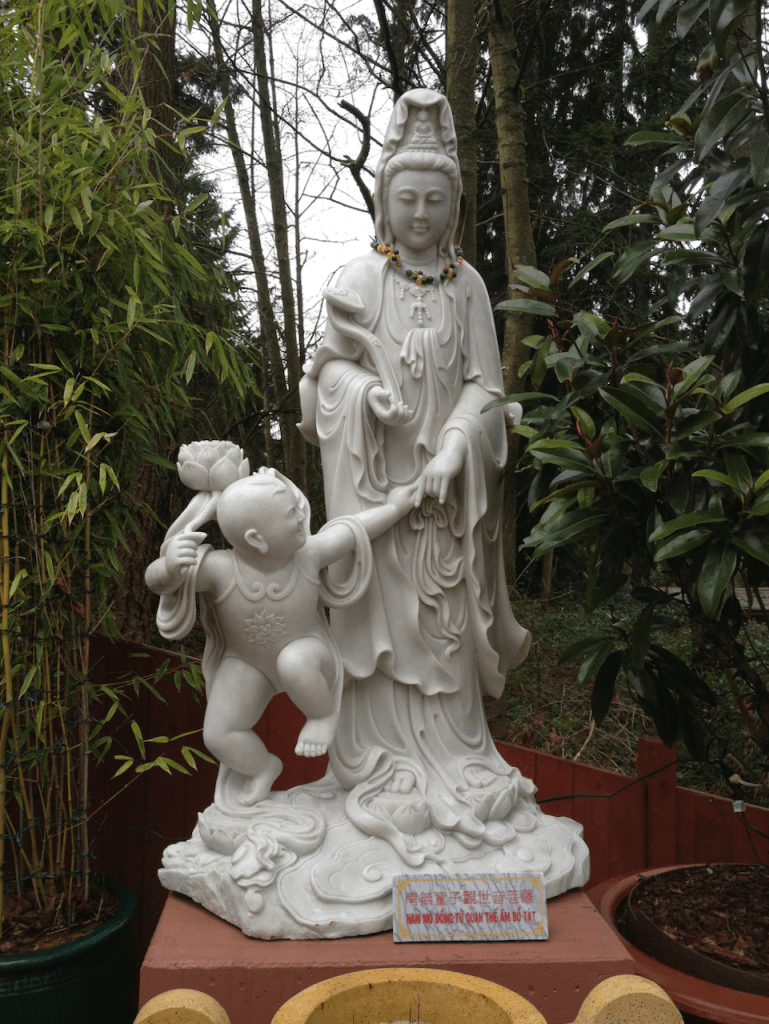
Kannon (観音) Bodhisattva in her more motherly form.

The underlying theme isn’t Enlightenment for Enlightenment’s sake. It is to help beings who suffer so that eventually they too may reach Buddhahood (a.k.a. Enlightenment).

One does not have to pray to the Buddhas and Bodhisattvas. The most important thing is to put the Buddhist teachings into practice as one can. But in times of unease, uncertainty or crisis it’s perfectly fine to pray to a Buddha or Bodhisattva that you revere. I do it from time to time myself when I am worried about my kids, on plane flights, before surgery, etc.

But also, in the end, I am responsible for my choices, my words, and my thoughts.

When you plant melon seeds you get melons, and when you plant beans you get beans. [Effect follows causes] like a shadow follows a physical shape, like an echo responds to a sound. Nothing is sown in vain. This is called “believing in the result”.

Ou-yi’s Mind Seal of the Buddhas, translation by J. C. Clearly

I alone bear the fruits of my choices, words and thoughts.

Namu Shakamuni Butsu

Namu Amida Butsu

Namu Kanzeon Bosatsu