Star Trek “For the World is Hollow and I have Touchedthe Sky” (s3ep8), Stardate 5476.4.
I started blogging way back in 2005 after visiting Japan for the first time, and discovering the Jodo Shu Buddhist path shortly thereafter from a now-defunct English-language site. Back then, I blogged on Blogger for a year or two, but soon moved to WordPress and have been here for almost 15 years. I have started, and then removed blogs a few times (Level 8 Buddhist, Japan: Life and Religion, etc), but I always come back and start again.
I am not sure why I have such a strong impulse to blog on such nerdy topic over and over again. In the beginning, it was my way of trying to reconcile my religious-cultural experiences in Japan, with the kind of stuff I learned about in Western textbooks. The two seemed pretty different, but over the years I learned a lot about Japanese religion and culture, and every time I learned something new, I’d put it on the blog so others could find it. I have often updated certain articles on Wikipedia as well.
Later, when I was part of a local Japanese-American temple (Jodo Shinshu sect), I learned even more from the experience. The Buddhism is often presented to Westerners is somewhat skewed by a combination of outmoded translations, native “Protestant” bias, and just lack of information. I had to relearn a lot of assumptions over the years myself, and I really miss that time with the temple community, even if I decided to follow a slightlydifferent path.
Over the years through blogging I have been lucky to meet disparate people in places like Europe, Africa and Asia who wanted to learn more, and were themselves struggling with finding the right information. Some of these areas do not have large Buddhist communities. But what matters is that anyone from any walk of life can find information they want, and put it into practice in a way that suits their life. A single mom in rural Arkansas, or a student in Sweden, or an elderly Asian-American all have the right to learn the Dharma, and shouldn’t be limited by time, place, background or cost.
I prefer this open approach. Instead of relying on gurus, special transmissions, seminars, meditation centers, retreats and so on, I want to present Buddhist teachings as-is from sources and sites I come across. I do not make money from this, and I don’t want people’s money (my current employment is enough). Instead, what I learn for myself, I also share with others. Truth must be truth for all with no strings attached.
The way I figure it: people can make their own informed decisions about how to put the Dharma into practice in their lives. They just need sufficient information to make informed choices.
A few years ago, when the family and I visited Japan for my mother-in-law’s funeral, we had a long visit with the temple family who presided over the funeral. Their family and my wife’s have known each other for generations; their kids have grown up with my kids and so on. We are pretty close.
The father, who runs this small parochial Jodo Shinshu-sect temple,1 enjoys sharing Buddhist insights and discussions with me, and in spite of my language limitations, I always look forward to the conversation. He also makes excellent homemade umeboshi in his spare time.
Anyhow, he mentioned that many families in Japan have leftover Buddhist altar goods after grandparents pass away, and so he entrusted us with a statue of Amida Buddha shown below. It had been sitting in storage for a long time, and since such goods are far less common in the West, I think he wanted to help deal with surplus, but also help Buddhism overseas. Needless to say, we were grateful.
The challenge after we came home was that we didn’t know where to put it. It was too big for our altar, so we put it on top of a bookshelf, but the bookshelf was remote so we didn’t see it much. But then, my wife decided to put it near the front door mezzanine like so:
Once we did this I noticed a change in pattern. Because we pass by it constantly, I started reciting the nembutsu more. Since we go up and down the stairs all day, having the Amida Buddha statue there is a nice reminder, and it’s easy to find 30 seconds in the day to recite the nembutsu. Plus we sometimes light incense, and so on.
This is a long-winded post, but this experience made me realize that Buddhist practice doesn’t just depend on willpower and self-discipline, environment matters too. Simple changes in environment or routine can go a long way.
Namu Amida Butsu
1 it might surprise some readers to learn that many Buddhist priests in Japan marry and have kids. There’s a lot of complex, historical reasons that I can’t go into here. Plus, Jodo Shinshu has, since inception, been an exclusively lay-oriented sect anyway. I neither condone nor condemn it, it’s just how Buddhism is practiced there.
Spock : “… I have noted that the healthy release of emotion is frequently very unhealthy for those closest to you.”
Star Trek, “Plato’s Stepchildren” (s3ep10), Stardate 5784.2
Meditation, specifically mindfulness meditation, is touted as a stress-relief exercise. Busy people believe that if they can block out the time to meditate for X minutes a day, or when stressed, this will make more happy and productive. It has been all the rage in Silicon Valley too.
But it doesn’t work.
It will calm your mind while you are sitting, but as soon as you are back to work, your blood pressure will quickly rise again. Old habits will quickly resurface. Self-help, in short, does not help.
How do I know this?
I tried the same trick in my late 20’s. My first child was born, and I was working at Amazon (yes, that Amazon) for a few years in a technical support role. The environment was stressful, demanding, constantly on the move, the on-call rotation gave little time to decompress because something was always broken,1 and I had to drive into work at all hours of the night to try and fix it.
Since I had recently converted to Buddhism at the time, and listened to a lot of Ajahn Brahm dharma talks, I wanted to try meditation. We had a spare office that no one used, so I would go in there once or twice a day, turn off the lights, dutifully sit, chant certain Buddhist mantras, meditate for 20 minutes or more, and then return to work.
As soon as I was back at my desk, the stress would rise all over again. I kept at the meditation for months, almost a year, before I finally gave up.
The stress, constant sense of inadequacy measuring myself to hyper-competitive co-workers who graduated from Stanford, unrealistic work performance goals, fear of losing my job, and so on simply didn’t go away until I QUIT MY JOB AND TOOK A LESS DEMANDING ONE.2
It took me years as a Buddhist to finally realize that stress-relief is not what mindfulness meditation was intended for.
Mindfulness meditation is a tool to develop insight, not stress relief. It is necessary in the early stages of meditation to quiet the chatter in the mind, but that is just the first stage. It is to remove barriers to insight by develop a focused mind, and a quiet mind, a mind that can perceive things in a more balanced way. Consider this quote from the Buddha in a very early text, the Dhammapada:
There is no meditative concentration for him who lacks insight, and no insight for him who lacks meditative concentration. He in whom are found both meditative concentration and insight, indeed, is close to Nibbana.
The monk who has retired to a solitary abode and calmed his mind, who comprehends the Dhamma with insight, in him there arises a delight that transcends all human delights. …
Control of the senses, contentment, restraint according to the code of monastic discipline — these form the basis of holy life here for the wise monk.
The emphasis is on focus, insight, and contemplation NOT relaxation or stress-relief. Mindfulness meditation has been repackaged and sold to naive Westerners with false promises. Meditation really does provide excellent benefits, but it has to be done as part of a much larger, holistic lifestyle change and with wholesome intentions. This is the “holy life” as described by the Buddha: a life of wholesome, guilt-free conduct, goodwill towards others, and a desire to pursue the Dharma (the teachings of the Buddha).
First, one should take up the Five Precepts of Buddhism. As we see in verse 374 above, the Buddha openly encourages that we curb our worst behaviors first as a foundation for other Buddhist practice. One will gain no lasting benefit from meditation until this is done. Full stop.
Second, one must approach meditation with the mindset of a monk. It is not necessary for lay-people to give up everything and go live in the woods. Buddhism accommodates both the “house-holder” lifestyle and that of a true renunciant (a.k.a. a monk or nun). But both the renunciant and the house-holder are expected to live a life of moderation and restraint.3 Easier said than done (speaking as a gamer and foodie), but it’s a goal to sincerely aspire to.
Speaking of restraint, one should always guard one’s speech. A long time ago, a Buddhist minister I admired once told me that speech was like toothpaste: once it was out of the tube, you couldn’t put it back. One has to learn to carefully monitor what one says both in person and online (and yes, at work). Again, easier said than done, but the alternative will only make your life miserable.
Finally, when such good foundations are established, meditation will help you learn more about yourself, and the world around you.4 It’s incredibly helpful, and life-changing when carried to fruition. I have my own little private insights that have stayed with me through the years, and I hope you will find yours too.
Namu Amida Butsu
Namu Shakamuni Butsu
P.S. if you feel the need to calm yourself right away, try something much simpler. You can recite the nembutsu, the Heart Sutra, a mantra, whatever. Try that for a minute, and see if that works. It is a band-aid fix though, and you still need to approach things from a holisitic standpoint, or you will gain no long-term benefit. Alternatively, just go for a walk.
1 Years later, the sound of a pager going off still triggers me a little bit. No joke.
2 Another ex-Amazonian who had joined the same company years earlier confided in me that after leaving Amazon, he drank himself stupid for months to decompress. I noticed that I was still on a hair-trigger for months after leaving Amazon, and it took me a while to unlearn those habits too. My wife noted that my posture improved after leaving, and that I grumbled about work less. Some jobs are simply not worth staying in.
3 The Buddha was pretty flexible about what exactly this meant, citing whatever cultural standards applied at the time as a benchmark. In short, a lot of it is rooted in common courtesy and good sense. If you cannot act toward others using common courtesy, meditation ain’t gonna fix your issue.
4 You may learn that your whole problem is that your job sucks, for example, and that the burn-out is not worth the money. Of course, if you’re a single mom caring for three kids, you have a lot fewer options available to you, and in such cases I recommend the nembutsu as a starting point.
Another post for the Fall Ohigan week. I was watching some classic Star Trek and wanted to share this quote:
Captain Kirk: Yes, well, those pressures are everywhere in everyone, urging him to what you call savagery. The private hells, the inner needs and mysteries, the beast of instinct. As human beings, that is the way it is. To be human is to be complex.…
Star Trek, “Requiem for Methuselah” (s3ep19), Stardate 5843.7
Being the homo sapiens that we are, we are indeed complex creatures. We are gifted with the capacity for logic and reason, and yet we are still savage in many ways. We still pattern ourselves in many ways our ancestors did, even if they are seemingly more modern and complex.
But also, from a Buddhist standpoint, we are capable of a great many things, both good and bad.
“We reach”
In Tendai Buddhism is a concept, later popularized in Nichiren Buddhism, called “3000 worlds in a single thought”, or ichinen-sanzen (一念三千). Broadly speaking, the idea is that with any moment in time, our thoughts and actions are capable of manifesting the highest levels of buddha-hood, or the very lowest, foul levels of a demon, and everything within that spectrum. There is certainly more to this, but that’s a brief summary.
Another way to look at it: we have within each of us that which is capable of being a bodhisattva or even a buddha, and yet we also have that within us that is capable of great evil. It comes down to things like environment, training, awareness and so on. We like to think other people as crazy and evil, but under the right circumstances we could just as easily slip down that path. In the same way, we see ourselves as hopeless, and yet with the right support and training, we can go on to do great things.
So, it helps to be a little vigilant of one’s own mind, especially when stressed, fatigued, or insulted. When times are good, it’s easy to behave kind and enlightened. The real test comes when under pressure, and given enough pressure anyone can crack and their brutal nature comes out.
On the other hand, when one does inevitably falter, it’s important to reflect and not flog oneself. Goodwill towards oneself is just as important as goodwill towards others. We are, afterall, human. It’s also why, especially in the Pure Land traditions, we acknowledge those faults and give thanks to the Buddha Amida for his goodwill towards us regardless.
The Japanese-Buddhist holiday of Ohigan is fast approaching, and I haven’t written about it in years (!), so I felt like posting about it today.
Ohigan (お彼岸, “the other Shore”) started with the pious 8th-century emperor Shomu. The name implies crossing over from this shore, which is comprised of greed, anger, desired, pain, frustration, strife, etc, etc., the usual nonsense. Contrast that with the “other shore” in Buddhism which symbolizes peace, contentment, freedom from harm, fear, conflict, etc. Because Ohigan is observed both at the Spring and Autumnal equinoxes, this is a time when the weather is mild, and so people can slow down and re-commit to the Buddhist path.1 Given how climate change is affecting the weather, this point is not lost on us today either.
Ages and ages ago, quotations of the historical Buddha, Shakyamuni (a.k.a. Siddhartha Gautama) were collected in India in a text called the Dhammapada. Despite the centuries gap between what the Buddha said, and what was recorded later, the Dhammpada probably represents one of the very oldest texts, and the closest to the historical Buddha that we’ll ever get. It’s short, easy to digest, and has lots of little witticisms that even today people can learn from.
One of them is this quote:
371. Meditate, O monk! Do not be heedless. Let not your mind whirl on sensual pleasures. Heedless, do not swallow a red-hot iron ball, lest you cry when burning, “O this is painful!”
In modern American English, I suppose we’d translate this as “don’t shoot yourself in the foot”.
But, of course we do this all the time. My doctor told me pretty bluntly that I should lose weight, and I want to lose weight, and yet when someone in the family offers to buy some bubble tea, I totally forget. What little spare time I have is usually spent playing Fire Emblem2 games instead of doing anything constructive like washing the dishes.
Centuries later, someone asked the Pure Land Buddhist teacher, Honen in the 12th century a series of questions and answers, this is question 57:
一。さけのむは、つみにて候か。 答。ま事にはのむべくもなけれども、この世のならひ。
Q: Is it a sin to drink saké [alcohol]? A: Indeed one ought not to drink, but [you know] it is the way of the world.
This is our normal state of being. Most of the time its benign, but clearly some actions we do are self-destructive even if just a little bit, and it’s hard to break the cycle if we aren’t even aware we’re doing the cycle to begin with.
So, there tends to be a need for both awareness, as well as self-restraint. When one becomes aware of their own habits, they are more capable of stopping self-destructive habits. By moderating or restraining bad habits, one tends to have fewer headaches later, and thereby getting one step closer on the Buddhist path.
There’s no magic formula for this. As we’ve seen in Mahayana Buddhism, there are countless ways to approach this both in the grand sense, but in the little day to day efforts too. Everyone is encouraged to find their own way, or emulate others they find admirable. The latter is why the Sangha, the Buddhist community, is considered one of the Three Treasures by the way. People can’t always see what they’re doing is harmful, and even if they can, they can’t always fix it without support from loved ones and people they trust.
The Buddhist path is long, spanning countless lifetimes, but even tiny little changes we make here and now, even if we falter, will still have big effects in the future. Don’t underestimate your own ability, and don’t be afraid to rely on others if needed. If nothing else, recite the nembutsu.3
Happy Ohigan!
Namo Shakyamuni Buddha
P.S. The featured image is the temple of Todaiji in Nara, Japan, another project by Emperor Shomu.
1 In modern Japanese culture, it is often a holiday time for overworked employees, and a chance to go to their home town, pay respects to their ancestors, etc. Like a smaller scale Obon.
2 After this initial post, I have still been actively playing Three Houses for the past year (!), but I have also branched into other games in the series. I have five games currently and am various stages of each. It’s a terrific series, but Three Houses will always be my favorite. Such a beautiful story, such an emotional rollercoaster. If you own a Nintendo Switch, I hope you get a chance to play it.
3 Question 69 of same letter addressed to Honen:
一。心に妄念のいかにも思はれ候は、いかがし候べき。 答。ただよくよく念仏を申させ給へ。
Q: When bad thoughts keep arising within my mind, what should I do? A: The only thing to do is to repeat Nembutsu.
Writing my recent post about Ikkyu and Rennyo brought back a lot of old memories for me.1 I was also overjoyed when I was recently contacted by another member of my old Jodo Shinshu community. So, I started leafing through the old material I saved, much of it out of print now, and remembered this old quote from the Tannisho (歎異抄), a collection of sayings attributed to the founder, Shinran (1173 – 1263):
10) 念仏には無義をもって義とす。不可称不可説不可思議のゆゑにと仰せ候ひき。
“In the nembutsu no selfworking is true-working; it is beyond description, explanation, and conception.”
translation by Dr Taitetsu Unno
This cryptic saying is probably the most emblematic of Shinran’s thinking, and what distinguishes Jodo Shinshu from the rest of the vast Pure Land Buddhist tradition.
Since the days of the early Chinese Buddhist Pure Land teachers such as Dao-chuo (道綽, 562–645) and Shan-dao (善導, 613–681), there has been this notion that Buddhism has two general paths:
The path of the Sages (i.e. the classic, monastic path), and
The path of the Pure Land
This morphed over time into the concepts of Self-Power and Other-Power. In other words, when following the Buddhist path does one rely on one’s own efforts, or fall back and rely on the grace of the Buddhist deities, primarily Amida Buddha? Every Pure Land Buddhist tradition and teacher that has arisen across history has wrestled with these competing approaches, how to find a balance, or where they might overlap. Charles B Jones’s book really explores this in far greater detail and well worth the read.
In any case, on the Self-Power vs. Other-Power spectrum, Jodo Shinshu Buddhism, as taught by Shinran and later Rennyo, really tipped the scales toward Other Power only. It’s not just 95% Other Power, 5% Self-Power; it’s entirely 100% Other Power. The idea arose through a combination of both Dharma Decline: that people were so far removed from the time of the historical Buddha Shakyamuni that any efforts towards one’s own emancipation were no longer possible, and the aforementioned tension between the Pure Land Path vs. Path of the Sages.
Thus, Shinran is saying that regardless of what one does or doesn’t do, the salvation provided by Amida Buddha is entirely due to Amida Buddha. One cannot add or detract from this grace. Once one experiences such grace, they spontaneously recite the nembutsu, rather than as a Buddhist practice.
Astute readers may find that this sounds an awful lot like Calvanism, and Charles B Jones points this out too. He also points out that the while this can provide great comfort to those who sincerely follow yet doubt their abilities, the challenge of Calvinist-type thinking is that it can leave the believer in doubt about whether they ever will be selected. It almost feels like a religious lottery. A person can be a genuine follower all their life, and yet grace might not come. Not every Jodo Shinshu follower experiences shinjin. And if they did, how would they know?
Back then, I wrestled with this issue quite a bit as a Jodo Shinshu follower. Shinshu teachings have a certain internal logic and beauty to them, but I always had this this nagging feeling that there was some “philosophical gymnastics” involved. And, to be frank, I am no longer convinced that this is what the Buddha taught. Even if you read the Larger Sutra of Immeasurable Life, the most important Pure Land Sutra and the source of the Juseige, it’s pretty clear that Shakyamuni intended for people to bend their efforts toward rebirth in the Pure Land, rather than let go and let Amida Buddha handle everything. The sutra is a bit long, and takes about 1-2 hours to finish reading, but if you’re learning about the Pure Land tradition, it’s worth the read.
I already critiqued Dharma Decline in another post so I won’t belabor that here. Suffice to say, it’s too formulaic to be a realistic assessment of human history.
But what about Other Power versus Self Power? In my humble opinion it’s a false dichotomy. You’re not actually forced in Buddhism to choose one or the other. It is possible, and very common, to find a balance of both in one’s practice. If a Buddhist deity inspires you to keep going, great! And since there many deities in Buddhism, it is possible to find someone who inspires you even if it is the historical Buddha himself. It doesn’t have to be a “cosmic” deity and will still be just as Buddhist.
I don’t want to trash on Shinran though, because a spiritual crisis like the one he had can be a very difficult to resolve even after years. Shinran was an accomplished and fascinating figure, and the Tannisho as a document is a valuable insight into his thinking process.
It’s just that I had my own “mini-crisis” in my younger years as a Buddhist and I came to a different conclusion even as a nembutsu devotee. These days I am pretty happy with my practice, small as it is, plus everything I’ve learned along the way.
Maybe I am totally wrong, but the way I figure it:
Slow and steady wins the race.
With the breadth of teachings and practices Buddhism has to offer there’s something for everyone and there’s nowhere to go but up.
Never be complacent. There’s always more to learn, more to try, and more to experience.
Good luck and happy practicing!
1 This is an old selfie I took of myself in 2015, wearing the robes of a minister’s assistant with the Buddhist Churches of America:
I was still in training (certified later in 2016), but I was very proud to wear it nonetheless. My chanting voice was terrible (still is), but I really tried to take my role seriously. I have a lot of happy memories from that time and am always grateful.
P.S. it’s hard to find a good translation of the Tannisho these days, but you find Dr Taitetsu Unno’s translation here on Web Archive.
One of the most influential sacred texts in Buddhism is the Lotus Sutra.
The Lotus Sutra has had a tremendous influence on Buddhism as we know it today. Much of Buddhist culture as we know it either came from the Lotus Sutra, or was influenced by its ideas and teachings. Not everything, of course. But the influence is hard to ignore. If you know the Lotus Sutra, a lot of things about Buddhist culture make more sense.
A copy of the Lotus Sutra enshrined at a Vietnamese Buddhist temple. Taken at Ksitigarbha Temple in Lynnwood, WA in 2013.
Because the Lotus Sutra has been translated to many different cultures at different times, it has had many names:
Original language
Title
Romanization
Sanskrit
Saddharma Puṇḍarīka Sūtra
n/a
Chinese
妙法蓮華經
Miàofǎ Liánhuā Jīng
Vietnamese
妙法蓮華經 (Han Nom) Diệu Pháp Liên Hoa Kinh (modern)
n/a
Korean
妙法蓮華經 (Hanja) 묘법연화경 (Hangeul)
Myobeop Yeonhwa gyeong
Japanese
妙法蓮華経
Myōhō Renge Kyō
Tibetan
དམ་ཆོས་པད་མ་དཀར་པོའི་མདོ
Damchö Pema Karpo’i do
The full title in English is the Sutra on the White Lotus of the True Dharma, but usually we just call it the “Lotus Sutra”. Similarly, in other languages, the full title of the Lotus Sutra is shortened as well. For example, in Japanese, Myōhō Renge Kyō is shortened to Hokekyō.
But I digress.
The Lotus Sutra is not short, and for new Buddhists it is not easy to read. Composed in India in the first century CE, it is divided into 28 chapters, so it reads like a full book. Many of these chapters have a prose section, then repeats itself in one or more verse sections.1
Like all Buddhist texts, or sutras, it presents its teachings in the form of a sermon by the historical founder of Buddhism, Shakyamuni Buddha (“Shakyamuni” for short). Could the Buddha have given such a long, long sermon all in the span of one sitting? Probably not. But that’s how Buddhist sutras are usually presented.
Through the Buddha, the Lotus Sutra teaches many parables and similes to get its point across. Many of these parables took on a life of their own and frequently appear in Buddhist art or literature. Others are strange and obscure to modern readers. In fact, if you’re just reading the sutra for the first time, it really helps to have some kind of side-by-side guide to help make sense of it because if you tried to read it literally, you will get a headache. Thich Nhat Hanh’s book Opening the Heart of the Cosmos really helped me a lot.
For example, the chapter with the Sermon in the Sky, where a second Buddha named Prabhutaratna appears, and everyone flies up impossibly high to hear their sermon, and the Buddha projects himself across many worlds, is a difficult read. If you try to read at face-value, it reads like a fever dream.
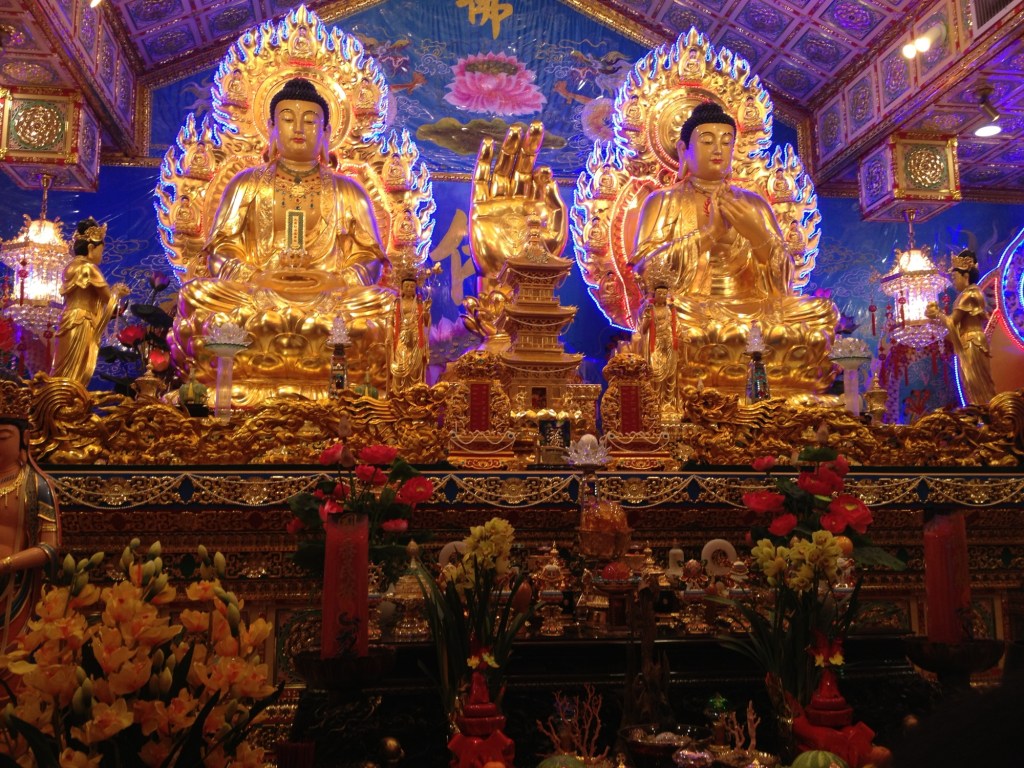
A mural from the Yulin Grotto in China. See page for author, Public domain, via Wikimedia CommonsAn altar revering the two buddhas, Shakyamuni and Prabhūtaratna, from the eleventh chapter of the Lotus Sutra, enshrined at a Vietnamese temple. Taken at Ksitigarbha Temple in Lynnwood, WA in 2013.
But the style of the Lotus Sutra isn’t to appeal to the head, it tries to appeal to the imagination. It is one thing to say that life is impermanent, it is another to describe the world as a great burning house, with people inside too distracted to notice. When the Buddha is shown projecting himself to countless worlds, it is just a colorful way of saying that the Dharma is everywhere, and there are countless buddhas across many worlds each preaching according to the environment. When the Buddha describes archetypal bodhisattvas in the later chapters, each one is meant to convey a different Buddhist virtue.
Deep stuff.
The Lotus Sutra was pretty radical for its time, and a core part of the larger Mayahana-Buddhist reform movement. The parable of the Dragon Princess, attaining enlightenment faster than any was obviously meant to blow the minds of the establishment, and challenge certain cultural prejudices about women, and so on.
A 12th century Japanese mural from the Heike Nokyo, depicting the Dragon Princess offering a jewel to the Buddha before transforming. Public domain, via Wikimedia Commons
Similarly, the chapter where countless streams of “bodhisattvas of the earth” emerge from the ground was meant to show how we didn’t need to rely on elite gurus, but that everyone had the capacity for being a bodhisattva too, if they just had the confidence.
I’ve talked about the main themes of the Lotus Sutra in an older post, but I wanted to cover two really important ones.
First, the most important teaching of the Lotus Sutra is probably the “One Vehicle” (Ekayāna) teaching. Previously, the reform Mahayana, or “great vehicle” Buddhists, bickered with the traditional Buddhist establishment (called Hinayana, or “small vehicle”), and traded barbs witih one another. You can see this is in some of the really early sutras composed by Mahayana Buddhists.
But then the Lotus Sutra took a step back and looked at the big picture, and taught that it was all just Buddhism (e.g. “one vehicle”) anyway. There were many places to start, and ways to move forward, but in time they would all converge, and the quality of one buddha was no different than another. What worked for one person didn’t necessarily work for another. There was no use bickering, any effort great or small was worth it.
Second, the other major teaching of the Lotus Sutra is that the Buddha was far, far older than history would tell us. The sutra implies that the Buddha would appear in some time and place, restart the Buddhist community, grow old and die, but that was just trick to keep people getting attached to the Buddha. This seems pretty disingenuous.
But what the sutra is trying to tell us is that the Buddha just personifies the Dharma (the teachings), and that the Dharma is the Buddha. Since the Dharma, the principle of existence, has always been around, in the same way one can see the Buddha also being around in one form or another, even in the darkest of times. Where does one begin, and the other end? I think the Mahayana Buddhists who composed it wanted people to stop getting hung up on the physical/historical Buddha, avoid a “cult of the Buddha”, and focus on the Dharma.
As a side note, the Lotus Sutra frequently promotes itself. It says that anyone who sincerely hears the Lotus Sutra, and praises it gets all kinds of benefits. But is not the Lotus Sutra as the written text from 1st century India. Like the “eternal Buddha”, this is the Lotus Sutra as the ultimate teaching (e.g. the Dharma) in its unvarnished form.
Thus, the Lotus Sutra is in some ways a very strange text because it is so dense with metaphor, simile and parables to get things across. But when you look at all the artwork and culture influenced by it, you can see that it gets something right. Rather than appealing to intellect, it conveys its messages through more impactful means. It is one of those texts that you keep referring back to over the years because it stands out so much.
Speaking from experience, it helps not to read it from cover to cover. Instead, focus on one chapter, try to suss out the meaning. Some chapters are, in my experience, a little bland, others are really moving. Sometimes a chapter won’t make any sense, then years later you will have an “ah ha” moment and you see it in a new light.
Speaking from experience. 😏
P.S. I probably own 3-4 translations of the Lotus Sutra, the Gene Reeves translation is probably the easiest for beginners in my opinion, but I like them all in their own way.
1 Researchers believe that the verses actually came first, and then the authors composed narrative around them.
In June, I posted about the “day” and “night” concept used in Tendai Buddhist practice, using the example of the Jimon sect. I felt inspired to experiment a bit and try this out myself. My adjustments to home practice took a few twists and turns, but within a week or so I settled onto a consistent routine that I’ve been happy with.
Here’s what I’ve been doing for the past month, more or less.
I have found that splitting the practice like this has had some benefits. For me, this style of practice lets me cover both the here and now, through veneration of Kannon and reciting the Heart Sutra, while also looking to the future through venerating Amida Buddha through the evening practice. I feel pretty content covering both aspects.
I made both morning and evening routines intentionally short and lightweight so they are more sustainable, rather than doing something elaborate.
Still, to be honest, sometimes I am still too busy to even do this much. Or I just forget. 😅
I am not proud of that, but I felt I should be honest with readers and let them know that mistakes in Buddhist practice are perfectly OK. Life is unpredictable, and for us are “householders” (e.g. lay-Buddhists), life gets in the way. That’s why the monastic community was (presumably) created: to give people the option of practicing Buddhism full-time, not part-time.
That said, Buddhist practice is like exercise: the more you can do, the better. Even a little bit is a positive thing.
Anyhow, when I am simply busy, sometimes I will just recite either the Kannon mantra in the morning, or the nembutsu in the evening. Sometimes, I can only just bow at the altar for a moment.1 The Soto Zen resources I read previously often said much the same thing: adjust as needed, depending on how busy you are. Sometimes your home practice will be longer, sometimes shorter.
Just don’t give up.
Keep experimenting, keep trying, make it personal, and always be flexible.
Good luck and happy … er, “Buddhist-ing”.
P.S. I took a nice, relaxing weekend off to catch up on some things, avoid social media, and just unplug for a bit. I didn’t really have a plan, I just took a break. I may have also played some Fire Emblem games as well. The fun continues. 😀
1 To make this “split service” work, I have two altars now at home: the main one for Amida Buddha and tiny little “side altar” for Kannon on my bookshelf. It’s basic, but it’s something I can keep building on over time.
In the prologue, we introduced the Buddhist monk Xuan-zang and explored the world of Tang-dynasty China. Xuan-zang left this world behind, contravening imperial decree about leaving the country without a permit, to pursue Buddhist teachings in India.
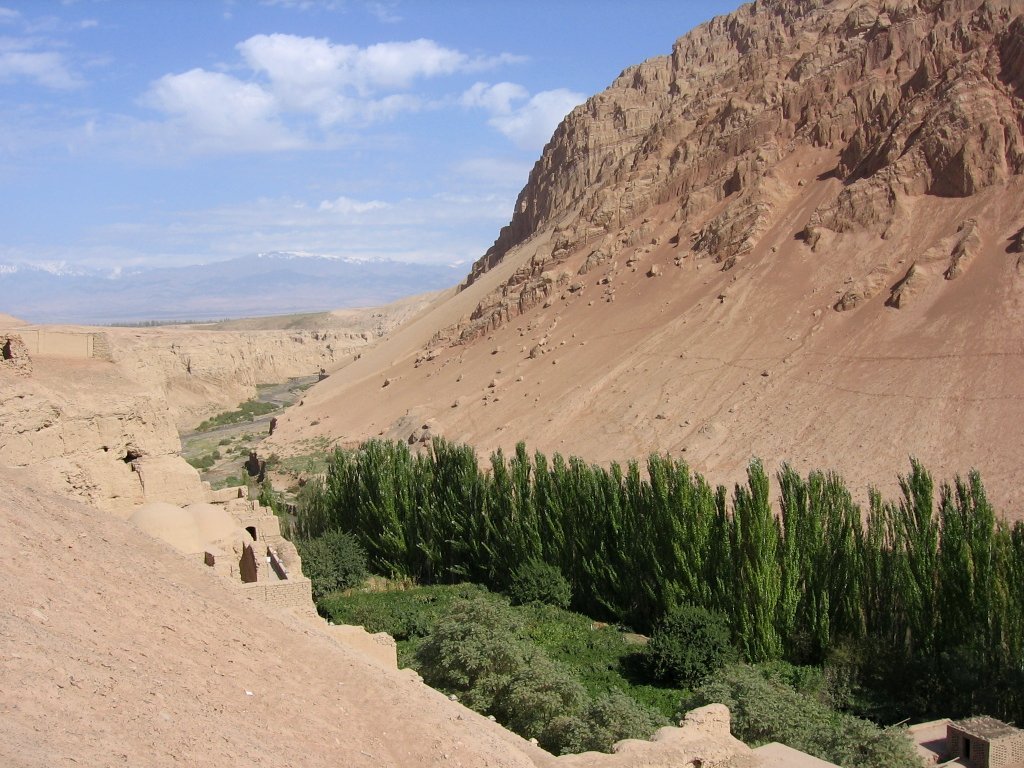
However, once he left the Yumen Pass, he immediately ran into a major issue: the Gobi Desert.
The road from the Yuman Pass to the next stop, the oasis at Hami, was barren, dry, with extreme heat and cold, and not well marked. Xuan-zang, who had little experience with this kind of travel, at one point lost his waterskin, became lost, and collapsed due to exhaustion. It is said that the bodhisattva Guan-yin guided him in his darkest hour to Hami.
The Hami Oasis
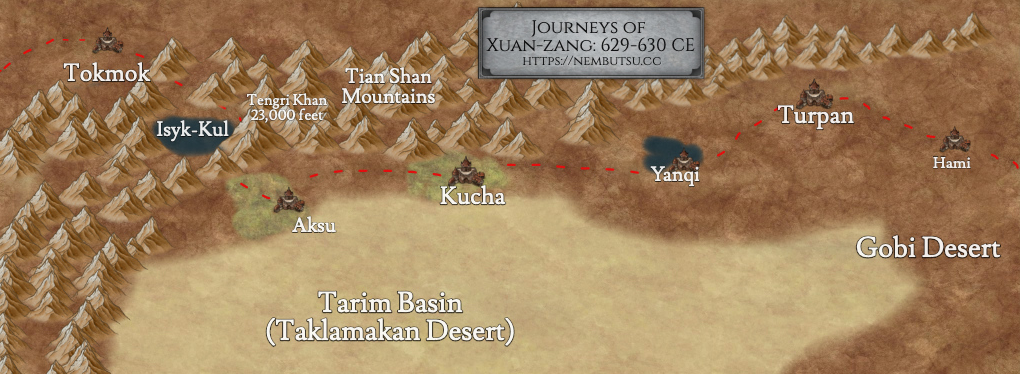
A map of the first part of Xuanzang’s journey. I made this using Inkarnate (a great online map tool). Apologies for any geographical mistakes. Free for non-commercial use.
The town of Hāmì (哈密), also known as Kumul (قۇمۇل) in Uyghur, was populated by a Chinese military colony since the Sui Dynasty, but had been cut off from China during turbulent times. At Xuan-zang’s time, it pledged loyalty to the regional Turk rulers while still maintaining diplomatic relations with the new Tang Dynasty. Some months after Xuan-zang left, Great Tang’s expansion absorbed Hami into its empire.
Here in Hami, Xuan-zang stayed at a Buddhist monastery where three Chinese monks lived. They were overjoyed to see a fellow monk, and offered him lodging. Xuan-zang did not stay too long here, and moved onto the larger city of Turpan.
The King of Turpan
The “Flaming Mountains” near the city of Turpan on the Silk Road. Photo by es:User:Colegota, CC BY-SA 2.5 ES, via Wikimedia Commons
The city of Turpan (Uyghur: تۇرپان) also called Tǔlǔfān (吐鲁番) in Chinese was a prosperous city since ancient times, and changed hands often, but since antiquity had a large Chinese community, and considerable Chinese cultural influence, especially compared to cities further west.
The King of Turpan at this time was a devout Buddhist, and gave Xuan-zang a warm welcome upon his arrival, but also pressured him to stay rather than continue his journey. When Xuan-zang politely refused, the King of Turpan begged, cajoled, and threatened him. Xuan-zang was not allowed to leave, and he resorted to fasting to make his point. The king relented, and got Xuan-zang’s promise that he would stay for a month to preach to the people of Turpan, and would return later upon his return trip.
Once this agreement was reached, Xuan-zang stayed as promised. He used this time to explore the area, including the ancient city of Gāochāng (高昌), also known as Qocho, which was the former capital of a once-powerful kingdom, where he gave sermons to audiences there. Archeological excavations have show plenty of evidence of a vibrant Buddhist community at the time.
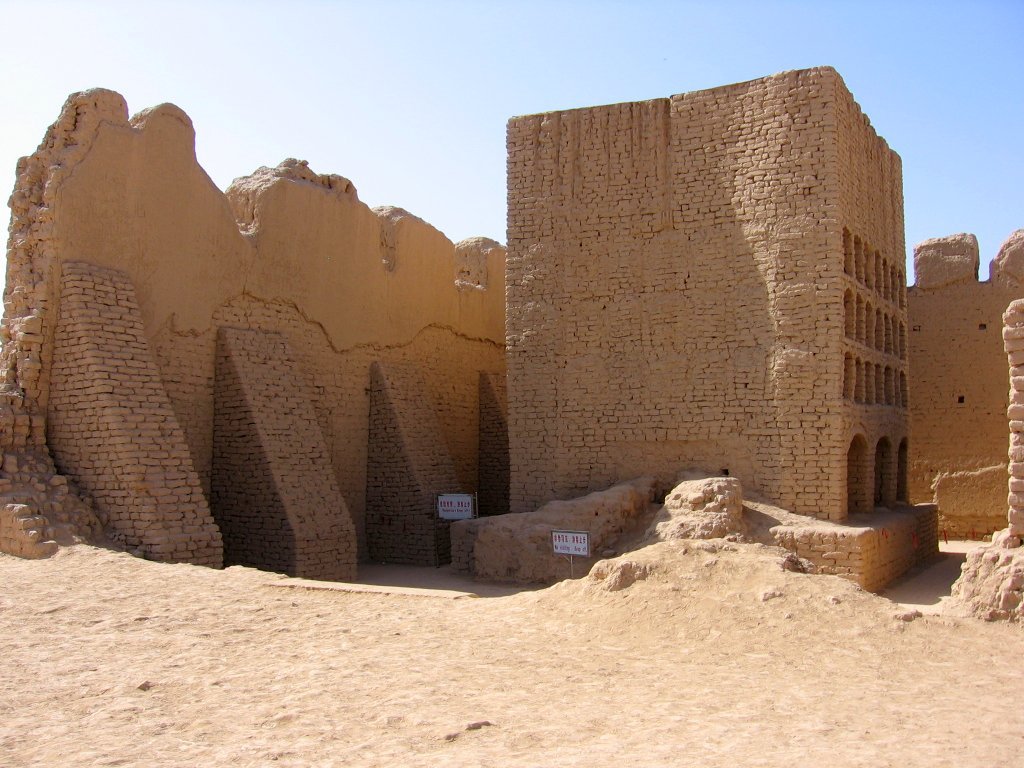
Remnants of a Buddhist stupa at Gaochang. Photo by Colegota, CC BY-SA 2.5 ES, via Wikimedia Commons
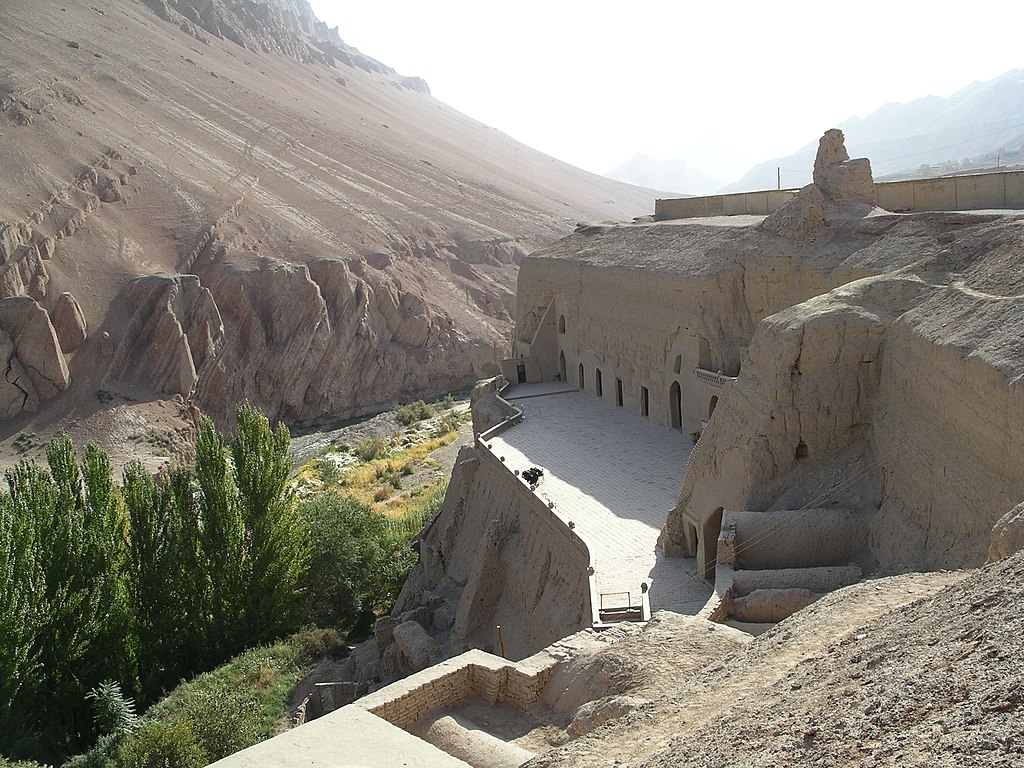
Xuan-zang also likely visted the nearby Bezeklik caves as well:
The Bezeklik Caves as seen from above. Photo courtesy of Wikimedia Commons.Photo by T Chu, CC BY 2.0, via Wikimedia Commons
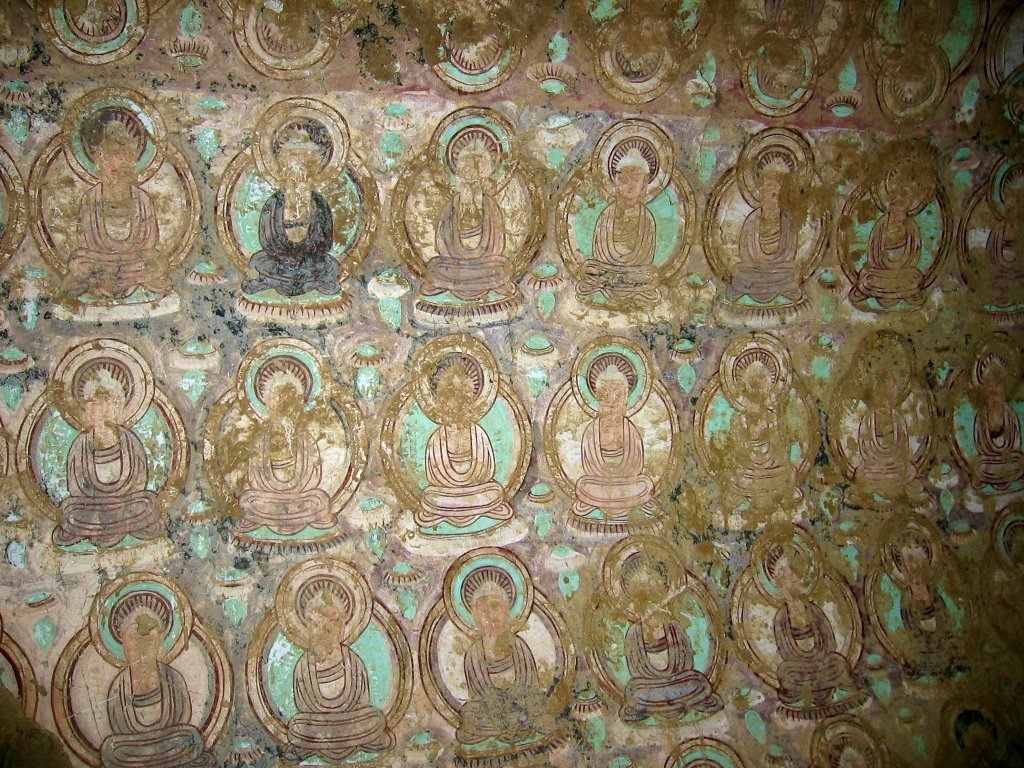
The Bezeklik caves are a massive grotto that served as a monastery for the local Buddhist monastic community. Many of the walls and ceilings were painted with frescoes of the Buddha, or other famous imagery, though in later generations, these were often defaced or damaged by locals for one reason or another (superstition, religious prohibition against human imagery, or simply raw materials).
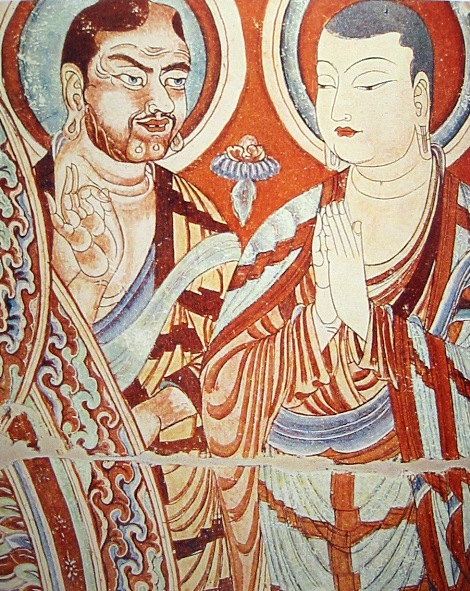
Further, European archeologists looted the caves and brought many works of art back to Europe, only for them to be destroyed later in World War II. Thus, very little remains of the artwork now, but what does remain is simply spectacular, and a shining example of the fusion of cultures along the Silk Road at this time.
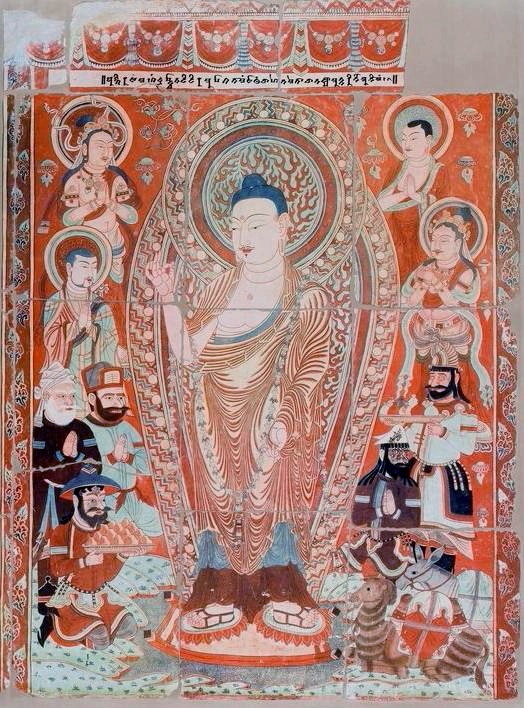
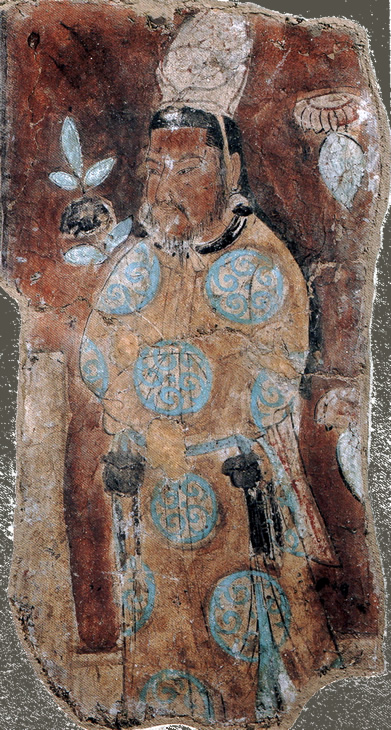
Bezeklik caves, Pranidhi scene 14, temple 9. Note the Sogdian men depicted in reverence of the Buddha. See page for author, Public domain, via Wikimedia Commons
Two Buddhist monks, one Eurasian (possibly Sogdian or Tokharian), and one East Asian. Public domain, via Wikimedia Commons
Once Xuan-zang’s month was completed, the King of Turpan made good on his word. He provided Xuan-zang with many goods, supplies and letters of introduction to the kings further along the road. He now traveled with a caravan toward the next city Yānqí (焉耆) known by many other names, including Karasahr (قاراشەھەر in Uyghur) or Agni from the old Tokharian name, but not before being robbed by bandits! Evidentially, the bandits had already killed and robbed an earlier caravan, and were content to be bribed by Xuan-zang’s party and left with no further violence.
Upon reaching the city of Yanqi/Karasahr/Agni, Xuan-zang was said to have received a warm welcome, and described a city with ten different monasteries, and with two thousand monks practicing Hinayana Buddhism.1 He did not have flattering things to say about the king of Yanqi though, and later in 643 when the king broke his allegiance with Great Tang, the emperor Taizong, whom we met in the prologue episode, steamrolled Yanqi’s army and took the king prisoner.
Xuan-zang for his part only stayed for one night and moved on toward the city of Kucha. Kucha is an important city in early Buddhist history, but as we’ll see in our next episode, it was caught in a game of political tug-of-war…
Until the next episode: the Western Turks!
1 The term Hinayana is a loaded term in Buddhism, and frequently misunderstood. It has also been used as a pejorative by Mahayana Buddhists too. Without getting lost in the weeds, think of “Hinayana” Buddhism as any pre-Mahayana Indian-Buddhist school. It is not the same as Theravada Buddhism (the other major branch of Buddhism) since both branches were geographically separate and had little interaction with one another.
I have been avidly playing the game Fire Emblem: Three Houses since fall of last year. Yes, the game is that good. But also the game makes you think about things too, including religion.
One of my favorite characters in the game, is the leader of the Golden Deer House, Claude von Riegan (also mentioned here and here), voiced in English by Joe Zieja. Claude’s background is unusual for the game’s cast, and he keeps his identity close to his vest, but needless to say he’s had a very worldly upbringing, and sees things different than the other students who mostly grew up in Fódlan. He is just as ambitious as Edelgard, but prefers to meet his goals in a more hands-off, less forceful way.1
Unlike most of his fellow students, who grew up within the Church of Seiros, Claude tends to be pretty cynical about Fódlan’s only religious organization, and regularly questions it (this is also important to certain elements of the plot, but that’s beside the point).
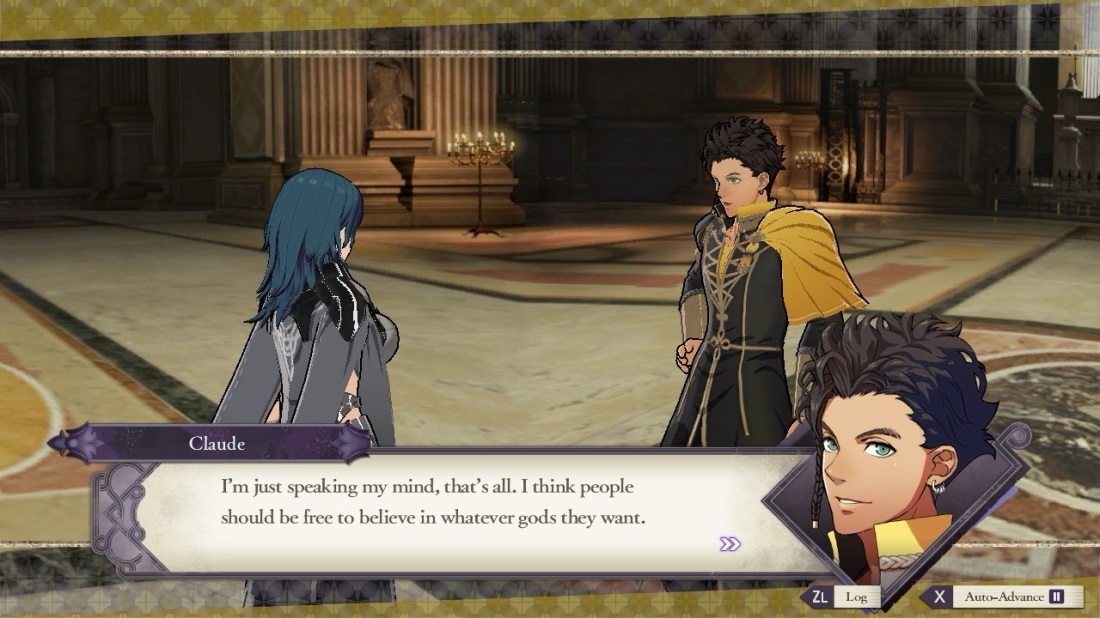
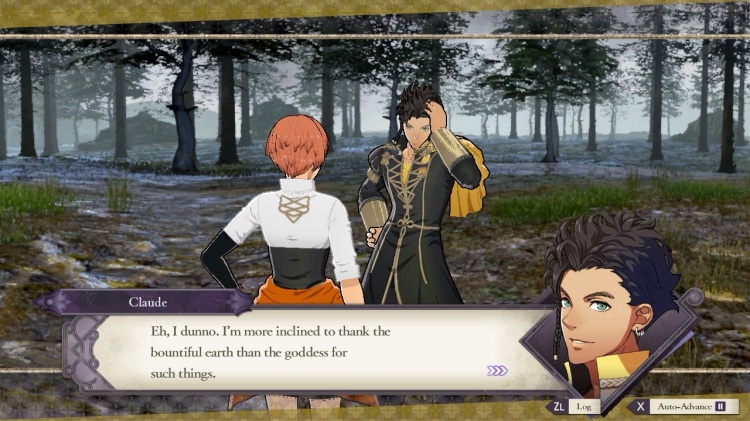
Anyhow, I wanted to share something he said that I think is worth considering (possibly out of order, I lost track of which is which):
Even though I tend to be an ardent Buddhist, I think what Claude is saying here is a healthy to look at the world and its religions. If you consider religions past and present, there have been countless gods and goddesses, rituals, liturgical languages, and so on. Even in in the same religions, practices and views diverge over time. This may offend purists, but it’s impossible to avoid, let alone manage.
Further, Buddhism has never been a particularly evangelical religion. It’s not in a race to win converts (minus a few cults), for a variety of reasons. First, this is in keeping with the Buddhist notion of metta (“goodwill”) that as long as other people have a belief system that helps them, not hinders or makes them feel bad, then that is fine. Second, the danger of imposing one’s beliefs on others is that it’s almost always fueled by ego and one’s own delusion anyway. A person’s religious beliefs, even Buddhist ones, are almost always a reflection of one’s own mind, and have to be taken with a grain of salt. Third, the Buddha clearly wanted people to take refuge in the Dharma of their own volition, and not by coercion. Even the Five Precepts are phrased as “I undertake” not as a command. Similarly with the practice of the nembutsu in Pure Land Buddhism. There’s nothing in the Buddhist canon that tells people to recite, or not recite it. It’s up to each individual to work with the tools offered in the Buddhist toolkit and apply them as best as they can. Like Claude says above, if you find a support system that works, great. This is no less true within Buddhism and its many traditions as well.
It’s generally better, and healthier for one’s own mental state, to let others be who they are, believe what they will, as long as its helpful, not harmful. The tighter one grasps, the more exhaustion and grief they inflict upon themselves, and others.
There are almost as many as variations on religious beliefs as there are people, so like the analogy of the Blind Men and the Elephant, each person is trying to feel their way through life using what resources, background and knowledge they have. Even within Buddhism, each person has their own “spin” on what the Buddha was, or what his teachings were.
It’s imperfect, but we all have to start from somewhere.
P.S. If you own a Switch, try Fire Emblem: Three Houses. 😋
1 Bit of a tangent, but of the three lords in Three Houses, I feel that Dmitri plays the role of the “conservative”, trying to restore his kingdom and the Church the way it was. Claude is the “liberal” trying to open things up and hoping it will change Fódlan, while Edelgard is the “revolutionary” who wants to change things directly (i.e. through force).











 Gleanings in Buddha-Fields


You must be logged in to post a comment.