The Art of Dying

One thing that really annoys me as a long-time Buddhist is the tendency for self-help and spritual seminars to cost so much money. I saw this advertised locally in my area for weeks, and the starting price for a seat is $250 for a backrow seat, which to me is totally bonkers.

The Dharma, as taught by Shakyamuni Buddha was freely given, and required nothing.

Having said that, as a counter to pricey spiritual seminars, I wanted to promote a concept: the Art of Dying.

DYING?!

It is a simple concept: you are going to die. You cannot necessarily choose the hour or manner of your death. But it will occur inevitably occur.

You do not have to take my word for it. Here’s a Buddhist sutra (freely given I might add) from the words of the Buddha:

There is no bargaining with Mortality & his mighty horde.

Whoever lives thus ardently, relentlessly both day & night, has truly had an auspicious day:

So says the Peaceful Sage [Shakyamuni Buddha].

MN 131, translation by Ven. Thanissaro Bhikkhu

The Lotus Sutra, a later Buddhist text but in my opinion the capstone of the Buddhist canon, describes this using the famous Parable of the Burning House in the third chapter. You can find Dr Burton Watson’s translation here (again, for free!).

But, to summarize the Parable, the Buddha Shakyamuni asks us, the reader, to imagine a great, big mansion that’s old, rickey, and so on. Then, imagine the house is burning. Deep inside, some kids are playing in a room, unaware the house is on fire. The father, having just returned from a trip, sees his kids in danger and calls out to them to leave the house at once. The kids, engrossed in their games, fail to see their situation. Finally, the father offers them great rewards if they leave (specifically carts of goods), and the kids finally come out.

The father, Shakyamuni Buddha, has left the burning house and stands outside. He calls to those in danger, namely the “kids”, to see their peril and to come out too.

What about the burning house itself? That is the world we live in, with strife, conflict, disease, chaos, aging, and death.

The late Thich Nhat Hanh wrote about this too:

“Imagine two hens about to be slaughtered, but they do not know it. One hen says to the other, “The rice is much tastier than the corn. The corn is slightly off.” She is talking about relative joy. She does not realize that the real joy of this moment is the joy of not being slaughtered, the joy of being alive.”

Thich Nhat Hanh, The Heart of the Buddha’s Teaching

This gets to the heart of the Buddha’s teachings: do not squander the time you have on this Earth. It doesn’t mean you can’t enjoy life and your loved ones, but remember: Death will not wait for it to be convenient for you.

When you hear this, your instinct might be the “live, laugh, and love”, indulge in all the fun things in life before it’s too late. But that’s not what the Buddha intended. When you look back at the Parable of the Burning House, the father wasn’t asking the kids to play more, he was telling them to get out before it’s too late.

Further, in the Mahayana tradition, one can get themselves out of the burning house, but helping and guide others to get out of the burning house is even better. One can call such people bodhisattvas.

But you can’t help others (let alone yourself) until you :

  • Recognize the situation
  • Put down your own toys and find the way out before you can help others.

This is part of the progression of the Buddhist path: get your foundations in order, increasing confidence in the Dharma (which you can see in your own life), and turning outward to help other beings.

But starting at the beginning, how does one establish a foundation?

Everyone is different, but generally it starts with some simple things:

  1. Taking the Buddha, Dharma and Sangha as one’s chosen refuge (you can do this by yourself or in a community). You can setup a small shrine too.
  2. Taking up an ethical life, such as undertaking the Five Precepts
    • If all five are too hard, start with one, and work your way up over the months and years.
  3. Cultivate metta:
    • Say to yourself (yes, you): May I be well, may I be free from harm.
    • Now think of loved ones: may they be well, may they be free from harm.
    • Now think of all living beings (even the awful ones): may they be well, may they be free from harm.
  4. Setup a reasonable daily practice. Think of it like exercise or stretching: if you start too aggressively, you’ll injure yourself and set yourself back. So start small, and build up.
    • What does a daily practice look like? Some examples here.
    • A small meditation practice can be beneficial too, but intention matters.
    • Study the sutras. Not self-help books, but the sutras. Commentaries on the sutras, such as those provided by Thich Nhat Hanh are quite good and easy to find in used and independent bookstores such as Powell’s City of Books.
    • Find worthy teachers and communities, not slick, overpriced seminars or cults. Caveat emptor.
  5. Give yourself permission to screw up, then reflect on it, and move on.
  6. Repeat. Buddhism is a long-term practice. “Play the long game“, but also remember you are on the clock. Time is short.

So, that’s your free teaching for today. Thanks for attending this seminar. Want to support the blog? Pay it forward or something. This is “Buddhism on a Budget”, and I strongly feel this is how Buddhism should be.

Namu Shakyamuni Butsu
Namu Amida Butsu
Namu Kanzeon Bosatsu

P.S. apparently this also a band with this name. As fellow PNW residents, I salute them.

What is the Lotus Sutra?

One of the most influential sacred texts in Buddhism is the Lotus Sutra.

The Lotus Sutra has had a tremendous influence on Buddhism as we know it today. Much of Buddhist culture as we know it either came from the Lotus Sutra, or was influenced by its ideas and teachings. Not everything, of course. But the influence is hard to ignore. If you know the Lotus Sutra, a lot of things about Buddhist culture make more sense.

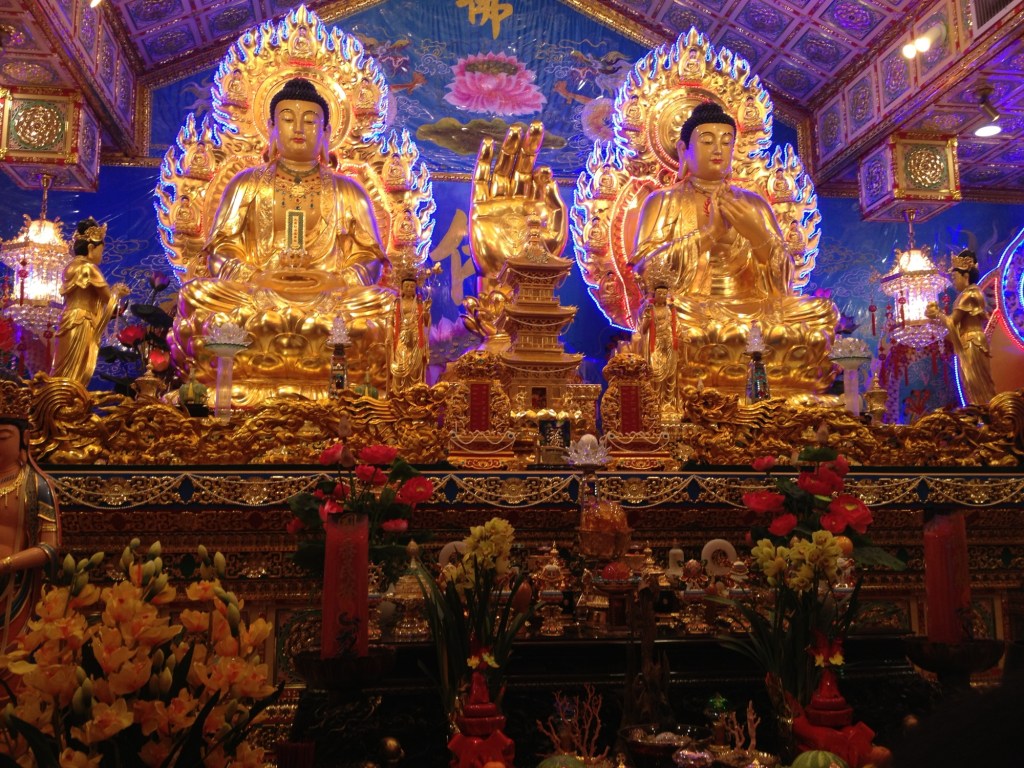
A copy of the Lotus Sutra enshrined at a Vietnamese Buddhist temple. Taken at Ksitigarbha Temple in Lynnwood, WA in 2013.

Because the Lotus Sutra has been translated to many different cultures at different times, it has had many names:

Original languageTitleRomanization
SanskritSaddharma Puṇḍarīka Sūtran/a
Chinese妙法蓮華經Miàofǎ Liánhuā Jīng
Vietnamese妙法蓮華經 (Han Nom)
Diệu Pháp Liên Hoa Kinh (modern)
n/a
Korean妙法蓮華經 (Hanja)
묘법연화경 (Hangeul)
Myobeop Yeonhwa gyeong
Japanese妙法蓮華経Myōhō Renge Kyō
Tibetanདམ་ཆོས་པད་མ་དཀར་པོའི་མདོDamchö Pema Karpo’i do

The full title in English is the Sutra on the White Lotus of the True Dharma, but usually we just call it the “Lotus Sutra”. Similarly, in other languages, the full title of the Lotus Sutra is shortened as well. For example, in Japanese, Myōhō Renge Kyō is shortened to Hokekyō.

But I digress.

The Lotus Sutra is not short, and for new Buddhists it is not easy to read. Composed in India in the first century CE, it is divided into 28 chapters, so it reads like a full book. Many of these chapters have a prose section, then repeats itself in one or more verse sections.1

Like all Buddhist texts, or sutras, it presents its teachings in the form of a sermon by the historical founder of Buddhism, Shakyamuni Buddha (“Shakyamuni” for short). Could the Buddha have given such a long, long sermon all in the span of one sitting? Probably not. But that’s how Buddhist sutras are usually presented.

A mural of the Buddha, attended by Bodhisattvas, at the Mogao Caves in Dunhuang, China. Photo taken by user scchoong123. Artwork is ancient and anonymous., Public domain, via Wikimedia Commons

Through the Buddha, the Lotus Sutra teaches many parables and similes to get its point across. Many of these parables took on a life of their own and frequently appear in Buddhist art or literature. Others are strange and obscure to modern readers. In fact, if you’re just reading the sutra for the first time, it really helps to have some kind of side-by-side guide to help make sense of it because if you tried to read it literally, you will get a headache. Thich Nhat Hanh’s book Opening the Heart of the Cosmos really helped me a lot.

For example, the chapter with the Sermon in the Sky, where a second Buddha named Prabhutaratna appears, and everyone flies up impossibly high to hear their sermon, and the Buddha projects himself across many worlds, is a difficult read. If you try to read at face-value, it reads like a fever dream.

A mural from the Yulin Grotto in China. See page for author, Public domain, via Wikimedia Commons
An altar revering the two buddhas, Shakyamuni and Prabhūtaratna, from the eleventh chapter of the Lotus Sutra, enshrined at a Vietnamese temple. Taken at Ksitigarbha Temple in Lynnwood, WA in 2013.

But the style of the Lotus Sutra isn’t to appeal to the head, it tries to appeal to the imagination. It is one thing to say that life is impermanent, it is another to describe the world as a great burning house, with people inside too distracted to notice. When the Buddha is shown projecting himself to countless worlds, it is just a colorful way of saying that the Dharma is everywhere, and there are countless buddhas across many worlds each preaching according to the environment. When the Buddha describes archetypal bodhisattvas in the later chapters, each one is meant to convey a different Buddhist virtue.

Deep stuff.

The Lotus Sutra was pretty radical for its time, and a core part of the larger Mayahana-Buddhist reform movement. The parable of the Dragon Princess, attaining enlightenment faster than any was obviously meant to blow the minds of the establishment, and challenge certain cultural prejudices about women, and so on.

A 12th century Japanese mural from the Heike Nokyo, depicting the Dragon Princess offering a jewel to the Buddha before transforming. Public domain, via Wikimedia Commons

Similarly, the chapter where countless streams of “bodhisattvas of the earth” emerge from the ground was meant to show how we didn’t need to rely on elite gurus, but that everyone had the capacity for being a bodhisattva too, if they just had the confidence.

I’ve talked about the main themes of the Lotus Sutra in an older post, but I wanted to cover two really important ones.

First, the most important teaching of the Lotus Sutra is probably the “One Vehicle” (Ekayāna) teaching. Previously, the reform Mahayana, or “great vehicle” Buddhists, bickered with the traditional Buddhist establishment (called Hinayana, or “small vehicle”), and traded barbs witih one another. You can see this is in some of the really early sutras composed by Mahayana Buddhists.

But then the Lotus Sutra took a step back and looked at the big picture, and taught that it was all just Buddhism (e.g. “one vehicle”) anyway. There were many places to start, and ways to move forward, but in time they would all converge, and the quality of one buddha was no different than another. What worked for one person didn’t necessarily work for another. There was no use bickering, any effort great or small was worth it.

Second, the other major teaching of the Lotus Sutra is that the Buddha was far, far older than history would tell us. The sutra implies that the Buddha would appear in some time and place, restart the Buddhist community, grow old and die, but that was just trick to keep people getting attached to the Buddha. This seems pretty disingenuous.

But what the sutra is trying to tell us is that the Buddha just personifies the Dharma (the teachings), and that the Dharma is the Buddha. Since the Dharma, the principle of existence, has always been around, in the same way one can see the Buddha also being around in one form or another, even in the darkest of times. Where does one begin, and the other end? I think the Mahayana Buddhists who composed it wanted people to stop getting hung up on the physical/historical Buddha, avoid a “cult of the Buddha”, and focus on the Dharma.

As a side note, the Lotus Sutra frequently promotes itself. It says that anyone who sincerely hears the Lotus Sutra, and praises it gets all kinds of benefits. But is not the Lotus Sutra as the written text from 1st century India. Like the “eternal Buddha”, this is the Lotus Sutra as the ultimate teaching (e.g. the Dharma) in its unvarnished form.

Thus, the Lotus Sutra is in some ways a very strange text because it is so dense with metaphor, simile and parables to get things across. But when you look at all the artwork and culture influenced by it, you can see that it gets something right. Rather than appealing to intellect, it conveys its messages through more impactful means. It is one of those texts that you keep referring back to over the years because it stands out so much.

Speaking from experience, it helps not to read it from cover to cover. Instead, focus on one chapter, try to suss out the meaning. Some chapters are, in my experience, a little bland, others are really moving. Sometimes a chapter won’t make any sense, then years later you will have an “ah ha” moment and you see it in a new light.

Speaking from experience. 😏

P.S. I probably own 3-4 translations of the Lotus Sutra, the Gene Reeves translation is probably the easiest for beginners in my opinion, but I like them all in their own way.

1 Researchers believe that the verses actually came first, and then the authors composed narrative around them.

Kiyomizudera Redux

As part of our trip this summer to Japan, including Kyoto and Nara, we visited the temple of Kiyomizu-dera (lit. “The temple of pure water”). We had visited this temple wayyyyyy back in 2005 during my first even trip to Japan, but in 18 years I have learned a lot about Buddhism in Japan and it was nice to come again with a more discerning eye, and a better camera. Unlike our last visit, which was in the middle of January, this last visit was in July when it was extremely hot and muggy, despite the seemingly cloudy weather.

This post is meant to be an updated tour of Kiyomizudera, but if you want more details about the temple, feel free to read the original post, or checkout the official website.

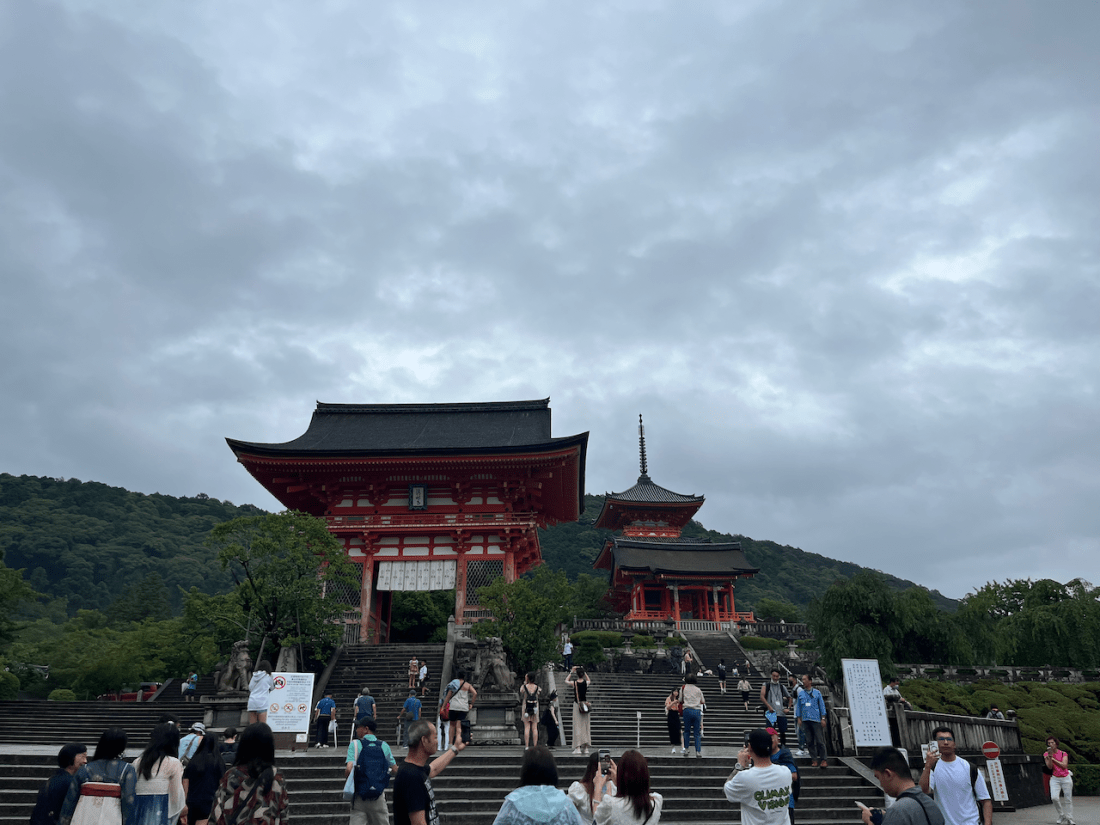
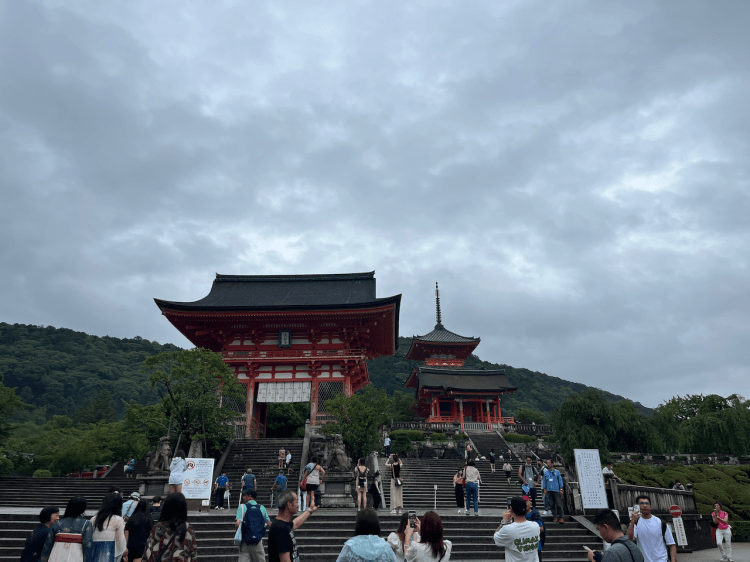
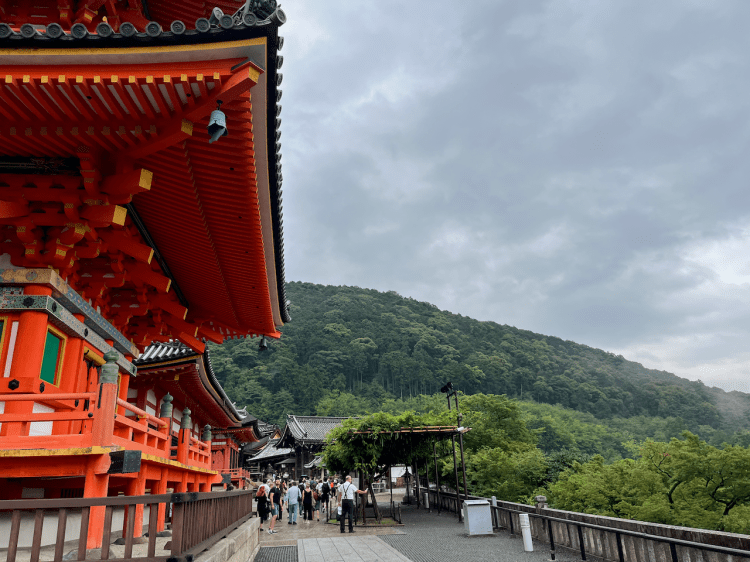
Anyhow, Kiyomizudera sits upon a hill toward the outskirts of Kyoto (which sits in a valley), and leads up to a path like so.

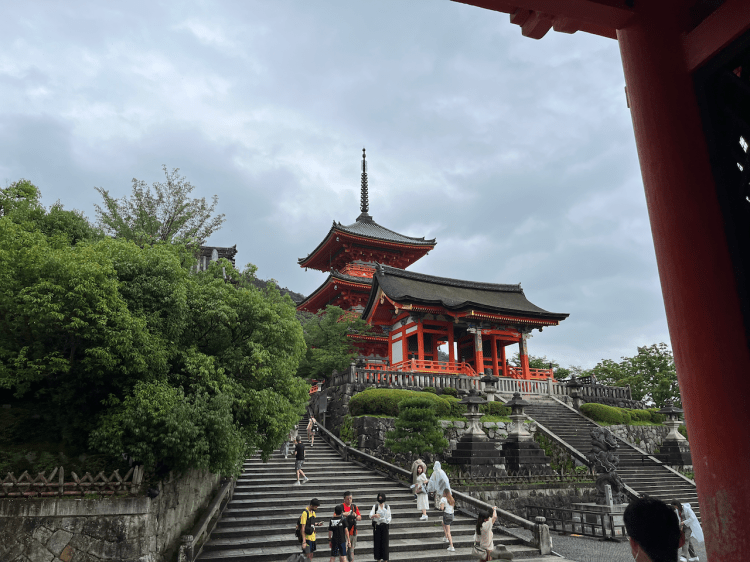
If you go up the stairs on the left, and pass under the gate, you will see the following

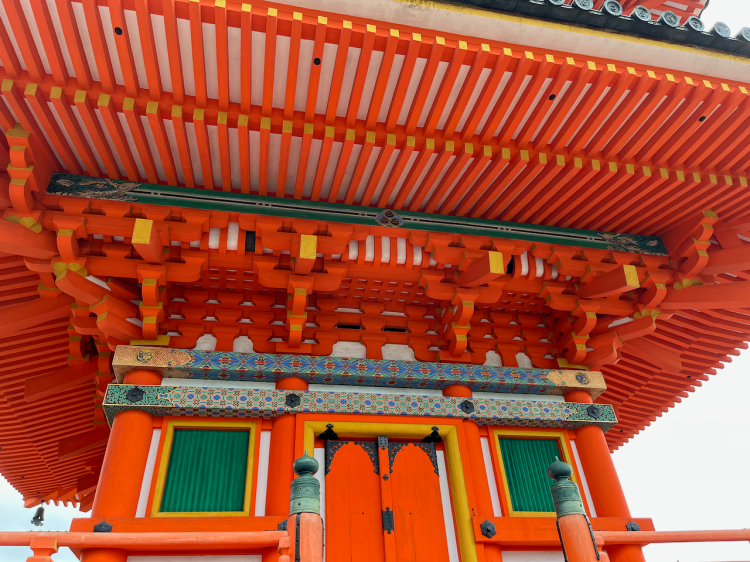
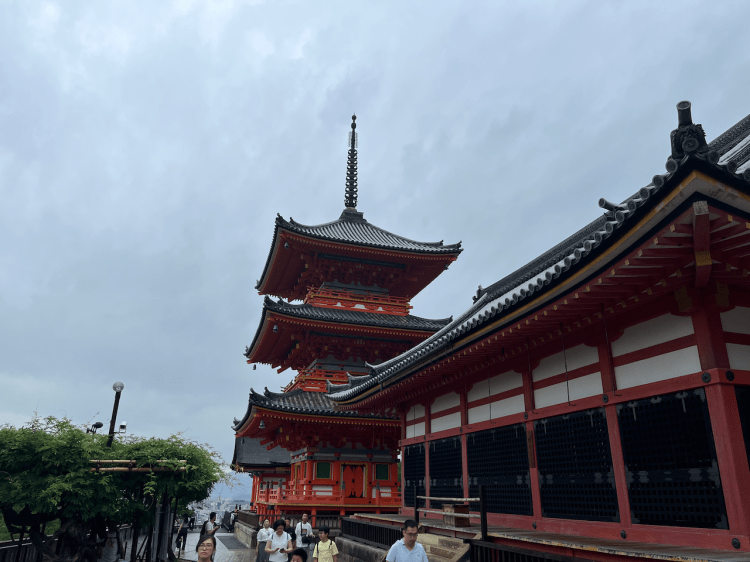
Up close, the tall pagoda (a Buddhist stupa) is very brightly colored. This reflects style used in early Japanese architecture, versus later more subdued color schemes.

From a bird’s eye view, Kiyomizudera is laid out like an “L”, but flipped vertically. From the pagoda you can see a long veranda overlooking the famous drop-off to the right, and the main temple to the left (hard to see in this photo). Further back, the path turns right.

Looking backward…

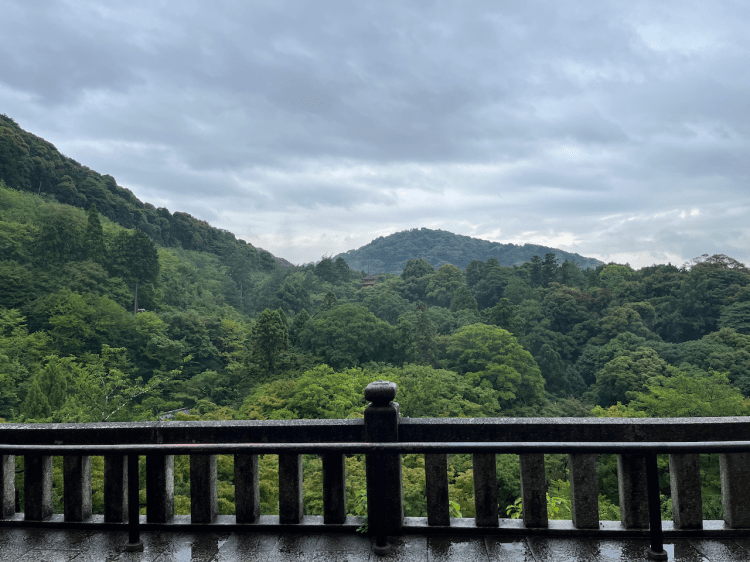
Here is the aforementioned drop-off which lets you look out over the hillside:

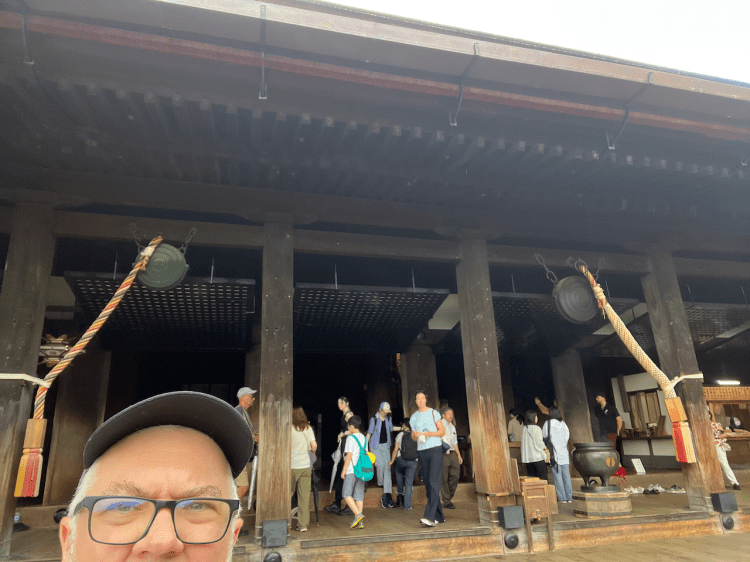
Directly behind the drop-off, is the main temple, devoted to the Bodhisattva Kannon. Unfortunately, photos are not allowed inside, so instead you can see my handsome face just outside. Inside, the statue of Kannon is shielded behind a wire mesh, with a large Buddhist bell that people can ring, offer veneration, etc. You can see the central figure on the official website here. This is a good example of the classic “1000-armed” Kannon, whose many arms express Kannon’s countless and varied efforts to help all beings. Kannon epitomizes many aspects of Mahayana Buddhism all in one nice image.

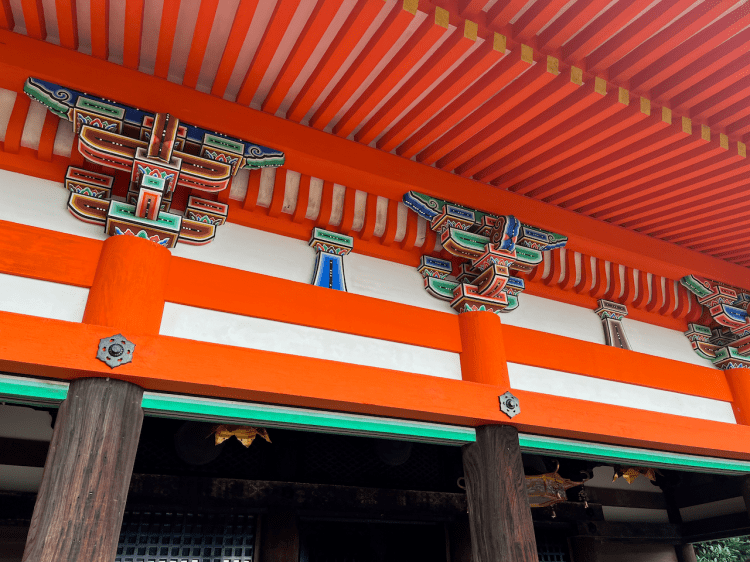
If you were to look up you can see some very pretty architecture.

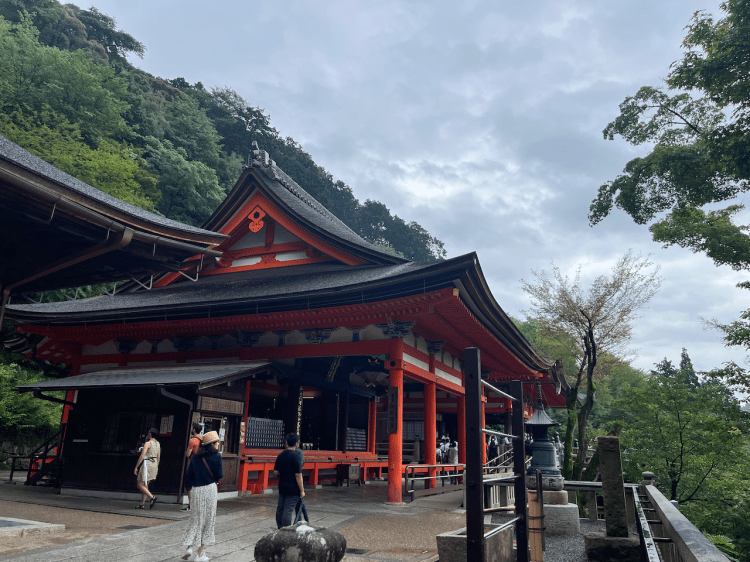
If you go further, around the “bend” of the “L”, to the right are a couple sub-temples:

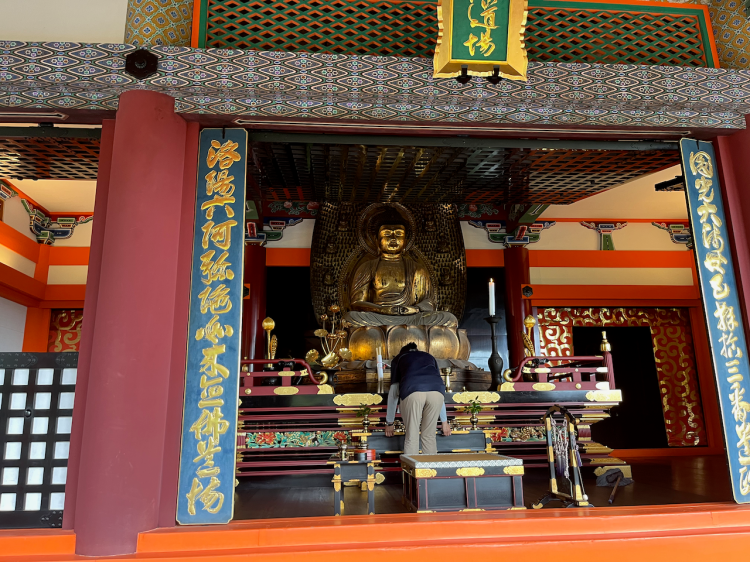
This sub-temple is devoted to Amitabha Buddha (e.g. Amida Buddha). Amida Buddha is the central figure of Pure Land Buddhism, which is prominent in the Tendai Buddhist tradition (of which Kiyomizudera is one such temple). Later Pure Land-exclusive sects all branched from Tendai: Jodo Shu, Jodo Shinshu, Ji-Shu, etc.

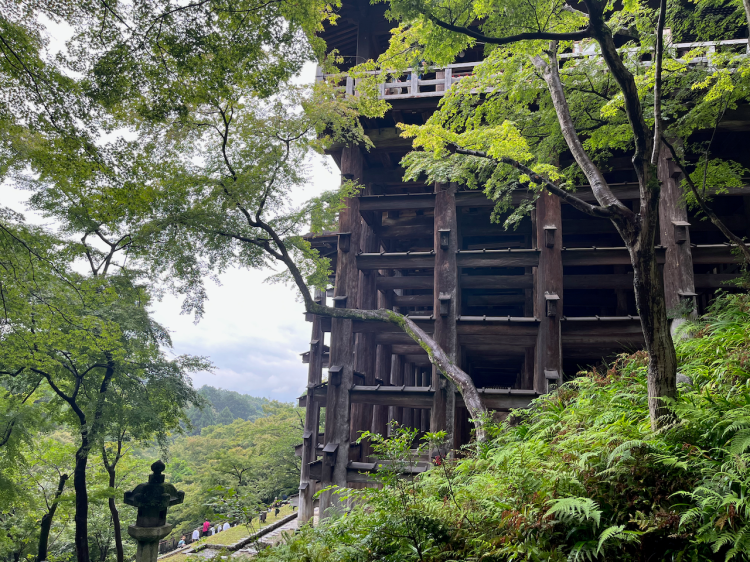
Near the bend of the “L”, there is a set of stairs that will take you down to the lower level. The drop-off I showed before was built entirely with wood, using pegs and no metal nails. Yet, as you can see, it is very well-constructed.

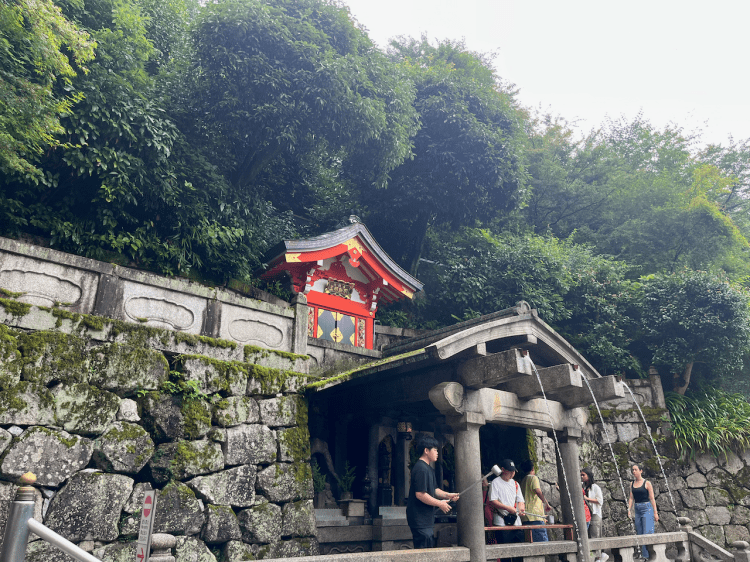
At the bottom is a small waterfall and spring from which the temple gets its name.

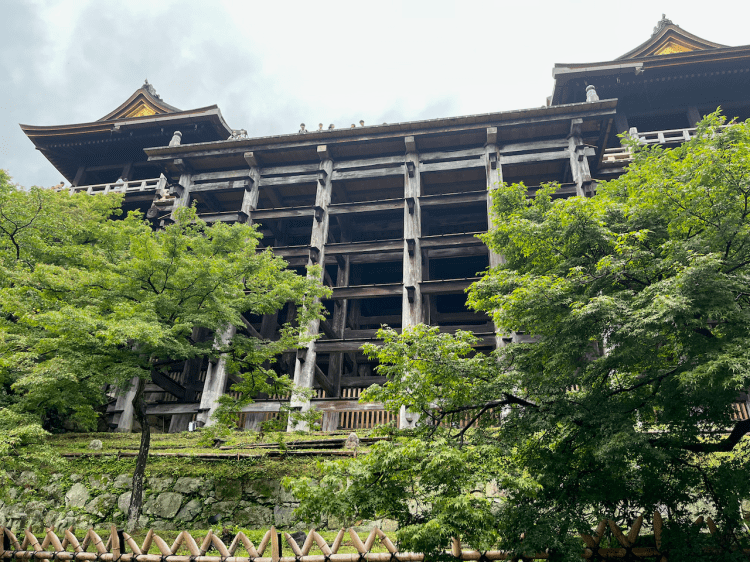
A view of the drop-off, from the bottom.

Kiyomizudera is a pretty neat temple, and as one of the oldest in Kyoto, it has seen countless, countless visitors of all kinds. It was nice to come once again, and pay respects to Kannon Bodhisattva here, and to better understand the layout and the significance of the temple with the benefit of experience and hindsight.

P.S. Been thoroughly busy these past weeks, and blogging a lot less than I used to. Most of this is related to holidays, but also work. Hopefully things will quiet down again soon.

Commitment

The Lotus Sutra is one of the most important Buddhist texts in the entire Mahayana-Buddhist canon. Because of its length, its chapters, and its variety of figures, parables and such, there’s something for everyone, hence its influence on the subsequent tradition.

Lately, I have been thinking about the story of the Bodhisattva Medicine King,1 in the 23rd-chapter of the Lotus Sutra. The story is too long to quote verbatim here, but I will try to post the relevant parts. I am using the Senchu Murano translation, but the Burton Watson translation (available online) is excellent, too.2

In this chapter, the narrator, Shakyamuni Buddha, describes a land that existed countless eons ago, populated by a great Buddha:

Innumerable kalpas [“eons”, very long periods of time] ago, that is, as many kalpas as there are sands in the River Ganges, there lived a Buddha called Sun-Moon-Pure-Right-Virtue….He was accompanied by eight thousand million great Bodhisattva-mahāsattvas…The duration of his life was forty-two thousand kalpas…There was no calamity in his world. The ground of his world was as even as the palm of his hand….

Page 305, Chapter 23 of “The Lotus Sutra” by Senchu Morano

Then as this Buddha preaches the Lotus Sutra to his disciples (with emphasis added), one of them was particularly inspired. After having practiced many austeries, and offered countless kinds of incense and flowers to his teacher (Sun-Moon-Pure-Right-Virtue Buddha), he decided it was not enough :

Having made these offerings [of incense, flowers, etc. to the Buddha] he emerged from samādhi, and thought, ‘I have now made offerings to the Buddha by my supernatural powers. But these offerings are less valuable than the offering of my own body.’

Then he ate various kinds of incense….then he applied perfumed oil to his skin, put on a heavenly garment of treasures in the presence of Sun-Moon-Pure-Bright-Virtue Buddha, sprinkled various kinds of perfumed oil on the garment, and set fire to his body, making a vow by his supernatural powers. The light of the flame illumined the worlds numbering eight thousands of millions of times the number of the sands of the River Ganges….

The body of the Bodhisattva kept burning for twelve hundred years, and then was consumed. Having made this offering according to the Dharma, Gladly-Seen-By-All-Beings Bodhisattva passed away. In his next life, he appeared again in this world of Sun-Moon-Pure-Bright-Virtue Buddha.

Page 307-308, Chapter 23 of “The Lotus Sutra” by Senchu Morano

Later in the chapter, the narrator Shakyamuni Buddha, then explains that this pattern of Gladly-Seen-By-All-Beings Bodhisattva offering himself to his teacher was repeated countless times across many eons. The big reveal in this chapter was that this Bodhisattva, according to the Lotus Sutra, was now the Medicine King Bodhisattva attending Shakyamuni’s audience.

If, by this point, you’re wondering “what on earth is going on?” don’t worry. The Lotus Sutra isn’t a straightforward text. If you try to read at face-value, you will probably get really confused. Unlike the sutras of the Pali Canon, which are formulaic and dry, the Lotus Sutra is a narrative composition that relied on literary flourish and hyperbole.

Like other bodhisattvas features in the second half of the Lotus Sutra (including Avalokiteshvara in chapter 25), each one is held up as the epitome of some aspect of Buddhism. The Medicine King Bodhisattva, I think, is meant to epitomize commitment to the Dharma. The Sutra is not asking people to burn themselves to practice Buddhism. What matters isn’t the specific action, but that he kept coming back over and over, unconcerned about the trivialities of life.

If this seems odd, consider this passage from the Heart Sutra:

Because there is no attainment, bodhisattvas rely on Prajñāpāramitā [the perfection of wisdom], and their minds have no obstructions. Since there are no obstructions, they have no fears.

Translation by Lapis Lazuli Texts

Or the opening passage of the Immeasurable Life Sutra (e.g. the “Larger Sutra”) in the Pure Land tradition. I have again trimmed for brevity:

Having well learned the extensive wisdom of fearless and having realized the illusory nature of dharmas, he [a typical bodhisattva] destroys Mara’s nets and unties all the bonds of passion….

He is above all worldly affairs and his mind, always serene, dwells on the path of emancipation; this gives him complete control over all dharmas….

Having awakened great compassion for sentient beings, he kindly expounds the teaching, and endows them with the Dharma-eye. He blocks the paths to the three evil realms, opens the gate of virtue and, without waiting for their request, provides beings with the Dharma. He does this for the multitude of beings just as a dutiful son loves and respects his parents. He indeed looks upon sentient beings as his own self.

Translation by Rev. Hisao Inagaki

In each, there is a strong sense of fearlessness and long-term commitment.

But on the other hand, this is not something the bodhisattva thinks about. Consider this passage from the Diamond Sutra:

The Buddha said to Subhuti, “The Bodhisattva Mahasattvas master their mind by meditating as follows: ‘However many species of living beings there are—whether born from eggs, from the womb, from moisture, or spontaneously; whether they have form or do not have form; whether they have perceptions or do not have perceptions; or whether it cannot be said of them that they have perceptions or that they do not have perceptions, we must lead all these beings to nirvana so that they can be liberated. Yet when this innumerable, immeasurable, infinite number of beings has become liberated, we do not, in truth, think that a single being has been liberated.’

“Why is this so? If, Subhuti, a bodhisattva still has the notion of a self, a person, a living being, or a life span exists, that person is not a true bodhisattva.

Translation by Ven. Thich Nhat Hanh

So it’s not just a sense of great commitment, but also a way of living that’s not self-centered or conceited. The bodhisattvas do not keep score.

It’s like someone who is really committed to a certain hobby or sport, and they’re not even really thinking about it anymore. They just do it, and keep going, refining their craft more and more. Similarly, a good parent doesn’t count how many times they tell their kids “good job”, or how many diapers they changed. They are committed to raising their kids, and even when things are really rough, they keep at it. Mistakes are made, but they don’t quit right there. They keep going.

The Mahayana-Buddhist ideal is along these lines: someone who selflessly teaches the Dharma, helps others over and over, and polishes their minds, no matter how long it takes, and yet their total commitment means that they aren’t really consciously thinking about it. It’s just part of their being.

Anyhow, the imagery in Chapter 23 is powerful, and while this chapter isn’t usually cited by other teachers, I think it still has something to teach us.

P.S. Photo taken by me at Sanjusangendō Temple in July 2023.

1 Not to be confused with the Medicine Buddha. As far as I know, they are unrelated figures.

Source: XKCD

2 The Lotus Sutra has many, many translations in English, and honestly they’re all good. The really archaic translations from the 19th century are kind of hard to read (e.g. Soothill), but any modern translation is fine. The only time the differences matter is mostly for academic reasons, and then it just becomes hair-splitting for your average Buddhist:

This Is The Way

I have been a big fan of the Disney series, The Mandalorian, and have been re-watching the series in anticipation of season 3.

One of the aspects of the show I love is the Mandalorian code. As an orphan, adopted by an offshoot religious cult called the Children of the Watch, the main character Din Djarin is raised under a strict warrior’s code.

Mandalorians cannot remove their helmet in front of other beings, and as Din Djarin comments “weapons are part of my religion”. It is a strict, inflexible religion in many ways, but the Mandalorians believe it is also their source of survival. Even after as the season progresses, and Din Djarin’s character evolves, he still strives to keep this code as much as possible.

This idea of sticking to a moral code is very interesting to me.

Personally, I am not interested in being a warrior, and as a middle-aged dad working an office job, it probably isn’t realistic anyway. In any case, I have been a committed Buddhist for almost 20 years, and I suppose in a way that’s become my code. Things such as the Five Precepts, the Bodhisattva Precepts, and a commitment to help all beings, these are important to me.

I think it’s important to have some kind of moral code in one’s life. It’s important to be able to commit to something beyond oneself, and live a life beyond simple indulgence. The flip side of course is that one has to uphold that code too, even when one doesn’t feel like doing it.

But that tension between the realities of one’s life, one’s code and one’s nature is how a person grows. 😄

P.S. If you look at the progression of Mr Spock as a character too, you can see how he gradually changes from a staunchly Vulcan, driven by logic, to something more well-rounded in the movie series, and later in Star Trek: The Next Generation.

The Four Bodhisattva Vows

Recently, I posted an example of Buddhist liturgy as found in the Japanese Tendai tradition, but I wanted to call out one aspect of that liturgy called the Four Bodhisattva Vows or shiguseigan (四弘誓願) among other names. According to my book on Genshin, the Four Bodhisattva Vows were formulated by the original founder of Tiantai (Tendai) Buddhism in China: Zhiyi. Zhiyi formulated these vows based on an earlier gatha verse from the fifth chapter of the Lotus Sutra:

Those who have not yet crossed over I will cause to cross over,

those not yet freed I will free,

those not yet at rest I will put to rest,

those not yet in nirvana I will cause to attain nirvana.

Translation by Burton Watson

The vows have since promulgated to other Buddhist cultures and sects. The liturgy text will vary slightly from Buddhist tradition to tradition, but like the dedication of merit, is remarkably consistent overall.

In the aforementioned Tendai tradition, one version of the vows is as follows:

Sino-Japanese1PronunciationTranslation by me
(other, better translations exist 😉)
衆生無辺誓願度Shu jo mu hen sei gan doSentient beings are innumerable, and yet I vow to save them all.
煩悩無尽誓願断Bon no mu hen sei gan danMy mental defilements (lit. bonnō) are innumerable, I vow to extinguish them all.
法門無量誓願学2Ho mon mu ryo sei gan gakuThe gates of the dharma are without measure, I vow to master them all.
仏道無上誓願成Mu jo bo dai sei gan shoThe path to Buddhahood is peerless, I vow to fulfill it.
1 Chinese liturgy with Japanese phonetic pronunciation
2 I’ve also seen the last character as 知 (chi), but more or less means the same thing

These vows cover something that we saw in previous articles about the Mahayana-Buddhist notion of the Bodhisattva: that we’re all in this together, and so the Buddhist path is not truly fulfilled until one completes their vows to aid all beings no matter how long it takes. The Mahayana path of the Bodhisattva is lofty, heroic even, but as the last verse says, nothing less is enough.

On the other hand, the path of the bodhisattva begins with a single good act, or a good thought towards others. It’s about piling up grains of sand or pebbles time and time again. With enough time and dedication, one can move mountains. Don’t be afraid to think big, even if you come up short in this life. Even if you acted like a dickhead today, that doesn’t mean tomorrow you will be one. Every day is a rehearsal. The very notion of “buddha nature” means that each one of you has the capability for great things, even if you don’t think you can. That’s why in the 20th chapter of the Lotus Sutra, the Bodhisattva Never Disparaging bows to each person, even when they’re a total jerk: given the right conditions, any sentient being can become a bodhisattva or a fully-awakened buddha. Given enough time all of them will.

My best wishes to you all, dear readers. May all you be well, free from harm, and find what you are looking for.

P.S. Featured image from the story of Chujo-hime in the Taima Mandala Engi (当麻曼荼羅縁起)

What is a Bodhisattva?

Author’s note: this is a post from the old blog that I am reposting as a handy reference, with some extra updates and polish. Enjoy! 😄

One concept that often frustrated me in my early years as a Buddhist was the bodhisattva. Bodhisattvas are central to Mahayana Buddhism, that is all Buddhism from Tibet to Japan (and now overseas), and it seems like everyone had a different idea what a bodhisattva is.

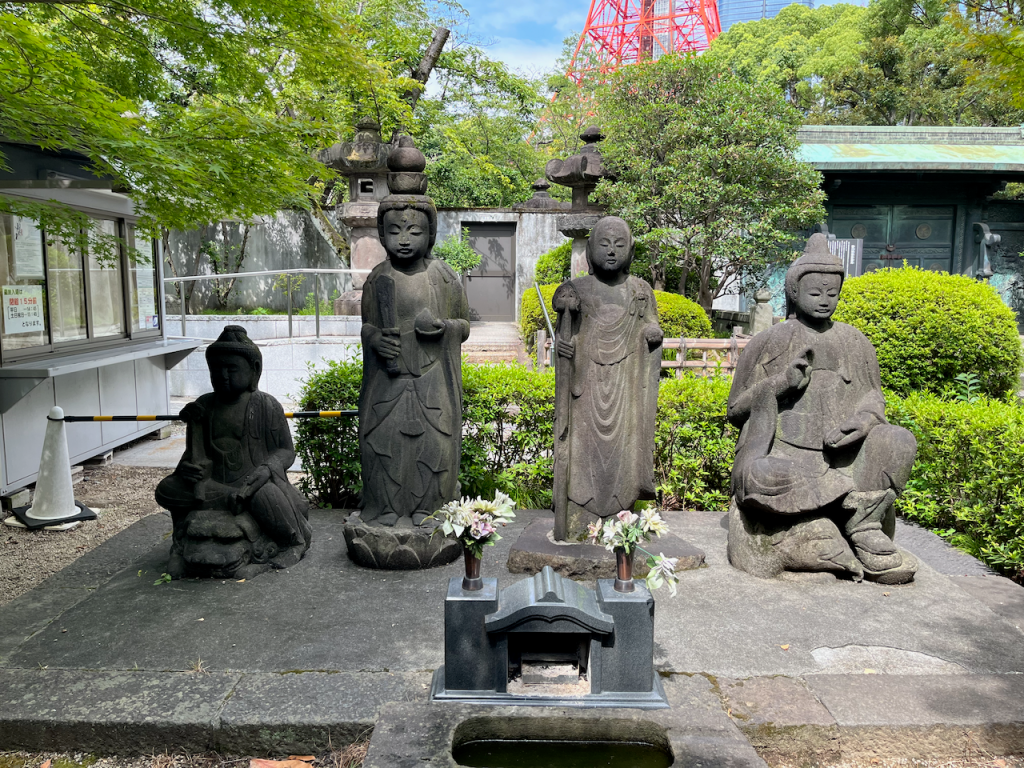
A series of statues at Zojoji Temple in Tokyo, Japan depicting four famous bodhisattvas in the Mahayana tradition. From left to right Manjushri (Monju), Avalokitesvara (Kannon), Ksitigarbha (Jizo), and Samanthabhadra (Fugen).

So, one time I decided to research this and hopefully provide a more comprehensive answer. This is still one man’s explanation, so take it with a grain of salt, but I did use the following sources:

  • Edward Conze – Buddhist Thought in India (ISBN 0472061291)
  • Robert E. Buswell Jr., Donald S. Lopez Jr. – Princeton Dictionary of Buddhism (ISBN: 0691157863)
  • Access to Insight – one of the best sources on Theravada Buddhism, and a great Buddhist resource in general.
  • Tagawa Shun’ei, translation by Charles Muller – Living Yogacara: An Introduction to Consciousness-Only Buddhism (ISBN: 0861715896)
  • Asvaghosha, translation by Yoshito S. Hakeda – The Awakening of Faith (In the Mahayana) (ISBN: 0231030258)

And the following sutras (or collections of sutras) were used:

In simplest terms a bodhisattva in Sanskrit, or bodhisatta in Pāli, means a “seeker of enlightnment”. In the earliest scriptures, the Buddha would talk to his disciples about his own past lives as a bodhisattva, such as this sutra in the Pali Canon:

“Bhikkhus [monks], before my enlightenment, when I was still only an unenlightened Bodhisatta, I too, being myself subject to birth, sought what was also subject to birth; being myself subject to aging, sickness, death, sorrow, and defilement, I sought what was also subject to aging, sickness, death, sorrow and defilement….”

Translation by Bhikkhu Ñāṇamoli and Bhikkhu Bodhi in The Middle Length Discourses of the Buddha

And in another sutra in the Pali Canon:

Ananda: “I heard and learned this from the Blessed One’s own lips ‘For the whole of his life-span the Bodhisatta remained in the Tusita heaven.’….”

Translation by Bhikkhu Ñāṇamoli and Bhikkhu Bodhi in The Middle Length Discourses of the Buddha

In this context, the term bodhisattva mainly referred to the past lives of the historical Buddha, Shakyamuni. In his past lives, when he dwelt in the heavenly realm called Tuṣita (Tushita) and then was born as a prince in India, he was on the cusp of Enlightenment, and only needed that final push. Further, early texts, such as the Jatakas Tales, also imply that this Enlightenment was actually the culmination of many previous lifetimes of searching, effort, and noble deeds. Thus the path of the Bodhisatta who became the historical Buddha was thought to imply an extraordinary, lengthy journey across many lives culminating in final enlightenment.

Later Teachings

In later generations, the role of the Bodhisattva expanded beyond the historical Buddha, and appears more and more often in Buddhist literature. However, it is not the case though that Bodhisattvas are found in Mahayana Buddhism only though. For an excellent treatment of the subject, I highly recommend reading this article by Bhikkhu Bodhi.1 It was just that the path seemed too remote and arduous for most disciples, especially since the presence of a living Buddha allowed them to reach enlightenment much more quickly as Śrāvaka (shravaka) or “hearer-disciple”.

Anyway, in the classic Buddhist model, the historical Buddha was something like a “first among equals”, in that the quality of enlightenment experienced by Arhats (e.g. “noble ones”) was the same as the Buddha. However, Buddhas were distinguished from Arhats by additional qualities that made them almost suprahuman. A Buddha is one who, among other things, gains insight into the truth at a time when the Dharma is unknown (i.e. no other Buddha to teach them), which requires extraordinary spiritual insights and qualities, not to mention their capacity to teach others in such a way that they become enlightened too, and can carry the Dharma onward for generations. This was the contrast between a Buddha and an Arhat.

Over time, the Buddhist community began to explore more and more the notion of becoming a Buddha too (e.g. Buddhahood), and thus the role of the Bodhisattva became increasingly important. As a result, the status of a bodhisattva was elevated over arhats, such that arhats were considered noble, but somewhat inferior to Buddhas and Bodhisattvas.

How Do Arhats, Bodhisattvas and Buddhas relate?

A number of models to explain the relationship between buddhas, bodhisattvas and arhats developed over the course of Buddhist history. As we saw earlier, the original model really only included arhats and buddhas. However, the influential Yogacara school of Mahayana Buddhism (of which the Hossō school in Japan is one of the few independent remnants) taught that different beings had different, inherent natures that would incline them toward the Buddhist path of an arhat, bodhisattva (and thus a Buddha), indeterminate or even those whom enlightenment was impossible.

However, the most popular model in Mahayana Buddhism became the Ekayāna or “One-Vehicle” model. This was popularized by the Lotus Sutra which taught that all disciples would inevitably follow the same path, even if they appeared different at first. Each path (arhat, bodhisattva, etc) were part of the same natural progression and would ultimately converge. In the famous “Parable of the Burning House” in Chapter Three, the father says to his children in the burning house:

“Such a variety of goat carts, deer carts, and bullock carts is now outside the gate to play with. All of you must come quickly out of this burning house, and I will give you whatever you want.”

Translation by Gene Reeves in The Lotus Sutra A Contemporary Translation of a Buddhist Classic

…and when they came outside:

Then the elder gives to each of his children equally a great cart, lofty and spacious, adorned with all the precious things…

Translation by Gene Reeves in The Lotus Sutra A Contemporary Translation of a Buddhist Classic

This parable, the Buddha explains, is meant to show that all followers seem to be following different trajectories, yet ultimately they all converge on the (Mahayana) Buddhist path and become bodhisattvas and then ultimately Buddhas.

Later, starting in the sixth chapter, the Buddha then predicts that his senior monks and nuns, all presumed to be arhats, will eventually become Buddhas. This again emphasizes that the arhat stage is not separate, but a kind of prepartory stage before the “real” Buddhist path begins. Again though, we see that arhat is considered a noble but somewhat inferior status to the bodhisattva, and that their enlightenment is somehow incomplete when compared to the enlightenment of a Buddha.
Nevertheless, the arhat is still revered and respected in Mahayana Buddhism. For example, in the Amitabha Sutra, the historical Buddha describes the Pure Land of Amitabha Buddha like so:

Moreover, Śāriputra, he [the Buddha Amitabha] has an innumerable and unlimited number of śrāvaka disciples, all of them arhats, whose number cannot be reckoned by any means. His assembly of bodhisattvas is similarly vast …. Śāriputra, those sentient beings who hear of that land should aspire to be born there. Why? Because they will be able to meet such sages of supreme virtue.

Translation by Rev. Hisao Inagaki

Anyhow, we have talked quite a bit about the history of the bodhisattva, but in part two we’ll discuss how the sutras describe and define a bodhisattva, and how they relate to the buddhas. Stay tuned!

1 Please repeat after me: Bodhisattvas are not found in Mahayana Buddhism only. Many elements of the bodhisattva that we do see in Mahayana Buddhism have their roots in the earlier Mahāsāṃghika school of early Buddhism, which Mahayana drew many ideas and inspirations from. However, the Mahayana also drew from other schools such as Sarvastivada and Dharmagupta among others. The ideas were already there, the early Mahayana Buddhists simply synthesized them.