IDIC, Redux

Imagine a star in the sky, any star. It is a great big ball of hydrogen gas (some helium too). Its own mass is so great that it compresses its core with tremendous heat and pressure until it ignites a nuclear fusion reaction.

Photo by Pixabay on Pexels.com

Through nuclear fusion (not fission as we use), hydrogen molecules fuse into helium, releasing energy each time. If the star is heavy enough it will eventually also fuse helium into things like carbon and oxygen. If the star is exceptionally big, it will fuse even heavier elements.

Such stars, when they reach the end of their lives, billions of years later, explode in dramatic fashion scattering all their fused elements into space. In a few more billion years, this material coalesces into another star, some planets, etc.

DELENN: We are all born as molecules in the hearts of a billion stars molecules that do not understand politics or policies or differences.

Over a billion years we foolish molecules forget who we are and where we came from.

In desperate acts of ego we give ourselves names, fight over lines on maps and pretend that our light is better than everyone else’s.

Babylon 5, “And All My Dreams, Torn Asunder” (s5:ep16)

Thus when you look at your own hands, or the cup of coffee you are drinking it is literally, and scientifically speaking, made from material that was fused in a nuclear reaction by stars that were destroyed many billions of years ago. This generation of stars is all but gone (the Universe is quite old), but we are their legacy. From ancient chemical processes, a near-infinite number of things have arisen. As the Vulcans in Star Trek would say: infinite diversity in infinite combinations (IDIC).

And yet, it’s easy to forget this.

We take our bodies for granted, as well as the things around us. We also assume they are permanent. A coffee cup is a coffee cup. Always will be. This gives rise to thoughts of “me” and “my things”. Survival becomes our primary motive. We are homo sapiens after all.

Evolution teaches us that we must fight that which is different in order to secure land, food, and mates for ourselves. But we must reach a point where the nobility of intellect asserts itself and says no. We need not be afraid of those who are different. We can embrace that difference and learn from it.

G’Kar, Babylon 5, “The Ragged Edge” (s5:e12)

But none of this is permanent. As the Buddha taught, we do not own anything. We don’t even truly own ourselves:

Rahula, any form whatsoever that is past, future, or present; internal or external; blatant or subtle; common or sublime; far or near: every form is to be seen as it actually is with right discernment as: ‘This is not mine. This is not my self. This is not what I am.'”

Mahā Rāhulovāda Sutta (MN 62) of the Pali Canon, translation by Thanissaro Bhikkhu

Thus, that cup of coffee isn’t really your cup of coffee. Your body isn’t really yours either. At most, you are borrowing that body (a gift from your parents, the universe, etc). That cup is in your care, but it will fall apart or go in the bin someday. Your children are in your care; you do not own them.

In time, like the stars that once forged the elements in your body, such things will be long, long gone. Dust in grand scheme of time.

P.S. Original IDIC post.
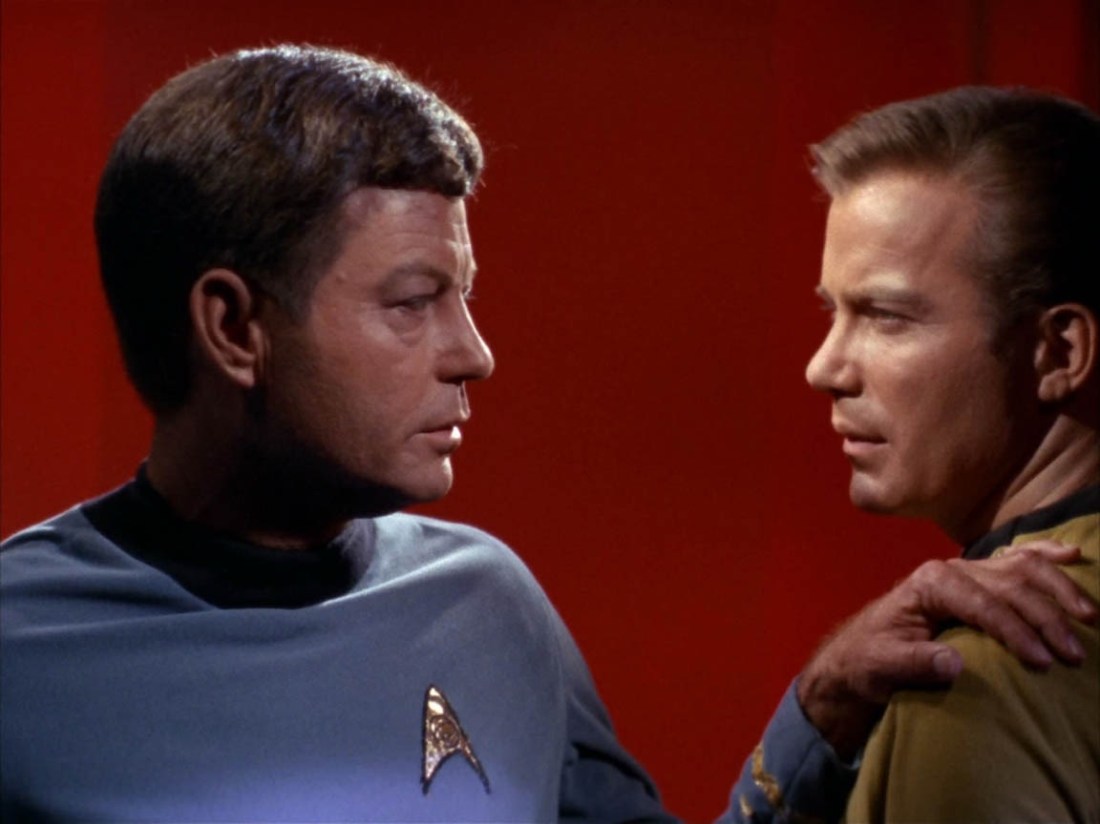
Uniquely You

McCoy: “…In this galaxy, there’s a mathematical probability of three million Earth-type planets. And in all of the universe, three million million galaxies like this. And in all of that, and perhaps more, only one of each of us. Don’t destroy the one named Kirk.”

Star Trek, “Balance of Terror” (s1ep14), Stardate 1709.2

This excellent quote by Star Trek reminds me of a famous Jodo Shinshu-sect Buddhist poem called either “Sonno-mama” or “Just As You Are”, which I posted here many moons ago.

Of course, we can quibble with the mathematics of what Dr McCoy said. (spoiler: the Universe is way bigger than what writers in the 1960’s thought…), but the implication is the same.

So take a moment to admire your life, this moment, and your place in the universe. 🙏

Have a good weekend!

Namu Amida Butsu

The Beauty of Diversity

A picture of Surak of Vulcan, his right hand in the Vulcan Salute.

Positing infinity, the rest is easy.

Roger Zelazny, Creatures of Light and Darkness

I’ve been sitting on this post for a while, trying to grapple with recent attacks on diversity and inclusion.

In the Star Trek episode, The Savage Curtain, Surak of Vulcan upon meeting humans for the first time (Kirk and Abe Lincoln) says a line that’s easily overlooked, but I think is also very beautiful:

I am pleased to see that we have differences.  May we together become greater than the sum of both of us.

Surak of Vulcan, “The Savage Curtain” (s3ep22), stardate 5906.4

The Vulcan philosophy in Star Trek is based upon a recognition of diversity: IDIC, or “Infinite Diversity in Infinite Combinations”. That is to say, each of us exists as combination of such elements and thus take on a greater significance together than separate:

KIRK: We’ve each learned to be delighted with what we are. The Vulcans learned that centuries before we did.
SPOCK: It is basic to the Vulcan philosophy, sir. The combination of a number of things to make existence worthwhile.

Star Trek, “The Savage Curtain” (s3ep22), stardate 5906.4

This is of course at the heart of Buddhist doctrine as well. Because all phenomena arise from various causes and conditions, given the right causes and conditions, anything is possible. And, given the scale of the universe, one can safely assume that practically everything exists, has existed, or will exist.

My head hurts just thinking about the implications.

Thus, I think, it is very helpful to consider and accept just how varied and weird existence is, and appreciate its sheer diversity. This isn’t just some political slogan: diversity, change, and infinity are the very nature of existence whether people want to accept that or not. Might as well embrace it, and save yourself the undue stress.

Namu Amida Butsu

Injustice

In a couple recent posts, I touched upon the misdeeds of one 12th century warlord named Minamoto no Yoritomo in the excellent Japanese historical drama, the Thirteen Lords of the Shogun. Huge credit to Japanese actor Oizumi Yo (大泉洋) for his brilliant performance by the way.

There’s one particularly heart-breaking scene halfway thorugh the drama series: Yoritomo bullies his retainer, Hojo no Yoshitoki, to carry out a series of bloody purges (partly as a test of loyalty). Yoshitoki hesitates, seekingly ready to stand up to Yoritomo at last, but in the end he backs down. Later in the episode after the purges have taken place, Yoshitoki is at home holding his infant baby, but quietly cries to himself. He says to his child, “please forgive your dad” as the episode ends. 😭

While some of this is dramatic fiction, Yoritomo really was a ruthless man, just one of many in history who exerts power and does whatever is necessary to keep it. They exploit others and toss them aside when they are done. Such men are so hopelessly self-absorbed that they pull everyone in orbit down with them, and even then it’s not enough. Like a bucket with a big hole at the bottom, the more they try to fill it and appease their ego, the more they need to fill it again.

For you science types you can also compare them to a singularity (e.g. a black hole): something that has collapsed in on itself and now pulls everything in destroying them in the process.

Sagittarius A*, the black hole at the center of our galaxy.

For simplicity, we’ll call these people “super assholes”. It’s a pseudo-Buddhist term. 😉

Even in modern times, such powerful assholes still exist. They merely changed jobs. Some run major corporations, some rule dictatorships, others are just obnoxious politicians, lawyers, priests, media influencers and so on. Yet in spite of their obvious misdeeds and harm to others, they seem invulnerable, able to evade justice through wealth, power and just being enough of an asshole.

Worse, even if you manage to take down one asshole, another one inevitably arises.


All governments suffer a recurring problem: Power attracts pathological personalities. It is not that power corrupts but that it is magnetic to the corruptible.

Frank Herbert, Chapterhouse: Dune (Dune #6)

That said, all is not hopeless.

When I think about this issue, I sometimes consider a passage from the Earth Store Bodhisattva Sutra, chapter five:

The power of karma is extremely great. It rivals Mount Sumeru in its heights. It surpasses the great oceans in its depths. It obstructs the path leading to sagehood. For that reason, beings should never think that minor bad deeds are unimportant or assume that they do not count as offenses. After death, there will be retributions to undergo that reflect all those details.

Translation by City of Ten Thousand Buddhas

This is, admittedly, a pretty small comfort to the countless people whose lives have been destroyed, literally and figuratively, by such powerful men. Sure, they may self-destruct someday, and face some kind of karmic retribution in the future, but what about the people who are suffering or dead now?

Make no mistake, though, time does go on, awful people wither and die, and their legacies are forgotten. Remember the ancient Assyrian king, Ashurbanipal? His was a reign of terror. But soon after he died, the dreaded Assyrian Empire fell and its legacy is now just dust. Small comfort to people at the time, but still.

Screenshot from the game Fire Emblem: Three Houses.

If you compare these “super assholes” to black holes in space, I find the best thing to do is steer clear of their orbit. If you’re far away, you can still escape with minimal effort, but get too close and you may get sucked in further no matter what you do, just like Hojo no Yoshitoki. Sometimes it’s better to just lay low and let things pass.

Sometimes, though, it feels unavoidable, and that becomes the true test of one’s character.

Namu Amida Butsu

P.S. I coincidentally wrote most of this before a certain asshole was convicted (you know who). I fear he will somehow escape justice though, but he will be dead in time anyway.

Update: I was right afterall.

Religion and the Scale of the Universe

The Whirlpool Galaxy, photo courtesy of Wikimedia Commons

As a kid, I was always fascinated by Astronomy, and I remember often watching the stars at night, when I would visit my dad’s house on the weekends. Back then, I didn’t really understand astronomy well, but I learned what I could about constellations, I visited the planetarium at the Pacific Science Center, and of course I became a big fan of classic Star Trek through my uncle. In college, I even majored in Astronomy for a time until I realized that Physics wasn’t my forté.

Space and the universe have always fascinated me, and for a long time, I’ve felt that in light of space, science, etc, Buddhism has been particularly suited for this worldview. 

The Buddha-Dharma functions in a lot of ways like the laws of physics or other natural laws. It’s less something to believe in, and something more to understand or at least acknowledge. It can fit into any time or place.

The various Buddhas and Bodhisattvas, primarily found in the Mahayana tradition, might seem superstitious, but embody important Buddhist truths and can be just as weird and cosmic as anything the universe has to offer. Further, belief is such beings is neither required nor expected. It is up to each person to adopt what they want. They are quite literally a form of expedient means.

Finally, when you look at the sheer vastness of space, it’s hard not feel small. But that is alright too. Buddhism thinks big, but also because everything is interconnected in some way, it assures that the choices we make, wholesome or unwholesome, do affect all other things. We can light one corner of the world (and universe) through our actions and our thoughts.

Namu Kanzeon Bosatsu
Namu Amida Butsu

P.S. Featured photo is Whirlpool Galaxy (NASA and European Space Agency, Public domain, via Wikimedia Commons)

P.P.S. I’ve often wondered if the Buddhas and Bodhisattvas really do exist, would they be humanoids like us, or would they be strange aliens like in Star Trek? Would Amida Buddha’s original from be a green alien with four arms? 😋