COGLEY: And I repeat, I speak of rights. A machine has none. A man must….you have brought us down to the level of the machine. Indeed, you have elevated that machine above us.”
Star Trek, “Court Martial” (s1ep20), Stardate 2950.1
SPOCK: Practical, Captain? Perhaps. But not desirable. Computers make excellent and efficient servants, but I have no wish to serve under them.
Star Trek, “The Ultimate Computer” (s2ep24), Stardate 4729.4
This is not a technology blog, but I was watching the episode “Court Martial” recently for Saturday Night Trek and the message was surprisingly relevant. It’s interesting that the concerns around AI have been around as far back as the 60’s. More than one episode of Trek explores the dangers of ceding too much control to AI.
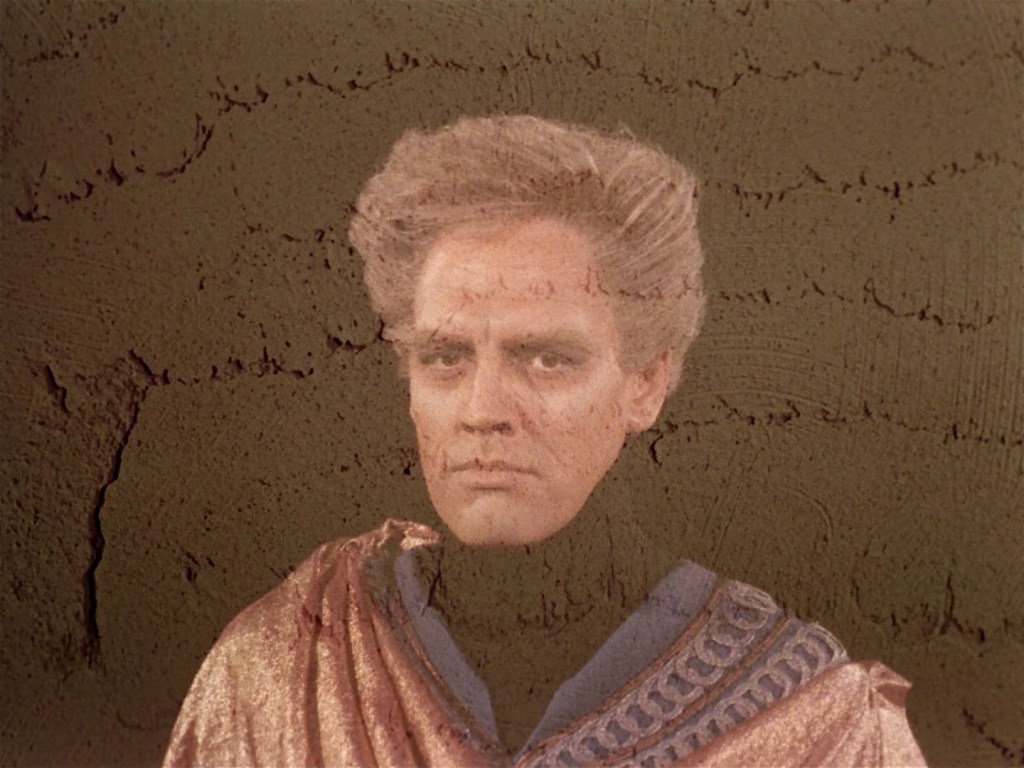
The AI “Landru” from episode “Return of the Archons”.
The problem and ethical issues haven’t changed in over 60 years yet companies keep foisting AI on us. ChatGPT and other AI services scan this blog almost daily, probably misappropriating my content, and Google insists on providing flawed AI answers to search queries even when I don’t want them.
Yet another flawed reply from Google AI. Someone posted this online, I did not encounter this first-hand. But I have run into flagrantly wrong answers.
My phone’s auto-correct uses AI too, even after I’ve turned off Siri. Even my Fire Emblem Amiibo have AI builtin:
A few of my Fire Emblem amiibo. In front is Byleth from Fire Emblem: Three Houses, to the right is Robin from Fire Emblem: Awakening, and on the left is Chrom (the best dad) from the same game.
It’s almost impossible to avoid these days.
Still, I have tried my best to avoid using it whenever possible, though. I turn it off when I can, I never use ChatGPT, and limit use of Google or disable AI answers using “-ai” in the query. As with helping the environment, and other things, small efforts still help.
In fact, AI is known to harm the environment through its waste of resources, and datacenter output.
SPOCK: Fascinating. This atmosphere is remarkably similar to your twentieth century. Moderately industrialized pollution containing substantial amounts of carbon monoxide and partially consumed hydrocarbons. MCCOY: The word was smog. SPOCK: Yes, I believe that was the term.
Star Trek, “Bread and Circuses” (s2ep25), Stardate 4040.7
This blog, and its nerdy author, remain committed to free, open, and 100% human content.
Further, contrary to what proponents assert, AI is not inevitable. The spread of AI can be countered.
Simply put: help the environment, help promote human creativity, and don’t feed the machine.
“I hope that your Engels and your Lenins never replace the religion that I hate, or the superstitions I have battened upon. You Babakov, have more blood on your hands than I have ever drunk. In destroying the gods of light you are also destroying the Dark Ones. We shall be avenged!”
Roger Zelazny, “On the Road to Splenoba”
I found this quote recently in an old, obscure Roger Zelazny short story titled On the Road to Splenoba, in which a vampire comes into contact with a Communist official with a surprise ending. No spoilers, sorry.
Anyhow, I just thought this quote was really neat because it speaks to the way the modern world has kind of destroyed the worldview where higher powers manage everything. We can’t attribute the motions of the planets, or the weather to deities the way we used to, because we know “under the hood” how these things work. People are no longer at the mercy of diseases thanks to medical technology.1 Of course, with the benefit of science, we also have a much better picture of the origins of the Earth, life, etc.
However, as the quote alludes to, it also feels like a bit of the magic of the world is gone too.
This reminds me of the Star Trek episode “Who Mourns for Adonais?“, when the Enterprise encounters the ancient Greek deity, Apollo, on a remote planet, and ultimately kill him in order to escape his grasp.
The “god” Apollo, played by Michael Forest.
The ending is melancholy:
KIRK: Would it have hurt us, I wonder, just to have gathered a few laurel leaves?
Star Trek, “Who Mourns for Adonais?” (s2ep2), stardate: 3468.1
The human race had outgrown Apollo, and gone on to accomplish many great things, yet it also cost something in the process. Maybe this is like growing up, trading a child’s imagination and wonderment for an adult’s self-mastery and freedom to choose one’s life…
1 Skepticism toward medical science is a modern issue though… 🙄. I doubt few who lived in the era of measles would object to taking a vaccine, but people have the luxury of choice now, even if those choices are reckless ones.
I saw this post recently on BlueSky, the hip new social media platform all the kids are talking about,1 and I had to share it with readers 🤣:
Speed-running is a fascinating sub-culture of gamers who finish games in impossibly short times through a combination of intense practice, manipulating errors in game code, and pre-planned strategy. My son and I like to watch speed-run world-records on YouTube for games I used to play as a kid. For example, this is a speed-run video where someone beats the classic NES game Mike Tyson’s Punch-Out in 22 minutes!
And this video shows someone attaining the world record for finishing the original Super Mario Brothers in 4:57. You can see multiple sneaky glitches and exploits here, plus lots of careful jump timing:
Finally, in this video, someone cleverly exploits an obscure glitch in Super Mario 3 to beat the game in 3:32!!!
But what does this have to do with Buddhism?
Buddhism is a 2,500-year old religion, adopted by many cultures and many times. The Buddha Shakyamuni (i.e. our historical founder), laid out the basic premise and trained his disciples on how to liberate themselves from the endless cycle of Samsara, and especially in the Mahayana-Buddhist tradition, to liberate others. We can see in early texts that this was a regimen of meditation training, self-restraint and living a humble, monastic lifestyle, as well as observation into one’s own mind. In video game terms, you can think of this as “grinding” level after level, building your skills, taking countless hours of gameplay.
The Buddhist path is a slow process, and requires a lifetime of dedication. Periodic visits to your favorite “meditation center” are fine, but Buddhism traditionally sees the path to awakening as a multi-lifetime endeavor for all but the truly talented (who may have already cultivated these qualities in previous lifetimes).
The actual length of time it normally took to accomplish awakening in Buddhism was hotly debated across Buddhist history. Early Buddhist texts implied that monks who were well-trained, or even lay-people who assiduously followed the basic code of conduct, could expect to reach awakening in one more lifetime, or may be a few lifetimes. But in Mahayana Buddhism, the length of time got longer and longer times as the bar of difficulty got higher and higher, well beyond what one could reasonably accomplish. A text called the Sutra of the Ten Stages in the Flower Garland Sutra describes the “Ten Stages of a Bodhisattva” over dozens of pages, and what’s required to complete each one before even getting to awakening. But each stage is a huge, huge endeavor by itself. Lifetimes of effort were not measured in eons of lifetimes.
As the road to awakening became longer and more remote, many Buddhist methods were developed to compensate for this and help people achieve the fruition of the Buddhist path much sooner, often through devotion to on Buddhist deity or another, or through specific samadhi methods, meditations and so on. The Pure Land path is by far the most popular and well-known due to its accessibility.
But in particular the Esoteric or Vajrayana traditions developed in the first centuries CE, hundreds of years after the Buddha. Historically speaking, the trend toward a longer and longer Buddhist path reversed and using this or that series of rituals, mantra chants, and mandala visual aids, one could “hack” the code of Buddhism and accomplish awakening in this very lifetime. Of course, the secrets behind such Buddhist speed-running techniques require a guru and a lineage.2 Vajrayana Buddhism is most prevalent in Tibet, but also in Japan through both Shingon and Tendai Buddhism.
But this does beg the question: is it really possible to speed-run the Buddhist path? Further, is the Buddhist path really eons and eons long as Mahayana Buddhism tends to assert, or is the length of time over-inflated?
Frankly, I don’t know.
Esoteric teachings and practices were definitely not part of the early Buddhist tradition (I definitely do not buy the idea of “secrets transmissions”, either). The Buddha’s advice in the early texts is generally pretty straightforward, one might say a little bland and anti-climactic, but also challenging because it gets to the root of who we are. It is definitely a lifetime effort.
But as much as I love the Mahayana tradition, it did have a tendency to out-do itself over and over. Waves and waves of Mahayana texts get increasingly dramatic, increasingly grandiose, and describe the Buddha path (namely through the Bodhisattva path) increasingly challenging terms. A backlash was inevitable, and so I can’t say I’m surprised that anti-intellectual movements such as Zen and Pure Land Buddhism, or “speed-run” methods such as Vajrayana arose in response.
Then there’s inevitable backlash from modern Buddhists who look at this convoluted history and complain, “none of this is real Buddhism anymore, it just cultural accretions”.
Every religion changes and evolves. Christianity as we know it didn’t have Christmas trees, and used Jewish-style liturgy in its early years. It adapted as it moved into new cultures. Islam grew into two different traditions, and as it became more urbanized some of the desert-nomadic traditions of the early community had to be adapted. Even obscure religions such as Zoroastrianism, whose early texts were composed amidst a steppe-nomadic culture, evolved to a more urbane and worldly culture until the Persian Empire.3
Zealous people love to go on a quest to find the “pristine” religious teachings, but you’ll never really find it. At best, you’re just reconstructing from pieces of the ancient past. At worst, you and your community just goes off the rails. It’s a fruitless quest.
So what to make of all this history and breadth of practice in Buddhism? Again, I just don’t know.
I do think that the old Kalama Sutta of the Pali Canon (AN 3.65) does provide some help though (slightly edited for readbility):
“It is proper for you, Kalamas, to doubt, to be uncertain; uncertainty has arisen in you about what is doubtful. Come, Kalamas. Do not go upon what has been acquired by repeated hearing; nor upon tradition; nor upon rumor; nor upon what is in a scripture; nor upon surmise; nor upon an axiom; nor upon specious reasoning; nor upon a bias toward a notion that has been pondered over; nor upon another’s seeming ability; nor upon the consideration, ‘The monk is our teacher.’
Kalamas, when you yourselves know: ‘These things are bad; these things are blamable; these things are censured by the wise; undertaken and observed, these things lead to harm and ill,’ abandon them.
Translation by Soma Thera
Followed by:4
…Kalamas, when you yourselves know: “These things are good; these things are not blamable; these things are praised by the wise; undertaken and observed, these things lead to benefit and happiness,” enter on and abide in them.’
Translation by Soma Thera
or the Buddha preaching to his stepmom in the Gotami Sutta of the Pali Canon (AN 8.53) :
“Gotamī, the qualities of which you may know, ‘These qualities lead to passion, not to dispassion; to being fettered, not to being unfettered; to accumulating, not to shedding; to self-aggrandizement, not to modesty; to discontent, not to contentment; to entanglement, not to reclusiveness; to laziness, not to aroused persistence; to being burdensome, not to being unburdensome’: You may categorically hold, ‘This is not the Dhamma, this is not the Vinaya, this is not the Teacher’s instruction.’
Translation by Thanissaro Bhikkhu
To summarize, if your Buddhist is leading to negative qualities described here, you should probably stop. If it is leading to wholesome qualities described here, keep going.
Namo Shakyamuni Buddha
Edit: I forgot to mention that the ultimate speed-runner in Buddhism is the Dragon Princess from the 12th chapter of the Lotus Sutra:
At that time the members of the assembly all saw the dragon girl in the space of an instant change into a man and carry out all the practices of a bodhisattva, immediately proceeding to the Spotless World of the south, taking a seat on a jeweled lotus, and attaining impartial and correct enlightenment. With the thirty-two features and the eighty characteristics, he expounded the wonderful Law for all living beings everywhere in the ten directions.
Translation by Burton Watson
1 I have a couple BlueSky feeds on there, but nothing related to the blog.
2 The Zen tradition is often compared to the Esoteric tradition since it also has ineffable teachings that can only be conveyed by a proper teacher.
3 I only know this because of the History of Persia podcast, by the way.
4 Because early Buddhist texts (sutras) were memorized and recited, they tended to be very repetitious. Later sutras, those in the Mahayana-Buddhist canon, used a more narrative style and thus longer and less repetitive, but also much more epic in tone.
A while back, I mentioned that I was trying to fix some problems with email notifications when I send updated blog posts, and after considerable trial and error, I started to realize that part of the issue wasn’t how I wrote the blog posts (though I can always improve), but how I was receiving them in email.
I subscribe to my own WordPress.com blogs over email so I can test things, but I also subscribe to other WordPress.com blogs as well for personal enjoyment. No matter what blog I subscribed to, the text would come in as plain text, which is hard to read since blogs tend to use a lot of rich formatting, links, images and so on. It’s readable, but not a great experience.
Finally, after contact WordPress.com support, I finally found the setting that adjusts this:
if you go to your WordPress.com account settings, you can then adjust Notification Settings, and from there you can choose “Email delivery format”. Once I did that, I finally got HTML emails from blog posts. I can’t tell you how nice it is to finally have readable email updates.
Spock : “… I have noted that the healthy release of emotion is frequently very unhealthy for those closest to you.”
Star Trek, “Plato’s Stepchildren” (s3ep10), Stardate 5784.2
Meditation, specifically mindfulness meditation, is touted as a stress-relief exercise. Busy people believe that if they can block out the time to meditate for X minutes a day, or when stressed, this will make more happy and productive. It has been all the rage in Silicon Valley too.
But it doesn’t work.
It will calm your mind while you are sitting, but as soon as you are back to work, your blood pressure will quickly rise again. Old habits will quickly resurface. Self-help, in short, does not help.
How do I know this?
I tried the same trick in my late 20’s. My first child was born, and I was working at Amazon (yes, that Amazon) for a few years in a technical support role. The environment was stressful, demanding, constantly on the move, the on-call rotation gave little time to decompress because something was always broken,1 and I had to drive into work at all hours of the night to try and fix it.
Since I had recently converted to Buddhism at the time, and listened to a lot of Ajahn Brahm dharma talks, I wanted to try meditation. We had a spare office that no one used, so I would go in there once or twice a day, turn off the lights, dutifully sit, chant certain Buddhist mantras, meditate for 20 minutes or more, and then return to work.
As soon as I was back at my desk, the stress would rise all over again. I kept at the meditation for months, almost a year, before I finally gave up.
The stress, constant sense of inadequacy measuring myself to hyper-competitive co-workers who graduated from Stanford, unrealistic work performance goals, fear of losing my job, and so on simply didn’t go away until I QUIT MY JOB AND TOOK A LESS DEMANDING ONE.2
It took me years as a Buddhist to finally realize that stress-relief is not what mindfulness meditation was intended for.
Mindfulness meditation is a tool to develop insight, not stress relief. It is necessary in the early stages of meditation to quiet the chatter in the mind, but that is just the first stage. It is to remove barriers to insight by develop a focused mind, and a quiet mind, a mind that can perceive things in a more balanced way. Consider this quote from the Buddha in a very early text, the Dhammapada:
There is no meditative concentration for him who lacks insight, and no insight for him who lacks meditative concentration. He in whom are found both meditative concentration and insight, indeed, is close to Nibbana.
The monk who has retired to a solitary abode and calmed his mind, who comprehends the Dhamma with insight, in him there arises a delight that transcends all human delights. …
Control of the senses, contentment, restraint according to the code of monastic discipline — these form the basis of holy life here for the wise monk.
The emphasis is on focus, insight, and contemplation NOT relaxation or stress-relief. Mindfulness meditation has been repackaged and sold to naive Westerners with false promises. Meditation really does provide excellent benefits, but it has to be done as part of a much larger, holistic lifestyle change and with wholesome intentions. This is the “holy life” as described by the Buddha: a life of wholesome, guilt-free conduct, goodwill towards others, and a desire to pursue the Dharma (the teachings of the Buddha).
First, one should take up the Five Precepts of Buddhism. As we see in verse 374 above, the Buddha openly encourages that we curb our worst behaviors first as a foundation for other Buddhist practice. One will gain no lasting benefit from meditation until this is done. Full stop.
Second, one must approach meditation with the mindset of a monk. It is not necessary for lay-people to give up everything and go live in the woods. Buddhism accommodates both the “house-holder” lifestyle and that of a true renunciant (a.k.a. a monk or nun). But both the renunciant and the house-holder are expected to live a life of moderation and restraint.3 Easier said than done (speaking as a gamer and foodie), but it’s a goal to sincerely aspire to.
Speaking of restraint, one should always guard one’s speech. A long time ago, a Buddhist minister I admired once told me that speech was like toothpaste: once it was out of the tube, you couldn’t put it back. One has to learn to carefully monitor what one says both in person and online (and yes, at work). Again, easier said than done, but the alternative will only make your life miserable.
Finally, when such good foundations are established, meditation will help you learn more about yourself, and the world around you.4 It’s incredibly helpful, and life-changing when carried to fruition. I have my own little private insights that have stayed with me through the years, and I hope you will find yours too.
Namu Amida Butsu
Namu Shakamuni Butsu
P.S. if you feel the need to calm yourself right away, try something much simpler. You can recite the nembutsu, the Heart Sutra, a mantra, whatever. Try that for a minute, and see if that works. It is a band-aid fix though, and you still need to approach things from a holisitic standpoint, or you will gain no long-term benefit. Alternatively, just go for a walk.
1 Years later, the sound of a pager going off still triggers me a little bit. No joke.
2 Another ex-Amazonian who had joined the same company years earlier confided in me that after leaving Amazon, he drank himself stupid for months to decompress. I noticed that I was still on a hair-trigger for months after leaving Amazon, and it took me a while to unlearn those habits too. My wife noted that my posture improved after leaving, and that I grumbled about work less. Some jobs are simply not worth staying in.
3 The Buddha was pretty flexible about what exactly this meant, citing whatever cultural standards applied at the time as a benchmark. In short, a lot of it is rooted in common courtesy and good sense. If you cannot act toward others using common courtesy, meditation ain’t gonna fix your issue.
4 You may learn that your whole problem is that your job sucks, for example, and that the burn-out is not worth the money. Of course, if you’re a single mom caring for three kids, you have a lot fewer options available to you, and in such cases I recommend the nembutsu as a starting point.
First, I am off to Japan again this summer. Due to illness and such, my vacation time is very limited, plus I will be helping my oldest daughter with college prep, while my wife and son head to Japan early to stay with family. Anyhow, all this is to say is that we’ll be heading to Kyoto again, just as we did last year, and hopefully I will have some fun things to share. Due to very limited time, plus non-vacation stuff, we’ll see how much I can post this year.
Second, I have been experimenting with making the blog more readable. I have been blogging since about 2005 in various forms, and such, and I realized lately while fixing up the other blog that I’ve become somewhat outdated in how I write blog posts. Blog technology has definitely advanced, and so are the ways that people read the blog. I noticed when I tried subscribing to my own blog that in some formats it is pretty hard to read, especially email. Some of the subtle links, or images don’t render properly.
What this means is that I will try to update the blog format, and how I write posts, so that they are readable in mobile formats. I intend to keep the content the same, but make it more readable hopefully. Thanks for your patience as I try to make things more enjoyable for readers.
A while back, I wrote a small post on how to express Sanskrit and Pali using diacritics in HTML and the Roman alphabet. This is handy for expressing Buddhist terms accurately, since the standard 26 letters of the English alphabet don’t always tell the whole story.
Coin of Agathokles, king of Bactria (ca. 200–145 BC). British Museum. Personal photograph 2006, courtesy of Wikipedia. The coin shows inscriptions in Greek. Upper left: ΒΑΣΙΛΕΩΣ. Upper down: ΑΓΑΘΟΚΛΕΟΥΣ. The coin also shows a Buddhist lion and Lakshmi. Note the Brahmi script on the obverse, too.
While exploring Sanskrit writing systems recently, I dabbled in using HTML to express the ancient Brahmi script, which was used to write Sanskrit a long time ago, including some Buddhist scriptures, and the writings of Emperor Asoka.
Brahmi script is available through Unicode, like many other obscure symbols. The key is to know how to type a Unicode letter in browser:
& # x(number) ;
The numerical table for each Brahmi script letter is found here and on Wikipedia. The code for “ka” (क in modern Devanagari script) is 11013, so in HTML, it would be & # x 11013 ; without any spaces. This produces 𑀓. So far so good.
But Brahmi, like other similar scripts, is an abugida. The vowels don’t usually stand alone as separate letters. Instead, they modify the base consonant. This is true with modern Devanagari as it is with Brahmi. So, in the example above, “ki” would be “ka” but modified with an “i” extension: कि in Devanagari, or 𑀓𑀺 in Brahmi. For Brahmi, I put & # x 11013 ; without any spaces, then & # x 1103a ; the code for the “i” vowel extension.
One other thing we need to cover is the consonants without a vowel. For example, in the word Buddha (buddho in Pāli language) , it would be split up into three letters “bu” “d” and “dha” with an “o” extension. The “d” here normally needs vowel, by default “a”, but if you add a virama mark, then instead of “da”, it gets cut off as “d”. In the Brahmi script, this is a & # x 11046 ; which looks like 𑀓𑁆 (k), a small line above the letter. Using the example of Buddha above, this would be 𑀩𑀼𑀤𑁆𑀥𑁄 or letters “bu” “d with virama” and “dho”.
As a bonus, the nembutsu in Sanskrit, in its simplest form, is namo’mitābhāya1 which in Brahmi script might be:
𑀦𑀫𑁄𑀫𑀺𑀝𑀸𑀪𑀸𑀬
Typing each letter by its Unicode HTML number is not a quick and easy process, but if you do it enough, it becomes somewhat easier. Soon, you’ll be typing like Emperor Ashoka in no time. 𑁍2
P.S. If you prefer to type in Devanagari, by the way, the simplest approach is to simply use the Hindi keyboard setting if you have one. You won’t need to type each Unicode letter. 😉
1 This may be a Chinese phrase rendered back into Sanskrit, not the other way around, but it does appear in the extant version of the Larger Sutra of Immeasurable Life, and something called the Dhāraṇīsaṅgraha, a collection of Buddhist dhanaris.
If you want to impress your friends (or your blog readers…*ahem*) when you talk about Buddhism, why not use some HTML diacritics?
You see, most of the Buddhist terms you read about derive from one or more non-European langauges:
Sanskrit: the holy language used in Hinduism, religious literature. Now a dead language.
Pali: an ancient language in India, mostly used for trade. It was popular as a lingua franca. Also a dead language.
Classical Chinese: this is how Chinese was in the olden days. There are more Buddhist texts preserved in Classical Chinese than any other language.
Japanese: actually, most Japanese Buddhist terms are really just Classical Chinese with Japanese pronunciations, as was the style back then.
None of these languages natively use a Romanized script like Western European languages do, so it’s up to translators to figure out how to Romanize things. So, to capture all the sounds that don’t exist in English, linguistics experts recycle Roman letters, but add extra characters: diacritics.1
Until real recently, it was pretty difficult to print non-standard Roman characters on a webpage. Back then, users had to download special fonts, and your browser had to be able to read them. Now though, as the Internet becomes more international, you can pretty much print any Romanized character you want using special “extended-ASCII” codes in HTML.
For example, let’s say I want to print an ā character. In the old days, I could use a Character Palette program on Windows or Mac to copy/paste it (if I could find it), but now I can just use the HTML extended-ASCII code & # 257 ;. This is, all one word, an ampersand, a pound sign, the HTML code number and a semi-colon. If you put these together the web browser will automatically translate it into the right letter you want.
All extended-ASCII letters in HTML have the format of:
&#(number);
So, the trick is just remembering what number you want, and fill in the blanks. Remember that you have to do this for each special letter you want to print.
Here’s a helpful chart for some commonly used diacritics and letters for Buddhist terms. Most are for Pali/Sanskrit, but for Japanese, the long vowel sounds are used too (ā, ī, ō, ū):
á – 225, the a with an acute mark
é – 233, the e with an acute mark
ñ – 241, the n with a tilde over it
ú – 250, the u with an acute mark
ā – 257, the long “ah” sound
ī – 299, the long “ee” sound
ō – 333, the long “oh” sound
ś – 347 (346 for upper case), the s with an acute mark. In practice, this is functionally the same as ṣ but written different in Sanskrit.
ū – 363, the long “oo” sound
ḍ – 7693, a “d” sound in Sanskrit
ḥ – 7717, a breathy “h” at the end, a.k.a. the visarga.
ḷ – 7735, the nasal “l” sound
ṁ – 7745, a soft “m” sound
ṃ – 7747, the “ng” sound
ṅ – 7749, another “ng” sound
ṇ – 7751, the soft “n” sound
ḍ – 7693, the nasal “d” sound
ṛ – 7771, the deep “r” sound in the back of the throat.
ṣ – 7779 (7778 for upper case), the emphatic “s” sound
ṭ – 7789, the nasal “t” sound
Try it out on your webpages and see if it works well for you. After a few times, it gets much easier to accurate represent Buddhist terms in English. Good luck and happy blogging!
Edit: an alternate system of romanizing Sanskrit called the Harvard-Kyoto system exists too. Use what seems appropriate for you.






 Gleanings in Buddha-Fields

You must be logged in to post a comment.