Spock Preaches the Four Noble Truths

Leonard Nimoy as Spock, and Arlene Martel as T’Pring

This is an iconic line from an iconic episode of the original series Star Trek:

After a time, you may find that “having” is not so pleasing a thing, after all, as “wanting.”  It is not logical, but it is often true.

Spock, “Amok Time” (s2ep1), stardate 3372.7

I like to think that this also encapsulates the Four Noble Truths of Buddhism very nice:

  1. Existence is marked by dukkha1 : dissatisfaction, unease, disappointment, etc.
  2. This dukkha arises from “wanting” or from unrealistic expectations.
  3. It doesn’t have to be this way.
  4. The way to avoid dukkha is to follow a lifestyle that is rational, “logical” and upright. In other words, the Noble Eightfold Path. 🖖

Buddhism historically uses a wide variety of parables, similes and other ways of expressing this, but they all say the same basic thing that Spock does: stop shooting yourself in the foot.

Namu Shaka Nyorai

Namu Amida Butsu

1 One of those fancy Buddhist Sanskrit terms that all the popular social-media influencers use… just kidding. 😉

Life Worth Living

I just stumbled upon this Tumblr feed yesterday, and felt like sharing as-is (special thanks to Ambromancy for reposting it).

https://www.tumblr.com/andremichaux/643573711612657664

This is originally from the Star Trek episode “City on the Edge of Forever”. The quote is:

Now I don’t pretend to tell you how to find happiness and love when every day is just a struggle to survive, but I do insist that you do survive because the days and the years ahead are worth living for.

Edith Keeler in Star Trek, “City on the Edge of Forever” (s1ep28), Stardate: 3134.0

Just posting as-is. Enjoy!

Saints Into Savages

Author’s note: I wrote this a couple months ago, but have been so backed up, I am finally posting it now. It was not intended to relate to current events. Just Star Trek nerdism, and me philosophizing.

The third-season episode of Star Trek titled Plato’s Children is often criticized as one of the worst episodes of the series. It actually has a really interesting premise, but suffers from poor execution.1

The Enterprise comes to planet populated by a self-styled republic,2 modeled after ancient Greek poleis, comprised of aliens who each have tremendous psychic powers. They live in great comfort, and spend their days pursuing whatever they want, but members of this republic have become so lazy, and have atrophied so much that they can’t manage even basic first-aid. When the leader suffers from a cut, he fails to do anything about it until it becomes seriously infected.

Further, one member of the community suffers from dwarfism, and no psychokinetic powers, and the other members of the republic bully him for entertainment and menial tasks. Michael Dunn’s performance as the “dwarf” character was excellent by the way. The same members also torment the Enterprise crew for an extended period of time to get what they want.3

By the end of the episode, it’s clear that the members of this republic are perpetually bored, and half-mad from having terrific power, but nothing constructive to use it for.

Without any struggle in life, or a way to stay grounded, I think the tendency is for one to gradually go mad. People’s minds, even when satisfied with basic needs, have a tendency to create more and more subtle problems for themselves. These problems nest fractally, there is no bottom.

Further, the other major point of the episode is said by the villain Patronius when he is defeated by Kirk:

Patronius: “Uncontrolled, power will turn even saints into savages. And we can all be counted on to live down to our lowest impulses.”

Star Trek, “Plato’s Stepchildren” (s3ep10), Stardate 5784.2

This is a very unintentionally Buddhist thing to say too. The mind is capable of the heights of sainthood (or bodhisattva-hood in Buddhism), as well as the depths of depravity, and everything in between. Under the right conditions any person can become a tyrant, or a saint bodhisattva. It’s not so much a question of personal will-power, environment matters more than one might think.

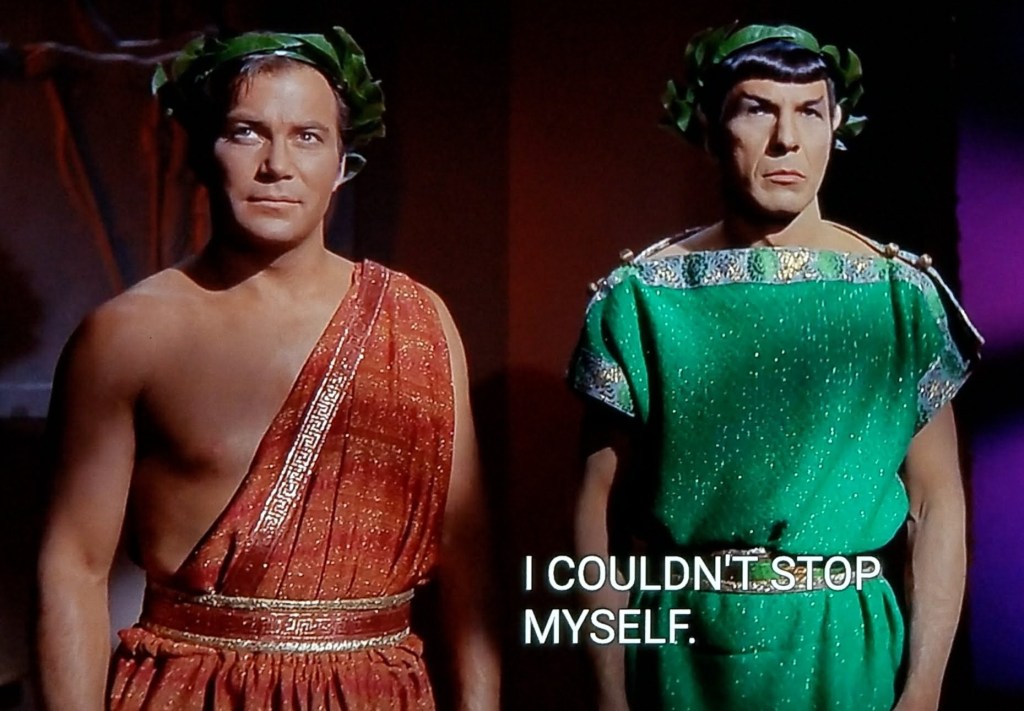
Under the right circumstances, you might even wear a toga….

It is always important to stay just a little vigilant toward one’s own mind. Perfectly rational people can easily go off the rails under the right circumstances. Further, you can’t control what others think and do (nor should you), but you can control how you react to them, or how you choose to conduct yourself. A mind unrestrained will inevitably run into disaster.

Namu Shaka Nyorai

1 Like many season 3 episodes.

2 The use of “republic” as modern people think it, is pretty different than the “res publica” as understood by Romans. It was more closer to a commonwealth, than a particular political structure, so even after Octavian took over as the princeps (the first “Emperor” in all but name), the res publica kept going well into the Easter Roman Byzantine era and beyond. By then, the Latin term was gradually replaced with the Greek equivalent: Politeia (πολιτεία).

3 This is why this episode is so unpopular. The script is pretty thin, so i guess the idea was to stretch out the time by adding more of these torment scenes.

Human Evolution

McCoy: Well, that’s the second time man’s been thrown out of paradise.

Kirk: No, no, Bones, this time we walked out on our own. Maybe we weren’t meant for paradise. Maybe we were meant to fight our way through, struggle, claw our way up, scratch for every inch of the way. Maybe we can’t stroll to the music of the lute. We must march to the sound of drums.

— Star Trek, “This Side of Paradise”, stardate 3417.7

Been thinking about this one all weekend. With all the upcoming chaos on Tuesday, and the continued struggles in society, I guess this one really hit home.

How often mankind has wished for a world as peaceful and secure as the one Landru provided.

Spock, “Return of the Archons” (s1ep21), stardate 3192.1

Of course, every generation everywhere faces its own crises, and somehow the Human race keeps going. We stumble, we fall back, but somehow we inevitably pick ourselves up, and move forward again.

The Hero Of Our Own Story

A rich man thinks all other people are rich, and an intelligent man thinks all other people are similarly gifted. Both are always terribly shocked when they discover the truth of the world.

“I, Strahd” by P.N.Elrod

Another book I have been reading lately for Halloween is the novel I, Strahd, which is a fictional autobiography of the villain of the “Barovia” fantasy-gothic horror setting: Strahd von Zarovich. As an autobiography, Strahd talks about his origins and justifies why he’s such a monster, literally and figuratively. It was one of the most popular novels of the Ravenloft series that was published in the 1990’s to promote this venerable Dungeons and Dragons setting, and is a kind of “bible” for fans of the setting due to broad number of characters, helpful backstories, and compelling story.1

But I digress.

People naturally assume their values and beliefs are pristine because that’s all they ever know, and that others will naturally agree to them. They are then shocked to discover that other functional adults subscribe to very different beliefs. Their own world is briefly shattered or they feel threatened, and conclude that such adults are just stupid, insane or evil. What follows usually isn’t good.

Even when people claim they are open to discussion or free-thinkers, I am reminded of Dave Barry’s famous quote:

People who want to share their religious views with you almost never want you to share yours with them.

Of course this applies to me as well. But on the other hand, I have to remind myself that I am not the center of the Universe. Whether I am actually right or not is irrelevant; I have to accept that not everyone comes to the same conclusions that I do, and I have no right to judge them for their views:

Gandalf: “Do not be too eager to deal out death in judgment. Even the very wise can not see all ends. My heart tells me that Gollum has some part to play yet, for good or ill before this is over.”

“Fellowship of the Ring”, by J.R.R. Tolkien

Hence the Dhammapada has the famous line:

Hatred is never appeased by hatred in this world. By non-hatred alone is hatred appeased. This is a law eternal.

Translation by Ven. Acharya Buddharakkhita

It doesn’t mean you have to be best friends with other people, but you have to accept the sheer variety of people, ideas and beliefs no matter how stupid they seem.

Spock: Madness has no purpose.  Or reason.  But it may have a goal.

Star Trek, “The Alternative Factor”, stardate 3088.7

You don’t have to give them oxygen either. Some ideas are better left dead. It’s about tolerance of people, not tolerance of bad ideas. Ideas are, like all phenomena, contingent and impermanent (Buddhism par excellence).

As soon as you begin to harbor ill-will toward others who are different, you will quickly spiral into a dark path of your own doing.

Namu Amida Butsu

P.S. I have a huge backlog of drafted posts lately, so you may see a few more this week. I hope you enjoy.

1 It is a terrific read, but I admit I still like Vampire in the Mists featuring his rival, the elf-vampire Jander Sunstar, even more. Strahd is definitely *not* the hero in that tale. Heart of Midnight was also an excellent read and a close third for me. To be honest, all the novels I’ve read int he series so far, even the less compelling ones, are still good reads.

Getting Older

Spock: Change is the essential process of all existence.

Star Trek, “Let That Be Your Last Battlefield”, Stardate 5730.2

As I approach yet another birthday, and my kids are getting close to adulthood, I am definitely starting to see a change in my attitude toward life.

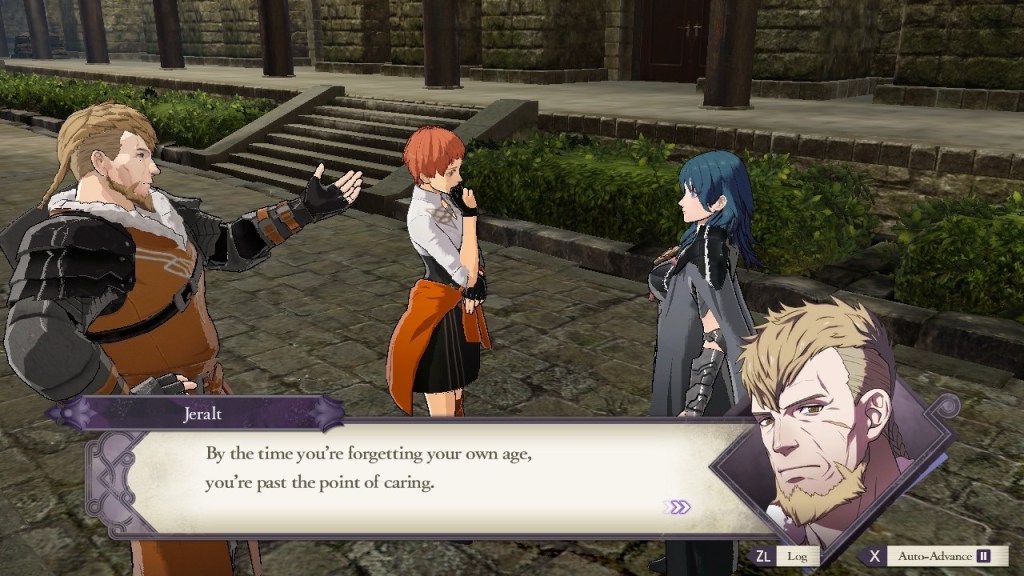
The character of Jeralt from Fire Emblem: Three Houses really sums it up nicely. My attitude has noticeably shifted this past year, especially after my time in the hospital in February, and I find I care a lot less about some things that were once important to me. I don’t mean this in a brooding or dismal sort of way. I am just so glad to be alive and well after that experience, and just being able to read my poetry from the Hyakunin Isshu, or playing Fire Emblem games1 makes me pretty happy lately. I keep my Buddhist routines small and sustainable as much as I can too.

My sense of ambition, something that really drove me in my twenties and thirties, has largely faded these days, and I am already looking forward to just being a nice grandad someday with my wife. Even certain recent goals I had don’t seem nearly as important as they were.

Is this part of the natural aging process? I am not sure. Maybe. Probably.

But it’s also nice being able to just let go and let life flow on, instead of constantly trying to wrestle with it, like punching a giant pile of dough into the shape you want, then getting frustrated when it loses its shape.

Of course, I still like to keep busy and still do self-improvement. I have just gradually narrowed my hobbies and personal goals to the ones I truly care about.

Namu Amida Butsu

1 I currently own five titles now. Three Houses is easily my favorite, but I also enjoy Awakening quite a bit, and Three Hopes. Fire Emblem: Engage is just disappointing. The crossover game, Tokyo Mirage Sessions #FE Encore, is also neat since you do get to tour parts of modern-day Tokyo, plus it’s pretty campy. I was lucky to get that game for less than half-price during my last trip to Japan.

Why This Blog

Natira: “Is truth not truth for all?”

Star Trek “For the World is Hollow and I have Touched the Sky” (s3ep8), Stardate 5476.4.

I started blogging way back in 2005 after visiting Japan for the first time, and discovering the Jodo Shu Buddhist path shortly thereafter from a now-defunct English-language site. Back then, I blogged on Blogger for a year or two, but soon moved to WordPress and have been here for almost 15 years. I have started, and then removed blogs a few times (Level 8 Buddhist, Japan: Life and Religion, etc), but I always come back and start again.

I am not sure why I have such a strong impulse to blog on such nerdy topic over and over again. In the beginning, it was my way of trying to reconcile my religious-cultural experiences in Japan, with the kind of stuff I learned about in Western textbooks. The two seemed pretty different, but over the years I learned a lot about Japanese religion and culture, and every time I learned something new, I’d put it on the blog so others could find it. I have often updated certain articles on Wikipedia as well.

Later, when I was part of a local Japanese-American temple (Jodo Shinshu sect), I learned even more from the experience. The Buddhism is often presented to Westerners is somewhat skewed by a combination of outmoded translations, native “Protestant” bias, and just lack of information. I had to relearn a lot of assumptions over the years myself, and I really miss that time with the temple community, even if I decided to follow a slightly different path.

Over the years through blogging I have been lucky to meet disparate people in places like Europe, Africa and Asia who wanted to learn more, and were themselves struggling with finding the right information. Some of these areas do not have large Buddhist communities. But what matters is that anyone from any walk of life can find information they want, and put it into practice in a way that suits their life. A single mom in rural Arkansas, or a student in Sweden, or an elderly Asian-American all have the right to learn the Dharma, and shouldn’t be limited by time, place, background or cost.

I prefer this open approach. Instead of relying on gurus, special transmissions, seminars, meditation centers, retreats and so on, I want to present Buddhist teachings as-is from sources and sites I come across. I do not make money from this, and I don’t want people’s money (my current employment is enough). Instead, what I learn for myself, I also share with others. Truth must be truth for all with no strings attached.

The way I figure it: people can make their own informed decisions about how to put the Dharma into practice in their lives. They just need sufficient information to make informed choices.

Mindfulness Meditation Isn’t What You Think

Spock : “… I have noted that the healthy release of emotion is frequently very unhealthy for those closest to you.”

Star Trek, “Plato’s Stepchildren” (s3ep10), Stardate 5784.2

Meditation, specifically mindfulness meditation, is touted as a stress-relief exercise. Busy people believe that if they can block out the time to meditate for X minutes a day, or when stressed, this will make more happy and productive. It has been all the rage in Silicon Valley too.

But it doesn’t work.

It will calm your mind while you are sitting, but as soon as you are back to work, your blood pressure will quickly rise again. Old habits will quickly resurface. Self-help, in short, does not help.

How do I know this?

I tried the same trick in my late 20’s. My first child was born, and I was working at Amazon (yes, that Amazon) for a few years in a technical support role. The environment was stressful, demanding, constantly on the move, the on-call rotation gave little time to decompress because something was always broken,1 and I had to drive into work at all hours of the night to try and fix it.

Since I had recently converted to Buddhism at the time, and listened to a lot of Ajahn Brahm dharma talks, I wanted to try meditation. We had a spare office that no one used, so I would go in there once or twice a day, turn off the lights, dutifully sit, chant certain Buddhist mantras, meditate for 20 minutes or more, and then return to work.

As soon as I was back at my desk, the stress would rise all over again. I kept at the meditation for months, almost a year, before I finally gave up.

The stress, constant sense of inadequacy measuring myself to hyper-competitive co-workers who graduated from Stanford, unrealistic work performance goals, fear of losing my job, and so on simply didn’t go away until I QUIT MY JOB AND TOOK A LESS DEMANDING ONE.2

It took me years as a Buddhist to finally realize that stress-relief is not what mindfulness meditation was intended for.

Mindfulness meditation is a tool to develop insight, not stress relief. It is necessary in the early stages of meditation to quiet the chatter in the mind, but that is just the first stage. It is to remove barriers to insight by develop a focused mind, and a quiet mind, a mind that can perceive things in a more balanced way. Consider this quote from the Buddha in a very early text, the Dhammapada:

  1. There is no meditative concentration for him who lacks insight, and no insight for him who lacks meditative concentration. He in whom are found both meditative concentration and insight, indeed, is close to Nibbana.
  2. The monk who has retired to a solitary abode and calmed his mind, who comprehends the Dhamma with insight, in him there arises a delight that transcends all human delights.
  3. Control of the senses, contentment, restraint according to the code of monastic discipline — these form the basis of holy life here for the wise monk.
Translation by Soma Thera from https://www.accesstoinsight.org/tipitaka/kn/dhp/dhp.25.budd.html

The emphasis is on focus, insight, and contemplation NOT relaxation or stress-relief. Mindfulness meditation has been repackaged and sold to naive Westerners with false promises. Meditation really does provide excellent benefits, but it has to be done as part of a much larger, holistic lifestyle change and with wholesome intentions. This is the “holy life” as described by the Buddha: a life of wholesome, guilt-free conduct, goodwill towards others, and a desire to pursue the Dharma (the teachings of the Buddha).

First, one should take up the Five Precepts of Buddhism. As we see in verse 374 above, the Buddha openly encourages that we curb our worst behaviors first as a foundation for other Buddhist practice. One will gain no lasting benefit from meditation until this is done. Full stop.

Second, one must approach meditation with the mindset of a monk. It is not necessary for lay-people to give up everything and go live in the woods. Buddhism accommodates both the “house-holder” lifestyle and that of a true renunciant (a.k.a. a monk or nun). But both the renunciant and the house-holder are expected to live a life of moderation and restraint.3 Easier said than done (speaking as a gamer and foodie), but it’s a goal to sincerely aspire to.

Speaking of restraint, one should always guard one’s speech. A long time ago, a Buddhist minister I admired once told me that speech was like toothpaste: once it was out of the tube, you couldn’t put it back. One has to learn to carefully monitor what one says both in person and online (and yes, at work). Again, easier said than done, but the alternative will only make your life miserable.

Finally, when such good foundations are established, meditation will help you learn more about yourself, and the world around you.4 It’s incredibly helpful, and life-changing when carried to fruition. I have my own little private insights that have stayed with me through the years, and I hope you will find yours too.

Namu Amida Butsu

Namu Shakamuni Butsu

P.S. if you feel the need to calm yourself right away, try something much simpler. You can recite the nembutsu, the Heart Sutra, a mantra, whatever. Try that for a minute, and see if that works. It is a band-aid fix though, and you still need to approach things from a holisitic standpoint, or you will gain no long-term benefit. Alternatively, just go for a walk.

1 Years later, the sound of a pager going off still triggers me a little bit. No joke.

2 Another ex-Amazonian who had joined the same company years earlier confided in me that after leaving Amazon, he drank himself stupid for months to decompress. I noticed that I was still on a hair-trigger for months after leaving Amazon, and it took me a while to unlearn those habits too. My wife noted that my posture improved after leaving, and that I grumbled about work less. Some jobs are simply not worth staying in.

3 The Buddha was pretty flexible about what exactly this meant, citing whatever cultural standards applied at the time as a benchmark. In short, a lot of it is rooted in common courtesy and good sense. If you cannot act toward others using common courtesy, meditation ain’t gonna fix your issue.

4 You may learn that your whole problem is that your job sucks, for example, and that the burn-out is not worth the money. Of course, if you’re a single mom caring for three kids, you have a lot fewer options available to you, and in such cases I recommend the nembutsu as a starting point.


Letting Go of Expectations of Others

Spock: No one can guarantee the actions of another.

Star Trek, “Day of the Dove” (s3ep7), stardate unknown

The third season of the classic TV series, Star Trek, gets a lot of flak for being lower in quality, but some of the best episodes of the series can be found there. One of my personal favorites is “Day of the Dove”.

The premise is strange at first glance: the Enterprise crew and a group of Klingon prisoners are trapped on the Enterprise by a phantasmal alien that feeds on anger and conflict, which keeps manipulating both sides in order to instigate them into hopeless, unending cycle of conflict. The alien furnishes weapons, seals corridors, plants false memories, and heals fatal injuries all so that the Enterprise crew and Klingons fight can ad infinitum, even as the ship is hurling out of control beyond the edge of the galaxy.

There’s a lot to unpack in this episode, and much of it still relates to circumstances today. But I’ll let you the reader decide for yourself.

In any case, Spock’s quote above illustrates something very Buddhist in my opinion: people expect other people to think and feel the way they do. When they don’t, we get frustrated. We naturally tend to see our own viewpoint as “pristine” and the more other’s deviate from this, the weirder or aberrant they are. We get frustrated when we they don’t do what we expect them to do. This can also happen between spouses, co-workers, and so on.

But as Spock rightly implies, this is arrogant, irrational, and dare I say “illogical”. We are not the center of the Universe, why should other people think and do as we do?

In the classic Buddhist text, the Dhammapada, are the following verses:

  1. One who, while himself seeking happiness, oppresses with violence other beings who also desire happiness, will not attain happiness hereafter.
  2. One who, while himself seeking happiness, does not oppress with violence other beings who also desire happiness, will find happiness hereafter.
  3. Speak not harshly to anyone, for those thus spoken to might retort. Indeed, angry speech hurts, and retaliation may overtake you.
  4. If, like a broken gong, you silence yourself, you have approached Nibbana,1 for vindictiveness is no longer in you.

[skipping for brevity…]

142. Even though he be well-attired [instead of dressed like a humble monk], yet if he is poised, calm, controlled and established in the holy life, having set aside violence towards all beings — he, truly, is a holy man, a renunciate, a monk.

translation by Acharya Buddharakkhita

Oftentimes, it is simply better to let go, let people be who they are, even if they are wrong or short-sighted, and wish them no harm.

Namu Shakamuni Butsu
Namu Amida Butsu

1 Nibbana is the Pali-style pronunciation of Nirvana. Both mean the same thing in a Buddhist context: liberation, unbinding, freedom. A Buddha’s awakening to the truth (e.g. enlightenment) leads to a state of letting go, unbinding. The Buddha Shakyamuni described it as a flame extinguished.

The Beast Within

Another post for the Fall Ohigan week. I was watching some classic Star Trek and wanted to share this quote:

Captain Kirk: Yes, well, those pressures are everywhere in everyone, urging him to what you call savagery. The private hells, the inner needs and mysteries, the beast of instinct. As human beings, that is the way it is. To be human is to be complex.…

Star Trek, “Requiem for Methuselah” (s3ep19), Stardate 5843.7

Being the homo sapiens that we are, we are indeed complex creatures. We are gifted with the capacity for logic and reason, and yet we are still savage in many ways. We still pattern ourselves in many ways our ancestors did, even if they are seemingly more modern and complex.

But also, from a Buddhist standpoint, we are capable of a great many things, both good and bad.

“We reach”

In Tendai Buddhism is a concept, later popularized in Nichiren Buddhism, called “3000 worlds in a single thought”, or ichinen-sanzen (一念三千). Broadly speaking, the idea is that with any moment in time, our thoughts and actions are capable of manifesting the highest levels of buddha-hood, or the very lowest, foul levels of a demon, and everything within that spectrum. There is certainly more to this, but that’s a brief summary.

Another way to look at it: we have within each of us that which is capable of being a bodhisattva or even a buddha, and yet we also have that within us that is capable of great evil. It comes down to things like environment, training, awareness and so on. We like to think other people as crazy and evil, but under the right circumstances we could just as easily slip down that path. In the same way, we see ourselves as hopeless, and yet with the right support and training, we can go on to do great things.

So, it helps to be a little vigilant of one’s own mind, especially when stressed, fatigued, or insulted. When times are good, it’s easy to behave kind and enlightened. The real test comes when under pressure, and given enough pressure anyone can crack and their brutal nature comes out.

On the other hand, when one does inevitably falter, it’s important to reflect and not flog oneself. Goodwill towards oneself is just as important as goodwill towards others. We are, afterall, human. It’s also why, especially in the Pure Land traditions, we acknowledge those faults and give thanks to the Buddha Amida for his goodwill towards us regardless.

P.S. More on the power of goodwill and the nembutsu.