Vengeance

MCCOY: What if you decide he is Kodos? What then? Do you play God, carry his head through the corridors in triumph? That won’t bring back the dead, Jim.
KIRK: No, but they may rest easier.

Star Trek, “The Conscience of the King” (s1ep13), Stardate 2817.6

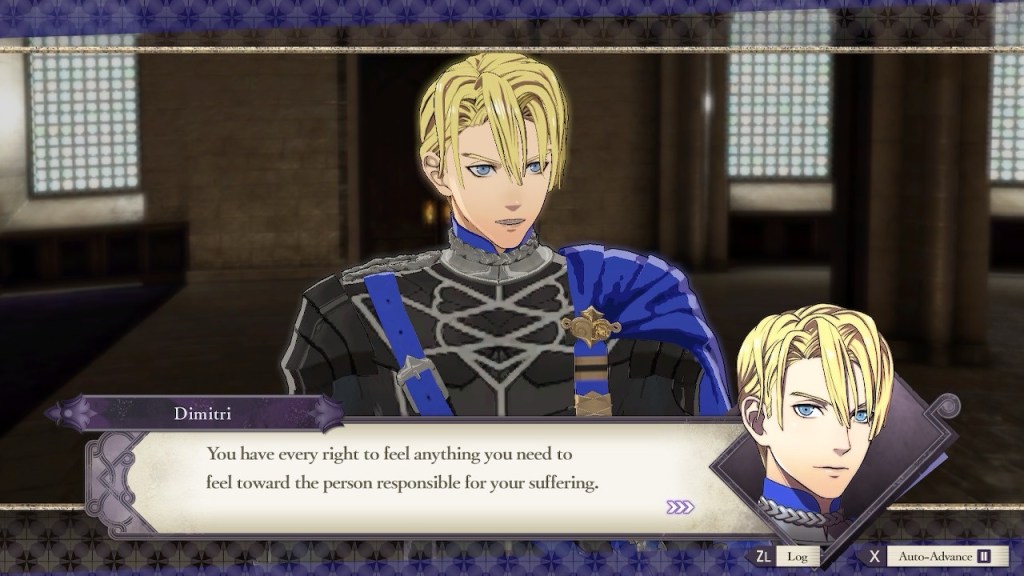
In the game Fire Emblem: Three Houses, one of the three main characters you interact with is the prince of Faerghus, Dimitri, who has suffered terrible tragedy in the youth. Behind his veneer of civility, he is gradually losing his mind.

He cannot get past the loss of his loved ones, and is determined to kill Edelgard personally, whom he blames for all his misery. Depending on which story path you choose in the game, Dimitri’s fate, and the fate of everyone he drags down with him, is very tragic indeed.

Dmittri in the “Azure Moon” route of Fire Emblem: Three Houses

The Buddha saw through this death-spiral of vengeance and hatred, and how utterly pointless it was:

“He abused me, he struck me, he overpowered me, he robbed me.” Those who harbor such thoughts do not still their hatred.

The Dhammapada, verse 3, translation by Acharya Buddharakkhita

Indeed, ill-will is one of the Five Hindrances, and can only be countered by goodwill. But what happens when someone has been genuinely hurt and abused by someone else?

Dimitri at an earlier point in the game.

Dimitri suffered terrible loss and hardship in his youth due to the political machinations outside his control, and the pain and grief are genuine, not something you can just wish away, or use platitudes to make it better. It’s not hard for readers to think back to moments of trauma in their own lives (I have my fair share), and feel raw anger, rage, or sadness (why did this happen to me? why do I have to live with these scars for the rest of my life?).

If you pick the story path that sides with Dimitri, there is a happier fate for him. I don’t want to spoil too much, but through his friends (including you, the main player), he learns to unravel his past and gradually learns to look forward toward the future his kingdom including a dramatic moment with Edelgard.

Thus, I think what the Buddha says in the Dhammapada is true: vengeance, anger and bitterness are indeed self-destructive, but if the trauma and pain are real, they can be very difficult to let go. It is too raw and painful to simply dismiss with logic and reason. But, in Dimitri’s case, support from loved ones helps him through the darkest moments, and helped him let go. He learned not to face it alone, and grew from it.

With whatever trauma you have to live through, I hope you dear readers find similar resolve and happiness.

Respect For Life

HEMMER: … I will not fight for Starfleet, but I will defend its ideals. Pacifism is not passivity. It is the active protection of all living things in the natural universe.

Star Trek: Strange New Worlds, “Momento Mori” (s1ep4), Stardate 3177.3

I love Star Trek: Strange New Worlds, and I love this quote.

The first precept of Buddhism, regardless of which list you talk about, starts with a vow not to destroy life. Further, in such texts as the venerable Dhammapada (collected sayings of the Buddha), you can see quotations like so:

129. All tremble at violence; all fear death. Putting oneself in the place of another, one should not kill nor cause another to kill.

and:

142. Even though he be well-attired, yet if he is poised, calm, controlled and established in the holy life, having set aside violence towards all beings — he, truly, is a holy man, a renunciate, a monk

Translations by Acharya Buddharakkhita

Per tradition, monks in the Buddhist tradition are often strictly vegetarian and why some devout lay Buddhists choose to be vegetarian, either full-time or on specific holidays.

But, I think Hemmer’s quote goes a step further, peace, goodwill, and pacifism are not simply refraining from violence; it is also respect for all life (even the Gollums in life). This requires empathy, putting yourself in their shoes. You see this expressed in such popular liturgy as the Four Bodhisattva Vows, dedication of merit, and so on.

But like many things in Buddhism, such a lofty goal is hard to uphold at first. So, the precepts more narrowly focus on simple training rules (not to do X, not to do Y), and overtime, as basic training rules become second-nature, and your understanding of the Buddha-Dharma deepens, one’s practice refines more and more over time. So, if you feel you can’t live up to such an ideal, don’t worry. It’s important to know that the ideal exists, and that every starts from somewhere.

Namu Shakamuni Butsu
Namu Kanzeon Bosatsu

P.S. Double post today to celebrate Strange New Worlds, season three. I cancelled my subscription of Paramount Plus some months ago (no regrets), but I enjoy the first two seasons on BluRay, and waiting to get the subsequent seasons on BluRay as well.

Eight Hour Monk

SPOCK: There are many who are uncomfortable with what we have created. It is almost a biological rebellion. A profound revulsion against the planned communities, the programming, the sterilised, artfully balanced atmospheres. They hunger for an Eden where spring comes.

Star Trek, “The Way to Eden” (s3e20), Stardate 5832.3

As I write this, the family is in Japan (sadly, I was unable to go this year) visiting relatives, and I am home with the dog, Cherry.

Since I have a couple weeks to myself, I thought it would be a great time to put in a little extra Buddhist practice, catch up on some personal projects, go offline for a bit, etc. Basically, try to live like a monk for a few days. I carefully planned it out, decided what I would do and not do, took a three days off from work, and then got ready for the “mini home retreat”.

I lasted eight hours.

The first few hours were great. It was peaceful, quiet, and I did finish reading a couple books on my to-do list, meditated extra, recited more sutras than usual, and so on. But then, as the hours progressed, isolation and boredom set in. I started worrying if I was missing a text from my family (in case of emergencies), and I discovered that it’s hard to read Japanese books without a dictionary which I only have on my phone.

Embarrassingly by early afternoon I gave up and turned on my phone. Then I went and played Fire Emblem: Three Houses for a few hours,1 watched Star Trek V: The Final Frontier2 for some crazy reason, got bored and played more Fire Emblem until 11pm.

Day two, I didn’t even really bother to try again. I realized that I had hyped up this time off too much, and without any support or contact with others, I quickly started to get a little stir-crazy. That’s not to say the time wasn’t unproductive either. Even today (day two), I still got some extra stuff done around the house, and did a little more Buddhist stuff than usual. But I also played Fire Emblem: Three Houses for three hours.

τὸ μὲν πνεῦμα πρόθυμον, ἡ δὲ σὰρξ ἀσθενής.
“Indeed the spirit is willing, but the flesh is weak.”

Matthew 26:40-43 with original Koine Greek

Indeed, in the Sutra on the Buddha of Immeasurable Life, one of the Three Pure Land sutras, the Buddha Shakyamuni laments that:

“People of the world, being weak in virtue, engage in strife over matters which are not urgent….Since they have not done any good in particular, nor followed the Way, nor acted virtuously, when they die, they will depart alone to an inferior world. Although they are destined to different states of existence, none of them understands the law of karma3 that sends them there.”

Translation by the late Hisao Inagaki, hosted here.

So, the problem of laziness and lack of follow-through in religious practices (or personal projects) is nothing new. Even in Japanese, there is a phrase: mikka bōzu (三日坊主) meaning “three day monk”. It’s a tongue-in-cheek phrase about how most endeavors last three days at most.

In my case, I think my failure was a combination of over-zealousness and perfectionism which set the bar too high for something I am not really used to doing day to day. The idea of a religious personal retreat is still worth it, but I should have set the bar lower the first time, and tried to be a bit more realistic.

The point isn’t to give up and just play more Fire Emblem (but then again, I might anyway), but reflect on what worked, and what didn’t and focus on something realistic and sustainable. As Dogen reminds us, it can be done, but expecting it to work overnight if I just push through hard enough is maybe a bit silly.

Namu Shakamuni Butsu
Namu Amida Butsu

P.S. Bonus post. Apologies for any typos, I wrote this one quickly while it was still fresh in my mind, so probably more editing mistakes than usual.

P.P.S. On the plus side, I also had some time to practice vegetarian cooking and made a large batch of Mapo Tofu, Pasta Mama (in honor of Captain Pike in Star Trek: Strange New Worlds), and some Thai curry. This photo is the Mapo Tofu:

… I also harvested the scallions I’ve been growing since Spring:

1 I am on my eighth play-through I think. I am finally going back and replaying my first route, Crimson Flower route (i.e. with Edelgard) and doing things I missed on my first play-through. It’s been nearly two years, and I still enjoy this game very much. The story, dialogue, characters and world-building never cease to amaze me.

2 I think I watched it to remember why this movie is so unpopular. It has some good qualities to it, but yeah, it’s not very good. As a teenager, I watched it in the theaters and thought it a bit odd, but it’s not aged well for me.

3 For similar teaching, see the first chapter of the Soto Zen text, the Shushogi.

Nature and Balance

SPOCK: War created an imbalance and nature counterbalanced it.

Star Trek, “The Omega Glory” (s2ep23), Stardate unknown

In some form or another, Climate Change has been with us since the beginning of Time. If you look at geologic time, gradual changes to climate happen, moving toward a hotter Earth or a colder one, and in the past once these changes lead to a tipping point, this leads to mass-extinction events. These changes in climate are often driven by natural forces: plate tectonics, accumulation of CO2 (carbon dioxide) in the atmosphere, shifts in the ocean currents and so on. Eventually, the pendulum swings back and the climate shifts toward the other direction. Meanwhile, life gradually recovers, diversifies again and so on.

But it’s important to understand that these changes happen very gradually over tens of thousands of years, or even hundreds of thousands of years.

Climate Change in the modern context refers to human-driven changes. The buildup of CO2 gas in the atmosphere is nothing new, but the output of that gas in the last 100 years is far higher than natural forces can account for. We know that this extra buildup is due to fossil fuels. Burning fossil fuels is literally like throwing gasoline on a fire.

Fossil fuels are not a sustainable energy source anyway, and they are condensing a process that should take a hundred thousand years into only tens of years. It’s small wonder we see such dramatic weather now: mass wildfires, mass rainfalls, mass drought and so on.

As Spock says, if we create an imbalance, nature will balance it out. But may not happen the way we want it to. The greater the imbalance, the greater the correction.

But just as 8-billion humans have, across generations, contributed to the problem, those same humans can contribute to fixing the imbalance (before Nature does it for us):

  • Reduce energy consumption at home. Even switching off lights at home helps.
  • Plant local, native plants in your neighborhood
  • Eat more vegetables (which I am trying to do anyway)
  • Cut back on fossil fuels: the less you use, the less accumulates in the atmosphere
  • and so on…

Find something you can reasonably do, and don’t hesitate to do some small good in the world.

Pride and Meditation

常に大慈大悲に住して、坐禅無量の功徳を、一切の衆生に回向せよ。憍慢・我慢・法慢を生ずることなかれ。これ外道凡夫の法なり。

“Always keep the noble spirit of goodwill and mercy in your heart, and dedicate the limitless merits of meditation to all beings. Do not allow pride, conceit, or sanctimony to dwell, lest this becomes the Dharma of heretics and fools.”

Keizan’s Zazen Yojinki (坐禅用心記, “A Guide to Zazen”), amateur translation by me.

The Zazen Yojinki of Keizan (1268–1325) is a text I have never encountered before and I was unable to find any English translations or information on. Japanese sources say that it is similar to, and inherits from, Dogen’s Fukan Zazengi but tends to emphasize more practical matters by comparison.

Anyhow, I thought this was a great quote.

There are many reasons why one starts Buddhist practice, including meditation, but Keizan emphasizes that it’s not about personal benefit. In fact, chances are you’ll not feel any personal benefit at first, at least not in the way you’re expecting. In a sense, meditation is useless.

But that’s not the point.

You do not live in isolation with others. We depend on one another, even when we can’t stand each other. What we do affects others, what others do affects us. No matter how you try to come out ahead, you will always depend on others, and even when others come out ahead, they still need you.

So, like it or not, we’re all in this together. Thus, the only way to find peace and well-being is to stop being a dick. The only way to stop being a dick is to take up training rules such as the precepts, to quiet the mind through meditation, and finally to dedicate any good merit you accumulate for the sake of others even when you feel they don’t deserve it.

Namu Shakamuni Buddha

P.S. Bonus 4th of July post. Ee’d Plebnista, baby!

Continuous Growth

While reading the excellent book, River of Fire, River of Water by Dr Taitetsu Unno last week, there was a nice chapter about Buddhism being about not one, but series of small awakenings.

Many people experience this type of [radical, spiritual] awakening, but normally it touches only one aspect of life and rarely involves the total person. Furthermore, a single experience may not effect any real transformation. The awakening must be repeated and deepened for as long as we are living and breathing.

page 65

Here, Dr Unno was talking about it in the context of the experience of Shinjin (信心, the sincere entrusting of Amida Buddha that Shinran taught), but he cites a few sources, including the Rinzai Zen master Hakuin (白隠 1686 – 1769), who evidentially taught that there was the initial awakening (in a Zen context), and then subsequent awakenings.

The book What Is Zen? 禅ってなんだろう describes something similar:

True kenshō [見性, “seeing your nature”] is a very difficult practice. That being the case, only a select few individuals who are gifted with special religious capabilities will ever achieve kenshō.

One shouldn’t give up on attaining kenshō, but there is another state prior to it called sei [省]. Of course Zen disdains practice for the sake of personal attainments, but when one sits in zazen and properly regulates one’s posture and breathing, the mind gradually grows calm. In that state, the honshō [本性, “one’s original nature?”] and original self become active, if not completely.

pages 39-41

Here, the author is describing the process of reaching final enlightenment, using the alternative Zen-specific term kensho.1 But, in keeping with mainstream Buddhism, this state of mind is pretty difficult to attain, and yet one has any number of smaller awakenings (sei) along the way. One may not necessarily fully become awakened, but even those brief glimpses can be transformative. The point is of course that it’s a journey, not just an abstract goal.

In Star Trek terms (because I am a giant nerd), think of the movie Star Trek VI: The Undiscovered Country. Spock talks to his protegé, Valeris, about the importance of logic, even for a Vulcan:

VALERIS: But is this logical? Surely we must…
SPOCK: Logic? …Logic is the beginning of wisdom, Valeris, not the end.

source: http://www.chakoteya.net/movies/movie6.html

I think Buddhism is less about “what have I accomplished” and more about “what can I do next” or “where do I go from here?”.

Namu Shakamuni Butsu

P.S. Next week I am changing up the schedule a bit. I hope you enjoy.

1 The generic Japanese-Buddhist term is satori (悟り), and they mean more or less the same thing. As someone who accomplished neither, I can’t really speak to either one. 😅

Truth and Truthier

Spock: Evil does seek to maintain power by suppressing the truth.
McCoy: Or by misleading the innocent.

Star Trek, “And The Children Shall Lead” (s3ep4), stardate 5029.5.

The season three episode of Star Trek, “And The Children Shall Lead” is widely considered a bottom-tier episode. It had a lot of problems, including its casting. Even as a classic Star Trek fan, I kind of despise this episode.

The evil entity “Gorgan”, played by infamous laywer Melvin Mouron Belli who had no prior acting experience. It was season three Trek at its worst.

But the premise of the episode did make a really important point: given the right persuasion, people (including children), can be made to do all kinds of terrible things. It just comes down to what someone asserts is “true” and if their argument is convincing enough. There’s plenty of examples in history, so I won’t belabor the point.

Or, like that old Simpsons gag:

Of course, ignorance as to what is actually true is the basis for our suffering, according to Buddhism. As thinking human beings, we have to piece together our understanding of the world as best we can, and hopefully we have good mentors along the way, but even a good mentor is not perfect. Simply put, subtle misperceptsions and misunderstandings can provide a foundation for a mountain of bad assumptions, stupid conduct, needless suffering. Thus, in Buddhism, this fundamental misunderstanding of things is one of the Three Poisons of the mind: the other two being anger and craving. But even anger and craving derive from misunderstanding too.

This is not something that can be fixed with some clever logic, or vaguely “zen-like” words. It’s a deeply seeded part of ourselves, something we cannot normally perceive in our daily lives, and even when you suppress it with willpower, it will surface again when you least expect it.

The Buddha described the awakening experience as “uprooting”:

….he [the renunciant monk] should develop the perception of inconstancy so as to uproot the conceit, ‘I am.’

Translation by Thanissaro Bhikkhu in the Meghiya Sutta of the Pali Canon (Ud 4:1 Meghiya)

Such a tree of ignorance isn’t cut down, leaving a stump; it is uprooted entirely.

Spock: “Humans do have an amazing capacity for believing what they choose and excluding that which is painful.”

Star Trek, “And The Children Shall Lead” (s3ep4), stardate 5029.5

But how can mundane people, who have yet to fully awaken, discern the truth?

The Buddha taught the Dharma. The Dharma is like a principle of existence (think: laws of physics), and it is something one can objectively measure their thoughts and actions against. In the words of the Buddha:

“Therefore, did we say, Kalamas, what was said thus, ‘Come Kalamas. Do not go upon what has been acquired by repeated hearing; nor upon tradition; nor upon rumor; nor upon what is in a scripture; nor upon surmise; nor upon an axiom; nor upon specious reasoning; nor upon a bias towards a notion that has been pondered over; nor upon another’s seeming ability; nor upon the consideration, “The monk is our teacher.”

Translation by Soma Thera of the Kalama Sutta of the Pali Canon (AN 3.65)

Intuition, logic, reasoning, or trust in a teacher or tradition is insufficient, because our own fundamental ignorance warps our understanding of such things. Instead, the Buddha encourages us to use simple benchmarks:

“What do you think, Kalamas? Does absence of greed [or hate, or delusion] appear in a man for his benefit or harm?” —

“For his benefit, venerable sir.” —

“Kalamas, being not given to greed [or hate, or delusion], and being not overwhelmed and not vanquished mentally by greed [or hate, or delusion], this man does not take life, does not steal, does not commit adultery, and does not tell lies; he prompts another too, to do likewise. Will that be long for his benefit and happiness?” —

“Yes, venerable sir.”

Translation by Soma Thera of the Kalama Sutta of the Pali Canon (AN 3.65)

Here, the Buddha is using the Five Precepts as a simple benchmark. Teachings and actions that lead to adherence of the Five Precepts (not taking life, stealing, adultery, etc) are proper teachings; choices that lead to breaking the Five Precepts are thus improper teachings. The monastic precepts are larger and have more rules, as are the Bodhisattva Precepts, but the essence is the same: a lifestyle that is honest, clean, and does not harm others in body, speech or mind.

The need for an objective benchmark such as the Dharma, is how we can know that words and teachings by others are for good or for ill. Evil can incite others to hate, or to lie and steal, but these clearly violate the benchmark that is the Five Precepts, and thus no matter what they say, we know they are false, conducive to harm, not good.

Namu Shakamuni Butsu

Full Circle

SPOCK: There’s no further need to observe me, Doctor. As you can see, I’ve returned to the present in every sense. 

Star Trek, “All Our Yesteryears” (s3ep23), Stardate 5943.7

I spent this past week volunteering as a chaperone for my son’s school camping trip, which was chaotic and busy, but also bought me some much-needed quiet time to read and reflect on some things. Exhausting, but nice.

Lately, while reviewing some old Buddhist material, I realized that I had conflicting thoughts about my own Buddhist path. I have spent much of my past 20 years as a Buddhist following the Pure Land path, especially Jodo-Shu/Jodo-Shinshu sect Buddhism, and this is reflected in many posts here, including recent posts like this one. This has been really formative to my understanding of Buddhist religion and teachings.

And yet, the reason why I left my old community nearly 10 years ago was that I felt there was more to Buddhism than just passively allowing the power of Amida Buddha to lead me (i.e. tariki 他力 in Japanese-Buddhist parlance). I wanted to pursue other facets, more active practices, and so on. This is reflected in my exploration of Buddhism in general, including recent posts like this one. But even then, I never could quite pin down what I should do for Buddhist practice, or what to prioritize. I had a general sense of things, but struggled to articulate what I think I should do.

So, for some time now, I have been plagued with self-doubt, and feeling conflicted about how best to be a “good Buddhist”. I was worried that I had lost my way. I read a few sources from different Buddhist traditions in my spare time, but it only made me feel more confused.

So, I decided to get back to basics. Using my spare time at camp, I started writing down what I genuinely believed in, and not what a particular tradition dictated to me. I didn’t have a lot of time, so I would just jot down notes on my phone, a sentence here or there. Over a few days, I had a list of items, and they had certain recurring themes. I was relieved to see that I came to the same conclusions as before, but now with a greater sense of conviction. What a relief.

I felt a bit like Captain Kirk in the season one Star Trek episode “This Side of Paradise” (s1ep24), after he has been affected by the mind-control spores. He is just about to leave the ship for good, but at the last minute, he comes to his senses and realizes that what he really valued was the ship, and his role as captain. It was as if he came out of a fever dream. This is how it felt for me.

But also with this new sense of conviction, I will probably be changing tack a little bit on the blog. Nothing dramatic, but I feel that it’s time to close the book on certain topics, and focus on other things that I want to explore more. Time will tell, but that’s what I want to do for some upcoming blog posts.

Thanks for reading!

Namu Shakamuni Butsu

P.S. Photos from camp.

P.P.S. Bonus episode this week. I felt like posting sooner than later. Enjoy!

Keeping a Level Head

McCoy: Illogical? Did you get a look at that Juliet? That’s a pretty exciting creature. Of course your, uh, personal chemistry would prevent you from seeing that. Did it ever occur to you that he might like the girl?

Spock: It occurred. I dismissed it.

McCoy: You would.

Star Trek, “The Conscience of the King” (s1ep12), Stardate 2817.6

This quote is very Buddhist to me. Spock is aware of fine-looking ladies (including his ex, T’Pring), but isn’t ruffled by them.1 This self-mastery, regardless of whether you’re a man or woman, old or young, rich or poor, is very much what the Buddha taught:

25. By effort and heedfulness, discipline and self-mastery, let the wise one make for himself an island which no flood can overwhelm.

The Dhammapada, translation by Acharya Buddharakkhita

The Buddha (a.k.a. Shakyamuni) greatly stressed the importance of a disciplined mind. Elsewhere in the Dhammapada, the Buddha warned that the mind was the source of all happiness or unhappiness, and that much of our problems were self-inflicted. A disciplined mind, by contrast, reins in the chaotic nature of the mind, and avoids these self-inflicted issues. Enlightenment was an inevitable outcome of such practice, but it also had more immediate benefits as well to oneself and those around you.

Take myself. I love food. I have been overweight for many years, and get lectured by my doctor about it yearly. They are right of course, but I have poor willpower and often can’t resist snacking. Even after my medical emergency last year, when I lost a lot weight, I gained it back (and then some) within half a year. As I get older, the threat of medical problems stemming from these poor eating habits only grows.

So, these days, I have to keep myself from eating too many snacks. I have years of health-neglect to make up for, and so I often spend my days constantly hungry as I try to claw back my weight to a more reasonable level. It’s not easy. I have to stop during dinner and remind myself that I’ve eaten enough, I have to limit my snacks to a couple chips, and not the whole bag. I have to remind myself that I don’t have to eat junk food today, because there’s always another opportunity down the road. And so on.

I say all this to make a point: our mundane minds are easily ruffled by things good (hot girls and food) as well as bad (annoying people, existential threats to the Republic, etc). It’s not about blocking them out, or spacing out somehow. It’s about acknowledging these things, and then being level-headed about it.

This is waaaaayyyyyy easier said than done, but any effort toward this end is an investment well spent.

Namu Shakamuni Butsu

P.S. More posts on the subject.

1 well … usually. Space flowers are another matter.

Spock being sprayed by the mind-controlling pollen of a space flower in This Side of Paradise (s1ep24), stardate 3417.3

Rhetoric and Reality

Violence in reality is quite different from theory.

Spock, “The Cloud Minders” (s3ep21), stardate 5818.4

The fantastic history podcast, Grey History, had an episode covering a dark period of the French Revolution: the September Massacres of 1792. When I listened to this episode recently, I was struck by how barbaric and senseless the violence was. The people of Paris were gripped with paranoia and fear over the arrival of the Prussian army, and whipped themselves up into a frenzy which then unleashed itself on prisoners of Paris who were all assumed to be part of a counter-revolutionary conspiracy. The eyewitness accounts of the event were horrifying.

What led up to the September Massacres was, from my limited understanding, a kind of death-spiral of paranoia and factional fighting among the Revolutionaries. This paranoia had some basis, in that there were some French counter-revolutionaries, but most of it was just imagined conspiracies of “fifth column” elements in society that got more and more outrageous and dire. As different factions accused one another more and more of conspiracy with the counter-revolution the violent rhetoric ratcheted up until someone decided to take matters in their own hands….

Rhetoric is one thing but once the first blow lands, or the weapon is drawn, a point of no return is crossed and many will needlessly die.

“Trouble can be purchased cheaply, though the refund may be more than you can bear.”

Roger Zelazny, Creatures of Light and Darkness

You speak of courage.  Obviously you do not know the difference between courage and foolhardiness.  Always it is the brave ones who die, the soldiers.

Kor, the Klingon Commander, “Errand of Mercy”, (s1ep26), stardate 3201.7

In short, small comments can have lasting consequences. That’s why the Buddha taught that right speech should be timely, true, and worthwhile. If not, best to simply keep quiet.

Further, studies have shown that non-violent demonstrations are statistically more effective in bringing about social change.

So, while social justice is a worthy goal, the means of achieving it, and how one expresses dissastisfaction can have lasting effects.

Namu Shakamuni Butsu