Person to Person

Some years ago, I received a tenugui (手ぬぐい), a kind of cotton cloth traditdionally used in Japan, with the following calligraphy on it:

我逢人
gahōjin

“self meets person”

I have briefly mentioned here this notion, but today I wanted to delve into it more. I have struggled to find a clear reference, but according to one story I found, these were the words uttered by founder of Soto Zen in Japan, Dogen, after first encountering his new teacher Rújìng (如淨, 1163–1228) in China.1 Dogen had studied under the Tendai sect in Japan for years, but he was dissatisfied with the lack of rigor, and journeyed with his mentor to Song-dynasty China to learn more there. At the Tiantong Temple (天童寺, Tiāntóngsì) he met Rujing, and after their first meeting, Dogen was said to have uttered these words meaning “At last, I have met someone”.

The sentiment here is that even though we might be physically in a room full of people, we may not really connect with them. We all go through this feeling. In modern society, that sense of isolation in a crowded room may feel even more acute. It is indeed a noisy yet lonely world we live in, and as the Buddha described it, a world of aimless wandering.

Only when you connect with someone does it really feel like you meet them. This could be someone romantic, or someone like a mentor, or just a really good friend. When you connect with that person, you can speak your mind 100%, and they will understand you. Such encounters are indeed rare (I can probably think of maybe 10-15 people in my own life), but it’s an example of how karma can work in mysterious ways, maybe across many lifetimes.

It is also why, in my opinion, when one encounters the light of Amida Buddha, or the Dharma in general, it subtly alters one’s aimless trajectory. Imagine an asteroid hurtling through the void of space for eons, then one day it’s finally caught within the gravity of a star. It’s still moving, but now its trajectory gradually bends more and more toward the star. I like to think of encountering the Dharma like that.

It’s also a great example of how Zen phrases and idioms proliferate Japanese language.

Namu Shakamuni Butsu

P.S. Please enjoy the Maha Santa Claus Sutra, an old classic I wrote 6 years old (!). Happy Holidays!

1 In Chinese, he is known better is Tiāntóng Rújìng (天童如净, “Rujing of Tiantong [temple]”).

IDIC, Redux

Imagine a star in the sky, any star. It is a great big ball of hydrogen gas (some helium too). Its own mass is so great that it compresses its core with tremendous heat and pressure until it ignites a nuclear fusion reaction.

Photo by Pixabay on Pexels.com

Through nuclear fusion (not fission as we use), hydrogen molecules fuse into helium, releasing energy each time. If the star is heavy enough it will eventually also fuse helium into things like carbon and oxygen. If the star is exceptionally big, it will fuse even heavier elements.

Such stars, when they reach the end of their lives, billions of years later, explode in dramatic fashion scattering all their fused elements into space. In a few more billion years, this material coalesces into another star, some planets, etc.

DELENN: We are all born as molecules in the hearts of a billion stars molecules that do not understand politics or policies or differences.

Over a billion years we foolish molecules forget who we are and where we came from.

In desperate acts of ego we give ourselves names, fight over lines on maps and pretend that our light is better than everyone else’s.

Babylon 5, “And All My Dreams, Torn Asunder” (s5:ep16)

Thus when you look at your own hands, or the cup of coffee you are drinking it is literally, and scientifically speaking, made from material that was fused in a nuclear reaction by stars that were destroyed many billions of years ago. This generation of stars is all but gone (the Universe is quite old), but we are their legacy. From ancient chemical processes, a near-infinite number of things have arisen. As the Vulcans in Star Trek would say: infinite diversity in infinite combinations (IDIC).

And yet, it’s easy to forget this.

We take our bodies for granted, as well as the things around us. We also assume they are permanent. A coffee cup is a coffee cup. Always will be. This gives rise to thoughts of “me” and “my things”. Survival becomes our primary motive. We are homo sapiens after all.

Evolution teaches us that we must fight that which is different in order to secure land, food, and mates for ourselves. But we must reach a point where the nobility of intellect asserts itself and says no. We need not be afraid of those who are different. We can embrace that difference and learn from it.

G’Kar, Babylon 5, “The Ragged Edge” (s5:e12)

But none of this is permanent. As the Buddha taught, we do not own anything. We don’t even truly own ourselves:

Rahula, any form whatsoever that is past, future, or present; internal or external; blatant or subtle; common or sublime; far or near: every form is to be seen as it actually is with right discernment as: ‘This is not mine. This is not my self. This is not what I am.'”

Mahā Rāhulovāda Sutta (MN 62) of the Pali Canon, translation by Thanissaro Bhikkhu

Thus, that cup of coffee isn’t really your cup of coffee. Your body isn’t really yours either. At most, you are borrowing that body (a gift from your parents, the universe, etc). That cup is in your care, but it will fall apart or go in the bin someday. Your children are in your care; you do not own them.

In time, like the stars that once forged the elements in your body, such things will be long, long gone. Dust in grand scheme of time.

P.S. Original IDIC post.

Time Travel and the Guardian of Forever

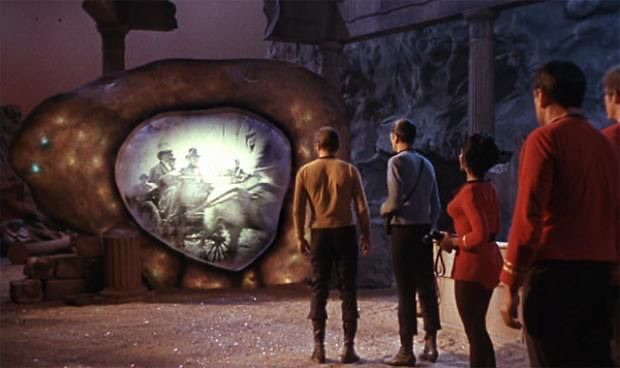
One of the most iconic episodes of the original Star Trek series is the episode “City on the Edge of Forever” (season 1, episode 28), where Kirk and Spock have to travel back in time through the Guardian of Forever, in order to correct a change in the timeline that drastically affects their future. The climatic ending involves a tragic moment where Kirk has to let someone they love die in order to correct the timeline.

During my last watch-through of this episode with the Saturday Night Star Trek team, I started thinking about the time-travel implications of this episode. If you haven’t seen the episode, please stop here and watch the episode (or save this post for another time). I think this episode is even trippier than you night believe at first.

Warning: spoilers.

Canonical Story

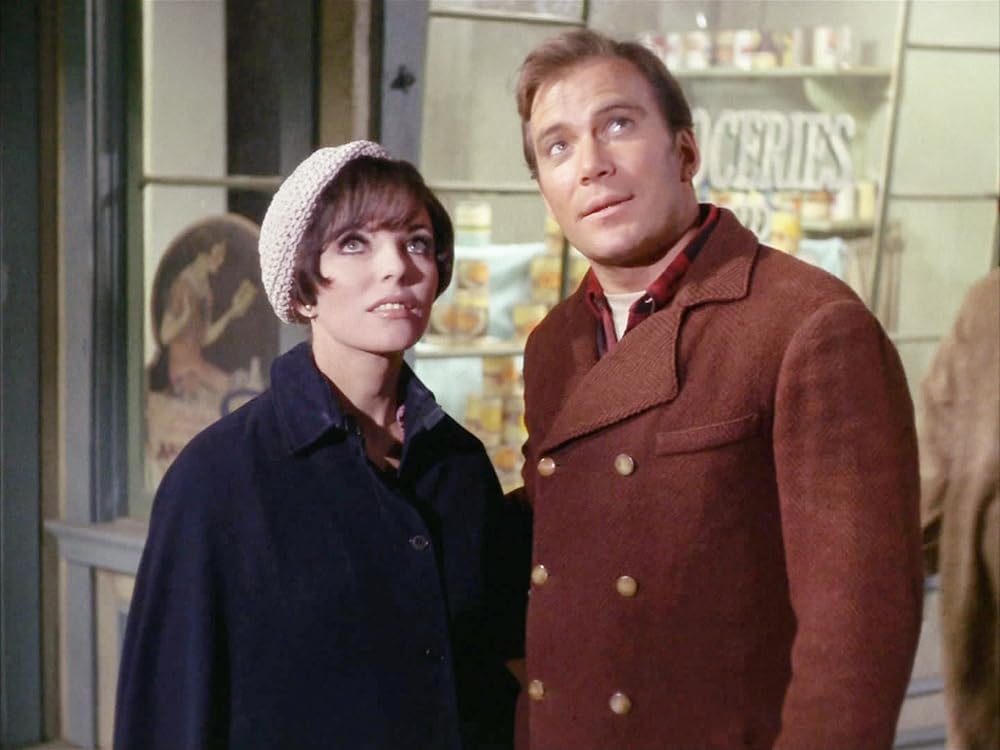
Edith Keeler (played by Joan Collins), and James Kirk (played by William Shatner)

This episode treats time travel in the following order:

  1. McCoy (deluded by overdose of medication) travels back in time to 1930’s and somehow saves Edith Keeler.
  2. Edith Keeler’s existence helps trigger a pacifist movement that delays US entry into World War II (Spock: “the right idea, but the wrong time”) leading to catastrophic consequences. The alternate (correct) history is that she dies in a car accident.
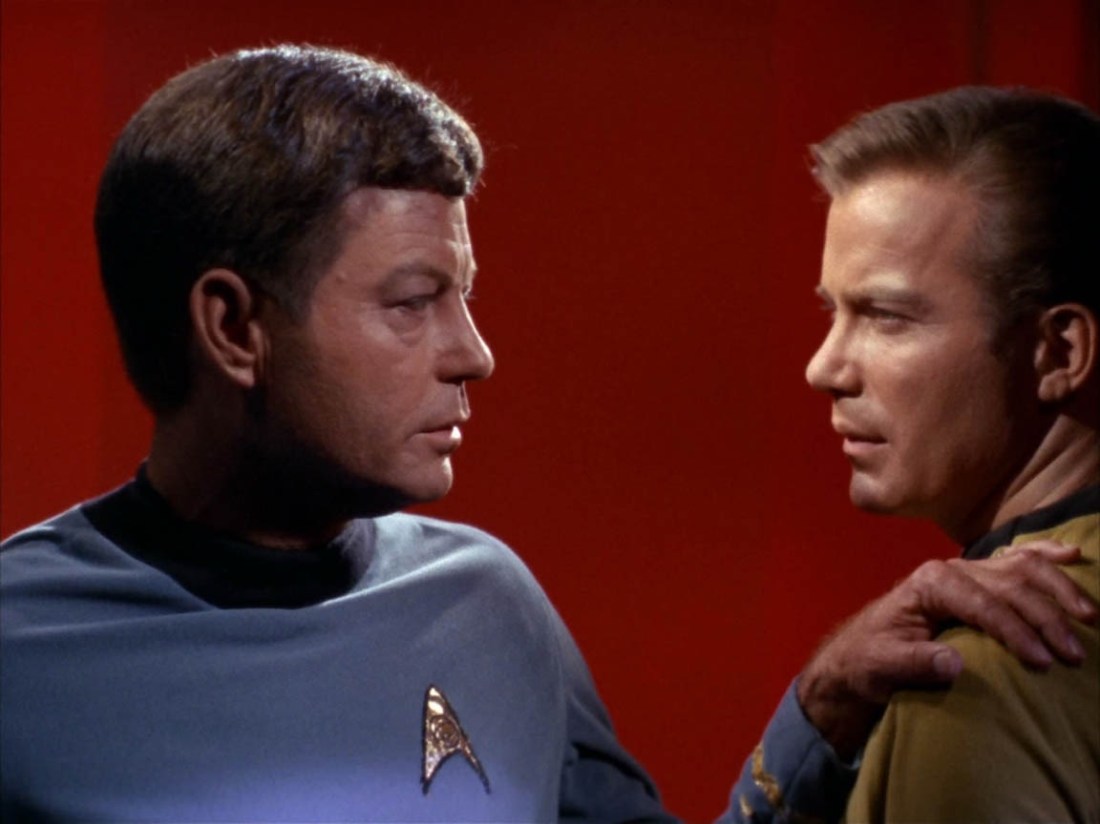
  3. Kirk and McCoy travel back in time to stop this.
  4. Kirk saves Edith Keeler from a fall down the stairs that might have killed her.
  5. After being admonished by Spock, Kirk chooses not to save Edith Keeler when she is struck by a car, ending her life. This restores the timeline to the way it was.
  6. Kirk, Spock, and McCoy return to the 23rd century, all is well (minus Kirk’s poor heart).

This is the canonical story.

My Fan Theory: Kirk is the Source of the Timeline not Restorer

My personal theory is that James Kirk didn’t restore the timeline as such; he caused it. The future we see now in Star Trek universe was a direct result of, not saved by, James T Kirk.

If you think about it for a moment, the canonical history is that Edith Keeler dies by a car accident before the start of World War II, but in the story, the reason why she gets into a car accident in the first place is because she crosses the street to see Jim Kirk. If both Jim and McCoy hadn’t travelled back, would Edith Keller still die by a car accident?

This is where causality in time travel gets weird. Assuming Jim Kirk is the cause of the canonical timeline, then presumably he was predestined at some point to find the Guardian of Forever, go back in time, interact with Edith Keeler in such a way that she dies by car accident.

The implication is that Jim Kirk was always going to travel back in time at the set date (barring further time travel shenanigans), which implies predestiny.

But what if Kirk and the Enterprise somehow never found the Guardian of Forever? Then Edith’s particular death shouldn’t happen, causing a paradox.

Or, if as Spock implies, time flows like river with “currents and eddies” and thus Edith Keeler would have still died by a traffic accident, but not this particular one, thus the timeline stays more or less unchanged.

Which one is true? Who knows.

The Weight of the Decision

The other aspect of this episode is that the timeline of Earth drastically changes due to the death (or life) of Edith Keeler. This means that following these events in the 1930’s countless people are drastically affected. Depending on the timeline, Person A might be killed in WWII, or they might live. If they live, Person A might have kids that otherwise might not exist.

Thus when Kirk restores (or causes) the timeline, his action causes the life or death of countless humans he will never know about. Similarly, McCoy’s initial interference.

So, regardless of which timeline is correct, Kirk and/or McCoy will be responsible for the countless deaths and lives that come after. A weighty decision indeed.

Another Timeline Change: Death by Phaser

Another aspect that’s often missed is McCoy’s first arrival in the 1930’s. He is robbed by a local homeless guy (the same guy who makes lewd comments about Edith Keeler earlier in the episode), who takes his hand-phaser and accidentally vaporizes himself. This seems to prevent any Federation technology from leaking back to the past (good), but the death of the homeless guy may have additional timeline consequences that we don’t know about, and never see the results of.

Granted, as Spock said in his “currents and eddies” comment, the timeline may resist change, and so the death of the man may not change all that much. But it’s also possible that his absence triggers events that the subtly alter the future in ways we don’t know about, even if they are not as dramatic as Edith Keeler’s.

So, when the Enterprise crew return to the ship, I wonder if they noticed any subtle oddities…

Conclusion

Time travel is weird, and the causality of time travel is even weirder. Since no one has actually travelled in time (as far as we know), the implications of changing the past are entirely theoretical, but it’s fun to imagine.

And, not surprisingly, “City on the Edge of Forever” remains one of the most iconic episodes in Star Trek. 🖖🏼

P.S. The Star Trek novel Yesterday’s Son by A.C. Crispin explores the Guardian of Time, and a certain other Star Trek episode involving Spock and a woman, and the implications of both. Quite a fun read if you find it.

P.P.S. An accidental double-post today. I made a scheduling error. 😅

Nature and Balance

SPOCK: War created an imbalance and nature counterbalanced it.

Star Trek, “The Omega Glory” (s2ep23), Stardate unknown

In some form or another, Climate Change has been with us since the beginning of Time. If you look at geologic time, gradual changes to climate happen, moving toward a hotter Earth or a colder one, and in the past once these changes lead to a tipping point, this leads to mass-extinction events. These changes in climate are often driven by natural forces: plate tectonics, accumulation of CO2 (carbon dioxide) in the atmosphere, shifts in the ocean currents and so on. Eventually, the pendulum swings back and the climate shifts toward the other direction. Meanwhile, life gradually recovers, diversifies again and so on.

But it’s important to understand that these changes happen very gradually over tens of thousands of years, or even hundreds of thousands of years.

Climate Change in the modern context refers to human-driven changes. The buildup of CO2 gas in the atmosphere is nothing new, but the output of that gas in the last 100 years is far higher than natural forces can account for. We know that this extra buildup is due to fossil fuels. Burning fossil fuels is literally like throwing gasoline on a fire.

Fossil fuels are not a sustainable energy source anyway, and they are condensing a process that should take a hundred thousand years into only tens of years. It’s small wonder we see such dramatic weather now: mass wildfires, mass rainfalls, mass drought and so on.

As Spock says, if we create an imbalance, nature will balance it out. But may not happen the way we want it to. The greater the imbalance, the greater the correction.

But just as 8-billion humans have, across generations, contributed to the problem, those same humans can contribute to fixing the imbalance (before Nature does it for us):

  • Reduce energy consumption at home. Even switching off lights at home helps.
  • Plant local, native plants in your neighborhood
  • Eat more vegetables (which I am trying to do anyway)
  • Cut back on fossil fuels: the less you use, the less accumulates in the atmosphere
  • and so on…

Find something you can reasonably do, and don’t hesitate to do some small good in the world.

Uniquely You

McCoy: “…In this galaxy, there’s a mathematical probability of three million Earth-type planets. And in all of the universe, three million million galaxies like this. And in all of that, and perhaps more, only one of each of us. Don’t destroy the one named Kirk.”

Star Trek, “Balance of Terror” (s1ep14), Stardate 1709.2

This excellent quote by Star Trek reminds me of a famous Jodo Shinshu-sect Buddhist poem called either “Sonno-mama” or “Just As You Are”, which I posted here many moons ago.

Of course, we can quibble with the mathematics of what Dr McCoy said. (spoiler: the Universe is way bigger than what writers in the 1960’s thought…), but the implication is the same.

So take a moment to admire your life, this moment, and your place in the universe. 🙏

Have a good weekend!

Namu Amida Butsu

The Healing Power of Nature

In the past, I talked about the four-character phrases, or yojijukugo, popular in Japanese culture. Recently, I learned about a new phrase that I hadn’t heard before: kachō-fūgetsu (花鳥風月). This phrase describes the beauty of nature, literally the Kanji characters for “flower”, “bird”, “wind” and “moon”.

The meaning here is various aspects of nature, but also in a positive healing sense.

Spock: Indeed, gentlemen. May I point out that I had an opportunity to observe your counterparts here quite closely. They were brutal, savage, unprincipled, uncivilized, treacherous; in every way, splendid examples of homo sapiens, the very flower of humanity. I found them quite refreshing. [he returns to the science station]

Kirk: I’m not sure, but I think we’ve just been insulted.

McCoy: I’m sure.

Star Trek, “Mirror Mirror” (s2ep4), stardate unknown

For all our veneer of civilization and advancement, we are still deep down biological creatures. We come from nature, and we need nature. Nature heals us and sustains us.

A small patch of grass in my yard, taken in April of 2025.

These days, it’s not hard to feel stressed by all the things that are going on, but I also found solace knowing that nature continues on regardless of what humans do or become. That doesn’t mean the future of humanity will necessarily be positive or negative, but it does remind me that life goes on nonetheless.

It also underscores how important protecting nature is.

P.S. More tips here for protecting the environment.

The Death of Gods

“I hope that your Engels and your Lenins never replace the religion that I hate, or the superstitions I have battened upon. You Babakov, have more blood on your hands than I have ever drunk. In destroying the gods of light you are also destroying the Dark Ones. We shall be avenged!”

Roger Zelazny, “On the Road to Splenoba”

I found this quote recently in an old, obscure Roger Zelazny short story titled On the Road to Splenoba, in which a vampire comes into contact with a Communist official with a surprise ending. No spoilers, sorry.

Anyhow, I just thought this quote was really neat because it speaks to the way the modern world has kind of destroyed the worldview where higher powers manage everything. We can’t attribute the motions of the planets, or the weather to deities the way we used to, because we know “under the hood” how these things work. People are no longer at the mercy of diseases thanks to medical technology.1 Of course, with the benefit of science, we also have a much better picture of the origins of the Earth, life, etc.

However, as the quote alludes to, it also feels like a bit of the magic of the world is gone too.

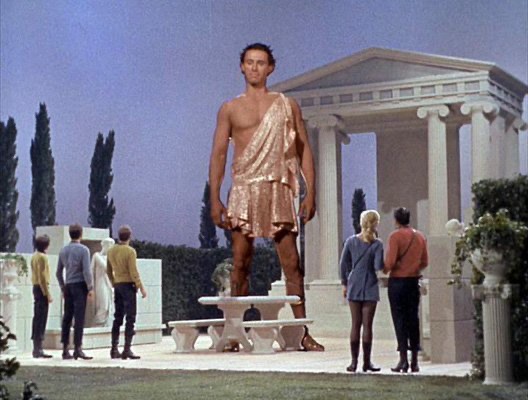
This reminds me of the Star Trek episode “Who Mourns for Adonais?“, when the Enterprise encounters the ancient Greek deity, Apollo, on a remote planet, and ultimately kill him in order to escape his grasp.

The “god” Apollo, played by Michael Forest.

The ending is melancholy:

KIRK: Would it have hurt us, I wonder, just to have gathered a few laurel leaves?

Star Trek, “Who Mourns for Adonais?” (s2ep2), stardate: 3468.1

The human race had outgrown Apollo, and gone on to accomplish many great things, yet it also cost something in the process. Maybe this is like growing up, trading a child’s imagination and wonderment for an adult’s self-mastery and freedom to choose one’s life…

1 Skepticism toward medical science is a modern issue though… 🙄. I doubt few who lived in the era of measles would object to taking a vaccine, but people have the luxury of choice now, even if those choices are reckless ones.

Big Changes, Little Changes

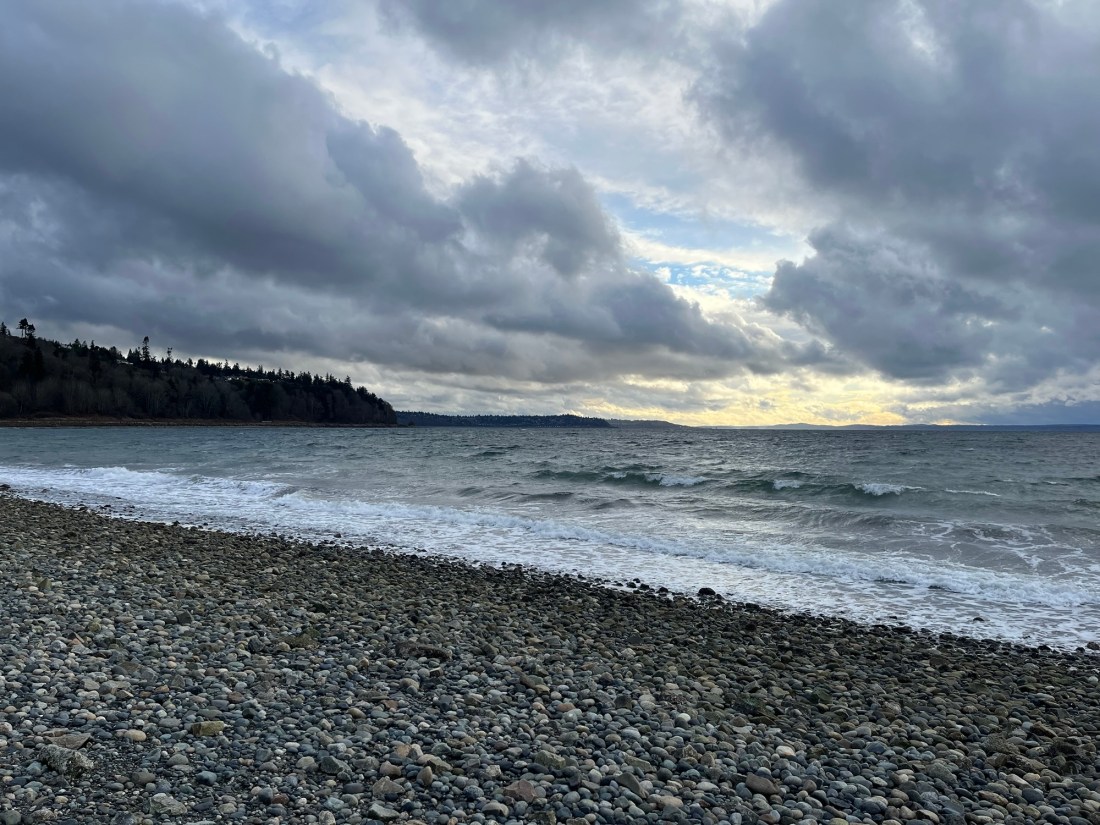
A beach scene with a rocky shore, and waves lapping up to teh shore. In the distance is a cloudy sunset.

Q: The redoubtable Commander Riker, whom I noticed before. You seem to find this all very amusing.
RIKER: I might, if we weren’t on our way to help some suffering and dying humans who–
Q: Your species is always suffering and dying.

Star Trek: The Next Generation, “Hide and Q” (s1ep10), Stardate: 41590.5

Something a little embarrassing I want to confess: sometimes, when I am uneasy or stressed, I go back and read some of my own posts. I don’t do this because of vanity (hopefully) or conceit, but I like to remind myself of certain things I might forget amidst daily turmoil. I suppose I write some of these blog posts as for myself to sort out what’s bothering me, as I do for the dear readers who follow the blog.1

One of my favorite posts of all time is this one. After visiting the Royal British Columbia Museum in 2022, and watching the excellent documentary about the different geologic ages of Antarctica, I walked away deeply impressed. These experiences help give a larger perspective about the world around us, and show how change is a constant of the universe whether we see it or not.

Change happens on the micro-level in our daily lives: one day to the next, we get older, our hobbies change, things at work happen, hairstyles change, etc. When I look at old photos of me and the kids, I am amazed at how much skinner I was, and no grey hear. 🤣

The world around us changes too: political, economically, and so on. The neighborhood you live in will look different 10 years from now, or looking back it’s probably changed in the past 10 years. Thinking about my life as a college kid in the early 2000’s, the Dot-com Era, it’s amazing how much has changed in a mere 20 years. Some things got better, some things got worse.

But if we step back even further, we can see with the benefit of hindsight slow-moving, multi-generational historical changes. From following the excellent History of Byzantium podcast, it’s amazing how much changes in the Eastern Roman (a.k.a. Byzantine) empire across generations. During the time of emperor Justinian the Great, chariot races were still hugely important in Byzantium, the empire had tenuous toeholds in North Africa and Spain, and many people still actively spoke Latin. By the time of emperor Manuel Komnenos, the Eastern Roman empire was far smaller, Greek language had long since replaced Latin, and the single universal church had long since split between Roman Catholic and Orthodox faiths. Between the 6th and 12th centuries, many changes happened, but because they stretch across many generations, it’s not possible for someone living within the city of Byzantium to fully grasp the scale of the changes. It was still the same Eastern Roman empire, and would continue for another 200+ years, but it had changed and evolved as external circumstances changed.

But let’s step even further back. An Egyptian peasant working the fields, or helping to build the Great Pyramid of Khufu, would be utterly stunned at the world today. Such a world would feel totally alien to him or her. It’s not just the level of technology we enjoy today, or the quality of our medicine, but also the way we view the world. Things that seem like common sense to such a peasant would feel strange or silly to us. Things that we inherently believe as 21st century adults would feel strange or bizarre to that peasant. We can’t really pin down when or how such things changed, but it’s series of gradual changes, each one piling on top of the rest.

And yet we can step even further back. If we look at the human race, it is new to the planet Earth. People can deny this using specious reasoning, but science doesn’t care what people believe or don’t believe. The natural world just works the way it does. We humans are just here, living on the Earth, but the Earth does not belong to us. We are its stewards. If not us, perhaps the Apes or Squids will be its stewards. 😏

Which I think brings me to my point: of all the craziness and turmoil going, I think there are two things to take away from all this:

  • We may lament how things have taken for the worse, but in a dispassionate sense, this is just more change unfolding due to causes and conditions that until now we may not have ever noticed. It doesn’t necessarily mean they are good changes, or harmless, but change is change. Also, by extension, the way things are now won’t always be this way in the future. Change is still happening, even if we can’t see it.
  • Of all the things to concern ourselves with most, in my humble opinion, the Environment (with a big “E”) is the most important. If we want to benefit Mankind, the Earth, and all life on it in ways that we’ll never see in our lifetime, if we want to get the most “bang for our buck”, then anything we can do to help the Environment works towards that end. Small changes and efforts now will ripple across generations we will never see, and help shape the Earth, hopefully in a positive way.

At times like this, I truly believe my old minister Rev. Don Castro of Seattle Buddhist Church was onto something when he described Buddhism, including Pure Land Buddhism, as an eco-religion. Amida Buddha, the Buddha of Infinite Light, embodies many things:

  1. As an embodiment of the Dharma, Amida sheds light on the continuous nature of all things: impermanent, fluid, changing.
  2. Also as an embodiment of the Dharma, Amida doesn’t require praise or devotion. The Dharma is just there, whether people notice it or not, whether they believe it or not. But as a Buddha, Amida tirelessly works to help all beings, to awaken them, to provide peace of mind.
  3. Also as an embodiment of the Dharma, Amida embodies how all things relate to one another. The small things that we do day to day to help improve, or degrade, life around us affect others even if they are far removed.
  4. Finally, Amida Buddha as the Dharma teaches rational, not selfish, thinking and non-fear. In a sense, WWTD: What Would Tuvok do?

All this is to say, I suppose, even amidst crazy times, do not fear. Take inspiration from the Buddha, make rational, wholesome choices, yet never assume things will stay a certain way forever. Do not be complacent, nor take things for granted.

Namu Amida Butsu

P.S. featured photo taken at Richmond Beach in Shoreline, WA earlier this year.

1 This blog is small-time, but it’s a labor of love, and I genuinely appreciate each and every reader.

Mindfulness Meditation Isn’t What You Think

Spock : “… I have noted that the healthy release of emotion is frequently very unhealthy for those closest to you.”

Star Trek, “Plato’s Stepchildren” (s3ep10), Stardate 5784.2

Meditation, specifically mindfulness meditation, is touted as a stress-relief exercise. Busy people believe that if they can block out the time to meditate for X minutes a day, or when stressed, this will make more happy and productive. It has been all the rage in Silicon Valley too.

But it doesn’t work.

It will calm your mind while you are sitting, but as soon as you are back to work, your blood pressure will quickly rise again. Old habits will quickly resurface. Self-help, in short, does not help.

How do I know this?

I tried the same trick in my late 20’s. My first child was born, and I was working at Amazon (yes, that Amazon) for a few years in a technical support role. The environment was stressful, demanding, constantly on the move, the on-call rotation gave little time to decompress because something was always broken,1 and I had to drive into work at all hours of the night to try and fix it.

Since I had recently converted to Buddhism at the time, and listened to a lot of Ajahn Brahm dharma talks, I wanted to try meditation. We had a spare office that no one used, so I would go in there once or twice a day, turn off the lights, dutifully sit, chant certain Buddhist mantras, meditate for 20 minutes or more, and then return to work.

As soon as I was back at my desk, the stress would rise all over again. I kept at the meditation for months, almost a year, before I finally gave up.

The stress, constant sense of inadequacy measuring myself to hyper-competitive co-workers who graduated from Stanford, unrealistic work performance goals, fear of losing my job, and so on simply didn’t go away until I QUIT MY JOB AND TOOK A LESS DEMANDING ONE.2

It took me years as a Buddhist to finally realize that stress-relief is not what mindfulness meditation was intended for.

Mindfulness meditation is a tool to develop insight, not stress relief. It is necessary in the early stages of meditation to quiet the chatter in the mind, but that is just the first stage. It is to remove barriers to insight by develop a focused mind, and a quiet mind, a mind that can perceive things in a more balanced way. Consider this quote from the Buddha in a very early text, the Dhammapada:

  1. There is no meditative concentration for him who lacks insight, and no insight for him who lacks meditative concentration. He in whom are found both meditative concentration and insight, indeed, is close to Nibbana.
  2. The monk who has retired to a solitary abode and calmed his mind, who comprehends the Dhamma with insight, in him there arises a delight that transcends all human delights.
  3. Control of the senses, contentment, restraint according to the code of monastic discipline — these form the basis of holy life here for the wise monk.
Translation by Soma Thera from https://www.accesstoinsight.org/tipitaka/kn/dhp/dhp.25.budd.html

The emphasis is on focus, insight, and contemplation NOT relaxation or stress-relief. Mindfulness meditation has been repackaged and sold to naive Westerners with false promises. Meditation really does provide excellent benefits, but it has to be done as part of a much larger, holistic lifestyle change and with wholesome intentions. This is the “holy life” as described by the Buddha: a life of wholesome, guilt-free conduct, goodwill towards others, and a desire to pursue the Dharma (the teachings of the Buddha).

First, one should take up the Five Precepts of Buddhism. As we see in verse 374 above, the Buddha openly encourages that we curb our worst behaviors first as a foundation for other Buddhist practice. One will gain no lasting benefit from meditation until this is done. Full stop.

Second, one must approach meditation with the mindset of a monk. It is not necessary for lay-people to give up everything and go live in the woods. Buddhism accommodates both the “house-holder” lifestyle and that of a true renunciant (a.k.a. a monk or nun). But both the renunciant and the house-holder are expected to live a life of moderation and restraint.3 Easier said than done (speaking as a gamer and foodie), but it’s a goal to sincerely aspire to.

Speaking of restraint, one should always guard one’s speech. A long time ago, a Buddhist minister I admired once told me that speech was like toothpaste: once it was out of the tube, you couldn’t put it back. One has to learn to carefully monitor what one says both in person and online (and yes, at work). Again, easier said than done, but the alternative will only make your life miserable.

Finally, when such good foundations are established, meditation will help you learn more about yourself, and the world around you.4 It’s incredibly helpful, and life-changing when carried to fruition. I have my own little private insights that have stayed with me through the years, and I hope you will find yours too.

Namu Amida Butsu

Namu Shakamuni Butsu

P.S. if you feel the need to calm yourself right away, try something much simpler. You can recite the nembutsu, the Heart Sutra, a mantra, whatever. Try that for a minute, and see if that works. It is a band-aid fix though, and you still need to approach things from a holisitic standpoint, or you will gain no long-term benefit. Alternatively, just go for a walk.

1 Years later, the sound of a pager going off still triggers me a little bit. No joke.

2 Another ex-Amazonian who had joined the same company years earlier confided in me that after leaving Amazon, he drank himself stupid for months to decompress. I noticed that I was still on a hair-trigger for months after leaving Amazon, and it took me a while to unlearn those habits too. My wife noted that my posture improved after leaving, and that I grumbled about work less. Some jobs are simply not worth staying in.

3 The Buddha was pretty flexible about what exactly this meant, citing whatever cultural standards applied at the time as a benchmark. In short, a lot of it is rooted in common courtesy and good sense. If you cannot act toward others using common courtesy, meditation ain’t gonna fix your issue.

4 You may learn that your whole problem is that your job sucks, for example, and that the burn-out is not worth the money. Of course, if you’re a single mom caring for three kids, you have a lot fewer options available to you, and in such cases I recommend the nembutsu as a starting point.

Injustice

In a couple recent posts, I touched upon the misdeeds of one 12th century warlord named Minamoto no Yoritomo in the excellent Japanese historical drama, the Thirteen Lords of the Shogun. Huge credit to Japanese actor Oizumi Yo (大泉洋) for his brilliant performance by the way.

There’s one particularly heart-breaking scene halfway thorugh the drama series: Yoritomo bullies his retainer, Hojo no Yoshitoki, to carry out a series of bloody purges (partly as a test of loyalty). Yoshitoki hesitates, seekingly ready to stand up to Yoritomo at last, but in the end he backs down. Later in the episode after the purges have taken place, Yoshitoki is at home holding his infant baby, but quietly cries to himself. He says to his child, “please forgive your dad” as the episode ends. 😭

While some of this is dramatic fiction, Yoritomo really was a ruthless man, just one of many in history who exerts power and does whatever is necessary to keep it. They exploit others and toss them aside when they are done. Such men are so hopelessly self-absorbed that they pull everyone in orbit down with them, and even then it’s not enough. Like a bucket with a big hole at the bottom, the more they try to fill it and appease their ego, the more they need to fill it again.

For you science types you can also compare them to a singularity (e.g. a black hole): something that has collapsed in on itself and now pulls everything in destroying them in the process.

Sagittarius A*, the black hole at the center of our galaxy.

For simplicity, we’ll call these people “super assholes”. It’s a pseudo-Buddhist term. 😉

Even in modern times, such powerful assholes still exist. They merely changed jobs. Some run major corporations, some rule dictatorships, others are just obnoxious politicians, lawyers, priests, media influencers and so on. Yet in spite of their obvious misdeeds and harm to others, they seem invulnerable, able to evade justice through wealth, power and just being enough of an asshole.

Worse, even if you manage to take down one asshole, another one inevitably arises.


All governments suffer a recurring problem: Power attracts pathological personalities. It is not that power corrupts but that it is magnetic to the corruptible.

Frank Herbert, Chapterhouse: Dune (Dune #6)

That said, all is not hopeless.

When I think about this issue, I sometimes consider a passage from the Earth Store Bodhisattva Sutra, chapter five:

The power of karma is extremely great. It rivals Mount Sumeru in its heights. It surpasses the great oceans in its depths. It obstructs the path leading to sagehood. For that reason, beings should never think that minor bad deeds are unimportant or assume that they do not count as offenses. After death, there will be retributions to undergo that reflect all those details.

Translation by City of Ten Thousand Buddhas

This is, admittedly, a pretty small comfort to the countless people whose lives have been destroyed, literally and figuratively, by such powerful men. Sure, they may self-destruct someday, and face some kind of karmic retribution in the future, but what about the people who are suffering or dead now?

Make no mistake, though, time does go on, awful people wither and die, and their legacies are forgotten. Remember the ancient Assyrian king, Ashurbanipal? His was a reign of terror. But soon after he died, the dreaded Assyrian Empire fell and its legacy is now just dust. Small comfort to people at the time, but still.

Screenshot from the game Fire Emblem: Three Houses.

If you compare these “super assholes” to black holes in space, I find the best thing to do is steer clear of their orbit. If you’re far away, you can still escape with minimal effort, but get too close and you may get sucked in further no matter what you do, just like Hojo no Yoshitoki. Sometimes it’s better to just lay low and let things pass.

Sometimes, though, it feels unavoidable, and that becomes the true test of one’s character.

Namu Amida Butsu

P.S. I coincidentally wrote most of this before a certain asshole was convicted (you know who). I fear he will somehow escape justice though, but he will be dead in time anyway.

Update: I was right afterall.