This article from the Guardian is a poignant reminder of what happens when you have power and money, and no restraint. The symbolism of a moldy mansion, rampant infections, and miserable people is not lost on readers either.
In an old bilingual book about Rinzai Zen I picked up at the airport in Japan once, the author described the normal, run-of-the-mill mind as the “mind that leads the mind astray” (mayowasu kokoro, 迷わす心):
No matter how you try to calm this “mind that leads the mind astray” through your own efforts, and no matter how you try to see and judge things objectively, you are likely to fail.
page, 30-31
Until one has fully broken through to the state of awakening (e.g. Buddhahood, enlightenment, etc), one cannot fully trust one’s own mind, no matter how certain one is. The mind operates from a basis of ignorance, insufficient information, a single point of view, etc. It is a slippery slope from a mistaken assumption, or a selfish thought to a line of thought that leads one further and further astray. One thinks they are working towards their own happiness and well-being, but in the end may drag others down with them.
This sort of ego is also self-reinforcing:
Your habits always come hunting after you. The self you construct will haunt you. A ghost wandering around in search of your body, eager to possess you. We are addicted to the self we construct.
Thus, an unrestrained mind is ultimately a disaster for oneself, and those around them. It can happen to any of us, given the right circumstances. Or, as the old Tears for Fears song goes:
375. Control of the senses, contentment, restraint according to the code of monastic discipline — these form the basis of holy life here for the wise monk.
376. Let him associate with friends who are noble, energetic, and pure in life, let him be cordial and refined in conduct. Thus, full of joy, he will make an end of suffering.
translation by Ven. Acharya Buddharakkhita
Better to know one’s limit, stay vigilant, and savor the moments you have.
Lately I’ve been talking a lotabouthomeBuddhistpractice, including home Buddhist services and such. These are things that devout lay-Buddhists often do (myself included), but then I realized I never talked about making one’s own sutra book.
There are a couple reasons why one might make their own.
First, Buddhist resources outside of Buddhist countries are hard to find. For someone like me who lives on a large city with a large Asian community this is not so hard. But if you lived in, say, rural Iowa, it might be a lot harder. So, sometimes you have to just DIY.
Second, it’s a nice way to personalize your Buddhist practice in a way that suits you.
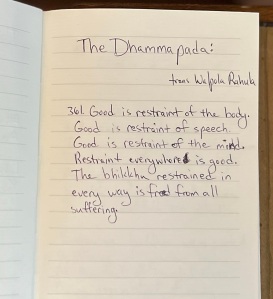
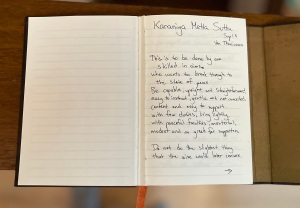
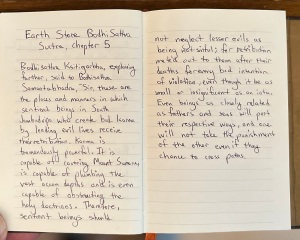
I started making my own maybe about 9-10 years ago. I picked up a nice little Paperblanks notebook at the airport at the time, and I decided to collect Buddhist sutras and quotes that I liked. I started out small, just copying things now and then from sites like accesstoinsight.org, or copied from books.
I also recorded Mahayana Buddhist sutras as well, such as this quote from chapter 5 of the Earth Store Bodhisattva Sutra:
I copied each of these by hand. I even tried to copy much longer texts, such as the 4th chapter of the Golden Light Sutra, which is a very beautiful prose about repentance and goodwill, but the text was much longer than I thought, and I eventually gave up halfway.
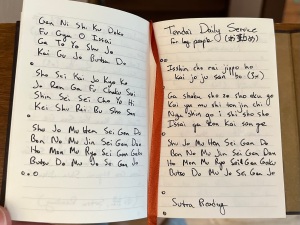
But eventually, around 2017-2018, when I left my old Jodo Shinshu-Buddhist community and started exploring other sects, I focused more on home practice and I started to add Japanese-style liturgies as well:
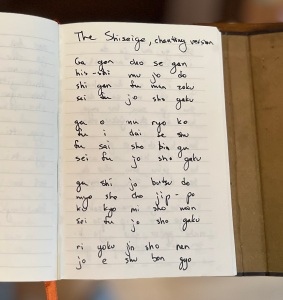
I also wrote specific sutra chants too, such as the Shiseige:
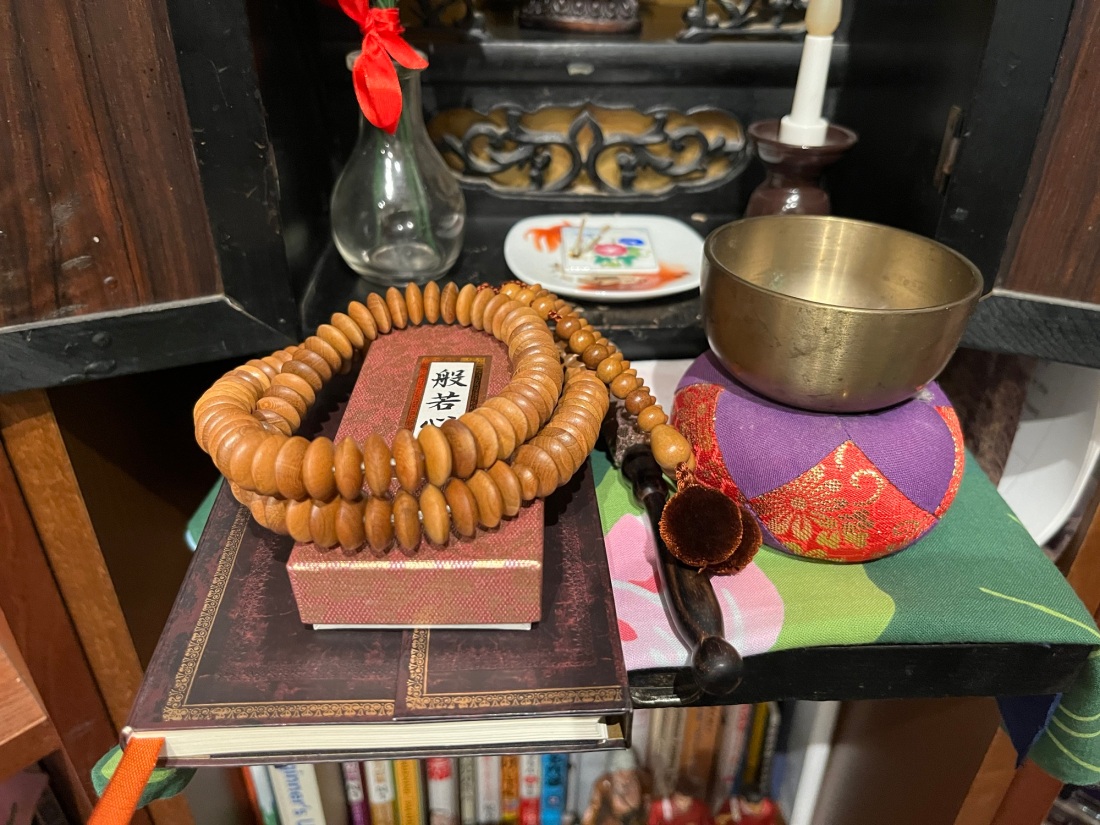
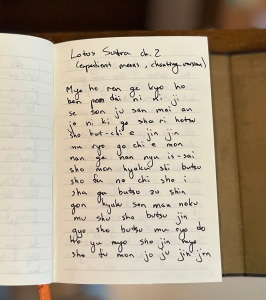
As you can see from the featured photo above,1 I keep this sutra book on my home altar (bottom left in photo), and use it almost daily. A personal sutra book works best when it’s meaningful, simple and useful for you, so the important thing is to not do what other people do, but make it useful for yourself. Find sutras or Buddhist quotes you like, collect them into a notebook, and copy them by hand (word of advice, use a gel pen, not a ballpoint pen, it’s easier to read), and make it your own. There’s no wrong way to do it.
Further, the sutra book I made has gradually progressed over time, just as my own path and practice have and I still have more room to write things in the future.
1 You can also see my Buddhist rosary, a Tendai-style rosary I ordered online, along with a boxed copy of the Heart Sutra, which I got in 2023 while visiting Nara‘s Kofukuji Temple, one of my personal favorite.
Chapter 25 of the Lotus Sutra is a popular devotional text in East Asian Buddhism. It is often referred to as the “Avalokiteśvara Sutra”, or kannongyō (観音経) in Japanese, or more formally the kanzeon bosatsu fumonbongé (観世音普門品偈, “Chapter on the Universal Gate of Kanzeon Bodhisattva”).
Despite the name, it is not a stand-alone text, but simply a famous chapter in the larger Lotus Sutra. This particular chapter is the main introduction to one of the most popular Bodhisattvas in Buddhism: Avalokitesvara (Kannon in Japanese, Guanyin in Chinese, etc.). The chapter describes the attributes of Kannon that are familiar to Buddhists, such as their vows to help all beings who call on them, their ability to take on various forms to teach people, and their unwavering compassion to lead all beings to Enlightenment.
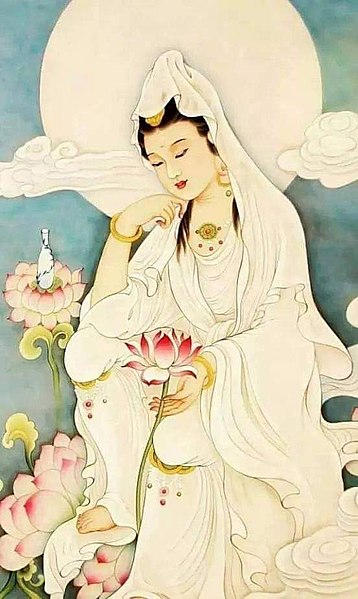
A more Chinese-style image of Kannon (a.k.a. Guan-yin) in her more motherly form, photo courtesy of Wikipedia.
The chapter as a whole is long and would be difficult to chant, so the verse section, not the narrative section, is frequently used for liturgical purposes. The Lotus Sutra often describes things in narrative form, then summarizes again in verse form. However, even the verse section alone is longer than the Heart Sutra, or the Shiseige, so just chanting the verse section is a bit challenging. In my experience it takes about 5-7 minutes.
For this reason, medieval Buddhists in Japan also devised an even shorter version called the Ten-Verse Kannon Sutra.
The sutra is frequently recited in both Zen and Tendai liturgies, among others, but it is not well known to Westerner lay-Buddhists. I had difficulty finding an online copy I could use as a reference here, even in Japanese, due to its length.
However, ages ago, I picked up a sutra book at the famous Sensōji temple in Tokyo, and once I figured out what the Kannon Sutra was, I copied it character by character to an old version of the blog, but then lost it later when I changed blogs. Recently, I was able to recover the text (not easily) from the original HTML I wrote, and posted it back on here with minor edits.
I have also provided a PDF version here if you want to print it out and use at home.
Also, special thanks to this website for providing much needed reference information on pronunciation and Chinese characters. My original, recovered text had a few errors, embarrassingly.
Examples
I found a few examples on Youtube that you can follow along if you are learning to chant the Kannon Sutra as shown below.
From Eiheiji temple (one of two home temples of Soto Zen). Note that they chant this at a pretty fast pace.
This example from Zenshoji Temple, a Shingon-sect temple, in Niigata Prefecture, has line by line annotation. The chanting pace is slower and easier to follow.
These examples are very similar, other than slight differences in pacing and pronunciation of certain Chinese characters. For people who are learning to recite the sutra, just pick what works until you get the hang of it.
Translation
I decided not to post the translation side-by-side with the text, the way I do with the Heart Sutra and such. This is due to formatting reasons on the blog, plus also length of the text makes this more difficult. I may revise this later.
For now, I highly recommend checking out a modern translation here by the excellent Dr Burton Watson. In that translation, the verse section starts after the phrase “At that time Bodhisattva Inexhaustible Intent posed this question in verse form“. The Buddhist Text Translation Society also has an excellent translation of the verse section here.
Disclaimer and Legal Info
I hereby release this into the public domain. Please use it as you see fit, but if you attribute it to this site, greatly appreciated. Also, please bear in mind this is an amateur work, and should not be taken too seriously.
Dedication
I dedicate this effort to all sentient beings everywhere. May all beings be well, and may they all attain perfect peace.
Namu Kanzeon Bosatsu
The Kannon Sutra, verse section
(2025 edition, with minor typo fixes)
Preamble
Original Chinese
Japanese Romanization
妙法蓮華經 観世音菩薩 普門品偈
Myo ho ren ge kyo kan ze on bo satsu fu mon bon ge
Verse Section
Original Chinese
Japanese Romanization
世尊妙相具 我今重問彼 佛子何因縁 名為観世音
Se son myo so gu ga kon ju mon pi bus-shi ga in nen myo i kan ze on
具足妙相尊 偈答無盡意 汝聴観音行 善応諸方所
gu soku myo so son ge to mu jin ni nyo cho kan on gyo zen no sho ho jo
弘誓深如海 歴劫不思議 侍多千億佛 発大清浄願
gu zei jin nyo kai ryak-ko fu shi gi ji ta sen noku butsu hotsu dai sho jo gan
我為汝略説 聞名及見身 心念不空過 能滅諸有苦
ga i nyo ryaku setsu mon myo gyu ken shin shin nen fu ku ka no metsu sho u ku
假使興害意 推落大火坑 念彼観音力 火坑変成池
ke shi ko gai i sui raku dai ka kyo nen pi kan on riki ka kyo hen jo ji
或漂流巨海 龍魚諸鬼難 念彼観音力 波浪不能没
waku hyo ru go kai ryu go sho ki nan nen pi kan on riki ha ro fu no motsu
或在須弥峰 為人所推堕 念彼観音力 如日虚空住
waku zai shu mi bu i nin sho sui da nen pi kan on riki nyo nichi ko ku ju
或被悪人逐 堕落金剛山 念彼観音力 不能損一毛
waku bi aku nin jiku da raku kon go sen nen pi kan on riki fu no son ichi mo
或値怨賊繞 各執刀加害 念彼観音力 咸即起慈心
waku ji on zoku nyo kaku shu to ka gai nen pi kan on riki gen soku ki ji shin
或遭王難苦 臨刑欲寿終 念彼観音力 刀尋段段壊
waku so o nan ku rin gyo yoku ju shu nen pi kan on riki to jin dan dan ne
或囚禁枷鎖 手足被杻械 念彼観音力 釈然得解脱
waku ju kin ka sa shu soku bi chu gai nen pi kan on riki shaku nen toku ge datsu
呪詛諸毒薬 所欲害身者 念彼観音力 還著於本人
shu so sho doku yaku sho yoku gai shin ja nen pi kan on riki gen jaku o hon nin
或遇悪羅刹 毒龍諸鬼等 念彼観音力 時悉不敢害
waku gu aku ra setsu doku ryu sho ki to nen pi kan on riki ji shitsu bu kan gai
若悪獣圍繞 利牙爪可怖 念彼観音力 疾走無邊方
nyaku aku shu i nyo ri ge so ka fu nen pi kan on riki jis-so mu hen bo
蚖蛇及蝮蠍 気毒煙火燃 念彼観音力 尋聲自回去
gan ja gyu fuku katsu ke doku en ka nen nen pi kan on riki jin sho ji e ko
雲雷鼓掣電 降雹澍大雨 念彼観音力 応時得消散
un rai ku sei den go baku ju dai u nen pi kan on riki o ji toku sho san
衆生被困厄 無量苦逼身 観音妙智力 能救世間苦
shu jo bi kon yaku mu ryo ku hitsu shin kan on myo chi riki no ku se ken ku
具足神通力 廣修智方便 十方諸国土 無刹不現身
gu soku jin zu riki ko shu chi ho ben jip-po sho koku do mu setsu fu gen shin
種種諸悪趣 地獄鬼畜生 生老病死苦 以漸悉令滅
shu ju sho aku shu ji goku ki chiku sho sho ro byo shi ku i zen shitsu ryo metsu
真観清浄観 廣大智慧観 悲観及慈観 常願常瞻仰
shin kan sho jo kan ko dai chi e kan hi kan gyu ji kan jo gan jo sen go
無垢清浄光 慧日破諸闇 能伏災風火 普明照世間
mu ku sho jo ko e nichi ha sho an no buku sai fu ka fu myo sho se ken
悲體戒雷震 慈意妙大雲 澍甘露法雨 滅除煩悩燄
hi tai kai rai shin ji i myo dai un ju kan ro ho u metsu jo bon no en
諍訟経官処 怖畏軍陣中 念彼観音力 衆怨悉退散
jo ju kyo kan jo fu i gun jin chu nen pi kan on riki shu on shitsu tai san
妙音観世音 梵音海潮音 勝彼世間音 是故須常念
myo on kan ze on bon on kai jo on sho hi se ken on ze ko shu jo nen
念念勿生疑 観世音浄聖 於苦悩死厄 能為作依怙
nen nen motsu sho gi kan ze on jo sho o ku no shi yaku no i sa e go
具一切功徳 慈眼視衆生 福聚海無量 是故応頂礼
gu is-sai ku doku ji gen ji shu jo fuku ju kai mu ryo ze ko o cho rai
Conclusion
Original Chinese
Romanization
爾時持地菩 薩即從座起 前白佛言世 尊若有衆生
ni ji ji ji bo sa soku ju za ki zen byaku butsu gon se son nyaku u shu jo
聞是観世音 菩薩品自在 之業普門示 現神通力者
mon ze kan ze on bo sa bon ji zai shi go fu mon ji gen jin zu riki sha
當知是人功 徳不少佛説 是普門品時 衆中八萬四
to chi ze nin ku doku fu sho bus-setsu ze fu mon bon ji shu ju hachi man shi
千衆生皆發 無等等阿耨 多羅三藐三 菩提心
sen shu jo kai hotsu mu to do a noku ta ra san myaku san bo dai shin
In the coming weeks, I hope to post a couple more such chants from the Lotus Sutra, as they are popular both in Tendai and Nichiren communities in particular, and I am learning to chant these too.
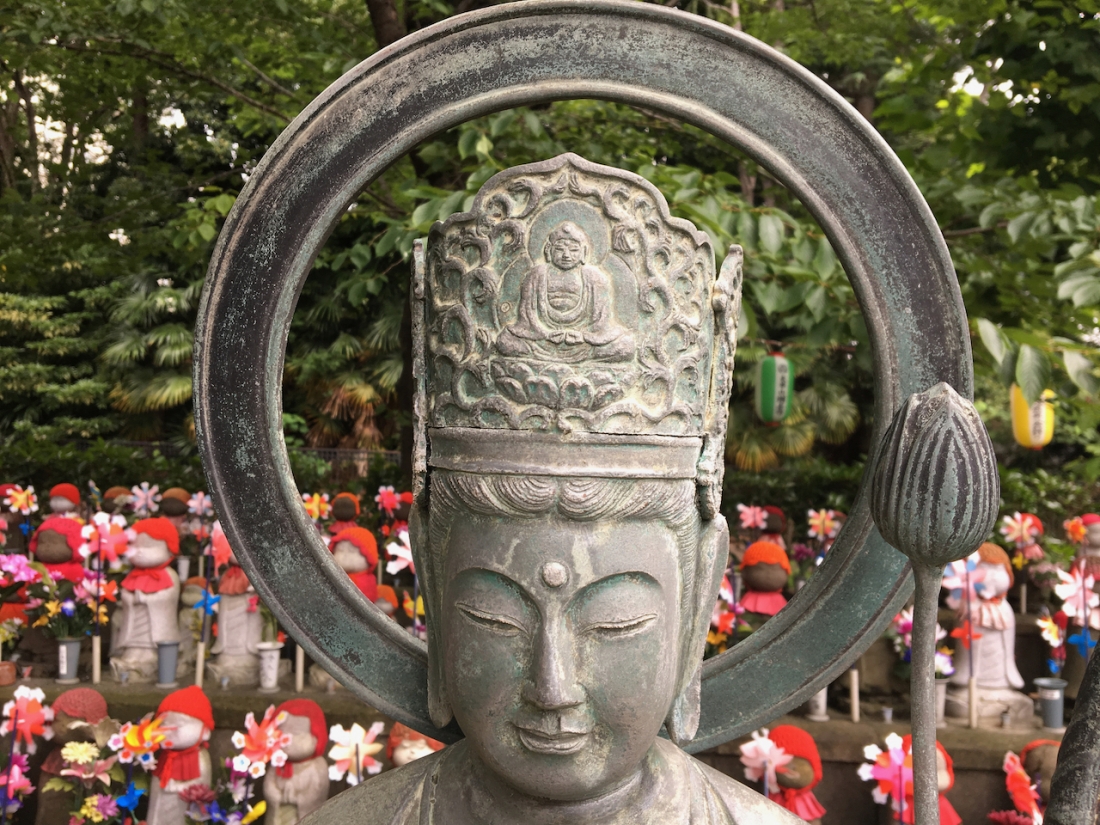
P.S. Featured photo was taken by me at Zojoji temple in Tokyo, Japan, with an image of Kannon Bodhisattva wearing a crown that features an image of Amitabha Buddha.
As a kid, I was always fascinated by Astronomy, and I remember often watching the stars at night, when I would visit my dad’s house on the weekends. Back then, I didn’t really understand astronomy well, but I learned what I could about constellations, I visited the planetarium at the Pacific Science Center, and of course I became a big fan of classic Star Trek through my uncle. In college, I even majored in Astronomy for a time until I realized that Physics wasn’t my forté.
Space and the universe have always fascinated me, and for a long time, I’ve felt that in light of space, science, etc, Buddhism has been particularly suited for this worldview.
The Buddha-Dharma functions in a lot of ways like the laws of physics or other natural laws. It’s less something to believe in, and something more to understand or at least acknowledge. It can fit into any time or place.
The various Buddhas and Bodhisattvas, primarily found in the Mahayana tradition, might seem superstitious, but embody important Buddhist truths and can be just as weird and cosmic as anything the universe has to offer. Further, belief is such beings is neither required nor expected. It is up to each person to adopt what they want. They are quite literally a form of expedient means.
Finally, when you look at the sheer vastness of space, it’s hard not feel small. But that is alright too. Buddhism thinks big, but also because everything is interconnected in some way, it assures that the choices we make, wholesome or unwholesome, do affect all other things. We can light one corner of the world (and universe) through our actions and our thoughts.
P.P.S. I’ve often wondered if the Buddhas and Bodhisattvas really do exist, would they be humanoids like us, or would they be strange aliens like in Star Trek? Would Amida Buddha’s original from be a green alien with four arms? 😋
This post was inspired by a recent play-through of Fire Emblem: Three Houses and contains spoilers to the game.
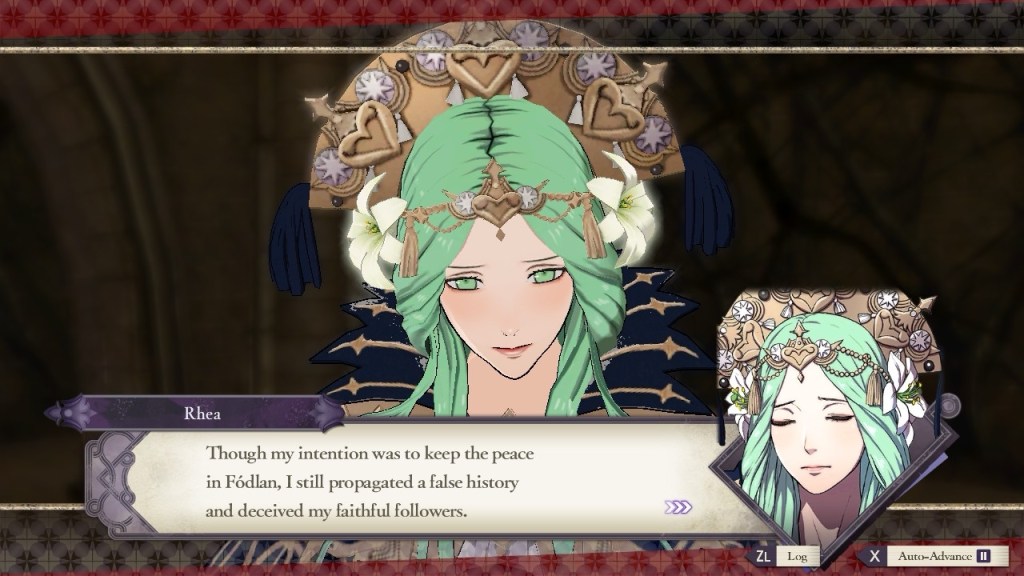
In addition to the main plot, Three Houses contains a lot of subtle side-stories and hidden lore that players discover as they explore the monastery. For example, the game strongly hints that the official history of the Church of Seiros is a fabrication used to obfuscate the real history of Lady Rhea the archbishop.
Lady Rhea doesn’t just venerate Saint Seiros (pictured above); she is Saint Seiros disguised for countless eons. The game, especially in the Silver Snow route, also reveals her divine dragon ancestry, the real source of the holy relics (remains of her siblings), and hints that other saints, namely Seteth (Saint Cichol) and Flayn (Saint Cethleann) are still alive after all these centuries, hiding their identities even as they manage the church.
Rhea/Seiros fears a repeat of a terrible massacre of her loved ones by humans centuries ago. Thus, she uses the Church to keep the peace, obfuscate the past with false narratives, suppress dissent, manipulate the governments of Fódlan, and (in a less cynical sense) gives the masses something positive to believe in: the goddess Sothis, her mother.
Rhea’s actions, like Lady Edelgard‘s, are morally grey in that they are driven by sincere desires to address the evils of society, but through questionable means.1 Good intentions lead to controversial decisions that nevertheless become church canon over the centuries.
It’s not hard to see the relevance of this toward real-world organized religions.
Organized religion is not, of course, being manipulated by divine dragon beings (presumably). However, seeing as how church official history can obfuscate unpleasant aspects of the past, one can’t help but wonder how many such inconvenient truths that we’ll never know about have been smoothed over and polished for the sake of unity and peace.
Further, is an inconvenient truth better than a convenient lie? This answer isn’t so easy.
This is where the inherent contradictions of organized religion come into play: humans tend to manipulate and corrupt religious teachings in order to further an agenda, often with well-meaning (or at least benign) intentions. And yet, in spite of this cynical view, organized religion is necessary to preserve and carry on teachings across generations. Thus, followers often have to make the best of an awkward situation.
Everyone in their own personal religious path has to try to resolve these contradictions and try to put teachings into practice as best they can. Or, like Edelgard, throw them out completely and expose the hypocrisy. This latter choice entails conflict, and worse: the risk of simply replacing one convenient lie with another more suited to one’s preferences if they are not careful.
Anyone who says religion is easy is either wrong or trying to sell you something.
1 Further in Three Houses, Rhea and Edelgard’s intentions are irreconcilable, mutually exclusive, and in the end one of them must destroy the other, hence the tragedy of the whole story.
A little while back, during my post on Fushimi Inari Shrine in Kyoto, Japan, I alluded to how the native Shinto religion often blended with Buddhism up until the early modern period (e.g. the Meiji Period) when they were more forcefully separated.
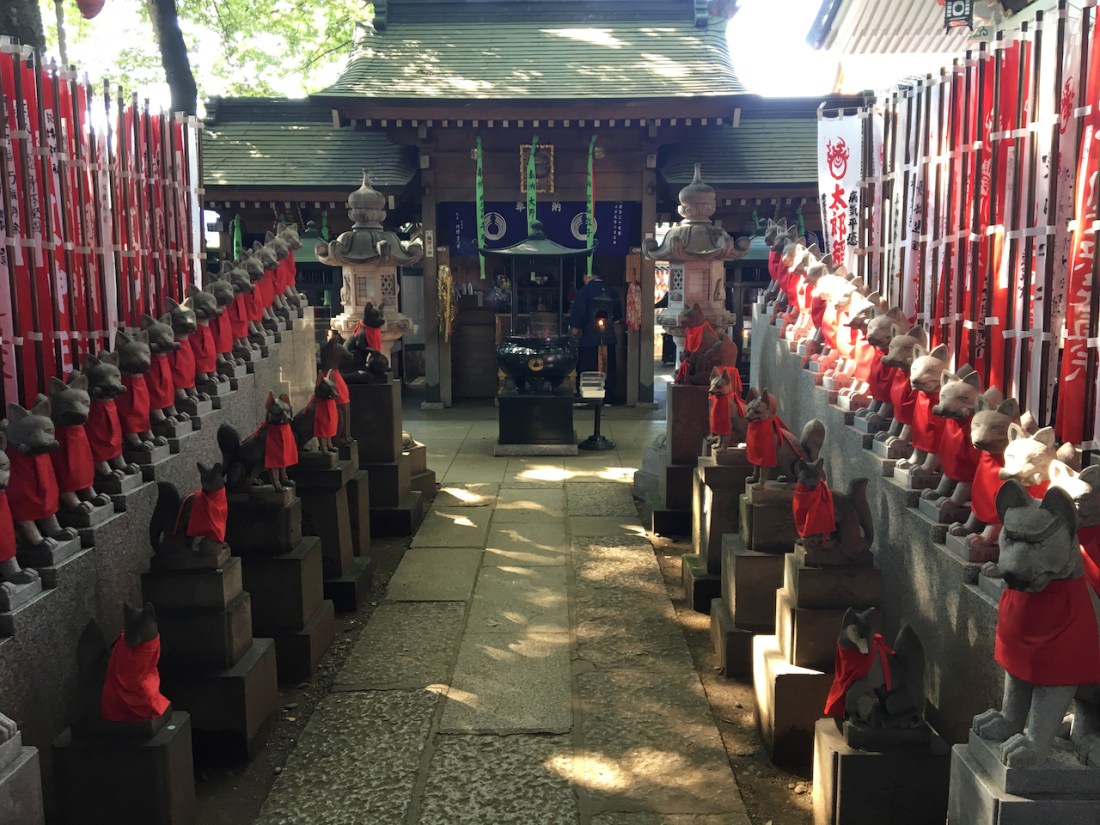
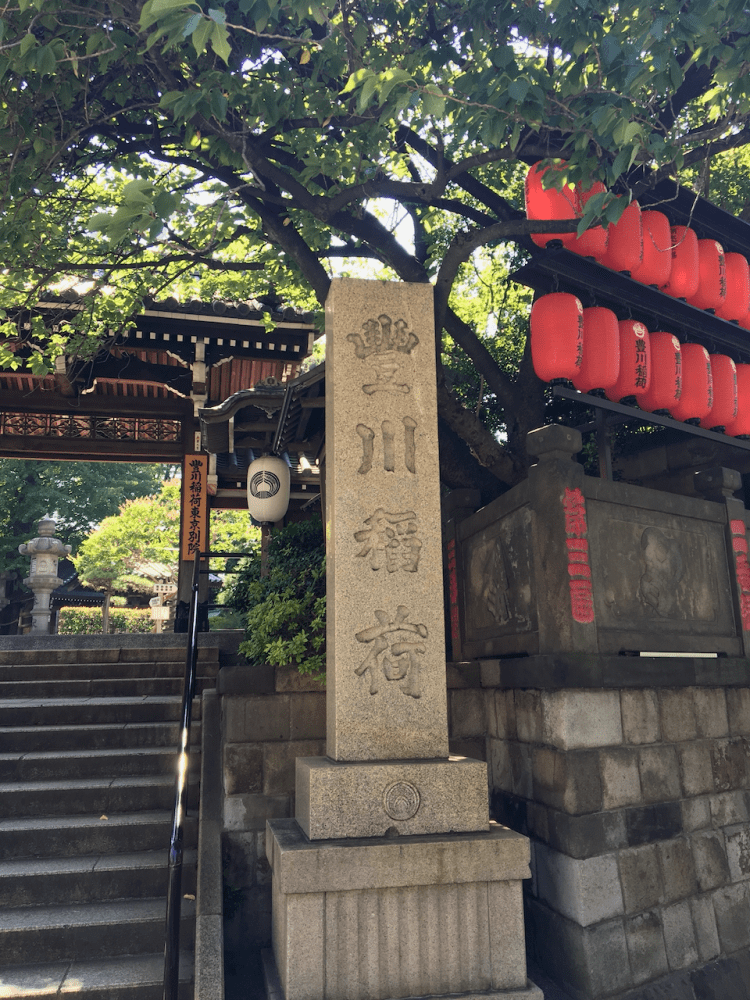
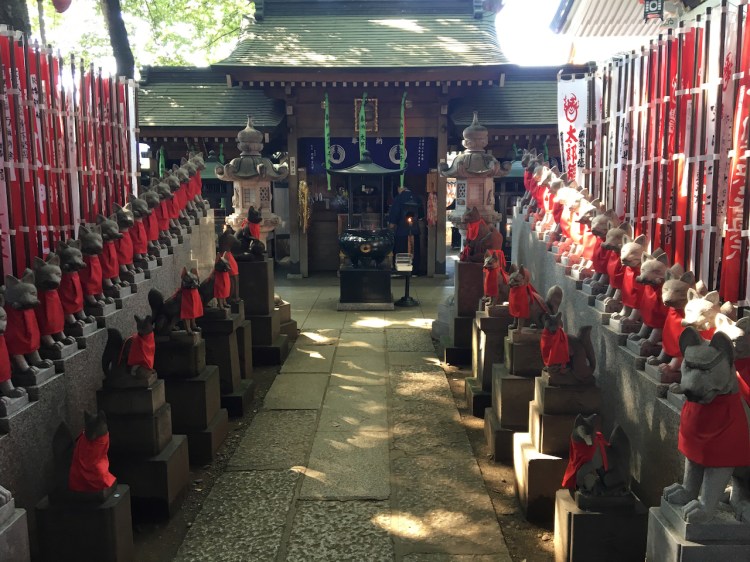
You can still see vestiges of this blending in some temples and shrines, but one great example is the Toyokawa Inari shrine right in the heart of Tokyo’s Minato Ward:
This Shinto shrine / Soto-Zen Buddhist temple venerates Dakini-ten (荼枳尼天), which is the Buddhist form of the Shinto kami Inari Ōkami.
Dakini-ten is based on the concept of Ḍākinī in esoteric (a.k.a. Vajrayana) Buddhism, but in Japan it blended with veneration of Shinto kami and thus took on a life of its own.
Inari Ōkami in his/her Buddhist form as Dakini-ten shining light upon a samurai warrior. Late medieval painting by Utagawa Kuniyoshi, source: Wikimedia
Anyhow, let’s talk about the temple itself. I visited the temple in 2018 and had little context back then, so I didn’t take as many good photos as I would have liked, but I will try to explain as best as I can.
Once you go past the main gate…
You come upon the main shrine to Inari Ōkami (colloquially known as “O-Inari-san”):
Another, small sub-shrine here:
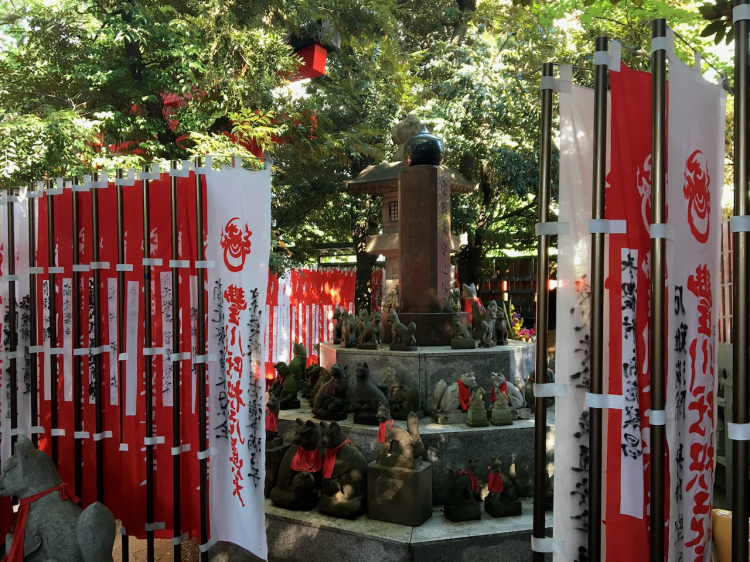
You can see fox statues all over the complex, due to their close association with Inari Ōkami.
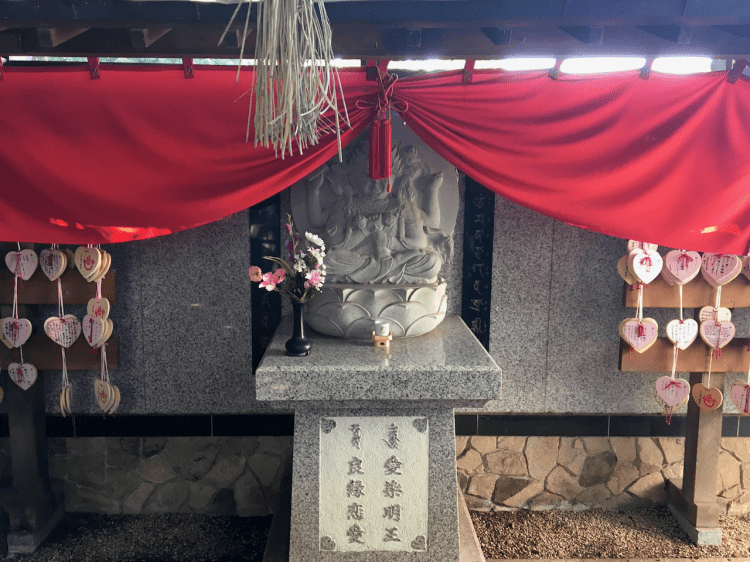
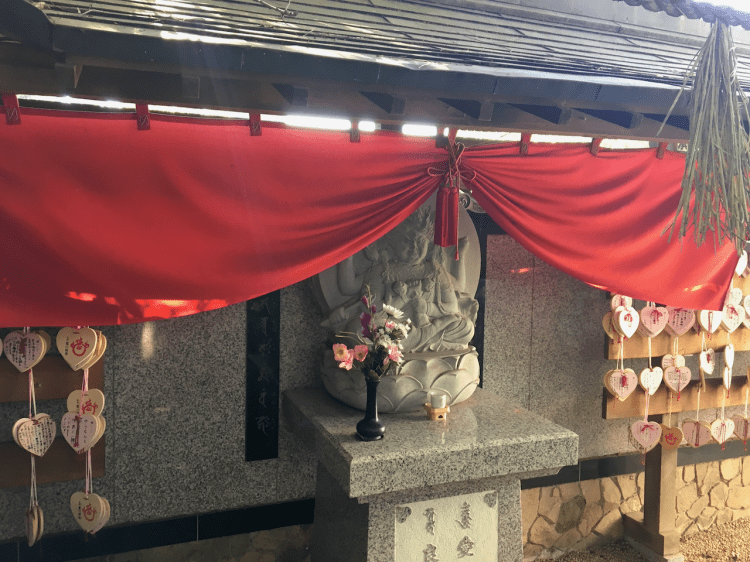
However, other deities, both Buddhist and Shinto are enshrined here too. For example, below is an esoteric-Buddhist (Vajrayana) deity named Aizen Myō-ō (愛染明王):
The fact that both Shinto deities like Benzaiten and Inari Ōkami reside in the same shrine as overtly Buddhist deities such as Kannon and Aizen Myō-ō is somewhat unusual, but really isn’t. This was normative for Japanese religion until the modern century. Japan has had two religions for a very long time, and they’ve co-existed for so long, that they often blended together.
If you look at American religion, pagan religion and Christianity co-existed for so long (even when paganism was officially repressed) that the two blended together. Things we take for granted such as Christmas trees, mistletoe, Easter eggs, and such are all examples where they have blended together to religion as we know it today. This might offend religious purists (to be fair everything annoys religious purists), but this is how societies absorb and adapt religions over generations. Japanese culture simply had different religions to work with.
Anyhow, fascinating stuff.
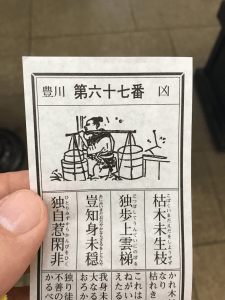
P.S. My omikuji fortune that visit was bad luck (kyō, 凶). I don’t remember having a particular bad year, especially compared to 2020 later, but it was surprising to get an overtly bad fortune for a change.
My son is in grade school and loves world mythology, especially Greek and Norse mythology (I did too at his age 🥰). But we’ve also been introducing him to Japanese mythology since it’s part of his heritage.
The trouble is is that Japanese mythology feels “scattered” and, due to cultural differences, hard to translate into English without a lot of explanation. Further, some of it just isn’t very kid-friendly.
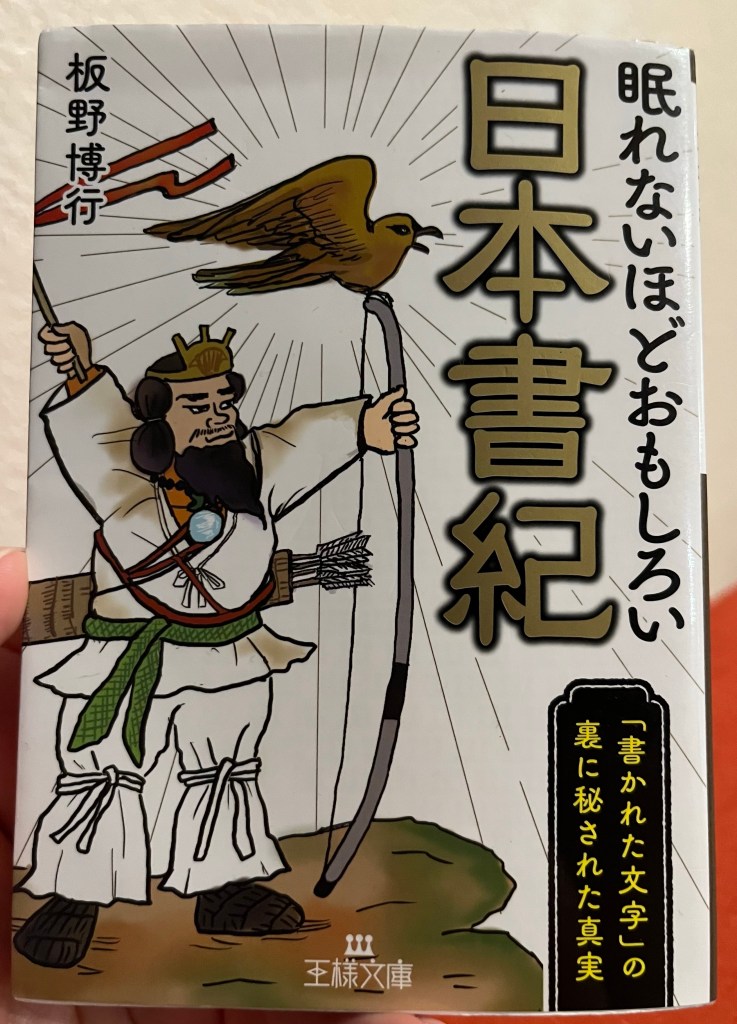
This post is meant to help make sense of Japanese mythology. I learned a lot about it after finding this book in Japanese about the Nihon Shoki (日本書紀), a legendary record of Japan’s foundation:
The Nihon Shoki is one of two records composed in the early 8th century about Japan’s history and origins. The other record is the Koijiki (古事記). Both were promulgated by Emperor Tenji, and both cover overlapping yet differing mythologies, so why are there two records?
The book above explains that the intended audiences were different.
The Nihon Shoki is a longer, more polished record of Japan’s foundation intended to impress Imperial China. It seamlessly transitions from mythology to the origins of the Japanese Imperial Family, legitimizing it in the eyes of their rivals in China, and even covers the life of Prince Shotoku. The Kojiki, by contrast, is shorter and includes more salacious details of some myths, and intended for domestic audiences only.
Even between the two records, some myths differ slightly, as we’ll see shortly.
In any case, much of what we know today about Japanese mythology derives from the Nihon Shoki and Kojiki, just as Greek mythology largely derives from only three sources: the Iliad and Odyssey attributed to Homer, and the Theogony by Hesiod.
The Founding Gods
The two gods credited with the founding of Japan are husband and wife Izanagi and Izanami. According to myth, they descended from the heaven realm, called Takama no Hara (高天原) and saw the primordial chaos of the world below. The Kojiki mentions 3 realms, by the way:
Takama no Hara (高天原) – the heaven realm
Ashihara no Nakatsukuni (葦原中国) – the earthly realm (e.g. Japan)
Yomi no Kuni (黄泉国) – the realm of the dead
According to my book above, the Nihon Shoki never mentions the second two, only the heaven realm. Also, if you’ve been playing Zelda: Tears of the Kingdom, you might notice some similarities….
Anyhow, Izanagi and Izanami stood over the primordial waters on a heavenly bridge called the Ama no Uki Hashi (天浮橋), dipped a spear or pike (literally hoko 矛 in Japanese, a kind of Chinese spear) into the water, and the salty water dripping from the spear tip encrusted and fell from the tip, forming the first island.
In the Nihon Shoki, they then fell in love with one another and wanted to have kids, but didn’t know how (being very new at this), and got advice from a Wagtail bird (lit. sekirei セキレイ in Japanese). Once they figured out how … the process works, they started giving birth to the “eight islands” of Japan (the Nihon Shoki and Kojiki differ slightly on what these islands are), as well as having many children, including some well-known kami :
Amaterasu Ōmikami (天照大神) – goddess (kami) of the sun, she was given dominion over the heavens. Her grandson, Ninigi-no-mikoto, is the progenitor of the Imperial family in Japan, according to the Nihon Shoki.
Susano-o-mikoto (須佐之男命) – god (kami) of storms, he was given dominion over the oceans. His son, Ōkuninushi, is a frequent figure in Japanese mythology especially relating to the founding of Japan.
Tsukuyomi-no-mikoto (月読命) – god or goddess (kami) of the moon, given dominion over the underworld. Their gender is unclear from the mythology.
However, in the Kojiki version, Izanami died when giving birth to the god of fire, and traveled to the underworld, leading to the myth shown below in the Youtube video.
The Nihon Shoki does not mention this myth, and simply states that they went on to create more gods and goddesses. In this Kojiki version, after Izanagi escaped the underworld, he purified himself under a waterfall, and from the droplets sprang more gods. In the Kojiki version, the three kami listed above were born from the water purifying Izanagi.
Sibling Rivalry
The rivalry between older sister Amaterasu Ōmikami (hereafter “Amaterasu”) and younger brother Susano-o-mikoto (hereafter “Susano-o”) drives a lot of the mythology found in the two records. Amaterasu did not like to lose, and Susano-o had a foul temper, so they often clashed.
In one story, they had a dare to see who had a pure heart (and who didn’t) by giving birth to more gods. In their minds, whoever gave birth to female goddesses had ulterior motives, while whomever gave birth to male gods did not.1 They sealed the agreement by exchanging items: Amaterasu gave her brother her jewels, and Susano-o exchanged his sword. Amaterasu gave birth to three female goddesses, and Susano-o gave birth to five male gods.
The Kojiki and Nihon Shoki differ on what happened next. In the Nihon Shoki, Susano-o cheered at first, but then Amaterasu pointed out that the male gods were born from her jewelry, thus she had the pure heart. In the Kojiki, Susano-o instead points out that the three goddesses were born from his sword, and being such sweet and kind goddesses, he obviously had the pure heart. Thus, depending on the source, different gods declared victory.
Side note: of the five male gods born, one of them, Ame-no-oshihomimi, is the reputed ancestor to the Imperial family. Of the female goddesses, they are still venerated a series of shrines in Fukuoka Prefecture (official homepage here).
In the Nihon Shoki version, Amaterasu won, but Susano-o had a huge tantrum and caused a ruckus, destroying many things, etc. Amaterasu was furious and hid herself in a cave, plunging the world into darkness. This famous myth is often depicted in Japanese artwork. The featured image above (source Wikipedia) depicts the efforts by the other kami to entice Amaterasu to leave her cave and thereby restore light to the world, including a risque dance by kamiAme-no-Uzume-no-Mikoto.
Descent to Earth
Fast-forwarding a bit for brevity, Susano-o, having been previously driven out of the heavens due to his behavior, undertakes some adventures, and rescues a maiden named Kushi-nada-himé from a massive serpent named Yamata-no-Orochi. From the serpents body came the mythical sword Kusanagi, one of the three sacred treasures (神器 jingi) of Japan by the way. The other two, the bronze mirror and jewel, were used in the aforementioned myth to draw Amaterasu out of her cave.
Susano-o and the maiden married, and their son, Ōkuninushi-no-kami (大国主神), who committed many great deeds that helped build and pacify Japan:
Interestingly, Ōkuninushi mostly only appears in the Kojiki.
Later, according to the Nihon Shoki, a kami named Takemikazuchi-no-kami (武甕槌神) was dispatched to inherit the country of Japan from Ōkuninushi who had been entrusted with its care. Interestingly, Takemikazuchi-no-kami is the patron god of the Fujiwara clan (originally the Nakatomi), and guess who helped compile the Nihon Shoki? Fujiwara no Fuhito.
Takemikazuchi demonstrated his power by sitting on a sword, point up, without losing his balance. Yes, that is as painful as that sounds. Needless to say Ōkuninushi was impressed. Ōkuninushi’s son, Takeminakata-no-kami (建御名方神) did not take this well and challenged Takemikazuchi-no-kami to a contest of strength, supposedly the first Sumo match ever, but Ōkuninushi’s son lost and fled elsewhere. Thus, Takemikazuchi-no-kami prevailed and inherited the country.
Later, Amaterasu’s grandson Ninigi2 descended from the heavens to the earthly realm with a retinue touching down at Mount Takachiho on the island of Kyushu.3 There are many versions of this myth. Sometimes Ninigi descends alone, in other versions he descends with various other kami who go on to found their own earthly clans. In some myths, he is obstructed by other kami, and in others he is bearing the aforementioned Three Sacred Treasures. In one myth, upon touching down, Ninigi jams a mythical spear, Ama-no-sakahoko (天の逆鉾) into the peak of the mountain, of which a replica exists today.
In any case, this is where the myths begin to transition to semi-legendary, semi-historical narrative, which is a tale for another day. It’s been fun to read about Japanese mythology in a more cohesive narrative, with humor and historical context thrown in, but I also read Japanese pretty slow, so it may take a little while to get to the next section.
Anyhow, I hope you enjoyed!
P.S. Thank you for your patience as I haven’t had much time to right articles lately. Outside of work and parenting, I have been working a lot on the other blog, plus enjoyingFire Emblem: Three Houses in what little spare time I have. I have more articles queued up and should hopefully get back on a regular cadence soon.
1 I wish I was making this up, but I am not. This kind of ritual to determine one’s heart was called Ukei (誓約) in Japanese, though in modern Japanese 誓約 is read as seiyaku and refers to oaths, vows or pledges in general.
2 More formally known as Amatsu-hikohikoho-no-ninigi-no-mikoto (天津彦彦火瓊瓊杵尊).
3 It’s interesting to note that many of the early myths, and older, more obscure kami in Shinto religion have some connection the island of Kyushu in particular, which is closest to mainland Asia.
When you read a textbook definition of Buddhism, usually it will state the First Noble Truth as something like “existence is suffering”, “existence is dukkha”, or “there is suffering”, etc, etc.
Recently, after stubbing my toe (again), I realized that these explanations don’t do it justice.
When the Buddha taught that life is (in the old Pāli language) dukkha, what he was saying was that Life entails pain. “Suffering” is vague and abstract, but pain is something we live with on a daily basis.
There is the obvious pain: pain from injury, pain from a stomachache, pain from medical issues, pain from heat, cold, homelessness, etc.
There’s also emotional pain: a break-up, loss of a loved one, the pain of romantic rejection, pain from being humiliated or abused, etc.
Then there are subtle pains: having to tear yourself from your favorite video game to go to work, the pain of eating the last French fry (and no more left), the pain of getting something and being disappointed, the pain from boredom, the pain from responsibility, the pain knowing someday you and your significant other will be parted for good, etc.
In short, pain is unavoidable. Sometimes it’s very raw and horrific, and at other times it’s subtle and bittersweet.
The Buddha did not teach that life is always suffering, or that life is not worth living. It’s just that pain is unavoidable. If you dream of a future of luxury or joy, you will still encounter pain. If you hope to live a long, happy life, pain still crops up sooner or later.
Even if you live as long as someone like Galadriel from the Lord of the Rings, with all her beauty, longevity and power, you still cannot avoid pain, regret, etc. If anything, it only piles up over time.
Most people who come to this realization decide to grin and bear it since life is still worth living. This is understandable. This is how many of us choose to live. The little joys in life, good friends, nature, etc, make life sweeter. The support we get from others keeps us going.
But there also comes a time in one’s life when we feel weary. A deep weariness.
At such times, the Third Noble Truth, that there is a way out of this, becomes important. Like Galadriel who eventually sailed to the West at the end of Lord of the Rings, there is an alternative for us too. Whether we choose to take that path is entirely our choice, but it is there when we wish to take it up.
On the list of unexpected surprises during our recent trip to Kyoto/Nara was another place we visited: Fushimi Inari Grand Shrine (English / Japanese homepages) also called Inari Taisha (稲荷大神) in Japanese. The Fushimi Inari Grand Shrine, located in south-east Kyoto, is the head shrine devoted to a very popular Shinto kami named Inari Ōkami (稲荷大神). However, he also known more colloquially as O-Inari-san (お稲荷さん).
Shinto religion reveres and recognizes, many, many kami, and oftentimes these kami are often tied to a certain place, or even to just a single shrine. Many are quite obscure, too. For example, while Kasuga Grand Shrine is considered one of the most sacred, its deities are not well-known in popular culture. However, a few kami enjoy an almost universal popularity within Japan. This includes O-Inari-san and Tenjin, among others. You’ll find branch shrines throughout Japan, all descended from the main one, and in the case of O-Inari-san, the head shrine is at Fushimi.
Even to visitors to Japan, O-Inari-san is often recognizable because his shrines are often decorated bright red, and white foxes. Why foxes? Foxes were thought to be messengers of O-Inari-san, hence they adorn his shrines. Technically, O-Inari-san is not a god of foxes, however. They just happen to be his messengers. Instead, what makes O-Inari-san so popular is that he was a kami associated with commerce, travel, and the harvest of the year rice crop. For the latter, foxes, were often dispatched by O-Inari-san to report on the status of the harvest across Japan. Thus, foxes often have a “fey” image within Japanese folklore.
Even in modern businesses and shopping malls, if you look carefully, you’ll often find a small shrine to O-Inari-san tucked away somewhere.
Further, when Buddhism and Shinto blended in the middle ages, it was assumed that O-Inari-san was a divine protector of Buddhism, and sometimes conflated with certain obscure Buddhist figure named Dakini. In downtown Tokyo is a Shrine I’ve visited before called Toyokawa Inari devoted to O-Inari-san, and was a hybrid Zen temple and Shinto shrine:
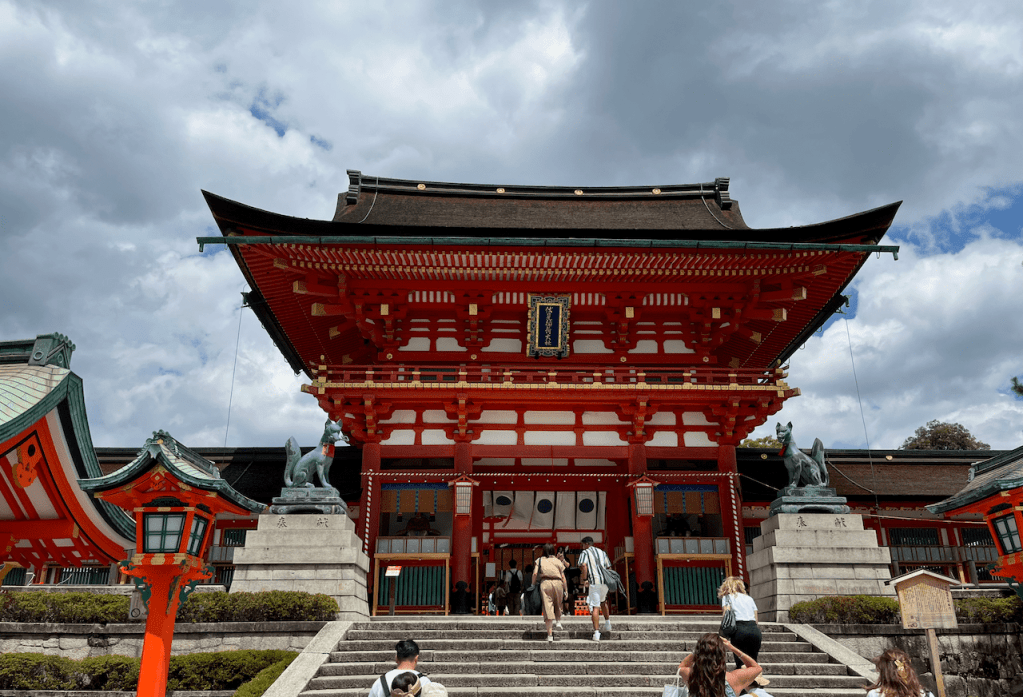
Anyhow, that’s the lengthy explanation of O-Inari-san; let’s look at the shrine. Chances are, you’ve probably seen photos of it, because the tunnel of red torii gates is so iconic, but there’s a lot more to the temple too.
From the Fushimi-Inari train station in Kyoto, you can find the shrine very easily (it’s a huge tourist draw):
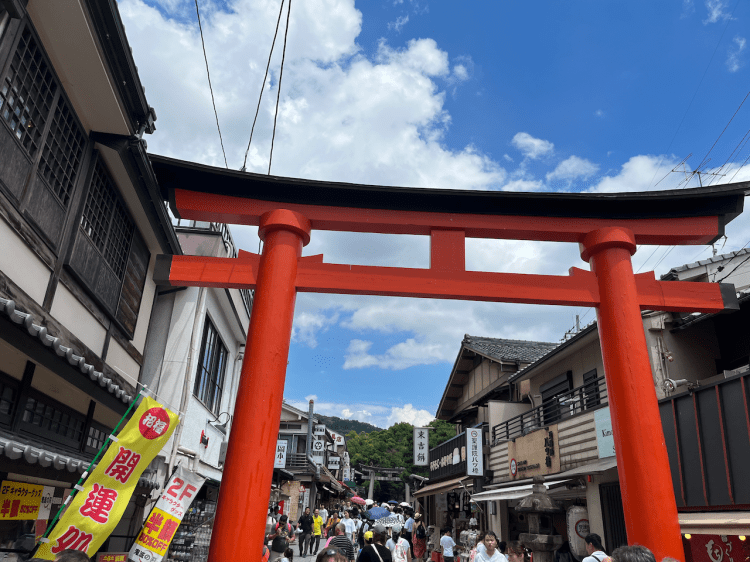
… until get to the front entrance:
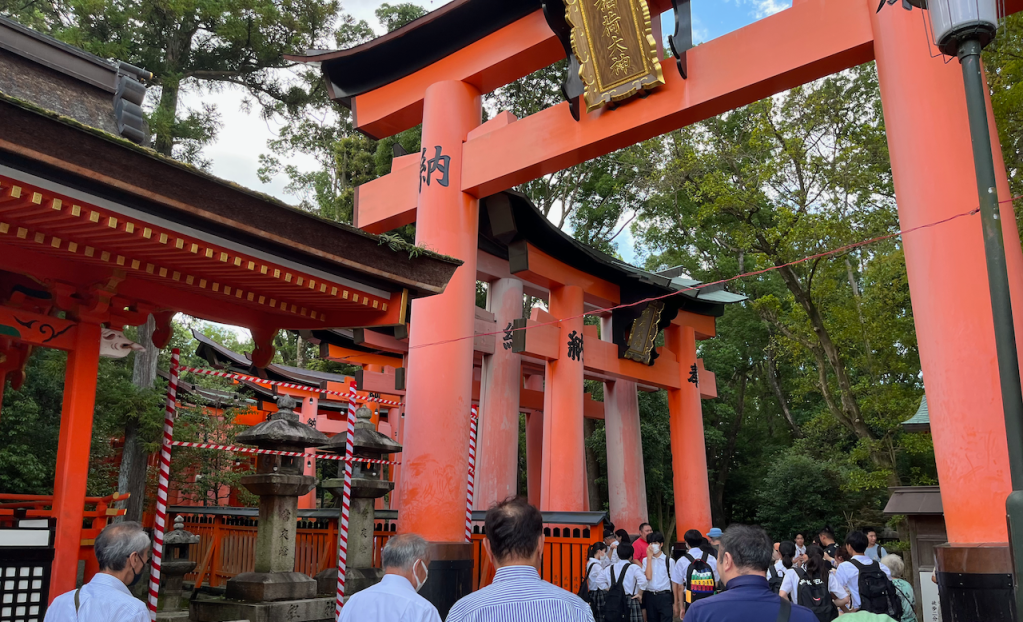
From here, the shrine splits into two places. Ahead, is the main, inner sanctum, however, the path also splits left and follows up the mountain:
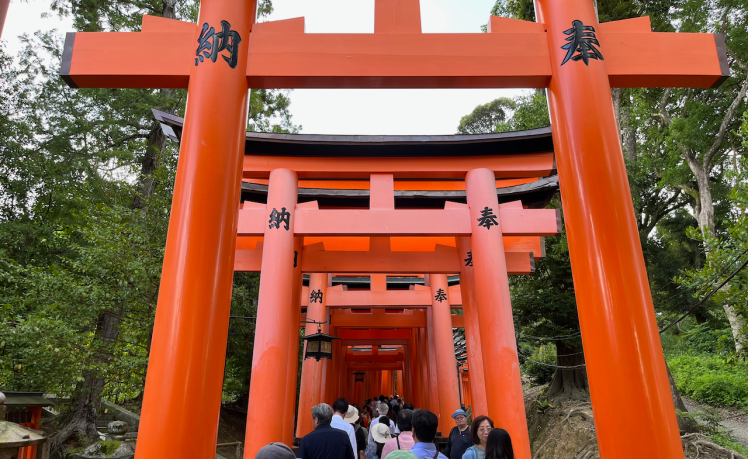
As you go up these stairs, the iconic tunnels begin to the right:
Each of these red torii gates is a donation by someone either praying for something, or an offering torii in gratitude for past blessings. This is a very common practice in Japanese Shinto (and Japanese religion in general): a cycle of supplication, and offerings of gratitude. This cycle is thought to deepen the connection (縁, en) between the particular kami and the supplicant over time.
Anyhow, the torii are pretty neat:
The tunnel branches off into a few side paths, but generally it loops up the mountain and back down again. There are other shrines at certain places up the mountain, and we visited a few, too many to post here (to be honest, I also got a bit lost without a map).
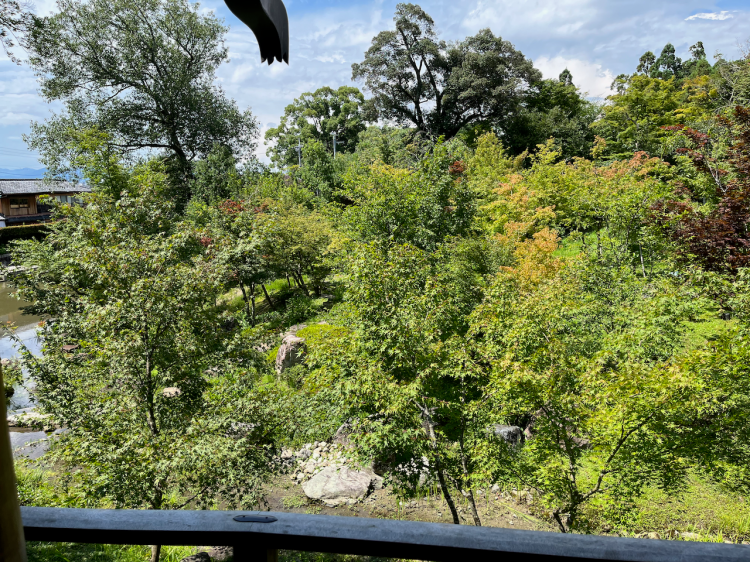
In any case, as you come down the mountain, there is a nice viewing spot here, to the right:
The veranda inside has a nice view, which I am told is especially lovely in Autumn:
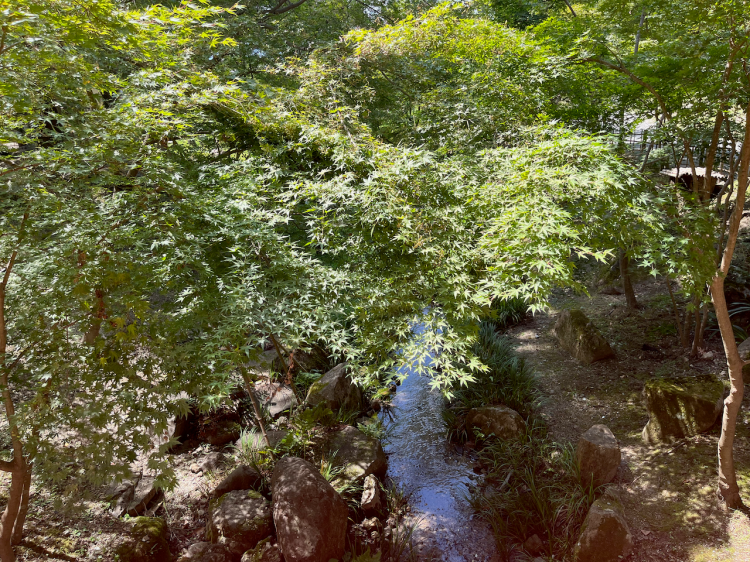
Finally, just before returning to the front gate, there is a nice little bridge with a small stream running under it:
I took a very brief video of the stream as well (apologies for the background noise):
Fushimi Inari Grand Shrine was quite a bit of fun, and a great place to spend half a day. It’s comparatively easy to get to in Kyoto, and there’s more than enough there to keep one busy. Further, my son, who loves foxes,1 really enjoyed himself. He even got a few fox (kitsune) toys. The photo at the top of this blog is his favorite, overlooking the famous Kamo River running through Kyoto.
P.S. the name o-inari-san is also used to describe those little fried tofu pockets with rice in them.
1 In our current Pathfinder 2nd ed campaign, my son is playing a Kitsune character.
On our recent trip to Kyoto and Nara, we spent our last morning in Nara visiting the venerable Shinto shrine called Kasuga Taisha (春日大社), or Kasuga Grand Shrine (English / Japanese).
The English site doesn’t really explain the history or significance of the shrine though. Kasuga, along with neighboring the Buddhist temple of Kofukuji, were centers of power for the elite Fujiwara clan. Both the shrine and the temple were sponsored by members of the Fujiwara clan, and as the clans fortunes grew, so did the prestige of these sites.
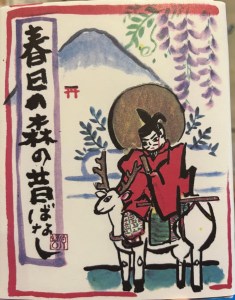
Anyhow, the legend of Kasuga Grand Shrine is said to begin when a Shinto kami named Takemikazuchi no mikoto was said to have ridden up Mount Mikasa on the back of a white deer. I picked up a children’s book of old stories about Kasuga Grand Shrine, and the cover depicts this legend:
In time, other kami had been added to the shrine, and venerated too (namely Ame no Koyané, Himegami, and Futsunushi no mikoto), but often are just revered as a single deity. Fun fact: Ame no Koyané is the patron deity of the Fujiwara clan itself.
One other note: Kasuga Grand Shrine is built along side a primeval forest, meaning a forest that has never been cut down in recorded history. You can see the forest from the shrine, but access is generally not allowed.
Anyhow, the main entrance to the Kasuga Grand Shrine is here, just to the right of Kofukiji temple:
From here, there is a long causeway leading to the shrine proper. You can see thousands of stone lanterns on either side. According to my Japanese sources, these lanterns are paid through donations by patrons extending all the way back to the Heian Period (8th – 12th century), and number up to 3,000 total.
You also run into some Nara Deer as well. Nara Deer are considered sacred, and thus roam freely throughout the larger Nara park area.
When you get to the torii gate, you are close to the Shrine:
Then follow the path to the left…
The courtyard of the Shrine is somewhat small, but contains several noteworthy things. For example, this wisteria tree is quite old:
This is the inner sanctum of the shrine, and requires an admission fee to go in, but it’s well worth it.
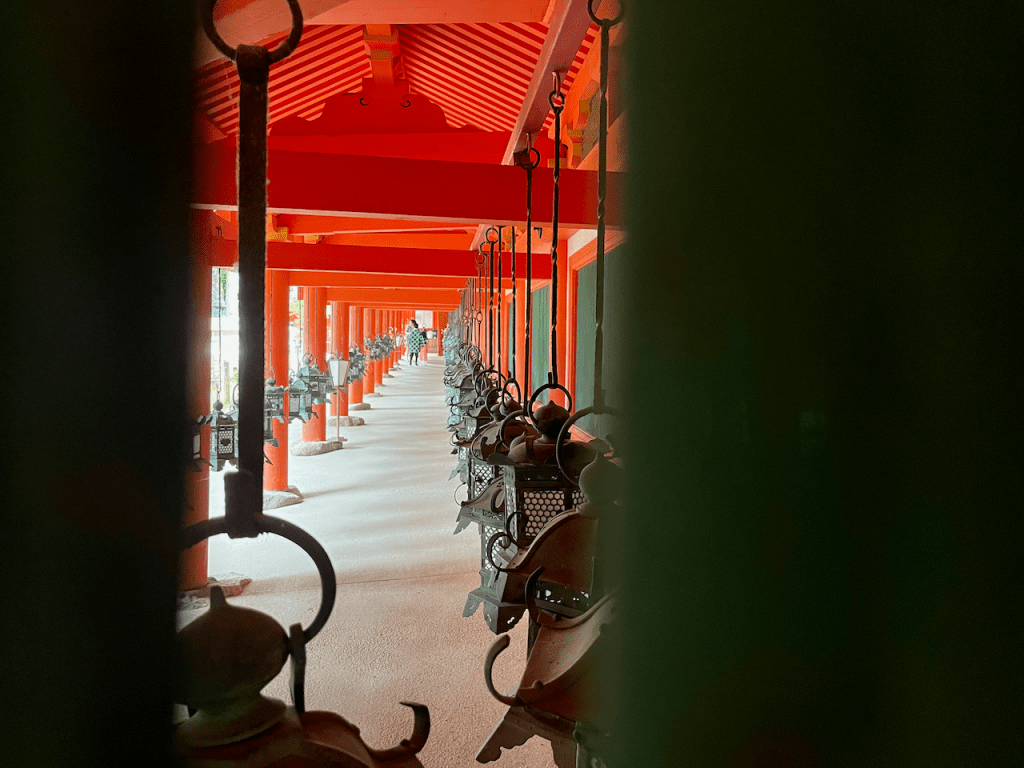
Inside the inner sanctum, visitors follow a set path, where you can see many hanging lanterns:
After walking this path, you come to an outdoor shrine altar that faces the primeval forest. I didn’t take a photo out of respect for the shrine, but it was neat to peer past the shrine into the forest, knowing that it’s been there for centuries.
Later, after leaving the altar, you enter a room that is very dark, where you find more lanterns:
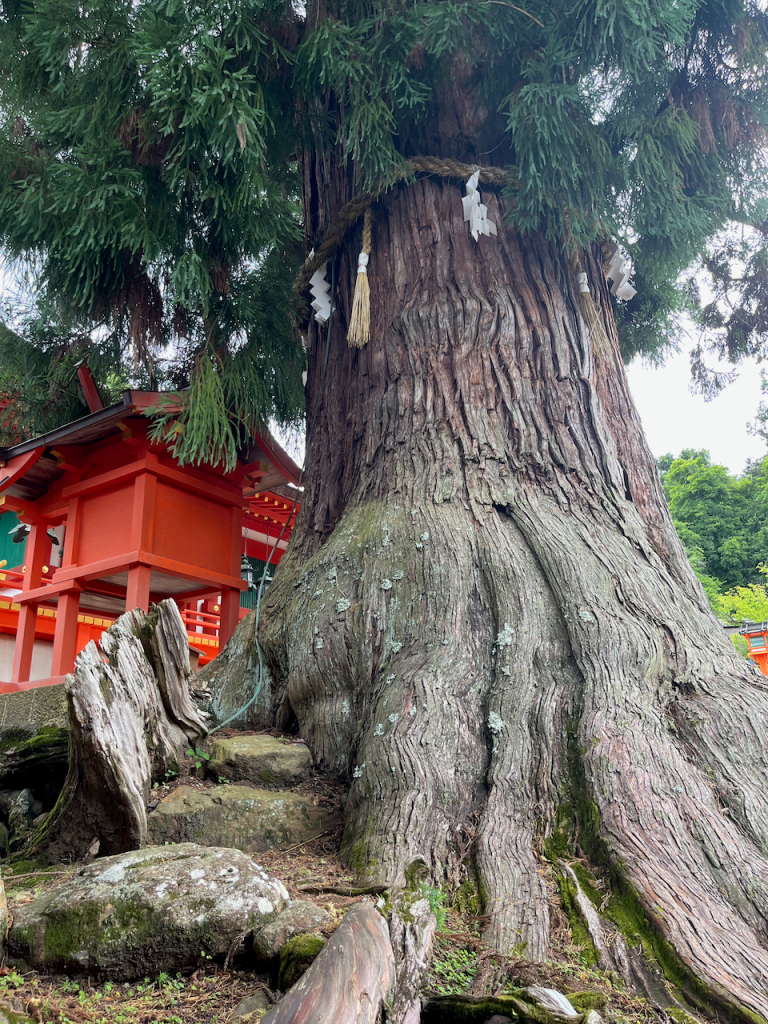
After leaving the dark room, you see this tree. The rope tied around is a shimenawa, which implies that the tree is sacred too.
Part of the tree has over time branched out into this position, and the shrine has just built around it:
Kasuga Grand Shrine is a fascinating example of a Shinto shrine that’s deep with history, and sacred to the Shinto religion, while also carrying a mysterious air to visitors. It’s not necessarily the first place visitors to Japan would think to visit, since Shinto isn’t well understood, and Kasuga has many cultural aspects that aren’t readily obvious, but it’s well worth a visit and if you are visiting places like Todaiji it’s just a quick walk.

























 Gleanings in Buddha-Fields
.jpeg?uselang=en)


You must be logged in to post a comment.