Suffering is endemic to this world, whether it be a stripper hustling just to make $20, refugees who lose their homes, or soldiers fighting to defend their homeland, or children who are simply neglected and unloved.
If you stop to think about all this suffering, pain and misery, it’s completely overwhelming, heartbreaking.
Even if you had all the money in the world, and give it away, it provides only temporary relief. If you held all the power in the world, you could only affect so much change. Worse, you might fall into hubris.
From the game Fire Emblem: Three Houses
I think this is why the Buddha-Dharma is so helpful.
Photo courtesy of the Yomiuri Shimbun newspaper. This is the fumetsu no hōtō (不滅の法灯), the “Unextinguished Lamp of the Dharma” at Mount Hiei.
A candle flame doesn’t seem like much, but in a very dark place, that candle flame really stands out.
The majestic light of the Buddha Amitāyus is the most exalted….If, sentient beings encounter his light, their three defilements are removed; they feel tenderness, joy and pleasure; and good thoughts arise. If sentient beings in the three realms of suffering see his light, they will all be relieved and freed from affliction. At the end of their lives, they all reach emancipation.
The Immeasurable Life Sutra, translation by Rev. Hisao Inagaki
I often think about the old stories of Honen, the 12th century monk who spread the Pure Land teachings in Japan. It was a time of rampant disease, warfare, and income inequality. Honen couldn’t fix any of these things but he taught a simple message to any who wouldlisten. If nothing else, it gave hope and a sense of direction in a directionless world.
A multilingual sign posted at the front of Chion-in Temple in Kyoto, Japan.1
Sometimes, small, sincere gestures of kindness can be the best help of all.
This is a path toward closeness with Chion-in Temple. That is to say the path for encountering Master Honen. It is also a path for receiving the teachings of the nembutsu. One receives the compassion of the Buddha, regardless of age or gender, a path that leads to a bright, upright, affable life. A path that heals weariness, reveres life, leads to sincere joy; this is that path. A path of Compassion.
In Ukrainian via Google Translate:
Дорога до улюбленого храму Чіон-ін. Це шлях до зустрічі з Хонен-самою. І шлях до отримання вчення Нембуцу. Шлях, який веде до людей різного віку, чоловіків і жінок, які живуть яскраво, праведно та гармонійно завдяки мудрості Будди. Шлях, який дозволяє зцілити втому життя та насолоджуватися гідністю та радістю життя. Ось цей шлях. Шлях мудрості.
In Arabic via Google Translate:
الطريق إلى معبد تشيون إن المحبوب. هذا هو الطريق لمقابلة هونين-ساما. والطريق لتلقي تعاليم نيمبوتسو. طريق يؤدي إلى الناس من جميع الأعمار، رجالًا ونساءً، للعيش بشكل مشرق وصالح ومتناغم من خلال حكمة بوذا. طريق يسمح لك بالشفاء من تعب الحياة والاستمتاع بكرامة الحياة ومتعتها. هذا هو هذا الطريق. طريق الحكمة.
In Spanish via Google Translate:
El camino hacia el querido templo Chion-in. Ese es el camino para encontrar a Honen-sama. Y el camino para recibir las enseñanzas del Nembutsu. Un camino que lleva a personas de todas las edades, hombres y mujeres, a vivir de manera brillante, recta y armoniosa a través de la sabiduría de Buda. Un camino que permite sanar el cansancio de la vida y disfrutar de la dignidad y la alegría de vivir. Ese es este camino. El camino de la sabiduría.
The moral, therefore, of my sermon on this small mount is this— even a mirror will not show you yourself, if you do not wish to see.
Roger Zelazny, Lord of Light
Self-reflection is one of the most important aspects of the Buddhist religion, and a critical component of emotional intelligence. And yet, self-reflection is surprisingly difficult to do. Peering into oneself, seeing the ugly sides of our personality, and not running away from it is a difficult thing to do.
But it can also be an illuminating experience if you are willing to face your darker self, and wind it backwards and figure out why it is there, why you feel or think the way you do.
As much as we like to think we are responsible, good people, the reality is is that our “shadow self” (to paraphrase Jung) is there, and it makes a mockery of many things we do. It doesn’t mean we are bad people or fake, just that we have to acknowledge that we are still motivated by basic needs, and that these are irrational and selfish. Hairless apes, in other words. 😉
Recently, I was watching an iconic episode of Star Trek, “Arena” (s1ep19, a.k.a. the one with the Gorn), and I noticed this dialogue for the first time:
SPOCK: You mean to destroy the alien ship, Captain?
KIRK: Of course.
SPOCK: I thought perhaps the hot pursuit alone might be sufficient. Destruction might be unnecessary.
KIRK: Colony Cestus Three has been obliterated, Mister Spock.
SPOCK: The destruction of the alien vessel will not help that colony, Jim.
KIRK: If the aliens go unpunished, they’ll be back, attacking other Federation installations.
SPOCK: I merely suggested that a regard for sentient life —
KIRK: There’s no time for that.
I was impressed by how much Spock went out of his way to avoid destroying sentient life, as his duty allowed. This is not the only time he does this, see for example in Devil in the Dark (s1ep25):
SPOCK: Or it is the last of a race of creatures which made these tunnels. If so, if it is the only survivor of a dead race, to kill it would be a crime against science.
Of course, it’s also known that Leonard Nimoy helped develop the character’s iconic Vulcan Neck Pinch too: a non-violent way of subduing humanoids. He also didn’t hesitate to toss people from time to time…
Nonetheless, Spock’s respect for all life, and commitment to reason, science, and non-violence is really admirable. In Arena, Kirk is taking vengeance against the Gorn for the destruction of Cestus III, but Spock points out that destroying the Gorn vessel won’t bring back Cestus III. Later, as the episode shows, the destruction of Cestus III was due to a misunderstanding between the Federation and the Gorn. Spock was right: wanton destruction would have done no good. Kirk’s mercy toward the Gorn at the end is also praised by the Metrons who instigated the arena-style battle of the episode.
I suppose my point here is that science, reason, and respect for all life are worthy traits to uphold even today. 🖖🏼
P.S. Many years ago, when I visited the Star Trek museum exhibit at the Museum of Pop Culture in Seattle and I got to see the original Gorn costume:
As of writing, it is late January in 2025, and it occurred to me recently that I’ve been a Buddhist now for twenty years. I can’t exactly remember exactly when this happened, but I definitely how it came about.
Let me clarify. I grew up as a Mormon in my youth, though my family wasn’t devout. I think my parents just wanted us kids to have some kind of spiritual upbringing, rather than explicitly following Mormonism. By my teens, I was exploring “Eastern thought”, and dabbling in many ideas and concepts. I was inspired by the TV show Kung Fu, and the cool flashbacks by Master Po (played by Keye Luke):
Note the first scene with the image of the Buddha in the background. I saw scenes like this, and having never seen Buddhism, I became very curious. In my teens, I continued to explore and dabble in Buddhism, Taoism, but still went to various churches (Mormon, Protestant, Catholic, etc) and such.
I didn’t really become a Buddhist, as in explicitly taking refuge in the Three Treasures, until my 20’s. When I met my future wife, she was raised Buddhist, and approached it very differently. I quickly realized that I had serious gaps in my understanding of Buddhism. Reading books about Buddhism, and being Buddhist in one’s life are two different things. I realize now that, until you take refuge in the Three Treasures, and choose to uphold the Five Precepts, the Buddhist path won’t 100% make sense.
Still, the big moment came when, after we got married, we went to Japan to meet her extended family. We also used the opportunity to visit Kyoto, Nikkō and such. Being at Chion-in temple in Kyoto, I saw a monk chanting before a statue of Amida Buddha, while striking a wooden fish to maintain rhythm. That really made an impression on me. Later, we visited my father-in-law’s hometown, which had a large temple devoted to the Medicine Buddha. The fact there was a Buddha entirely devoted to healing and well-being in Buddhism had never occurred to me.
Soon after coming home, I found the Jodo Shu Research Institute’s (JSRI) English website about Jodo Shu-Buddhism1 and that very night, I was so inspired that I recited the nembutsu for the first time. The rest, I guess, was history.
If not for my wife, the JSRI, and later Seattle Buddhist Church, I don’t know how my Buddhist path would have turned out. There was so much information that I was missing, and through all these wonderful encounters, I learned a great deal. There’s been many twists and turns, many mistakes, many experiments, bad assumptions, but overall I feel much more richer for the experience. I wonder how things will look 20 years from now.
I’ve tried sharing my experiences since that fateful January night 20 years ago, first on Blogger, and then on WordPress in one form or another. I want other Buddhists, and others curious about Buddhism, to have the full range of information.
When you look at the local bookstore for books on Buddhism, they tend to be dominated by a handful of authors, and tend to be written for either the Zen crowd, or the Tibetan-Buddhist crowd. Such books also frequently downplay cultural aspects of Buddhism, for fear or turning off their Western (read: liberal white) convert audience. Buddhism is much broader than this, and it’s a shame more books aren’t written from the perspective of Asian Buddhists, and aren’t shy about these cultural aspects. Buddhism isn’t just a philosophy for nerds, it’s a living, breathing tradition that encompasses all walks of life.
There’s something for everyone in it, and I hope people feel encouraged to explore the greater tradition, not just what’s filtered through pop culture.
Namu Amida Butsu
1 The site is long gone, sadly, but the Wayback Machine has an archive of the site.
Now, I, Vairocana Buddha am sitting atop a lotus pedestal;
On a thousand flowers surrounding me are a thousand Sakyamuni Buddhas.
Each flower supports a hundred million worlds; in each world a Sakyamuni Buddha appears.
All are seated beneath a Bodhi-tree, all simultaneously attain Buddhahood.
All these innumerable Buddhas have Vairocana as their original body.
The Mahayana version of the “Brahma Net Sutra”, translation by Young Men’s Buddhist Association
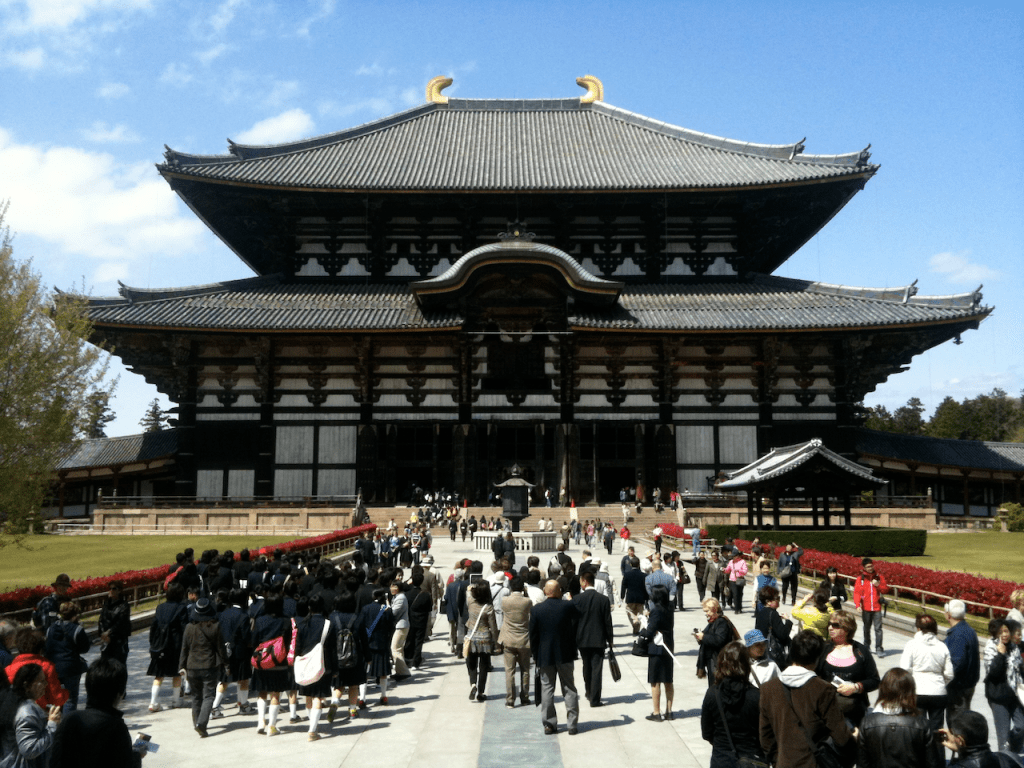
If you ever visit the famous Todaiji temple in Nara, Japan, you will see a truly colossal structure like so:
Taken by me on April 2010.
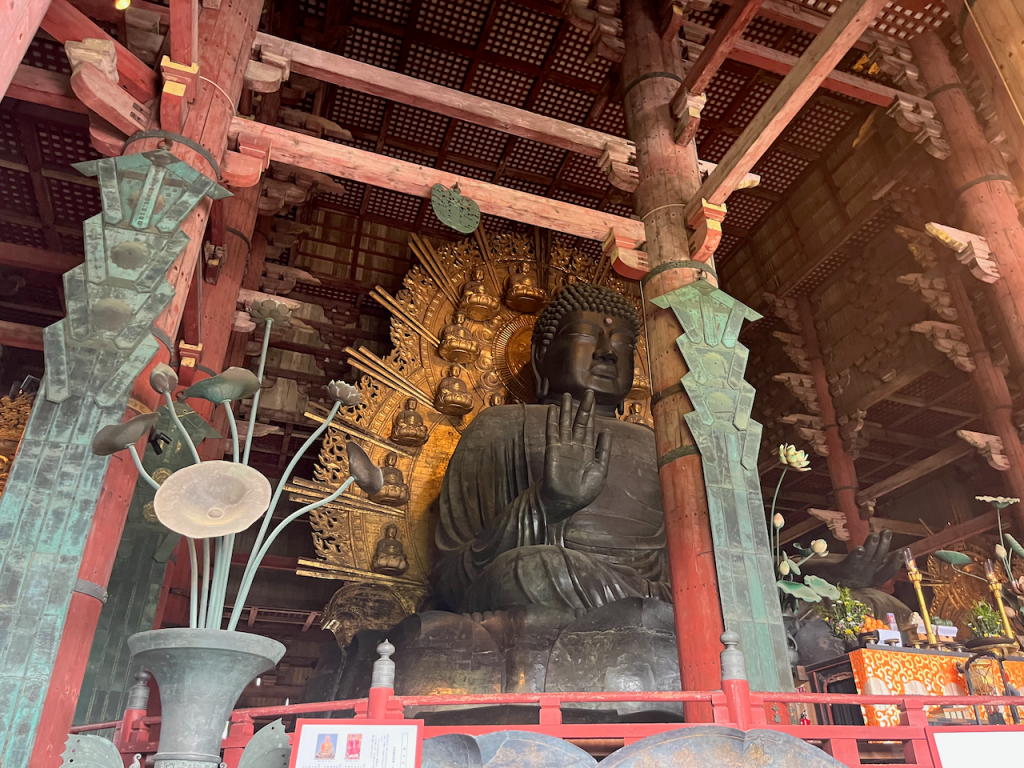
Inside as you approach is a colossal Buddha statue:
A side profile of the Great Buddha (daibutsu) of Todaiji Temple in Nara, Japan. This Buddha is Vairocana Buddha, the “Buddha of the Sun”. Taken in 2023.
This picture does not convey the size very well. It’s truly massive. But what is this Buddha?
This Buddha is a somewhat obscure figure named Vairocana (pronounced Wai-ro-chana) in Sanskrit, which means something like “of the Sun”. So, Vairocana is the Buddha of the Sun.
Vairocana features in a few Buddhist texts in the Mahayana canon: the Brahma Net Sutra quoted above and the voluminous Flower Garland Sutra, for example. It is also very prominent in esoteric traditions in Japan (Shingon and Tendai sects) as Maha-Vairocana (“Great Buddha of the Sun”).
The Brahma Net Sutra introduced Vairocana and explains that all Buddhas that appear in such-and-such time and place are embodiments of Vairocana. Thus Vairocana isn’t just another buddha, but is their source. Vairocana, in other words, embodies the Dharma.
That is why in the Great Buddha statue above at Todaiji Temple, you see rays of light emanating outward with “mini Buddhas” among them. Each of these Buddhas is thought to have the same basic origin story as the historical Shakyamuni Buddha. Hence in the text they are all just called “Shakymunis”. All these Buddhas have the same basic qualities ( Chapter Two of the Lotus Sutra teaches the same thing, by he way), one is the same as all the others.
This is primarily a Mahayana-Buddhist concept, but has precedence in pre-Mahayana sources. Consider the Vakkali Sutta from the Pali Canon:
“Enough, Vakkali! What is there to see in this vile body? He who sees Dhamma, Vakkali, sees me; he who sees me sees Dhamma. Truly seeing Dhamma, one sees me; seeing me one sees Dhamma.”
Translation by Maurice O’Connell Walshe
So the historical Buddha, founder of the Buddhist religion, Shakyamuni, is telling his disciples that his personage is less important than the Dharma. Mahayana Buddhism simply applies this same teaching towards all the Buddhas.
Also, some Buddhist texts assign different Buddhas to this role: the “cosmic” Shakyamuni Buddha of the Lotus Sutra or Amida Buddha in interpretations.
But it doesn’t really matter what you call this embodiment of the Dharma.
What matters, I think, is that the source of Buddhist wisdom is the Dharma, not a specific teacher, and that the Dharma pervades everywhere, regardless of the particular community, or lack thereof….
Having travelled in a westerly direction for a long time, and finally turning south at Samarkand, the 8th century Buddhist monk Xuan-zang is finally approaches the hinterlands of India, birthplace of the Buddha.
A map of northern India including the Gandhara region in the northwest (modern Pakistan and Afghanistan). Created using Inkarnate, apologies for any mistakes.
In our last episode, Xuan-zang had gone as far as the city of Balkh (modern Afghanistan) and was deep in “Buddhist country” northwest of India. Times are very different now, but it was a major bastion of Buddhist learning at the time. From here, Xuan-zang moves to Bamiyan and the famous statues there.
Journey to Bamiyan
While staying in Balkh (part 4), Xuan-zang befriended a local monk named Prajñakara. Prajñakara was, according to Xuan-zang, a follower of Hinayana Buddhism (instead of Mayahana Buddhism), and yet Xuan-zang respected him so much they decided to journey the next leg together to India: Bamiyan.
These two besties, along with their caravan, had to traverse the Hindu Kush mountains to reach Bamiyan.
Not unlike the crossing of the Tian Shan mountains (part 2), the overload route was extremely dangerous. Xuan-zang reported snow drifts up to 20-30 feet tall, and the weather was a constant blizzard:
These mountains are lofty and their defiles deep, with peaks and precipices fraught with peril. Wind and snow alternate incessantly and at midsummer it is still cold. Piled up snow fils the valleys and the mountain tracks are hard to follow. There are gods of the mountains and impish sprites which in their anger send forth monstrous apparitions, and the mountains are infested by troops of robbers who make murder their occupation.
page 45, The Silk Road Journey with Xuanzang by Sally Hovey Wriggins
Thankfully the more experienced Xuan-zang and his team crossed safely and with fewer casualties than past mountain crossings. In time they reached Bamiyan (بامیان in Dari language).
Bamiyan and the Great Buddhas
Bamiyan, since antiquity, has been an oasis town residing where the Hindu Kush and Koh-i-Baba mountain ranges meet, and is a high-altitude, cold-desert climate. Nonetheless, Xuan-zang described Bamiyan as producing wheat, fruit and flowers, as well as pasturage for cattle and such. Due to the climate, Xuan-zang stated that people wore fur and coarse wool, and their personality was similarly coarse and uncultivated. Yet he praised their sincere religious faith.
Up until 2001, the town of Bamiyan was dominated by several sites, including two massive Buddha statues which were built during the reign of the so-called “White Huns” or Hephathalites. The Huns themselves were not Buddhist, but allowed Buddhist worship to continue and devout local patrons helped fund the statues perhaps as an act of piety. Interspersed between the statues were monasteries and grottoes carved into the cliffside.
Of the two “great Buddha” statues, the “eastern” statue depicts Shakyamuni Buddha, the historical founder, measuring 38-meters, while the western statue depicts Vairocana Buddha1 measuring 55-meters. Sadly these no longer exist, as they were destroyed by the Taliban in 2001. In Xuanzang’s time, the status were painted and decorated. The western statue was painted red, while the eastern was white. Both had blue-orange robes, and adorned with gold. This coloration lasted at least until the 12th century.
Interestingly, Xuan-zang described a third, reclining statue of the Buddha at Bamiyan, but no evidence has been found yet of this statue.
In any case, Xuan-zang was greeted by the king of Bamiyan and the local monks, adherents to an obscure sect of “Hinayana Buddhism” that taught that the Buddhas transcended “earthly laws”, took Xuan-zang and his party on a tour of the monastery and valley. My book and online research doesn’t clarify which sect or what this means.
Despite the warm reception, it doesn’t appear that Xuan-zang stayed all that long, and eventually moved on through the Hindu-Kush mountains to Kapisi next.
Kapisi and the Chinese Prince
Next through the Hindu Kush mountains was the city of Kapisi (also known as Kapisa, Chinese: 迦畢試 Jiapishi), which was the capitol of the local Kapisi Kingdom near the modern city of Bagram. Xuan-zang reports that once again, the weather was very difficult, and they even got lost at one point, but some locals helped guide them safely to Kapisi.
Storm clouds part, offering a rare glimpse through the crisp air at Bagram Air Field, Afghanistan, Dec. 18, 2008. The high altitude of the Hindu Kush mountain range creates a harsh climate ranging from more than 100 degrees Fahrenheit in the summer to below-freezing temperatures in the winter. Photo by U.S. Air Force photo by Staff Sgt. Samuel Morse (Released), Public domain, via Wikimedia Commons
As with Bamiyan, Xuan-zang received a cold reception from the people, but was greeted by the local king whom he described as “intelligent and courageous”, and ruled over the neighboring areas.
Bamiyan and Kapisi are both places that have seen countless historical events. Alexander the Greats army marched through Kapisi in the spring of 329 BCE, and the Kushan Empire established Kapisi at its first capital in the first century CE. It was the Kushans in particular who were instrumental in helping Buddhism spread to East Asia (and now the world) especially under the great Emperor Kanishka (reigned 127 – 150 CE).
During the reign of Kanishka, a Chinese prince had resided in a monastery in Kapisi as a political hostage. When the prince returned home, he sent gifts and offerings to the monastery in gratitude. Centuries later during the 7th century CE, Xuan-zang paid homage to this prince at the monastery (called the “Hostage Monastery”), where it as thought that the prince’s treasure was buried. According to Xuan-zang’s account, he suggested they dig under a statue of the Buddhist deity Vaiśravaṇa,2 and after a time, the treasure was discovered. Because Xuan-zang was also Chinese, like the prince, it was assumed that his fellow countrymen from the past helped guide them to the treasure.
Later, Xuan-zang was invited by the king of Kapisi to preside over a religious debate amongst the Buddhist clergy, and (again based on Xuan-zang’s account) he was well-versed in the Buddhist doctrines and won, while his opponents only knew their own limited doctrine. One cannot help but roll their eyes slightly. 🙄
Finally, Xuan-zang ran into Hindu ascetics for the first time. Hinduism as we know it, arose roughly the same time as Buddhism and developed in parallel, not one from the other. A common and incorrect statement is that Buddhism descended from Hinduism; they drew from the same cultural and religious well, but arrived at different conclusions. At this time in history, Hinduism was on the rise as Buddhism began a slow decline. Since Hinduism had never reached China, Xuan-zang was not aware of it and spoke ill of the ascetics he encountered, describing them as decadent, untrustworthy, and selfish. It’s unclear why he had such a negative first impression though. Later, in India, he would invest much time debating against them in philosophical contests.
However, Xuan-zang’s joruney was not done. He needed to reach the next destination before crossing into India: Jalalabad.
…. which we’ll talk about in our next post. Thanks for reading!
1 Vairocana is a “cosmic Buddha” that first appears in a Mahayana version of the “Brahma Net Sutra” (the Pali Canon/Theravada version is unrelated). Vairocana, the “Buddha of the Sun” is also the great Buddha statue at Nara, Japan, and is particularly important in the esoteric Buddhist tradition where it is called Maha-Vairocana.
A photo taken by me in 2010 of the central image of the great hall at Todaiji Temple in Nara, Japan: Vairocana Buddha.
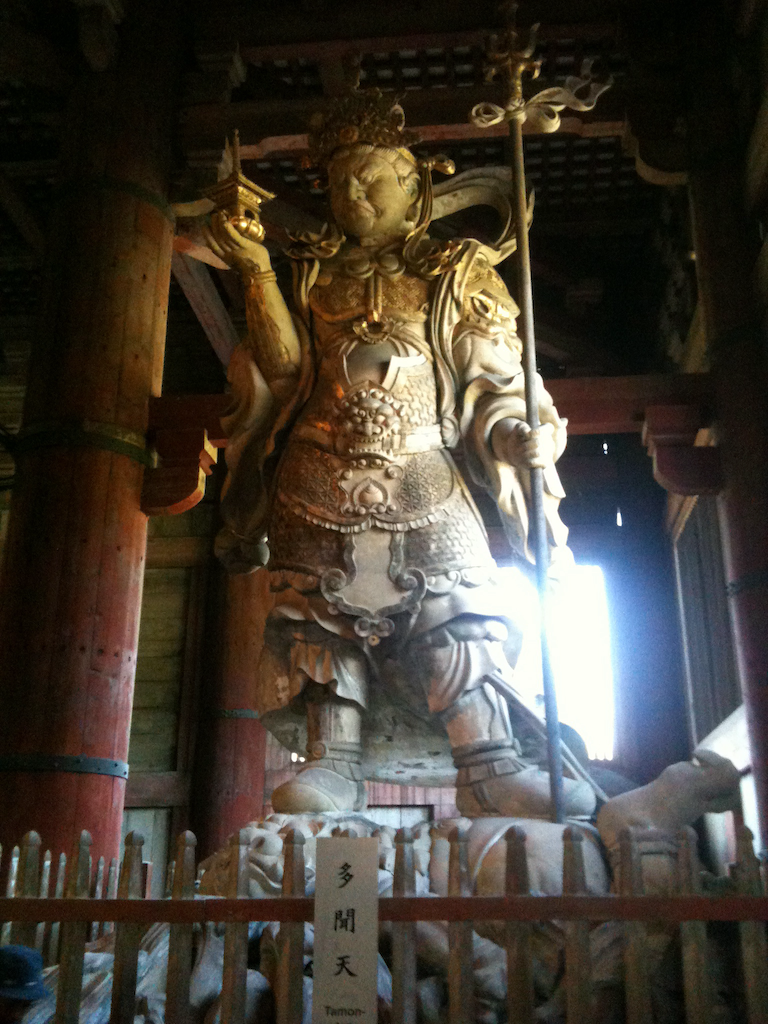
2 Vaiśravaṇa, known in Japanese Buddhism as Bishamonten (毘沙門天), can be seen at the famous temple of Todaiji in Nara. I took this photo back in 2010 when visiting there.
A photo of a statue of the Buddhist deity Vaiśravaṇa, known as either Bishamonten, or Tamonten, in Japanese Buddhism. Photo taken at main hall at Todaiji Temple in Nara, Japan.
Indeed, what we see today of Buddhism in Japan and beyond is directly related to the things that Xuan-zang saw along the Silk Road, even if the connection is not obvious at first sight.
A long time ago, my wife and I watched this TED Talk in Japanese about religion and how Japanese culture approaches it:
The TED Talk is entirely in Japanese, with no subtitles, so unfortunately most folks here won’t be able to easily follow it. Which is a shame because it’s quite good. I had a saved in my personal playlist, and rewatched it recently. There a couple points in particular that I wanted to tease out:
The priest in question, Matsuyama Daiko, was raised in a “priest family” in Japan (e.g. Buddhist priest),1 but attended a Catholic school growing up. This is not unusual. My sister-in-law also attended a Catholic school in Japan, we have good friends who are a Buddhist priest family. Matsuyama makes the point that Japan approaches religion the way it approaches dinner: in the West we tend to feature a main dish, and maybe a few smaller side dishes (or none). In Japan, food is usually not served with a main dish, but several dishes that are more or less same quantity.
In the same way, while Matsuyama is an ordained Buddhist priest, he grew up with a wide exposure to other religions but sampled many dishes. It’s not unusual for a Japanese person to do Buddhist stuff, but also visit Shinto shrines during Hatsumode, get married in a Christian chapel, etc. Hence, like many dishes, Japanese tend to sample many traditions, and respect them all. People have their personal inclinations (or none at all), but they are not forced to choose following A versus following B. I don’t want to oversell this too much, but it is a practical approach to religion and one you’ll find not just in Japan, but other Asian cultures as well.
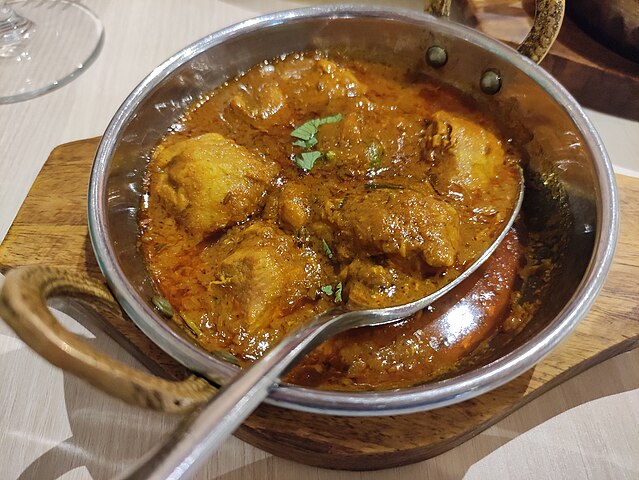
The second point that Matsuyama makes that I thought was interesting was the idea of variation even within the same religion. Matsuyama talked about how Buddhists in Theravada countries might look at Japanese Buddhism (Mahayana), and be confused by some of its practices, and vice-versa. So, he used the example of curry. Curry is a food that is found across all of Asia, but there’s an incredible amount of local variety. I LOVE curry. I eat any kind of curry, and love the sheer variety.
Different curry dishes arise from different environments and circumstances: availability of ingredients, cooking methods, climate, and so on. Matsuyama stated that Indian curry tends to be very spicy, which is handy in a hot, dry climate as some parts of India are, because it helps you sweat. Japanese curry, which tends to be very hearty and mild, works well in a climate that is colder. Thai curry uses a lot of coconut milk, something not available in Japan, and seafood. Curry as consumed in the UK has also been adjusted for local resources and taste.
Yet all of these are unquestionably curry. Anyone can taste any of these dishes and immediately recognize it as curry. In the same way, each tradition and sect with Buddhism is easily recognizable. It may not suit one’s personal taste, but the variety of cultures, historical precedents, people and geography have led to a variety of traditions, and there’s something for everyone. Of course, this is true of other world religions too, but I wanted to use Buddhism as the example.
So, when looking at the variety of ideas, teachings and practices, consider the example of curry. Different curries arise from different conditions, and each is suitable for different people, but also curry is delicious no matter how you try it. So, don’t be afraid to sample other versions.
1 Unlike most Buddhist countries where monks are celibate and usually live a cloistered life, Buddhist monks in Japan are (for complex historical reasons that are too long to go into here) parochial, live among communities and marry.
SPOCK: Insults are effective only where emotion is present.
Star Trek, “Who Mourns for Adonais?” (s2ep2), stardate 3468.1
SPOCK: Where there’s no emotion, there’s no motive for violence.
Star Trek, “Dagger of the Mind” (s1ep9), stardate 2715.1
I wrote about the Buddhist virtue of forbearance before, but I had an important reminder recently why this matters so much in Buddhist practice.
Our natural tendency is to hold a grudge when someone slights us, or when we have been wronged. This is normal human pattern of behavior. But, like self-doubt, this is a form of conceit, putting ourselves and our ego before others.
In the Dhammapada, a collection of sayings attributed to the Buddha and one of the very earliest Buddhist texts still preserved, the Buddha has much to say regarding the subject. For example:
133. Speak not harshly to anyone, for those thus spoken to might retort. Indeed, angry speech hurts, and retaliation may overtake you.
134. If, like a broken gong, you silence yourself, you have approached Nibbana [a.k.a. Nirvana, final Unbiding], for vindictiveness is no longer in you.
The Dhammapada, translation by Acharya Buddharakkhita
The Buddha was uncompromising on this: no vengeance, lest you bring even further misery upon yourself.
Indeed, the Buddha taught by freeing oneself of ill-will and other negative emotions, one is liberated:
197. Happy indeed we live, friendly amidst the hostile. Amidst hostile men we dwell free from hatred.
198. Happy indeed we live, friendly amidst the afflicted (by craving). Amidst afflicted men we dwell free from affliction.
199. Happy indeed we live, free from avarice amidst the avaricious. Amidst the avaricious men we dwell free from avarice.
200. Happy indeed we live, we who possess nothing. Feeders on joy we shall be, like the Radiant Gods.
The Dhammapada, translation by Acharya Buddharakkhita
Of course, this is easier said than done.
As with self-doubt or any negative emotion, stop and think like a Vulcan: assess the situation including your own feelings. Is this productive? Is it harmful? Is it based on conceit?
Spock in season 3 episode 21, the “Cloud Minders”, played by Leonard Nimoy
Many times, we are prone to act or lash out, but if we take a moment to assess our feelings, and the situation, we are more capable of handling it rationally. In so doing, we avoid further misery for ourselves and others.
When the ego is bruised, it demands attention and resolution. But that is short-sighted, and rarely fixes anything.
SEPTIMUS: Our way is peace.
Star Trek, the Son Worshiper, “Bread and Circuses” (s2ep25), stardate 4040.7.
A commitment toward peace and well-being towards others feels counter-intuitive at times, but peace toward others inevitably leads toward peace for oneself.
The joke here is a Japanese-Buddhist monk looking at a receipt from Muji (a Japanese home goods store), and commenting that this “sacred text” shows they purchased a lot.1 This happens to us too.
Anyhow, what is a sacret text in Buddhism?
Buddhist sacred texts are called sutras (sometimes suttas), from the old Indian Sanskrit word.2
Buddhism doesn’t have one sacred text like you would associate with the Bible, Q’uran, etc. Instead, it has layers and layers of sacred texts.3
I won’t get into why there are so many layers, but suffice to say that the Buddhist tradition holds the sutras as genuine sermons of the Buddha (a.k.a. Shakyamuni Buddha) which have been passed down generation after generation until today.
Sometimes sutras, or teachings contained therein, are repackaged into newer sutras, especially in the Mahayana Tradition, but the underlying teachings, the Dharma, are believed to be just as important. Think of Spiderman: every few years there’s another Spiderman movie, some more popular than others, but the underlying lore of Spiderman is always the same.4 The history of Buddhist sutras is awfully similar in this respect.
What’s important isn’t so much the specific text of a specific sutra, but the Dharma. In the same way, although Shakyamuni Buddha is very important, the Dharma he taught is even more so.
Because there are so many sutras, this also leads to many sects, schools, and traditions within Buddhism. Each sect or school strives to apply the Dharma as best they can, based on whatever sutra is considered most appropriate.
So how do we know if the Dharma is true? Because it can be applied in one’s own life, through good conduct, meditation, lifestyle choices and so on. If your doctor tells you to lose weight and exercise more, the results speak for themselves. Buddhism is a lot like this.
Should a Buddhist read all the sutras? No, there are simply too many. Some ate huge. It’s often best to start with one or two that are already part of the tradition you are interested in. From there, you can branch out as you see fit. Ask your local community if you need recommendations.
Also, an important tradition across all of Buddhism is reciting sutras. Some sutras are very short and can be recited as a whole. Other sutras are much too long, so people recite key passages only.
This tradition of reciting sutras not only helps internalize the teachings (make them a part of you), but also helps connect to the Buddhist tradition at large. People have been reciting the Buddha’s teachings from the very beginning, 2,500 years ago. When we recite and put the teachings into practice, we are another link in the chain.
Buddhism has no “holy” language, so you can recite them in your local translation, or use a liturgical format that fits your preferred tradition. Or switch between one and the other.
A booklet with the Heart Sutra used in Japanese Buddhism, which I posted about here.
What’s important is that followers make the teachings a part of their lives somehow. This helps them apply the Dharma and also generate good merit to help others. The Buddhist path is not a solitary path: we are all in this together.
Namu Shakamuni Butsu
Namu Amida Butsu
1 Muji is a great store, and there are a few oversea outside of Japan. You can find clothes, household items, stationary and so on. We shop at Muji in Japan whenever we visit there, but also have visited Muji stores along the West Coast as well.
2 Related distantly to the English word suture as in a thread. Old sutras were often palm leaves or tree bark threaded together to form a kind of book.
3 HInduism too, iirc.
4 Even when it’s Miles Morales vs. Peter Parker (or Gwen, or other Spider people), the lore is the basically the same.
Star Trek, “Day of the Dove” (s3ep11), stardate unknown
Ever since … recent events, I’ve been thinking about this quote a lot.
This also reminded of a passage from the Analects of Confucius:
[8:13] The Master said: “Be of unwavering good faith and love learning. Be steadfast unto death in pursuit of the good Way.1 Do not enter a state which is in peril, nor reside in one which people have rebelled. When the Way prevails in the world, show yourself. When it does not, then hide. When the Way prevails in your own state, to be poor and obscure is a disgrace. But when the Way does not prevail in your own state, to be rich and honored is a disgrace.”
The Analects is a compilation of Confucius’s (a.k.a. “the Master”, or “Master Kong”, etc) teachings by his disciples, completed around the 1st or 2nd century BCE. This particular passage does a nice job of summarizes Confucius’s general teachings: at all times a “gentleman” (jūn zǐ, 君子) should always stick to their principles regardless of the conditions of the world.
There are times where one openly expresses their views and strives to do what’s right, where one can share their talents for public good. But there are also times when one should bide their time, avoid getting entangled, and focus inward. Whatever is necessary to maintain one’s integrity at all times. Better to be broke but maintain integrity, than to compromise personal values for the sake of gain.
In Confucius’s time the central state of the Zhou Dynasty kingship was breaking down, and the different nobles governing each fiefdom were either breaking away and declaring themselves kings, or being overthrown by their own ministers who would in turn assert authority. It was a cutthroat time in Chinese history, and Confucius wanted no part in it.
One cannot help but find parallels even today.
P.S. Featured photo is of Kang the Klingon from the Stat Trek episode “Day of the Dove”, played by the brilliant Michael Ansara.
1 When Confucius speaks of the “Way” (daò, 道) he is using a common Chinese religious term for things like righteousness, justice, stability, and so on. The Taoist usage of the term is similar, and draws from the same “cultural well” even if nuances differ.







 Gleanings in Buddha-Fields
.jpg)


.jpg)
You must be logged in to post a comment.