SPOCK: [being a Vulcan] means to adopt a philosophy, a way of life, which is logical and beneficial.
Star Trek, “Journey to Babel” (s2ep10), Stardate 3842.3
Recently, while I was doing some soul-searching, I found this very helpful article online by Dr. Jacqueline Stone. The article is an overview of how different Japanese-Buddhist monks of the Kamakura Period (12th-14th century), the same monks who founded important Buddhist sects we see today, addressed the concept of Dharma Decline. The site requires registration, but it’s free and easy. The article is worth a read if you are curious about the topic.
In any case, I found this great quote in Dr Stone’s article:
“The Zen sect regards the precepts as being of first priority,” he [Eisai] wrote. And, “By means of the precepts, meditation and wisdom are brought forth.”
Eisai (栄西, 1141 – 1215) also known as Myōan Eisai (明菴栄西) is the original founder of the Rinzai Zen-sect in Japan (more on its convoluted history here), and isn’t someone I really talk about much, but he was one of the founders of this “new” Kamakura-era Buddhism.
Anyhow, this quote really struck me.
In my limited experience, I rarely heard the importance of precepts from Western Zen sources, or that they are the basis for other Zen practice. That’s not to say it’s not there, but it often seemed to get lost in the message of Zen mysticism.
Bluntly speaking, precepts aren’t sexy like mindfulness, koan riddles, or meditation.
And yet, Eisai is taking a more traditional, conservative standpoint and reiterating that one should not put the cart before the horse. This is not limited to Eisai, by the way: the 19th century Soto-Zen text for lay-followers, the Shushogi, stressed the importance of the precepts, reflection on one’s actions, and practicing kindness, patience and generosity whenever possible.
But if you’re familiar with Zen, this might seem odd. Isn’t Zen all about meditation, being in the moment and so on?
Consider the Marvel movie Ant-Man (2015). In the movie the villain, a bald tech-CEO who bears more than a passing resemblance to a certain CEO and founder,1 brags to a coworker about some deep thoughts he had during “morning meditation”. This is not far from the mark: many ambitious people use meditation and mindfulness as a way to get what they want, not what it’s intended for. If a person can’t regulate their day to day conduct towards others, meditation will not avail them.
Put another way: a rotten person might meditate, but a person who follows the precepts is probably not a rotten person.2
Further, this focus on the precepts fosters mindfulness because one is monitoring their own actions, etc. It has concrete impact on one’s sense of self-worth, one’s relationships with others, and leads to greater peace of mind, even when not meditating. So, there’s a clear benefit, both short-term and also long-term to taking up the precepts first, and then letting other disciplines and practices extend from it.
Finally, upholding the precepts is something any Buddhist can do, regardless of background or circumstances. It is very accessible, beneficial (just like Spock says), and opens many doors to Buddhist practice.
Namu Shakamuni Butsu
P.S. I’ll cover this issue of precepts in more detail later, but TL;DR both Rinzai and Soto Zen both encourage people to take up the Ten Bodhisattva Precepts specifically.
SPOCK: There’s no further need to observe me, Doctor. As you can see, I’ve returned to the present in every sense.
Star Trek, “All Our Yesteryears” (s3ep23), Stardate 5943.7
I spent this past week volunteering as a chaperone for my son’s school camping trip, which was chaotic and busy, but also bought me some much-needed quiet time to read and reflect on some things. Exhausting, but nice.
Lately, while reviewing some old Buddhist material, I realized that I had conflicting thoughts about my own Buddhist path. I have spent much of my past 20 years as a Buddhist following the Pure Land path, especially Jodo-Shu/Jodo-Shinshu sect Buddhism, and this is reflected in many posts here, including recent posts like this one. This has been really formative to my understanding of Buddhist religion and teachings.
And yet, the reason why I left my old community nearly 10 years ago was that I felt there was more to Buddhism than just passively allowing the power of Amida Buddha to lead me (i.e. tariki 他力 in Japanese-Buddhist parlance). I wanted to pursue other facets, more active practices, and so on. This is reflected in my exploration of Buddhism in general, including recent posts like this one. But even then, I never could quite pin down what I should do for Buddhist practice, or what to prioritize. I had a general sense of things, but struggled to articulate what I think I should do.
So, for some time now, I have been plagued with self-doubt, and feeling conflicted about how best to be a “good Buddhist”. I was worried that I had lost my way. I read a few sources from different Buddhist traditions in my spare time, but it only made me feel more confused.
So, I decided to get back to basics. Using my spare time at camp, I started writing down what I genuinely believed in, and not what a particular tradition dictated to me. I didn’t have a lot of time, so I would just jot down notes on my phone, a sentence here or there. Over a few days, I had a list of items, and they had certain recurring themes. I was relieved to see that I came to the sameconclusionsasbefore, but now with a greater sense of conviction. What a relief.
I felt a bit like Captain Kirk in the season one Star Trek episode “This Side of Paradise” (s1ep24), after he has been affected by the mind-control spores. He is just about to leave the ship for good, but at the last minute, he comes to his senses and realizes that what he really valued was the ship, and his role as captain. It was as if he came out of a fever dream. This is how it felt for me.
But also with this new sense of conviction, I will probably be changing tack a little bit on the blog. Nothing dramatic, but I feel that it’s time to close the book on certain topics, and focus on other things that I want to explore more. Time will tell, but that’s what I want to do for some upcoming blog posts.
Thanks for reading!
Namu Shakamuni Butsu
P.S. Photos from camp.
P.P.S. Bonus episode this week. I felt like posting sooner than later. Enjoy!
Recently I had talked about Rennyo and his famous letters, also known as the gobunsho (御文書). These letters are sometimes overlooked by Western Jodo Shinshu Buddhists, but are a core part of the tradition.
6. On Norms of Conduct
If there are any of you who have heard the meaning of our tradition’s other-power faith and become decisively settled, you must store the truth of that faith in the bottom of your hearts; do not talk about it with those of other sects or others [not of our tradition]. Furthermore, you must not praise it openly [in the presence of such people] on byways and main roads and in the villages where you live. Next, do not slight the provincial military governors and local land stewards, claiming that you have attained faith; meet your public obligations in full without fail. Further, do not belittle the various kami and buddhas and bodhisattvas, for they are all encompassed within the six characters na-mu-a-mi-da-butsu [the nembutsu]. Besides this, in particular, take the laws of the state as your outer aspect, store other-power faith deep in your hearts, and take [the principles of] humanity and justice as essential. Bear in mind that these are the rules of conduct that have been established within our tradition.
Respectfully.
Written on the seventeenth day of the second month of Bunmei 6 (1474). [i.e. the 6th year of the Bunmei era]
There are three aspects of this letter that I find interesting:
First, is Rennyo’s advice about daily life. Because Rennyo is writing to lay poeple, not monastic renunciants, the advice is simple: be socially responsible, and don’t use your religious faith as an excuse to misbehave. “Render unto Caeser, that which is Caesar’s” in other words. This seems kind of obvious, but the Pure Land movement originally had a number offshoots and communities, and some tended to flout convention on the belief that they were saved by Amida Buddha anyway. In other words: antinomianism.
Second, Rennyo stresses the importance about not bragging about one’s faith. Jodo Shinshu was (comparatively speaking) novel and new within Japanese Buddhism, and somewhat unorthodox due to its entirely lay community. Rennyo’s warning is to avoid taking pride in this, since there was nothing worth bragging about. It was all due to Amida Buddha’s compassion, and not any accomplishment by the disciple.
Finally, Rennyo makes an interesting point about the Amida Buddha in relation to other buddhas, bodhisattvas, and the kami of Shinto. Rather than treating Amida as yet another buddha within the larger Mahayana Buddhist pantheon, Rennyo describes Amida as the source of all such divinities. His ancestor, Shinran, had also hinted at a similar view toward Amida Buddha, and indeed when we look at another buddha named Vairocana, we see that this concept is not new. They are just different names for the same concept.
But it’s interesting to hear that Rennyo, generations later, is reiterating this point: in the Jodo Shinshu interpretation of Amida Buddha, Amida isn’t just another deity, it embodies the Dharma, and all contained within it.
Lately, I’ve been enjoying a fantastic history podcast called Grey History, covering the French Revolution in detail. While enjoying this show I started thinking about a famous peasant uprising in medieval Japanese history called the Ikko-Ikki rebellions of the 16th century.
The Ikko-Ikki rebellions are remarkable as being the one time in pre-modern Japanese history where a peasant uprising not only succeeded, but successfully carved out a region of Japan that was ruled by the masses, not by military samurai, nor the old aristocracy from Kyoto. The binding influence of the uprising was a strong affinity to a certain Buddhist sect, the Jodo Shinshu (浄土真宗, “True Pure Land Sect”), but there was more to the Ikko-Ikki than a “rebel cult” as some labeled them.
Information in English about the Ikko-Ikki is sparse, and often misinformed. I am happy though to have obtained a copy of Dr Carol Tsang’s excellent book War and Faith: Ikko Ikki in Late Muromachi Japan (publisher link), covers the Ikko Ikki, who they were, and their relation to the Jodo Shinshu sect. It’s been a fascinating read even for an old “history nerd” like myself.
This post is part two of three exploring the Ikko Ikki, of which part one is here. We can’t talk about the Ikko-Ikki until we cover the life of the 8th-generation Caretaker (monshu, 門主) of the Honganji mausoleum: Rennyo.
I originally intended to do only two posts, but as I wrote this one I realized there was too much interesting detail, and now it has split into three.
Enter Rennyo
As we saw in part one, Jodo Shinshu had somewhat unorthodox origins as a fully lay-oriented sect of Buddhism, through the work of Shinran in the 12th century. Shinran like many disciples of Honen, had been exiled and defrocked. Shinran took this in stride, married, and continued to spread the Pure Land Buddhist teachings he had learned from Honen to provincial people until we returned from exile and died in Kyoto.
His mausoleum (later called the Honganji temple) was managed by his descendants for generations. Like other families in medieval Japan (and other medieval societies), marriages by Shinran’s descendants were arranged to help benefit the family political, economically, etc. These descendants managed the mausoleum, while also building powerful alliances with samurai clans, or influential disciple families in the provinces. Some even married into the aristocracy in Kyoto. Shinran’s various disciples in the provinces went on to found various sects of Jodo Shinshu, while the Honganji remained significant, but not very influential.
By the time of the disastrous Onin War in the 15th century, Rennyo (蓮如, 1415–1499) had been born to the 7th generation caretaker Zonnyō (存如, 1396–1457).1 His mother was of unknown origin, but it is thought that she was a maidservant of Zonnyō, and thus politically risky. She was sent away, and Zonnyō married a woman named Nyoen from an influential family. Rennyo and his step mother did not get along well, and suffice to say, there was a succession struggle between him and Nyoen’s son, but Rennyo won out in the end thanks to the powerful Hino clan (the same clan that married into the reigning Ashikaga Shoguns). Rennyo had also, as per tradition in the family, spent time training at Kofukuji temple in Nara, and could claim some tenuous connections to the prestigious Fujiwara clan through the Kujō cadet branch.
As Jodo Shinshu grew in influence, problems between the community in his native province of Ōmi, near Kyoto, and the powerful Tendai sect arose. Ostensibly, this was due to perceived heresies by the Jodo Shinshu sect, but there’s plenty of evidence that the Tendai sect viewed the growth of Jodo Shinshu as an impact to their fiefdom revenue. Before long, armed conflict with the Tendai sects warrior-monks arose, and the Jodo Shinshu community suffered greatly. The community attempted to fight back, organizing defenses (a forerunner to later Ikko-Ikki armies), bribing the Tendai sect to back off, etc, but the Tendai persisted.
Ministry At Yoshizaki
Bronze statue of Rennyo at the remains of Yoshizaki Gobō temple. Photo by 藤谷良秀, courtesy of Wikipedia.
Rennyo decided it was safer for everyone involved for him to leave, and eventually he retreated to a remote village named Yoshizaki (吉崎) in the province of Echizen in the year 1471. Yoshizaki had a number of advantages, including a large, existent community of Jodo Shinshu followers, distance from Tendai-sect centers of power, and political remoteness, and yet it was on a coastal trade route so it was prosperous too. Soon a temple, now known as Yoshizaki Gobō (吉崎御坊) was founded the same year. The official website (Japanese only) for Yoshizaki Gobō has some neat photos and illustrations, though bear in mind that the original temple was destroyed 1506, and reconstructed centuries later.
It was here that Rennyo and his proselytizing work really took off.
For context, Shinran the founder (and Rennyo’s ancestor) had lived in exile in the eastern provinces and spent much time there teaching the Pure Land am faith as he understood it. Even after he was pardoned and returned to Kyoto in his final years, the communities out in the principles (i.e. his disciples) continued for generations, each in isolated pockets. These communities grew and diverged gradually, but were always more numerous and influential than the Honganji branch under Rennyo’s ancestors.
Thus, when Rennyo showed up, things were a little tense. A major regional sect was the Takada sect (shinshū takadaha, 真宗高田派) which still exists today. I spent a weekend trying to figure out how the Takada sect’s version of Jodo Shinshu differed from the Honganji sect, but couldn’t really find any “ah ha” moments. They both revere Shinran, both recite the nembutsu, both revere Amida Buddha, etc., so the differences feel like they are mostly administrative and liturgical. Jodo Shinshu without the Honganji, in other words. The question, it seems, was basically who had the final say on doctrinal matters.
Rennyo’s Letters
Rennyo was a very active letter writer and these letters (ofumi, 御文) were instrumental in helping to strengthen and clarify the message and build relationships with local communities. I’ve talked about the most famous letter, the Letter on White Ashes, before, but I can say with personal experience that Rennyo’s letters overall are quite good and helpful in clarifying Jodo Shinshu teachings. You can find a collection of them here. I highly recommend reading the letter On Pilgrimage in the Snow (number 6 in the link above).
Side note: these letters (formally called the gobunsho 御文書), were compiled by later generations and are now an important part of Jodo Shinshu liturgy. When my mother-in-law passed away, and we attended her first year memorial in Japan, our local priest (a family friend) recited the Letter on White Ashes, after we recited Shinran’s hymn, the Shoshinge. That’s how important they are. You can see an excellent example of this here on Youtube:2
Within years, Yoshizaki grew to a much larger community, and Rennyo clashed with other existing Jodo Shinshu sects, while also reforming liturgy and standardizing aspects of the faith. Much of these power struggles at the time had as much to do with politics as they did doctrine.
For example, the aforementioned Takada-sect was allied with one Togashi Kōchiyo warlord who was in a bitter feud with his brother Togashi Masachika. The battles for rulership of Echizen and Kaga provinces spilled over into Yoshizaki when the defeated Masachika showed up to recruit members and rebuild his forces. Thus a local ikkō-ikki was formed to assist him.
As we’ll see, this was only the beginning …
P.S. I posted this too early on accident. Please enjoy, and apologies for any typos.
1 random and useless factoid – Rennyo was alive during the final days of the Eastern Roman Empire, and roughly contemporary with its final ruler, Emperor Constantine XI Palaiologos. Of course, Japan and Constantinople didn’t really know of one another. Still, it’s weird to think how both historical events were going on roughly at the same time.
2 The language of the gobunsho letters feels archaic now to a native Japanese speaker (or a language nerd like me), but at the time, this was how people spoke, and thus it was very accessible compared to more formal texts that monks in monasteries wrote.
The copying of Buddhist sutras is a time-honored devotional tradition in Buddhism. In the Olden Days, people did this not only as a form of devotion, but a necessary step in propagation before wood-block printing became widespread. But even with printing, sutra copying has been a popular personal practice.
A formal sutra-copying room at the temple of Seiryō-ji Buddhist Temple (homepage) in Japan. Photo by Yanajin33, courtesy of Wikipedia.
In Japan, this practice is called shakyō (写経), and is often available at major temples. You pay a small fee to cover material costs, and get a sheet of paper and an example sutra to copy from. From there, using an ink brush you copy the text in your own hand, and can either donate to the temple or take it home.
As for which sutras to copy the Heart Sutra is the most popular choice due to its size and popularity.1 However, in some sects, the preferred sutra varies. For example in the Jodo Shinshu tradition, some people copy the Shoshinge hymn (which is pretty long), or the Juseige. For Nichiren Buddhists, they copy excerpts of the Lotus Sutra such as chapter two and sixteen among others.
But I digress.
In a larger sense, a Buddhist follower can copy any sutra or excerpt of a sutra in whatever medium or language they want: Classical Chinese on a $2 notebook, Sanskrit Siddham script on fine washi Japanese paper, Ukrainian Cyrillic cursive, Latin, Koine Greek, or whatever. You can simply copy it by hand into your own sutra book, or make a PDF to share with others. You can copy it once, or a hundred times if you prefer.
There’s no restriction; the act of copying reverently is what matters.
I will also follow-up soon to show an example of more traditional sutra copying of the Heart Sutra, a project I’ve been working on on the side. Please stay tuned.
A Japanese copy of the Heart Sutra. This is the rufubon version (you can see the extra 一切 in the middle), compared to Xuan-zang’s version.
1 Fun fact: the version of the Heart Sutra used in Japan differs very slightly from the popular version attributed to my main man Xuanzang.
The Japanese version, popularized by the Shingon esoteric tradition, is called the rufubon (流布本) version. The rufubon version has two extra Chinese characters (262 total) from Xuanzang’s 260, namely the issai (一切) in the line on ri issai ten dō. It also uses slightly different characters for mantra at the end: 揭諦 instead of original 揭帝 for pronouncing Sanskrit gaté phonetically.
April 8th in the Japanese-Buddhist tradition is the birthday of Shakyamuni Buddha, also known as “the Buddha”, “Siddhartha Gautama”, and so on. Many other countries celebrate on the 8th day of the 4th lunar month, so traditions vary.1
But I digress.
In Buddhism, a Buddha is a being who, across many lifetimes of hard work, religious discipline, and great compassion towards others fulfills the quest for Enlightenment. Not only that, a Buddha then teaches and awakens others rather than hoarding the joys all to themselves.
This altar, which is in the basement of Zojoji Temple in Tokyo, Japan, contains a tiny relic of the historical Buddha, Shakyamuni. It was donated in the 1950’s by India as a goodwill gesture after being discovered in an archeological site after countless centuries. Pretty neat story, actually, though not available in English.
So, within our tradition Shakyamuni Buddha (i.e. “the Buddha of the Shakya clan”) is what we call the historical Buddha who around 500 BCE fulfilled his path and taught others the Dharma: the principle of existence (think: “Law of Gravity” kind of stuff).
Thus, today is his 🙏🏼 birthday. Was he really born on the 8th day of the 4th month? Who knows.
The message of the story is more important than historical details: any sentient being, given enough time and dedication can fully liberate themselves, and then through awakened compassion, liberate others as well. Even someone who is totally rotten now can, given enough time and the right circumstances, accomplish great good.
The Dharma taught by the Buddha is for all. The Dharma is free, beneficial, and illuminating.
A joyous Buddha’s Birthday to you all! 🙏🏼
Namu Shakamuni Butsu (南無釈迦牟尼仏)
P.S. April 7th is the birthday of my favorite Japanese-Buddhist monk, Honen.
1 The Theravada tradition of South East Asia celebrates Buddhist holidays according to an entirely different calendar than the Mahayana tradition described here. As far as I am concerned, none of these holidays have reliable historicity, so just like Jesus’s birthday not actually taking place in December (taxes were not collected that time of year), the date is kind of artificial, and frankly doesn’t really matter. One date is as good as another.
Lately, I’ve been enjoying a fantastic history podcast called Grey History, covering the French Revolution in detail. While enjoying this show I started thinking about a famous peasant uprising in medieval Japanese history called the Ikko-Ikki rebellions of the 16th century.
The Ikko-Ikki rebellions are remarkable as being the one time in pre-modern Japanese history where a peasant uprising not only succeeded, but successfully carved out a region of Japan that was ruled by the masses, and not by military samurai, nor the old aristocracy from Kyoto. The binding influence of the uprising was a strong affinity to a certain Buddhist sect, the Jodo Shinshu (浄土真宗, “True Pure Land Sect”), but there was more to the Ikko-Ikki than a “rebel cult” as some labeled them.
Information in English about the Ikko-Ikki is sparse, and often misinformed. I am happy though to have obtained a copy of Dr Carol Tsang’s excellent book War and Faith: Ikko Ikki in Late Muromachi Japan (publisher link), covers the Ikko Ikki, who they were, and their relation to the Jodo Shinshu sect. It’s been a fascinating read even for an old “history nerd” like myself.
This post is part one of two three exploring the Ikko Ikki, but before we talk about the rebellions, we need to cover some Jodo Shinshu history. Speaking as someone who was part of the Jodo Shinshu community for a long time, and also a history nerd, Jodo Shinshu’s history is … different.
The Jodo Shinshu Sect
The Jodo Shinshu sect was one of several Buddhist sects that arose during the Kamakura Period of Japanese history (12th-14th centuries) as a kind of backlash to the Buddhist establishment at the time, and their close association with the ruling aristocracy. Starting with my favorite monk, Honen (法然, 1133 – 1212), a populist Pure Land Buddhist movement took shape, filling a gap that was missing in Japanese society at the time. To be clear, Pure Land Buddhism was not the only new Buddhist movement at the time: we see Nichiren Buddhism and new Zen sects imported from China as well. However, the Pure Land movement was much more widespread in comparison.1 Under Honen this movement was diverse, widespread, and loose-knit comprising of peasants, nobility, and clergy.
However, it was not to last.
The Pure Land Buddhist movement was punished by the Emperor in the Jogen Persecution of 1207 (承元の法難, jōgen no hōnan), and the community was scattered across many parts of Japan and its monks defrocked. Not unlike the many disciples of Socrates in classical Greece,2 these disciples each had their own recollection of Honen’s teachings, and since they were now living different provinces of Japan, individual sects and communities arose.
Jodo Shinshu – started by Shinran and the subject is this post.
“Single Nembutsu” teaching – started by Kosai (who was later denounced by Honen), but quickly faded.
“Many Nembutsu” teaching – started by Ryukan, but also petered out later.
Ji-shū – started by Ippen, who was not a direct discipled of Honen, but a disciple of Shoku’s disciple.
…. among other groups.
As we can see, Shinran (親鸞, 1173 – 1263) was one of these disciples.
A portrait of Shinran, founder of Jodo Shinshu, from the 13th century. Public domain via Wikimedia Commons.
According to some scholars, Shinran had been a mid-level disciple of Honen. When he was defrocked and sent to Echigo province he broke precedence, famously declaring that he was neither priest nor laymen. He then took a wife, and fathered children.
Shiran was not idle though. He was a prolific writer and teacher, spreading Honen’s message (as he understood it) to people in his province. After the exiles were pardoned, Shinran returned to Kyoto with his daughter Kakushin-ni (覚信尼, 1224-1281?) who cared for Shiran until his last days. Shinran spent his time in the capital still teaching, writing hymns and letters. When he passed, he left behind a large community of disciples in the provinces, and Kakushin-ni helped establish a mausoleum for her father in Kyoto. The ownership and maintenance of this mausoleum (later called the Honganji temple) was complicated, but it seems to have been a shared model between the disciples and supporters in the provinces, and Shinran’s descendants.
In time, Shinran’s grandson Kakué (覚恵, 1239 – 1307) assumed the role as caretaker of the mausoleum, the monshu (門首), after Kakushi-ni. Kakue passed on this hereditary role to his son Kakunyo (覚如, 1271 – 1351) and from here the role of Caretaker/Patriarch fell to successive descendants of Shinran even to this day. However at the time, the Honganji mausoleum was not very influential, compared to provincial communities. In time, that would change.
The “Karamon” gate of Nishi-Honganji (West Honganji) Temple in Kyoto, Japan. In the Edo Period, well after events here, the Honganji temple split into two separate temples and lineages due to strife between two brothers: east and west. Photo taken by me in 2010, hence the graininess (old camera phone). The Nishi Honganji temple website has excellent photos.
In any case, Jodo Shinshu from its outset was a firmly lay-Buddhist sect, the first in Japanese history. It was somewhat decentralized and had no monastic institution whatsoever. Other competing Pure Land sects listed above, were founded by monks, and still maintained some form of monastic institutions (some more than others) by contrast.
In the case of Jodo Shinshu, its local communities were organized by lay priests, peasants and craftsman who like Shinran worked and raised families. They organized religious gatherings in small dōjō (道場) rather than formal temples. A dojo in this context could be a room in someone’s home, or a communal space. A network of temples arose over the generations to oversee the various dojo, but early Shinshu communities started out small and informal.
This remained the state of the community for generations up through the Ikko Ikki rebellion.
The Warrings States Period and the Ikki Rebellions
Fast-forward about 200 years since Shinran and Honen. By this point in Japanese history, the reigning Ashikaga Shoguns have become permanently weakened by the disastrous Onin War, and social order was rapidly breaking down as rival warlords who had nominally supported the Ashikaga family, now fought one another for control of Japan. Technically, the Ashikaga still ruled a small region around Kyoto the capital, but the rest of Japan was rapidly descending into all-out war which lasted for another 100 years: the Sengoku or Warring States period (mid-15th through 17th centuries).3
A mural depicting a battle during the Onin War, by Utagawa Yoshitora, Public domain, via Wikimedia Commons
Japanese society at this time had been a feudal, militaristic society. The various domains and provinces had been managed by the Ashikaga Shogunate through a complex web of grants, appointments, and negotiations. Much like medieval society in Europe, the feudal order of Japan was complicated and full of political tension between the Church (i.e. the old Buddhist orders), local land-owning warlords, and peasants who were compelled to work the land in various arrangements. Similar to medieval England at the time, peasants were not all one social class. Many were modestly successful like the English yeoman, while others were saddled with ancestral debt and had to work the land they rented from their landlords (military or Buddhist temples) like European serfs. Other peasants were part of artisan communities that formed associations that might be vaguely compared to European guilds.
A portrait of Toyotomi Hideyoshi, formerly a peasant soldier, now the overlord of Japan and regent of the Emperor in 1598. Painting by Kanō Mitsunobu (狩野 光信, 1565–1608), Public domain, via Wikimedia Commons
Further, the distinction between samurai and peasant wasn’t so clear-cut as it would be in later generations. A low-ranking, provincial samurai or jizamurai (地侍) worked the land and sold goods just as peasants did, though they also had certain obligations to their liege lord, and enjoyed patronage and influence as a result. Even the famous Hojo no Yoshitoki worked his own land (at least some of the time).
Meanwhile, wealthy and powerful land-holding peasants could command local military resources when the needs for mutual defense arose, or lend them to the local warlord if needed, in return for some arrangement. Such peasant soldiers were often called up by local samurai as ashigaru (足軽) foot soldiers. Even the great Toyotomi Hideyoshi once started this way before eventually claiming dominion over all of Japan.
So, while there were social classes, they were fluid, and the boundaries were vague. A low-level jizamurai and a powerful peasant weren’t all that different. In the end, it was a “might makes right” environment.
Thus, in this fast, fluid and shifting environment, communities or like-minded people would form an ikki (一揆), which was a society founded for one single purpose. According to Dr Tsang, ikki were often formed in a ceremony where the participants would gather at a religious site, sign a contract vowing to accomplish their stated aim, burn the contract, mix the ashes into water, and drink it together. The pact was thus sealed in the most solemn of manners.
But why form a society like this?
Local samurai, especially if they had familial ties, might found an ikki promising one another mutual aid and defense. Peasants of a village might form an ikki to push the government for tax relief. An ikki formed in 1428 was large enough to march on Kyoto and burned down debt owners and tax-collecting tolls, for example.
The Ikko ikki (一向一揆) specifically were formed by those who subscribed to the Jodo Shinshu sect, which was also called the Ikkō (一向) sect at the time. The term ikkō referred to their singular reliance on Amida Buddha (lit. all facing one direction: toward Amida and the Pure Land). Ostensibly these followers formed an ikki for mutual defense but soon grew to challenge the most powerful warlords of the era.
With the rise of Shinran’s descendant Rennyo, the ragtag societies grew into a powerful army that even warlords like Oda Nobunaga were unable to defeat. We’ll see more of this in part two.
Stay tuned!
P.S. These longer historical posts take some time to write (let alone proofread), so I may be delayed in posted part two.
1 The rise of the opposing Nichiren sect is an interesting aspect of Japanese-Buddhist history, but it’s out of scope here, and was somewhat smaller in scale. Dr Tsang’s book does point out that there were Nichiren Ikki groups, too, in later ages.
2 Socrates left behind no writing (unlike Honen who was a prolific writer), but his disciples such as Plato and Xenophon described
3 The “sengoku” name was borrowed from a much earlier, though equally fascinating, period of Chinese history. The Warring States Period of Chinese history should not be underestimated in terms of influence too, because many strands of Chinese political philosophy arise from this period, as various thinkers tried to grapple with the collapse of social order, and the debauchery and degradation of the times. These same ideas later had a profound influence on later Asian culture, and the world at large.
“I hope that your Engels and your Lenins never replace the religion that I hate, or the superstitions I have battened upon. You Babakov, have more blood on your hands than I have ever drunk. In destroying the gods of light you are also destroying the Dark Ones. We shall be avenged!”
Roger Zelazny, “On the Road to Splenoba”
I found this quote recently in an old, obscure Roger Zelazny short story titled On the Road to Splenoba, in which a vampire comes into contact with a Communist official with a surprise ending. No spoilers, sorry.
Anyhow, I just thought this quote was really neat because it speaks to the way the modern world has kind of destroyed the worldview where higher powers manage everything. We can’t attribute the motions of the planets, or the weather to deities the way we used to, because we know “under the hood” how these things work. People are no longer at the mercy of diseases thanks to medical technology.1 Of course, with the benefit of science, we also have a much better picture of the origins of the Earth, life, etc.
However, as the quote alludes to, it also feels like a bit of the magic of the world is gone too.
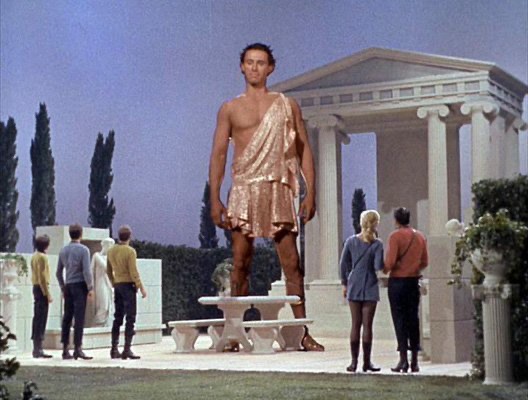
This reminds me of the Star Trek episode “Who Mourns for Adonais?“, when the Enterprise encounters the ancient Greek deity, Apollo, on a remote planet, and ultimately kill him in order to escape his grasp.
The “god” Apollo, played by Michael Forest.
The ending is melancholy:
KIRK: Would it have hurt us, I wonder, just to have gathered a few laurel leaves?
Star Trek, “Who Mourns for Adonais?” (s2ep2), stardate: 3468.1
The human race had outgrown Apollo, and gone on to accomplish many great things, yet it also cost something in the process. Maybe this is like growing up, trading a child’s imagination and wonderment for an adult’s self-mastery and freedom to choose one’s life…
1 Skepticism toward medical science is a modern issue though… 🙄. I doubt few who lived in the era of measles would object to taking a vaccine, but people have the luxury of choice now, even if those choices are reckless ones.
SPOCK: Jim, madness has no purpose or reason, but it may have a goal.
Star Trek, “Alternative Factor” (s1ep25), Stardate: 3087.6
I was going to write something based on this excellent quote, but then the good folks at Extra History published this fascinating and hilarious video about Goodwin Wharton (1653 – 1704), and his autobiography describing his secret life as the King of the Faeries, unbeknownst to the rest of the world:
There is also a great blog post from 2015 that goes into more details.
It’s kind of baffling that someone like this could be a (more or less) functional individual yet also be completely consumed by their own fantasy, and so totally divorced from reality. Goodwin Wharton had goals, per Spock’s comment, though. However, Wharton was totally devoid of both reason and purpose. He was just quietly living out his fantasy life as “King of Faeries”.
It kind of makes one wonder how many more such people exist in a world like this. Would we even recognize them?
Thinking further on this, could any one of us be living in such fantasies? Could I, the writer of this blog, be similarly devoid of reality? I assume “no” of course, but then again, how would I even know? Are my personal goals just further extension of my own madness?
Looking at it form a Buddhist standpoint, our understanding of the world around us is obscured by ignorance, or misconceptions, which become the foundation of how we interact with the world. In a loose sense, this can be a form of madness, but most of us are functional adults with varying degrees of emotional maturity.
Further, we do have the capacity to ask ourselves, “is this the right thing to do?” or “does this even make sense?”. I think that ability to analyze ourselves is what helps counterbalance ignorance and madness. Further, the Dharma, that which is taught by the Buddhas, is meant to act as a kind of benchmark for one’s actions. It doesn’t what you think is right, if it aligns with the principles of the Dharma, than it is considered skillful, wise, and conducive to liberation and well-being. The Buddha doesn’t decide this, it is just how things work.
Conversely, those who never bother to analyze themselves, though, can go through life in a single trajectory and not realize their mistake. Just like Goodwin Wharton…
P.S. I felt like posting a bonus episode today since it is Spring Ohigan week. Please enjoy the weather and have a great weekend! 😊
Q: The redoubtable Commander Riker, whom I noticed before. You seem to find this all very amusing. RIKER: I might, if we weren’t on our way to help some suffering and dying humans who– Q: Your species is always suffering and dying.
Star Trek: The Next Generation, “Hide and Q” (s1ep10), Stardate: 41590.5
Something a little embarrassing I want to confess: sometimes, when I am uneasy or stressed, I go back and read some of my own posts. I don’t do this because of vanity (hopefully) or conceit, but I like to remind myself of certain things I might forget amidst daily turmoil. I suppose I write some of these blog posts as for myself to sort out what’s bothering me, as I do for the dear readers who follow the blog.1
One of my favorite posts of all time is this one. After visiting the Royal British Columbia Museum in 2022, and watching the excellent documentary about the different geologic ages of Antarctica, I walked away deeply impressed. These experiences help give a larger perspective about the world around us, and show how change is a constant of the universe whether we see it or not.
Change happens on the micro-level in our daily lives: one day to the next, we get older, our hobbies change, things at work happen, hairstyles change, etc. When I look at old photos of me and the kids, I am amazed at how much skinner I was, and no grey hear. 🤣
The world around us changes too: political, economically, and so on. The neighborhood you live in will look different 10 years from now, or looking back it’s probably changed in the past 10 years. Thinking about my life as a college kid in the early 2000’s, the Dot-com Era, it’s amazing how much has changed in a mere 20 years. Some things got better, some things got worse.
But if we step back even further, we can see with the benefit of hindsight slow-moving, multi-generational historical changes. From following the excellent History of Byzantium podcast, it’s amazing how much changes in the Eastern Roman (a.k.a. Byzantine) empire across generations. During the time of emperor Justinian the Great, chariot races were still hugely important in Byzantium, the empire had tenuous toeholds in North Africa and Spain, and many people still actively spoke Latin. By the time of emperor Manuel Komnenos, the Eastern Roman empire was far smaller, Greek language had long since replaced Latin, and the single universal church had long since split between Roman Catholic and Orthodox faiths. Between the 6th and 12th centuries, many changes happened, but because they stretch across many generations, it’s not possible for someone living within the city of Byzantium to fully grasp the scale of the changes. It was still the same Eastern Roman empire, and would continue for another 200+ years, but it had changed and evolved as external circumstances changed.
But let’s step even further back. An Egyptian peasant working the fields, or helping to build the Great Pyramid of Khufu, would be utterly stunned at the world today. Such a world would feel totally alien to him or her. It’s not just the level of technology we enjoy today, or the quality of our medicine, but also the way we view the world. Things that seem like common sense to such a peasant would feel strange or silly to us. Things that we inherently believe as 21st century adults would feel strange or bizarre to that peasant. We can’t really pin down when or how such things changed, but it’s series of gradual changes, each one piling on top of the rest.
And yet we can step even further back. If we look at the human race, it is new to the planet Earth. People can deny this using specious reasoning, but science doesn’t care what people believe or don’t believe. The natural world just works the way it does. We humans are just here, living on the Earth, but the Earth does not belong to us. We are its stewards. If not us, perhaps the Apes or Squids will be its stewards. 😏
Which I think brings me to my point: of all the craziness and turmoil going, I think there are two things to take away from all this:
We may lament how things have taken for the worse, but in a dispassionate sense, this is just more change unfolding due to causes and conditions that until now we may not have ever noticed. It doesn’t necessarily mean they are good changes, or harmless, but change is change. Also, by extension, the way things are now won’t always be this way in the future. Change is still happening, even if we can’t see it.
Of all the things to concern ourselves with most, in my humble opinion, the Environment (with a big “E”) is the most important. If we want to benefit Mankind, the Earth, and all life on it in ways that we’ll never see in our lifetime, if we want to get the most “bang for our buck”, then anything we can do to help the Environment works towards that end. Small changes and efforts now will ripple across generations we will never see, and help shape the Earth, hopefully in a positive way.
At times like this, I truly believe my old minister Rev. Don Castro of Seattle Buddhist Church was onto something when he described Buddhism, including Pure Land Buddhism, as an eco-religion. Amida Buddha, the Buddha of Infinite Light, embodies many things:
As an embodiment of the Dharma, Amida sheds light on the continuous nature of all things: impermanent, fluid, changing.
Also as an embodiment of the Dharma, Amida doesn’t require praise or devotion. The Dharma is just there, whether people notice it or not, whether they believe it or not. But as a Buddha, Amida tirelessly works to help all beings, to awaken them, to provide peace of mind.
Also as an embodiment of the Dharma, Amida embodies how all things relate to one another. The small things that we do day to day to help improve, or degrade, life around us affect others even if they are far removed.
Finally, Amida Buddha as the Dharma teaches rational, not selfish, thinking and non-fear. In a sense, WWTD: What Would Tuvok do?
All this is to say, I suppose, even amidst crazy times, do not fear. Take inspiration from the Buddha, make rational, wholesome choices, yet never assume things will stay a certain way forever. Do not be complacent, nor take things for granted.
Namu Amida Butsu
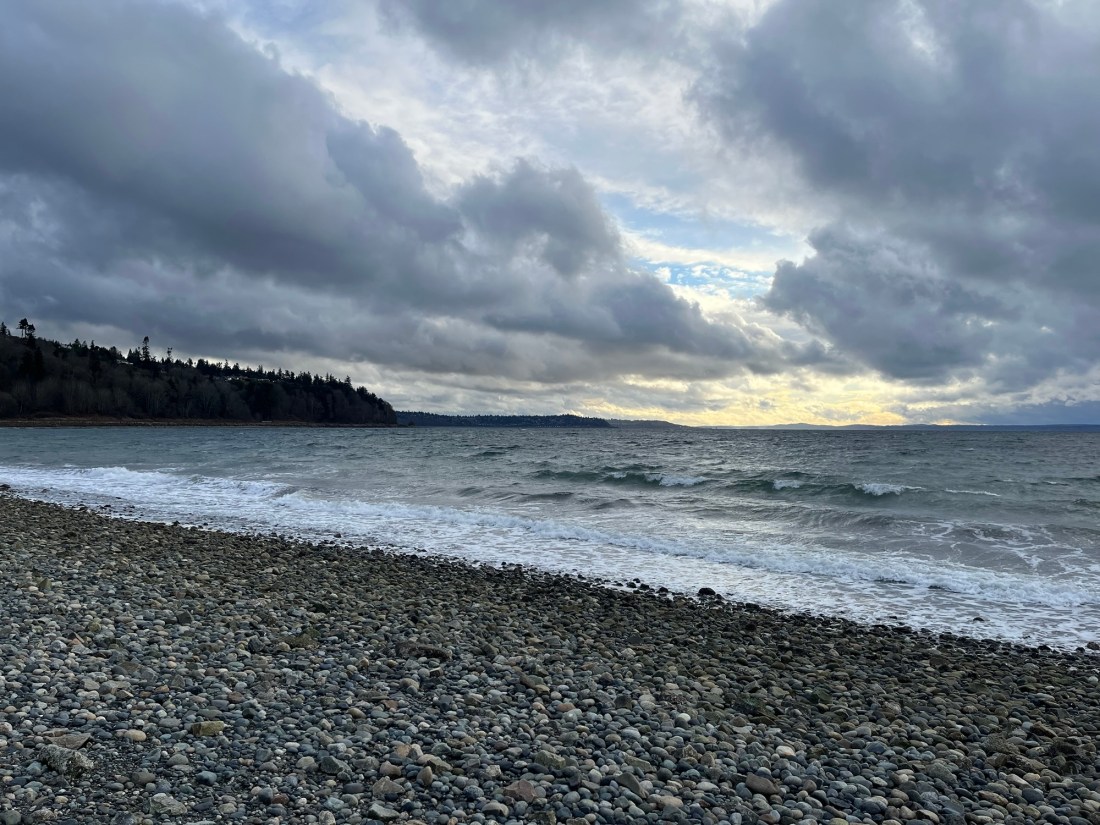
P.S. featured photo taken at Richmond Beach in Shoreline, WA earlier this year.
1 This blog is small-time, but it’s a labor of love, and I genuinely appreciate each and every reader.







 Gleanings in Buddha-Fields


You must be logged in to post a comment.